








































































Article Contents:
- What is a decorative butterfly on the wall
- Why it's not a sticker, but a three-dimensional stucco decor
- How a polyurethane butterfly differs from wooden and plastic ones
- When a butterfly works as a single accent, and when as part of a panel
- NPU-479 — accent butterfly for wall and furniture
- NPU-482L and NPU-482R — paired elements for symmetry
- NPU-489 — decorative butterfly for a light interior composition
- If you need one large butterfly as an accent
- If you need a butterfly panel for the wall, buy as a set
- If the butterfly is needed for furniture
- for the bedroom
- For children's room
- living room
- For the hallway
- For a salon, showroom, cafe
- One butterfly
- Three to five butterflies as a light flock
- Panel above the sofa or bed
- Need to cover an empty wall
- Need to design a furniture facade
- Need to assemble a panel for a children's room
- Need to decorate an area in a salon or showroom
- Choosing only by a beautiful photo
- Buying one detail instead of a composition
- Ignoring direction
- Too bright coloring without connection to the interior
- Lack of base inspection
- Where to buy a polyurethane wall butterfly?
- How is a polyurethane butterfly better than a sticker?
- Can you paint a wall butterfly?
- How to attach a decorative butterfly to the wall?
- How many butterflies are needed for the panel?
- Will a butterfly on the wall suit a children's room?
- Can a butterfly be used for a furniture facade?
- What to choose: one large butterfly or several small ones?
- How to combine butterflies with moldings?
- What to buy together with a decorative butterfly?
- Can butterflies be used in the living room?
- How to understand which model will suit?
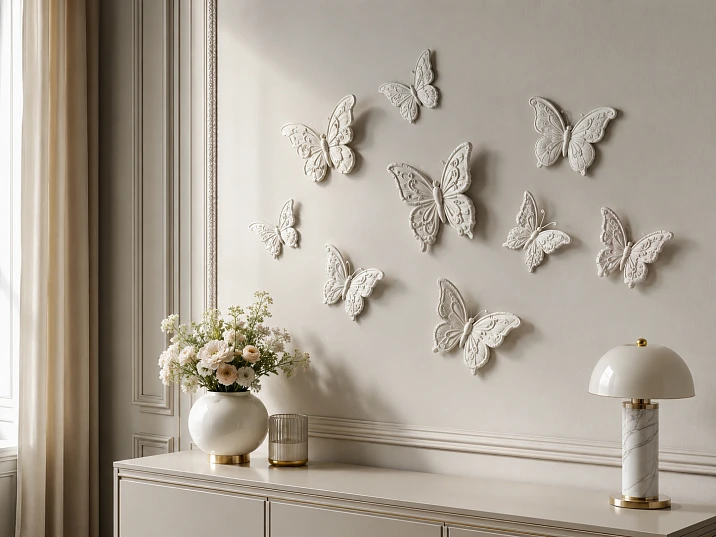
When a buyer enters the query "buy butterfly for wall", most often they are not looking for a paper figurine, a temporary sticker, or a random plastic decor. They need an expressive three-dimensional element that can be integrated into the interior as a real finishing detail: placed on the wall, added to a molding frame, used on a furniture facade, included in a panel, or arranged as a light composition for a bedroom, children's room, living room, hallway, salon, or showroom.
A polyurethane butterfly differs from a regular wall decoration in that it functions as stucco molding. It has relief, thickness, shadow, texture, and architectural expressiveness. Such a detail does not look like a flat picture: it becomes part of the surface, supports the composition, and helps assemble the interior more neatly. That is why a decorative butterfly for the wall is suitable not only for a children's room but also for an adult interior, furniture finishing, decorative panels, and commercial spaces.
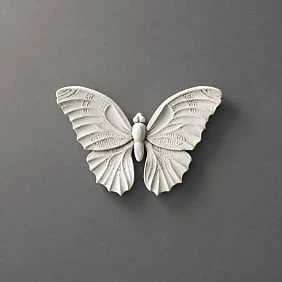
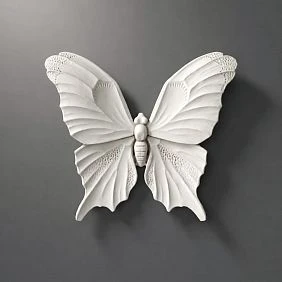
In the STAVROS assortment for this task, there are several polyurethane butterflies: buy the NPU-479 butterfly for the wall can be used as an independent accent, decorative butterfly NPU-482L made of polyurethane и decorative butterfly NPU-482R made of polyurethane help create a paired composition, and stucco molding butterfly NPU-489 is convenient for light interior solutions and small decorative groups.
The main mistake when buying such decor is choosing only by photo. On the wall, size, thickness, shape direction, viewing distance, future paint color, neighboring elements, and installation location are important. One butterfly can become a delicate accent, and several models can become a full-fledged panel. Therefore, before ordering, it is better to understand in advance where the accent will be placed, how many elements are needed, what scale suits the room, and what to buy together so that the composition looks complete.
What is a decorative butterfly on the wall
A decorative butterfly on the wall is a three-dimensional stucco element that is attached to a prepared surface and participates in interior design. Unlike a sticker, it does not just add a pattern. It creates relief, casts a slight shadow, and helps shape the surface as part of architectural finishing. Such an element can be painted in the wall color, highlighted with contrast, framed with moldings, or used on furniture.
The butterfly works especially well where lightness is needed without heavy ornamentation. Plant overlays, rosettes, and classic scrolls are suitable for more formal decoration, while the butterfly is perceived as softer. It adds movement, a natural motif, and a lively detail without overloading the wall. Therefore, it is often considered for bedrooms, children's rooms, vanity areas, accent walls in living rooms, small panels, and furniture facades.




Why this is not a sticker but a three-dimensional stucco decor
A sticker provides a quick decorative effect but remains flat. It may be suitable for temporary decoration but does not solve the task of full finishing. A polyurethane butterfly is perceived differently: it is visible from the side, casts a shadow, follows the logic of stucco decor, and can be painted together with the wall or separately.
If the butterfly is painted in the wall color, it becomes a subtle relief. This technique is suitable for calm interiors where a bright pattern is not needed. If the element is highlighted with a different shade, it turns into an accent. If several butterflies of different sizes and directions are used, a panel with movement is created. Therefore, the query "buy decorative butterfly for wall decor" is better considered not as purchasing a single figurine, but as choosing an element for an interior composition.
Our factory also produces:
How a polyurethane butterfly differs from wooden and plastic ones
Polyurethane is convenient for interior decor because it provides a three-dimensional shape with low weight. Such an element is easier to use on a wall, ceiling, furniture, or door than a heavy solid wood part. At the same time, it does not look like thin household plastic but like stucco decor designed for painting and integration into finishing.
A wooden butterfly may be appropriate in projects where wood texture is important, but for a painted wall or stucco panel, polyurethane is often more practical. It is easier to fit into the room's color scheme, use alongside moldings and other decorative overlays, and assemble a composition without extra load on the surface. Ordinary plastic, especially thin and glossy, often looks like temporary decor rather than part of the finishing.
Get Consultation
When the butterfly works as a single accent and when as part of a panel
A single butterfly is appropriate where you need to enliven a small area: a section of wall above a bedside table, a corner of a molding frame, a dresser door, a cabinet front, a spot near a mirror. In this case, it's important not to overdo the size. The detail should be noticeable but not compete with furniture, a lamp, a painting, or textiles.
A wall panel with butterflies is assembled differently. Here, it's not a single shape that works, but the movement of a group. Several elements can be arranged diagonally, creating a gentle rise from the bottom corner to the top, decorating the area above a bed or sofa, or adding butterflies inside a molding frame. For this scenario, it's convenient to combine NPU-479, paired NPU-482L and NPU-482R, as well as NPU-489. Then the composition appears not random, but assembled by scale and direction.
Which STAVROS butterflies can you buy
The STAVROS line includes several models of polyurethane butterflies. They differ in size, shape, direction, and decorative character. This allows you to choose either a single decorative butterfly for the wall or a set for a panel, furniture, or interior frame.
For quick orientation, it's convenient to start with the specifications. Sizes are important not only for installation but also for perception. On a large empty wall, a small element can get lost. On a furniture facade, conversely, a butterfly that is too large will look heavy. Therefore, before ordering, it's worth comparing the model's dimensions with the installation location.
| Model | Size | Material | Where to use |
|---|---|---|---|
| NPU-479 | 96 × 84 × 17 mm | Polyurethane | Wall, furniture, panel, decorative composition |
| NPU-482L | 56 × 93 × 15 mm | Polyurethane | Left part of a paired composition, furniture, wall |
| NPU-482R | 56 × 93 × 15 mm | Polyurethane | Right part of a paired composition, furniture, wall |
| NPU-489 | 80 × 53 × 16 mm | Polyurethane | Light composition, small panel, furniture facade |
NPU-479 — accent butterfly for wall and furniture
NPU-479 is the most noticeable option among the models considered. Its size of 96 × 84 × 17 mm allows it to be used as a standalone accent on the wall, in a decorative frame, next to a mirror, or on a furniture facade. This butterfly is expressive enough not to get lost on the surface, yet remains neat and does not turn the interior into an overloaded decorative scene.
If you need to buy one decorative butterfly for the wall, it makes sense to start with this model. It is well suited for the area above a vanity table, for a small composition in the bedroom, for decorating a children's wall, or for an accent on a furniture facade. However, before ordering, you need to check the installation location: on a narrow facade or small panel, NPU-479 may be too active, and on a large wall, it may need support from other elements.
For a single accent, you can go to the product page and buy the NPU-479 butterfly for the wall, after checking the size, material, and future painting method.
NPU-482L and NPU-482R — paired elements for symmetry
NPU-482L and NPU-482R are paired butterflies that are convenient to use together. Their size of 56 × 93 × 15 mm makes the models elongated and light. The main value of the pair is the ability to create symmetry. In the interior, this is important when decor is placed on the sides of a frame, mirror, furniture insert, headboard, or decorative panel.
One butterfly can look free and lively, while a pair gives a sense of thoughtfulness. If you need to decorate two sides of a composition, it is better not to try to visually flip the same model, but to use the left and right elements. Then the movement of the wings and the direction of the shape will look natural.
For a paired scheme, you can look at decorative butterfly NPU-482L made of polyurethane and supplement it with a model decorative butterfly NPU-482R made of polyurethane. Such a set is especially useful for molding frames, paired facades, panels, and calm symmetrical interiors.
NPU-489 — a decorative butterfly for a light interior composition
NPU-489 measures 80 × 53 × 16 mm. In proportions, it feels lighter and more compact. It is convenient to use where a large accent is not needed: on a furniture facade, inside a small decorative area, next to other elements, in a light panel, or in a composition where it is important not to overload the wall.
This model works well as an additional butterfly. For example, if NPU-479 sets the main accent, NPU-489 can support the movement nearby. If NPU-482L and NPU-482R form a paired symmetry, NPU-489 will add a freer element. Thanks to this, the panel turns out not too strict and not too random.
For small decorative groups, you can use stucco molding butterfly NPU-489, especially if you need a detail for painting on a wall, furniture, or interior panel.
How to choose a butterfly for the wall based on the task
The choice begins not with the shape, but with the task. You need to understand why the decor is being purchased: to cover an empty section of wall, decorate furniture, assemble a panel, add an element to a children's room, support a natural motif in a bedroom, or design a commercial space. The same butterfly can look different depending on the location, color, and neighboring details.
If you need a calm finish, it's better to paint the butterfly the same color as the wall. Then it will be noticeable only due to the relief. If you need an accent, you can choose a contrasting shade or highlight the element in the color of furniture, textiles, or a lamp. For a children's room, you can make the composition softer and airier, and for a living room, stricter, with a frame made of moldings.
| Task | What to choose | Why it's convenient |
|---|---|---|
| Need one decorative butterfly on the wall | NPU-479 | The model is noticeable enough for a single accent |
| Need a paired composition | NPU-482L and NPU-482R | The left and right elements help create symmetry |
| Need a light panel | NPU-479, NPU-482L/R, NPU-489 | Different sizes make the composition livelier |
| Need to decorate a furniture facade | NPU-489 or NPU-482L/R | Compact elements are easier to fit into a facade |
| Need a composition for painting | Polyurethane butterflies and adjacent stucco decor | The decor can be matched to the wall color or highlighted as an accent |
If you need one large butterfly as an accent
A single accent works best on a small section of wall, in a decorative frame, or on furniture. Here, a large number of elements is not needed. The main thing is to choose a place where the butterfly will be visible but will not compete with other details. For example, it can be placed above a console, next to a mirror, in the corner of a molding frame, above a bedside table, or on a dresser facade.
For this scenario, NPU-479 is suitable. It is expressive enough to hold attention, but not so large as to require a big wall. If the area is small, consider NPU-489 or paired NPU-482L/R, especially if the decor is needed for a furniture facade.
If you need a butterfly panel for the wall, buy as a set
The panel is built on repetition and movement. One detail is rarely enough here. It is better to lay out the composition on the floor or on a sheet of paper in advance: where the main element will be, where the secondary ones will be, how the diagonal will go, whether there will be a frame of moldings, how much free space will remain around. The larger the wall, the more important the distances between elements.
For a panel, you can combine NPU-479 as the central butterfly, NPU-482L and NPU-482R as paired details, and NPU-489 as a light additional element. This group is suitable for the area above a bed, sofa, dresser, desk, crib, or decorative console. If the panel needs to be strict, it can be framed. For this, the following are suitable polyurethane moldings for the frame, which will help create a neat border around the composition.
If a butterfly is needed for furniture
On furniture, a butterfly is perceived differently than on a wall. Here, not only the beauty of the shape matters, but also the scale of the facade. On a small door, a large element may look accidental. On a wide facade, a too small butterfly will get lost. Therefore, before purchasing, you need to measure the place where the decor will be and imagine not only the element itself but also the free space around it.
Compact and medium models are often suitable for furniture. NPU-489 can be used on facades, small doors, decorative inserts. NPU-482L and NPU-482R are convenient if you need to decorate two sides or create a paired arrangement. NPU-479 is suitable for a more noticeable accent on a large facade, panel, or decorative insert.
How to choose a butterfly for the wall by room
The same decorative butterfly can look delicate, strict, playful, or almost architectural. It all depends on the room, color, scale, and neighboring elements. Therefore, choosing by room helps avoid a random effect. The butterfly should not just be liked separately but work with the specific wall, furniture, and lighting.
For the bedroom
In the bedroom, butterflies should be used softly. A bright decorative splash is rarely needed here. More often, the task is different: to make the wall above the bed calmer, add light relief, connect the headboard, bedside tables, lamps, and textiles. Painting in the color of the wall or a close shade looks good. Then the butterfly does not shout but appears due to volume.
For the bedroom, you can choose one NPU-479 above the bedside area or assemble a small group of NPU-479 and NPU-489. If there are molding frames on the sides of the headboard, paired NPU-482L and NPU-482R will help create symmetry. This approach is especially successful when the interior relies on calm colors, soft fabrics, and delicate finishes.
For a children's room
In a children's room, butterflies feel natural, but it's easy to overdo it. If you use too many bright details, the room will quickly become visually noisy. It's better to choose a clear scheme: one zone, one diagonal, one frame, or one composition above the bed, desk, or dresser. Then the decor will delight without overwhelming the space.
Polyurethane butterflies can be painted in soft shades: the wall color, pastel furniture color, or textile color. For a small room, it's better to use several compact elements rather than one overly large accent. For a more spacious children's room, you can use NPU-479 as the main detail and complement it with NPU-489.
For the living room
In a living room, a butterfly should look mature. To prevent the natural motif from seeming random, it's better to connect it with a frame, panel, mirror, furniture, or a general decorative line. For example, butterflies can be placed inside a molding frame above the sofa or in the console area. If there is a floral pattern, rosettes, or decorative overlays nearby, the composition will become more cohesive.
For a living room, viewing distance is especially important. What looks good from one meter may get lost from three to four meters. Therefore, small elements are better grouped together, while a single accent should be more noticeable. NPU-479 is suitable for the main role, NPU-482L/R for symmetry, and NPU-489 for a light addition.
For the hallway
In a hallway, there is often little space but many vertical surfaces: walls near the mirror, console area, door, furniture facades, and side panels of cabinets. Here, a butterfly can soften the strict finish and add individuality to the interior. However, due to the narrow space, it's important not to choose an overly active composition.
A good option is one small group near the mirror or a neat element on the facade. If the hallway is decorated in calm colors, the butterfly can be painted in the wall color. If you need to support the furniture, the decor color can be tied to the facade, handles, or mirror frame.
For a salon, showroom, or cafe
In a commercial interior, decor should be not only beautiful but also memorable. A butterfly can become part of a photo zone, waiting area, wall behind the counter, display window, or interior panel. Here, more noticeable compositions are appropriate because the visitor perceives the space faster than a home room.
For a salon or showroom, you can assemble a panel from several butterflies, add a molding frame, use contrasting colors, or place elements diagonally. At the same time, it's important to plan ahead for maintenance, base durability, and a spot where visitors won't constantly bump into the decor.
How to choose size and quantity
The size of the butterfly affects not only the appearance, but also whether the decor will be noticeable at all. A small element on a large wall can look like a random dot. A too large detail on a narrow facade will compete with the furniture. Therefore, before buying, you need to evaluate three things: the surface area, the viewing distance, and the neighboring objects.
If the butterfly is at eye level and viewed up close, you can choose a compact model. If it is placed above a sofa, bed, or in a high part of the wall, it is better to make the accent larger or assemble a group. If the decor is used on furniture, you need to consider not only the height and width of the facade, but also the handles, panels, frames, inserts, and opening lines.
One butterfly
One butterfly is suitable for a small accent. It can enliven an empty corner of a frame, a dresser facade, a wall near a vanity table, or an area next to a mirror. In this case, it is important to leave free space around it. If the element is pressed too close to the edge, it will look random. If it is surrounded by a lot of other decor, it will lose its meaning.
NPU-479 is well suited for the role of a single accent. NPU-489 works better where a lighter and more compact touch is needed. NPU-482L or NPU-482R can be used separately if the shape direction suits the composition, but their strength is revealed precisely in a pair.
Three to five butterflies as a light flock
A composition of three to five elements looks livelier than a single detail. But it requires order. It is better to choose one main butterfly and several supporting ones. The main one holds the center of attention, the others create movement. If all elements are identical and spaced equally, the composition may look mechanical. If the distances are too random, the panel will seem untidy.
A convenient scheme is one NPU-479, one or two NPU-489, and a pair of NPU-482L/R if a directional composition is needed. Before installation, it is better to lay out the elements without glue, look at them from different distances, and only then fix them.
Panel above a sofa or bed
A panel above a sofa or bed should account for the width of the furniture. If the decor is too small, it will get lost against the large piece. If it is too wide, the wall will become cluttered. A good guideline is not to fill the entire width of the furniture, but to leave some breathing room at the edges. Butterflies can go diagonally, be placed inside a frame, or gently rise from one edge to another.
If the panel is planned inside a frame, it is important to choose the molding in advance. The frame sets boundaries and makes the composition cohesive. Without a frame, butterflies look freer but require more precise placement. In both cases, it is better to check the dimensions of each model in advance and sketch a layout on the wall using painter's tape.
Material and coloring: why polyurethane is convenient for such decor
STAVROS butterflies are made of polyurethane. For wall and furniture decor, this is a practical material: it allows for a three-dimensional shape without adding unnecessary weight and is well-suited for interior compositions that require painting. This is why polyurethane butterflies can fit into various styles—from a delicate children's room to a restrained bedroom or a decorative wall in a living room.
The main advantage of this material is its flexibility in finishing. A butterfly can be made almost invisible if painted the same color as the wall. It can be highlighted with a separate shade. The color can be tied to furniture, textiles, a mirror frame, or molding. This means the buyer is not limited to a ready-made product color and can adapt the decor to a specific interior.
Before painting, it is necessary to consider the surface condition, the chosen paint, and preparation recommendations. If the butterfly is placed on the wall along with other elements, it is better to think in advance whether the entire composition will be painted in one color or some details will become accent pieces. This is especially important for panels: random different shades can ruin the integrity, while a well-thought-out palette will make the decor calm and professional.
What to pair butterflies with on the wall
A butterfly rarely lives in an interior completely on its own. It usually needs support: a frame, a neighboring pattern, a furniture line, a mirror, a panel, a wall color, or textiles. If you buy a decorative butterfly for the wall without understanding its surroundings, it may look random. But if you connect it with other elements, the decor becomes part of the overall finish.
The most obvious combination is a molding frame. It sets boundaries within which butterflies look like a panel. For this task, you can use polyurethane moldings for the frame. The frame is especially helpful in living rooms, bedrooms, hallways, and commercial interiors where you need not just to hang decor but to create a complete decorative zone.
If the composition should be more free, you can use adjacent overlays instead of a frame. In this case, it's worth looking at STAVROS PU overlays. They allow you to add floral, ornamental, or other relief elements if butterflies alone are not enough. For wall decoration, it is also useful to study Polyurethane wall decorto select adjacent solutions within the same logic.
What to buy together with a decorative butterfly
Buying a single butterfly is suitable for a simple accent. But if the task is broader — a panel, furniture composition, frame, design of the area above the bed, or a decorative wall — it is better to think about a set right away. This helps avoid a situation where the main piece is already purchased, but there is no suitable framing, adjacent elements, or mounting materials.
Butterflies are often paired with mounting adhesive for polyurethane, paint, painter's tape for temporary fixation, moldings for the frame, and additional decorative overlays. At the same time, links in the article should open specifically to sections and product cards where confirmed STAVROS items can be viewed: butterflies NPU-479, NPU-482L/R, NPU-489, the PU overlays section, wall decor, and polyurethane moldings.
| What to add to the purchase | Why this is needed | For which scenario |
|---|---|---|
| Moldings | To assemble a frame around the panel | Bedroom, living room, hallway, salon |
| PU overlays | To complement butterflies with other relief | Panel, furniture, decorative group |
| Paint | To match the decor to the wall color or highlight an accent | Any composition for painting |
| Construction adhesive | To secure the polyurethane decor to the base | Wall, furniture, door, decorative panel |
| Painter's tape | To temporarily mark the composition before installation | Panel of several butterflies |
If you need to assemble not just one piece but a full wall composition, it's better to first choose the main element, then add paired or additional butterflies, and then decide on the frame and color. This order helps avoid buying unnecessary items and prevents scale mismatch.
How not to confuse a polyurethane butterfly with similar decor
The buyer may see similar products: 3D stickers, plastic figures, carved overlays, panels, moldings, rosettes, plant elements. They all belong to decor but serve different purposes. If you confuse the purpose, you might buy a beautiful item that doesn't suit a specific wall or furniture.
| Element | What's the difference | When to choose |
|---|---|---|
| Polyurethane butterfly | Volumetric stucco element for painting | When relief is needed on a wall, furniture, or panel |
| 3D sticker | Temporary lightweight decor without architectural character | When quick seasonal decoration is needed |
| Carved overlay | General name for a decorative element | When relief is needed for furniture, wall, or door |
| Panel | Composition of several parts | When you need to decorate a large area |
| Molding | Linear framing, not a central motif | When you need a frame or border of the composition |
If you specifically need a stucco butterfly decor, you should look not at flat images, but at the material, thickness, size, and purpose. A polyurethane butterfly is suitable for cases where the decor should become part of the finish, not a temporary decoration.
Practical selection for different situations
Need to cover an empty wall
If the wall looks empty but you don't want to hang a painting, a butterfly can become a soft decorative accent. For a small area, one NPU-479 or NPU-489 is enough. For a wall above a sofa, bed, or console, it's better to consider a group. To prevent the composition from looking random, you can add a frame of moldings or build a diagonal movement.
Need to design a furniture facade
For a facade, it's important not only to choose a beautiful shape but also to check the size. The butterfly should not interfere with the handle, joint, door opening, or panel line. On small facades, compact models are more appropriate. On a large panel, you can use NPU-479. If the facade is paired, NPU-482L and NPU-482R will help create a symmetrical design.
Need to assemble a panel for a children's room
In a children's room, it's better to avoid overly complex compositions. A few butterflies painted in calm shades are enough. You can make a diagonal from the bed to the upper part of the wall or decorate a small area above the dresser. If you want to add a frame, it's better to use simple moldings without overloaded ornament.
Need to decorate an area in a salon or showroom
In commercial spaces, decor should be noticeable from a distance. Here, you can use several elements and more expressive coloring. Butterflies are well-suited for photo zones, waiting walls, display windows, and areas behind the counter. The main thing is to plan the composition in advance so that it looks cohesive, rather than a set of individual figures.
Installation, preparation, and painting
Installation of a polyurethane butterfly depends on the base. Before fixing, the surface must be clean, level, and suitable for attaching the decorative element. If the butterfly is installed on a painted wall, furniture facade, door, or panel, the adhesion of the glue to the specific coating must be considered. For complex bases, it is better to clarify the appropriate installation method in advance.
Before final fixation, it is useful to make markings. For a single element, it is enough to mark the center and height. For a panel, it is better to first lay out all the butterflies on the floor, then transfer the scheme to the wall using painter's tape. This makes it easier to see distances, direction of movement, and balance of the composition.
Painting is better planned before installation. Sometimes it is more convenient to paint the elements separately and then attach them. Sometimes the entire composition is painted on the wall along with moldings and other details. If the butterfly should match the wall color, it is important to achieve a neat transition. If it will be contrasting, special attention must be paid to edges and relief.
Mistakes when buying a butterfly for the wall
Choosing only based on a beautiful photo
A photo helps to understand the shape but does not show the scale in your room. Before ordering, you need to compare the model's size with the installation location. For example, NPU-479 is more noticeable and better suited for an accent, while NPU-489 fits more easily into small areas. If dimensions are not considered, you may end up with an element that looks too small or too large on the wall.
Buying one piece instead of a composition
Sometimes a buyer wants a panel but buys only one butterfly. As a result, the wall remains empty, and the element looks lonely. If the task is to decorate a large area, it is better to plan a set in advance: a main butterfly, additional elements, paired models, a frame of moldings, and a color scheme.
Ignoring direction
For a single butterfly, direction is not always critical. But in a paired composition, it is important. NPU-482L and NPU-482R help make the left and right sides natural. If you use the wrong direction, the composition may appear random or visually skewed.
Too bright coloring without connection to the interior
A butterfly can be an accent, but the color should be connected to the room. If the shade is not repeated in furniture, textiles, lamps, or other details, the decor may look out of place. A safer option is a wall color, a close tone, or a neat contrast that is already present in the interior.
Lack of base inspection
Polyurethane decor must be attached to a suitable surface. If the base is crumbling, has a weak coating, or is not prepared, the installation may be unreliable. Before installation, check the wall, facade, or panel, and if in doubt, clarify recommendations for glue and preparation.
Who this decor suits and who should choose a different solution
A polyurethane butterfly is suitable for those who want to add a voluminous but lightweight decorative element to the interior. It is good for buyers who plan to paint, love relief finishes, want to decorate a wall without a painting, are assembling a panel, or are looking for non-trivial decor for furniture.
This solution is especially appropriate if the interior already allows for stucco, moldings, decorative overlays, soft natural motifs, or individual accents. The butterfly looks good in a bedroom, children's room, living room, hallway, salon, showroom, cafe, near a mirror, at the headboard, on a dresser facade, or inside a decorative frame.
If a completely temporary decor for one season is needed, a sticker is more suitable. If the interior is strictly minimalist and does not involve relief, the butterfly may be unnecessary. If a large classic central detail is needed, it is worth looking not only at butterflies but also at other overlays, rosettes, or elements from the wall decor section.
How to buy a wall butterfly at STAVROS
It's best to start your purchase with a goal. If you need a single accent, open the NPU-479 card and check the size against the installation location. If you need symmetry, it's more convenient to look at the NPU-482L and NPU-482R pair right away. If you're planning a lightweight panel or an additional element for furniture, consider adding NPU-489.
After choosing a model, you need to check the size, material, purpose, and future finish. If the decor will be part of a panel, it's helpful to look at neighboring categories in advance: at STAVROS PU overlays, Polyurethane wall decor и polyurethane moldings for the frame. This makes it easier to put together not a random purchase, but a set for a finished decorative area.
If the butterfly is being selected for existing furniture, a complex wall panel, or a commercial interior, it's better to check the dimensions in advance and confirm compatibility with a STAVROS manager. This is especially important when elements need to match in scale, color, mounting location, and overall style.
FAQ
Where to buy a polyurethane wall butterfly?
Polyurethane butterflies can be selected on the STAVROS website in the NPU-479, NPU-482L, NPU-482R, and NPU-489 cards. Before ordering, check the size, installation location, and future painting.
How is a polyurethane butterfly better than a sticker?
A sticker remains flat and is often perceived as temporary decor. A polyurethane butterfly provides volume, relief, and shadow, so it looks like part of a stucco finish.
Can you paint a wall butterfly?
Yes, polyurethane decor is often chosen specifically for painting. The butterfly can be made in the color of the wall or highlighted with a separate shade. Before painting, you need to consider
How to attach a decorative butterfly to the wall?
Usually, such decor is attached to a prepared base using a suitable mounting compound for polyurethane. The surface must be clean, level, and sufficiently strong.
How many butterflies are needed for a panel?
For a small panel, three to five elements are often enough. For a large wall, the quantity depends on the area, viewing distance, and chosen scheme. It's better to lay out the composition in advance and check its scale.
Is a butterfly on the wall suitable for a children's room?
Yes, butterflies are well-suited for a children's room if you don't overload the wall with quantity and bright colors. It's better to choose a calm composition above the bed, dresser, or work area.
Can a butterfly be used on a furniture facade?
Yes, polyurethane butterflies can be used on furniture if the size matches the facade and the decor does not interfere with opening, handles, or other elements. For small facades, it's better to look at compact models.
What to choose: one large butterfly or several small ones?
One butterfly is suitable for a point accent. Several elements are needed if a large area, panel, or decorative wall is being decorated. For a lively composition, it is better to combine different sizes.
How to combine butterflies with moldings?
Moldings help create a frame around the panel. Butterflies can be placed inside the frame, at the corner, diagonally, or next to the central element. The main thing is to leave enough free space.
What to buy together with a decorative butterfly?
Most often, moldings for the frame, additional PU overlays, paint, mounting glue, and marking materials are chosen together with butterflies. If a panel is planned, it is better to think through the set before ordering.
Can butterflies be used in the living room?
Yes, but in the living room the composition should be more cohesive. Frames made of moldings, painting to match the wall, and combination with furniture, a mirror, or a decorative panel work well.
How to understand which model will suit?
NPU-479 is suitable for a noticeable accent, NPU-482L and NPU-482R for a paired composition, NPU-489 for light groups and small areas. Before purchasing, you need to compare the size with the surface.
Result: which wall butterfly to choose
A butterfly on the wall is not just a cute decorative motif. In polyurethane, it becomes part of stucco molding: it adds relief, helps assemble a panel, enlivens a furniture facade, and makes the interior more individual. To make a successful purchase, you need to choose not only by shape, but also by size, direction, installation location, color, and neighboring elements.
For a single accent, you can choose NPU-479. For symmetry, NPU-482L and NPU-482R are suitable. For a light composition or a small facade, consider NPU-489. If the task is broader than one detail, it is better to think through the set right away: butterflies, moldings, additional overlays, color, and installation scheme.
On STAVROS, it is convenient to move from an idea to a specific choice: view butterfly cards, compare sizes, select adjacent stucco decor, and assemble a composition for a wall, furniture, or panel without random details. This approach helps you buy a decorative butterfly for the wall consciously — not as a one-time decoration, but as a neat element of a future interior.