






























































Article Contents:
- When a simple transition between two wall colors looks too flat
- KPU-114 is a decorative molding that can be used as a wall border
- What the size 100 × 5 × 2000 mm means on a real wall
- A width of 100 mm is already an architectural level, not a thin edging
- A relief of 5 mm: the strip remains thin in depth, but chiaroscuro already appears
- The two-meter length is the key to correctly calculating the purchase
- The lower painted panel and KPU-114: first, we determine the wall's architecture itself
- What height to aim for
- The height of the bottom panel and the width of the border should be perceived together
- Border in the color of the bottom panel
- KPU-114 in the color of the upper wall
- Separate contrasting color
- KPU-114 or a regular smooth molding: choose based on the task, not out of habit
- When 100 mm looks proportionate
- When KPU-114 may be too wide
- Run the carved band around the entire room or stop at one wall
- Around the entire perimeter
- Only on accent walls
- On several connected walls
- Symmetrically relative to the center
- In a less noticeable zone
- At a logical point in the architecture
- Do not assemble several short pieces in a row
- Option 1
- Option 2
- Option 3
- The belt is interrupted by a door opening
- The belt runs above the door
- Count only the total perimeter
- Divide the footage by two and place the order right away
- Do not subtract doors
- Subtract doors, but do not take their position into account
- Leave a 200-millimeter piece at the most visible end of the wall
- Make too many joints to save on leftovers
- Throw away all leftovers before installation is complete
- Consider any leftover suitable
- Choose the height based on only one wall
- Do not account for the 100 mm width
- Consider the 5 mm relief insignificant
- Simultaneously make carved borders, frames, and many overlays without a layout
- Paint KPU-114 contrastingly only according to a small sample
- Start cutting before installing the trims
- Buy a universal percentage of allowance
- Save one plank at the cost of a poor joint on the main wall
- Buy an extra plank without a clear purpose
- Call KPU-114 an ordinary molding
- Do not compare KPU-114 with other trim models
- Assume that the border must run along the entire perimeter
- What is KPU-114?
- What is the size of KPU-114?
- What is the width of KPU-114 in centimeters?
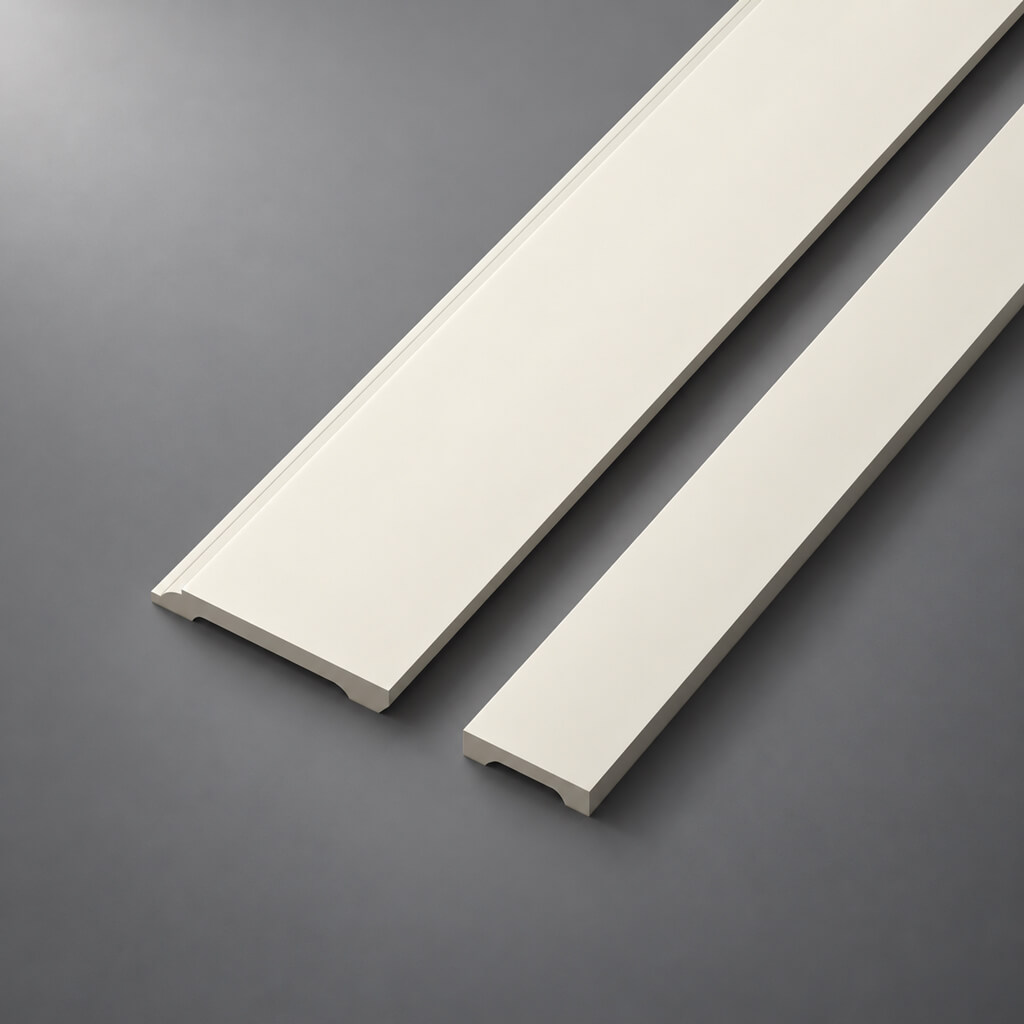
- Is KPU-114 a regular smooth molding?
- Can it be used as a border on the wall?
- At what height should KPU-114 be installed?
- Do I need to paint the lower part of the wall first?
- Can KPU-114 be painted to match the color of the lower panel?
- Can it be made to match the color of the upper wall?
- Can a third contrasting color be chosen?
- How many slats are needed for a 13.8 m wall?
- So, seven will definitely be enough?
- Why can the total length be sufficient, but the slats not?
- How to calculate the doorway?
- Do I need to subtract the windows?
- Can KPU-114 be placed under the windowsill?
- Where is it better to place the joints?
- Can I connect 2000 mm and 200 mm on a wall 2.2 m long?
- How to assemble 4.2 m symmetrically?
- Can I just place two 2 m slats and add 200 mm at the end?
- How to assemble a 3.6 m wall?
- What to do with the 400 mm remainder?
- Can any remainder be used?
- How much extra should I take?
- Is it worth buying one additional plank?
- Can KPU-114 be run around the entire perimeter?
- Is it mandatory to run it along all walls?
- How is KPU-114 different from a regular molding?
- When is it better to choose a regular molding?
- Where can I see the moldings?
- What to do if 100 mm is too wide?
- Can I add borders below KPU-114?
- Is it mandatory to add borders?
- Can I add carved overlays?
- Where to choose overlays?
- Do I need to account for external corners?
- What about internal ones?
- What to do near the door casing?
- Can measurements be taken before installing casings?
- What to do with the switch on the border line?
- Can KPU-114 pass behind the cabinet?
- Will KPU-114 fit for a bedroom?
- Will it suit the living room?
- Can it be used in a hallway?
- What matters more in the calculation — meters or the number of sections?
- How to avoid getting many short pieces?
- Do I need to order KPU-114 first, and then decide on the layout?
- Where to buy KPU-114?
- What to check in the product card before ordering?
- Where can I see other polyurethane decor?
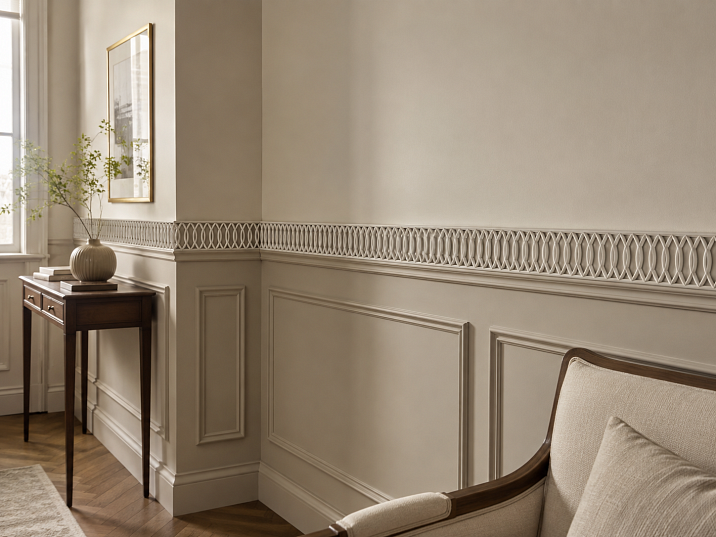
The lower part of the wall has already been decided to be highlighted with color: below — a more saturated, dark, or simply different shade, above — the main paint. It all looks convincing in the visualization, but after marking on a real wall, a feeling of incompleteness often appears. Two colors meet along a straight horizontal line, and the architecture itself of this transition is missing. A regular smooth molding can mark the boundary, but in a classic or decoratively rich interior, it sometimes looks too neutral. Then another scenario arises — to make a carved border from decorative polyurethane molding KPU-114.
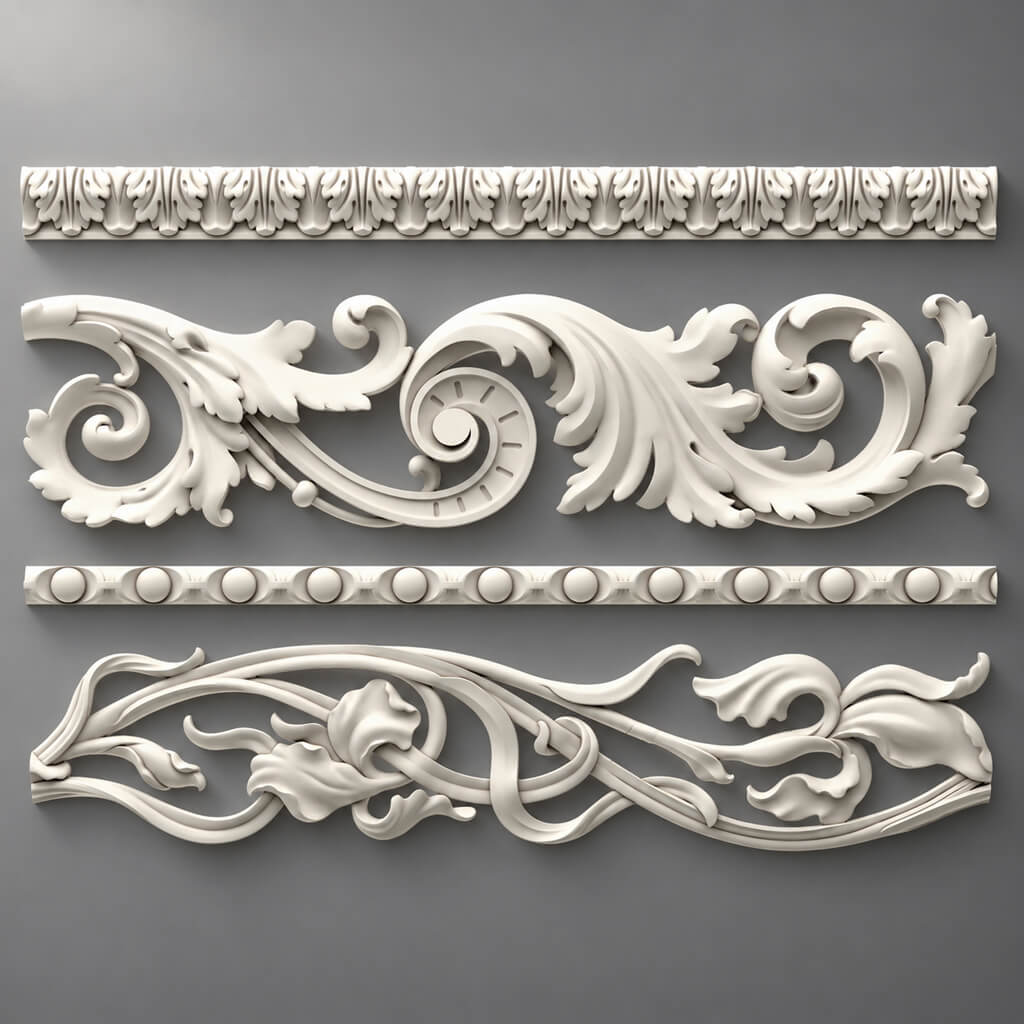
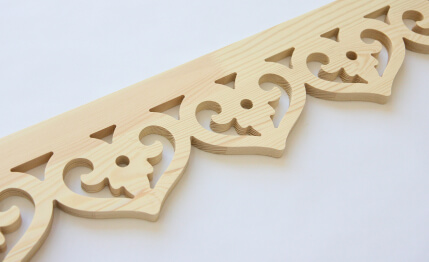
KPU-114 is not an ordinary smooth wall molding. It is a decorative molding with an ornament that can be used as a horizontal stucco belt between the lower painted panel and the upper part of the wall. The size of one plank is 100 × 5 × 2000 mm. A width of 100 mm means that on the wall there will be not a thin line, but a full-fledged ornamental border 10 cm wide. The length of 2000 mm immediately raises a practical question: how many such planks will be needed for the room, where to place the joints, and how not to get a short remainder in the most visible area.
It is the calculation that distinguishes a well-thought-out wall finish with decorative molding from buying "by the general perimeter." If 13.8 m of carved belt is required along the walls, simple arithmetic shows seven two-meter pieces: 13.8 ÷ 2 = 6.9. But seven is only the mathematical minimum. The actual layout depends on the length of each individual wall, the location of doors and windows, internal and external corners, and where joints are acceptable. It happens that the total footage fits into seven planks, but specific whole segments cannot be neatly arranged across them.
Therefore, before buy carved molding KPU-114It is useful to do two things: determine the exact height of the decorative belt and draw a wall layout with the dimensions of each continuous section. After that, the price, quantity, leftovers, and joint locations become clear even before ordering.

When a simple transition between two wall colors looks too flat
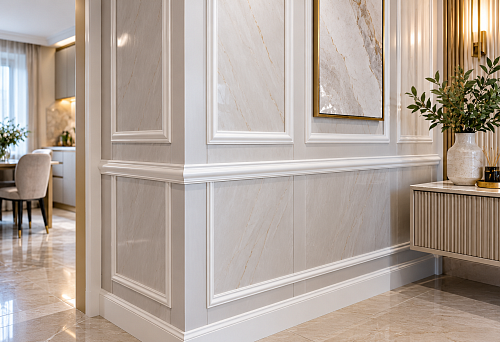
Painting the lower part of the wall in a separate color is a strong interior technique in itself. It can visually bring together a long corridor, make a large wall more proportional, tie the color of furniture to the room's architecture, or create the effect of a classic wall panel without full wooden cladding.
But the technique has a weak point: the boundary between two colors.
If the transition is done only with painter's tape, a person sees a graphic line. It can be neat, but it remains purely color-based.
A smooth molding adds volume.
Carved KPU-114 adds ornament as well.
The difference is significant.
The smooth profile says: "this is where the lower zone ends."
A carved decorative belt says: "this is a separate architectural level of the wall."
That is why KPU-114 should be used not to mechanically close the paint border. It is chosen when horizontal division should become a noticeable part of the interior.




KPU-114 is a decorative molding that can be used as a wall border.
The product name must be understood precisely.
KPU-114 is a decorative polyurethane molding. In our task, it is used horizontally and begins to function as an ornamental border between two wall zones.
That is, "border" here describes the method of application.
The product itself remains a molding.
This distinction is useful when choosing. A buyer may search for "polyurethane wall border," and in the catalog, the suitable solution should be found among molding products.
If you want to compare KPU-114 with other ornamental profiles before deciding on width and pattern, it makes sense to first buy decorative polyurethane molding after viewing the entire category and matching sizes.
Our factory also produces:

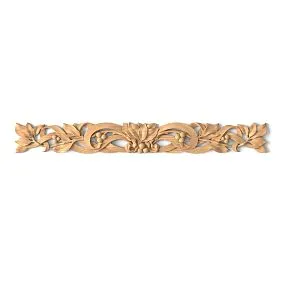
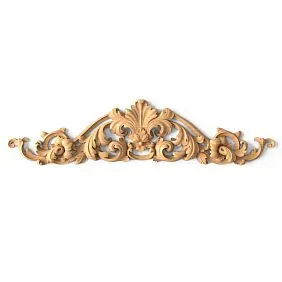
What does the size 100 × 5 × 2000 mm mean on a real wall
The three numbers affect the project in completely different ways.
| Parameter | KPU-114 | What this means for the wall |
|---|---|---|
| Product type | decorative linear molding | Can be used as a long ornamental belt |
| Material | Polyurethane | The decor belongs to polyurethane molding |
| Width | 100 мм | A strip 10 cm wide appears on the wall |
| Relief | 5 мм | The ornament protrudes above the plane of the wall |
| Length | 2000 мм | Each purchased element covers up to 2 m of linear section before accounting for cutting |
| Price at time of check | 11,770 ₽ per 1 pc. | The quantity is preferably calculated according to the layout, not "approximately" |
| Main article scenario | Horizontal border | Separates the lower painted panel and the upper part of the wall |
| What to measure before ordering | All continuous sections | Walls, openings, piers, and corners should be counted separately |
After this table, it is especially clear why KPU-114 cannot be chosen based on the product photo. On the card, the eye is occupied by the pattern. In the room, the first impression is created by scale.
One hundred millimeters is ten centimeters.
Such a belt can be one of the main horizontal elements of the wall.
Get Consultation
A width of 100 mm is already an architectural level, not a thin edging
Take a sheet of paper and cut a strip exactly 100 mm wide.
Attach it to the wall at the intended height.
Even without a pattern, it becomes clear: a ten-centimeter line is noticeable from afar.
If the lower painted part of the wall is itself low, a wide ornament can take up too large a share of its height.
If the room is tall, on the contrary, 100 mm can turn out to be proportionate.
Therefore, the questions "is KPU-114 suitable?" and "do you like its ornament?" cannot be combined.
First, the scale.
Then, the pattern.
Relief of 5 mm: the band remains thin in depth, but chiaroscuro already appears
KPU-114 should not be perceived as a flat print on the wall.
The relief is 5 mm.
With side lighting, the ornament creates shadows.
If the border is painted the same color as the bottom panel, it is the chiaroscuro that helps it remain visible.
If the color is contrasting, the geometry becomes even more noticeable.
This way, you can achieve different effects from one product without changing its size.
The two-meter length is the key to calculating your purchase correctly.
The wall can be 4.2 m long.
One plank is 2 m.
Two planks give 4 m.
200 mm remains.
The most obvious option is 2000 + 2000 + 200 mm.
But is it the best one?
Not always.
A short 200-millimeter section at the end of a prominent wall can look like a random leftover.
Therefore, even before cutting, it's worth trying other schemes.
For example, place a solid two-meter plank in the center, and use two identical segments on the edges.
For a 4.2 m wall, you get:
4200 − 2000 = 2200 mm;
2200 ÷ 2 = 1100 mm.
Scheme:
1100 + 2000 + 1100 mm.
The two joints turn out to be symmetrical.
This layout may look neater if the KPU-114 pattern allows matching the design at the chosen locations.
That is why the length of the plank should be considered before purchasing it, not after.
The lower painted panel and KPU-114: first, we determine the wall architecture itself
You cannot start with the question of how much to buy.
First, you need to decide where the border runs.
The entire perception of the wall depends on this height.
If the line is too low, the room may seem squat.
If it is too high, the lower panel begins to occupy a large part of the wall.
If there is a door on one wall and a window on another, the molding must interact with both openings.
Therefore, the height is chosen not by an abstract formula, but by the room.
What height to aim for
In interiors, you can find horizontal division around the level of classic panels, but you shouldn't transfer someone else's number without checking.
First, mark the future boundary on the wall with painter's tape.
Not one short section.
Run it along at least two adjacent walls.
After that, enter the room from different points.
Sit down.
Look while standing.
Open the door.
Check the wall near the window.
The tape instantly shows whether the chosen level works.
Only after that add another 100 mm to it to see the actual width of KPU-114.
The height of the lower panel and the width of the border should be perceived together.
Suppose the lower zone is painted up to a level of 900 mm.
Molding 100 mm wide — a significant part of this height.
If the line runs directly above the lower color, you need to decide in advance whether the 100-mm border is included in the panel height or is located above it.
This seems like a minor detail until color marking begins.
There are two different principles:
the lower paint ends at the lower edge of KPU-114;
or the color division runs beneath the molding itself, and the decorative strip visually overlaps the boundary.
Which option is suitable depends on the color scheme and the future painting of the KPU-114 itself.
Border in the color of the lower panel
If the decorative molding is painted together with the lower part of the wall, the lower zone is visually completed with an ornamental crown.
The strip becomes a continuation of the panel.
This option is especially convincing if the lower shade is saturated.
The wall reads as follows:
lower colored zone;
carved top edge;
calm upper plane.
Width of 100 mm here emphasizes the importance of the lower part.
KPU-114 in the color of the upper wall
You can do the opposite.
The lower panel ends with a clean color boundary, and KPU-114 is connected to the upper part of the wall.
Then the border is perceived as the lower boundary of the upper architectural zone.
The effect is easier.
Especially if the lower color is very dark and the upper is light.
A separate contrasting color
The third scenario is to highlight KPU-114 with its own shade.
This way, the decorative belt becomes the main horizontal element of the room.
But at a width of 100 mm, the contrast turns out to be strong.
If the border runs along the entire perimeter, the room effectively gets a continuous colored strip tens of meters long.
Therefore, a small paint sample is not enough.
It is better to make a temporary strip 100 mm wide on at least a few meters of the wall.
KPU-114 or a regular smooth molding: you need to choose based on the task, not out of habit
Both products are capable of marking a boundary.
But the result is different.
| Criterion | KPU-114 | Plain smooth molding |
|---|---|---|
| Main role | Ornamental horizontal band | Geometric line |
| Character | Expressive, decorative | More calm |
| Width of the model in question | 100 мм | depends on the model |
| Relief KPU-114 | 5 мм | Depends on profile |
| Length KPU-114 | 2000 мм | depends on the model |
| Suitable for a simple modern wall | Only if a deliberate decorative contrast is needed | Usually easier to fit in |
| Suitable for classical division | Yes | Yes |
| The main question before purchasing | Are the width and ornament too active | Is the profile sufficient for the desired effect |
| Calculation | Regarding two-meter planks and cutting | Regarding the length of the specific selected molding |
If you only need to neatly cover the border between two colors, you can Buy polyurethane wall moldings and choose a calmer profile.
If you specifically want a carved belt, KPU-114 has its own purpose.
When 100 mm looks proportionate
A wide decorative border feels especially confident:
on long walls;
in rooms with fairly large furniture;
where the lower panel has a noticeable height;
in interiors where classical or carved decor is already present;
on a wall that is not overloaded with many other horizontal lines;
if the ceiling height and the scale of the room allow the molding to be perceived freely.
This list should not be understood as strict rules.
Its purpose is to suggest which parameters to compare.
When KPU-114 may be too wide
The problem arises not because 100 mm is "a lot" in itself.
The width becomes excessive relative to a specific wall.
For example:
very low baseboard;
small narrow corridor;
low ceiling;
a wide strip of another decor already runs nearby;
door trims and cornice have strong ornamentation;
many frames on the wall;
all furniture is built on very thin lines.
In such situations, a paper template is especially useful.
If KPU-114 looks heavy, don't try to convince yourself that painting will fix it.
Better to look at other positions in the section where you can buy decorative polyurethane molding.
Run a carved belt around the entire room or stop at one wall
This is one of the most underestimated questions.
A person sees a beautiful accent wall and automatically continues KPU-114 around the entire perimeter.
But a continuous strip changes the room more than a single section.
Around the entire perimeter
The room gets a single horizontal level.
Suitable when the lower painted panel also goes around the entire room.
Only on accent walls
Suitable if the lower paint is not used everywhere or a more restrained interior is required.
On several connected walls
For example, the living room and adjacent dining area share one decorative level, while the kitchen part remains calmer.
In each case, the number of KPU-114 changes.
Why you can't first buy for the full perimeter and then decide where to install
At a plank price of 11,770 ₽, the difference between 8, 10, and 12 pieces is already significant.
But it's not just about cost.
Each extra two-meter plank means the layout is not yet defined.
It's more professional to first draw the border route.
Where it begins.
Where it ends.
Which openings interrupt it.
Which walls are involved at all.
And only then calculate.
First calculation: total perimeter of the room
Let's take an example from the original problem.
Walls:
4.2 m;
3.6 m;
4.2 m;
3.6 m.
Total:
4.2 + 3.6 + 4.2 + 3.6 = 15.6 m.
If the room had no doors or other gaps at all, this would be the first approximate length of the border.
But a real room is almost never arranged this way.
Subtract doorways
Suppose there are two doorways, each 0.9 m wide.
Total width of gaps:
0.9 × 2 = 1.8 m.
Working length:
15.6 − 1.8 = 13.8 m.
One KPU-114 is 2 m long.
13,8 ÷ 2 = 6,9.
So, seven slats is the minimum quantity by total length.
Seven planks give:
7 × 2 = 14 m.
Theoretical total remainder:
14 − 13.8 = 0.2 m.
Total 200 mm.
On paper, everything added up almost perfectly.
In practice, it is precisely this kind of "perfect" arithmetic that requires the most attention.
Why seven planks may prove insufficient
Because walls require specific segments.
Suppose on one prominent wall 4.2 m long, one wants to avoid a short 200-millimeter fragment.
For a symmetrical layout, you may need two pieces of 1100 mm and one solid piece of 2000 mm.
Now you need to figure out which planks to take these 1100-millimeter parts from and whether the leftovers are suitable for other walls.
If there is a 1.4 m section nearby, the 900 mm remainder after cutting 1100 mm will no longer cover it.
The total length of material may be sufficient, but the layout of individual pieces does not fit together.
That is why the number 7 cannot be automatically turned into an order.
The correct calculation is based not on the perimeter, but on the map of sections.
First, make a table of all continuous fragments.
For example:
| Section | Length |
|---|---|
| Wall A before the door | 1600 мм |
| Wall A after the door | 1700 мм |
| Wall B | 3600 мм |
| Wall B | 4200 мм |
| Wall G before the door | 1200 мм |
| Wall G after the door | 1500 мм |
| Other small areas | according to actual dimensions |
Now each section can be laid out into planks of 2000 mm length.
And only after this does it become visible where remnants form and where they can be used.
It is better to draw the cutting map as actual two-meter planks
A very simple method.
Draw rectangles on paper with a length of conventionally 2000 mm.
Each one is one KPU-114.
Then fit the required segments into them.
For example:
plank No. 1: 1600 mm + remainder 400 mm;
plank No. 2: 1700 mm + remainder 300 mm;
plank No. 3: 2000 mm entirely;
and so on.
It is immediately clear which remainders are useful.
Sometimes two fragments of 400–500 mm can be used on short partition walls.
Sometimes nowhere.
Not every remainder can be considered useful
This is carved molding.
It has an ornament.
If 380 mm remains, it does not automatically mean that this piece can be placed at the end of another wall.
Need to check:
where the cut was made;
how the pattern ends;
how it will meet the next element;
whether the motif will not turn out noticeably cut off.
Therefore, pure arithmetic by millimeters is only part of the calculation.
The most visible wall should get the best pieces
A good principle for distributing material:
First, lay out the most visible walls.
For example, the wall opposite the entrance.
The wall behind the sofa.
The wall along the dining area.
Only then do they use the leftovers in secondary areas.
A bad scenario is to save whole pieces for the main wall, only to end up with five seams there, while leaving a two-meter solid segment in a hidden corner.
Where is the best place to position seams on a long wall
There is no universal place.
There are several approaches.
Symmetrically relative to the center
Suitable if the wall is open and the composition itself is symmetrical.
In a less noticeable area
For example, behind tall furniture or closer to a corner.
At a logical architectural point
Near a frame, pilaster, wall section, or other element, if present.
Do not assemble several short pieces in a row
Even if leftovers allow saving on the plank, the wall may lose neatness.
A short fragment in the middle of a wall is almost always more noticeable than it seems during calculation
Imagine a section:
2000 + 350 + 2000 mm.
On the plan, everything is symmetrical.
But the central piece of 350 mm may look like an insert.
Another option:
1175 + 2000 + 1175 mm.
Two joints.
All parts have a clear scale.
Therefore, sometimes it is worth adding one cut for symmetry, rather than preserving the maximum number of whole pieces.
But the number of joints cannot be increased indefinitely either.
There is an opposite extreme.
Trying to make the layout perfectly symmetrical, a person splits a long wall into four or five elements, although it could be assembled from two or three.
Each joint requires careful work.
Each connection must continue the pattern.
Therefore, the choice is a balance between:
reasonable length of parts;
minimal number of connections;
visual symmetry;
efficient use of material.
How to calculate a 4.2 m wall
Let's consider several theoretical schemes.
Option 1
2000 + 2000 + 200 mm.
Plus — minimal cutting waste.
Minus — the last piece is very short.
Option 2
1100 + 2000 + 1100 mm.
Plus — symmetry.
Minus — you need to get two identical segments.
Option 3
2000 + 1100 + 1100 mm.
Plus — the two remaining segments are identical.
Minus — the whole layout is shifted and may look less cohesive.
For an inconspicuous wall, the first option is sometimes acceptable.
For accent — the second one more often deserves checking first.
How to calculate a wall of 3.6 m
Simplest scheme:
2000 + 1600 mm.
This results in one joint.
After the second plank, 400 mm remains.
If the room has a short section to the door of exactly 400 mm or less, the remainder can be useful.
But with a carved pattern, compatibility still needs to be checked.
Another option:
1800 + 1800 mm.
The joint is in the center.
Two identical segments may look calmer.
However, two separate strips of 2000 mm will be needed, with 200 mm left over from each.
Openings change not only the total length, but also the cutting layout.
A door 900 mm wide is subtracted from the perimeter only in arithmetic calculation.
In the actual layout, it turns one long wall into two independent sections.
For example:
before the door — 1.3 m;
after the door — 2.0 m.
These are two different tasks.
You cannot combine them into 3.3 m and treat it as one wall.
Is it necessary to run KPU-114 above the door
Depends on the chosen architectural principle.
There are two different approaches.
The belt is interrupted by the door opening.
KPU-114 fits up to the trim and continues after the door at the same height.
This is the most understandable option for a classic lower panel.
The belt runs above the door.
Then the decorative line effectively ceases to be just the upper boundary of the lower panel and becomes an independent frieze.
This option requires a separate project.
There is no need to do it automatically for the sake of material continuity.
Where to end KPU-114 near the trim.
Do not cut all sections to the wall's construction width upfront.
After installing door trims, the clear length decreases.
Therefore, final dimensions are taken from the actual visible boundaries.
If the trim is not yet installed, you need its exact design size or postpone the final cutting.
A window creates a different situation.
A door usually breaks the bottom panel down to the floor.
A window can be located above the border level.
If KPU-114 runs below the windowsill, the line can sometimes continue under the window.
If the belt level coincides with the windowsill or falls within its zone, an intersection of two horizontal lines appears.
You need to decide which one is the main one.
KPU-114 under the window
If the lower painted panel continues under the window, the carved belt can run continuously below the windowsill.
But you need to check:
window sill protrusion;
slopes;
radiator;
decorative screen;
presence of floor-length curtains.
Sometimes a formally free wall turns out to be visually covered.
KPU-114 at the windowsill level
This option requires particularly precise fitting.
Two horizontal elements can:
coincide;
diverge by a few centimeters;
partially overlap.
A random mismatch looks worse than deliberately spaced levels.
Therefore, the height of the border is determined across the entire room at once, not just along the blank wall.
Internal corners: the place where one wall ends and the next begins
If the band runs around the perimeter, internal corners are inevitable.
This is exactly where you cannot calculate the wall by its clean length alone and forget about the joint.
You need to understand in advance:
which fragment fits the corner;
which continues the next wall;
how the pattern is aligned;
what cut will be required according to the chosen technology.
The specific installation and cutting technology should be selected based on the actual geometry of the product and the surface.
An external corner is more noticeable than an internal one
On the external corner, KPU-114 is visible from both sides.
Any mismatch in the pattern becomes more noticeable.
Therefore, the strip for such an area cannot be left as "whatever remains."
External corners are better accounted for at an early stage of layout, and suitable pieces should be reserved for them.
What to do if the external corner is near a door
This results in a short wall section between two complex nodes.
For example:
door trim;
600 mm of wall;
external corner.
In terms of total length, the piece is small.
But it is fully exposed to view and has connections on two sides.
It is precisely such sections that often require more attention than long walls.
Belt on one accent wall: the calculation is much simpler
If KPU-114 is used only on one wall 4.2 m long, there is no need to buy material for the entire perimeter.
The project turns into a local composition.
This is a good scenario if:
the bottom color is also only on one wall;
the room already has a lot of decor;
want to test KPU-114 in an interior without fully wrapping the space;
the wall behind the sofa or bed is an independent zone.
Living room: a carved border can connect furniture and the wall
In the living room, the lower painted panel often interacts:
with the sofa;
console;
sideboard;
fireplace;
door portals.
KPU-114 can set a single horizontal level.
But here you need to check the furniture especially carefully.
If the top of the sofa back almost coincides with the decorative belt, the two lines may overlap.
Sometimes it's better to raise or lower the border at the painting marking stage.
Bedroom: avoid hitting the random headboard level
A tall headboard already creates a large horizontal line.
If KPU-114 passes a few centimeters above it, a narrow strip of wall appears.
If exactly along the top edge, the elements are visually connected.
If noticeably lower, the bottom panel becomes part of the bed's background.
Each option is possible.
Random level — no.
Hallway: the belt must withstand many doors
In the corridor, the total wall length can be large, but there are few real long sections.
Five doors break the perimeter into many short segments.
Therefore, dividing the total footage by 2000 mm is especially risky here.
You need to count each wall segment.
Sometimes 12 m of total length requires an unexpectedly large number of whole planks due to an inconvenient set of sections.
Study: KPU-114 can become a calm frame for furniture.
If the lower part of the walls is painted in a dark color and a calm neutral shade is used on top, a carved border can connect classic furniture with the wall.
It looks especially expressive on a long free wall behind a desk or library.
But if cabinets cover almost the entire perimeter, buying KPU-114 behind them makes no practical sense.
Dining room: consider chair backs and a sideboard
The height of the decorative border may fall into the active furniture zone.
Therefore, before fixing the level, it is useful to place all furniture in its places.
Marking in an empty room sometimes seems ideal, but after installing chairs and a buffet, the border turns out to be visually squeezed.
Children's room: an ornamental border does not have to mean "adult classic interior"
Two wall colors are often used in a children's room as well.
KPU-114 can connect them more architecturally.
But the width of 100 mm and the character of the pattern must match the overall style.
If the interior is very light and graphic, a simpler molding may be more precise.
Commercial interior
In a salon, boutique, cafe, or small hotel, a long carved belt can be repeated across several rooms.
Then the calculation becomes especially important.
A mistake of one plank in a home room is one issue.
A mistake repeated on ten walls is already a significant overspend.
For a series of rooms, a consolidated cutting map needs to be made.
The remainder from one room can be used in another if the length and pattern fit.
What to buy together with KPU-114
The KPU-114 itself can be the only relief element on the wall. There is no need to automatically surround the border with additional molding.
But several product groups are logically considered together if the interior requires more complex decoration.
| What to consider | Why | When it fits | Link |
|---|---|---|---|
| KPU-114 | Main carved border | Need an ornamental band 100 mm | buy carved molding KPU-114 |
| Other decorative molding | Compare width and pattern | KPU-114 seems too large or active | buy decorative polyurethane molding |
| Moldings | Make frames in the lower panel | One horizontal line is not enough | Buy polyurethane wall moldings |
| Decorative overlays | Create separate ornamental centers | Lower panels have large empty fields | Buy decorative polyurethane overlays |
| Wall molding decor | Compare other decoration options | Need a more complex wall system | wall molding for sale |
| General polyurethane catalog | Connect walls with other moldings | Several decorative zones are being designed | You can buy ready-made stucco matching the Baroque style. Calculate the quantity: linear meters of cornices and moldings, number of rosettes, pilasters, consoles, corner elements. Add a ten to fifteen percent allowance for trimming. |
The table is not meant to build the largest cart.
It shows the branching points.
If KPU-114 is already enough — other categories are optional.
KPU-114 plus frames in the lower panel
One of the most logical ways to complicate a wall.
From above, the lower painted zone is bounded by a carved belt.
Inside it, rectangular frames are formed from a calmer molding.
Functions are separated:
KPU-114 — upper ornamental border;
moldings — panel geometry.
This approach is often cleaner than trying to make all wall lines carved.
KPU-114 plus decorative overlays
If the lower panels are large, a separate ornamental element can be placed inside.
But here it is easy to overload the interior.
KPU-114 already has a width of 100 mm and its own pattern.
Therefore Buy decorative polyurethane overlays makes sense only after the horizontal belt itself is already shown on the wall in full size.
Not all lower panels need to be filled.
A very useful rule.
If the border is active, the inner part of the panel can remain completely smooth.
Color plus the carved belt already create sufficient structure.
There is no need to add frames and overlays just because they are available in the catalog.
How not to confuse KPU-114 with a smooth wall molding.
Look not only at the length.
The main feature of KPU-114 is its ornamental character.
This is decorative molding.
A smooth molding builds a line with its profile.
KPU-114 forms a pattern along the entire strip.
If the goal is a barely noticeable color boundary, this may be too active.
If a bold border is needed, this becomes an advantage.
How not to confuse molding and decorative trim
The trim has a limited shape.
It works as a separate motif.
KPU-114 is linear repeating decor.
For a continuous horizontal band, molding is more logical.
How not to confuse border and frieze as design concepts with a product category
A buyer may call KPU-114 a curb, a frieze, or a carved belt.
This describes its role on the wall.
When ordering, you should rely on the exact name and article number:
KPU-114, decorative polyurethane molding, 100 × 5 × 2000 mm.
This reduces the risk of ordering a product from a different category.
What not to make from scratch if there are ready-made STAVROS elements
If you want a carved belt, you don't necessarily have to draw the ornament yourself and look for a workshop to make each two-meter section.
There is no need to manually cut out a repeating pattern.
There is no need to assemble a long horizontal line from dozens of small overlays.
There is no need to try to create a carved profile from a regular smooth molding.
The finished KPU-114 already has a specified width, relief, pattern, and length.
The buyer is left with the design part:
choose the level;
calculate the quantity;
plan the joints;
prepare the base;
Coordinate the finishing;
install the planks.
This is how a DIY task becomes manageable: the complex decorative shape is purchased ready-made, and the work focuses on precise layout.
Wall preparation: a border will not fix poor geometry
A long horizontal line shows unevenness more strongly than an empty painted surface.
If the wall is noticeably wavy, KPU-114 may emphasize this.
If the bottom panel border is drawn with a deviation, the carved belt will also show an error.
Therefore, before installation, check:
horizontal level;
condition of the base;
joint locations;
angles;
trim;
sockets and switches near the line.
The marking must be continuous
Bad method:
mark the height at one corner of each wall and then connect them "by eye."
It is better to apply a common horizontal line along the entire route of the border.
Then it is visible whether it matches:
with doors;
window sills;
furniture;
switches;
wall lamps.
Socket or switch on the KPU-114 line
This is discovered precisely at the stage of general layout.
Moving an engineering element for the sake of decor is not always reasonable.
Sometimes it is easier to change the level of the entire border.
Sometimes — to interrupt the decorative line.
The choice depends on the specific wall, but finding out about the conflict after purchase is definitely not worth it.
Sconces and wall lights
If a decorative molding runs under the sconce, check the distance between them.
One hundred millimeters of KPU-114 plus the lamp base can form too tight a joint.
A full-size template helps you see this before installation.
Fireplace portal and KPU-114
In a classic living room, a carved molding may approach the portal.
The question arises: continue through it or stop.
Often the decision is made based on the architecture of the
First, the long walls
For a 4.2 m wall, consider:
1100 + 2000 + 1100.
Two such walls require:
four segments of 1100;
two whole planks 2000.
Four segments of 1100 cannot be obtained from two planks of 2000 — from each, after one 1100, 900 will remain.
Consequently, four separate two-meter planks will be required for these four segments, if the 900 remainders cannot be used elsewhere.
It is already clear how quickly pure arithmetic of 13.8 m begins to differ from practical cutting.
But these 900 mm remainders may just come in handy near the doors.
Therefore, the entire room must be considered together.
900 mm remainders can save the layout
If there is a section of 850 mm near the door, the 900 remainder fits in length.
If the section is 1000 mm — it no longer does.
Five centimeters of difference can determine the need for one more whole plank.
That's why final measurements must be accurate.
Two rooms are better calculated as a single layout if KPU-114 is used in both.
For example, the living room and hallway are finished simultaneously.
A leftover of 700 mm, useless in the living room, may fit perfectly for a short section of the hallway.
In this case, a combined layout reduces random leftovers.
But this approach only makes sense with the same direction and logic of the pattern.
Where the price of the product becomes part of the design solution
One plank costs 11,770 ₽ at the time of checking.
If the scheme requires seven parts:
7 × 11 770 = 82 390 ₽.
If eight:
8 × 11 770 = 94 160 ₽.
The difference:
11 770 ₽.
Therefore, changing the layout by one plank is not a trifle.
It can justify a more careful joint design.
At the same time, saving a plank at the expense of poor composition is not always reasonable.
The buyer should see both sides of the decision.
When it is better to choose a narrower decorative molding instead of KPU-114
If a 100 mm paper strip looks too massive.
If the bottom panel is low.
If the room is small.
If there are very thin door trims nearby.
If a delicate line is required rather than a main border.
Then it's worth looking at the entire section and buy decorative polyurethane molding of a different model.
You don't need to buy KPU-114 just because you liked the close-up pattern.
When it's better to switch to a regular molding altogether
If the interior requires strict geometry.
If two paints already create a sufficiently strong contrast.
If the walls are filled with paintings.
If the doors have complex decor.
If you want minimalism with a slight classical touch.
Then Buy polyurethane wall moldings may be more precise than introducing a wide ornamental belt.
When KPU-114 is especially convincing
If the border itself should become part of the room's character.
If the lower painted panel looks too conventional without it.
If the interior requires ornament, but you don't want to fill the walls with many separate appliqués.
If a long horizontal line supports the furniture and architecture well.
If the 100 mm width has passed a full-size fitting.
Whether to cut before or after painting—first, you need to decide the technological sequence of the project.
Here, you cannot give one universal recipe for any substrate, paint, and mounting system.
But the compositional principle is universal:
do not perform irreversible cutting until final size verification.
First, measure.
Then the wall map.
Then the layout.
Then the pattern check.
And only then the final cuts.
Why the trimming of the last plank cannot be left "in place"
On a short simple section this sometimes seems convenient.
But if there is one ornamental band running across the room, an error in the last segment can ruin the entire pattern sequence.
It is better to know the dimensions of each fragment in advance and have a diagram of its position.
Numbering the parts greatly simplifies a large room
After cutting, the segments can be laid out along the walls and marked according to the project:
A1;
A2;
A3;
B1;
B2;
and so on.
This reduces the risk that a suitable segment with a good pattern ending will go to another wall.
What to check before final installation
Before fixing, it is useful to walk around the entire room and see KPU-114 at least in a dry layout.
Check:
overall level;
position relative to doors;
windows;
furniture;
internal corners;
external corners;
joint locations;
short partitions;
switch locations;
selected color.
If one wall looks weaker than the others, the layout can still be changed.
Mistakes that most often ruin a carved border
Counting only the total perimeter
The perimeter does not show a set of segments.
Dividing the footage by two and immediately placing an order
The result is only a mathematical minimum.
Do not deduct doors
Extra length is purchased.
Deduct doors, but do not account for their position
The understanding of the layout is lost.
Leave a 200-millimeter piece at the most visible end of the wall
Thus, the technical length of KPU-114 becomes a visible part of the design.
Make too many joints to save on offcuts
The wall turns into a set of pieces.
Throw away all offcuts before the installation is complete
Short pieces may be useful for wall piers.
Consider any remainder suitable
The pattern may not allow a beautiful continuation.
Choose the height on only one wall
In another room, the line may conflict with a window or door.
Do not take into account the 100 mm width
The actual belt turns out to be significantly more massive than expected.
Consider a 5 mm relief insignificant
Side light makes the pattern more noticeable.
Simultaneously make a carved border, frames, and many overlays without a mockup
The wall becomes overloaded.
Paint KPU-114 contrastingly only on a small sample
On the full perimeter, the color is perceived much more strongly.
Start cutting before installing the trims
Final lengths change.
Buy a universal percentage of allowance
The percentage does not replace the cutting map.
Save one plank at the cost of a poor joint on the main wall
Need to compare cost and visual result together.
Buy an extra plank without a clear purpose
This is also not a calculation.
Calling KPU-114 an ordinary molding
This loses the main product difference — the carved ornament.
Do not compare KPU-114 with other trim models
100 mm is not suitable for every room.
Assuming the border must run along the entire perimeter
Sometimes an accent wall is enough.
Who KPU-114 is truly suitable for
For a buyer who has already decided to divide the wall into lower and upper zones.
For those who find a plain smooth line too simple.
For those who want exactly a carved ornamental belt.
For those whose interior accommodates a width of 100 mm.
For those who are ready to calculate two-meter planks and joints in advance.
For those who want to use ready-made polyurethane decor instead of making a long ornament themselves.
In which cases it is better to choose another solution
If the lower painted panel is very low.
If 100 mm is visually too much.
If the interior is minimalist.
If there is already a lot of carved decor on the walls.
If you only want to subtly emphasize the color boundary.
If the room geometry is so complex that a wide ornamental strip creates too many short fragments.
Then it is worth comparing KPU-114 with other products in the category or with regular moldings.
Practical route for purchasing KPU-114
First, determine where the lower painted panel will actually run across the room.
Apply the level.
Make a strip 100 mm wide.
Check if the scale is suitable.
After that, measure each wall.
Mark separately:
doors;
windows;
furniture;
short partitions;
external corners;
internal corners.
Make a list of continuous segments.
Lay them out on 2000 mm rails.
Only now it becomes clear how many KPU-114 are needed.
When the cutting is ready, you can order KPU-114 100 × 5 × 2000 mm in the calculated quantity.
If KPU-114 turned out to be too active
There is no need to give up the idea of horizontal molding.
You can open the section and buy decorative polyurethane molding of a different scale.
or choose polyurethane wall moldings, if a stricter line is needed.
The point of the article is not to convince any room to accept KPU-114.
The point is to understand when exactly this profile is justified.
If you want to develop the bottom panel further
After installing the border, it may turn out that the lower zone is still too empty.
Only then is it worth considering frames or individual decorative elements.
If necessary, you can Buy decorative polyurethane overlays and try them on inside large fields.
But first, take a photo of the wall with only KPU-114.
Often this is already enough.
How to buy molding for the entire room without a random set of products
If besides the border, the following are planned:
frames;
cornices;
wall elements;
other polyurethane decor,
it's better to first look at the overall catalog and You can buy ready-made stucco matching the Baroque style. Calculate the quantity: linear meters of cornices and moldings, number of rosettes, pilasters, consoles, corner elements. Add a ten to fifteen percent allowance for trimming. as a unified selection system, rather than assembling each wall section from random unrelated details.
For a purely wall-mounted task, you can also go to where Wall molding, and compare the carved horizontal belt with other design options.
FAQ: KPU-114 as a carved border between two wall colors
What is KPU-114?
KPU-114 is a decorative polyurethane molding. In the interior in question, it is used horizontally as a carved border between the lower painted panel and the upper part of the wall.
What is the size of KPU-114?
The size of one strip is 100 × 5 × 2000 mm.
How many centimeters is the width of KPU-114?
100 mm is 10 cm. Therefore, before ordering, it is useful to make a paper template of exactly this width.
Is KPU-114 a regular smooth molding?
No. It is a decorative trim with an ornament.
Can it be used as a border on the wall?
Yes, this is exactly the scenario discussed in the article: a horizontal ornamental band between two painted zones.
At what height should KPU-114 be installed?
There is no universal value. The height needs to be checked against the room's proportions, doors, windows, furniture, and the height of the lower panel.
Do I need to paint the lower part of the wall first?
The sequence of finishing work depends on the chosen technology, but the overall decorative level and the position of KPU-114 should be determined before the final boundary between the two colors is defined.
Can KPU-114 be painted to match the color of the lower panel?
This option can be considered. The band is then perceived as the upper completion of the lower painted zone.
Can it be made in the color of the upper wall?
Yes. In that case, the decorative line is more strongly connected to the upper part.
Can a third contrasting color be chosen?
We can, but a 100 mm wide strip around the entire perimeter becomes very noticeable. It's better to first make a full-size color mockup.
How many slats are needed for a 13.8 m wall?
By mathematical length, seven: 13.8 ÷ 2 = 6.9, the result is rounded up to seven whole two-meter pieces.
So, seven will definitely be enough?
Not necessarily. We need to check the cutting of each continuous section, joint locations, and the possibility of using offcuts.
Why can the total length be sufficient, but the slats not?
Because the material needs to be distributed into specific pieces. Offcuts may end up shorter than the required sections.
How to calculate a doorway?
If KPU-114 does not fit above the door, subtract the width of the opening from the total length of the border, and calculate the wall sections on the left and right separately.
Do windows need to be subtracted?
Only if the window actually interrupts the line of KPU-114. If the band runs continuously below it, the section under the window remains in the calculation.
Can KPU-114 be run under the windowsill?
This layout can be considered if the height allows and the decor does not conflict with the radiator, slopes, or other elements.
Where is it best to place the joints?
The most visible walls should be designed separately, avoiding random very short inserts. The suitable location depends on the wall length and the pattern.
Can 2000 mm and 200 mm be joined on a wall 2.2 m long?
In terms of length, it is possible, but the small 200-millimeter piece may look random. It needs to be compared with a symmetrical layout.
How to assemble 4.2 m symmetrically?
One option is 1100 + 2000 + 1100 mm, if such a joint suits the pattern and the overall composition.
Can you simply place two 2 m planks and add 200 mm at the end?
It can be considered, but on a prominent wall, a short finishing section usually requires particularly careful evaluation.
How to assemble a 3.6 m wall?
The simplest scheme is 2000 + 1600 mm. Another option is two 1800 mm sections with a central joint.
What to do with the 400 mm remainder?
Keep it until the cutting is finished. It may fit a short partition wall if the size and pattern allow.
Can any remainder be used?
No. You need to consider not only the length, but also the cut location in the ornament.
How much extra should you take?
There is no universal percentage for KPU-114. The quantity is better determined after the cutting layout.
Is it worth buying one additional plank?
It depends on the layout, the number of complex areas, and the remainder. An additional full piece should have a clear role in the project.
Can KPU-114 be run along the entire perimeter?
Yes, if the bottom panel and decorative belt are designed as a single system for the whole room.
Is it mandatory to run it along all walls?
No. KPU-114 can be used only on one or several accent walls.
How is KPU-114 different from a regular molding?
The main difference is the ornamental character and the width of the model in question. A smooth molding creates a calmer profile line.
When is it better to choose a regular molding?
If you only need to neatly mark the color boundary, a wide carved border may seem too active.
Where can I view moldings?
You can Buy polyurethane wall moldings and compare them with KPU-114.
What to do if 100 mm is too wide?
View other models in the section where you can buy decorative polyurethane molding.
Can I add frames below KPU-114?
Yes, if the bottom panel is large enough and the interior requires more developed architecture.
Is it mandatory to add frames?
No. The colored bottom zone and the carved KPU-114 can be a complete composition on their own.
Can carved overlays be added?
Yes, but first it's worth evaluating the wall with only the border to avoid an excess of ornament.
Where can I find overlays?
You can Buy decorative polyurethane overlays.
Do I need to account for external corners?
Yes. External corners are highly visible and require separate layout.
What about internal ones?
Those too. They affect segment lengths and how two walls are joined.
What to do near a door casing?
The final segment length is determined relative to the actual visible edge of the casing.
Can measurements be taken before installing the casings?
For a preliminary calculation, confirmed design dimensions can be used, but the final cutting should be done based on the actual geometry.
What to do with a switch on the border line?
The position needs to be identified at the marking stage. After that, decide whether to change the height, interrupt the line, or use another solution.
Can KPU-114 fit behind a cabinet?
Physically, this depends on the construction, but there is usually no decorative point in a hidden section. The route is better calculated along visible walls.
Is KPU-114 suitable for a bedroom?
It may suit if the 100 mm width and the pattern align with the headboard, furniture, and the scale of the room.
Will it suit the living room?
Yes, especially if the lower painted panel needs a pronounced architectural finish.
Can it be used in a hallway?
Yes, but the many doors make cutting particularly important.
What matters more in the calculation—meters or the number of sections?
Both parameters. The total length shows the mathematical minimum, while the number and length of individual sections determine the actual cutting layout.
How to avoid getting many short pieces?
First distribute whole and large pieces on the most visible walls, and use leftovers only where they really fit.
Do I need to order KPU-114 first, and then decide on the layout?
No. It is wiser to first make a wall map and only then determine the quantity.
Where can I buy KPU-114?
After calculation, you can buy carved molding KPU-114.
What to check in the product card before ordering?
Item KPU-114, size 100 × 5 × 2000 mm, current price and required quantity.
Where can I see other polyurethane decor?
You can You can buy ready-made stucco matching the Baroque style. Calculate the quantity: linear meters of cornices and moldings, number of rosettes, pilasters, consoles, corner elements. Add a ten to fifteen percent allowance for trimming. after the overall decorative scheme of the room has already been determined.
The carved border should be started not from the first plank, but from the last joint.
KPU-114 has very clear product logic: each plank has a size of 100 × 5 × 2000 mm. These parameters immediately give the buyer the opportunity to check the scale, calculate the length, and understand the cost of the project.
But the two-meter format cannot be perceived only as a unit of sale.
It determines the layout of the entire room.
If 13.8 m of decorative belt is required, arithmetic indeed shows seven planks. But professional calculation does not end there. These 13.8 m need to be distributed across real walls, partitions, and areas near doors and windows. See where whole segments will be needed. Where a joint is acceptable. Where the remainder from one KPU-114 can be used on another wall. Where saving one element will lead to a short fragment in the center of the most visible wall.
Only after this does the number of planks become an order, not an assumption.
KPU-114 is especially interesting where the lower painted part of the wall is already conceived as a full architectural panel, but a smooth border seems too neutral. The 100 mm width turns the transition of two colors into a true ornamental belt. The 5 mm relief adds chiaroscuro. The two-meter length allows building an extended system across several walls.
If the scale has passed a full-size check and the cutting is calculated, you can order KPU-114 100 × 5 × 2000 mm exactly in the quantity required for a specific room.
If the ten-centimeter carved belt turned out to be too active, the right step is not to simplify the interior "by eye," but to compare other positions and buy decorative polyurethane molding of a suitable scale. If only a calm border between two colors is needed, more appropriate may be polyurethane wall moldings.
STAVROS company allows building such finishing not from randomly selected strips and individual ornaments, but from ready-made decorative moldings with known dimensions. This is especially convenient for the buyer at the calculation stage: even before ordering, you can unfold all walls on paper, distribute two-meter KPU-114, see joint locations, check the project cost, and decide where a carved border is truly needed.
After this, the lower painted panel ceases to be just two colors on one wall. It gets a clear upper boundary, and the whole room gets a unified architectural level. And this is achieved not by the amount of stucco, but by the precise choice of width, height, layout, and number of planks.