Article Contents:
- What NPU-428 is and why its shape is suitable specifically for the top accent
- Why a full frame around a small sconce may be excessive
- First, measure the smooth area, not the entire slat wall
- What the size 130 × 52 × 11 mm means specifically for this niche
- A paper template 130 × 52 mm will provide more information than a product photo
- Frontally
- From a regular viewing angle
- With the lamp turned on
- The composition is designed strictly for a specific sconce
- A more universal niche is needed
- The sconce shines upward
- The sconce shines predominantly downward
- The fixture provides two-sided light
- The smooth niche is small
- The slat wall is already active
- The sconce itself is decorative
- The top of the platform looks empty
- The arched shape supports the light fixture
- The 130 × 52 mm template reads well from a typical viewing point
- Option A — without decor
- Option B — only NPU-428
- Option C — full frame
- In the color of the smooth area
- In the color of the slats
- Contrasting
- Subordinate the NPU-428 to the light fixture.
- Subordinate it to the architecture of the niche.
- Reconsider the entire niche.
- Mistake 1. Buying NPU-428 based only on niche width
- Mistake 2. Placing decor too close to the sconce body
- Mistake 3. Checking only the light fixture when it is off
- Mistake 4. Adding a frame to NPU-428 just "for completeness"
- it should decorate the top of a small niche more lightly than a full frame, rather than creating another complex composition inside an already active slat wall.
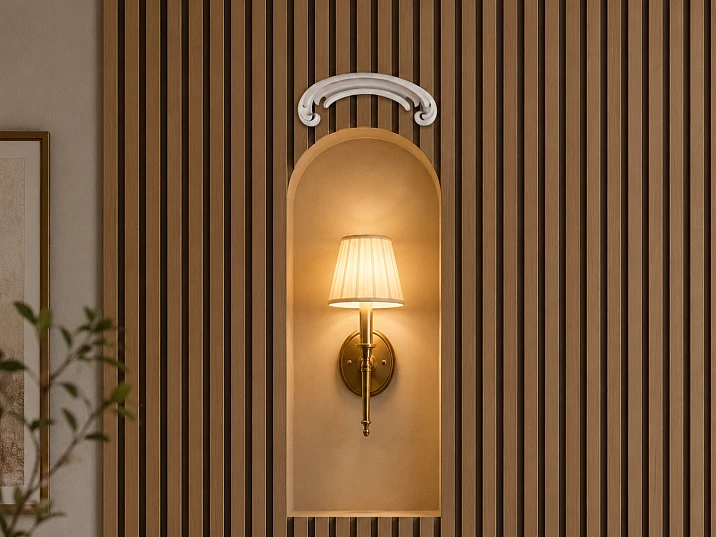
A slat wall itself already has an active pattern. Vertical lines repeat across the entire surface, light emphasizes the relief, and the gaps between the slats add depth to the wall. Therefore, the spot for a wall sconce is often made differently: a small smooth area is left around the sconce's base, where it is easier to build a calm local composition.
After installation, another problem arises. The light fixture stands fine, but the smooth insert looks too rectangular and technical. There is a desire to frame it with moldings on all four sides.
For a small niche, this is not always the best option.
A full frame adds four more lines, four corners, and a separate geometric contour next to the already active slat panels. If the decorative task is only to soften the top of the niche and tie it to the interior style, you can consider a much more compact solution — a single arched carved overlay NPU-428 above the sconce.
The current size of the NPU-428 is 130 × 52 × 11 mm, the material is polyurethane, and the price is 950 ₽ per piece.
The main thing before buying is not to decide in advance that "130 mm will definitely fit."
You need to check five things:
the width of the smooth area → the actual size of the light fixture → the position of the central axis → free space above → the behavior of the 11 mm relief when the sconce is turned on.
Only if these five conditions work together can a single NPU-428 really replace a more complex molding frame.
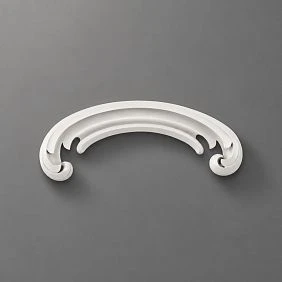
What is NPU-428 and why its shape is suitable specifically for a top accent
NPU-428 is a small decorative polyurethane overlay. STAVROS describes it as an arched element with wavy lines and curls. The card dimensions are 130 × 52 × 11 mm, and the current price is 950 ₽.
| Characteristic | NPU-428 |
|---|---|
| Type | arched carved overlay |
| Size | 130 × 52 × 11 mm |
| Material | Polyurethane |
| Price | 950 RUB/piece |
| Minimum purchase | 1 pc. |
| Made to order | 3–7 days |
Product card:
Overlay section:
Buy decorative polyurethane overlays
The meaning of the NPU-428 shape in the project under consideration is not to completely outline the niche.
The overlay works as a single decorative top point.
The eye reads the sequence:
slat wall → smooth field → sconce → small arched accent.
This is a fundamentally different composition than:
slat wall → rectangular frame → light fixture → another inner rectangle.
In a small field, the first option can look lighter.




Why a full frame around a small sconce can be excessive
A frame made of moldings is useful when you need to create an independent architectural panel.
It works well if it contains:
-
a large mirror;
-
a painting;
-
a large lamp;
-
a group of decorative elements;
-
wide empty field.
A small niche near a sconce has a different scale.
Suppose the smooth surface is only 250–300 mm wide.
If you outline it with molding, it creates:
-
left vertical;
-
right vertical;
-
top horizontal line;
-
lower horizontal;
-
Four corners.
The lamp itself remains inside.
And directly nearby — a vertical pattern of slats.
This results in a very high concentration of lines in a small area.
NPU-428 offers a different approach: not outlining the niche boundary, but marking its top.
Instead of a new rectangle, an arc appears.
This is especially interesting next to the slats, because the shape of the overlay works across their strict vertical rhythm.
But this advantage only appears when the overlay correlates well with the scale of the platform.
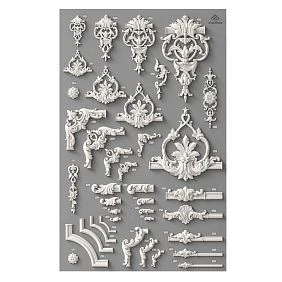
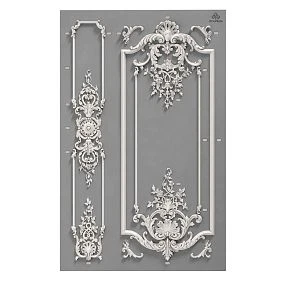
Our factory also produces:
First, we measure the smooth platform, not the entire slatted wall.
For NPU-428, it doesn't matter whether the total wall length is five meters or two meters.
A specific local rectangle containing the sconce is needed.
Measure:
W — the actual width of the smooth area;
H — the actual height of the platform;
WS — the width of the sconce itself;
HS — the height of the luminaire;
T — the free distance from the top point of the sconce to the upper boundary of the area.
If the platform is located between two slat zones, separately measure the distance from its side edges to the nearest protruding elements.
Do not use only the design dimension.
After installation, the actual width may differ by a few millimeters due to:
-
the finish coating;
-
the position of the outermost rail;
-
platband;
-
junctions of another panel;
-
of the actual wall geometry.
For an overlay about 130 mm wide, a few millimeters by themselves usually do not determine the composition, but they matter if the field is already very narrow.
Get Consultation
What the size 130 × 52 × 11 mm means specifically for this niche
The three numbers answer different questions.
130 mm sets the main extended dimension of the trim.
52 mm defines the second frontal dimension.
11 mm shows the maximum size of the relief along the third axis according to the card.
At the same time, the size designation in the card itself is not sufficient proof of the orientation of each axis in a specific composition.
Therefore, the condition used for the calculations below is:
if in the selected position the NPU-428 occupies 130 mm horizontally.
This is a logical orientation for the arched top accent, but before final markup it still needs to be checked against the image and product drawing.
This approach eliminates a typical mistake: seeing "130 × 52" in the card and automatically taking the first number as the width for any possible rotation of the product.
A paper template of 130 × 52 mm will provide more information than a product photo.
For NPU-428, there is no point in making a decision based only on the on-screen image.
Cut out a 130 × 52 mm rectangle from thick paper.
Even better, print an image of the overlay at approximately actual size.
On the template, mark:
-
central vertical axis;
-
the lowest point of the arch;
-
the extreme points of the ornament;
-
the approximate silhouette.
Attach it above the sconce with painter's tape.
Then make three checks.
Frontally
Look directly at the light fixture.
Here you can best see:
-
centering;
-
width;
-
relation to the niche boundaries.
From a typical viewing point
If the sconce is in the hallway, step back to where a person usually sees it.
In the bedroom — look from the bed.
In the living room — from the sofa or from the passage.
It is at this distance that it becomes clear whether the NPU-428 is a noticeable accent or gets lost.
With the lamp turned on
A flat paper mockup does not show the relief, but helps check the main thing: where the light falls and where shadows will be.
After that, you can already assess the 11 mm depth.
How the scale of the NPU-428 changes with different widths of a smooth niche
The same overlay cannot be considered equally suitable for platforms 180 and 400 mm wide.
If 130 mm are positioned horizontally and the overlay is centered, the free space is calculated as follows:
free space = niche width − 130 mm.
For a conditionally symmetrical position, the result is divided in half.
| Width of the smooth area | After NPU-428 remains | Conditionally on each side | What the scale looks like |
|---|---|---|---|
| 160 мм | 30 мм | 15 mm each | Very dense composition |
| 180 мм | 50 мм | 25 mm each | Dense top accent |
| 220 мм | 90 мм | 45 mm each | the overlay remains noticeable |
| 250 мм | 120 мм | 60 mm each | a calmer ratio |
| 300 мм | 170 мм | 85 mm each | noticeable empty space |
| 350 мм | 220 мм | 110 mm each | NPU-428 becomes a subtle accent |
| 400 мм | 270 мм | 135 mm each | there is a risk that one overlay will visually get lost |
This table does not establish a "correct" width.
It shows something else: the scale changes very quickly.
On a 180 mm platform, the NPU-428 takes up most of the width.
On a 400 mm platform, it takes up less than a third.
Therefore, with a large niche, the question is no longer whether the overlay fits, but whether one is enough.
180 mm niche: the overlay becomes almost part of the luminaire itself
With a conditional horizontal width of the NPU-428 of 130 mm:
180 − 130 = 50 mm.
Approximately remains:
25 mm on each side.
This is a dense composition.
If the sconce is narrow and small, the arched decor may be perceived as its decorative finish.
If the lamp is wide, the NPU-428 may be narrower than its housing.
Then the visual connection changes: the overlay no longer 'covers' the composition and becomes a small detail above a larger object.
Therefore, in a narrow niche it is especially important to compare the width of the sconce and the width of the overlay, not just the width of the wall.
Niche 300 mm: independent space appears around the decor
With a width of 300 mm:
300 − 130 = 170 mm.
With conditional centering:
85 mm each.
Now the overlay no longer fills almost the entire top of the platform.
Three independent objects emerge:
left part of the smooth field → NPU-428 → right part of the smooth field.
This size is often easier to combine with slat panels, because a noticeable pause remains between the carved ornament and the vertical rhythm.
But the final decision depends on the sconce itself.
A large lamp can fill these 300 mm almost completely.
A small sconce will leave a lot of free space.
If the platform is 400 mm or wider, compare one NPU-428 with another solution.
At 400 mm:
400 − 130 = 270 mm.
That is, after conditional centering, 135 mm remains on each side.
On a large smooth insert, the NPU-428 may become too small.
This does not mean it cannot be used.
Different scenarios are possible:
-
minimal accent is exactly what is needed;
-
the sconce itself is small, and the whole composition should be light;
-
there are other decorative elements around;
-
the overlay repeats the ornament of another object.
But if the goal was to architecturally frame the entire niche, one detail may not be enough.
Then it is reasonable to compare:
-
a larger overlay;
-
paired composition;
-
a molding frame;
-
a different form of decor.
For this, you don't need to buy NPU-428 "on trial." A mockup is enough first.
The center of NPU-428 does not always have to coincide with the geometric center of the niche
The most obvious scheme:
center of the platform = center of the lamp = center of the cover plate.
If everything is symmetrical, it works.
But real light fixtures can be different.
For example:
-
the arm is directed to one side;
-
the shade is offset;
-
the metal branch extends to the right;
-
the base is mounted in the center, but the visible mass is on the side;
-
The pull-chain switch is located on one side.
Therefore, the sconce has at least two axes:
mounting axis
и
visual axis.
They may not coincide.
If the NPU-428 is automatically placed in the center of the mounting plate, it may appear offset relative to the luminaire itself.
Correct check:
-
mark the center of the smooth niche;
-
mark the center of the sconce mounting;
-
determine the visual center of the luminaire;
-
apply the NPU-428 to each of these axes;
-
Compare.
The desired position is chosen based on the entire composition, not just by the tape measure.
With two identical sconces, it is important to compare not individual niches, but the entire wall.
If there are two lamps in the room, one fitting is not enough.
Make two templates NPU-428.
Secure them simultaneously.
Now other parameters are checked:
-
same height;
-
same orientation;
-
equal distance to the wall lamp;
-
the relationship of the two decorative accents to each other;
-
connection with slat panels.
For two niches you will need:
2 × NPU-428.
At the current price:
2 × 950 = 1 900 ₽.
With four identical niches:
4 × 950 = 3 800 ₽.
The cost is calculated linearly, since the product is sold per piece. The current card shows a price of 950 ₽.
But the quantity cannot be determined only by the number of sconces.
If one niche has a different architecture, it may require a different solution.
The distance from the sconce to the NPU-428 cannot be assigned as one universal number
One could write:
"Leave 50 mm between the light fixture and the overlay."
But such a rule does not take into account the size of the light fixture.
For a small sconce, 50 mm may be a significant gap.
For a tall, elongated lamp — almost absent.
You need to measure:
T = the distance from the top visible point of the sconce to the bottom point of the overlay.
Then make three mockups:
-
close position;
-
medium;
-
more free.
It is not necessary to measure dozens of variants.
The goal is to understand whether the NPU-428 is perceived as:
part of the sconce composition
or
a separate wall decor above it.
If the distance is too great, the connection is lost.
If too small, the two relief objects may visually collide.
The decor must not extend onto the luminaire's mounting area.
The NPU-428 and the sconce perform different functions.
The luminaire must have its own designated mounting.
The decorative cover must not:
-
cover the fasteners;
-
hinder removal of the lamp;
-
block access to the mounting part;
-
be used as a support for the wall sconce.
This needs to be checked against the paper template as well.
Especially if the wall sconce base is tall and the NPU-428 is planned close above it.
Imagine that in a few years the light fixture will need to be replaced.
If the decorative cover is installed in such a way that the sconce body cannot be removed without damaging the molding, the composition is designed too tightly.
Think about replacing the sconce even before gluing the decor.
Light fixtures are changed more often than wall decor.
Therefore, one useful check looks like this:
will another sconce be able to fit in this spot in a few years?
If the NPU-428 is placed very close to the current light fixture and exactly follows its contour, a new body that is 20–30 mm taller may no longer fit.
There are two approaches.
The composition is designed strictly for a specific sconce
Then the tight connection is justified.
But when replacing the light fixture, you may also have to change the placement of the decor.
A more universal niche is needed.
Then more free space is left.
This makes the wall less dependent on a single lamp model.
The 11 mm relief should be evaluated with the sconce turned on.
In the photos, NPU-428 is visible from the front.
On the wall, it has volume.
The card indicates the third dimension of 11 mm.
For ordinary wall decor, this is just part of the plasticity.
For a sconce, it is also a source of shadow.
The lamp can direct light:
-
up;
-
down;
-
in both directions;
-
sideways;
-
through the diffuser.
If the flow goes up, NPU-428 is directly in the illuminated area.
Shadows from the curls are intensified.
As a result, the small overlay becomes visually more noticeable than with the light off.
Conversely, with frontal soft lighting, the relief may look calmer.
Therefore, the decision cannot be made only during the day.
Light upward and light downward give the NPU-428 completely different roles
The sconce shines upward
The overlay falls into the active light cone.
Shadows become part of the design.
The arched shape is emphasized.
In this case, even a small element of 130 × 52 mm can look quite expressive.
The sconce shines mainly downward
The upper part of the niche is illuminated more weakly.
NPU-428 works more like a regular wall decoration.
If the smooth surface is wide, it can get lost.
The luminaire provides two-sided light
The overlay ends up inside the upper light spot.
Here it is especially important to check whether it is located too close to the body, because a very sharp shadow can make the composition visually heavy.
The side view shows what is not visible in the front sketch
The slat wall already has several levels:
main plane → slats → smooth platform → sconce housing.
NPU-428 is added.
Look from the side.
Various situations are possible:
-
the smooth field is recessed relative to the slats;
-
is in the same plane with them;
-
protrudes slightly;
-
The sconce is strongly pulled away from the wall.
If the niche is recessed, the NPU-428 will also be inside a deeper plane.
The battens can visually act as natural side boundaries.
In such a situation, a full additional frame is often less needed.
If the smooth insert is flush with the slats, NPU-428 becomes an independent relief on the overall surface.
Why NPU-428 is better to mount on a smooth field rather than randomly over the reiki
In the original scenario, the area under the sconce is already smooth.
This is useful for both the lamp and the decor.
NPU-428 receives:
-
a continuous base;
-
a calm background;
-
clear geometry;
-
free space for ornament.
If you start placing its edges over vertical slats, another node appears:
part of the overlay contacts the smooth wall, part contacts the protrusions, and part ends up over the gaps.
Such a transition cannot be considered a regular adhesive installation on a flat base.
Therefore, before purchasing, it is advisable to ensure that the entire mounting contour of NPU-428 remains within the smooth area.
If the overlay is wider than the field, it is better to choose a different size or change the composition.
Is it necessary to leave equal space from NPU-428 to the left and right boundaries of the area
If the sconce and the niche are symmetrical, that is usually a good starting option.
But this is not a mandatory rule.
An asymmetrical light fixture may require a slight optical offset.
The main thing is not to do it accidentally.
A useful method:
-
first, place the NPU-428 strictly along the geometric axis;
-
take a photo;
-
shift it by 10–15 mm toward the visual center of the sconce;
-
take a photo again;
-
compare the two frames.
The eye notices the difference better in photos than during constant manual movement of the template.
When one NPU-428 is truly enough
One overlay instead of a frame is especially logical if several conditions are met simultaneously.
The smooth niche is small
A full frame would take up too much space.
The slat wall is already active
Four additional lines of molding would increase visual density.
The sconce itself is decorative
It doesn't need another heavy architectural structure.
The top of the platform looks empty
NPU-428 solves exactly this local problem.
The arched shape supports the light fixture
For example, the body has rounded or fluid lines.
The 130 × 52 mm template is clearly readable from a normal viewing point.
If these conditions are sufficient, there is no need to add a frame just because "it is customary to frame a niche."
When one small overlay no longer solves the task.
There is also the opposite scenario.
The smooth field is large.
The sconce is large.
There is a lot of free wall on the sides.
One NPU-428 looks like a random small detail.
Signs:
-
it is hard to notice from a normal distance;
-
it does not tie the niche into the composition;
-
there remains a large empty space above the sconce;
-
the side edges of the smooth panel look unfinished;
-
the decor does not match the scale of the fixture.
Then there is no need to artificially raise the color contrast to "save" a too-small overlay.
It is better to compare a different size or a different type of finish.
The catalog allows Buy decorative polyurethane overlays and choose an element that better matches the actual field.
For a wider wall composition, you can go to the section . Clear lines, created using modern technologies, emphasize the strict aesthetics of the room. Each decorative element harmoniously fits into the overall concept, creating a sense of order and thoughtfulness..
When a full molding frame is still better
NPU-428 is not a universal replacement for the frame.
Molding composition is more reasonable if the task is to:
-
visually enlarge the niche;
-
combine a sconce with a painting or mirror;
-
emphasize the entire rectangle of the smooth insert;
-
connect several adjacent panels;
-
create a classic wall panel.
In such a situation, the four sides of the frame perform an independent architectural function.
NPU-428 on top no longer replaces it.
It can become an additional detail, but it is a completely different composition.
The main thing is not to mix the two intents.
If you only need to slightly decorate the top of a small niche, a frame may be excessive.
If you need to form a full-fledged architectural panel, one overlay is not enough.
Compare three options on the same photo of the wall
The most practical way to choose:
Option A — without decor
Smooth niche and a sconce.
Option B — only NPU-428
One arched overlay above the light fixture.
Option B — full frame
Four sides around the area.
Photograph the wall straight on.
Apply simple mockups or temporarily outline with painter's tape.
Compare not the beauty of each element separately, but the whole wall.
Ask four questions:
-
Where does the eye stop first?
-
Does the decor compete with the sconce itself?
-
Does the zone become heavier than the surrounding slat panels?
-
Does the added element have a clear function?
If option B solves the problem without extra lines, one NPU-428 is a good choice.
The color of the overlay changes its scale
Even with unchanged 130 × 52 mm, NPU-428 may look visually larger or smaller.
In the color of the smooth surface
The relief is read through light and shadow.
The form looks calmer.
For a slat wall, this is often a logical initial layout: the vertical background is already active, so the top decor does not have to stand out additionally with color.
In the color of the slats
The overlay is connected to the side trim.
This way you can visually assemble two systems:
slats → decorative accent → slats.
Contrasting
NPU-428 becomes an independent object.
On a small field of 180–220 mm, this can make it too active.
On a wider platform, contrast, on the contrary, helps a small overlay not get lost.
Therefore, color is checked after size, not instead of it.
There is no need to automatically paint polyurethane decor "gold" just because of the ornament.
The NPU-428 card indeed describes a decorative form associated with waves and swirls.
But this does not mean that the entire composition must become historical or emphatically classical.
Slat panels often have a strict modern rhythm.
That is why it is more interesting to first check calmer options:
-
wall color;
-
slat color;
-
sconce body color;
-
close neutral shade.
If the interior is truly built on gilded or patinated details, a contrasting finish may be justified.
But the style is defined by the entire room, not by a single overlay.
The slat rhythm and arched decor can work in contrast
The vertical slat is built on the repetition of straight lines.
NPU-428 — on the curve.
This is not necessarily a conflict.
On the contrary, a small arch can become a point that makes a rigid system less monotonous.
But here, dosage is important.
If you add nearby:
-
two more overlays;
-
a wide frame;
-
corner elements;
-
ceiling decor;
-
contrasting paint,
a small niche begins to contain too many different languages.
Therefore, the strength of NPU-428 in this scenario is precisely that it is alone.
What to check on a smooth surface before installation
The overlay is small, but the base still needs to be prepared.
Check:
-
whether the surface is clean;
-
Is there any dust;
-
paint is not peeling;
-
the template lies evenly;
-
Are there any protruding fasteners;
-
the location does not intersect with the mounting part of the luminaire.
In the NPU-428 card, among related products, KUDO HIGH TACK 280 ml is currently shown at a price of 990 ₽.
If this compound is suitable for your base, it can be considered as a related mounting product:
buy glue for installing moldings
But the amount of adhesive for one NPU-428 does not need to be calculated according to a made-up universal standard.
It depends on:
-
of the actual back surface;
-
the base;
-
application patterns;
-
other elements that are mounted simultaneously.
The cover plate should be tried on after installing the wall lamp, not just according to the design.
The size of the fixture from the catalog and its actual appearance on the wall are different things.
After installation, the following become clear:
-
actual projection;
-
position of the shade;
-
tilt of the arms;
-
light zone;
-
visible mounting hardware;
-
optical center.
Therefore, if the sconce has already been purchased, it is better to install it first and only then finally choose the position of the NPU-428.
If the lamp has not been purchased yet, the mockup should include both elements at once:
the sconce outline + NPU-428.
Otherwise, you can perfectly place the overlay in an empty niche, and then discover that the actual lampshade almost touches it.
If the sconce has not been chosen yet, do not design the NPU-428 too rigidly
Sometimes the finishing is done before the electrical work and lighting fixtures.
In such a case, do not fix the overlay in a point with millimeter precision in advance.
First, determine a safe compositional zone.
For example:
-
the upper part of the smooth insert;
-
the central axis;
-
range of possible positions.
When the lamp appears, the NPU-428 template moves within this range.
This preserves flexibility.
What to do if the sconce is not centered on the smooth insert
This happens due to the electrical outlet or furniture.
There are three strategies.
Subordinate the NPU-428 to the sconce
The plate is centered relative to the sconce.
Then the smooth field may remain asymmetric.
Subordinate it to the niche architecture
NPU-428 remains centered on the platform.
The sconce looks slightly shifted within the composition.
Reconsider the entire niche
If the misalignment is highly noticeable, a decorative cover will not fix the placement error.
In this case, it is better to first resolve the actual architecture of the light fixture.
Do not use NPU-428 as a means to 'mask' a serious misalignment.
If two sconces are mounted at different heights, the same position of the cover plates may be incorrect.
For example, one sconce is near the bed, the other is near the vanity table.
The fixtures are identical, but the mounting height differs.
In such a project, two approaches are possible:
The NPU-428 follows each sconce
or
both NPU-428s are on a common horizontal line.
Which option is better depends on the wall.
If the niches are independent, it makes more sense to connect the trim to its own light fixture.
If the entire wall is built along a strict horizontal line, the common line may be more important.
This needs to be seen on two templates.
The number of NPU-428 is calculated by the number of truly identical compositions.
One niche:
1 overlay = 950 ₽.
Two identical ones:
2 overlays = 1,900 ₽.
Four:
4 covers = 3,800 ₽.
But you don't need to buy four just because there are four sconces on the wall.
Let's imagine a long corridor.
Three lamps are placed in identical slatted sections.
The fourth is near the door and has a narrower smooth area.
For the first three, the NPU-428 can work perfectly.
For the fourth — no.
The quantity is determined not by the number of electrical outlets, but by the number of equally suitable decorative units.
When it's rational to buy one NPU-428 as a trial
The price of one cover is 950 rubles.
If the project involves many identical niches and the visualization raises doubts, you can first test one real composition.
For example, eight lamps are planned in a long room.
A paper template shows the size but does not convey:
-
actual terrain;
-
shadows;
-
quality of painting;
-
interaction with specific light.
Purchasing one item for a real-life trial may be a reasonable step before ordering the entire series.
But if it's only about two niches and the size is already well verified, a separate intermediate purchase may be unnecessary.
When it's better to immediately browse the catalog of other trims
NPU-428 doesn't need to be "saved" at any cost.
Move on to alternatives if:
-
130 mm is too small for the platform;
-
the shape is too large for a narrow niche;
-
the arc doesn't match the light fixture;
-
the 11 mm relief looks too active when the light is on;
-
The required position extends beyond the smooth field;
-
a symmetrical paired composition of a different type is required.
In the section polyurethane decorative overlays NPU-428 is located next to other options. The official catalog does show it among C-shaped and other polyurethane overlays.
It is better to choose an alternative based on the actual niche size rather than the similarity of the name.
When it is better to leave the smooth field without decoration altogether
In some interiors, after all the fittings, the best option turns out to be the simplest one.
Leave the niche without NPU-428 if:
-
the bra is the main decorative object;
-
the area is very small;
-
the slatted wall is already quite saturated;
-
the light fixture above creates a beautiful light spot;
-
additional ornamentation fragments the composition;
-
there are no other details in the room to connect the carved shape with.
Empty space is also part of the design.
Having a free wall does not mean it must be filled with stucco.
Four expensive mistakes easily avoided here with a template
Mistake 1. Buying NPU-428 based solely on niche width
Reason: 130 mm physically fits.
Consequence: after installation, the trim may turn out to be disproportionate to the sconce.
Check: paper template together with the actual outline of the light fixture.
Solution: evaluate not only the wall, but also the object itself beneath it.
Mistake 2. Placing decor too close to the sconce body.
Reason: want to tie the elements into one composition.
Consequence: the light fixture becomes difficult to service or replace.
Check: mentally or physically remove the sconce along the intended path.
Solution: leave a functionally sufficient space.
Mistake 3. Checking only the light fixture when it is off
Reason: layout is done during the day.
Consequence: in the evening, an 11 mm relief creates a much more active shadow than expected.
Check: the mockup and full-scale sample are evaluated under working lighting.
Solution: consider light as part of the decor.
Mistake 4. Add a frame to NPU-428 just "for completeness"
Reason: it seems that one detail is not enough.
Consequence: a small niche gets too many lines.
Check: compare three photos — without decor, only NPU-428, with frame.
Solution: keep each element only if it has its own function.
What to put in the cart after a successful fitting
If one NPU-428 really fits, the order is simple.
For one niche:
1 × NPU-428 = 950 ₽.
For two symmetrical:
2 × NPU-428 = 1 900 ₽.
For four identical:
4 × NPU-428 = 3 800 ₽.
Product:
order NPU-428 made of polyurethane
If a different model is needed:
Buy decorative polyurethane overlays
For the overall system:
If the wall sections themselves are also being designed:
Buy slatted panels for wall finishing
No need to build the cart before checking the scale. The most useful sequence here is the reverse:
template → sconce → light → base → quantity → product.
Final algorithm before purchasing NPU-428
- Measure the actual width and height of the smooth niche.
- Measure the visible dimensions of the sconce.
- Mark the mounting axis of the light fixture.
- Determine its visual center.
- Check the free space above.
- Verify the image and orientation of NPU-428.
- Make the template 130 × 52 mm.
- Place it above the sconce.
- Look straight ahead.
- Look from the normal viewing point.
- Check the position with the light on.
- Make sure the decor does not interfere with the mounting part of the light fixture.
- Check the possibility of future removal of the sconce.
- Look at the assembly from the side.
- Make sure the cover plate fully sits on the smooth surface.
- Compare the version without decor.
- Compare NPU-428 with the full frame.
- If one overlay solves the task, do not add a frame without reason.
- For two fixtures, make two templates at once.
- Count only those niches where NPU-428 is truly suitable.
- Select mounting material for the existing base.
- After that, place the order.
Result: when one NPU-428 above the sconce is really enough
NPU-428 has a compact size of 130 × 52 × 11 mm and costs 950 ₽ per piece. STAVROS describes the shape as arched, with wavy lines and curls.
In a small smooth niche among slat panels, this allows using it not as a full frame, but as one upper decorative accent.
With an area of about 180 mm and a conventional horizontal orientation of 130 mm, the overlay occupies most of the width and works quite actively.
At 250–300 mm, more free space appears around it.
At 400 mm, one NPU-428 may, on the contrary, turn out to be too small — then it's worth comparing a larger decor or a molding composition.
But deciding the issue by the width of the niche alone is not enough.
Need to check:
niche → sconce → free height → central axis → light direction → relief → smooth mounting field.
If after a full-size fitting, the NPU-428 neatly finishes the top of the niche, does not interfere with the light fixture, and does not overload the slat wall, it can be buy carved overlay NPU-428 in the quantity of one piece per identical niche.
If the small arch gets lost, there is no need to compensate for it with a few more random details. It is better to go straight to the catalog and choose a scale that matches the area.
If, without decor, the niche itself looks calmer and better highlights the light, the right decision may be to add nothing at all.
The NPU-428 has a very specific function here:
it should frame the top of the small niche more lightly than a full frame, rather than creating another complex composition inside an already active slat wall.
FAQ
Can the NPU-428 be installed if there is a horizontal panel seam above the sconce?
Yes, if the overlay gets a normal flat base and the seam does not create a height difference under its mounting area. If the surfaces are at different levels, the geometry of the base must be resolved first.
What to do if a smooth niche is located very close to a door casing?
Check the entire composition at once: the trim, the NPU-428, the sconce, and the edge of the slat panels. The small overlay may physically fit, but turn out to be a third active decorative element in a too-narrow wall section.
Can NPU-428 be used above a sconce with a hanging chain or cord?
This option can be considered if the hanging element does not cross the decorative zone and remains convenient to use. The marking should be done with the actual position of the chain or cord, not just based on the fixture body.
Do I need to take the lampshade into account if it is wider than the sconce's mounting base?
Yes. For visual scale, the maximum visible dimension of the entire fixture matters, not just the metal plate attached to the wall.
What to do if the lampshade can be replaced with a larger one?
Check the most likely shade size before installing the NPU-428. A very tight composition for the current small shade may not accommodate a larger option.
Can NPU-428 be installed between two closely spaced sconces?
This is a different composition. One central plate will link a pair of fixtures rather than frame each niche separately. This option should be mocked up as a single unit and not automatically considered equivalent to two separate NPU-428s.
Will the NPU-428 fit for a wall sconce above a mirror?
Physically, the size may fit, but the reflection needs to be checked. The mirror shows not only the front surface, but sometimes the side relief and mounting area. This can make the decor visually more noticeable.
What to do if the sconce is located in the corner of the room?
With a close side wall, the NPU-428 may appear asymmetrical even when precisely centered above the light fixture. Make a template and look from the main entry point of the room.
Can the overlay be placed below the sconce instead of above it?
Physical placement depends on the composition, but the arched shape needs to be evaluated in the chosen orientation. The lower option solves a different design task and requires a separate mockup.
Is a separate NPU-428 needed for a wall sconce that is barely visible from the room?
Not necessarily. If the niche is in a secondary area and the additional detail is not noticeable from the usual viewing point, the purchase may not provide a practical visual result.
What to do if two identical NPU-428 look the same in daylight, but in the evening one is darker?
The reason may be in the different direction of the light flow or the position of the sconce. First, check the sconces themselves and their direction, rather than trying to fix the difference by adjusting the position of the overlay.
Can I first mount the NPU-428 and install the sconce later?
Only if the exact position and dimensions of the future light fixture are known. In practice, it is safer to first have the actual light fixture or its full-size template to avoid a height conflict.
What to do if the NPU-428 looks beautiful above one sconce but poorly above another of a different design?
Do not strive to use the same decor just for formal symmetry. If the light fixtures themselves differ, their decorative solutions may also differ.
Can leftover paint from slat panels be used for NPU-428?
This depends on the coating system and the compatibility of the paint with the prepared polyurethane surface. Before painting, it is worth testing on a separate sample or an inconspicuous area in accordance with the instructions of the specific coating.
Where to buy NPU-428?
The product card is here:
At the time of the check, the official website shows 130 × 52 × 11 mm, polyurethane, and a price of 950 ₽ per piece.