




































Article Contents:
- Wall clock CHPU-001 453×250×49 mm: what the product card actually confirms
- Polyurethane clock above the radiator: why a free wall does not yet mean a suitable location
- Why you cannot invent universal "30 or 50 cm from the battery"
- What to measure on the wall before ordering CHPU-001
- Geometry without thermal conclusions
- Wall and air are different measurable objects
- How not to get a beautiful but incorrect number
- Calculating free height
- Width check
- If the thermostat is set to 22 °C, can the temperature at the clock be considered the same?
- Will a smart home sensor work instead of a separate inspection?
- What to do if the radiator is replaced with a different model in winter?
- Is the solution preserved after installing long curtains?
- Can I use an AA battery to buy batteries less often?
- Can I replace the time capsule with another one if its temperature range is known?
- Will a sheet of foil behind the clock help protect the mechanism?
- Can I mount the clock with glue or double-sided tape?
- There are similar clocks hanging above the heating in the showroom. Is that a sufficient example?
- Can I order several CHPU-001 for identical hotel rooms?
- Are these clocks suitable as a gift if the recipient chooses the location themselves?
- Do I need to install the battery immediately after cold delivery?
- What to do if the clock starts stopping only after the heating is turned on?
- Can one approval be used if the same radiator model is in the adjacent room?
- What counts as completed preparation for purchase if the manufacturer's response has not yet been received?
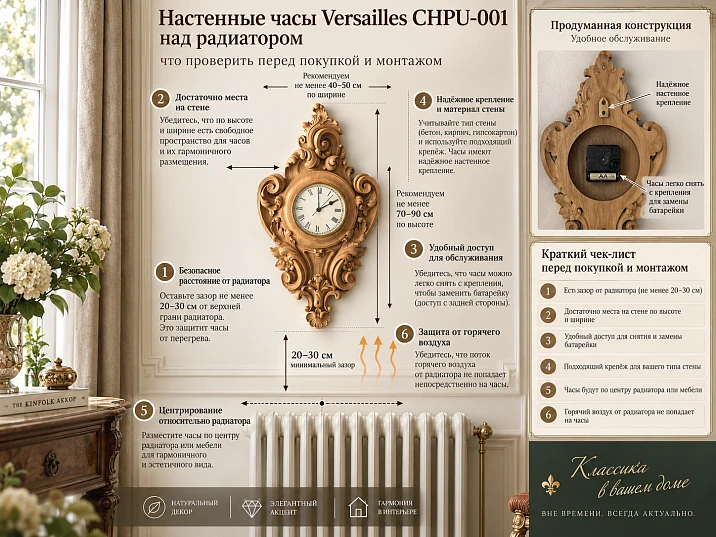
The radiator is already installed, and there is a free wall section above it. The white Versailles CHPU-001 clock matches the doors and ceiling cornice, requiring no wood matching or separate painting. But buying it specifically for this spot is only worth it after checking the operating conditions: the open CHPU-001 card does not publish the permissible operating temperature or the minimum distance to the heating device. An offset of 30 or 50 cm chosen from a photo does not replace this data. [1]
The practical procedure is as follows: describe the installed radiator and wall geometry, assess the conditions with the heating running, request STAVROS requirements for the finished product, then check the composition and access. If a suitable mode cannot be confirmed, it is wiser to choose another wall than to test the heat resistance of already purchased clocks by heating.
The absence of a temperature range in the card does not mean either a ban on any proximity to heating or permission to hang the clock at an arbitrary point. It means that for a specific location, technical information is lacking. Below is a sequence that helps obtain this information without confusing wall temperature with air temperature and without redoing the finished interior after drilling.
Article contents
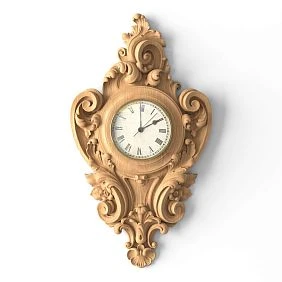
Wall clock CHPU-001 453×250×49 mm: what the card actually confirms
First, let's check the product itself. Similar designations CHPU-001 and CH-001 refer to different versions, so when requesting temperature information, one cannot limit oneself to the name Versailles.
| Parameter | CHPU-001 data |
|---|---|
| Dimension A × B × C | 453 × 250 × 49 mm |
| Body material | Polyurethane |
| Finish | White enamel |
| Mechanism | Quartz, with smooth sweep |
| Capsule | Brass rim, glass lens, white dial with Roman numerals |
| Pendant | Mounting bar, one piece included |
| Power supply | One AA battery, not included |
| Stated warranty | 12 months |
| Price as of September 5, 2026 | 13 340 ₽ |
Specifications and price are taken from the specific model's card, not from general furniture collections. [1]
Before buy Versailles clock CHPU-001, you need to separate confirmed parameters and questions that still need to be resolved. Dimensions help with fitting. The material name allows you to properly place an order. The presence of the bar explains the general hanging method but does not determine the mounting hardware for your wall.
From the listed items, you also cannot derive the product's weight, the exact mounting coordinate, the process of removing the housing, or the method of accessing the battery. This information should be requested based on the installation instructions and the specific kit. A front-facing photo is insufficient for such verification.
The question about placement above the radiator refers to the clock as an assembly. Do not replace it with a question about decorative resin in general. The case, coating, capsule, and power source operate in one location, but their requirements may be described by different parameters. An answer about only one component does not yet justify approving the entire installation.
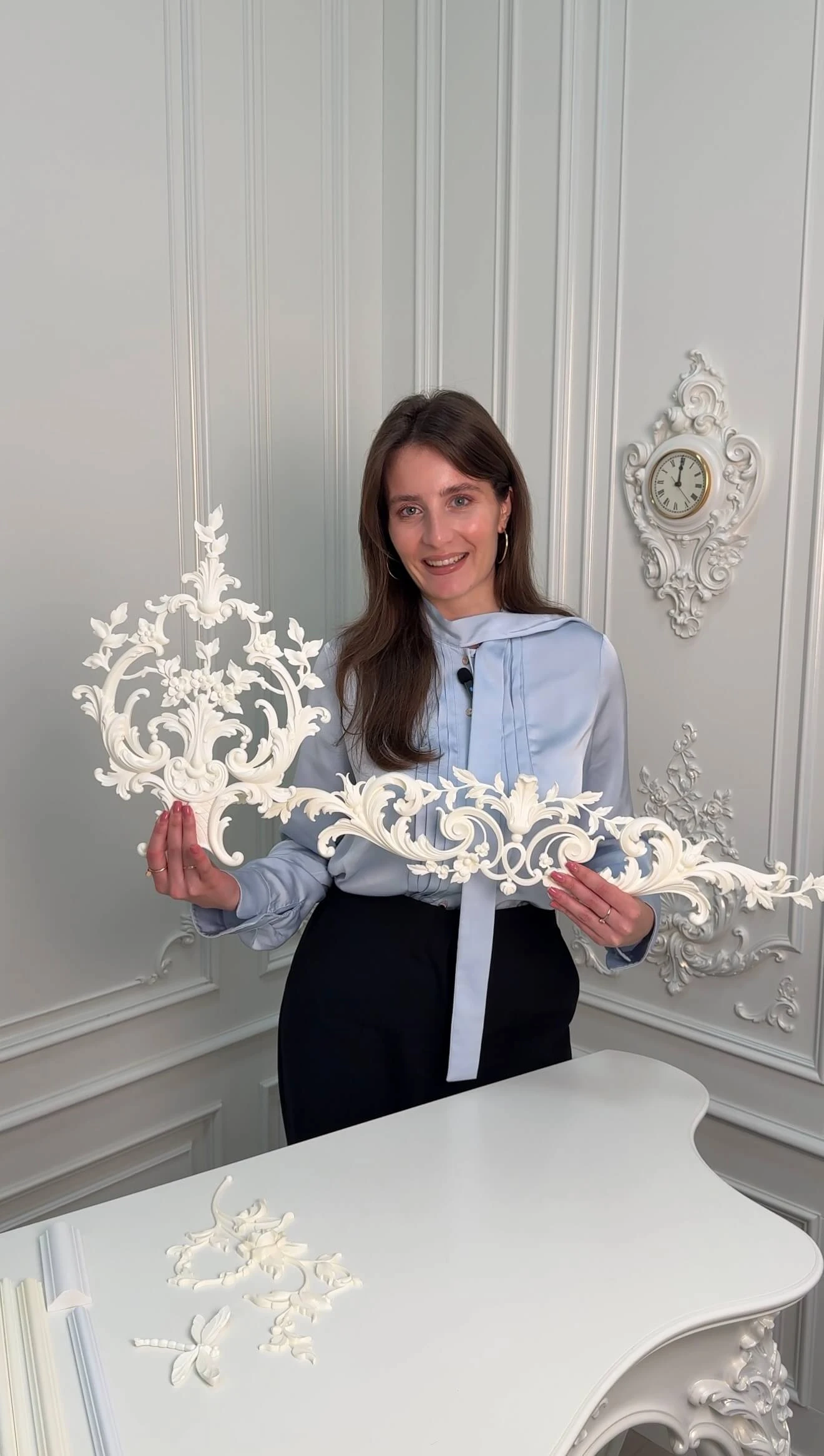

Polyurethane clock above a radiator: why a free wall does not yet mean a suitable location
A free wall section has two independent characteristics: it can be compositionally favorable and simultaneously require additional temperature verification. A flat white surface by itself tells nothing about the conditions near it in winter.
A heating device transfers heat through radiation and convection. Heated air rises, and its movement depends on the surrounding environment. Therefore, the area above a radiator cannot be automatically equated with the rest of the room. The heating equipment manufacturer Stelrad describes both heat transfer mechanisms; the share of each for your device should not be determined based on someone else's model. [2]
For a clock, this raises several different questions. How much does the wall itself heat up? What air temperature will be near the bottom of the case and the clock capsule? Does direct thermal radiation affect the product? Does a niche create conditions different from an open wall? A single number on a room thermometer cannot answer all of this.
Imagine two walls of the same width. On the first, the radiator stands openly; on the second, it is under a deep windowsill between side slopes. Even with the same bottom mark of the clock, these are different geometric situations. Transferring a decision from the first wall to the second just because the distance matches is incorrect.
There is also a difference between a flat sketch and volume. The clock protrudes from the wall, the heating device protrudes even further; between them there may be a windowsill, a riser, and furniture. A frontal photograph hides part of these relative positions. For a technical request, a side view is also needed.
At this stage, the task is not to declare the wall section dangerous. It is necessary to stop considering it obviously suitable and gather initial data. This approach preserves the possibility of a beautiful composition but does not force technical conclusions to fit it.
Our factory also produces:

Why universal "30 or 50 cm from the radiator" cannot be invented
Distance is a placement characteristic, not an independent guarantee of permissible temperature. It makes sense together with the type of device, its operating mode, the direction of air flow, and the clock's requirements.
First, clarify from where to where the offset is measured. The phrase "half a meter from the radiator" can mean the distance from the top edge of the radiator to the bottom of the case, to the center of the dial, or to the mounting hole. For a shaped object, these are different positions. In the work record, use an unambiguous definition: the vertical gap from the top point of the heating device to the bottom point of the case. Separately record protruding parts and other obstacles.
Then determine which device is installed. A water panel radiator, a sectional radiator, and an electric convector cannot be considered the same just because of the household name "battery." Specific equipment may have its own restrictions on placing items on top and nearby. Checking the clock does not override the heating device's instructions.
The result is also affected by circumstances that look secondary in the photo: a wide windowsill, a deep niche, the position of curtains, a riser on the side, an existing screen. They do not need to be modified independently. They need to be included in the description of the location, and then this specific configuration should be evaluated.
There is a common erroneous attempt to take the distance from the instructions for a shelf, TV, or wall molding. But such recommendations apply to a different product and a different task. Even the permissible temperature rating of the source material is not equivalent to permission to use the assembled clock at the same temperature.
Ultimately, a sufficient basis will not be the phrase "that's how it's usually done," but an applicable instruction or specific technical confirmation for the described conditions. If a document establishes both distance and temperature restrictions, both conditions are checked. A suitable thermometer reading does not override a directly stated placement restriction.
Get Consultation
What to measure on the wall before ordering CHPU-001
Start with the geometry that can be recorded without heating and without the clock. Measure all heights from one level—for example, from the finished floor. Do not mix marks from the subfloor with marks after the covering is laid.
| What to record | How to make the record useful |
|---|---|
| Height of the top point of the radiator | Specify millimeters from the finished floor |
| Dimensions and position of the device | Add width, protrusion from the wall, nearest riser |
| Assumed bottom of the housing | Separate mark, not replaced by the dial center |
| Upper obstacle | Bottom of cornice, shelf, or other protruding part |
| Window sill or niche | Side photo, depth and position relative to the device |
| Free width of the wall section | Between actual limiting elements |
| Wall temperature | Point, time, device, and heating mode |
| Air temperature at the future clock location | Separate measurement with a suitable sensor |
| Access | Where you can stand and place the necessary equipment |
Geometry without thermal conclusions
For a conditional example, let's take the top of the radiator at 780 mm and the desired bottom of the case at 1380 mm. The vertical gap is:
1380 − 780 = 600 mm.
With a vertical template dimension of 453 mm, the top of the clock will be at:
1380 + 453 = 1833 mm.
This is a calculation for a specific location, not a recommendation to leave 600 mm. Based on it, you can draw a clear diagram and formulate a request. The suitability of a place cannot be determined by a single obtained number.
Do not call the middle of this rectangle the center of the dial. For it, the result is 1606.5 mm, but the position of the dial within the shaped case must be clarified separately. The suspension coordinate is also not obtained by dividing the height in half.
The wall and the air are different measurable objects
A pyrometer estimates the surface temperature. It does not measure the temperature of the transparent air in front of the wall and does not show the temperature of the mechanism hidden inside the capsule. For air, a sensor designed for that purpose is needed. Even a combined device obtains such values through different measurement channels: for example, Testo separately describes infrared surface measurement and an air sensor. [3]
For a preliminary survey, mark several points on the diagram within the future case: near the lower part, in the middle zone, and at the top. Add points on the side if the radiator or riser is offset. Do not declare the lower point as necessarily the hottest: the location of the maximum must be determined by the actual place, not guessed.
In air measurements, also record the distance of the sensor from the wall. A record like "air 30 degrees" without the sensor position is poorly reproducible. The measurement method must exclude accidental contact with the wall and the influence of the hand; for complex geometry and pronounced radiant heating, it is better to entrust the methodology to a specialist.
Before purchase, this survey describes the surrounding environment. It does not prove that the temperature inside the installed product will be exactly the same. Adding the case changes the local geometry, and a reading on an open wall does not become a factory test of the clock.
How not to get a beautiful but incorrect number
For a pyrometer, consider the size of the measurement spot, distance, surface properties, and emissivity settings. The laser mark helps aim but does not mean the device measures only a tiny point. On glossy and reflective surfaces, it is especially easy to get an erroneous estimate. These limitations are described in Fluke recommendations. [4]
Do not apply paint to finished finishes or stick tape for an experiment without coordination with its contractor. For a complex surface, another acceptable measurement method can be chosen. Eliminating error should not create damage to the wall before installation.
The digit after the decimal point is also not equal to accuracy. The display resolution shows the display step, while the permissible error is taken from the device documentation. [5] For example, a nominal 31.2 °C with a rated error of ±1.5 °C gives an interval of 29.7–32.7 °C only within that rated component; errors in the measurement method itself may add uncertainty.
It is useful to convey such an interval along with the result. But assigning it a status of "suitable" or "not suitable" without applicable product requirements is not allowed. The temperature limit does not arise from the accuracy of the thermometer.
Why temperature checks are performed with the heating running
In summer, you can choose a composition and measure the pier, but you cannot confirm winter conditions near a turned-off radiator. A cold wall in August shows the state specifically in August, not throughout the upcoming heating season.
For an inspection, the intended operational mode is required. It is not enough to turn on the heating and immediately record the first reading: it is important to understand whether the values have stopped changing noticeably and whether the observed pattern repeats in the normal operating cycle. A universal "wait twenty minutes" would be just as unverified a recommendation here as a universal 50 cm.
Do not change the heating system settings specifically for an article or a home test. The modes that can be checked are determined by the equipment instructions and its operation. If necessary, information about the most intensive intended mode should be obtained from a service specialist.
For recording, it is convenient to use a log. The following numbers are entirely conditional: this is an example of formatting, not a measurement of CHPU-001 and not permissible temperatures.
| Condition | Air in the main zone of the room, °C | Wall at the marked point, °C | Air near the intended housing, °C |
|---|---|---|---|
| Heating is off | 22,4 | 22,0 | 22,5 |
| Start of standard warm-up | 22,5 | 25,1 | 28,9 |
| Later observation | 23,0 | 29,6 | 33,8 |
| Next observation | 23,1 | 30,2 | 35,1 |
These lines illustrate two errors. First, the temperature of the main room zone does not automatically describe the clock location. Second, the last value has increased further, so such a series cannot be used to claim that a steady maximum has been found. The arithmetic mean does not solve the problem here: it would mix the cold start and the warmer state.
For a real log, add the date, time, point designations, the instrument used, and the state of curtains, doors, and windowsill. Data from different objects cannot be combined into a single column 'temperature near the radiator'. Otherwise, the manufacturer will not understand what was sent to them.
In a new building before heating is turned on, there are two reasonable solutions. The first is to postpone the final choice of the disputed point, leaving the finishing without holes. The second is to immediately agree on a location outside the intended local influence of the device. Buying a clock in advance is advisable when there is a suitable spare wall for it, not just a promise that everything will be fine in winter.
Classic wall clocks and quartz movement: not only the housing needs to be checked
Sometimes the discussion stops at the outer shell: whether it will change shape or the paint will deteriorate. But the functionality of the decorative part does not prove that the conditions are acceptable for the clock mechanism.
A technical answer must clearly specify the object. "Heating is permissible for the material" is an answer about the material. "The operating ambient air range is specified for the mechanism" is an answer about the mechanism and a specific environmental parameter. "The product may be placed according to this scheme" is already an answer about the assembled watch. These formulations are not interchangeable.
Request the designation of the installed mechanism and the applicable instruction for it. This does not mean that the buyer needs to independently study the structure of the quartz resonator. It is necessary to exclude a situation where the manager responds about one component, but the delivered set contains another.
It is also useful to clarify which mode the published value implies: operation or storage, prolonged exposure or short-term, air or surface temperature. Even identical numbers in two documents cannot be compared until it is determined what they describe.
For applicable requirements, the principle of simultaneous fulfillment applies. However, mechanically selecting the smallest number from any found temperatures is incorrect. The surface temperature limit of the case and the ambient air limit refer to different measurements. They are each compared against their own condition, not mixed into a single "heat resistance" table.
Do not use the operability of the hands as the only indicator. A check like "hung it overnight — it runs" only indicates observation during that evening. It does not establish the permitted mode and does not confirm the long-term suitability of the location. A missing document cannot be replaced by a short home test of the purchased product.
AA element in CHPU-001: why heating and access are two different problems
For the power source, two questions need to be resolved: whether the operating conditions are permissible and whether the replacement can be performed properly. Good access does not fix an unsuitable temperature regime. A suitable regime, in turn, does not make replacement convenient above an obstacle.
General Energizer recommendations warn: elevated temperature during storage of batteries and devices with batteries can lead to capacity loss, leakage, or damage to the power element. This is not a statement that such consequences will necessarily occur for CHPU-001 above any radiator, nor is it a temperature specification of the installed mechanism. [6]
The power source is selected according to the watch instruction and marking, not according to a promise on the packaging to withstand harsh conditions. A wider range of a specific element does not automatically extend the range of the entire construction. One should not try to "compensate" for a questionable location with an expensive battery.
The replacement procedure also requires clarification. The presence of a watch capsule does not prove that it can be removed from the front side. The name of the canopy does not indicate how many millimeters the case is lifted. Request the standard sequence, permissible gripping points, and the need for tools.
The radiator prevents access to the wall, and the windowsill may further restrict movement. Do not design the project to rely on the heating appliance, its pipes, or valves. If work at height is necessary, suitable equipment is placed on the floor considering the actual environment; unsafe reaching over an obstacle does not become acceptable just because the operation is short.
The service scenario should be discussed in advance: where the person is located, where the product is moved during planned removal, where the new element is placed, and how surrounding surfaces are protected. Recording the replacement date helps track your own usage, but assigning a universal service life for AA without mechanism data is not possible.
How to make a template CHPU-001 453×250 mm above the radiator
The template is needed for scale and composition. It does not measure the thermal environment, does not replicate the clock mechanism, and does not serve as a stencil for mounting holes.
For a preliminary fitting, use a dimensional rectangle of 453 mm vertically and 250 mm horizontally. This is 45.3×25 cm. When printing or transferring dimensions, check the result with a ruler on both sides. The "fit to page" setting may reduce the layout while preserving visually correct proportions.
If the print came out at 95% scale, instead of 453 mm it will be 430.35 mm. The layout will be about 22.7 mm lower. On a spacious wall, the difference may be unnoticeable, but under a cornice it will create a false impression of clearance. Correct scale is more important than a neat picture.
The fitting is done without blocking the radiator and without placing a flammable template in the hot airflow. You can work with a dimensional layout, temporarily mark the outline on a safely accessible wall with the heating off, or use photomontage with verified scale. Cardboard should not be left in place during thermal inspection.
Calculation of free height
Suppose the bottom of the housing in the project is at 1650 mm, and the lower edge of the ceiling cornice is at 2300 mm. Then above the top point of the template there will be:
2300 − 1650 − 453 = 197 mm.
When moving the bottom to 1830 mm, the remainder will decrease:
2300 − 1830 − 453 = 17 mm.
Both options fit statically on the wall. But the second leaves much less space for the intended movement during removal and for hands. Neither 197 mm nor 17 mm are declared as a standard here: the necessary clearance is determined by the suspension design and instructions.
Width check
On a wall segment 820 mm wide, when centering a 250 mm dimension, the side margins are:
(820 − 250) ÷ 2 = 285 mm.
On a wall segment 340 mm wide, 45 mm remains on each side. The last option requires particularly careful checking of the door trim, door leaf movement, adjacent light fixture, and access to the case. The width remainder alone does not answer the question of service convenience.
After calculation, evaluate the clock from real viewing points: sitting at the table, from the sofa, and at the entrance. The printed silhouette shows scale but does not prove the readability of Roman numerals and does not reproduce glass reflections. For a final assessment, information about the visible dial area and a suitable trial fitting of the product outside the disputed heating is needed.
Why the clock does not necessarily need to be centered strictly over the radiator
The radiator may have been offset due to existing pipes, installation location, or structural constraints. Making its axis the main one for the entire wall is not mandatory. Sometimes the composition is determined by the wall segment itself, the door opening, or nearby furniture.
Let's take a conditional wall 1000 mm wide. Its middle is at a distance of 500 mm from the left edge. A radiator 700 mm wide is installed from mark 100 to 800 mm, so its axis is 450 mm. The difference between the axes is 50 mm.
When centering the clock on the wall, the side margins will be 375 mm each: (1000 − 250) ÷ 2. When centering relative to the radiator, the left margin will be 325 mm, and the right margin will be 425 mm. Neither option becomes correct automatically. The calculation only shows that behind the words "shift slightly" there are specific proportions.
To choose, consider the wall together with adjacent elements. If the door forms a strong vertical line, it is useful to assess the balance between it and the clock case. If a console stands nearby, its axis may prove more convincing than the radiator's. If the wall section is mainly visible from the side, frontal symmetry does not always solve the entire task.
At the same time, shifting left or right should not be considered a ready-made way to escape the heat flow. Even if the clock is no longer exactly above the center of the device, the impact may persist. The new position requires its own initial data.
Do not try to eliminate the visual mismatch by adding decor around the battery. First, choose a clear compositional axis. If it conflicts with operation, change the clock's location rather than creating a hidden technical problem for the sake of a perfect frontal shot.
White Versailles clock and warm airflow: what to consider for a painted surface
The ready white finish saves the buyer from a separate painting stage. But the color and presence of coating do not confirm the surface's suitability for any heating. Neither mandatory yellowing nor complete absence of changes can be promised without data relevant to this specific product.
Before ordering, it is useful to separate two questions: how the enamel looks next to existing white surfaces and what operating conditions are permitted for it. The first is resolved with a sample or inspection under the required lighting. The second is resolved with the manufacturer's technical information.
The radiator, trim, and clock may differ in shade and gloss, although all are called white. Evaluate the combination under normal daylight and evening light. A photo with automatic white balance does not prove an exact match. In a finished interior, a small coordinated contrast is better than a random mismatch noticed only after installation.
Upon acceptance, take photos of the surface before installation. They will help later to discuss a detected feature substantively, but they do not by themselves establish its cause. A stain, gloss change, or cleaning trace cannot be automatically attributed to the radiator just because it is located nearby.
The care method must also match the coating and construction. Do not choose a universal solvent based on advice for painted radiators, and do not try to improve "heat resistance" with additional varnish. For a ready-made clock, such modification requires coordination; the applied layer does not create a confirmed tolerance for the mechanism.
A practical solution is to keep the care instructions together with the product documentation. This way, the owner knows not only how to hang the clock, but also how to handle it after installation, without having to guess which cleaning agent to use by trial and error.
When it is better to move CHPU-001 to the adjacent wall section
Moving should be considered when the original location requires too many unconfirmed assumptions. For example, there is no data on the future heating mode, the manufacturer does not confirm the described conditions, or access to the clock is only possible through a protruding appliance.
Start not with an arbitrary half-meter offset, but with finding another suitable zone. The adjacent wall section should fit in terms of width, viewing height, base, and maintenance. Check whether a riser, other heating elements, or airflow from a separate appliance pass nearby.
For comparison, it is convenient to evaluate several options using the same criteria.
| Option | What is checked first | What should not be considered as evidence |
|---|---|---|
| Along the radiator axis | Conditions in the case area and equipment limitations | Beautiful symmetry |
| With an offset on the same wall | Conditions exactly at the new point | Mismatch of axes |
| On the adjacent pier | Heat sources, base, view, and access | The word "adjacent" itself |
| Above a separate console | Free approach and compatibility with furniture | Ability to stand on the console |
Moving before drilling requires revising the sketch. Moving after installation may require restoring holes and finishing. Therefore, it is useful to agree on an alternative not as an emergency option, but as a normal part of the choice.
Refusing to place it above the radiator does not mean refusing the CHPU-001. When the model suits the interior and the obstacle is only related to the location, it is easier to keep the chosen clock and find a suitable wall for it. This is especially reasonable in an already lived-in room where the heating and furniture are not planned to be changed.
Why you cannot cover a radiator with a decorative composition for the sake of a clock
A questionable placement is sometimes attempted to be "fixed" with a shelf, a box, or a wide decorative element that supposedly redirects heat. Without a project, such a structure creates a new configuration, not proven protection for the clock.
Blocking free air movement and placing objects near a heating device require compliance with its instructions. The thermostat must not be covered separately: Danfoss states that curtains, clothing, and furniture can interfere with correct room temperature detection. [7]
It does not follow that any factory-made screen is unacceptable. What follows is this: an existing approved screen is considered part of the initial conditions, and a new homemade structure is not designated as a means of protecting the CHPU-001. After changing the environment, previous measurements no longer describe the same situation.
The clock or accompanying decor cannot be used as a load-bearing part of the casing, a support above the radiator, or a mounting point for heating elements. It is an independent interior item with its own suspension, not a functional part of the heating system.
If heating repairs and wall decoration are planned simultaneously, decisions are coordinated in the correct sequence: first, the equipment and its installation conditions are approved, then an acceptable zone for decor is chosen. The clock must not become a reason to bypass requirements for the device on which room heating depends.
Wall clock above a console next to a radiator: a compositional alternative
A console on an adjacent section of the wall allows preserving the classic composition without necessarily placing the clock directly above the heating. But the word "next to" does not yet describe either the distance or the thermal conditions. The new section is checked independently.
In such a scheme, it is useful to first define the boundaries of the furniture. The clock can be positioned along its axis, not along the radiator's axis. A visually clear separation is left between the compositions so that the console does not look like a random screen for the heating device.
Check the height of items on the countertop. A vase, lamp, or mirror can block the dial and make access to the case inconvenient. When trying it out, evaluate not the empty console, but its intended contents. If you have to move a fragile collection every time to replace the battery, that also counts as operating costs — albeit not monetary ones.
Do not turn the countertop into a platform for climbing. The ability to approach the clock from the floor or install suitable equipment must remain regardless of the furniture's strength. If the console completely blocks access, the alternative scenario may turn out to be only slightly better than the original one.
Decorative additions are chosen after the clock's location is approved. When it is necessary to buy carved decor for the interior, compare the scale and purpose of the elements, without filling the space required for access. This composition is valuable not for the number of details, but for being convenient to use in the finished room.
Wooden wall clock CH-001 as an alternative: why it cannot be considered automatically more heat-resistant
Replacing polyurethane with wood answers the question of material and finish, but by itself does not solve the heating issue. A wooden case cannot be designated as "protection" for the mechanism from unconfirmed conditions.
When there is a desire to buy wooden wall clocks, they consider specifically CH-001: this model features beech or oak and is supplied without painting. [8] First, determine a suitable location, then select the wood and finish. Reversing these steps creates a risk of ordering custom finishing for a wall whose suitability has not yet been established.
STAVROS has a separate memo for solid wood and MDF products. It recommends not placing furniture closer than one meter to heating appliances, avoiding prolonged exposure to hot air; for storage and use of wooden products, a recommended air temperature range of +10 to +25 °C is specified. This is a general memo with a section on wooden products before finishing and installation, not a special CHPU-001 passport. [9]
It cannot be used to draw two opposite but equally incorrect conclusions: "polyurethane clocks are allowed at +25 °C" and "wooden clocks are guaranteed to be allowed exactly one meter above the radiator." The first transfers requirements between materials. The second substitutes a check of the entire structure with a single distance from a general recommendation.
For the wooden alternative, request the applicability of the memo to the finished clocks, requirements for the chosen coating, and operating conditions of the mechanism. The response should make it clear that wall placement in the described location is being considered, not storage of a wooden blank in an ordinary room.
The general logic of selection remains the same: changing the material may be the right aesthetic decision, but it is not the result of a thermal engineering check. If the original wall is unsuitable, replacing one housing with another on it without new data is impractical.
CHPU-001 or CH-001: where the choice actually lies
For this project, the difference is conveniently reduced to the readiness of the appearance. CHPU-001 is chosen when the manufacturer-provided white finish is needed. CH-001 is considered when wood and an individually agreed finish are important. [1] [8]
| Buyer's question | CHPU-001 | CH-001 |
|---|---|---|
| A ready white surface is needed | White enamel is provided | Finishing is planned separately |
| Need a visible wood texture | This is a polyurethane version | They are considering a wooden case |
| Can the inspection of the space above the radiator be skipped | No | No |
| Is it necessary to understand maintenance in advance | Yes | Yes |
There is no need to choose again between all the advantages of wood and polyurethane. Detailed comparison of CH-001 for custom finishing and ready-made CHPU-001 is dedicated specifically to choosing the version. Here the task is narrower: to determine whether a specific wall is suitable for the selected item. [10]
When transitioning to a wooden interior, you can buy wooden clocks and other home goodsBut additional items should also not be placed above a heat source without checking. The commonality of the collection means a coordinated appearance, not identical technical tolerances for all products.
How to mount CHPU-001 to a wall: first determine the base
After agreeing on operating conditions, proceed to installation. To choose the fastening, you need to know the actual base, the weight of the product, the design of the standard suspension, and the available installation method. The words "ordinary wall" do not provide the installer with this information.
Concrete, solid masonry, hollow material, and a framed partition require different solutions. Cladding is also not necessarily a load-bearing base. If the wall is covered with a decorative panel, first determine the structure of the entire assembly, rather than choosing fasteners based on the thickness of the visible layer.
In this regard, the as-built repair diagram and information about hidden utilities are especially useful. Pipes to the radiator may be partially concealed. The mere absence of a visible pipe near the future hole is not a check. The location of utilities and the suitability of the drilling point are clarified before work, if necessary, with the help of an appropriate survey.
Do not independently assign a universal dowel based on the advice "enough for light clocks." The weight of CHPU-001 is not published in the verified card, and external similarity to small decor does not replace calculation and documentation of the fastening system. The product's suspension and its connection to the wall are considered together.
Also, you cannot arbitrarily change the body offset by adding blocks or spacers to "let air pass through." This alters the installation scheme and the conditions around the clock. The admissibility of such a solution must be confirmed, not derived from the everyday notion that a larger gap is always better.
For work at height, a stable position is needed without stretching over the radiator. General HSE recommendations on ladders separately emphasize support and the inadmissibility of excessive reaching. Here they serve as a guide for safe access organization, not as an instruction from the clock manufacturer or a Russian installation standard. [11]
Why the height must be finally approved before drilling
The correct sequence looks like this: checking conditions and requirements → dimensional template → composition and access → marking of standard fastening → installation. Geometry can be discussed in advance, but holes appear only after agreeing on all influencing conditions.
In the working diagram, mark the bottom and top of the housing, the position of the dial, the suspension point, and adjacent obstacles. The first two marks describe the external dimensions; the rest are derived from confirmed product data. The installer must not reconstruct coordinates from a photo where the clock is drawn approximately.
For submitting the work, it is useful to save frontal and side photos, dimensions, and the applied instruction. The note "hung nicely" does not explain whether the housing can be removed and what conditions were assumed when choosing the point.
| Mistake | Why it occurs | Possible consequence | Check before drilling |
|---|---|---|---|
| The offset is measured to the center of the dial | Initial points are not defined | The bottom of the housing ends up closer to the device than expected | Label both measurement boundaries |
| First drill along the radiator axis | The technical axis is taken as the interior axis | After fitting, transfer is required | Agree on a full template |
| They take temperature at the entrance door | It is convenient to place one thermometer | Conditions near the enclosure remain unknown | Separate measurements of the room and installation location |
| Fasteners are chosen based on the type of finish | Wall construction is not clarified | The solution does not match the base | Clarify the load-bearing layer and utilities |
| The upper cornice is checked only visually | The fixed dimension is taken into account | Removal is hindered by an adjacent part | Check the standard service trajectory |
During acceptance, there is no need to conduct a homemade strength test by jerking the carved protrusion or heating the clock. The method of checking the fastening is determined by the contractor within the chosen system. Handling of the case remains as permitted by the manufacturer.
Installation can be considered complete when the clock is at the agreed mark, the time is visible from the intended points, access is reproducible, and adjacent elements do not interfere with maintenance. If removal requires disassembling the ceiling decor or leaning on pipes, the inconvenience does not disappear just because the work looks finished externally.
Can CHPU-001 be purchased in winter and the location checked immediately
In winter, it is easier to inspect the area with the heating running. However, the correct procedure is to first check the empty zone and obtain applicable requirements, then place the clock. The purchase should not turn into testing the product at an unknown temperature.
A single observation on a warm winter day may not cover the entire intended operating mode. The journal should record the inspection conditions and determine how typical they are for further operation. If the heating is automatically regulated, information about its operation is clarified from documentation and the maintenance specialist, not inferred from the position of a knob in a single photo.
Do not try to reproduce winter with a hairdryer, heater, or directed airflow from another device. Such an experiment creates a different situation. It does not confirm the clock's characteristics and may damage the finish. For the same reason, you must not deliberately reduce the radiator heat before measurement and then consider the result valid under normal settings.
There are three different scenarios for object readiness.
A lived-in room. Furniture, curtains, and the heating device are already in place. The inspection describes the actual environment, but the record still indicates the state of the window, curtains, and settings that can be reliably determined. A suitable location must work under the intended use of the room, not only with a specially chosen curtain position.
A new apartment after heating is turned on. The measurement can be performed, but future windowsills, furniture, or screens may change the environment. If these elements are not yet installed, the final decision is made based on the completed configuration or its technically justified assessment. An empty apartment is not equivalent to the future interior.
A house with seasonal occupancy. The period of absence must also be considered. Whether the temperature regime is suitable without constant heating, how the clock is prepared for a long break, and who then restores normal operation are separate questions for the instructions. White finish does not automatically mean suitability for any seasonal mode.
During winter delivery, do not use a radiator to speed up warming of the packaging or the product itself. The unpacking, resting, and startup procedure should be clarified according to the kit documentation. A universal waiting time in hours without such instructions is incorrect to assign.
What to ask STAVROS before ordering a clock for the wall above a radiator
A technical request should allow answering specifically your scenario. An image of the desired composition is useful, but without dimensions and conditions, it leaves too much unknown.
Below is a message template. Empty fields are filled with actual information; measured values cannot be replaced with numbers from the article's examples.
I plan to order the Versailles CHPU-001 wall clock, 453×250×49 mm, polyurethane, white enamel. The intended location is the wall above an existing radiator.
Type and model of the heating device: ___. Top of the device from the finished floor: ___ mm. Intended bottom of the case: ___ mm. Vertical gap between them: ___ mm. Radiator protrusion, windowsill, niche, screen, and nearest pipes: ___.
I am attaching a frontal photograph, a side view, and a dimensional diagram. During the inspection in the specified mode, the following were obtained: wall temperature at the marked points ___; air temperature in the enclosure area ___; temperature of the main zone of the room ___. Dates, sensor positions, instruments, and available information on their measurement error are provided in the log.
Please inform me of the applicable temperature and placement requirements for the CHPU-001 assembly, including the housing, white coating, and installed clock mechanism. Is the described layout permissible? Is there a separate restriction on placement above a heat source or in an upward warm air flow?
Also, please provide the product weight, mounting diagram, method for removing and replacing the AA battery, clearance requirements, and care instructions. If the information is insufficient, please indicate what additional data is needed for a response.
If no measurements are available yet, state this directly. In that case, the first result of the request may be instructions on which parameters should be checked, rather than a final approval for installation.
When evaluating the response, do not look only for the word "allowed." The article number, product composition, and described placement must match. The phrase "products for indoor use" does not answer the question about local heating above a radiator. A response about decorative molding without the mechanism also does not address the task.
Divide responsibility for the source information. The clock supplier provides the requirements of their product. The heating specialist explains the applicable operating conditions of the device. The installer assesses the base, mounting, and access. The designer aligns the obtained constraints with the composition. Do not ask one participant to confirm characteristics that another possesses.
Save the response together with the diagram to which it refers. If after approval the radiator, clock position, or surrounding decor changes, the previous message cannot automatically be considered confirmation of the new configuration.
When CHPU-001 is better not to buy for this location
It is reasonable to refrain from purchasing specifically for the disputed wall niche when the basis remains only assumptions. This is not an assessment of the model's quality. This is an assessment of whether the question of its use in a specific room has been resolved.
| Project status | Decision before payment |
|---|---|
| Requirements for hours and heating are known, conditions comply, mounting and access are agreed | Can proceed to order the agreed execution |
| Heating did not work, future conditions unknown | Do not approve disputed point; choose verifiable alternative or postpone decision |
| There is only a response about polyurethane, but no data on the assembled product | Supplement the request, do not consider compatibility established |
| Installation contradicts applicable instruction | Choose a different scheme or location |
| For maintenance, one must stand on the radiator or reach dangerously | Review access or abandon this spot |
| After technically acceptable placement, the time is hard to see | Change the composition: technical acceptability does not replace usefulness |
It is not worth buying CHPU-001 for this area if a suitable layout can only be achieved through constant household restrictions: "we never turn on this radiator," "no one moves this curtain," "guests know not to touch the handle." If such conditions are not a planned and confirmed operating mode, the interior depends on too unreliable an agreement.
For a final decision, it is useful to compare not just two points on the wall, but two complete scenarios. The first requires additional research, inconvenient access, and special restrictions. In the second, the clock fits the existing interior without interfering with the heating. With equal decorative value, the second option may prove significantly more practical.
Sometimes the best solution is to leave the area above the radiator free. An unoccupied wall space is not a defect that must be fixed with a functional item. You can return to the purchase when another suitable location or a technically confirmed layout appears.
Where to buy Versailles CHPU-001 wall clock
Once the location is agreed upon, you can buy CHPU-001, specifying the specific version in the order. One location requires one clock set; the power source, delivery, and installation are planned separately according to the composition of the selected offer.
Include not only the price of the product in the budget. For the scenario under consideration, the following formula is useful:
Total budget = clock + power source + delivery + necessary inspection and installation.
The cost of additional work is obtained from contractors. The article provides no basis for setting an average price for thermal inspection or mounting on any wall. Some checks may be performed as part of other work, so the same service should not be counted twice.
A practical comparison example does not require invented rates. When moving the same model from the wall above the radiator to another agreed-upon wall, the cost of the clock itself does not change. The budget difference is determined only by the changed work and materials. This makes it easier to understand whether you are paying for a truly necessary solution or an attempt to preserve the original sketch at any cost.
If the room design is still being discussed, you can buy classic wall clocks and select neighboring items in the classic furniture and interior section. First, check the specific product's suitability for the location, then the combination of collection and scale.
Before payment, verify the item number in the cart, finish, completeness, and current price. Save the confirmed placement conditions and installation information. Purchasing ready-made white clocks eliminates the need to separately choose the finish, but not the need to check the wall where they will operate.
FAQ: additional questions about purchase and operation
If the thermostat is set to 22 °C, can the temperature at the clock be considered the same?
No. The regulator setpoint is not a measurement of each point in the room. For a request, actual conditions in the intended housing area are needed, as well as an explanation of which parameter the specific equipment regulates. Do not copy the number from the regulator into the "wall temperature" field. Danfoss separately warns about the need for free air around the thermostat: a sensor closed off by curtains or furniture may incorrectly reflect room conditions. [7] Even correct operation of room regulation by itself does not confirm the absence of local heating above the device.
Would a smart home sensor be suitable instead of a separate inspection?
It can provide a useful log if it is intended for the required measurement, is installed at a known point, and has suitable characteristics. A sensor on a bookshelf at the other end of the room does not automatically describe the location of the clock. Keep records of the position, recording interval, and error. Make sure the app shows raw values, not just a smoothed graph. Such a record helps with a technical request but does not replace manufacturer requirements and does not show the temperature of hidden mechanism components.
What to do if the radiator is replaced with a different model in winter?
Re-evaluate the initial data before returning the clock to its previous place. The new model may differ in size, protrusion, and requirements for surrounding objects. Do not transfer the approval just because the pipes remain the same. Compare the old layout with the new one: which dimensions have changed, whether the housing position is preserved, and what is known about the operating mode. For significant changes, current information and a re-assessment are needed. During the work itself, it is better to remove the clock in advance using the intended method, not leaving it in an area of potential damage.
Does the decision remain valid after installing long curtains?
Not automatically. Curtains add a new environment and may end up near the radiator, thermostat, or housing. First, check the heating equipment requirements, then assess thermal conditions and access in normal fabric positions. Do not consider a promise to always keep one curtain panel drawn aside as sufficient. In the dimensional record, it is useful to note the edge and possible movement of the fabric. If the fabric touches the clock or covers the dial when opened, an independent operational issue arises, unrelated to the temperature tolerance.
Can I use an AA rechargeable battery to buy batteries less often?
This is checked against the instructions of the specific mechanism. Matching the external size is not confirmation of compatibility with any power source. Request the permissible characteristics and follow them when purchasing. In the task at hand, choosing a rechargeable battery does not eliminate access: it will also need maintenance. Do not leave a hidden assumption in the plan that with a different element the clock will never need to be removed again. The operating life of a specific set without manufacturer data is not calculated in advance.
Can the clock capsule be replaced with another one if its temperature range is known?
A known range for one component does not yet permit reworking the product. Compatibility of mounting, fixation, and power supply is needed, as well as approval of the replacement itself. After it, the requirements of the housing and coating, which have not disappeared, must be considered. Therefore, first contact the supplier for an acceptable service solution. Buying a random capsule based on external similarity and considering the clock suitable for a radiator solely based on its datasheet is incorrect. Self-modification is a different task, not a simplified way to approve the original placement.
Will a sheet of foil behind the clock help protect the mechanism?
Without a justified design and manufacturer confirmation, this is only an experiment. An additional layer may change the offset, conditions around the housing, and the operation of the suspension; it cannot be assessed as guaranteed protection. Do not glue material to the finished back surface and do not cover unknown structural zones. If the location requires a specially designed shield, compare the cost and complexity with moving to another wall. For a typical interior order, the second path is often easier to assess and approve without creating a new device around the clock.
Can the clock be mounted with glue or double-sided tape?
Non-standard mounting must be approved separately. It must account not only for mass but also for the base, wall covering, operating conditions, and serviceability. The absence of a hole does not by itself mean there is no risk of damage. In particular, a non-removable connection may interfere with standard access to the mechanism. With unknown mass and unconfirmed surface compatibility, tape should not be selected based on advertising claims. Discuss acceptable mounting with the supplier and installer, without replacing the standard with a random fixation method.
In the showroom, similar clocks hang above the heating. Is that a sufficient example?
No, until the model, actual conditions, and placement method are known. A similar silhouette may belong to a different product, and the device below may not be operating at the time of inspection. Even prolonged observation does not replace the applicable instruction. Such an example is useful as a reason to request specific technical information: what is installed, on what basis it was approved, and what parameters were monitored. A photo of a nice showroom helps choose a composition but is not a document about the compatibility of your unit with your radiator.
Can several CHPU-001 be ordered for identical hotel rooms?
Yes, but identical furniture should not automatically be considered identical installation conditions. Before ordering a batch, compile a list of rooms and possible differences: heating devices, windowsills, walls, curtains, and staff access. A standard solution applies only to spaces where its original conditions truly match. Others require separate verification. Also, determine in advance who is responsible for battery replacement and instruction storage. The purpose of batch preparation is reproducible placement, not transferring one successful photo to all rooms.
Are these clocks suitable as a gift if the recipient chooses the location themselves?
Ready white finishing simplifies this scenario, but documents should be handed over with the product, and installation above the radiator should not be promised in advance. The size and preferences of the recipient are better clarified before purchase. If the gift is intended for a specific wall niche, the technical questions remain the same as with a regular order. The recipient should not be left with the task of fixing the heating or ordering complex installation to preserve an unexpectedly chosen composition. A suitable alternative location makes the gift more practical.
Is it necessary to install the battery immediately after cold delivery?
The sequence of unpacking and starting is clarified according to the kit's instructions. Do not set it based on the rules of another electronic device and do not speed up preparation by placing it on a heating appliance. Before installation, inspect the available surfaces, completeness, and documents. If there are traces of moisture, damage, or doubt about the condition of the mechanism, the issue should be resolved with the supplier before starting and mounting. Clocks received in winter should not be first tested already on the wall where they are difficult to access.
What to do if the clocks started stopping only after the heating was turned on?
The coincidence in time should be noted, but it does not yet establish the cause. Do not continue testing with heat and do not disassemble the mechanism yourself. Arrange safe removal according to the instructions, check the power source in the prescribed manner, and contact the supplier with a description of the events. Dates, the nature of the stops, information about the battery, and the saved placement diagram are useful. Until the causes are clarified, the problem should not be considered solved just because the hands started moving again after installing a new element.
Can one approval be used if the same radiator model is in the adjacent room?
The model match is only part of the conditions. Compare the installation height, clock position, niche, windowsill, surroundings, and operating mode. In one room, the area near the appliance may be free, while in another, there may be furniture or long curtains. When requesting confirmation of a standard solution, include the differences, not just the equipment names. This helps determine whether the original scheme is truly applicable again. The wall base is checked separately: identical heating does not mean identical partition construction and mounting.
What counts as completed preparation for purchase if the manufacturer's response has not yet been received?
Measurements, sketches, and model selection can be complete, but not the confirmation of a disputed location. In your notes, separate the statuses: what is measured, what is proposed by the designer, and what is already technically confirmed. Then a preliminary order will not be mistakenly perceived as approved installation. For a purchase not tied to a radiator, another suitable location can be available. If the only option remains unverified, it is wiser to postpone payment than to count on a favorable response after receiving the product.