Article Contents:
- Decorative molding KPU-130 120×17×930 mm: what is confirmed by the product card
- Why one KPU-130 definitely does not fit for 1800 mm
- The central axis of a double door is more important than the outer edges
- Can you simply cut off 30 mm from each outer edge
- Central joint of two KPU-130: first the ornament, then the size
- What to do if the ideal repeat gives a total length not of 1860 mm
- Paper mockup 120×1800 mm before purchase
- Is the height of the upper field enough for KPU-130 120 mm
- KPU-130 17 mm protrusion: why a side cut is needed
- Should KPU-130 match the width of the outer edges of the platbands
- KPU-130 ends exactly at the outer edges of the platband
- KPU-130 is slightly narrower than the portal
- KPU-130 is wider than the platbands
- Mistake 1. Immediately cutting off 30 mm
- Mistake 2. Fitting from the left casing to the right
- Mistake 3. Not accounting for the 17 mm protrusion
- Mistake 4. Buying a third part without a reason
- Mistake 5. Painting before fitting
- What is the size of KPU-130?
- What is the length of KPU-130?
- Will one KPU-130 be enough for 1800 mm?
- Will two KPU-130 units be enough?
- How many extra millimeters do two pieces provide?
- Can we remove 30 mm from each edge?
- Where is the best place to make the joint between two KPU-130 units?
- Do we need to align the floral ornament?
- Why should the joint coincide with the door axis?
- Can KPU-130 be installed above the transom?
- What is the protrusion of KPU-130?
- Can KPU-130 be painted?
- Do we need to buy a third piece as a spare?
- How much do two KPU-130 cost?
- Where to buy decorative trim?
- Where can I buy molding?
- Where can I order KPU-130?
- How to combine KPU-130 with door casings?
- How to combine a molded frieze with a wooden baseboard?
- What to do if the center only joins beautifully with an offset?
- Can I start cutting from the outer edges?
- When is it better to replace KPU-130 with another profile?
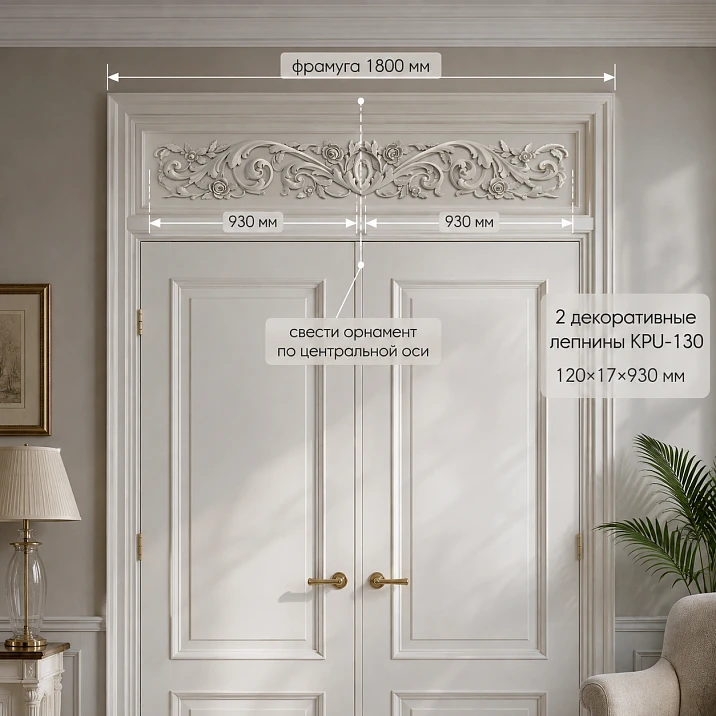
A double door is already in place, the panels align exactly along the central axis, the casings are set, and the upper decorative zone above the panels has a finished width of 1800 mm. Two KPU-130 pieces of 930 mm each are placed on the table, and immediately you get nice arithmetic:
930 + 930 = 1860 mm.
Excess:
1860 − 1800 = 60 mm.
The most obvious solution is to remove 30 mm from each outer edge and get two pieces of 900 mm:
930 − 30 = 900 mm.
900 + 900 = 1800 mm.
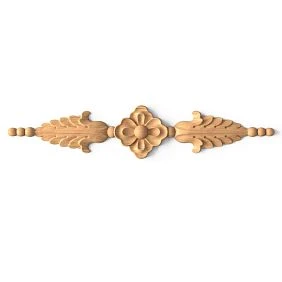
Geometrically, the scheme looks almost perfect. But KPU-130 is not a smooth rail. It is an ornamental decorative molding. Therefore, you cannot cut two pieces at once by 30 mm. First, you need to align them according to the floral pattern in the center of the door, see how the motif continues, fix the actual central joint, and only then determine how much to actually remove from the outer ends.
If the repeat connects naturally and both sides remain symmetrical after alignment, the scheme 30+30 mm may be confirmed. If the central pattern requires a slight shift, the outer trims will already be different.
Therefore, the correct answer is this: for a 1800 mm transom, you preliminarily need two KPU-130 120×17×930 mm pieces, but symmetrical trimming of 30 mm is only an initial hypothesis, not a ready-made instruction.
After dry layout, you can Buy moldings already according to the confirmed geometry of the door portal.
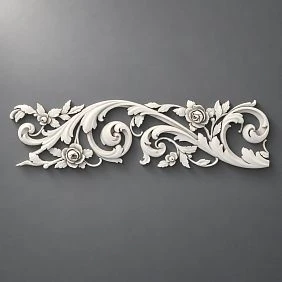
Decorative molding KPU-130 120×17×930 mm: what is confirmed by the card
The current card for KPU-130 confirms one size:
| Parameter | Value |
|---|---|
| Width A | 120 мм |
| protrusion B | 17 мм |
| Length L | 930 мм |
| Material | Polyurethane |
| Price at time of check | 9 990 ₽ |
STAVROS describes KPU-130 as a decorative ornamental strip / decorative trim, not as a regular smooth molding.
The card allows use on furniture, walls, door panels, and in interior compositions.
After checking the joint, you can buy KPU-130 120×17×930 mm in the quantity of two pieces.




Why one KPU-130 definitely does not fit for 1800 mm
One piece — 930 mm. The transom — 1800 mm.
Missing:
1800 − 930 = 870 mm.
Therefore, the option with a single KPU-130 is ruled out immediately. Two give 1860 mm, and the task shifts from "is there enough material" to "how to properly align the pattern."
Our factory also produces:
The central axis of a double door is more important than the outer edges
A double door has a strong architectural axis: the point where the two leaves meet.
If the central joint of the KPU-130 shifts 20–30 mm to the side, the error may be more noticeable than a slight difference at the outer ends.
Therefore, the marking logic is as follows:
-
determine the exact central axis of the door;
-
transfer it to the transom;
-
align the two KPU-130 units at this point;
-
only then check the extreme ends.
Do not first fit both pieces to the trim, and then see where the joint happens to end up.
Get Consultation
Can you simply cut off 30 mm from each outer edge?
Only after checking the pattern.
The calculation itself is correct:
60 / 2 = 30 mm.
But it says nothing about what is in the last 30 mm of the ornament. You need to see where the motif starts and ends, whether there is a large leaf or curl at the edge, whether the two ends are symmetrical, and whether one side will not look visually more "cut off" than the other.
If the last 30 mm is a neutral continuation of the pattern, symmetrical trimming may look natural. If a significant part of the motif is in that area, it is better to first reassemble the central joint.
Central joint of two KPU-130: first the ornament, then the size
Incorrect:
-
cut off 30 mm each;
-
get two pieces of 900 mm;
-
place them on the transom;
-
try to align the pattern in the center.
Correct:
-
place two KPU-130 on a flat surface;
-
align them according to the pattern;
-
find the best visual joint;
-
secure the resulting pair;
-
mark the center of the composition;
-
transfer the pair to the 1800 mm field;
-
measure the actual external excess;
-
only then make end cuts.
Thus, geometry follows the pattern, not the other way around.
What to do if the ideal rapport gives a total length of not 1860 mm
A situation is possible where, for a beautiful joining of two motifs, the parts need to be slightly shifted.
In this article, it is impossible to prescribe a universal method of joining based on a product photo. The correct check is a dry layout of two physical KPU-130 units.
After that, the actual length of the central pair is obtained and calculated:
actual pair length − 1800 mm = total amount of external trimming.
If the result is, for example, 52 mm, the symmetrical option will be 26+26 mm. If it is 68 mm — 34+34 mm.
Paper mock-up 120×1800 mm before purchase
Even before receiving the product, it is useful to cut out a rectangle of 120×1800 mm from paper or cardboard.
It shows the real scale of the future frieze above the door.
It should be checked from a normal distance: from the entrance to the room, from the center of the room, at an angle, with the doors closed and with the door open.
If the paper strip already seems too heavy, it's too early to buy two KPU-130 units. In this case, it's better to open the section where you can buy decorative trim, and choose a different profile.
Will the height of the top field be enough for KPU-130 120 mm
The transom width is 1800 mm — only one size.
You also need to check the height: the top of the door opening to the ceiling, the top of the casing to the ceiling cornice, the height of the transom itself, and the position of adjacent moldings.
KPU-130 with a height of 120 mm should look like an independent horizontal line. If it has to be squeezed between the casing and the ceiling decor, the profile may be too large.
KPU-130 protrusion 17 mm: why a side cut is needed
Frontally, a person sees 120 mm, but the profile protrudes by 17 mm.
If the casing protrudes, for example, by 12 mm, KPU-130 will be about 5 mm further forward. This can be a beautiful intentional effect, but it needs to be seen in advance.
It is useful to make a side cut and show the wall, casing, transom, KPU-130, and ceiling cornice.
Should the KPU-130 match the width of the outer edges of the casings?
Not necessarily.
There are three working schemes:
KPU-130 ends exactly at the outer edges of the casing
The strictest option.
KPU-130 is slightly narrower than the portal
Calm fields remain along the edges.
KPU-130 is wider than the casings
The frieze becomes an independent architectural element.
None of the schemes is a standard. The decision depends on the entire portal.
Two KPU-130s or one other long profile
If the central joint of the plant aligns poorly, there is no need to force the two parts to work together at any cost.
Reasons to decline KPU-130: the pattern does not align at the center, after joining the edges become too different, the central seam is noticeable, the interior is too minimalist, or the 120 mm frieze looks heavy.
Cost of two KPU-130
One piece — 9,990 ₽.
Two:
9 990 × 2 = 19 980 ₽.
This is already a significant amount, so it is not worth turning trimming into an experiment on a finished product. An erroneous cut of one piece means the risk of buying again for another 9,990 ₽ plus new delivery.
Therefore, a dry layout and a paper mock-up are economically justified here.
If you need to compare other products before ordering, a general Moldings shop.
Is a third KPU-130 needed as a spare
For a field of 1800 mm in clean length — no.
Two pieces give 1860 mm.
The third one can only be justified as a separate reserve if:
-
another door will be decorated with the same ornament;
-
the object is remote and redelivery is inconvenient;
-
the installer is working with this profile for the first time;
-
a repair element is needed;
-
the project includes several identical portals.
There is no need to automatically buy a third one "just in case."
If there are two identical double doors in the room
Then it is better to consider both portals at the same time.
If each pair of KPU-130 is fitted separately, the ornament on one door may start at one phase, and on the other — at another.
For a symmetrical interior, this is noticeable.
Better:
-
lay out four parts;
-
identify identical central joints;
-
select the same pattern phase;
-
solve the outer ends identically;
-
label parts by portals.
This is especially useful for hotels, restaurants, lobbies, and other serial interiors.
Polyurethane KPU-130 for painting: when to do the finish
First:
-
dry assembly;
-
matching the repeat;
-
markup;
-
trimming;
-
center control;
-
Edge check.
And only after that do they move on to the chosen finishing technology.
If you paint both parts in advance and then find out that the central joint requires additional fitting, you can damage the coating on the ends.
Therefore, the sequence must be coordinated with the installer and the finisher.
Central seam and light
Even a good joint can look different under different lighting scenarios.
Check:
-
daylight;
-
top lighting;
-
side wall sconce;
-
portal backlighting;
-
light from the adjacent room.
If side light runs along the frieze, even the slightest difference at the central joint becomes more noticeable.
This means that a dry fit should be carried out not only under construction lighting.
How to mark the center of a door
Do not rely only on the geometry of the wall.
The center is taken based on the door composition itself.
Check:
-
meeting point of the door leaves;
-
outer edges of the trims;
-
actual width of the portal;
-
position of the transom;
-
symmetry of the wall section.
If the wall is slightly asymmetric and the door is installed correctly, the KPU-130 should support the door, not the random width of the adjacent wall.
How to avoid a 2–3 mm error in the center
On a long horizontal of 1800 mm, even a slight shift can be read.
Practical procedure:
-
place the laser vertical in the center of the leaves;
-
transfer it to the transom;
-
apply a thin control mark;
-
align the joint of two KPU-130 with this line;
-
check from a distance;
-
only then fix the extreme dimensions.
This way the center does not "drift" due to sequential measurement from one casing to another.
KPU-130 and wooden plinth: how to connect the top and bottom of the portal
The upper stucco frieze does not have to literally repeat the lower plinth.
But they simultaneously participate in the room's architecture.
It is worth comparing:
-
scale;
-
color;
-
degree of decorativeness;
-
profile rhythm;
-
connection with architraves.
If the lower profile is still being selected, you can to buy wooden baseboard after the door portal is approved.
There is no need to pick a skirting board just because it is also "classic." It is important that the top and bottom do not argue in scale.
Buying online: what to check in the product card before payment
If it is decided buy stucco in an online store, before payment you need to check again:
-
article number KPU-130;
-
size 120×17×930 mm;
-
quantity 2 pcs.;
-
current price;
-
deadline;
-
delivery conditions;
-
condition of packaging;
-
possibility of one set if multiple portals are purchased.
What to send to the STAVROS manager
Working specification:
KPU-130 / 120×17×930 mm / 2 pcs. / above a double door / finished decorative zone 1800 mm / central door axis fixed / initial total allowance 60 mm / final trimming determined after pattern alignment / color ___ / casing ___ / free field height ___.
After confirmation, you can order decorative molding KPU-130.
When two KPU-130 not to purchase yet
The order is premature if:
-
1800 mm taken from the project, not from the finished door;
-
central axis not defined;
-
height of the upper field not measured;
-
casing protrusion unknown;
-
paper mockup 120×1800 mm not checked;
-
it is assumed to automatically remove 30 mm each;
-
central rapport not studied;
-
it is not decided how the outer edges end.
Errors when ordering KPU-130 for a 1800 mm transom
Error 1. Immediately saw off 30 mm each
Reason: the arithmetic looks perfect.
Consequence: the central ornament does not match.
How to avoid: first dry assembly according to the rapport.
Error 2. Fit from the left casing to the right
Reason: it is easier to measure this way.
Consequence: the central joint shifts relative to the sashes.
How to avoid: build the composition from the door axis.
Mistake 3. Not accounting for the 17 mm protrusion
Reason: attention is focused on the length.
Consequence: the frieze physically protrudes more than the trim, more than expected.
How to avoid: make a side cut.
Mistake 4. Buying a third piece without reason
Reason: fear of making a mistake when cutting.
Consequence: an extra 9,990 ₽ in the cart.
How to avoid: assess the real risk and do a dry layout.
Mistake 5. Painting before fitting
Reason: want to speed up installation.
Consequence: edges have to be finished after the finish.
How to avoid: first joint and cut, then agreed finish.
How to perform a dry layout of two KPU-130 before cutting
For checking, no complex stand is needed. A flat surface longer than 1800 mm, masking tape, and a precise center mark are sufficient.
First, draw a line of 1800 mm on a table or floor and mark its middle — 900 mm. This mark imitates the central axis of the door. Then lay out two KPU-130 face up and connect them at the intended central joint.
The check is done in the following order:
-
align the plant motif without trimming the outer ends;
-
mark the position of the ornament center;
-
align this center with the 900 mm mark;
-
measure how far the left and right parts extend beyond the 1800 mm field boundaries;
-
compare the two outer ends;
-
only after this apply the cutting lines.
If the left side measures 29 mm and the right side 31 mm, the issue is no longer about forcing 30+30. It is necessary to understand whether the asymmetry yields a better pattern in the center and whether different outer ends are acceptable.
For a symmetrical door portal, identical edges are preferable, but the ornamental logic is checked first.
How to check the outer ends after aligning the central pattern
After the central assembly, attention shifts to the edges.
At the two outer ends, compare:
-
the shape of the last leaf or curl;
-
the distance from the ornament to the casing;
-
the sameness of the visual "break" of the pattern;
-
the possibility of clean butt cutting;
-
the need for an additional smooth pause.
If one edge after cutting looks finished, while the other seems cut off in the middle of the motif, it is better to reassemble the pair again. Sometimes a slight shift of the central joint by a few millimeters gives significantly neater two endings.
That is why in the product article one cannot turn mathematical 30 mm into an installation standard.
KPU-130 and the general catalog of polyurethane decor
If after the layout it became clear that the floral pattern is too active or the central joint is difficult to make convincing, it is wiser to change the profile before purchase. To do this, you can open a polyurethane molding store and compare other types of decorative molding.
When comparing, they look not only at the price and length, but also at:
-
the phase of the ornament on two parts;
-
possibility of central connection;
-
profile height;
-
a protrusion;
-
nature of the outer termination.
This is more important than formal length matching.
The cost of two parts and the cost of a mistake
Two KPU-130 units cost 19,980 ₽ at the card price at the time of checking. If one element is damaged by incorrect end cutting, repurchasing one part adds another 9,990 ₽ excluding delivery.
Therefore, before final ordering, it is useful to open the section again where the Polyurethane molding price, and check the current price.
For such a unit, dry layout is not an unnecessary precaution, but a normal part of the purchasing decision.
Summary: how to order two KPU-130 units for a 1800 mm transom
One KPU-130 has a length of 930 mm.
Two — 1860 mm.
Transom — 1800 mm.
Nominal excess — 60 mm.
Pure symmetric arithmetic gives:
30 mm on the left + 30 mm on the right.
But the correct order is different:
-
buy two KPU-130;
-
align them by the floral ornament;
-
place the central joint exactly on the axis of the double door;
-
measure the actual total length of the resulting pair;
-
distribute the outer trimming;
-
check two edges;
-
only then cut.
If after aligning the pattern the pair indeed remains 1860 mm long and the edges allow identical end cutting, you can remove 30 mm from each outer end.
If a shift is required for a beautiful center, the outer trimmings are recalculated.
Therefore, two KPU-130 units are the correct quantity by length, and the final geometry is determined not by the 30+30 formula, but by the central repeat.
FAQ
What is the size of KPU-130?
120×17×930 mm.
How long is KPU-130?
930 mm.
Will one KPU-130 be enough for 1800 mm?
No. One is short by 870 mm.
Will two KPU-130 be enough?
By total length, yes: two give 1860 mm.
How many extra millimeters do two pieces give?
60 mm.
Can we remove 30 mm from each edge?
This scheme can only be considered after aligning the central ornament.
Where is the best place to make the joint of two KPU-130?
On the central axis of the double door.
Do we need to align the floral ornament?
Yes. The pattern is more important than the mechanical equality of the two pieces.
Why should the joint coincide with the door axis?
Because the double door itself sets a strong symmetrical architectural axis.
Can KPU-130 be installed above a transom?
The card allows use on door and interior compositions, but the specific geometry needs to be checked on site.
What protrusion does KPU-130 have?
17 mm.
Can KPU-130 be painted?
Polyurethane decor is used as a finishing element under the chosen coating system. The specific technology is coordinated with the installer and finisher.
Do I need to buy a third part as a spare?
Not automatically. Two already provide sufficient length. A third is only needed as a deliberate reserve.
How much do two KPU-130 cost?
19,980 ₽ at the card price at the time of checking.
Where to buy decorative moldings?
In the STAVROS decorative molding category.
Where to buy molding?
In the general catalog of STAVROS polyurethane decor.
Where to order KPU-130?
In the KPU-130 product card.
How to combine KPU-130 with door casings?
Need to check the outer width of the portal, the height of the frieze, and the protrusion of the casings in the side section.
How to combine a stucco frieze with a wooden baseboard?
It is not necessary to repeat the same pattern. More important is to coordinate the scale, color, and degree of ornamentation.
What to do if the center only aligns beautifully with an offset?
Fix the correct central repeat, measure the actual length of the pair, and recalculate the outer cuts.
Can you start cutting from the outer edges?
No, you shouldn't. First, the central node is assembled, then the edges are determined.
When is it better to replace KPU-130 with another profile?
When the central ornament doesn't align well, the 120 mm frieze overloads the portal, or the height of the upper field is insufficient.