Article Contents:
- Short answer: how many N-434.1 you need to buy
- What is N-434.1 and why does the buyer need it
- Confirmed specifications of N-434.1
- Why it is more profitable to buy N-434.1 as part of a system rather than a separate random overlay
- The central element is not a mandatory part of every frame
- What counts as a standalone molding frame
- Why the number of doors does not equal the number of N-434.1
- Option 1. One common frame
- Option 2. Separate frame on each door
- Option 3. Central frame and calm side sections
- Option 4. Two overlays on one frame
- Only upper center
- Only lower center
- Upper and lower center
- Without central overlay
- Beech for enamel
- Oak for tinting
- Cabinet
- Sideboard
- Showcase
- Kitchen front
- Built-in library
- Commode
- One large frame
- Two independent frames
- Three frames
- How many N-434.1 are needed for a three-door wardrobe?
- Do I need to buy one N-434.1 for each door?
- Can one frame require two overlays?
- Can I install N-434.1 only on the central section?
- What size is N-434.1?
- What is the 25 mm thickness used for in the calculation?
- Which molding is N-434.1 associated with?
- Can I use a different molding?
- What to choose: beech or oak?
- How is "Standard" different from "Prestige"?
- Can N-434.1 be installed next to a handle?
- Can N-434.1 cover the joint of two doors?
- Is a 1:1 template needed?
- What is included in the purchase of one N-434.1?
- Do I need to buy N-434.1 together with MLD-003?
- Is N-434.1 suitable for a wall?
- Is N-434.1 suitable for an interior door?
- How to calculate the quantity for a wall panel?
- Can N-434.1 be trimmed?
- When is it better to avoid N-434.1?
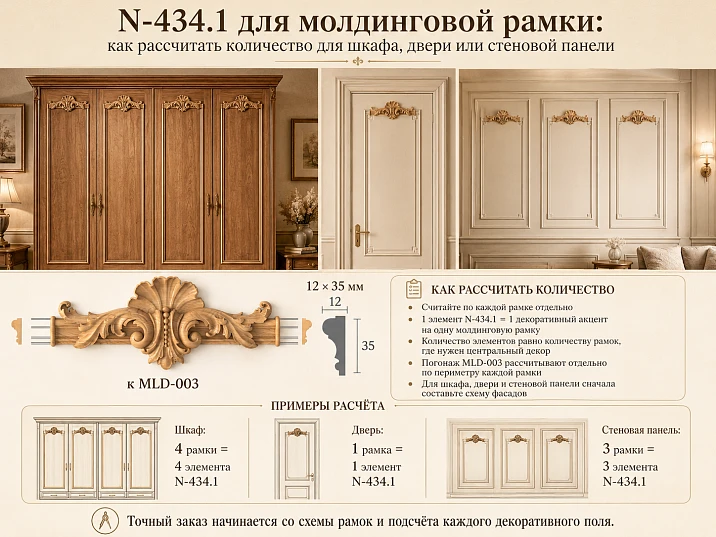
The central decorative element N-434.1 is not purchased "by the number of doors" or "by the number of cabinet sections." Its quantity is determined by how many independent molding frames are provided in the project and how many central positions each frame has. It is this difference that most often causes errors: a cabinet may have three doors but one common frame and only one center; while one large wall panel may have two separate frames, each with an upper and lower central overlay.
Buy the central element N-434.1 makes sense when the buyer wants not a random carved detail on the facade, but a complete system: a frame from a compatible molding, a clear central axis, coordinated corners, and a single material under the chosen finish. N-434.1 helps make furniture, a door, or a wall panel more expressive, but its main practical value lies in the precise completion of the molding composition. It connects the straight sections of the frame, sets the center, and eliminates the feeling that the decor was simply "glued onto an empty space."
In this article, we will examine why it is more beneficial for the buyer to first create a map of the frames, then count the central positions, and only after that order N-434.1 together with MLD-003. This approach helps purchase the exact number of parts, avoid unnecessary expenses, not face a shortage of one overlay at the end of installation, and maintain the same material, sanding, and future finish throughout the entire composition.
Short answer: how many N-434.1 you need to buy
The quantity of N-434.1 equals not the number of doors, but the sum of all central positions provided by the project.
One frame can have:
-
one overlay on top;
-
one overlay on the bottom;
-
two overlays — on top and on the bottom;
-
not a single overlay, if the central zone is occupied by a handle, lock, or another element;
-
one common overlay for a composition that unites several doors.
Therefore, the correct calculation looks like this:
-
determine the boundaries of each independent frame;
-
assign numbers to the frames;
-
mark the top, bottom, and, if necessary, side centers;
-
apply handles, locks, hinges, and opening lines;
-
count only confirmed positions N-434.1;
-
add a reasonable reserve if it is needed for the project and agreed with the client;
-
order the entire set in one batch together with the molding and other system elements.




What is N-434.1 and why does a buyer need it
N-434.1 is a wooden central element for a molding frame. Its purpose differs from that of corner decor. The corner completes the turn of the frame, while the central overlay forms the semantic center of the horizontal section. It can be placed on the top or bottom rail, emphasize the axis of the facade, unify the composition around handles, and support the classical architecture of furniture or a wall.
A buyer needs N-434.1 not because "it's just prettier overall," but because it solves specific tasks:
-
completes the long horizontal line of the molding;
-
makes the center of the frame readable;
-
helps connect several furniture sections into one composition;
-
allows highlighting the central door of a cabinet or sideboard;
-
supports symmetry relative to handles, a mirror, a doorway, or the axis of the wall;
-
replaces random decor with a coordinated system element;
-
helps order molding, corners, and central overlays as a single set;
-
reduces the risk of mismatch in wood species, preparation, and finishing;
-
makes the facade complete without excessive carving.
If you limit yourself to just the molding, the frame can look calm and concise. If the project requires a more expressive classical presentation, N-434.1 creates a center that gathers the entire pattern. Therefore, the purchase is justified where the central axis is truly needed, not just because the part is available in the catalog.
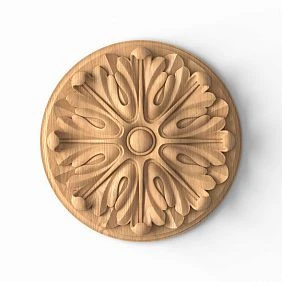
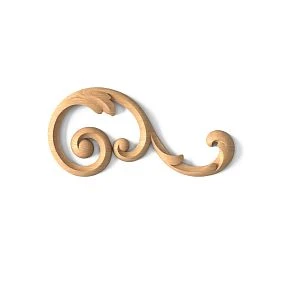
Our factory also produces:
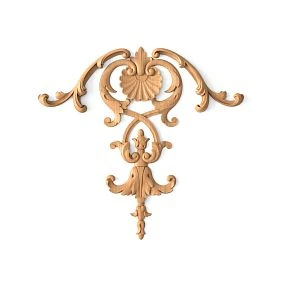
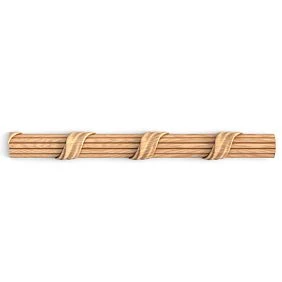
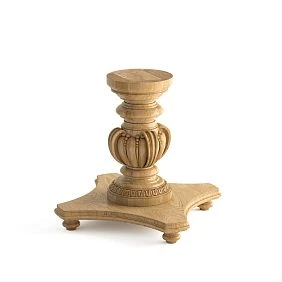
Confirmed characteristics of N-434.1
| Parameter | Confirmed value | What this gives the buyer |
|---|---|---|
| Article number | N-434.1 | Allows you to specify the model precisely in the specification |
| Product type | Central decorative element for a molding frame | Needed for the central position, not for a corner or joint |
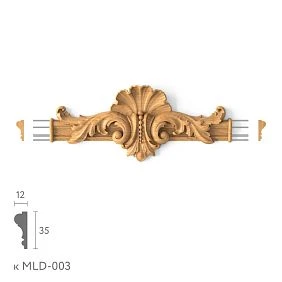
| Size | 303 × 127 × 25 mm | Helps to check the free field and the protrusion above the base |
| Material | Beech or oak | You can choose the wood species for opaque or transparent finishing |
| Preparation | "Standard" or "Prestige" | Allows to coordinate the amount of independent finishing |
| Beech finish | For enamel | Suitable for painting in the color of the facade, wall, or door |
| Oak finish | For tinting | Suitable for projects with visible wood texture |
| Main role | Central frame element | Forms the axis and completes the horizontal composition |
| Confirmed system | MLD-003 and decor of the 003 series | Provides a clear purchase path for compatible parts |
| Main URL | N-434.1 measuring 303 × 127 × 25 mm | The card checks current variants and parameters |
The size 303 × 127 × 25 mm cannot be assessed only by the first digit. The width of 303 mm determines the length of the occupied horizontal area, the height of 127 mm affects the distance to the inner field of the frame, handles, and adjacent parts, and the thickness of 25 mm shows how much the relief protrudes above the base. For a furniture door or a narrow partition, the protrusion is especially important: it must not interfere with opening, hand movement, or the operation of the adjacent leaf.
Get Consultation
Why it is more profitable to buy N-434.1 as part of a system rather than a separate random overlay
A separate carved overlay may appeal in a photo, but the buyer cares not only about the pattern. The central element must align with the molding line, support its scale, not look too massive, and be prepared for the same finish. That is why it makes sense to consider N-434.1 together with MLD-003.
buy wooden molding MLD-003 it is worth doing simultaneously with the approval of the central overlay. Then you can check in advance:
-
whether the molding profile fits the side sections of N-434.1;
-
whether the selected wood species matches;
-
whether the frame will be painted or tinted with one system;
-
whether there are enough straight sections between the corners and the central element;
-
is it necessary to change the width of the frame;
-
how many linear meters of molding are needed;
-
how many central positions are provided;
-
is there space for handles and locks;
-
what level of surface preparation is needed for the entire set.
Purchasing a system reduces the number of random decisions during installation. The craftsman gets not a set of disparate parts, but a coordinated scheme: straight sections, a central element, corner joints, and a clear position on the base. This is especially useful when making a cabinet, built-in library, sideboard, wall panel, or a series of doors, where an error is repeated across several sections at once.
The central element is not a mandatory part of every frame
N-434.1 enhances the composition, but this does not mean it should be placed in every frame. Sometimes the best commercial choice is to buy fewer overlays, but use them where they are truly noticeable and justified.
The central element is especially useful:
-
on a wide frame, where a long section of molding looks empty;
-
on the central section of the cabinet;
-
above double doors;
-
in the upper part of the sideboard or display case;
-
on the main wall panel;
-
above the console, fireplace area, or mirror;
-
on an interior door with a pronounced central axis;
-
in a composition where the side sections remain calm.
N-434.1 can be omitted:
-
on a very narrow frame;
-
if there is a handle in the center;
-
if another large decor is already in use;
-
if the frame should be laconic;
-
if the width of the straight section is insufficient;
-
if the 25 mm protrusion interferes with opening;
-
if the decorative system is not connected to MLD-003;
-
if the facade is minimalist and central carving would be stylistically alien.
An honest calculation helps the buyer not overpay for unnecessary parts and at the same time not save where without the center the frame looks unfinished.
What counts as an independent molding frame
An independent frame is not necessarily one furniture door. It is a complete decorative contour with its own axis, inner field, and clear boundaries.
An independent frame usually has:
-
closed or design-completed contour;
-
own horizontal axis;
-
inner field;
-
corner or finishing elements;
-
separate role in the overall composition;
-
own logic of symmetry;
-
own top and bottom center.
The frame boundary may coincide with the door boundary, but this is not a mandatory rule. For example, a molding may run across a common overlay panel and visually unite three doors. Then the customer sees one frame, although functionally the furniture is divided into three leaves.
The reverse situation is also possible: one wide furniture section contains two separate decorative frames. Then it will be necessary to calculate the centers of each of them separately.
Why the number of doors does not equal the number of N-434.1
The formula "three doors — three overlays" is convenient, but almost always too rough. It does not take into account the facade architecture.
Let's consider several options for one three-door wardrobe.
Option 1. One common frame
The molding runs along the common outer panel and unites all three doors. In the center of the upper horizontal section, one N-434.1 is provided. The number of doors is three, the number of independent frames is one, the number of central positions is one.
The buyer needs to order one overlay, not three.
Option 2. Separate frame on each door
Each door has its own complete contour. At the top center of each frame, there is N-434.1. The number of doors, frames, and central positions matches — three each.
But even here, you cannot automatically buy three elements: on the side doors, you can leave only the molding, and install the central overlay on the main door.
Option 3. Central frame and calm side sections
The wide middle door gets a frame with N-434.1, the side doors are designed more calmly. The buyer needs one central overlay.
Such a solution often looks more convincing than a mechanical repetition of carving on each door. It emphasizes the center of the wardrobe and helps reduce the cost of the set without losing expressiveness.
Option 4. Two overlays on one frame
On one tall frame N-434.1, install from top and bottom. Number of frames — one, number of overlays — two.
Consequently, even the formula "one frame — one overlay" does not always work.
One common frame for the entire cabinet: why the customer needs it
A common frame helps visually assemble a wide cabinet into a single architectural form. It is useful when the customer wants to reduce the fragmentation of the facade and hide the feeling of several randomly placed doors.
Advantages of a common frame:
-
the cabinet looks more cohesive;
-
the central axis becomes clear;
-
fewer corner and central elements are required;
-
the risk of visual overload is reduced;
-
you can use one N-434.1 as the main accent;
-
it is easier to coordinate the finish;
-
the molding connects different sections;
-
the decorative center does not conflict with each individual handle.
However, the overall frame should be designed with functional seams in mind. The molding and overlay should not interfere with door opening, cross working gaps, or block access to fasteners. Before ordering, all doors, seams, and handles should be marked on the drawing.
A separate frame on each door: when this option is justified
Separate frames suit furniture where each door should read as an independent panel. This is typical for sideboards, libraries, display cases, kitchen fronts, and classic cabinets with a pronounced modular rhythm.
The buyer receives:
-
a clear structure for each door;
-
the ability to replace or remove one door;
-
a repeatable decorative module;
-
expressive rhythm;
-
ability to use N-434.1 only on selected sections;
-
flexibility in combining solid and glass facades.
Disadvantage — more parts and a higher price for the full set. In addition, repeated use of N-434.1 may be too active. Therefore, before purchasing, you need to compare two layouts: with all central overlays and with only one accent section.
Central section as the main commercial scenario
For a three-section wardrobe, sideboard, or built-in library, it is often advantageous to buy one N-434.1 for the middle section. The side frames remain calm and support the center with straight MLD-003 sections.
This approach offers several advantages:
-
the buyer spends less on central decor;
-
the main accent is not fragmented;
-
the wide middle section gets sufficient visual weight;
-
the side doors are not overloaded;
-
handles are easier to place;
-
the composition is perceived as more expensive and meaningful;
-
it is easier to match furniture with the architecture of the room.
Here, N-434.1 is bought not "to fill the void," but to control attention. It shows where the center of the furniture is and connects the top line of the frame with the overall axis of the facade.
Top and bottom center: one or two overlays
One frame can have one N-434.1 on top, one on the bottom, or two at once. The choice depends on the height, the location of the handles, and the overall saturation of the decor.
Only top center
The most versatile option. The central overlay is located above the active contact zone, does not interfere with the handle, and supports the upper architecture of the furniture. Suitable for cabinets, doors, display cases, and wall panels.
Only bottom center
Used less often. Suitable for compositions where the top is already occupied by a cornice, mirror, another overlay, or complex decor. It is necessary to check whether the element interferes with leg movement, nearby furniture, or cleaning.
Top and bottom center
Creates pronounced symmetry. Suitable for a tall frame, door, or large wall panel. The buyer should consider that two N-434.1 double the number of central parts and increase the decorative load.
Without central overlay
A rational option if the frame is narrow, the handle is on the axis, or the furniture itself is already rich in carving. In this case, it is enough to purchase MLD-003 and suitable corner elements.
Formula for calculating the quantity of N-434.1
The universal formula looks like this:
Quantity of N-434.1 = sum of all approved top, bottom, and side central positions for each frame.
There is no need to multiply the number of doors, sections, or cabinets by the same coefficient. First, a list is compiled.
| Frame | Top center | Bottom center | Side centers | Quantity N-434.1 |
| P-01 | 1 | 0 | 0 | 1 |
| P-02 | 1 | 1 | 0 | 2 |
| P-03 | 0 | 0 | 0 | 0 |
| P-04 | 1 | 0 | 0 | 1 |
| TOTAL | 3 | 1 | 0 | 4 |
The report shows not only the total but also the location of each part. This is useful for ordering, receiving, and installation. If the overlays are distributed across different rooms or furniture items, a column with the object name is added to the table.
Practical calculation examples
| Object | Number of doors or sections | Independent frames | Center scheme | How many N-434.1 to buy |
| Double-door cabinet with a common frame | 2 | 1 | Only the top center | 1 |
| Three-door cabinet with a frame on each door | 3 | 3 | One top center each | 3 |
| Three-section cabinet with a center accent | 3 | 1 accent + 2 calm | One center on the middle section | 1 |
| Tall interior door | 1 | 1 | Top and bottom center | 2 |
| Wall panel with two frames | 2 fields | 2 | One top center each | 2 |
| Sideboard with top and bottom group of fronts | 6 doors | 4 frames | Two top overlays | 2 |
These examples are not a mandatory manufacturer scheme. They show why it is important for the buyer to count not doors, but real center positions.
Full-size template 303 × 127 × 25 mm
Before ordering, it is useful to make template N-434.1 at 1:1 scale. It helps to see the real size, check the free space, and not make a decision based only on the image on the screen.
The template must show:
-
outer contour 303 × 127 mm;
-
geometric center;
-
axis MLD-003;
-
left and right borders;
-
top and bottom;
-
position of adjacent corners;
-
handles;
-
locks;
-
hinges;
-
facade edge;
-
seams between doors;
-
opening line;
-
side protrusion 25 mm.
To check the depth, make a separate side strip 25 mm wide or a simple volumetric cardboard mockup. This is especially important on a door, narrow facade, or wall near a passage.
Why the size 303 × 127 × 25 mm matters for purchase
A width of 303 mm requires a sufficiently long straight section of molding. If the frame is narrow, the central element may approach the corners and visually "compress" the composition.
A height of 127 mm affects the inner field. The overlay must not overlap the panel, press against the glass, conflict with the handle, or extend beyond the panel boundary.
A thickness of 25 mm affects side visibility and usability. On a wall panel, this protrusion is usually perceived as relief. On a furniture door, it may interfere with the adjacent leaf, hand movement, or drawer opening.
It is beneficial for the buyer to check all three parameters before payment. Then there will be no need to change the layout, move the handle, or reject the part after receipt.
How to position N-434.1 on the central axis
The geometric center of the frame is found by its clean internal or external dimension — depending on the design scheme. However, the visual center does not always coincide with the mathematical one.
The perception is influenced by:
-
handle;
-
the lock;
-
glass insert;
-
asymmetric panel;
-
adjacent pilaster;
-
cornice;
-
side sections;
-
different door widths;
-
position of furniture relative to the wall.
First, mark the geometric axis, then evaluate the composition as a whole. If N-434.1 is formally centered but looks offset due to a handle or another strong detail, adjust the entire assembly rather than randomly moving the overlay.
N-434.1 and furniture handle
The handle and central overlay often compete for the same axis. If placed too close together, the customer gets a beautiful facade that is inconvenient to use.
Before ordering, check:
-
wrist movement;
-
handle grip;
-
distance to relief;
-
opening of the adjacent door;
-
position of mounting holes;
-
handle height;
-
symmetry of paired doors.
Possible solutions:
-
raise N-434.1 higher;
-
move handle lower;
-
choose two handles on the sides;
-
use one overlay only on top;
-
abandon the lower center;
-
make a common frame for several doors;
-
choose a calmer option without central decor.
It is not allowed to drill N-434.1 for a handle or change its contour without separate technical approval. It is easier and safer for the buyer to separate functions: the carved element is responsible for the center, and the handle is for convenient opening.
Why N-434.1 is worth buying together with MLD-003
Compatibility is the main argument in favor of a systematic purchase. Central decor for MLD-003 helps achieve a coordinated transition between the straight profile and the carved part.
If you buy a random molding, problems may arise:
-
the profile does not match in height;
-
the molding line does not fit into the pattern of the overlay;
-
the width of straight sections looks random;
-
the wood species differs;
-
the finish absorbs differently;
-
the corners do not align with the center;
-
the craftsman has to adjust the parts on site;
-
the frame looks assembled from different sets.
Purchasing N-434.1 and MLD-003 as a set simplifies design and reduces the risk of rework. The buyer knows in advance which profile is used, how many meters are needed, and where the central elements are located.
How to calculate the length of MLD-003 next to N-434.1
First, determine the full perimeter of the frame, then subtract the sections occupied by the central and corner elements, and add a technological allowance for cutting if it is provided for in the project.
The exact dimensions of the straight sections depend on:
-
the frame size;
-
quantities N-434.1;
-
positions of the pads;
-
corner constructions;
-
joining method;
-
molding pattern;
-
actual length of supplied strips;
-
cutting map.
General material on how to calculate straight sections of a molding frame, useful before placing an order. It helps move from a decorative idea to a quantitative list.
What to buy together with N-434.1
The central element is rarely purchased in isolation. A finished frame requires straight profiles, corner solutions, mounting materials, and coordinated finishing.
| What to add to the purchase | Why is this needed | For which scenario | What to pay attention to | Link |
| MLD-003 | Forms straight sections of a compatible frame | Cabinet, door, wall panel | Wood species, length, cutting | buy wooden molding MLD-003 |
| Central and corner parts | Complete the frame as a system | Complex classic composition | Do not mix random series | Decor for Molding |
| Other wooden moldings | Allow comparing the scale of profiles | When MLD-003 does not fit the task | Check compatibility with selected decor | View wooden moldings for frames |
| Installation materials | Needed for attachment to a specific base | Furniture, door, wall | Base, finish, weight, method of fixation | Materials for installing wooden decor |
| Selection of surface preparation | Helps coordinate the amount of finishing | Enamel, tinting, transparent finish | "Standard" or "Prestige" | Select preparation N-434.1 for finishing |
| Design project | Needed for a complex multi-section facade | Large cabinet, library, wall system | Axes, frames, handles, quantity | Calculate N-434.1 for multi-section facade |
It is beneficial for the buyer to assemble the set before starting the facade finishing. Then all parts can be tried on, checked in place, marked, and prepared in one sequence.
How to choose corner and center elements without overload
The central overlay should be the main or supporting accent, not one of many equally active parts. Before ordering, it is useful to study, how to choose corners and center elements for the frame.
For a calm composition, it is enough:
-
one type of molding;
-
one central element;
-
coordinated corners;
-
single finish.
For a more complex system, you can add side or paired elements, but each new element must solve a task. If carving appears in every free space, the buyer pays more, and the facade looks less cohesive.
How to assemble wooden decor into a single system
For a complex project, it is important not only to buy N-434.1 and MLD-003, but also to coordinate them with other furniture or interior details. The material about how to assemble wooden decor into a single system, helps to check the repetition of motifs, scale, and finish.
Unity is created by:
-
the same wood species;
-
one level of preparation;
-
a coordinated profile;
-
repeating axis;
-
similar thread character;
-
unified color system;
-
same degree of gloss;
-
well-thought-out number of accents.
The buyer doesn't necessarily need to use a lot of decor. It's much more valuable when several elements are truly connected to each other.
Beech or oak: which option N-434.1 to buy
Beech for enamel
Beech is logical for covering finishes. It is chosen when N-434.1 needs to be painted in the color of the facade, door, molding, or wall.
The buyer receives:
-
calm base for enamel;
-
the ability to make the carving part of the painted architecture;
-
single color with furniture;
-
emphasis on shape rather than wood texture;
-
convenient option for white, colored, and complex opaque coatings.
Oak for tinting
Oak is chosen when the texture should remain visible. Tinting, stain, or a transparent system highlights the wood grain and makes the central element a standalone detail.
The buyer receives:
-
noticeable texture;
-
more pronounced play of light;
-
ability to tie decor with oak facades;
-
natural wooden character;
-
suitable option for libraries, studies, doors, and wall panels.
N-434.1 and MLD-003 should preferably be ordered from the same wood species. Mixing beech and oak in one frame complicates finishing and may result in different shades even under an opaque coating.
"Standard" or "Prestige": what the buyer pays for
| Criterion | "Standard" | «Prestige» |
| Preparation | Basic machine processing | More thorough manual finishing |
| For whom | For a workshop ready to refine the decor | For a project where they want to reduce the amount of independent sanding |
| Close viewing distance | Requires especially careful inspection | More convenient for furniture and doors viewed up close |
| Transparent finish | May require additional preparation | More rational for complex tinting and visible texture |
| Large number of elements | More manual work before finishing | Helps standardize batch preparation |
| Cost | More affordable configuration | Higher due to additional processing |
The choice depends not on an abstract idea of quality, but on the actual process. If the workshop sands the entire set before enamel itself, "Standard" may be rational. If N-434.1 is installed on a visible facade, oak and transparent finish are used, "Prestige" reduces the amount of complex finishing of the relief.
Where N-434.1 is especially useful
Wardrobe
On a cabinet, the central overlay helps assemble several doors into a single architecture. It suits a common frame or a highlighted central door.
Sideboard
On a sideboard, N-434.1 can emphasize a wide middle section, the upper display part, or a central drawer. The main thing is not to repeat large decor on every small door.
Showcase
On a display case, the overlay helps connect glass fields with a wooden frame. It is necessary to check that the 127 mm height does not cover the glass or disrupt the light opening.
Kitchen facade
In the N-434.1 kitchen, it is better to use selectively: on the exhaust portal, tall column, central section, or decorative panel. Repeating it on every facade can complicate maintenance and overload the composition.
Built-in library
For a library, the central element is useful on wide upper frames, above the central passage, or in a composition around the door. The oak version under tinting helps tie the decor to the solid wood and veneered surfaces.
Chest of drawers
On a dresser, one N-434.1 can be placed on the top frame or central door. On each drawer, such an element is usually redundant.
N-434.1 for wall panel
On the wall, the number of overlays is calculated by individual panel fields. A large wall can have one common frame, several identical sections, or a central composition with calmer side areas.
N-434.1 helps:
-
highlight the central panel;
-
decorate the area above the console;
-
connect the boiserie with the door;
-
create an upper center of a tall frame;
-
support the symmetry of the room;
-
connect moldings and carved decor in one system.
Before purchasing, check the scale from a distance. The size 303 × 127 mm may be noticeable on furniture, but on a large wall it will be perceived more calmly. The thickness of 25 mm creates a shadow, so it is important to evaluate side lighting.
For a wall project, it is useful to compare Decor for Molding and choose not only the central overlay, but also the entire set for finished frames.
N-434.1 for an interior door
On the door N-434.1 can be located in the upper center of one large frame or in two centers of a tall composition. The buyer needs to check:
-
opening direction;
-
distance to the casing;
-
position of the handle and lock;
-
the thickness and construction of the door leaf;
-
the possibility of reliable fastening;
-
the protrusion of 25 mm;
-
readability on both sides;
-
compatibility with the rest of the opening's decor.
On a double door, one common overlay above the central joint is possible, but only if it is attached to a fixed or specially provided surface. The element cannot be automatically placed on the working seam of two leaves.
N-434.1 for a wall frame around a mirror or picture
The central element can complete the top part of the frame around a mirror, panel, or decorative insert. Here it is purchased for the architectural center and coordination with the interior.
It is necessary to check:
-
whether the overlay covers the reflection;
-
whether the straight section of MLD-003 is sufficient;
-
whether the axis aligns with the mirror;
-
whether the relief conflicts with the lighting;
-
whether the material matches the frame and furniture;
-
whether the part can be securely attached;
-
whether there is too much decor around the object.
How not to confuse N-434.1 with other products
N-434.1 is a wooden central element of the system, not a corner piece, not a connector, and not a polyurethane analogue.
Before ordering, check:
-
exact article number;
-
material;
-
size 303 × 127 × 25 mm;
-
purpose of the central element;
-
compatibility with MLD-003;
-
preparation "Standard" or "Prestige";
-
version for enamel or tinting;
-
main product page URL.
It is especially important not to mix wooden N-434.1 with NPU-434.1. Similarity in number does not mean the same material, geometry, profile, or method of application.
If a different design, scale, or role is needed, it is wiser to look at the category rather than try to modify N-434.1 by trimming. View wooden moldings for frames and available decor is useful before final approval of the system.
Installation: why the mounting method cannot be chosen in advance for all substrates
N-434.1 can be used on a furniture facade, door, wall panel, or other substrate. There is no universal mounting for all cases.
Before installation, check:
-
base material;
-
its thickness;
-
strength of the face layer;
-
surface evenness;
-
weight of the part;
-
future finishing;
-
compatibility of the mounting compound;
-
need for mechanical fixation;
-
ability to temporarily hold the element;
-
access from the reverse side;
-
wiring position on the wall;
-
movement of doors and drawers.
Materials for installing wooden decor are chosen after determining the base and finishing technology. The buyer should not buy random glue together with the overlay without checking compatibility.
Finishing before or after installation
The decision depends on the project.
Finishing before installation is convenient when:
-
you need to paint a complex relief;
-
the part is tinted separately;
-
the base is already ready;
-
it is important to protect adjacent surfaces;
When it's better to choose a different solution
-
The frame is too narrow;
-
N-434.1 does not fit without trimming;
-
A corner element is required;
-
A connector is needed for the intersection of moldings;
-
A polyurethane system is used;
-
The 25 mm protrusion interferes with operation;
-
The handle occupies the central axis;
-
The facade is minimalist;
-
A different theme is needed;
-
MLD-003 is not suitable for the project;
-
the base does not support the chosen mounting method.
-
open the N-434.1 card;
-
check the size;
-
choose beech or oak;
-
compare "Standard" and "Prestige";
-
select MLD-003;
-
view the decor category;
-
choose mounting materials;
-
coordinate a complex facade through the design project;
-
order the exact quantity according to the list.
Another option is needed if:
In such cases, it is useful to open Decor for Molding and compare the roles of the elements, rather than trying to use N-434.1 for unintended purposes.
Why buying from STAVROS is more convenient than random selection
The main advantage is the ability to assemble a system kit based on verified product and category pages. The buyer can:
Random selection by images often results in mismatched profile, scale, and finish. At STAVROS, the buyer moves from a specific system to a complete set, not the other way around.
How to place an order for STAVROS
First open the card and order N-434.1 in beech or oak after checking the size template.
Next:
-
determine the number of frames;
-
create a list of central positions;
-
select top and bottom centers;
-
check handles and working seams;
-
calculate MLD-003;
-
select the wood species;
-
determine 'Standard' or 'Prestige';
-
specify the future finish;
-
coordinate the installation;
-
process the entire set as one batch.
For a complex cabinet, wall system, or series of doors, it is useful Calculate N-434.1 for multi-section facade before placing the order.
Why accurate calculation saves money even before purchase
The main financial benefit of an accurate list is that the buyer pays not for a conditional set "just in case," but for parts that will actually occupy specific places. An error in calculation works both ways.
If you order too many N-434.1, expensive carved elements will remain that are difficult to use in another project. Their size, profile, and material are tied to the MLD-003 system and the approved finish. The remainder cannot be automatically transferred to other furniture: the wood species, color, frame scale, or handle placement may not match.
If you order too few, another problem arises. The missing overlay will have to be ordered separately, which means additional waiting, separate delivery, and the risk of the new batch differing in wood shade or surface preparation. Installation may stop at the final stage when moldings are already cut, facades are prepared, and one central position remains empty.
Accurate calculation helps the buyer:
-
immediately understand the cost of the central decor;
-
compare a calmer and a more saturated configuration;
-
avoid unnecessary repetition on side sections;
-
include MLD-003 and mounting materials in the budget in advance;
-
avoid a separate additional order;
-
coordinate the quantity with the master before finishing;
-
keep the same wood species and preparation for the entire batch.
Therefore, the commercial meaning of N-434.1 lies not only in the decorative effect. It is a controlled specification item: the buyer knows why each part is needed and where it will be installed.
One, two, or three frames: how to choose the configuration before ordering
The number of frames affects not only the count of N-434.1 but also the overall character of the furniture.
One large frame
One common frame suits a wide cabinet, panel, or built-in system that needs to be perceived as a single architectural object. The buyer needs just one strong center. This scheme reduces the number of overlays and corners, makes the facade calmer, and helps hide the fragmentation of multiple doors.
Buying one N-434.1 is reasonable if the common frame truly has one center and does not cross working seams. This option is especially beneficial for a wide cabinet with a central axis, a wall panel above a console, or a two-door composition where the decor is placed on a fixed part.
Two independent frames
Two frames suit paired doors, symmetrical wall fields, or two side sections. Here the buyer decides whether two identical N-434.1 are needed or only one overlay on the main frame.
A fully symmetrical set is convincing when the frames are equal in size and aligned. An asymmetrical option suits an interior where one section is primary and the other is supporting. Before purchasing, it is useful to print two mockups: one with two centers and one with a single center.
Three frames
Three frames are often found on cabinets, bookcases, and wall panels. The most common mistake is automatically buying three central overlays. In practice, different schemes are possible:
-
three identical centers;
-
one N-434.1 on the middle frame;
-
two overlays on the side frames and a calm center;
-
one common top composition above three sections;
-
top centers on all frames without bottom ones;
-
a central frame with two overlays, side frames without decor.
It is beneficial for the buyer to compare these options before ordering, because the difference in quantity can be significant, and the external result can be fundamentally different.
Why it is better to order the entire set in one batch
N-434.1, MLD-003 and other wooden elements should be perceived as one system. Ordering in one batch simplifies not only logistics, but also subsequent finishing.
Wood may have natural differences in shade and grain. With opaque enamel, they are less noticeable, but the preparation and behavior of the surface still matter. When tinting oak, the differences become part of the appearance, so it is better to coordinate the set in advance.
Ordering simultaneously helps:
-
get parts from the same wood species;
-
choose the same level of preparation;
-
conduct a common test coating;
-
lay out all elements within the frames;
-
check transitions before installation;
-
perform finishing in one technological sequence;
-
reduce the risk of differences between the main order and the additional order;
-
generate one set of documents and one list.
If the project is large, each N-434.1 is marked by frame number: R-01, R-02, R-03. Moldings and corner elements receive the same designations. Then the craftsman will not confuse parts after sanding and painting.
Control sample before finishing the entire batch
It is beneficial for the buyer to approve the finish not on a small flat bar, but on a fragment that shows the actual relief. Shadows, recesses, and end sections of N-434.1 may look different than the flat surface of the facade.
The control sample helps to check:
-
color in carving recesses;
-
uniformity of enamel;
-
manifestation of oak texture;
-
gloss level;
-
compatibility of the coating with MLD-003;
-
the need for additional sanding;
-
the behavior of patina or tinting on the relief;
-
appearance under daylight and artificial lighting.
After the sample is approved, the craftsman transfers the technology to the entire set. This reduces the risk that the central overlay will turn out darker, lighter, or more glossy than the straight parts of the frame.
Acceptance of N-434.1 before installation
Receiving the order is not the moment for immediately gluing parts. First, the set is checked against the list.
Check:
-
quantity of N-434.1;
-
article number on documents;
-
size 303 × 127 × 25 mm;
-
selected wood species;
-
level of preparation;
-
absence of random mixing of beech and oak;
-
condition of the relief and edges;
-
correspondence to the number of upper and lower centers;
-
presence of MLD-003 according to the cutting map;
-
set of mounting materials, if ordered separately.
Next, the parts are laid out on frames and applied to the full-size drawing. Such a check detects an error before painting and installation. If one position does not match the project, it is easier to clarify it while the facades are not yet finally prepared.
How N-434.1 adds value to finished furniture
The buyer purchases the central overlay not for the part itself, but for the result. A properly installed N-434.1 makes the furniture visually more cohesive and individual.
It helps:
-
turn a standard facade into an author's composition;
-
designate the main module of the cabinet;
-
connect furniture with moldings and panels of the room;
-
support the classic character of the interior;
-
add relief without replacing the entire facade structure;
-
use natural wood in the visible area;
-
coordinate furniture with doors, boiserie, or library;
-
create a finished look for a private or commercial project.
For a furniture workshop, such an element expands the product's capabilities: the client can be offered a basic frame, a frame with one center, or a richer configuration. The buyer sees a clear difference and chooses an option based on budget and style.
N-434.1 in a commercial interior
In a restaurant, hotel, salon, boutique, or showroom, central decor helps create a memorable look without crafting complex carvings from scratch. N-434.1 can be used on a counter, wall panel, door, display window, or built-in cabinet, if it matches the project's style.
The advantage of a ready-made element for a commercial property is repeatability. You can design several frames using one scheme, calculate the quantity in advance, and replace random manual improvisation with a coordinated system.
It is important to consider the intensity of use. The overlay should not be in an area of constant impacts, movement of carts, bags, or hands. The 25 mm protrusion is checked against walkways and door openings. For public spaces, a reliable base and a coordinated installation method are especially important.
How to choose between a single N-434.1 and a more subdued frame
The buyer does not always need a central element. The decision can be made based on five questions:
-
Does the frame have a long horizontal section that looks unfinished?
-
Does the furniture or wall need a pronounced central axis?
-
Is there free space of 303 × 127 mm without conflicting with the handle?
-
Does the interior support carved wooden decor?
-
Is a compatible MLD-003 and a unified finish planned?
If most answers are positive, purchasing the N-434.1 is justified. If the frame is already expressive, the center is occupied by hardware, or the furniture should remain understated, it is better to invest in a quality molding and neat finishing without an additional overlay.
This approach makes the article and the purchase honest: N-434.1 is not offered to everyone, but to those projects where it really improves the result.
FAQ: questions about N-434.1
How much N-434.1 is needed for a three-door wardrobe?
From one to several pieces. If the wardrobe is united by one common frame, one overlay may be needed. If each door has its own frame, the quantity depends on the number of approved upper and lower centers.
Do I need to buy one N-434.1 for each door?
No. The part is counted by the central positions of the frames, not by the doors.
Can one frame require two overlays?
Yes. A tall frame can have N-434.1 at the top and bottom.
Can I install N-434.1 only on the central section?
Yes. This is one of the most rational scenarios for a three-section wardrobe: the central section becomes an accent, the side ones remain calm.
What size does N-434.1 have?
Confirmed size is 303 × 127 × 25 mm.
What is the 25 mm thickness used for in the calculation?
It shows the relief protrusion above the base. It must be considered near handles, adjacent doors, and passages.
Which molding is N-434.1 associated with?
Confirmed system is MLD-003 and decor of the 003 series.
Can another molding be used?
Only after checking the profile and compatibility. A random molding may not match the N-434.1 transition.
What to choose: beech or oak?
Beech is rational under covering enamel. Oak is for tinting and transparent finishing with visible texture.
How does 'Standard' differ from 'Prestige'?
"Standard" implies basic preparation and may require additional finishing. "Prestige" is more convenient when you need to reduce manual sanding of complex relief.
Can N-434.1 be installed next to a handle?
Yes, if a comfortable distance is maintained between them and the hand does not touch the relief. The position is checked with a mock-up.
Can N-434.1 overlap the joint of two doors?
Usually, a working joint cannot be overlapped. Such a solution is only acceptable with a specially designed fixed structure.
Is a 1:1 template needed?
Yes. It shows the real scale and helps check the position relative to the molding, corners, handles, and joints.
What is included in the purchase of one N-434.1?
One central decorative piece is purchased. Molding, corners, mounting materials, and a ready-made layout are not included automatically.
Do I need to buy N-434.1 together with MLD-003?
For a system frame, this is the most logical path. Buying them together helps coordinate the material, quantity, and finish.
Is N-434.1 suitable for a wall?
Yes, if it is used as a central element of a molding frame and the base allows for reliable fastening.
Is N-434.1 suitable for an interior door?
Yes, but you need to check the handle, lock, opening direction, panel thickness, and relief protrusion.
How to calculate the quantity for a wall panel?
Number the individual frames and mark the top and bottom centers. The total equals the sum of all approved positions.
Can N-434.1 be trimmed?
Trimming changes the pattern and geometry. It is better to choose a different layout or a different element than to reduce a finished part without approval.
When is it better to avoid N-434.1?
When the frame is too small, the center is occupied by hardware, the protrusion interferes with operation, or the project style requires a calm decor.
What the buyer ultimately receives
After precise calculation, the buyer receives not just the required number of carved parts. They have a ready-made frame scheme, a clear placement of each center, an aligned MLD-003, a selected wood species, and a unified finishing strategy. This reduces the number of decisions during installation and makes the result predictable. N-434.1 is purchased for a completed facade in which molding, central decor, handles, and sections do not conflict with each other. The earlier this system is assembled on the drawing, the lower the risk of overpayment, work stoppages, and rework of already prepared furniture.
Conclusion
N-434.1 is worth buying not as a separate beautiful overlay, but as a central element of a well-thought-out molding system. It helps complete the frame, mark the axis of a cabinet, door, or wall panel, and connect straight sections of MLD-003 into a unified composition.
It is important for the buyer to first determine the boundaries of the frames, then mark the top and bottom centers, check the handles, seams, and the 25 mm protrusion. Only after this is the quantity calculated. This order protects against two opposite mistakes: buying too many based on the number of doors and running short of parts on a frame with two centers.
Before ordering, it is worth opening Buy the central element N-434.1, verify the size 303 × 127 × 25 mm, choose beech or oak, "Standard" or "Prestige", and then order the compatible MLD-003 and mounting materials. As a result, the buyer receives not a random set of carvings, but a ready-made route to a complete facade: precise calculation, coordinated parts, clear finishing, and predictable installation based on STAVROS products.