Article Contents:
- Why one number in the name does not replace the full dimension string
- Four versions of N-227: comparing not by a single number
- Compact version 90 × 89 × 11 × 123 mm
- Medium version 120 × 118 × 15 × 165 mm
- Enlarged version 131 × 129 × 16 × 180 mm
- Large version 160 × 158 × 20 × 220 mm
- A and B cannot be replaced by a single "average size"
- C is a thickness that cannot be hidden in a note
- L cannot be declared as a diagonal
- What should be visible on the dimension scheme
- The drawing version matters
- A screenshot is not equal to the production file
- Step 1. Select a specific configuration
- Step 2. Get the current contour
- Step 3. Disable automatic scaling
- Step 4. Check control dimensions
- Step 5. Cut out the outer contour
- Step 6. Mark the front side and orientation
- One facade does not always equal four overlays
- Is a reserve needed
- Beech for enamel
- Oak for tinting
- Side light emphasizes the relief
- The handle must remain comfortable
- The adjacent facade must open freely
- The thickness of the finish is added to C
- Small dresser drawer
- Cabinet door
- Wide chest of drawers
- Interior door
- Wall panel
- Frame or portal
- Compare overlays only on screen
- Evaluate only the first size A
- Choose by free width, forgetting height
- Make coordinate markings
- Check the reverse side
- Do a dry fitting of the set
- Consider the working time of the glue
- Do not replace preparation with excess glue
- Before installation
- After installation
- Combined scheme
- The facade is already manufactured
- The facade is only being designed
- Need to replace the old overlay
- The designer works with silhouette and volume
- The constructor protects furniture from late rework
- The specifier records the execution without colloquial abbreviations
- The installer gets a map, not a set of identical parts
- How to check the four corners of the frame
- Central symmetry does not guarantee an identical pattern
- The orientation must be agreed upon before painting
- A small difference of 120 and 131 mm can also be decisive
- The transition from 131 to 160 mm changes the character of the composition
- What is checked on the pilot sample
- The pilot must be made from working materials
- After the pilot, the documentation is updated
- Changing the material also creates a new version
- The quantity is linked to the layout
- Take a trace map
- Check the thickness of the old and new part
- The old coating must hold the new connection
- A dimensional reference should be nearby
- Perspective changes A and B
- The screen does not confirm the color
- Do not stack relief face to face without protection
- Distribute oak parts before tinting
- Keep the packaging marking
- The first point is the drawing
- Second point — the account
- Third point — the received batch
- Rule of one current specification
- Is N-227 90 mm sized 90 × 90 mm?
- What size should be written to the manager?
- What does L = 123 mm mean?
- Is 123 mm the diagonal of 90 × 89 mm?
- What size should be transferred to the facade?
- How many variants of N-227 exist?
- Can I enlarge a small template on the copier?
- How many overlays are needed for one facade?
- Can I set different sizes on one headset?
- What to choose: beech or oak?
- How is "Standard" different from "Prestige"?
- Will N-227 arrive painted?
- Can I glue N-227 onto a finished facade?
- Is mechanical fastening required?
- Can I install N-227 on a door?
- Will a large N-227 fit on a wall?
- How can I make sure the four overlays are identical?
- Can I order one N-227 as a sample?
- What should I do if the template doesn't fit?
- Where can I see other corner overlays?
- What to check in the cart?
- Is a design project needed for four corners?
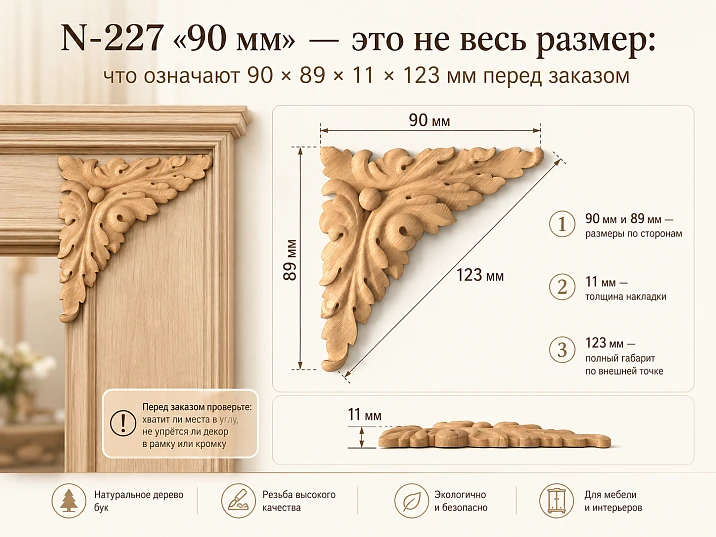
In the N-227 card, the buyer first sees the short designation "90 mm", then opens the table and gets four values: 90 × 89 × 11 × 123 mm. Which number should be passed to the designer? Which one should be written in the list for the furniture maker? What size is needed to build the frame? Can 123 mm be considered the diagonal or the width of the required corner field? This is where errors begin, due to which the facade is made before the overlay is tried on in real scale.
Short answer: the designation "N-227 90 mm" is not enough for production and ordering. The specific version is selected by the full line A × B × C × L, indicating the material, sanding quality, quantity, and orientation. For the compact version, this line looks like this: 90 × 89 × 11 × 123 mm. The value of each parameter must be read from the current drawing of the product, not assigned by guesswork.
A buyer who plans buy carved overlay N-227, it is useful to solve the problem before launching the facade into production. First, download the dimensional diagram, print a full-size template, check the free corner field, moldings, panel, handle, and four sides of the composition. Only then, in the order, fix one of the four versions of N-227, beech or oak, "Standard" or "Prestige", and the exact number of parts.
Why one number in the name does not replace the full dimensional line
The short number helps distinguish options in the catalog, but does not describe the entire geometry. N-227 has four versions, each of which is recorded with four parameters. If only "90 mm" is left in the request, project participants may understand the entry differently.
The designer may take 90 mm as the width of the decor along the horizontal side of the frame. The furniture maker — as the overall square that needs to be left free in the corner. The procurement specialist — as the height. The painter will not see the difference between the four options at all if the specification lacks the thickness and the full article size. All participants are talking about the same overlay, but building different contours.
A full record eliminates this ambiguity:
Carved corner overlay N-227 — 4 pcs.; A × B × C × L — 90 × 89 × 11 × 123 mm; material — beech; sanding — "Prestige"; preparation — for agreed coating; orientation — according to the attached diagram.
Such a line does not explain a drawing instead of a drawing, but it precisely identifies the selected modification. The manager sees that a compact version is required, the cabinetmaker gets a dimensional diagram, and the installer understands that this is not an abstract "90 mm corner."




Four versions of N-227: comparing not by a single number
| Execution | Full size A × B × C × L, mm | Thickness C, mm | Practical task before ordering |
|---|---|---|---|
| Compact | 90 × 89 × 11 × 123 | 11 | Check a small corner of a frame, drawer, or narrow facade |
| Average | 120 × 118 × 15 × 165 | 15 | Compare with a medium-scale facade and molding field |
| Enlarged | 131 × 129 × 16 × 180 | 16 | Check whether the ornament intersects with the panel, handle, or adjacent decor |
| Large | 160 × 158 × 20 × 220 | 20 | Evaluate the relief protrusion, distance to edges, and scale of the entire frame |
The table shows: the model increases not only in the first parameter. B, C, and L change simultaneously. Therefore, you cannot take the template of the 90-mm variant, enlarge it by eye to 160 mm, and consider it a production contour. The proportions are close, but for precise layout, a drawing of the specific version is used.
Our factory also produces:
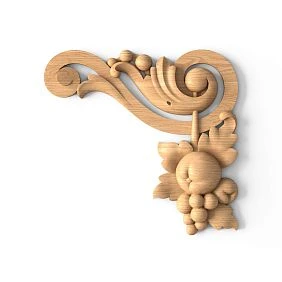
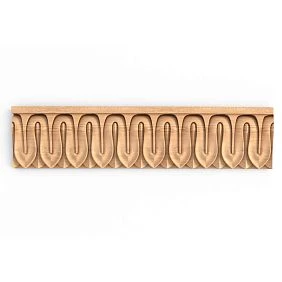


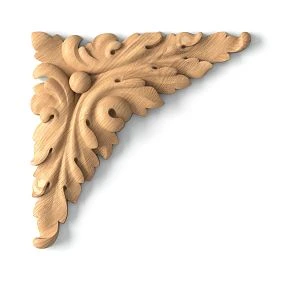
Compact variant 90 × 89 × 11 × 123 mm
This size is convenient for a small decorative field, but the word "compact" does not mean it will fit in any corner. The frame may have sufficient width on one side and insufficient on the other. The 11 mm thickness adds an additional constraint: the overlay protrudes above the surface, so near a drawer, door, or adjacent facade, clearances need to be checked.
Get Consultation
Medium variant 120 × 118 × 15 × 165 mm
An increase in the first dimension by 30 mm is accompanied by a growth in thickness to 15 mm and parameter L to 165 mm. On the facade of a medium dresser, such decor may look appropriate, but the decision is made based on a template. Particular attention is paid to checking the distance from the carving to the inner boundary of the molding and to the edge of the panel.
Enlarged variant 131 × 129 × 16 × 180 mm
The difference between A and B remains small, but this does not make the overlay square. Both values must be preserved in the specification. On a wide cabinet door, the 131 × 129 × 16 × 180 mm variant can support the frame scale, while on a narrow drawer, it may take up too much of the free field.
Large variant 160 × 158 × 20 × 220 mm
The 20 mm thickness becomes an independent design parameter. Such relief reacts more strongly to side light, protrudes more noticeably near the molding, and may conflict with a handle or the trajectory of an adjacent door. It is chosen not because the furniture is generally large, but after checking a specific corner.
What A, B, C, and L mean: where fact ends and guesswork begins
The product card confirms the order of parameters A × B × C × L. The decorative overlays category also uses A as width, B as height, and C as thickness in the filter system. However, for a specific corner shape, the position of measurement lines and the meaning of the additional parameter L need to be checked on the dimensional diagram N-227.
A and B cannot be replaced with a single "average size"
Even in the compact version, A = 90 mm and B = 89 mm. The difference of just 1 mm seems insignificant until the drawing is rotated or mirrored. In the production sheet, the two axes must remain distinguishable: one relates to one side of the shape, the second to the other.
The notation "approximately 90 × 90 mm" is suitable for an early sketch, but not for an order. At the facade manufacturing stage, an exact contour or at least a full card row along with the drawing is needed.
C is the thickness that cannot be hidden in a note
The thickness determines how far the overlay protrudes from the plane. For four versions, it varies from 11 to 20 mm. This affects light and shadow, the fit to the molding, the position of the hardware, and the safety of opening.
If the handle has a low leg, a large N-227 may visually conflict with it or physically interfere with gripping. If the overlay is located next to an adjacent door, the protrusion of the relief is checked at full opening.
L cannot be declared as a diagonal
A simple calculation shows that L does not match the mathematical diagonal of the rectangle A × B.
| Finish | √(A² + B²), mm | L per card, mm | Does L match the diagonal |
| 90 × 89 | about 126.6 | 123 | No |
| 120 × 118 | about 168.3 | 165 | No |
| 131 × 129 | about 183.9 | 180 | No |
| 160 × 158 | about 224.9 | 220 | No |
This check is useful as protection against misinterpretation, but it does not reveal the purpose of L. After the table, one cannot claim that L is a "shortened diagonal," "length along the ornament," or "minimum margin." The exact position of the parameter is shown only by the actual drawing.
Why the L value cannot be turned into a square field size
A buyer may see 123 mm and decide: "So, for a small plate, a square of 123 × 123 mm is needed." This logic is not confirmed. The corner ornament has a complex contour, and the free area around it depends on orientation, frame, and adjacent parts.
The field for decor is built not by a single number, but along the template contour. It includes:
-
the actual boundary of the overlay;
-
the technological indentation from the facade edge;
-
distance to the molding;
-
the gap to the panel;
-
handle position;
-
the zone for hinges and fasteners on the reverse side;
-
opening trajectory;
-
visual breathing room around the carving.
Even if L on the drawing passes through the most distant points, this does not mean that a square with side L is required around the product. The shape may occupy the corner unevenly. Therefore, the furniture maker is given not the phrase "leave 123 mm," but a full-size diagram.
Drawing N-227 must be obtained before the facade is manufactured
Section download the current drawing N-227 needed not only by the designer. It links the catalog, the layout, and the real furniture. The drawing is used to check where A, B, C, and L run, how the corner shape is oriented, and which contour should be transferred to the template.
What should be visible on the dimension scheme
Before approving the project, make sure the scheme allows determining:
-
direction A;
-
direction B;
-
thickness C;
-
the line or measurement points L;
-
outer contour;
-
the inner part of the corner shape;
-
the position of the ornament relative to the conditional corner;
-
orientation of the front side;
-
the print scale or original dimensions.
If part of the information is not readable, do not redraw it from the photo. Request the current file or clarification.
The drawing version matters
A card, catalog, and local file from a furniture maker may be saved at different times. In the specification, it is useful to record the date the drawing was received or the file name. Then, in a dispute, it is clear which version the template was built from.
A screenshot is not equal to the production file
A screenshot is convenient for discussion, but its scale changes when sent and printed. For a full-size fitting, a file with known dimensions is used, and after printing, a control segment is checked with a ruler.
How to print template N-227 at full size
A full-size template is needed before purchasing a batch and before starting the facade. It shows not only the dimensions but also the location of the threading relative to the frame.
Step 1. Select a specific version
You cannot simultaneously make a "universal template N-227." First, choose one line: 90 × 89 × 11 × 123, 120 × 118 × 15 × 165, 131 × 129 × 16 × 180, or 160 × 158 × 20 × 220 mm.
Step 2. Get the current contour
The basis of the template is a drawing, not a photo of the card. The perspective of the image distorts the shape, and decorative shadows prevent seeing the exact boundary.
Step 3. Disable automatic scaling
In the print window, select actual size 100%. The options "fit", "fit to page", and "scale" change the scale. For a large version, printing on multiple sheets with subsequent precise gluing may be required.
Step 4. Check the control dimensions
After printing, measure A and B or a special control segment. If 90 mm turned into 87 or 94 mm, the template is not used.
Step 5. Cut out the outer contour
For an early fitting, thick paper or thin cardboard is sufficient. Internal cutouts can be marked with lines if they do not affect the check of the free field. For an accurate assessment of a complex shape, a transparent template is useful.
Step 6. Mark the front side and orientation
Label the top, bottom, left, and right sides. If the composition requires mirror placement, do not assume that one part can simply be flipped face to the front. The orientation of products is confirmed by the item and the drawing.
A paper template checks the area, and a volumetric mockup checks the thickness
A flat pattern does not show C. For a compact version, you can add a conditional side with a height of 11 mm to the template, for a medium one — 15 mm, for an enlarged one — 16 mm, for a large one — 20 mm. Such a mockup does not reproduce the thread, but helps to see the protrusion.
Volumetric checking is especially needed:
-
next to the handle;
-
at the adjacent door;
-
on the drawer;
-
at the trim;
-
in the corner of the wall panel;
-
near the lamp;
-
on the door that opens toward the wall;
-
in a narrow frame with a tall molding.
The mockup does not confirm the installation method and does not replace the product. Its purpose is to detect conflicts before ordering.
Free decorative area: we measure not the entire facade
The facade may be 600 mm wide, but the available space in the corner is significantly smaller. The useful area is limited by the frame, panel, hardware, and offsets.
For each corner, a local rectangle or contour is constructed, within which the overlay can be placed without intersections. From the total width and height, subtract:
-
facade edge;
-
a molding frame;
-
panel profile;
-
handle and its base;
-
gap between doors;
-
hinge area;
-
holes;
-
the adjacent decor;
-
technological seams;
-
the area covered by the countertop or cornice.
After that, template N-227 is applied. If it fits only tightly, the composition is not yet approved: the carving needs visual breathing room, and the installer needs a clear working area.
Four corners of one frame are rarely checked in a single motion
In a perfectly symmetrical facade, it seems sufficient to try the template at the top left and order four identical parts. But real furniture often has asymmetry:
-
the handle is on the right;
-
hinges occupy the left side;
-
the bottom corner covers the plinth;
-
the top corner fits the cornice;
-
the adjacent door opens differently;
-
one edge adjoins the wall;
-
the panel is offset;
-
the frame has different widths at the top and on the side.
Therefore, the template is applied to all decorated corners. For each, a strictly frontal photo is taken and the orientation is noted. If N-227 is used only at the top, the quantity will be two, not four. If one accent corner is decorated, one piece will be needed.
How many N-227 to order: count installation points, not facades
The formula looks like this:
Q = U + D + R,
where Q is the final quantity, U is the number of decorated corners, D is additional decorative elements, R is the agreed reserve.
One facade does not always equal four overlays
Different layouts are possible:
-
one overlay in the upper outer corner;
-
two parts in the two upper corners;
-
four elements along the perimeter of the frame;
-
eight overlays on two identical doors;
-
two parts on the dresser and four on the cabinet;
-
a separate corner accent on the door;
-
a series of identical frames in a commercial interior.
The quantity is fixed after layout. Do not automatically order four pieces for each facade just because the product is called corner.
Is a reserve needed
A spare part may be justified for a large batch, complex tinting, a remote site, or serial furniture production. For a single home facade, an extra overlay is not necessary. The decision depends on the cost of repeat delivery, timelines, and the ability to store the remaining finishing compound.
Why it is better to order all corners in one batch
Wood retains natural variations. Even with the same material, adjacent pieces may differ slightly in grain, and batches in base tone. With opaque enamel, wood differences are more hidden, but the issue of consistent preparation and sanding remains.
One batch simplifies control:
-
all overlays have the same finish;
-
material is not mixed;
-
sanding quality matches;
-
finishing is done in one cycle;
-
color and patina are coordinated simultaneously;
-
packaging is labeled according to one list;
-
the installer receives a complete set.
If you first order two pieces, and then two more a month later, it is harder to get a visually uniform set.
Beech or oak: the decision is made not by the style name, but by the finish
N-227 is available in beech and oak. The choice is linked to existing furniture, flooring, and the method of showcasing the wood.
| Criterion | Beech | Oak |
| Covering enamel | Suitable for dense staining with coordinated preparation | Can also be stained, but the wood species is chosen deliberately |
| Transparent finish | Gives a calmer pattern | More strongly emphasizes the natural texture |
| Combination with the facade | Check the base material and the primer system | It is especially important to coordinate the tone with the oak facade |
| Selection of four corners | Ensure uniform preparation | Check the grain and tone of all parts |
| Main risk | Accept "under enamel" as the finished color | Expect an identical wood grain pattern |
Beech for enamel
For a painted facade, beech is often considered a clear base, but the overlay does not automatically arrive in the furniture color. The order specifies the preparation, then priming and finishing are done according to the selected system.
Oak for tinting
With a transparent coating, oak N-227 shows pores and fibers. The four corners need to be laid out side by side and distributed across the facade before painting, so that differences look natural. The default card configuration "under enamel" does not confirm a transparent scenario; the quality of re-gluing for tinting is agreed separately.
"Standard" and "Prestige": the difference is visible on carved relief
The card offers two sanding qualities. Before choosing, it is useful compare sanding "Standard" and "Prestige".
"Standard" is associated with milling and machine preparation. This option may require additional manual work before finishing, especially in recesses and on transitions of complex ornament.
"Prestige" includes detailed manual sanding and is designed for a more prepared surface. But even "Prestige" does not mean that the product is already painted or that the painter can skip priming and interlayer treatment.
The choice depends on who finishes the decor, what coating is used, and how visible the relief is. For a small batch of four corners, savings on preparation may be less than the cost of manual touch-up on site.
Under enamel and under tinting — different requirements for the workpiece
An opaque coating hides the re-lamination pattern, so geometry, sanding, and stable preparation become key. A transparent system reveals the wood, lamella joints, and natural variations.
In the specification, you should write not just "oak," but:
-
material;
-
sanding quality;
-
preparation for enamel or tinting;
-
type of coating;
-
color;
-
gloss level;
-
patina;
-
the need for a test sample.
If a parameter is not confirmed by the card, it is agreed upon before payment. You cannot assume that any oak option is automatically intended for clear lacquer.
Thickness C changes the light-and-shade and adjacent gaps
The N-227 has four C values: 11, 15, 16, and 20 mm. The difference between the compact and large versions is 9 mm. On paper it seems small, but on the facade it changes the character of the corner.
Side lighting emphasizes the relief
The higher the protrusion, the deeper the shadow. A large overlay near a window or under a directional light can become the main accent of the frame. If the goal is a quiet continuation of the molding, the relief is checked under real lighting.
The handle should remain comfortable
The user grips the handle with their fingers, not looking at the front sketch. The 3D template helps check whether the hand hits the thread.
The adjacent facade must open freely
On a corner cabinet or narrow cabinet, the adjacent door passes close. The full trajectory is checked, not just the closed state.
The thickness of the finish is added to C
Primer, enamel, or varnish slightly change the surface. A universal allowance cannot be assigned in advance: it depends on the system. But in a tight joint, it is important to remember that the card describes the wooden part before the finish coating.
N-227 and molding frame: a beautiful corner starts with the joint
The corner overlay is often used next to moldings. It can complete the frame, cover the joint, or work as a standalone accent. However, N-227 cannot be declared a connecting element for any profile.
Need to check:
-
whether the shape of the overlay matches the width of the molding;
-
where the profile ends terminate;
-
whether an open gap remains;
-
does the thread overlap the panel;
-
does the relief height match;
-
is trimming of the molding required;
-
how is the joint painted;
-
can the elements be installed in the correct sequence.
General material on how does the corner overlay differ from the straight one, helps to choose the type of decor. For N-227, the final decision is still made by the full-size layout.
Why N-227 should not be confused with NPU-227
Similar numbers in the article numbers do not mean the same product. N-227 refers to wooden carved decor and is made of beech or oak. NPU-227 is a different article and a different material.
An erroneous replacement changes:
-
weight;
-
thickness;
-
edge character;
-
the preparation method;
-
finishing;
-
installation;
-
texture;
-
sizes;
-
price;
-
behavior in humidity.
The specification sheet always lists the full article number. It cannot be shortened to "227", especially when the project includes wood and polyurethane.
Where to use N-227: size-dependent scenarios
Small dresser drawer
The compact option is considered after checking the space between the edge, handle, and panel. One element can work as an asymmetric accent, two can form the top pair. Four pieces on a small drawer can overload the facade.
Cabinet door
A medium or enlarged N-227 can support the frame of a tall door. Scale is especially important here: too small an overlay will get lost, too large one will occupy the corner area and approach the central decor.
Wide chest of drawers
On a wide facade, four corners or two top overlays are possible. The distance between decor elements should leave a calm central field. If there is a handle or a separate carved composition in the center, all elements are checked together.
Interior door
Corner decor is placed on the panel, but the trim, hinges, lock, relief thickness, and opening toward the wall must be considered. Installation on a finished surface requires compatible adhesive and preliminary fitting.
Wall panel
On wall N-227, the corner of a decorative frame can be marked. The base, paint, and mounting compound are checked separately. The wall geometry should not be replaced by the geometry of the furniture facade.
Frame or portal
A large variant can work at an architectural scale, but only after comparison with moldings, cornice, and the overall width of the portal. One overlay will not fix the random proportions of the entire composition.
How to choose a size without advice like "small for small"
The simple principle of "90 mm for a cabinet, 160 mm for a wardrobe" is too rough. The size is chosen through the ratio to the free field.
You can use a sketch fill coefficient:
K = area of template projection ÷ area of free corner field.
This formula does not provide a universal standard and does not replace visual assessment. It helps compare options on one facade. If K increases sharply, the overlay begins to dominate. If too small, the ornament gets lost.
Practical procedure:
-
Build the free field.
-
Apply the template 90 × 89 × 11 × 123 mm.
-
Take a photo.
-
Repeat with the adjacent size.
-
Compare the distances to the frame, handle, and center.
-
Look at the facade from a normal distance.
-
Check the volume.
-
Approve one option.
Three ways to make a mistake before even buying
Compare overlays only on the screen
Cards may be displayed at different scales. Without a ruler, the 90- and 160-millimeter options seem similar. A template is needed.
Evaluate only the first size A
B differs from A, C changes almost twice, L grows from 123 to 220 mm. One parameter does not describe the product.
Select by free width, forgetting height
The corner shape occupies two axes. If there is space horizontally, vertically the thread may cross the panel or cornice.
What to buy together with N-227
For a project, one product line is not enough. The buyer assembles a set of decor, materials, drawings, and solutions.
| What to add | Why | When especially needed | What to pay attention to |
| Required quantity of N-227 | Arrange all approved corners | For any project | One full size, material, and sanding |
| Material sample | Compare beech, oak, and finish | Before the batch under a transparent coating | The sample may show the material, but does not always replicate the shape of N-227 |
| Installation materials | Attach the overlays to a specific base | For furniture, doors, or walls | Compatibility of the adhesive with wood and coating |
| Finishing materials | Achieve the desired color and gloss | For unpainted decor | Complete system of primer and finish |
| Drawing | Check A, B, C, and L | Before manufacturing the facade | Current version and scale |
| Design project | Align four corners and frame | For complex composition | Actual facade dimensions |
| One delivery | Preserve batch completeness | For multiple facades | Box labeling and acceptance |
In this section you can order samples of wooden decor for checking material and future finishing. However, a sample of a different shape does not replace the full-size N-227: it helps evaluate the wood, but not the fit of the corner ornament.
For fixation, use buy materials for mounting overlays after checking the base. A specific adhesive cannot be assigned only by the product name: painted MDF, solid wood, veneer, plaster, and ready-made enamel require different adhesion assessments.
Installation: first layout, then adhesive and fixation
Overlay decor seems simple: apply adhesive and press. The corner shape quickly shows displacement. If the top part shifts by 2 mm, the bottom side will also change position relative to the frame.
Make coordinate markings
On the facade, two control lines of the corner, the axes of moldings, and the template contour are marked. Pencil and masking tape must not damage the finish. For a ready painted surface, a safe marking method is used.
Check the back side
Before installation, the surface, cleanliness, and absence of defects are inspected. If the drawing does not confirm cutouts or seating elements, they cannot be invented.
Conduct a dry fitting of the set
Four parts are laid out simultaneously. Mirror symmetry, grain direction, and wood differences are checked. After painting, positions are marked so that marks do not fall on visible surfaces.
Consider the adhesive working time
The composition is selected according to the instructions. Some adhesives require holding time, others require immediate bonding. The corner trim must remain within the markings for the entire fixation period.
Do not replace preparation with excess adhesive
A thick layer does not fix a crooked facade. Excess can seep onto the painted surface and damage the finish.
Useful recommendations for installing carved overlays provide general technological context, but the final method is tied to the substrate and the chosen coating.
Paint before or after installation
Before installation
Pros: access to edges and recesses is open, the facade is easier to protect. Cons: the finished coating can be damaged during fixation; the adhesive area requires coordinated preparation.
After installation
Pros: the trim and frame are painted with one system, making it easier to unify the joint. Cons: it is harder to paint the relief and protect adjacent surfaces.
Combined scheme
The main preparation is done separately, and after installation the finish or local touch-up is applied. The choice depends on the facade material, enamel, varnish, and mounting compound.
It cannot be universally stated that one method is better. The sequence is recorded in the technological chart before purchasing the batch.
Order line that cannot be understood ambiguously
Product: carved corner overlay N-227.
Quantity: ___ pcs.
Full size A × B × C × L: ___ × ___ × ___ × ___ mm.
Selected version: 90 / 120 / 131 / 160 mm by A.
Material: beech / oak.
Sanding quality: "Standard" / "Prestige".
Preparation for coating: specify after approval.
Installation location: facade, door, wall panel, frame.
Corners: list according to the diagram.
Orientation: according to the attached drawing.
Coating: specify system, color, and gloss.
Batch: manufacture and finish all parts simultaneously.
Mounting materials: select by base.
Drawing: attached, version and date specified.
Template: verified on a real facade.
Delivery: city and pickup method.
This entry is longer than "N-227 90 mm", but it is exactly what protects the project from misgrading and different interpretations.
Example of a list for a wardrobe, dresser, and nightstand
| Item | Angles | Preliminary version | Quantity | What to check |
| Wardrobe, two doors | Four top and four bottom | 131 × 129 × 16 × 180 mm | 8 | Gap between doors, handles, cornice |
| Commode | Two top corners of the frame | 120 × 118 × 15 × 165 mm | 2 | Central handle and height of drawers |
| Cabinet | One accent corner | 90 × 89 × 11 × 123 mm | 1 | Door opening and edge of countertop |
| Wall frame | Four corners | 160 × 158 × 20 × 220 mm | 4 | Moldings, light, and wall plane |
This is an example of a bill of quantities structure, not a universal size selection. The specific option is determined by the template on the specific furniture.
Receipt N-227: checking the entire line, not just the article number
After delivery, open the invoice and the order card. For each part, verify:
-
article number N-227;
-
A;
-
B;
-
C;
-
L;
-
material;
-
sanding;
-
quantity;
-
thread condition;
-
absence of chips;
-
batch consistency;
-
marking;
-
completeness of accompanying materials.
If four corners of 90 × 89 × 11 × 123 mm are ordered, the presence of four items with a similar pattern does not complete the acceptance. It is necessary to rule out the adjacent size and mixing beech with oak.
Why price and availability are checked against a specific configuration
The cost of N-227 depends on size, material, and quality of sanding. Availability also refers not to the article number in general, but to a specific line. The phrase "N-227 is in stock" may mean a different size or different preparation.
Before payment, in the card you need to:
-
choose beech or oak;
-
select "Standard" or "Prestige";
-
check the quality of the re-gluing;
-
specify the quantity;
-
view the final cart line;
-
confirm the term for the selected configuration.
The article should not fix the current price: it changes, and the decision on the size should be based on the project, not on a random remainder.
Old card addresses cannot be multiplied in internal linking
N-227 has old and duplicate paths. The main address in the carved decor section is used for the article. All article anchors should lead to one confirmed card, not be distributed among versions with endings.
This is important for SEO and for the buyer: a single point collects product information, options, and ordering. Before publishing the site, it is useful to separately check redirects and canonical, but within the finished article there is no need to discuss technical duplicates.
How not to confuse N-227 with a regular carved corner
The word "corner" is used too broadly. It can mean:
-
flat furniture pad;
-
corner molding connector;
-
architectural decor;
-
polyurethane part;
-
metal fastener;
-
protective profile;
-
mirror pair;
-
one element of the set.
N-227 is a specific wooden carved pad with four size variants. In the order, do not replace the article number with the description "carved corner 90 mm".
For a buyer who has not yet chosen a shape, it is useful to first buy corner decorative overlays after comparing the catalog. If the choice is made on N-227, all further documentation must use its exact string.
When N-227 is suitable, and when a different decor is needed
N-227 is suitable if:
-
a corner floral ornament is needed;
-
one of the four sizes is confirmed by the template;
-
the thickness does not interfere with the hardware;
-
the material is agreed with the coating;
-
the number of corners is determined;
-
the drawing is received before the facade production;
-
The mounting surface is prepared.
It is better to choose a different model if:
-
the free field does not accept the contour;
-
the frame needs a connecting element with a specific cutout;
-
the thickness conflicts with the handle;
-
polyurethane is required;
-
the composition must be strictly geometric;
-
a mirrored set is needed, and the N-227 orientation is not confirmed;
-
no size matches the scale.
In general wooden carved decor catalog You can compare trims, sockets, and other elements. A new product is chosen not as a replacement for a "similar corner piece," but through the same procedure: drawing, template, material, and specification.
Practical Selection Scenarios
The facade is already manufactured
Do not drill or glue decor according to the picture. Make four size templates, compare them on the facade, and choose the one that does not cross the frame or hardware. If none fit, change the decor, not the finished facade.
The facade is only being designed
This is the best moment. Get drawing N-227, lay out the contour in CAD, print the template, and check the scale on the door mockup.
Need to replace the old overlay
Take measurements of the old trace, holes, and damage. N-227 must not only fit but also cover the traces, if that is part of the task.
Control checklist before payment
-
Item N-227 has been selected.
-
Full size A × B × C × L is specified.
-
The drawing is current.
-
The template scale has been checked with a ruler.
-
The template is applied to all corners.
-
Thickness C has been checked.
-
Handles and hinges have been taken into account.
-
The quantity has been determined.
-
Beech or oak has been selected.
-
Sanding has been selected.
-
Preparation for coating has been agreed upon.
-
All parts have been ordered in one batch.
-
Mounting materials have been selected based on the substrate.
-
The deadline and delivery have been confirmed for the specific configuration.
For a remote object, it is possible to order N-227 with Contact us to confirm shipping to your destination. in one delivery together with materials. Upon receipt, first acceptance is carried out, then finishing and installation.
Who needs what size: designer, structural engineer, manager, and installer
One of the reasons for confusion is the attempt to pass the same short number to all project participants. In reality, each specialist works with their own part of the information, but the original string N-227 should remain common.
| Participant | What they need | What is insufficient |
| Designer | Full contour, thickness, orientation, and scale relative to the facade | Photos of the overlay and the number 90 mm |
| Furniture designer | Drawing A × B × C × L, free field, handle and hinge zones | Sketch without dimensions |
| Assembler | Article number, full line, material, sanding, quantity | Phrases "small corner" |
| Manager | Selected configuration and delivery address | Links to the old copy of the card |
| Painter | Wood species, preparation, coating system, test paint-out | Words "paint like the facade" |
| Installer | Layout diagram, corner numbering, base and fixation technology | One template without orientation |
| Receiver | Invoice, marking, dimensions, material, quality and quantity | Checks only by external pattern |
The designer works with silhouette and volume
The visualization should show not a conditional curl, but a specific modification. If a 90-mm overlay image is stretched to 160 mm without replacing the model, not only A and B change. In the real product, thickness C grows from 11 to 20 mm, and parameter L — from 123 to 220 mm. Therefore, the 3D model must match the selected line.
The designer protects furniture from late rework
The designer checks whether the decor falls on the handle hole, hinge cup, frame joint or panel edge. On the back side of the facade there may be fasteners that are not visible in a beautiful front sketch. If the overlay covers such an area, the solution is changed before drilling.
The configurator records the execution without colloquial abbreviations
The purchase table should not contain entries like “N-227 small” and “N-227 large”. Names are convenient for discussion, but the invoice is built by the full line. If the project contains two sizes, each is assigned a separate item and quantity.
The installer receives a map, not a set of identical parts
Even four identical overlays can have different locations: top left, top right, bottom left, bottom right. The map shows how to orient the pattern and where the control line passes. With natural finish, it also helps to preserve the pre-selected distribution of parts by tone.
Rotation, reflection, and mirror composition: three different actions
A corner overlay may appear symmetrical in a small photo. But in a project, you cannot mix rotation, mirror reflection, and flipping face-up.
Rotation preserves the face side and changes the position of the part on the plane. The overlay is turned by 90, 180, or 270 degrees if its shape and pattern allow such placement.
Mirror reflection means a different geometry—a left or right version. The presence of such a pair must be confirmed with a card or drawing. Visualization software can mirror the image with one click, but production is not obligated to have a mirrored item.
Flipping changes the face and back sides. This cannot be used to create a mirrored decor: the back surface is not intended for display, and the relief and preparation differ.
How to check the four corners of a frame
Print four copies of the approved outline. Label each one: TL, TR, BL, BR. Arrange them in the corners without automatically mirroring the pattern. If two positions require a shape that is not among the possible rotations, this will be detected before ordering.
Central symmetry does not guarantee an identical pattern
A frame can be geometrically symmetric, while the ornament has a pronounced direction of a leaf or curl. On the left and right, it must either deliberately face the center or diverge outward. This artistic decision is fixed in the scheme.
Orientation must be agreed upon before painting
After opaque enamel, differences on the front side are still visible by relief. With transparent tinting, the wood grain direction is added. Marking is done on the packaging or in an invisible area using a safe method, not with a pen on the finished surface.
Comparing sizes in percentages helps to see the scale of change
Adjacent versions differ unevenly. The first value A grows from 90 to 120 mm by a third, then to 131 mm by less than a tenth, and further to 160 mm by about a fifth. Therefore, the names "small, medium, large" poorly convey the actual transitions.
| Transition | Change in A | Change in B | Change in C | Change in L |
| 90 → 120 | +33,3 % | +32,6 % | +36,4 % | +34,1 % |
| 120 → 131 | +9,2 % | +9,3 % | +6,7 % | +9,1 % |
| 131 → 160 | +22,1 % | +22,5 % | +25 % | +22,2 % |
| 90 → 160 | +77,8 % | +77,5 % | +81,8 % | +78,9 % |
This table does not choose a product instead of a template. It explains why the 131 mm variant is visually closer to the 120 mm one than to the 160 mm one, and the large overlay is almost twice as thick as the compact one in relative increase.
A small difference of 120 and 131 mm can also be decisive
An increase of 11 mm in A seems insignificant, but in a tight corner it can reduce the gap on each side, bring the ornament sheet closer to the molding, or cross the edge of the panel. It is better to compare these versions using two transparent templates placed on top of each other.
The transition from 131 to 160 mm changes the character of the composition.
Here, not only the area increases, but also the thickness from 16 to 20 mm. The angle becomes more noticeable under side lighting. On a wide cabinet, this can support the scale, but on a dresser, it can turn the frame into a heavy decorative structure.
A working example: a facade of 520 × 760 mm still says nothing about the size of the overlay.
Let's imagine a door with an external size of 520 × 760 mm. A frame 45 mm wide runs along the perimeter, a panel is located inside, a handle is installed on the right, and a furniture cornice partially covers the facade from above.
The wrong way: seeing the width of 520 mm and choosing N-227 131 or 160 mm as "large enough."
The right way starts with a map of the free field:
-
Mark the outer edge.
-
Draw the inner boundary of the frame.
-
Apply the actual panel profile.
-
Add the handle base and the finger grip area.
-
Show the cornice in front projection.
-
Mark the hinges and holes from the back.
-
Place four templates.
-
Check each door when opening.
After such a layout, it may turn out that 160 × 158 × 20 × 220 mm overlaps the handle, 131 × 129 × 16 × 180 mm fits in the upper corners but is tight at the bottom, and 120 × 118 × 15 × 165 mm maintains even margins everywhere. This is not a universal recommendation for a 520 × 760 mm facade, but an example of how the solution changes after applying all constraints.
A pilot facade is needed before the serial order.
For one cabinet, a paper template may be a sufficient scale check. For ten cabinets, the risk multiplies by the number of doors. Before starting a series, it is useful to make one pilot facade, obtain one or a set of N-227 of the selected size, and go through the entire cycle.
What is checked on the pilot sample
-
matching of the actual product with the drawing;
-
position relative to the molding;
-
thickness after primer and finish;
-
handle convenience;
-
the opening of adjacent doors;
-
type of joint;
-
adhesive consumption and behavior;
-
the need for temporary fixation;
-
painting sequence;
-
installation operation time;
-
result under working lighting.
The pilot must be made from working materials
A cardboard facade shows proportion but does not reflect adhesion, finish, and real gaps. A prototype is made from the same material and using the same technology as the series. Otherwise, the test does not answer the main questions.
After the pilot, documentation is updated
If the overlay had to be shifted by 4 mm, the painting order changed, or an adjacent size selected, these changes are transferred to the drawing, specification, and installation map. Corrections cannot be left only in the foreman's memory.
Change control: how not to get two sizes on one batch of furniture
The project goes through several versions. First, the designer chooses 120 mm, then the client asks to make the decor larger, the constructor changes it to 131 mm, and procurement keeps the old table. As a result, the facades are marked for one execution, but the invoice shows another.
For protection, a simple log is introduced:
| Version | Date | Size N-227 | What has changed | Who approved |
| 01 | ___ | 120 × 118 × 15 × 165 | First layout | ___ |
| 02 | ___ | 131 × 129 × 16 × 180 | Scale increased | ___ |
| 03 | ___ | 131 × 129 × 16 × 180 | Orientation clarified | ___ |
Only the current version is sent to production. Old files are saved with the note "do not use" rather than left in the shared folder under similar names.
Changing the material also creates a new version
Switching from beech to oak is not a cosmetic edit. It affects the finish, test coating, and acceptance. The same applies to changing from "Standard" to "Prestige."
The quantity is linked to the layout
If you declined the bottom corners, the statement should reflect not only the image but also the number of parts. In a large series, the difference of two overlays per facade turns into dozens of extra items.
Replacing the old corner decor with N-227
When repairing furniture, the new element must fit not into a clean project but into the trace of the old overlay. After dismantling, holes, glue, color differences, and damaged coating may remain.
Take a trace map
Transfer onto transparent film or paper:
-
the outer contour of the old decor;
-
holes;
-
chips;
-
the fading boundary;
-
glue residues;
-
unevenness;
-
position relative to the frame.
Then, contour N-227 is applied on top. The new part should cover damage only when confirmed by a template. The first dimension A cannot be considered an overlap zone.
Check the thickness of the old and new part
If the previous overlay was almost flat, N-227 with a thickness of 20 mm will noticeably change the facade. The handle, adjacent door, and overall style may require reconsideration.
The old coating must hold the new joint
Adhesive bonds not to an abstract facade, but to the top layer of paint or varnish. If the coating peels off, the glued overlay will come off with it. The base is repaired before installation.
Photos and visualization: why scale on screen deceives
Product photography is intended to show shape, not for comparison with the facade without scale. A close-up of compact N-227 may look more massive than a general shot of the 160-millimeter one.
A dimensional reference should be nearby
For approval, use a template on the actual facade, a ruler in the frame, or a visualization with verified geometry. A palm, phone, or random object does not provide accurate scale.
Perspective changes A and B
Shooting at an angle shortens one axis. A frontal shot is taken with the camera parallel to the facade. A separate side shot shows C.
The screen does not confirm color
Beech and oak, primer and tinting require a physical sample. Monitor brightness, camera white balance, and room lighting change the shade. A photo is suitable for preliminary discussion, not for final selection of a transparent coating.
Commercial route: from the general catalog to one exact line
A buyer who has not yet decided on the shape starts with the section decorative inlays for furniture. There, central, corner, straight, curved, and other solutions are compared. A broad query should lead to the category, not force one card to answer for the entire assortment.
After choosing a corner plant form, proceed to N-227. In the card, select size, material, and sanding. For a general understanding of application methods, you can read what decorative furniture overlays exist, but the final geometry is taken from the product drawing.
Further, the route diverges according to the task:
-
sample — for material and finish;
-
drawing — for dimensions;
-
template — for fitting;
-
design project — for complex composition;
-
materials — for installation and finishing;
-
card — for price, availability, and ordering;
-
delivery — for receiving the entire batch.
Thus, internal linking helps make a decision rather than turning into a list of random pages.
Storage and preparation of the batch before installation
The received overlays should not be immediately distributed to different workshops. First, the set is accepted, photographed, and marked. Wooden parts are stored in conditions suitable for the material and subsequent finishing, away from moisture, heating devices, and construction dust.
Do not stack relief face to face without protection
Protruding leaves and curls can press on each other. A safe spacer that does not stick to the wood or the future coating is left between items.
Distribute the oak parts before tinting
If the grain pattern of the solid wood differs, decide in advance which overlay goes to each corner. After staining, swapping them is undesirable: the visual balance may be disrupted.
Keep the packaging labels
Do not throw away labels and documents until installation is fully complete. They link the parts to the invoice and help when checking the configuration.
Post-installation check: the four corners should read as one system
After fixing, not only strength is checked. Step back to a normal distance and assess:
-
equality of indents;
-
ornament direction;
-
uniformity of seam thickness;
-
color;
-
shine;
-
transition to the molding;
-
handle position;
-
chiaroscuro;
-
opening;
-
absence of glue traces.
If one overlay seems higher, first measure the layout, rather than trying to correct the impression with additional patina. The cause may be the orientation of the pattern, different lighting, or an actual offset.
Final cross-check between the drawing, the invoice, and the actual part
Before sending the order to production, it is useful to perform a triple check. It takes less time than redoing a painted facade.
First point — the drawing
The drawing must specify concrete A, B, C, and L. The orientation and location on the facade are also recorded there. If the project contains several N-227 sizes, each is assigned its own designation, for example U1 and U2. The line color in the visualization does not replace a signature.
Second point — the invoice
The invoice line must match the drawing in four parameters: material, sanding, and quantity. You cannot confirm a document that only states "N-227, 90 mm" if the project requires unambiguous identification of the version. In case of discrepancy, correct the invoice before payment, rather than expecting the warehouse to understand the intent from correspondence.
The third point is the received batch
Real overlays are applied to the saved template and distributed across marked corners. If the contour, thickness, or material do not match the approved specification, finishing and installation are not started. After sanding, priming, or gluing, it is harder to prove the original condition.
The rule of one current specification
The designer, furniture maker, painter, and installer must have the same file. If an edit is made after ordering, it is documented separately: what changes, which items are affected, whether production is stopped, and whether a recalculation of quantities is required. Verbal agreements near the machine should not replace the document.
When to first buy one N-227, and when to order a set right away
One piece is useful as a test sample if the facade is already ready, the coating is complex, or the installation joint is unverified. On it, you can assess the actual relief, perform a test paint-out, and check the position next to the handle. But the test order must match the future batch in size, material, and sanding quality. Buying a beech N-227 "Standard" does not test how an oak "Prestige" will look under clear oil.
Ordering a set right away is reasonable when the drawing is confirmed, templates have been fitted, the finishing technology has already been used, and all facades are identical. In this scenario, a single batch reduces the risk of differences and repeat delivery.
An intermediate option is to order a full set for one test facade. For example, four corners allow you to evaluate not one piece in isolation, but the entire frame: symmetry, pattern reflection, joints with the molding, and color consistency. After approval, the set becomes the standard for the series.
The decision to make a test purchase should not break the completeness. If the remaining overlays will be ordered later, the order number, coating parameters, and a sample of the finished color are saved in advance. Otherwise, the test may be successful, but the repeat batch will be assembled based on incomplete data.
FAQ: questions about N-227 sizes before ordering
Is the N-227 90 mm size 90 × 90 mm?
No. The full compact version line is 90 × 89 × 11 × 123 mm. The parameter layout is checked against the drawing.
What size should be written to the manager?
Write all four values A × B × C × L, material, grinding, and quantity. A single value of 90 mm is not enough.
What does L = 123 mm mean?
The exact position of L is shown in the current N-227 dimension diagram. Without the drawing, it cannot be called width, height, diagonal, or field size.
Is 123 mm the diagonal of 90 × 89 mm?
No. The geometric diagonal of a 90 × 89 mm rectangle is approximately 126.6 mm.
What size should be transferred to the facade?
Transfer the full contour from the current drawing, not a single value. For control, label A, B, C, and L.
How many variants of N-227 exist?
The card shows four versions: 90 × 89 × 11 × 123, 120 × 118 × 15 × 165, 131 × 129 × 16 × 180, and 160 × 158 × 20 × 220 mm.
Can the small template be enlarged on a copier?
Only with precise scale control, but it is more reliable to print a drawing of the specific version. After printing, be sure to measure the control dimensions.
How many overlays are needed for one facade?
As many as the number of corners approved by the layout: one, two, four, or another quantity. There is no universal rule of "always four."
Can different sizes be placed on the same set?
Yes, if the scale of different items requires it and the ornament remains connected. For one symmetrical facade, the corners usually must be the same.
What to choose: beech or oak?
The choice depends on the facade and the coating. For transparent finishes, it is especially important to match the wood species and the quality of the glue joint.
How does 'Standard' differ from 'Prestige'?
"Prestige" includes more detailed hand sanding. Both options still require preparation for the chosen coating.
Will N-227 arrive painted?
Do not consider the finish included without separate confirmation. The selected card configuration may be prepared for enamel, but the color and coating are agreed upon separately.
Can N-227 be glued onto a finished facade?
It is possible with a suitable base and compatible composition. First, a dry fitting is done and the adhesion of the coating is checked.
Is mechanical fastening required?
This depends on the base, size, and technology. Without a confirmed joint, it cannot be promised whether fastening is needed or not.
Can N-227 be installed on a door?
Yes, the card is suitable for use on doors, but the thickness, opening, hinges, and coating need to be checked.
Will a large N-227 fit on a wall?
It can be used as corner decor for a frame, but the project is checked against the template and the wall base.
How to ensure that four overlays are identical?
Order one modification, one material, and one sanding in one batch, then verify the marking and dimensions upon receipt.
Can I order one N-227 as a sample?
The possibility of ordering a single piece and the lead time are checked in the current product card. To assess the scale before purchasing, use the full-size template.
What to do if the template doesn't fit?
Choose a smaller option, a different model, or adjust the frame before production. Do not trim the carved ornament without a technical solution.
Where can I see other corner overlays?
In the corner shapes filter and the decorative decor category. Compare not only the first size, but also the full drawing.
What should I check in the cart?
Size A × B × C × L, material, sanding, glue joint quality, quantity, and lead time for the specific configuration.
Is a design project needed for four corners?
For a simple facade, an accurate drawing and template are sufficient. For a complex frame, a furniture series, or a combination of several elements, a project reduces the risk of rework.
Before ordering N-227, record four parameters and one approved STAVROS contour.
The designation "N-227 90 mm" is convenient for a first introduction, but is not suitable as the only line in a production sheet. The compact version has full dimensions of 90 × 89 × 11 × 123 mm; three other variants are 120 × 118 × 15 × 165, 131 × 129 × 16 × 180, and 160 × 158 × 20 × 220 mm. For each, two axes, thickness, and parameter L change.
The main limitation is simple: do not interpret L by guesswork. Obtain the current drawing, check the positions of A, B, C, and L, print the contour at 1:1 scale, and apply it to all corners to be decorated. Then choose beech or oak, "Standard" or "Prestige", calculate the mounting points, and order the set as one batch.
In STAVROS, the N-227 card becomes the point of purchase, the category of overlays becomes the place for comparison, and drawings, samples, materials, and the design project help bring the choice to a finished specification. A correct order begins not with a short phrase "four corners at 90 mm", but with a full entry: article number, A × B × C × L, material, sanding, quantity, orientation, and a confirmed facade scheme.