








































































Article Contents:
- Why straight decor doesn't work where there is a curve
- What are curved and corner decorative overlays
- Where to use curved and corner overlays: scenario breakdown
- Furniture: cabinets, dressers, nightstands, consoles
- Frames: mirrors, paintings, panels
- Arches and Arch Openings
- Facades and side panels: decor for complex areas
- Decorative interior panels and frame compositions on walls
- Types of shapes in the STAVROS catalog: a quick navigator
- Curved
- Corner
- C-shaped
- S-shaped
- Left and right
- Center
- Vertical and horizontal
- Ornament: what to choose for curved or corner overlay
- Floral ornament
- Acanthus
- Floral ornament
- Geometric ornament
- Laurel, ribbon, garland
- Woven ornament
- How to choose the right overlay shape: step-by-step selection logic
- Material: oak, beech, MDF — what to choose for curved overlays
- Oak
- Oak
- MDF
- How not to overload the corner and radius with decor
- Installation of curved and corner overlays: what you need to know
- Glue is the basis of fastening
- Surface Preparation
- Positioning before applying glue
- Fixation
- Final finishing
- 9 mistakes when choosing curved and corner overlays
- What to buy together with STAVROS curved and corner overlays
- Three examples: how curved and corner overlays work in real projects
- Classic kitchen with radius corner cabinets
- Mirror in the hallway: DIY frame assembly
- Arched doorway in the living room
- About the Company STAVROS
- Frequently Asked Questions
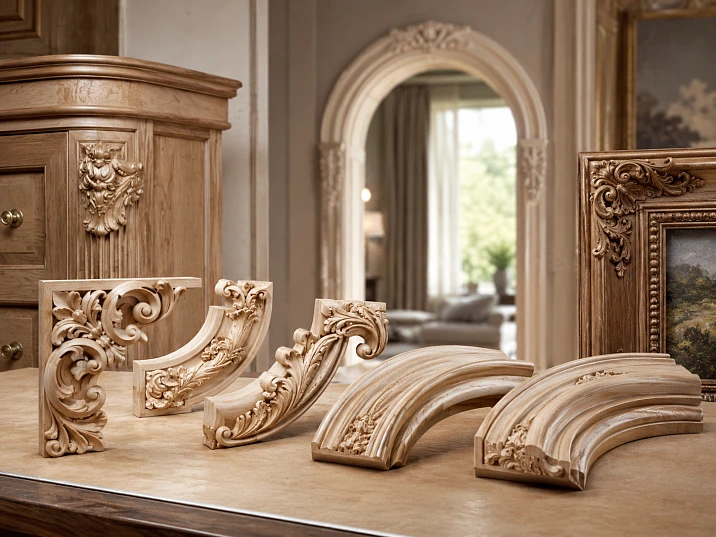
This is not an installation error. This is a selection error. A straight overlay cannot beautifully decorate a curved surface — just as a straight baseboard cannot go around a column. For radii, corners, arches, and curved facades, there is a separate class of products: curved decorative overlays STAVROS and corner decorative elements. This article is about them.
We will break down: what a curved and corner overlay is, where and how it is used, how to choose the shape, pattern, material, and size, what mistakes to avoid, and why the system of decor for complex surfaces is not a luxury but an architectural logic of the interior.
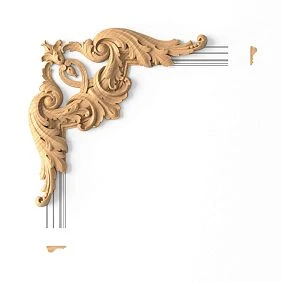
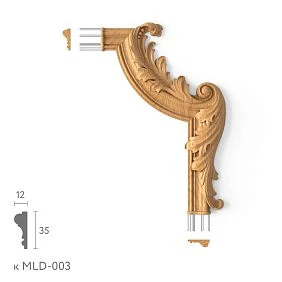
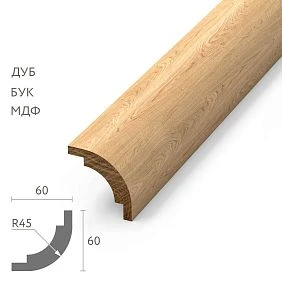
Why straight decor does not work where there is a curve
Let's start with an honest diagnosis. Most decorative overlays sold on the market are straight. This is logical: flat furniture facades, straight frames, even walls — the standard range is designed for these. A straight overlay holds well on a flat surface, requires no adjustment, and is easy to install.
But as soon as the surface ceases to be flat, everything changes.
What happens to a straight overlay on a radius:
-
The edges pull away from the surface, creating a gap.
-
When trying to press the part against the surface, it breaks or deforms.
-
The ornament line loses plasticity, visually 'breaking' at the transition point.
-
The joint with the adjacent element does not close neatly.
What happens to a straight overlay on an external corner:
-
A characteristic break appears at the corner point.
-
If you try to join two straight overlays at 45°, the joint rarely turns out perfect without professional routing.
-
The decorative ornament breaks off in an unfortunate place, and the corner lacks completeness.
That is why Corner decorative overlays — this is not an alternative decor to taste, but a constructive necessity where a transition needs to be beautifully designed. They are created for a specific geometric task.




What are curved and corner decorative overlays
Let's define the terms — without unnecessary academicism, but clearly.
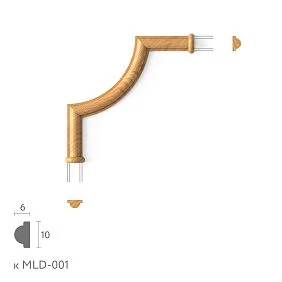
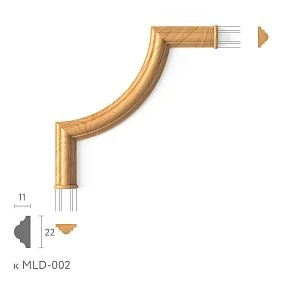
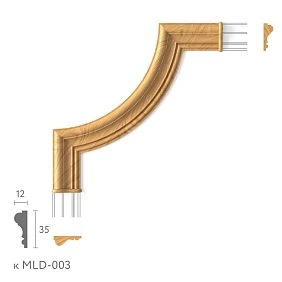
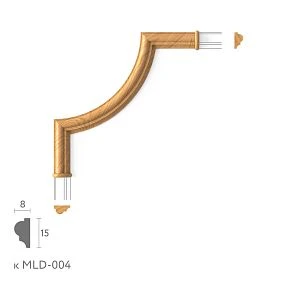
A curved overlay is a carved decorative element made with a smooth bend along its length or width. It is designed for installation on a surface with a radius: a curved facade, arch, oval frame, rounded corner. A curved overlay does not "bend during installation" — it already comes in the required shape, milled or bent from wood or MDF with the required radius of curvature.
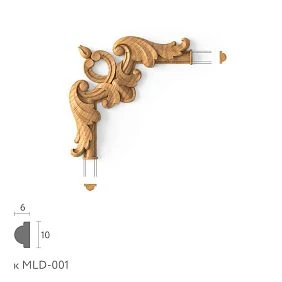
A corner overlay is an element that decorates a corner transition: typically a 90-degree external corner. It can have a V-shaped profile, a pointed or rounded relief, and is mounted directly on the edge of the corner — covering it and turning the technical joint into a decorative accent.
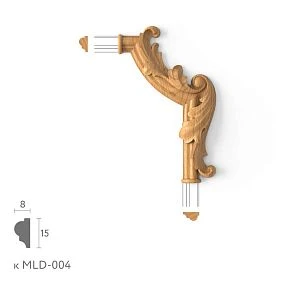
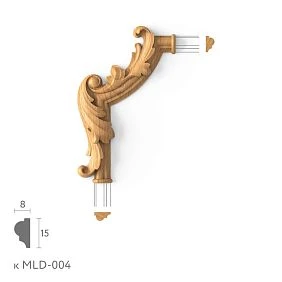
C-shaped and S-shaped overlays are types of curved elements with a more complex bending trajectory. C-shaped — a semicircle, used for framing rounded frames, side transitions, decorative niches. S-shaped — a double bend, used where a plastic decorative line without rigid geometry is needed.
Left and right overlays are mirror pairs. They are needed where a symmetrical composition is created: an arch with two symmetrical sides, a mirror frame, paired corner elements of a cabinet or portal facade.
All these varieties are present in the catalog of decorative wooden overlays STAVROSand for each task — a complex corner, a smooth radius, an arched opening — there is a suitable element.
Read about applied decor in general, its nature and logic of use in interiors — read the article about STAVROS applied decor. In this article, we focus specifically on complex surfaces.
Our factory also produces:
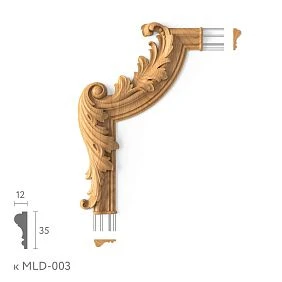
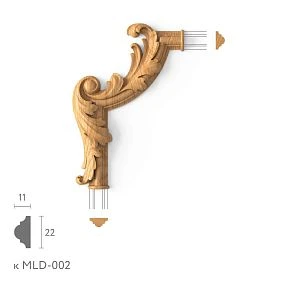
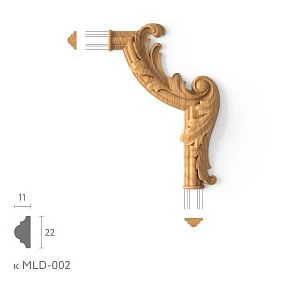
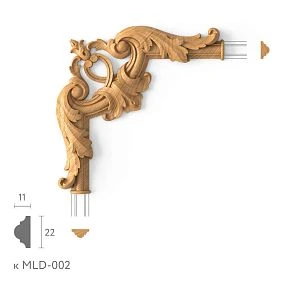
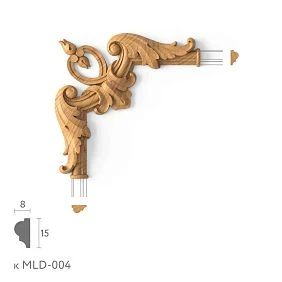
Where curved and corner overlays are used: scenario breakdown
Get Consultation
Furniture: cabinets, dressers, nightstands, consoles
Furniture with right angles is the standard of modern production. But it is the outer corners of case furniture that often remain visually unfinished: the edge of the corner without decor looks technical, especially if moldings, trims, or overlays on the facades are installed nearby.
Furniture corner overlays solve this problem in one motion: the corner decorative element is mounted directly on the edge, covering it and giving the furniture a finished, 'assembled' look — like in handmade furniture or historical interiors.
For radius facades — when the corner of a cabinet or the side of a dresser has a rounded shape — a curved overlay with a suitable radius of curvature is needed. Without it, the facade will look unfinished at the transition point.
Frames: mirrors, paintings, panels
Frame decor is one of the main application scenarios carved corner overlays. A classic frame consists of four straight elements plus four corner pieces. It is the corner overlays that connect the straight sides of the frame into a single visual system.
For rectangular frames — corner elements with corresponding ornament. For oval and semi-circular frames — curved overlays that follow the curve of the frame. STAVROS mirror frames are ready-made solutions, but if you are creating a frame yourself from straight elements, corner overlays are necessary to finish the corners.
Arches and arched openings
An arch is one of the most demanding objects for decoration. The transition from the vertical post to the radius part of the arch is the point where the decor either works beautifully or demonstrates its inadequacy.
Curved decorative overlays for arch framing work in two zones:
-
The radius part of the arch — overlays with curvature that follows the arch.
-
Post-to-arch transition — corner or S-shaped overlays that create a smooth decorative transition.
The combination of straight overlays on posts and curved ones on the arch, fastened with corner transition elements, is a professional system for decorating an arched opening.
Facades and side panels: decor of complex areas
In furniture manufacturing, radius facades are no longer a rarity. Kitchen cabinets with curved corners, corner sections of sofas, side panels with smooth transitions — all of this requires a decorative solution that will not break at the bend.
Curved wooden overlays are mounted on such surfaces in the same way as straight ones — with glue and mechanical fastening. The only difference is that their shape already matches the geometry of the surface.
Decorative interior panels and frame compositions on walls
Frame compositions on walls are one of the most popular interior techniques right now. Rectangles of molding on the wall create visual rhythm and depth. But in the corners of these rectangles, there is always a question: how to finish the joint neatly?
A corner decorative overlay is an elegant answer. It is mounted in the corner of the frame section and hides the technical joint of the moldings, turning it into a decorative accent. with wood and MDF molding products from STAVROS corner overlays work in a unified system.
Form types in the STAVROS catalog: a quick guide
The STAVROS overlay catalog includes filtering by product shape. This is a key selection tool — especially for those working with complex surfaces. Let's look at the main shapes.
Curved
A classic bend along the length of the product. Used where the surface has a smooth radius: curved facades, oval frames, arched vaults. curved decorative overlays STAVROS — this is a separate filter in the catalog that collects all products with curved geometry.
Corner
An element for decorating an external or internal corner. The cross-sectional shape is V-shaped or with a rounded edge. Mounted directly on the corner transition of the surface.
C-shaped
A semicircular element used to frame rounded shapes: oval mirrors, semicircular niches, decorative medallions. Also used as an independent decorative element that creates movement in a flat composition.
S-shaped
Double curve. Works in transitions and complex compositions where a plastic line without right angles is needed. Especially effective in Baroque, Art Nouveau, and Rococo styles.
Left and right
Mirror pairs. Necessary for creating symmetrical compositions: paired arch elements, mirror sides of a frame, symmetrical facade decor. Important rule: always check if you need a pair before purchasing.
Central
Element for accent design of the central area. Mounted in the middle of a horizontal or vertical plane — as a cornice accent, central frame decor, or facade medallion.
Vertical and horizontal
Elements with a pronounced ornament direction. Vertical overlays work on posts, pilasters, legs. Horizontal ones — on friezes, shelves, belts.
Ornament: what to choose for curved or corner overlays
Shape is only half the choice. Ornament defines the style and emotional temperature of the decor. On curved and corner overlays, ornament works differently than on straight ones: it must be such that the curve emphasizes its plasticity, not destroys it.
Floral ornament
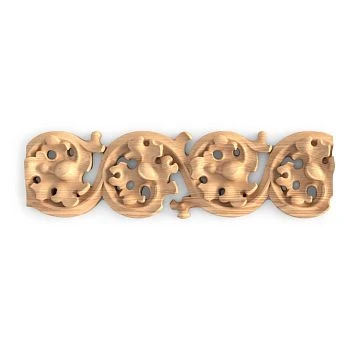
Leaves, branches, curls, shoots — this is the most flexible ornament for curved surfaces. Plant forms organically "flow" around the radius, creating the feeling that the overlay grew out of the curve, not glued to it. Suitable for classic, Provence, Russian style, rustic interior.
Acanthus
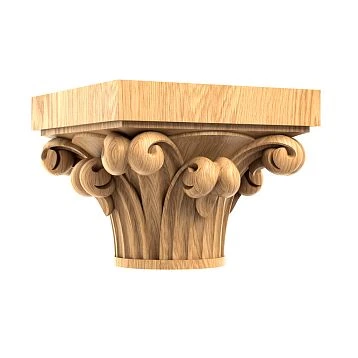
The acanthus leaf is one of the oldest decorative motifs, originating from the ancient capital. On corner overlays, acanthus works especially convincingly: its large curved leaves logically fill the corner plane. Ideal for Empire style, palace aesthetics, and solemn classical interiors.
Floral ornament
Buds, wreaths, garlands — all of this fits beautifully on curved overlays for frames, mirror surrounds, and furniture facades in Provence or romantic style. It is especially organic in combination with STAVROS mirror frames with a similar ornament.
Geometric ornament
Straight lines, rhombuses, weaves, meander. For corner overlays, geometric patterns work where a calm neoclassicism without pomp is needed. It pairs well with minimalist facades and modern classics.
Laurel, ribbon, garland
Solemn, symmetrical motifs — for portals, arches, frames of formal areas. On horizontal curved elements, a laurel branch or ribbon garland creates a strong decorative accent without overload.
Woven ornament
Textured, slightly archaic, with a pronounced relief. For corner overlays in rustic, Russian, or Gothic style.
How to choose the right overlay shape: the logic of step-by-step selection
Choosing a curved or corner overlay is not about 'like / dislike'. It is an engineering task with a decorative component. Let's break it down step by step.
Step 1: determine the surface geometry
First of all, ask yourself: what exactly needs to be finished? Is it:
-
An external right angle (90°)?
-
A smooth radius (curved facade, arch)?
-
A transition from straight to curved (arch post → vault)?
-
A frame corner?
-
A rounded furniture corner?
The type of overlay depends on the answer: corner, curved, C-shaped, S-shaped, or corner with a transition profile.
Step 2: measure dimensions and radius
For corner overlays — measure the width of both sides of the corner and the height of the decorative area. The overlay should completely cover the corner, without protruding unattractively beyond its edges or being too small.
For curved overlays — measure the radius of curvature of the surface. This is a key parameter: an overlay with a different radius simply will not fit the surface without gaps.
Step 3: determine the scale of the decor
A small frame for a 15×20 photo cannot tolerate a large overlay with a sprawling acanthus. A massive fireplace portal will not notice a thin, delicate detail. The scale of the ornament and the thickness of the overlay must match the scale of the object.
A good rule: the decorative element should not exceed 15–20% of the size of the surface it decorates.
Step 4: check the style
Overlays do not exist in a vacuum. They coexist with moldings, STAVROS wooden baguette, furniture handles, moldings. The ornament and character of the overlay must be coordinated with the surrounding elements.
Mixing acanthus in the Empire style with a braided ornament in a rustic style means creating a decorative conflict that the eye perceives as chaos.
Step 5: determine if a pair is needed
Symmetrical compositions require left and right overlays. If you are decorating an arch, a pair of symmetrical cabinet corners, or a mirror frame, check the product card for a mirror pair and order both parts simultaneously.
Material: oak, beech, MDF — what to choose for curved overlays
Curved and corner overlays STAVROS are made from several materials. Each product card specifies the specific material — this is important to check when purchasing because not all items are available in all options.
Oak
Oak is a dense, heavy wood with characteristic open porosity and a pronounced grain pattern. Carved decor from oak has high detail, resistance to mechanical stress, and expressive texture.
For corner and curved overlays made of oak, it is important to understand: oak is a rigid material. Curved oak products are manufactured by milling from solid wood with a specified radius, not by bending. This ensures high shape quality and durability.
Oak overlays work where visible wood texture is important — under oil or a clear finish. For a prestigious interior, classic, art deco, modern neoclassicism.
Beech
Beech is more uniform, light, with fine pores. Carving on beech results in sharper edges and finer details. Beech better accepts enamel, primer, and paint, making it preferable for overlays that are planned to be painted white, ivory, or a colored finish.
For curved products, beech is more flexible than oak, allowing for thinner profiles with a smaller radius.
MDF
MDF is a medium-density fiberboard. It is stable, does not change geometry with humidity fluctuations, mills well, and paints beautifully. For overlays that go under enamel or in combination with painted furniture, MDF is the optimal choice.
Important note: MDF is not intended for a natural wood finish. Its texture and structure differ from solid wood, so MDF is not used under oil or stain.
After applying the decor, you can use Rubio Monocoat oil for final protection — for solid wood products. For MDF — primer and enamel.
How not to overload the corner and radius with decor
This is one of those questions that most often remains unanswered in decor instructions. Theoretically, the rule is simple: decor should enhance, not overwhelm. In practice, it is more complicated.
Signs of overloaded decor on the radius:
-
Three or more decorative elements of different patterns within a single surface.
-
An overlay whose ornament is larger than the molding it adjoins.
-
A corner piece that 'overpowers' the adjacent straight decor — all attention goes to the corner, not the plane.
-
An ornament that overlaps the work surface (e.g., a corner overlay blocks hinges or hinders door opening).
Balance principles:
-
One accent ornament per decorative zone. Other elements should be neutral or thematically related.
-
The size of the corner overlay should not exceed 1/4 of the facade height.
-
The richer the ornament, the simpler the adjacent elements should be.
STAVROS solid wood decorative elements are selected in a unified style — this simplifies the task: within a single collection, ornaments are coordinated in scale and character.
Installation of curved and corner overlays: what you need to know
Installing decorative overlays is not the most complex operation, but it has its nuances, especially for curved and corner elements.
Glue is the basis of attachment
Decorative overlays are primarily attached using woodworking or construction glue. It is important to choose a glue that provides sufficient open time: corner and curved parts often require positioning and clamping with force.
In the section STAVROS installation and finishing materials There are glues recommended for working with wooden decorative elements.
Surface preparation
The surface under the overlay must be clean, smooth, and dry. This is especially important for curved overlays: if there is a bump or depression at the bend point, the overlay will either not fit tightly or will crack under pressure.
Positioning before applying glue
Before applying glue, always dry-fit the overlay. Make sure that:
-
For a corner overlay, it fits exactly into the corner without gaps.
-
For a curved one, the radius matches, and the overlay contacts along the entire length without gaps.
-
For paired overlays, the left and right are symmetrical about the axis.
Fixation
After applying the glue, the overlay is fixed: with painter's tape, clamps with soft jaws, or any other method without damaging the surface. The holding time is according to the glue instructions, usually 30–60 minutes.
Final finishing
After installation — the finish. For overlays made of solid oak or beech — Rubio Monocoat oil for a clear natural finish, or primer + enamel for painting. For MDF — only primer and paint.
9 mistakes when choosing curved and corner overlays
Mistakes on this topic are common — and all of them are fixable if you know about them in advance.
Mistake 1: installing a straight overlay on a radius. The most common one. A straight part does not fit a curved surface, creates a gap, or breaks when trying to press it down. Solution — a curved overlay with the required radius.
Mistake 2: not checking the left/right orientation. In some catalog positions, the overlay is sold only in one orientation. If you need a pair — make sure the mirrored version exists before placing the order.
Mistake 3: choosing silicone or soft protective corner guards instead of decorative ones. These are completely different product classes. Silicone corner guards are needed for child safety. STAVROS produces wooden decorative overlays — for interior decor and aesthetics, not for protecting corners from impacts.
Mistake 4: the ornament does not match the furniture style. A baroque acanthus on a Scandinavian minimalist kitchen will look out of place. The ornament style should always match the interior style.
Mistake 5: not considering the thickness of the overlay. If a molding or trim is installed nearby, the thickness of the overlay must be coordinated — otherwise there will be a step at the joint.
Error 6: not checking the installation location. The corner overlay should not interfere with hinges, handles, the back wall, or other functional elements of the furniture. Always dry-fit.
Error 7: overly active decor on a small surface. A large corner overlay with an elaborate ornament on a small cabinet will overload the piece. The scale of the decor should match the scale of the object.
Error 8: not coordinating overlays with adjacent decorative elements. If the interior already has Wooden Picture Frame, moldings and handles from a specific collection — the corner overlays should be in the same style.
Error 9: buying one overlay when a pair is needed. An arch requires two transition elements. A frame requires four corner pieces. A facade with two external corners requires two corner pieces. Always count the quantity before purchasing.
What to buy together with STAVROS curved and corner overlays
Overlays don't live alone — they are part of a system. Here's what makes sense to add to the order.
Decorative overlays of different shapes. A curved or corner overlay is part of the overall decorative scheme. It may include straight elements for flat areas, central medallions for accent, horizontal frieze details. The entire catalog of decorative wooden overlays STAVROS — in one place.
Wooden baguette. The baguette and corner overlays are often installed together: the baguette along the perimeter, the overlays in the corners. STAVROS wooden baguette in the same style — is a mandatory part of this system.
Linear products. Moldings and cornices — horizontal decorative lines that work together with corner elements. Wood and MDF linear products STAVROS — a wide selection of profiles for any style.
Mirror frames. If you are designing a mirror from scratch, STAVROS mirror frames are already assembled — with corner transitions and a selected ornament. This is an alternative to assembling a frame from overlays and linear products yourself.
Carved decor. STAVROS carved decor — these are not only overlays. Consoles, brackets, flat ornaments, medallions, pilasters. All of this can be part of a single decorative scheme where corner and curved overlays are one of the elements.
Oil for final protection. Wooden overlays made of solid wood require a final coating. Rubio Monocoat oil — the recommended choice for oak and beech products. Preserves texture, protects the surface, does not create a film.
Glue and mounting materials. STAVROS installation and finishing materials — adhesives, finishing compounds and everything needed for proper attachment of decorative elements.
Three examples: how curved and corner overlays work in real projects
Classic kitchen with radius corner cabinets
Challenge: corner sections of the kitchen have radius facades. Flat decor looks alien. Need to design the radius in a unified style with straight facades.
Solution: curved overlays with floral ornament on radius facades + straight overlays with the same ornament on flat doors. A single ornament creates a common visual system. Decor is fixed before installation, finished with Rubio Monocoat Pure oil.
Mirror in the hallway: DIY frame assembly
Challenge: oval mirror in the hallway, need a frame in Provence style. No ready-made frames of the required size available.
Solution: C-shaped curved overlays STAVROS + wooden molding around the perimeter. Molding is straight, along straight sections. C-shaped overlays — along the top arch. Corner transitions at the bottom points where the arch meets the straight sides. Single floral ornament around the entire perimeter. Finish — white enamel.
Arched doorway in the living room
Challenge: interior arch that needs to be decorated with wooden overlays in a neoclassical style.
Solution: straight overlays with geometric ornament on vertical posts + curved overlays with the same ornament on the radius arch + S-shaped transition elements at the post-to-arch transition points. All parts made of beech for white primer and enamel. KUDO glue for installation. Result — an arch with a unified decorative rhythm from the base to the keystone.
About the company STAVROS
STAVROS is a Russian manufacturer of decorative wooden products and furniture hardware with a history dating back to 2002. The company was founded in St. Petersburg by artists Andrey Ragozin and Evgeny Tsapko. From the first years of operation — participation in the reconstruction of the Konstantinovsky Palace in Strelna, later — work in the Hermitage, the Alexander Palace, and the Trinity-Izmailovsky Cathedral.
Today STAVROS is a full-fledged production facility, showrooms in Moscow and St. Petersburg, a catalog of thousands of items: decorative overlays, moldings, baguettes, frames, carved decor, furniture handles, slat panels, fittings, installation and finishing materials.
Curved and corner decorative overlays are one of the most professional sections of this catalog. This is where solutions for complex surfaces that do not fit into standard rectangular decor are found. Here, the radius becomes not a problem, but an opportunity.
Frequently asked questions
What is a curved decorative overlay?
This is a carved decorative element with a curved geometry, designed for installation on surfaces with a radius of curvature: arches, oval frames, curved furniture facades. Unlike a straight overlay, it fits the surface along its entire length without gaps.
How is a curved overlay different from a corner overlay?
A curved overlay works on a smooth radius — its axis is curved along its length. A corner overlay works on the external transition of two planes — it covers the edge of the corner and visually completes the corner joint.
How to choose the radius of a curved overlay?
Measure the radius of curvature of the surface. When ordering, refer to the parameters in the product card. If the required radius is not available in the standard catalog, contact the STAVROS manager: custom manufacturing is possible.
Do I need to buy overlays in pairs?
For symmetrical compositions — yes. Arches, frames, symmetrical furniture corners require left and right overlays. Always check for a mirror pair before placing an order.
Can wooden overlays be painted white?
Yes, especially overlays made of beech and MDF. For a white finish: sanding, primer, several coats of enamel. Oak overlays can also be painted but require a special primer to seal the pores.
Where to buy decorative furniture corner overlays in Saint Petersburg?
At the STAVROS showroom in Saint Petersburg or in the online catalog with Contact us to confirm shipping to your destination. Order Furniture corner overlays can be from one piece.
How to install curved overlays?
With woodworking or construction adhesive with sufficient open time. After applying the adhesive, the part is secured with masking tape or clamps. Recommended adhesives are in the STAVROS installation materials section.
Which ornaments work best on arches and curved surfaces?
Floral ornaments, acanthus, floral motifs — all "soft," plastic ornaments organically follow the curve of the overlay. Rigid geometric patterns work worse: on a radius, they lose their strictness.
How to choose the size of a corner overlay for a chest of drawers?
Measure the height of the decorative area (the distance from plane to plane that the overlay should cover) and the width of both edges of the corner. The overlay should completely cover the corner, without protruding beyond the surface.
Are there curved overlays for arches in STAVROS?
Yes. In the STAVROS catalog, there is a filter by shape "Curved" — it collects all curved decorative overlays suitable for arches, radius facades, and oval frames. Full catalog of curved overlays: https://www.stavros.ru/products/izdeliya-iz-massiva/nakladki/formy_izdeliy_gnutaya/