


























Article Contents:
- What is RPU-068
- First, measure not the entire frame, but the clean inner field
- Paper template 115 × 60 mm: a check that saves an extra order
- How RPU-068 looks in panels of different sizes
- Why an empty field inside moldings is not always a problem
- One RPU-068 in the center: the calmest option
- Do you need to place the rosette strictly in the geometric center
- Place RPU-068 horizontally or vertically
- One or two RPU-068 in one panel
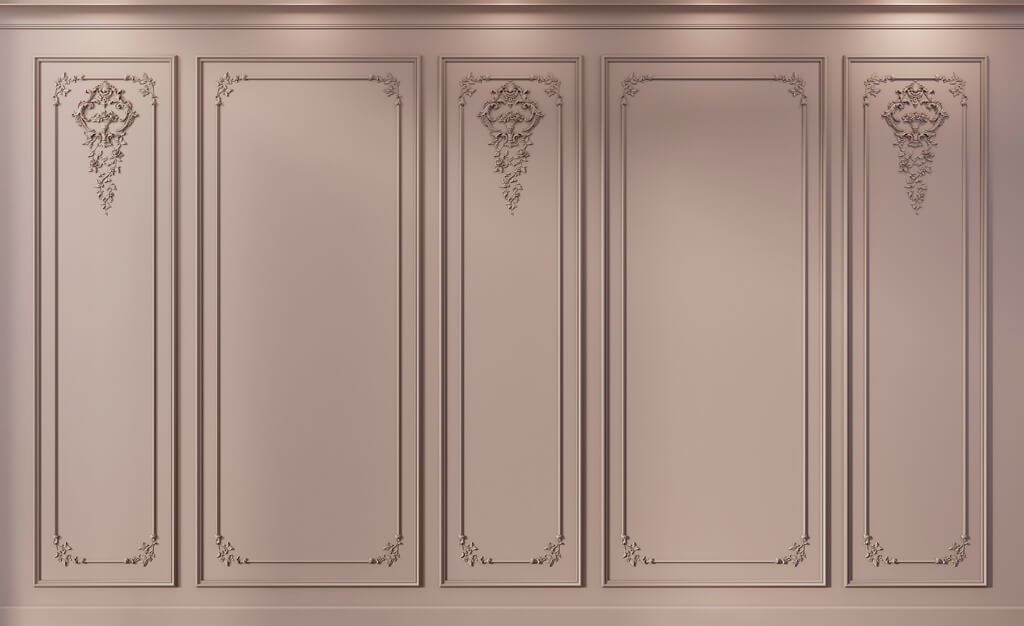
- Three large panels and two narrow ones: you don't have to install five sockets
- Five identical panels: how many RPU-068 to order
- If panels are of different widths, don't mentally reduce or enlarge RPU-068
- Depth 11 mm: why you need to look not only at the size 115 × 60
- How depth affects placement near furniture
- Should RPU-068 be placed in every frame in the room
- What to do if a picture is already hanging inside the frame
- RPU-068 and a wall lamp inside one panel
- Can RPU-068 be installed above a console
- Can RPU-068 be used on a door
- RPU-068 or decorative cover plate
- When it's better to leave only moldings
- When one RPU-068 is not enough
- How to mark one outlet exactly in the center
- How to mark several identical panels
- What to do if the frames are already installed slightly unevenly
- How much to indent from the molding
- Why the product photo does not show the real scale
- Do you need to match the outlet to the width of the molding
- Outlet and decor of corners of one panel
- Paint RPU-068 in the wall color or highlight it
- Do I need to paint the molding and RPU-068 the same way
- Can I add RPU-068 after the frame is already painted
- Buy one socket for testing or the whole set at once
- Cost of RPU-068 for standard sets
- Where to buy RPU-068
- How to understand in five minutes if RPU-068 fits your panel
- What to put in the cart for specific scenarios
- Main selection criterion
- FAQ
- What is the size of the carved rosette RPU-068?
- What material is RPU-068 made of?
- How much does RPU-068 cost now?
- Will RPU-068 fit a large molding frame?
- Do I need to install RPU-068 in every molding frame?
- How many RPU-068 units are needed for five identical wall panels?
- Can I install two RPU-068 units inside one panel?
- What should I do if RPU-068 seems too small?
- What to do if RPU-068 almost touches the molding?
- Is it mandatory to place RPU-068 strictly in the center?
- Can I rotate RPU-068 vertically?
- How far does the RPU-068 protrude from the wall?
- Which is better: RPU-068 or another inner molding frame?
- Which is better: RPU-068 or a large decorative overlay?
- Where to buy the RPU-068 carved rosette?
- Where can I see other carved polyurethane rosettes?
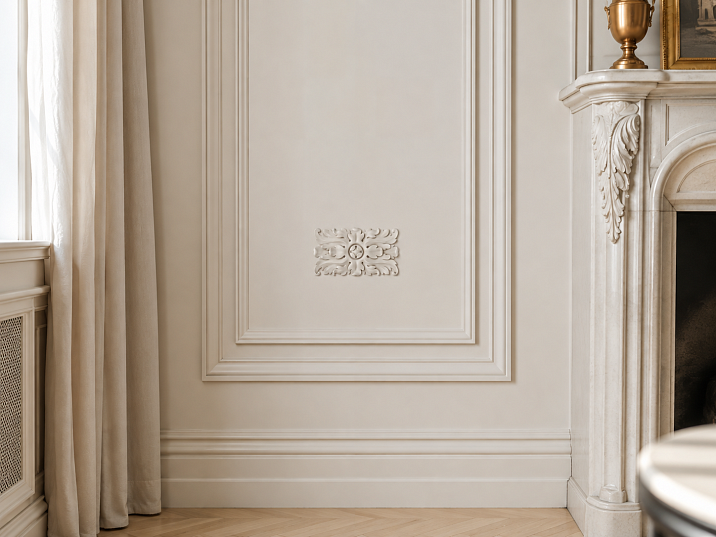
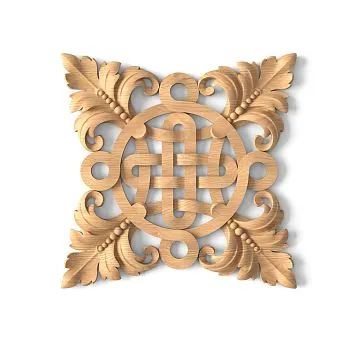
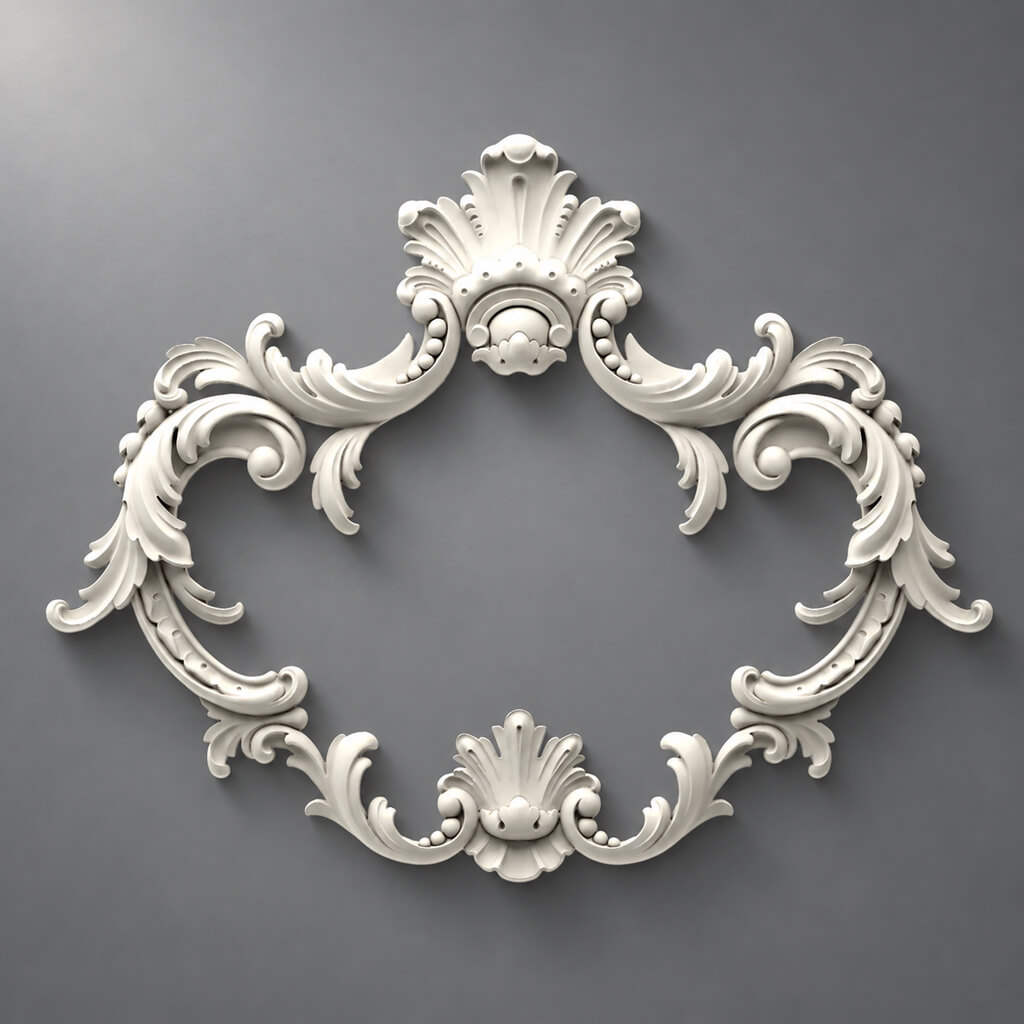
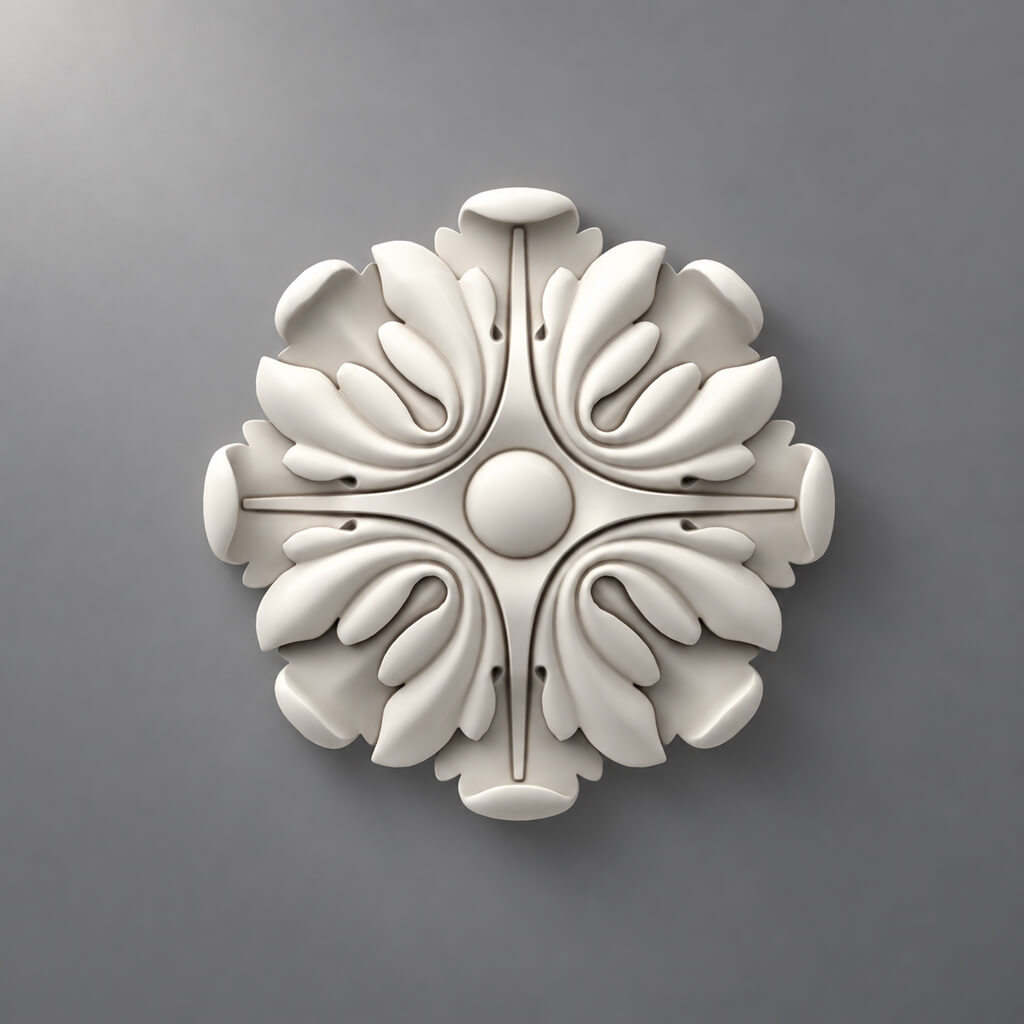
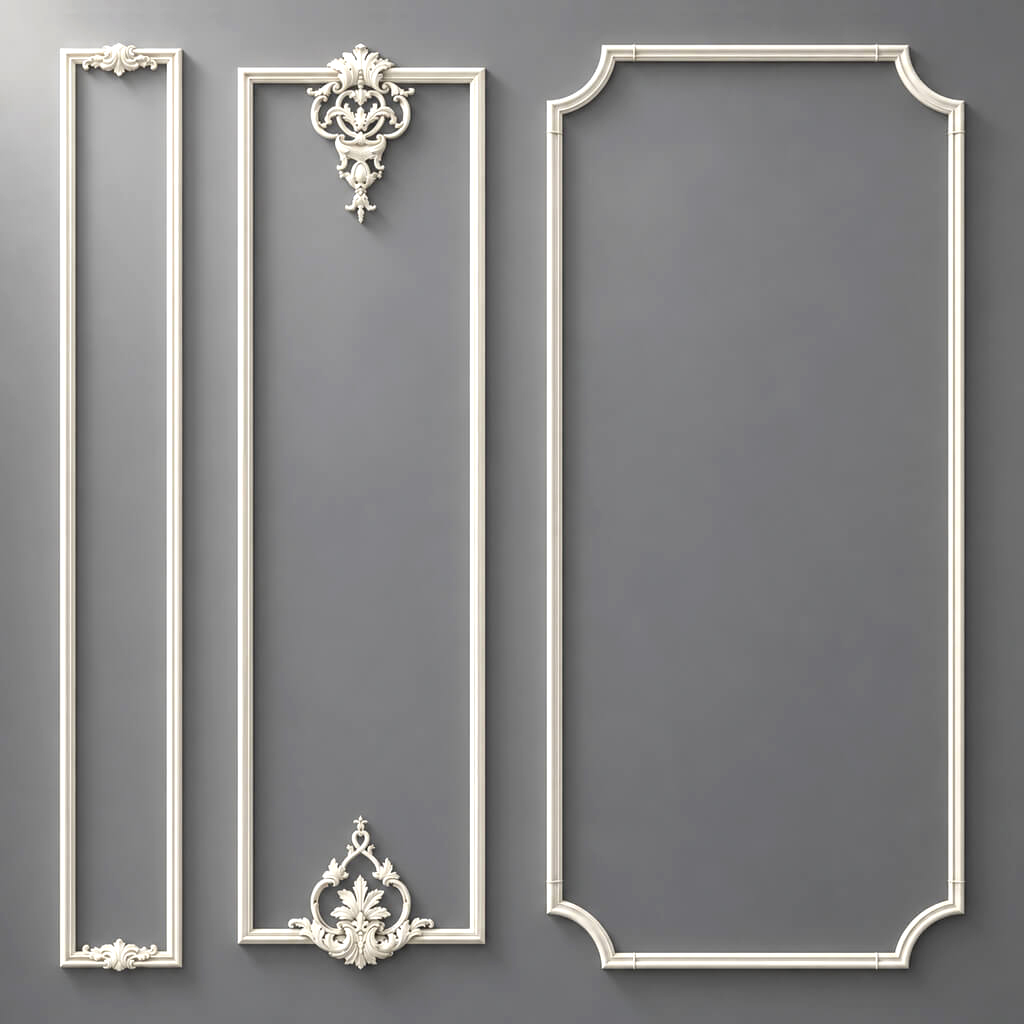
For such a situation, one can consider a small carved polyurethane rosette RPU-068. Its size is 115 × 60 × 11 mm, and the price at the time of checking is 980 ₽.
The main thing here is not the mere presence of free space inside the moldings. First, you need to understand the scale. RPU-068 has a length of 115 mm, that is, 11.5 cm, and a width of 60 mm, or 6 cm. On a large wall panel, such a rosette will become a small central accent. In a very narrow frame, the same 115 × 60 mm can already take up a noticeable part of the free field.
The most reliable way to check the size before ordering is to cut a 115 × 60 mm rectangle from plain paper, attach it with masking tape in the intended location, and look at the panel not up close, but from the point in the room where the wall is usually seen in full.
This makes it clear whether just one RPU-068 is needed, whether it's worth using two sockets, whether a larger decor is needed, or whether it's better to leave the molding panel empty altogether.

What is RPU-068
RPU-068 is specifically a carved polyurethane rosette. This is important for correctly understanding its role in the composition.
It is not a molding used to build a frame. It is not a long linear element or a corner piece. RPU-068 is a separate local decorative accent that can be placed within an already formed field.
Main features:
| Parameter | RPU-068 |
|---|---|
| Type | Carved rosette |
| Material | Polyurethane |
| Size | 115 × 60 × 11 mm |
| Length | 115 мм |
| Width | 60 мм |
| Relief depth | 11 мм |
| Price at time of check | 980 ₽ |
Proportions matter here. The rosette is neither square nor round. It is elongated along one axis roughly twice as much as along the other. Therefore, in a rectangular molding panel, it supports the geometry of the frame itself better than an element with a completely different shape.
At the same time, 115 × 60 mm is a fairly compact size. If the inner part of the panel has a width of, for example, 700–900 mm, a single RPU-068 will not fill a significant portion of the field. It will work more as a point where attention converges.
That is why it should be chosen not on the principle of "need to fill the emptiness with something," but based on the question: is a small central accent needed inside the panel.
First, measure not the entire frame, but the clean inner field
One of the simplest mistakes is to measure the outer dimensions of the molding panel and compare RPU-068 with them.
For a decorative element, another distance is more important: how much free wall remains inside the molding frame.
Let's imagine a wall panel with an outer size of 800 × 1200 mm. If the molding is placed with a noticeable inset inward or the profile itself is quite wide, the clean field between the inner edges of the molding will be smaller.
It is precisely into this field that the socket must fit.
Therefore, it is useful to take four measurements: the width of the clean inner field, its height, the position of the geometric center, and the distance from the intended location of RPU-068 to the nearest interior elements.
The last parameter often turns out to be decisive. Inside the frame, there may be enough space mathematically, but nearby there is a switch, a sconce, a door handle, a console, or a furniture backrest. Then the geometric center and the visual center of the wall may not coincide.
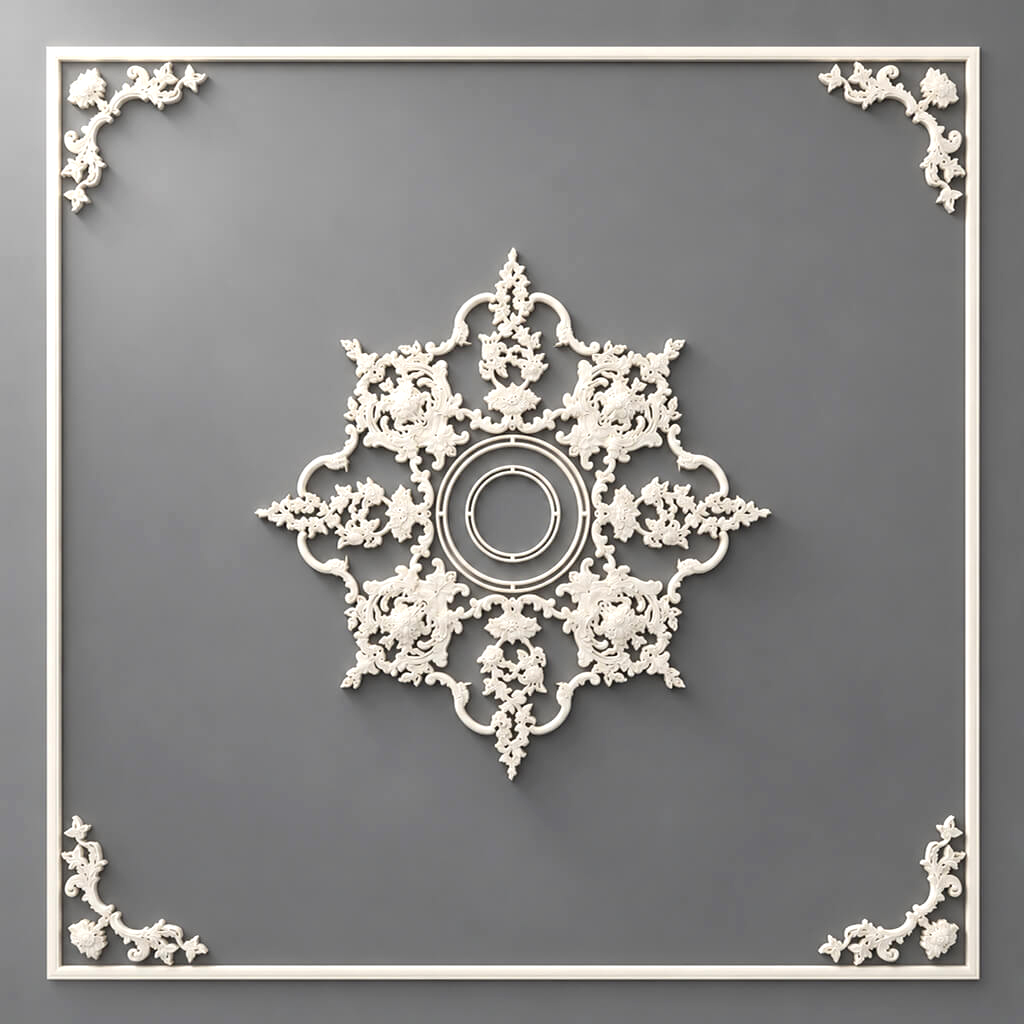
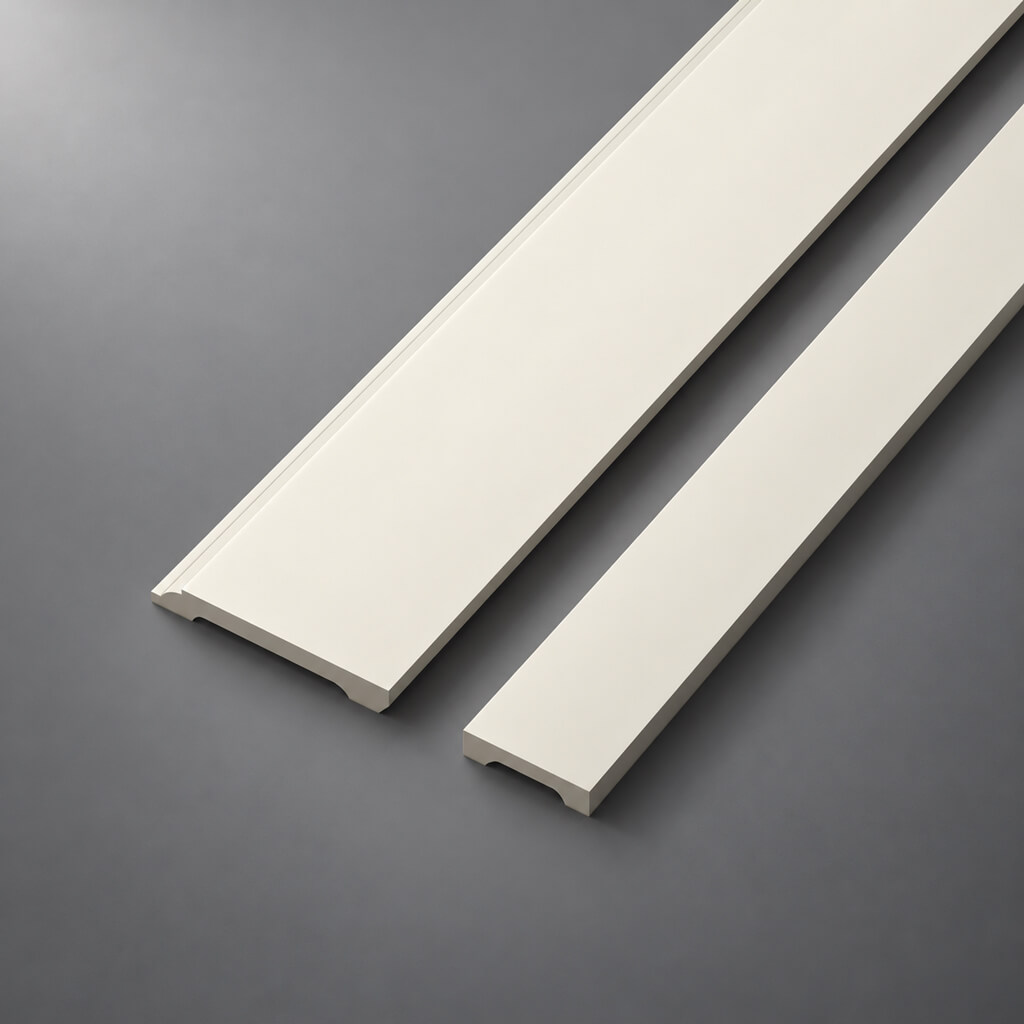
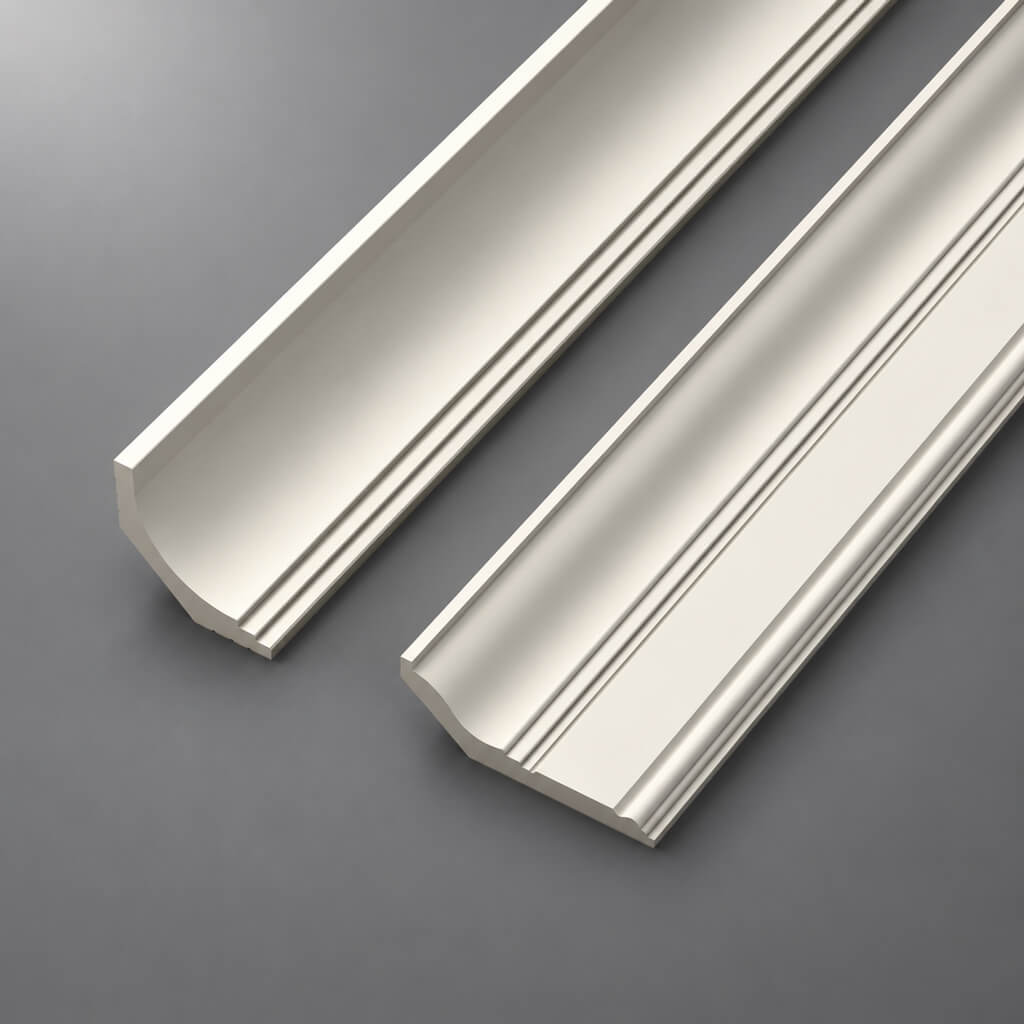
Our factory also produces:


Paper template 115 × 60 mm: a check that saves an extra order
Before purchasing RPU-068, you can fairly accurately estimate its scale without even having the socket itself.
Cut out a rectangle measuring 115 × 60 mm.
Do not enlarge it "approximately to the size of the item." Here, precision is exactly useful: 115 mm is 11.5 cm, 60 mm is 6 cm.
Attach the template inside the frame.
First, position it exactly in the center. Then step back a few meters.
If from a normal viewing point the paper rectangle almost disappears, you need to decide whether this matches the task. Perhaps a small and delicate accent is exactly what is needed here. If a noticeable central composition was expected, RPU-068 may be too compact.
If the template, on the contrary, almost fills the narrow space between the moldings, the problem is the opposite: a rosette that is small by catalog standards becomes large for a specific panel.
It's useful to do such a check before ordering several identical items. A mistake with one rosette is one incorrectly chosen element. A mistake when designing eight identical wall panels means eight elements of inappropriate scale.
Get Consultation
How RPU-068 looks in panels of different sizes
There is no universal rule like "the rosette should occupy 20% of the frame width." The interior composition depends on the molding, wall height, furniture, and the number of panels.
But mathematics helps to see the real scale of the item.
Let's say the clean inner field of the frame is 600 × 900 mm.
If the RPU-068, measuring 115 × 60 mm, is placed exactly in the center horizontally, the remaining width will be:
(600 − 115) / 2 = 242.5 mm
on each side.
Vertically:
(900 − 60) / 2 = 420 mm
at the top and bottom.
That is, on a 600 × 900 mm panel, the socket remains a small central element with a large amount of free space around it.
For the internal field of 300 × 600 mm, we get a different picture.
By width:
(300 − 115) / 2 = 92.5 mm
By height:
(600 − 60) / 2 = 270 mm
The socket occupies a significantly more noticeable share of the panel width.
If the internal width is only 200 mm, with horizontal orientation of RPU-068, the following remains:
(200 − 115) / 2 = 42.5 mm
on each side.
Mathematically, it fits. But 42.5 mm of free space between the edge of the socket and the boundary of the field is already a completely different character of composition. Here, a real fitting is especially needed.
| Clean field of the panel | Free space on the left and right when centering RPU-068 | How to interpret the calculation |
|---|---|---|
| 800 mm in width | 342.5 mm | the socket will be a small accent |
| 600 мм | 242.5 mm | Lots of free field |
| 400 мм | 142.5 mm | the element becomes more noticeable |
| 300 мм | 92.5 mm | the socket takes up a noticeable part of the width |
| 200 мм | 42.5 mm | a particularly careful fitting is needed |
This is not a table of "allowed and forbidden sizes." It only shows the geometry. The final decision is still made based on the actual wall.
Why an empty field inside moldings is not always a problem
After installing the frames, there is sometimes a desire to definitely add something inside each panel.
This is not a mandatory rule.
The empty field is also part of the composition. It is the empty painted plane that allows the molding to be read as a graphic frame.
If the panel is narrow, located next to a saturated furniture facade, adjacent to a painting, or already contains a sconce, an additional outlet can make the wall look overloaded.
Therefore, RPU-068 makes sense to add not because "there is nothing inside the frame," but when the empty field truly seems disproportionately large relative to the surrounding composition.
A good test is simple: temporarily stick a paper template, photograph the wall with and without it from the same point. Comparing two photos is often easier than trying to remember the impression of the wall.
One RPU-068 in the center: the calmest option
For a large rectangular panel, one outlet in the center is the most obvious scheme.
In this case, the molding continues to do the main work. RPU-068 merely marks the center.
This option is especially logical if there are several identical wide panels on the wall. The same small outlet, installed at the same point in each frame, creates a repeating rhythm.
But here a requirement for marking arises.
If the first outlet ends up 10–15 mm above the geometric center, and the next one below, individually the error may seem insignificant. When several panels are visible simultaneously, the difference becomes more noticeable.
For a series of identical frames, it's better not to mark each RPU-068 independently, but to draw a common horizontal axis across the entire wall.
Should the socket be placed strictly in the geometric center?
Most often, it is convenient to start fitting from this position, but the geometric center is not mandatory.
Imagine a tall panel whose lower part is partially covered by a console. The formal center ends up too close to the countertop. If you raise the RPU-068 a bit higher, the composition from a furniture perspective may become more balanced.
Another example is a sconce in the upper part of the panel. Here, installing the socket exactly in the center can create two competing accents on the same vertical axis.
Therefore, there are two centers:
the geometric center of the frame and the visual center of the entire composition together with furniture and lighting fixtures.
First, it is worth trying the first option. You should deviate from it only for a clear reason, not randomly.
Whether to place the RPU-068 horizontally or vertically
The socket size is 115 × 60 mm, so the orientation noticeably changes its perception.
In a wide, low panel, horizontal placement naturally follows the direction of the frame itself.
In a tall narrow panel, you can check the vertical orientation. Then 115 mm becomes the height of the element, and 60 mm becomes its width.
You cannot claim in advance that one orientation is always correct. The RPU-068 relief also has its own direction, so before installation, the part should be viewed directly on the wall in the intended position.
Be especially careful when changing orientation if several panels form a single composition. Rotating identical sockets randomly in adjacent frames is not advisable: it creates the impression that the elements are installed without a common system.
One or two RPU-068 in a single panel
If the panel is tall, a single small socket in the center may be too weak an accent. Then the idea of installing two arises.
This option is possible, but it cannot be considered an automatic improvement.
Two sockets form not a point, but an axis. If placed one above the other, the eye begins to move vertically. If spaced horizontally, the composition becomes wider.
The choice depends on the proportions of the frame.
| Option | What happens visually | When to check |
|---|---|---|
| one RPU-068 | one compact center appears | most of the usual rectangular frames |
| two vertically | the vertical axis is strengthened | very tall panel |
| two horizontally | the center of the composition expands | wide horizontal panel |
| larger single decor | the field fills more noticeably | if RPU-068 is clearly lost |
| without a rosette | the clean geometry of the molding is preserved | narrow panels or a rich interior |
If you want to install two RPU-068 just because one looks small, first check an alternative: perhaps you need not a double set of small sockets, but a different decorative element of a larger size.
Three large panels and two narrow ones: it is not necessary to install five sockets
The molding layout often does not consist of identical rectangles.
For example, on the wall there may be:
three wide central panels and two narrow side ones.
The automatic logic of "five panels, so five RPU-068 needed" doesn't always work here.
If narrow side fields are needed only for rhythm, adding the same outlet to each of them can overload the edges of the composition.
In such a scheme, it is reasonable to check a variant where RPU-068 are installed only in the three large panels.
Then 3 sockets are required, not 5.
At a price of 980 ₽, the cost of three items is:
3 × 980 = 2 940 ₽.
Five outlets:
5 × 980 = 4 900 ₽.
The difference is 1,960 ₽, but the choice is not determined by savings. Simply, identical filling of frames of different scales may be compositionally unjustified.
Five identical panels: how many RPU-068 to order
Here the calculation is simpler.
If there are five identical molding panels on the wall and one RPU-068 is planned in the center of each:
5 panels = 5 RPU-068.
At the current price of 980 ₽:
5 × 980 = 4 900 ₽.
If the project provides for two sockets in each frame:
5 × 2 = 10 RPU-068.
Cost of the sockets themselves:
10 × 980 = 9 800 ₽.
Therefore, the decision of "one or two" should preferably be made on the template before ordering the entire batch.
For eight identical panels with one RPU-068:
8 × 980 = 7 840 ₽.
The quantity calculation is simple, but first you need to determine whether each panel should actually repeat the same decorative element.
If the panels are of different widths, do not mentally reduce or enlarge the RPU-068.
The RPU-068 has a fixed size of 115 × 60 × 11 mm.
On a wide panel it does not become physically smaller, and on a narrow one it does not become larger. Only the ratio of the product to the surrounding free field changes.
Because of this, the same product on adjacent panels of different sizes can be perceived completely differently.
For example:
the central field has a width of 700 mm;
The side fields are 250 mm each.
In the center, around a socket 115 mm wide, there is a lot of empty space.
On a field 250 mm wide after centering:
(250 − 115) / 2 = 67.5 mm
on each side.
Therefore, the idea of placing one identical RPU-068 in each of the three frames deserves real testing on the wall. Formal symmetry in the number of products does not yet mean visual symmetry.
Depth 11 mm: why you should look beyond just the size 115 × 60
In the frontal image of a product, the length and width are usually perceived first.
But RPU-068 has a third size — 11 mm.
This is the depth, which determines how much the relief protrudes from the plane of the wall.
One centimeter and a bit seems like an insignificant size until the element appears next to a very thin flat molding. With side lighting, the relief begins to cast its own shadow and can look more prominent than expected from the photo.
Therefore, when selecting central decor for an already installed molding frame, you need to compare not only the width of the products.
If the molding is almost flat, and a more pronounced carved relief appears inside, the center of the panel will become visually more active than its border. Sometimes this is exactly what is needed. Sometimes the opposite effect is desired — so that the entire design remains almost graphic.
The paper template shows the size in plan but does not show the depth of 11 mm. If this parameter is critical, it needs to be separately presented in real scale.
You can take a strip of cardboard or another safe object about 11 mm thick and look from the side to see how far the element will protrude from the wall.
How depth affects placement near furniture
If the RPU-068 is simply on a free wall, the 11 mm protrusion is usually assessed primarily visually.
A completely different situation arises near movable objects.
For example, a molding panel is located behind a hinged cabinet door that, when fully opened, comes close to the wall. Or a heavy curtain moves along the wall. Or the panel is located next to a furniture door.
Then, before installation, it is worth checking the actual gap.
It cannot be assessed only by the frontal size of 115 × 60 mm. The socket protrudes 11 mm from the wall, plus the actual mounting surface is taken into account.
If nothing moves nearby and no one touches the wall, this issue is less critical.
Should the RPU-068 be placed in every frame of the room
There is no need to automatically repeat the socket in all molding panels.
The rhythm can be built in several ways.
If the walls are absolutely symmetrical and the panels are identical, repeating one RPU-068 in each frame looks logical.
If one wall is an accent wall, sockets can only be used on it.
If the central panels are larger than the side ones, only the large ones can be decorated.
If part of the frames is filled with paintings or lamps, adding a socket there is not necessary.
A good layout is determined by the entire room, not by the rule "one frame — one socket."
What to do if a painting is already hanging inside the frame
In this case, the RPU-068 and the painting claim roughly the same role — to become an accent within the field limited by the molding.
Placing a socket directly next to a painting just to fill the remaining space is usually risky. A small carved element may start to look like a random addition.
If the panel was designed for a painting, photograph, or mirror, it is worth first evaluating it fully with that item.
RPU-068 is more logically used in those adjacent panels that remain free.
This way, you can support the decorative rhythm of the wall without competing with the image.
RPU-068 and a wall sconce within the same panel
A lamp is an even stronger object because, in addition to its own shape, it creates a light pattern on the wall.
If a sconce is already in the center of the panel, an outlet in the same spot is obviously unnecessary.
You can consider the RPU-068 lower or higher, but only if there is truly enough free space.
Particular attention should be paid to the depth of the relief and the light. Directional side lighting can make a small carved detail visually much more expressive.
In such a situation, a paper template is useful, but it is better to finally evaluate the composition with the sconce turned on.
Can the RPU-068 be installed above a console
Yes, if there is already a molding panel above the furniture and you want to get a small decorative center inside it.
But the position should be calculated relative to two objects at once: the frame and the console.
Let's imagine that the geometric center of a tall panel is just a few centimeters above the countertop. Mathematically, the RPU-068 is installed correctly, but visually it looks too low.
Therefore, when furniture is present, it is worth first determining the free visible part of the panel above it.
Sometimes it is wiser to raise the outlet above the geometric center of the frame. Sometimes the console is so high that central decor is not needed at all.
Can RPU-068 be used on a door
RPU-068 is made as a separate polyurethane decorative element, and this format allows it to be considered not only for walls but also for decorative finishing of suitable door and furniture surfaces.
But for a door, additional limitations arise.
You need to check the width of the free field, the position of the handle, the movement of the panel, and the distance to the trim.
The depth of 11 mm is especially important in places where an opening door passes close to a wall or an adjacent panel.
If the goal of the article and project is specifically a molding panel on the wall, it is better not to complicate it with door scenarios unnecessarily. For a wall, RPU-068 is chosen primarily by the scale of the field and composition.
RPU-068 or decorative overlay
These types of decor should not be mixed just because both products are glued to the surface and have relief.
RPU-068 is a carved rosette. In the scenario under consideration, it works as a compact medallion or a central accent.
The decorative overlay can have completely different dimensions, an elongated shape, and a more complex composition.
If the panel is large and the empty field needs to be filled more noticeably, the buyer should indeed compare RPU-068 not with another small rosette, but with a larger wall decor.
You can see different options in the section buy wall decor.
But it makes sense to move to a larger element only after testing RPU-068 at a 1:1 scale. In the card image, a compact socket may appear much larger than the actual 115 × 60 mm.
When it's better to leave only moldings
There are situations where the absence of RPU-068 is a deliberate decision, not an oversight.
If the inner field is small, the molding already creates sufficient relief.
If a wall lamp is located inside the panel, an additional central element may interfere.
If there is furniture with carved facades nearby, another ornament on the wall sometimes becomes redundant.
If the interior is built on calm solid surfaces and fine geometry, a decorative rosette changes the stylistic accent of the entire wall.
And finally, if after a paper mock-up of 115 × 60 mm you constantly want to make the template smaller, then the central decor of this panel is probably not needed at all.
When one RPU-068 is not enough
The opposite situation occurs in very large panels.
For example, a frame takes up a significant part of the wall from the baseboard almost to the ceiling. In such a field, 115 × 60 mm can be perceived as a very small point.
There are three reasonable paths.
You can leave one RPU-068 and deliberately make it a delicate accent.
You can test a composition of several identical rosettes.
You can move to larger stucco decor.
Choosing the second option just to fill the area is not worth it. Two small details create a different pattern, not just replace one large one.
How to mark one rosette exactly in the center
Suppose the inner field of the frame has a width of 620 mm and a height of 920 mm.
RPU-068 is installed horizontally.
Free distance across the width:
620 − 115 = 505 mm.
Divide in half:
505 / 2 = 252.5 mm.
This means that from the inner edge of the molding field to the edge of the socket on each side there will be 252.5 mm.
By height:
920 − 60 = 860 mm.
860 / 2 = 430 mm.
If you step back 252.5 mm horizontally and 430 mm vertically, RPU-068 will be geometrically centered in the clean inner field.
In practice, it is more convenient to first draw the vertical and horizontal axes, find their intersection, and align the center of the socket with it. This reduces the risk of accumulating errors from measurements to each edge.
How to mark several identical panels
If there are five identical frames on the wall, you should not find the center of each one with just a tape measure independently of the others.
It's better to first determine the level of the outlets and draw a single horizontal reference line.
After that, the center of each panel is marked according to its width.
This way, all five RPU-068 will be at the same height.
If the floor or ceiling has a slight deviation, relying solely on them is risky: the row of decorative elements may visually start to "drift" up or down.
For the composition, the consistency of the panels themselves matters more.
What to do if the frames are already installed slightly unevenly
Here an unpleasant choice arises: center each RPU-068 relative to its own frame or align all outlets along a common line.
There is no universal solution.
If the differences between the frames are minimal, it's usually more reasonable to maintain the common level of the outlets.
If one panel is noticeably different in height, placing it strictly along the common axis may make the offset relative to its moldings obvious.
Therefore, before installation, you need to lay out all paper templates simultaneously and look at the wall as a whole.
It is precisely for such situations that templates are more useful than calculations in millimeters: they show not an individual size, but the overall composition.
How much to indent from the molding
There is no fixed mandatory distance for RPU-068.
Only a geometric minimum can be determined: the socket itself must physically fit in the free field.
But if its edge almost touches the molding, the two relief elements begin to compete and may visually merge.
The smaller the inner frame, the more important it is to do a real fitting.
For example, with a clear field width of 180 mm and a horizontal RPU-068:
180 − 115 = 65 mm.
After centering, only this remains:
65 / 2 = 32.5 mm
on each side.
It can fit. But the 32.5 mm distance can no longer be assessed only by the formula "it fits — so it's suitable."
With a field width of 500 mm, the remainder is:
(500 − 115) / 2 = 192.5 mm.
Here, there is much more free wall around the socket.
Why the product photo does not show the real scale
The product card should show the shape and relief, so the item naturally takes up a significant part of the frame in the photo.
Because of this, a 115-mm socket may be perceived as large.
In an interior, 115 mm is 11.5 cm.
For comparison with your wall, it's better to literally measure this length with a tape measure.
If the inner field of the molding panel is 900 mm wide, RPU-068 takes up about one-eighth of that width along its long side.
If the field is 250 mm, the same part takes up almost half.
The product itself hasn't changed. The context has changed.
Do you need to match the rosette to the width of the molding?
There is no direct mathematical relationship.
You can't say that with a molding of width X, you necessarily need a rosette of width Y.
But the visual connection should be checked.
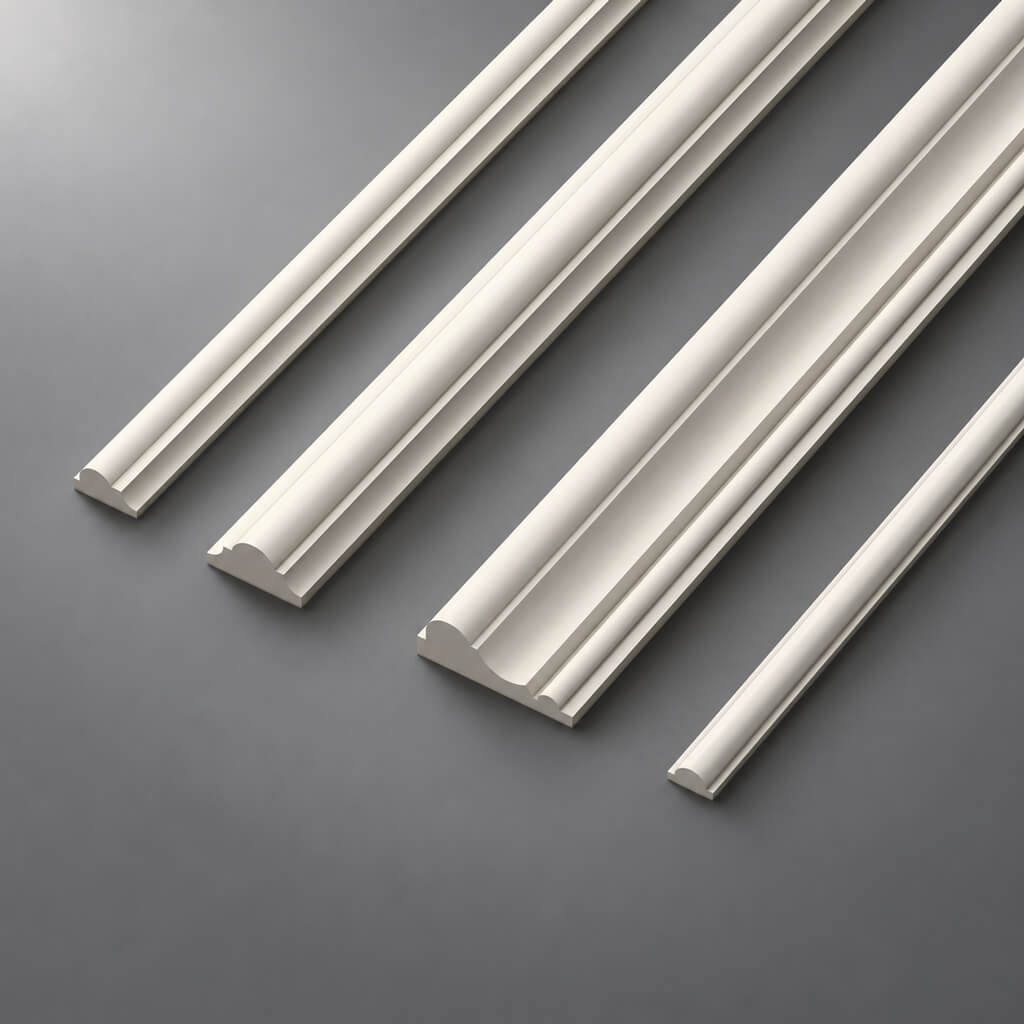
A thin frame and the embossed RPU-068 create one character of composition. A wider ornamental molding and the same small rosette create another.
If the molding has not been chosen yet, the assortment can be viewed in the section Buy polyurethane wall moldings.
If the frame is already installed, the choice is simpler: there is no need to select two unknown items at once. It is enough to make a template of RPU-068 and evaluate it next to the actual profile on the wall.
Socket and corner decor of one panel
Additional corner elements and the central RPU-068 perform different tasks.
Corner decor complicates the perimeter of the frame.
RPU-068 works inside the field.
You can use both types at the same time, but a small panel quickly becomes saturated.
If the corners already have a pronounced ornament, it is worth first looking at the frame without the central rosette.
If the perimeter is simple and even, RPU-068 gets more visual space and can become the only carved accent.
To select elements for the moldings themselves, there is a section Decor for polyurethane moldings.
Paint RPU-068 in the wall color or highlight it
If the moldings are already painted together with the wall, the calmest option is to continue the same principle for RPU-068.
Then the ornament is revealed through its own relief and shadows, rather than through color contrast.
A contrasting rosette will be more noticeable. For a small element, this can be useful if a clear center of the panel is needed.
But there is a nuance: with contrasting painting, the size of 115 × 60 mm is visually perceived more strongly than with tone-on-tone painting.
Therefore, the color issue is better resolved after checking the scale.
If the paper template already seems very active on a narrow panel, contrasting highlighting will further enhance the effect.
Do the molding and RPU-068 need to be painted the same way
Not necessary, but identical finishing makes it easier to combine them into a single composition.
For example, a white wall and white molding will give a calm classical relief.
A wall of a complex rich color and molding in the same shade will create a more modern interpretation: the ornament will be revealed as lighting changes.
Contrasting moldings and contrasting RPU-068 form a very graphic composition.
There is no separate rule specifically for RPU-068. You should choose based on the entire wall.
Can RPU-068 be added after the frame has already been painted?
The article's scenario itself assumes that the decision about the central decor may come after the molding panel has been installed.
This is convenient from a selection standpoint: you have a real frame in front of you, not a drawing.
You can accurately measure the field, make a template of 115 × 60 mm, and understand whether an accent is needed.
But further installation and surface preparation must account for the actual final wall finish and the requirements of the materials used. You should not choose a mounting method just because the element is light and small.
If the surface is already fully finished, precise preliminary marking is especially valuable: moving an adhered piece unnecessarily can damage the finish.
Buy one socket for a test fit or the entire set at once
If the project contains one or two panels and the size is already clear from the template, the set can be calculated immediately.
For a large series of identical frames, a mistake is more costly.
Suppose you need to design ten panels.
Ten RPU-068 at 980 ₽ each — 9,800 ₽.
If after installation it turns out that the product is too small or too large for the chosen frame, the problem will repeat ten times.
Therefore, for a large project, it is especially useful to first confirm the design on at least one real panel.
At the same time, a paper template remains the first and simplest verification step.
Cost of RPU-068 for standard sets
At a price of 980 ₽ per RPU-068, the arithmetic looks like this:
| Number of panels | Sockets per panel | Total RPU-068 | Cost of sockets |
|---|---|---|---|
| 1 | 1 | 1 | 980 ₽ |
| 2 | 1 | 2 | 1 960 ₽ |
| 3 | 1 | 3 | 2 940 ₽ |
| 5 | 1 | 5 | 4 900 ₽ |
| 8 | 1 | 8 | 7 840 ₽ |
| 5 | 2 | 10 | 9 800 ₽ |
| 10 | 1 | 10 | 9 800 ₽ |
This is the cost of the sockets themselves at the price at the time of checking. It does not include moldings, mounting materials, surface preparation, painting, and other parts of the wall composition.
Before ordering, the current price should be checked in the product card.
Where to buy RPU-068
If after trying on, the size 115 × 60 × 11 mm fits your molding panel, buy the carved socket RPU-068 directly in the model card.
If RPU-068 turned out to be too small or you need a different shape, it makes sense to first look at the entire section of carved polyurethane sockets.
For a larger field fill, you can go to Wall Decor.
And if the molding frame itself is still being designed, you can compare profiles in the section polyurethane wall moldings.
A wider range of interior stucco molding is collected in the section Polyurethane moldings.
How to understand in five minutes whether RPU-068 fits your panel
You will need a tape measure, a sheet of paper, and painter's tape.
Measure the clean inner field between the moldings.
Cut out a template of 115 × 60 mm.
Find the center of the panel and secure the template horizontally.
Step back to the usual viewing distance.
Then turn the template vertically, if the frame proportions allow for this option.
If there are several panels, make several paper copies and place them at the same time.
After this, the answer usually becomes more obvious: one RPU-068 looks appropriate, a pair is needed, the element gets lost, or additional decor is not required at all.
For a product costing 980 ₽, such a check is especially reasonable when purchasing in series of five, eight, or ten identical panels.
What to put in the cart for specific scenarios
If there is one large molding panel and one small central accent is needed, 1 × RPU-068 will be required.
If the wall consists of three identical large panels, one socket in each — 3 × RPU-068.
If there are three wide central and two very narrow side panels, do not automatically order five items. First, check the option with only three central ones: 3 × RPU-068.
If five identical tall frames require two rosettes each — 10 × RPU-068.
If after the template the size of 115 × 60 mm seems too small, do not increase the quantity automatically. First, compare with a larger one wall decor.
If the rosette barely fits between the moldings, it is better to refuse the purchase or choose a different composition, rather than trying to fill all the free space with relief.
Main selection criterion
RPU-068 is suitable for a molding panel not because there is free space inside the frame.
It is suitable when a compact elongated carved accent measuring 115 × 60 mm with relief up to 11 mm is needed inside the frame.
For a large panel, one rosette can work as a small medallion.
For a tall panel, you can check a pair of elements.
For several identical frames, RPU-068 allows creating a repeating rhythm.
For a narrow panel, it may turn out to be too active.
For a frame with a painting, mirror, or sconce, additional central decor is often not needed at all.
Therefore, the correct purchase order is simple: measure the inner field → make a 115 × 60 mm template → check the position and quantity → only then order the required number of RPU-068.
FAQ
What is the size of the carved rosette RPU-068?
The size of RPU-068 is 115 × 60 × 11 mm. When choosing for a wall panel, all three values must be considered: length, width, and depth of the relief.
What material is RPU-068 made of?
RPU-068 is made of polyurethane.
How much does RPU-068 cost now?
As of the check, the price of one RPU-068 is 980 ₽. Before placing an order, it is better to check the current price directly in the product card.
Will RPU-068 fit for a large molding frame?
It may fit as a small central accent. To check, cut out a paper template measuring 115 × 60 mm and attach it in the center of the actual panel.
Is it necessary to install RPU-068 in every molding frame?
No. In identical panels, repetition may be logical, but narrow side fields, frames with paintings, or panels with lighting can be left without rosettes.
How many RPU-068 are needed for five identical wall panels?
If each uses one socket, 5 RPU-068 will be needed. At a price of 980 ₽, the cost of five items is 4,900 ₽.
Can two RPU-068 units be installed inside one panel?
Such a layout can be considered for a tall or wide frame, but two small sockets create a different pattern rather than simply replacing one large element. It is better to first check the placement with paper templates.
What to do if RPU-068 seems too small?
It is not necessary to install two or three identical sockets. If the goal is specifically to noticeably fill a large area, it is better to compare RPU-068 with larger wall decor.
What to do if RPU-068 almost touches the molding?
This is a sign that the element may be too large for this frame. There is no formal prohibition, but a small gap between two relief details often makes the composition feel cramped. A 1:1 scale mock-up is needed.
Is it mandatory to place RPU-068 strictly in the center?
No. The center is the best starting point for fitting. If there is furniture, a wall lamp, or another object inside the panel, a visually justified offset is possible.
Can RPU-068 be rotated vertically?
The proportion of 115 × 60 mm allows checking both orientations if the pattern and design of a specific composition permit it. For a tall narrow panel, a vertical placement may look more appropriate than a horizontal one. Before installation, the relief itself should be evaluated in the chosen orientation.
How far does the RPU-068 protrude from the wall?
The third dimension of the product is 11 mm. This size should be taken into account with side lighting and especially near moving furniture or door parts.
What is better: RPU-068 or another inner frame made of molding?
These are different compositions. The second frame enhances the geometry and perimeter of the panel. RPU-068 creates a local center. The choice depends on what a specific wall lacks.
What is better: RPU-068 or a large decorative overlay?
If a small central accent is needed, RPU-068 is more logical. If a significant part of a large panel needs to be filled, it is worth comparing it with larger wall decor.
Where to buy carved rosette RPU-068?
The model can be order in the RPU-068 card.
Where can I see other carved polyurethane rosettes?
Other options are collected in the section buy carved polyurethane rosettes.