Article Contents:
- What HI WOOD TR12 actually is
- Why you can't just call TR12 “HI WOOD 12 mm moulding”
- Can you get a piece without a joint?
- How many original strips are needed
- What offcuts are left over
- What reserve is needed
- How to place a follow-up order
- Where the error starts to multiply
- Why length should be a separate field
- Where the extra meters "disappear"
- What happens if the system considers TR12 to be two meters long
- First the parts list, then the total footage
- Divide the parts into three functional groups
- Almost full commercial length
- Medium
- Short
- Why critical long parts are reserved first
- Standard rooms are counted as types, not 72 separate files
- Mirrored rooms must be checked separately
- Non-standard rooms are not included in the multiplier
- Strip 001
- Strip 002
- Strip 003
- Why you can't just cut 2700 into convenient pieces first
- What to do with medium-sized parts
- Why short parts can't be considered "free"
- How to maintain a bank of useful offcuts for TR12
- Why several short offcuts don't replace a single 2700 strip
- TR12 must not be mixed with TR10 and TR20 in the catalog
- Why the TR prefix is not a purchasing unit
- How to check the catalog before importing TR12
- Why the purchasing unit should be "pcs."
- Budget unit
- Purchase unit
- Why the length must be checked before unloading
- How to label a warehouse cell
- Why TR12 2700 requires a separate logistics group
- How to issue TR12 to installers
- Why linear meters can be left as a control
- How to process a master data correction
- Why you cannot correct only the name
- How to find the hidden 2000 mm error
- Test 1
- Test 2
- Test 3
- How to build a map of 72 rooms by type
- Why a shared map can be more efficient than a per-room one
- Why useful remnants should not be allocated before long parts
- How to evaluate the usefulness of a remnant numerically
- U1 — critical
- U2 — likely useful
- U3 — free
- W — waste
- Why 34.56 m of remnants from long verticals can have almost zero value
- How to compare two cutting maps
- Map A
- Map B
- Why a solid part must have a flag in the list
- Solid TR12 2700
- Usable remnants
- Finished serial parts
- Why the solid reserve must be protected from current cutting
- How to manage remnants and reserve in the warehouse
- How to label a leftover
- Why the remaining stock must be measured physically
- How to accept a return from the installation crew
- What to do with a damaged 2700 strip
- Why a damaged long strip does not count as a full reserve
- How to process the acceptance of the first batch
- Why it is useful to measure the first strip
- What to do if the invoice says 2700 but the delivery note says 2000
- Why a cheaper two-meter equivalent can be more expensive in the project
- How to use general B2B requests naturally
- 1. Automatically record TR12 as 2000 mm
- 2. Count all HI WOOD as one length
- 3. Divide the total linear meters by 2700 and treat this as the order
- 4. Do not flag the requirement for a single-piece part
- 5. Design the joint at a vertical of 2580 mm
- 6. Cut the short parts first
- 7. Consider any offcut useful
- 8. Mix TR12 with TR10/TR20
- 9. Provide only linear meters
- 10. Store TR12 in the "molding 2 m" bin
- 11. Count 2700 mm of short leftovers with one spare strip
- 12. Place reorders in meters
- 13. Carry over wooden semantics
- 14. Call TR12 polyurethane because of the catalog structure
- 15. Attribute the parent query's frequency to the SKU
- What size is TR12?
- What material is TR12 made of?
- What is the commercial length?
- Why is this unusual for the neighboring part of the HI WOOD line?
- Can TR12 be considered a two-meter profile?
- If the vertical is 2580 mm, how much TR12 is needed?
- Why can't we just add up the total square footage?
- What should be done with the 120 mm remainder?
- Should the reserve be stored as whole planks?
- Can the reserve be counted in linear meters?
- How should the warehouse be organized?
- How should materials be issued to installers?
- How to place a reorder?
- Can TR12 be replaced with TR10 or TR20?
- Can leftover long planks be used for short parts?
- Should the product card be checked before reordering?
- Where can TR12 be purchased?
- Central table: erroneous entry versus working
- Second table: parts list
- Input data
- Parts
- Net linear meters
- Naive division by 2.7
- Actual minimum requirement for verticals only
- Nominal remainder
- Practical value of the remainder
- Scenario: vertical 2650 mm
- Why the quantity can both decrease and increase
- How to conduct estimate audits
- R1
- R2
- R3
- Why R1 and R3 cannot be used simultaneously
- How to perform control of the first delivery batch
- When a single batch should not be considered proof
- How to tell that a deviation is systemic
- How to organize delivery to the floor
- Why 2700 mm affects warehouse infrastructure
- How to store TR12 safely
- How to distinguish a whole TR12 from a long remnant
- Why the repair fund needs to know the minimum critical length
- How to place a TR12 reorder after several months
- What to attach to the reorder
- Why the reorder reason is needed
- How to hand over TR12 to operations
- How to check master data readiness
- How to check calculation readiness
- How to check warehouse readiness
- How to check reorder readiness
- Three diagnostic scenarios before the final purchase
- Scenario 1 — the estimate is corrected, the cutting plan is not
- Scenario 2 — the purchase is correct, the warehouse is labeled "2 m"
- Scenario 3 — large remaining stock in meters, but the reserve is empty
- How to run a reverse check of the final order
- Why the reserve is better explained by the number of scenarios
- How to compare actual consumption after the first phase
- Why one mistake can turn 2700 back into 2000
- How to train a new crew
- Why 2700 mm must be written even in the installation sheet
- When TR12 doesn't solve the problem
- How to submit the repair passport
- What the final request should look like
- Physical length test
- Long part test
- Purchase unit test
- Reserve test
- How to verify that stock is not counted twice
- How to verify that a full reservation did not end up in the main map
- How to close the material balance after 72 rooms
- Why this audit matters for the next site
- What the reader should be able to do after the article
- How to verify repeat order readiness after a year
- Why the final criterion is not the minimum number of strips
On a large project, an error in product length rarely looks dangerous at the moment it appears. The corporate catalog already contains dozens of HI WOOD profiles with a length of 2000 mm, the buyer copies a standard line, the estimator enters the usual value, and the cutting system receives the standard two meters. For most items, this may match reality. For TR12, it does not.
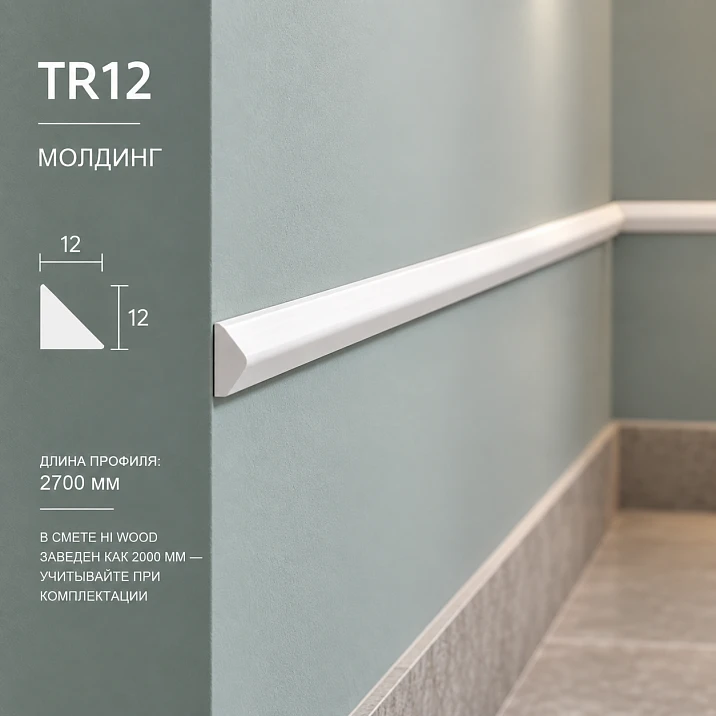
HI WOOD TR12 has a cross-section of 12×12 mm and a product length of 2700 mm. This is not a secondary characteristic. For long vertical decorative lines, the difference between 2000 and 2700 mm changes the structure itself: a part that an erroneous estimate splits into two pieces with a joint can be made as a single piece from the actual TR12.
Therefore, buying TR12 molding wholesale for 72 rooms should not be done after mechanically dividing the total meterage by 2 or 2.7 meters, but according to the following chain:
current TR12 product card → master item 12×12×2700 mm → finished parts list → identification of long single-piece elements → cutting map → number of whole strips → usable remnants → reserve → acceptance → warehouse → issue → reorder.
Main principle:
the product length must live in the procurement system as a separate verifiable field, not as a template copied from neighboring HI WOOD items.
If TR12 is mistakenly recorded in the catalog as 2000 mm, the error spreads quickly:
-
to the number of strips;
-
for design joints;
-
for cutting;
-
on the leftovers;
-
for reserve;
-
for logistics;
-
for reorder.
You need to correct not only the line in the invoice, but the entire data chain.

What HI WOOD TR12 actually is
TR12 is a HI WOOD wall decorative molding made of polystyrene.
| Parameter | Value |
|---|---|
| Article number | TR12 |
| Brand | HI WOOD |
| Material | Polystyrene |
| Cross-section | 12×12 mm |
| commercial length | 2700 мм |
| Format | wall decorative molding |
Product card: HI WOOD molding TR12 12×12×2700 mm.
In the current catalog, next to TR12 there are indeed many two-meter moldings. For example:
-
TR10 — 10×10×2000 mm;
-
TR20 — 20×20×2000 mm;
-
W1060 — 60×9×2000 mm.
It is precisely the proximity to a large number of two-meter items that makes the template error realistic.




Why you cannot call TR12 simply “HI WOOD molding 12 mm”
Such a description loses two important parameters at once:
-
the second side of the cross-section, 12 mm;
-
the length of 2700 mm.
Working line:
HI WOOD TR12 / polystyrene / 12×12×2700 mm.
Not:
molding 12 mm;
white TR;
HI WOOD 2 m.
Our factory also produces:


Why 2700 mm length is part of the design, not just a reference figure
For purchasing, the product length affects five different decisions.
Get Consultation
Can a piece be obtained without a joint?
If the vertical has a finished length of 2580 mm:
-
from TR12 2700 mm — yes;
-
from a standard two-meter profile — no.
How many original planks are needed
One part of 2580 mm requires one whole TR12 plank.
The total linear meters alone do not show this.
What offcuts appear
After 2580 mm, the remainder is:
2700 − 2580 = 120 mm
before accounting for technological operations.
What reserve is needed
For a long vertical, the reserve must retain the ability to yield a single-piece part.
How a reorder is placed
Need to reorder:
TR12 12×12×2700 mm / ___ pcs.
And not:
another 54 meters of molding.
Why TR12 can easily turn into a two-meter profile inside an estimate
The error usually appears not because of a lack of product knowledge, but because of automation.
In the catalog:
| SKU | Length |
|---|---|
| TR10 | 2000 |
| TR20 | 2000 |
| D22 | 2000 |
| W1060 | 2000 |
| TR12 | 2000 — incorrect |
The estimator copies the previous line.
Now every subsequent document assumes that TR12 = 2 m.
Where the error starts to multiply
-
Excel reference;
-
BIM/schedule;
-
estimate;
-
procurement ERP;
-
cutting program;
-
warehouse card;
-
supplier request;
-
reorder.
Therefore, the correction must be master data:
TR12 = 2700 mm.
Not a one-time note in the letter.
Creating a single master item TR12
Working structure:
HI WOOD / TR12 / polystyrene / 12×12 / 2700 mm / purchase unit — pcs.
If the system allows separating fields:
| Field | Value |
|---|---|
| brand | HI WOOD |
| sku | TR12 |
| material | polystyrene |
| width | 12 |
| depth | 12 |
| stock_length | 2700 |
| purchase_unit | pcs |
| status | active |
The main field of this article:
stock_length = 2700.
Why length should be a separate field
If it is stored only inside the name:
“Molding TR12 12×12×2.7 m”,
automatic calculation may not use it.
If there is a separate column:
2700,
the system can:
-
validate the cutting layout;
-
catch error 2000;
-
count whole planks;
-
check the reorder.
Conditional object: 72 rooms
Let's imagine 72 standard hotel rooms or apartments.
Each project includes:
-
long vertical decorative lines;
-
horizontal frames;
-
short extension pieces.
For example, let's take four verticals with a length of:
2580 mm.
Per room:
4 verticals.
For 72:
72 × 4 = 288 verticals.
This is no longer "lots of meters of molding."
This:
288 specific pieces of 2580 mm each.
Why the total linear footage gives a dangerously beautiful number
Net length:
288 × 2.58 = 743.04 m.
If we divide:
743,04 / 2,7 ≈ 275,2.
One can solve:
276 planks will be enough.
But this is incorrect.
One TR12 rail of 2700 mm provides only one vertical of 2580 mm.
Two verticals physically do not fit into one rail.
Therefore:
for 288 verticals, a minimum of 288 whole TR12 rails — even before any reserve.
This is one of the main calculations in the article.
Where the extra meters “disappear”
From each rail, nominally remaining:
120 mm.
Across 288 rails:
34,560 mm = 34.56 m.
Mathematically, this is a large residual linear meterage.
But you cannot assemble another 2580 mm vertical from it without joints.
Therefore:
total remaining linear meters ≠ additional ability to cover a long part.
The same rule applies to the reserve.
What happens if the system treats TR12 as two meters
For a 2580 mm vertical, the program will create:
2000 + 580 mm.
That is, it will add a joint.
On 288 verticals, this results in up to 288 extra joints that could be avoided with a real TR12 of 2700 mm.
This is no longer just a quantity error.
Changes:
-
the visual result;
-
labor intensity;
-
cutting time;
-
joint material;
-
risk of a visible seam;
-
number of short blanks;
-
reserve.
Therefore, the commercial length is part of the project's structural logic.
First the parts list, then the total linear footage
Correct order:
-
write out all finish parts;
-
specify their lengths;
-
determine the quantity;
-
mark which ones should be solid;
-
compare with the commercial length TR12 2700;
-
build cutting map;
-
get the number of whole planks;
-
add a reserve.
Not:
added up the meters → divided by 2.7.
We divide the parts into three functional groups
Almost full product length
For example:
-
2400;
-
2500;
-
2580;
-
2650 mm.
Such parts are protected first.
Medium
For example:
-
1000–2000 mm.
They can be combined with each other and with short ones.
Short
It makes sense to obtain them from useful offcuts if the geometry allows.
These are not universal standard ranges.
This is a working classification for a specific project's map.
Why critical long parts are reserved first
If a 2580 mm part is needed as a single piece, it cannot be "made up" from two offcuts without changing the design.
A short 400 mm part can often be obtained from an offcut.
Therefore the priority is:
long single pieces → medium → short.
And only after that is waste assessed.
TR12 parts list
Practical form:
| Code | Room Type | Finished length | Quantity | Single-piece part | Source |
|---|---|---|---|---|---|
| V-01 | А | 2580 | ___ | Yes | TR12 2700 |
| G-01 | А | ___ | ___ | No | By map |
| B-02 | Б | ___ | ___ | Yes/No | By map |
| K-01 | NT | ___ | ___ | As per project | Separately |
This table is more important than the total area.
It answers:
-
how many parts;
-
of what length;
-
which ones must be solid;
-
which ones can be made from leftovers.
We count typical rooms as types, not 72 separate files
For example:
-
A ×40;
-
A-mirrored ×20;
-
B ×8;
-
non-typical ×4.
For each type:
-
own statement;
-
number of repetitions;
-
cutting map;
-
final number of whole TR12.
This keeps the project manageable.
Mirrored rooms must be checked separately
The net area may match.
But the following may differ:
-
end location;
-
location of short elements;
-
installation sequence;
-
position of the joint;
-
combinations in the map.
If everything is fully interchangeable, the mirrored type can be merged.
If not — a separate code.
We do not include non-standard rooms in the multiplier
One non-standard wall should not be multiplied across all 72 rooms.
Non-standard:
NT-01;
NT-02;
are counted separately.
After the mass cutting map, you can check whether they are covered by usable remnants.
Cutting map TR12 2700 mm
For each source strip:
Strip no. → part 1 → part 2 → kerf → remnant.
For example:
Strip 001
-
V-01 = 2580;
-
remaining ≈120 mm before machining operations.
Strip 002
-
G-01 = 1400;
-
G-02 = 1100;
-
nominal 2500;
-
Remainder 200 mm.
Strip 003
-
800;
-
800;
-
800;
-
nominal 2400;
-
Remainder 300 mm.
The numbers are illustrative.
Before production, the plan accounts for the actual saw kerf and end requirements.
Why you can't first cut 2700 into convenient pieces
The warehouse may decide:
let's make them 1350 mm — easier to carry up to the floor.
After that, the main advantage of TR12 is lost:
the ability to get a single piece up to 2700 mm.
Therefore, the original strip remains whole until the map assigns parts to it.
What to do with medium parts
Medium parts:
-
1800;
-
1500;
-
1200 мм
can be combined.
For example:
1500 + 1100 = 2600 mm.
Nominal remainder 100 mm.
Or:
1200 + 1200 = 2400 mm.
Remainder 300 mm.
These combinations need to be compared across the entire series, not just one room.
Why short parts cannot be considered "free"
Remainder:
120 mm.
Formally, this is material.
But if the project has no part ≤120 mm, its usefulness is zero.
Remainder:
480 mm.
can cover:
-
short insert 420;
-
filler 450;
if the requirements for ends and condition match.
Therefore, every remnant must have a potential purpose.
How to maintain a bank of useful remnants TR12
Example:
| Code | Length | Condition | Purpose | Status |
|---|---|---|---|---|
| O-001 | 620 | suitable | K-03 | assigned |
| O-002 | 480 | suitable | Spacious | reserve of short pieces |
| O-003 | 120 | suitable | no purpose | Waste |
| О-004 | 2700 | whole | Reserve | protected |
Entry:
remnants 18 m
too coarse.
Why several short remnants do not replace one 2700 strip
Available:
-
1200;
-
900;
-
600 mm.
Sum:
2700 mm.
But if the 2580 mm vertical is damaged, these three pieces do not replace one solid part.
Therefore:
meters of reserve ≠ functional reserve.
Long parts require a portion of whole TR12.
TR12 must not be mixed with TR10 and TR20 in the catalog
Adjacent SKUs:
-
TR10 — 10×10×2000;
-
TR12 — 12×12×2700;
-
TR20 — 20×20×2000.
Error:
HI WOOD TR / length 2000.
Such a master position erases distinctions.
Correct:
-
TR10;
-
TR12;
-
TR20.
Each one is a separate line.
Why the TR prefix is not a purchasing unit
TR — part of the model.
It does not mean:
one interchangeable group.
If the warehouse cell:
HI WOOD TR,
three different profiles may end up there.
Therefore, in the warehouse:
TR12 / 12×12×2700.
How to check the reference list before importing TR12
Minimum audit:
-
SKU = TR12;
-
width = 12;
-
depth = 12;
-
length = 2700;
-
material = polystyrene;
-
unit = pcs.
If length = 2000:
error flag.
If unit = meters:
check, because physical purchasing is done in whole planks.
Why the purchase unit should be "pcs."
The estimate can calculate meters.
But the supplier ships:
whole products 2700 mm.
Therefore:
Budget unit
m / rub. per m — acceptable for analysis.
Purchase unit
pcs. TR12 2700 — final.
This prevents the situation:
54 m = 20 planks?
Because:
20 × 2.7 = 54 m.
But the actual requirement for parts may require 21, 22, or more planks.
Acceptance of wholesale batch TR12
Checked:
-
TR12;
-
12×12 mm;
-
2700 mm;
-
quantity;
-
condition;
-
packaging;
-
compliance with the order;
-
absence of TR10/TR20.
If the invoice contains:
TR12 12×12×2000,
this is not a minor typo that can be ignored.
You need to understand:
-
document error;
-
product card error;
-
a genuinely different product.
Why the length must be checked before unloading
If the commercial documents show 2000 mm, it is better to clarify before the batch is:
-
unloaded;
-
distributed;
-
opened;
-
carried up floors.
So the correction is cheaper.
How to label a warehouse bin
Not:
HI WOOD molding.
Not:
12 mm molding.
Not:
TR 2 m.
Stronger:
HI WOOD / TR12 / 12×12×2700
Separately:
TR12 / reserve.
Why TR12 2700 requires a separate logistics group
Even if the material is lightweight, the profile is 700 mm longer than the neighboring two-meter one.
This affects:
-
storage space length;
-
transportation;
-
elevators/stairs;
-
moving to the floor;
-
risk of damage.
The article does not become logistics material A53, but the product length must also be taken into account here.
How to issue TR12 to installers
Not:
81 linear meters.
Stronger:
TR12 / 30 pcs. ×2700 mm.
If necessary:
type A / 12 pcs.;
type B / 8 pcs.;
reserve / 2 pcs.
Physical issue corresponds to physical purchase.
Why linear meters can be left as a control
If issued:
30 planks,
Reference meterage:
30 × 2.7 = 81 m.
But this is a secondary value.
Primary:
30 whole TR12.
How to protect TR12 from incorrect length in the corporate reference
If the organization already has master data for HI WOOD, it is not only the specific estimate that needs to be corrected.
Minimum check:
-
product card;
-
corporate reference;
-
BIM library;
-
Excel calculator;
-
purchase request template;
-
warehouse card.
In all places, TR12 must have:
2700 mm.
If at least one template continues to return 2000 mm, the error will recur in the next project.
How to submit a master data correction
Working note:
SKU: TR12
Was: 12×12×2000 — incorrect
Now: 12×12×2700 — confirmed by the current card
Date: ___
Source: card/drawing
Responsible: ___
Revision: R2
This is more useful than silently correcting an Excel cell.
Six months later, it's clear:
-
what was changed;
-
why;
-
on what basis.
Why you can't correct just the name
Name:
TR12 12×12×2.7 m
may be correct.
But the hidden field length is still = 2000.
The cutting program will use a numeric field, not the name.
Therefore, the check must be technical.
How to find a hidden error of 2000 mm
Useful tests:
Test 1
Create a part of 2580 mm.
The system must allow obtaining it from a single TR12.
If it creates:
2000 + 580,
the length in the data is incorrect.
Test 2
Calculate 10 whole TR12.
Reference meterage:
27 m.
If the program shows:
20 m,
2000 is used.
Test 3
Generate a purchase request.
It should contain:
TR12 / 12×12×2700.
Not:
12×12×2000.
How to build a map of 72 rooms by type
Let's imagine:
-
type A — 40;
-
AR — 20;
-
B — 8;
-
NT — 4.
For each type:
-
parts list;
-
critical full lengths;
-
medium parts;
-
short ones;
-
TR12 quantity;
-
remainders.
After that, the total order:
qty(A)×40 + qty(AR)×20 + qty(B)×8 + NT + reserve.
But only if the type maps are confirmed.
Why a shared map can be more efficient than per-room
If one type creates a leftover of 800 mm, and another requires parts of 760 mm, a shared pool allows the leftover to be used.
If each room is calculated in isolation:
800 mm = waste.
Therefore, it's better to:
-
protect long solid parts;
-
then combine medium and short ones across the entire type or queue.
Why you should not give away useful leftovers before long parts
A 1300 mm leftover seems convenient for two short parts.
But if the next type requires:
1250 mm,
it may be more valuable there.
Therefore, leftovers are allocated by priority.
Simple rule:
the part with fewer possible sources receives material first.
A long solid vertical has one source:
whole TR12.
Short 400 mm — many options.
How to evaluate the usefulness of the remainder numerically
You can enter categories.
U1 — critical
The remainder covers a specific unfinished part.
U2 — likely useful
Suitable for several future short parts.
U3 — free
No purpose yet.
W — waste
No reasonable use.
This classification is more useful:
remnants = 24.7 m.
Why 34.56 m of remnants from long verticals can have almost zero value
In the example, 288×120 mm yield:
34.56 m.
On paper, this is almost 13 whole TR12 by total length.
But if the project does not contain parts ≤120 mm, the practical value of these 34.56 m is close to zero.
This clearly shows the difference:
geometric footage ≠ functional material.
How to compare two cutting maps
Let's say there are options.
Map A
-
290 planks;
-
few large offcuts;
-
long parts are solid.
Map B
-
286 planks;
-
but two long parts require a joint.
If the project requires a continuous vertical, map B is unacceptable.
That is, the minimum number of strips is not always the goal.
Goal:
complete the project with minimal reasonable consumption while meeting the detail requirements.
Why a continuous part must have a flag in the specification
Column:
whole_piece_required = yes/no.
It prevents automatic optimization that could suggest a joint.
For B-01 2580:
yes.
For a horizontal where a joint is acceptable and hidden:
no is possible.
The project determines the decision.
Not an algorithm.
How to calculate the TR12 reserve
The reserve cannot be determined by a percentage of meters alone.
It is divided.
Whole TR12 2700
For:
-
long verticals;
-
non-standard changes;
-
repair.
Useful remnants
For:
-
short parts;
-
local replacement.
Ready-made serial parts
If the object requires quick repair.
Exactly how much is decided by the risk project.
Why the entire reserve should be protected from current cutting
If the map says:
reserve — 12 planks,
but they are already allocated for short parts, there is no reserve.
You need to:
main_production = ___;
reserve_whole = ___.
Separately.
How to manage leftovers and reserve in the warehouse
Cells:
TR12 / MAIN / 2700.
TR12 / RESERVE / 2700.
TR12 / OFFCUTS / measured.
So the warehouse does not use the reserve by accident.
How to label the remainder
For example:
TR12 / 820 / batch 04 / FREE.
Or:
TR12 / 620 / type B / assigned.
Not:
white molding.
HI WOOD has many white profiles.
Why the remainder must be measured physically
Nominally, after 2580, 120 mm remains.
After cutting and trimming, the actual remainder may be less.
Therefore, the actual length is written into the warehouse record.
Not the calculated one.
How to accept returns from the installation crew
Returned separately:
-
whole TR12;
-
useful leftovers;
-
damaged;
-
departure.
For the whole:
TR12 / 2700 / valid.
For the remainder:
TR12 / 940 / valid.
This way the next stage receives real data.
What to do with a damaged 2700 plank
It is not necessary to write off the entire thing.
For example, the 300 mm end is damaged.
After inspection, the following may remain:
2350 mm of usable profile.
It is no longer a reserve for the long vertical of 2580.
But it can cover:
-
the middle part;
-
a few short ones.
The status changes.
Why a damaged long strip is not considered a complete reserve
Even if its total usable length is large.
The reserve answers:
can we reproduce the critical part?
If not:
reserve_whole does not increase.
How to process the acceptance of the first batch
The first batch is especially important.
From it are created:
-
physical reference TR12;
-
photo of the end;
-
a photo of the label;
-
confirmation 2700;
-
master row;
-
warehouse cell.
All subsequent deliveries are compared against the reference.
Why it is useful to measure the first bar
Not to question the manufacturer.
But to:
-
confirm that the item received TR12;
-
link the documentation to the physical product;
-
train the warehouse;
-
catch mis-sorting.
If TR10 arrived:
the length and cross-section will immediately reveal the error.
What to do if the invoice says 2700 but the delivery note says 2000
Do not assume that this is "just a template."
You need to:
-
stop acceptance of the disputed item;
-
check with the supplier;
-
check the marking;
-
measure the sample;
-
correct the documents.
Because 2000 versus 2700 changes the entire calculation.
How to compare commercial proposals
Suppliers must calculate the same item:
HI WOOD TR12 / 12×12×2700 / ___ pcs.
Compared:
-
price per strip;
-
deadline;
-
availability;
-
delivery;
-
packaging;
-
possibility of reordering.
Price per meter can be additional analytics.
But not the only criterion.
Why a cheaper two-meter equivalent can be more expensive in a project
If a 2580 mm vertical is needed, a two-meter profile requires:
-
at least two blanks;
-
joint;
-
an additional cut;
-
joint material;
-
work;
-
risk of a visible joint.
Therefore, the comparison:
₽/m
without accounting for the output part is misleading.
You need to compare:
the cost of the finished project result.
How to use general B2B queries naturally
When choosing construction materials wholesale from the manufacturer or wholesale supplies of building materials It is important for the buyer to pass the exact master item to the supplier.
The same applies to wholesale of building materials и materials in bulk.
A broad commercial request leads to the supplier.
But the order ends:
TR12 / 12×12×2700 / quantity.
Fifteen mistakes when purchasing TR12 in bulk
1. Automatically record TR12 as 2000 mm
Why it happens: most neighboring HI WOOD items are two meters long.
Consequence: the entire cutting system works with the wrong product length.
How to prevent: stock_length = 2700 as a separate field.
2. Treat all HI WOOD as one length
Why it happens: the catalog is perceived as a single series.
Consequence: TR12 loses its key differentiator.
How to prevent: separate master data for each SKU.
3. Divide the total linear meters by 2700 and treat that as the order
Why it happens: the arithmetic looks logical.
Consequence: long parts require more full planks.
How to prevent: calculate from the parts list.
4. Not flagging the requirement for a single-piece part
Why it happens: the program automatically optimizes the material.
Consequence: an unnecessary joint appears.
How to prevent: flag whole_piece_required.
5. Design the joint at a vertical of 2580 mm
Why it happens: the system considers TR12 to be two meters long.
Consequence: an extra seam and extra work.
How to prevent: actual length 2700.
6. Cut short parts first
Why it happens: you want to quickly prepare mass sizes.
Consequence: whole planks for critical verticals are lost.
How to prevent: prioritize long pieces.
7. Consider any leftover useful
Why it happens: the desire to minimize waste.
Consequence: the warehouse is overflowing with offcuts that have no purpose.
How to prevent it: a remnant gets a status only when it is actually usable.
8. Mixing TR12 with TR10/TR20
Why it happens: the shared TR prefix.
Consequence: a different SKU, a different cross-section and length.
How to prevent it: separate bins.
9. Issuing only linear meters
Why it happens: the estimate is in meters.
Consequence: the physical quantity of strips is lost.
How to prevent: issue in pieces, meters — control.
10. Store TR12 in the "molding 2 m" bin
Why it happens: old warehouse template.
Consequence: the 2700 length is forgotten physically and digitally.
How to prevent: TR12 / 12×12×2700.
11. Count 2700 mm short offcuts as one reserve plank
Why it happens: the total linear meters match.
Consequence: a long solid part cannot be restored.
How to prevent: keep a reserve of whole planks separately.
12. Place reorders in meters
Why it happens: "we need another 54 m".
Consequence: an employee may order a two-meter analogue or an incorrect quantity.
How to prevent: TR12 / 2700 / pcs.
13. Carry over wooden semantics
Why it occurs: a series of articles mixes products.
Consequence: incorrect relevance.
How to prevent: TR12 — polystyrene.
14. Calling TR12 polyurethane because of the catalog structure
Why it occurs: the card is located in the general decor branch.
Consequence: incorrect material.
How to prevent: rely on the actual product card.
15. Assign SKU the search frequency of the parent query
Why it happens: there are strong numbers for "molding for wall buy".
Consequence: fabricated search frequency.
How to prevent: for specific TR12 — only verified data.
Practical questions before payment
What size is TR12?
12×12×2700 mm.
What material is TR12 made of?
Made of polystyrene.
What is the product length?
2700 mm.
Why is this unusual for the neighboring part of the HI WOOD line?
Nearby, many moldings, including TR10 and TR20, have a length of 2000 mm. Therefore, the default field of 2000 is dangerous.
Can TR12 be considered a two-meter profile?
No.
If the vertical is 2580 mm, how many TR12 are needed?
One whole 2700 mm strip per one such vertical.
Why can't we just add up the total linear meters?
Because long parts require separate whole strips.
What should be done with the 120 mm remainder?
Consider it useful only if there is a specific part that can actually be made from it.
Should the reserve be kept as whole strips?
For long critical parts — yes.
Can the reserve be counted in linear meters?
Only as an additional control value. Functionally, the number of whole TR12 is more important.
How to organize the warehouse?
Separate cell:
TR12 / 12×12×2700.
How to issue to installers?
In TR12 pieces, not just in meters.
How should a reorder be placed?
HI WOOD TR12 / 12×12×2700 mm / ___ pcs.
Can TR12 be replaced with TR10 or TR20?
No, these are different SKUs and different cross-sections/lengths.
Can offcuts of long planks be used for short parts?
Yes, after providing all whole critical parts.
Should I check the product card before reordering?
Yes. A reorder should be based on up-to-date data.
Where to buy TR12?
Once the map is ready, you can order TR12 in the calculated quantity.
Central table: incorrect entry vs. working one
| Parameter | Incorrect | Correct |
|---|---|---|
| Article number | HI WOOD molding | TR12 |
| Cross-section | 12 мм | 12×12 mm |
| Length | 2000 mm according to template | 2700 мм |
| Purchase unit | linear meter | full plank |
| Calculation | total linear meters ÷ 2.7 | parts list |
| Vertical 2580 | 2000+580 | one TR12 |
| Reserve | meters of offcuts | whole TR12 + usable remnants |
| Reorder | another ___ m | TR12 12×12×2700 / ___ pcs. |
This table shows the whole problem at a single point.
Second table: parts list
| Type | Code | Finished length | Quantity | Solid TR12 is mandatory | Source plank | Remainder |
|---|---|---|---|---|---|---|
| А | V-01 | 2580 | ___ | Yes | 2700 | nominally 120 |
| А | G-01 | ___ | ___ | No | By map | ___ |
| Б | B-02 | ___ | ___ | Yes/No | By map | ___ |
| NT | H-01 | ___ | ___ | As per project | Separately | ___ |
This table must precede the final quantity.
Practical scenario: 72 rooms and 288 long verticals
Let's return to the example.
Initial data
-
72 rooms;
-
4 verticals;
-
2580 mm each;
-
TR12 2700 mm.
Parts
288.
Net linear meters
743.04 m.
Naive division by 2.7
≈276 planks.
Real minimum requirement for verticals only
288 strips.
Nominal remainder
288×120 = 34.56 m.
Practical value of the remainder
Depends on the availability of short parts ≤ the actual length of the remainder.
Thus, one example shows at once:
-
why the linear meters are insufficient;
-
why integrity matters;
-
why the remaining linear meters are not equal to the reserve.
Scenario: vertical 2650 mm
From TR12 2700:
-
one part;
-
nominal remainder of 50 mm before the technology.
From a two-meter profile:
-
A joint is needed.
If the system erro
How to audit an existing estimate
If the project has already been calculated as 2000 mm:
-
export all TR12 lines;
-
replace the commercial length with 2700;
-
recalculate the parts;
-
remove artificial joints;
-
recalculate the planks;
-
recalculate the remaining stock;
-
recalculate the reserve;
-
update the budget;
-
issue a new revision.
It is not enough to simply change 2000 to 2700 in the header.
Why the quantity can both decrease and increase
After correcting the length, 2700 seems logical:
the number of planks will always become smaller.
Not necessarily.
If the total linear meters were previously divided by 2000, the number was large.
But if you then simply divide by 2700, you can get too small a number, because long parts require whole planks.
Therefore, the correct recalculation can:
-
reduce unnecessary joints;
-
changing the quantity;
-
increase the number of planks compared to the naive
meters/2700.
The result is determined by the bill of materials.
How to conduct estimate revisions
For example:
R1
TR12 incorrectly shows 2000.
R2
Corrected to 2700, but without a new card.
R3
Full recalculation of parts and quantities.
Included in procurement:
R3.
This helps to understand why the numbers changed.
Why R1 and R3 cannot be used simultaneously
The architect sent the old R1 bill of materials.
Procurement is already working with R3.
If the files are mixed:
-
some rooms will have joints;
-
some — solid parts;
-
the quantity will no longer add up.
Therefore, there is only one current revision.
How to carry out inspection of the first delivery phase
It is not necessary to order the entire project at once.
The first phase can cover:
-
6;
-
10;
-
12 rooms.
After installation, check:
-
actual output;
-
remnants;
-
damage;
-
convenience 2700 when transferring;
-
actual quantity;
-
reserve consumption.
If the calculation is confirmed, scale.
When a single queue is better not considered proof
If the first rooms are non-standard, their consumption does not represent the entire series.
You need to choose:
standard block.
Otherwise, the project is adjusted by exclusion.
How to understand that the deviation is systematic
Signals:
-
two standard blocks consume equally more;
-
identical remnants are constantly left unused;
-
the cutting map consistently does not match;
-
the crew is forced to make additional joints.
Then the remaining object is recalculated.
How to organize delivery to the floor
If TR12 2700 is inconvenient to move in large bundles, logistics can be organized by floors.
But material must not be cut in advance just for convenience.
First:
-
map;
-
the purpose;
-
marking.
Then:
-
movement.
Why 2700 mm affects warehouse infrastructure
A rack designed for 2000 mm may turn out to be too short.
The profile will protrude.
This increases the risk of:
-
snagging;
-
breaking;
-
deforming;
-
losing the label.
Therefore, even before delivery, the warehouse must physically accommodate 2700.
How to store TR12 safely
General principles:
-
protected area;
-
length support;
-
no heavy load on top;
-
label preservation;
-
separate bin;
-
reserve separately.
There is no need to invent a specific temperature without instructions.
How to distinguish a full TR12 from a long leftover
Full:
factory length 2700.
Remainder:
actual measured length.
Even a leftover of 2680:
-
is not equal to a whole 2700;
-
may not close the part 2690;
-
has a different status.
Why the repair stock should know the minimum critical length
If the longest service part:
2580,
then a reserve of 2600 mm may be functional.
If needed:
2660,
No.
Therefore, the repair stock stores not only meters, but also lengths.
How to reorder TR12 after a few months
A new employee should not have to remember:
I think it was a two-meter molding.
He opens the master position:
TR12 / 12×12×2700.
Then checks the current card and places the order:
___ pcs.
What to attach to the additional order
Useful:
-
SKU;
-
size;
-
URL;
-
the latest specification;
-
old invoice;
-
the reason for the additional order.
For example:
TR12 / 12×12×2700 / 24 pcs. / reserve restoration after queue 2.
Why the reason for the additional order is needed
It shows:
-
error in the original calculation;
-
project change;
-
damage;
-
use of reserve;
-
additional volume.
On the next project, this data helps improve the norm.
How to hand over TR12 to operations
After handover, keep:
-
whole reserve TR12;
-
useful leftovers;
-
size;
-
article number;
-
commercial length 2700;
-
the card;
-
standard parts map.
This way the service crew won't buy a two-meter profile using the old template.
Final readiness matrix for TR12 for wholesale ordering
| Check | Status |
|---|---|
| TR12 approved | Yes/No |
| Material — polystyrene | Yes/No |
| Section 12×12 mm confirmed | Yes/No |
| Commercial length 2700 mm confirmed | Yes/No |
| Reference updated | Yes/No |
| Template 2000 mm not applied | Yes/No |
| Room types highlighted | Yes/No |
| Long solid parts marked | Yes/No |
| Parts list ready | Yes/No |
| Cutting map ready | Yes/No |
| Usable offcuts classified | Yes/No |
| Whole reserve allocated | Yes/No |
| Receiving line is ready | Yes/No |
| Storage cell 2700 mm is ready | Yes/No |
| Issued in pieces | Yes/No |
| Reorder format approved | Yes/No |
| Repair fund is provided | Yes/No |
If several critical lines remain "no", it is better not to submit the final request.
How to check master data readiness
Before payment, open four places:
-
product card;
-
corporate reference;
-
purchase request;
-
warehouse card.
All should have:
TR12 / 12×12×2700.
If somewhere 2000 remains:
error is not closed.
How to check calculation readiness
You need to be able to answer:
-
how many long solid parts;
-
how many medium ones;
-
how many are short;
-
how many whole TR12;
-
what reserve;
-
which remnants are actually used.
If the answer exists only as:
approximately 760 meters,
the calculation is not ready yet.
How to check warehouse readiness
The warehouse must have:
-
space for 2700;
-
a separate cell;
-
marking;
-
reserve zone;
-
return rules;
-
a stock balance sheet.
If TR12 is physically placed next to two-meter profiles:
a logistics error is still possible.
How to check reorder readiness
An employee who did not participate in the first purchase must document:
HI WOOD TR12 / 12×12×2700 / ___ pcs.
If he has to call the first supplier and ask:
"was it 2 m or 2.7?"
master data is insufficient.
Three diagnostic scenarios before the final purchase
Scenario 1 — the estimate is corrected, the cutting program is not
In the estimate:
In the cutting program, a hidden reference list:
Vertical 2580 is still split into two elements.
Conclusion:
fixing the text does not equal fixing the system.
You need to test the actual result.
Scenario 2 — purchase is correct, warehouse is labeled "2 m"
The supplier delivered the correct TR12.
The warehouse uses the old bin:
HI WOOD molding 2 m.
A week later, TR12 gets mixed with TR10/TR20.
Conclusion:
a correct purchase can be ruined by internal accounting.
Scenario 3 — large remaining stock in meters, but the reserve is empty
In stock:
-
900;
-
850;
-
700;
-
650 mm.
Sum:
3100 mm.
But a vertical replacement of 2580 mm is needed.
Not a single piece fits.
Conclusion:
meter margin is positive, functional reserve = 0.
How to perform a reverse check of the final order
Suppose the order is:
TR12 — 310 pcs.
The number needs to be explained.
For example:
-
288 — long verticals;
-
10 — medium/short on the map;
-
12 — full reserve.
If part of the number:
“was simply added on top,”
needs clarification.
Each group must have a function.
Why reserve is better explained by the number of scenarios
For example:
6 strips — repair of long verticals;
4 — non-standard premises;
2 — installation risk of the first phase.
This is more useful:
+4 %.
The percentage can be used as a control.
But the functional purpose is stronger.
How to compare actual consumption after the first phase
If expected:
42 planks.
Actual:
Difference 3.
First find out:
-
damage;
-
cutting error;
-
size change;
-
new part;
-
incorrect return;
-
loss of remainder.
Only after that, recalculate the remaining 60 rooms.
Why one mistake can turn 2700 back into 2000
The supplier may be correct.
But during installation, the crew cuts all planks down to 2000 for ease of transport.
As a result:
-
long verticals get a joint again;
-
the advantage of TR12 disappears;
-
the reserve becomes short.
Therefore, you cannot shorten the original length without a map.
How to train a new crew
Short sheet:
SKU: TR12
Size: 12×12×2700
Do not cut to 2000 in advance
Long parts — according to the schedule
Mark the remnants
Do not use spare full planks without approval
This way, the key distinguishing feature of the product remains visible.
Why 2700 mm must be written even in the installation schedule
The installer may only see the length of the finished part.
But specifying the original product length helps to understand:
why the 2580 vertical must be one piece.
And it prevents an attempt to assemble it from two pieces.
When TR12 does not solve the problem
There is no need to create the impression that 2700 mm is a universal advantage.
TR12 may not be the best solution if:
-
the required part is longer than 2700;
-
the project requires a different width;
-
a different relief is needed;
-
the architectural composition is based on a different profile.
The article considers purchasing after choosing TR12.
Not a molding choice for all cases.
How to submit the repair passport
Save:
-
SKU;
-
12×12×2700;
-
photo of the end;
-
product card;
-
list of standard parts;
-
full reserve;
-
useful leftovers;
-
batch date.
After a year, the service should not order:
HI WOOD molding 12 mm, approximately 2 meters.
It sees the exact line.
What the final request should look like
We kindly ask you to calculate the wholesale supply of HI WOOD TR12 polystyrene molding, size 12×12×2700 mm, for a project consisting of 72 rooms. Quantity according to the confirmed parts list — ___ pcs., full installation reserve — ___ pcs., operational reserve — ___ pcs. Please confirm the current price, lead time, packaging, and delivery terms. In the documents, please specify the commercial length as 2700 mm; do not use the 2000 mm length for TR12.
The last phrase is useful if the project has already encountered a template error.
Final diagnostic check before payment
Before the final order, it is useful to run four tests that do not depend on the beauty of the Excel spreadsheet.
Physical length test
We take a reference TR12 and confirm:
2700 mm.
Then we compare with the master reference.
If the physical item and the digital card diverge, the purchase is halted until clarification.
Long part test
We enter the part into the working system:
2580 mm.
Correct result:
one TR12 2700.
Incorrect:
2000 + 580.
This test instantly shows whether an old template is still lurking somewhere.
Purchase unit test
We request:
20 TR12.
The system should show:
20 pcs. ×2700 = 54 linear meters of reference footage.
If the main answer is only:
54 m,
we need to check whether the piece as a purchasing unit has been lost.
Reserve test
We ask:
can we replace one long vertical of 2580 mm right now?
If the reserve consists of:
-
1200;
-
900;
-
700;
-
500 mm,
Answer:
No.
Even if the total footage is more than 2.7 m.
This is the best test of the reserve's functionality.
How to check that the leftovers are not counted twice
Remnant О-012 with a length of 820 mm was first assigned:
К-04 / type B.
Later, another employee sees it in the common pool and assigns it again:
Г-03 / type A.
Now two parts on paper are covered by one physical workpiece.
Therefore, the remnant must have one status:
-
FREE;
-
ASSIGNED;
-
RESERVE;
-
SCRAP.
After ASSIGNED it disappears from the free pool.
How to check that the entire reserve did not end up in the main map
Final order:
320 TR12.
In the table:
-
production — 310;
-
reserve — 10.
We need to verify that the cutting plan uses only 310.
If all 320 are numbered in the source strip list:
the reserve is already being consumed.
This is a common mistake when a separate column exists only formally.
How to close the material balance after 72 rooms
After the last room, you need to reconcile:
purchased → cut → installed → returned intact → usable remnants → damaged → operational reserve.
For example:
purchased 320 TR12;
296 went into the main installation;
4 damaged;
8 remained intact;
12 are equivalent to accounted-for usable remnants and finished service parts.
The specific figures for the project will be different.
But the principle is the same:
each source strip must have a final status.
If ten strips cannot be accounted for, the material accounting is not closed.
Why this audit matters for the next site
After 72 rooms, your own statistics emerge:
-
how much actually went to type A;
-
which leftovers turned out to be useful;
-
which reserve was excessive;
-
where damage occurred;
-
how well the map worked;
-
how many times the system tried to substitute 2000 mm.
The next project can be built not on an abstract percentage, but on the actual operating experience of the TR12 2700.
What the reader should be able to do after the article
Purchaser:
-
check the length of the TR12;
-
correct the master data;
-
count whole strips by parts;
-
create a correct request;
-
check the quotation;
-
place an additional order without going back to 2000 mm.
Technologist:
-
protect long solid parts;
-
build the map;
-
classify the remnants;
-
separate the full reserve.
Warehouse:
-
do not mix TR12 with TR10/TR20;
-
store 2700 separately;
-
issue in pieces;
-
return remnants with actual length.
Operation:
-
keep full TR12;
-
do not consider short pieces a full replacement for a long vertical;
-
reorder the exact SKU.
This is the practical result of the wholesale article.
How to verify repeat order readiness a year later
The most dangerous check for master data comes not on the day of the first purchase, but later, when the project team has already been partially replaced. A new employee receives an archived invoice, a stock list, and the task of ordering a few more planks.
The system is considered robust if, without verbal explanations, they can reconstruct the correct product line:
HI WOOD TR12 / polystyrene / 12×12×2700 mm / ___ pcs.
For this, the repair passport must store not only the name and reference, but also a separate product length field. If the old template still substitutes 2000 mm, the error will resurface precisely on the reorder.
Before repurchasing, you need to:
-
check the current product page;
-
compare it with the saved master item;
-
verify the stock of whole 2700-millimeter planks;
-
check usable offcuts by actual length;
-
determine whether a solid long piece is needed;
-
order the missing quantity in pieces.
This way, operation does not repeat the original estimate error and does not create a joint where TR12 allows preserving a solid element.
Why the final criterion is not the minimum number of planks
A good TR12 purchase is not necessarily the smallest number in the "pcs." column. A strong specification must simultaneously provide:
-
all long parts without prohibited joints;
-
rational use of medium and short lengths;
-
a clear whole reserve;
-
a verifiable material balance;
-
correct reorder.
If, to save one or two strips, the map creates additional joints or eliminates a functional reserve, such optimization contradicts the project's objective.
Final logic of wholesale order TR12
TR12 selected
→ 12×12×2700 confirmed
→ master data corrected
→ template 2000 disabled
→ 72 rooms typed
→ long solid parts highlighted
→ parts list ready
→ cutting map built
→ number of whole TR12 calculated
→ leftovers classified
→ whole reserve secured
→ order in pieces
→ quotation checked against 2700
→ receiving checks 2700
→ warehouse cell TR12/2700
→ issue in pieces
→ remnants returned with length
→ first batch reconciled with actual
→ additional order only TR12 12×12×2700
→ the repair stock preserves whole planks
The main question of wholesale purchasing here is not:
how many meters of molding are needed for 72 rooms?
But:
what specific details should TR12 provide, which of them use its actual length of 2700 mm as a design advantage, and how many whole planks need to be purchased after the corporate template of 2000 mm is completely excluded from the calculation?
Once this issue is resolved, TR12 stops being "just another HI WOOD." Its product length, unique for this part of the range, is preserved from the product card to the last repair reorder, and the project does not create unnecessary joints and an erroneous quantity just because the old template considers all profiles to be two meters long.