






























































Article Contents:
- What exactly MLDPU-001 and NPU-362.1L/R form
- Why a regular straight cut is not always suitable
- Why NPU-362.1L and NPU-362.1R cannot be considered the same product
- The most common case: the molding ends near the door opening
- Example: two symmetrical lines on the sides of the door
- Near the cabinet up to the ceiling
- Above the console
- On sides of mirror
- On the furniture facade
- Is NPU-362.1L compatible with MLDPU-001?
- Is NPU-362.1R compatible with MLDPU-001?
- Is it always necessary to buy NPU-362.1L and NPU-362.1R as a pair?
- How many end caps are needed for two identical lines on both sides of a door?
- Are NPU-362.1L/R needed for a closed frame made of MLDPU-001?
- Can two NPU-362.1L be installed on different sides of the same molding?
- How to determine which end cap is needed near a doorway?
- What is the size of MLDPU-001?
- What is the size of NPU-362.1L and NPU-362.1R?
- Can MLDPU-001 be finished with a plain straight cut end?
- Do I need to consider the tip size when marking the wall?
- How to calculate the number of MLDPU-001 strips?
- Where to buy polyurethane wall moldings?
- Where to buy decor for polyurethane moldings?
- What to order if MLDPU-001 ends only near the door?
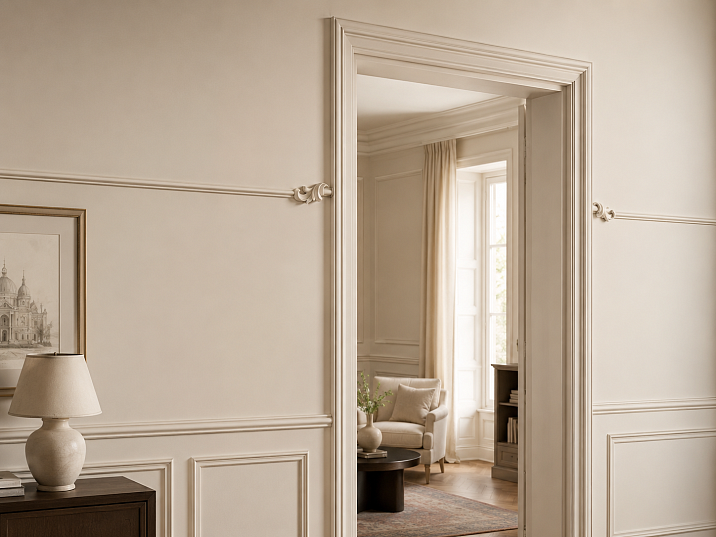
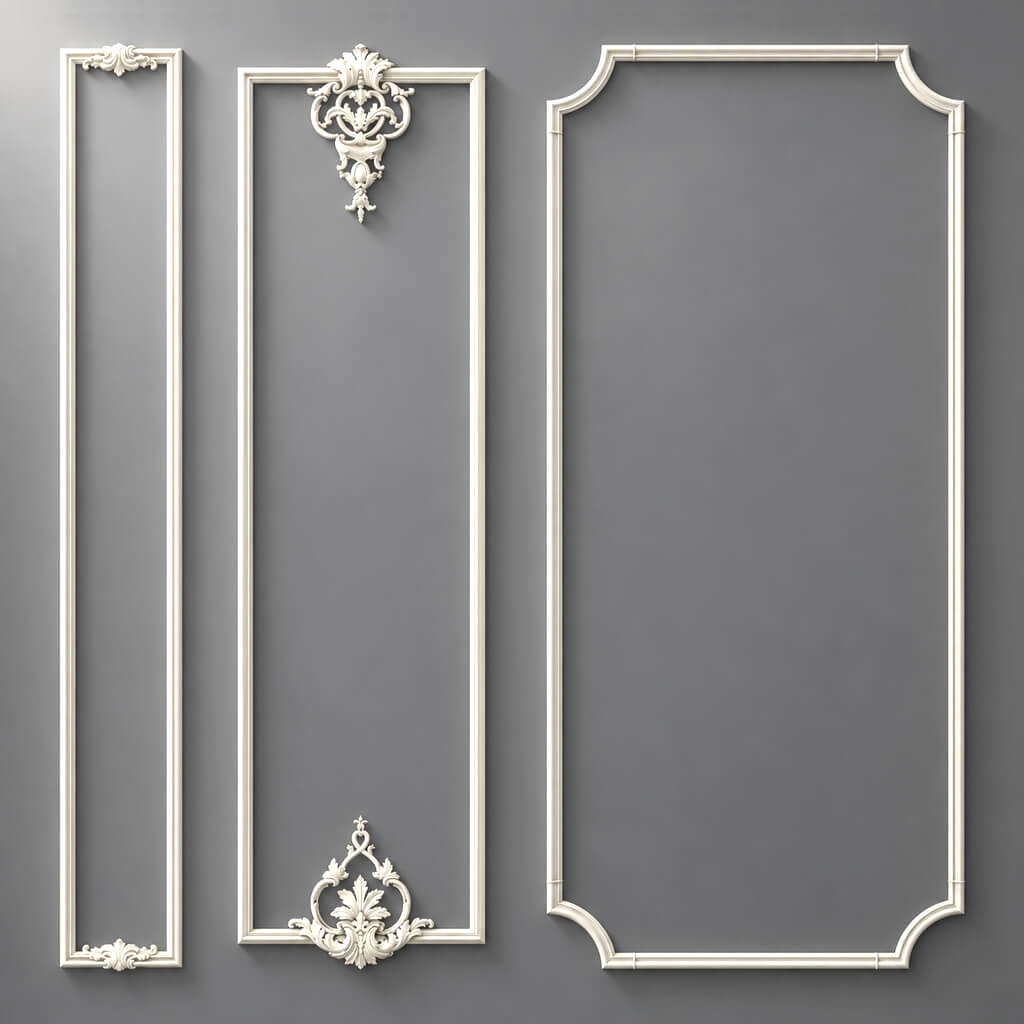
If Molding MLDPU-001 It forms a closed frame, so the question of its ending usually does not arise: one strip connects to another at the corner. But in an interior, a molding line is not always closed. It can end near a doorway, trim, tall cabinet, niche, or simply on an open section of the wall.
Leaving a regular cross-cut at such a point is technically possible, but visually the result is completely different. The thin decorative line suddenly breaks off with a flat end, and the termination point begins to look more like the result of trimming than part of the intended composition.
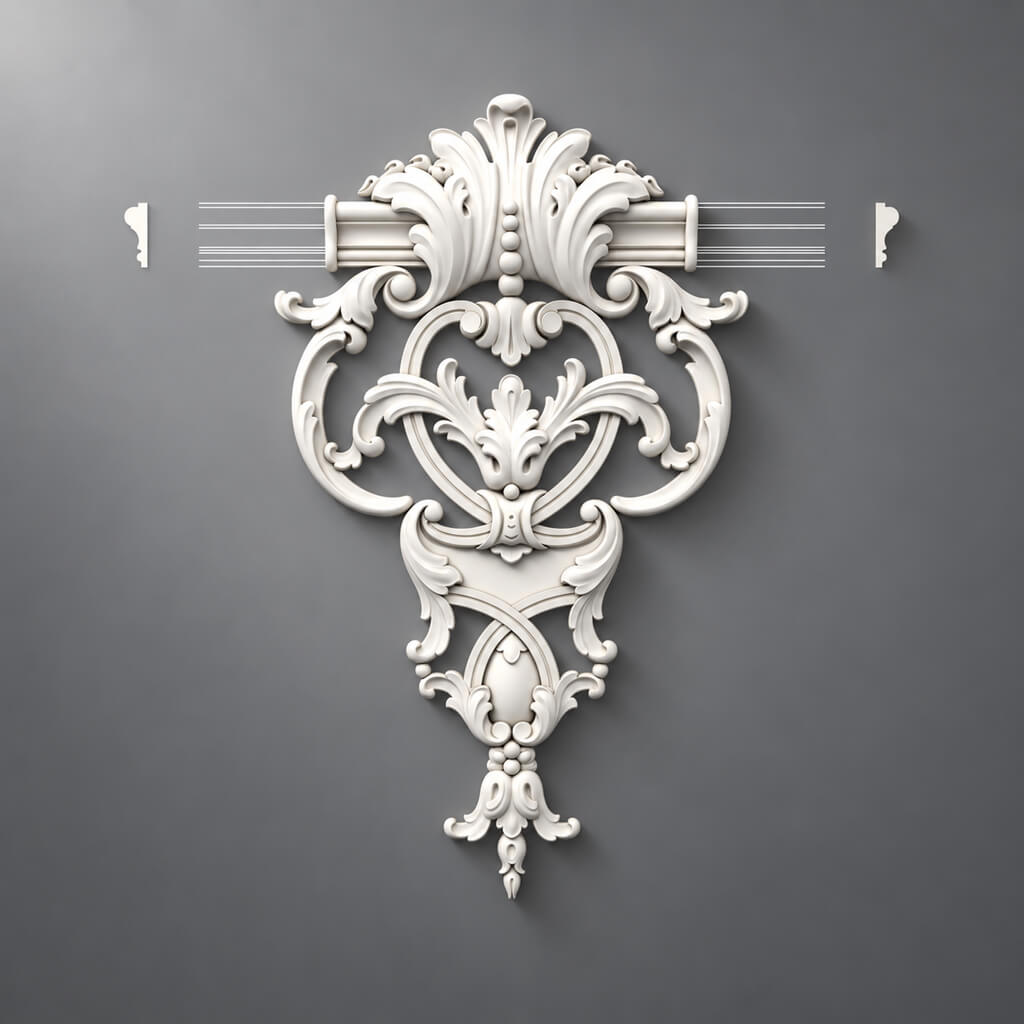
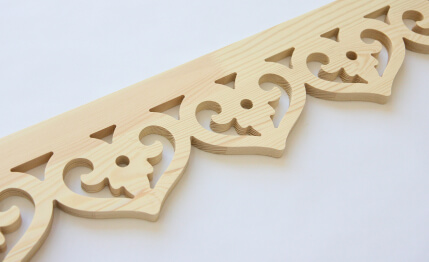
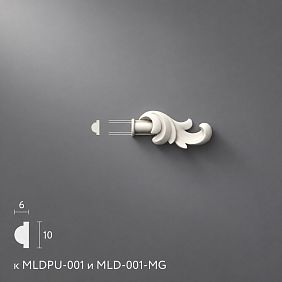
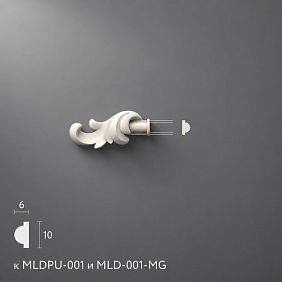
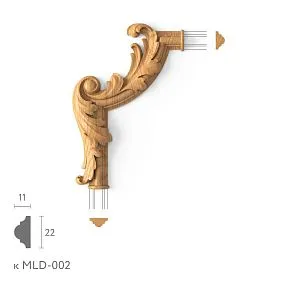
For MLDPU-001, this task can be solved with ready-made carved endings from the same system: left tip NPU-362.1L и right tip NPU-362.1R.
Both parts have dimensions of 54 × 26 × 11 mm and are made of polyurethane. They are mirror images in direction, so when ordering, it is not enough to determine only the total number of tips. You need to calculate in advance how many left open ends and how many right open ends will be in the composition.
For a typical separate horizontal line with two decoratively designed ends, the calculation is simple: 1 × NPU-362.1L + 1 × NPU-362.1R. But if one end of MLDPU-001 goes under a trim, adjoins a cabinet, or connects to another element, buying a pair is not automatically necessary. You should count the actual open points.

What exactly MLDPU-001 and NPU-362.1L/R form
Three independent products are involved in this composition, and each has its own function.
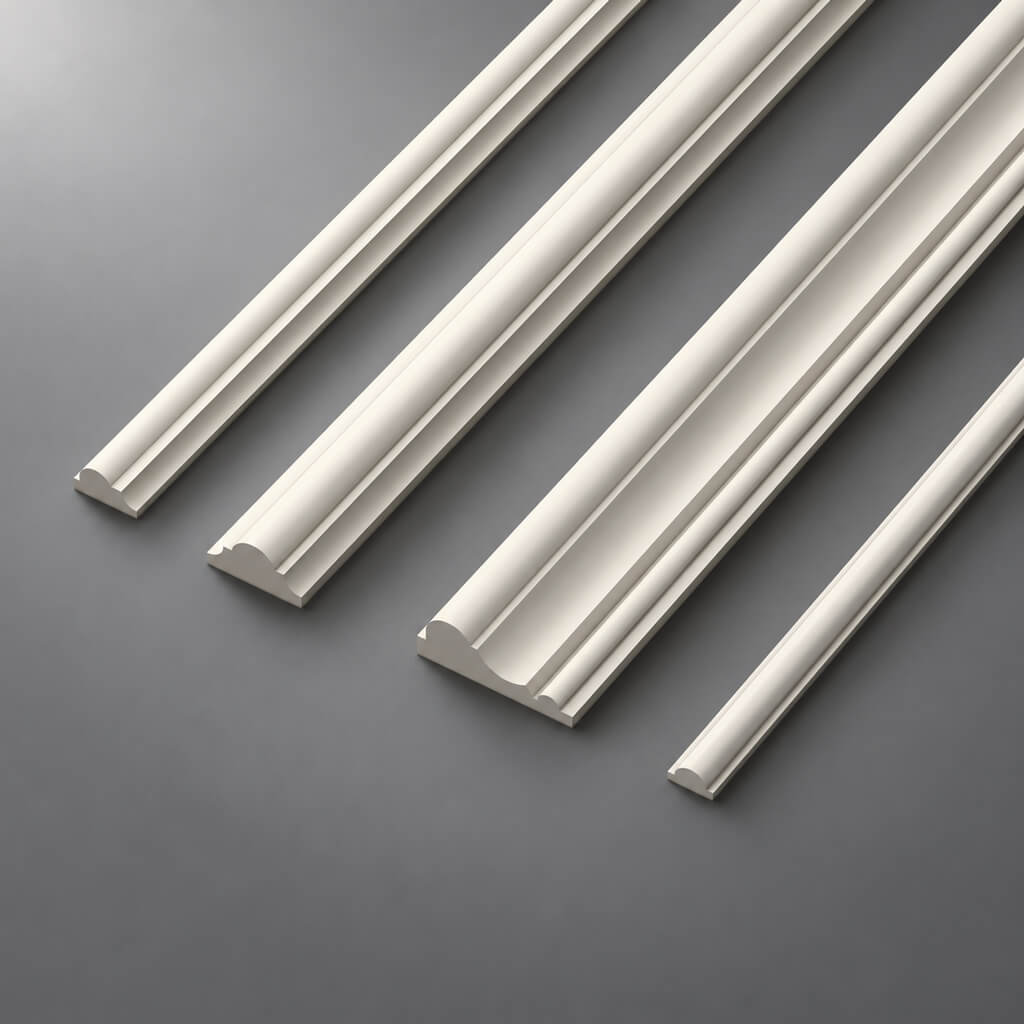
Polyurethane molding MLDPU-001 — a thin profile with dimensions of 10 × 6 × 2600 mm. Its width is only 10 mm, so on the wall it is perceived as a thin decorative line, not as a massive frame.
At the time of preparing the material, one strip 2600 mm long costs 1,740 ₽.
NPU-362.1L — a left-handed carved tip with dimensions of 54 × 26 × 11 mm.
NPU-362.1R — its mirror right-handed pair with the same dimensions of 54 × 26 × 11 mm.
The price of each tip at the time of checking is 330 ₽.
| Detail | Type | Size | Role in composition | Price at the time of check |
|---|---|---|---|---|
| MLDPU-001 | Polyurethane molding | 10 × 6 × 2600 mm | main decorative line | 1 740 ₽ |
| NPU-362.1L | left carved end cap | 54 × 26 × 11 mm | completes the left side | 330 ₽ |
| NPU-362.1R | right carved end cap | 54 × 26 × 11 mm | completes the right side | 330 ₽ |
The dimensions explain the visual logic of the set well. The molding is 10 mm wide, while the decorative end expands to 26 mm. Therefore, the end cap reads as an independent finishing piece, not as a small plug on the profile end.
At the same time, the end cap is only 54 mm long. It does not turn the light line of MLDPU-001 into a massive stucco composition and does not require a large free wall area.




Why a regular straight cut is not always suitable
The cross-cut of MLDPU-001 itself is not a defect. If the profile goes directly into another part, ends in an inconspicuous area, or its end is meant to be hidden per the design, an additional end cap may not be needed at all.
The problem appears when the end of the line remains visible.
Imagine a wall where a thin molding runs horizontally for several meters and stops 70–100 mm before the door casing. The entire composition is perceived as decorative, but the final point is a simple perpendicular cut. The eye notices precisely the abrupt stop of the line.
The NPU-362.1L/R has a different geometry. The molding does not simply end: the line receives an ornamental finish 54 mm long. The transition from the straight profile to the carved shape becomes part of the wall's pattern.
The difference is especially noticeable where the ends are approximately at eye level: near doors, mirrors, consoles, wall panels, and furniture facades.
But using tips automatically on every end is also not advisable. If MLDPU-001 fits flush against a vertical casing and, according to the design project, should visually merge into it, an additional carved element between the two profiles may be superfluous. First, the wall pattern is determined, then the set of parts.
Our factory also produces:




Why NPU-362.1L and NPU-362.1R cannot be considered the same product
The difference between L and R is not a decorative formality.
The letter L denotes a left-hand version, R — a right-hand version. The ornament on the parts is directional, so the elements form a mirror pair.
This is easy to overlook when ordering remotely. On the screen, two small parts may seem almost identical, and the desire arises to simply add the required total quantity to the cart. For example, four tips.
But the phrase "need four tips" still says nothing about the correct configuration. These could be:
| Scheme | NPU-362.1L | NPU-362.1R |
|---|---|---|
| two separate symmetrical lines | 2 | 2 |
| one line with a left open end + three lines with a right | 1 | 3 |
| four open ends in only one direction | 4 | 0 |
| three separate segments with both ends open | 3 | 3 |
Therefore, it is better to count tips not as "pairs in general," but according to the wall plan.
A convenient rule is very simple: consider each open point of MLDPU-001 separately and mark it as L or R.
Only after that, sum up the quantity.
Get Consultation
The most common case: the molding ends near a doorway
A door creates a natural boundary for the decorative layout. That is why unclosed molding lines often appear near openings.
Suppose there is a wide free wall to the right of the door. A horizontal MLDPU-001 line is planned on it. It starts at the outer part of the wall and ends before the door trim.
If both ends remain open and visible, two oppositely directed tips will be needed for such a line.
If the far end meets a wall corner, connects to another molding, or is hidden by furniture, a decorative finish may only be needed near the door.
The mirror situation occurs on the other side of the opening.
That is why the phrase "I have two lines on the sides of the door" does not automatically mean four end caps. You need to see what happens to the other ends of these lines.
Example: two symmetrical lines on the sides of the door
To the left of the door there is a horizontal MLDPU-001 segment 900 mm long, and to the right there is the same. Both lines are independent and open on both sides.
That makes four open ends.
Order:
2 × NPU-362.1L
2 × NPU-362.1R
The total length of the molding itself is 1800 mm. Theoretically, for straight segments, one MLDPU-001 plank 2600 mm long would be enough, since 900 + 900 = 1800 mm. But this calculation is only correct if, after marking and cutting, both segments can indeed be obtained from one plank.
Do not order material strictly by the arithmetic minimum first, and then decide on site where to make cuts. First, write down the actual dimensions of all sections, then plan the cutting of each plank.
If the molding approaches the door only on one side
Let's imagine a different composition. One MLDPU-001 segment 1650 mm long runs from a tall cabinet to the doorway. Near the cabinet, the profile fits flush against its side and visually butts into it. Near the door, the end remains open.
Here, one decorative point needs to be designed, not two.
Therefore, only one tip of the corresponding direction will be needed.
Buying NPU-362.1L and NPU-362.1R as a pair in such a situation makes no sense.
This is one of the most useful calculation principles: the number of tips is determined not by the number of molding segments, but by the number of visible open ends.
A single segment can have two decorative ends, one, or none.
When it is better to leave a small gap near the trim
The carved tip is wider than the MLDPU-001 itself. The molding has a width of 10 mm, while the decorative piece is 26 mm. Therefore, the end point cannot be determined only by the length of the straight profile.
If you run MLDPU-001 almost flush against the trim and then try to add NPU-362.1L or NPU-362.1R, there may simply be no visual space left for the ornament.
The composition should be laid out in reverse: first determine the position of the tip, and only then calculate the length of the straight section of MLDPU-001.
This technique is especially useful near wide decorative trims. There should be enough air between two decorative shapes, otherwise the end of the molding and the door frame begin to be perceived as randomly overlapping details.
There is no single mandatory distance here. It depends on the width of the casing, the free wall space, the scale of the room, and the overall composition.
Therefore, the correct sequence is: place the tip at the intended end point, assess it relative to the casing, and only then mark the connection point with the straight molding.
Do not measure the length of MLDPU-001 up to the edge of the tip
This is a common mistake during preliminary calculation.
Suppose the distance between the conditional extreme points of the decorative composition is 1800 mm. If the customer orders a straight MLDPU-001 exactly 1800 mm long, and then adds NPU-362.1L/R on both sides, the finished composition turns out longer than planned.
For an accurate project, you need to distinguish:
the total length of the decorative composition and the length of the straight section of MLDPU-001.
The tips have their own dimensions and take up space on the wall.
On site, it is better to lay out using actual parts or work from drawings of specific products. Especially if the decorative line must fit precisely between a door and furniture, between two casings, or in a narrow wall section.
How many NPU-362.1L and NPU-362.1R to order
For most projects, the calculation can be done before purchase.
| Configuration | Left NPU-362.1L | Right NPU-362.1R | Total tips |
|---|---|---|---|
| one independent horizontal line, both ends open | 1 | 1 | 2 |
| two independent identical lines | 2 | 2 | 4 |
| three independent open segments | 3 | 3 | 6 |
| one segment, the second end is hidden or adjacent to another part | by direction | by direction | 1 |
| two segments, each with only one end finished | By scheme | By scheme | 2 |
| closed rectangular frame | 0 | 0 | 0 |
The last line is crucial. For a regular closed frame made of MLDPU-001, the carved ends of NPU-362.1L/R are not mandatory: there is no open endpoint that needs to be finished with a tip.
That is why you do not need to buy such decor 'just in case for all molding'.
How to calculate MLDPU-001 by 2600 mm strips
У MLDPU-001 the length of one strip is 2600 mm.
For a rough estimate, you can add up the lengths of all straight sections and divide the result by 2600 mm. But this is only the first step.
For example, three segments are needed:
750 мм
1100 мм
1350 мм
Total length:
750 + 1100 + 1350 = 3200 mm.
By total length, it is clear that one 2600 mm strip is not enough. At least two will be needed.
Now another example:
1300 мм
1300 мм
The total length is exactly 2600 mm. On paper, this results in one plank. In real work, such a calculation is too rigid: it leaves no space even for the technological cut and on-site size adjustments.
Therefore, when ordering, you need to look not only at the total meters, but also at the cutting layout.
Another example:
1700 мм
1000 мм
The total length is 2700 mm. The difference from one plank is only 100 mm, but two MLDPU-001 planks will still be required.
It is precisely in such layouts that it becomes clear why the calculation of "wall length / 2.6" is insufficient for a real order.
Do you need to include a reserve?
For NPU-362.1L/R, the reserve and the molding reserve are different things.
The long MLDPU-001 is cut on site, so a certain reserve helps compensate for trimming and cutting layout features.
The situation with tips is different. This is a finished oriented part. If the project is small and the number of open ends is precisely known, they can be ordered directly according to the scheme.
The main protection against errors here is not the reserve percentage, but the correct division into L and R.
If required on the wall:
3 left endings
2 right endings,
then the base configuration is:
3 × NPU-362.1L
2 × NPU-362.1R.
Buying conditional "five any tips" does not solve this task.
Why it is better to do the layout before gluing
The MLDPU-001 is only 10 mm wide. An error in position even by a few millimeters can become noticeable relative to the trim, furniture, or an adjacent molding line.
The tip is already 26 mm wide and 54 mm long. It is visually more active than a straight profile, so it is convenient to determine the final point of the composition by it.
Before final fixation, it is reasonable to lay out the entire system as a whole:
a straight section MLDPU-001, left or right ending, adjacent architectural details, and, if the composition is symmetrical, elements of the opposite side.
After such a fitting, things that are hard to notice on a single drawing immediately become visible: how close the ornament comes to the trim, whether there is enough free space, whether the endings on both sides of the door are positioned identically, and whether one line seems longer than another due to the surrounding furniture.
It is especially useful to first mark up the entire wall rather than install each section separately.
Where else the open line MLDPU-001 works
A doorway is a clear example, but not the only one.
Near a cabinet up to the ceiling
Tall furniture often becomes a natural boundary for a decorative wall. If the molding line should not continue behind the cabinet, it can be ended before the side panel.
Here you need to decide whether MLDPU-001 should visually enter the furniture or end as an independent carved accent.
In the first case, a finial is not necessary.
In the second case, NPU-362.1L or NPU-362.1R is used depending on the direction of the ending.
Above the console
A short horizontal molding can work as an independent decorative line above a console table, dresser, or small wall panel.
If both ends remain open, a logical configuration is one mirror pair: NPU-362.1L and NPU-362.1R.
This option is especially clear where a full large frame would be too heavy in scale.
On the sides of the mirror
Not every mirror needs to be placed inside a rectangle of four moldings. Sometimes two short horizontal or vertically arranged decorative sections next to it are enough.
If they have visible free ends, finials allow emphasizing that the lines are intentionally left unclosed.
On a furniture facade
The width of MLDPU-001 at 10 mm allows considering it not only as a wall-mounted but also as a relatively delicate profile for a decorative composition.
Here scale is especially important. NPU-362.1L/R have a length of 54 mm, so before ordering it is essential to compare them with the actual size of the facade, handle positions, and free margins.
What looks good on a wide cabinet facade may be excessive on a narrow door.
When NPU-362.1L/R are not needed at all
There are several situations in which a decorative ending will only complicate the composition.
The first is a closed frame. If MLDPU-001 runs along the full perimeter of a rectangle, there are no open ends.
The second is that the end is completely hidden. For example, the molding goes behind a fixed furniture panel.
The third is that the profile should visually abut the trim. Sometimes this is the intended design. There is no need to insert an additional ornament between the two elements.
The fourth is too small a free field. The tip measures 54 × 26 mm in plan. If only a small area remains between the end of a straight line and an adjacent object, the decor may look cramped.
The fifth is an extremely minimalist interior. The MLDPU-001 itself is quite thin. If the task is only to create strict graphics on the wall, the carved ending may change the character of the entire composition.
That is, NPU-362.1L/R should be used where ornamental finishing is truly required, not just because it is a compatible component.
Can the end simply be mitered instead of using a ready-made tip?
An angled cut can change the nature of the ending, but it does not replace a carved tip.
These solutions have different purposes.
Trimming changes the geometry of the straight profile itself. NPU-362.1L/R add a separate ornamental shape measuring 54 × 26 × 11 mm.
If the interior is based on strict geometry, a simple end or another neat trimming method may be more logical.
If the molding line is to have a classic or decorative finish, a ready-made end cap provides exactly the visual result for which a separate part is used.
Therefore, comparing these options only by installation complexity is incorrect. First, you need to choose the appearance of the end point.
What happens if you install two L or two R
Physically placing identical parts on both sides of a straight line is possible, but a symmetrical factory pair will not result.
The directional pattern will be oriented the same way. At one end it will match the intended orientation, at the other—it will not.
On an isolated part, the difference is sometimes underestimated. After installing two end caps on the same horizontal line, the mismatch becomes much more noticeable: the viewer perceives them simultaneously.
Therefore, for a standard symmetrical line with two open ends, the set should be mirrored:
NPU-362.1L + NPU-362.1R.
Before gluing, it is useful to place the parts in their positions without adhesive and look at the entire line from a distance of several meters.
How not to confuse L and R on the object
Do not determine the side only by how an individual part lies on the table.
The orientation is best checked directly in the position in which the tip will be installed relative to the MLDPU-001.
If there are several identical lines in the room, you can mark the endpoints L and R on masking tape before installation. Then place the corresponding set under each line.
This way, the likelihood of discovering a missing right tip after installing half the wall is significantly lower.
Such preparation is especially useful if several doorways are being finished at the same time.
How to join the tip with the MLDPU-001 visually neatly
Both parts should be perceived as a single line.
Before gluing, check three things: whether the axis of the profile matches the intended contact point of the tip, whether a noticeable stepped shift has appeared, and whether the paired ends are positioned identically relative to the surrounding architecture.
Do not expect that the final paint will fix a marking error. A single color does help assemble the polyurethane decor into a cohesive composition, but it does not correct different heights or a shifted axis.
That is why the sequence "mark — try on — check symmetry again — glue" is more reliable than installing from one edge of the wall without prior layout.
How to paint MLDPU-001 and NPU-362.1L/R
In most such compositions, it makes sense to paint the molding and finials the same color.
A unified coating reduces the visual separation between the straight and carved parts. After finishing, the eye perceives them as one decorative system.
You can use the wall color if you need calm relief graphics. Then the molding is read mainly through light and shadow.
Contrast painting emphasizes each line and each finial more strongly. For a small NPU-362.1L/R, this means that any symmetry errors will also become more noticeable.
Therefore, the color should be chosen after the scale of the entire composition is understood.
If MLDPU-001 is used on several walls in a room, it is better to decide in advance whether the same painting principle will be applied everywhere. A random combination of some profiles in the wall color and some in a contrasting shade can fragment the interior more than the differences in the moldings themselves.
How to calculate a set for one wall: a practical example
Suppose there is a door 900 mm wide. On both sides of it, there are free wall sections.
On the left, one horizontal line of MLDPU-001 is planned, 1050 mm long.
On the right, a second one, 1450 mm long.
Both segments must be independent and have a decorative finish on both sides.
We get:
Total length of MLDPU-001:
1050 + 1450 = 2500 mm.
One factory strip has a length of 2600 mm. By simple arithmetic, 2500 mm fits into it.
But only 100 mm of difference remains. Therefore, before ordering, you need to check the actual cutting layout and the possibility of obtaining both finished segments after trimming.
The calculation for the tips is more straightforward:
for the first segment — 1 L + 1 R;
for the second — 1 L + 1 R.
Total:
2 × NPU-362.1L
2 × NPU-362.1R
If the outer ends of both segments go into the side walls and carved decor is required only near the doorway, the set changes dramatically: only two tips will be needed, and their orientation must be determined based on the actual position of the lines.
The same length of molding can thus require a completely different number of NPU-362.1L/R.
Example for a wall with a wardrobe
Another case: a built-in wardrobe occupies the right part of the wall. From the left corner to the wardrobe runs MLDPU-001 with a length of 2100 mm.
At the left edge, the line connects to a vertical molding composition. Near the wardrobe, a free decorative ending is provided.
There is only one open point.
Therefore, for this section, one NPU-362.1L or NPU-362.1R is needed, depending on the orientation of the specific ending.
Purchasing an L + R set will give one extra part.
This example shows why you need to count the end points, not the number of MLDPU-001 planks.
Example with three short decorative lines
Suppose three independent segments are planned above a long console:
650 мм
650 мм
650 mm.
The total length of MLDPU-001 is 1950 mm. It fits into a single plank of 2600 mm with a noticeable remainder.
But each of the three segments is open on both sides.
Consequently, six tips are already required:
3 × NPU-362.1L
3 × NPU-362.1R
This results in a situation where only one plank of straight molding is needed, but the number of decorative components is quite large.
This is another reason to count the straight profile and carved ends separately.
How to check an order before payment
Once the scheme is ready, it is enough to walk along the wall from left to right once more and stop at each endpoint.
Each point must have one of three statuses:
closed by a joint — no tip needed;
hidden by an abutment — no tip needed;
open and must be decoratively finished — NPU-362.1L or NPU-362.1R is required.
After this, the quantities L and R are simply summed up.
This method is more reliable than trying to determine the configuration from a photo of an already finished beautiful interior, because in photos it is often not visible where the profile actually ends and where it goes into another part.
Where to see other elements for moldings
If the project is built around MLDPU-001 and one pair of end caps is not enough, it is better to look at the system as a whole.
In the section buying polyurethane molding decor decorative elements for different molding series are collected. For MLDPU-001, the catalog provides a separate compatibility attribute, so it is more convenient to select parts within a specific profile rather than just by a visually similar ornament.
This is especially useful for complex layouts where there are straight sections, turns, and open ends at the same time.
If you first need to choose the profile itself, in the section Buy polyurethane wall moldings you can compare MLDPU-001 with other moldings by size.
For a more complete interior configuration, the catalog is available moldings from polyurethane.
When to choose MLDPU-001 specifically
MLDPU-001 has a cross-section of 10 × 6 mm, so it makes sense to consider it where a thin line is needed.
This could be a small decorative layout near the door, a light composition on a furniture facade, a narrow wall panel, or several parallel lines that should not look massive.
Before purchasing, it is worth looking at the 10 mm size in real scale. On a large product card image, any profile appears larger than it will be on the wall.
A strip 10 mm wide is only 1 cm.
And the tip 54 × 26 mm occupies an area 5.4 cm long and up to 2.6 cm wide.
These numbers are more useful than the abstract definition of "thin" or "small": using them, you can draw the outline directly on the wall with painter's tape and understand the scale before ordering.
How much does the basic kit with two endings cost
At the time of preparing the material:
MLDPU-001 — 1,740 ₽ per 2600 mm strip;
NPU-362.1L — 330 ₽;
NPU-362.1R — 330 ₽.
Therefore, one MLDPU-001 strip and one mirrored pair of tips, based on the cost of these three items themselves, amount to:
1 740 + 330 + 330 = 2 400 ₽.
This is not the final cost of installing the entire composition: additional materials, painting, consumables, delivery, and possible other decorative elements are not included in the calculation.
But the sum is useful for initial configuration: if for a specific wall one plank and two end caps are enough, the buyer immediately understands the cost of the main decorative set.
For two pairs of end caps:
1 740 + 330 × 4 = 3 060 ₽,
if all the necessary straight molding can indeed be obtained from one plank.
If two planks of MLDPU-001 are required:
1 740 × 2 + 330 × 4 = 4 800 ₽.
Before placing an order, the price and availability should be checked directly in the product cards.
Where to buy MLDPU-001 and end caps separately
The molding MLDPU-001 can be purchased in the product card.
For the left end point, use carved end cap NPU-362.1L.
For the right — carved tip NPU-362.1R.
If the position of all open ends is already marked, before ordering it is enough to write down two numbers: the total quantity L and the total quantity R. This is more reliable than buying an equal number of left and right parts by default.
What to put in the cart: a quick check
For one independent MLDPU-001 line with two visible open ends, you need a straight molding of the required length, 1 × NPU-362.1L and 1 × NPU-362.1R.
For two independent symmetrical lines with four open ends — 2 × L and 2 × R.
For three independent lines — 3 × L and 3 × R.
If one end of each profile is hidden, adjoins furniture, or is part of another molding structure, do not automatically buy pairs. Count only those points that will actually remain open and should receive a carved finish.
This is the whole logic of system configuration: MLDPU-001 sets a straight line, and NPU-362.1L/R are used only where this line should end with an independent decorative point.
FAQ
Is NPU-362.1L compatible with MLDPU-001?
Yes. NPU-362.1L is provided as a left-side decorative element for the system with MLDPU-001. The size of the tip itself is 54 × 26 × 11 mm, and the cross-section of the MLDPU-001 molding is 10 × 6 mm.
Does NPU-362.1R fit MLDPU-001?
Yes. NPU-362.1R is the right-side pair for NPU-362.1L and is used on the opposite open end of the molding line.
Is it always necessary to buy NPU-362.1L and NPU-362.1R as a pair?
No. A pair is needed when one independent segment has two open ends that need decorative finishing. If only one end remains open, one tip of the corresponding direction is sufficient.
How many tips are needed for two identical lines on the sides of a door?
If each line is open at both ends, 2 × NPU-362.1L and 2 × NPU-362.1R will be required. If some ends abut other elements and do not need decorative finishing, the quantity decreases.
Are NPU-362.1L/R needed for a closed frame made of MLDPU-001?
Usually no. A closed frame has no free end that needs to be finished with a carved tip.
Can two NPU-362.1L be installed on different sides of the same molding?
For a symmetrical composition, use a mirror pair of L and R. Two identically oriented elements will give a different direction of the ornament on one of the sides.
How do I know which tip is needed near a doorway?
Determine the side not by the room itself and not by whether the door opens left or right. Look at the specific end point of the molding line and the orientation of the decorative piece relative to MLDPU-001. Before gluing, it is better to attach the tip together with a section of the molding.
What is the size of MLDPU-001?
The MLDPU-001 molding has a cross-section of 10 × 6 mm and a length of one strip of 2600 mm.
What is the size of NPU-362.1L and NPU-362.1R?
Both parts have a size of 54 × 26 × 11 mm.
Can MLDPU-001 be finished with a regular straight end?
Yes, if it fits the composition. The tip is needed not technically, but for decorative finishing of the visible end point. If the end is hidden or the molding must strictly abut another part, a carved ending may be unnecessary.
Do I need to take the size of the tip into account when marking the wall?
Yes. You cannot first bring the direct MLDPU-001 to its final extreme point and then try to add NPU-362.1L/R to it. The tip has its own dimensions — 54 × 26 × 11 mm, so space for it is allocated during the initial layout of the composition.
How to calculate the number of MLDPU-001 planks?
First, write down the length of each straight segment. Then try to distribute them across planks of 2600 mm in length, taking into account the actual cutting allowances. Simply dividing the total length by 2600 mm is not enough if individual segments do not fit well into the cutting layout.
Where to buy polyurethane wall moldings?
You can view the assortment in the section Buy polyurethane wall moldings. The specific profile from this article is in the card molding MLDPU-001.
Where to buy decor for polyurethane moldings?
To select compatible decorative parts, use the section Decor for polyurethane moldings. You can also open the cards separately NPU-362.1L и NPU-362.1R.
What to order if MLDPU-001 ends only near the door?
If the other end of the molding is hidden or connected to another part of the composition, only one tip of the appropriate orientation is needed. In such a situation, it is not necessary to buy L and R as a pair.