Article Contents:
- MLD-060 — one SKU, but four purchasing positions
- Why the total linear meters of MLD-060 tell you nothing about the correct set of 1000 and 2400 mm
- First the finished axes are calculated, then the purchasing meters
- Decorative post types turn the series into a manageable system
- ST-01
- ST-02
- ST-03
- Why the 1000 mm option cannot be considered simply a short version
- From MLD-060, 1000 mm long
- From MLD-060, 2400 mm long
- The finish creates another level of separation
- A test assembly is more important than ordering a hundred sets blindly
- Lengths of 1000 and 2400 mm must be labeled so they cannot be confused
- How to classify remnants without unnecessary bureaucracy
- When MLD-060 2400 mm is more advantageous
- Practical calculation of a tight combination 1450 + 920 mm
- Allowance control is mandatory before mass optimization
- When MLD-060 should not be purchased at all
- How to compare the economics of 1000 and 2400 mm
- When short 1000 mm pieces reduce the risk of mis-sorting
- Critical long axes
- Medium series parts
- Short parts
- Long 2400 mm pieces should be stored as a separate reserve
- Warehouse accounting should separate 1000 and 2400 mm
- Marking should remain functional after cutting
- How to issue MLD-060 to the production or installation crew
- The first series should become the control series
- If the error repeats, the map changes, not each rack manually
- The completeness of MLD-060 and KN must be counted together
- Why one missing KN can block dozens of finished axes
- When a long MLD-060 cannot be replaced by two short ones
- When a metal pipe can be an alternative
- Why the calculation must be done separately for beech and oak
- How to account for ST-04 as a consumer of leftovers
- Not all leftovers are worth storing
- How to account for leftovers between production queues
- How to organize phased delivery
- First delivery
- Second
- Third
- Why the reserve cannot be duplicated in each delivery
- How to account for damage to the long axis
- What to do if the actual length of the post changed after measurement
- How to manage revisions of post types
- What to send to the supplier along with the request
- What to check in the invoice or order confirmation
- Why the total warehouse stock can be misleading
- How to calculate savings from usable remaining stock
- How to choose between 1000 and 2400 mm for a short run
- Are there long parts that leave a suitable offcut?
- Can two or more short parts be cut from 2400 mm with an acceptable remainder?
- If 1000 mm is used, how small is the unavoidable remainder?
- Is a long MLD-060 required as a strategic reserve?
- How to account for the production queue
- What to do after completing the run
- 1. Ordering only by total linear meters
- 2. Not separating 1000 and 2400 mm
- 3. Do not separate beech and oak
- 4. Use long axes on short parts before reserving long ones
- 5. Join two short axes for a long part without a project
- 6. Assume Ø34 guarantees assembly without a trial fit
- 7. Do not create post types
- 8. Do not count system completeness
- 9. Mix leftovers of different materials
- 10. Assign a general reserve percentage
- 11. Call MLD-060 a regular flat molding
- 12. Place a reorder without length and material
- Step 1. Oak critical group
- Step 2. Beech group 1450 mm
- Step 3. Remaining ST-01
- Step 4. ST-04 at 430 mm
- Why the “cheapest length per meter” can result in a more expensive series
- How to calculate the cost of a complete post
- When a series should be split into several production batches
- Balance of order MLD-060
- How to use the actual consumption of the first phase
- What to do if the 950 mm remainder is only suitable after additional processing
- When to store leftovers by piece and when in groups
- How to avoid mixing up beech and oak after finishing
- What to do if the KN fit changed after finishing
- Why the trial assembly must include the actual finish
- How to document a change in post length after series approval
- When a leftover from another revision cannot be used
- Final purchasing line
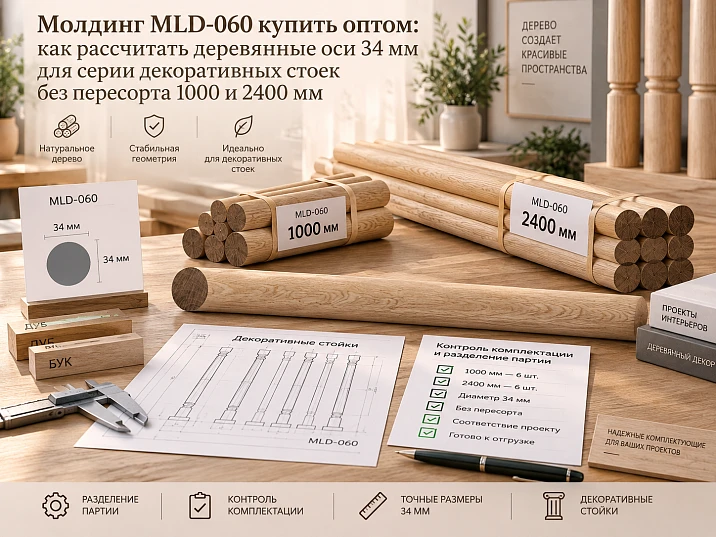
When MLD-060 is purchased for a single decorative post, a mistake in choosing the length can still be corrected locally: take another strip, change the cutting plan, use the leftover somewhere else. In a series of 20, 50, or 100 identical posts, this logic stops working. A mistake in choosing the initial length is repeated dozens of times and turns into extra consumption, a shortage of long axes, or a stockpile of short leftovers that cannot be used in subsequent sets.
Therefore, buying MLD-060 molding in bulk is not a matter of “calculating the total meters of round profile.” The correct calculation starts with the finished parts:
post type → finished axis length → number of posts → material → number of parts → cutting 1000/2400 mm → number of whole MLD-060 → usable offcuts → reserve → batch marking.
The current STAVROS product card shows MLD-060 as a round wooden axis with a diameter of 34 mm made of beech or oak. Lengths of 1000 and 2400 mm are available, and the sanding quality is "Prestige". For a wholesale specification, this means that one SKU effectively turns into at least four purchasing positions:
| Material | Section | Length |
|---|---|---|
| Beech | 34×34 mm | 1000 мм |
| Oak | 34×34 mm | 1000 мм |
| Beech | 34×34 mm | 2400 мм |
| Oak | 34×34 mm | 2400 мм |
Product card: Wooden molding MLD-060.
The main principle for a large batch:
first reserve the longest critical axes, then calculate the medium parts, after that the short ones; only then sum up the purchasing quantity of whole 1000 and 2400 mm strips.
This helps prevent a typical mistake: all the long MLD-060 have already been cut into short elements, the total linear meters are still in stock, but there is nothing left to assemble a 2150 or 2300 mm post from.
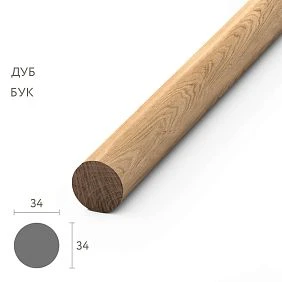
MLD-060 — one SKU, but four purchasing positions
One SKU, but the material and length change the purchasing logic.
You cannot send the supplier:
MLD-060 — 100 meters.
This line is unclear:
-
beech or oak;
-
length 1000 or 2400 mm;
-
how many solid long axes are required;
-
how many parts are shorter than a meter;
-
which offcuts must be reused;
-
which type of post belongs to a specific part of the batch;
-
what finish is provided.
For a large order, the work line should be more specific:
MLD-060 / beech / 34×34×2400 mm / “Prestige” / ST-03 / number of solid strips ___.
And separately:
MLD-060 / beech / 34×34×1000 mm / “Prestige” / ST-01 / quantity ___.
If a project contains both oak and beech at the same time, these are already two independent material branches. A leftover piece of beech does not replace a missing oak axis, even if the diameter and length match.
If the finishes differ, there are even more branches.
Therefore, the first level of the master specification:
MLD-060 → material → length → finish → post type.




Why the total linear meters of MLD-060 says nothing about the correct set of 1000 and 2400 mm
Let's imagine the requirement:
-
40 parts of 920 mm;
-
60 parts of 370 mm;
-
20 parts of 2150 mm.
Total finished length:
40 × 920 = 36,800 mm;
60 × 370 = 22,200 mm;
20 × 2150 = 43,000 mm.
Total:
102,000 mm = 102 m.
If you simply order “102 meters of MLD-060,” the problem is not solved.
A 2150 mm part cannot be obtained from a one-meter axis. It requires a 2400 mm blank or another approved design solution.
The 920 mm part, on the contrary, uses the one-meter axis almost entirely.
The 370 mm part can be placed well both in 1000 mm and in the remnants of 2400 mm strips.
Consequently, the same net linear meters may require a completely different number of source strips.
For wholesale purchasing, you need to calculate not only “how many meters of finished parts,” but also from which specific commercial lengths these parts will be obtained with the smallest unavoidable remainder.
Our factory also produces:



Finished axes are counted first, then purchased meters
Correct sequence:
-
determine post types;
-
determine the finished length of MLD-060 in each type;
-
determine the number of stands;
-
get the total quantity of identical parts;
-
separate beech and oak;
-
separate the finishes;
-
build a cutting plan for 1000/2400 mm;
-
determine the number of whole commercial strips;
-
add a justified reserve.
Reverse order is bad:
the budget allows purchasing 150 m, then we'll try to cut posts from them.
The number of meters must not dictate the geometry of the structure.
The geometry of standard racks should determine the purchase quantity.
Get Consultation
Types of decorative racks turn the series into a manageable system
For a large project, it is convenient to create codes.
ST-01
Finished wooden axis — 920 mm.
Quantity — 40 pcs.
Material — beech.
ST-02
Finished axis — 1450 mm.
Quantity — 20 pcs.
Material — beech.
ST-03
Finished axis — 2250 mm.
Quantity — 8 pcs.
Material — oak.
Next, the master list:
| Type | Finished length MLD-060 | Quantity | Material | Initial candidate length |
|---|---|---|---|---|
| ST-01 | 920 мм | 40 | Beech | 1000/2400 after cutting |
| ST-02 | 1450 мм | 20 | Beech | 2400 |
| ST-03 | 2250 мм | 8 | Oak | 2400 |
It is immediately clear: ST-02 and ST-03 cannot be produced as a solid axis from a one-meter MLD-060. For them, the long version is not a matter of saving material, but the minimum required starting length.
ST-01 can be made from 1000 mm or included in a 2400 mm cutting plan. Which is more efficient is determined by the overall layout.
Why the 1000 mm option cannot be considered simply a short version
The one-meter MLD-060 can be a standalone optimal product option.
For example, an axis of 920 mm is needed.
From 1000 mm:
1000 − 920 = 80 mm before accounting for the actual cut and technological allowances.
If the same part is cut from 2400 mm:
2400 − 920 = 1480 mm.
1480 mm is already a large amount. It can be useful if the project has a part around 1450 mm. If there is no such part, a long strip for a single 920 mm axis may turn out to be inefficient.
Therefore, the rule "a long bar is always more efficient" does not work.
Likewise, "a short bar always reduces waste" does not work.
The solution depends on the full set of parts in the series, not on a single post.
Practical calculation: part 920 mm
Let's consider 40 identical axles of 920 mm each.
From MLD-060, 1000 mm long
One commercial axle yields one finished part.
For 40 parts, the minimum required is:
40 bars of 1000 mm each.
Net material:
40 × 920 = 36,800 mm.
Original:
40 × 1000 = 40,000 mm.
Simple difference:
3200 mm, excluding the cut.
From MLD-060, 2400 mm long
Two parts can be obtained from one strip:
920 + 920 = 1840 mm.
remains:
560 mm before accounting for the cut.
For 40 parts, the following is required:
20 planks of 2400 mm each.
Initial linear meters:
20 × 2400 = 48,000 mm.
At first glance, the meter-long version uses less source wood.
But a conclusion cannot be drawn from this group alone.
If the project has 20 additional parts of approximately 500–550 mm, the offcuts from the long version start to work.
Therefore, the decision is made based on the overall series.
Practical calculation: parts 1500 and 2300 mm
It is impossible to obtain a solid 1500 mm axis from the 1000-millimeter MLD-060.
Buying two meter-long planks and joining them to obtain 1500 mm is not allowed without a separate approved structural solution.
If the project requires a solid wooden axis of 1500 mm, the initial length is 2400 mm.
Simple difference:
2400 − 1500 = 900 mm.
The remaining 900 mm is potentially very useful: it can cover a short axis of another type.
For a 2300 mm part, the one-meter version is also excluded.
MLD-060 2400 mm potentially allows obtaining a solid part:
2400 − 2300 = 100 mm.
But these 100 mm cannot automatically be considered a guaranteed technological allowance. It is necessary to take into account the cutting method, end trimming, possible edge defects, and finishing.
The purchaser should see the wording:
a solid 2300 mm part is needed from a 2400 mm strip; confirm the technological allowance before mass production.
The article deliberately does not specify an invented allowance value.
The main benefit appears in series production, not on a single post
One 920 mm axis is a simple choice.
Series:
-
ST-01 — 40 pcs. × 920 mm;
-
ST-02 — 20 pcs. × 1450 mm;
-
ST-03 — 8 pcs. × 2250 mm;
-
ST-04 — 30 pcs. × 430 mm;
— already requires unified optimization.
The remainder after ST-02 can cover ST-01.
The remainder after two ST-01 from 2400 mm can cover ST-04.
And ST-03 almost fully consumes the long plank and should be reserved before the others.
Therefore, the order is:
longest → medium → short.
This way, the long 2400 mm pieces are not accidentally used for parts that could have been made from 1000 mm or remnants.
Beech and oak are considered as two independent batches
MLD-060 is produced in beech and oak.
For procurement, you cannot write:
MLD-060 — 68 pcs.
Must be counted separately:
MLD-060 / beech / 1000;
MLD-060 / beech / 2400;
MLD-060 / oak / 1000;
MLD-060 / oak / 2400.
The remaining beech does not cover the shortage of the oak part.
If the post has visible natural wood, the material directly affects the appearance.
Even with opaque finishing, species cannot automatically be considered interchangeable without project approval.
Therefore, all cutting is built across at least two independent material branches.
Finishing creates another level of separation
The project may include different finishing systems: clear, tinted, opaque, or other approved finishing.
For procurement, it is enough to understand the principle:
the same material and length do not guarantee interchangeability if the finishing belongs to a different zone.
For example:
MLD-060 / oak / 2400 / О-01.
и
MLD-060 / oak / 2400 / О-02.
If О-01 and О-02 differ, their remnants are accounted for separately.
MLD-060 and KN elements: the nominal Ø34 mm does not eliminate the need for a test fit
MLD-060 has a round size of 34 mm.
Geometric elements of the KN series may have a 34 mm hole and are directly intended for use with MLD-060.
For example, KN-006 has a 34 mm hole and is designed for the MLD-060 wooden axle or a pipe of the corresponding diameter.
But from matching nominal sizes, one cannot conclude:
everything will guaranteed fit perfectly without verification.
Product pages do not publish the full set of fit tolerance limits for a specific pair of parts.
Therefore, mass production should begin with a test assembly:
nominal match → dry fit → verification of actual assembly → approval → production run.
Related material: KN-006 and 34 mm axle.
A test assembly is more important than ordering a hundred sets blindly
Before a bulk purchase, it is useful to assemble one physical set.
Required:
-
actual MLD-060;
-
actual KN elements;
-
material of the required species;
-
actual finish or test sample;
-
approved fastening system;
-
actual lengths.
Check:
-
whether the axle passes through the mounting holes;
-
is there any conflict after finishing;
-
is it convenient to assemble the elements;
-
do the actual dimensions match the project;
-
is technological adjustment required.
If one assembly unit cannot be assembled, it is too early to order one hundred identical sets.
What counts as a set for a decorative post
A post is not “one and a half meters of MLD-060.”
For example:
ST-01
-
MLD-060 — 1 finished axis;
-
KN-004 — quantity according to the project;
-
KN-005 — quantity per project;
-
KN-006 — quantity per project;
-
other elements — per project;
-
finish — О-01.
For wholesale assembly, a useful metric:
how many complete ST-01 units can be assembled from the available MLD and KN.
The warehouse may hold 100 long MLD-060 axles. If there are only enough KN for 72 uprights, the actual completeness is 72.
This is a stronger metric:
MLD-060 is supplied at 100%.
Lengths 1000 and 2400 mm must be marked so they cannot be confused
MLD-060 has the same cross-section of 34×34 mm.
In the warehouse, short and long axles differ externally only in length.
If the packaging is opened, mix-ups are especially easy.
Marking:
MLD-060 / beech / 1000 / ST-01 / batch 2.
and:
MLD-060 / beech / 2400 / ST-02/ST-03 / batch 2.
For oak — separate lines.
Poor labeling:
wooden axle.
It does not correspond to material, length, or purpose.
Long MLD-060 2400 mm must be reserved before cutting short parts
If there are axles:
-
2100 mm;
-
2250 mm;
-
2300 mm;
they depend on the long 2400-millimeter blanks.
You cannot first use all 2400 mm for two short parts of 920 mm each, and then discover that there is nothing left to make ST-03 from.
Correct order:
-
parts close to 2400 mm;
-
parts that cannot be obtained from 1000 mm;
-
parts that are advantageous to combine on 2400 mm;
-
parts shorter than a meter;
-
remainders.
This is not an assembly sequence. This is the priority for distributing the source material.
The remainder is useful only when there is a specific part for it
After cutting the long MLD-060, there may be:
-
100 mm;
-
300 mm;
-
560 mm;
-
900 mm;
-
1450 mm.
You cannot add everything up and say:
we have 20 meters of usable offcuts.
Usefulness is determined by length.
For example:
-
100 mm — may not fit anywhere;
-
560 mm — fits ST-04;
-
900 mm — fits the short axis;
-
1450 mm — potentially covers ST-02.
Therefore, offcuts should preferably be tracked by actual lengths or by ranges tied to real project parts.
Otherwise, the total meterage of offcuts overstates actual availability.
How to classify offcuts without unnecessary bureaucracy
It is not necessary to track every piece separately if the batch is large.
You can define working ranges based on actual part dimensions.
For example:
-
R1 — up to 300 mm, only test and auxiliary fragments;
-
R2 — 301–600 mm, suitable for short ST-04 parts;
-
R3 — 601–999 mm, candidates for ST-01 and other short axes;
-
R4 — from 1000 mm, use as a long offcut after verification.
The boundaries here are arbitrary. In a real project, they are determined not by nice round numbers but by the parts list.
The main thing is to stop treating every piece as a “useful reserve.”
When MLD-060 1000 mm is more advantageous than 2400 mm
The one-meter version is especially logical if:
-
most finished parts are shorter than one meter;
-
the long version yields a repeating unusable remainder;
-
parts cannot be rationally grouped in twos or threes on 2400 mm;
-
logistics of short strips is more convenient for a specific series;
-
there are no long parts in the project.
For example, 100 parts of 920 mm each.
If there are no other short elements, a 1000 mm strip uses the source length much closer to the finished size.
But the decision is still confirmed by calculation, not intuition.
When MLD-060 2400 mm is more advantageous
The long version is needed or advantageous when:
-
a solid axis longer than 1000 mm is required;
-
several repeating parts are obtained from a single plank;
-
the remainder after a long part fits another part in the series;
-
the project aims to reduce the number of source products with good cutting.
For example:
1450 mm + 900 mm = 2350 mm.
Before accounting for the actual cut, the sum is close to 2400 mm.
If the manufacturing process allows, such a pair can be very efficient.
But it cannot be considered guaranteed without allowance for cutting and processing.
Practical calculation of a tight combination 1450 + 920 mm
The series contains:
-
20 parts of 1450 mm each;
-
40 pieces of 920 mm.
Sum of one pair:
1450 + 920 = 2370 mm.
There are 30 mm left to the nominal 2400 mm.
If the actual cutting and trimming technology requires more than 30 mm, the scheme does not work.
If the technologist has confirmed that this is sufficient, 20 long strips can yield:
-
20 parts of 1450 mm each;
-
20 pieces of 920 mm.
The remaining 20 pieces of 920 mm can then be obtained from 1000 mm axles.
The result is a combined order:
-
20 long 2400 mm;
-
20 short 1000 mm.
This is already much more precise than “you need 47.4 meters of beech MLD-060.”
Allowance control is mandatory before mass optimization
The denser the cutting layout, the higher the sensitivity to the process.
For example, 2370 mm on an original length of 2400 mm leaves only 30 mm.
Need to consider:
-
kerf width;
-
end trimming;
-
possible edge defect;
-
finish machining;
-
additional fitting.
Therefore, it is useful to have a field in the master table:
cutting layout confirmed — yes/no.
The purchaser should not save millimeters without confirmation of the actual process.
When MLD-060 should not be purchased at all
MLD-060 — round wooden axis Ø34 mm.
It should not automatically substitute for another product type.
Do not choose MLD-060 if the project requires:
-
a flat wall molding;
-
a decorative wall frame;
-
a different axis diameter;
-
a metal pipe;
-
a structural system where wood does not suit the task.
For example, for KN-014 STAVROS considers both the wooden MLD-060 and a Ø34 mm metal pipe. The choice depends on the structure and design, not on which material is "better in general."
Related material: KN-014 — wooden or metal axle.
How to compare the economics of 1000 and 2400 mm
Comparing "which plank is cheaper per meter" is not enough.
You need to calculate:
cost of the source batch / number of usable finished parts.
Also consider:
-
useful leftovers;
-
unusable leftovers;
-
additional cuts;
-
logistics;
-
reserve;
-
quantity of whole items.
For example, 2400 mm may have a higher cost per plank, but yield two parts and a useful remainder.
1000 mm can cover one part with almost no waste.
The optimal option is selected per series.
When short 1000 mm lengths reduce the risk of mismatched grades
If a separate zone consists only of 800–950 mm parts, meter-long MLD-060 may be convenient not only for cutting.
They:
-
visually differ in length;
-
easier to label for a specific type;
-
do not require storing a large remainder;
-
reduce the risk that a long critical strip goes to a short part.
But this operational advantage must be compared with the real price and logistics, and not considered universal.
How to calculate the wholesale reserve
Universal formula:
total linear meters + 10%
too coarse.
Better to split:
Critical long axes
The loss of a single plank can halt an entire set.
Medium-sized standard parts
Often made from long blanks and usable offcuts.
Short parts
More often can be restored from leftover material.
The reserve is determined by:
-
the number of sets;
-
the length of the parts;
-
the availability of reordering;
-
the schedule;
-
material;
-
finishing features.
The main unit for a long group is a whole plank, not a percentage of meters.
Long 2400 mm items must be stored as a separate reserve
If the project contains parts 2100–2300 mm, the reserve for them must be specifically in long planks.
Bad entry:
reserve MLD-060 — 15 m.
Better:
MLD-060 / oak / 2400 / reserve of long ST-03 — 3 whole planks.
And separately:
MLD-060 / beech / 1000 / reserve of short ST-01 — 2 pcs.
This way the reserve can actually cover damage.
Warehouse accounting must separate 1000 and 2400 mm
Entry:
MLD-060 / beech — balance 24 pcs.
insufficient.
You need to:
MLD-060 / beech / 1000 — 14 pcs.
MLD-060 / beech / 2400 — 10 pcs.
If there are different finishes, a code is added.
10 long planks can cover ST-02.
14 one-meter ones — no.
By the total number of items, the warehouse looks well-stocked; by length, there may be a shortage.
Marking must also work after cutting
After sawing, individual pieces appear.
If usable remnants will be used in the next series, they need to be re-marked.
For example:
MLD-060 / beech / О-01 / 950 mm / remnant after ST-02 / suitable for ST-01.
This can be done with a sticker, a warehouse tag, or digital tracking.
The format is not critical.
It is important to keep:
-
material;
-
length;
-
finishing;
-
purpose.
How to issue MLD-060 to a production or installation crew
Poor issue:
beech MLD-060 — 20 pcs.
Better:
ST-03 / MLD-060 / oak / 2400 — 8 pcs.
ST-02 / MLD-060 / beech / 2400 — 10 pcs.
ST-01 / MLD-060 / beech / 1000 — 12 pcs.
This way the crew understands the purpose.
If some parts must be cut from ST-02 remnants, this is indicated on the card.
The first series should become the reference
Before launching 100 racks, it is useful to assemble the first 3–5 sets.
Check:
-
actual consumption;
-
actual lengths;
-
compatibility with KN;
-
remnants;
-
repeatability;
-
technological allowance;
-
assembly quality;
-
ease of marking.
If the map shows that 560 mm constantly remains out of 2400 mm, and there is no suitable part, the next batch can be recalculated.
If the remainder covers ST-04 well, the scheme is confirmed.
If the error repeats, the map changes, not each rack manually
For example, after three assemblies it turned out that the finished length of ST-01 should be not 920, but 935 mm.
If the series has not yet been fully cut, the master list is updated.
There is no need to continue the old cutting plan and then adjust each part.
Serialization should work toward correcting errors:
one adjustment → the entire next batch.
The completeness of MLD-060 and KN must be counted together
The axle is only one part of the decorative post.
Let's imagine:
-
MLD-060 is enough for 50 posts;
-
KN-006 — for 46;
-
another geometric element — for 42;
-
fastening kit — for 48.
Actual completeness:
42 posts.
This is a more useful metric than:
MLD-060 is 100% procured.
The master specification can include a separate table:
| Component | Kits provided |
|---|---|
| MLD-060 | 50 |
| KN-006 | 46 |
| KN-X | 42 |
| Fastening | 48 |
| full set | 42 |
Such a table is especially useful when MLD and KN arrive in different batches.
The purchaser sees not only the stock of individual SKUs, but also the actual number of racks that can be assembled without stopping.
Why one missing KN can block dozens of ready-made axles
The warehouse may contain:
-
100 MLD-060 axles;
-
100 finishing kits;
-
100 packages of other components;
but one KN is only enough for 70 racks.
Then 30 axles do not actually turn into a finished product.
For wholesale assembly, it is important to track the bottleneck of the kit.
This rule is useful not only for the current batch, but also for reordering.
Bad reorder:
another 20 MLD-060.
If there are already enough axles, such a purchase will not increase the number of finished racks.
First, the completeness of the entire system is checked.
When a long MLD-060 cannot be replaced by two short ones
If the project requires a solid wooden axle, joining two one-meter parts is already a different structural solution.
It cannot be accepted only because of a shortage of 2400 mm.
Separate project confirmation is required:
-
how to connect;
-
where to place the joint;
-
how it affects strength;
-
whether it will be visible;
-
is it compatible with KN;
-
how to perform the finishing.
If no such solution exists, the long part must be made from a single original axis of sufficient length.
For a post of 1450, 2100, 2250, or 2300 mm, two one-meter strips are not an automatic replacement for the 2400 mm MLD-060.
When a metal tube can be an alternative
Some KN elements allow installation on a wooden MLD-060 or a Ø34 mm metal tube.
But this is not universal interchangeability.
Metal and wood provide:
-
different appearance;
-
different fastening method;
-
different finishing requirements;
-
different structural logic;
-
a different perception of the finished rack.
Therefore, you cannot buy a metal tube just because the wooden axle has run out.
The alternative must be included in the design.
If both options are initially provided for in the design, they become two independent sets.
How to build a master list for 100 racks
Let us consider a hypothetical property.
You need to:
-
40 posts ST-01;
-
30 posts ST-02;
-
20 posts ST-03;
-
10 posts ST-04.
Finished lengths:
-
ST-01 — 920 mm;
-
ST-02 — 1450 mm;
-
ST-03 — 2250 mm;
-
ST-04 — 430 mm.
Material:
-
ST-01 — beech;
-
ST-02 — beech;
-
ST-03 — oak;
-
ST-04 — beech.
Working sheet:
| Type | Length | Quantity | Material | Criticality |
|---|---|---|---|---|
| ST-01 | 920 | 40 | Beech | Short |
| ST-02 | 1450 | 30 | Beech | Long |
| ST-03 | 2250 | 20 | Oak | Critical |
| ST-04 | 430 | 10 | Beech | Short |
ST-03 is defended first.
For 20 oak axles of 2250 mm, a minimum of 20 oak MLD-060 with a length of 2400 mm is required if each post is made from a single strip.
Next, beech is calculated.
ST-02 requires 30 long axles of 1450 mm.
After each one, up to 950 mm theoretically remains.
Such a remainder is potentially suitable for ST-01 920 mm.
If the technological allowance permits the combination:
1450 + 920 ≤ 2400 mm including the cut,
then 30 long beech planks can simultaneously yield:
-
30 ST-02;
-
30 ST-01.
There will still be 10 ST-01 left.
They can be obtained from:
-
10 one-meter MLD-060;
-
or another confirmed 2400 mm cutting plan.
ST-04 at 430 mm each is better considered as a consumer of leftovers.
Thus, the overall series is counted not as four independent lines, but as a single parts map within each material.
Why the calculation must be done separately for beech and oak
In the example given, the total linear meters of all axes can be summed up.
But for purchasing purposes, this is an almost useless figure.
Oak part:
20 × 2250 = 45,000 mm = 45 m.
Beech part:
40 × 920 + 30 × 1450 + 10 × 430.
This is a separate pool.
If the beech cutting plan turns out to be very efficient, its savings do not reduce the number of oak long strips.
Therefore, optimization is carried out within a single interchangeable group:
material + length of the original strip + finish.
How to account for CT-04 as a consumer of remnants
The 430 mm part is convenient precisely because it is short.
But one cannot assume in advance that all 10 CT-04 will be free remnants.
The actual cutting layout needs to be checked.
For example, after two 920 mm parts, 560 mm remains out of 2400 before accounting for the cut.
Theoretically, 430 mm fits there.
If the technological allowance permits, one MLD-060 2400 can yield:
-
920;
-
920;
-
430;
with a total of:
2270 mm.
There is 130 mm left before the cut is accounted for.
This is much more realistic than trying to use a 100 mm remnant after a 2300 part.
This is how the short ST-04 becomes part of an efficient scheme.
Not all remnants are worth keeping
If a remnant does not match any repeatable part, keeping it can create unnecessary warehouse work.
For example:
-
85 mm;
-
120 mm;
-
170 mm.
If the project has no parts of such sizes, they should not be counted as a full-fledged reserve.
Remnants can be divided into:
useful — have a specific purpose;
conditionally useful — can be used for tests or auxiliary work;
unused in the main series — not included in the availability calculation.
This makes the remaining quantity figure more accurate.
How to account for remnants between production batches
Let's say the first batch is 25 uprights.
After it, the following accumulated:
-
12 pieces of 560 mm;
-
8 pieces of 930 mm;
-
3 pieces of 1400 mm.
Before ordering the second batch, you need to first check them against the bill of materials.
Possibly:
-
560 mm are covered by ST-04;
-
930 mm cover ST-01;
-
1400 mm is not enough for ST-02 1450 mm.
The last 3 pieces cannot be considered a replacement for long parts.
Therefore, the second-stage order is reduced only by those leftovers that actually cover specific parts.
How to organize staged delivery
A large order does not necessarily have to be shipped in one batch.
For example:
First delivery
Sets for 20 racks.
Second
Another 40.
Third
The remaining 40 plus reserve.
But all three deliveries must reduce a single master specification.
You cannot create three independent calculations, each of which adds the reserve anew and does not account for the remnants of the previous batch.
Working scheme:
needed → ordered → received → cut → assembled → remaining → reserve.
Why the reserve cannot be duplicated in each delivery
Suppose the project decided to keep:
-
3 long oak MLD-060 2400;
-
4 long beech MLD-060 2400;
-
5 short MLD-060 1000.
If there are four deliveries, you cannot automatically add these numbers to each one.
Otherwise, instead of 3 long oak reserves, you get 12.
A reserve exists at the level of the entire series or a specific queue, if this is specifically established.
Therefore, in each delivery it is visible:
what part of the total reserve has already been delivered.
How to account for damage to a long axis
Damage to a 2400 mm axis intended for a 2250 mm part is critical.
It cannot be replaced by two short offcuts.
If the damage is at the end and it is technologically possible to obtain a shorter part, the strip can be transferred to another type.
For example:
the strip is excluded from ST-03, reassigned to ST-01/ST-04 after inspection.
Thus, a defect does not always mean complete waste.
But the transfer is recorded so that the warehouse does not continue to count the bar as a reserve for the long post.
What to do if the actual post length changed after measurement
A serial project may initially have ST-02 = 1450 mm.
After the test assembly, it turns out that 1470 mm is needed.
This change affects the cutting.
Combination:
1450 + 920 = 2370 mm
could have been potentially acceptable.
After the change:
1470 + 920 = 2390 mm.
Only 10 mm remains before accounting for the cut.
There is a high probability that the previous scheme no longer works.
Consequently, changing the finished length by 20 mm can change the entire procurement set 1000/2400.
This is another reason not to start mass cutting before the control assembly.
How to manage rack type revisions
It is useful to designate:
ST-02 / revision 1 — 1450 mm.
ST-02 / revision 2 — 1470 mm.
If part of the batch has already been cut according to revision 1, it is necessary to determine separately:
-
how many parts are ready;
-
whether they can be used;
-
where;
-
whether it needs to be redone;
-
how many new source planks are required.
You cannot simply replace 1450 with 1470 in the table and forget about the material that already exists.
What to send to the supplier along with the request
For an accurate commercial proposal, it is useful to prepare:
-
SKU MLD-060;
-
beech/oak;
-
1000/2400 mm;
-
the number of whole planks of each length;
-
sanding quality;
-
finishing requirements, if they relate to the delivery;
-
breakdown by batches;
-
deadlines.
The internal map of all parts can be sent to the supplier as an attachment if it helps verify the quantity.
Bad request:
need round wooden moulding 34 mm, 120 metres.
Good:
MLD-060 / beech / 1000 mm — 20 pcs.; MLD-060 / beech / 2400 mm — 35 pcs.; MLD-060 / oak / 2400 mm — 22 pcs.; distribution by series — in the appendix.
for wholesale building material suppliers such a specification is much more unambiguous than the total linear metres.
What to check in the invoice or order confirmation
After submitting the request, you need to verify that the supplier has confirmed exactly:
-
MLD-060;
-
material;
-
length;
-
quantity;
-
8 pieces of 700 mm;
-
6 pieces of 900 mm;
-
4 pieces of 1200 mm;
-
1 whole plank 2400 mm.
-
first, lobby racks;
-
then the restaurant;
-
then the room numbers;
-
then the reserve.
-
which materials were used;
-
which lengths were purchased;
-
what types of posts existed;
-
which revision was final;
-
which KNs were used;
-
what finish;
-
how many whole planks remained;
-
which useful remnants were saved.
-
exact SKU;
-
round axle Ø34 mm;
-
beech or oak;
-
length 1000 or 2400 mm;
-
quantity of posts of each type;
-
finished length of each axis;
-
number of parts of each type;
-
finish;
-
compatible KN;
-
physical test assembly;
-
technological allowance;
-
cutting map;
-
long critical parts;
-
short parts;
-
useful leftovers;
-
reserve;
-
marking;
-
warehouse separation;
-
production queue;
-
output format;
-
reorder format.
-
60 posts ST-01, 920 mm each, made of beech;
-
30 posts ST-02, 1450 mm each, made of beech;
-
20 posts ST-03, 2250 mm each, made of oak;
-
10 posts ST-04, 430 mm each, made of beech.
-
30 ST-02;
-
30 ST-01.
-
how many usable parts are produced;
-
how much unused material remains;
-
whether an additional cut is needed;
-
how many whole axes must be kept in reserve;
-
how many batches will be required;
-
which option better covers the long critical parts.
-
batch 1 — 20 control posts;
-
batch 2 — 50 main ones;
-
batch 3 — the remaining 50;
-
a separate reserve.
-
the series is new;
-
the geometry is still being checked;
-
KN and MLD arrive at different times;
-
finishing is approved in stages;
-
the project is installed in phases.
-
planned 20 meter-long MLD;
-
actually needed 18;
-
6 useful remnants of 560 mm appeared;
-
one long oak element was damaged;
-
one cutting plan turned out to be unworkable due to the allowance.
-
end condition;
-
actual length after trimming;
-
surface quality;
-
need for re-processing;
-
finishing.
-
900–949 mm;
-
950–999 mm;
-
500–599 mm.
-
920–949 mm;
-
950–999 mm.
-
SKU;
-
wood species;
-
length;
-
rack type;
-
batch.
-
where the coating appeared;
-
whether the technology was followed;
-
whether the seating area needs protection;
-
whether the current scheme matches the recommendations for specific elements.
-
verify the invoice;
-
receive the goods;
-
place in the warehouse;
-
issue to production;
-
place an additional order.
Why the total warehouse stock can be misleading
Let's imagine that at the end of the first phase the warehouse shows:
MLD-060 / oak — 18.6 m.
At first glance, there is plenty of material.
In fact, this is:
For a 2250 mm post, only one whole plank from the entire remainder is suitable.
Therefore, the report must have two levels:
total remaining linear meters and remainder by usable lengths.
The second level manages production.
How to calculate savings from usable remainder
Savings are not the mere fact of having an offcut, but that it replaced the purchase of a new commercial plank.
For example, after ST-02, 930 mm remains.
The next batch requires an ST-01 with a length of 920 mm.
If, after checking the allowance, the remainder is suitable, it covers one part without a new meter-long MLD-060.
Only then can the remainder be counted as a real saving.
If a 930 mm piece sat in the warehouse until the end of the project and was never used, there was no saving.
This approach helps to honestly compare the 1000 and 2400 mm schemes.
How to choose between 1000 and 2400 mm for a short run
For a part shorter than a meter, you can go through four questions.
Are there long parts after which a suitable piece remains?
If yes, we use their remainder first.
Is it possible to get two or more short parts from 2400 mm with an acceptable remainder?
If so, the long version may be more advantageous.
If using 1000 mm, how small is the unavoidable remainder?
For a 920 mm part, it is small.
Is the long MLD-060 required as a strategic reserve?
If so, do not use up the entire long stock on the short group.
This is not a universal selection formula, but a verification sequence that protects against a random decision.
How to account for the production queue
The series may proceed not by types, but by zones of the site.
For example:
If the lobby uses oak and the rooms use beech, the warehouse pools are already separated naturally.
If both zones use beech but with different finishes, the separation is by finish.
If both the material and the finish match, the leftovers from the first zone can be used for the second after the reserve is closed.
Thus, the production sequence must be tied to the master ledger rather than existing as a separate schedule without regard for material.
What to do after completing the series
After installation, it is useful to keep the MLD-060 passport:
In a year, this will help order a single replacement without rebuilding the entire logic again.
Phrase:
there was a wooden axle 34 mm,
too weak.
Entry:
MLD-060 / oak / 2400 / О-02 / СТ-03 / revision 2
allows reproducing the required configuration much more accurately.
Twelve mistakes when buying MLD-060 wholesale
1. Order only by total linear meters
Reason: the meter budget seems sufficient.
Consequence: it is unknown how many 1000 mm and 2400 mm pieces are needed.
How to prevent: start with a bill of finished parts.
2. Do not separate 1000 mm and 2400 mm
Reason: there is a single SKU.
Consequence: short rails do not cover long posts.
How to prevent: separate purchasing lines.
3. Do not separate beech and oak
Reason: the diameter is the same.
Consequence: leftovers are mistakenly considered interchangeable.
How to prevent: independent cutting plans.
4. Use long axes for short parts before reserving long ones
Cause: the short batch is started earlier.
Consequence: there is nothing to make ST-03 from.
How to prevent: prioritize long critical parts.
5. Join two short axes for a long part without a design
Cause: the desire to use available material.
Consequence: an unverified structural solution appears.
How to prevent: only an approved connection scheme.
6. Treat Ø34 as a guarantee of assembly without fitting
Cause: nominal dimensions match.
Consequence: incompatibility is discovered in the series.
How to prevent: control dry assembly.
7. Do not create post types
Cause: all parts are called “axes.”
Consequence: it is impossible to optimize the series.
How to prevent: ST-01, ST-02, ST-03.
8. Do not consider the system completeness
Cause: MLD and KN are purchased separately.
Consequence: there are many axles, but few ready-made posts.
How to prevent: count full sets.
9. Mixing leftovers of different materials
Cause: the length and diameter match.
Consequence: the oak series receives beech.
How to prevent: labeling the material on leftovers.
10. Assigning a single reserve percentage
Cause: it is easier to calculate.
Consequence: the reserve consists of short parts, but there is no long axle.
How to prevent: reserve by length groups.
11. Calling MLD-060 a regular flat molding
Reason: the word "molding" is perceived too broadly.
Consequence: the product is selected for the wrong function.
How to prevent: use the precise description "round wooden axle Ø34 mm".
12. Placing a reorder without length and material
Cause: the SKU is already known.
Consequence: the wrong version arrives.
How to prevent: MLD-060 / material / 1000 or 2400 / quantity.
Pre-wholesale order checklist
Before paying for MLD-060, check:
If only the total linear footage is known, the procurement task is not yet closed.
Practical example of a complete order for 120 decorative posts
Let's consider a larger batch.
The project includes:
Step 1. Oak critical group
ST-03:
20 × 2250 mm.
Each post requires a long initial MLD-060 2400 mm.
Minimum:
20 whole oak MLD-060 2400 mm.
A reserve is added to this later.
The one-meter oak version does not solve the problem here.
Step 2. Beech group 1450 mm
ST-02:
30 × 1450 mm.
It also requires long beech MLD-060 2400 mm.
After each part, approximately 950 mm theoretically remains before accounting for the actual allowance.
This remainder is close to ST-01 = 920 mm.
This means a potential scheme:
1450 + 920 = 2370 mm.
It is very tight and definitely requires confirmation of the technological allowance.
If confirmed, 30 long beech planks can cover:
Step 3. Remaining ST-01
Total ST-01 — 60.
30 are already potentially covered by the remainder after ST-02.
remains:
60 − 30 = 30 pcs.
For these, 30 one-meter MLD-060 1000 mm can be considered.
Step 4. ST-04 at 430 mm
10 pcs are needed.
They are first attempted to be placed in the actual remnants of the previous schemes.
If there are no suitable remnants, decide separately: 1000 or 2400 mm will give a more efficient cutting layout.
So the final order is built not from the total footage, but from sequentially covering the parts.
Why the “cheapest length per meter” can result in a more expensive series
Suppose one product length is cheaper per meter.
This does not yet mean a lower cost for the finished rack.
Need to consider:
For example, a one-meter version may be ideal for 920 mm and completely useless for 1450 mm.
The long version may cost more than a single strip, but it can cover both 1450 and 920 mm from a single blank.
Therefore, for a commercial comparison, a metric is needed:
the cost of material per finished part or per complete set, not just the price per linear meter.
Specific prices change, so they are not fixed in the article unless necessary.
How to calculate the cost of a complete rack
If ST-01 consists not only of MLD-060 but also of several KN elements, the cost of the axis is only one part.
Total cost of the set:
MLD-060 + KN elements + finishing + fastening + preparation + assembly + logistics.
This is important if the buyer is comparing a wooden and an alternative construction.
You can't just compare:
the price of a wooden axis versus the price of a metal tube.
You need to compare a complete project kit.
When a series needs to be split into several production batches
A single overall order can be produced or delivered in stages.
For example:
This approach is useful if:
But each batch must reduce one common balance.
You cannot recalculate the order each time without linking it to the previous one.
MLD-060 order balance
Convenient control:
| Position | Required | Ordered | Received | Cut | Used | Remaining |
|---|---|---|---|---|---|---|
| Beech 1000 | ... | ... | ... | ... | ... | ... |
| Beech 2400 | ... | ... | ... | ... | ... | ... |
| Oak 1000 | ... | ... | ... | ... | ... | ... |
| Oak 2400 | ... | ... | ... | ... | ... | ... |
Separately, useful remnants by length can be seen.
This makes it easy to understand why there is still total warehouse footage, but a certain type of rack can no longer be assembled.
How to use the actual consumption of the first phase
After the first 10–20 racks, the planned and actual picture is compared.
For example:
These data should change the calculation for the next phase.
This is precisely the advantage of phased purchasing: mistakes from the first series do not have to be repeated in the second.
What to do if the 950 mm remainder is only suitable after additional processing
You cannot automatically count such a piece as a finished ST-01 920 mm.
Need to check:
If after all operations 918 mm remains, the part is no longer suitable.
Therefore, the "usable remainder" receives its status only after actual verification.
When to store remainders individually and when in groups
For a small number of usable remainders, you can store the exact length of each one.
For a large series, groups are more convenient.
For example:
But the ranges must correspond to actual parts.
If ST-01 requires 920 mm, the 900–949 group is too wide: some pieces are shorter than required.
Then it is more reasonable:
That is, the storage system is built from parts, not from round warehouse intervals.
How to avoid mixing up beech and oak after finishing
If both species are coated with opaque enamel, it can be harder to distinguish them visually after finishing.
Therefore, the material marking must not be removed after painting.
Need to preserve:
Even if the appearance matches, the project specification remains separate.
What to do if the KN fit changed after finishing
The coating can affect the actual fit, especially if it gets into the seating channel of a geometric element.
Therefore, the control assembly must account for the actual finishing technology.
If everything assembled before painting but not after, you cannot simply increase the force during installation.
Need to check:
Mass production is best halted until the cause is determined.
Why the control assembly should include the actual finish
A dry wooden axle and a painted axle are not always identical in actual surface.
If the series will be tinted, lacquered, or painted, it is useful to check at least one reference set in the actual finish.
This reduces the risk that hundreds of elements will be finished before a fit issue is discovered.
How to document a change in post length after series approval
Let's imagine:
ST-02 / revision 1 = 1450 mm.
After furniture approval:
ST-02 / revision 2 = 1420 mm.
The new length may change the cutting layout.
The remainder from 2400 becomes:
980 mm instead of 950 mm.
This may already fit ST-01 920 mm better.
That is, an architectural change of 30 mm changes the economics of the entire series.
Therefore, any revision of the finished length should automatically trigger a recalculation of the cutting plan.
When a leftover from another revision cannot be used
If ST-02/R1 has already been cut to 1450 mm, but the new version requires 1420 mm, the old part can sometimes be shortened.
The reverse situation is worse: if the new version is longer, a finished short part cannot be extended automatically.
Before using an old batch, each group must be checked.
One should not assume that a new revision automatically turns old parts into waste.
But they also cannot be used without analysis.
Final purchase line
By the time of payment, the line must be reproducible.
For example:
MLD-060 / beech / 34×34×2400 mm / "Prestige" / О-01 / batch 2 / 32 pcs.
And separately:
MLD-060 / beech / 34×34×1000 mm / "Prestige" / О-01 / batch 2 / 30 pcs.
MLD-060 / oak / 34×34×2400 mm / "Prestige" / О-02 / batch 2 / 22 pcs.
This entry allows you to:
Final order logic MLD-060
For a serial object, the sequence should be as follows:
SPECIFIC MLD-060 Ø34
→ BEECH OR OAK
→ POST TYPE
→ FINISHED AXLE LENGTH
→ NUMBER OF PARTS
→ CRITICAL LONG AXLES
→ CUTTING 2400 MM
→ CUTTING 1000 MM
→ USEFUL OFF-CUTS
→ CONTROL SET WITH KN
→ CONFIRMATION OF ALLOWANCES
→ number of whole strips
→ RESERVE
→ MARKING
→ delivery
→ ACTUAL CONSUMPTION CONTROL
→ ADD-ON ORDER BY MATERIAL AND LENGTH
It is this approach that turns wooden molding for furniture abstract linear material into a manageable serial kit.
For MLD-060, the main wholesale purchasing question is not:
how many meters of wooden axis are needed in total?
But:
how many finished axes of each type are required, from which commercial lengths of 1000 and 2400 mm it is rational to obtain them, which long blanks need to be protected from premature cutting, and which remnants actually fit the next part of the series?
If a master bill answers these questions, a large order can be scaled without mixing up beech and oak, without a shortage of long 2400-millimeter axes, and without a warehouse of short offcuts that are listed as “remnant in meters” but cannot cover a single post.