
























Article Contents:
- Geometric shape KN-006: what the individual product card confirms
- Why D = 34 mm is the main dimension for this specific article
- Why 34 mm in the base name still does not eliminate the need for fitting
- Why the 0.5 mm radius conflict is significant
- Why you cannot "bore out KN-006 by 1 mm" without a project
- Why a ruler is not enough
- How to check the diameter with a caliper at several points
- What to do if a metal pipe is oval
- Preliminary decision matrix based on the actual base diameter
- How to check the part path along the long axis
- Why "34 by 34" still doesn't mean "will fit without checking"
- Wood to wood: which glue does the card recommend
- Dry assembly of KN-006 on MLD-060: practical procedure
- What 34×2 mm means in this task
- Metal and wood: a different glue
- Dry assembly on FUR-045: how it differs from wood
- What happens if primer gets inside
- How to compare a self-made stand and KON-003 by the volume of solutions
- Five final scenarios before buying KN-006
- Step 2. Measure the base
- Step 5. Choose a wooden or metal axle
- Step 7. Do a dry assembly
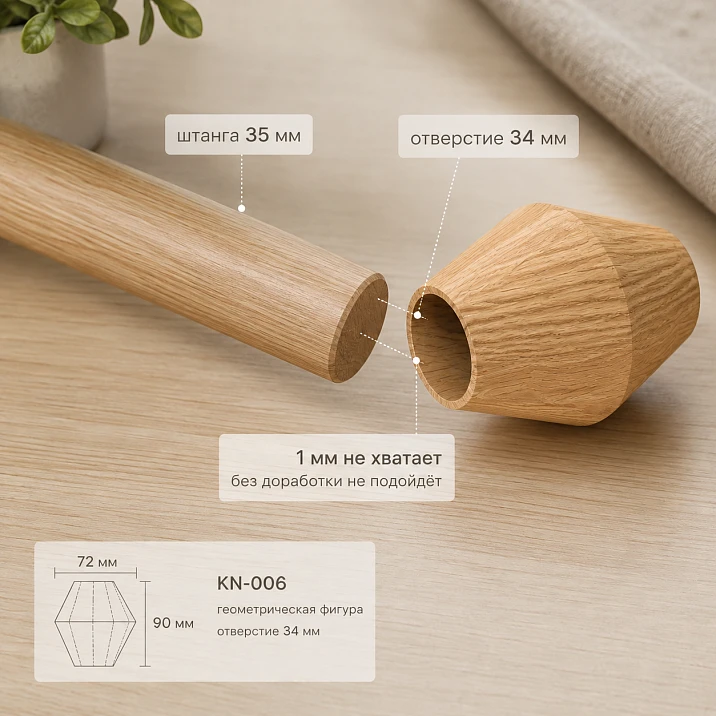
If the outer diameter of the already purchased bar is indeed 35 mm, and the through mounting hole of KN‑006 has a nominal size of 34 mm, the direct answer is no — without modifying the KN‑006 parts, it will not fit on such a bar.
The calculation is simple:
35 − 34 = 1 mm.
In terms of diameter, the bar is 1 mm larger than the hole. In radial terms, the conflict is:
1 / 2 = 0.5 mm on each side.
This is not a "small mounting clearance" that can be ignored. On the contrary, the dimensions physically intersect: the outer surface of the bar takes up more space than is nominally available inside the mounting channel.
Therefore buy geometric figure KN-006 with the "we'll adjust later" approach is not allowed. Before ordering, you need to resolve the size conflict.
You cannot rely on assumptions:
-
"the wood will spread a bit";
-
"we'll press it during assembly";
-
"we'll sand the hole a little";
-
"we'll shave a millimeter off the rod";
-
"the paint will hide everything."
Any reaming of KN-006 or reducing an already purchased rod changes the geometry of the parts. Without coordination with the manufacturer and designer, such modification can ruin the fit, disrupt the symmetry of the figure, remove the protective coating from the metal, or result in play instead of a precise connection.
The correct scenario is to first ensure that 35 mm is actually measured, not taken from the approximate name of the rod. Then choose a base that the KN-006 card itself indicates as compatible: a wooden axle MLD-060 with a nominal diameter of 34 mm or a polished stainless steel pipe FUR-045 with a diameter of 34 mm. Even if the nominal values match 34/34, a dry fit is needed before adhesive fixation: the card does not publish manufacturing tolerances, so the article should not promise a fit with "guaranteed interference" or "guaranteed clearance".
The current KN-006 has dimensions of 90 × 72 × 72 × 34 mm, is made of beech or oak, and is supplied with a "Prestige" sanding quality. For beech in the current configuration, preparation for enamel is specified, for oak — for tinting. The card directly names MLD-060 with a diameter of 34 mm and a polished stainless steel pipe with a diameter of 34 mm as standard bases.
If the project is only being formed, you can Buy decorative wooden elements for furniture within the "Constructor" system and assemble the composition around a single mounting diameter. If KN-006 has already been selected as a specific part, the next step is not searching for a "similar rod," but checking the actual base.
The main sequence before ordering:
-
measure the already purchased rod with a caliper;
-
check the outer diameter in at least several sections;
-
make sure it is specifically about the outer dimension;
-
compare the maximum actual diameter with D = 34 mm of KN-006;
-
if the rod is indeed 35 mm — do not order KN-006 for it without changing the project;
-
choose MLD-060 34 mm or FUR-045 34 mm, or a ready-made agreed set;
-
conduct a dry fit;
-
protect the landing channel when painting;
-
only after checking, choose the glue and final fixation.
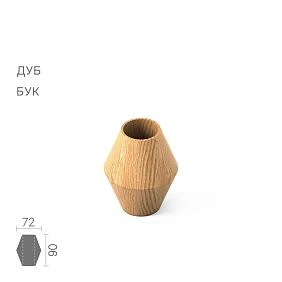
Geometric figure KN‑006: what the individual product card confirms
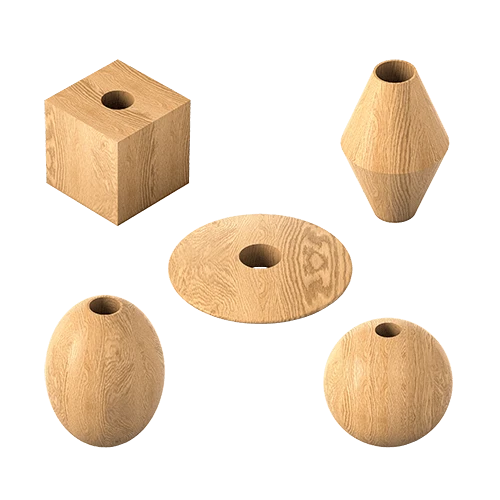
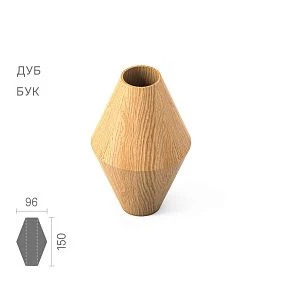
KN‑006 is not a carved overlay or a standalone baluster. It is a faceted geometric figure made of solid wood with a through mounting hole D = 34 mm, designed for installation on an axle or pipe.
| Parameter | Current value |
|---|---|
| Article number | KN‑006 |
| Size A × B × C × D | 90 × 72 × 72 × 34 mm |
| Landing hole D | 34 мм |
| Materials | Beech / Oak |
| Sanding | «Prestige» |
| Beech | For enamel |
| Oak | For tinting |
| Standard wooden base | MLD‑060, 34 mm |
| Standard metal base | FUR‑045, 34 mm |
| Shape | faceted geometric |
The card assigns KN‑006 to the furniture construction system and suggests using it in decorative partitions, screens, racks, supports, composite furniture legs, balusters, decorative rods, and designer compositions.
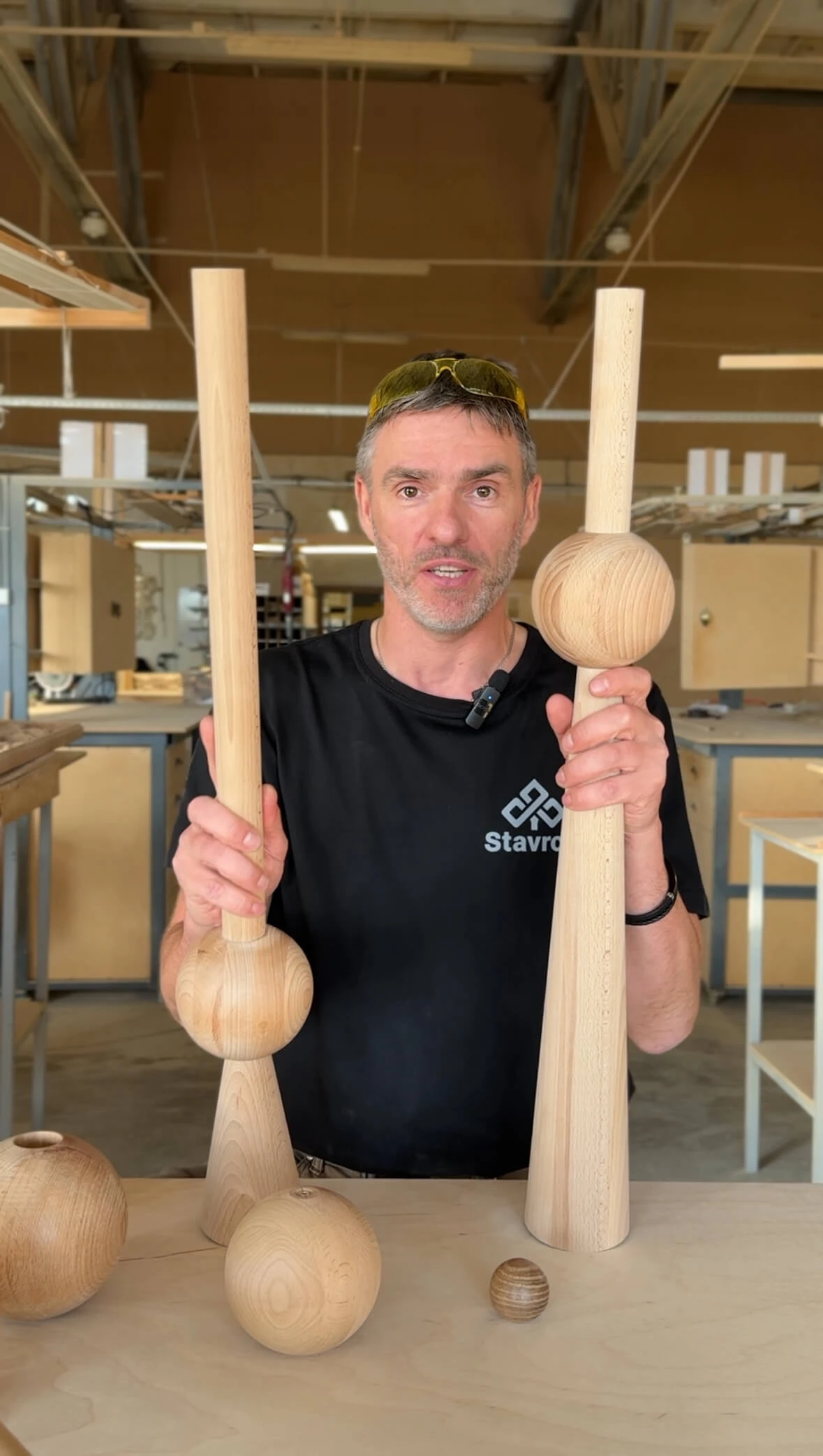

Why D = 34 mm is the key dimension for this article
A = 90 mm indicates the longitudinal dimension of the shape.
B = C = 72 mm is the external transverse dimension.
D = 34 mm is the through mounting channel.
When a buyer already has a rod, compatibility is primarily determined by the pair:
outer diameter of the rod ↔ inner mounting size D.
The error occurs when a person compares 35 mm with the external 72 mm and concludes: “The rod is much thinner than the shape — it will fit.”
The external size of the shape does not help here. The channel inside matters.
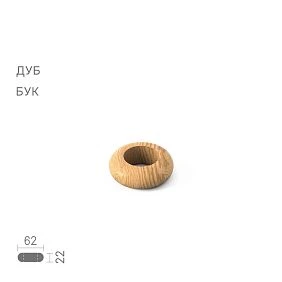
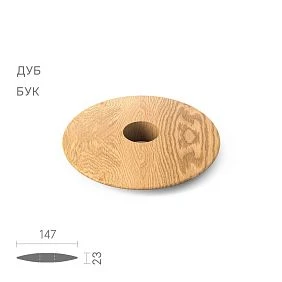
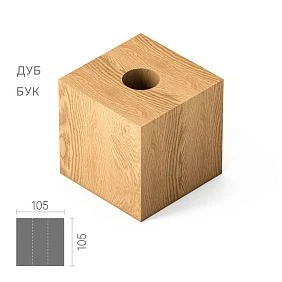
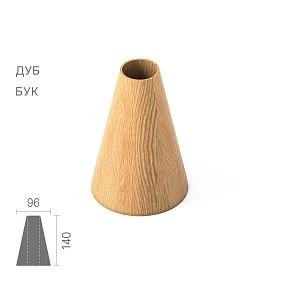
Our factory also produces:
Why 34 mm in the base name does not eliminate the need for fitting
MLD-060 and FUR-045 nominally correspond to 34 mm. But card KN-006 does not report:
-
limit deviations of the hole;
-
limit deviations of the axis;
-
fit class;
-
calculated interference;
-
calculated clearance.
Therefore, the correct production logic is:
nominal match → dry fit → fixation.
Not:
nominal match → immediate glue.
Beech and oak do not change the mounting nominal
KN-006 made of beech and oak has D = 34 mm.
The problem of a 35-mm rod cannot be solved by choosing a different wood species.
The material affects:
-
appearance;
-
future finishing;
-
coordination with other wooden elements.
But it does not turn 34 mm into 35 mm.
"Prestige" and the hole
The 'Prestige' sanding quality refers to the preparation of the wooden product. It does not mean that the mounting channel has a published precision tolerance for any pipe.
Before ordering, you can check the quality of wooden elements, but technical compatibility is still verified by actual dimensions.
Get Consultation
Wooden element KN-006 and a 35 mm rod: why the part will not fit
Consider the geometry without assumptions.
Given:
Dsh = 35 mm — outer diameter of the rod.
Do = 34 mm — nominal diameter of hole KN‑006.
For a cylindrical element to pass freely through a round hole, the actual outer size of the base must not be larger than the actual through size of the hole.
Here already by nominal value:
35 > 34.
The difference:
1 mm.
That is, the intersection exists even before accounting for paint, varnish, ovality, or tolerance.
Why the 0.5 mm conflict by radius is significant
If we mentally align the centers of the circles:
-
radius of the rod 35 mm = 17.5 mm;
-
hole radius 34 mm = 17 mm.
Each side of the rod extends beyond the nominal boundary of the hole by:
17.5 − 17 = 0.5 mm.
To make the connection possible, material must be physically removed:
-
either from the hole;
-
or from the rod;
-
or from both parts.
This is already machining, not assembly.
Why wood does not need to be "spread apart"
KN‑006 is a ready-made faceted part made of solid wood. The through channel runs inside the product.
Attempting to force a larger diameter barbell may:
-
damage the hole wall;
-
cause chipping;
-
create a crack along the grain;
-
ruin the outer edges;
-
make further seating unpredictable.
No commercial article should recommend an operation such as a "tight landing."
Why you cannot manually grind a 35 mm steel tube down to 34 mm
If this is a polished tube, reducing the outer diameter by 1 mm means removing approximately 0.5 mm of metal along the radius across the entire area where parts pass through.
Manual grinding will almost inevitably create:
-
uneven diameter;
-
ovality;
-
scratches;
-
polishing damage;
-
local dips.
If the original rod has an unknown wall thickness, removing metal can also change its strength.
Why you can't "bore out KN-006 by 1 mm" without a project
Boring from 34 to 35 mm seems small.
But you need to know:
-
the thickness of the wood around the channel;
-
the orientation of the fibers;
-
alignment accuracy;
-
tool;
-
the method of fixing the faceted part;
-
acceptable material loss;
-
the future glue.
After manual finishing, the hole may become not 35.0, but 35.6 mm and cause play.
If a non-standard size is really needed, it is better to coordinate it with the manufacturer.
Why paint only worsens the 35/34 scenario
Card KN-006 directly warns: the paint layer can increase the working size of the base/reduce the free passage and complicate installation. Therefore, it is recommended to mask the mounting channel.
If the hole is already 1 mm smaller than the rod, a layer of paint inside will not solve the problem, but will increase the conflict.
Faceted wooden figure with a 34 mm hole: how to correctly measure the base
The most dangerous situation is when "35 mm" is known inaccurately.
The bar could be:
-
marked by the seller as approximately 35 mm;
-
measured with a ruler;
-
covered with a thick layer of paint;
-
have a decorative shell;
-
be oval;
-
turn out to be a 34 mm pipe with a visual measurement error.
Therefore, before abandoning KN‑006, it is worth confirming the actual outer size.
Why a ruler is not enough
The cost of a mistake is buying an incompatible set.
The difference between 34 and 35 mm is only 1 mm.
A regular ruler:
-
shows tenths poorly;
-
depends on the viewing angle;
-
is inconvenient for a round cross-section;
-
does not show ovality.
For such a solution, a caliper is needed.
How to check the diameter with a caliper at several points
Measure with the outer jaws.
Minimum:
-
at one end;
-
in the middle part;
-
at the other end.
In each zone, it is useful to make two measurements with the tool rotated by approximately 90°.
Example:
| Point | Direction 1 | Direction 2 |
| end A | 34,96 | 35,04 |
| Center | 35,01 | 35,08 |
| end B | 34,98 | 35,02 |
Maximum about 35.08 mm.
For passing through a fixed hole, the focus is not on the smallest value, but on the maximum actual outer dimension that must pass through.
What to do about ovality of a metal pipe
If in one direction the pipe is 34.7 mm, and in another 35.2 mm, the average value does not solve the problem.
The widest axis:
35.2 mm.
It is this that limits the passage.
Attempting to rotate an oval pipe inside a round hole will not eliminate the geometric conflict: during rotation, the wide part will still meet the wall.
How to measure a painted wooden rod
If the rod is already painted, the caliper shows the actual size including the coating.
This size is what matters for the actual fit.
If under the paint the base is 34 mm, but the finished diameter is 34.6 mm, this is already a different installation scenario.
The outer and inner diameter of a pipe are different parameters
For KN-006, the outer diameter of the pipe is important because the figure is placed over it.
If the pipe is marked as 35 × 2 mm:
-
35 mm usually describes the outer dimension;
-
2 mm is the wall thickness.
The inner diameter does not help to place a wooden figure over the pipe.
These parameters must not be confused.
Pre-decision matrix based on actual base diameter
When choosing KN-006, it is useful to separate several measurement scenarios. These are not STAVROS factory tolerances, but the logic of preliminary diagnostics based on the nominal hole of 34 mm.
| Maximum measured outer dimension of the base | What is visible before fitting |
| 33.5 mm | nominally less than D = 34; possible gap, fitting required |
| 33.9 mm | nominally less; fitting mandatory |
| 34.0 mm | nominal match; fitting mandatory |
| 34.2 mm | greater than nominal D; without actual confirmation, fit is questionable |
| 34.5 mm | conflict already noticeable; do not plan force installation |
| 35.0 mm | nominally incompatible by 1 mm |
| 35.5 mm | nominally incompatible by 1.5 mm |
Main rule: the article does not turn this table into an "acceptable range." The card does not publish tolerances, so the only confirmation of an actual connection is actual parts or official dimensional information from the manufacturer.
Why a measurement of 34.0 mm still does not allow gluing immediately
If the caliper shows exactly 34.0 mm, questions remain:
-
where exactly was it measured;
-
is there a larger point further along;
-
what is the actual channel KN-006;
-
is there a chamfer at the entrance;
-
is there no coating applied;
-
how does the part pass along the entire working length.
Therefore, "34.0" moves the project from the category of clearly incompatible to the category of needs to be tried on, not to "ready for gluing."
How to check the part's path along the long axis
Suppose KN-006 should be located in the center of a post 1800 mm long.
If the part is fitted from the end, it must travel the entire section from the end of the axis to the installation mark.
It is not enough to measure only the place where it will be installed.
It is necessary to check the diameter along the entire sliding path.
For example:
-
at the end — 33.9 mm;
-
at 400 mm — 34.0;
-
at 900 mm — 34.4;
-
at the installation point — 34.0.
The part may not reach the required mark due to a local thickening of 34.4 mm in the path.
When the element can be installed not from the end
Standard KN‑006 has a through channel, but the card does not describe a split design.
So it slides onto the shaft, not snaps on from the side.
If the finished rod is already secured at both ends and cannot be disassembled, even the correct diameter of 34 mm does not guarantee easy installation.
Need to check the assembly sequence:
-
Can the barbell be removed?
-
Can the figures be put on before installation?
-
can the rod be put back in place;
-
do adjacent elements block the passage.
Painted barbell 34 mm: why the nominal size before finishing is insufficient
If the wooden axle was 34 mm before enamel, and then received primer and paint, the actual outer size increased.
You cannot take the drawing diameter of the base and ignore the finished coating.
The measurement is taken after the finishing stage in which assembly occurs.
That is why the card recommends assembling the system before the final finish.
What to do if the 35 mm barbell has already been paid for but not yet installed
This is the best moment to adjust the project.
Options:
-
return/exchange the 35 mm rod, if the seller's terms allow;
-
buy MLD-060 34 mm;
-
buy FUR-045 34 mm;
-
choose another figure for 35 mm;
-
review the entire assembly before installation.
The most expensive scenario is to first secure the 35 mm base, and then start fitting KN-006 on site.
What to do if the 35 mm rod is already built in
If dismantling is not possible, KN-006 should not be purchased "as an experiment."
First, an alternative needs to be determined:
-
other decor;
-
detachable decorative element;
-
surface-mounted unit;
-
separate figure with a different mounting channel;
-
custom manufacturing.
This is a case where rejecting a specific product saves more than attempting adaptation.
Wooden axle MLD-060 with a diameter of 34 mm for figure KN-006
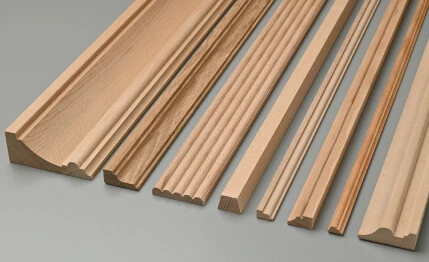
If the buyer wants to keep the wooden base, the standard candidate for KN-006 is MLD-060. The current MLD-060 card shows a round wooden molding/axle with a diameter of 34 mm made of beech or oak in lengths of 1000 and 2400 mm.
For this article, the decorative function of MLD-060 is not important, but the dimensional pair is:
MLD-060 — 34 mm.
KN-006 D — 34 mm.
That is, by nominal value, the parts are in the same dimensional system of the designer.
Why "34 by 34" still does not mean "will fit without checking"
Real wooden parts have:
-
geometric deviations;
-
moisture changes;
-
local ovality;
-
actual roughness;
-
influence of coating;
-
possible batch differences.
Therefore, before applying glue:
-
MLD‑060 is measured;
-
KN‑006 is dry-fitted;
-
the passage along the entire length of the section is checked;
-
only after this is the glue applied.
If the element fits too tightly even without coating, you cannot simply fill the joint with PVA and hammer it in.
What lengths of MLD-060 are available
The current card shows:
-
1000 mm;
-
2400 mm.
This is important for calculating a long post.
If the design height exceeds 2400 mm, a single long axis is not sufficient. Then you need to:
-
use an additional segment;
-
design a docking node;
-
use a shape that allows connecting two axes;
-
or choose a ready-made composition.
The MLD-060 card directly states that large shapes of the system can serve as a joint node, allowing two axes to be glued in. However, the article should not automatically assign KN-006 as such a node unless the specific project confirms this.
Wood to wood: which glue does the card recommend
For mounting KN-006 on MLD-060, the card recommends PVA D3 glue.
Additionally allowed:
-
temporary fixation with painter's tape;
-
micro pins.
This is already a specific manufacturer's recommendation for this combination of materials.
But the very fact of recommending PVA does not mean that preparation can be skipped.
Before practical assembly, it is also useful to study tips on finishing and installation.
Before glue:
-
remove dust;
-
check dry fit;
-
ensure correct orientation of edges;
-
protect surfaces that must remain clean.
Why the orientation of KN‑006 is more important than that of a round shape
KN‑006 has a faceted shape and an external cross-section of 72 × 72 mm.
If it is rotated on its axis, the faces will change position relative to:
-
the partition facade;
-
adjacent straight elements;
-
other KN‑006;
-
walls;
-
furniture.
Therefore, before gluing, you need not only to put on the figure, but also to set its rotation.
It is useful to make marks:
-
"FACADE";
-
"LEFT";
-
"top";
-
axial risk.
After fixing with glue, changing the orientation will be difficult.
Why assembly first, then finishing
The KN‑006 and MLD‑060 card recommends painting or tinting after full assembly and installation of elements.
The reason is directly stated by the manufacturer: the paint layer can change the mounting geometry and complicate installation.
This is especially important with a nominal match of 34/34.
If the following gets inside the channel:
-
primer;
-
enamel;
-
lacquer;
-
oil with the formation of a layer,
the free size will become smaller.
Example of a conditional coating layer
Let's imagine not the actual tolerance, but a geometric illustration.
If a 0.2 mm layer forms on each side of the channel wall, the free diameter will decrease by approximately:
0.2 + 0.2 = 0.4 mm.
The nominal 34 mm turns into a conditional 33.6 mm.
This is an example, not a characteristic of a real coating. It shows why masking the channel makes sense.
How to mask the channel
The task is to prevent the finish from getting onto the working seating surface.
The method depends on the technology:
-
temporary insert;
-
painter's protection;
-
plug;
-
another workshop method.
It is important not to damage the edge of the hole and not to leave adhesive tape inside after finishing.
When to choose beech
If the structure will be covered with opaque enamel, beech is logically combined with preparation for enamel.
When to choose oak
If visible wood texture is needed, oak for tinting matches the product logic of the card.
But the wood species does not affect the 35/34 issue: the diameter remains 34 mm.
After checking the project, you can buy round wooden molding MLD-060 with a diameter of 34 mm in the required length and material.
Dry assembly of KN-006 on MLD-060: practical procedure
Before gluing, it is useful to assemble at least one full rack fragment.
Procedure:
-
check the end of MLD-060;
-
measure the diameter;
-
Dust off channel KN‑006;
-
put the fitting on without glue;
-
slide it to the design mark;
-
Check the rotation of the faces;
-
Mark the axial position with a pencil line or painter's tape;
-
remove;
-
Only after this prepare PVA D3.
If the figure fits easily but has noticeable play, that is also a reason to stop. The amount of glue should not be used as a way to compensate for an unknown geometric error without the master's assessment.
How to check several KN‑006 on one axis
If there are four, try all four, not just one "typical" one.
Natural wood and real parts may differ slightly.
It is useful to label:
-
KN‑006 №1;
-
№2;
-
№3;
-
№4.
And assign each its own position before finishing.
If one figure goes noticeably tighter than the others, the cause must be determined before gluing.
Why you cannot mix random 34‑mm axes in one partition
One stand may be MLD‑060, another a third-party 34 mm rod, a third a painted tube.
The nominal value is the same, but:
-
material;
-
actual diameter;
-
surface;
-
glue;
-
Appearance
differ.
For a serial partition, one proven system is better.
FUR-045 pipe with a diameter of 34 mm and faceted element KN-006
The second standard option is a polished stainless steel pipe FUR‑045.
The KN‑006 card directly states installation on a polished stainless steel pipe with a diameter of 34 mm.
FUR‑045 has the designation 34×2 mm and a length of 3000 mm. The material is AISI 304, with a polished surface.
What does 34×2 mm mean in this task
For external mounting of KN‑006, the outer dimension of 34 mm is important.
The wall thickness of 2 mm affects the internal geometry of the pipe, but does not answer whether the pipe will fit into the KN-006 hole.
The buyer should not confuse:
-
outer diameter;
-
wall thickness;
-
inner diameter.
KN‑006 is fitted onto the outer surface.
Why FUR-045 is better than a random 35 mm barbell
Because it is exactly 34 mm that is specified in the KN‑006 product system.
This does not mean that FUR-045 automatically fits without trying it on, but the nominal geometry is aligned.
A random 35 mm rod already conflicts at the nominal level.
Metal and wood: a different adhesive
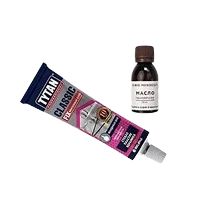
For KN‑006 on FUR‑045, the card recommends TYTAN Professional Classic Fix.
This differs from the wooden scenario MLD‑060, where PVA D3 is recommended.
The reason is obvious from the materials:
-
wood ↔ wood;
-
wood ↔ polished stainless steel.
You cannot use one adhesive scenario just because the hole is the same.
Preparation of the polished surface
Polished pipe is a finished visible surface.
Before installation, you need to decide:
-
whether the bonding area is cleaned;
-
whether local preparation is needed;
-
how to protect the visible polish;
-
how to remove excess glue;
-
how not to scratch the pipe during fitting.
Specific abrasive preparation cannot be invented without the glue instructions and the manufacturer.
Why dry fitting is mandatory for metal too
Even if FUR‑045 is nominally 34 mm:
-
the end may have deformation;
-
burrs appear after cutting;
-
the pipe may have ovality;
-
the edge may be damaged.
Before putting on KN-006, the end face must be safe.
The wooden figure must not be forcibly pulled over a sharp burr: it will damage the mounting channel.
Pipe cutting
If FUR-045 is cut from 3000 mm:
-
a clean perpendicular end face is required;
-
burrs are removed;
-
visible polishing is protected;
-
the seating area is checked against the actual diameter.
Why KN-006 cannot be painted before fitting on FUR-045
The coating in the channel will reduce the passage size.
On a metal pipe, this is especially noticeable: steel does not compress or adapt to the wood.
Therefore, first:
pipe → dry fit → orientation → installation → finishing.
Can painted KN‑006 be used on an already finished pipe
Only if the channel was protected and the actual fit has been confirmed.
If the piece is already painted inside the opening and does not fit, you cannot start with rough reaming.
First, measure:
-
the actual D of the channel;
-
the pipe diameter;
-
coating thickness;
-
the conflict location.
What to choose: a wooden or metal base
MLD‑060
-
The entire composition is made of wood;
-
PVA D3;
-
Can be painted or tinted as a single wooden object;
-
Lengths 1000/2400 mm.
FUR‑045
-
contrast wood + metal;
-
mounting adhesive;
-
polished AISI 304;
-
length 3000 mm;
-
another processing and assembly technology.
These are two different design languages.
After approval of the metal base, you can buy a FUR-045 pipe with a diameter of 34 mm as an agreed blank.
Dry assembly on FUR-045: how it differs from wood
On a polished tube, it is especially important not to scratch the visible surface.
For fitting:
-
protect the end;
-
remove burrs;
-
do not use impact tools;
-
do not push the figure through resistance;
-
do not rotate KN-006 with abrasive dust inside the channel.
If the element does not pass by hand with correct alignment, it is not a reason to take a mallet. First, measure.
How to protect the polish during adhesive assembly
Excess mounting adhesive may seep out along the edges of KN‑006.
Therefore, determine in advance:
-
the boundary of the masking protection;
-
the method for removing fresh compound;
-
the open time according to the instructions;
-
the position of the figure before polymerization.
Do not experiment with solvent on a polished pipe without checking compatibility.
Why the figure should be oriented before applying TYTAN
Mounting adhesive is not intended for prolonged "twisting" of the part to find a nice position.
First, on a dry assembly, marks are made:
-
front edge;
-
design height;
-
position along the axis.
After KN-006 glue, bring it straight to these marks.
Combined stand wood + stainless steel
If FUR-045 is visible between wooden figures, an additional design question arises: how does the pipe end at the floor/ceiling and what does the transition to adjacent parts look like.
The KN-006 card confirms a compatible base, but does not design:
-
flanges;
-
ceiling mounting;
-
floor mounting;
-
plugs;
-
the structural work of the stand.
That is, the mounting compatibility of KN-006/FUR-045 is only one layer of the project.
KN-006 furniture construction element: why pre-painting the channel is dangerous
This is a separate issue because a finishing error can ruin even the correct 34/34 pair.
The KN‑006 card directly warns: the paint layer can increase the base diameter or reduce the free passage of the channel and complicate installation. On shaped elements, it is recommended to mask the seating channel.
What happens if primer gets inside
Primer creates a layer.
Even if it seems thin:
-
the channel becomes smaller;
-
the surface changes friction;
-
local bulges appear;
-
the fit ceases to be uniform.
Enamel is more dangerous in one thick layer
If the master applies enamel in several passes and does not mask the channel, local thickenings may appear inside.
The figure can be put on the first 10–20 mm and then get stuck further.
This is a typical situation when it seems that "the diameter fits, but the part is stuck."
Oil also should not be poured inside unnecessarily
Oil usually gives a thinner finish, but the working channel is not a decorative face surface.
If the manufacturer recommends masking, it is better not to create an extra layer.
Why painting after assembly is easier for geometry
With the assembled structure:
-
fits are already confirmed;
-
figures are fixed;
-
edges are aligned;
-
no need to re-drag the painted part along the axis.
The downside is that hard-to-reach areas are more difficult to paint.
Therefore, the craftsman must plan the technology in advance, but the channel is protected in any case.
If contrasting painting is needed
For example:
-
MLD-060 — natural oak;
-
KN-006 — black enamel.
Then it makes sense to finish the elements separately, but the working channel KN-006 should still be masked.
After drying:
-
remove protection;
-
clean the work area;
-
conduct a dry fit;
-
only then glue.
Why you cannot sand a painted channel "until it fits"
This method does not control the geometry.
You can get:
-
taper;
-
ovality;
-
play (looseness);
-
removal of material from only one side.
If coating got into the channel, it is better to remove the coating itself in a controlled way, without changing the wood geometry unnecessarily.
Wooden partition KON-003 or self-assembly from elements
The buyer can go two ways.
Path 1 — self-composition
He chooses himself:
-
KN‑006;
-
MLD‑060 or FUR‑045;
-
other elements;
-
step;
-
length;
-
finishing;
-
glue;
-
attachment to floor/ceiling.
Path 2 — ready-made KON‑003 stand kit
KON‑003 already includes matched system elements with a diameter of 34 mm.
The current card confirms that the composition includes:
-
KN‑003 — 1 pc.;
-
KN‑004 — 2 pcs.;
-
MLD‑060 2400 mm — 1 pc.;
-
KN-005 — 12 pcs.;
-
KN‑006 — 2 pcs.;
-
KN‑007 — 6 pcs.;
-
MLD-060 1000 mm — 1 pc.
That is, KN‑006 here is not a random recommendation: it really comes as part of the set.
When a ready-made KON‑003 is more convenient
If the task is specifically a decorative partition, rather than a single custom stand, a ready-made set removes part of the selection:
-
axis size;
-
basic set of shapes;
-
decorative rhythm;
-
compatibility of elements of one system.
But the set does not cancel:
-
measuring the opening;
-
number of racks;
-
mounting method;
-
finishing;
-
assembly.
The price of the set is not equal to the price of the entire partition
Card KON-003 indicates that one set is one decorative post.
If the partition consists of 8 posts:
partition cost = cost of one set × 8
plus installation and finishing.
This is an important commercial nuance.
When self-assembly is better
If the project requires:
-
only KN-006;
-
a different rhythm;
-
metal FUR‑045;
-
non-standard number of figures;
-
custom furniture support;
-
decorative rod,
KON-003 may be redundant.
Why you shouldn't buy a single KN-006 for a partition without a project
One figure does not create a partition.
Need to know:
-
how many posts;
-
which height;
-
what step;
-
how many elements per post;
-
what axis;
-
how it is attached at the top and bottom.
If the buyer actually needs a ready-made system, it is more rational buy a wooden partition for zoning as an agreed set of racks, rather than assembling a random collection.
How to compare a self-made post and KON-003 in terms of solution scope
With self-assembly, the buyer makes more decisions on their own.
You need to determine:
-
total height;
-
axis length;
-
quantity KN-006;
-
adjacent figures;
-
step;
-
order of elements;
-
bottom and top mounting;
-
material;
-
finishing;
-
glue;
-
assembly sequence.
KON‑003 already has a decorative composition of one rack predefined. But there are still remaining:
-
opening height;
-
number of racks;
-
the step between them;
-
floor mounting;
-
ceiling mounting;
-
finish.
That is, the ready-made kit does not turn the partition into a product "take out of the box and place", but it removes the risk of accidentally selecting mismatched elements.
For a single decorative experiment, a craftsman may accept such a risk, but an article for a buyer should not present it as a normal way to order.
When you should not buy the geometric shape KN‑006
KN‑006 is a specific part with a specific mounting size. There are situations where the right decision is not to find a way to “fit” it, but to refuse to buy this particular shape.
If you already have only a 35 mm rod and cannot change it
If the rod:
-
is already built in;
-
has a finish;
-
should remain as per the project;
-
has an actual outer diameter of about 35 mm,
KN-006 with D = 34 mm is not suitable without modifying one of the parts.
If the appearance of KN-006 is critical, the designer should look for:
-
a similar element with a larger hole;
-
another method of decorative fastening;
-
a separate shell;
-
ordering a custom part from the manufacturer.
But the article should not promise that STAVROS will manufacture KN-006 with D = 35 mm without separate confirmation.
A collapsible design is needed
The card recommends adhesive fixation:
-
PVA D3 for MLD-060;
-
assembly adhesive for FUR-045.
If the client wants to regularly disassemble the stand, swap figures, or dismantle the composition without damage, the standard adhesive scheme may not be suitable.
A detachable joint needs to be designed separately.
No layout project for the faces
KN‑006 has an orientation.
If the figures are glued randomly:
-
one face forward;
-
another edge-on;
-
a third at an intermediate angle,
the composition will look like a mistake.
Before purchasing, you need to decide:
-
how many KN-006;
-
at what marks;
-
what rotation angle;
-
how they relate to other shapes.
A classic turned style without facets is needed
KN‑006 is a strict geometric shape.
If the project consists of:
-
round balusters;
-
soft oval details;
-
classic carving;
-
smooth shapes,
a faceted square element may be stylistically alien.
In this case, it is better to choose another KN element.
It is planned to paint all parts in advance together with the channel
If the technologist insists on full painting with filling of the mounting channel before assembly, this contradicts the card's recommendation about masking the channel.
First, the technology needs to be changed, rather than buying KN-006 and hoping that everything will "push through" later.
A ready-made partition is needed, but the buyer orders only one figure
If the ultimate goal is room zoning, KN-006 is only one component.
Without the axis, adjacent figures, mounting, and calculation of the number of posts, purchasing one part is premature.
The base has a variable diameter
If a wooden rod:
-
tapered;
-
turned;
-
with thickenings;
-
has local transitions larger than 34 mm,
KN-006 may not reach the required mark even if the start of the axis is 34 mm.
The entire path along which the figure will move during assembly must be measured.
The pipe has a welded external seam or local deformations.
A polished round pipe must have actual geometry compatible with the channel.
If a random pipe has:
-
dent;
-
longitudinal bulge;
-
damaged end face;
-
local ovality,
the nominal "34 mm" does not guarantee passage.
An element that is secured without glue is needed.
Standard installation of KN-006 is based on adhesive fixation.
If the project prohibits glue:
-
restoration object;
-
fully mechanical assembly;
-
frequent disassembly;
-
rented exhibition,
a different node is needed.
Five final scenarios before purchasing KN-006
Scenario 1. The rod is actually 35.0 mm and is mandatory per the project
KN-006 is not ordered in the standard version. First, another decorative element is sought or a non-standard one is approved.
Scenario 2. "35 mm" turned out to be an approximate name, actually 34.0 mm
The project returns to the working area, but a dry fit of the specific KN-006 is needed. Nominal matching is not yet equal to guaranteed fit.
Scenario 3. The 35 mm rod is not yet installed and can be replaced
The simplest solution is to switch to the standard MLD-060 or FUR-045 34 mm, if they are suitable in terms of material and overall design.
Scenario 4. A wooden partition is needed, but the composition has not been designed yet.
Instead of piece-by-piece selection, you can compare KON‑003, where KN‑006 is already part of an approved system with MLD‑060.
Scenario 5. A custom stand on polished steel is needed.
FUR-045 34 mm + KN-006 is an acceptable commercial pair according to the card, but a separate pipe mounting project, dry fit, and assembly adhesive are required.
These five scenarios show that the question "whether to buy KN-006" cannot be separated from the status of the existing base. One millimeter changes the entire path of the project.
How to record the decision in the specification
For wooden axle:
KN‑006 / D 34 mm / oak / Prestige / for toning / 4 pcs. / MLD‑060 Ø34 / dry fit / PVA D3 / protect channel at finish.
For metal:
KN‑006 / D 34 mm / beech / Prestige / for enamel / 4 pcs. / FUR‑045 34×2 / dry fit / TYTAN Classic Fix / protect polish.
For incompatible existing base:
The rod is actually Ø35.0 mm / standard KN‑006 D34 is not applicable / a base change or another element is required.
Such a record eliminates the most dangerous error: when the purchasing department sees only the article KN‑006, and the installer on site first learns that the rod is 35 mm.
Errors when ordering a wooden part with a 34 mm hole
Error 1. Relying on the rod name without measuring
The price tag may say “35 mm”, “approximately 35”, or “Ø35”.
But for the solution, the actual size is needed.
Prevention: calipers at several points.
Error 2. Confusing outer diameter with inner diameter
A pipe 35 × 2 mm has different outer and inner dimensions.
KN‑006 is put on from the outside.
So, the outer one is needed.
Error 3. Considering 34 and 35 mm practically the same
A difference of 1 mm seems small until we remember that this is an intersection of cylinders.
By radius:
0.5 mm on each side.
This already requires removing material.
Mistake 4. Boring out KN‑006 with a hand drill
Reason: “need to remove only half a millimeter per side.”
Consequence:
-
the channel deviates from the axis;
-
the hole becomes oval;
-
the outer edges turn out to be of different thicknesses;
-
play occurs.
Mistake 5. Grinding the pipe by hand
A polished pipe loses:
-
geometry;
-
appearance;
-
Same diameter.
If the rod is already 35 mm, it is better to replace the base.
Mistake 6. Apply primer and enamel inside the seating channel.
This reduces the working clearance.
At 34/34, even tenths of a millimeter can change the fit.
Mistake 7. Start gluing without a dry fit
Glue increases friction and limits time for adjustment.
If the piece gets stuck halfway, removing it without damage is harder.
Mistake 8. Not aligning the edges
KN-006 is not a round bead.
After the glue polymerizes, the random rotation will remain forever.
Mistake 9. Mixing beech and oak without a finish decision
Under a transparent finish, the wood species look different.
If the structure must visually be a single piece of wood, all elements need to be coordinated in advance.
Error 10. Choose beech for enamel, then decide to leave it natural.
The current card shows beech "for enamel."
If the project has changed to a transparent finish, the suitable configuration needs to be rechecked.
Mistake 11. Buying KN‑006 separately when KON‑003 is needed
The buyer sees a beautiful faceted part and starts assembling the partition piece by piece.
But the ready-made KON-003 already includes KN-006, MLD-060, and other agreed elements.
Error 12. Considering MLD-060 34 mm as a guaranteed precision fit.
The nominal value matches.
But tolerances are not published.
A dry fit is still needed before glue.
Error 13. Slip KN-006 over the burr of FUR-045
After cutting, the pipe may have a sharp edge.
It can tear out wood inside the channel.
First, the end face is processed.
Error 14. Painting individual figures after gluing without protecting the metal
If the composition is mixed:
-
oak;
-
stainless steel;
-
enamel,
the painter must protect the metal from accidental primer and paint.
Error 15. Ignoring the orientation of the square outer cross-section
72 × 72 mm create four distinct sides.
On a long stand, the rotation of one figure is more noticeable than a slight difference in shade.
How to buy geometric figure KN‑006 without mistakes
A correct order can be placed as a short technical protocol.
Step 1. Determine the scenario
What is being built:
-
partition;
-
post;
-
furniture leg;
-
baluster;
-
decorative rod;
-
custom design.
The number and type of base depend on the scenario.
Step 2. Measure the base
If there is already a rod:
-
measure the outer diameter;
-
at least in three places;
-
in two directions at each point.
If the maximum is more than 34 mm, this is already a risk signal.
If it is about 35 mm, KN-006 does not pass the nominal value.
Step 3. Decide whether the base can be replaced
If the 35 mm bar is random and is not part of a mandatory project, it is easier to switch to the standard 34 mm base.
Options:
-
MLD‑060;
-
FUR‑045.
Step 4. Choose the material for KN-006
Beech — if enamel is planned.
Oak — if visible wood texture is needed.
This corresponds to current product variants.
Step 5. Choose a wooden or metal axle
MLD‑060
-
beech/oak;
-
34 mm;
-
PVA D3;
-
wooden composition.
FUR‑045
-
polished stainless steel;
-
34×2 mm;
-
mounting adhesive;
-
contrast of wood + metal.
Step 6. Check the number of elements
For the author's stand, the number is set by the drawing.
For KON‑003, the card already specifies:
2 × KN‑006 per stand.
If the partition consists of 6 stands:
6 × 2 = 12 KN‑006
as part of six KON‑003 kits.
Step 7. Do a dry assembly
Before gluing, check:
-
passage;
-
turn;
-
height;
-
order of shapes;
-
joints;
-
axis length.
Step 8. Mark orientation
Marks are placed on the back/invisible area.
This is especially useful if there are several KN‑006.
Step 9. Choose glue based on the base
MLD‑060 → PVA D3.
FUR‑045 → TYTAN Professional Classic Fix per card KN‑006.
Do not swap these scenarios without a technical reason.
Step 10. Mask the channel during finishing
If the shapes are finished before the final glue, the channel is protected.
Step 11. Check the final order
The line may look like this:
KN‑006 / 90 × 72 × 72 × 34 mm / oak / Prestige / for tinting / 4 pcs. / axis MLD‑060 34 mm / dry fit before glue.
Or:
KN‑006 / beech / for enamel / 8 pcs. / FUR‑045 34×2 mm / TYTAN per instructions / mask the channel.
After checking, you can order the faceted wooden element KN‑006 in the required material and quantity.
Why price should not be the first filter
If KN-006 is cheaper than reworking an already purchased 35mm rod, that doesn't mean the part should be bored out.
If FUR-045 is more expensive than a random 35mm pipe, that's also not an argument for an incompatible size.
Compatibility first.
Then cost.
Checking delivery and batch
Before paying, it's useful to:
-
check the availability of the entire batch;
-
ensure it's the same material;
-
receive items of the same configuration;
-
Check the deadlines;
Frequently asked questions about the wooden figure KN‑006
What is the hole diameter of KN‑006?
The current card indicates D = 34 mm.
Will a 35 mm diameter bar fit?
No, according to nominal geometry.
The bar is 1 mm larger in diameter than the hole.
Can the 1 mm difference be considered insignificant?
No.
That is 0.5 mm of overlap in radius on each side.
Will the wooden axle MLD‑060 fit?
It is the standard base of KN-006 and has a nominal diameter of 34 mm.
But before glue, a dry fitting is needed.
What lengths of MLD-060 are available?
The current card shows 1000 and 2400 mm.
Can KN-006 be installed on FUR-045?
Yes, the KN-006 card directly provides for a polished stainless steel pipe of 34 mm.
What is the size of FUR-045?
The designation is 34×2 mm, length 3000 mm.
For external mounting of KN-006, the external size of 34 mm is important.
How to measure the diameter?
With a caliper.
For a difference of 1 mm, a ruler is not enough.
Is it necessary to measure the pipe in several places?
Yes.
This way, ovality and local deformation can be detected.
What to do if one direction is 34.8 mm and the other is 35.1 mm?
Focus on the maximum size of 35.1 mm.
Such a section does not match the nominal 34 mm channel.
Can the KN-006 hole be bored out?
Not without approval.
This is a modification of a finished part.
Can the 35 mm rod be ground down?
Not as a household installation operation.
You will lose the geometry and finish.
When to apply enamel or oil?
The card recommends finishing after full assembly and installation of all elements.
If finishing is done in parts, the mounting channel must be protected.
Do I need to protect the channel when painting?
Yes, this is a direct recommendation from the card.
What glue should be used on MLD-060?
PVA D3 is recommended.
What glue is specified for FUR-045?
Card KN-006 recommends TYTAN Professional Classic Fix.
Can PVA be used on stainless steel?
The card separates scenarios: PVA D3 for the wooden axis, assembly adhesive for the steel pipe.
What to choose — beech or oak?
Beech in the current configuration is under enamel.
Oak is under tinting.
The choice is determined by the future finish.
Is KN-006 included in the ready partition kit?
Yes. KON-003 contains 2 KN-006 per decorative post.
Is MLD-060 included in KON-003?
Yes. The set includes MLD-060 2400 mm and 1000 mm.
Can the partition be assembled on FUR-045 instead of MLD-060?
As a custom project, only after separate design. KON-003 is standardly described with wooden MLD-060.
How many KN-006 are needed for a custom partition?
Determines the composition.
If the KON-003 pattern is repeated, 2 are used per post, but this is not a universal rule for all partitions.
Can KN-006 be used horizontally?
The card allows decorative rods and custom compositions. Orientation depends on the project and fixation.
Why do edges need to be aligned before gluing?
Because after polymerization, changing the rotation of the part is difficult.
Where to order a separate KN-006?
In the STAVROS individual product card.
Where to buy the entire set for a decorative partition?
KON-003 can be used if its composition matches the project.
Do I need to buy a decorative partition if I already have my own 35 mm rod?
No. First, decide whether this rod is retained. If it is mandatory and has 35 mm, KN-006 in standard geometry is not compatible.
What is the main thing to check before paying?
Three things:
-
the actual outer diameter of the base;
-
D = 34 mm KN-006;
-
assembly technology and finishing.
Summary. If the rod truly has an outer diameter of 35 mm, KN-006 with a 34 mm hole cannot be installed on it without modifying parts. This is not a matter of "tight fit," but a direct geometric conflict.
The most rational path is to keep KN-006 and switch to a standard 34 mm base, or abandon KN-006 if the 35 mm rod is unchangeable. For a wooden composition, MLD-060 is provided; for a metal one, FUR-045. Before fixing, both pairs should be dry-fitted, and the mounting channel should be protected from paint coatings.
This way, the buyer does not turn a beautiful faceted part into an experiment with boring, but assembles the structure from compatible elements.