Article Contents:
- Why the material name in the request cannot be written "approximately"
- Which product is actually selected
- Why the confusion "polystyrene or polyurethane" arises
- What is considered the main source when specifying D40
- Forming the reference product line
- Why the entry cannot be shortened to "D40 40 mm"
- Why you cannot write only "polystyrene molding"
- SKU and material are two independent fields
- What should be included in the finishing schedule
- What to pass to procurement
- How to send a request to multiple suppliers
- What not to write in a request
- A correct request to a supplier
- How to review a received quotation
- Why the word “analog” requires separate approval
- How an analog can differ even if it is also 40 mm
- What to do if a polyurethane analog is proposed
- Why a purchaser should not change the material on their own
- Does the entire project need to be re-approved when replacing
- Reference sample D40 for a large batch
- Why a photo of the facade is not enough
- How to check 300 planks upon delivery
- Why the number of boxes does not equal the number of D40
- How to draw up a discrepancy report
- How to label the warehouse
- Why you should not sign off the warehouse as "polyurethane moldings"
- How to issue D40 for installation
- How to account for returns from the installation area
- How to label usable remnants
- Why the remainder of another polystyrene molding cannot be considered a D40 remainder
- D40 batch reserve
- How to determine a reasonable reserve without a universal percentage
- Why a whole plank is more valuable than random short leftovers
- Reordering after three months: where material is most often lost
- What to include in a reorder
- How to check whether the product card has changed
- Do not carry over the old price into a new request
- “For painting” is not a material name
- Why the finisher also needs to know the exact material
- If the estimate historically says "polyurethane molding"
- How to work with the corporate materials reference
- Category and material are not the same thing
- The final route without losing identity
- Central table: how D40 gets distorted at different stages
- Second practical specification table
- Practical scenario: batch of 300 D40 for a project with repeating zones
- Master specification as the single source of product identity
- How to normalize an old schedule if it already says "polyurethane D40"
- Why the same SKU in different files must be checked for matching specifications
- How not to turn D40 into an impersonal "decorative molding" within the estimate
- How to compare three commercial proposals for one batch
- Why the absence of material in a commercial proposal cannot automatically be considered an error
- How to record supplier confirmation
- What to check in the invoice before payment
- Why the invoice "molding HI WOOD — 300 pcs." requires clarification
- How to work with a contract where the goods are defined by an appendix
- How to label a project batch before shipment
- Why the size 40×18×2000 must be stored in full
- How to distinguish a procurement error from a design substitution
- When an alternative can actually be considered
- When an alternative should be rejected immediately without lengthy comparison
- How not to mix D40 with other HI WOOD in the warehouse
- A practical warehouse log for D40
- How to count 300 planks if some are going into reserve
- Why "300 planks per the invoice" does not guarantee 300 usable planks
- How to carry out spot checks without chaos
- What to do if the documents say "polyurethane" but the packaging says D40
- What to do if the packaging has no clear item code
- How to control D40 during transfers between warehouses
- How to work with 300 strips for partial delivery
- Why repeat delivery is especially sensitive to reductions
- How to work with shared wholesale anchors without diluting the topic
- Why wooden keys are irrelevant here
- How to use commercial queries naturally
- When D40 should not be purchased before the specification is complete
- When, conversely, a large order is already ready to be placed
- How to perform an internal audit of a request before sending
- How to perform a commercial proposal audit
- How to perform a warehouse delivery audit
- How to perform an audit before reordering
- Common mistakes when buying D40 wholesale
- Final checklist before paying for a batch of 300 D40
- Buy D40 molding wholesale after final specification verification
- How to maintain versioning of the D40 specification
- How to link the specification version to the invoice and delivery
- What to do if the supplier sent the correct D40 but the material is listed incorrectly on the delivery note
- What to do if the documents are correct but a different profile physically arrived
- How to check D40 during partial unpacking
- How to use the end cross-section as an additional check
- How to track remaining stock after completing one queue
- Why a reorder cannot be based only on missing linear meters
- How to verify the quantity of 300 planks before placing an order
- How to prevent a general tender from turning D40 into an "equivalent item"
- Why the specification must survive a change of employee
- The final formula for the procurement team
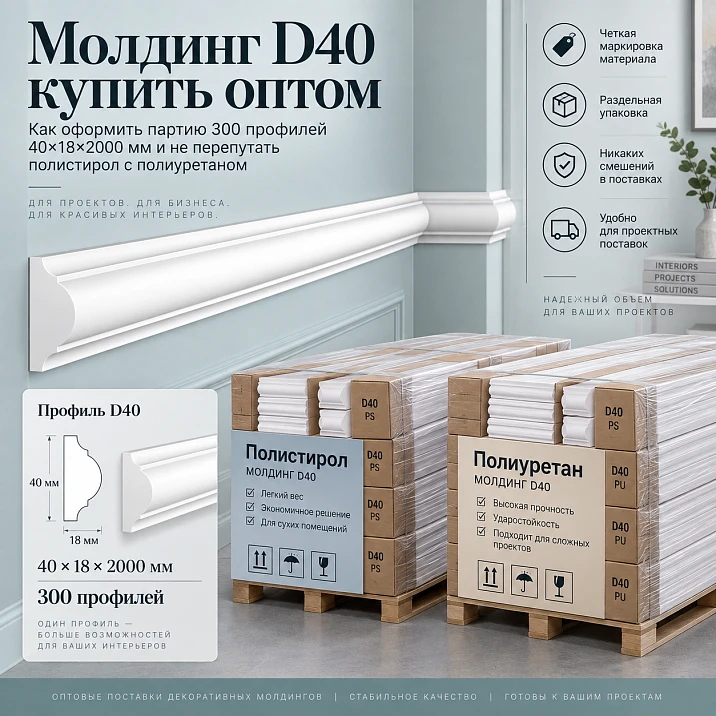
When purchasing a large batch of decorative molding, an error can appear long before shipment. The designer selects a specific HI WOOD D40, the working documentation keeps a simplified entry "40 mm molding," procurement copies the name of the general catalog section, and the supplier request already contains a different wording — "40 mm polyurethane molding." After several forwards, the original product gradually loses its exact identity. The invoice may retain only the brand and width, the warehouse may have a generalized group "white moldings," and three months later, when reordering, an employee searches for "the same profile by photo."
For a batch of 300 planks, this scenario is more dangerous than for a single purchase. One incorrect term multiplies across all documents and can lead to an offer of another product that looks similar but is not the approved D40. Therefore, the procurement line must remain stable from project to reorder: HI WOOD D40 / polystyrene / 40×18×2000 mm / for subsequent painting.
This article is specifically about how to buy D40 molding wholesale and carry one specific item through the project, bill of materials, supplier request, quotation, invoice, delivery, acceptance, warehouse, installation, reserve, and reorder without substituting the material and SKU. This is not an article about which molding is better, and not a comparison of polystyrene with polyurethane in general. The subject is much more practical: how not to lose the exact designation of the already selected D40.
The main protection against error is the master specification. In it, the manufacturer, SKU, material, cross-section, length, and surface purpose are in separate fields. Each subsequent document is checked against this line. The name of the catalog section, the colloquial term "polyurethane decor," or visual similarity must not replace the characteristics of a specific product card.

Why the material name in a request cannot be written "approximately"
Consider a project: a hotel, apart-hotel, or public space where D40 is approved in repeating interior zones. The calculation requires 300 strips. The designer used a specific profile, but in one of the schedules wrote "polyurethane molding 40 mm." Procurement takes this line literally and sends a request to several suppliers.
The first supplier offers HI WOOD D40. The second — an "equivalent polyurethane molding 40 mm." The third sends a quotation that states only "HI WOOD 40×18." Comparing the three prices, the buyer may mistakenly assume these refer to the same product. But the offers become comparable only after checking the SKU, material, and full dimensions.
The word "approximately" is dangerous precisely because the procurement chain loves abbreviations. One person knows the context and understands that D40 is meant. The next sees only a line in a table. Another receives it in an email without a drawing. By the time the invoice is issued, the original decision may no longer be obvious.
Therefore, for a large batch, you need to write not "molding 40 mm" but the full product line. The 40 mm size is only one characteristic. It does not identify the profile as a whole.




Which product is actually selected
For procurement, a specific item is recorded:
| Field | Value |
|---|---|
| Manufacturer | HI WOOD |
| Article number | D40 |
| Product type | Molding |
| Material | Polystyrene |
| Size | 40×18×2000 mm |
| Finishing | For subsequent painting |
Product card: molding HI WOOD D40 40×18×2000 mm.
These fields should not be merged into one vague phrase. The SKU identifies the model. The material — what the product is made of. The size — its geometry. "For painting" refers to further finishing and does not replace the material.
Our factory also produces:




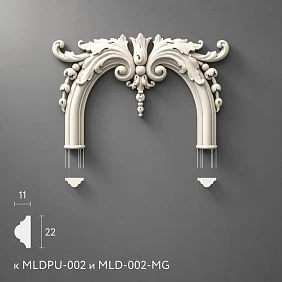
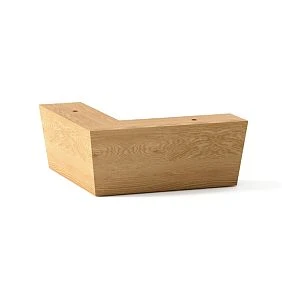
Why the confusion "polystyrene or polyurethane" arises
The reason may be purely informational. On the website, the decorative assortment is located within a general catalog branch whose name mentions polyurethane decor. But the specific D40 card identifies the product as a polystyrene molding. If an employee copies the name of the top-level section instead of the characteristics of the specific card, a technically incorrect wording appears in the specification.
Such an error is especially likely during mass export of nomenclature, manual copying of names, or working through internal reference lists where categories are broader than specific materials.
Therefore, the website category cannot be used as proof of the material of a specific SKU. The catalog section answers the question "where is the product located," while the card of the specific D40 answers "what exactly is being purchased."
Get Consultation
What is considered the main source when specifying D40
For a specific product, the priority must be clear. First, the current D40 card is checked. Then, the current drawing or technical information for that item. If ambiguity remains, the characteristic is clarified with the manufacturer or supplier before placing the order.
The name of the top-level catalog section must not override the specific product data. Likewise, an old internal file cannot be considered primary just because it was used a year ago. For a repeat order, the current characteristics are verified again.
Forming the reference product line
A working line might look like this:
HI WOOD / D40 / polystyrene / 40×18×2000 mm / for painting / 300 pcs.
This line becomes the control line. Documents may contain additional fields — object, phase, room, reserve, price, order number — but the core of the item does not change.
If the supplier uses its own internal code, it is added alongside. It does not replace D40. If the accounting system requires a short name, the full description must remain in the specification or appendix.
Why you shouldn't shorten the entry to "D40 40 mm"
Such an abbreviation looks recognizable within a single team, but it doesn't transfer well between organizations. It loses the material, the second dimension axis, the length, and the manufacturer. A few months later, an employee who wasn't involved in the original selection will no longer be able to reconstruct the exact product without additional searching.
For quick internal labeling, "D40" is acceptable if a master reference guide is available nearby. For a supplier request, this is not enough.
Why you shouldn't write only "polystyrene molding"
The opposite mistake is to keep the material but lose the product code. There are many polystyrene moldings. Two profiles may have a similar width but differ in thickness, relief, face geometry, or length.
Therefore, correct purchasing is based not on the material as a whole, but on the combination of manufacturer, product code, material, and dimensions.
Product code and material are two independent fields
D40 and "polystyrene" cannot be considered interchangeable information. The product code identifies the model within the product system. The material describes one of its characteristics. In an ideal world, the material could be reconstructed from the product code. In a real, long document chain, some information often gets detached from the product card, so critical attributes are better stored explicitly.
This is exactly what prevents the situation where an employee sees D40, opens the wrong card or uses an old reference guide, and transfers the wrong material.
What should be in the finish schedule
For the object, a separate row or table with the following fields is useful:
- room;
- area;
- manufacturer;
- article number;
- product type;
- the material;
- cross-section;
- length;
- quantity;
- finishing;
- note;
- specification version.
If 300 strips are distributed across several floors, you can add a queue and quantity for each zone. But the product identity D40 in each row remains the same.
What to pass to procurement
Procurement does not need the entire design album to make an initial request. It needs a clear purchasing line, a link to the card or drawing, and the quantity. If the project allows equivalents, this must be explicitly stated as a separate condition. If it does not allow them — even more so.
The less the procurement specialist has to interpret designations on their own, the lower the risk of substitution.
How to send a request to several suppliers
The same original specification is sent to all suppliers. Otherwise, commercial proposals cannot be fairly compared. If you write "D40" to one, "polyurethane molding 40 mm" to another, and send a photo to a third, each will consider their product suitable.
A standard request must contain the exact item, quantity, and a request to confirm compliance.
What must not be written in a request
Bad wording:
Polyurethane molding 40 mm, roughly like D40.
White decorative molding 40 mm.
HI WOOD, about 2 m, 300 pieces.
All of them leave the supplier too much room for interpretation. If D40 is specifically required, that should be stated directly.
Correct request to the supplier
Working wording:
HI WOOD D40 required, polystyrene, 40×18×2000 mm, quantity 300 pcs. Please confirm the exact item, price, availability or lead time, and shipping terms.
If the order is split into phases, the quantity can be specified by stage. If there are separate requirements for packaging or project labeling, they follow as the next items.
How to check the received quotation
Verification does not start with the final price. First, check that the supplier has quoted the same item. The quotation must clearly state HI WOOD, D40, polystyrene, 40×18×2000 mm, and the quantity.
If one of the fields has disappeared, it is requested before comparing prices. For example, the line "molding D40 — 300 pcs." looks close to the original, but the material and length are no longer visible in it. To be safe, it is better to confirm them.
Why the word "analog" requires separate approval
The phrase "analog D40" means that a different product is being offered. It is not necessarily a bad product, but it is no longer identical to the approved item. The comparison must be deliberate.
If a supplier offers an analog, the purchaser receives a card or drawing and passes it to the responsible project participant for approval. Until then, the replacement cannot be considered approved just because the price is lower or the item is in stock.
How an analog may differ even if it is also 40 mm
The same visible width does not guarantee a match. There may be differences in thickness, profile, face geometry, material, strip length, and surface preparation. Even a small difference can change the visual line of the frames or the junction with adjacent elements.
There is no need to prove that another material is worse. It is enough to understand: "different" and "the same" are not the same thing.
What to do if a polyurethane analog is offered
Correct sequence:
stop automatic replacement → obtain the card and drawing → compare geometry and material → send for approval → if approved, change the specification officially.
If the replacement is approved, the new documents should no longer contain D40 as if the product had not changed. The new SKU gets its own line.
Why the purchaser should not change the material on their own
Even if two white profiles look similar on the outside, the material is part of the approved specification. The purchaser is responsible for the accuracy of the procurement, not for making an independent design decision.
Their task is to identify the discrepancy, propose an option, and obtain a decision from the responsible party. This protects both the project and the purchaser from disputes after installation.
Does the entire project need to be re-approved when a substitution is made
Not necessarily. The scope of approval depends on the project rules and the nature of the substitution. But the decision must be made by an authorized party, not by a warehouse worker or procurement officer on their own initiative.
In practice, this can be a short written confirmation of a specific item. The main thing is that the change is recorded and included in the current master specification.
Reference sample D40 for a large batch
For a batch of 300 planks, it is useful to have a physical reference. This can be one actual plank or a reference cut, accompanied by a photo of the face surface, a photo of the end cross-section, the current card, and the drawing. Such a set helps during acceptance and in disputed situations.
A physical sample is especially useful when several white decorative HI WOOD profiles are used on the project at the same time. In the packaging and in the photo they may appear similar, but the end cross-section immediately shows the difference.
The reference must not replace the documents. Its purpose is additional verification. The main identifier remains the manufacturer, article number, material, and size.
Why a photo of the facade is not enough
A photo shows the overall appearance well, but identifies the profile poorly. Perspective, lighting, and scale can hide a difference of 2–3 mm or in the shape of the relief. Two moldings may have a similar face line but differ in depth or in the back side.
Therefore, ordering a repeat batch "from a photo on the wall" is bad practice. A photo can be attached as additional context, but line D40 must be restored from the original documentation.
How to check 300 strips upon delivery
Receiving a large batch does not mean you need to randomly open all packages. Control should be systematic. First, the documents and marking of the packaging units are verified. Then the items and the condition of the batch are checked selectively.
Minimum check set:
- manufacturer HI WOOD;
- item code D40;
- material according to documents — polystyrene;
- size 40×18×2000 mm;
- total quantity;
- packaging integrity;
- absence of visible damage;
- compliance with the object marking, if agreed.
If a batch is divided into phases, it is better to accept each as a separate complete set group. For example, 120 planks for the first phase, 100 for the second, and 80 for the reserve or final delivery. The total of 300 should not hide an error within a specific phase.
Why the number of boxes does not equal the number of D40
You cannot base acceptance solely on the number of packages if the quantity of items inside each is not confirmed. Packaging is a logistics unit, D40 is a product unit. If the documents show 15 places, this does not automatically answer the question of how many planks actually arrived.
Therefore, the total is verified by pieces or by the unit of account that is explicitly recorded in the delivery documents.
How to draw up a discrepancy report
The phrase "similar, but not the same" is too subjective. The report or internal record must describe the specific difference.
For example:
In the order: HI WOOD D40, polystyrene, 40×18×2000 mm. In the delivery documents: a different model / different material / different cross-section.
Or:
The article number on the packaging does not match the D40 order.
Such a description allows you to quickly understand which specification field is violated.
How to label a warehouse
On a warehouse cell or picking tag, it is better to keep at minimum:
HI WOOD D40 / polystyrene / 40×18×2000 / object ___ / phase ___
If the material has already been distributed by floors or rooms, the corresponding code is added. You should not write only “moldings” or “white decor.”
The longer the project lasts, the more important such labeling becomes. After three months, the team’s original memory fades, but a proper code continues to work.
Why you cannot label a warehouse “polyurethane moldings”
This is too broad a group. In it, D40 loses its precise identity and may be mixed with other profiles. Even if the corporate warehouse has historically used such a section, there must be a separate D40 card within it with the correct material.
The storage category can be broad. The product characteristic cannot.
How to issue D40 for installation
Issue must be made for a specific item and a specific quantity. For example:
D40 / floor 4 / zone B / 24 pcs.
Incorrect:
Take 24 moldings from the rack.
The second wording only works until a similar profile first appears nearby.
How to account for returns from the installation area
Whole unused strips are returned as D40, not as a “decor remnant.” If the packaging has been opened, it is important to preserve identification. An anonymous white strip should not end up in the warehouse, only to be identified later from memory.
If short pieces are returned, they should be accounted for only if they are actually suitable for future parts. Otherwise, the warehouse fills up with material that is listed as stock but has no practical use.
How to label useful remnants
The simplest labeling:
D40 / 870 mm
D40 / 630 mm
If a site has multiple phases or special colors after pre-painting, the code is extended. For a clean profile before finishing, the article number and actual length are usually sufficient.
A remnant should exist in accounting only if its length fits a future confirmed part. The mere fact that the material was not discarded does not make it a reserve.
Why a remnant of another polystyrene molding cannot be considered a D40 remnant
Even if the width is similar, a different profile does not become D40. Remnants are tracked by SKU, not by general material. The statement "we still have 12 meters of polystyrene molding" is not sufficient to cover a D40 shortage.
You need to know how many of those meters belong specifically to D40 and in what lengths.
D40 batch reserve
It is better to separate the main volume and the reserve. For example:
| Status | Quantity |
|---|---|
| D40 working requirement | ___ pcs. |
| Full D40 reserve | ___ pcs. |
| Total for the order | ___ pcs. |
This shows how much is required for the approved installation and how much is kept as reserve. If the project scope changes later, the reserve can be reviewed deliberately.
You cannot keep one common "reserve for all mouldings on the project." If D40 is short, having another profile in stock does not solve the problem.
How to determine a reasonable reserve without a universal percentage
The article should not invent mandatory 5%, 10%, or 15%. The reserve depends on cutting layout, dimensional stability, the number of repeating zones, the possibility of a quick reorder, the risk of damage, and the project stage.
For a large project, it is useful to separate at least the working cutting requirement and a separate full-length reserve. If technological offcuts are already included in the working requirement, they must not be hidden a second time inside a large percentage.
Why a full-length piece is more valuable than random short offcuts
Two meters of D40 in one full-length piece and two meters made up of four 500 mm pieces do not have the same production value. If a 1500 mm part needs to be replaced, the short offcuts are useless.
Therefore, the project balance should show full-length items separately from usable offcuts.
Reorder after three months: where material is most often lost
On a repeat order, it is easy to lose the original accuracy. An employee opens the old correspondence, sees "40 mm molding" or a photo, and performs a new search. As a result, a different product may end up in the request.
It is more correct to restore the original master line and only then open the current D40 card for verification.
What to send in a reorder
Minimum:
HI WOOD D40 / polystyrene / 40×18×2000 mm / ___ pcs.
If available, the old order, project, and batch number are added. This helps the supplier match the new request with the previous delivery.
How to check whether the product card has changed
Before a repeat order, the current card is opened. The SKU, material, and dimensions are compared. If a discrepancy with the historical specification is found, it cannot be ignored. You need to clarify with the supplier what has changed: the card, the nomenclature, the description, or the product itself.
Until this is clarified, old data must not be automatically transferred to the new order.
Do not transfer the old price to the new request
Price is a variable parameter. Therefore, an evergreen article should not fix the cost of D40 as permanent. In a repeat request, the price is requested again.
Historical price is useful for budget analysis, but it is not a product characteristic.
"For painting" is not a material name
This is a separate field. Polystyrene is a material. "For subsequent painting" is a surface condition or purpose in a finishing system. If these concepts are mixed, strange entries appear such as "material: for painting".
For procurement, it is better to keep the fields separate:
| Field | Value |
|---|---|
| Material | Polystyrene |
| Finish/surface purpose | For subsequent painting |
Why the finisher also needs to know the exact material
There is no need to turn this section into an article about adhesives and paints. One principle is enough: the contractor must receive accurate product information about the D40 actually being used, so that installation and finishing materials are checked specifically for it.
If the transferred bill of quantities says "polyurethane molding" but the actual item on site is polystyrene D40, the contractor is already starting with contradictory data.
If the estimate historically says "polyurethane molding"
There is no need to rewrite old history retroactively. It is better to issue a clarifying specification or an official explanation:
In fact, HI WOOD D40 is approved. According to the current product card, the material is polystyrene. Size — 40×18×2000 mm.
After that, new documents are generated based on the updated line.
How to work with the corporate materials reference
In an internal ERP or warehouse system, there may be a large group called “polyurethane decor” as a historical category. It is not necessary to completely redo the corporate classification for the sake of one item.
But the product card for a specific item must have a separate field “product material” with the value “polystyrene.” Then the broad accounting group does not replace the technical characteristic of the SKU.
Category and material are not the same thing
It is useful to reinforce this formula for the entire procurement team:
the catalog section shows where to look for the product; the card for the specific D40 shows which product is being purchased.
The same rule applies in internal systems: a folder, section, group, or category does not replace the characteristic of a specific item.
Final route without losing identity
The correct sequence looks like this:
D40 card → drawing → master specification → request → commercial proposal → invoice → order → delivery → acceptance → warehouse → installation → reserve → reorder.
At every stage, the core must remain:
HI WOOD D40 / polystyrene / 40×18×2000 mm.
Additional fields may change. Price, quantity, queue, and project depend on the situation. The core of product identity does not change without a separate agreed decision.
Central table: how D40 is distorted at different stages
| Stage | Incorrect entry | Correct entry |
|---|---|---|
| Project | polyurethane molding 40 mm | HI WOOD D40, polystyrene, 40×18×2000 mm |
| Request | D40 or equivalent | HI WOOD D40 + exact specifications |
| Commercial Proposal | decorative molding 40 mm | D40 + material + size |
| Invoice | HI WOOD molding | HI WOOD D40 |
| Warehouse | Polyurethane moldings | D40 / polystyrene |
| Issuance | 10 white strips | D40 / 10 pcs. |
| Reorder | the same molding | D40 / polystyrene / 40×18×2000 mm |
Second practical specification table
| Specification field | What to write |
|---|---|
| Manufacturer | HI WOOD |
| Article number | D40 |
| Product type | Molding |
| Material | Polystyrene |
| Size | 40×18×2000 mm |
| Finishing | For subsequent painting |
| Quantity | ___ pcs. |
| Object | ___ |
| Queue | ___ |
| Reserve | ___ pcs. |
Practical scenario: a batch of 300 D40 for a project with repeating zones
Imagine a project where D40 is used in corridors, public areas, and rooms. The design team approved a single profile, and the total requirement after calculation is 300 full lengths. The quantity itself is simple. The difficulty begins when these 300 lengths pass through several departments.
The designer hands over the finish schedule. The estimator transfers the line item into the budget. Procurement prepares the request. The supplier creates a quotation. Accounting receives the invoice. Logistics arranges the shipment. The warehouse receives and distributes the material. The contractor receives it by floor. A few months later, a reorder appears. At every stage, there is a risk that the line becomes shorter and less precise.
If at the beginning only “D40 molding — 300 pcs.” is recorded, some participants may still be able to recover the product by item code. But if at the next stage the line turns into “40 mm molding,” and then into “polyurethane decor,” product identity is practically lost.
Therefore, a large order is better built around a single master record, rather than around many manually typed names.
Master specification as the single source of product identity
For D40, the master specification can be a simple table. The main thing is to designate it as the primary source. All working documents get their data from it, not from old emails and other people's files.
| Field | Reference value | Can it be changed without approval |
|---|---|---|
| Manufacturer | HI WOOD | No |
| Article number | D40 | No |
| Material | Polystyrene | No |
| Size | 40×18×2000 mm | No |
| Finishing | For subsequent painting | only by project decision |
| Quantity | based on current demand | yes, after recalculation |
| Price | based on the current quotation | Yes |
| Queue | Per schedule | Yes |
This immediately shows which fields are constant and which depend on a specific order. The price can change. The quantity can change. The delivery queue can change. But if D40, polystyrene, or 40×18×2000 mm changed without approval, then it is no longer the same procurement item.
How to normalize an old list if it already says “polyurethane D40”
There is no need to delete old entries and pretend that no error occurred. It is more correct to issue an updated statement with a separate "clarification" column or a new version of the document.
For example:
Was: polyurethane molding D40, 40 mm.
Updated: HI WOOD D40, polystyrene, 40×18×2000 mm, for subsequent painting.
This preserves the change history and at the same time eliminates ambiguity for new purchases.
If the old designation has already been included in the estimate, the financial model does not need to be rebuilt entirely unless required by the project rules. But the procurement specification must contain up-to-date data.
Why the same SKU in different files must be checked for matching specifications
Sometimes all documents contain D40, but the specifications differ. In one file, 40×18×2000 is indicated; in another, only 40×18; in a third, the material is called polyurethane. The presence of the same SKU creates a false impression that the documents are aligned.
Before ordering, it is useful to perform a simple cross-check on key fields. If at least one field contradicts the current product card, the document is marked as requiring clarification.
Such control is especially important when copying rows between projects. The old project may have used a similar product or an old product card.
How not to turn D40 into a depersonalized "decorative molding" within an estimate
An estimating system often tends to merge similar items. For analytics this is fine: you can have a group called "decorative moldings." But within the group, the nomenclature line D40 must be preserved.
If only a general group without an article number remains in the working estimate, procurement is forced to select the product again. Then the already approved design solution turns into a new tender selection.
Therefore, aggregated budget line items and precise procurement positions must exist simultaneously, but perform different functions.
How to compare three commercial offers for one batch
First a product matching table is created, and only then a price table.
| Supplier | HI WOOD | D40 | Polystyrene | 40×18×2000 | Quantity | Status |
|---|---|---|---|---|---|---|
| А | Yes | Yes | Yes | Yes | 300 | comparable |
| Б | No | analog | Polyurethane | different geometry | 300 | Requires approval |
| В | Yes | Yes | not specified | 40×18×2000 | 300 | request confirmation |
Only after that do they compare cost and lead times. Supplier B's price may be the lowest, but this offer is for a different product. It cannot be placed in the same price column as fully equivalent.
Why the absence of material in a quotation cannot automatically be considered an error
A quotation may be abbreviated: the supplier specified the exact D40 and size, but did not duplicate the word "polystyrene". This does not necessarily mean substitution. However, the buyer must obtain confirmation that the original product is indeed the one being quoted.
In other words, the task is not to reject any abbreviated quotation, but to restore clarity before placing the order.
How to record supplier confirmation
Confirmation may be in an updated quotation, a specification attached to the invoice, or a written response clearly stating that HI WOOD D40 with the required characteristics is being offered. It is better when the exact line appears directly in the order document.
Correspondence saying "yes, that's correct" is useful, but weaker than a document in which the product itself is named correctly.
What to check in the invoice before payment
An invoice is often perceived as a financial document, so product abbreviations go unnoticed. But it is precisely according to the invoice that payment and subsequent shipment may proceed. If a different item has appeared there, it is better to stop the error before payment.
Checked:
- item code D40;
- manufacturer, if specified;
- size;
- quantity;
- absence of an unapproved substitution;
- compliance with the commercial proposal.
If the material is not specified, but the exact D40 is unambiguously confirmed in the specification, this may be acceptable under the company's internal rules. The main thing is that there should be no contradiction in the document set.
Why the invoice "molding HI WOOD — 300 pcs." requires clarification
The brand does not identify a specific model. If the manufacturer has several moldings, such a line is too broad. Before payment, it is better to ask to add an article number or obtain a separate specification.
On a batch of 300 pieces, this formality can prevent a costly mistake.
How to work with a contract where the goods are defined by an appendix
If the main contract states generally "finishing materials," this is not a problem if the appendix or specification contains the exact D40. It is important that the legally significant document defining the subject of supply allows the goods to be unambiguously identified.
The article does not replace a legal review of the contract, but from a procurement standpoint the rule is simple: somewhere in the approved document set there must be an exact product line.
How to label a project batch before shipment
If the supplier is ready to add extra labeling, it is useful to include the object and phase:
HI WOOD D40 / object HOTEL-A / phase 1 / 120 pcs.
This does not change the factory labeling, but supplements logistics. At receiving, it is immediately clear which part of the project the material belongs to.
This is especially convenient if other decorative profiles are being shipped at the same time.
Why the size 40×18×2000 must be stored in full
In conversations, it is often shortened to “the fortieth molding.” But 40 mm is only the first dimension axis. The 18 mm thickness and 2000 mm length are also part of the specification. If one of them changes, the cutting plan, profile projection, or number of whole strips may become different.
Therefore, in the master line the size is stored in full, even if only D40 is used in the short warehouse code.
How to distinguish a purchasing error from a project replacement
If the supplier accidentally sent a different product, this is a purchasing error. If the project officially approved a different profile, this is a project replacement. In the documents, these situations should look different.
In a project replacement, the master specification is updated, and the new product becomes the active one. In a purchasing error, the master specification does not change — the delivery is corrected.
This is an important distinction. Otherwise, an accidentally supplied alternative could be "legalized" simply because it was entered into the warehouse table.
When an alternative can actually be considered
It makes sense to discuss an alternative if the original D40 is not available within the required timeframe, the project allows alternatives, the budget needs to be optimized, or another objective reason arises. But this is a separate comparison procedure, not an automatic right of the supplier to substitute the product.
For comparison, geometry, material, length, surface, and visual result may be needed. If an alternative is approved, it must be given its own item code. The wording "alternative to D40" should not remain the permanent name of the new product.
When an alternative should be rejected immediately without a lengthy comparison
If the project explicitly requires a specific D40, the timeframe allows obtaining the original item, and the alternative offer does not provide a clear product card or drawing, the purchaser has no reason to spend time on an uncertain substitution.
In that case, it is easier to request the exact product or another supplier.
How not to mix up D40 with other HI WOOD products in the warehouse
Brand grouping is convenient, but within a single brand there can be dozens of similar profiles. The warehouse must store them by item code. Even if the packaging looks similar, the bins or labels differ.
If the material is issued without packaging, D40 is retained on the remaining stock. One cannot rely on the assumption that an experienced craftsman will "recognize" the profile anyway.
Practical warehouse log for D40
| Date | Operation | Whole pieces count | Usable remnants | Zone | Base |
|---|---|---|---|---|---|
| ___ | incoming | 120 | — | Warehouse | delivery #1 |
| ___ | Issuance | -24 | — | Floor 2 | Request |
| ___ | Return | +3 | 870 mm, 630 mm | Warehouse | installation remainder |
You don't have to use exactly this form. The key is to see whole planks and short offcuts separately.
How to count 300 planks if some go into reserve
Tolerance
Why "300 planks per invoice" doesn't guarantee 300 usable planks
During acceptance, some items may be damaged. That is why quantity and quality are two separate control parameters. Formally, the delivery is closed by piece count, but the operational need may remain unmet.
If a defect is detected, it is recorded before distribution across floors, so that damaged goods do not dissolve into the general batch.
How to conduct sampling inspection without chaos
The batch is divided by packaging units. Inspection is performed systematically: several units from different parts of the batch, plus additional checks when deviations are detected. The specific scope of control is determined by internal rules and delivery terms.
The main thing is not to open random packs without recording it, and then lose track of what has already been checked.
What to do if the documents say "polyurethane" but the packaging says D40
Such a contradiction cannot simply be ignored. First, it is confirmed that the physically delivered material is indeed the ordered D40. Then the supplier must clarify or correct the documents if the material is listed incorrectly.
Making the decision "since the item code is correct, the rest doesn't matter" is risky, because the incorrect wording will carry over into accounting and reordering.
What to do if the packaging has no clear item code
Before distribution to the site, supplier confirmation must be obtained and the goods must be matched against the documents and the reference sample. You cannot distribute 300 similar profiles across floors and then try to identify them after the fact.
The earlier a labeling problem is detected, the cheaper it is to solve.
How to control D40 during transfers between warehouses
If an object has a central warehouse and floor warehouses, the same SKU and quantity are preserved with each transfer. An internal transfer should not shorten the name to “molding.”
It is useful when the transfer invoice contains D40 and the object code. This allows the batch path to be restored later.
How to handle 300 strips when supplying in parts
A total order can be split, for example, into 120 + 100 + 80. The same master line is used for each shipment. Only the quantity and the queue number change.
You must not allow the first delivery to be called D40 and the second “molding 40 mm” just because the supplier already knows the context. Documents must remain self-contained.
Why a repeat delivery is especially sensitive to abbreviations
Employees may change between the first and third shipment. What “everyone understood” at the beginning is no longer understood by anyone a few months later. Therefore, each batch must carry precise identification on its own.
How to handle general wholesale anchors without diluting the topic
The article remains product-focused and should primarily talk about D40. General queries such as finishing material suppliers, delivery of finishing materials, finishing materials wholesale or building materials at wholesale prices are used only where it genuinely concerns a comprehensive purchase and supply chain.
They lead to the STAVROS homepage and should not replace the link to the specific D40 product card.
Why wooden keywords are irrelevant here
D40 is polystyrene HI WOOD. Therefore, phrases about wooden molding or solid wood molding do not match the product. Adding them just to expand semantics is wrong: the article will lose accuracy and start attracting users with a different expectation.
The same applies to furniture intent if the article discusses the wall decorative application of D40. Semantics should support a specific page, not turn it into a collection of all molding-related queries.
How to naturally use commercial queries
Phrases like buy wall molding, buy wall moldings, buy decorative molding, buy molding for walls, and custom molding are appropriate in the context of selection and order arrangement. There is no need to repeat them in every heading or paragraph.
The main product intent remains one — D40 wholesale.
When D40 should not be purchased before the specification is finalized
If the designer is still choosing between several profiles, the dimensions of the decorative lines have not been approved, or the project officially allows substitution without a selected SKU, an early order of D40 may be premature.
A wholesale discount does not offset the risk of buying 300 planks before the project decision is locked. First the item is approved, then the batch is placed.
When, conversely, a large order is already ready to be placed
You can proceed to order when D40, the material, the full size, the quantity, the sequence, whether analogues are allowed or prohibited, and the acceptance system are locked. If the delivery is split into stages, the first stage must also have an exact specification.
How to perform an internal audit of a request before sending
Before sending, an employee can run through a short checklist:
- Is HI WOOD present?
- Is D40 present?
- Is polystyrene specified?
- Is the size 40×18×2000 mm specified?
- Is the quantity specified in pieces?
- Is it clear whether analogues are allowed?
- Is there a link or drawing for verification?
- Does the specification version match?
Such a check takes minutes, but it eliminates most information errors.
How to audit a commercial proposal
The reverse side of the same chain is checked: what the supplier returned in response. If the original request was accurate, any discrepancy is immediately visible.
Particular attention is paid to the word "analogue", a changed SKU, a disappeared size, and material. If the supplier added their own internal coding, it must not hide the original D40.
How to audit a delivery at the warehouse
The warehouse should not re-decide what was ordered. It receives the master line and the reference. Its task is to verify the physical goods and documents.
If the data does not match, the batch is isolated until a decision is made. There is no need to distribute material for installation hoping to sort it out later.
How to perform an audit before reordering
Before reordering, two things are checked: what exactly was used on the project and whether the D40 card is up to date. Then a new request is formed using the full product line.
The old price, old availability, and old lead times are not carried over into the new request as fact.
Common mistakes when purchasing D40 wholesale
Mistake 1. Copying the name of the catalog section instead of the card material. As a result, polystyrene D40 becomes "polyurethane" in the bill of materials.
Mistake 2. Writing "polyurethane D40" without checking. The contradiction is fixed in all subsequent documents.
Mistake 3. Ordering only "40 mm molding." The SKU, manufacturer, thickness, and length are lost.
Mistake 4. Not specifying HI WOOD. D40 without context may be unclear in an external request.
Mistake 5. Allowing substitution with an equivalent automatically. A different product ends up in the project without approval.
Mistake 6. Checking only the price. The cheapest quote may be for the wrong product.
Error 7. Not attaching the card or drawing. The supplier has to interpret a short name.
Error 8. Not having a reference sample. It is harder to distinguish similar white profiles at receiving.
Error 9. Mixing different moldings in the warehouse. Leftovers lose their SKU identity.
Error 10. Treating any polystyrene leftover as a D40 leftover. The material matches, the SKU does not.
Error 11. Ordering a repeat batch from a photo. Visual similarity does not confirm geometry.
Error 12. Mixing material and the "for painting" condition. Polystyrene and finish are different fields.
Error 13. Using wooden commercial queries for D40. They do not correspond to the product.
Error 14. Transferring the frequency of the parent query to the SKU-specific D40. The product phrase is considered separately, without an invented number.
Error 15. Using the SEO name of the section as the technical description of the product. Catalog and technical classification serve different purposes.
Final checklist before paying for the batch of 300 D40
| Check | Status |
|---|---|
| HI WOOD specified | ___ |
| D40 specified | ___ |
| Material — polystyrene | ___ |
| Size — 40×18×2000 mm | ___ |
| Quantity matches the order | ___ |
| No substitute added without approval | ___ |
| Quotation and invoice refer to the same line item | ___ |
| Delivery terms confirmed | ___ |
| Project-specific labeling agreed if required | ___ |
Buy D40 molding wholesale after final specification verification
For a batch of 300 strips, the main risk is not a complex arithmetic calculation, but the gradual loss of accuracy in the product description. One person writes “D40,” another writes “40 mm molding,” a third copies the general category “polyurethane decor,” the supplier offers a substitute, and the warehouse is left with simply “white moldings.” As a result, an already approved line item quietly turns into an undefined product group.
To prevent this, a single control record is maintained at all stages: HI WOOD D40 / polystyrene / 40×18×2000 mm / for subsequent painting. Changing any permanent field is treated as a separate replacement, not as an acceptable abbreviation.
A request to multiple suppliers is sent using a single specification. Commercial proposals are first compared for product compliance and only then by price. The word "analog" automatically moves the proposal into a separate approval branch. The invoice before payment is also checked against the master line.
During acceptance, the article number, size, quantity, condition, and document compliance are checked. At the warehouse, D40 is stored under its own code. Whole strips, working demand, and reserve are accounted for separately. Usable remnants are marked with the article number and length. A remnant of another polystyrene profile is not counted as D40 just because the material matches.
A few months later, reordering begins not with searching for a "40 mm molding," but with restoring the original line and checking the current product card. Price, availability, and lead time are requested anew; product identity remains the same.
This approach allows you to buy D40 molding wholesale without the typical procurement substitution and to maintain one specific SKU throughout the entire path from project to installation. If the site simultaneously purchases finishing materials wholesale or works through building materials supplier, the exact D40 article line must remain separate within the overall order.
After the final verification, you can place HI WOOD D40 Molding in the required quantity, without substituting polystyrene with the word "polyurethane" just because of the name of the catalog branch, and without allowing the supplier to decide on their own which "similar 40 mm molding" should be considered equivalent.
How to maintain versioning of the D40 specification
On a long project, a single exact line is not enough if no one understands which revision is in effect. Therefore, it is useful to assign a version number to the master specification. For example, D40-v1 is the original procurement record, D40-v2 is the version after the material was clarified, D40-v3 is the version after a quantity change or breakdown by phases.
Not every change has to create a new item. If only the quantity changed from 300 to 286 slats, the item code remains D40. But the document gets a new revision so that the warehouse and procurement do not work from the old number. If a different profile is approved, however, this is no longer a new version of D40, but a new product item with its own code.
Old versions do not need to be destroyed. They are useful for the project history. But the current one must be clearly marked in the working folder. Otherwise, an employee may easily attach the old table to a request, where it still says “polyurethane molding.”
How to link a specification version to an invoice and delivery
In the request, you can specify: “item according to specification D40-v3.” Then, when the quotation is received, it is clear which revision the supplier responded to. If the quantity changes after that, the new invoice must correspond to the next version.
This approach is useful when approval takes weeks. It prevents a situation in which the project has already changed the material to polystyrene, while the supplier continues to calculate the old request with a different description.
What to do if the supplier sent the correct D40, but the material is listed incorrectly on the delivery note
The physical conformity of the item does not cancel an error in the documents. If the correct HI WOOD D40 arrived at the site, but the delivery note says “polyurethane,” it is better to request a correction or written confirmation. Otherwise, the incorrect characteristic will enter the warehouse system and be used in the next order.
At the same time, there is no need to create a conflict around the item itself if its identity has been confirmed. The task is to bring the documentary chain into line with the facts.
What to do if the documents are correct, but a different profile arrived physically
This is the reverse case, and it is more dangerous. A decision cannot be made based on the invoice alone. If the packaging or a spot check shows a different item code, the batch must be stopped until clarification.
Documents in such a situation do not make the physical goods correct. The report records the discrepancy between the order and the actual delivery. After that, the supplier either replaces the goods, or the project separately reviews the proposed replacement.
How to check D40 during partial unpacking
After removing the outer packaging, it is important to preserve the link between individual planks and the product item. If the factory marking is only on the pack, the D40 and object code can be duplicated on the internal warehouse tag. Then, after part of the material is issued, the remainder does not become nameless.
This is especially important for white decorative profiles, which may look similar to each other. Once identity is lost, it later requires re-measurement and comparison with the reference sample.
How to use the end cross-section as an additional check
When there are several similar moldings on site, the end cross-section is more informative than a frontal photo. It shows the actual geometry of the profile. Therefore, in the control set it is useful to keep a photo of the D40 end face next to the item code and size.
But even an exact match of the cross-section should not completely replace the item code. The end face is an additional visual check, not a standalone product specification.
How to track the remainder after completing one phase
Suppose the first phase received 120 whole D40 pieces. After installation, 9 whole planks and several cut pieces remained. For the next phase, the calculation includes all 9 whole pieces and only those cut pieces that fit in length for confirmed future parts.
Instead of the phrase "D40 remaining — 16 meters", it is better to store the structure:
| Leftover type | Quantity | Status |
|---|---|---|
| Whole planks 2000 mm | 9 pcs. | universal reserve |
| Offcuts 1000–1500 mm | As per actual | check against future parts |
| Short segments | As per actual | use only when suitable assemblies are available |
This way, the next purchase is reduced by the actually available material, not by an abstract total linear meterage.
Why a reorder cannot be based only on missing linear meters
If a project is short by 18 linear meters, that does not automatically mean nine D40 planks. You need to know the lengths of the remaining parts. Theoretically, 18 m equals nine two-meter pieces, but cutting may require more.
For example, if twelve parts of 1550 mm remain, each one needs a separate two-meter plank, and nine planks are not enough. The total meterage is 18.6 m, but the purchasing requirement is 12 whole pieces. This is a clear example of why a linear meter does not replace a parts map.
How to verify the quantity of 300 planks before placing an order
The quantity must have a basis. It can be made up of the working cutting plan, a full reserve, and a breakdown by phases. If the figure 300 appeared only because "that was roughly how many were in the previous estimate," the order is not ready yet.
It is useful to have a simple summary:
| Base | Quantity |
|---|---|
| Planks according to the confirmed cutting plan | ___ |
| Full reserve | ___ |
| Minus the confirmed warehouse stock | ___ |
| Total for the order | 300 |
This way the order can be explained and recalculated whenever the project changes.
How to prevent a general tender from turning D40 into an "equivalent item"
Tender forms often include an "or equivalent" field. If the project truly allows an equivalent, the procedure for approving it must be defined in advance. A supplier may offer another product, but it does not automatically become equal to D40 just by filling in the price table.
If equivalents are not provided for, it is better to state this directly. Then tender participants will not send incomparable offers and complicate the analysis.
Why the specification must survive a change of employee
A good procurement system works even after a change of designer, supply manager, or warehouse keeper. A new employee should open a line and immediately understand what needs to be ordered. If they have to call someone who worked on the project three months ago, the documentation is not precise enough.
D40 is convenient as an example precisely because all critical information fits into one short entry. There is no reason to replace it with a vague everyday name.
Final formula for the procurement team
For a specific D40, a simple logic applies:
site category ≠ product material;
SKU ≠ full specification;
analog ≠ automatically acceptable replacement;
total linear meters ≠ number of whole planks;
warehouse group ≠ product identity.
If these five distinctions are preserved, most typical errors disappear before the invoice is paid.