Article Contents:
- Which solid wood furniture elements to buy for different components
- What to prepare before selecting from the catalog
- How to read the dimensions of ready-made parts
- Ready-made furniture legs and supports
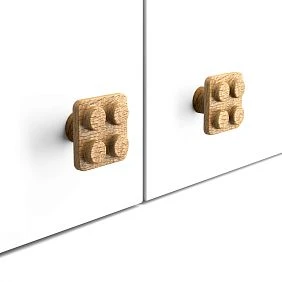
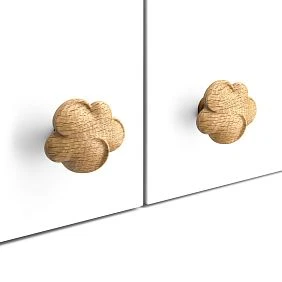
- Wooden furniture handles
- Carved wood decor: choose its place in the composition
- Decorative overlays: from free space to size
- Wooden rosettes for the center and joints of the frame
- Brackets and three-dimensional parts
- Mouldings and trim: they buy strips, they design cut lengths
- Oak or beech is chosen for the entire visible set
- Unfinished or with a ready-made finish
- How to assemble a set for a single chest of drawers
- When it is worth buying a sample first
- Specification before ordering
- What to check in a supplier's offer
- Where to buy solid wood furniture elements
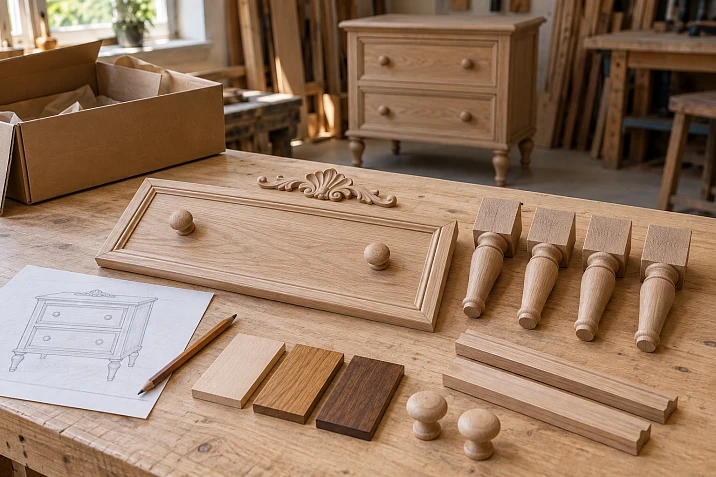
For the chest of drawers, four legs, six handles and three carved overlays were chosen. Individually, everything matches in style. But on the front, the handle overlaps the edge of the ornament, the top plate of the leg does not fit under the bottom, and the ordered moulding is sufficient in linear metres but not in the length of continuous sections. What has to be corrected is no longer the design but the composition of the purchase.
Before deciding which solid wood furniture elements to buy, make a list of tasks for the specific item. What will support the carcass, what will open the drawers, where is relief needed and which lines should frame the fronts? After that, choose the categories, check the actual dimensions and assemble a coordinated set. A finished wooden part is useful to a project when its place, fastening, finish and quantity have been defined.
Which solid wood furniture elements to buy for different components
A single catalog brings together parts with different functions in furniture. A leg bears the load, a handle transmits force when opening, and an overlay decorates the surface. That is why you first need to determine the function, and only then, within the appropriate group, compare pattern and shape.
| Project objective | Which elements to consider | What to determine before choosing a model |
|---|---|---|
| Raise and support the cabinet | Legs, supports, base frame | Support scheme, height, mounting location |
| Open a door or drawer | Knob handle, pull, profile handle, or another handle | Grip, placement, holes, front movement |
| Decorate the open field | Overlay, carved element | Available width and height, relief protrusion |
| Make the center or node of the frame | Decorative rosette | Scale and alignment with adjacent parts |
| Finish the edge, frame, band | Molding, rail, linear profile | Section, joints, segment lengths |
| Finish the protruding side node | bracket | Depth, mounting planes and role in the structure |
| Complete the post or pilaster | Capital | Base width, projections and abutments |
If a bracket is to support a shelf, a decorative shape alone is not enough: load-bearing use must be confirmed for the specific part and joint. A capital also does not become a supporting node merely because of its position under the upper rail of the furniture.
A separate group — wooden modules for furniture. They are selected for the assembly composition specified by the project. A single module cannot automatically be considered a complete leg: the other elements of the system and coordinated joints will be required.
For small accents and junctions, it is useful to look at wooden decorative elements. But it is not necessary to expand the set just because a part with a suitable pattern has been found. Each item must serve its own purpose on the furniture.




What to prepare before selecting from the catalogue
To begin with, a general view of the furniture and a few dimensions are enough. You need the overall dimensions of the carcass, the sizes of the fronts, the free areas for decoration, the intended height of the supports and a description of the finish. If the item has already been manufactured, instead of an approximate sketch, use measurements with the existing holes and projections.
Divide the requirements into mandatory ones and those that allow a choice. For example, the distance between the already drilled handle holes is a constraint. Its pattern can still be chosen. The thickness of the overlay near an adjacent door is limited by the movement of the front; the ornament within a suitable dimension may vary.
This makes the catalog noticeably simpler: unsuitable versions are filtered out before comparing dozens of photos. For each remaining option, save the item code, size, and link. A name like "small oak rosette" will not let you unambiguously return to the selected product.
The dimensions of finished wooden furniture elements are entered into the project before final drilling, cutting of mating parts, and finishing. If the model changes, the dependent body dimensions are also checked. A similar photo does not confirm interchangeability.
Our factory also produces:
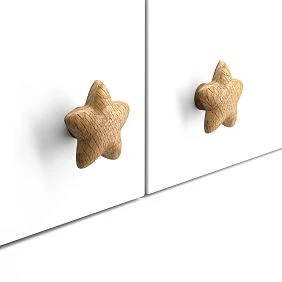
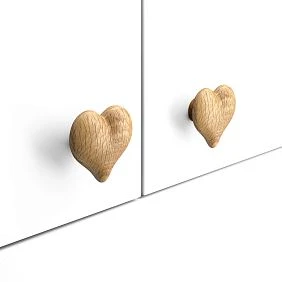
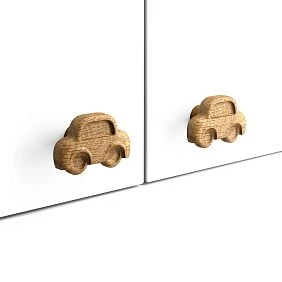
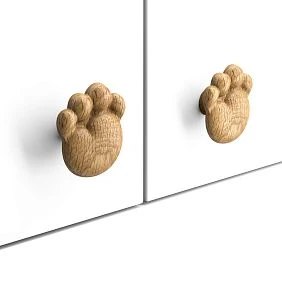
How to read the dimensions of finished parts
The designations A, B, C, and L are convenient for recording, but their interpretation is taken from the drawing of the specific product. You cannot assume that one letter always denotes depth, another height, and that the entire table is the same for a handle and a leg.
For a support, height, the upper mounting plate, and the profile matter. For a handle, the outer dimension, projection, and mounting locations matter. For an overlay, the contour on the front and the relief depth matter. For molding, you need the cross-section and the length of the retail strip from which the pieces will be cut.
Check not only the outer dimension but also the connection point. A wide carved part may have a small actual contact area. A large leg may have a narrow upper part. A handle that fits on the front may leave little room for fingers next to the overlay.
To check the scale, it is convenient to transfer the contour to a full-size drawing or make a paper template. Such a template shows the placement on a plane. Projection, grip comfort, and the movement of adjacent parts are checked using a 3D model or a sample.
Get Consultation
Finished furniture legs and supports
In the section of furniture legs and supports start with the required height of the finished furniture. Then determine what part of this height is accounted for by the body, the mounting unit, the wooden leg, and the foot pad. The length of the part from the product page is not always equal to the clearance under the furniture.
The next check is the upper plate. On the bottom view, place the contour of the support, the fasteners, and the load-bearing parts of the body. Make sure that the unit fits and can be assembled. The decorative profile below the plate is chosen taking into account the width and visual mass of the furniture.
The number of supports is determined by the design. Four legs are a possible scheme for a chest of drawers, but not a universal rule for any long or heavy cabinet. The need for additional supports, a frame, or reinforcement is considered in the project, and the permissible load is not derived from a single leg diameter.
If the workshop performs the overall finishing of the furniture, they select from STAVROS open boundless possibilities for designers, furniture makers, and anyone striving to create unique high-quality furniture.. Before ordering, clarify which holes and fasteners are already provided and which operations remain with the workshop.
It makes sense to buy wooden furniture legs as a set of a coordinated finish: one model, the required size, material, and preparation. A trial piece, which will remain as a reference sample, is counted separately.
Wooden furniture handles
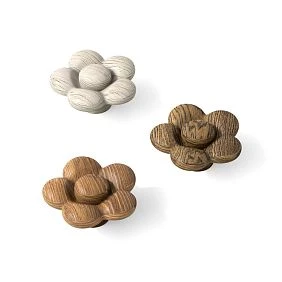
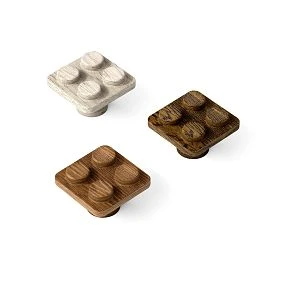
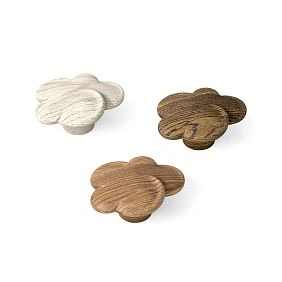
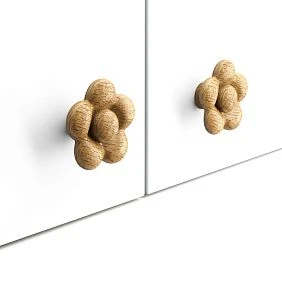
Wooden furniture handles they are selected according to the front and the opening method. For a small drawer, a tall door, and a wide pull-out front, the position of the hand will be different. First choose the type of grip, then the length and appearance.
With a single mounting point, check the position of the handle and the intended method of fixing it. With two or more, check the dimensions between the mounting points. The external length of the part does not replace the center-to-center distance, especially when replacing handles on finished furniture.
For example, handles HL-011 the product page lists the variants A × B × C × D: 180 × 40 × 25 × 128 mm and 260 × 40 × 25 × 192 mm, as well as other sizes. For ordering, the entire row of the selected variant matters. The model name without the size is not enough, and the hole pattern is checked against the drawing.
The HL-011 description also states that the mounting kit is included in the price. This is a condition of this model and should not be automatically transferred to other handles. The contents of the kit and the suitability of the fasteners for the actual front thickness are clarified during selection.
Try the handle together with the overlay or frame. The finger should fit freely into the grip area; protruding decor should not interfere with hand movement. On corner furniture, additionally check the opening path and possible contact with the adjacent front.
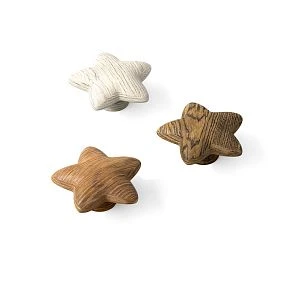
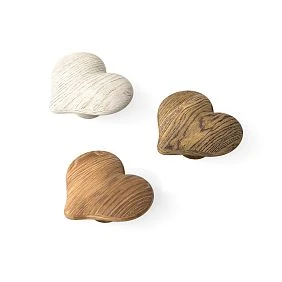
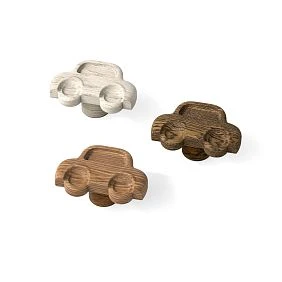
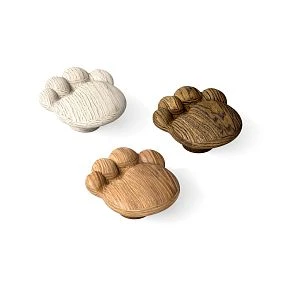
For a custom color, the following are provided uncoated furniture handlesIf a ready-made component is needed, they compare it Handles with Finish with the actual facade. Color and gloss are agreed upon before purchasing the entire batch.
Carved wooden decor: choose a place in the composition
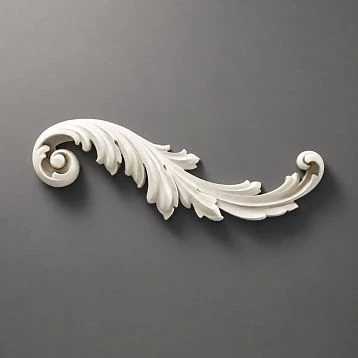
In the section wooden carved decoration they look for details for a specific area of the furniture: the central panel, corner, vertical strip, or top finishing element. This order is more useful than choosing an ornament without reference to the cabinet.
Ready-made carved geometry saves the workshop from making this pattern from scratch. But even for a few pieces, a purchase is justified only when the execution fits in size, direction, and installation. A small quantity alone does not make any mass-produced element a good choice.
For asymmetric decor, check the left and right versions. Rotating one piece does not always create a mirrored pair: the direction of the ornament and the position of the contact plane change. In the order, the sides are recorded as separate lines.
If the furniture has several facades, evaluate the repetition of the pattern across the entire piece. The same overlay may fit on each door but be excessive on a narrow top drawer. Sometimes a different size of the same model is required, sometimes a simpler element.
Decorative overlays: from free field to size
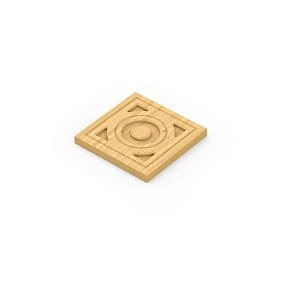
for decorative overlay for furniture measure the free field, not the entire facade. It excludes the frame, handle, junction zones, and areas where the relief would interfere with opening.
Let's show the selection using a specific model. For wooden decor N-002 there are versions 140 × 77 × 12, 160 × 88 × 14 and 200 × 110 × 17 mm. Let's take a conditional free field of 180 × 100 mm and place the piece in the center in the corresponding orientation.
| Version N-002, mm | Remaining on the sides | Remaining on top and bottom | Preliminary result |
|---|---|---|---|
| 140 × 77 × 12 | 20 mm each | by 11.5 mm | You can check the composition and relief |
| 160 × 88 × 14 | 10 mm each | 6 mm each | The field is filled more densely |
| 200 × 110 × 17 | The piece is wider than the field | Detail extends beyond the field | Does not fit in the specified field |
This is a geometric comparison, not a spacing standard. Even the first option requires checking the shape, mounting, and projection. As the size increases, the depth of the relief changes too: a different three-dimensional product is selected, not simply a wider image.
If there is no suitable size, consider another item code. Trimming a finished carved overlay can disrupt the pattern and the mounting contour; it cannot be assumed in advance to be a standard fitting method.
Wooden rosettes for the center and joints of the frame
Wooden sockets are used as a standalone accent or as part of a composition with linear profiles. For the center of the facade, check the overall dimensions and the free field; for the corner of the frame, also check the junction with the moldings.
A round shape by itself does not mean that any profile can be conveniently brought up to it. Compare the width of the molding, the projections of both products, and the type of junction. If the difference in level should be noticeable, show it on a sketch; if a continuous line is needed, check it on samples.
The quantity is counted by placement points. One central rosette on each of the three doors — three pieces. Four corner rosettes on each of the three frames — that is already twelve. You need to multiply the approved layout, not the number of facades by itself.
Brackets and three-dimensional details
Wooden Brackets are selected by their appearance from the front and side. A deep detail may look good under the upper band but protrude into the passage, interfere with the door, or not fit under the shelf.
Check the height, width, depth and the actual contact surfaces. For a pair, confirm the installation direction. An image of a single bracket does not automatically show how the opposite side of the furniture will look.
Determine the role of the part separately. Decorative finishing of a side assembly and support of a loaded shelf require different confirmations. For load-bearing use, data on the model, fastening and base are needed. In the absence of such data, the load must be borne by the assembly provided for in the design, and the decorative part is selected to match it.
Capitals are assessed in a similar way: the base is matched to the post or pilaster, the upper contour to the band, and the side projection to the adjacent parts. A beautiful finishing piece should not turn out after purchase to be wider than the space allotted to it.
Mouldings and linear trim: buy the strips, design the cut lengths
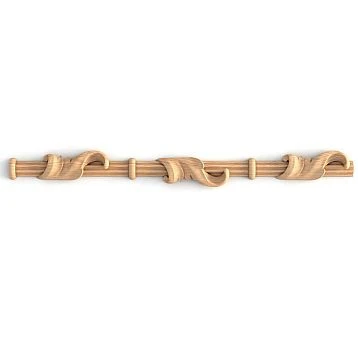
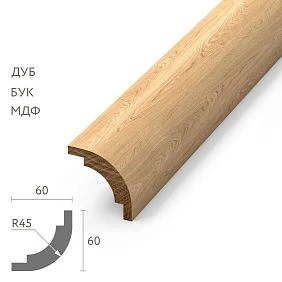
Wooden moldings for furniture they are selected for frames, bands, surrounds and edges. Other linear profiles are conveniently compared in the section solid wood trim. When choosing, check the actual material of manufacture: products made of wood and MDF may sit side by side in the catalogue.
On a facade, the profile occupies a strip of a certain width and projects above the base. These dimensions affect the inner field of the frame, the space for the handle and the fit of the overlay. The length of the cut lengths is set after choosing the cross-section and the method of joining the corners.
To place an order, you need a list of cut lengths and a plan for obtaining them from the stock strips. The total linear metreage serves only as an initial check. For example, a project requires four continuous lengths of 1300 mm, while the nominal length of a strip is 2400 mm. The sum is 5200 mm, which is formally less than the length of three strips, 7200 mm. However, two lengths of 1300 mm cannot be obtained from one strip. Four strips will be required if joints within the lengths are not permitted.
In actual cutting, the saw kerf, end treatment and pattern matching, where required, are additionally taken into account. The values depend on the tool and the profile. A universal allowance of a few percent does not replace laying out the parts by length.
The unit of sale from the product page is carried over into the request: pieces, strips or linear metres. The entry “moulding — 5.2 m” does not explain to the supplier how many product units are needed and which continuous sections the workshop should obtain.
Oak or beech is chosen for the entire visible set
If a dense enamel is required, beech can be considered as a base for the overall furniture color. If it is important to preserve a pronounced wood grain, oak versions are compared. Both species allow different finishing methods; the final decision is made based on the specific part and the test result.
For a clear finish, lay a handle, an overlay and a section of moulding side by side. They may be made from the same species but differ in pattern and base shade. With the same tinting, this difference will not necessarily disappear.
Also specify the type of blank. In in the description of materials and quality of STAVROS the variants of lamination "for enamel" and "for tinting" are listed separately, as well as the quality of surface treatment. Selecting wood by species and the thoroughness of sanding are different characteristics that must be agreed upon in the order.
If the project involves a combination of species, record it explicitly. For example, painted beech supports and oak handles under a clear finish may be a deliberate decision. Accidental replacement of some parts due to stock availability must undergo re-approval of the appearance.
Uncoated or with a ready finish
An unpainted part is convenient when the workshop paints the entire furniture item using its own technology. But the words "without coating" do not mean that any surface is ready for any composition without testing. First, the condition of the item and the requirements of the chosen system are assessed.
For parts with a ready coating, check the color, texture and gloss next to the actual facade. A matching shade name does not confirm a visual match. The difference is especially noticeable between a wide cabinet surface and a small relief that creates its own shadows.
Mounting and finishing materials are selected for the base and assembly sequence. If the decor is glued on, decide in advance what the joint area should be like and when the coating is applied. An arbitrary scheme of "paint everything first, then glue" is not suitable for every composition and base.
Fastening holes, seating areas and contact surfaces must remain suitable for the intended connection. These requirements are communicated to the finisher before work begins, together with a colour sample.
How to assemble a kit for a single chest of drawers
Let's take a conventional chest of drawers with three drawers. The project provides for four supports, two handles per front, one central overlay per drawer and moulding frames. This is an example configuration, not a universal chest of drawers design.
First, the legs are aligned with the lower part of the carcass. Then the handles are positioned: the grip area and the free space between them depend on them. After that, the overlays and moulding lines are test-fitted. As a result, each part is assessed in relation to the others.
| Position | Per chest of drawers | For a series of five chests of drawers | Calculation basis |
|---|---|---|---|
| Legs | 4 pcs. | 20 pcs. | According to the adopted support scheme |
| Handles | 6 pcs. | 30 pcs. | 3 drawers × 2 handles |
| Central overlays | 3 pcs. | 15 pcs. | One per front |
| Molding | According to the cutting map | According to the general cutting map | Taking into account the product length of the strips |
| Additional socket | Only if provided for | According to the approved composition | Not added automatically |
The table data does not include samples and reserve. They are counted as separate items. For moulding, it is advantageous to lay out the series entirely by lengths: suitable offcuts from one product can be used on another if the pattern and surface requirements allow it.
Check the set on a single general drawing. The overlay must not intrude into the handle grip; the moulding must not cross its fastening; the protrusions of adjacent parts must not collide when opening. If one element gets in the way, change its size or position and re-check the dependent items.
Not every product group is needed for every piece of furniture. A chest of drawers with expressive handles can do without central rosettes. Buying a full set of decorative categories is not the goal: you need a set that matches the approved appearance and construction.
When it is worth buying a sample first
A sample is useful if checking against the drawing leaves a significant question: whether the handle is comfortable, how the relief looks at real scale, whether the mounting area is suitable, whether the required colour is achieved. For an already familiar item, a repeat sample purchase is required only when conditions change that need to be checked.
Choose a sample for the task. A small piece of wood helps evaluate the finish but does not confirm handle grip. A single overlay lets you check the relief and fit but does not automatically show the entire paired composition. If the left and right sides matter, try on a pair.
In the section product samples clarify the available options. Verifying a specific component may require the actual product part. The possibility of ordering individually and the scope of delivery are checked for the selected version.
The procedure is short: obtain the part, verify the dimensions, test-fit it, perform a trial finish, and record the decision made. For a surface that must match the facade, keep two linked samples — the decor and the base.
If the sample remains in the workshop, it is not deducted from the working set. If it is intended to be installed on furniture, this is allowed only after assessing its condition: trial drilling, painting, or trimming could have altered the part.
Specification before ordering
It is convenient to order finished solid wood parts for furniture using a single list. In it, each line corresponds to a specific item code and version. Different sizes, materials, and mirrored variants are not combined under a single entry called “carved decor.”
| Field | What to record |
|---|---|
| Position in the furniture | A leg, handle, overlay, or other element with a designation on the drawing |
| Article number | Full product code and link to the product page |
| Size | All parameters of the selected version according to the drawing |
| Material | Beech, oak, or another confirmed material |
| Preparation | Requirements for the blank and surface |
| Finish | Finished execution or own finish with sample number |
| Installation | Joint assembly, required holes and hardware |
| Quantity | Per product, per series; samples and reserve separately |
| Order unit | Piece, set, strip or meter according to sales terms |
For linear mouldings, a cutting plan is attached to the list. For directional elements — a diagram of sides and installation. For a set, its composition is checked: the word "set" may refer to a single assembly rather than the entire furniture item.
Save the date and version of the project. If the cabinet height, overlay or handle size changes, the purchaser must receive an updated list rather than piecing together a decision from several messages with different dimensions.
A single link to a product page does not fix the entire order: several sizes, species and preparation options may be available on the page. The selected parameters are recorded in text next to the item code. Before approving the invoice, this exact record is verified — it must match the execution that the supplier included in the quotation.
What to check in the supplier's quotation
Check the quotation line by line: item code, size, species, preparation, finish, quantity and sales unit. Pay especially close attention to substitutions of execution. The same model in a different species or a different size is already a change to the order.
Prices are compared based on a complete set. In addition to wooden parts, hardware, finishing materials, surface preparation, trial assembly and delivery may be required. Comparing a single price per piece is only useful when the scope of the offer is identical.
If different items have different lead times, assess which one determines the start of assembly or finishing. The legs you receive do not compensate for missing handles, for which the fronts still need to be marked out. Confirm the readiness of the entire set for the required production stage.
When several products are supplied, the marking must allow the parts to be linked to the bill of materials. Before processing, verify the quantity and versions, inspect the surface and check critical dimensions. It is better to identify any discrepancy before applying a finish or modifying a part.
Where to buy solid wood furniture elements
The main selection point is the STAVROS catalog of solid wood furniture elements and other wooden products. It brings together different groups of components; within the required category, you select a specific model and check the material it is made of. The general section also includes MDF products, so the category name does not replace the material line in the product card.
To buy wooden furniture parts for a single project, provide the supplier with a specification and a sketch showing the installation locations. For decor, specify the free fields; for handles, the mounting scheme and front type; for supports, the mounting area; for mouldings, the required lengths. If selection assistance is needed, this data allows suitable options to be discussed concretely.
Do not limit your request to phrases such as “I need to buy carved wooden decor” or “I need furniture parts.” Add the quantity, size, wood species, intended finish and whether a trial sample is needed. Agree the price, availability and lead time for these parameters.
The decision on which solid wood furniture elements to buy should result in a defined order composition: each part has an item code, a place in the furniture and an installation method. With such a bill of materials, you can order samples, confirm the combination of elements and then purchase the entire set for assembly.