Article Contents:
- Why you should buy MN-148
- What is MN-148 and how is it different from a regular wooden support
- Why the shape suits frameless constructions
- Why eight heights are not just a decorative choice
- Why the insert is not glued in advance
- When a metal accent is truly useful
- 100–150 mm: low cabinets, bedside tables and chests of drawers
- 250–450 mm: coffee tables, consoles and accent furniture
- 650–750 mm: tall wall-mounted structures
- How to calculate the final height
- How to choose the height for cleaning and robot vacuum
- How height affects visual scale
- Beech under white enamel
- Beech under black or colored enamel
- Oak under oil or clear lacquer
- Oak for stain or tint
- Why you shouldn't mix wood species in one set
- How to order MN-148 from the desired wood
- When to choose the stainless steel option
- When to choose the brass shade
- How to combine a metal tip with handles
- How to combine the insert with light fixtures
- How metal changes next to colored enamel
- Why you can't choose an insert based on a small sample
- Why separate delivery is convenient
- What to check upon receipt
- Why wood finishing is done first
- When to install the metal element
- How to choose the fixing method
- Practical assembly sequence
- Direct mounting
- Alternative mounting FUR-012
- 10° tilt
- Mounting plate FUR-020
- Why you cannot mix different angles
- What to check when installing at an angle
- What the apron belt does
- Heights 650–750 mm at the wall
- Tall freestanding table
- Makeup table
- How to know that a single tabletop is not enough
- Four legs
- Fifth central support
- Six legs
- Two supports and wall mounting
- Why the quantity cannot be selected by appearance
- How to place an order
- Adjustable foot FUR-029
- Laminate and parquet
- Tile and stone
- Carpet
- How the foot affects the height
- Cabinet
- Commode
- TV console
- Coffee Table
- Makeup table
- Wall-mounted console
- Writing or dining table
- Commercial furniture
- Modern minimalism
- Modern classicism
- Art Deco
- Scandinavian interior
- Eclecticism
- Stone and glass
- Wooden leg with metal insert and fully metal support
- MN-148 and a regular unpainted leg
- MN-148 and a leg with a metal base
- Angled leg and straight leg with a foot
- High leg and ready-made underframe
- Brass color and solid brass
- Silver insert and stainless steel leg
- Need to update an old dresser
- Need a TV console with a light silhouette
- Need a coffee table
- Need a tall wall console
- Need a dressing table
- Need custom furniture for a showroom
- Test swatch
- Beech finish
- Oak finish
- Drying
- Insert assembly
- Furniture installation
- Maintenance
- Height selection based only on photo
- Four high legs without frame
- Oak under dense enamel without reason
- Beech under clear lacquer expecting oak texture
- Random mixing of metals
- Waiting for glued insert
- Incorrect fastening
- Tilt without dimension calculation
- Lack of central support
- Excessive adjustment of the foot plate
- Different batches of oak
- Installation on a thin base
- Painting after metal installation
- Using a heavy countertop without calculation
- Specify the final height of the furniture
- Add a drawing of the base
- Secure the position of the legs
- Describe the finish
- Calculate the entire set
- Check the order of work
- What heights are available for MN-148?
- What is the main part of the leg made of?
- What is the cross-section of MN-148?
- Should I choose beech or oak for white enamel?
- What should I choose for clear varnish?
- Is brass or stainless steel better for black furniture?
- Is the metal insert already glued?
- Can MN-148 be installed at an angle?
- Which kit is needed for direct mounting?
- What is included in FUR-001?
- How is FUR-012 different from FUR-001?
- Is a footpad needed?
- How many legs are needed for a dresser?
- Does MN-148 fit a TV console?
- Can 750 mm be used for a dining table?
- What are heights 650–750 mm suitable for?
- Is a stretcher needed?
- Can oak be painted with enamel?
- How to combine the insert with handles?
- Can I order one leg?
- What to check before payment?

Turned solid wood support with decorative metal insert
Why you should buy MN-148
Short answer: MN-148 is suitable when you need a turned wooden leg with a metal accent and the ability to choose a height from 100 to 750 mm. Beech is convenient for opaque enamel, oak for finishes that preserve texture. The stainless steel insert matches cold hardware, the brass one matches warm golden details. Before ordering, you need to check the furniture base, number of supports, type of fastening, and the need for a stretcher belt.
Buy MN-148 leg Choose fasteners for MN-148
Eight height options. Available in 100, 150, 250, 350, 450, 650, 700 and 750 mm — from a low cabinet to a tall wall console.
Beech or oak. Beech is chosen for white, black, gray or colored enamel; oak for oil, varnish, stain or translucent tint.
Brass or stainless steel. The warm insert complements brass handles and lights, the cold one complements chrome and steel fittings.
Straight or angled position. The leg can be installed vertically or at an angle using a compatible mounting plate.
Metal insert supplied separately. It is convenient to first finish the wooden part, let it dry completely, and then install the metal element.
The set is assembled according to the project. For MN-148, you can choose the FUR-001 or FUR-012 bracket, a mounting plate, and an adjustable foot.
The main mistake is to perceive the MN-148 as a universal decorative leg that can simply be ordered in a quantity of four and screwed to any cabinet. A height of 100 mm and a height of 750 mm create completely different loads on the mounting assembly. A low leg works close to the cabinet and rocks the structure less. A tall leg turns into a long lever, so freestanding furniture requires a more thoughtful base, correct placement of supports, and, in some cases, a stretcher belt.
The material also cannot be chosen separately from the coating. A beech leg is rational for opaque enamel: white, black, gray, or colored. An oak version is needed where the buyer wants to preserve the pronounced wood grain under oil, clear varnish, stain, or semi-transparent tinting. Oak can be densely painted, but then its texture stops contributing to the external result.
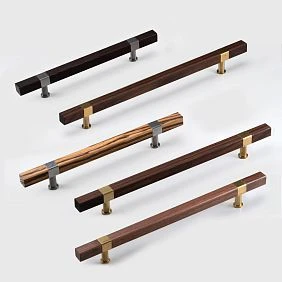
The metal insert remains a decorative part, while the main support is made of solid wood. In the article, the model cannot be called all-brass or all-steel. The buyer chooses specifically the color and character of the metal accent: warm brass or cold silver, resembling stainless steel. To make the set look cohesive, this shade is best coordinated with handles, profiles, lighting fixtures, and other visible metal parts.
If you like the MN-148 shape, but the buyer is not yet sure about the height or installation method, first open the product page and choose the height of the MN-148 leg from 100 to 750 mm. For comparison with other turned and geometric models, you can separately buy unpainted wooden furniture legs in the parent section.




What is MN-148 and how does it differ from a regular wooden support
MN-148 is a cone-shaped turned leg made of solid oak or beech with a separate decorative metal insert. The cross-section of the wooden part is specified as 44 × 25 mm. Visually, the model is built on a gradual taper, so the furniture looks lighter than on massive square supports. The metal lower accent emphasizes the leg line and helps connect natural wood with modern hardware.
Unlike a carved classic leg, MN-148 is not overloaded with ornament. Its expressiveness is created by proportion, the cone, and the transition between materials. Unlike a fully metal support, the model retains the warm feel of wood and the possibility of individual finishing. Unlike a simple unpainted leg without decoration, the metal insert immediately sets the direction for the entire furniture composition.
Our factory also produces:

Why the shape is suitable for frameless constructions
The card positions MN-148 for frameless solutions. This means the leg can be used without a visible traditional apron belt in low and medium furniture with correct base design. But the word "frameless" does not cancel the calculation. The base of the body or tabletop must have sufficient thickness, rigidity, and suitable embedded parts.
Get Consultation
Why eight heights are not just a decorative choice
Height determines the final level of the item, ease of cleaning, seating position, facade proportion, and load on fasteners. A 100 mm leg only lifts the body off the floor. A 450 mm leg already forms a noticeable furniture architecture. Options 650–750 mm practically create the entire height of the support system and require separate stability checks.
Why the insert is not glued in advance
The metal element is supplied separately from the wooden part. This is convenient for finishing: the wood can be sanded, primed, painted, or tinted without covering the metal with painter's tape and risking staining it with the compound. After the coating is completely dry, the insert is installed and fixed using the chosen method.
When a metal accent is truly useful
The insert not only decorates the leg but also helps connect the item with surrounding hardware. On a cabinet, it can match the color of the handles. On a console, it can echo the lamp. On a coffee table, it can support the metal profile or base decor. If there are no other metal parts in the interior, the insert can still become an independent accent, but its color must be chosen deliberately.
Confirmed characteristics of MN-148
| Parameter | Confirmed value | What this gives the buyer |
|---|---|---|
| Model | MN-148 | You can assemble a set of identical supports and select compatible hardware by article number. |
| Type | Turned cone-shaped leg with metal insert | The shape suits modern, transitional, and minimalist classic furniture. |
| Height | 100, 150, 250, 350, 450, 650, 700, or 750 mm | You can choose a low support, a medium furniture leg, or a high support for a wall-mounted structure. |
| Cross-section | 44 × 25 mm | The leg looks slender; the mounting point and load must be calculated according to the project. |
| Wood | Beech or oak | Beech is convenient for painting with enamel, oak — for leaving with visible texture. |
| Preparation | For enamel or tinting | You can coordinate the finish with the facade, countertop, and adjacent parts in advance. |
| Color of the metal insert | Stainless steel or brass look | The accent can be matched with cold or warm hardware. |
| Insert assembly | The metal element is supplied separately from the wooden base. | The wooden part is convenient to finish before final assembly. |
| Order | From one piece | You can replace one support, assemble a standard set of four, or order an extended kit. |
The table helps to quickly understand the model but does not replace the calculation of the finished item. Before ordering, you need to know the body height, base thickness, leg position, and furniture weight. This especially applies to options above 450 mm. For them, it is important not only to choose an attractive size but also to ensure the spatial rigidity of the structure.
How to select the height of MN-148 for specific furniture
The leg height cannot be chosen separately from the body, tabletop, and the way the item is used. The final furniture height consists of the support height, the thickness of the top part, the body height, and any possible base plate. Even a difference of 50 mm noticeably changes the seating, access to drawers, and the perception of the facade.
100–150 mm: low bodies, cabinets, and chests of drawers
The 100 and 150 mm options are suitable for furniture that needs to be raised off the floor without radically changing its character. The 100 mm leg creates a small gap and helps visually separate the body from the floor. It is appropriate for a bedside table, low chest of drawers, TV console, and small furniture cabinet.
A height of 150 mm makes the supports more noticeable. More air appears under the body, cleaning becomes more convenient, and the metal insert reads better. For a heavy chest of drawers, this can be a good proportion if the base is rigid enough and the legs are properly spaced at the corners.
When choosing between 100 and 150 mm, it is useful to place the body on temporary supports of the corresponding height. A photo at eye level will show whether the item has become too tall and whether it has lost connection with neighboring furniture.
250–450 mm: coffee tables, consoles, and accent furniture
Heights of 250, 350, and 450 mm already form a large part of the silhouette. The 250 mm option is suitable for a low coffee table, a small banquet cabinet, or furniture where the body remains visually dominant. A 350 mm leg makes the item lighter and can be used for an accent console, a tall dressing table, or a designer cabinet.
A height of 450 mm is on the border between medium and high supports. Here it is especially important to check the width of the body and the position of the center of gravity. Narrow furniture on long slender legs can look impressive, but with incorrect placement of supports, it becomes sensitive to lateral load.
For a coffee table, first determine the final height of the tabletop. If the top plane should be around the level of the sofa seat, subtract the thickness of the tabletop and the mounting assembly from the desired value. You cannot simply choose 450 mm and then find that the finished table is too tall.
650–750 mm: tall wall-mounted structures
Options of 650, 700, and 750 mm are primarily suitable for lightweight wall-mounted consoles and dressing tables. In such a project, the wall, body, and furniture placement help limit lateral movement. For a freestanding table, four long legs without an additional frame should not be automatically considered a stable structure.
The higher the support, the stronger the lever at the attachment point. A small play at the top turns into noticeable wobbling at the bottom. Therefore, for tall options, a belt frame, a rigid under-table frame, a wide base, or another design system is provided in advance.
A height of 650 mm may suit a dressing table with a relatively thick tabletop or body. Options of 700 and 750 mm allow for a standard or increased working surface height, but the final result is always calculated based on the full structure, not just the leg separately.
How to calculate the final height
Add four values: leg, foot or mounting bracket, body or frame, and tabletop. For a cabinet, add the body height. For a console with a thin tabletop, most of the height comes from the support. For a chest of drawers, legs may account for only a small portion.
For example, a 30 mm thick tabletop on a 700 mm leg will give about 730 mm without considering the plate and foot. If there is a 80 mm high box on top, the total will approach 810 mm. This may be convenient for a tall console, but not for a desk.
How to choose height for cleaning and robot vacuum
The buyer often needs clearance under the body. Check not only the leg height, but also the lower furniture elements, central support, sagging base, and cables. A 100 mm leg does not guarantee free passage if the body is lowered below the mounting plane.
How height affects visual scale
Low supports make the body more substantial. Medium ones give furniture lightness. High ones turn legs into the main architectural element. A metal insert on a 100 mm version reads as a small touch, while on a 750 mm version it appears as a noticeable finish to a long line.
| Height MN-148 | Suitable tasks | What to Check |
|---|---|---|
| 100 мм | Low cabinet, TV console, compact chest of drawers | Clearance under the body and position of the metal insert |
| 150 мм | Chest of drawers, bedside table, lightweight cabinet furniture | Final height of drawers and body stability |
| 250 мм | Coffee table, accent cabinet | Tabletop level relative to the sofa |
| 350 мм | Console with body, vanity furniture, designer table | Body width, load, and fastening unit |
| 450 мм | Tall accent furniture and lightweight structures | Lateral rigidity and center of gravity |
| 650–750 mm | Wall console, vanity table, project furniture | Tsargovy belt, frame, wall and floor attachment, and full height |
Beech or oak: material is chosen based on finish
Both species are suitable for turned furniture supports, but create different visual results. Beech has a calmer and more uniform structure, making it especially convenient for dense enamel. Oak is more pronounced: its pores and grain become part of the design under a transparent or semi-transparent coating.
Beech under white enamel
White beech MN-148 is suitable for a light cabinet, console, or vanity table. The opaque enamel unites the leg with the body, while the metal insert remains a separate accent. For a clean result, it is important to coordinate the shade of white and the degree of gloss.
Beech under black or colored enamel
A black leg with a brass insert creates a striking contrast. Black with a silver insert looks more austere. Gray, green, blue, and other colors can be matched to the facade, but it is better to paint the entire set at the same time to avoid differences between batches.
Oak under oil or clear varnish
This option preserves the natural texture. It is suitable for furniture with a veneered body, oak tabletop, or exposed wood. Before finishing, a test sample is made: oil and varnish noticeably change the depth of color.
Oak under stain or tint
Tinting allows you to pair MN-148 with nutty, smoky, or dark wood tones. The pattern remains visible but becomes richer. A brass insert usually complements warm oak, while a silver one creates a modern contrast.
Why you shouldn't mix wood species in one set
The four legs of a piece of furniture should be perceived as a single batch. Even under opaque enamel, differences in preparation can result in different gloss or texture. Under a transparent finish, oak and beech are clearly different. It's better to order a set from one species and finish it at the same time.
How to order MN-148 in the desired wood
After choosing the finish, you can order MN-148 in oak or beech. In the product card, before payment, you need to check the height, preparation, and color of the metal insert.
Brass or stainless steel: how to choose the color of the metal insert
The metal insert on MN-148 is not an independent load-bearing leg, but a decorative finish for the wooden support. Its color affects the entire character of the piece. A warm golden shade makes the furniture more elegant and closer to modern classics, art deco, and interiors with brass fittings. A cool silver option supports minimalism, gray palettes, chrome, and stainless steel surfaces.
When to choose the stainless steel option
A silver insert suits furniture with chrome or steel handles, black-and-gray appliances, metal profiles, and cool-toned lighting. It looks calm on white or gray enamel. On natural oak, it creates a contrast between warm wood and cool metal.
This option works well in a study, modern living room, hallway, and interiors with stone or glass. It doesn't have to exactly match every metal item, but it's advisable to maintain the shade direction: cool details next to bright yellow brass may look accidental.
When to choose a brass shade
A brass insert naturally pairs with oak, walnut tones, warm white, deep green, burgundy, and black. It complements gold handles, sconces, frames, profiles, and decorative overlays. On a vanity or console, brass can serve as a link between legs and a mirror or light fixture.
There's no need to turn the entire interior into a set of identical gold details. It's enough to repeat the metal in two or three places. For example, the brass insert MN-148, furniture handles, and the base of a desk lamp create a clear connection without overloading.
How to combine a metal tip with handles
If handles are already chosen, use them as a reference. Chrome and nickel models usually pair with a stainless steel option. Brass, bronze, and gold ones pair with a warm insert. When mixing metals, make one shade primary and the other secondary.
For furniture without visible handles, a metal insert can be the only accent. Then its color is tied to lighting, hinges, legs of adjacent items, or decorative profiles.
How to combine the insert with lighting
A wall-mounted console often stands under a mirror and next to sconces. If the lights are brass, the warm insert MN-148 completes the composition. For silver pendants, steel tracks, and chrome sconces, a cool option is more logical. Exact alloy matching isn't necessary, but the difference shouldn't be too stark.
How metal changes next to colored enamel
On a black leg, brass looks contrasting and decorative, while a silver insert looks graphic and restrained. On white enamel, both appear softer. On a blue, green, or burgundy surface, brass adds warmth, steel makes the object more modern.
Why you shouldn't choose an insert based on a small sample
On the card, the metal is shown large, but in the finished furniture it will be repeated four or five times. One brass detail seems delicate, but a whole row can become the main decorative motif. It's useful to create a visualization or attach a piece of metallized paper of the desired shade to the furniture leg mockup.
Is the metal insert supplied glued
The metal element is supplied separately from the wooden part. This is an important characteristic to consider in the assembly schedule. The buyer gets the opportunity to finish the wood without the risk of staining the metal, but must arrange the final fixation of the insert after the coating has completely dried.
Why separate delivery is convenient
When painting with enamel, there is no need to cover the metal with tape. During tinting, the compound does not get on the insert and does not change its shine. The wooden part can be sanded between layers, freely held and dried. After finishing, the metal element is installed on a clean surface.
What to check upon receipt
Lay out all wooden legs and metal parts by sets. Check the quantity, color of inserts, uniform height, and surface condition. Before painting, perform a dry fit to ensure the parts match each other.
Why wood finishing is done first
If the insert is glued in advance, primer and paint can get on the metal. Attempting to clean them after drying can leave scratches. Toning around an already installed element is often uneven. Separate finishing provides a neater material boundary.
When to install the metal element
Only after the finish coating has completely dried and gained strength. Enamel that feels dry to the touch may still be soft. Early pressure from the insert will leave a mark or glue parts with a weak layer.
How to choose the fixing method
The specific adhesive and technique must be compatible with the metal, wood, and finish. Do not use random glue that damages the varnish or does not adhere to smooth metal. It is best to clarify the method in the product card, with a manager, or with a finishing specialist.
Practical assembly sequence
- check the quantity of legs, inserts, and fasteners;
- perform a trial dry assembly;
- disassemble the set and prepare the wooden surface;
- apply enamel, oil, varnish or tint;
- allow the coating to dry completely;
- install and secure the metal insert;
- mount the legs on the furniture;
- check the geometry, stability and contact with the floor.
Straight or angled leg placement
MN-148 can look different depending on the angle. Vertical installation emphasizes slimness and makes the furniture calmer. Angled creates a more dynamic silhouette, visually widens the base and can support the mid-20th century furniture style. But the angle cannot be set just "by eye".
Straight mounting
The vertical position is easier to calculate. The leg axes point downward, and the overall dimension of the item almost matches the body. This option is suitable for cabinets, chests of drawers, consoles and coffee tables where compactness is important.
For threaded connection, you can buy FUR-001 mounting kit for furniture legs. It includes an M8×60 stud and an M8×13 metal insert. Compatibility with the base, material thickness, and mounting holes should be checked before drilling.
Alternative mounting FUR-012
The FUR-012 kit includes a round mounting plate and a stud. It is convenient when the threaded assembly needs to be placed on a separate metal base attached to the body or tabletop. Before choosing, you can view the FUR-012 mounting kit and compare it with FUR-001 in terms of base design.
Tilt 10°
A special plate is used for the designed tilt. You can buy the 10° mounting plate FUR-017, made of wood with an M8 metal insert. It sets a uniform angle and helps avoid discrepancies between the four supports.
The tilt increases the external dimensions of the furniture. The lower points spread out to the sides, so the item requires more space. In a narrow passage or near a baseboard, this can become a problem. Marking is done not only at the upper attachment points but also based on the future position of the legs on the floor.
Mounting plate FUR-020
For a different base scheme, you can select the mounting plate FUR-020. This is a wooden plate for attaching furniture supports and structural parts. Its purpose and geometry must be matched to the project, not chosen solely by appearance.
Why you cannot mix different angles
If one leg is installed slightly more vertically, it will bear the load differently and disrupt the overall silhouette. On long supports, the error becomes more noticeable. All plates and templates must be identical, and the marking must be repeatable.
What to check during angled installation
- increased floor footprint;
- distance to the edge of the body;
- tilt direction of each support;
- thread and plate compatibility;
- base thickness;
- need for an adjustable ball joint foot;
- stability under lateral load;
- accessibility of fasteners after assembly.
When a tall option requires an apron belt
MN-148 is intended for apronless constructions, but this does not mean that an apron is never needed. For a low cabinet, the body itself acts as a rigid box. For a tall console with a thin tabletop, such a box may not exist. The longer the leg and the freer the item stands, the more important the connection between supports.
What the apron belt does
Aprons connect the legs into a single frame and reduce lateral swaying. They distribute the load, support the tabletop, and reduce stress at individual fastening points. For tall freestanding furniture, this is a structural element, not just a decorative detail.
Heights 650–750 mm at the wall
A lightweight wall-mounted console can work without a massive visible apron if the base is designed, the body is rigid enough, and the furniture is not used as a freestanding table. In some projects, the console is additionally fixed to the wall. The method must be planned in advance.
Tall freestanding table
Four legs 700 or 750 mm high under a heavy tabletop create strong lateral load on the fasteners. Without a frame, the item can wobble even with quality components. For a dining or writing table, calculation of aprons, underframe, or other reinforcement is needed.
Vanity table
If the table stands against a wall, has a shallow body with drawers and light load, tall MN-148 may be suitable. The body connects the supports and adds rigidity. But when a person leans on the edge of the tabletop, a lateral moment occurs, so the base and fasteners are still checked.
How to understand that a single tabletop is not enough
A thin slab without a frame bends, and the fastening points work separately. If the legs noticeably move with light lateral force on the mockup, additional connection is needed. Do not try to eliminate wobbling by tightening screws harder: the problem lies in the overall geometry.
How to calculate the number of legs
The standard scheme is four supports at the corners. But a long cabinet, heavy chest, or wide console may require an additional central leg or internal support frame. The quantity is determined by dimensions, body weight, base deflection, and partition placement.
Four legs
Suitable for compact and medium furniture with a rigid body. All supports must have the same height, material, insert, and fastening. It is better to order the set in one batch, especially if the oak remains under a transparent coating.
Fifth central support
May be needed for a long dresser or cabinet to support the middle of the base. It is placed under an internal partition or reinforced area. The fifth leg cannot be screwed to a thin bottom without a mounting plate.
Six legs
Used on very long cabinets: four at the corners and two in the middle zone. This scheme requires precise adjustment of contact with the floor. If one support is shorter or the floor is uneven, the furniture will wobble.
Two supports and wall mounting
Some consoles are designed with front legs and rear wall fixation. MN-148 can be part of such a solution, but it must be designed as a single structure. You cannot simply remove the two rear legs without a reliable wall bracket.
Why the quantity cannot be chosen based on appearance
Four slender legs look lighter, but a long base may sag. An additional support is sometimes hidden in the center and hardly affects the design, yet it supports the cabinet. The designer evaluates not only aesthetics but also the base's performance.
How to place an order
Count all visible and hidden supports, add hardware to each point, and determine the glides. If one leg is central, its height and bottom contact must match the others. For complex tinting, consider one spare unit processed together with the set.
How to protect the floor and compensate for minor unevenness
The lower metal insert does not cancel the foot pad. The floor covering, installation method, and furniture height determine whether a soft, standard, or adjustable element is needed. For a tall leg, it is especially important that contact with the floor does not create a tilt.
Adjustable foot pad FUR-029
You can buy adjustable foot pad FUR-029, to compensate for minor floor unevenness and improve support contact. It has a ball joint, which is especially useful when the leg is positioned at an angle.
Adjustment should not fix serious structural curvature. If the difference between legs is large or the base is assembled with a tilt, first eliminate the cause. The foot pad is intended for fine-tuning, not for masking errors of centimeters.
Laminate and parquet
Clean contact without sharp edges and sand is needed. Even a soft foot pad surface can scratch the floor if dirt accumulates underneath. Furniture should not be dragged: it should be lifted and moved.
Tile and stone
Hard floors often have minor unevenness at seams. An adjustable foot pad helps level the furniture. On smooth tiles, additionally evaluate slipping.
Carpet
Long pile compresses unevenly. After installation, the furniture needs to be rechecked after some time. Tall consoles on soft carpet may seem less stable, so the location and load should be assessed in advance.
How the foot pad affects height
It adds a few millimeters and can change the appearance of the lower node. In precise design, this is included in the overall height. On four legs, the adjustable elements are set sequentially, controlling the level of the tabletop and even contact.
How MN-148 works in different furniture items
Cabinet
For a bedside or furniture cabinet, 100–150 mm is usually suitable. The supports lift the body, make cleaning easier, and make the metal insert noticeable. It is important to check the final height of the top surface relative to the bed or seat.
Chest of drawers
Low and medium options help change the proportion of a heavy body. A long dresser may require a central support. An oak leg for tinting is paired with a wooden facade, a beech leg for enamel with a painted body.
TV console
A height of 100 or 150 mm is usually more convenient than tall options: the screen remains at a comfortable level, and the body does not look too raised. Check the cables and the central load from the equipment. A long console needs mid-support.
Coffee table
Options of 250–450 mm are chosen based on the sofa height and tabletop thickness. For a light round or small rectangular table, four MN-148s create a slim silhouette. A heavy stone tabletop requires separate calculation and suitable fastening.
Vanity table
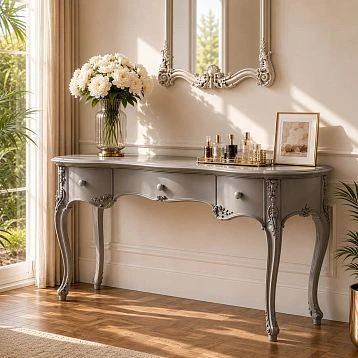
Tall legs of 650–750 mm allow for a working height with a thin body. A wall-mounted position and a drawer box add rigidity. The brass insert pairs well with a mirror frame and warm-toned lights.
Wall console
This is one of the most logical scenarios for long MN-148s. A narrow tabletop, shallow depth, and wall placement create a lightweight piece. However, the console cannot be used as a support for a person if the structure is not designed for such a load.
Writing or dining table
A high leg can be part of the project, but four separately attached supports without stretchers cannot be considered a finished safe table. A frame, a rigid tabletop, and calculation of joints are needed. For daily load, stability remains the priority.
Commercial furniture
In a showroom, hotel, restaurant, or shop, MN-148 can be used in consoles, counters, or display furniture. Frequent use increases requirements for fastening and coating. Before serial ordering, it is useful to assemble one test sample.
How to combine MN-148 with style and other materials
Modern minimalism
For minimalist furniture, beech under white, gray, or black enamel with a silver insert is suitable. The leg remains slender, and the metal supports handles and profiles. It is important not to overload the body with additional decor: expressiveness is already created by the combination of two materials.
Modern Classic
Oak with warm tinting and a brass insert pair well with paneled facades, brass
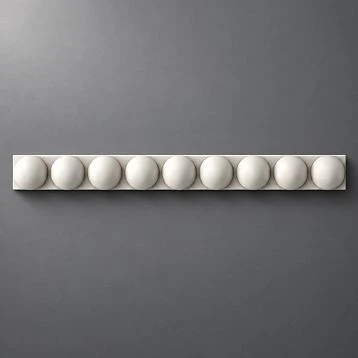
Art Deco style is renowned for its love of ornamentation, symmetry, and refined details. The molded decoration NPU-422 can become an excellent complement to geometric motifs and contrasting color combinations characteristic of this style. Try highlighting it with metallic paint or patina — and you’ll get an eye-catching detail that’s hard to look away from.
Black or deep colored enamel with a brass accent creates a more decorative look. The legs can be linked to gold handles, mirror frame, and lighting fixtures. There is no need to add too much gloss: it is enough to repeat the metal in a few key points.
Scandinavian interior
Light oak under a clear coating and a silver insert give a calm combination. For a white body, beech under enamel can be used, keeping the metal as a small accent. The height is chosen moderate so that the furniture remains light but does not lose stability.
Eclecticism
MN-148 allows combining a painted body, a natural tabletop, and metal. In an eclectic interior, this is useful, but the connection must be intentional. If the legs are brass, the handles are chrome, and the light fixture is black, the item may look random. One metal is made leading.
Stone and Glass
With a glass or stone tabletop, slender legs look expressive, but the load and fastening become critical. A heavy slab requires a reinforced frame, while transparent glass reveals the entire mounting assembly. The project cannot be built solely on a decorative picture.
What to buy together with MN-148
A set of supports without fasteners and foot pads is not yet a finished furniture system. The buyer needs to determine the method of connection to the body, the installation angle, and the contact with the floor. At the same time, you should not buy all the fittings at once "just in case": FUR-001, FUR-012, FUR-017, and FUR-020 solve different tasks.
| What to add | Why this is needed | Suitable scenario | What to Check |
|---|---|---|---|
| Fastening kit FUR-001 | Creates a threaded assembly from an M8×60 stud and an M8×13 insert | Direct fastening to a suitable wooden base | The thickness of the material, mounting holes, and access for installation |
| Fastening kit FUR-012 | Uses a round mounting plate and a stud | Base where a separate metal plate is more convenient | Plate size, body mounting, and load |
| Mounting plate 10° FUR-017 | Sets the same tilt for supports | Coffee table, cabinet, or console with angled legs | Furniture footprint on the floor, M8 thread, and base strength |
| Mounting plate FUR-020 | Provides an alternative wooden mounting assembly | Custom furniture with a separate mounting plate | Compatibility with a specific scheme and plate dimensions |
| Adjustable foot FUR-029 | Compensates for minor unevenness and improves floor contact | Tile, uneven base, angled supports | Seating, additional height, and appearance of the lower joint |
| Other wooden furniture legs | Allow comparing shapes and selecting a different scale | MN-148 does not fit in height, style, or load capacity | Size, material, attachment, and purpose of each model |
For a standard set, the same number of fastening units and glides as legs is usually required. If a central support is used, hardware is also counted for it. Angled plates cannot be installed on only part of the set: all visible supports must have the same geometry.
How not to confuse MN-148 with similar products
Wooden leg with metal insert and fully metal support
In the MN-148, the main load-bearing part is made of solid wood, while metal is used as a decorative insert. The all-metal leg has a different design, rigidity, and attachment method. Comparing them only by the color of the tip is incorrect.
MN-148 and a regular unpainted leg
A simple wooden support does not create a metal accent and blends more easily into all-wood furniture. The MN-148 is chosen when metal should be part of the design. If there is no related detail in the interior, a regular leg may be calmer.
MN-148 and a leg with a metal base
In some models, the metal part is a reinforced mounting base. In the MN-148, it is a decorative insert in the lower part. You cannot transfer the characteristics and attachment methods of another model to it.
Angled leg and straight leg with a foot
The angle is set by the mounting plate and the entire axis of the support. The adjustable foot only adapts to the contact angle and minor irregularities. It does not turn a vertically installed leg into a designed angled one.
Tall leg and ready-made underframe
Four 750 mm supports are not equal to a ready-made underframe. The underframe already connects the legs with a frame. Tall MN-148 legs require designing aprons or another rigid system.
Brass color and solid brass
The description refers to the color of the metal insert. The main leg remains wooden. Do not promise the properties of a solid brass support or call the entire element brass.
Silver insert and stainless steel leg
Similarly, the stainless steel option describes the metal accent, not the material of the entire support. This is important for expectations regarding weight, rigidity, and maintenance.
Practical selection of MN-148 for specific situations
Need to update an old dresser
Measure the body, bottom thickness, and location of internal partitions. For most dressers, it is reasonable to start with 100 or 150 mm. If the old legs were attached differently, the base may require embedded parts. Beech under enamel will allow matching the body color, oak will create contrast.
Need a TV console with a light silhouette
Choose low supports so the screen is not too high. Check the body length and add a central leg if necessary. The silver insert pairs well with electronics and black profiles, the brass one with warm wood and decorative hardware.
Need a coffee table
First, determine the tabletop level relative to the sofa. Then subtract its thickness and the mounting assembly. For a slanted silhouette, use identical FUR-017 plates and account for the base expansion on the floor.
Need a tall wall console
Consider 650–750 mm, but do not limit yourself to four fastenings. Think through the body, crossbars, or wall fixation. Do not place a heavy stone on such a console without calculation. A brass insert can connect the legs with the mirror and sconces.
Need a dressing table
Check the seating height, drawer body thickness, and legroom. High supports must be connected by the body. Metal can be repeated in handles and lights. Beech under enamel is convenient for precise furniture color.
Need custom furniture for a showroom
Assemble a prototype of one support with finish, insert, and fasteners. Check the visual effect under exhibition lighting and stability during daily use. Only after that order the series.
Preparation, finishing, and final assembly
MN-148 is supplied without a ready coating, so finishing becomes part of the project. It must protect the wood, emphasize the chosen material, and match the body. You cannot assume that an unpainted support can simply be screwed to the furniture: exposed wood gets dirty faster, and accidental stains are absorbed unevenly.
Test paintout
Before the entire batch, prepare one sample from the same wood species. For beech, check the primer, enamel color, and gloss. For oak, check the tint and clear finish. The composition on a small flat board may look different than on a turned conical shape, so it is better to use a real leg or a profile of similar geometry.
Finishing of beech
Beech under enamel requires uniform preparation. The surface is cleaned, primed, and painted with a system compatible with furniture. A too-thick layer on the lower seat may hinder the installation of the metal insert, so the connection points are protected or processed according to the master's technique.
Oak finishing
Tinting should emphasize the pores, not turn them into dirty spots. The compound is applied evenly and excess is removed. Under a clear varnish, any scratches and glue marks become more noticeable, so the surface is inspected under side lighting.
Drying
The coating must not only dry to the touch but also gain sufficient strength. If the metal insert is installed too early, it will leave an imprint or damage the layer. The time depends on the chosen material and room conditions.
Insert assembly
After drying, a second fitting is performed. The metal should sit evenly and identically on all legs. Excess glue is immediately removed using a safe method without damaging the finish. The parts are left in a stable position until fully cured.
Mounting to furniture
Before installation, mark the axes and offsets from the corners. All fasteners must be identical. The legs are screwed in without excessive force, controlling verticality or the design angle. After assembly, the furniture is placed on a level base and the diagonals are checked.
To keep the decor attractive, it is enough to periodically wipe it with a soft dry or slightly damp cloth. For heavy soiling, use a mild soap solution. Avoid aggressive chemical agents and stiff brushes, which may damage the finish.
Painted or varnished wood is wiped with a soft cloth. Aggressive solvents and abrasives may alter the gloss. The metal insert is cleaned with a compound compatible with its surface, avoiding contact with the wood.
Mistakes when purchasing MN-148
Choosing height only from a photo
On the card, all options look proportional, but in real furniture, 100 and 750 mm solve different tasks. The final height must be calculated together with the body and tabletop.
Four high legs without a frame
The buyer assembles a freestanding table and gets wobbling. For 650–750 mm, checking the aprons, underframe, and fastening is necessary. Height increases lateral load.
Oak under dense enamel without reason
The buyer pays for expressive wood, then completely covers the texture. If the pattern is not needed, beech under enamel is usually more rational.
Beech under clear varnish expecting oak texture
Beech has a different visual character. For pronounced pores and natural tinting, oak is chosen.
Random mixing of metals
Brass legs, chrome handles, and bronze fixtures can create a mismatch. Before ordering, determine the dominant metal shade.
Waiting for glued insert
Metal element is supplied separately. Its assembly must be included in the schedule and a compatible fixing method must be selected in advance.
Incorrect fastener
FUR-001, FUR-012 and mounting plates are not interchangeable by default. They are selected based on the base and layout. You cannot buy the cheapest kit and adjust the furniture to fit it after manufacturing.
Tilt without dimension calculation
The lower points of the legs extend beyond the body contour and obstruct passage. Before drilling, draw the furniture position in the plan.
Lack of central support
The long bottom of the dresser sags. An additional leg or frame must be provided before finishing and ordering the full set.
Excessive adjustment of the support pad
One leg is noticeably extended, and the furniture looks skewed. Adjustment is intended for minor variations. A serious error is corrected in the design.
Different batches of oak
Some leg parts are purchased later, resulting in a different pattern. For a clear finish, it's better to buy the set at the same time.
Mounting to a thin base
The insert or plate does not have enough material for reliable fixation. An embedded part, reinforcement, or a different joint is needed.
Painting after metal installation
Enamel gets on the insert, and the border looks messy. It's better to finish the wood separately and assemble after drying.
Using a heavy tabletop without calculation
A slim appearance does not mean unlimited load. Stone, massive slab, and glass require base design.
Who MN-148 is really suitable for
- for a cabinet, chest of drawers, or TV console on legs 100–150 mm;
- for a coffee table and accent furniture on legs 250–450 mm;
- for a lightweight wall-mounted console or vanity table on high legs with calculated rigidity;
- for painted furniture, if beech is chosen under enamel;
- for furniture with open wood texture, if oak is chosen for tinting;
- for an interior with brass or silver hardware;
- for a project where straight or identical angled installation is required;
- for custom furniture, for which a set of hardware is selected in advance;
- for body restoration, if the base can be reinforced and re-marked;
- for a commercial interior after testing a prototype.
When it's better to choose a different leg or ready-made underframe
- a fully finished painted support is needed without separate finishing;
- the project requires an all-metal structure;
- the heavy freestanding countertop has no frame or aprons;
- the height from eight options does not match the calculation;
- the base is too thin and cannot be reinforced;
- the furniture must have a massive carved classic support;
- the metal accent is not connected to the rest of the interior;
- a different type of lower node is needed for the floor;
- the buyer is not ready to arrange finishing and assembly of the insert;
- the structure must withstand the load for which a special engineered support is needed.
How to buy MN-148 on STAVROS
First, determine the finished height of the item. Subtract the body, tabletop, plate, and foot from it. Then choose a straight or tilted position and check the base. For options above 450 mm, separately address the issue of the apron belt or frame.
After the structural check, move on to the appearance. For opaque enamel, choose beech; for transparent finish, choose oak. Pair the silver insert with chrome and steel, the brass insert with golden handles and warm lamps.
Then calculate the number of supports, including central and spare ones, and select fittings for each point. If a vertical threaded installation is needed, you can choose FUR-001 or FUR-012. For a 10° angle, choose FUR-017. For small floor level differences, choose FUR-029.
After that, open the product card and buy the MN-148 set with a brass or steel insert, after checking the height, wood, and current conditions. If the model is not suitable, in the general category you can Buy wooden furniture legs of a different shape and size.
How to prepare a request for a furniture maker or manager
Even if the buyer has already chosen MN-148, a single phrase "need four legs 700 mm" is not enough. For an accurate selection, a short specification is needed, which includes all the parameters of the structure. Such a document helps to avoid confusing the height, material, metal, and fittings, and also shows the weak points of the project in advance.
Specify the final height of the furniture
Record not only the support size, but also the desired level of the tabletop or body from the floor. Next to it, indicate the thickness of the top part, the height of the drawers and the mounting unit. This way, the specialist can check whether the item will turn out higher or lower than the calculation.
Add a base drawing
The diagram should show the length and width of the body, the thickness of the bottom, internal partitions, and locations of embedded parts. For a long chest of drawers, mark the central support. For a tall console, indicate the apron belt, frame, or wall attachment points.
Fix the position of the legs
Specify straight or angled mounting. For an angle, indicate the direction of each support and the external floor dimension. This is especially important for a narrow hallway, where protruding legs may obstruct passage or hit the baseboard.
Describe the finish
For beech, specify the enamel code and gloss level. For oak, specify the type of tinting, oil or varnish, and desired saturation. Add a photo of the facade or a material sample. Mark the metal insert separately: brass or a stainless steel option.
Calculate the entire set
The specification includes legs, inserts, fastening kits, mounting plates, and glides. If there are five or six supports, hardware is needed for each. Separately, record one spare leg if the project is large and requires a uniform transparent finish.
Check the order of work
First, wooden parts and fasteners are fitted, then the legs are finished, after complete drying, metal inserts are installed, and only then the furniture is assembled. This order reduces the risk of staining the metal, damaging the enamel, or discovering incompatibility after finishing.
Final check of the set before payment
Before ordering, break the project down into four questions. Is the height suitable? Will the base support it? Does the finish match? Is all the hardware present? If there is no exact answer to at least one question, it is better to stop and clarify the parameters.
For low furniture, check the clearance and position of drawers again. For tall furniture, check the stretchers and stability. For oak, check the pattern and test tinting. For painted beech, check the color and gloss. For angled installation, check identical plates and contact of the glides with the floor.
Also verify that all legs have the same height, same wood species, and same color of the metal insert. A random mix of brass and silver elements is immediately noticeable. After receiving the kit, inspect it before painting and installation, while possible issues can be resolved without reworking the finished furniture.
For serial furniture, it is useful to keep a separate sample of the finished MN-148 and a photo of the mounting assembly. This makes it easier to repeat the kit when expanding the project, restore a damaged support, or order an additional cabinet without re-selecting the shade, insert, and fasteners.
FAQ: questions about the furniture leg MN-148
What heights of MN-148 are available?
100, 150, 250, 350, 450, 650, 700 and 750 mm. The final height of the furniture is calculated with the body, tabletop, mounting, and glide.
What is the main part of the leg made of?
Made from beech or oak. Metal is used in the decorative insert.
What is the cross-section of MN-148?
The diagram shows a cross-section of 44 × 25 mm. The exact parameters of the selected height should be checked in the card and drawing.
Should I choose beech or oak for white enamel?
Beech. It is rationally suitable for opaque painting where the wood texture should not be visible.
What should I choose for clear varnish?
Oak for tinting if a pronounced natural texture is important.
Is brass or stainless steel better for black furniture?
Both options are suitable. Brass creates a warm decorative contrast, a silver insert is more strict and modern.
Is the metal insert already glued?
No, it is supplied separately from the wooden part. This allows the wood to be finished first.
Can the MN-148 be installed at an angle?
Yes, when using a suitable mounting plate and calculating the dimension. For a 10° angle, FUR-017 is suitable.
What kit is needed for direct mounting?
You can consider FUR-001 or FUR-012. The choice depends on the base material and the desired node design.
M8×60 stud and M8×13 metal insert.
How does FUR-012 differ from FUR-001?
FUR-012 uses a round mounting plate and a stud, while FUR-001 uses a stud and an insert installed into the base.
Is a footplate needed?
Is a footplate needed?
Depends on gender and scheme. FUR-029 helps compensate for small irregularities and is suitable for precise adjustment.
How many legs are needed for a dresser?
Usually four, but a long body may require a fifth central or six supports. The decision is made based on the rigidity of the bottom and partitions.
Is MN-148 suitable for a TV console?
Yes, especially heights of 100–150 mm. For a long console, you need to check the central support.
Can 750 mm be used for a dining table?
Only in a designed structure with aprons, frame, or underframe. Four high supports without reinforcement do not guarantee stability.
What are heights of 650–750 mm suitable for?
Primarily for lightweight wall-mounted consoles and dressing tables with a rigid body or additional frame.
Is an apron belt needed?
For tall freestanding items, often yes. It connects the legs and reduces wobbling.
Can oak be painted with enamel?
Technically possible, but its expressive texture will be covered. If you need a dense enamel, beech is usually more practical.
How to combine the insert with handles?
The silver option goes with chrome and steel, the brass one with golden and warm metal details.
Can I order just one leg?
Yes, the model is available from one piece. For furniture, it's better to order the set in one batch.
What should I check before payment?
Height, quantity, wood species, preparation, insert color, mounting, glides, need for stretchers, and current conditions in the product card.
Bottom line: MN-148 is chosen as part of a structure, not as a standalone decor
MN-148 combines a turned wooden form, eight height options, and a metal accent in brass or stainless steel. The model suits low case furniture, coffee tables, consoles, and tall project structures, but each scenario requires its own calculation.
Beech is chosen for opaque enamel, oak for finishes that preserve the texture. The metal insert is installed after finishing the wooden part. For installation, FUR-001, FUR-012, FUR-017, FUR-020, or the adjustable foot FUR-029 are selected in advance.
The most important thing before ordering is to check the total height, base rigidity, and number of supports. Tall freestanding items require a belt frame or other frame. On the STAVROS website, you can order the MN-148 set in oak or beech and assemble a fastening system for specific furniture without random mismatches in height, finish, and installation.