Article Contents:
- What is confirmed about MN-205 and what to check before ordering
- Why the leg height does not equal the height of the finished furniture
- Five heights of MN-205 — five different designs
- MN-205 with a height of 250 mm: low furniture with a noticeable gap
- MN-205 with a height of 350 mm: bench, coffee table, and tall cabinet
- MN-205 with a height of 450 mm: expressive support for medium furniture
- MN-205 with a height of 650 mm: console and compact work desk
- MN-205 with a height of 740 mm: writing and dining table after calculation
- Opaque enamel
- Stain and clear varnish
- Oil
- Decorative aging
- Hardware for stainless steel
- Brass option
- Choosing the height without calculating the finished furniture
- Painting metal together with wood
- Removing dried coating with a knife
- Making a different finish line on four legs
- Considering the tip as a ready-made floor protector
- Not checking the stretchers on the tall version
- Attach legs directly to the thin panel
- Consider only vertical load
- Order legs in different batches
- Select metal separately from handles
- Drill the body without a drawing
- Do not add FUR-023 to the order
- Consider FUR-001 universal for any base
- Choose a leg only by photo
- What is MN-205?
- What heights are available?
- What types of wood is MN-205 made from?
- Can I buy MN-205 for enamel coating?
- Can I order MN-205 for tinting?
- What metal part options are available?
- Can the metal tip be painted over?
- How to make an even coating boundary?
- Is MN-205 suitable for a dresser?
- Is MN-205 suitable for a bench?
- What height should I choose for a coffee table?
- Is the 650 mm version suitable for a console?
- Can I use MN-205 740 mm for a desk?
- Are stretchers needed?
- What is FUR-001?
- What is FUR-023?
- How many FUR-023 are needed for four legs?
- Can I order one leg?
- How to calculate the price of a full set?
- Where can I see other unpainted models?
- Where can I compare table legs?
- Where can I buy MN-205?
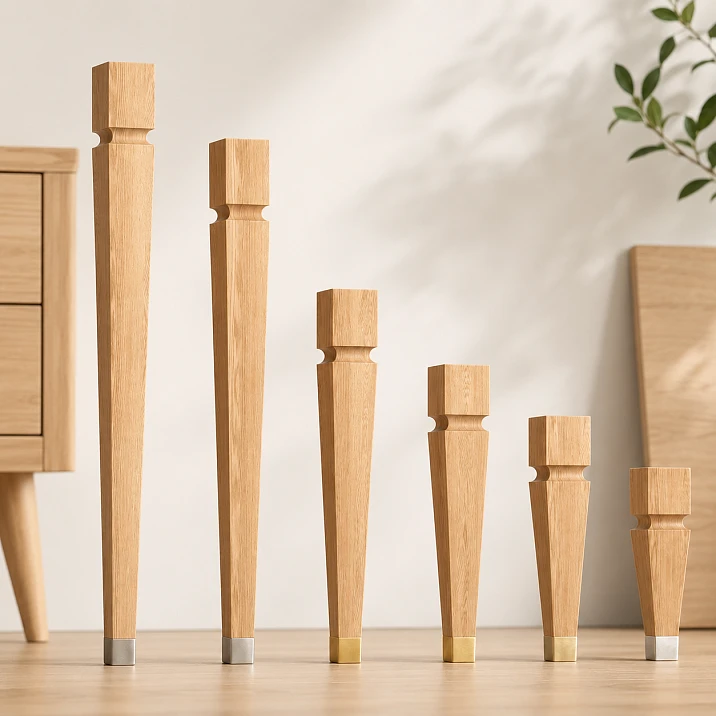
Furniture leg MN-205 with metal tip This is not just a wooden support with a decorative detail at the floor. It combines solid wood, a metal tip, precise geometry, a fastening unit, and future finishing. All these parts must work as one system. A mistake rarely goes unnoticed: incorrect height changes the proportions of the furniture, lack of rigid connection causes wobbling, and careless painting turns the clean boundary between wood and metal into a visible defect.
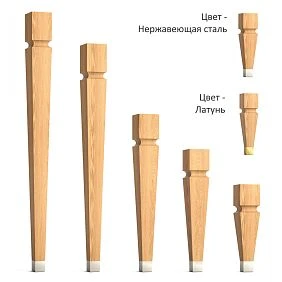
The MN-205 card presents five heights: 250, 350, 450, 650, and 740 mm. This range allows the common design to be used in a low dresser, bench, coffee table, console, writing desk, or dining table. But you cannot choose a leg just by the name of the item. First, calculate the final height of the furniture together with the body, tabletop, apron frame, mounting, and floor cap. Only then does it become clear which version of MN-205 is truly suitable.
A commercially correct order includes not just four legs. The buyer needs to choose beech or oak, wood preparation for enamel or tinting, the metal hardware option, the mounting method, the need for aprons, and square floor cap FUR-023 25 × 25 mm. For threaded mounting, separately check FUR-001. If even one item is left "for later," assembly may stop after the finished parts have already been painted.
The main feature of the model is the expressive junction of materials. The wooden part can be painted or tinted, while the metal tip must retain a neat factory surface. You cannot cover the entire leg with a single layer of enamel: primer, stain, oil, or varnish will leave drips and stains on the metal. Therefore, choosing MN-205 starts with dimensions, continues with frame design, and ends with coordinated finishing of the entire set.
What is confirmed for MN-205 and what to check before ordering
| Parameter | Confirmed value | Practical significance |
|---|---|---|
| Article number | MN-205 | Allows ordering a specific model without confusion |
| Type | Geometric furniture leg in a modern style | Suitable for minimalist and combined furniture |
| Main material | Solid wood | Beech and oak available |
| Decorative part | Metal tip | Requires protection when finishing wood |
| Heights | 250, 350, 450, 650 and 740 mm | Cover low and high furniture |
| Dimension lines | 250 × 60 × 60 × 30; 350 × 60 × 60 × 30; 450 × 60 × 70 × 30; 650 × 60 × 80 × 30; 740 × 60 × 80 × 30 mm | Parameters B, F and G are read from the drawing |
| Hardware options | For stainless steel and brass | Availability is checked in the selected line |
| Wood preparation | For enamel or tinting | The choice is linked to the finish coating |
| Rigidity | Legs can be connected with stretchers | Especially important for heights of 650 and 740 mm |
| Recommended lower element | FUR-023, 25 × 25 mm | The quantity is counted by the number of legs |
| Fastening | FUR-001 is listed as required hardware | Compatibility is checked by the design |
| Application | Chests of drawers, benches, poufs, coffee tables, writing and dining tables, consoles | The purpose is clarified by furniture calculation |
After the table comes view five sizes of MN-205 in the product card and compare them not only with the name of the future item, but also with its full vertical cross-section. For the buyer, what matters is not the abstract height of the support, but the level of the seat, tabletop, or cabinet body after assembly.




Why the leg height does not equal the height of the finished furniture
The height of the finished item consists of several parts. For a table, these are MN-205, the mounting plate or apron, the tabletop, and the floor glide. For a dresser, the bottom panel, body, and top lid are added. For a bench, the frame, seat base, padding, and upholstery are included. Even a small additional layer changes the final ergonomics.
In simplified terms, the calculation looks like this:
Furniture height = MN-205 height + structure above the leg + top part + bottom element.
The formula is needed not for a universal answer, but for discipline. You cannot take a 740 mm leg, add a massive tabletop, and expect a regular writing desk. You cannot choose an MN-205 with a height of 250 mm for an already tall dresser without checking the convenience of the top surface. First, design the finished item, then select the support.
Before buy the MN-205 set, it is useful to make one vertical cross-section. On it, mark the floor, the floor glide, the metal tip, the wooden part, the fastener, the apron, the bottom panel, and the top surface. Such a drawing reveals an error before it turns into four expensive parts of unsuitable height.
Our factory also produces:

Five heights of MN-205 — five different designs
Get Consultation
MN-205 with a height of 250 mm: low furniture with a noticeable gap
The 250 × 60 × 60 × 30 mm version is suitable for use in dressers, cabinets, poufs, low benches, and TV furniture. The 250 mm height creates a pronounced gap under the body, making the item look lighter, and the floor remains accessible for cleaning. However, a high gap under a heavy body increases stability requirements.
For a chest of drawers, the shift in the center of gravity is checked when opening drawers. For a TV stand, the final screen height is checked. For a pouf and a bench, the thickness of the soft seat is checked. A low support does not mean a small load: a person sits down with dynamic force, and the joint receives a lateral impact.
If the metal tip does not match the design intent and a fully wooden silhouette is needed, it is more reasonable to compare MN-205 with fully wooden models, rather than painting over the metal and losing the character of the product.
MN-205 with a height of 350 mm: bench, coffee table, and tall cabinet
The size 350 × 60 × 60 × 30 mm occupies an intermediate position. It can be considered for a bench, coffee table, tall cabinet, or compact console. But the purpose is not determined by a single number. A coffee table should relate to the sofa, and a bench should provide a comfortable final seat height.
When designing a table, the extreme points of the metal tips are checked. The supports should not protrude so that people catch on them when passing by. For a bench, lateral rigidity is assessed: a narrow body on relatively high legs can wobble even with sufficient vertical strength.
The 350 mm version well demonstrates the main logic of the series: one form works in different items if the entire structure is calculated, not just the height from the floor.
MN-205 with a height of 450 mm: expressive support for medium furniture
The size 450 × 60 × 70 × 30 mm can be considered for a coffee table, designer cabinet, auxiliary table, or tall bench. Here, one of the transverse parameters changes, so the mounting template from the 250 and 350 mm versions cannot be transferred without checking the drawing.
A height of 450 mm makes the leg a noticeable part of the silhouette. The metal tip is in view and has a stronger impact on the interior. The stainless steel option can be paired with cool metal hardware. The brass accent supports warm handles and lighting fixtures, but exact shade matching should be checked against samples.
For a clear oak finish, the orientation of the grain on all four legs is especially important. For beech under enamel, a single masking line for the metal part is required.
MN-205 with a height of 650 mm: console and compact work desk
The size 650 × 60 × 80 × 30 mm places the model in the category of tall supports. It can be considered for a console, vanity table, compact writing desk, or wall-mounted furniture. At this height, lateral stability becomes a separate challenge.
A tall leg can handle vertical load, but the furniture will still wobble from a push if there is no horizontal connection between supports. For a console, some rigidity can be provided by wall mounting, but this must be specified in the design. For a freestanding table, a stretcher rail or other frame is usually needed.
Before ordering, it is useful to read why a tall table may require a stretcher rail, and not to confuse the strength of wood with the stability of the entire geometry.
MN-205 with a height of 740 mm: writing and dining table after calculation
The 740 × 60 × 80 × 30 mm version is suitable for testing in writing desks, dining tables, tall consoles, and custom underframes. This is where choosing only by height is especially dangerous. After adding the tabletop, the work surface may end up higher than expected.
For a desk, space for knees, position of aprons, drawers, and cable channels are considered. For a dining table, placement of chairs, distance between supports, and tabletop overhang are considered. A long tabletop increases lateral loads and requires a rigid connection.
Before purchasing, it is necessary to check the legs, fastening, and tabletop before assembly. If the project does not allow aprons due to leg space, choose a different frame or a different model, rather than attaching four high legs to a thin board.
How to read dimensions A × B × F × G without guessing
The product card provides parameters A, B, F, and G. Trying to immediately translate each letter into a familiar name is risky. A changes with the overall height, and the meaning of B, F, and G must be determined by the dimension arrows on the drawing of the specific version. One parameter may refer to the top section, another to the transition part, and a third to the metal. A convincing but incorrect interpretation can ruin the frame before the legs even arrive.
The working order looks like this:
-
open the drawing of the selected height;
-
find the top mounting plane;
-
determine the actual cross-section in the attachment area;
-
see which part F and G belong to;
-
check the length of the wooden zone;
-
set the dimensions of the metal tip;
-
match the leg with the apron, body, and foot block;
-
only then design the holes and seating positions.
You cannot write "G — metal height" in the production card just because the number seems suitable. Before drilling, you need to check the price and drawing MN-205 and save the version of the technical file along with the specification.
Wood and metal cannot be finished in one pass
MN-205 differs from the all-wood leg in that the material transition line remains part of the design. On light enamel, any buildup near the metal is noticeable. On dark staining, the error looks like a dirty stripe. The stain can leave a spot on the metal surface, and attempting to remove the dried coating with an abrasive can scratch the tip.
Before finishing begins, four questions are answered:
-
whether the metal part is removed according to the factory scheme or remains in place;
-
where the exact masking boundary runs;
-
which system is chosen for the wood;
-
at what stage the protective tape is removed.
Disassembly cannot be automatically recommended. The tip design must be confirmed. If the metal is not intended for removal, it is protected in place. If the joint is detachable and this is technically confirmed, separate finishing may be more convenient, but the decision is made by the contractor after inspecting the actual leg.
Painter's mask for MN-205: a uniform line across the entire set
The four legs are perceived simultaneously. Even a slight difference in the height of the painted area looks like production negligence, because the metal tips form one horizontal row. Therefore, a single masking template is needed for the set.
The template can be a precise ring, a paper strip, or a marking jig that sets the same protection height. The tape is applied without wrinkles, carefully pressed along the edge, and checked for compatibility with the coating. On complex shapes, several narrow strips are more reliable than one wide strip that forms creases.
The test coat should answer practical questions:
-
doesn't the soil seep under the edge;
-
doesn't glue remain on the metal;
-
doesn't a thick step of enamel form;
-
does the line match on all four supports;
-
isn't the tip damaged when removing the protection;
-
is the same wood gloss preserved near the joint.
The exact technology is tied to the chosen primer, enamel, varnish, or oil. There is no universal tape for all systems.
Beech under enamel: uniform color of the body and legs
Beech is practical to consider for opaque finishing. If the legs must match the painted body, a blank under enamel helps achieve a solid color and make the geometric shape the main accent. The metal tip remains a contrasting bottom point.
But the very fact of choosing beech does not guarantee an even result. The wood is primed, matted, and coated according to an approved system. All four legs receive the same number of coats. The metal is covered before the first priming, not after drops have already appeared on it.
The card presents wood preparation options. To understand how the enamel finish differs from the tinting option, it is useful to study Materials and product quality. The commercial choice must match the finish: preparation for tinting is not needed if the wood is completely covered with dense enamel.
Oak for tinting: the texture becomes part of the composition
Oak is chosen when it is important to preserve the natural grain and connect the legs with the oak tabletop, body, or facades. A translucent coating highlights the fibers, so the four supports are evaluated as a set, not individually.
A metal tip next to tinted oak affects color perception. Stainless steel makes the look colder and stricter. Brass adds warm contrast. This is not a universal style rule, but a visual effect that is checked on a sample under real lighting.
With a transparent finish, the following are especially noticeable:
-
tone differences between legs;
-
direction of fibers;
-
uneven absorption of the composition;
-
stains near the metal border;
-
different degrees of gloss;
-
the difference of one leg ordered later.
Therefore choose MN-205 from birch or oak must be simultaneous with the finishing system and the color of the hardware.
Enamel, stain, varnish, or oil: different risks near metal
Opaque enamel
Enamel covers the wood grain and ties the legs to the painted body. The main risk is a thick edge near the protective tape. If layers accumulate, a noticeable step remains after removal. The coating is applied evenly, without directing excess material into the joint.
Stain and clear varnish
Stain highlights the wood but can seep onto the metal tip. A control sample shows how the color looks next to brass or stainless steel. Varnish should not gather in a drop at the bottom of the wooden part.
Oil
Oil requires careful removal of excess. If the compound remains on the metal, it may dry in spots. The boundary is cleaned before polymerization begins, without using aggressive abrasives.
Decorative aging
Patina or other effects are allowed only as part of the agreed finishing. Accidental contact of the compound with the tip visually ages the metal unevenly and deprives the model of its neat, modern character.
How to achieve a uniform look for four legs
The set is perceived simultaneously. A person may not study each individual leg but will immediately notice that one leg is darker, another has metal covered with paint, and a third has a different boundary height. Therefore, the entire set goes through one technological chain.
| Control | What should match |
| Material | One wood species |
| Height | One size row |
| Metal | One hardware option |
| Preparation | For enamel or tinting for the entire set |
| Finish | One batch of materials and the same number of layers |
| Mask | Same line of wood and metal |
| Gloss | Uniform finish level |
| Texture | Coordinated orientation for oak |
| Floor protectors | One type and the same position |
That is why it is better to order legs for one item in a single batch. For serial furniture, it is reasonable to provide a spare support, but it is finished together with the main set.
The metal tip does not replace the floor glide
The tip is a noticeable part of the design, but the card separately recommends FUR-023. This means that the metal bottom cannot automatically be considered a ready contact surface for the floor. The lower assembly is designed as a separate part.
Floor glide for leg MN-205 has a size of 25 × 25 mm. Before ordering, check the mounting method, compatibility with the lower part, possible protrusion beyond the tip boundaries, and the floor material. Parquet, tile, stone, and soft flooring react differently to point contact.
For four legs, four floor glides are usually considered if such a scheme is confirmed by the drawing. You cannot install three elements and hope that the fourth will not be needed: all supports must have the same lowest point.
FUR-023 25 × 25 mm: a small item that completes the order
The floor glide costs disproportionately less than the finished item, but the absence of this part can stop assembly after the body and legs have already been painted. Therefore, buy four floor glides FUR-023 better simultaneously with MN-205.
The specification specifies:
-
article FUR-023;
-
quantity according to the number of legs;
-
size 25 × 25 mm;
-
installation method according to the drawing;
-
type of floor covering;
-
need for adjustment;
-
position relative to the metal tip.
If the project requires height adjustment, FUR-023 cannot be considered adjustable without confirmation. Then another fitting or a separate system is chosen.
Set FUR-001: the mounting is checked before drilling the housing
In the MN-205 card, FUR-001 is listed as required hardware. The kit includes an M8 × 60 stud and an M8 × 13 metal insert. But even a confirmed item cannot be installed without checking the thickness of the body, side rail, or tabletop.
FUR-001 kit for attaching furniture legs requires precise holes. Before drilling, the following are established:
-
which part the insert goes into;
-
where the stud is located;
-
whether the base thickness is sufficient;
-
whether the hole intersects with a groove or joint;
-
whether an additional plate or side rail is needed;
-
whether the furniture can be disassembled for transport;
-
whether the threaded assembly matches the MN-205 drawing.
It is not allowed to transfer holes from another model or another height until the technical drawings are matched.
What parts does the complete MN-205 assembly consist of?
A complete set for one support may include MN-205, FUR-001 mounting, FUR-023 foot, and part of the stretcher or body connection. For four legs, the quantity is multiplied, but the structural logic remains common.
To avoid missing a small item, it is useful to look at what parts the furniture leg mounting assembly consists of. Then the list is linked to a specific item.
| Position | Preliminary quantity for four supports | What to check |
| MN-205 | 4 | Height, material, metal, and preparation |
| FUR-023 | 4 | Seating and contact with the floor |
| FUR-001 | By scheme | Base thickness and threaded assembly |
| Tsargi or frame | As per project | Lateral rigidity |
| Tabletop or body | One set | Thickness and mounting fields |
| Finishing materials | For all legs | Compatibility with wood and metal |
| Masking template | 1 | Single coating boundary |
Can MN-205 be installed without tsargi
There is no unambiguous answer. A low cabinet on 250 mm legs and a desk on 740 mm supports operate under completely different conditions. Height increases the lever arm of lateral force: a small push on the edge of the tabletop creates a noticeable load on the fastening near the top of the leg.
A design without stretchers is possible if rigidity is provided by another frame, a massive lower frame, a metal underframe, or a calculated cabinet system. But the absence of a visible horizontal connection does not mean that reinforcement is not required.
Before ordering, check:
-
leg height;
-
mass and dimensions of the body;
-
base material;
-
distance between supports;
-
mounting method;
-
lateral loads;
-
frequency of moving furniture;
-
purpose of the item;
-
possibility of wall mounting;
-
presence of an internal frame.
If four tall legs are attached to a thin panel and are not otherwise connected, the project requires revision. The vertical strength of the solid wood does not protect against rocking.
When the apron belt becomes necessary
Aprons form a horizontal frame, connect the supports, and reduce their independent movement. For MN-205 with heights of 650 and 740 mm, this issue is especially important. The longer the tabletop and the farther the legs are from each other, the stronger the structure reacts to lateral loads.
The apron belt is considered when:
-
the tabletop is long or heavy;
-
the furniture stands separately from the wall;
-
the user may lean on the edge;
-
the item is often moved;
-
the distance between the legs is large;
-
the base is made of MDF or laminated chipboard;
-
the fastening works pointwise;
-
a durable collapsible structure is required;
-
the furniture is used in a public space.
The apron should not accidentally deprive a person of knee space. For a desk, its position is coordinated with seating, drawers, and cable channels. Sometimes a different frame is used instead of a wooden apron, but that is a separate solution, not a reason to skip checking rigidity.
MN-205 for a dresser: height, stability, and drawers
A dresser on visible legs looks lighter, and the space under the body remains open. However, when a drawer is pulled out, the center of gravity shifts forward. The higher the body and the shallower its depth, the more carefully stability needs to be assessed.
For MN-205 with a height of 250 or 350 mm, check:
-
the total height of the dresser;
-
the depth of the body;
-
the mass of the contents;
-
the position of the four extreme supports;
-
need for a central leg;
-
securing furniture to the wall;
-
access to the bottom drawer;
-
passage for a robot vacuum;
-
combination of the tip with the handles.
Metal decor can be matched with the handles, but the same shade name does not guarantee a perfect match. Brass and stainless steel from different parts may differ in color and luster, so samples are compared side by side.
A wide dresser sometimes needs a central hidden support. This does not necessarily have to be another MN-205: the central part can have a different appearance if it matches exactly in height and is rated for the load.
MN-205 for a nightstand: a small mistake changes convenience
For a bedside table, the top surface should align with the mattress level. For a TV stand, it should align with the screen line. For a console table, it should align with the overall wall composition. A 250 mm leg can raise the body more noticeably than it seems in a photo.
If the final height of the furniture is already set, the body has to be reduced. Therefore, supports are chosen before approving the cutting plan, not after the box is manufactured. Otherwise, the furniture maker receives a finished body and has to look for legs of an "approximately suitable" height.
They also check the location of the lower drawers and guides. The MN-205 fastener must not cross the internal hardware. The thickness of the bottom panel must allow the installation of FUR-001 or another approved assembly without the fastener protruding into the visible area.
MN-205 for a bench and pouf: dynamic load is more important than static load
When a person sits down, the load acts not only vertically. They may sit on the edge, turn around, push off with a foot, or shift the bench. The joints receive repeated lateral impulses. Therefore, the bench cannot be calculated as a shelf that sits quietly under a constant weight.
For the project, they check:
-
final seat height;
-
frame depth and width;
-
corner rigidity;
-
attachment of the four legs;
-
need for aprons;
-
material of the glides;
-
finish resistance to cleaning;
-
protection of metal from impacts;
-
possibility of replacing one leg.
Version 250, 350, or 450 mm is selected after calculating the soft part. Foam, base, and upholstery add height, so you cannot rely only on the leg size.
MN-205 for a coffee table: proportion with the sofa and passage
A coffee table should not accidentally end up higher than the seat or too low for habitual use. Supports of 350 and 450 mm create different levels, but the final result depends on the tabletop, underframe, and glides.
Metal tips are clearly visible against the floor background. Light metal emphasizes modern geometry. Brass tone adds a warm accent. On a dark floor, a thin metal part can visually separate the wooden leg from the surface and make the piece lighter.
Check the leg overhang. If the legs are placed close to the edges, people will bump into them when passing. If they are shifted too far inward, the support contour narrows. For a round or oval tabletop, a full-size template is especially useful: a rectangular placement scheme may unexpectedly extend beyond the smooth contour.
MN-205 for a console: narrow furniture requires a precise frame
A console usually has a small depth and stands near a wall. Legs of 650 mm give it a light silhouette, but a narrow piece is sensitive to tipping. Wall attachment, if provided, should be shown on the drawing, not remain a verbal recommendation to the installer.
The project notes:
-
the distance between the front and back legs;
-
the depth of the tabletop;
-
the position of the drawers;
-
apron belt;
-
wall mounting;
-
the height of the baseboard;
-
opening of the adjacent door;
-
the passage next to the furniture.
If the baseboard does not allow the console to be pushed close, the center of gravity and the visual axis change. It is necessary to decide in advance whether a cutout, an offset, or a special rear assembly will be made.
MN-205 for a writing desk: working height and legroom
A 740 mm leg seems like a natural choice for a writing desk, but after adding the tabletop, the final level may turn out to be too high. In some projects, a 650 mm version and a different structure above it are considered, but there is no ready-made universal answer.
For a workspace, the following are evaluated:
-
the user's height;
-
The thickness of the tabletop;
-
position of the stretchers;
-
height of the drawers;
-
width of the chair;
-
knee space;
-
cable duct;
-
system unit or cabinet;
-
possibility to disassemble the table for transportation.
Wooden legs for table it is worth comparing by height, cross-section, attachment, and style. MN-205 is chosen not as a neutral support, but as a combined part with a noticeable metal finish.
MN-205 for the dining table: seating and lateral stability
The dining table experiences constant loads: hands lean on the edge, the table is moved, chairs touch the legs, children may pull items from the surface. The 740 mm version must work together with the calculated frame or stretcher belt.
The position of the supports is linked to the seating arrangement. Legs placed too close to the ends interfere with the person. Too much inward shift reduces stability and increases the tabletop overhang. For each seating position, the width and chair movement are checked.
If the tabletop is stone, made of thick solid wood, or has a large format, the general article cannot be used as a load calculation. A separate structural assessment of the frame is needed. MN-205 can retain a decorative role, but the load-bearing scheme must be provided by a proven joint.
Modern character of MN-205: geometry without impersonality
The straight geometric shape makes the leg suitable for modern furniture, but the solid wood retains the warmth of the material. The metal tip adds a subtle technical detail without turning the support into a fully metal one.
MN-205 can be combined with smooth facades, minimalist tabletops, geometric handles, and calm colors. But style should not mask structural errors. A beautiful tip does not compensate for incorrect height, weak fastening, or missing crossbars.
To evaluate alternatives, one can compare geometric and turned legs. The turned shape creates a more decorative rhythm, while MN-205 works through clear proportion, tapering, and the combination of wood with metal.
Stainless steel or brass: which tip to choose
The card presents hardware options for stainless steel and brass. The specific combination with height, beech, or oak is checked in the selected row before placing the order.
Fittings for stainless steel
The cool metallic tone pairs with modern appliances, steel profiles, chrome or nickel-plated details, and a neutral palette. On white or graphite enamel, it looks contrasting and composed.
Brass option
Warm metal supports brass handles, lamps, and decorative accents. Next to tinted oak, the look becomes richer and softer. However, different types of brass may vary in shade, so the color name does not replace a sample.
When choosing, not only handles but also hinges, base, lamps, and elements of adjacent furniture are considered. The tip is near the floor, but it still participates in the overall metallic palette of the room.
What to buy together with MN-205
| What to add to the order | Why is this needed | Commercial transition |
| FUR-023 | Finish the lower support point | Floor glide for leg MN-205 |
| FUR-001 | Assemble the threaded fastening unit | FUR-001 Kit |
| Tsargi or frame | Increase lateral rigidity | Calculation of table leg rigidity |
| Tabletop or body | Agree on final height and mounting | Check compatibility with countertop |
| Additional supports | Assemble the set in one batch | Catalog of solid wood furniture legs |
| Finish sample | Approve wood color and boundary with metal | Materials and product quality |
| Fully wooden alternative | Exclude metal accent | from STAVROS open boundless possibilities for designers, furniture makers, and anyone striving to create unique high-quality furniture. |
The table does not mean that each item is mandatory for any furniture. It shows questions that must be resolved before placing the overall order.
Why all legs should be ordered in one batch
Wood has natural variations. Metal parts, sanding, and preparation should also be perceived as a single set. Ordering on different dates increases the risk of differences in tone, texture, and finish.
One batch simplifies:
-
selection of beech or oak;
-
geometry control;
-
metal selection;
-
uniform masking;
-
common test coating;
-
completion with support pads;
-
marking for installation;
-
replacement of damaged packaging before finishing.
For serial furniture, each set of four is combined with an object code. For example, MN205-T01-01…04. A spare leg is marked and finished simultaneously with the set, otherwise it will not be a visually equivalent replacement.
Preliminary calculation of the set for a dresser
| Position | Quantity | What to clarify |
| MN-205 of selected height | 4 | One wood species and one metal |
| FUR-023 | 4 | One per support |
| FUR-001 | By scheme | Attachment to the bottom frame |
| Aprons or base | As per project | Rigidity and deflection |
| Finish sample | 1 | Approve before the entire set |
| Central support | If necessary | Height and hidden position |
| wall mounting | As per project | Stability of a tall cabinet |
This table is a checklist, not a finished specification. A wide dresser may need a central support and reinforcement of the bottom panel.
Preliminary calculation of a desk kit
For a table on four MN-205 legs, account for four legs, four floor glides, fasteners for each support, an apron or underframe, a tabletop of agreed thickness, a drilling template, and finishing materials.
This list must not be turned into a universal set. The length of aprons, the number of fastening points, and the allowable load depend on table dimensions. But commercial
Dry assembly before final finishing
Before painting, it is useful to assemble one control unit. It shows whether the upper mounting section fits, whether there is enough space for the apron, whether the floor glide is correctly positioned, and whether any skew occurs.
Dry assembly is especially important for MN-205 with heights of 650 and 740 mm. On tall furniture, a small angular error becomes noticeable at the floor, and a difference in diagonals turns into wobbling.
After checking, the structure is disassembled, marked, and sent for finishing. If the coating is applied to the assembled frame, the metal tips are still protected individually. The painter should receive not just four legs, but an approved sample and a masking scheme.
Installation of MN-205 without skew
The level shows the position of the tabletop, but does not reveal all errors. You need to check the diagonals of the support contour, the verticality of each leg, and equal offsets from the edges.
Work sequence:
-
Apply axes to the body or frame;
-
Attach the mounting template;
-
Check the holes against the drawing;
-
Perform a test drilling with a depth stop;
-
Install the fasteners;
-
Assemble the legs without final tightening;
-
Measure the diagonals;
-
Check verticality;
-
tighten the connections;
-
install the support pads;
-
place the furniture on a level floor;
-
check that there is no play.
The support pad should not correct an improperly installed leg. If the support is at an angle, first find the error in the fastening, marking, or body geometry.
What you don't need to make yourself
The buyer receives a ready-made geometric shape made of solid wood with a metal tip. There is no need to turn five identical profiles, select metal ends, and achieve a repeatable material boundary. It is this readiness that makes MN-205 commercially interesting for a furniture workshop and a private project.
What remains for you to decide yourself are the solutions that cannot be universalized:
-
choosing the height;
-
calculating the finished piece;
-
designing tsargs;
-
selecting fasteners;
-
preparing finishing;
-
metal protection;
-
installing the foot support;
-
assembly and rigidity check.
The finished leg saves the production of a complex part, but does not replace a furniture project. The buyer purchases a professional component, not a ready-made table, dresser, or bench.
How not to confuse MN-205 with a fully wooden leg
A solid wood leg can be finished along its entire height with one system. In MN-205, the metal tip remains a separate material. This affects painting, maintenance, and combination with handles or lamps.
If the project requires a monochrome leg without visible metal, it is better to choose a leg of a different height or shape than to paint over the tip and destroy the structural image of MN-205.
If a metal accent is needed, the ready-made model saves you from searching for a cap for the lower part yourself and helps to repeat the same ending on all legs.
How not to confuse the leg height with the furniture's purpose
The catalog may show MN-205 among legs for tables, chairs, or other furniture. This helps to find the product, but does not mean that any height suits every item. The purpose is confirmed by the project.
A 250 mm leg can be used in a low cabinet, and a 740 mm one in a table. But width, mass, mounting, and rigidity matter no less. Therefore wooden legs for a table and a dresser compared by several parameters, not only by the application filter.
Main mistakes when buying MN-205
Choosing the height without calculating the finished furniture
The buyer remembers the thickness of the tabletop after ordering and gets a table that is too high. Solution — a vertical cut before purchase.
Painting metal together with wood
Primer and enamel leave drips. Solution — a single painting mask and a control sample.
Removing dried coating with a knife
Metal gets scratched, and the edge becomes uneven. Solution — prevent runs and remove protection according to the coating technology.
Making a different finish line on four legs
The set looks assembled from different parts. Solution — one masking template.
Consider the tip as a ready-made foot
The card separately recommends FUR-023. Solution — design the lower assembly of the furniture leg.
Not checking the stretchers of the tall version
The table on 740 mm supports rocks. Solution — a calculated belt, frame, or under-table.
Attaching legs directly to a thin panel
Holes weaken the base, and fasteners may protrude into the visible area. Solution — check thickness and construction.
Considering only vertical load
Lateral force destroys the joint before the mass from above. Solution — evaluate dynamic behavior.
Ordering legs in different batches
Wood, metal, or preparation differ. Solution — buy the set at the same time.
Choosing metal separately from handles
On finished furniture, shades clash. Solution — compare samples in the same lighting.
Drilling the body without a drawing
Parameters B, F, and G are interpreted incorrectly. Solution — work according to the technical diagram for the specific height.
Not adding FUR-023 to the order
Assembly stops at the last stage. Solution — include support feet in the overall list.
Considering FUR-001 universal for any base
A confirmed set still requires suitable thickness and fit. Solution — check the entire assembly.
Choosing a leg only by photo
The photo does not show the final height, rigidity, and installation. The solution is to use a drawing and a full-size diagram.
When MN-205 is truly suitable
MN-205 should be chosen when:
-
a modern geometric silhouette is needed;
-
the metal tip is part of the design;
-
one of the five heights fits;
-
it is possible to calculate the aprons or another frame;
-
the wood will be painted or tinted;
-
the set is purchased in one batch;
-
there is an opportunity to carefully protect the metal;
-
FUR-001 and FUR-023 are compatible with the project;
-
The furniture does not require hidden adjustable supports.
The model looks especially convincing in pieces where the legs are exposed and readable from a distance: consoles, benches, coffee tables, desks, or dining tables.
When it's better to choose a different model
MN-205 may not be suitable if:
-
a fully wooden appearance is needed;
-
metal does not match the interior;
-
a height is required that is not in the range;
-
the legs must be positioned at a pronounced angle;
-
the design does not allow for aprons and has no other reinforcement;
-
a hidden adjustable support is needed;
-
the metal part will be in constant contact with a corrosive environment;
-
the upper mounting zone does not fit the cabinet;
-
a heavy tabletop requires a special frame;
-
the trim must cover the entire leg with a single material.
In such a situation, it is more reasonable choose a set of furniture supports from a different series than reworking MN-205 and losing its character.
How to order the MN-205 kit from STAVROS
-
Determine the type of furniture and the final height.
-
Choose one of the five versions of MN-205.
-
Check the drawing A × B × F × G.
-
choose beech or oak
-
Specify preparation for enamel or tinting.
-
Select metal fittings.
-
Calculate the number of legs.
-
Check the need for stretchers.
-
Add FUR-001 according to the scheme.
-
Add FUR-023 based on the number of supports.
-
Approve the sample finish.
-
Check the current price and order terms.
After that, you can buy the MN-205 set not as four random supports, but as an agreed lower furniture assembly.
Commercial specification for the request
An accurate request helps the manager verify the product and compatible items before payment. The wording may look like this:
Furniture legs MN-205 are required for the project ______. Selected height — ______ mm, quantity — ______ pieces. Material — beech/oak. Preparation — for enamel/for tinting. Metal fittings — ______. Please confirm the current drawing, top mounting section, compatibility of FUR-001 and FUR-023, price, and order terms. The cabinet drawing, final furniture height, and apron belt diagram are attached to the request.
Such a request communicates not only the article number but also the task. It reduces the risk that the legs will be ordered separately from the fasteners, and that finishing will begin without the selected metal option.
Questions and answers about the furniture leg MN-205
What is MN-205?
It is a geometric furniture leg made of solid wood with a metal tip, available in five height options.
What heights are available?
250, 350, 450, 650, and 740 mm.
What wood species is MN-205 made from?
Beech and oak are presented in the card.
Can MN-205 be purchased for enamel?
Yes, preparation options for enamel are available. The specific combination of height, material, and fittings is checked in the product card.
Can MN-205 be ordered for tinting?
Yes, tinting options are available for projects where the wood grain needs to be preserved.
What metal part options are available?
The product card specifies fittings for stainless steel and brass. Availability is checked in the selected size row.
Can the metal tip be painted over?
The model is designed as a combination of wood and metal. Usually, the tip is protected during wood finishing rather than painted along with it.
How to achieve an even coating boundary?
Use one masking template for the entire set, test the tape on a sample layer, and avoid creating a thick bead of material.
Is MN-205 suitable for a dresser?
Yes, the model is specified for dressers, but you need to calculate stability, body height, drawer opening, and wall mounting.
Is MN-205 suitable for a bench?
Yes, provided the frame and dynamic load during sitting are calculated.
What height should be chosen for a coffee table?
Versions of 350 and 450 mm can be considered as options, but the final result depends on the tabletop and the sofa level.
Is the 650 mm version suitable for a console?
Yes, this is a possible scenario. A narrow console requires checking stability and wall mounting.
Can MN-205 740 mm be used for a writing desk?
It can be used after calculating the final height, legroom, aprons, drawers, and tabletop.
Are tsargs needed?
For tall structures, they are often necessary, but the final decision depends on the frame, dimensions, and load.
What is FUR-001?
This is a mounting kit with an M8 × 60 stud and an M8 × 13 insert. Its compatibility is checked against the drawing.
What is FUR-023?
This is a square base plate 25 × 25 mm, recommended for MN-205.
How many FUR-023 are needed for four legs?
Usually four, one per support, if the scheme is confirmed.
Can I order just one leg?
Current order conditions are checked in the product card. For a finished item, it is better to buy the entire kit in one batch.
How to calculate the price of a complete kit?
You need to account for the quantity of MN-205, FUR-001, FUR-023, the apron or frame, finishing, and assembly. Current prices are checked before ordering.
Where can I see other unpainted models?
In the category unpainted wooden furniture legs.
Where to compare table legs?
In the category wooden table legs and in the general catalog of supports.
Where to buy MN-205?
In the official card of the furniture leg MN-205 on the STAVROS website.
Conclusion: MN-205 is purchased as a complete furniture system
MN-205 combines modern solid wood geometry and a metal tip. Five heights allow using one design in low and high furniture, but each size line requires a separate calculation. The 250 mm leg works in a cabinet differently than the 740 mm version in a desk. The higher the support, the more important the stretchers, fastening, and lateral stability become.
A commercially strong order includes four solutions: the exact height of the finished furniture, a unified finish of the wooden part, protection of the metal tip, and a complete set of hardware. FUR-001 connects the leg to the body, FUR-023 finishes the contact with the floor, and the stretcher belt helps tall supports work as a system.
Before purchasing, open the card, check the sizes and price of MN-205, choose beech or oak, metal option and wood preparation. Order all legs in one batch, add glides and agree on fasteners before drilling the furniture.
STAVROS offers not only a separate support, but also a linked set of solutions for furniture production: a catalog of legs, technical drawings, fastening hardware and information on wood selection. When these elements are combined in one project, MN-205 becomes not a random part, but a precise architecture of the lower part of the furniture.
Total project cost: why the price of one leg does not show the furniture budget
The query "MN-205 price" leads the buyer to the product card, but the cost of one support is not equal to the cost of the finished lower assembly. For a piece on four legs, consider four MN-205 units, a fastening kit for each point, four glides, aprons or another frame, finishing materials, a test finish and assembly work. If the furniture must be disassembled for transport, add detachable joints and re-assembly control.
The higher the legs, the more expensive may be not the support itself, but ensuring rigidity. A dresser on 250-mm legs has a sufficiently strong lower frame, while a desk on the 740 mm version may require a full apron belt. Saving on the frame often results in wobbling and rework.
It is useful to divide the budget into groups in advance:
| Expense item | What it depends on |
| MN-205 | Height, material, hardware and quantity |
| FUR-001 | Number of fastening points and assembly scheme |
| FUR-023 | Number of legs |
| Tsargi or frame | Furniture size and required rigidity |
| Finishing | Enamel, tinting, varnish, or oil |
| Metal protection | Template, tape, and manual work |
| Assembly | Marking complexity and access to fasteners |
| Reference sample | Need for color and joint coordination |
Such a calculation helps compare not individual prices, but complete solutions. Sometimes a more expensive set with a properly selected frame turns out to be more profitable than cheap legs that have to be reinforced after assembly.
MN-205 in serial furniture: how to maintain repeatability
For a furniture workshop, one successful trial assembly does not guarantee the same result in a series. It is necessary to fix the leg height, wood type, metal, preparation, masking line, hole positions, and hardware set. Any change must receive a new version of the document.
The production card may contain:
-
product code;
-
article number MN-205;
-
height;
-
material;
-
metal part variant;
-
preparation for enamel or tinting;
-
coating sample number;
-
masking line height;
-
fastener FUR-001;
-
support foot FUR-023;
-
drawing of the frame belt;
-
approval date.
The first set is installed on a control item. The furniture is checked for levelness, diagonals, rocking, comfort, and visual alignment of the four legs. Only after this is the next batch launched. This procedure is especially important for tables and benches, where dynamic load quickly reveals a weak joint.
Replacing one damaged leg
Sometimes one support gets damaged during transportation or use. Ordering just one new MN-205 is technically simpler than replacing the entire set, but visual matching is not guaranteed. Wood from a different batch may differ in tone and grain, and metal hardware may differ in shade or gloss level.
For replacement, keep the product passport:
-
exact height of MN-205;
-
beech or oak;
-
wood preparation;
-
metal option;
-
coating composition and code;
-
mounting method;
-
type of floor glide;
-
photos of the original set.
The new leg is first finished on a sample and compared next to the furniture. With opaque enamel, matching the color is usually easier, but the gloss level and coating thickness must also match. With a transparent oak finish, texture differences may remain noticeable, so a spare leg purchased together with the main set is a reasonable solution for serial or expensive furniture.
Care for wood and metal tip
The combined leg requires careful maintenance at the boundary of materials. Do not use abrasives that could scratch the metal or dull the lacquer. Do not leave moisture near the lower part for a long time. Wood care products should not dry on the tip, and metal care products should not get on painted or tinted surfaces.
When cleaning, first remove dry dust with a soft cloth, then clean each surface with an appropriate method. Pay special attention to the joint where dirt can accumulate. If the furniture is moved frequently, periodically check the floor glides and tighten the fasteners.
Loosening cannot be fixed only by tightening to the limit. First, determine the cause: weakened threads, deformation of the base, insufficient rigidity of the stretchers, or an uneven floor. This approach extends the service life of the entire piece of furniture, not just one leg.
Why it is advantageous to choose MN-205 together with the rest of the furniture system
A single leg may appeal in a photo, but a strong project is built on connections. The height must match the cabinet body, the wood must match the tabletop or facades, the metal must match the handles and lighting fixtures, the fasteners must match the base material, and the floor protector must match the floor. When these decisions are made simultaneously, the risk of random mismatches is noticeably reduced.
В catalog of solid wood furniture legs you can compare MN-205 with other geometric, turned, and carved models. In the category unpainted wooden furniture legs it is convenient to check alternatives for self-finishing. If the task involves a table, a separate selection legs for a solid wood table helps to see models of similar purpose.
Such a route does not distract from MN-205, but confirms the choice. The buyer understands that the metal tip, five heights, and combined finish are truly needed for the project, not chosen randomly.