








































































Article Contents:
- What is a mascaron and why is it bought
- Mascaron as a carved decorative overlay
- Why the mascaron works as an accent, not as background decor
- Where it is appropriate: furniture, facade, door, portal, fireplace area
- Lion mascaron: symbol of strength and status
- Female mascaron: classic, antiquity, interior plasticity
- Mascarons with a pronounced architectural character
- Small, medium and large formats
- For a furniture front
- For a door or portal
- For a building facade
- For a fireplace area
- For an interior wall composition
- Small mascarons for furniture
- Medium models for doors and portals
- Large mascarons for facades and central compositions
- Why you can't choose based on photos alone
- Mascaron and cartouche
- Mascaron and rosette
- Maskaron and regular decorative overlay
- Maskaron for furniture and maskaron for facade
- Carved wooden maskaron and polyurethane decor
- Need to decorate the facade of a chest of drawers or sideboard
- Need to create a grand entrance door area
- Need a lion maskaron for a classic interior
- Need to restore old furniture or a decorative fragment
- Need to design a commercial interior
- How material affects perception
- Can the maskaron be painted or tinted
- Why installation depends on the base
- Choosing only by subject
- Not checking the size
- Placing a mascaron without surroundings
- Overloading a project with several strong images
- Not considering the finish
- Confusing furniture and facade scale
- Where to buy a wooden mascaron?
- What is a mascaron in interior design?
- What is a carved mascaron used for?
- Is a mascaron suitable for furniture?
- Can a wooden mascaron be used on a facade?
- How is a mascaron different from a cartouche?
- How to choose the size of a mascaron?
- Which STAVROS mascaron is suitable for a classic interior?
- Can a wooden mascaron be painted or stained?
- What to buy together with a mascaron for a finished composition?
- Can a mascaron be installed on a door?
- How not to overload the interior with a mascaron?
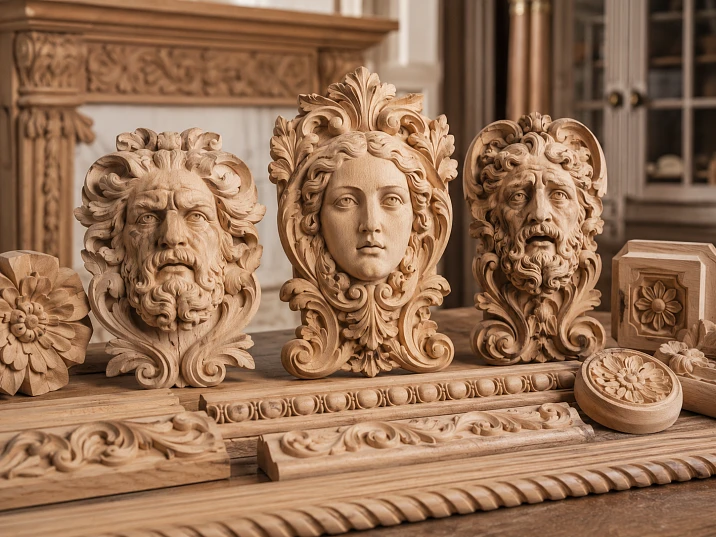
It is worth buying a mascaron when furniture, doors, facades, or interior compositions need not just a decorative element, but a strong central image. A mascaron works differently than a regular overlay, molding, or rosette: it immediately draws the eye, sets the character of the project, and helps make the surface expressive. It is used where an empty plane needs a semantic accent: on furniture facades, door portals, fireplace areas, wall panels, facade details, or classic interior fragments.
A carved wooden mascaron is chosen not based on the principle of 'which is prettier.' It is important to understand the subject, size, depth of relief, installation location, material, future finish, and neighboring elements. One mascaron may look appropriate on the facade of a large cabinet or portal but overload a small nightstand. Another may be well-suited for furniture but too subdued for a facade composition. Therefore, the purchase begins with the task: where the decor will be placed, what role it should play, and what it will be combined with.
At STAVROS you can buy a wooden mascaron STAVROS and choose a model to match furniture, facade, door, portal or interior composition. The catalog features various carved mascarons, including models M-002, M-006, M-009, M-010, M-015 and other items. For an accurate selection, you should look not only at the general section but also at the cards of specific products: for example, Carved mask M-002, Carved Mask M-006, Carved Maskron M-009, Carved Mask M-010 и Carved Mask M-015.
In this article, we will break down what a mascaron is in decor, where it can be installed, how a mascaron differs from a cartouche, rosette, and regular overlay, how to choose the size and subject, which models to look at for furniture, facade, door, or portal, what to buy together, and how to avoid mistakes when ordering carved wooden decor.
What is a mascaron and why is it bought
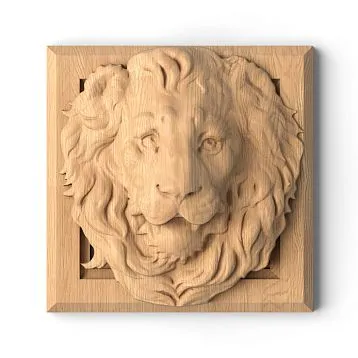
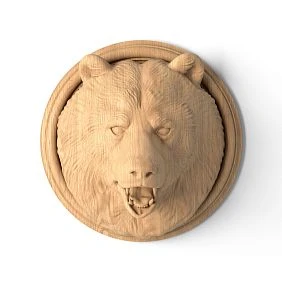
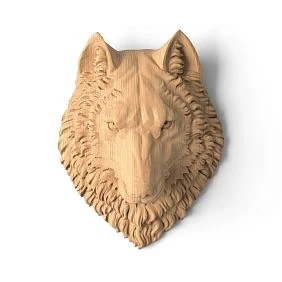
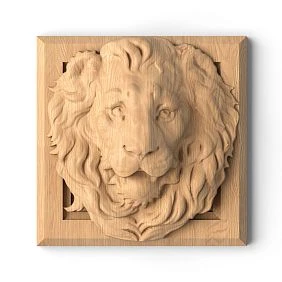
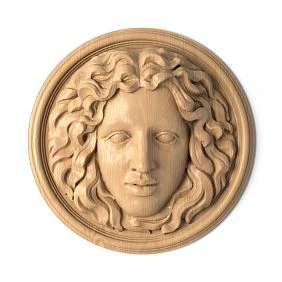
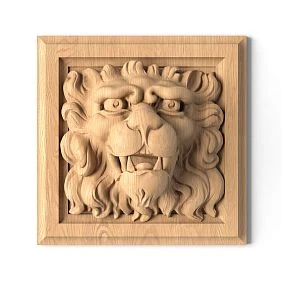
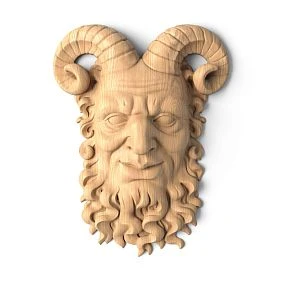
A mascaron is a sculptural decorative element in the form of a face, head, mask, lion, mythological or symbolic image. In wooden decor, it most often works as a carved overlay installed on the surface of furniture, doors, portals, facades, fireplace areas, or wall compositions. But in meaning, a mascaron is stronger than a regular overlay: it does not just fill an empty space but becomes the main expressive fragment.
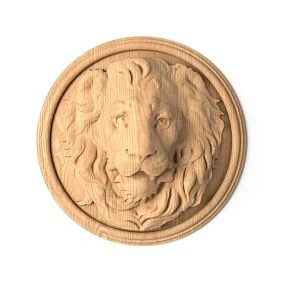
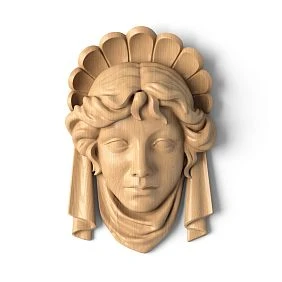
In classical architecture and interior decor, mascaron are used as symbolic images. A lion can be associated with strength, protection, status, and grandeur. A female image is associated with antique plasticity, softness, classical aesthetics, and decorative sculpture. More strict architectural mascaron help assemble a facade or portal into a cohesive composition, where the central detail emphasizes the style of the entire project.




Mascaron as a carved decorative overlay
From a practical standpoint, a mascaron is installed as a decorative overlay on a chosen surface. It can be considered for furniture facades, the central part of a door portal, a fireplace area, an interior panel, a decorative wall, or a facade fragment. It helps cover an empty plane, strengthen the center, add volume, and connect adjacent elements into a more expressive system.
If a regular overlay can be floral, geometric, or ornamental, a mascaron always has a more figurative character. It is more noticeable, more emotional, and requires more attention to the installation location. It should not be placed randomly: the mascaron should be where the main accent is needed.
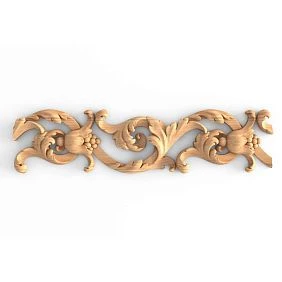
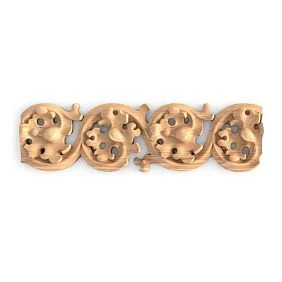
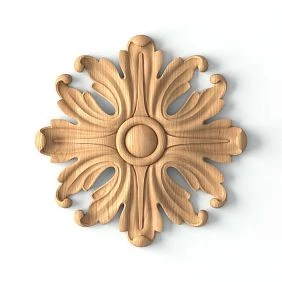
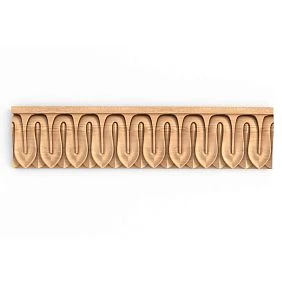
Our factory also produces:
Why the mascaron works as an accent, not as background decor
Background decor helps support the style but does not take all the attention. This is how simple moldings, small overlays, linear trim, or calm frames work. A mascaron works differently. A face, a lion's head, or an expressive carved image immediately becomes the visual center. A person looks at it first, and only then at the surrounding details.
That is why a mascaron works especially well in central places: above the door, at the top of the portal, in the middle of a furniture facade, on the fireplace area, in a wall panel, on the decorative axis of the interior. If you place it in a random corner or next to many other strong details, the effect may be lost.
Get Consultation
Where it is appropriate: furniture, facade, door, portal, fireplace area
A mascaron can be used in different projects, but in each place it solves its own task. On furniture, it makes the facade more expressive. On a door or portal, it emphasizes the entrance area. On a building facade, it adds architectural character. In the fireplace area, it becomes the central decorative point. On a wall composition, it helps to gather moldings, frames, rosettes, and other elements around one image.
If the project is complex, it is better to select a mascaron not alone, but together with neighboring categories. For furniture, you may need Decorative solid wood overlays. For a broader project, you should look at STAVROS carved decor to select elements of the same character and not mix incompatible ornaments.
Which mascarons can be bought from STAVROS
STAVROS offers various carved mascarons: from more compact decorative models to expressive elements for large compositions. In the selection, not only the subject and appearance are important, but also the scale. The mascaron should match the surface on which it is installed. A small model may look good on furniture but get lost on a facade. A large model may emphasize a portal but overload a dresser door.
| What to choose | For which task | What to Check |
|---|---|---|
| buy a wooden mascaron STAVROS | Selection across the entire group of mascarons for furniture, facade, and interior. | Plot, size, material, installation location, future finishing. |
| Carved mask M-002 | Facade, furniture, interior and restoration tasks. | Is the scale suitable for the surface and adjacent decor. |
| Carved Mask M-006 | Furniture facade, decorative panel, accent area. | Will the decor be too active for the chosen plane. |
| Carved Maskron M-009 | Expressive accent for a classic project. | Combination with portal, facade, furniture and frames. |
| Carved Mask M-010 | Central decor for a portal, door or interior composition. | Installation height, symmetry and adjacent elements. |
| Carved Mask M-015 | Large accent for an architectural or interior composition. | Whether there is enough space and whether the model overloads the project. |
Lion mascaron: a symbol of strength and status
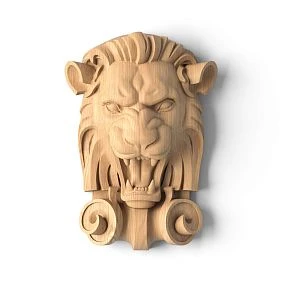
Queries like "buy lion mascaron", "buy lion mascaron", "lion mascaron buy" are usually associated with the desire to get an expressive classic image. The lion is perceived as a symbol of protection, status, strength, and grandeur. Such decor works well on facades, door portals, fireplace areas, office furniture, restaurants, halls, and classic interiors.
A lion mascaron should not be chosen just because it is noticeable. In a small room or on light furniture, it may look too heavy. However, on a large surface, in a symmetrical composition, or in a formal area, such an image helps immediately set the desired impression. Before ordering, you need to check the size, relief depth, and installation location in the specific model's card.
Female mascaron: classic, antiquity, interior plasticity
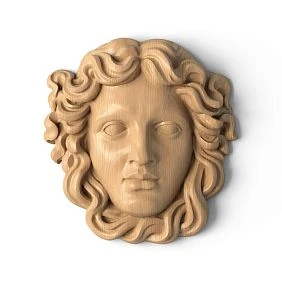
A female mascaron is chosen for a softer classical aesthetic. It can be appropriate in interiors with antique motifs, classic-style furniture, decorative panels, mirror zones, portals, and wall compositions. This image is often perceived as less rigid than a lion, but still remains the main accent.
When choosing a female mascaron, it is important to consider the surroundings. If there are many strict geometric elements nearby, a plastic image may look out of place. If the interior is built on soft lines, carved details, baguettes, and decorative overlays, such a mascaron can become a natural center.
Mascarons with a pronounced architectural character
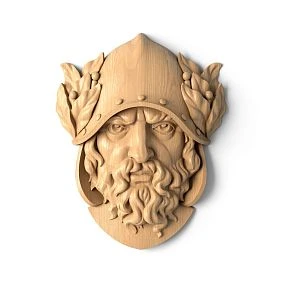
Some mascarons look not like a furniture detail, but like an architectural fragment. They are better suited for portals, facades, door areas, fireplaces, and large wall compositions. In such projects, not only the beauty of the carving itself is important, but also the connection with verticals, frames, moldings, capitals, cartouches, and other details.
For architectural tasks, a mascaron should be chosen considering the axis of the composition. It is often located in the center, above an opening, in the upper part of a portal, or at a point where the main decorative sign should be. If the axis is disrupted, even a beautiful carved element will look random.
Small, medium, and large formats
Conventionally, mascarons can be considered as small, medium, and large in perception. Small ones are suitable for furniture and small facade fragments. Medium ones are for doors, portals, fireplace areas, and panels. Large ones are for central compositions, facades, and large interior solutions. But the final choice depends not on the format name, but on the actual size of the model in the product card.
You cannot judge the scale only from a photo. On screen, all products may look similar, but in a real project, a difference of a few centimeters changes everything. Therefore, before purchasing, you need to check the dimensions in the product card, apply them to the drawing, or at least mark them on the future installation surface.
How to choose a mascaron by installation location
The installation location determines almost everything: size, subject, relief depth, amount of adjacent decor, and presentation method. A mascaron for furniture and a mascaron for a facade may be similar in style, but work differently. On furniture, a person sees the detail up close. On a facade or portal, it should be readable from a distance. On a door, it is important not to interfere with the structure. In a fireplace zone, the decor must sustain a central role.
For furniture facades
A wooden mascaron for furniture is used on the facades of cabinets, chests of drawers, sideboards, nightstands, display cases, kitchen modules, decorative panels, and custom furniture. It helps to design an empty central area, emphasize a classic style, add sculptural quality, and make the piece more individual.
Size is especially important for furniture. The mascaron should not interfere with handles, the opening of doors, drawers, or adjacent overlays. If the facade is small, it is better to look at more compact models. If the facade is wide and tall, a striking central accent can be considered. To select adjacent details, it is useful to open Decorative solid wood overlays, so that the facade looks cohesive.
For a door or portal
On a door or portal, the mascaron is usually placed in the upper central zone, above the opening or as part of a decorative frame. Here it works as a sign of entry, emphasizes grandeur and helps to combine verticals, moldings, cornices and overlays into one architectural system.
Symmetry is especially important for a portal. The mascaron should be on the axis, and the adjacent elements should support it, not compete. If there are already carved capitals, cartouches, rich moldings, and large overlays around, the mascaron must be chosen carefully. One strong center is better than several competing details.
For the building facade
A mascaron for a wooden facade is used where the project allows for carved wooden decor and where the element is protected or properly integrated into the structure. The facade task differs from the interior one: the decor must be readable from a distance, match the scale of the building, and not look too small.
Before using on a facade, you need to carefully check the material, finish, operating conditions, and recommendations for the selected model. In STAVROS product cards, mascarons are described as elements for interiors, facades, furniture, and architectural projects, but the specific scenario should always be verified before ordering. If the project is external, it is better to clarify the details with a STAVROS manager in advance.
For a fireplace area
A fireplace area almost always has a central axis. The mascaron can be placed above the firebox, in the upper part of the portal, on a decorative panel, or as part of a wooden frame. It helps enhance the ceremonial feel, add a sculptural accent, and make the fireplace not just a functional object but an interior centerpiece.
Compatibility with materials is especially important here. The mascaron must match the portal, shelf, moldings, carved overlays, and trim. If the fireplace area is small, a too-large piece will feel overwhelming. If the portal is large, a small mascaron will get lost.
For an interior wall composition
On the wall, the mascaron can become the central element of a frame, decorative panel, niche, mirror area, or classic composition. It can be used as a semantic center around which moldings, overlays, rosettes, and baguettes are built.
For a wall composition, it is important to leave enough space around the mascaron. If you surround it too densely with small decor, the relief will lose its expressiveness. If you place a single mascaron on an empty wall without a frame or connection to other elements, it may look lonely. A good result is achieved when the mascaron is linked to the overall architecture of the wall.
How to choose the size of a mascaron
The size of the mascaron should be selected based on the surface, viewing distance, and its role in the composition. The closer a person approaches the decor, the more noticeable the carving details and relief depth become. The farther the viewer is, the more important the overall silhouette and large forms are. Therefore, the same mascaron can be suitable for furniture but too small for a facade, or expressive for a portal but excessive for a dresser door.
Small mascaron for furniture
For furniture, models that do not overload the facade or hinder use are often chosen. The mascaron should fit on the surface with some margin: there should be fields, frames, or free areas around it. If the part is placed flush with the edges, the facade looks heavy.
Before ordering, it is worth measuring the facade and marking the future size of the decor. Even a simple paper layout helps to understand if the mascaron will be too large. If the furniture has handles, panels, or other overlays, you need to check how they will combine.
Medium models for doors and portals
For doors and portals, the mascaron should be noticeable at the level of the overall composition. It can be located above the opening, in the central part of the frame, or in the decorative upper zone. The medium format usually helps create an accent without turning the entire portal into a heavy sculptural group.
But even here, you cannot choose based on a photo. The portal can be narrow or wide, low or high, simple or rich. The mascaron must correspond not only to the width of the opening but also to neighboring elements: moldings, cornices, capitals, overlays.
Large mascaron for facades and central compositions
A large mascaron is needed where the decor should be readable from a distance. This includes facades, large wall panels, high portals, fireplace areas, halls, restaurant interiors, front doors, or architectural projects. Such a detail immediately becomes the main element, so it cannot be placed without an overall scheme.
If a large mascaron is chosen correctly, it ties the composition together. If you make a mistake with the scale, it will look heavy or theatrical. Therefore, before ordering a large model, it is better to check the dimensions in the product card, compare them with the drawing, and decide in advance which elements will be nearby.
Why you can't choose only by photo
A photo helps to understand the subject and general character, but it poorly conveys scale. On a screen, a small and a large mascaron can look almost identical. In a real project, the difference becomes noticeable immediately. Besides size, a photo does not always show the depth of the relief and how the detail will cast shadows under side lighting.
Before purchasing, it is useful to imagine the mascaron in its real place: on a furniture facade, above a door, on a portal, in the center of a wall. If you have a project or drawing, it is better to check the proportions there. If the project is complex, it is worth clarifying the parameters with a STAVROS manager.
How a mascaron differs from a cartouche, rosette, and overlay
A mascaron is often confused with a cartouche, rosette, regular overlay, or capital. All these elements can be carved and decorative, but their roles are different. A mistake in the name leads to an incorrect purchase: the buyer expects a sculptural image but chooses an ornamental shield; wants a central emblem but takes a background overlay; looks for the top of a column but looks at mascarons.
| Element | What's the difference | When to choose |
|---|---|---|
| Mascaron | Sculptural decor in the form of a face, head, or symbolic image. | When a strong central accent is needed for furniture, facade, door, or portal. |
| Cartouche | An ornamental shield or central decorative form. | When a decorative center is needed without the image of a face or head. |
| Rosette | Round or radial decorative element. | For corners, centers of frames, panels, and repeating ornament. |
| Overlay | General name for a decorative element for a surface. | When you need to decorate a facade, panel, or wall without a mandatory sculptural image. |
| Capital | Upper part of a column or pilaster. | When you need to complete a vertical architectural element. |
Commercial choice: which mascaron to look at for your task
To avoid choosing blindly, it's better to start from the task. Need a small accent for furniture — look at more compact and calm options. Need a lion mascaron — evaluate models with an expressive symbolic image. Need a central decor for a portal — check more prominent models. Need a large architectural accent — compare large-scale options and the general section.
| Task | What to look at | Why it fits |
|---|---|---|
| Small accent for furniture | Carved Mask M-006 or Carved mask M-002 | Can be evaluated as a decorative center for a facade or panel. |
| Expressive lion mascaron | Carved mask M-002, Carved Mask M-006, Carved Maskron M-009 | Suitable for projects where an image of strength, status, and classical expressiveness is needed. |
| Central decor for a portal | Carved Mask M-010 or Carved Mask M-015 | Helps highlight the axis of the portal, door, or fireplace area. |
| Large architectural accent | Carved Mask M-015 and other models from the general section | Suitable for large compositions where the decor should be readable from a distance. |
| Selection across all models | buy a wooden mascaron STAVROS | Convenient to compare different themes, sizes, and application options. |
What to buy together with the mascaron
A mascaron rarely works completely on its own. To make it look like part of the project rather than a random detail, it needs to be connected to its surroundings: a frame, overlays, moldings, pilasters, capitals, cartouches, rosettes, or other carved decor. However, you should only reference those sections that are present in the confirmed scheme. Therefore, in this article, the general mascaron section and model cards are used for navigation. Decorative solid wood overlays и STAVROS carved decor.
If the mascaron is installed on a furniture facade, overlays for side areas, frame elements, or other decor that supports the central accent may be needed nearby. If it's about a portal, it's important to consider verticals, the top finish, and symmetry. If the mascaron is needed for a facade or interior wall, it's best to connect it with the overall surface architecture.
| What to add to the purchase | Why this is needed | For which scenario |
|---|---|---|
| buy a wooden mascaron STAVROS | Select the main sculptural accent for the project. | Furniture, facade, portal, door, fireplace area, interior panel. |
| Decorative solid wood overlays | Support the central mascaron with adjacent carved details. | Furniture facades, panels, side areas, decorative inserts. |
| STAVROS carved decor | Assemble a broader set in one decorative style. | Portals, facades, classic interiors, custom furniture. |
| Mounting materials | Help install decor on the chosen base. | The selection depends on the base, weight, installation location, and finish. |
| Finishing samples | Needed if the decor will be painted, tinted, or combined with wood. | Furniture, facade, interior compositions with precise color matching. |
How not to confuse a mascaron with similar products
Mascaron and cartouche
A cartouche is an ornamental decorative form, often resembling a shield or a figured central insert. A mascaron is an image: a face, head, mask, lion, or other symbolic motif. If a sculptural character is needed, a mascaron should be chosen. If a decorative center without a face or head is needed, a cartouche can be considered.
Mascaron and rosette
A rosette is usually built on a circular or radial form. It works well in corners, centers of frames, repeating decor, and ornamental compositions. A mascaron does not have to be round and is almost always perceived as a figurative center. It is stronger in character and requires more careful application.
Mascaron and regular decorative overlay
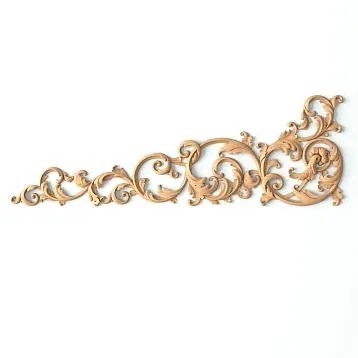
Overlay is a broad concept. It can be floral, geometric, ornamental, symmetrical, simple, or complex. A mascaron is a specific and more expressive type of applied decor. If you just need to fill an empty area of a facade, a regular overlay may suffice. If you need a main image, you should look at mascarons.
Mascaron for furniture and mascaron for facade
A furniture mascaron is seen up close, so detailing, relief depth, and scale matching with the facade are important. A facade mascaron must be readable from a distance, so it often needs a larger silhouette and a proper place in the architectural scheme. Before purchasing, you need to check if the selected model fits your scenario.
Carved wooden mascaron and polyurethane decor
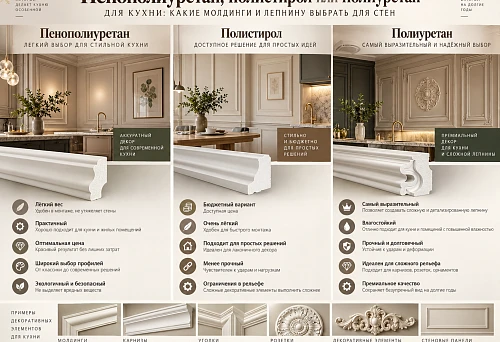
A wooden mascaron is chosen when natural material, finishing options, and connection with wooden furniture, facade, portal, or interior composition are important. Polyurethane decor can solve other tasks, but in terms of material feel and woodworking, it differs. If the project is based on wooden elements, a carved wooden mascaron looks more natural.
Practical selection for different situations
Need to decorate the facade of a chest of drawers or sideboard
For a chest of drawers, sideboard, or cabinet, it is better to place the mascaron in the central part of the facade. It can be one, if you need to create a main accent, or be used as part of a more complex symmetrical scheme. At the same time, it is important not to interfere with handles, panels, door opening, and other decorative details.
For such a scenario, you can start with a general section to buy a wooden mascaron STAVROS, and then supplement the facade through Decorative solid wood overlays.
You need to make a front door area
For a door area, the mascaron is often placed above the opening or in the upper part of the portal. Here the axis is important: the decor must be strictly aligned with the center of the opening. If it is shifted, even a small error will be noticeable. Adjacent elements should support the mascaron, not compete with it.
For doors and portals, you can look at more expressive models, for example Carved Mask M-010 or Carved Mask M-015, if the size and character suit the project.
Need a lion mascaron for a classic interior
A lion mascaron works especially well in a study, library, restaurant, hall, fireplace area, or formal interior. It sets a stronger character than plant decor. But that is precisely why it cannot be placed next to a large number of other active images.
For such a scenario, it's worth comparing Carved mask M-002, Carved Mask M-006 и Carved Maskron M-009Before ordering, you need to check the dimensions and understand which model best suits the furniture, door, facade, or portal.
You need to restore old furniture or a decorative fragment.
In a restoration task, the mascaron should not just be pleasing but match the character of the old piece. You need to consider the carving style, scale, depth, future finish, and neighboring elements. Decor that looks too new in character can appear foreign on old furniture.
For such tasks, it's especially useful to check the cards of specific models and not rush into a purchase. For example, M-002 is described as an option that can be considered for facades, furniture, interiors, and restoration tasks. But the final decision still depends on the specific object.
Need to design a commercial interior
In a restaurant, hotel, salon, showroom, or study, a mascaron can become a noticeable part of the atmosphere. It works well in the entrance area, by the fireplace, in the hall, on a decorative panel, behind the reception desk, or in a classic furniture group. But a commercial interior requires moderation: the detail should be expressive but not turn the space into a stage set.
Here it is especially important to choose a mascaron based on the viewing distance. If a visitor sees it from afar, a more readable silhouette is needed. If they approach closely, the quality of carving and precision of details are more important.
Material, finish, and preparation for installation
A wooden mascaron is good because it can be integrated into furniture or interior logic: matched to wood, painted, tinted, or finished in the same style as adjacent elements, if the specific product and chosen technology allow. However, you cannot assume any coatings, colors, or materials in advance. Before purchasing, you need to check the card of the selected model and clarify current options with a STAVROS manager.
How material affects perception
Wood is perceived as warmer and deeper than a random imitation. In a carved mascaron, this is especially noticeable: the relief, shadow, transitions, protrusions, and recesses read more vividly. If the decor is placed on wooden furniture, a portal, door, or facade, the natural material helps connect the detail with the rest of the composition.
Can a mascaron be painted or tinted
Wooden decor is often chosen for further finishing, but the specific method depends on the product, material, and project. A mascaron can be considered for painting, tinting, staining, or other finishing only after checking the product card and consulting on the selected model. If the part needs to match the color of furniture or facade, it is better to plan a finish sample in advance.
Why installation depends on the base
A mascaron can be installed on a furniture facade, door, wall panel, portal, or facade surface. Each base has its own requirements. On furniture, it is important not to damage the facade and not to interfere with opening. On a wall, the surface must be properly prepared. On a facade, operating conditions must be considered. The specific installation method is best chosen based on the base and model dimensions.
Mistakes when choosing a mascaron
Choose only by plot
A lion, female image, or expressive mask you like is not enough. The subject must suit the installation location, surface size, and project style. A strong image on a small facade may look heavy, while a calm mascaron on a large portal may get lost.
Not checking the size
Size is the main parameter after the subject. The mascaron needs to be compared with the facade, door, portal, or wall. If it is too large, it overloads the composition. If too small, it does not serve as an accent. Before ordering, check the dimensions in the product card.
Placing a mascaron without surroundings
A mascaron can be the main element, but it often needs support: a frame, moldings, overlays, pilasters, a cornice, or other carved decor. Without surroundings, it sometimes looks like a randomly glued detail. For a complete selection, you can look STAVROS carved decor.
Overload the project with several strong images
If a composition has too many faces, lions, cartouches, rosettes, and large overlays, the eye cannot find the main focal point. It's better to choose one strong mascaron and support it with calmer details.
Not considering the finish
The same mascaron looks different under paint, tinting, or natural finish. If the decor must match furniture or a facade, the finish needs to be planned in advance. Otherwise, the finished piece may differ from adjacent elements.
Confusing furniture and facade scale
A mascaron for furniture is seen up close, while a facade element is viewed from a distance. What is expressive on a chest of drawers may be too small on a facade. Conversely, large facade decor may not suit a furniture door.
Who is a wooden mascaron suitable for
A wooden mascaron is suitable for those who want to add a strong carved image to a project: a designer, carpenter, furniture workshop, owner of a classic interior, restorer, architect, owner of a restaurant, hotel, study, salon, or country house. It is especially useful in projects where a regular overlay is not enough and a more expressive decorative center is needed.
A maskaron should be considered for classic, neoclassical, Empire, study interiors, formal portals, fireplace areas, facade details, custom furniture, and restoration tasks. It helps emphasize the status, history, character, and sculptural quality of the project.
Such decor may not suit those looking for minimalist furniture without noticeable details, a neutral background, a simple modern facade, or maximally unobtrusive decor. The mascaron does not disappear into the interior. It always makes itself known, so it must be chosen deliberately.
How to buy a mascaron on STAVROS
It is best to start the purchase with the task. If you need a general selection by group, open the section buy a wooden mascaron STAVROS. If the character of the project is already clear, proceed to specific models: Carved mask M-002, Carved Mask M-006, Carved Maskron M-009, Carved Mask M-010 or Carved Mask M-015.
Before ordering, check the dimensions, material, purpose, relief depth, future finishing, and installation location. If the mascaron is needed not separately but for a ready-made composition, look in advance Decorative solid wood overlays и STAVROS carved decorThis will help you put together not a random purchase, but a complete set.
If the project is complex — a facade, restoration, large portal, fireplace area, or custom furniture — it's better to clarify the parameters with a STAVROS manager in advance. The mascaron must be suitable not only in beauty but also in size, material, installation location, and overall decorative task.
FAQ
Where to buy a wooden mascaron?
Wooden mascarons can be selected in the STAVROS mascaron section. There you can conveniently compare different models, themes, and application options for furniture, facades, doors, portals, and interiors.
What is a mascaron in interior design?
A mascaron is a carved decorative element in the form of a face, head, mask, or symbolic image. In interior design, it works as a strong accent on furniture, walls, doors, portals, or fireplace areas.
What is a carved mascaron used for?
It is used to highlight the central part of the composition, add sculptural decor, emphasize the classical style, decorate furniture fronts, portals, doors, fireplace areas, or facade fragments.
Is a mascaron suitable for furniture?
Yes, a mascaron can be used on furniture facades, chests of drawers, sideboards, cabinets, nightstands, and decorative panels. The main thing is to choose the right size and not interfere with handles, drawers, and door openings.
Can a wooden mascaron be used on a facade?
Yes, if the specific model is suitable for such a scenario and the material, finish, and installation location are correctly selected. For facade tasks, it is better to clarify the parameters with a STAVROS manager in advance.
How is a mascaron different from a cartouche?
A mascaron has the image of a face, head, lion, or mask. A cartouche often looks like an ornamental shield or a figured decorative form without such a sculptural image.
How to choose the size of a mascaron?
The size is chosen based on the surface and viewing distance. For furniture, more compact models are suitable; for a portal and facade, more noticeable ones. Before ordering, you need to check the dimensions in the product card.
Which STAVROS mascaron are suitable for a classic interior?
For classic style, you can consider models with an expressive sculptural image: M-002, M-006, M-009, M-010, M-015, and other mascaron from the general section. The choice depends on the surface size and the role of the decor.
Can a wooden mascaron be painted or tinted?
A wooden mascaron can be considered for finishing, but the specific method depends on the model, material, and project. Before ordering, it is better to check the product card and clarify the suitable finish.
What should be bought together with a mascaron for a complete composition?
Most often, decorative overlays, frame elements, moldings, cartouches, rosettes, pilasters, or other carved decor are viewed together with a mascaron. It is important to assemble a set that matches in style and scale.
Can a mascaron be placed on a door?
Yes, if the size and depth of the relief are suitable for the door or portal. It is important to position it along the axis and ensure that the decor does not interfere with the structure and looks proportional.
How not to overload the interior with a mascaron?
Choose one main mascaron and support it with calmer details. Do not place too many large images, cartouches, rosettes, and active overlays next to each other.
Conclusion: a mascaron is chosen as the main image, not as a random overlay
A mascaron is a carved wooden decor with a strong character. It is suitable for furniture, facades, doors, portals, fireplace areas, and interior compositions when you need not a background but an expressive central image. That is why it is chosen more carefully than a regular overlay: the subject, size, relief depth, installation location, finish, and neighboring elements matter.
For a furniture facade, it's better to check the scale and ease of use. For a door and portal — the axis and symmetry. For a facade — readability from a distance and application conditions. For a fireplace area — connection with the overall composition. For a classic interior — combination with other carved details.
At STAVROS you can buy a wooden mascaron STAVROS, compare Carved mask M-002, Carved Mask M-006, Carved Maskron M-009, Carved Mask M-010 и Carved Mask M-015, and for a finished composition, additionally look Decorative solid wood overlays и STAVROS carved decor. This approach helps to choose a mascaron not based on a random picture, but for a real piece of furniture, facade, or interior task.