Article Contents:
- Answer on the first screen: which N-332 to choose for a 720 mm field
- Three sizes of N-332 are three different pattern scales
- Small version 400 × 30 × 12 mm
- Medium version 650 × 49 × 20 mm
- Large version 800 × 60 × 24 mm
- Linear molding part
- Carved overlay N-332
- A leaf or branch breaks off
- The symmetrical ending disappears
- The visual center shifts
- A new end face appears
- Two parts become different
- Proportions do not turn into an average size
- One size for all facades
- Medium N-332 on the central facade, small on the side ones
- Large N-332 only on the central panel
- Different scales without a system
- Beech for enamel
- Oak for tinting
- Finishing separately
- Finish after installation
- Measure the full door
- Look only at length A
- Buying 800 mm 'with a margin'
- Equating the overlay to a molding
- Cutting before the template
- Not checking the side protrusion
- Install on frame drop
- Order different facades without a list
- Mix beech and oak
- Paint before the control fitting
- Do not repeat manual trimming exactly
- Promise an individual size in advance
- Order without a drawing
- Do not leave free fields
- What sizes is N-332 available in?
- Can an 800 mm N-332 be shortened?
- Why won't shortening 800 mm result in a 650 mm option?
- What to choose for a 720 mm field?
- Will 400 mm fit a 720 mm field?
- What to do if the field is 760 mm?
- When does the 800 mm size fit?
- What should be measured on a frame facade?
- What is the 1:1 template for?
- How to check the thickness?
- Which material should I choose?
- What is the difference between "Standard" and "Prestige"?
- Is N-332 supplied painted?
- Can I order a non-standard size?
- Can N-332 be installed on a door?
- Is N-332 suitable for a kitchen facade?
- Do I need to order one control sample?
- What to do if the medium is too small and the large does not fit?
- Where can I see a more compact overlay?
- How many overlays are needed for four doors?
- When should the overlay be painted?
- How to position N-332 relative to the handle?
- Can the overlay be installed on a frame offset?
- Where can I check the current price?
- Can different sizes of N-332 be used on the same cabinet?
- Should a spare overlay be kept?
- What is more important: length or overall contour?
- Can I first buy 800 mm and decide after delivery?
- How is N-332 different from a long carved strip?
- Is a drawing needed if the dimensions are known?
- What should be checked upon acceptance?
- Can N-332 be chosen based only on furniture style?
- How to understand that there are enough free fields?
- Is it worth reducing the size to leave more air?
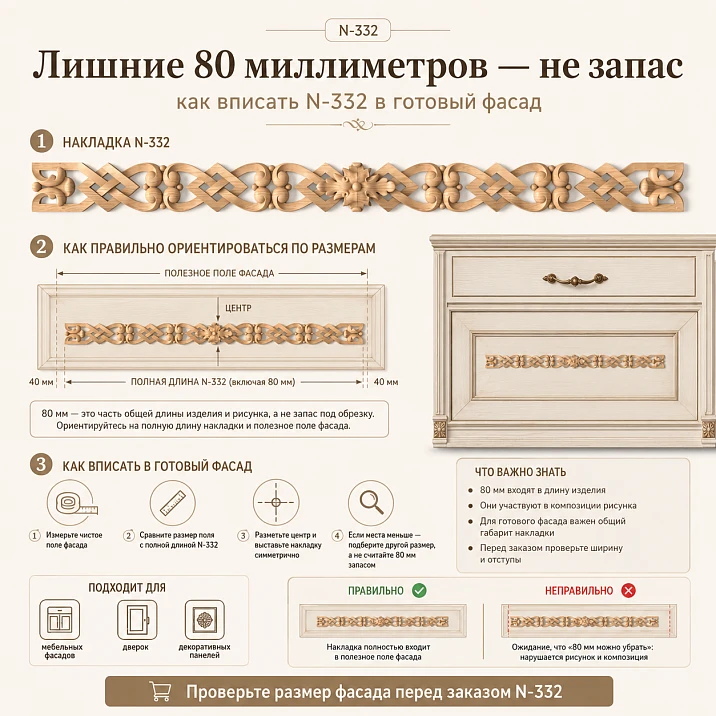
A free field 720 mm high remains on the facade. The N-332 pattern matches the style, the medium overlay 650 mm long seems a bit short, and the large one 800 mm long does not fit by only 80 mm. An almost automatic thought arises: order the large one, attach it to the furniture, and saw off the excess. For molding, such an approach may be a normal part of installation. For the carved overlay N-332, it can end up with a ruined ornament.
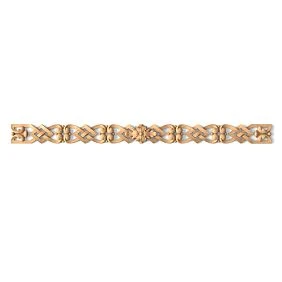
Buy wooden overlay N-332 available in three factory versions: 400 × 30 × 12 mm, 650 × 49 × 20 mm, and 800 × 60 × 24 mm. Not only the length changes. Along with it, the width of the pattern and the thickness of the relief increase. These are three scales of one decorative composition, not one long blank that the manufacturer offers to shorten on site.
The main question before ordering sounds simple: what to do if a beautiful floral ornament suits the furniture, but the useful field of the facade falls between two standard sizes? The answer does not start with a saw. First, you need to measure exactly the decorative field, not the entire door, compare three full-size contours, check the position of the handle, frame, and adjacent doors. If no option works without interfering with the pattern, choose another overlay or separately request the possibility of a non-standard version.
Self-cutting of wood is physically possible. But the possibility of making a cut does not mean that after it N-332 will retain the completion of leaves, symmetry, proportions, and the same appearance throughout the entire batch. Therefore, the extra 80 mm cannot be considered a regular installation allowance.
Answer on the first screen: which N-332 to choose for a 720 mm field
With a usable field of 720 mm, an average N-332 with a length of 650 mm looks safer than a large part with a length of 800 mm. After central placement, 70 mm of free space remains — approximately 35 mm on each side. These margins need to be seen on the template: on one facade they will support the pattern, on another they will appear cramped due to the frame or handle.
The large N-332 does not fit on a 720 mm field without modifying the project. Cutting off 40 mm from each side is not the same as buying a factory version with a length of 650 mm. The large version has a different width — 60 mm instead of 49 mm — and a different thickness — 24 mm instead of 20 mm. Even after shortening, it will remain more massive, and the pattern will lose its intended endings.
The small version of 400 mm will fit freely, but will give a completely different scale. It is not a "shortened average overlay": the width is 30 mm, the thickness is 12 mm. On a large panel, such decor may look too compact.
Practical route:
-
measure the field actually available for the ornament;
-
print the contours of 400 × 30, 650 × 49, and 800 × 60 mm;
-
mark the thickness of each option with a separate side mockup;
-
apply the templates to the facade;
-
check the handle, frame, adjacent door, and opening;
-
select factory scale without cropping;
-
if in doubt, order one control part or check N-332 on the facade drawing.




Three sizes of N-332 are three different scales of the pattern
| Execution | Length A | Width B | Thickness C | How it is perceived |
|---|---|---|---|---|
| Small | 400 мм | 30 мм | 12 мм | Compact ornament for a small decorative field |
| Average | 650 мм | 49 мм | 20 мм | More noticeable composition for a medium facade |
| Large | 800 мм | 60 мм | 24 мм | Large relief for a wide or tall surface |
This table destroys the main selection mistake. When a buyer looks only at length, it seems that between 650 and 800 mm there is a missing option of 720 mm. But N-332 scales in three directions at once. The overall contour increases, the relief becomes deeper, and the decorative mass protrudes more strongly above the facade.
Our factory also produces:


Small version 400 × 30 × 12 mm
An overlay 400 mm long is suitable for small doors, narrow panels, upper drawers, small panels, and cases where the ornament should remain delicate. The 12 mm thickness visually loads the surface less and conflicts with the handle less often.
On a 480 mm field with central installation, 80 mm remains: about 40 mm on each side. This calculation shows the geometry but does not replace a trial fit. If the facade has a massive frame, 400 mm may look appropriate. On a smooth tall door, the same size can get lost.
Get Consultation
Medium version 650 × 49 × 20 mm
An overlay 650 mm long gives a larger pattern and noticeable relief. This option often becomes the first candidate for a 700–750 mm field because it leaves space around the ornament without needing to interfere with its completion.
The 49 mm width requires a separate check. If a narrow strip remains between the frame and the handle, the overlay may fit in length but not in width. The 20 mm thickness also affects perception and opening.
Large version 800 × 60 × 24 mm
The large N-332 is designed for a spacious decorative field. The 800 mm length should be considered together with the 60 mm width and 24 mm thickness. On a large central facade, it can become the main decorative element. On a narrow panel, the pattern will be cramped, and the relief too heavy.
You cannot buy this version "with a reserve." A reserve implies a section that can be removed without losing shape. In N-332, each edge is part of a complete plant pattern.
Why the thought "I'll take 800 mm and saw it off" seems logical
The buyer is not mistaken in common sense. In renovation and furniture production, many parts are indeed adjusted:
-
moldings are cut to length;
-
trim is cut to fit the opening size;
-
baguettes are joined at corners;
-
baseboards are shortened;
-
slats are trimmed to height;
-
edge profiles are adapted to the facade.
Therefore, a large overlay is perceived as a part with extra allowance. But the similarity ends with the material. N-332 belongs not to linear trim, but to carved decor with a beginning, middle, and end of the composition.
The problem especially often arises when:
-
the furniture is already manufactured;
-
the facade frame took more space than expected;
-
the handle is installed before choosing the decor;
-
the door turned out to be non-standard;
-
the free field was measured approximately;
-
the same ornament is wanted to be placed on facades of different sizes;
-
the choice was made from a photo without scale;
-
the size of 800 mm seems closer to the desired one than 650 mm.
In each of these scenarios, the desire to trim the part is understandable. But the correct solution remains fitting factory scales, not automatically changing the pattern.
N-332 and moldings solve different tasks
Linear molding part
A molding, trim, or baguette has a longitudinal profile. Its length is adjusted to fit the object. The end is often hidden in a corner, joint, or junction. Removing a section does not change the character of the profile: the same pattern continues along the entire length.
Carved overlay N-332
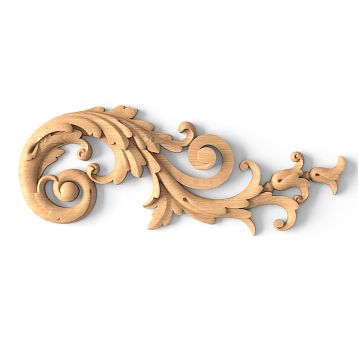
N-332 is an independent decorative composition. Leaves and branches form a complete silhouette. The design has a central part, side branches, and endings. When shortened, it is not a neutral fragment that disappears, but part of the concept.
| Criterion | N-332 | Molding or trim |
| Nature of the Pattern | Complete ornament | Repeating profile |
| Standard trim zone | Not confirmed | Usually provided by installation |
| What changes after cutting | Silhouette, leaves, symmetry, end face | Predominantly length |
| Scale | Three factory versions | One profile of different lengths |
| End face | May remain visible | Often hidden in the joint |
| Selection method | By useful field and template | By section length |
| Risk of manual trimming | Composition disruption | Standard installation operation with proper technique |
Section with decorative overlays on furniture facades helps to choose exactly the finished form. Searching for N-332 by the logic of molding means choosing a product not by its purpose.
What happens to the ornament after self-trimming
The cut changes more than just the length. Possible consequences depend on where the line runs.
A leaf or branch is cut off
At the edge, a shape remains that looks unfinished. Even after careful sanding, the eye notices that the pattern should have continued.
Symmetric ending disappears
If you remove different sections on the right and left, the overlay loses balance. If you cut off the same amount, symmetry in length may be formally preserved, but compositional endings will still disappear.
Visual center shifts
After removing one edge, the central accent is no longer in the middle of the actual part. On the facade, this looks like an installation error.
A new end face appears
The factory edge has a designed shape and finish. After cutting, a flat or uneven end face appears, which needs to be sanded and protected again. Its color after finishing may differ.
Two parts become different
When ordering multiple overlays, manual trimming must be repeated exactly the same. A difference of even a few millimeters will be noticeable on adjacent doors.
Proportions do not turn into an average size
The large N-332 after shortening remains 60 mm wide and 24 mm thick. It does not become a 650 × 49 × 20 mm version.
Therefore, a custom cut cannot be considered a standard way to obtain a new scale. The possibility of non-standard execution, cost, and minimum order are confirmed separately by the manufacturer.
You need to measure not the entire facade, but the useful decorative field.
Let the door have a height of 800 mm. This does not mean that an overlay of 800 mm in length fits on it. Part of the space is occupied by the frame, panel, handle, keyhole, gaps, and adjacent elements.
The useful field is the area where the ornament can be placed without touching other details and maintaining free margins.
The following are subtracted from the full size:
-
top frame;
-
bottom frame;
-
side stiles;
-
protruding molding;
-
handle and its base;
-
keyhole;
-
hinge or fastening zone;
-
gap between doors;
-
adjacent overlays;
-
areas covered by the countertop or cornice;
-
fields necessary for normal perception of the pattern.
How to choose the size of a carved overlay, it is useful to read before marking the entire furniture series. But for N-332 it is especially important to compare not just one length, but the full contour of each version.
Measurement form for N-332
| Facade parameter | actual size |
| Full height or width of the facade | ___ mm |
| Useful inner field | ___ mm |
| Frame width at the top | ___ mm |
| Bottom frame width | ___ mm |
| Left free field | ___ mm |
| Right free field | ___ mm |
| Handle zone | ___ × ___ mm |
| Distance to the handle | ___ mm |
| Allowed overlay length | ___ mm |
| Allowed overlay width | ___ mm |
| Allowed decor thickness | ___ mm |
| Distance to adjacent leaf | ___ mm |
| Opening direction | ___ |
| Selected scale N-332 | ___ |
The table should be filled after installing or finalizing the handles and frames. Otherwise, the useful field will be conditional.
Free fields around the ornament are part of the composition
The overlay should not fill the entire available plane from edge to edge. The space around it helps to see the silhouette. If the leaves almost touch the frame, even a correctly chosen size looks randomly squeezed.
Formula for central placement along the length:
(useful field − overlay length) ÷ 2
For a field of 720 mm and N-332 with a length of 650 mm:
(720 − 650) ÷ 2 = 35 mm
This is only geometry. Thirty-five millimeters may be sufficient on a narrow panel and too small next to a large frame. The template will show the result better than a number.
Free fields can be unequal if the composition is related to a handle or an asymmetric facade. But such a shift must be deliberate and the same on repeated doors.
Template 1:1: the cheapest way not to ruin the facade
For fitting, three full-size contours are needed:
-
400 × 30 mm;
-
650 × 49 mm;
-
800 × 60 mm.
The contours can be cut out of paper or thin cardboard. On each one, mark:
-
central axis;
-
top and bottom;
-
length A;
-
width B;
-
the extreme points of the ornament;
-
position relative to the handle;
-
free margins;
-
the frame line.
The thickness is not visible on a flat template. It is checked with a separate strip or a small side mock-up:
-
12 mm for the small size;
-
20 mm for the medium size.
-
24 mm for the large one.
For precise work, you can download drawings of decorative overlays. Print at 100% scale, without automatic fit to page. After printing, check the control size with a ruler.
Why you need to check the print scale with a ruler
The "fit to page" setting reduces the drawing. A 650 mm overlay on paper may become 620 or 630 mm. The buyer will apply the template, see good margins, and order a part that will actually be larger.
Procedure:
-
select 100% scale;
-
disable fitting;
-
print a control fragment;
-
measure a known dimension;
-
glue the sheets according to the marks;
-
only after checking, apply the template to the furniture.
The photo on the screen does not replace the template. The image size depends on the monitor and browser zoom.
Example 1: useful field 480 mm
The small version with a length of 400 mm leaves 80 mm:
480 − 400 = 80 mm
With central installation:
80 ÷ 2 = 40 mm
The medium version of 650 mm does not fit. The large one — even more so.
On the 480 mm field, not only the length of 400 mm is checked, but also the width of 30 mm and the thickness of 12 mm. If the overlay is installed above the handle, you need to make sure that the leaves do not cross its base.
This scenario suits a small drawer, a cabinet door, or a narrow panel. But on a tall smooth door of 400 mm, they may look too modest.
Example 2: useful field 720 mm
The small size of 400 mm leaves 320 mm of free space. With central placement — 160 mm on each side. The decor may look compact.
The medium size of 650 mm leaves 70 mm — 35 mm on each side. This is the main candidate, but the result is checked with a mockup.
The large size of 800 mm is 80 mm longer than the field. Trimming is not confirmed as a standard operation. Therefore, the correct choice is not to "remove 40 mm" but to consider the medium version, another decor, or a custom request.
Additionally, compare the width:
-
30 mm;
-
49 mm;
-
60 mm.
On a narrow panel, the medium N-332 may fit in length but could be close to the side edges.
Example 3: useful field 760 mm
Only 40 mm are missing to reach the large N-332. This is where the most dangerous feeling arises: "just remove 20 mm each."
Twenty millimeters on paper seem small. In a plant ornament, they may fall on the end of a leaf or a thin branch. After two cuts, the pattern will be shorter, but the width of 60 mm and thickness of 24 mm will remain.
The average overlay will leave 110 mm:
760 − 650 = 110 mm
With central installation — 55 mm each. In most compositions, such a margin is perceived as more natural than a trimmed large part. But the final choice is confirmed by the template.
Example 4: useful field 900 mm
The large N-332, 800 mm long, leaves 100 mm — 50 mm each with central placement. Geometrically, the option looks convincing.
Then check:
-
whether the field width is sufficient for 60 mm;
-
whether the 24 mm thickness conflicts with the handle;
-
whether the overlay touches the adjacent leaf;
-
does the pattern fit inside the panel;
-
does the furniture withstand the scale;
-
does the decor not compete with the cornice;
-
is it possible to arrange the details identically across the entire series.
If the facade is wide and central, the large N-332 can become the main decoration. On the narrow side doors, the same scale may be excessive.
Example 5: useful field 550–600 mm
This is a complex interval. The small 400 mm version fits with noticeable margins. The medium 650 mm does not fit. Trimming the medium piece disrupts the composition.
Possible solutions:
-
use 400 mm;
-
choose a different article;
-
change the position of the handle or frame, if the furniture is still being designed;
-
highlight N-332 only on the large central facade;
-
request an individual option without promising a result;
-
order a design check.
In such a situation, it is useful look at the compact overlay N-333. This does not mean automatic interchangeability. The dimensions, pattern, and proportions of N-333 need to be checked on its card. The link provides a neighboring product route when N-332 does not fit.
Several facades of different sizes: one pattern or one scale
A kitchen, cabinet, or sideboard often has central and side doors of different widths. The buyer wants to keep one ornament but does not know whether all overlays must be the same length.
Four schemes are possible.
One size on all facades
For example, N-332 with a length of 400 mm is installed on central and side doors. The rhythm is uniform, but on large facades the decor may look smaller.
Medium N-332 on the central facade, small on the side ones
The drawing is preserved, the scale changes. Such a system emphasizes the hierarchy of furniture. It is necessary to check whether the three factory sizes are perceived as one collection.
Large N-332 only on the central panel
Large decor becomes an accent. The remaining doors can stay without overlays or get a different, more compact element.
Different scales without a system
On one door — 650 mm, on another — 400 mm, on the third — a trimmed 800 mm. Such a mix looks random. Differences should follow the furniture architecture.
Before a serial order, it is useful to study, how to place decor on a kitchen or wardrobe. Then, for each type of facade, a separate template is made.
The central axis is more important than the full size of the door
The ornament should be connected with the facade architecture. On a symmetrical door, the center of N-332 is usually aligned with the central axis. On a drawer — with the center of the front panel or handle. On paired doors, a common composition is possible, but it needs to be designed as a whole.
If the overlay is shifted to bypass the handle, the free margins will become different. This is only acceptable as a deliberate decision. On several identical doors, the shift is repeated using a template.
On the mock-up, mark:
-
facade axis;
-
overlay axis;
-
the handle axis;
-
frame boundaries;
-
door separation line;
-
adjacent elements.
This makes it clear whether the problem is really in the size or in an incorrectly chosen position.
Width B: the parameter most often forgotten
The buyer compares 400, 650, and 800 mm, but rarely sees 30, 49, and 60 mm at a glance. Meanwhile, the width determines whether the panel fits inside the frame and how much air remains at the top and bottom.
Let's imagine a panel with a height of 90 mm:
-
the small version with a width of 30 mm leaves a large margin;
-
average 49 mm takes up more than half;
-
large 60 mm becomes dominant.
If the frame has a complex profile, the edge of the ornament may physically fit, but visually approach the transition. The carved part must rest on a flat surface and not hang over the transition.
The width is measured along the maximum outer contour, not along the central branch.
Thickness C: the decor may fit in front and interfere from the side
Thickness of 12, 20, or 24 mm affects the relief and protrusion above the surface. The large N-332 protrudes more noticeably, so you need to check:
-
distance to the handle;
-
opening of the adjacent sash;
-
proximity to the countertop;
-
drawer extension;
-
space next to the wall;
-
clothing and passage;
-
light shadows;
-
combination with the depth of other overlays.
On a smooth facade, a 24 mm relief looks sculptural. On a narrow door, it may seem heavy. A flat paper outline does not show this, so a side mockup is needed.
The handle and N-332 should not compete for the same space
The handle is the functional center, the overlay is the decorative one. If they are too close, the hand catches the ornament, and the composition looks cramped.
Check:
-
outer size of the handle;
-
position of fasteners;
-
grip area;
-
finger movement;
-
distance to relief;
-
symmetry;
-
possibility of replacing the handle;
-
presence of a keyhole.
On the N-332 box, it can be positioned above the handle, below it, or used without a central handle per the design. There is no universal scheme. A full-size fitting of both elements simultaneously is required.
Framed facade: the length may fit, but the plane does not.
The frame reduces the usable area not only in length and width. It creates a height difference. If part of the N-332 falls on the stile and part on the recessed panel, the component does not get a flat support.
Options:
-
place the overlay entirely within the panel;
-
install it entirely on a wide frame stile;
-
choose a different size;
-
provide a prepared backing per the design;
-
abandon the overlay on this facade.
Filling the height difference with glue arbitrarily is not allowed. The mounting base and fixation method must be coordinated.
Smooth facade: a simple plane requires precise marking
On a smooth door, it is easier to find a level base, but any deviations are more visible. If the N-332 is rotated or shifted by a few millimeters, the long horizontal shape emphasizes the error.
For a series, a single jig or template is made:
-
the center;
-
extreme points;
-
installation height;
-
distance to the handle;
-
orientation;
-
facade number.
The first overlay is installed as a reference, furniture is assessed from a distance, and only then is the marking repeated.
One reference piece before ordering the entire batch
Buying one sample seems like an unnecessary expense until compared with the cost of the batch and redoing facades. The reference N-332 answers questions that a screen cannot.
Check:
-
the actual scale;
-
relief quality;
-
width and thickness;
-
position relative to the handle;
-
free margins;
-
opening;
-
view from a distance;
-
wood grain pattern;
-
trial finishing;
-
ease of installation;
-
combination with other elements.
For several types of facades, one part is applied to each. If 650 mm fits on the central door, this does not prove its compatibility with the side ones.
Beech or oak for N-332
Beech for enamel
Beech is prepared for opaque painting. When the overlay is made in the color of the facade, the silhouette and chiaroscuro come to the forefront. The wood texture ceases to be the main effect.
Beech is convenient for white, gray, colored, and other enamel solutions, but the specific coating system is selected by the workshop. A test coat is done before the entire batch.
Oak for tinting
Oak is chosen when the natural pattern needs to be preserved. On a long overlay, the texture emphasizes the direction of the ornament. The tone should match the facade, handles, and adjacent wooden parts.
One photo is not enough. The shade is checked under the room's lighting and on the approved finishing system.
| Criterion | Beech | Oak |
| Basic preparation | For enamel | For tinting |
| Visible effect | Color and relief | Texture and relief |
| Matching to furniture | By coating color | By tone and pattern |
| Control stage | Test enamel | Trial tinting |
| Order series | One batch and one color sample | One batch and approved tone sample |
Mixing beech and oak in one series of identical facades without a separate design intent is not advisable.
"Standard" or "Prestige": how much finishing will be required
The card confirms two sanding qualities — "Standard" and "Prestige". The difference affects the surface's readiness for further finishing and the amount of manual preparation.
Choose the "Standard" or "Prestige" sanding needed before processing a batch. You cannot assume that any quality allows applying the finish immediately without inspection. The carved relief is checked on leaves, recesses, edges, and the back side.
"Prestige" is rational when:
-
the overlay is painted with a noticeable relief;
-
the batch is large;
-
manual preparation needs to be reduced;
-
the finish is transparent or thin;
-
repeatability is important.
"Standard" may suit a workshop that plans its own finishing. The decision depends on the furniture production technology.
The overlay is supplied without a ready finish
Beech and oak require subsequent finishing. You cannot install an untreated part on finished furniture and consider the job complete.
Before the finish:
-
perform a fitting;
-
check the surface;
-
approve the position;
-
decide whether to finish separately or after installation;
-
protect the gluing areas if the technology requires it;
-
perform a test;
-
maintain a uniform color for the entire batch.
Preparation and finishing of carved wood help build the overall sequence. Specific materials are chosen for beech or oak, the facade surface, and the desired appearance.
Paint before or after installation
Both options are possible in different projects, but the decision is made before work begins.
Finishing separately
It is convenient to paint the relief and edges. The facade is protected from accidental material. But the area for glue may require masking, and after installation the joint sometimes needs adjustment.
Finishing after installation
The overlay and facade get a single color. But it is harder to paint the edges and protect adjacent parts. An installation error already occurs on the finished composition.
You cannot give universal advice without a chosen system. The workshop must agree on the compatibility of glue, primer, and finish.
What to buy together with N-332
| Addition | Why | When required | Inner page |
| Control N-332 | Check the scale and relief | Before a batch of several facades | Buy wooden overlay N-332 |
| Other overlays | Find a suitable contour | If no N-332 size fits | buy decorative overlays for furniture facades |
| N-333 | Consider a more compact adjacent option | For the field between standard sizes | look at the compact overlay N-333 |
| Decor of one collection | Match the furniture ensemble | For a wardrobe, sideboard, or kitchen | View wooden decor in Russian style |
| Drawing | Check the outline and axes | Before ordering and drilling | download drawings of decorative overlays |
| Design project | Place decor on a series of facades | With a complex frame and different sizes | check N-332 on the facade drawing |
| Installation and finishing materials | Prepare fixation and finish | After choosing the base and technology | Select materials for installing the overlay |
Accessory materials should not be purchased automatically. First, confirm the condition of the N-332 surface, the facade material, and the finishing technology. Only then select the primer, paint, tinting compound, adhesive, and auxiliary tools.
How not to confuse N-332 with N-333
N-333 follows the same collection logic, but it is a different product. Similar origin does not mean identical dimensions, pattern, or purpose.
The comparison is based on the product cards:
-
outer contour;
-
length;
-
width;
-
thickness;
-
material;
-
polishing;
-
completion of the ornament;
-
useful field of the facade;
-
visual scale.
N-333 should be considered if N-332 does not fit or looks excessively large. But one article cannot be replaced with another just because of the name "compact." First, cut out a separate template, check the pattern relative to the handle, and make sure the new ornament supports the furniture style.
How not to confuse N-332 with a polyurethane overlay
N-332 is made of wood — beech or oak. Polyurethane decor has a different material nature, finish, and installation. Requests for flexible overlays or moldings do not apply to this product.
Wooden N-332 is chosen when the following matters:
-
natural base;
-
possibility of enamel on beech;
-
oak tinting;
-
combination with wooden furniture;
-
carved relief;
-
collectible styling.
The material cannot be changed in an article or order for the sake of visual similarity. The buyer must understand what surface they will get, how it will be finished, and how it will behave next to other wooden parts.
N-332 on the central cabinet door
A medium or large overlay can emphasize the furniture axis. The central facade is often wider than the side ones, so a larger scale is appropriate on it. But the decision is not reduced to the rule "the largest door — the largest overlay".
Check:
-
width of the inner panel;
-
height of the useful field;
-
distance to the cornice;
-
the position of the handles;
-
symmetry of adjacent doors;
-
distance to the floor;
-
overall rhythm of the cabinet.
If the central door receives N-332 with a length of 800 mm, the side doors can be left without ornament or decorated with a small version of 400 mm. It is important that the difference looks like a hierarchy, not like a lack of identical parts.
Carved overlay on the buffet facade
A buffet often has framed doors, drawers, keyholes, and a cornice. The free field is divided into several sections. You cannot compare the length of N-332 only with the total width of the facade.
For a buffet, it is useful to make a frontal drawing of the entire piece of furniture. On it, mark:
-
central axes;
-
panels;
-
handles and keyholes;
-
cornice;
-
base;
-
overlays of other shapes;
-
size N-332.
The floral ornament supports traditional furniture well, but an overloaded composition quickly loses clarity. If the facade already has carved frames and corner elements, N-332 should take its place rather than cover the free surface at any cost.
N-332 for a wide dresser drawer
Horizontal installation ties in with the length of the front panel. On a wide drawer, a medium or large overlay is often considered, but the handle may be located exactly where the central branch runs.
Three schemes are possible:
-
overlay above the handle;
-
overlay below the handle;
-
two handles on the sides, and N-332 in the center.
The third option should not be chosen without checking the grip. The hand must not touch the leaves. A thickness of 20 or 24 mm is especially important on a frequently used drawer.
If the dresser has three identical drawers, the position of the decor is repeated according to one template. On the top drawer, the overlay should not be reduced just because it is closer to the tabletop, if the facades are the same size and the project requires a unified rhythm.
N-332 for kitchen facade
Kitchens place high demands on finishing and maintenance. N-332 can be considered for decorative facades, columns, buffet areas, or islands, but the specific coating and installation location should be agreed upon based on operating conditions.
The relief should not be placed where it will constantly come into contact with hands, steam, or dirt without appropriate protection. The card confirms the material and preparation, but does not provide a universal guarantee for any kitchen area.
Before ordering, you need to decide:
-
whether the facade will be opened frequently;
-
whether the relief can be easily cleaned;
-
whether the decor is located near the work surface;
-
whether the coating matches kitchen conditions;
-
whether the overlay interferes with the handle;
-
how it combines with adjacent facades.
Overlay for a door or decorative panel
The card classifies N-332 as overlay decor for furniture, doors, and surfaces. This expands its application but does not cancel base checks.
On the door, measure:
-
the free field between panels;
-
the distance to the handle and lock;
-
opening direction;
-
proximity to the wall;
-
the possibility of impact from the relief;
-
position relative to the trim
Why it's better not to stretch one batch over months
Natural wood varies in grain and tone. A repeat order may be perceived differently after clear finishing. Additionally, the workshop may use a different batch of coating.
One order helps:
-
approve the scale;
-
distribute beech or oak;
-
perform general preparation;
-
make one test coat;
-
maintain the same sanding;
-
repeat the marking;
-
leave a reserve.
Current deadlines, price, and availability are checked in the product card before payment. They cannot be fixed in the article as permanent.
Installation begins with marking, not with glue
Before fixing, the overlay is applied to the facade and checked against the template. The central axis and extreme points are marked on the surface. The same jig is used for the series.
Procedure:
-
accept the product;
-
check the size and material;
-
inspect the relief;
-
apply without glue;
-
compare the fields;
-
check the handle and opening;
-
approve the position;
-
prepare the base;
-
select a compatible mounting compound;
-
perform fixation according to the technology;
-
check for absence of displacement;
-
finish the finishing.
Select materials for installing the overlay possible after determining the facade surface. A universal adhesive cannot be assigned without checking the substrate.
What to check when receiving an order
The packaging must be opened before painting, trimming, and gluing. The buyer checks not only the quantity but also the selected modification.
Receiving checklist:
-
article number N-332;
-
length 400, 650, or 800 mm;
-
corresponding width;
-
corresponding thickness;
-
beech or oak;
-
"Standard" or "Prestige";
-
quantity;
-
condition of the relief;
-
edges and ends;
-
absence of noticeable damage;
-
uniformity of the selected series;
-
compliance with the order.
If a different version arrives instead of 650 × 49 × 20 mm, fitting must not begin. First, record the discrepancy and clarify the order.
Storage before fitting and installation
Carved wooden parts must not be left in the aisle, near wet work areas, or heating appliances. They are stored under conditions suitable for wooden products, on a flat surface, and in packaging that protects the relief.
Several overlays from the same batch are marked by facades:
-
central 1;
-
central 2;
-
left side;
-
right side;
-
control;
-
reserve.
After trial finishing, parts are not mixed. If oak overlays have noticeably different grain patterns, distribution across facades is approved before painting.
Errors due to which N-332 does not fit the facade
Measure the full door
The frame and handle reduce the usable area. A facade size of 800 mm does not mean that an 800 mm overlay fits inside.
Look only at length A
Width B and thickness C also change. On the large N-332, the relief is noticeably more massive.
Buying 800 mm "with a margin"
The ornament has no confirmed neutral cutting zone. The extra length is part of the pattern.
Equating an overlay with a molding
A finished pattern cannot be adjusted like a repeating profile.
Cutting to the template
The buyer ruins the part, although a smaller scale or a different article could have been suitable.
Not checking the side overhang
The thickness interferes with the handle or the adjacent panel, although the front contour looks suitable.
Install on a frame offset
The overlay does not have a flat support and may only adhere with part of its back surface.
Order different fronts without a parts list
The scales are distributed randomly, and the installer does not understand which part is intended for which door.
Mixing beech and oak
After finishing, the batch looks inconsistent. Differences in wood species cannot be hidden with a random uniform color without a test swatch.
Paint before the trial fitting
Correcting the size, edge, or position damages the finish.
Do not repeat manual trimming exactly
The two modified parts differ from each other, and the pattern on adjacent fronts loses its rhythm.
Promise an individual size in advance
Availability, cost, and minimum order require separate confirmation.
Order without a drawing
The photo does not show the actual outline, width, thickness, and margins.
Do not leave free margins
The ornament looks cramped and starts to conflict with the frame.
Request template for manager
A carved overlay N-332 is required for a furniture facade. Useful decorative field — ___ × ___ mm. We are considering execution ___ × ___ × ___ mm. Number of facades — ___, overlays per facade — ___. Material — beech/oak. Sanding — "Standard"/"Prestige". Planned finish — ___. Please confirm the current drawing, possibility of installation without trimming, price, lead time, completeness, and possibility of non-standard execution if no factory size fits.
The following are added to the request:
-
a photo of the facade strictly from the front;
-
a drawing with dimensions;
-
frame dimensions;
-
handle position;
-
opening direction;
-
selected template;
-
quantity of each modification;
-
finishing sample;
-
information about other carved parts;
-
requirement to agree on changes in writing.
Such a request saves time. The manager sees not an abstract request to "fit the overlay," but a specific field, selected size, and reason for doubts.
How to order N-332 on STAVROS
-
Open the product card and buy wooden overlay N-332 after checking the size.
-
Measure the useful field of the facade.
-
Compare three versions.
-
Print the template at 1:1 scale.
-
Check the width and thickness.
-
choose beech or oak
-
Coordinate the 'Standard' or 'Prestige' option.
-
Decide which finish is needed.
-
Order one test piece for a complex series.
-
Do not plan self-trimming as a regular method.
-
If dimensions do not match, look at another decor.
-
Confirm the possibility of custom execution separately.
Additionally, you can View wooden decor in Russian style and coordinate the overlays with other furniture elements. There is no need to mechanically fill every free surface with ornament. The collection approach works when details are connected by pattern but differ in role and scale.
When the field almost exactly matches the length of the overlay
Sometimes the useful field is 650–660 mm, and the average N-332 formally fits. Such precision does not always mean a good fit. The floral ornament may end up almost flush with the frame, and the outer leaves will be perceived as accidentally cut off by the facade border, although the part itself remains intact.
Before ordering, you need to assess not only the possibility of physically placing the overlay, but also the presence of air around it. If the free field is a few millimeters, the product appears visually cramped. In this case, it is wiser to check the small version of 400 mm or another article.
Size coincidence is especially dangerous on a framed facade. The outer contour may fit inside the panel, but the edge of the relief will approach the bevel of the frame. Under side lighting, this tightness will become more noticeable.
Horizontal and vertical placement of N-332
N-332 can be evaluated in the orientation that a specific project provides. However, rotating the ornament changes its perception and requirements for the useful field. A horizontal overlay emphasizes the width of a drawer or door. A vertical one can elongate a tall panel, but must match the composition of the pattern and the location of the handle.
For vertical fitting, you cannot simply swap the length and width in the table and consider the task solved. You need to apply the actual contour, check the direction of the leaves, and ensure the ornament looks natural. The card and drawing remain the main reference.
On paired doors, two schemes are possible:
-
the same direction on both leaves;
-
a mirror composition according to a separate project.
You should not independently flip one overlay for mirroring until it has been checked how the pattern works in a pair.
How to assess scale from a distance
Up close, the carving attracts with details, so the large N-332 almost always seems more impressive. From a distance of two to three meters, something else becomes visible: whether its mass matches the facade, whether the 60 mm width looks excessive, and whether there is enough free space around the leaves.
The check is carried out at three points:
-
directly in front of the furniture — to assess the relief and the handle;
-
from the usual point of entry into the room — to check the overall scale;
-
from the side — to assess the thickness and shadows.
It is useful to temporarily attach a paper template with painter's tape, which does not damage the surface, and leave it for several hours. A quick try-on within a minute often gives an emotional rather than a considered choice.
What changes after replacing a furniture handle
If the handle has not yet been chosen, N-332 cannot be finally approved. New hardware can take up more space, change the central axis, and require a different grip zone. This is especially noticeable on a wide drawer where the handle and the overlay are located on the same horizontal line.
First, it is useful to define both elements on one mockup. Mark the outer contour of the handle, the mounting points, and the space for fingers. Then overlay N-332. If the pattern crosses the working area, change the position or scale before ordering.
Do not expect to be able to move the handle after installing the overlay without traces. Old holes and coating damage may remain visible.
Size selection checklist
Check 400 мм 650 мм 800 мм Total Fits in length Yes / no Yes / no Yes / no ___ Fits in width Yes / no Yes / no Yes / no ___ Thickness is suitable Yes / no Yes / no Yes / no ___ There are free fields Yes / no Yes / no Yes / no ___ Does not interfere with the handle Yes / no Yes / no Yes / no ___ Lies on a flat surface Yes / no Yes / no Yes / no ___ Matches the scale Yes / no Yes / no Yes / no ___ Confirmed by template Yes / no Yes / no Yes / no ___ The table helps separate the emotional desire to take the largest decor from real compatibility. Choose the version that passes all checks, not just fits by length.
Two identical overlays need to be compared before painting
When ordering paired parts, do not limit yourself to checking the article number and length. Place two N-332 side by side in the same direction and compare the outer leaves, central axis, overall width, and depth of the relief. Natural wood may differ in grain, so oak elements are pre-distributed across facades.
After approving the pair, mark the overlays: left, right, central, or reserve. This is especially useful during tinting when the natural grain remains visible. If the craftsman swaps the parts after a test stain, the combination with facades may change.
Checking the pair also shows how accurately the installation will be repeated. For adjacent doors, use one template, the same height, and the same distance to handles. This way, the furniture looks assembled as a single composition, not as a set of separately decorated doors.
Questions and answers about N-332
What sizes is N-332 available in?
In three versions: 400 × 30 × 12 mm, 650 × 49 × 20 mm, and 800 × 60 × 24 mm. These are three proportionally different scales of the same pattern.
Can the 800 mm N-332 be shortened?
Self-trimming cannot be considered a standard method. It may damage the leaves, branches, symmetry, and edge treatment.
Why won't a 650 mm variant work after shortening an 800 mm one?
Because the width and thickness differ. For the large version, they are 60 and 24 mm; for the medium, 49 and 20 mm.
What to choose for a 720 mm field?
The first candidate would be N-332 with a length of 650 mm. That leaves 70 mm, approximately 35 mm on each side with central placement.
Will a 400 mm fit for a 720 mm field?
It will fit, but it may look too compact. The decision is made based on the template and the overall scale of the facade.
What to do if the field is 760 mm?
Compare the medium 650 mm option and other overlays. The large N-332 should not be automatically shortened by 40 mm.
When is the 800 mm size suitable?
When the useful field actually accommodates a length of 800 mm, a width of 60 mm, a thickness of 24 mm, and free margins around the pattern.
What to measure on a frame facade?
The inner flat field, the frame, the handle, gaps, and the space to the adjacent door. The full door size is insufficient for selection.
Why is a 1:1 template needed?
It shows the real contour and free fields. A product photo does not convey scale and does not help check the handle.
How to check the thickness?
Make a side mockup of 12, 20, or 24 mm and assess the protrusion near the handle, frame, and adjacent door.
Which material to choose?
Beech is for enamel, oak is for tinting and preserving texture. The choice is linked to furniture finishing.
What is the difference between "Standard" and "Prestige"?
By the quality of surface preparation and the amount of further finishing. Exact requirements are better verified in the quality section and product card.
Is N-332 supplied painted?
No, confirmed data indicates supply without a ready finish coating.
Can I order a non-standard size?
Availability, price, and minimum order are confirmed separately by the manufacturer. Promising an individual option in advance is not possible.
Can N-332 be installed on a door?
The card classifies the overlay as decor for furniture, doors, and surfaces. The base and installation need to be checked against the project.
Is N-332 suitable for a kitchen facade?
The possibility depends on the coating, location, and usage conditions. The finish and maintenance need to be coordinated.
Is it necessary to order one control sample?
For a complex or serial project, this is useful. The sample shows the actual thickness, relief, scale, and behavior of the finish.
What to do if the medium is too small and the large one doesn't fit?
Choose another item, change the composition, or separately request a custom version.
Where can I see a more compact overlay?
You can look at the compact overlay N-333 and check its dimensions in the card.
How many overlays are needed for four doors?
With one overlay per door — four pieces plus an agreed reserve. If door sizes differ, a list is compiled by groups.
When should the overlay be painted?
After a trial fitting and approval of the technology. Finishing before checking the size increases the risk of damaging the finish.
How to position N-332 relative to the handle?
Overlay full-size contours of both elements and check hand movement, axis, and free space.
Can an overlay be installed on a frame offset?
Without a special design solution, it should not be done. The base must provide a flat support.
Where can I check the current price?
In the N-332 card before placing an order. Price, availability, and lead times may change.
Can different sizes of N-332 be used on the same cabinet?
Yes, if the difference is related to the facade architecture and is pre-verified with templates. A random mix of scales looks disjointed.
Should I leave a spare overlay?
For a large batch, a reserve can be useful. It's better to finish the spare part together with the main order.
What matters more: length or overall contour?
Overall contour. Length only affects one parameter, while width and thickness affect fit and visual weight.
Can I first buy 800 mm and decide after delivery?
That path increases the risk of an unnecessary purchase. First compare templates, then choose the scale.
How does N-332 differ from a long carved plank?
N-332 has a complete ornament and three factory scales. A plank with a repeating profile usually allows length adjustment.
Is a drawing needed if the dimensions are known?
Yes. The line 650 × 49 × 20 mm does not show the exact silhouette of leaves and branches.
What should be checked upon acceptance?
Size, material, sanding, quantity, relief condition, edges, and compliance with the ordered modification.
Can N-332 be chosen only by furniture style?
No. Stylistic compatibility is important, but without geometric verification, the overlay may not fit.
How to understand that there are enough free fields?
Make a template, look at the facade from a distance, and assess whether the pattern approaches the frame or handle. There is no universal number for all facades.
Should the size be reduced to leave more air?
Sometimes a smaller scale looks better than a large one. The decision depends on the useful field, frame, and the role of the facade in the overall furniture.
Summary: the size is chosen before ordering, not created with a saw after delivery.
N-332 is available in three finished scales. The small version has dimensions of 400 × 30 × 12 mm, the medium — 650 × 49 × 20 mm, the large — 800 × 60 × 24 mm. Not only the length increases, so a large overlay cannot be perceived as a blank with extra centimeters.
Before purchasing, measure the useful field, not the entire facade. Print three contours, check the width, thickness, handle, frame, and adjacent doors. For a 720 mm field, first consider 650 mm, not a trimmed 800 mm piece. If factory versions do not fit, choose another ornament or request the possibility of a custom solution.
STAVROS offers the N-332 overlay with confirmed dimensions, a choice of beech or oak, two sanding qualities, drawings, and related carved decor sections. This approach allows you to preserve the finished pattern and order an overlay that truly fits the facade, rather than turning a ready-made ornament into a blank for risky alterations.
-