



























Article Contents:
- Wooden handrail PR‑002: why the 2500 mm limit matters before purchase
- How to measure the stair flight before ordering a 3000 mm handrail
- What exactly needs to be measured
- Why horizontal 2800 mm can give a completely different length
- Scenario 1. 2800 mm is already the final size between the finished end planes
- Scenario 2. 2800 mm — only the inclined central part, and the handrail must additionally extend into the nodes
- Scenario 3. The line can be architecturally divided
- Appearance under opaque finish
- Appearance under tinting
- Structural logic
- Oak
- Oak
- Why mixing wood species should only be done deliberately
- Why can't you recall PR-003 after receiving the handrail
- 1. PR-002 length
- 2. PR-003 length
- 3. Material
- 4. Preparation for finish
- 5. Grinding quality
- 6. Number of flights
- 7. End nodes
- 8. Transport length
- What to measure in the house
- Simplest mockup without a handrail
- If the handrail will be under enamel
- If the handrail will be under tinting
- Why a control sample is needed
- Mistake 1. Measure 2.8 m along the floor and order 3000 mm
- Mistake 2. Consider 200 mm a guaranteed margin
- Mistake 3. Expect a solid-lamella construction for 3000 mm
- Mistake 4. Not ordering PR-003
- Mistake 5. Assume that PR-003 is also available in a single 3000 mm length
- Mistake 6. Mixing oak and beech without a finishing project
- Mistake 7. Buying a handrail before approving balusters and posts
- Mistake 8. Not checking the delivery route
- Mistake 9. Buying PR-002 instead of round PR-004
- Mistake 10. Asking the manufacturer to cut standard 3000 mm down to 2800 mm as a regular service
- An example when 3000 mm is sufficient
- Where the PR-003 joint can be located
- Should the PR-003 joint coincide with the PR-002 joint
- Can two PR-003 units of 1500 mm be used?
- Can a custom PR-003 be ordered?
- Check using a scaled sketch
- Why should a three-meter part be inspected along its length?
- PR‑002
- PR‑003
- Fencing
- Logistics
- Installation
- What length of PR-002 is made from a solid lamella blank?
- What changes after 2500 mm?
- Will a length of 3000 mm fit for a flight of 2800 mm?
- Can the handrail be trimmed on site?
- Is a sub-rail plank PR-003 needed?
- Can PR-002 be purchased without PR-003?
- Is PR-003 available in a length of 3000 mm?
- Can 3000 mm be made from two PR-003 pieces of 1500 mm each?
- What to choose — an oak or beech handrail?
- Is the splice visible after tinting?
- How is a three-meter handrail delivered?
- Can PR-002 be used as a wall-mounted handrail?
- How does PR-002 differ from round PR-004?
- Do I need to order the handrail and balusters at the same time?
- Why can't I order 3000 mm right after measuring the flight with a tape measure?
- How much allowance should be left for trimming?
- Can I buy 2500 mm and add a short 300 mm piece?
- If the ladder is already in place, can the handrail be measured after the balusters are installed?
- Why is PR-002 called finger-jointed if the 1500 mm length is made from a single lamella?
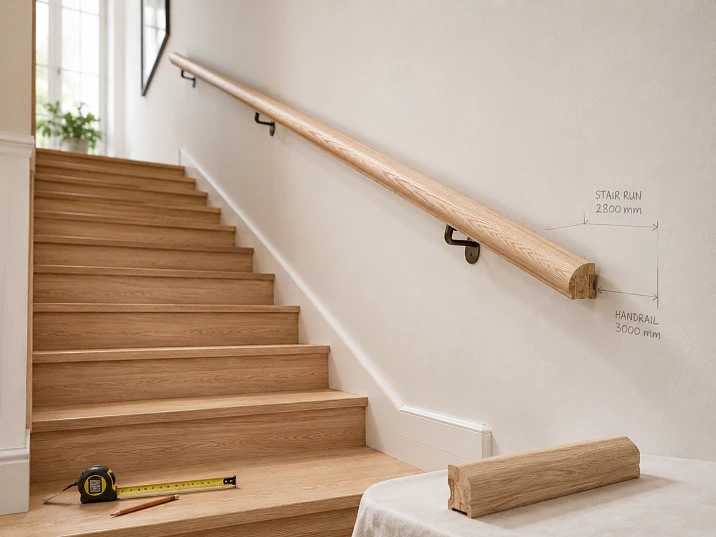
The stair flight has already been measured, along the future railing line it came to about 2.8 m, and the choice seems obvious: take the nearest standard length of 3000 mm, trim the extra 200 mm, and get one continuous handrail. For PR-002, this scenario is indeed possible as a starting point, but it is precisely at the 3000 mm length that a detail appears that is easy to miss when ordering: the structure of the blank already differs from the 1500, 2000, and 2500 mm options.
Product card wooden handrail PR-002 with a length of 3000 mm confirms: lengths up to and including 2500 mm are made from a single-lamella joinery blank, while options over 2500 mm are made from a blank that is finger-jointed along its length. This does not mean that two ready-made pieces will be delivered to the site and you will be asked to join them in the middle of the flight. It refers to the manufacturing method of the longest factory blank.
The second important detail is the kit. PR-002 is designed to work in a stair railing and is supplemented with a sub-rail strip PR-003. The handrail has a seating part of 60 mm, and PR-003 also has a width of 60 mm. But the current PR-003 card shows standard lengths of 1500, 2000, and 2500 mm. Therefore, for a 3000 mm handrail, one cannot simply assume that a ready-made strip of the same length automatically exists in the neighboring card. Before payment, it is necessary to agree on how exactly the sub-rail will be resolved on the three-meter section: from which standard parts, where a joint is acceptable, whether a non-standard size is needed, and whether it is possible for a specific quantity of products.
The third detail is the number 2800 mm itself. If it is obtained along the inclined line of the future handrail between already defined end points, the 3000 mm workpiece gives a nominal reserve of 200 mm. If 2800 mm is the length of the stepped flight, the horizontal projection, the distance between posts on the floor, or simply an "approximate staircase length," it cannot be considered the finished length of the handrail.
Therefore, the short answer is this: PR-002 3000 mm makes sense to consider for a flight of about 2800 mm if the project confirms the actual handrail line, 200 mm remains a sufficient technological reserve after accounting for ends and connections, the spliced structure is acceptable in terms of finish, and PR-003 and the entire baluster assembly are calculated simultaneously. Buying a three-meter handrail just because 3000 is greater than 2800 is not enough.
Wooden handrail PR-002: why the 2500 mm boundary is important before purchase
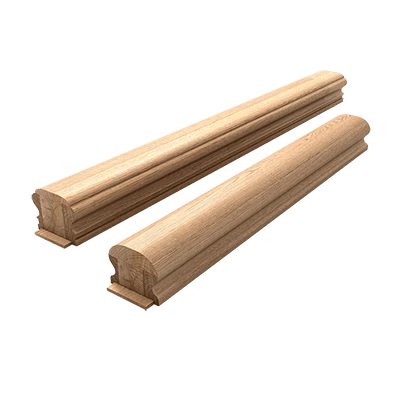
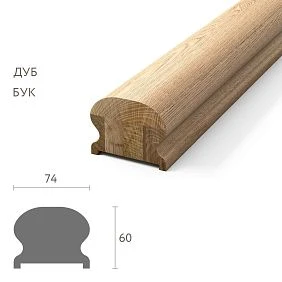
PR-002 is a profiled wooden handrail for stair railings. The card lists standard lengths of 1500, 2000, 2500, 3000, 3500, 4000, 4500, and 5000 mm. The cross-section for all these lengths is specified as 74 × 60 mm, with a seating part of 60 mm. Materials are beech and oak. The current card shows a "Prestige" sanding quality.
The main feature of the size range is hidden not in the size table, but in the description: 1500, 2000, and 2500 mm are made from a solid lamella joinery workpiece, while lengths over 2500 mm are made from a joinery workpiece spliced along the length.
| Length PR-002 | Blank type per card |
|---|---|
| 1500 мм | solid-lamella |
| 2000 мм | solid-lamella |
| 2500 мм | solid-lamella |
| 3000 мм | finger-jointed along length |
| 3500 мм | finger-jointed along length |
| 4000 мм | finger-jointed along length |
| 4500 мм | finger-jointed along length |
| 5000 мм | finger-jointed along length |
For a buyer of a 2.8 m march, this boundary is fundamental. If they only looked at the 2500 mm sample and then switched to 3000 mm, the external profile remains the same, but the method of forming the long blank changes. This needs to be known before choosing the finish, especially if a semi-transparent coating is planned, where the wood structure remains visible.
A finger-jointed blank is not equal to a "handrail made of two halves." It is produced as a long joinery element. Therefore, one cannot treat PR-002 3000 mm in advance as if there will necessarily be a rough installation seam in the middle. But neither can one promise absolute visual indistinguishability of the joint locations after any tinting: natural wood has non-uniformity, and transparent and semi-transparent systems emphasize the surface grain more than opaque enamel.
If a solid-lamella option is fundamentally important for the project, 3000 mm no longer meets this condition. Then the task changes: it is not about finding "the same PR-002, just longer," but about solving the railing design — whether the handrail can be divided at an architecturally justified node, the position of the intermediate post changed, or another scheme selected. This should be done together with the staircase manufacturer, because the handrail joint relates not only to aesthetics but also to the railing structure.
If a finger-jointed blank is acceptable, then 3000 mm becomes the nearest standard size to 2800 mm. After that, the main question is not the type of wood, but the correctness of measurement.
After checking the geometry, you can Buy a wooden handrail for stairs already understand why the 2500 mm boundary changes not just the length, but the production structure of the product.
How to measure a stair flight before ordering a 3000 mm handrail
The handrail is installed not along the floor and not along an imaginary horizontal line between the beginning and end of the stairs. Its length is determined by the actual trajectory of the top line of the railing, including the architectural solution for the start, end, transition to the landing, and connection with adjacent sections.
If the flight is straight, the basic geometry of the inclined line can be estimated using the Pythagorean theorem:
L = √(P² + H²),
Where:
-
P — horizontal projection of the section;
-
H — vertical rise;
-
L — inclined length.
For example, if the horizontal projection is 2500 mm and the rise is 1260 mm, the inclined geometric length is approximately 2800 mm. But this figure is not yet the automatic length of the finished PR‑002: the handrail is located above the steps and must connect to specific posts, balusters, landing, or the next section.
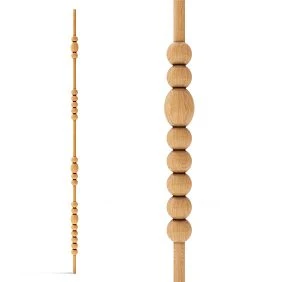
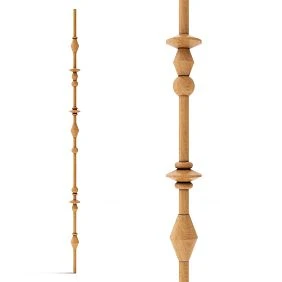
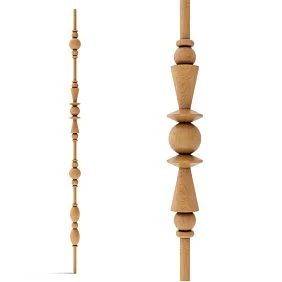
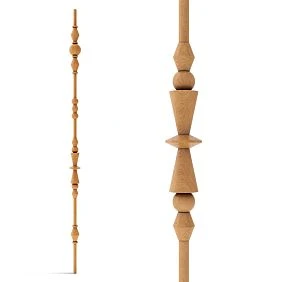
Our factory also produces:
What exactly needs to be measured
For ordering, it is useful to have not just one figure "2.8 m", but a diagram with points:
-
start of the inclined section;
-
end of the inclined section;
-
position of the lower post;
-
position of the upper post;
-
the upper platform, if the handrail continues horizontally;
-
turn, if after the flight the railing changes direction;
-
assumed end assembly;
-
place of possible joint with another handrail;
-
actual length of the under-rail strip;
-
route for carrying a three-meter part.
Measuring along the outer side of finished steps is useful as a check, but does not replace alignment with the railing. A step may have an overhang, a baluster its own axis, and a post a different junction geometry.
Get Consultation
Why horizontal 2800 mm can give a completely different length
Let's imagine that a user measured the distance on the floor with a tape measure from the bottom to the top point and got 2800 mm. If the staircase rises 1600 mm, the inclined line will be about 3225 mm. A 3000 mm handrail will be shorter even without considering the ends.
The reverse error is also possible: 2800 mm is measured along the inclined line of the steps, but the future handrail ends earlier due to a massive post. Then the finished size may turn out to be smaller.
Therefore, in the request to the manager, it is better to write not "a 2.8-meter staircase" but "preliminary handrail line between design points — 2800 mm; need PR-002, considering a 3000 mm blank." This wording immediately separates the measurement from the selected standard size.
Handrail for a 2800 mm staircase: buy 3000 mm or divide the structure
If the final design length of the section is indeed close to 2800 mm, the 3000 mm option gives a nominal remainder of 200 mm:
3000 − 2800 = 200 mm.
These 200 mm cannot automatically be considered "extra." They are a potential allowance for trimming and fitting. How much of them actually remains depends on the method of finishing the handrail.
Let's consider three different situations.
Scenario 1. 2800 mm is already the finished size between the ready end planes
Then the 3000 mm workpiece has a logical allowance of 200 mm. The installer will be able to distribute the trimming according to the project and the quality of the ends. But even here, it is necessary to decide in advance which end will be trimmed and how the profile is preserved.
Scenario 2. 2800 mm — only the inclined central part, and the handrail must additionally enter the nodes
Let's imagine a conditional project: to 2800 mm, 120 mm must be added for two end connections. That makes 3040 mm. In this scenario, the standard length of 3000 mm is no longer sufficient.
The figures of 120 mm here are not a norm for PR‑002 — this is an example of how additional sections change the result. The actual values are determined by the project.
Scenario 3. The line can be architecturally divided
If an intermediate post or turn is provided on the flight, one continuous 3000-millimeter element is not always necessary. Sometimes it is more logical to have two sections, each ending at a structurally clear point. But cutting the railing only for delivery convenience cannot be done without calculating the connection.
The comparison looks like this:
| Solution | What we gain | What to be sure to check |
| PR‑002 3000 mm as one element | fewer visible joints on the straight section | spliced construction, trimming, drift, PR-003 |
| two shorter sections | easier transport and work in a tight house | location and type of joint, support, aesthetics, structural feasibility |
| intermediate post | the joint can become architecturally justified | position of post, baluster, flight pattern |
| different profile or railing scheme | non-standard geometry can be solved | full compatibility of all elements |
There is no universal rule of "always take 3000 for 2800." There is only the correct order: design line → nodes → allowance → standard length.
What does the 200 mm allowance mean and why it cannot be assigned by eye
In linear products, the allowance is needed not because the manufacturer "might make a mistake by 200 mm," but because real installation involves end operations. However, with PR-002, the profile is more complex than a regular rectangular batten, so the trimming strategy must be coordinated with the installer.
Before ordering, ask four questions:
-
what actual finished size is needed;
-
which ends will remain visible;
-
where trimming is possible without destroying the design node;
-
who performs the trimming.
The STAVROS website FAQ explicitly states that cutting or sawing to individual size is not provided. This means a 3000 mm blank will not automatically become a finished 2800 mm element at the factory under a regular retail order. Trimming and fitting must be planned on the installer's or joinery workshop's side.
This also affects transport logistics. If you expected to order 3000 mm and receive 2800 mm from the manufacturer, such a scenario cannot be considered standard without separate agreement.
Solid-lamella and finger-jointed wooden handrail: what is the difference for the buyer
The term "solid-lamella" can easily be misunderstood as "cut from a single solid log." The PR-002 card refers to a solid-lamella joinery blank for lengths up to 2500 mm and a lengthwise finger-jointed joinery blank for lengths over 2500 mm. In both cases, the manufacturer refers to a high-quality glued solid oak or beech array.
For the buyer, what matters are not the technological production details themselves, but three consequences.
Appearance under opaque finish
Under enamel, the texture and tonal transitions of the wood are visually hidden. Therefore, the boundary between lamellas and the features of the solid wood pattern are usually less significant for perception than the profile geometry and sanding quality.
If the interior involves white, graphite, beige, or another opaque color, a finger-jointed 3000 mm blank should not be judged by the criterion "I want solid wood without shade variation": the finishing system will cover the natural texture anyway.
Appearance under tinting
Under a translucent coating, the wood grain remains part of the design. Here, it is useful to accept in advance the fact that a long 3000 mm handrail is made from a lengthwise finger-jointed blank. Natural wood may have differences in tone and texture even within a single order.
Therefore, a tinting sample should be made not only on a small piece of "oak in general," but, if possible, on material of the same preparation category. The color on a smartphone screen is insufficient for a final choice.
Constructive logic
A factory-spliced blank and an installation joint on site are different things. You cannot transfer reasoning about the strength of a random connection of two handrails to the very fact of using a factory-spliced blank. Conversely, you cannot assume that the presence of a long factory handrail automatically solves all railing nodes.
If the staircase designer allows PR-002 3000 mm as a single element, the choice becomes an ordinary commodity solution. If only solid-lamella material is required, the length and architecture of the railing will have to be reconsidered.
Buy an oak or beech PR-002 handrail for a private house
The PR-002 card offers two materials — oak and beech. Both are hardwoods, but the choice is better linked not to an abstract "what is stronger" rating, but to the finish and other staircase details.
Beech
On the STAVROS information page, beech is described as a dense, non-porous wood often used for products under enamel. It has a calmer grain, and with opaque painting, the natural texture is not the main part of the result.
Beech PR-002 makes sense to consider if the balusters, posts, and PR-003 are also ordered in beech and the entire system will be painted in one opaque color.
Oak
Oak has a pronounced porous texture and is often chosen for semi-transparent finishes that highlight the wood grain. If the staircase is built around visible wood texture, an oak handrail is usually more logical to match with oak balusters and posts.
At a length of 3000 mm, it is especially useful to make a control finish sample. Tinting should be perceived not as a way to "hide the splice," but as part of the overall color system.
Why mixing wood species should only be done deliberately
Beech and oak perceive transparent and semi-transparent finishes differently. If the handrail is oak, the plank is beech, and the balusters are oak again, after tinting the difference may become more noticeable than on raw blanks.
Therefore, for a private house it is more reasonable to first approve the material of the entire balustrade, then purchase the elements. If you are just starting to assemble the railing, the section where you can buy stair handrails for a private house, it is better to use it as part of the overall selection, rather than as a purchase of one isolated rail.
Why the wooden handrail PR-002 needs the plank PR-003
The description of PR-002 directly states: the handrail is additionally equipped with the under-rail plank PR-003. This is not a decorative recommendation "for beauty," but a connected element of the stair railing.
Product card of the under-rail plank PR-003 for the handrail indicates its purpose: the plank is used in the stair railing structure to fix the upper ends of the balusters with self-tapping screws, after which the handrail is placed on top.
Parameters of PR-003 in the current card:
| Parameter | Value |
| Width | 60 мм |
| Thickness | 6 мм |
| Material | Beech or oak |
| Standard lengths in the current table | 1500, 2000, 2500 mm |
| Sanding quality | «Prestige» |
| Purpose | fixing the upper ends of balusters under the handrail |
The 60 mm width match with the mounting part PR-002 explains the combined operation of these two products.
Why you cannot remember PR-003 after receiving the handrail
If the balusters are already installed and the under-rail strip has not been ordered, the mounting assembly remains incomplete. You will have to separately select the material, length, and handle the joints.
It is much more reliable to consider the handrail and the under-rail as one system:
PR-002 → the upper profile and the grip line.
PR-003 → the intermediate element beneath it, through which the top of the balusters is organized.
This also affects the finish. If PR-002 is oak for tinting and PR-003 is chosen from beech for enamel, it is harder to achieve a visually unified open system.
Important clarification: for PR-002 3000 mm, PR-003 currently does not have a single standard 3000 mm strip in the card
This is exactly where the preliminary order plan often breaks down.
PR-002 has a standard length of 3000 mm. For PR-003, the current table shows 1500, 2000, and 2500 mm. Therefore, the formula "one handrail 3000 + one plank 3000" is not confirmed by the current product card.
This does not mean that the three-meter PR-002 cannot be used. It means that the PR-003 assembly needs to be resolved separately before payment.
There are several questions that need to be asked to the manager and the staircase manufacturer:
-
Can PR-003 be used for your project from several standard segments;
-
Where is their joint allowed;
-
Should the joint coincide with the axis of a specific baluster or post;
-
Can PR-003 be ordered in a non-standard length;
-
Does the custom size only apply to bulk orders;
-
How does the plank length relate to the finished length of PR-002 after trimming.
The STAVROS website states that changing the standard size is possible for bulk orders and requires approval from the manager. Therefore, for a single private flight, an individual PR-003 3000 mm cannot be promised in advance.
This nuance should be clarified before ordering the main handrail. Otherwise, you can get a beautiful three-meter PR-002 and only discover during installation that the under-rail was not designed.
How to order the PR-002 handrail and the under-rail plate as one system
It is better to compile the checklist by components rather than by products.
1. Length of PR-002
Record the preliminary and final length. For the scenario under consideration:
-
line according to the project — about 2800 mm;
-
standard blank — 3000 mm;
-
nominal reserve — 200 mm.
2. Length of PR-003
Do not automatically copy the number 3000. Specify the actual length of the under-rail according to the project and ask how it is assembled from available standard elements.
3. Material
Handrail, under-rail, balusters, and posts should ideally be matched by wood species before finishing.
4. Preparation for finish
Determine whether an opaque enamel or semi-transparent tint will be used. In card PR-002, re-lamination options are available for different finish types.
5. Sanding quality
The current cards PR-002 and PR-003 specify "Prestige". More details can be checked sanding quality of the wooden handrail. "Prestige" includes detailed manual sanding and is designed to minimize additional finishing before paint and varnish materials.
6. Number of flights
If the staircase has two flights, you cannot count only the long section. The second flight, landing, and turn must have the same profile system, material, and finish.
7. End nodes
Write down where each end goes: into a post, onto a landing, into a continuation of the railing, or into a separate end element.
8. Transport length
A part 3000 mm long must be physically delivered and carried into the house.
Will a 3000 mm wooden handrail fit through the staircase, elevator, and doorway
The buyer often measures the installation location and forgets to measure the path to it. For three-meter lengths, this is a separate task.
The dimensions of the PR‑002 itself are 3000 × 74 × 60 mm. After packaging, the length and cross-sectional size of the cargo may be larger. The exact transport packaging needs to be confirmed before shipping.
The STAVROS website states that the packaging method depends on the type of product; corrugated cardboard and stretch film are often used, and fragile items may be additionally secured on a rigid base. For a long profile, it cannot be assumed that the packaging will end exactly at the 3000 mm mark.
What to measure in the house
Vestibule. If the entrance door opens inward, the clear passage may be smaller than the size of the door leaf.
Turn immediately after the entrance. A three-meter element can be carried through a wide door, but cannot be turned in a short corridor.
Staircase landing. Not only the distance between walls matters, but also the diagonal available when tilting the part.
Elevator. Check the internal height, depth, cabin diagonal, and door dimensions. A handrail cannot be considered as fitting into the elevator just because the cabin height is "almost three meters."
Exit from the elevator. Even if the element entered diagonally, it still needs to be turned in the lobby.
Temporary storage location. Before installation, the long profile should not lie in the passage where builders might bump into it.
Simple mock-up without a handrail
If you doubt the turns, take a lightweight batten, plastic pipe, or another safe mock-up about 3000 mm long and walk the entire route. Such a test does not account for packaging thickness, but immediately reveals an impossible turn.
For final logistics, use the transport dimensions provided by the seller, not the net product size.
Why transportation can affect the decision "one handrail or two"
One three-meter PR-002 looks preferable when you want a visually continuous line. But if the house is already finished, passages are narrow, and the staircase is on the second or third floor, transportation can become a real limitation.
Dividing the handrail just for the sake of carrying it in is not always acceptable. The joint must have a designed support and a structural solution. If such a node does not exist, the convenience of transport does not justify a random break in the grip line.
Therefore, the decision is made in the following order:
-
first, check whether a continuous element is needed by design;
-
then, check whether it can be delivered;
-
if delivery is impossible, return to the staircase designer;
-
only after changing the structural scheme, choose shorter elements.
Do not buy two short parts "just in case," planning to come up with a connection on site.
Painting and tinting of the spliced PR-002 handrail
The finish must take into account the method of manufacturing the long blank, the wood species, and the entire staircase system.
If the handrail will be under enamel
For opaque painting, the quality of surface preparation, primer, and uniformity of the finish become the main factors. The STAVROS card explains that a workpiece "under enamel" can be re-glued without matching lamellas by color and texture, because the natural pattern will be covered by an opaque material.
This is especially convenient if the handrail, PR-003, balusters, and posts are painted in one color.
If the handrail is to be tinted
For semi-transparent finishing, lamellas are matched by color and texture, but natural wood still retains tonal differences. For a 3000-mm finger-jointed blank, this should be accepted in advance.
It cannot be promised that after tinting, the finger-joint areas will "completely disappear." Semi-transparent finishing preserves the wood grain, so the final result depends on the specific material, shade, and coating composition.
Why a reference sample is needed
The same shade looks different on beech and oak. Even on the same species, the depth of color depends on surface preparation.
Therefore, before finishing a long handrail, it is reasonable to:
-
choose a sample of the same species;
-
perform the same sanding;
-
apply the selected system of primer, stain, varnish, or enamel;
-
view the sample in daylight and artificial light;
-
only after approval transfer the system to the entire staircase set.
You cannot rely only on the monitor. The screen changes color, brightness, and contrast, and real wood additionally has its own shade.
On the page tips for installing wooden handrails you can compare the overall sequence of preparing and applying the paint coating.
Why it is better to finish the handrail, PR-003, balusters, and posts as one set
Even a correctly chosen PR-002 can look out of place if the other staircase elements were ordered separately without a common finishing map.
Imagine an oak handrail for tinting. If PR-003 is made of beech, the balusters were previously coated with a different varnish, and the posts are ordered "under enamel," it is difficult to achieve a uniform shade.
For one staircase, it is useful to create a specification:
| Element | Article/type | Species | Preparation | Finish |
| Handrail | PR‑002 | Oak/beech | For enamel or tinting | Unified system |
| Handrail support strip | PR‑003 | Same species | Approve | the same finish |
| Balusters | As per project | the same or deliberately different | Approve | the same finish |
| Posts | As per project | Approve | Approve | the same finish |
Such a document is more useful than a list of items in a cart. It allows you to check not only the availability of each item, but also compatibility.
What does the "Prestige" sanding quality mean for the long PR-002
The current PR-002 card indicates the "Prestige" level. According to STAVROS, this is machine processing with detailed manual sanding; the permissible residual lint and processing marks are significantly less than those of the "Standard."
For a handrail, surface quality is especially noticeable: the hand constantly passes along the profile, and side light along a three-meter element reveals unevenness well.
But "Prestige" is not a ready-made protective coating. After receiving, the wood still needs to be finished according to the project. Sanding quality should not be confused with varnish, oil, or enamel.
Before painting, the surface is dusted, the selected primer system is applied, and interlayer preparation is performed according to the material's instructions.
Mistakes when buying a wooden handrail for a staircase
Mistake 1. Measure 2.8 m along the floor and order 3000 mm
Why it occurs: it is convenient to place a tape measure between the start and end of the staircase.
Consequence: the inclined line may turn out to be longer than 3000 mm.
How to prevent: measure the design line of the handrail and separately record the horizontal projection and the rise.
Error 2. Considering 200 mm as a guaranteed margin
Why it occurs: 3000 − 2800 = 200, the arithmetic seems final.
Consequence: additional end sections, a landing, or a connection eat up the reserve.
How to prevent: calculate the finished length after determining all nodes.
Error 3. Expecting a solid-lamella construction for 3000 mm
Why it occurs: the profile and photo look the same as for 2500 mm.
Consequence: after receiving, the buyer is surprised by the manufacturing method of the long workpiece.
How to prevent: remember the card rule: up to 2500 mm inclusive — solid lamella blank, over — finger-jointed along the length.
Error 4. Not ordering PR‑003
Why it occurs: the under-rail strip is perceived as an optional accessory.
Consequence: the installation of the upper ends of balusters and the handrail is not assembled into a single system.
How to prevent: calculate PR-002 and PR-003 simultaneously.
Error 5. Assuming that PR‑003 also comes in one length of 3000 mm
Why it occurs: the buyer transfers the handrail size range to the under-rail.
Consequence: during assembly, it turns out that the current PR‑003 card shows only 1500, 2000, and 2500 mm.
How to prevent: agree on segmentation or a non-standard option in advance.
Error 6. Mixing oak and beech without a finishing project
Why it occurs: elements are purchased at different times.
Consequence: under a transparent coating, the system looks uneven in tone and structure.
How to prevent: maintain a single specification of wood species and finishes.
Mistake 7. Buying a handrail before approving balusters and posts
Why it happens: it seems that 74 × 60 mm is a standalone commercial size.
Consequence: the seating part, railing height, or end connections do not match the project.
How to prevent: first assemble the structural scheme of the balustrade.
Mistake 8. Not checking the delivery route
Why it occurs: the installation site is spacious.
Consequence: a three-meter package cannot be turned around in the vestibule or on the stair landing.
How to prevent: walk the route with a three-meter mock-up and clarify the packaging dimension.
Error 9. Buying PR-002 instead of round PR-004
Why it occurs: both products are called stair handrails.
Consequence: the customer receives a different profile and a different application scheme.
How to prevent: compare the cross-section. PR-002 has a profiled cross-section of 74 × 60 mm and a seating part of 60 mm; PR-004 is a round handrail with a diameter of 50 mm.
Error 10. Asking the manufacturer to cut standard 3000 mm down to 2800 mm as a regular service
Why it occurs: it seems that this is automatically available for linear products.
Consequence: the order does not meet expectations.
How to prevent: take into account that the STAVROS FAQ does not state a standard service for trimming or cutting to size; final fitting should be arranged in advance with the installer.
PR-002 or round PR-004: why the request "round wooden handrail 50 mm" cannot be referred to this article
PR-002 and PR-004 cover different product queries.
PR-002 is a profiled handrail with dimensions of 74 × 60 mm and a mounting part of 60 mm. It is designed for stair railing with a sub-rail plank PR-003.
PR-004 is a round wooden handrail with a diameter of 50 mm. Its card should not be used as a source of parameters for PR-002.
Therefore, a person looking for a round 50 mm handrail for wall mounting should not choose PR-002 just because they saw a high commercial query "buy wooden handrail". The structural type is determined first.
This is an important semantic boundary: commercial demand should not replace product compatibility.
Can PR-002 be used as a wall-mounted handrail
The PR-002 card describes it as a handrail used in stair railing structures and directly links it to PR-003. It does not position this profile as a ready-made wall-mounted handrail kit with specific wall brackets.
Therefore, without a separate project, it cannot be automatically claimed that PR-002 can simply be screwed to the wall in the same ways as a round handrail.
If a wall-mounted option is needed, the brackets, offset from the wall, mounting method, presence of a continuous lower plane, and grip requirements are determined first. Only after confirming compatibility can a specific profile be considered.
For the current article, the safe conclusion is simple: PR-002 is purchased primarily as part of a balustrade, not as a universal wall-mounted bar.
Who should buy the wooden handrail PR-002 with a length of 3000 mm
PR-002 3000 mm is suitable if the following conditions are met simultaneously.
The project requires exactly the 74 × 60 mm profile. This is not a round or simple rectangular handrail.
The line of the flight is indeed about 2800 mm. The dimension is obtained from the design trajectory, not from the floor.
200 mm provides sufficient margin. All end nodes are already accounted for.
A lengthwise finger-jointed blank is acceptable. The buyer does not require a solid-lamella option over 2500 mm.
PR-003 is included in the calculation. Moreover, the method of assembling the sub-handrail on the three-meter section is agreed separately.
The material is related to the rest of the staircase. Oak or beech is not chosen in isolation.
The finish issue is resolved. Whether under enamel or under tinting — this is known before ordering.
The delivery route is checked. The three-meter part and its packaging fit through the premises.
There is a craftsman who will perform the final fitting. You should not rely on the standard cutting service from the manufacturer.
When PR-002 3000 mm should not be purchased without additional verification
It is better to postpone the purchase if the length of the flight is still measured "approximately." Even a difference of 100-150 mm can completely change the choice of a standard blank after accounting for the landing and posts.
Additional verification is needed if a solid-lamella construction is strictly required. According to the card, 3000 mm is already beyond the 2500 mm limit.
You should not place an order if the balusters and posts have not yet been approved. The mounting part of 60 mm must fit into a specific joint, not exist on its own.
PR-002 is not suitable for a person who is actually looking for a round handrail with a diameter of 50 mm. There is a different profile for that.
Finally, you should not buy a single 3000-mm element if it is physically impossible to bring it into the house and the designer has not yet developed an alternative connection.
How to calculate two flights and a landing, not just one section of 2.8 m
If the staircase has two flights, each is calculated separately. You cannot simply add two inclined lengths and buy one maximum-length handrail if there is a turn between them.
For each section, the following are recorded:
-
finished length;
-
standard blank;
-
finishing method;
-
PR‑003;
-
material;
-
finish;
-
joint on the landing.
Example of a specification:
| Section | Design length | PR-002 under consideration | Feature |
| lower flight | 2800 мм | 3000 мм | spliced blank, trimming |
| Platform | 1100 мм | separate solution | horizontal section |
| upper flight | 2200 мм | 2500 мм | Solid lamella blank |
Here the lower and upper handrails, although having the same profile, are made from blanks of different types due to the 2500 mm limit. Under a transparent finish, it is useful to consider this when approving the sample.
The platform is also not a "remainder" of the lower handrail without a design solution. It has its own direction and connection.
How to understand that 3000 mm is really enough: a working ordering formula
To avoid reducing the calculation to a single number, it is convenient to divide the length into three parts:
Lorder ≥ Lfinished + Ljoints + Ltrimming
Where:
-
Lfinished — the actual length of the visible section of the handrail;
-
Ljoints — sections that go into end connections, transitions, or abutments, if they are provided for by the project;
-
Ltrimming — a technological reserve that the craftsman leaves for final fitting.
For a specific house, the values of Ljoints and Ltrimming should not be assigned by an article. They are determined by the craftsman based on the drawing. But the formula itself is useful: it shows why one cannot compare 2800 and 3000 without a project.
Example when 3000 mm is enough
The finished line according to the drawing is 2810 mm. The end joints are already included
But turning 150–200 mm of remainder into a structural insert, end piece, or repair element without a project should not be done. The handrail profile works within the railing system, and its short remainder does not automatically become a certified component.
For translucent finishing, a small offcut is especially useful as a sample: you can test stain, oil, varnish, or another compound on it without risking damage to a three-meter element.
How to design PR-003 if a single 3000 mm plank is not in the standard table
This is one of the most important practical questions for a specific scenario.
The current PR-003 range is 1500, 2000, and 2500 mm. For a section around 2800 mm, a single standard plank is insufficient. Arithmetically, different combinations are possible, for example, 1500 + 1500 or 2000 + part of a second element. But arithmetic does not determine the correct joint.
Before purchasing, you need to get answers to four structural questions.
Where the PR-003 joint can be located
The joint should not appear at a random point just because the standard plank ended there. Its position must be linked to balusters, possible support, and the fastening method.
Should the joint of PR-003 coincide with the joint of PR-002?
PR-002, with a length of 3000 mm, has no mounting joint in the middle—it is a single factory-spliced blank. Therefore, copying a non-existent handrail joint down to PR-003 is pointless. The connection point of the under-rail is determined separately.
Can two PR-003 pieces of 1500 mm each be used?
In length, two standard strips give 3000 mm. But the article cannot confirm the structural acceptability of such a connection for any staircase. This must be confirmed by the railing manufacturer.
Can I order a non-standard PR-003?
The STAVROS website states that size changes are possible for bulk orders and require approval. For a single staircase, an individual size cannot be promised as a standard service.
Practical conclusion: before paying for PR-002 3000 mm, request a written or drawn scheme of PR-003 from the manager and staircase master. Then the set will not need to be modified on site.
How much under-rail strip should be calculated for a flight of 2.8 m?
You should not simply calculate "2.8 linear meters." The under-rail strip is tied to a row of balusters and to the actual section where the handrail rests on this system.
If the handrail extends beyond the edge of the first or last baluster, the lengths of PR-002 and PR-003 may differ. If the handrail transitions to a post as a separate unit, the under-rail may end earlier. If there is a landing, its horizontal row is calculated separately.
Therefore, the specification must contain two different lines:
PR-002: design finished length ___ mm.
PR-003: design finished length ___ mm, joint scheme ___ .
Even if the final figures match, it will be the result of calculation, not automatic copying.
How to align posts and balusters before purchasing a long handrail
The handrail defines the top line of the railing, but it cannot be designed separately from the supports.
The lower and upper posts determine the start and end of the line. Balusters form the intermediate row. PR-003 connects their top ends. Only after this does PR-002 get a clear fit.
If the posts have not been selected yet, the following are unknown:
-
the exact entry point of the handrail;
-
the height and shape of the end connection;
-
the possibility of continuation onto the landing;
-
the visual line of the profile;
-
actual length between nodes.
Therefore, buying a handrail "in reserve" while the staircase project exists only as steps creates a risk of unnecessary trimming or shortage.
Checking via a scaled sketch
Even a simple side drawing to scale helps to see the problem. Mark:
-
steps;
-
axes of posts;
-
axes of end balusters;
-
line PR‑003;
-
top profile PR-002;
-
Start and end points.
After this, the 2800 mm dimension becomes a verifiable part of the project, not an approximate measurement.
How to accept a PR-002 with a length of 3000 mm after delivery
The long wooden profile should be inspected before finishing and installation.
First, check the packaging. If it has a visible impact, tear, or deformation, document it before unpacking in accordance with carrier rules.
After unpacking, check:
-
whether the article number matches the order;
-
whether the length matches;
-
whether the required material is selected;
-
whether the preparation option for finishing matches;
-
whether there are any transport damages;
-
whether the profile edges are damaged;
-
is the geometry of the seating part preserved;
-
whether the quantity of PR-003 matches the order.
You should not immediately paint the received handrail if there is doubt about the geometry or configuration. After applying the finish coating, it is more difficult to discuss a transport defect or a mis-sort.
Why a three-meter part needs to be inspected along its length
A short defect is easy to notice from the front. Long geometry is better assessed along the profile with side lighting. This reveals local surface damage and deviations that are not noticeable from a distance.
The final suitability for installation is assessed by the master, taking into account the specific assembly.
Where to store a long wooden handrail before installation
Several days may pass between delivery and installation. A three-meter element cannot be left where people will step on it, place building materials, or regularly move it.
Storage must comply with the manufacturer's recommendations for wooden products. It is important to avoid conditions that differ sharply from the normal indoor environment of the site, as well as direct contact with moisture.
Do not place PR-002 vertically in a narrow corner just because it takes up less space, unless such a position is provided for by a safe storage scheme. A long profile can easily be accidentally tipped over or hit the ceiling with its top end.
Before installation, it is also useful to keep the marking and packaging information so as not to confuse parts of two flights or different wood species.
How to mathematically check the clearance of a three-meter handrail
For rectangular openings, the diagonal can be used as a preliminary reference:
D = √(a² + b²),
where a and b are the two internal sides of the space.
For example, in an elevator car with a depth of 2100 mm and a height of 2400 mm, the diagonal of this plane is about 3189 mm. On paper, a clean 3000 mm profile seems to fit diagonally.
But this is not enough. You need to consider:
-
the elevator car door opening;
-
the thickness and length of the packaging;
-
the ability to bring the first end inside;
-
the ability to lift the second end;
-
handrails and panels inside the elevator;
-
turn in the lobby.
Therefore, the diagonal is only a "theoretically possible" filter, not a confirmation of delivery.
For the stair landing, the situation is even more complex because the part rotates in three dimensions. Here, a practical mock-up is often more useful than a formula.
Delivery of PR-002 3000 mm: what to ask before ordering
Before payment, clarify:
-
actual package dimensions;
-
method of protecting the long profile;
-
whether additional rigid packaging can be ordered if required;
-
which carrier accepts such dimensions;
-
How is delivery calculated?
-
where the long-length cargo will be issued;
-
Will the vehicle be able to approach the site?
-
who is responsible for unloading;
-
how damage is recorded upon acceptance.
Current service conditions are best checked on the page payment and delivery of the long handrail, because the cost and shipping scheme depend on size, weight, and address.
What to check in the order before payment
Before placing an order, compile one specification sheet.
PR‑002
-
SKU PR‑002;
-
length 3000 mm;
-
material;
-
sanding quality;
-
re-lamination option for the finish;
-
quantity;
-
which march does this element get;
-
Estimated finished length after installation.
PR‑003
-
required total length;
-
available standard lengths;
-
number of segments;
-
design joint location;
-
material;
-
finish;
-
connection alignment method.
Fence
-
baluster type;
-
quantity;
-
Lower post;
-
top column;
-
transition to platform;
-
adjacent flight;
-
end nodes.
Logistics
-
transport clearance;
-
delivery address;
-
entrance door;
-
vestibule;
-
elevator;
-
stair landings;
-
storage location.
Installation
-
who performs the trimming;
-
where cutting is allowed;
-
how the end is finished;
-
when the finish is executed;
-
who is responsible for the structural assembly;
-
when PR-003 is installed;
-
how the line is checked before final fixation.
Such a list is more useful than an order for "handrail 3 meters, oak."
Where to buy wooden handrail PR-002 and components
If the calculation confirms the standard length of 3000 mm, you can go to the product page and buy wooden handrail PR-002 with a length of 3000 mm. It selects the length, material, and preparation option for finishing.
If the PR-002 profile is not yet approved, it is wiser to first open the section where you can buy a wooden handrail for railings, and compare models by cross-section and application.
PR‑003 is listed as a separate item. For a three-meter PR‑002, its length must be decided in advance, because the current standard range of the PR‑003 card does not include a 3000 mm option.
After the project, length, and configuration are confirmed, you can buy a wooden handrail no longer as a separate three-meter beam, but as a calculated part of the stair railing.
FAQ about the wooden handrail PR‑002
What length of PR‑002 is manufactured from a solid-laminate blank?
For card PR-002, the solid-lamella joinery blank is used for lengths 1500, 2000, and 2500 mm. Options over 2500 mm are produced from a blank finger-jointed along its length.
What changes after 2500 mm?
The method of manufacturing the workpiece is changing. The profile and cross-section of PR-002 are preserved, but the 3000 mm variant already refers to length-spliced pieces.
Will a length of 3000 mm suit a flight of 2800 mm?
It may fit if 2800 mm is the actual design length of the handrail and, after accounting for all end fittings, the 200 mm allowance is sufficient. If 2800 mm is only an approximate length of the staircase, it is too early to choose the product.
Can the handrail be trimmed on site?
Final fitting of the linear element is possible as part of installation work, but the cutting method and edge finishing must be determined by a specialist. STAVROS does not state in the FAQ that cutting to custom size is a standard service, so you should not rely on automatic factory trimming from 3000 mm to 2800 mm.
Is the under-rail strip PR-003 needed?
Yes, the description of PR-002 directly indicates the additional component PR-003. The strip's card explains that it secures the upper ends of balusters and is installed under the handrail.
Can PR-002 be purchased without PR-003?
Physically, the items are listed as separate positions, but for a staircase railing, PR-003 cannot be considered optional just because it is sold separately. The design of the specific staircase must be agreed upon before ordering.
Is there a PR-003 with a length of 3000 mm?
The current PR-003 product card shows standard lengths of 1500, 2000, and 2500 mm. The 3000 mm option as a single standard item is not confirmed. For a three-meter handrail, the sub-handrail scheme needs to be agreed upon separately.
Can 3000 mm be made up of two PR-003 pieces of 1500 mm each?
Arithmetically, two elements give 3000 mm, but the structural acceptability of the joint, its position, and the method of fastening must be confirmed by the staircase manufacturer. One should not assume such a joint is correct just because the lengths add up.
What should be chosen — an oak or beech handrail?
The choice is linked to other elements and the finish. Beech is often used under opaque enamel, oak under a finish with visible texture. For one balustrade, the wood species should be coordinated with PR-003, balusters, and posts.
Will the splice be visible after staining?
Complete visual invisibility cannot be guaranteed. A translucent finish preserves the natural wood grain, and the long 3000-mm PR-002 is made from a lengthwise-spliced blank. The final appearance should be evaluated based on a finish sample.
How is the three-meter handrail delivered?
The packaging method depends on the product. Before ordering, you need to clarify the actual shipping dimensions and check the entire route: entrance, vestibule, elevator, landings, turns, and storage location.
Can PR-002 be used as a wall-mounted handrail?
The card positions PR-002 as a stair railing element and links it to PR-003. Use on wall brackets should not be considered standard without separate verification of the structure and fastener compatibility.
How does PR-002 differ from the round PR-004?
PR-002 has a profiled cross-section of 74 × 60 mm and a mounting part of 60 mm. PR-004 is a round handrail with a diameter of 50 mm. These are different products and different product scenarios.
Do I need to order the handrail and balusters at the same time?
It is not necessary to place all items in one operation, but they should be designed simultaneously. The position of balusters, PR-003, posts, and end assemblies directly affects the finished length of PR-002.
Why can't I order 3000 mm right after measuring the flight with a tape measure?
Because a tape measure may show the length of steps or the distance between approximate points, not the finished line of the handrail. Before choosing a standard blank, you need to determine the start, end, landings, turns, and connections.
How much allowance should be left for trimming?
The article does not set a universal figure for PR-002. The reserve depends on the end assemblies and the installation method. For a flight of about 2800 mm, standard 3000 mm gives a nominal 200 mm, but the sufficiency of this reserve must be confirmed by the project.
Can I buy 2500 mm and add a short 300 mm piece?
Such a random joint cannot be considered a correct solution. If the project requires approximately 2800 mm of continuous line, the 2500 mm option is shorter. The connection of individual parts must have a structurally designed joint.
If the staircase is already installed, can the handrail be measured after the balusters are installed?
This is often more accurate than a preliminary measurement, because the actual railing points already exist. But the final size should still be taken by the craftsman responsible for cutting and connections.
Why is PR-002 called finger-jointed if the 1500 mm length is solid lamella?
The card name refers to the product model and its long size range. The description clarifies that lengths over 2500 mm are made from a finger-jointed blank, while 1500–2500 mm are solid lamella.
In summary: for a 2.8 m flight, the main change begins not with the extra 200 mm, but with the design of the entire system
If the design line of the handrail is indeed about 2800 mm, PR-002 with a length of 3000 mm seems like the logical nearest standard size. But the selection cannot be considered complete by subtracting 3000 − 2800 = 200 mm.
First, 3000 mm is beyond the technological limit of 2500 mm: such PR‑002 is made from a finger-jointed carpentry blank. Second, the finished size depends on posts, landings, turns, end joints, and trimming. Third, the handrail must be designed together with PR‑003, and the under-rail strip in the current card does not have a single standard position with a length of 3000 mm. Fourth, the three-meter element still needs to be delivered and physically brought into the facility.
Therefore, the correct sequence before purchasing is as follows: measure the railing line → approve posts and balusters → determine the finished size → check the sufficiency of 3000 mm → accept the spliced construction → decide on PR-003 → choose oak or beech and finish type → check the transport route → only then place the order.
With such preparation, PR‑002 3000 mm becomes not a randomly chosen "handrail with extra margin," but a calculated element of a specific staircase.