Article Contents:
- Why level matters more than beauty of detail
- Level one: basic stucco — architectural neatness without extra noise
- Polyurethane moldings: architectural frame of the wall
- Ceiling stucco: rosette, cornice, decor near the chandelier
- Basic stucco in different rooms
- What to buy for the basic level: final list
- Level two: accent stucco — when the interior needs emotion
- Birds, butterflies, dragonflies: light images for living spaces
- Ornamental overlays: relief without a figure
- Accent on furniture: when a mass-produced item becomes a designer piece
- What to buy for an accent level: options by task
- Level three: grand stucco molding — when the space needs status
- Mascaron: the face of architecture
- Pilasters and portal decor
- Fireplace composition: three parts of one whole
- High hall and staircase space
- What to buy for the grand level: a system set
- How to understand which level you need
- Diagnosis by four questions
- Scenarios by situations
- Selection table: task — level — what to buy
- Typical mistake: grand stucco in a small room
- Typical mistake: buying only one piece when a set is needed
- Stucco color by levels: from monochrome to patina
- Basic level: tone — and that's it
- Accent level: relief under the angle of light
- Grand level: patina, gold, bronze
- Final block: how to buy stucco without unnecessary mistakes
- Frequently Asked Questions
- About the company
Opening a catalog of stucco molding and feeling overwhelmed is normal. Rosettes, moldings, mascaron, birds, butterflies, fish, cornices, pilasters, decorative overlays — everything is beautiful, you want it all, but where to hang it and what to combine with what? Most buyers make the same mistake at this stage: they choose based on the task level, but on the principle of "I liked it." As a result, a beautiful detail ends up in the wrong place — and the interior looks not more expensive, but more random.
The right question is different: not "which to buy molding", but "what level of decor does my interior need right now." The answer to this question immediately builds a shopping list — not one random detail, but a system. And it is the system that makes the interior look expensive.
In this article — three levels of polyurethane stucco decor, diagnostics for each case, specific products, and ready-made purchase scenarios. From simple to complex, from a molding under the ceiling to a mascaron above a fireplace portal.
Why level is more important than the beauty of a detail
Imagine a library. It contains books of different scales: pocket editions, magazines, encyclopedias, and A2 format atlases. Each book is good on its own. But put a pocket detective novel next to a world atlas — and the shelf immediately looks disorganized. The same logic works in interior decor: a small overlay next to a high ceiling and a monumental fireplace gets lost, while a large mascaron in a small cozy bedroom feels oppressive.
The level of decor is not about budget or the owner's status. It is about matching the scale to the task. In a small apartment after renovation, a thin polyurethane molding along the ceiling adds +30% to the feeling of "expensiveness" for minimal money. But a large stucco decor for the wall in the same apartment can overload the space — and create the opposite effect.
The three levels we will break down in this article are not a rigid hierarchy or "the more expensive, the better." It is a navigation tool. By understanding your level, you stop wasting time browsing the catalog and start buying precisely — what will give the desired result in a specific space.




Level one: basic stucco molding — architectural neatness without unnecessary noise
The basic level is not a "poor" option. It is the most intelligent: when the decor does not shout about itself, but quietly makes the interior more cohesive. It is at this level that the best European interior traditions work: strict moldings along the ceiling perimeter, a thin cornice above the window, a modest rosette under the chandelier. Nothing extra — but remove it, and the room immediately "falls apart."
Who needs the basic level? Almost everyone who has just finished renovating a new build. Bare walls, even ceilings, empty planes — everything is neat but lifeless. This is where moldings and ceiling stucco work as the first and most important step: they give the space an architectural framework that can later be supplemented with accent details — or left as is.
Our factory also produces:
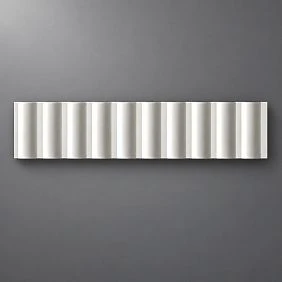
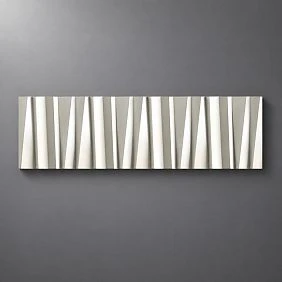
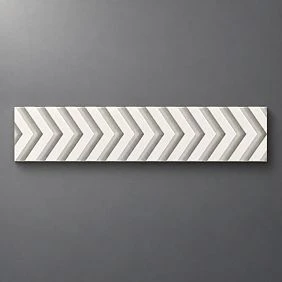
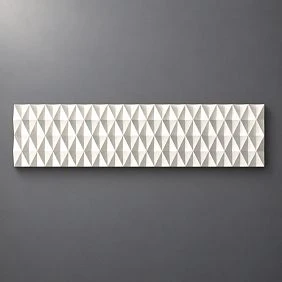
Polyurethane moldings: the architectural framework of the wall
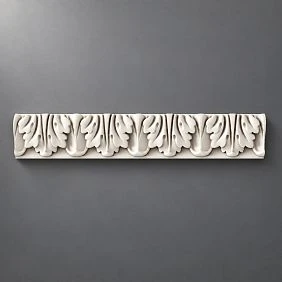
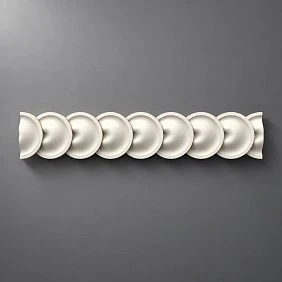
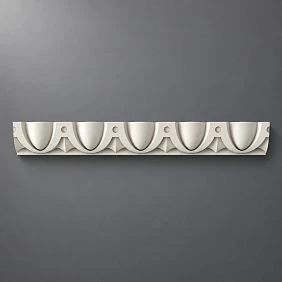
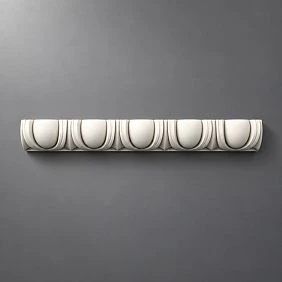
Moldings made of polyurethane — this is the basis of the basic level. Profiled strips that are installed along the ceiling (instead of or together with the ceiling plinth), around the perimeter of wall panels, around door and window openings. Their task is not to decorate, but to organize. To draw horizontal and vertical lines that structure the space and set visual order.
Why polyurethane and not plaster or wood? Three fundamental arguments. First — weight: a polyurethane molding is 6–8 times lighter than its plaster counterpart, which is critical when installing on drywall and in apartments with thin walls. Second — installation: glue plus 20 minutes — and the molding is on the wall. No dowels, no dust, no cracks from impact. Third — moisture resistance: polyurethane is not afraid of steam and moisture, making it the only reasonable choice for bathrooms and kitchens.
The width and profile of the molding are chosen according to the ceiling height: for ceilings 2.5–2.7 m — a profile 40–60 mm wide, for ceilings 2.8–3.2 m — 60–100 mm, for ceilings above 3.2 m — from 100 mm and wider. This ratio is not accidental: a thin molding under a high ceiling gets lost, a wide molding under a low one feels oppressive.
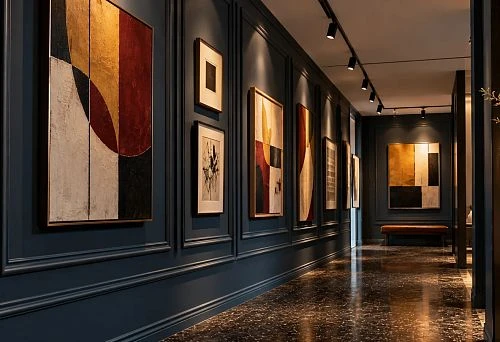
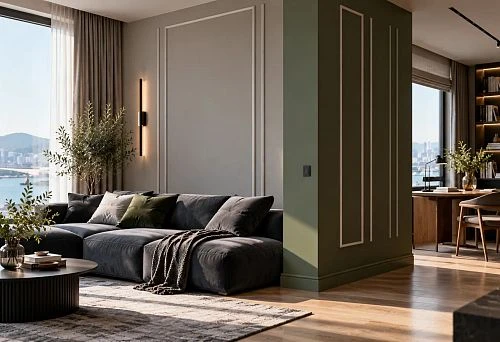
Wall frames made of moldings at the basic level are a technique that turns an ordinary wall into a paneled one. A few rectangles of molding, aligned in height and width along the main wall of the living room — and the wall acquires a character that cannot be achieved with any paint or wallpaper. Inside the frames, you can leave the same color as outside, or give a slight color contrast. Both options look good.
Get Consultation
Ceiling stucco: rosette, cornice, decor near the chandelier
Ceiling molding — the second mandatory element of the basic level. First of all, we are talking about two items: the ceiling cornice and the ceiling rosette under the chandelier.
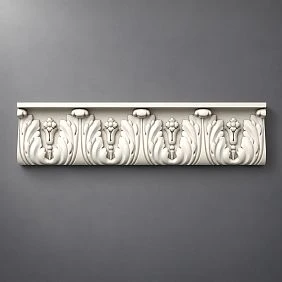
The ceiling cornice is a profiled strip that runs along the line where the wall and ceiling meet. Unlike a simple molding, the cornice has a more complex profile and greater width. It hides gaps between the wall and ceiling (which exist in almost every apartment), masks wires, and gives the "ceiling" space a finished look. buy ceiling stucco in the form of a cornice is one of the most cost-effective solutions in interior design: the ratio of cost to visual result here is the best of all possible.
ceiling rosettes — round decorative elements installed at the exit point of the chandelier wire. It seems like a small detail. But it is the rosette that completes the "ceiling" part of the composition: chandelier + rosette + cornice — this is already a system, not a set of items. Without a rosette, the wire and mounting plate of the chandelier look technical and random. With a rosette, it becomes the architectural center of the ceiling. The diameter of the rosette is chosen based on the diameter of the chandelier: the rosette should be slightly larger than the mounting plate but smaller than the chandelier itself — a proportion of 1:1.5–2 relative to the mounting plate.
Basic molding in different rooms
Living room. Moldings along the perimeter of the ceiling + wall frames on the accent wall + a rosette under the chandelier. The color is uniform, matching the ceiling or wall. This is the minimum set that makes the living room look "expensive" without a single accent element.
Bedroom. A thin cornice along the perimeter + one rosette under the central light fixture. For a bedroom, the silence of decor is important: here the basic level is not modesty, but deliberate restraint.
Hallway. Molding along the top line of the walls + frames around the mirror. The hallway is small, so the basic level here easily "reaches" the accent level: just add a small pair of overlays near the mirror — and the space immediately gains character.
Bathroom. Moisture-resistant polyurethane ceiling molding along the perimeter — and that's enough. Decorative overlays and rosettes for the bathroom are selected considering the humidity class of the room: only polyurethane, no plaster.
Kitchen. Molding along the top line of the kitchen unit, frames on the walls above the countertop (for areas without a backsplash). For the kitchen, the basic level is especially valuable: it structures the space, which is always overloaded with functional items.
What to buy for the basic level: final list
-
Moldings made of polyurethane — for ceiling cornice and wall frames
-
Ceiling molding — cornice, frieze, decorative planks
-
ceiling rosettes — for chandeliers and central lights
-
Mounting acrylic adhesive + primer
-
Matte paint matching wall or ceiling color
Basic level budget for a standard apartment (60–80 sq. m) — from 5,000 to 25,000 rubles depending on the width of moldings and number of rosettes. This investment pays off immediately: such an apartment, when sold or rented, is perceived by the buyer or tenant in a fundamentally different price category.
Level two: accent stucco — when the interior needs emotion
If the basic level is order, then the accent level is character. This is where images appear: a bird facing a mirror, a butterfly on the wall above a desk, a pair of fish in the bathroom, an ornamental overlay on a cabinet door. These details do not organize the space — they animate it. They make the room memorable, personal, "with a story."
Accent Decorative stucco appears in the interior when the basic level has already been established — or when the space is spacious enough that one bright accent does not seem random. This is a level for those who want not just "more expensive," but "more interesting."
Birds, butterflies, dragonflies: light images for living spaces
Among all decorative motifs, birds are the most popular and the most versatile. They work in neoclassicism, Scandinavian style, modern interiors with natural motifs, and even in some versions of minimalism — if the size is small and the coloring is monochrome.
One bird at the mirror is an accent. A pair of birds L/R on either side of the mirror is already a complete composition. And that is precisely the difference between "bought a beautiful detail" and "created an interior technique."
Molded decor NPU-492L и NPU-492R at 1,490 RUB each — a large pair with an expressive silhouette. This is accent molding for those who are not afraid to make a statement. It works well above the headboard of a bed in a bedroom with ceilings from 2.7 m, on the sides of a tall mirror in a hallway or foyer, in a system with a molding frame on an accent wall in a living room. Finish: monochrome matching the wall tone for a restrained elegant effect, contrasting white on dark for bold classicism.
Butterflies and dragonflies as a decorative motif give the interior a lightness that is hard to achieve by other means. This is not an architectural motif — it does not require strict symmetry and allows for freer placement. A butterfly on the wall above a desk, on a cabinet door, on a baseboard — anywhere you want a lively touch without monumentality.
Ornamental overlays: relief without a figure
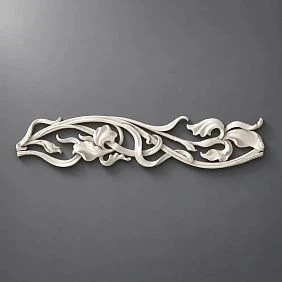
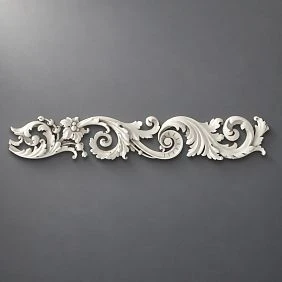
Not everyone needs birds and butterflies. In some interiors, an ornamental relief without a specific image — geometric, floral, or abstract — looks more organic. Such overlays are easier to integrate into modern interiors with a neutral palette: they add texture and volume but do not "weigh down" the space with figurativeness.
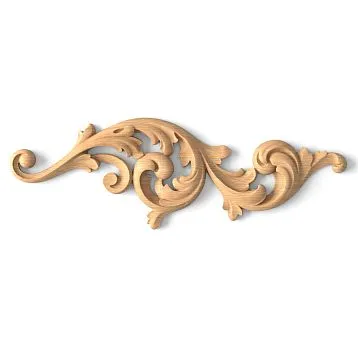
Molded decor NPU-479 for 770 RUB — a compact overlay with a laconic ornamental relief. Alone — an accent on a furniture facade or a small wall. In a series of three to five pieces with equal spacing — a horizontal frieze that reads as a decorative belt. Inside a molding frame — a medallion with pronounced geometry.
Molded decor NPU-481 for 290 RUB — the most affordable item in the accent level. Small format, delicate relief. These are the overlays that give the maximum return on a limited budget: five pieces at 290 rubles plus one meter of molding strip — and the wall above the bed or desk acquires a cohesive architectural look.
Molded decor NPU-485 — an ornamental overlay of medium format with a detailed relief. It works well as a central accent in a molding frame and as an independent decor on a furniture facade. The universal size and character of the motif make it suitable for a bedroom, living room, study, and even a bathroom with the right finish.
Accent on furniture: when a mass-produced item becomes custom
A furniture facade with decorative overlays is one of the most underestimated techniques at the accent level. The idea is simple: standard furniture from any store with glued polyurethane overlays and a single repaint in a matte color looks custom-made. The difference in perception is huge. The difference in cost is minimal.
For furniture, choose overlays with a shallow relief depth (up to 20 mm): deeper relief prevents doors from closing properly. Size — proportional to the facade: for a 40×70 cm door, overlays 10–15 cm high are suitable; for a 60×90 cm door, 15–20 cm high. Installation — acrylic mounting glue without nails or drilling. Painting — to match the facade, without highlighting the decor with color.
The principle of "buying stucco for furniture" is implemented through three scenarios: a single overlay along the door axis, a pair L/R symmetrically on one door, mirror overlays on adjacent doors — each gives a different level of visual effect.
What to buy for the accent level: options by task
For a mirror in the hallway or bedroom:
-
Thin molding for a frame around the mirror or decorative area
-
Mounting glue, paint to match the wall
For an accent wall in the living room:
-
Molding frame + one or a pair of overlays inside
-
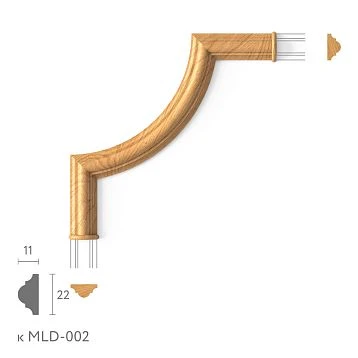
Corner decorative rosettes at molding joints — Decor for Molding
For furniture facade:
-
Small-format overlays with relief up to 20 mm
-
Thin frame molding along the door perimeter
-
Paint matching facade color, matte
For the wall above the bed:
-
NPU-481 in rhythmic repetition or pair L/R
-
Molding frame, proportionate to headboard width
-
Central decorative element on request
An important nuance of the accent level: there should be few elements. One or two motifs in one zone is the maximum. Overloading with accents turns a lively interior into a chaotic one. Look for Buy Moldings not by the principle of 'liked everything', but by the principle of 'one motif — one zone'.
Level three: ceremonial stucco — when the space needs status
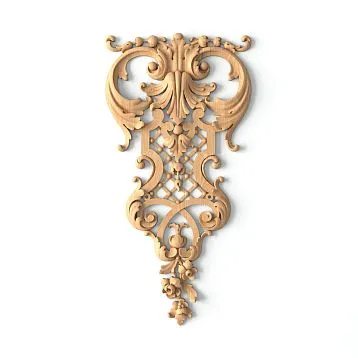
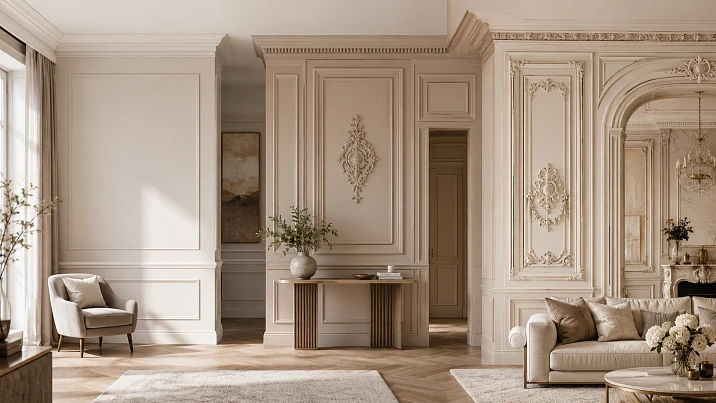
The ceremonial level is a different story. Not 'decorate', but 'erect'. A large mascaron above the fireplace portal is not a decorative detail, it is an architectural statement. Pilasters on the sides of the doorway are not moldings, they are columns in miniature. A complex symmetrical composition on the wall with large overlays, molding frames, and corner decorative elements is no longer 'renovation', it is 'architectural interior'.
Ceremonial Decorative polyurethane molding is not needed in every space. It reveals itself where there is scale: high ceilings (from 3 m), large areas, ceremonial zones — hall, study, fireplace living room, restaurant, country house. In a small apartment with 2.5 m ceilings, large ceremonial decor will not work — it will rather overwhelm than decorate.
Mascaron: the face of architecture
A mascaron is a stucco mask installed along the axis of symmetry of an architectural element. A lion, an ancient god, a female face in a laurel wreath, a warrior in a helmet. Historically, the mascaron was placed above the keystone of an arch, above the center of a fireplace portal, above the entrance opening. Its function is to mark the axis, declare the status of the space, 'put a point' in the architectural composition.
Polyurethane decor MPU-002 — lion mascaron, 10,340 rubles. Size range: from 49×49 mm to 208×208 mm, relief depth up to 69 mm. This is the central element of the ceremonial composition — it is installed strictly along the axis of symmetry: above the center of the fireplace, in the lock of the arched opening, on the axis of symmetry of the decorative panel. The lion is a traditional ceremonial motif: strength, dignity, immutability. On a white classic wall, painted to match with a slight gold patina on the mane — this is an impeccable result.
Pilasters and portal decor
A pilaster is a flat column built into a wall. In full architectural finishing, pilasters flank door and window openings, divide walls into regular sections, and support the entablature. In a modern interior with polyurethane decor, the pilaster effect is achieved using vertically installed molding strips with decorative capitals at the top and bases at the bottom.
Buy stucco for a portal at the formal level means thinking not about a single element, but about a system: vertical pilasters + horizontal architrave + maskaron in the keystone = a full-fledged door portal in classical traditions. Such a portal above the door to a study or living room transforms the opening from a functional hole in the wall into an architectural event.
Fireplace composition: three parts of one whole
A fireplace is a natural dominant of any space in which it is located. The task of the decor around the fireplace is not to compete with it, but to support its status and extend its architectural significance beyond the structure itself.
A classic fireplace composition at the formal level is built on the principle of trinity: center (maskaron or cartouche on the axis of symmetry above the shelf), two side elements (pilasters or vertical molding sections on the sides of the portal), horizontal belt (cornice or decorative shelf). Together, this forms the classic scheme of a triumphal arch — and that is why a well-designed fireplace always looks architecturally convincing.
Element sizes: maskaron — at least 150×150 mm for a fireplace 100–120 cm wide, preferably 200×200 mm. Vertical moldings — height from the top shelf to the floor or from the top shelf to the ceiling (depending on the room height). Cornice — proportional to the fireplace width plus 15–20 cm on each side.
High hall and staircase space
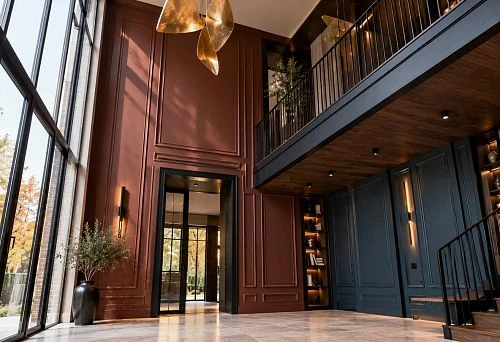
High double-height halls and staircase spaces of country houses are an ideal environment for the formal level. Here, scale works in your favor: large heights and spacious planes can accommodate large decor without being overwhelmed. Molding frames at full wall height with maskarons above each frame create a full-fledged palace interior, achievable without restoration budgets.
For the grand hall, the recommended scheme: a horizontal belt of molding at a height of 1.0–1.2 m (imitating a panel base), molding frames in the upper part of the wall, a cornice along the ceiling line with a developed profile. Accent overlays or mascaron — in the locks of the frames or along the centers of the side spans.
What to buy for the grand level: system kit
-
Polyurethane architectural decoration — wide moldings, cornices, architraves
-
Buy decorative stucco — mascaron, large overlays, pilaster elements
-
Buy polyurethane moldings — wide profiles for frames and belts
-
Decor for Molding — corner locks, rosettes for joints, decorative capitals
-
Assembly adhesive, putty, primer, paint (or patina)
How to understand which level you need
This is not a test with a correct answer. It is a diagnosis that takes three minutes and saves you from purchasing mistakes.
Diagnosis based on four questions
First question: what is the square footage and ceiling height?
— Up to 50 sq. m, ceilings 2.5–2.7 m → basic or accent level
— 50–100 sq. m, ceilings 2.7–3.0 m → accent or grand level
— Over 100 sq. m, ceilings from 3.0 m → grand level is appropriate
Second question: is there a focal point in the space — a fireplace, portal, staircase, tall hall?
— Yes → grand level for this area
— No → accent or basic level
Third question: what is the overall stylistic direction of the interior?
— Classic, neoclassical, Empire, Baroque → all three levels, up to grand
— Scandinavian style, modern minimalism → basic + delicate accent
— Modern neutral → accent in wall color
Question four: is there already a base level (moldings, cornice, rosette)?
— No → start with base
— Yes, and want more → accent
— Yes, and there is a formal area → formal
Scenarios by situation
Apartment after renovation, everything neat but empty. Start with the base: buy polyurethane moldings for a ceiling cornice and one or two wall frames. Ceiling rosette under the chandelier. All in ceiling tone. This is the minimum budget with maximum effect.
Interior neat but boring — want a 'highlight'. Accent level: Buy Molded Decoration for a mirror, wall or furniture. One or two overlays, possibly a pair L/R, molding for the frame. Color — in wall tone.
There is a fireplace, a country house, a high hall or an executive office. Ceremonial level: mascaron, moldings for portals and frames, pilaster decor. Think in terms of a system, not a single element. The set will cost more, but the result is at the level of a professional design project.
Budget is limited. Start with one zone. Best return: ceiling rosette + cornice (basic), or mirror with a pair of overlays (accent). One properly decorated corner says more about the interior than a chaotically decorated entire apartment.
Selection table: task — level — what to buy
| Task | Level | What to buy | Category |
|---|---|---|---|
| Make the renovation more expensive without theatricality | Base | Moldings, rosette, ceiling decor | All stucco |
| Decorate the wall behind the sofa | Basic / accent | Moldings + overlays | Wall Decor |
| Decorate a mirror or console | Accent | Paired overlays L/R, molding | PU overlays |
| Make custom furniture | Accent | Small-format overlays | PU overlays |
| Design a fireplace or portal | Grand | Maskaron MPU-002, moldings, pilasters | PU overlays |
| Add a center for the chandelier | Basic / grand | Ceiling rosette | Outlets |
| Design a bed headboard | Accent | Pair of overlays + molding frame | PU overlays |
| Door portal | Grand | Moldings + vertical pilasters | Moldings and cornices |
Typical mistake: grand stucco in a small room
A large maskaron in a 14 sq m bedroom with a 2.5 m ceiling is not an expensive interior. It is visual discomfort: decor that is not scaled to the space feels oppressive. A lion maskaron is a beautiful element, but only where it has room to breathe: a high ceiling, a spacious wall, a wide portal, or a monumental fireplace.
A different logic works in a small room: delicate relief, small size, monochrome coloring, thin molding. It is restraint that creates the feeling of an expensive interior here, not large decor. Choose polyurethane molding for a small room, you need a proportionality factor: the height of the overlay is no more than 1/8 of the wall height. For a 2.5 m wall, this is a maximum of 30 cm. For most small rooms, it's 15–20 cm.
A typical mistake: buying only one piece when a set is needed
"I'll buy one beautiful bird and see how it goes." It will go like this: a bird on the wall, without context, without a pair, without a frame. A beautiful bird that holds nothing and is attached to nothing. A feeling of incompleteness is guaranteed.
Stucco molding sells itself in sets. It is in a set that the very effect of "built-in-ness" appears, for which everything was started. Here are working combinations:
-
Molding + central overlay → wall panel
-
Rosette + ceiling cornice → finished ceiling
-
Pair L/R + mirror + thin molding → decorative area in the hallway or bedroom
-
Mascaron + pilaster moldings → full architectural portal
-
Decorative frame made of moldings + central accent → panel above the sofa or bed
When Buy Molded Decoration means buying a set — the result is always more convincing than buying individual parts. buy polyurethane moldings together with the overlays — this is not an extra expense, it's an investment in completeness.
Molding color by levels: from monochrome to patina
Basic level: matching the tone — and that's it
At the basic level, the decor should "dissolve" into the space — be visible through light and shadow, not through color contrast. Moldings and the ceiling cornice are painted the same color as the ceiling or wall (depending on the installation location). Rosettes are always the same color as the ceiling. Matte paint is mandatory: gloss "pulls" the decor out of the plane and makes it look random.
Accent level: relief under the angle of light
At the accent level, there is a bit more freedom. The main principle remains the same — monochrome matching the tone — but here the decor is often deliberately illuminated by a side light source so that the relief "reveals itself" at certain angles. A sconce next to the overlay, a directed spotlight, a floor lamp — these are all tools that make the relief decor come alive without changing color.
For furniture facades — paint strictly matching the facade tone. For mirror areas — a warmer shade than the wall can be used to create a "zone" around the mirror.
Ceremonial level: patina, gold, bronze
At the ceremonial level, decorative finishes are allowed that are not available at lower levels. Patina — applying a metallic pigment over the relief using a dry brush technique: gold, bronze, copper, dark silver. Result: the decor "shimmers" with movement, recesses remain dark, protrusions remain light. This is the technique that distinguishes palace-style finishing from tacky "gilding."
Important rule: patina is applied only to 20–30% of the relief surface (only to the most protruding parts). If you patinate the entire surface, the effect is lost, and the decor looks like it was painted with gold paint rather than an antique item. Glossy varnish after patina is strictly not allowed: a matte finish, and only that.
Final block: how to buy stucco without unnecessary mistakes
The algorithm for a correct purchase fits into five steps:
-
Determine the level — basic, accent, or formal — based on the room size, ceiling height, and presence of formal areas
-
Choose the zone — a specific wall, mirror, fireplace, furniture, or ceiling
-
Determine the system — molding + overlay, pair L/R + center, mascaron + pilasters — depending on the task
-
Select the coloring — monochrome in tone for basic, relief under light for accent, patina for formal
-
Buy the set — overlays + moldings + decor for moldings + glue + paint
Polyurethane stucco with this approach looks not like "something glued on," but like part of a well-thought-out space. This is the difference between "renovation" and "interior."
Choose stucco, moldings, and stucco decor from polyurethane in the STAVROS catalog — and start with a level that suits your space right now.
Frequently asked questions
Which molding should I buy for my first renovation?
For a first renovation, the basic level is optimal: Moldings made of polyurethane for a ceiling cornice, Ceiling molding and one or two ceiling rosettes. Minimal budget — maximum architectural effect. This is the foundation onto which you can easily add an accent level later.
What to buy if you want a beautiful accent, not just moldings?
Decorative polyurethane overlays: birds, butterflies, ornamental elements. It's better to start with one zone — a mirror, a wall above the bed, or a furniture facade — and immediately think in pairs L/R and a molding frame. buy decorative moldings correctly means buying an element together with its context.
When is large formal stucco needed?
Large decor unfolds in high (from 3 m) rooms, formal areas — halls, studies, fireplace living rooms, restaurants, country houses. In standard apartments, a formal level requires at least one monumental point: a portal, fireplace, or high accent wall.
Can you combine moldings and decorative overlays?
This is one of the best options: moldings provide an architectural framework, overlays add emotion. A molding frame with an overlay inside is a classic technique that works on all three levels.
What is more profitable to buy: one expensive overlay or a set of moldings?
If the wall is empty, start with a molding system: it gives a greater visual result for less money. If an architectural framework already exists, add an accent overlay or paired decor. Both solutions are correct, but at different times.
What to do if the budget is limited?
Choose one zone and decorate it completely: a mirror with a pair of overlays or a wall above the sofa with a molding frame. One finished fragment speaks about the interior more convincingly than scattered details throughout the apartment. You can buy ready-made stucco matching the Baroque style. Calculate the quantity: linear meters of cornices and moldings, number of rosettes, pilasters, consoles, corner elements. Add a ten to fifteen percent allowance for trimming. even in small quantities, it is the right start.
About the Company
The entire range — moldings, ceiling stucco, decorative overlays, rosettes, mascaron, and architectural decor — is presented in the STAVROS catalog. STAVROS is a Russian manufacturer of polyurethane interior decor with a long history and a wide range of products for all three levels: from basic moldings to large ceremonial mascaron.
All STAVROS products are made from high-quality extruded polyurethane with precise geometry and clear relief. They are easily mounted with glue, painted in any color, and serve without deformation or cracking for many years. STAVROS is an opportunity to buy not just one beautiful element, but the right system for any interior level: from a neat new building to a ceremonial country house.