Article Contents:
- Wooden decorative trim N-358: three sizes that must not be confused with each other
- Why the name "N-358 472 mm" is too short
- Why the full dimension line must go into the estimate and the work sheet
- Why production needs a contour based on extreme points
- The niche size is also not always 600 × 600 mm of free space
- What can be stated
- What cannot be asserted
- What to write to the manager
- Facade width 700 mm
- Why the 607 mm scale changes the visual center
- Why the mounting field must be calculated before ordering
- The 25 mm thickness also participates in the project
- Clean facade width
- Clear height
- Inner panel
- Distance to the handle
- Distance to hinges and fasteners
- Overlay thickness
- Free contour at extreme points
- Central placement
- Upper zone
- Paired doors
- First the full overlay dimension, then the frame
- Why visual air is needed
- Construction size
- Finished size
- Light or decorative opening
- Why a photo does not replace a drawing
- Step 1. Get the drawing
- Step 2. Check the scale
- Step 3. Cut out the outer contour
- Step 4. Apply to the facade or wall
- Step 5. Take a photo
- Why this is especially important with a transparent finish
- For enamel
- For a carved product, sanding is especially noticeable
- 16 мм
- 20 мм
- 25 мм
- Conflict with the handle
- Conflict with the door leaf
- Large calm facade
- Narrow facade
- Facade with active panel
- Flat facade
- Two identical overlays
- Uniform sanding
- Same material
- One finishing system
- Numbering
- Frame around
- Skirting board below
- Furniture front
- Door
- Wall
- Panel
- Why
- What to secure
- What is being compared
- Check the article number
- Check the modification
- Compare the drawing
- Check the thickness
- Verify the material
- Check processing
- Inspect thin elements
- Check the quantity
- Why
- How
- Recess 600 × 600 mm
- Recess 700 × 700 mm
- Field 900 × 900 mm
- Facade 500 mm
- Facade 800 mm
- Panel 1200 mm
- Mistake 1. Looking only at 472 mm
- Error 2. Calling L a diagonal without a drawing
- Error 3. Ignoring 651 mm
- Error 4. Calculating the niche by construction size
- Error 5. Not accounting for the molding
- Error 6. Not accounting for the handle
- Error 7. Not accounting for the thickness
- Error 8. Ordering "N-358 472"
- Error 9. Not specifying the material
- Error 10. Not specifying the sanding
- Error 11. Not receiving a drawing
- Error 12. Measuring from a photo
- Error 13. Making the frame before the decor
- Error 14. Trimming the ornament without approval
- Error 15. Ordering the medium instead of the small based on the principle 'the bigger, the prettier'
- Error 16. Not making a 1:1 template
- Error 17. Not checking the pairing
- Error 18. Mixing materials
- Error 19. Mixing levels of sanding
- Error 20. Not checking thin elements upon acceptance
- Error 21. Storing decor under heavy materials
- Error 22. Painting before fitting
- Error 23. Not checking sash opening
- Error 24. Not linking N-358 to the frame
- Error 25. Not specifying installation position
- Error 26. Using one drawing scale without a control line
- Error 27. Not recalculating the free field after finishing
- Error 28. Comparing size by name, not by full line
- Error 29. Considering all wooden overlays interchangeable
- Error 30. Paying for an order without understanding L
- Step 1. Open the product card
- Step 2. Don't choose based only on the first digit
- Step 3. Measure the mounting area
- Step 4. Get the drawing
- Step 5. Determine the full outline
- Step 6. Make a template
- Step 7. Agree on the position
- Step 8. Choose the material
- Step 9. Select processing quality
- Step 10. Approve finish
- Step 11. Assemble frame and accompanying decor
- Step 12. Check the bill
- What is the size of the small N-358?
- What does L=651 mm mean?
- Will the N-358 472 mm fit into a 600 × 600 mm niche?
- Can we simply consider 651 mm as the diagonal?
- What other sizes of N-358 exist?
- How to choose between 472 and 607 mm?
- Will 607 mm fit into the 600 mm niche?
- What is the 16 mm size for?
- What is the thickness of the medium N-358?
- What is the thickness of the large one?
- Can N-358 be installed on a furniture facade?
- Can N-358 be installed on a wall?
- Will N-358 fit for a door leaf?
- Can the overlay be trimmed?
- Can I order just by the name "N-358 472"?
- Do I need to specify the material?
- Do I need to specify the sanding quality?
- What is a full mounting field?
- How does the mounting field differ from the facade size?
- How to calculate the frame around N-358?
- Where to choose a frame molding?
- Do I need to make a 1:1 template?
- Can I print a photo at full size?
- What to check upon receipt?
- What to do if a different size arrives?
- Can I paint the overlay immediately after receiving it?
- What to do if the edge of the ornament overlaps the molding?
- What size is best for a wall panel?
- What size is best for a wardrobe?
- Where can I see other overlays?
- Where can I see other carved decor?
- What materials are needed for installation?
- Do I need to coordinate N-358 and the plinth?
- Can N-358 be used without a molding frame?
- Why does L increase with each modification?
- What is the main question to ask the manager?
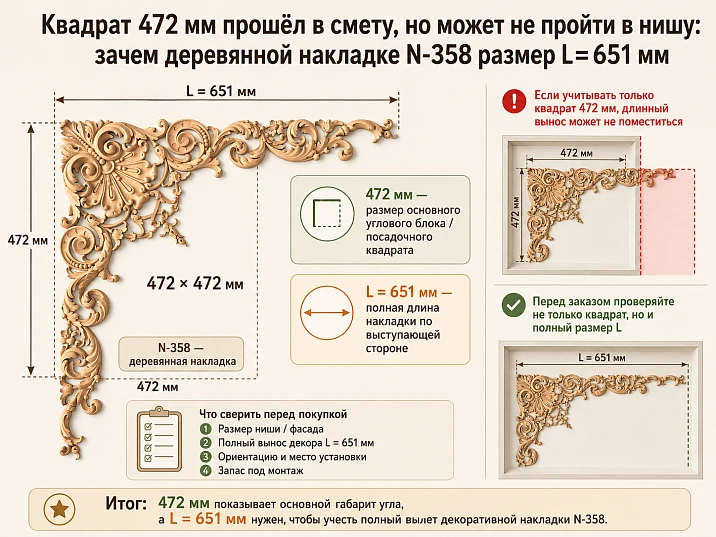
In the estimate, everything looks calm: a square wooden overlay N-358, size 472 × 472 mm, niche 600 × 600 mm. On paper, 64 mm of free space remains on each side — it would seem you can pay for the order and send the facade or wall panel into production. But in the product card, next to the familiar 472 × 472, another number appears: L=651 mm. And this line completely changes the attitude to the size.
What does 651 mm mean? Does this dimension pass through the extreme protruding points of the carved ornament? Does it refer to another measurement direction? Can the overlay physically extend beyond the boundaries of the square field 600 × 600 mm, even though the first two dimensions are 472 mm? The answer cannot be invented from a photo or derived only from geometry. The purpose of parameter L must be established from the technical drawing of the specific N-358.
That is why, if you wish to buy the wooden overlay N-358 the buyer is not enough to see the first two digits. The product has confirmed full size lines:
-
472 × 472 × 16 × 651 mm;
-
607 × 607 × 20 × 837 mm;
-
742 × 742 × 25 × 1024 mm.
The fourth parameter is not a decorative addition. It is present in all three variants and is noticeably larger than A and B. Therefore, any mounting field — furniture facade, panel, door leaf, wall niche, panel inside a molding frame — must be checked not by the conventional name "overlay 472", but by the full drawing.
There is another reason for caution here. The ornamental overlay is not a simple rectangle with a straight edge. It has protruding carving elements, diagonal pattern directions, thin decorative parts, and a visual contour that may be perceived as wider than the main square area. It is the extreme points, not just the two base sides, that determine whether the decor fits into the actual free field.
The buyer's task therefore sounds specific: not to choose a beautiful N-358, but to prove before payment that the selected modification physically fits into the prepared space and does not conflict with the frame, handles, panel, adjacent decor, or facade edges.
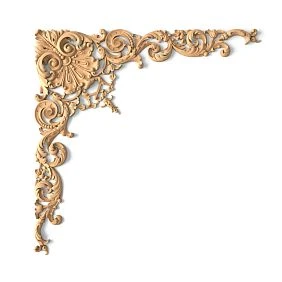
Wooden decorative overlay N-358: three sizes that must not be confused with each other
N-358 has three confirmed size configurations. They differ not by one side, but by the entire size line at once.
| Variant N-358 | Full size string | Thickness by third parameter | Additional parameter L |
|---|---|---|---|
| Small | 472 × 472 × 16 × 651 mm | 16 мм | 651 мм |
| Medium | 607 × 607 × 20 × 837 mm | 20 мм | 837 мм |
| Large | 742 × 742 × 25 × 1024 mm | 25 мм | 1024 мм |
This table already shows a pattern: with an increase in size A × B, the thickness and L increase. Therefore, the buyer should not perceive the last digit as a random technical field.
But making the opposite mistake — independently declaring L as the diagonal — is also not allowed. Without a technical drawing, it is impossible to reliably determine between which points this dimension is taken.




Why the name "N-358 472 mm" is too short
The phrase is convenient in conversation, but dangerous in a specification.
It does not specify:
-
second size;
-
thickness;
-
parameter L;
-
selected material;
-
processing quality;
-
finishing preparation option;
-
mounting position;
-
Quantity.
If a craftsman receives a record "N-358, 472 mm", he may decide that the actual outer contour fits into a 472 × 472 mm square. This conclusion cannot be drawn from the card.
Our factory also produces:



Why the full dimension line should be included in the invoice and work sheet
It is more correct to write:
Wooden decorative trim N-358, 472 × 472 × 16 × 651 mm, material ___, processing quality ___, preparation for finishing ___, quantity ___ pcs., installation according to the agreed drawing.
Then the seller, designer, and craftsman talk about one modification.
If the customer switches from 472 to 607 mm, not only the ornament area changes. The thickness increases to 20 mm, and L — to 837 mm. Therefore, you cannot simply "take the next size" after the furniture project is finished.
Get Consultation
Square carved overlay 472 × 472 mm: why a 600 × 600 niche still guarantees nothing
Let's consider the initial situation.
Niche: 600 × 600 mm.
Selected N-358: 472 × 472 × 16 × 651 mm.
If you look only at A × B, the calculation seems perfect.
600 − 472 = 128 mm.
With conditional centering, this gives 64 mm of free space on the left and right, top and bottom.
But next to it is L=651 mm.
651 mm is greater than the niche side of 600 mm.
Can we automatically say after this that the overlay does not fit? No.
Can we automatically say that everything is fine because the "real square is still 472"? Also no.
The only professional action is to obtain a diagram showing between which points L is measured.
Why production needs a contour based on extreme points
A furniture maker is not satisfied with knowing the nice external dimensions of the product. They need the real mounting envelope: the minimal zone within which all parts of the overlay are located.
For such an envelope, the following are checked:
-
the extreme left point;
-
the extreme right;
-
top;
-
the bottom;
-
protruding diagonal elements;
-
thickness;
-
position relative to axes;
-
orientation during installation.
If the decorative curl extends beyond the conventional square base, it must be taken into account.
The niche size is also not always 600 × 600 mm of free space
The drawing may indicate a total niche of 600 × 600 mm, but the actual usable area is reduced due to:
-
chamfers;
-
frame profile;
-
moldings;
-
inner edge;
-
fastening zone;
-
decorative border;
-
of adjacent hardware.
Therefore, first measure the clear free opening, and only then compare it with the full dimension of N-358.
How to read the four dimensions of N-358 without guessing
The main mistake of the buyer is trying to independently "decipher" the card.
A person sees 472 × 472 × 16 × 651 and reasons:
"472 is the width, 472 is the height, 16 is the thickness, 651 is probably the diagonal."
This looks logical, but logic does not replace documentation.
What can be stated
It can be stated that the card links the small configuration of N-358 with the full line 472 × 472 × 16 × 651 mm.
What cannot be stated
Without a drawing, one cannot write categorically:
-
L — diagonal;
-
L — length from one protrusion to another;
-
L — packaging size;
-
L — length of individual element;
-
L — radial dimension;
-
L — size of mounting area.
Need a breakdown of designations A, B, C, and L.
What to write to the manager
It is better to formulate the request as follows:
Please provide the current technical drawing N-358 for modification 472 × 472 × 16 × 651 mm and decipher dimensions A, B, C, and L. It is necessary to determine the overall product dimensions at extreme points for installation in a 600 × 600 mm field.
Such a question eliminates the dispute about who "correctly understood the numbers."
Medium N-358 607 × 607 × 20 × 837 mm: when a 135 mm increase turns into a new composition
The difference between 472 and 607 mm seems moderate — only 135 mm per side.
But the area, visual scale, and additional dimension change noticeably.
L increases from 651 to 837 mm.
Thickness — from 16 to 20 mm.
The medium N-358 can no longer be considered just an enlarged copy that can easily be placed in the same spot if there is "a little extra space" around it.
Facade width 700 mm
Suppose the furniture facade has a net width of 700 mm.
With A=607 mm, what remains is:
700 − 607 = 93 mm.
That is, about 46.5 mm on each side when centered.
Sounds acceptable.
But L=837 mm again requires a drawing. If this parameter refers to the maximum spatial dimension, the facade may turn out to be too small.
Why the 607 mm scale changes the visual center
On a large cabinet, such an overlay may look proportional.
On a narrow door, it starts to dominate.
The carved pattern approaches the edges, handle, and frame. Even when the physical item fits, compositionally it may feel too cramped.
Therefore, two things are checked separately:
-
physical fit;
-
visual clearance around the ornament.
Large overlay N-358 742 × 742 × 25 × 1024 mm: a separate task, not a "most beautiful size"
The large modification already has a thickness of 25 mm and L=1024 mm.
In an interior, such an element can work as the center of a large panel, wall composition, wide facade, or significant door leaf.
But it is the large size that punishes mistakes the most.
Why the mounting field must be calculated before ordering
The overlay cannot be confidently "tried on later" if:
-
the wall frame is already installed;
-
the facade is manufactured;
-
handle holes are drilled;
-
moldings are painted;
-
the door panel has a fixed size.
If the outer elements N-358 extend beyond the intended area, not only the decor but also the surrounding architecture will need to be redone.
The 25 mm thickness is also part of the project
A large ornament protrudes more above the surface.
This is important near:
-
the door handle;
-
the protruding molding;
-
the adjacent facade;
-
with an opening leaf;
-
with a sliding element.
Physically, the overlay may fit in width, but interfere with the moving part due to its thickness.
Carved wooden decor for furniture facades: what dimensions to take before purchasing
The query "buy decorative overlays for furniture facades" seems product-oriented, but the actual purchase starts with measuring.
If needed buy furniture decor not in general, but for a specific cabinet, dresser, or display case, record the facade dimensions separately from the dimensions of the free decorative area.
Net width of the facade
Measure the actual size of the door.
But this is only the first level.
Net height
Needed to check the vertical position of the ornament.
Inner panel
If the facade is framed, the external width of the door is not equal to the free field.
For example:
-
facade — 800 mm;
-
frame — 100 mm on each side;
-
inner field — 600 mm.
For N-358, the internal size is important.
Distance to handle
The handle occupies its own zone. A large ornament may visually or physically conflict with the base of the hardware.
Distance to hinges and fasteners
For an external decorative overlay, hinges may be invisible, but their fasteners are located inside the facade.
When designing the method of fixing wooden decor, conflicts should be avoided.
Overlay thickness
16, 20, or 25 mm is the actual protrusion.
It affects the ability to open the adjacent door.
Free contour by extreme points
This is the main parameter of the article.
Not "472 mm", but the actual area occupied by the entire pattern.
Wooden overlay for a door leaf: when the external door size is not enough
The query "buy interior door overlay" may lead the buyer to large carved decor. But the door has its own architecture.
The canvas may have:
-
panels;
-
glass;
-
frame;
-
handle;
-
the lock;
-
decorative grooves;
-
factory milling.
N-358 must fit into a specific field.
Central placement
The classic option is an ornament along the axis.
But the geometric center of the door may not coincide with the center of the decorative panel.
Upper zone
A large square overlay can occupy the upper part of the canvas.
Here, the distance to the edges and the handle height are checked.
Pair doors
For two leaves, identical position, material, finish, and orientation are especially important.
The slightest shift is clearly visible.
Wooden wall panel: how to calculate the field inside a molding frame
A wall panel often looks simple: a rectangular frame and a carved center.
But the outer size of the frame is not equal to the inner one.
Suppose:
-
outer area — 800 × 800 mm;
-
molding width — 50 mm;
-
inner opening — 700 × 700 mm;
-
N-358 — 472 × 472 × 16 × 651 mm.
Based on the first two parameters, the margin seems large.
But the final decision again comes down to L.
First, the full size of the overlay, then the frame
Don't do it the other way around.
Bad sequence:
-
buy molding;
-
assemble the frame;
-
order N-358;
-
discover that the edge ornament comes close to the profile.
Correct:
-
get drawing N-358;
-
determine the full contour;
-
set the desired visual offset;
-
get the inner frame size;
-
After that Buy wooden moldings under the already calculated composition.
Why visual breathing room is needed
Even decor that physically fits can look cramped.
If the curls almost touch the frame, the composition loses readability.
The empty space is not a "wasted area." It helps to see the design.
N-358 in a square niche: three different concepts of size
For a proper project, you need to distinguish:
the size of the structure;
the size of the decorative field;
the size of the overlay itself.
For example:
-
niche for construction opening — 660 × 660 mm;
-
after finishing — 620 × 620 mm;
-
decorative free field — 600 × 600 mm.
If the designer says "niche 600", clarify which level is meant.
Construction size
Before finishing.
Finished size
After materials.
Light or decorative opening
Actually visible field.
It is precisely this last parameter that most often needs to be compared with the carved element.
Can the purpose of L be calculated mathematically
Technically, one can notice that 651 is greater than 472, 837 is greater than 607, and 1024 is greater than 742.
But a mathematical coincidence is not confirmation of the purpose of the size.
Even if 651 seems close to the diagonal of a square with a side of 472 mm, one cannot turn this observation into a product characteristic.
Why?
Because:
-
the carved contour does not have to coincide with a geometric square;
-
the measurement may be taken between other points;
-
the numbers may account for the external ornament;
-
the designation L may have the manufacturer's internal logic.
The article and the order state honestly: the purpose of L is verified against the technical drawing.
What drawing is needed for N-358
A good drawing should allow the craftsman to build the mounting field without a photo of the product.
It is desirable to obtain:
-
front general view;
-
side view;
-
designations A, B, C, L;
-
measurement lines;
-
extreme points;
-
axes of symmetry;
-
thickness;
-
mounting position;
-
scale or reference dimension.
Why a photograph does not replace a drawing
In the photo:
-
perspective distorts the shape;
-
no scale;
-
shadows hide the edge;
-
background may blend with the carving;
-
difficult to determine the extreme protrusions.
The picture is needed for design. The drawing is for production.
How to make a template at 1:1 scale
For large N-358, a full-size paper template is useful.
Step 1. Get the drawing
Do not redraw from a photo.
Step 2. Check the scale
The printout must have a control line.
Step 3. Cut out the outer contour
If the manufacturer provides it.
Step 4. Apply to the facade or wall
Immediately visible:
-
allowance;
-
conflict with the handle;
-
distance to the molding;
-
position by height.
Step 5. Take a photo
The client and designer can approve the real scale before purchase.
Carved wooden overlay: the material cannot be left "by default"
The main plot of the article is size. But the material must still be in the specification.
The phrase "N-358 472 mm" does not specify the wood species.
If in the selected configuration the order is made from beech, it is written as such: beech.
If a different material is required, its availability must be confirmed before payment.
Why this is especially important with a transparent finish
When the wood remains visible, the material determines:
-
fiber pattern;
-
shade;
-
reaction to tinting;
-
combination with moldings.
Under Enamel
With an opaque paint finish, the wood grain plays a lesser visual role, but the material is still recorded in the documents.
Grinding quality: why "we'll finish grinding later" is a bad specification
In the order example for N-358, the "Prestige" processing quality is used.
If the project requires this specific option, the word must be included in the invoice.
You cannot write:
"N-358, beech, 1 pc."
and expect that the craftsman will automatically understand the required level of preparation.
For a carved product, grinding is especially noticeable
The ornament has:
-
internal corners;
-
curves;
-
narrow bridges;
-
Depth transitions.
After painting or tinting, insufficient preparation shows more strongly than on a flat board.
Thickness 16, 20, and 25 mm: don't forget about the profile
The buyer often looks only at the front.
But the decorative trim protrudes above the surface.
16 мм
The small N-358 looks lighter and intrudes less into the space.
20 мм
The medium one has a more noticeable relief.
25 мм
The large one creates a pronounced volume.
This is especially important with side lighting.
Conflict with the handle
If the handle is located nearby, its base and the user's fingers should have free space.
Conflict with the door leaf
On adjacent doors, large decor can interfere with opening if the leaves come close together.
N-358 and furniture front: how to check proportion without universal percentages
It cannot be said that the overlay should occupy exactly 60% of the front.
There is no universal rule.
Instead of percentages, real contours are compared.
Large calm front
N-358 can become the main motif.
Narrow front
A square ornament can look too heavy.
Facade with active panel
Two patterns can compete.
Flat facade
Carved decor reads more clearly.
When it is better to choose a different overlay
N-358 does not have to suit every project.
If after receiving the drawing it turns out that:
-
the free field is small;
-
L conflicts with the niche;
-
the thickness is excessive;
-
the pattern is too large;
-
the handle is located close;
-
the frame is already mounted,
It is better to look at other decorative inlays for furniture, than trying to trim a complex ornament.
Why trimming is not the default solution
The carved pattern is designed as a composition.
By trimming the edge, you can:
-
destroy the symmetry;
-
remove an important curl;
-
weaken a thin bridge;
-
get an open end;
-
change the outer contour.
The admissibility of size changes must be confirmed by the manufacturer or a specialist for each specific case.
You cannot buy a product larger than the niche with the thought: "we'll saw off the excess."
Decorative door overlays: why symmetry is more noticeable than it seems
If two identical N-358 are installed on paired doors, the distances to the edges must match.
Check:
-
the height of the center;
-
left indent;
-
right indent;
-
position relative to handles;
-
ornament direction;
-
same size;
-
identical finish.
A deviation of just a few millimeters can be noticeable next to the vertical lines of the door.
Pair installation N-358 on the cabinet
A large cabinet often has two or four doors.
Two identical overlays
Order them in the same size configuration.
Uniform sanding
Do not mix different levels of preparation.
Same material
Especially when tinting.
One finishing system
The color should be repeated.
Numbering
Before installation, mark the parts and their panels.
N-358 as the center of a wall panel
On a wall, a large carved element works differently than on furniture.
A person sees it from a greater distance.
Therefore, a medium or large modification may be justified even where it seems excessive on a facade.
Frame around
First the size of N-358, then the molding.
Skirting board at the bottom
If the entire composition is built in one material language, you can buy wooden skirting board separately, specifying the profile, material, and finish.
The dimensions of the skirting board are not mixed with the dimension line of the overlay.
Complex wooden decor: when one N-358 is not enough
In a large interior, the overlay can be combined with:
-
with moldings;
-
baseboard;
-
with sockets;
-
capitals;
-
other carved details.
View and to buy carved wooden decor makes sense after the main element has already been determined in scale.
Otherwise, it is easy to assemble several beautiful details that together compete.
What to buy together with N-358
| What to check or buy | Why |
|---|---|
| Wooden overlay N-358 | Main decorative element |
| decorative inlays for furniture | Find an alternative size or shape |
| Carved wooden decoration | Assemble the overall composition |
| Wooden moldings | Build a frame around the ornament |
| Mounting and finishing materials | Prepare installation and finish |
| Wooden baseboard | Connect the wall composition with the lower trim |
The table does not mean that all items are mandatory. It shows the commercial route of the project.
Installation materials: why the mounting method cannot be improvised
For a large wooden overlay, fastening is important.
But without a confirmed scheme, you cannot assign:
-
a specific adhesive;
-
number of points;
-
self-tapping screws;
-
hidden pins;
-
double-sided fasteners.
First, you need to get recommendations for N-358 and check the base.
After that, you can Buy materials for installation and finishing.
Wall, MDF, solid wood, door: the bases are different
The installation method depends on the surface.
Furniture facade
You must not damage the back side and the mechanism.
Door
The thickness of the panel must be taken into account.
Wall
The finishing layer and the base are checked.
Panel
They clarify how well it holds the load.
There is no universal method without input data.
Preparation for enamel
If N-358 is to be painted with an opaque enamel, the quality of preparation must be agreed upon before ordering.
Why
The thread creates many shadow zones.
After a glossy or semi-glossy coating, defects become more noticeable.
What to record
-
material;
-
sanding quality;
-
preparation for finishing;
-
test coating;
-
final color.
Preparation for tinting
When tinting, the wood remains visible.
Therefore, it is especially important:
-
select material;
-
agree on the shade;
-
check the sample;
-
do not mix different treatment options.
Test sample: when it is really needed
For one painted element, the sample can be made directly on the technological part of the project.
For a large batch or combination with moldings, it is better to agree on the finish in advance.
What is being compared
-
N-358;
-
molding;
-
baseboard;
-
furniture;
-
door;
-
wall panel.
How to write N-358 in an invoice without ambiguity
Bad entry:
N-358 — 1 pc.
Slightly better:
N-358 472 mm — 1 pc.
But it is also incomplete.
Working version:
Wooden decorative trim N-358, size 472 × 472 × 16 × 651 mm, material beech, sanding quality "Prestige", preparation for finishing ___, quantity 1 pc., installation position per agreed drawing.
If another confirmed material or another level of processing is selected, the line is changed before payment.
How to order medium N-358
For the medium modification:
N-358, 607 × 607 × 20 × 837 mm.
Do not shorten to "607".
The master must see L.
How to order large N-358
Full line:
742 × 742 × 25 × 1024 mm.
For a large element, a drawing is especially needed.
What to send to the STAVROS manager
Convenient request:
Please confirm the technical dimensions of the wooden overlay N-358.
Selected modification: 472 × 472 × 16 × 651 mm.
Free mounting field size: 600 × 600 mm.
Please provide the current drawing and explain dimensions A, B, C, and L; indicate the full overall size to the extreme points of the ornament; confirm the recommended mounting position and the possibility of placement within a 600 × 600 mm field without altering the product.
Also, please confirm the material, sanding quality, and preparation for future finishing.
Until the drawing is received, the niche dimensions will not be sent to production.
This message solves the problem much more precisely than the question "Will 472 mm fit exactly?".
Acceptance N-358 after delivery
The order has arrived. Do not take the part to the paint shop immediately.
Check the article number
N-358.
Check the modification
The full dimension string must match.
Compare the drawing
Especially parameter L.
Check the thickness
16, 20, or 25 mm.
Verify the material
It must match the order.
Check the processing
If a specific sanding level was ordered.
Inspect the thin elements
There should be no damage.
Check the quantity
This is especially critical for a paired composition.
Why a large wooden ornament needs to be stored carefully
Carved decor has thin protruding parts.
Do not place heavy objects on top.
Do not drag it across the floor.
Do not place it on an edge without support.
Do not unpack with a knife near the front carving.
Dry fitting before painting
Fitting is needed even after a correct drawing.
Why
It shows:
-
the actual scale;
-
position;
-
indents;
-
conflict with handles;
-
frame compliance.
How
Attach the part or template without final fixation.
What to do if N-358 does not fit
Do not start trimming.
There are four normal routes:
-
increase the decorative field;
-
choose a smaller N-358;
-
choose a different overlay;
-
Change the frame.
The choice depends on the project stage.
If the niche is already ready
Then the range of solutions is smaller.
They check a smaller N-358 or another shape.
If the facade is not yet manufactured
You can change the inner panel.
If the molding is not yet purchased
Recalculating the frame is easier.
If everything is already painted
Better to change decor rather than destroy a finished composition.
Comparison of three N-358 by scenario
| Task | 472 × 472 × 16 × 651 | 607 × 607 × 20 × 837 | 742 × 742 × 25 × 1024 |
|---|---|---|---|
| Average furniture facade | Consider after checking L | Often requires a large field | Usually needs a large facade |
| Niche about 600 mm | Requires a drawing | A is already more than 600 | Does not fit by A |
| Large panel | May look intimate | Expressive center | Main architectural element |
| Door leaf | Depends on the panel | Needs a large free area | Only for a very large field |
| Thickness | 16 мм | 20 мм | 25 мм |
| Requirement for L check | Mandatory | Mandatory | Mandatory |
This is not a table of “which size is better.” It shows how quickly the required space grows.
Practical scenarios
Niche 600 × 600 mm
Small N-358 can only be considered after decoding L.
The average A × B is already 607 mm and does not fit into a clean 600 mm square without a separate solution.
Niche 700 × 700 mm
The small one looks more spacious.
The average has A × B 607 × 607, but L=837 again requires a drawing.
Field 900 × 900 mm
The small one may look too small.
The average is more proportional.
The large one fits by A × B, but L=1024 needs to be checked.
Facade 500 mm
The small N-358 472 mm almost fills the width.
Even without L analysis, the visual reserve is minimal.
Facade 800 mm
The small one has more air.
The medium one is considered after the drawing.
Panel 1200 mm
Here you can already compare all three sizes based on the actual drawing and visual role.
Mistakes when purchasing N-358
Mistake 1. Looking only at 472 mm
The full line contains four parameters.
Mistake 2. Calling L a diagonal without a drawing
This is an assumption.
Error 3. Ignore 651 mm
The parameter must be decrypted.
Error 4. Calculate the niche by construction size
Need a clean field.
Error 5. Do not take into account the molding
It reduces the opening.
Error 6. Do not take into account the handle
It conflicts with the decor.
Error 7. Do not take into account the thickness
N-358 protrudes above the surface.
Error 8. Order "N-358 472"
Specification is too short.
Error 9. Do not specify material
The invoice must include the wood species.
Error 10. Do not specify polishing
Preparation quality may vary.
Error 11. Do not receive a drawing
The main mistake of the entire topic.
Error 12. Measure from a photo
No scale.
Error 13. Make the frame before the decor
Then the overlay has to be adjusted.
Error 14. Trim the ornament without coordination
You can ruin the pattern.
Error 15. Order the medium instead of the small based on the principle "the bigger, the prettier"
The scale must match the field.
Error 16. Not making a 1:1 template
On screen, large decor is perceived differently.
Error 17. Not checking the pairing
Two overlays may end up in different positions.
Error 18. Mixing materials
When tinting, the difference will become noticeable.
Error 19. Mixing sanding levels
The finish may lay differently.
Error 20. Not checking thin elements upon acceptance
Damage is discovered after finishing.
Error 21. Storing decor under heavy materials
The thread is damaged.
Error 22. Painting before fitting
After the mistake, the coating has to be repaired.
Error 23. Not checking the opening of the sashes
The thickness of the decor may interfere.
Error 24. Not connecting N-358 with the frame
The composition turns out to be cramped.
Error 25. Not specifying the installation position
The ornament may be oriented incorrectly.
Error 26. Using one drawing scale without a control line
The printout may change the size.
Error 27. Not recalculating the free field after finishing
The actual niche is smaller than the project.
Error 28. Comparing size by name, not by full string
472, 607, and 742 are only part of the data.
Error 29. Considering all wooden overlays interchangeable
Each pattern has its own outer contour.
Error 30. Paying for an order without understanding L
It is the fourth parameter that can change the decision.
Who N-358 suits
N-358 is worth considering when:
-
a large symmetrical carved center is needed;
-
there is sufficient mounting space;
-
drawing received;
-
full dimensions known;
-
material suits the finish;
-
thickness does not interfere with furniture;
-
frame is calculated around the decor;
-
size chosen based on actual composition.
Better to choose a different overlay for someone
Another option is more reasonable if:
-
niche is too small;
-
the handle occupies the center;
-
frame already limits the field;
-
thin, almost flat decor required;
-
It is impossible to obtain the required installation allowance;
-
L according to the drawing does not fit;
-
The large pattern overloads the facade.
How to buy N-358 on STAVROS without mistakes
Step 1. Open the product card
Compare three size ranges.
Step 2. Do not choose only by the first digit
472, 607, or 742 is not enough.
Step 3. Measure the installation field
In the finished state.
Step 4. Get the drawing
With A, B, C, and L.
Step 5. Determine the full contour
By extreme points.
Step 6. Make a template
Check the scale.
Step 7. Coordinate the position
With the designer and the craftsman.
Step 8. Choose the material
And fix it.
Step 9. Select processing quality
Do not leave the line empty.
Step 10. Approve the finish
Enamel or another confirmed option.
Step 11. Assemble the frame and accompanying decor
Only after dimensions are approved.
Step 12. Check the invoice
The full line must match.
FAQ about wooden overlay N-358
What is the size of the small N-358?
The full confirmed dimensions are 472 × 472 × 16 × 651 mm. Using only "472 mm" for production marking is insufficient.
What does L=651 mm mean?
The purpose of L needs to be verified against the technical drawing. Without it, this parameter cannot be reliably called a diagonal or any other specific dimension.
Will the N-358 472 mm fit into a 600 × 600 mm niche?
In terms of A × B, it is smaller than the niche, but that is not enough for a final answer. We need to determine how the L=651 mm parameter is oriented and what the full outline of the product is.
Can we simply consider 651 mm as the diagonal?
No. Such an assumption cannot be turned into a product specification without the manufacturer's drawing.
What other sizes of the N-358 exist?
Confirmed dimensions are 607 × 607 × 20 × 837 mm and 742 × 742 × 25 × 1024 mm.
How to choose between 472 and 607 mm?
Compare the full drawing of each modification with the clean mounting field and assess the visual scale. The first digit alone does not determine the choice.
Will 607 mm fit into a 600 mm niche?
By A × B — no: the side is 607 mm. Changing the niche or choosing a smaller modification must be decided before ordering.
What is the 16 mm dimension for?
This is the third parameter of the small configuration and it is involved in assessing the product thickness. During installation, the protrusion of the decor above the surface must be taken into account.
What is the thickness of the medium N-358?
20 mm according to the third parameter of the dimension string.
What is the thickness of the large one?
25 mm.
Can N-358 be installed on a furniture facade?
This scenario can be considered after checking the facade dimensions, inner panel, handles, thickness, and the full overall size of the overlay.
Can N-358 be mounted on a wall?
Yes, carved decor can be considered as an element of a wall composition, but the mounting base and attachment method need to be coordinated separately.
Will N-358 be suitable for a door leaf?
It depends on the free field of the door, handles, panels, and thickness. A template or drawing is required before purchase.
Can the overlay be trimmed?
The permissibility of trimming cannot be considered automatic. Modifying a complex carved contour may disrupt the ornament and must be coordinated separately.
Can I order just by the name "N-358 472"?
Not recommended. In the order, it is better to specify 472 × 472 × 16 × 651 mm.
Do I need to specify the material?
Yes. The material must be a separate parameter in the specification.
Do I need to specify the sanding quality?
Yes, especially if a specific processing level is selected, such as "Prestige."
What is a full mounting field?
This is a free zone within which all extreme points of the product must be placed with the necessary indentation.
How does the mounting field differ from the facade size?
The facade may have a frame, panel, handle, and other elements. The actual free zone is usually smaller than the external size of the door.
How to calculate the frame around N-358?
First, get the full dimensions of the overlay, then set the visual indentation, and only after that determine the internal size of the molding frame.
Where to select a frame molding?
You can Buy wooden moldings after determining the size of the internal field.
Is it necessary to make a 1:1 template?
For a large overlay, this is very useful. The template allows you to see the real scale on the wall, door, or facade before the final purchase.
Can I print a photo at actual size?
It is better to use a technical outline or a drawing. Photos have perspective distortions.
What to check upon receipt?
Article number, size line, thickness, material, finish, quantity, thread integrity, and compliance with the agreed drawing.
What to do if a different size arrives?
Do not send the product for finishing or installation. First, verify the order and resolve the delivery issue.
Can I paint the overlay immediately after receiving it?
It is better to do a fitting first and make sure the size and position are suitable.
What to do if the edge of the ornament overlaps the molding?
Check the project. It may be necessary to enlarge the frame, reduce the decor, or choose a different overlay.
What size is best for a wall panel?
Depends on the panel size. Small, medium, and large N-358 should be compared on a full-size template.
What size is best for a cabinet?
Depends on the facade and the free panel. There is no universal recommendation.
Where can I see other overlays?
In this section you can buy furniture decor and compare shapes and dimensions.
Where can I see other carved decor?
In the catalog you can to buy carved wooden decor and assemble a broader composition.
What materials are needed for installation?
This depends on the base and the confirmed fixing method. After the technology is approved, you can Buy materials for installation and finishing.
Do I need to coordinate N-358 and the plinth?
If they are part of a single finishing composition, it is advisable to coordinate the material and finish. The plinth itself is ordered as a separate line item.
Can N-358 be used without a molding frame?
Yes, if such a variant matches the project. The frame is not a mandatory condition for the decorative element itself.
Why does L increase with each modification?
This is related to the dimensional geometry of the product, but the exact purpose of the parameter still needs to be read from the drawing.
What is the main question to ask the manager?
"What is the full dimension of N-358 at the extreme points and what exactly does L mean in the selected dimension line?"
Final check of order N-358
Before payment, fill in the table:
| Parameter | What should be recorded |
| Article number | N-358 |
| Full dimension line | 472 × 472 × 16 × 651 / 607 × 607 × 20 × 837 / 742 × 742 × 25 × 1024 mm |
| L value | Decoded from the drawing |
| Full outer contour | Confirmed |
| Mounting field | Measured |
| Visual indent | Approved |
| Material | Specified |
| Sanding | Specified |
| Preparation for finish | Approved |
| Quantity | Verified |
| Mounting position | Approved |
| Frame | Calculated after N-358 |
| Adjacent hardware | Checked |
| Fitting | Completed |
| Acceptance | Scheduled |
If the "L value" line remains empty, the order cannot yet be considered fully prepared.
N-358 needs to be purchased according to the drawing, not by the nice number 472
N-358 has one feature that is easy to miss in the catalog: the familiar square size does not fully describe the product. The small configuration is not just 472 × 472 mm, but 472 × 472 × 16 × 651 mm. The medium one is 607 × 607 × 20 × 837 mm. The large one is 742 × 742 × 25 × 1024 mm.
The L parameter cannot be ignored. But its purpose cannot be arbitrarily explained either. The correct path is one: obtain the current technical drawing, see the measurement lines, and determine the actual external dimension by the extreme points.
After this, the choice becomes simple and predictable. The niche is checked against the clean free field. The facade is checked against the inner decorative zone, handles, and panel. The wall panel is checked against the inner frame size. The door is checked against the geometry of the leaf and adjacent hardware.
If N-358 is installed in a composition with other wooden elements, its real scale is determined first, then moldings, baseboards, and additional carved decor are built around it. This sequence protects the project from a situation where a beautiful piece has to be trimmed or returned after finishing is complete.
STAVROS company allows you to assemble the entire decorative route in one catalog: choose N-358, compare other overlays, select carved decor, wooden moldings, baseboards, and materials for installation and finishing. But a strong order starts not with the number of items in the cart, but with a precise specification. For N-358, it is critical to record the full dimensional line, material, treatment, and installation according to the agreed drawing. Then the 472 mm square truly becomes part of the project, not a source of surprise after the niche or facade has already been manufactured.