Article Contents:
- Where exactly does the error occur: the product is correct, the documents are different
- Why a verbal explanation does not help
- Why you cannot simply swap the numbers in the invoice
- Why 10 mm cannot be removed from the estimate
- The product size and the occupied field are not the same thing
- Product card language
- Designer's language
- Furniture maker's language
- Estimator's language
- Installer's language
- Do you need to change an already issued invoice
- What to write to the manager
- Free field width
- Field vertical size
- Panel depth
- Curvature of old furniture
- Coverage condition
- Overlay above the handle
- Overlay below the handle
- Handle on the side, overlay in the center
- Overlay around the handle
- Flat layout
- Volumetric mockup
- Mockups on all furniture
- Narrow wardrobe door
- Tall kitchen cabinet
- Showcase
- Sideboard
- Wardrobe in hallway
- Furniture pilaster
- Wall panel
- Single accent
- Symmetrical pair
- Repeating row
- Overlay in a frame
- Set of carved decoration
- Beech for opaque enamel
- Oak for tinting
- Can oak be painted with enamel
- Can beech be tinted
- "Standard"
- "Prestige"
- One overlay
- Two
- Four
- Six or more
- Additional unit
- Why you cannot fix the first overlay separately
- Why overlays are numbered
- Opaque enamel
- Transparent coating
- Dark tinting
- Patination
- Test swatch
- N-505 and NPU-505
- Overlay and molding
- Overlay and handle
- Wooden and polyurethane decor
- Vertical and horizontal composition
- Two-door wardrobe
- Four-door wardrobe
- Tall cabinet
- Dresser
- Sideboard
- Display cabinet
- Restoration
- New furniture
- Wall panel
- Commercial interior
- Mistake 1. Write only 228 × 50
- Mistake 2. Remove 10 mm
- Mistake 3. Specify only N-505
- Mistake 4. Write "vertical overlay"
- Mistake 5. Rename A width without a drawing
- Mistake 6. Adjust the card to the estimator's habit
- Mistake 7. Rotate the product to match the record
- Error 8. Not checking the free field
- Error 9. Evaluating only the exterior facade
- Error 10. Not accounting for the handle
- Error 11. Not accounting for the opening direction
- Error 12. Choosing beech or oak after calculation
- Error 13. Mixing wood species in one line
- Error 14. Not specifying sanding
- Error 15. Considering "Prestige" as a coating
- Error 16. Confusing enamel and tinting
- Error 17. Ordering from a photo
- Error 18. Not making a template
- Error 19. Gluing without layout
- Error 20. Not numbering the series
- Error 21. Counting by cabinets
- Error 22. Automatically placing two
- Error 23. Not checking the cart
- Error 24. Sending a cropped screenshot
- Error 25. Writing "as in the picture"
- Error 26. Mixing N-505 and NPU-505
- Error 27. Buying random glue
- Error 28. Mount on a dirty surface
- Error 29. Paint before fitting
- Error 30. Apply too thick enamel
- Error 31. Sand roughly
- Error 32. Not order the batch at once
- Error 33. Expect complete wood identity
- Error 34. Not do a test paint
- Error 35. Fix the old price
- Error 36. Not count delivery
- Error 37. Not save the specification
- Error 38. Place on a moving joint
- Error 39. Not checking the scale from afar
- Error 40. Not assigning a responsible person
- Open the exact product card
- Check the size
- Add an explanation
- Select material
- Select sanding
- Determine preparation
- Specify the quantity
- Add materials
- Check the cart
- Save the line
- How to correctly specify the size of N-505?
- Can I write 228 × 50 × 10 mm?
- Why does the estimate show 228 × 50?
- What does A mean?
- What does B mean?
- What does C mean?
- Can C be called thickness?
- Is N-505 a vertical plate?
- Will the size change if it is rotated?
- Will a field of exactly 50 × 228 mm fit?
- Why make a template?
- Do I need to account for 10 mm when opening the door?
- How to check the adjacent facade?
- Can I place N-505 next to the handle?
- What to choose — beech or oak?
- Is beech always cheaper?
- Can oak be painted with enamel?
- Can beech be tinted?
- How does "Standard" differ from "Prestige"?
- Is "Prestige" already painted?
- What does "under enamel" mean?
- What does "under tinting" mean?
- How many overlays are needed for a two-door cabinet?
- Can I install one overlay on two doors?
- How many are needed for a four-door cabinet?
- Is a spare needed?
- Can I order just one first?
- Is it better to order the oak series at the same time?
- How to calculate the total price?
- Is glue included?
- What mounting material should be used?
- Can it be glued onto enamel?
- Do I need to sand the facade?
- When should the overlay be painted?
- Can the overlay be painted together with the facade?
- Will N-505 work for old furniture?
- Can it be mounted on a wall?
- Can it be used on doors?
- How not to confuse N-505 with NPU-505?
- What to do if the invoice says 228 × 50?
- Do I need to correct the visualization?
- What to write to a furniture maker?
- What should I write to the manager?
- What should be kept after purchase?
- Can you mix "Standard" and "Prestige"?
- Can I order part in enamel and part in tinting?
- Where can I see alternatives?
- Where to choose the rest of the decor?
- Is N-505 delivered across Russia?
- Can I make a purchase in one click?
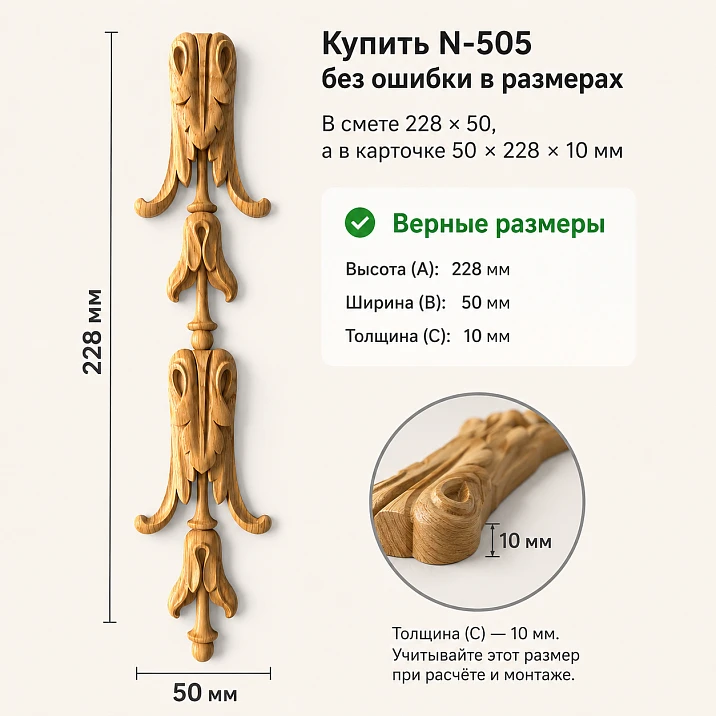
In the furniture estimate, a line appears: "carved overlay 228 × 50 mm, place vertically." The designer understands it without difficulty: before him is an elongated decorative element 228 mm high and 50 mm wide. The furniture maker also sees no problem — he is used to writing dimensions as "height × width." But the manager opens the N-505 card and finds a different sequence: A × B × C — 50 × 228 × 10 mm.
The numbers are almost the same. The ornament is the same. The article number is the same. Why then can the order turn out to be erroneous?
Because the notation "228 × 50" does not explain which number corresponds to A, which to B, where C = 10 mm disappeared, and whether it really refers to the specific N-505. One project participant describes the position of the overlay on the facade, another — the size of the product according to the card, a third transfers only two noticeable dimensions into the invoice. Everyone thinks they are talking about the same product, but they use different coordinate systems.
To buy overlay N-505 without swapping sides and ambiguity, no need to argue which number is "more correct" to put first. The safe solution is simpler: in the commercial specification, the manufacturer's designations are kept, and the position on the furniture is indicated with a separate explanation.
The correct line looks like this:
N-505, size A × B × C — 50 × 228 × 10 mm, design placement — vertical according to the drawing.
It is necessarily supplemented with:
-
beech or oak;
-
"Standard" or "Prestige";
-
preparation for enamel or tinting;
-
quantity;
-
the purpose;
-
delivery address.
After such a record, the designer can continue to call the long side the height. The furniture maker can use their own facade table. The manager works with the STAVROS card. The main thing is that everyone sees the original A, B, and C and can verify them against one product page.
This article does not try to explain once again how to choose vertical and horizontal overlays in general. The task is more specific and closer to payment: how to transfer N-505 from the card to the estimate, invoice, request, and production order so that the same product does not turn into four different expectations.
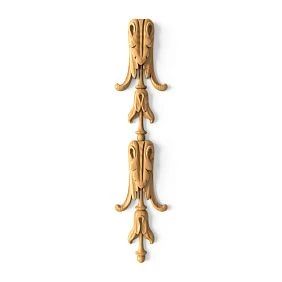
Where exactly the error occurs: the product is correct, the documents are different
Let's imagine a typical order chain.
The designer draws a tall cabinet and places an elongated plant ornament on each door. In the specification, he writes: "N-505, 228 × 50 mm, 4 pcs."
The estimator transfers the line to the table, shortening it to "overlay 228 × 50". The article number remains in the adjacent column, and the 10 mm dimension disappears as supposedly insignificant.
The customer sends a message to the manager: "Need four vertical overlays 228 by 50 in beech."
The manager opens the card where the dimension is listed as 50 × 228 × 10 mm and is forced to clarify:
-
whether N-505 is really needed;
-
whether another model is not confused;
-
what the first dimension in the estimate means;
-
whether preparation for enamel is needed;
-
whether sanding is selected;
-
whether the 10 mm relief is accounted for;
-
four overlays — this is an exact quantity or an assumption.
If questions are not asked, the goods may be shipped correctly, but a dispute will arise at the site: "We ordered 228 × 50, but here it's 50 × 228."
In fact, the dimensions have not changed. Only the order of notation has changed. But for acceptance, accounting, and the production task, this is already a conflict.




Why verbal explanation does not save
The phrase "well, you understand, it's vertical" works while only two people are involved in the project. In a real order, documents pass through:
-
designer;
-
customer;
-
manager;
-
estimator;
-
accountant;
-
picker;
-
furniture maker;
-
the painter;
-
installer.
The verbal explanation is lost. The card line remains.
Our factory also produces:
Why can't you just rearrange the numbers in the invoice
The invoice must unambiguously correspond to the selected card. If the card has dimensions A × B × C written as 50 × 228 × 10 mm, and the invoice shows 228 × 50 × 10 mm without explanation, a question arises: is this the same product or a different modification?
Even when there is actually only one modification, a mismatched entry complicates:
-
alignment;
-
verification;
-
acceptance;
-
reordering;
-
filing a claim;
-
transferring the project to another contractor.
Therefore, the original order is preserved, and the familiar description is added after it.
Get Consultation
Safe order formula N-505
For all documents, use one basic structure:
Carved wooden overlay N-505, size A × B × C — 50 × 228 × 10 mm, design position vertical according to the drawing, material — [beech/oak], sanding — ["Standard"/"Prestige"], preparation — [for enamel/for tinting], quantity — [___] pcs.
If the order is placed with delivery, the city is added.
If N-505 is included in several different groups, each configuration is recorded on a separate line.
For example:
N-505, A × B × C — 50 × 228 × 10 mm, beech, "Prestige", for enamel — 4 pcs., cabinet doors.
N-505, A × B × C — 50 × 228 × 10 mm, oak, "Prestige", for tinting — 2 pcs., display case facades.
Combining these items into a line "N-505 — 6 pcs." is not allowed. The article number and size match, but the material and preparation differ.
Brief passport N-505
| Parameter | Confirmed value | What the buyer needs to do |
|---|---|---|
| Article number | N-505 | Check the full spelling in all documents |
| Product type | Wooden carved decorative overlay | Do not confuse with a handle, molding, or polyurethane decor |
| Size | A × B × C — 50 × 228 × 10 mm | Keep the order from the card |
| Design position | Vertical according to the drawing | Indicate separately from the dimension line |
| Material | Beech or oak | Select before price calculation |
| Sanding | "Standard" or "Prestige" | Coordinate with the finisher |
| Preparation | For enamel or tinting | Link to future covering |
| Quantity | According to the surface list | Count specific installation locations |
| Order | Cart or one-click purchase | Check all switches before payment |
| Delivery | Across Russia | Specify city and current conditions |
| Price | Depends on the selected configuration | See in the card before ordering |
This table has no arbitrary characteristics. It shows only what needs to be transferred from the card to the working specification.
How to read 50 × 228 × 10 mm without inventing letter meanings
The card specifies the order:
-
A = 50 mm;
-
B = 228 mm;
-
C = 10 mm.
At this point, one wants to automatically write:
-
A — width;
-
B — height;
-
C — thickness.
For a specific design drawing, such reading may be convenient, but it cannot be turned into a universal rule. Different product groups may have designations referring to different parts of the geometry. The meaning of a letter is always checked against the diagram of the specific card.
To place an order, it is enough to record the fact:
N-505 has dimensions A × B × C 50 × 228 × 10 mm.
For a furniture task, you can add:
In the composition, the part is positioned vertically, with its elongated direction along the facade.
This way, professional languages do not conflict.
Why 10 mm cannot be removed from the estimate
The third dimension seems less important because it hardly affects the frontal silhouette. But it affects the actual placement.
C = 10 mm must be taken into account when checking:
-
the protrusion relative to the facade;
-
the neighboring handle;
-
door trajectories;
-
distance to the wall;
-
drawer opening;
-
intersection with the frame;
-
packaging of finished furniture;
-
thickness of the paint layer;
-
installation method;
-
perception of side light.
If only 228 and 50 mm remain in the estimate, the product becomes conditionally flat. On site, it turns out that it has relief.
Product size and occupied field are not the same thing
An overlay of size A × B × C 50 × 228 × 10 mm does not mean that it only needs a free rectangle of exactly 50 × 228 mm without any surrounding space.
On the facade, you need:
-
a flat area for adhesion;
-
visual indents;
-
distance to the frame;
-
a gap to the handle;
-
space for opening;
-
an acceptable edge of the trim.
The exact contour is checked against the drawing and a full-size template.
Five dimension languages found in a single project
One reason for confusion is that participants use different ways to describe space.
Product card language
A × B × C — 50 × 228 × 10 mm.
This is the main language of the commercial position.
Designer's language
Height × width × protrusion.
This is convenient for describing the position on the facade.
Furniture maker's language
Field width × field height × panel depth.
This is how the seating area is assessed.
Estimator's language
Name × quantity × price.
Technical dimensions are often abbreviated.
Installer's language
Top, bottom, axis, edge offset, handle location.
He works with coordinates on the actual facade.
You can't force everyone to abandon professional systems. We need to create a link:
Card line: A × B × C — 50 × 228 × 10 mm.
Project note: vertically, along the field axis, with offsets per drawing.
Which entries are acceptable and which create risk
| Formulation | Assessment | Reason |
|---|---|---|
| N-505 | Not enough | No configuration |
| Decor 228 × 50 | Dangerous | No article, C and order A/B |
| N-505, 228 × 50 × 10 | Ambiguous | Numbers rearranged relative to the card |
| N-505, 50 × 228 × 10 | Better | No indication of A × B × C |
| N-505, A × B × C 50 × 228 × 10 | Correct | Matches the card |
| N-505, A × B × C 50 × 228 × 10, vertical per drawing | Optimal | Combines the card and the project |
| N-505, as in the visualization | Unacceptable | The visualization is not a complete specification |
| Vertical overlay with acanthus | Not enough | You can choose a different model |
How to fix the estimate where 228 × 50 is already written
There is no need to delete the entire list and compile it anew. It is enough to add a note that returns the original system.
Was:
N-505, 228 × 50 mm, 4 pcs.
Now:
N-505, card size A × B × C — 50 × 228 × 10 mm; in the project list, the position is described as 228 mm vertically and 50 mm in horizontal dimension; placement is vertical per the drawing; 4 pcs.
After correction, the following should be synchronized:
-
estimate;
-
order;
-
invoice;
-
visualization;
-
production drawing;
-
installation diagram.
Do we need to change the already issued invoice?
If the invoice only specifies the article N-505 and quantity, ask to add the configuration. If the size is written in a different order, it is better to obtain a clarified version or written confirmation that the item matches the card A × B × C 50 × 228 × 10 mm.
This is not bureaucracy. It is protection for both parties against different interpretations.
What to write to the manager
In our design estimate, the size is written as 228 × 50 mm according to the principle of "vertical dimension × horizontal." I ask that in the commercial proposal, the card designation N-505 be used: A × B × C — 50 × 228 × 10 mm. The design placement is vertical.
This way, the manager does not have to guess whether you made a mistake or deliberately changed the order.
Before ordering, they measure not the door, but the free decorative field
A cabinet may have a large door, but a small panel. A dresser may have a wide drawer, but the handle occupies the center. A kitchen tall cabinet may have enough height, but the internal profile leaves a narrow flat strip.
The check begins with the actual area where the N-505 will be installed.
Width of the free field
The distance between the inner boundaries of the frame, molding, or other protruding elements is measured.
It is not enough to see a number greater than 50 mm. The contour and offsets must be taken into account.
Vertical size of the field
The field must accommodate an elongated composition without visually sticking to the top and bottom borders.
The number 228 mm itself does not define beautiful margins.
Panel depth
If the central part is recessed, the back side of the overlay must fit against a suitable flat surface. You cannot rest the edges on the frame while leaving the middle without contact.
Curvature of old furniture
On a restored facade, the surface may be uneven. A dry fit is mandatory.
Condition of the coating
Old varnish, enamel, wax, or dirt affect installation. The preparation method is agreed upon with the craftsman and the manufacturer of the mounting material.
Handle: a functional center that cannot be overlooked after purchase
A decorative overlay and a handle compete for the same spot more often than it seems. Especially on narrow doors.
Before ordering, decide:
-
where the N-505 axis runs;
-
where the handle holes are located;
-
how much space remains for fingers;
-
whether the hand touches the relief;
-
whether the distances are the same on all facades;
-
how the elements look when the door is open.
It is better to choose suitable hardware together with the decor. In the catalog, you can buy furniture handles after the overall composition of the facade has been approved.
Overlay above the handle
Suitable for a tall door if there is enough space between the elements.
Overlay below the handle
Works on some cabinets and sideboards, but the relief may end up near the hand.
Handle on the side, plate in the center
Convenient scheme for a classic door if the handle offset does not disrupt the rhythm of adjacent panels.
Plate around the handle
Requires a particularly precise template. Do not drill holes until the actual sample is received or approved.
Full-size template N-505
The template allows checking not only whether it fits or not, but also the actual scale.
Flat mock-up
-
Draw a rectangle 50 × 228 mm.
-
Draw the central axis.
-
Sign A = 50 and B = 228.
-
Specify the top based on the visualization.
-
Cut it out.
-
Secure with masking tape.
-
Take photos straight on and at an angle.
The rectangle shows the maximum field, but not the exact shaped contour. For final assessment, it's better to use a printed image or a scaled drawing.
3D mockup
Add a 10 mm thick layer to check the third dimension.
Open the door and inspect:
-
adjacent facade;
-
a wall;
-
handle;
-
drawer;
-
a frame;
-
person passage;
-
packaging dimension.
Layouts on all furniture
Place four templates on the four-door wardrobe. Perhaps one element looks neat, but repeating it on each door overloads the facade.
Commercial quantity is approved after the overall layout.
Vertical composition: where N-505 works convincingly
Narrow wardrobe door
The elongated ornament supports the vertical. Check the width of the central field and the handle.
Tall kitchen cabinet
The overlay helps connect a tall facade with classic kitchen decor. Frequent opening and finishing must be taken into account.
Showcase
N-505 can be placed on the blind lower part or narrow side elements. It cannot be transferred to glass without a separate project.
Sideboard
One central accent helps highlight the main door without repeating the decor on every drawer.
Wardrobe in the hallway
A vertical overlay can support the line of trim and baseboard. At the same time, the surface will more often come into contact with clothing and bags, which is taken into account in the finishing.
Furniture pilaster
N-505 can become part of an elongated decorative strip, but it should not automatically be considered a pilaster. A pilaster is a more complex compositional system.
Wall panel
Application is possible only after checking the base and scale. Local furniture decor on a large wall may look too small without a frame.
When one N-505 is enough, and when a system is needed
Single accent
One overlay works on the central door, panel, or sideboard.
Symmetrical pair
Two pieces are placed on two doors or on the sides of the central composition.
Repeating row
Four or six elements require strict marking and uniform finishing.
Overlay in a frame
The molding frame creates an architectural field, and N-505 becomes the center.
Set of carved trim
If one overlay is not enough, you can to buy carved wooden decor and select compatible elements: rosettes, moldings, corner decor, or other overlays.
The main thing is not to turn the facade into a random catalog of ornaments. Repeating motifs should be coordinated.
Beech or oak: the choice is related to what the buyer will see after finishing
The size of N-505 does not change, but the material affects the price and the visual result.
Beech for opaque enamel
Beech is often considered if the overlay will be fully painted:
-
with white enamel;
-
gray;
-
green;
-
blue;
-
black;
-
in the color of the facade.
The natural pattern ceases to be the main visual factor. Form and coating quality come to the forefront.
It cannot be promised that beech is always cheaper: the current amount is compared in the product card.
Oak for tinting
Oak makes commercial sense when the wood remains visible:
-
under a transparent varnish;
-
with oil;
-
with light tinting;
-
with dark stain;
-
with a patinated transparent finish.
It is better to order several parts in one batch and process them simultaneously.
Can oak be painted with enamel
The technical solution is coordinated with the finisher. But with a full opaque color, the visible texture of oak stops working as a decorative advantage. If all furniture is already specified in oak, the choice may remain justified.
Can beech be tinted?
Can only be considered after a test coating. Beech does not turn into oak because of a similar color.
"Standard" and "Prestige" in the estimate
The quality of sanding cannot be left in a verbal comment.
"Standard"
A reasonable option when:
-
there is an own carpentry section;
-
final sanding is included in the work;
-
the craftsman is familiar with carved wood;
-
the customer compares the full estimate;
-
the timeline allows for preparation.
"Prestige"
Suitable when:
-
manual finishing needs to be reduced;
-
the finisher counts preparation separately;
-
the overlays are at eye level;
-
the visible texture is preserved;
-
the series is large;
-
the deadlines are limited.
"Prestige" does not mean a ready color. It denotes more detailed surface preparation.
Under enamel and under tinting are two different commercial items
Preparation under enamel is used for opaque finishes. Preparation under tinting is needed when the wood grain remains visible.
Correct examples:
N-505, A × B × C 50 × 228 × 10 mm, beech, "Prestige", under enamel — 4 pcs.
N-505, A × B × C 50 × 228 × 10 mm, oak, "Prestige", for tinting — 2 pcs.
Incorrect:
N-505, beech/oak, for painting or tinting — 6 pcs.
This line does not allow forming a specific order.
Configuration comparison
| Task | Species | Sanding | Preparation | What the buyer pays for |
|---|---|---|---|---|
| White cabinet, own workshop | Beech | "Standard" | For enamel | Preparing and internal finishing |
| White cabinet, third-party painter | Beech | «Prestige» | For enamel | More prepared surface |
| Oak sideboard | Oak | «Prestige» | For tinting | Material, texture, and preparation |
| Restoration in the workshop | As per project | "Standard" | By finish | Workpiece with custom finishing |
| Sample for testing | As in the future batch | As in the batch | As in the batch | Scale and coverage check |
| Large series | One wood species | One level | One type | Repeated specification |
How to count without the template rule of "two per cabinet"
The count equals the number of approved decorative fields.
One overlay
One central accent.
Two
Symmetrical pair.
Four
One on each of four doors, or two pairs.
Six or more
A repeating row, where precise marking and a single batch are especially important.
Additional unit
Justified as:
-
test sample;
-
reserve for a large series;
-
part in case of damage;
-
future replacement.
But first, the main quantity is calculated.
List of overlays
| № | Item | Field | Article | A × B × C, mm | Position | Quantity |
|---|---|---|---|---|---|---|
| 1 | Cabinet | Left door | N-505 | 50 × 228 × 10 | Vertically | 1 |
| 2 | Cabinet | Right door | N-505 | 50 × 228 × 10 | Vertically | 1 |
| 3 | Commode | Upper drawer | — | — | Not installed | 0 |
| 4 | Buffet | Central door | N-505 | 50 × 228 × 10 | Vertically | 1 |
| 5 | Sample | Test panel | N-505 | 50 × 228 × 10 | Vertically | 1 |
Total: 4 pcs.
Full order cost
The price of a finished decorative scheme is calculated as follows:
**quantity N-505
× current price of the selected wood species, sanding, and preparation
-
Delivery
-
Mounting materials
-
Surface preparation
-
Finishing
-
master's work
= final cost.**
Do not fix the price in the article: it depends on the active configuration.
What to buy together with N-505
| Position | What it's for | What to Check | Page |
|---|---|---|---|
| N-505 | Main decorative accent | A × B × C, material, preparation | buy overlay N-505 |
| Other overlays | For fields of other sizes | Dimensions and ornament | buy decorative overlays for furniture |
| Carved decoration | For a complete composition | Unity of motifs | to buy carved wooden decor |
| Furniture handles | For a functional zone | Placement and protrusion | buy furniture handles |
| Installation and finishing materials | For installation and finishing | Compatibility with the base | Buy materials for installation and finishing |
| Wooden skirting board | For the overall carpentry line | Breed and coating | buy wooden skirting board |
Unified room finish
When overlays, furniture handles, casings, and floor trim are part of a single carpentry composition, it's better to compile the specification simultaneously. For a unified finish, you can also select buy wooden skirting board from the same species or under the same opaque enamel.
The same species does not guarantee an identical shade without test samples, but a joint purchase helps coordinate materials and work.
Installation: first layout, then glue or another fastening method
Specific installation depends on the base, coating, and chosen materials. A universal technology for any facade cannot be promised.
Before fixing:
-
attach all overlays;
-
check the axes;
-
compare the indents;
-
open the doors;
-
take a photo;
-
number them;
-
mark the position;
-
align the layout.
After that, you can Buy materials for installation and finishing according to the master's technique.
Why can't the first overlay be fixed separately
The slightest shift of the first part will become a reference for the entire series. On four doors, the error will repeat or create a different rhythm.
Why overlays are numbered
With visible wood, the master can distribute the grain across the facades. After fitting, each element returns to its place.
Finish: size is preserved, relief may visually change
Opaque enamel
Covers the natural color but emphasizes the shape through light and shadow.
Clear coating
Preserves the wood grain pattern.
Dark tinting
Recesses become more expressive, and preparation flaws may be more noticeable.
Patination
Requires a sample: the composition may accumulate in the relief and change the character of the ornament.
Test paintout
Needed before processing the entire batch. It shows:
-
color;
-
shine;
-
preservation of details;
-
behavior of recesses;
-
combination with the facade;
-
need for additional sanding.
How not to confuse N-505 with similar products
N-505 and NPU-505
Similar numbers do not make products identical. Check the full article number, material, and category.
Overlay and molding
N-505 is a local element. Molding is an extended profile.
Overlay and handle
N-505 does not open the facade. A functional handle is ordered separately.
Wooden and polyurethane decor
Materials have different properties, preparation, and installation. They cannot be changed just because the size matches.
Vertical and horizontal composition
Position is a design decision. The article number and A × B × C remain unchanged.
Ten practical scenarios
1. Two-door cabinet
One N-505 per door. Quantity — 2 pcs. The mirror composition is checked, not the mirroring of the carving as an unconfirmed characteristic.
2. Four-door wardrobe
It is not necessary to install four. Decoration of only the central pair is possible.
3. Tall pencil case
The direction is suitable, but the central field may be narrower than required.
4. Chest of drawers
The height of the drawers may not accommodate 228 mm. The model cannot be mechanically transferred to each facade.
5. Sideboard
One N-505 can highlight the central door.
6. Display case
The combination with glazing and wooden sections is being checked.
7. Restoration
The old coating and surface need to be assessed.
8. New furniture
The overlay is included in the drawing before drilling the handles.
9. Wall panel
On a large surface, a frame or a group of decor may be required.
10. Commercial interior
The series requires a sample, numbering, and a unified specification.
Responsibility matrix
| Participant | What it is responsible for | What to pass to the next |
|---|---|---|
| Designer | Position and composition | Article, A × B × C, visualization |
| Cabinetmaker | Landing field and layout | Facade dimensions, coordinates |
| Manager | Product configuration | Confirmed order line |
| Estimator | Total cost | Material, quantity, works |
| Painter | Preparation and finishing | Sample and technology |
| Installer | Precise fixation | Diagram and part numbers |
| Customer | Approval | Unified approved specification |
What to do after receiving N-505
-
Verify the quantity.
-
Check the article number.
-
Compare the size.
-
Ensure the selected wood type.
-
Check the quality of sanding.
-
Lay out the series.
-
Perform a dry fit.
-
Make a test paint out.
-
Number.
-
Send to finishing.
-
Install according to the approved scheme.
Forty mistakes when ordering
Mistake 1. Write down only 228 × 50
It is unclear where A and B are.
Mistake 2. Remove 10 mm
The third dimension disappears.
Error 3. Specify only N-505
No material and preparation.
Error 4. Write "vertical overlay"
You can choose a different article.
Error 5. Rename A width without a drawing
A false universal rule arises.
Error 6. Fix the card to fit the estimator's habit
Source data is lost.
Error 7. Rotate the product to match the record
The document needs to be corrected.
Error 8. Not checking the free field
The overlay overlaps the frame.
Error 9. Evaluating only the outer facade
The panel turns out to be smaller.
Error 10. Not accounting for the handle
The elements conflict.
Error 11. Not accounting for the opening direction
The relief touches the adjacent part.
Error 12. Choosing beech or oak after the calculation
The price changes.
Error 13. Mixing breeds in one line
The order is ambiguous.
Error 14. Not specifying the grinding
Cannot assess the preparation.
Error 15. Considering "Prestige" as a coating
This is surface quality.
Error 16. Confusing enamel and tinting
A different preparation is selected.
Error 17. Ordering by photo
Scale not verified.
Error 18. Not making a template
Error is detected after delivery.
Error 19. Gluing without layout
The row turns out uneven.
Error 20. Not numbering the series
Parts get swapped.
Error 21. Counting by cabinets
The number of installation locations is different.
Error 22. Automatically placing in pairs
The facade is reloading.
Error 23. Cannot check the cart
The wrong option is saved.
Error 24. Send a cropped screenshot
Characteristics are not visible.
Error 25. Write "as in the picture"
No commercial configuration.
Error 26. Mix N-505 and NPU-505
A different material is being ordered.
Error 27. Buy random glue
No confirmed compatibility.
Error 28. Mount on a dirty surface
Adhesion deteriorates.
Error 29. Paint before fitting
Finish is damaged during fitting.
Error 30. Apply too thick enamel
Relief loses clarity.
Error 31. Rough sanding
Ornament changes.
Error 32. Do not order the batch at the same time
Wood and finish may vary.
Error 33. Expecting complete identity of wood
Natural grain is variable.
Error 34. Not making a test stain
The color turns out different.
Error 35. Fixing the old price
The current configuration changes.
Error 36. Not counting delivery
The estimate is incomplete.
Error 37. Not saving the specification
Repeat order is difficult.
Error 38. Place on a movable joint
The overlay interferes with two leaves.
Error 39. Not checking the scale from a distance
The series looks overloaded.
Error 40. Not assigning a responsible person
Different documents diverge.
Who N-505 is suitable for
N-505 is worth considering if:
-
a vertical elongated ornament is needed;
-
free field matches the drawing;
-
wooden decor is required;
-
finish selected;
-
project specifies beech or oak;
-
fitting can be done;
-
article and configuration are fixed in writing;
-
decor matches the handle;
-
quantity calculated by surfaces.
When it is better to choose a different overlay
Another model is opened if:
-
field does not fit;
-
need a wide horizontal motif;
-
the handle occupies the center;
-
the relief interferes with opening;
-
the ornament is too active;
-
a different material is required;
-
the base is uneven;
-
the size is compositionally small;
-
the project requires a different shape.
In such cases, it is more reasonable buy decorative overlays for furniture after comparing the drawings.
How to place order N-505 at STAVROS
Open the exact product page
Check the full article number.
Verify the size
A × B × C — 50 × 228 × 10 mm.
Add a note
Vertically according to the project drawing.
Choose the material
Beech or oak.
Select sanding
"Standard" or "Prestige".
Determine preparation
For enamel or for tinting.
Specify the quantity
According to the field list.
Add materials
After technology approval.
Check the cart
All parameters must match.
Save the line
Pass it to the designer, cabinetmaker, and painter.
FAQ: questions before order N-505
How to correctly specify the size N-505?
Write: A × B × C — 50 × 228 × 10 mm. Specify the design position separately.
Can I write 228 × 50 × 10 mm?
As an orientation note — yes, but the commercial line must preserve the card order.
Why does the estimate show 228 × 50?
Presumably, the author used the order 'height × width'. This should be clarified.
What does A mean?
For N-505, in the card A = 50 mm. The geometric meaning is verified against the drawing.
What does B mean?
B = 228 mm.
What does C mean?
C = 10 mm — the third dimension, which cannot be removed from the specification.
Can C be called thickness?
The term should be verified against the drawing. In the order, the designation C is sufficient.
Is N-505 a vertical plate?
In the considered project application, it is positioned vertically.
Will the size change if it is rotated?
No. A, B, and C remain the same.
Will a field of exactly 50 × 228 mm fit?
It cannot be promised without checking the contour, fit, and margins.
Why make a template?
It shows the scale, position, and potential conflicts.
Do I need to account for 10 mm when opening the door?
Yes. The relief protrudes relative to the surface.
How to check the adjacent facade?
Install the volumetric model and open all the flaps.
Can the N-505 be placed next to the handle?
Yes, if convenience and compositional indents are preserved.
What to choose — beech or oak?
Beech is often considered under enamel, oak — under visible texture. The decision depends on the project.
Is beech always cheaper?
This should not be stated without checking the current card.
Can oak be painted with enamel?
The technology is coordinated with the finisher. But the visible texture will be covered.
Can beech be tinted?
The result is checked with a test stain.
How does "Standard" differ from "Prestige"?
"Prestige" receives more detailed hand sanding. "Standard" may require more finishing work.
Is "Prestige" already painted?
No.
What does "under enamel" mean?
Preparation for future opaque coating.
What does "for tinting" mean?
Preparation for finishing with visible wood.
How many overlays are needed for a two-door wardrobe?
Often two, if one per door. The exact quantity is determined by the project.
Can one overlay be installed on two doors?
The movable joint should not be covered.
How many are needed for a four-door wardrobe?
From two to four or another quantity — according to the approved composition.
Is a reserve needed?
Only if it is intended for a sample, series, or possible replacement.
Can I order one first?
Yes, to check the scale and finish.
Is it better to order the oak series at the same time?
Yes, it simplifies selection and finishing.
How to calculate the full price?
The quantity is multiplied by the current configuration price, and materials, labor, and delivery are added.
Is glue included?
The configuration and materials need to be checked separately.
What mounting material should be used?
One suitable for the wood, substrate, and coating according to the manufacturer's technology.
Can it be glued onto enamel?
Only after checking the compatibility and strength of the coating.
Does the facade need to be sanded?
The preparation of the base is determined by the craftsman.
When should the overlay be painted?
After a dry fitting and approval of the composition.
Can the overlay be painted together with the facade?
Such a technology can be considered if it has been confirmed by a painter.
Will N-505 be suitable for old furniture?
After checking the flatness, coating, and size of the field.
Can it be mounted on a wall?
The possibility depends on the composition and base; a card furniture overlay does not automatically become a universal wall element.
Can it be used on a door?
Yes, if the door's surface and movement are suitable.
How not to confuse N-505 with NPU-505?
Check the full article number, material, and card address.
What to do if the invoice says 228 × 50?
Ask to add the card designation A × B × C 50 × 228 × 10 mm.
Do I need to correct the visualization?
If it does not contain the article number and card line, it is better to add a caption.
What to write to the furniture maker?
Article number, A × B × C, coordinates, orientation, material, and quantity.
What to write to the manager?
Full configuration and delivery city.
What to save after purchase?
Card, invoice, configuration, finish sample, and layout diagram.
Can you mix "Standard" and "Prestige"?
For one visible series, this is undesirable without a special reason.
Can I order part in enamel and part in tinting?
Yes, but as separate lines.
Where can I see alternatives?
In the catalog you can buy decorative overlays for furniture of a different size and ornament.
Where to pick the rest of the decor?
In the general section, you can to buy carved wooden decor for a comprehensive composition.
Is N-505 delivered across Russia?
Delivery is provided; current terms are checked at checkout.
Can I place an order in one click?
You should rely on the active buttons of the current product card.
Final check before payment
Check one line:
N-505 — A × B × C 50 × 228 × 10 mm — vertically per drawing — beech or oak — "Standard" or "Prestige" — for enamel or for tinting — quantity — delivery city.
Then compare it with:
- visualization;
- facade schedule;
- invoice;
- basket;
- production task;
- painting map;
- installation diagram.
Do not force the product to fit the record — make the record unambiguous
The phrase "in the estimate 228 × 50, but in the card 50 × 228" does not mean that one of the participants necessarily made a mistake in geometry. The designer could have put the vertical dimension first, while the card uses A × B × C. The error begins later — when the design description is passed off as an exact product designation.
A correct order does not require choosing between two sequences. It combines them:
N-505, card size A × B × C — 50 × 228 × 10 mm; intended placement — vertical.
Next, the material, sanding, preparation, quantity, and delivery are fixed. After that, the manager calculates exactly N-505, the cabinetmaker knows the position, and the customer can check the invoice without guessing.
STAVROS provides an active N-505 card, a choice of beech and oak, two sanding qualities, preparation for different types of finishes, and the ability to assemble a decorative composition together with overlays, handles, carved decor, and mounting materials. The precise specification does not complicate the purchase. It makes the order transparent: one article number, one size system, and one agreed expectation for all project participants.