Article Contents:
- What is confirmed about the NPU-423L/R pair
- Why this article does not duplicate STAVROS materials about wall clocks
- The clock remains the center, NPU-423L/R is only side framing
- Geometry of the pair around the round clock: total width, free margins, and height
- First calculation: total width of the composition
- Second calculation: whether there is enough smooth field between the slats and the other boundary
- Asymmetric wall: when the clock cannot simply be centered between the slats and the other boundary
- Is a mandatory gap required between the clock and the overlays
- NPU-423L/R height relative to the center of the round clock
- By the geometric center of the clock
- Slightly above the center
- Slightly below the center
- Why two identical L or two identical R are not equivalent to a pair
- Why one NPU-423L without NPU-423R is already a different composition
- Checking the total width
- Checking the left side
- Checking the right side
- Slat panels on the right or left: how to understand when the NPU is already too close
- Check 1. Dimensions
- Check 2. Actual contour
- Check 3. View from the room
- If the clock is already partially on the slat zone
- 13 mm of relief: why a flat template is not enough
- Clock with a massive decorative frame: when an additional pair is redundant
- Simple round clock: when the NPU-423L/R pair is especially logical
- If there is already a sconce, painting, or mirror nearby
- Sconce
- Painting
- Mirror
- Pair color: it's better to start with a shade matching the wall
- Two templates should be made together, not one at a time
- Stage 1. Dimensions
- Stage 2. Silhouette
- Stage 3. Orientation
- Stage 4. Gap
- Stage 5. Volume
- Stage 6. Light
- The height of the overall composition is determined not only by the 58 mm overlays
- Viewing distance changes the assessment of the pair
- A slat wall can already provide enough decor
- Commercial calculation: 0, pair, or a separate new project
- Why the price of a pair is not the main argument for buying
- The clocks are already hanging, so their existing position is protected first
- The marking of the pair must be mirror-controllable
- The foundation of the wall needs to be checked before choosing the mounting compound.
- If the wall is covered with wallpaper
- If the wall is painted
- If the clock is planned to be replaced someday
- If a pair has been installed, what size of new clock will be able to fit into it later
- Can a pair be arranged without a molding frame
- If NPU-423L/R are not suitable, you should look not for "something similar," but for the required scale
- The pair is too long
- The floral pattern is too active
- There is little space next to the rails
- Need a different curvature
- Error 7. Not accounting for the 13 mm thickness
- Error 8. Treating an empty field as a problem
- Error 9. Using one half of a pair as an emergency replacement
- Error 10. Choosing the mounting compound only based on the pad card
- What to check in 15 minutes before ordering NPU-423L/R
- Step 1. Measure the watch case
- Step 2. Measure the smooth field
- Step 3. Record the center of the watch
- Step 4. Calculate the minimum width
- Step 5. Add assumed gaps
- Step 6. Check the left side
- Step 7. Check the right side
- Step 8. Make two templates 336 × 58 mm
- Step 9. Check the real S-shaped contour
- Step 10. Check the height
- Step 11. Simulate 13 mm of relief
- Step 12. Turn on the light
- Step 13. Compare the variant without NPU
- Step 14. Check article numbers
- Step 15. Make a decision
- Full algorithm: from already hanging clocks to the cart
- Decision matrix: buy a pair or leave the clocks standalone
- Can the NPU-423L/R be mounted vertically on the sides of the clocks?
- Will the NPU-423L/R fit oval clocks?
- What to do if the clocks have a pendulum?
- Can the NPU-423L/R be placed around clocks that hang above a console?
- What to do if the clocks are not perfectly centered on a smooth field, but they cannot be moved?
- Can L and R be painted a different color than the clock?
- Do I need to buy a spare third overlay?
- Will NPU-423L/R fit clocks with built-in backlighting?
- Can the overlays be positioned not in the center of the clock, but along the line of the 3 and 9 numerals?
- If NPU-423L/R are too long, can they be trimmed?
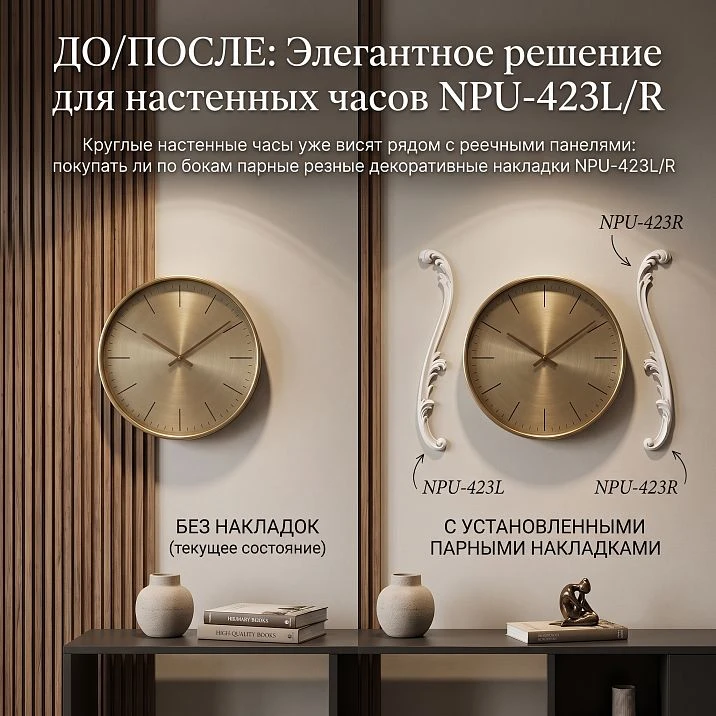
The round wall clock is already hanging on a smooth part of the wall. Next to it, slat paneling begins. The functional center of the composition has already been chosen, so the task is not about which clock to buy or where to hang it. Another question needs to be resolved: will a mirrored pair of long carved overlays NPU-423L and NPU-423R enhance the existing clock, or will the wall become overloaded?
Both overlays have the same confirmed size:
-
A = 336 mm in width;
-
B = 58 mm in height;
-
C = 13 mm in thickness;
-
Material — polyurethane.
The current price on fresh STAVROS pages is 1,690 ₽ for NPU-423L and 1,690 ₽ for NPU-423R. So the base product cost of the paired solution is:
1 690 + 1 690 = 3 380 ₽.
This is not a set of two identical parts. For a symmetrical composition around the clock, you need a kit:
1 × NPU-423L + 1 × NPU-423R.
The first question before ordering is not "are these overlays beautiful," but how much space the entire composition will take up together with the existing clock.
If the clock diameter is denoted as D, and the visual gap from the clock to each overlay is G, then when placing the pair horizontally, the total width will be:
W = D + 336 + 336 + 2G
Or:
W = D + 672 + 2G.
For example, a round clock with a diameter of 500 mm without any gaps already gives together with two overlays:
500 + 672 = 1172 mm.
If you leave 80 mm of air on each side of the clock:
500 + 672 + 160 = 1332 mm.
This fundamentally changes the perception. A single NPU-423L seems like a narrow detail 336 mm wide. But the mirrored pair around the clock creates a horizontal center more than a meter wide.
Therefore, the correct purchase sequence is:
measure the clock → measure the smooth field → check the side next to the rails → make two templates 336 × 58 mm → choose the gap → calculate the final width → compare the option with and without the pair → only then buy L and R.
If the composition works, you can buy the carved decorative overlay NPU-423L and separately buy the carved decorative overlay NPU-423R.
If there is not enough space or the clock is already self-sufficient, the correct cart is 0 overlays.
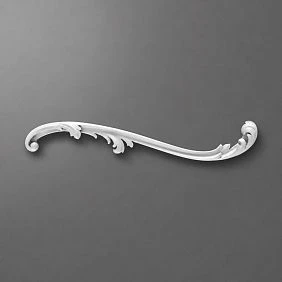
What is confirmed about the NPU-423L/R pair
| Parameter | NPU-423L | NPU-423R |
|---|---|---|
| Type | Carved decorative overlay | Carved decorative overlay |
| Role in the pair | Left | Right |
| Material | Polyurethane | Polyurethane |
| A, width | 336 мм | 336 мм |
| B, height | 58 мм | 58 мм |
| C, thickness | 13 мм | 13 мм |
| Current price | 1 690 ₽ | 1 690 ₽ |
| Quantity for a symmetrical pair | 1 pc. | 1 pc. |
Total:
2 items = 672 mm of total own width excluding clocks and gaps.
Cost of a pair = 3,380 ₽.
In the official STAVROS filter, A is decoded as width, B as height, C as thickness. So for calculating the horizontal span, 336 mm per overlay can be used.
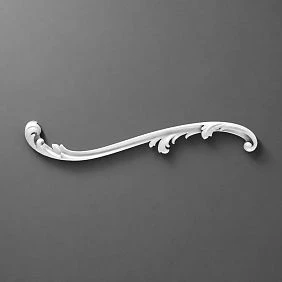
However, the 336 × 58 mm dimension is not equal to a solid rectangle of the ornament. The actual silhouette is S-shaped, so for the final fitting it is better to use not only two paper rectangles, but also images/drawings of the left and right parts at 1:1 scale.
This is especially important near slat panels: the overall rectangle may formally fit close to the slats, while the specific curl of NPU-423R may actually be even further from the boundary — or vice versa, it is the protruding part of the ornament that will visually conflict with the slats.




Why this article does not duplicate STAVROS materials about wall clocks
STAVROS already has separate articles about wall clocks CH-001, CH-002, and CHPU-001. They help choose the clock itself, compare the case material, finish, style, and placement.
In this task, the clocks already exist.
It doesn't matter whether they are purchased from STAVROS or another manufacturer. For calculating the article, the actual parameters of the specific item are important:
-
outer diameter;
-
case thickness;
-
center height;
-
decorative richness of the frame;
-
distance to slat panels;
-
free field on the opposite side.
Therefore, the new article does not answer the question:
which wall clock to choose?
It answers the question:
Should existing round clocks be turned into a wider wall composition using two specific polyurethane overlays NPU-423L/R.
This is a different user path.
A broad article about clocks ends with choosing and placing the item. Here, the work begins after the clock is already hanging.
Separation is also needed from broad articles about slat panels and moldings. They discuss combining systems as a whole. The new page solves the exact configuration: 0 parts or 1 L + 1 R around one round item.
Our factory also produces:
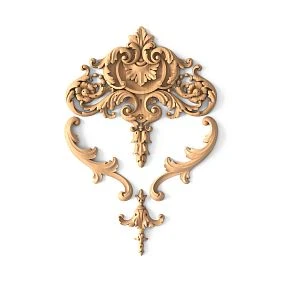
The clock remains the center, NPU-423L/R is only side framing
This is the main compositional principle.
If after adding the overlays a person first notices the molded "wings" rather than the clock, and the dial itself becomes a small detail between them, the scale is chosen incorrectly.
The paired composition works convincingly when:
-
the circle remains the center;
-
L and R direct the gaze toward it;
-
both elements are read as one system;
-
the slat surface remains adjacent material;
-
there is visual air between the three objects.
Bad scenario:
slats → very close NPU-R → clock → NPU-L → free empty wall.
The composition becomes asymmetric relative to the external surroundings, although the panels themselves are mirrored.
Good scenario:
free field → NPU-L → clock → NPU-R → free field → slats.
The outer fields do not have to be mathematically identical. But visually it should be clear that the paired composition has not "cut into" the adjacent slat system.
Get Consultation
Geometry of the pair around the round clock: overall width, free fields, and height
First calculation: total width of the composition
The formula is simple:
W = D + 672 + 2G
Where:
-
W— final width; -
D— outer diameter of the watch; -
672— total width of NPU-423L and NPU-423R; -
G— one identical gap between the watch and each overlay.
If the gaps differ:
W = D + 672 + GL + GR.
This is useful for an asymmetrical wall, but for a paired composition it is wiser to first check equal gaps.
The table shows the scale without repeating the same arithmetic:
| Watch diameter | G = 0 mm | G = 50 mm | G = 80 mm | G = 120 mm |
| 300 мм | 972 мм | 1072 мм | 1132 мм | 1212 мм |
| 400 мм | 1072 мм | 1172 мм | 1232 мм | 1312 мм |
| 500 мм | 1172 мм | 1272 мм | 1332 мм | 1412 мм |
| 600 мм | 1272 мм | 1372 мм | 1432 мм | 1512 мм |
| 700 мм | 1372 мм | 1472 мм | 1532 мм | 1612 мм |
The table shows: even with a clock diameter of 300 mm, the composition almost reaches a meter without gaps. For clocks of 600–700 mm, the total span easily extends to 1.4–1.6 m.
Therefore, NPU-423L/R is not "two small overlays next to the clock," but a means to noticeably expand the wall center horizontally.
Second calculation: whether there is enough smooth field between the rails and the other boundary
Let the available smooth wall width be S.
For a centered composition with a total width of W the remaining free field:
Ftotal = S − W.
If the clock and the pair are centered in this field:
Fside = (S − W) / 2.
For example:
-
smooth field — 1800 mm;
-
clock — 500 mm;
-
gap G — 80 mm;
-
overall composition — 1332 mm.
Remainder:
1800 − 1332 = 468 mm.
With strict centering:
468 / 2 = 234 mm on each outer side.
This is no longer a standard, but a useful picture of the space.
If to the right after 234 mm the slats begin, a separate pause remains between NPU-R and the vertical rhythm.
If the field is only 1450 mm:
1450 − 1332 = 118 mm,
that is, 59 mm on each side when centering.
This option formally fits, but visually it may appear cramped.
Therefore, "it fits by arithmetic" and "the composition looks calm" are two different stages of checking.
Asymmetric wall: when the clock cannot simply be centered between the slats and another boundary
In a real interior, a smooth field is rarely symmetrical.
On one side, slatted panels may begin.
On the other — a door, wardrobe, wall corner, sconce, or open passage.
The clock is already hanging and may be tied not to the geometric center of the wall, but to:
-
to the sofa;
-
console;
-
to the table;
-
to the fireplace;
-
the passage;
-
to the existing outlet;
-
furniture.
Therefore, after calculating the total width, you need to check two independent external margins:
-
FL— from the outer edge of NPU-423L to the nearest left boundary; -
FR— from the outer edge of NPU-423R to the nearest right boundary.
If the clock is already mounted, it is more convenient to measure from its center.
Let the clock diameter be D, and the gap to each plate be G.
From the clock center to the outer edge of one side of the composition:
E = D / 2 + G + 336.
For example, a clock with a diameter of 500 mm and a gap of 80 mm:
E = 250 + 80 + 336 = 666 mm.
This means that from the center of the clock, you need about 666 mm of free horizontal space to the outer dimension of the pair on each side.
If there are only 590 mm to the right up to the rails, the right part of the composition in the chosen scheme no longer fits:
590 < 666.
If there are 900 mm on the left, the problem exists only on the side of the rails.
It is precisely in such a situation that you cannot automatically shift only the right overlay closer to the clock. This destroys the paired rhythm.
First, compare the options:
-
reduce the same gap G on both sides;
-
check the actual S-shaped contour instead of the rectangular dimension;
-
assess the acceptability of a slight shift of the entire composition if the clock can be moved;
-
choose a more compact decor;
-
leave the clock without a pair.
If the clocks are already firmly fixed and relocation is undesirable, the latter option is often better than "fitting" a symmetrical pair into an asymmetrical remaining space.
Is a mandatory gap between the clocks and the overlays required?
There is no confirmed universal number like 50, 80, or 100 mm that would suit all clocks.
The gap depends on:
-
the diameter of the clocks;
-
the nature of their frame;
-
the height of the NPU 58 mm;
-
the pattern of the overlays;
-
viewing distance;
-
color;
-
the proximity of the battens.
But there is a principle that can be checked visually:
The overlays should be a separate side framing, not appear glued to the watch case.
If the gap is too small, there is a false impression of a single object, even though materials, color, and texture may differ.
If it is too large, the connection falls apart:
NPU-L — void — watch — void — NPU-R.
Then the elements look like three independent objects.
A full-size template allows you to test at least three gap options without assembly.
For example:
-
tight;
-
medium;
-
loose.
There is no need to turn them into "norms."
Their task is to determine at what distance the eye still reads a single composition.
Height of NPU-423L/R relative to the center of the round watch
Each overlay has a height of 58 mm.
Round clocks can be:
-
300 mm;
-
500 mm;
-
700 mm;
-
of a different diameter.
Therefore, the overlays occupy only a narrow horizontal strip.
The most obvious scheme is to place them approximately along the horizontal axis of the clock.
But "center to center" is not always the best option.
By the geometric center of the clock
Suitable if:
-
the dial is visually uniform;
-
The frame does not have a heavy top or bottom part;
-
The NPU should create a calm horizontal axis.
Slightly above center
Can work if the lower part of the clock is visually heavier or if furniture is already placed beneath it.
Slightly below center
Sometimes appropriate for clocks with a pronounced decorative upper part.
The article does not specify a universal offset in millimeters.
Practical method:
-
draw a horizontal axis through the center of the clock;
-
apply two templates;
-
take a photo;
-
raise both templates together by the same amount;
-
repeat;
-
compare.
The main thing is to move L and R synchronously, keeping one common axis.
Paired logic of NPU-423L/R: orientation, symmetry, and single element
Why two identical L or two identical R are not equivalent to a pair
NPU-423L and NPU-423R have the same size but different L/R designations.
For symmetrical arrangement around the central circle, pair logic requires left and right orientation.
Two identical parts can create:
-
same direction of the curl;
-
visual movement in one direction;
-
asymmetry relative to the clock.
Therefore, the base basket of the article:
1 × NPU-423L + 1 × NPU-423R.
Before permanent installation, it is useful to lay out both parts on the floor or table relative to the clock template circle and check:
-
which ends should face the center;
-
which ones should face outward;
-
whether the sides are mixed up;
-
whether each part needs to be rotated.
You cannot rely only on the L/R letters as an installation instruction for a specific wall. The card confirms the article numbers, size, and material, but the final orientation of the ornament is better verified against the image/drawing.
Why one NPU-423L without NPU-423R is already a different composition
If there is little space on the right due to the battens, there is a temptation to leave only the left overlay.
Technically, a single decorative element can be used as a standalone accent, but this is no longer a paired framing of the clock.
This option needs to be evaluated anew.
A single overlay can work if:
-
the entire wall is intentionally asymmetrical;
-
the clock is already shifted toward the battens;
-
the single ornament balances another object;
-
asymmetrical compositional logic is repeated in the interior.
But it cannot be considered:
"the pair didn't fit, so let's put half of the pair".
This solution is from the remainder.
For the original intent, the commercial fork is simpler:
paired scheme passes → buy L + R;
does not pass → first abandon the pair and design another option.
Working measurement map: one sheet instead of a series of 'by eye' fittings
For a paired composition, it is useful to record all initial data before cutting templates. Then it becomes clear which variable creates the problem: watch diameter, proximity of slats, small gap, or shifted center.
| Parameter | Designation | Actual value |
| Outer diameter of the watch | D | ___ mm |
| Gap on the left to NPU | GL | ___ mm |
| Gap on the right to NPU | GR | ___ mm |
| From the center of the watch to the left border | CL | ___ mm |
| From the clock center to the right edge/bars | CR | ___ mm |
| Clock center height | H | ___ mm |
| NPU-L width | A | 336 мм |
| NPU-R width | A | 336 мм |
| Height of each NPU | B | 58 мм |
| Thickness | C | 13 мм |
After filling, three checks are performed.
Total width check
W = D + 672 + GL + GR.
If GL = GR = G, the formula simplifies to D + 672 + 2G.
Left side check
From the clock center to the outer dimension of NPU-L required:
EL = D/2 + GL + 336.
Must be no less than the actual space available CL, if there are no other obstacles between them.
Checking the right side
Similarly:
ER = D/2 + GR + 336.
This is where a conflict with slat paneling is most often found.
The working map is useful for another reason: it separates a lack of physical space from visual discomfort. If the arithmetic works out but the template still looks cramped, the problem is no longer in millimeters — the pair simply lacks a calm margin.
Slat panels, clock pattern, and light: when a pair enhances the wall, and when it overloads it
Slat panels on the right or left: how to tell when the NPU is already too close
The slat surface creates a frequent vertical rhythm.
NPU-423R or L — a long, low plant ornament.
When they come close to each other, two strong geometries meet:
-
vertical linear;
-
horizontal curvilinear.
The combination itself can be interesting.
The problem arises when there is no visual pause between them.
Then the edge of the S-shaped overlay begins to be perceived as an accidental continuation of or collision with the rails.
Before purchasing, it is useful to do three checks.
Check 1. Dimensions
The 336 × 58 mm rectangle does not intersect the slatted surface.
Check 2. Actual contour
The outermost curl does not fit the slats more tightly than it appears by the rectangle.
Check 3. View from the room
From the main distance between elements, there is a separate zone of smooth wall.
There is no need to invent mandatory 100 or 150 mm.
The pause is determined by the actual pattern.
If the clock is already partially on the slat zone
This is a fundamentally different scenario.
Suppose part of the round body already extends onto the slats or the clock hangs directly on the slat panel.
Then the symmetrical pair NPU-423L/R on the smooth wall may not have a normal common plane with the center.
Possible problems:
-
the left pad ends up on the smooth part;
-
the right one — on the rails;
-
the reliefs are at different levels;
-
the common horizontal line is broken.
In this case, the article does not recommend "gluing" the right NPU on top of the rails.
The entire assembly needs to be reconsidered.
If the clock must remain on the rail surface, it is better to design the decor specifically for that system.
The original theme is designed for a clock hanging on the smooth part of the wall next to the rails.
13 mm of relief: why a flat template is not enough
The thickness of each NPU is 13 mm.
This means that under side lighting, the pair will be more noticeable than two paper strips.
The relief affects:
-
shadow;
-
depth;
-
side view;
-
the relationship to the watch case;
-
proximity to the rails.
If the watch case protrudes from the wall by 40–60 mm, an NPU 13 mm thick will remain a flatter side trim.
If the watch is almost flat, the relief of the overlays may become unexpectedly noticeable.
Therefore, after the dimensional template, it is useful to make a simple three-dimensional mock-up:
-
place foam board underneath;
-
use a cardboard strip;
-
simulate approximately 13 mm of depth.
There is no need to precisely reproduce the thread.
The task is to see the shadow.
Clocks with a massive decorative frame: when an extra pair is redundant
Not all round clocks need side elements.
If the case already has:
-
thread;
-
a wide metal rim;
-
decorative patina;
-
a massive wooden baguette;
-
ornamental protrusions,
NPU-423L/R adds another layer.
Then the composition can become similar to:
decorative clocks inside another decorative object.
This is especially noticeable near the rails, where a third texture is already present.
For such clocks, the best test is to first look at the wall without NPU.
If the object itself confidently holds the center and the empty spaces on the sides are perceived as necessary breathing room, stucco is not needed.
Simple round clocks: when a pair of NPU-423L/R is especially logical
The opposite case — minimalist clocks:
-
thin rim;
-
simple dial;
-
neutral color;
-
without decorative carving.
On a large smooth wall, they may look like too small a functional item.
NPU-423L/R extend the composition horizontally without creating a full molding frame.
As a result:
-
the circle remains the functional center;
-
the pair provides decorative width;
-
slat panels maintain the vertical background;
-
the wall receives a connected horizontal accent.
It is precisely for this scenario that the idea of a pair is most understandable.
If there is already a sconce, painting, or mirror nearby
Each additional item changes the solution.
Sconces
Two sconces on either side of the clock already create a side frame.
An NPU between the clock and the sconces can serve as a third layer.
Painting
If a painting hangs nearby, a horizontal pair extends the clock toward it and can reduce the visual gap between independent centers.
Mirror
A mirror often forms a large composition on its own. A clock with a pair of NPUs nearby can compete with it.
Practical principle:
if an adjacent item already serves as a side boundary, an NPU is only needed when proven additional benefit exists.
Don't buy a pair just because there's physically enough space.
Color of the pair: it's best to start with a version matching the wall tone
The small height of 58 mm and relief of 13 mm allow the NPU-423L/R to work through shadow.
If the walls are light, you can first check overlays in a close color.
So the composition:
-
remains calm;
-
does not turn into a graphic arrow;
-
coexists better with wooden slats;
-
allows the clock to remain the main object.
The contrasting color enhances the side elements.
It is justified if this color is already repeated:
-
in the clock bezel;
-
in the hardware;
-
in luminaires;
-
furniture.
You cannot automatically paint NPU "wood-like" just because there are slats nearby. Polyurethane does not become wood from brown paint, and a solid imitation can look artificial next to natural texture.
Full-size fitting: how to check a pair before ordering and not be deceived by dimensions
Two templates need to be made together, not one at a time
One NPU 336 mm wide may seem suitable in almost any free space.
But the buyer considers the paired composition, so the pair needs to be tested.
The correct layout includes:
-
circle of the actual watch diameter;
-
NPU-423L 336 × 58 mm;
-
NPU-423R 336 × 58 mm;
-
selected intervals;
-
edge of the slat panels;
-
adjacent objects.
If the clock is already hanging, there is no need to draw a circle — work around the real object.
Stage 1. Overall dimensions
Cut out two rectangles 336 × 58 mm.
This will quickly show the overall scope.
Stage 2. Silhouette
If the overall dimensions pass, transfer the real L/R contours from a card, drawing, or quality image.
Stage 3. Orientation
Place the left and right versions so that their pattern truly frames the center.
Stage 4. Gap
Check at least two different distances from the clock.
Stage 5. Volume
Model a relief of about 13 mm.
Stage 6. Light
Look at it in daylight and evening lighting.
Only after this does it make sense to move from the mockup to the order.
The height of the overall composition is determined not only by the 58 mm overlays
NPU-423L/R themselves are low: 58 mm.
But the visual height of the entire composition is determined by the diameter of the clock.
For example, with a clock diameter of 500 mm:
-
the vertical center is occupied by a 500 mm circle;
-
the side elements provide only thin horizontal extensions.
This creates a shape resembling:
a long horizontal axis with a large round center.
If the clock diameter is 300 mm, the ratio is different:
58 / 300 ≈ 19,3%.
If the diameter is 700 mm:
58 / 700 ≈ 8,3%.
That is, on small clocks the overlays appear relatively "thicker," and on large ones — thinner.
This is a new selection criterion that is not visible from a single size of 336 mm.
Therefore, for very large diameter clocks, NPU-423L/R may be too delicate, even if everything fits in width.
Conversely, next to small clocks, they may dominate.
Viewing distance changes the assessment of the pair
On the wall in the hallway, the clock may be 1.5–2 meters from the viewer.
In the living room — 3–5 meters.
At close range, the following are visible:
-
individual curls;
-
depth of 13 mm;
-
finish difference;
-
minor symmetry errors.
At a long distance, the following are readable:
-
overall span;
-
clock circle;
-
horizontal line of the pair;
-
connection with the rack field.
Therefore, the decision cannot be made while standing 50 cm from the wall.
Need to check at minimum:
-
usual passage point;
-
main sitting point;
-
close point.
If from a distant point the steam disappears but the clock remains, the decorative addition may not provide enough benefit.
If on the contrary — the NPUs turn a small circle into a clear compositional center — the purchase is justified.
A slat wall can already provide enough decor.
Sometimes a smooth section with a clock is deliberately left calm between two more active zones.
The slats create:
-
texture;
-
shadow;
-
verticality;
-
material contrast.
Round clocks provide:
-
a functional center;
-
a different geometry;
-
point of view.
These are already two systems.
NPU-423L/R adds a third.
Therefore, the question of whether something is needed on the sides cannot be resolved out of fear of emptiness.
An empty smooth wall may be exactly what allows the clocks and rails not to argue.
If after a layout without overlays the interior looks cleaner, 0 NPU is a professional result, not incompleteness.
Commercial choice: 0 overlays, a pair of L/R, or other decor
Commercial calculation: 0, a pair, or a separate new project
Current price:
-
NPU-423L — 1 690 ₽;
-
NPU-423R — 1 690 ₽.
Paired product value:
3 380 ₽.
Comparison:
| Solution | NPU-423L | NPU-423R | Cost of overlays |
| Leave the clock without stucco molding | 0 | 0 | 0 ₽ |
| Symmetrical pair | 1 | 1 | 3 380 ₽ |
| Deliberate asymmetry | 1 or 0 | 0 or 1 | 1 690 ₽ |
| Different composition | Depends on the project | Depends on the project | recalculated |
The base article leads to the first two options.
A single overlay is acceptable only after separate verification, because it changes the principle of composition.
There is no need to buy L + R "just in case" if it is already clear that one side does not fit.
Why the price of a pair is not the main argument for buying
3,380 ₽ — noticeably less than the cost of many large wall pieces, but a low price does not automatically make a decorative solution the right one.
The main risk here is not in the cost of the item, but in what happens after installation:
-
the clock will lose its independence;
-
the wall will become overloaded;
-
the right NPU will come too close to the rails;
-
the pair will be asymmetrical relative to the actual architecture.
Therefore, testing with a template makes more sense than reasoning:
“for that price, you can give it a try.”
Adhesive mounting on a finished wall can be difficult to reverse for the finish.
First, the design.
Then purchase.
Installation on a finished wall and future replacement of the clock
The clock is already hanging, so its current position is protected first
If the clock is in a good spot, don't change its position just for NPU without a serious reason.
Before installing the pair, record:
-
center of the clock;
-
horizontal axis;
-
distance from the center to the slats;
-
distance to the other boundary.
L/R templates are built from the existing center.
If the result doesn't fit, that's an argument against the pair.
There is no need to "crawl" the entire composition along the wall if the clocks are tied to furniture or an architectural axis.
The marking of the pair must be mirror-controlled.
For paired decor, an error of 5–10 mm can be more noticeable than for a single overlay.
It is useful to fix:
-
one common horizontal line;
-
the same gap from the clock body;
-
same height;
-
symmetrical outer points.
If the wall itself is asymmetrical, the geometric symmetry of the pair should still be maintained relative to the clocks, unless you have deliberately chosen a different solution.
It is more convenient to mark from the center:
-
center of the clock;
-
the left edge of the clocks;
-
right edge;
-
gap G;
-
inner edge NPU-L;
-
inner edge NPU-R;
-
external dimensions.
This way there are fewer accumulated errors than if you measure each part from different wall boundaries.
The wall base needs to be checked before choosing the mounting compound.
NPU cards show polyurethane.
But the wall can be:
-
painted;
-
covered with wallpaper;
-
covered with decorative plaster;
-
microcement;
-
MDF panel;
-
other finish.
Therefore, the article does not prescribe a universal adhesive "for any wall."
Compatibility needs to be confirmed:
polyurethane NPU → mounting compound → actual wall finish.
STAVROS has a section for stucco installation materials, and in NPU cards, the accompanying product is shown KUDO HIGH TACK adhesive.
These are natural options for testing, but the final choice is made according to the instructions for the specific composition and substrate.
If the wall is covered with wallpaper
The top layer of wallpaper cannot automatically be considered a reliable substrate for a permanent decorative overlay.
Even if the adhesive holds polyurethane, the weak link may be:
-
the wallpaper itself;
-
old wallpaper adhesive;
-
the top decorative layer.
If installation requires reaching a solid substrate, the technique must be coordinated separately.
No universal advice can be given:
"glue it directly over any wallpaper."
If the wall is painted
Need to check:
-
paint durability;
-
absence of peeling;
-
compatibility of the mounting compound;
-
possibility of local cleaning.
This is especially important if the walls have been repainted many times.
The mounting holds not only to the "wall" but to the top coating system.
If the clock is planned to be replaced at some point
The paired composition creates another operational dependency.
Currently, the clock is 500 mm in diameter.
In a few years, they are replaced with a 350 mm one.
NPU-L/R remain in their old positions.
With the previous gap between the new frame and the pads, extra space will appear.
Conversely, large new watches may not fit inside the existing pair.
Therefore, if the watch is a temporary item and the NPU is planned to be mounted long-term, it is useful to consider the future range of diameters.
This is an argument in favor of:
-
a more neutral gap;
-
or abandoning the permanent molded pair.
If the pair is mounted, what size of new watch will later be able to fit into it
After permanent mounting of the NPU, the distance between their inner edges becomes fixed.
Let's denote it P.
For the current clock:
P = D + GL + GR.
If the gaps are equal:
P = D + 2G.
For example, a clock with a diameter of 500 mm is installed with an 80 mm gap to each overlay:
P = 500 + 160 = 660 mm.
If later the clock is replaced with a model with a diameter of 600 mm, the new remainder:
660 − 600 = 60 mm,
that is, when centering, 30 mm on each side.
Geometrically, the new clock fits, but the composition will become much denser.
A clock with a diameter of 700 mm will no longer fit between the fixed inner edges:
700 > 660.
This calculation is not needed for a person who definitely keeps the clock for a long time. But it is useful in an interior where accessories are changed regularly: paired molding turns a free wall into a more rigid system with a limited range of future sizes.
Can a pair be arranged without a molding frame?
Yes, that is exactly the strength of the scenario.
NPU-423L/R do not have to be inside a rectangular molding frame if the clocks themselves already set the center.
The composition is built on three elements:
left branch — circle — right branch.
Adding an outer rectangle will change the character of the wall:
-
more lines;
-
more corners;
-
more architecturality;
-
less free plane.
Next to slat panels, this may be redundant.
If the entire room is already decorated with molding frames, then the absence of a frame around the clock may stand out from the overall system. That's a different project.
If the NPU-423L/R doesn't fit, you should look not for "something similar," but for the right scale.
The reason for the refusal determines the alternative.
The pair is too long.
They look for more compact side trims.
The floral pattern is too busy.
They look for more geometric or simple decor.
There's little space next to the slats.
Either the composition is reduced, or the clock is left without side decor.
Need a different curvature
Close ones compare
Error 7. Not accounting for the 13 mm thickness
Why it occurs: the decor looks flat on the screen.
Consequence: side shadows turn out stronger than expected.
Check: a simple volumetric mockup.
How to avoid: look at it under working lighting.
Error 8. Treating empty space as a problem
Why it occurs: you want to fill every section of the wall.
Consequence: clocks and slats lose their breathing room.
Check: photo without NPU and with NPU.
How to avoid: choose a pair only if it is objectively better with it.
Mistake 9. Using one half of a pair as an emergency replacement
Why it happens: on one side there is not enough space.
Consequence: accidental asymmetry.
Check: a separate sketch of the single option.
How to avoid: treat it as a new project, not a shortened pair.
Mistake 10. Choosing an installation composition only based on the overlay card
Why it happens: the accompanying adhesive seems like a ready-made universal recommendation.
Consequence: the actual wall finish is not taken into account.
Check: instructions for glue and base.
How to avoid: check the entire connection system.
Practical check before purchase: 15 minutes, full algorithm and matrix
What to check in 15 minutes before ordering NPU-423L/R
Step 1. Measure the case
You need the outer diameter, not the dial diameter.
Step 2. Measure the smooth field
From the nearest left architectural boundary to the start of the slats or another right boundary.
Step 3. Fix the center of the clock
It is already the starting point.
Step 4. Calculate the minimum width
D + 672 mm.
Step 5. Add assumed gaps
W = D + 672 + 2G.
Step 6. Check the left side
Is the distance from the center to the outer edge of NPU-L sufficient?
Step 7. Check the right side
Does NPU-R not fall into the rack zone?
Step 8. Make two templates 336 × 58 mm
Both at once.
Step 9. Check the actual S-shaped contour
Especially the edge closest to the rails.
Step 10. Check the height
First along the horizontal axis of the clock.
Step 11. Model 13 mm of relief
Look at the shadow.
Step 12. Turn on the light
Daylight, sconce, backlighting for the slats.
Step 13. Compare the version without NPU
Do not skip this stage.
Step 14. Check the article numbers
Need L and R, not two identical sides.
Step 15. Make a decision
0 overlays
or
1 × NPU-423L + 1 × NPU-423R.
Full algorithm: from already hanging clocks to the basket
-
Do not move the clocks until the pair is checked.
-
Measure the outer diameter D.
-
Record the height of the clock center.
-
Measure the distance from the center to the edge of the rails.
-
Measure the opposite free field.
-
Calculate the minimum span D + 672.
-
Select test gap G.
-
Calculate W = D + 672 + 2G.
-
Calculate one side overhang E = D/2 + G + 336.
-
Compare E with the actual free distance on the left.
-
Repeat on the right.
-
If there is a conflict, do not buy the pair immediately.
-
Make two dimensional templates.
-
Place NPU-L on the left, NPU-R on the right.
-
Check the same gap.
-
Check one horizontal axis.
-
Take a photo from the main point.
-
Check the other gap.
-
Compare the two versions.
-
Transfer the real contour of the overlays.
-
Check the curl closest to the rails.
-
Model a thickness of 13 mm.
-
Enable real lighting.
-
Check if the watch remains the main center.
-
Check the neighboring sconces, mirror, painting, or furniture.
-
Evaluate the future replacement of the watch.
-
Determine the type of wall finish.
-
Select a compatible mounting system.
-
Do a dry fit of the actual NPUs.
-
Only after PASS, order 1 L + 1 R.
If you need general context about the interior clocks themselves, it's useful to separately review the STAVROS material. about the carved wall clocks CH-001 and CH-002. But in the current task, the clock model is no longer being selected.
Decision matrix: buy a pair or keep the clocks standalone
| Situation | Solution |
| The clocks are minimalist, the field is wide, the slats are far apart | strong candidate for L + R |
| Overall width W fits comfortably | Go to visual fitting |
| The item fits, but there is almost no air to the slats | CHECK against the actual outline |
| NPU-R physically fits onto the slats | 0 pairs or smaller decor |
| The clock already has a rich carved frame | first 0 NPU |
| Two sconces already frame the clock | a pair may be redundant |
| The clock is small on the huge wall | check a different scale of the whole composition |
| One side is tight, the other is free | do not reduce the gap only on one side |
| The paired scheme does not fit, but one NPU is desired | a separate asymmetric project |
| A future clock replacement is likely | take into account the range of the new diameter |
| The mockup improves the wall and does not conflict with the slats | buy 1 L + 1 R |
| Without the overlays, the wall looks cleaner | 0 NPU |
Bottom line: a pair of NPU-423L/R is needed only when it extends the hours, not competes with them
NPU-423L and NPU-423R are two polyurethane decorative overlays of the same size 336 × 58 × 13 mm, designed for the left and right roles in a paired composition.
Current price:
NPU-423L — 1 690 ₽;
NPU-423R — 1 690 ₽;
pair — 3,380 ₽.
For already hanging round clocks, the main calculation:
W = D + 672 + 2G.
It immediately shows the real scale of the future wall center.
For a clock with a diameter of 500 mm and a gap of 80 mm, the final width is 1332 mm.
This is already a full-fledged composition, not two small decorative additions.
Next, the following are checked:
-
left and right free margins;
-
edge of slat panels;
-
pair height;
-
S-shaped contour;
-
relief 13 mm;
-
light;
-
decorativeness of the clock itself;
-
adjacent objects.
If two templates provide a clear mirror framing, the clock remains the main center, and a clean pause remains next to the slats, the base basket is simple:
1 × NPU-423L + 1 × NPU-423R.
If the right or left element has to be squeezed in, reducing the gap on only one side or extending onto the slat field, the pair should not be purchased.
If the clock is already decoratively rich, an empty wall may be better.
If a different length or pattern is needed, you can view S-shaped decorative polyurethane overlays or Buy decorative polyurethane overlays of a different type.
If the task becomes broader and you need not a paired accent, but a full-fledged wall architecture, then it makes sense You can buy ready-made stucco matching the Baroque style. Calculate the quantity: linear meters of cornices and moldings, number of rosettes, pilasters, consoles, corner elements. Add a ten to fifteen percent allowance for trimming. for a separate project.
The commercial result of this article is binary and verifiable:
layout passes → order L + R for 3,380 ₽;
layout does not pass → leave the watch as a standalone item or choose other decor.
FAQ
Can the NPU-423L/R be rotated vertically on the sides of the watch?
Such a rotation creates a different composition: the confirmed size A = 336 mm will become the vertical dimension. Before use, you need to re-check the actual pattern, orientation, and distance to the watch. The original article considers horizontal side framing.
Will the NPU-423L/R fit oval watches?
Geometrically possible, but the formula through a single diameter no longer accurately describes the object. You need to use the actual horizontal width of the oval case and check the layout against the real contour.
What to do if the clock has a pendulum?
The pendulum adds vertical dynamics and shifts the center of the entire composition. Side overlays at the dial level may look detached from the elongated case, so a separate full-size sketch is needed.
Can NPU-423L/R be placed around clocks that hang above a console?
Yes, but another axis appears — the center of the furniture. You need to check that the clock center aligns with the console and ensure the extended composition does not become wider than the visual base without intention.
What to do if the clock is not hanging perfectly centered on a smooth field, but it cannot be moved?
First, build a pair relative to the clock itself. If the outer margins become clearly unbalanced, it is better to abandon the symmetrical pair than to try to compensate for the wall with different gaps.
Can L and R be painted a different color than the clock?
Yes, but then the side elements gain an independent role. For the first fitting, it is safer to check the wall color or a color already repeated in the interior.
Do I need to buy a spare third overlay?
For a basic symmetrical composition, only one L and one R are needed. Stocking up only makes sense for a separate operational reason; there is no need to automatically add a third item to the cart.
Will NPU-423L/R fit watches with built-in backlighting?
Need to check the light pattern. Side light can sharply enhance the 13 mm relief and create shadows that are not present on a regular template.
Can the overlays be placed not in the center of the watch, but along the line of the 3 and 9 numerals?
For a round dial, this is essentially the same horizontal axis if the case is symmetrical. If the frame has asymmetric decor, the entire outer silhouette needs to be checked, not just the dial.
If NPU-423L/R are too long, can they be trimmed?
The cards do not state them as length-adjustable elements. Trimming may damage the carved pattern. For lack of space, it is more reasonable to compare more compact S-shaped overlays.