Article Contents:
- One hundred sixty millimeters is a full visible circle, not a conditional number in the name
- What is included in the Halo HL-069M look
- A surface-mounted handle takes up the facade — and this differs from concealed systems
- Halo and Gola are different names and different constructions
- Halo is not a knob handle
- Halo is not a recessed handle
- Field across the door width
- Field by facade height
- Example 1. Drawer 800 × 140 mm
- Example 2. Drawer 800 × 200 mm
- Example 3. Drawer 800 × 300 mm
- Example 4. Door 300 × 720 mm
- Doors 300 mm wide
- Doors 400–450 mm wide
- Two handles do not have to be at the same height as the drawers
- Checking from a distance is more important than a close-up
- Corner door next to a drawer
- Handle near the wall
- Handle next to the refrigerator
- Cabinet with built-in appliances
- Two Halo handles on one tall front
- Halo inside the frame
- Halo above the drop
- Halo next to the carved overlay
- Geometric center
- Center of the free field
- Ergonomic height
- Compositional center of the group
- American walnut
- Zebrano
- Wenge
- Rosewood
- Glossy chrome and satin steel are not equal
- Brass next to Halo
- When mixing Halo and Orion looks logical
- When mixing looks random
- Example of kit calculation
- Is a spare handle needed
- Old holes are completely under the circle
- One hole extends beyond the 160 mm contour
- Old holes match the 96 mm parameter
- The surface around the old handle is pressed in
- Why the 160 mm template is not a drilling template
- Why you cannot drill from a photo
- Why the thickness of the facade must be known
- What is behind the facade
- Dark kitchen with black appliances
- Kitchen with wooden facades
- Facades in stone or concrete style
- Kitchen in modern art deco style
- Kitchen-living room
- Sideboard next to the kitchen
- Commercial interior
- Mistake 1. Treating 160 mm as the distance between holes
- Mistake 2. Only looking at the width of the facade
- Mistake 3. Ordering Halo for all facades in one line
- Mistake 4. Trying one handle on a pair of doors
- Mistake 5. Pressing the circles to the central joint
- Mistake 6. Centering Halo on the tall door
- Mistake 7. Ignoring the molding
- Mistake 8. Installing the base on a height difference
- Mistake 9. Checking the corner cabinet only when closed
- Mistake 10. Not opening the adjacent drawer during the test
- Mistake 11. Choosing wood from a small photo
- Error 12. Mixing wood without a system
- Error 13. Ordering half a set later
- Error 14. Mistaking satin steel for chrome
- Error 15. Confusing Halo and Gola
- Error 16. Calling Halo a button
- Error 17. Drilling using a paper circle
- Error 18. Drilling using a drawing of a similar Orion
- Error 19. Not measuring the thickness of the facade
- Error 20. Not checking the back side
- Error 21. Using Halo to tighten a damaged door
- Mistake 22. Assuming that a circle will hide any old holes
- Mistake 23. Buying random screws in advance
- Mistake 24. Installing the handle too close to the edge
- Mistake 25. Putting Halo on a 160 mm high drawer
- Mistake 26. Using different handles on identical fronts
- Mistake 27. Mixing Halo and Orion without a repeatable rule
- Mistake 28. Not testing the handle with a wet or occupied hand
- Mistake 29. Placing Halo next to protruding appliances
- Mistake 30. Not evaluating the kitchen from the living room
- Mistake 31. Placing the handle over busy decor
- Error 32. Ignore zebrano pattern between items
- Error 33. Wipe coating with abrasive
- Error 34. Not checking the product upon receipt
- Error 35. Arranging delivery in parts without necessity
- Step 1. Print a 160 mm circle
- Step 2. Divide the kitchen into groups
- Step 3. Check the free field
- Step 4. Open all furniture
- Step 5. Choose the wood
- Step 6. Download the technical drawing
- Step 7. Count the quantity
- Step 8. Select an alternative
- Step 9. Clarify the completeness
- Step 10. Order in one batch
- What is the external size of Halo HL-069M?
- Is 160 mm the center-to-center distance?
- Can the 96 mm parameter be considered the center-to-center distance?
- What is the minimum facade width that Halo fits on?
- Will Halo fit a door width of 200 mm?
- Will the handle fit a door width of 300 mm?
- Can Halo be installed on a drawer with a height of 140 mm?
- What happens on a drawer with a height of 160 mm?
- At what drawer height does Halo look more spacious?
- Can two Halo units be placed on paired doors?
- How to calculate the distance between two circles?
- Is it necessary to make two templates?
- Is Halo suitable for a corner cabinet?
- Can Halo be installed on a tall tall cabinet?
- Is Halo suitable for a framed front?
- Can the base be partially installed on the molding?
- Does Halo hide old holes?
- What to do if the old hole extends beyond the edge of the handle?
- Is the mounting hardware included in the set?
- How to choose fasteners for a thick front?
- What wood options are available?
- Which option should I choose for a light kitchen?
- What should I choose for dark facades?
- Do I need to order handles in one batch?
- Can I use different wood options in the same kitchen?
- How to combine satin steel with brass?
- Is Halo a Gola handle?
- Does Halo belong to button handles?
- What to replace Halo with on a low drawer?
- Can Halo and Orion be combined?
- How to calculate the number of handles?
- Do blind panels need to be counted?
- Is one spare Halo needed?
- Can you drill using a printed photo?
- Where to get the Halo drawing?
- Do you need to check the handle from the back of the facade?
- Can Halo be installed on a glass door?
- Will Halo suit a ready-made painted kitchen?
- How to care for a combination of wood and steel?
- Where can I see other models?
- How to find out the current price?
- Is there Contact us to confirm shipping to your destination.?
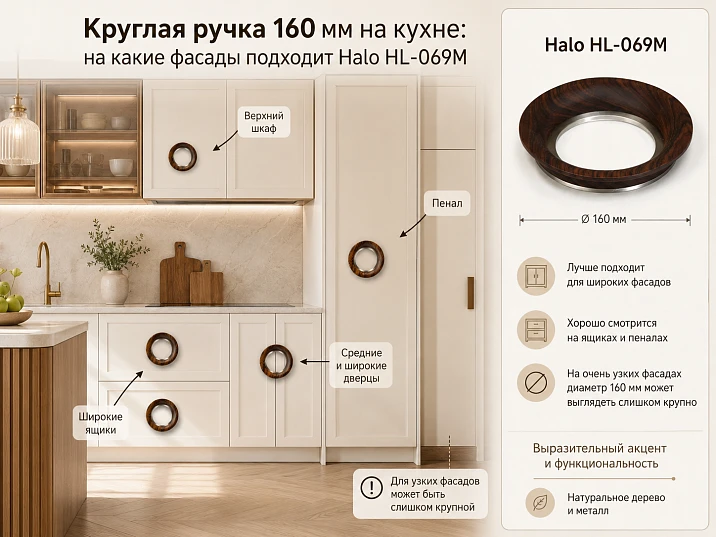
A large circle requires great attention to the facade. The round handle of 160 mm can change a kitchen more than a new countertop or a different wall shade. The reason is simple: the handle is touched every day, and its shape constantly remains in the field of view. But a large circle works convincingly only when the facade is truly able to accept it. On a tall door, the Halo HL-069M looks like an independent decorative sign. On a low drawer, the same circle goes beyond the boundaries, crowds neighboring details, and makes the mistake noticeable even before the first opening.
A buyer who is going to buy the round handle Halo HL-069M for the kitchen, should check not only the fasteners. The external size of the plate is 160 × 160 mm. This circle needs to be applied to the facade in full size, compared with edges, frame, panel, neighboring door, drawer, and the opening trajectory of the corner cabinet. Two holes may formally fit on the door, but the handle itself may not.
The Halo HL-069M cannot be automatically ordered for every facade of a kitchen set. First, the kitchen is divided into groups: tall doors, upper cabinets, lower doors, wide drawers, low drawers, tall cabinets, and corner modules. For each group, the full circle with a diameter of 160 mm is checked. Only then the quantity, wood option, and handle positions are determined.
This approach protects against three costly mistakes. First, a large handle turns out to be wider or taller than the free space. Second, two Halo handles on paired doors visually stick together at the central joint. Third, after drilling, it turns out that the base conflicts with the molding, hinge cup, guide, or old holes. None of these problems is solved by choosing an "approximately suitable" size.
One hundred sixty millimeters is the full visible circle, not a conditional number in the name
A furniture handle has several dimensional levels. The buyer sees the external shape. The craftsman additionally checks the drawing, mounting points, facade thickness, and internal space. These levels must not be mixed.
Halo has a confirmed overall record of 160 × 160 × 22 × 96 mm. For the compositional calculation, the first two numbers are critical: the wooden front overlay occupies a 160 × 160 mm circle on the facade. The value of 96 mm is present in the table as parameter D, but before drilling, it must be read only from the technical drawing. You cannot independently declare D as the center distance, offset, or base diameter.
Practical verification begins with a paper circle with a diameter of 160 mm. It is applied to the door, not mentally compared with the overall width of the cabinet. The template immediately shows:
-
whether the outer contour fits;
-
how much margin remains at the top, bottom, and sides;
-
whether the circle fits too close to the edge;
-
whether it overlaps a molding or panel;
-
whether there is enough room for the hand;
-
do two handles next to each other not collide;
-
does the overlay extend onto the adjacent facade;
-
how a large circle looks from a distance.
There is no universal "correct" field here. Ten millimeters around the circle may be geometrically possible, but visually and technically insufficient. One hundred twenty millimeters on a wide door gives a calm fit, but the handle may get lost if placed without connection to the overall composition. Geometric calculation only answers the question "does it fit." The answer "does it look and work well" appears after a mockup and testing the opening.




What is included in the image of Halo HL-069M
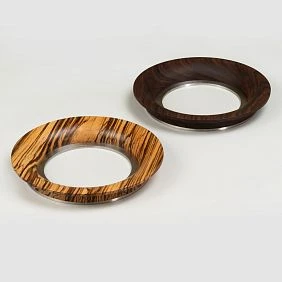
Halo is a large round surface-mounted handle from the Esthete collection. Its front part is made of precious wood, with a round element of satin stainless steel behind it. The wood provides color, texture, and a warm tactile feel; the metal forms a clear graphic boundary and connects the handle with appliances, faucet, sink, or lighting fixtures.
The shape resembles a halo: the wooden plane reads inside the metal circle. Due to this, the handle does not look like an ordinary button, although its silhouette is built around a circle. On a smooth facade, it becomes a full compositional center. On a facade with rich molding or carved decor, competition may arise—then a mockup is checked first, rather than trying to add all expressive elements at once.
| Parameter | Confirmed data | What it means for the buyer |
|---|---|---|
| Model | Halo HL-069M | The full article number must be specified in the order |
| Type | Large round surface-mounted furniture handle | The handle occupies a noticeable area of the facade |
| Size | 160 × 160 × 22 × 96 mm | The outer circle is checked with a 160 × 160 mm template; mounting parameters — per the drawing |
| Front part | Wooden profiled overlay | The wood grain becomes part of the kitchen design |
| Base | Satin stainless steel | The metal needs to be coordinated with the appliances and other hardware |
| Wood options | American walnut, zebrano, wenge, rosewood | Chosen based on the facade color, contrast, and texture character |
| Stylistics | Modern interpretation of art deco | Suitable for kitchens where hardware acts as a decorative accent |
| Finish | Ready-made finish | No separate painting of the wooden insert is required before installation |
| Drawing | Available in the product card and in the downloads section | Drilling is performed according to technical data, not based on a photo |
| Price | Depends on the selected option | Before placing an order, you need to find out the current price of Halo HL-069M |
| Quantity | Calculated based on suitable opening facades | The number of cabinets does not equal the number of handles |
| Fastening | Checked in the card of the selected configuration | You cannot pre-determine the length of screws and the drilling pattern in advance. |
Halo belongs to ready-made handles with a coating. A buyer who values a finished surface without having to paint the wood themselves would benefit from comparing and buying wooden handles with a ready-made coating. But even a ready-made handle does not become universal: the 160 mm size remains the main limitation.
Our factory also produces:
An overlay handle occupies the facade — and this is what distinguishes it from hidden systems
In the category you can buy surface-mounted handles for the kitchen of various shapes and sizes. They are united by a principle: the handle is installed on the front surface and remains a visible part of the composition.
Halo does not try to disappear. It emphasizes the point of contact, creates a large circle, and connects wood with metal. This is a fundamentally different logic than that of profile, edge, or recessed solutions.
Get Consultation
Halo and Gola are different names and different designs
The words "Halo" and "Gola" sound similar, but they denote different products.
Halo HL-069M is a specific surface-mounted round handle. It is visible on the front, has an external size of 160 × 160 mm, and is attached according to the product drawing.
Gola is a profile opening system integrated into the structure of a kitchen cabinet or front. It does not form a round wooden element on the door.
Therefore, queries like "Gola handles for kitchen," "Gola profile handle," and "hidden handle" cannot be used as equivalents to Halo. A buyer who needs a nearly invisible opening line is looking for a different system. Halo is chosen when the handle should be noticeable.
Halo is not a knob handle
A compact knob occupies a small area and suits narrow fronts and light drawers. Halo has a large external circle. Even if the grip method seems similar, the scale and role on the furniture differ.
Halo is not a recessed handle
A recessed model requires a mounting recess in the front and partially goes into its thickness. Halo is installed using a surface-mounted method. The possibility of replacing a recessed handle with Halo depends on the old hole, damage, and the flatness of the front.
Door geometry: how much field remains around the circle
When Halo is placed strictly in the center of a rectangular front, the remainder on each side can be estimated with the formula:
Field = (front size − 160 mm) ÷ 2.
The calculation is performed separately for width and height. It does not set a mounting standard, but shows pure geometry.
Field by door width
| Facade width | Remainder on the left | Right remainder | Preliminary assessment |
|---|---|---|---|
| 160 мм | 0 мм | 0 мм | The circle matches the facade width; practically requires a different solution |
| 180 мм | 10 мм | 10 мм | Formally fits, but the margins are extremely narrow |
| 200 мм | 20 мм | 20 мм | A full-size mockup and edge check are needed |
| 240 мм | 40 мм | 40 мм | The geometry is calmer now, but hardware and frame may interfere |
| 300 мм | 70 мм | 70 мм | The circle reads as a large center |
| 400 мм | 120 мм | 120 мм | Enough space for compositional choice |
| 450 мм | 145 мм | 145 мм | Suitable for an expressive round handle after checking the mounting |
| 600 мм | 220 мм | 220 мм | The wide front allows varying the position |
A width of 180 or 200 mm does not automatically permit installation. You need to check where the metal base is, how the mounting runs, whether drilling weakens the edge, and whether space remains for the hand. On a 160 mm front, the outer circle matches the full width: any error, corner rounding, or protrusion beyond the edge becomes critical.
Field along the facade height
| Front height | Remainder at top and bottom when centering | Conclusion |
|---|---|---|
| 120 мм | Handle extends 40 mm above the facade | Halo does not fit |
| 140 мм | Handle extends 20 mm above the facade | Halo does not fit |
| 160 мм | 0 мм | The circle takes up the full height |
| 180 мм | 10 mm each | Fits formally, but looks cramped |
| 200 мм | 20 mm each | Base, edges, and grip need checking |
| 240 мм | 40 mm each | A large central composition is possible |
| 300 мм | 70 mm each | The handle gets a calmer field |
The table leads to a direct commercial conclusion: a 160 mm handle on a kitchen drawer 120–140 mm high does not physically fit. Buying Halo for the entire set in one quantity without separating facades is not possible.
A small facade can be wide, but still not accept Halo
The buyer often looks only at the width. A wide 800 mm drawer seems suitable for a large handle. But with a height of 140 mm, a 160 mm circle will extend beyond the top and bottom boundaries. Width does not compensate for the lack of height.
Both conditions are used for verification:
Free field width ≥ 160 mm
Free field height ≥ 160 mm
The word "free" is more important here than the word "facade". On a framed door, the full width may be 450 mm, but the inner flat area may be only 150 mm. Halo should not be applied to molding or panel transitions without a separate project.
Example 1. Drawer 800 × 140 mm
In width, the handle fits with a large margin. In height, it does not fit: the outer circle exceeds the facade by 20 mm.
The solution is to choose a more compact model for this series or to abandon Halo on low drawers.
Example 2. Drawer 800 × 200 mm
With vertical centering, 20 mm remains at the top and bottom. Geometrically this is possible, but the circle will occupy most of the height. It is necessary to check whether the handle looks heavier than the entire drawer and whether it is convenient to grip it.
Example 3. Box 800 × 300 mm
70 mm remains at the top and bottom. Halo can work as a central decorative element, especially on a wide smooth facade.
Example 4. Door 300 × 720 mm
70 mm remains on each side in width. The handle fits, but its position does not have to coincide with the geometric center of a tall door. A comfortable grip height and the overall handle line matter more than the formal middle.
Two hinged doors: large circles should remain a pair, not a merged blob
On a double-door cabinet, handles are usually placed near the central seam. With compact models, this is a common scheme. Two Halo handles with a diameter of 160 mm change the scale: adjacent circles can almost touch and turn the center of the kitchen into a heavy double shape.
Before drilling, two paper templates of 160 × 160 mm are needed. One circle does not show the real composition of the pair. The templates are attached to the doors, both leaves are opened, and the distance between the outer contours is assessed.
If the center of each handle is at a distance S from the central seam, the geometric gap between the circles is:
Gap = 2S − 160 mm.
Examples:
| Distance from the seam to the center of each Halo | Gap between the circles | Visual Result |
|---|---|---|
| 80 мм | 0 мм | The circles touch at the joint |
| 90 мм | 20 мм | The pair looks very dense |
| 100 мм | 40 мм | A readable field appears between the handles |
| 120 мм | 80 мм | The circles are perceived as more independent |
| 140 мм | 120 мм | The composition becomes free, but the handles move further from the joint |
This is only geometry, not a ready-made prescription. The allowed position depends on the facade width, mounting scheme, grip comfort, and internal fittings. Nevertheless, the formula quickly shows why two handles cannot be placed according to the usual marking of small brackets.
Doors 300 mm wide
If the Halo center is moved 100 mm from the joint, 200 mm remains to the outer edge of the door. A circle with a radius of 80 mm fits. The gap between the handles will be 40 mm. But the free field on the outer side and the relation to the edges need to be checked with a template.
Doors 400–450 mm wide
More freedom appears here. Handles can be moved away from the joint so they don't merge while remaining comfortable. A wide door particularly benefits from large round elements if the facade is smooth and not overloaded with decor.
Two handles don't have to be at the same height as the drawers
The handle line on hinged doors can be tied to ergonomics, while on drawers it can be tied to the center of each facade. Trying to draw one absolute horizontal line through all elements sometimes makes the tall cabinet uncomfortable or shifts the Halo on a small door. A common system is needed, but not mechanical equality of coordinates.
Checking from a distance matters more than a close-up
Up close, texture and metal are visible. From two to three meters away, the compositional mass becomes clear. Two circles can look neat in a photo of a single door and too heavy on a full set. Therefore, templates are evaluated together with the countertop, appliances, backsplash, and neighboring cabinets.
Corner cabinet: a closed facade doesn't show future collisions
A corner kitchen requires checking in motion. A large overlay handle can fit entirely on the door in the closed position, but when opening, it may meet the neighboring facade, handle, wall, column, or countertop protrusion.
For checking, it's not enough to apply the circle to a flat surface. A three-dimensional mockup needs to be created. A simple option is to cut a circle from thick cardboard and add a spacer corresponding to the actual depth of the product per the drawing. Then the mockup is secured in the intended location and the door is slowly opened to the full working angle.
Four positions are checked:
-
facade closed;
-
door is open at 30–45°;
-
door passes near the adjacent handle;
-
maximum opening angle reached.
At each stage, not only collision is assessed. The hand must freely hold the Halo without being pinched between two facades.
Corner door next to a drawer
If the drawer is extended, the corner door handle may be in its path. The check is performed for all combinations of moving elements that can actually be open simultaneously.
Handle near a wall
A wall or side filler limits the travel. The outer circle may touch the surface before the hinge opens to the design angle. You cannot rely only on the distance from the edge to the wall in the closed position.
Handle next to a refrigerator
The refrigerator door, the protruding appliance handle, and the furniture front form a complex assembly. The Halo must be applied to the overall layout taking into account the actual depth of the equipment.
Tall cabinet: a 160 mm circle becomes the point around which the facade is built
On a tall smooth cabinet, Halo looks especially expressive. The large surface does not crowd the circle, and the wooden insert softens the strict vertical. But the geometric center of the door is almost never a comfortable handle height.
For the cabinet, three lines need to be coordinated:
-
a height comfortable for the hand;
-
handle levels of adjacent cabinets;
-
the compositional center of the specific door.
If the cabinet consists of two independent facades, each requires a separate handle. If the tall facade opens as a whole, one Halo may be sufficient. The count is based on opening parts, not on visual kitchen columns.
Cabinet with built-in appliances
The oven, coffee machine, or refrigerator have their own horizontals. Halo should not accidentally cross them. Sometimes it is better to align the handle with the adjacent door, sometimes with the center of the free furniture zone. The solution is checked on the full layout.
Two Halos on one tall facade
Installing two handles on one door solely for decorative symmetry should not be done without a structural reason. The buyer must understand which element actually opens the facade and how the load is distributed. An extra handle creates additional holes and complicates the composition.
Frame, molding, and panel: the facade size here guarantees nothing
A kitchen door 450 mm wide may seem spacious. But if a molding 50–70 mm wide runs along the perimeter, the inner flat field narrows. A 160 mm circle must be fully located on the surface designed for the handle base.
For a framed facade, record:
-
full width and height;
-
inner field;
-
frame width;
-
plane difference;
-
panel position;
-
thickness of the decorative profile;
-
possible movement of the wooden insert;
-
old holes;
-
fastening zone on the reverse side.
Halo inside the frame
This option looks cohesive if the circle has sufficient margin on all sides. On a narrow panel, the handle may visually press against the molding.
Halo over the transition
The base must not rest partially on the molding and partially on the recessed plane. Poor fit cannot be compensated by tightening the fasteners.
Halo next to the carved overlay
A large round handle is already a strong decorative element. If a carved overlay is present within the same zone, the two accents may compete. Separate them by levels or choose one main motif.
Handle position: center on the facade or on the hand
On a small square facade, the geometric center often works. On a tall door and a wide drawer, the solution is more complex.
Geometric center
Pros: strict symmetry. Cons: on a tall cabinet, the handle may end up too high or too low.
Center of the free field
Molding, panel, or decorative frame is taken into account. This method is usually more accurate for facades with architectural detailing.
Ergonomic height
The handle is installed where it is comfortable to grip. Adjacent facades are linked by a common line, but not necessarily by fully matching centers.
Compositional center of the group
On a series of cabinets, Halo can repeat at the same height, creating a horizontal rhythm. For drawers, the height changes along with the facades, otherwise the handles will end up too close to the edges.
The criterion for correct placement is simple: a person opens the furniture without unnecessary movement, and the circle does not look randomly glued to the surface.
American walnut, zebrano, wenge, or rosewood: four characters of one shape
Halo maintains the same geometry, but the wood changes perception. The choice cannot be reduced to the question of "which option is darker." You need to match the facade, countertop, floor, lighting, and stainless steel.
American walnut
Walnut suits a warm brown palette, natural countertops, and calm beige and gray-beige facades. Its grain creates a soft transition between wood and satin-finished metal. On a very dark door, walnut can be a moderate contrast; on a light one, a noticeable accent.
Zebrano
Zebrano is chosen for its directional striped grain. On a circle, the texture is especially noticeable: the lines cross the closed form and make each handle visually active. For a set, it's important to review in advance how the grain is distributed across multiple pieces.
Wenge
Wenge provides a deep dark accent. This option can support black appliances, dark display cabinets, or contrasting details. On a graphite facade, the circle becomes calmer; on a light one, sharper.
Rosewood
Rosewood is distinguished by a complex warm pattern and can become the main decorative material. It is reasonable to choose it for a kitchen where there are not many competing wood species nearby.
The color and texture of natural wood do not repeat like a printed pattern. For a large kitchen, it is advisable to order handles in one batch, then lay them out before installation and distribute them across the facades. The section helps to assess in detail the processing and features of materials check the quality of wooden handles.
Satin stainless steel: how to match handles with appliances
The Halo metal base has a satin surface character. It doesn't have to exactly replicate every metal item in the kitchen. The goal is to avoid accidental clashes.
Match the handle with:
-
the refrigerator door;
-
the oven;
-
the cooktop;
-
the range hood;
-
the faucet;
-
the sink;
-
the legs of bar stools;
-
the frames of light fixtures;
-
with sockets;
-
with display case profiles.
If the appliances are silver, satin steel usually supports the overall metallic language. But there may be brass lights or a black faucet nearby. In a mixed palette, repetition is needed: stainless steel should appear in at least one more noticeable element or be a deliberate neutral base.
Glossy chrome and satin steel are not the same
Chrome reflects light differently. On a kitchen with mirror-chrome hardware, Halo may look more matte. This is not a mistake if the difference is supported by the appliances or the texture of the facades.
Brass next to Halo
Warm metal and stainless steel can coexist, but a random single combination looks disjointed. Check the entire palette on samples.
Halo as part of the Esthete collection
The Esthete collection combines designer handles where valuable wood species are paired with metal and modern geometry. For a buyer who wants to build not one random detail but a coordinated system, it is useful to buy designer pens from the Esthete collection and compare models by area, shape, and placement method.
In one kitchen, it is not necessary to use only Halo. A large circle can appear on tall cabinets and large doors, while a more compact related model can be used on narrow drawers. But the mixing must be consistent:
-
one collection;
-
identical wood options;
-
common metal;
-
clear division by facade type;
-
repeated height;
-
absence of random single models.
Orion HL-068M: a narrower alternative for facades where the circle does not fit
Orion HL-068M retains a length of 160 mm and the combination of wood with stainless steel, but has an external size of 160 × 80 × 22 × 96 mm. In height, it takes up half the space of the Halo.
| Situation | Halo HL-069M 160 × 160 mm | Orion HL-068M 160 × 80 mm |
|---|---|---|
| Tall smooth door | Expressive circle | More elongated and calmer shape |
| Drawer 140 mm high | Does not fit in height | Fits geometrically, but a mockup is needed |
| Drawer 180 mm high | 10 mm remains on each side | Significantly more free space |
| Narrow panel | May not fit | Requires less height |
| Double doors | Two large circles | Two elongated elements look lighter |
| Pencil case | Strong decorative center | More restrained accent |
Transition to Orion does not mean it fits automatically. The model retains a length of 160 mm, and the mounting parameter is also checked against the drawing. But for low fronts, it is reasonable buy a narrower Orion HL-068M handle instead of trying to place a circle that is physically higher than the drawer.
When mixing Halo and Orion looks logical
-
Halo is used on tall cabinets and large doors;
-
Orion is repeated on all wide low drawers;
-
the wood and metal match;
-
the models belong to the same decorative system;
-
the transition is explained by the size of the fronts;
-
the quantity of each model is counted in a separate line.
When the mixing looks random
-
one Orion is installed only because one Halo was not enough;
-
the wood differs;
-
different models are used on identical facades;
-
the handles are placed at different heights without a system;
-
the shape changes from cabinet to cabinet.
To search for other sizes and shapes, you can select and buy furniture handles after compiling the list of facades.
How many Halo to order: you need to count facades, not cabinets
One kitchen module can have one door, two doors, three drawers, or a combined facade. Therefore, the number of handles is calculated based on the opening elements on which Halo is actually suitable.
The work sheet is built by groups:
| Facade type | Number of facades | Size of each | Template 160 mm fits | Solution | Quantity Halo |
|---|---|---|---|---|---|
| Tall cabinet doors | ___ | ___ × ___ mm | Yes / no | Halo / other model | ___ |
| Upper hinged doors | ___ | ___ × ___ mm | Yes / no | Halo / other model | ___ |
| Lower doors | ___ | ___ × ___ mm | Yes / no | Halo / other model | ___ |
| Wide tall drawers | ___ | ___ × ___ mm | Yes / no | Halo / Orion | ___ |
| Low drawers | ___ | ___ × ___ mm | Usually not | Orion / compact model | 0 or ___ |
| Corner fronts | ___ | ___ × ___ mm | Check in motion | Halo / other model | ___ |
| Fronts with molding | ___ | Field ___ × ___ mm | By free field | Halo / other model | ___ |
Example of kit calculation
Suppose the kitchen includes:
-
2 tall cabinet fronts 450 × 2100 mm;
-
4 lower doors 450 × 720 mm;
-
4 upper doors 450 × 700 mm;
-
2 wide drawers 800 × 300 mm;
-
3 low drawers 800 × 140 mm;
-
1 corner door 400 × 720 mm.
After the layout, the decision was made:
-
for 2 tall cabinets — 2 Halo;
-
for 4 lower doors — 4 Halo;
-
for 4 upper doors — 4 Halo;
-
for 2 tall drawers — 2 Halo;
-
for 3 low drawers — narrower handles;
-
Halo is not installed on the corner door due to a conflict when opening.
Total:
2 + 4 + 4 + 2 = 12 Halo HL-069M handles.
Three low drawers get a separate model. The corner facade — a handle that passes the trajectory check.
Such a set looks more complex than identical handles on all doors, but works better. A unified collection, wood and metal maintain the connection, and the size of each model matches a specific facade.
Is a spare handle needed
For a large kitchen, one extra handle can be a reasonable reserve, especially if the wood is expressive and a single batch matters. But a reserve is not added automatically. First, they assess:
-
availability of the selected option;
-
possibility of reordering;
-
number of handles;
-
risk of damage during installation;
-
need for future replacement;
-
budget;
-
uniformity of wood in the batch.
The spare Halo must be stored in the packaging along with the order data. It cannot be used as a test piece for drilling.
Replacing old handles: the outer ring can hide a defect, but the mounting is still determined by the drawing.
Halo is often considered for updating an existing kitchen. A large cover plate can hide old holes, scuffs, or faded areas. But visual coverage does not mean technical compatibility.
Before purchasing, measure:
-
number of old holes;
-
distance between their centers;
-
diameter of each hole;
-
area of damaged surface;
-
flatness of the facade;
-
thickness of the door;
-
position of the hinge cup;
-
internal reinforcements;
-
direction of the grain or pattern of the facade;
-
possibility of repairing old holes.
Old holes are completely under the circle
This is a good first sign, but not sufficient. New mounting points should not be too close to old ones, weaken the material, or intersect with internal hardware.
One hole extends beyond the 160 mm outline
Halo will not hide the defect. The facade will have to be repaired or a different handle position chosen.
Old holes match the 96 mm parameter
Matching the number proves nothing. The D=96 mm parameter cannot be interpreted independently without the Halo drawing. First, download the technical diagram and check the notations.
The surface around the old handle is pressed in
A large base should not be used to pull together a damaged facade. First, restore the flatness.
Materials for filling, cleaning, and surface preparation can be ordered together with materials for facade installation and repair. The specific composition is chosen based on the door material and coating; a universal putty or adhesive cannot be prescribed without this data.
A drawing before a drill: four numbers on a card do not replace a diagram
The 160 × 160 mm dimension is needed by the designer and the buyer. For installation, a technical drawing is required. It must clearly show:
-
mounting centers;
-
installation direction;
-
shape and size of the metal base;
-
position of the wooden overlay;
-
necessary holes;
-
fastener requirements;
-
depth and protrusion;
-
possible restrictions on facade thickness.
Before drilling, you can download drawings and 3D models of the hardware. The working file is checked specifically against the Halo HL-069M, not against a similar Orion model or another handle from the collection.
Why the 160 mm template is not a drilling template
The paper circle is responsible for the composition. It shows the outer contour but does not transfer mounting points. Drilling requires a separate template built according to the drawing.
Why you cannot drill using a photograph
Perspective and scale distort distances. Even a high-quality photo does not replace a dimensional diagram.
Why the thickness of the facade must be known
The length of the fastening elements depends on the design of the handle and the door. Too short fasteners will not provide the required fit, too long ones may protrude or damage the element. The specific length is determined by the kit and the drawing.
What is behind the facade
On the reverse side may be located:
-
hinge cup;
-
hinge fastener;
-
drawer guide;
-
inner wall;
-
metal frame;
-
glass;
-
reinforcing bar;
-
lifting mechanism.
Marking must account for all internal space.
Hardware for installation: do not buy random screws in advance
The Halo card contains a section related to mounting hardware, but the actual contents of the selected item need to be verified at checkout. The diameter, length, and number of screws cannot be specified in advance without confirmation.
If necessary, you can buy hardware for installing furniture handles, but the category contains various components. The selection is made for a specific Halo construction and facade.
Before payment, ask four precise questions:
-
what is included in the kit of one handle;
-
what facade thickness is the standard fastener designed for;
-
what holes need to be prepared;
-
whether additional hardware is needed for a specific door.
The answers are recorded in the specification. The phrase "standard fastener" is too vague for an expensive handle and a finished facade.
Full-size testing of one handle saves more than buying a batch blindly
For a kitchen with ten, twelve, or twenty handles, it is reasonable to first purchase one Halo or get the opportunity to try the model in a showroom. One real piece shows what the screen does not:
-
actual scale;
-
weight and balance;
-
depth
Dark kitchen with black appliances
Wenge can dissolve into the facade, leaving a noticeable metal halo. Walnut or rosewood will provide a warmer distinction. First, compare samples under real lighting.
Kitchen with wooden facades
A new handle species should either continue the material or create a controlled contrast. Mixing an oak facade, zebrano, walnut countertop, and other wooden flooring requires special care.
Facades made of stone or concrete
A wooden insert softens the cold surface, and steel connects the handle with modern appliances. Here, Halo often looks more convincing than a regular metal bracket, but the size is still checked for each door.
Kitchen in modern art deco
Circle, metal, exotic texture, and strict repetition support the style. Large symmetrical facades, display cases, and tall cabinets work especially well. It's better not to overload small drawers.
Kitchen-living room
Handles are visible from the lounge area, so they are evaluated from a distance. Halo becomes part of the overall interior, not just kitchen hardware. Match it with the coffee table, lighting and living room furniture.
Sideboard next to the kitchen
You can repeat Halo on the sideboard if the facades are comparable in scale. It's not necessary to use the same model on every door: the main thing is a consistent logic.
Commercial interior
In a bar, showroom, or salon, a large handle helps highlight the furniture. But intensive use requires careful maintenance and proper mounting. The number of spare items is determined by the project.
Who Halo HL-069M suits
Consider this model when:
- facades have a sufficient free field;
- the kitchen needs a noticeable overlay handle;
- the large circle matches the scale of the furniture;
- there are smooth doors or wide panels;
- wood should become an accent;
- satin steel supports the interior;
- the buyer is ready to check each group of facades;
- on double doors there remains a sufficient gap;
- corner facades pass the opening test;
- the drawing is studied before drilling;
- handles are ordered as one coordinated batch;
- the kitchen style allows a modern interpretation of art deco.
In which cases is it better to choose a different model
Halo should not be purchased for a specific facade if:
- its height is less than 160 mm;
- the free field inside the molding is smaller than the circle;
- the handle extends beyond the edge;
- two Halos collide or look stuck together;
- the corner door hits the adjacent facade;
- old holes weaken the new mounting;
- the metal base does not fit flush against the surface;
- the handle interferes with the operation of the guide or hinge;
- the kitchen requires the hidden Gola system;
- the customer is looking for a compact button;
- wood conflicts with other species;
- no way to verify the technical drawing;
- a large circle overloads a row of small facades.
Mistakes that make a large round handle not work in the kitchen
Mistake 1. Treating 160 mm as the distance between holes
The external size of Halo is 160 × 160 mm. The parameter D=96 mm is read from the drawing, not called the center distance by eye.
How to avoid: separate the check of the outer contour and the mounting.
Mistake 2. Looking only at the width of the facade
A wide drawer with a height of 140 mm does not accept a circle with a diameter of 160 mm.
How to avoid: measure the free width and height.
Error 3. Ordering Halo for all facades in one line
Low drawers, corner doors, and framed facades require separate solutions.
How to avoid: a list by groups.
Error 4. Trying one handle on a pair of doors
One circle does not show the density of two adjacent Halo elements.
How to avoid: two templates at the same time.
Error 5. Pressing circles to the central joint
The two elements visually merge and make gripping difficult.
How to avoid: calculate the clearance and check by hand.
Error 6. Centering Halo on a tall door
The geometric center of the pencil case may be uncomfortable for a person.
How to avoid: align the ergonomic and compositional height.
Error 7. Ignore the molding
The full door is wide, but the inner field is small.
How to avoid: calculate the free plane.
Mistake 8. Installing the base on a drop
Part of the handle rests on the frame, part on the panel.
How to avoid: ensure a level mounting area.
Mistake 9. Checking the corner cabinet only when closed
When opened, Halo collides with the adjacent element.
How to avoid: a bulky layout and full door travel.
Error 10. Do not open the adjacent drawer during the test
Two moving fronts can conflict in real-world use.
How to avoid: check all permissible opening combinations.
Error 11. Choosing wood from a small photo
Texture and tone are perceived differently on a real sample.
How to avoid: one test handle or material sample.
Error 12. Mixing wood without a system
Walnut, zebrano, wenge, and rosewood start to clash with each other.
How to avoid: one option for the entire set or a clear separation of groups.
Mistake 13. Ordering half of the set later
The natural pattern of a new batch may differ.
How to avoid: order the main volume at the same time.
Error 14. Mistaking satin steel for chrome
Different degrees of gloss disrupt the expected match.
How to avoid: compare real metal samples.
Mistake 15. Confusing Halo and Gola
The buyer expects a hidden system but gets a large surface-mounted handle.
How to avoid: determine the opening type before choosing a model.
Error 16. Calling Halo a button
The scale and contact area are completely different.
How to avoid: use the exact designation "large round surface-mounted handle".
Error 17. Drilling using a paper circle
The drilling template does not contain confirmed mounting points.
How to avoid: a separate drilling template based on the drawing.
Mistake 18. Drilling using a drawing of a similar Orion
Models have different external shapes and may differ in the layout of parts.
How to avoid: a file with the exact article number HL-069M.
Error 19. Not measuring the thickness of the facade
The fasteners may turn out to be unsuitable.
How to avoid: match the door panel with the handle configuration.
Error 20. Not checking the reverse side
The hole falls into the hinge cup or guide rail.
How to avoid: use a double-sided drawing of the facade.
Error 21. Using Halo to tighten a damaged door
A large base does not repair cracks or deformation.
How to avoid: restore the facade before installation.
Error 22. Assuming the circle will hide any old holes
The defect may extend beyond the outer contour or weaken new points.
How to avoid: precise damage map.
Error 23. Buying random screws in advance
The completeness and required length are unknown.
How to avoid: check the card and drawing.
Error 24. Installing the handle too close to the edge
The circle formally fits, but the mounting and grip become risky.
How to avoid: mockup and technical check.
Error 25. Placing Halo on a 160 mm high drawer
The circle takes up the entire height and leaves no visual field.
How to avoid: consider a narrower model.
Error 26. Using different handles on identical facades
The kitchen looks assembled from leftovers.
How to avoid: one model per group.
Error 27. Mixing Halo and Orion without a repeatable rule
The transition seems random.
How to avoid: Halo on doors, Orion on low drawers — or another clear scheme.
Error 28. Not testing the handle with wet or occupied hands
A beautiful mockup doesn't show the real grip.
How to avoid: physical testing at working height.
Error 29. Placing Halo next to protruding appliances
The door doesn't open fully.
How to avoid: general layout of furniture and equipment.
Error 30. Not separating the kitchen from the living room
Large circles create an unwanted visual rhythm at a distance.
How to avoid: photos of the layout from key viewpoints.
Mistake 31. Placing a handle over rich decor
Two strong elements compete.
How to avoid: define the main accent.
Mistake 32. Ignoring the zebrano pattern between products
The stripes on adjacent doors look inconsistent.
How to avoid: lay out the set before installation.
Error 33. Wiping the coating with an abrasive
Wooden and metal surfaces may lose their neat appearance.
How to avoid: follow care recommendations and use mild products.
Error 34. Not checking the product upon receipt
The difference in the wood variant is discovered after drilling.
How to avoid: verify the article number, quantity, material, and packaging condition.
Error 35. Arranging delivery in parts without necessity
The set is distributed between batches, increasing costs and the risk of differences.
How to avoid: order handles for the entire kitchen in one shipment.
Checklist before payment
The buyer should have not a general photo of the kitchen, but a small package of precise data.
Check What should be ready List of facades Each door and each drawer counted separately Dimensions Width and height of the free field Templates Circles 160 × 160 mm fixed on all types of facades Double doors Two circles and the gap between them checked Corner cabinet Full opening check passed Frame facades The base is placed on one plane Old holes Applied to the drawing with the reverse side Technical file Drawing Halo HL-069M downloaded Facade thickness Measured for fastener selection Wood variant Selected for the entire set Metal Matched with equipment and lighting fixtures Quantity Calculated based on suitable facades Alternative For low drawers, Orion or another model was chosen Package contents It is clarified what is included in one item Delivery The main batch is ordered simultaneously How to buy Halo HL-069M on STAVROS without altering facades
The buyer's journey starts not with the cart button, but with the layout.
Step 1. Print a 160 mm circle
Make several templates to see a pair of handles and a row of facades.
Step 2. Divide the kitchen into groups
Separately mark doors, wide drawers, low drawers, tall cabinets, and corner modules.
Step 3. Check the free field
Measure the surface inside the molding or frame, not just the full facade.
Step 4. Open all furniture
The trajectory, adjacent handles, and finger space are being tested.
Step 5. Choose the wood
Match American walnut, zebrano, wenge, and rosewood with facades and light.
Step 6. Download the technical drawing
Do not decipher parameter D on your own.
Step 7. Count the quantity
Halo is added only to suitable opening facades.
Step 8. Choose an alternative
Orion or another handle covers low and narrow groups.
Step 9. Specify the completeness
Check the fasteners and their compliance with the door thickness.
Step 10. Order in one batch
This makes it easier to distribute the natural wood grain and avoid repeated delivery.
After checking, you can order Halo HL-069M for kitchen fronts. Shipping conditions for regions are posted on the page where you can order delivery of furniture handles across Russia.
Frequently asked questions about Halo HL-069M in the kitchen
What is the external size of Halo HL-069M?
Confirmed specification — 160 × 160 × 22 × 96 mm. For visual inspection, a circle of 160 × 160 mm is used.
Is 160 mm the center-to-center distance?
No. These are the outer dimensions of the round shape. The mounting scheme must be read from the drawing.
Can the 96 mm parameter be considered center-to-center?
Not on your own. In the table, this is parameter D. Its meaning is confirmed by the technical drawing of the specific product.
What is the minimum facade width that Halo fits on?
Purely geometrically, the circle fits at a width from 160 mm, but the lack of margins makes such placement impractical. A real choice requires more free space and checking the mounting.
Will Halo fit a door 200 mm wide?
When centered, 20 mm will remain on each side. A mockup, drawing, and edge check are needed. Such a facade cannot be automatically considered suitable.
Will the handle fit a door 300 mm wide?
70 mm remains on each side in width. Then check the height, molding, mounting, and convenience.
Can Halo be installed on a 140 mm high drawer?
No. The 160 mm circle is physically 20 mm taller than the front.
What happens on a box 160 mm high?
The outer shape occupies the full height without top and bottom margins. For most projects, it is more reasonable to choose a narrower model.
At what box height does Halo look more spacious?
At 240 mm, there are 40 mm left at the top and bottom; at 300 mm, 70 mm each. These are geometric values, not a standard.
Can two Halo handles be installed on paired doors?
Yes, if the circles fit completely, there is a suitable gap between them, and both doors open conveniently.
How to calculate the distance between two circles?
If the center of each handle is at distance S from the joint, the gap equals 2S − 160 mm.
Do I need to make two templates?
Yes. One template does not show the actual density of the pair.
Is Halo suitable for a corner cabinet?
Only after checking the full travel of the doors and adjacent fronts. The closed position is not sufficient.
Can Halo be installed on a tall pantry cabinet?
Yes. On a large smooth surface, the handle can become a strong accent, but the height is determined by convenience and the overall kitchen line.
Is Halo suitable for a framed front?
It is suitable when the entire mounting area is on a single plane and the circle fits within the free field.
Can the base be partially installed on molding?
Without a specially designed joint, it should not be done. Poor fit creates a risk of misalignment.
Does Halo hide old holes?
It can hide them visually if they are within the circle. The new mounting is still checked separately.
What to do if the old hole extends beyond the edge of the handle?
The facade is repaired, or the position and model are changed. Halo will not completely cover the defect.
Is the mounting hardware included in the kit?
The completeness should be checked in the card of the selected item. Screws and their length cannot be predetermined.
How to choose fasteners for a thick facade?
Match the door thickness, handle design, and technical requirements. If necessary, select confirmed hardware.
What wood options are available?
American walnut, zebrano, wenge, and rosewood.
Which option should be chosen for a light kitchen?
This depends on the desired contrast. Walnut and rosewood provide a warm accent, wenge is darker, zebrano has an active striped pattern. The decision is made based on a real sample.
What to choose for dark facades?
Wenge can look more restrained, while walnut, zebrano, or rosewood can be more contrasting. Lighting can change the impression.
Should handles be ordered in one batch?
Preferably, especially for a large kitchen. Natural wood has differences in grain and tone.
Can different wood options be used in one kitchen?
Technically possible, but without a clear compositional reason, the set looks random. For one unit, a single option is safer.
How to combine satin steel with brass?
A repeatable palette is needed. A single steel piece among fully brass hardware can look out of place.
Is Halo a Gola handle?
No. Halo is a round knob handle, Gola is a profile opening system.
Does Halo belong to knob handles?
By scale and design, it is more correctly considered as a large overlay designer handle, rather than a compact button.
What can replace Halo on a low drawer?
You can consider the Orion HL-068M measuring 160 × 80 mm or another more compact model.
Can Halo and Orion be combined?
Yes, when Halo is repeated on large doors, and Orion on all low drawers, with the same wood and metal.
How to calculate the number of handles?
Count all opening fronts, check each type with a template, and add only matching positions.
Do blind panels need to be counted?
No, if they do not open and do not need a handle. Decorative installation is considered separately.
Is one spare Halo needed?
For a large batch, this may be reasonable, but the decision depends on availability, budget, and the possibility of reordering.
Can I drill through a printed photo?
No. The photo distorts the scale. Use the official drawing.
Where can I get the Halo drawing?
In the product card and in the STAVROS catalog and drawings section.
Do I need to check the handle from the back side of the facade?
Yes. There may be hinges, guides, reinforcements, and other parts.
Can Halo be installed on a glass door?
The possibility depends on the glass design, holes, and mounting. Without a confirmed assembly, such installation cannot be promised.
Will Halo fit a ready painted kitchen?
Yes, if the facade is not damaged, the dimensions fit, old holes are accounted for, and the mounting is compatible.
How to care for a combination of wood and steel?
Use a soft cloth and products compatible with the finished coating. Abrasives and aggressive compounds should not be used without recommendation.
Where can I see other models?
In the general catalog of furniture handles and in the section of handles with coating.
How to find out the current price?
Select the wood option in the Halo HL-069M card. The price may vary by finish.
Is there Contact us to confirm shipping to your destination.?
Yes. Specific conditions, terms, and cost depend on the region and the order.
A large circle requires great attention to the facade
Halo HL-069M is not bought just to add another handle. It is chosen as a prominent kitchen element: the wooden circle, satin-finished metal base, and art-deco character form a standalone image. That is why size cannot be treated as a secondary number.
Before ordering, check the full contour of 160 × 160 mm, not just the future holes. A low drawer of 140 mm will not accept Halo. On a facade of 180–200 mm, the circle formally fits, but too little margin remains. Paired doors require two templates and calculation of the gap. A corner cabinet must be checked in motion. Molding and paneling reduce the mounting surface. The parameter D=96 mm is only readable from the drawing.
The right set may consist of more than one model. Halo suits tall cabinets, wide doors, and high drawers. For a low row, you can choose Orion HL-068M or another compact handle. Unity is maintained through wood, metal, collection, and a repeatable distribution rule.
STAVROS company allows you to assemble such an order sequentially: compare Halo and Orion, choose American walnut, zebrano, wenge or rosewood, download drawings, clarify fasteners, add materials for facade preparation and arrange delivery of the entire batch. The result depends not on the number of identical circles, but on the precision with which each handle is matched to its facade.