Article Contents:
- Flexible slat panel PAN-001 1010×8 mm: what exactly are we buying for the column
- PAN-001 made of MDF
- Primed slat panel PAN-001
- Wooden PAN-001 made of beech
- Oak slat panel PAN-001
- Why the width of 1010 mm determines the circumference, and the length of 2400/2670 mm determines the height
- Why this is only preliminary arithmetic
- Design Ø300 and actual Ø300 are not always the same thing
- Why it's better to measure the circumference with a flexible tape measure
- The column may turn out to be oval
- What the 8 mm depth actually changes
- Why it's still useful to understand the outer diameter
- Practical conclusion
- If the actual circumference is significantly less than 1010 mm
- If only a small extreme reserve remains
- If a beautiful slat rhythm requires removing the edge of the panel
- If the column changes diameter along its height
- If one PAN-001 only passes "to zero"
- Width reserve is not automatically waste
- The column area can be small
- The full rotation is decisive
- The width of the initial module 1010 mm is more important than m²
- Height is calculated separately
- From the wall side
- From the furniture side
- On the input axis — usually the most visible position
- The column is visible from 360° — the position is chosen based on light
- Why the joint must be assigned before longitudinal trimming
- The edge must account for the actual slat rhythm
- Two mathematically equal trims can produce unattractive edge elements
- First, the joint and the whole edge slat are determined
- Only then are the cut lines assigned
- Apply the sample to the actual column
- Check the bend of the selected material
- View the distance between slats on the arc
- Check the side light
- Compare MDF, beech, and oak
- Why is the sample cheaper than the second full-size panel
- PAN-001 MDF 2670 mm for a tall column
- Covering finish
- Ability to get a solid vertical section
- Why the column height is still measured separately
- Oak PAN-001 2400 mm
- Beech PAN-001 2400 mm
- What to do with a column taller than 2400 mm
- Why a horizontal joint can change the entire material choice
- By width
- By height
- Two diameters instead of one
- Better to measure the actual circumference
- Several measurements along the height
- Why buying one PAN-001 per drawing is risky
- Why a seam can become wedge-shaped
- What to do
- One panel mathematically covers the column
- The second one is purchased only with justified risk
- The reserve will be useful for repairs or another area
- When a sample is cheaper than buying a second full-size module
- What the table shows
- Why you can't set a universal "red line"
- Step 1. Measure the actual circumference
- Step 2. Cut a strip 1010 mm wide
- Step 3. Mark the conditional boundaries of the slats
- Step 4. Wrap the column
- Step 5. Check several shift options
- Step 6. Only after this, transfer the solution to the real material
- From the corridor
- From the room
- In an open space
- Front light
- Side lighting
- Overhead Lighting
- Bottom lighting
- Question 1. Is the column completely finished?
- Question 2. Has the actual maximum circumference been measured?
- Question 3. Is the maximum circumference less than 1010 mm with a real margin?
- Question 4. Do the beautiful edge and seam location fit within the remainder?
- Question 5. Does the selected material sample work normally on the column?
- Question 6. Does the SKU length cover the height?
- Question 7. Is there a reason to buy a second module as a spare?
- Error 1. Use only the design diameter
- Error 2. Calculate only one diameter in the center
- Error 3. Automatically add 16 mm to the diameter
- Error 4. Divide the remainder of 67.5 mm in half
- Error 5. Place the joint on the most visible side
- Error 6. Buy a second module instead of a sample
- Mistake 7. Forgetting about height
- Mistake 8. Considering MDF, beech, and oak completely interchangeable
- Mistake 9. Not accounting for the horizontal joint on a 2600-mm column
- Mistake 10. Considering the column area as the main criterion
- Mistake 11. Cutting real material without a paper template
- Mistake 12. Not saving the remainder
- Will PAN-001 with a width of 1010 mm be enough for a column Ø300 mm?
- What is the circumference of a column with a diameter of 300 mm?
- How many millimeters will remain from PAN-001 after a full rotation?
- Do I need to account for the 8 mm thickness of PAN-001 when calculating the circumference?
- Can PAN-001 be wrapped around a column?
- How do I check the radius before ordering?
- What is OPAN-001 used for?
- Where is the best place to position the vertical joint?
- Can a joint be made on the invisible side of the column?
- What to do if the column is oval?
- What to do if the diameter varies with height?
- Which PAN-001 should I choose — MDF, beech, or oak?
- What lengths of PAN-001 are available?
- How many PAN-001 are needed for a column 2600 mm high?
- Do I need to buy a second panel as a spare?
- Where can I buy the flexible slat panel PAN-001?
- How can I order PAN-001 with delivery?
- Can I buy only one PAN-001?
- What should I do if the actual circumference is 1000 mm?
- What should I do if the circumference is 1015 mm?
- Do I need to take two panels if the column is Ø305 mm?
- Can I cut off the remainder equally from both sides?
- What is more important — perfect seam symmetry or intact edge slats?
- Do I need to calculate the square meters of the column?
- Can a short PAN-001 740 mm be used on a column?
- When is PAN-001 950 mm better?
- What to choose for a 2600 mm column — MDF or oak?
- Can I buy the panel first and decide later where the seam will be?
- Do I need to check the top and bottom of the column separately?
- How to check the current price of PAN-001?
- Can I order samples of all three materials?
- When two panels are economically justified
- When two panels look like overpayment
- Narrow longitudinal remainder
- Remainder by length
- Why remainders need to be labeled
- One main module + neat addition
- Two more uniform sectors
- Joint in architectural axes
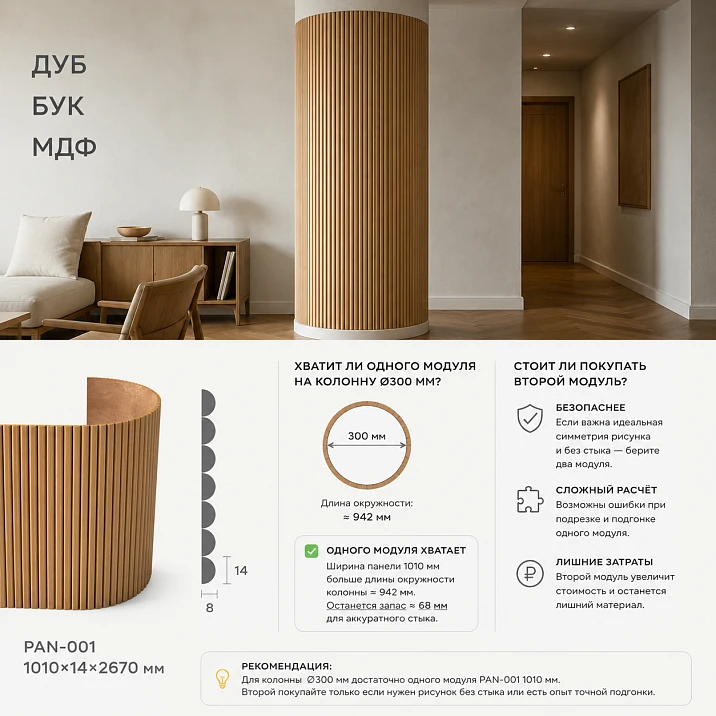
The column is already ready. Plastering is finished, the surface is leveled, the diameter per project is 300 mm. For finishing, a flexible slat panel PAN-001 with a width of 1010 mm was chosen. On the calculator, everything looks almost perfect: the circumference of a round column with a diameter of 300 mm is approximately 942.5 mm, and the width of one PAN-001 is 1010 mm. Nominally, about 67.5 mm remains.
On paper, the conclusion is simple: one panel should be enough.
But 67.5 mm of mathematical remainder does not yet prove that one PAN-001 can be confidently paid for without checking. The design Ø300 mm and the actual finished column may differ. Plastering can give slight ovality. The diameter at the top and bottom may be different. The real vertical joint needs to be placed in a meaningful place. The edge of PAN-001 cannot be cut like a smooth sheet without considering the rhythm of the slats. And the selected material — MDF, beech, or oak — needs to be physically checked on the specific column, because the source data does not have a confirmed universal minimum radius for all versions of PAN-001.
Therefore, the main question of the article is not "how to calculate the circumference," but when one PAN-001 is truly enough and when a second full-size panel is a justified reserve, not an expensive over-insurance.
The basic arithmetic looks like this:
C = π × D
For D = 300 mm:
C ≈ 3.1416 × 300 ≈ 942.5 mm.
Width of PAN-001:
1010 mm.
Nominal remainder:
1010 − 942.5 ≈ 67.5 mm.
If the actual circumference of the finished column is indeed close to 942–943 mm, if the rhythm of the edge slat allows forming a neat seam, and if the sample shows that the chosen execution wraps the real surface normally, one panel in width may be sufficient.
But buying a second one just because “68 mm is a small margin” is also wrong. A second PAN-001 makes sense when there is a specific reason: the actual circumference almost uses up the entire width, the column is noticeably oval or widens with height, a beautiful vertical seam requires cutting off a significant part of the edge rhythm, or the second module is needed as a real repair reserve or for another area of the object.
That is, the decision is not made by the formula “Ø300 = one panel”, but by the sequence:
-
measure the actual circumference of the finished column;
-
repeat the measurement at the bottom, center, and top;
-
determine the location of the vertical seam;
-
check which outermost rail should remain intact;
-
verify the actual bend on the OPAN-001 sample;
-
select the material;
-
compare the column height with lengths of 2400/2670 mm;
-
only after this decide whether to buy one PAN-001 or two.
If these checks have already been done, you can buy slatted panel PAN-001 in the calculated configuration. If Ø300 mm currently exists only in the drawing, and no one has measured the finished circle, one panel remains a mathematical hypothesis rather than a ready specification.
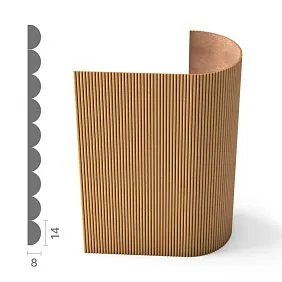
Flexible slat panel PAN-001 1010×8 mm: what exactly we are buying for the column
For calculating a round column, two independent dimensions are important for PAN-001.
The width of 1010 mm accounts for a full revolution around the column.
The length of 740, 950, 2400, or 2670 mm accounts for the height of the area being clad.
These two dimensions cannot be mixed. One panel can perfectly cover the circumference, but fall short in height. And vice versa: a long format can cover a column from floor to ceiling, but the actual full rotation needs to be checked in width.
According to the current card, as reflected in the plan, PAN-001 has a width of 1010 mm and a thickness of 8 mm. Short and full-size versions are available in MDF, beech, and oak. At the time of verification, the following were recorded in the plan, for example:
-
MDF 1010×8×740 mm — 7,560 ₽;
-
MDF 1010×8×950 mm — 9,700 ₽;
-
MDF 1010×8×2670 mm — 24,660 ₽;
-
beech and oak — in short format 950 mm and full-size 2400 mm.
Prices change, so in the article they are used only as a reference as of the verification date. Before ordering, the card must be reopened.




PAN-001 made of MDF
MDF makes sense when a covering paint is needed or when the column should become part of the overall color architecture of the room.
For a conditional column with a height of 2600 mm, the long MDF 2670 mm is especially interesting: it nominally covers the height with one vertical fragment.
But "2670 is greater than 2600" does not yet mean a ready cut. The top and bottom trimming, the actual height around the perimeter, the finished floor, and the ceiling must be taken into account.
In width, MDF remains the same PAN-001 1010 mm. Therefore, for Ø300 mm, the basic calculation of a full rotation does not depend on length.
Our factory also produces:
Primed slat panel PAN-001
The plan separately provides for a primed version. For the article, it is important not to turn this section into a comparison of primed and regular MDF in general.
In the context of a column, choosing a primed version makes sense only after solving two main tasks:
-
whether one panel is enough around the circumference;
-
whether the selected length is enough in height.
If these issues are not resolved, discussing preparation for painting is premature.
Get Consultation
Wooden PAN-001 made of beech
Beech provides a natural material and a different visual character of the vertical seam. If the texture remains visible, the joint becomes part of the composition.
In width, one beech PAN-001 still has 1010 mm. But the full-size version in the plan is 2400 mm, and for a column above this mark, an additional task in height appears.
Oak slat panel PAN-001
Oak is the most expressive option for natural finishing. It is especially sensitive to an unsuccessful vertical joint: the difference in the pattern of two edges can be more noticeable than on painted MDF.
Therefore, in oak, the decision of "one or two panels" cannot be made based only on the circumference. If one panel fits with minimal leftover, but a beautiful completion of the rhythm requires a different cutting line, the width allowance may be nearly exhausted.
Why the width of 1010 mm handles the circumference, while the length of 2400/2670 mm handles the height
This is the main specification rule.
For a round column, two calculations are needed:
Calculation A — by width: whether 1010 mm is enough for a full turn.
Calculation B — by height: whether 2400 or 2670 mm is enough for the finished height of the column.
The product is ordered only after both of these conditions are met.
Column Ø300 mm: what is the actual development for PAN-001
The mathematical circumference of an ideal cylinder is calculated by the formula:
C = π × D
For D = 300 mm:
C ≈ 3.14159265 × 300 ≈ 942.48 mm.
Can be rounded to 942.5 mm.
The width of PAN-001 is 1010 mm.
Nominal remainder:
1010 − 942.5 = 67.5 mm.
That is, one PAN-001 theoretically covers an ideal column Ø300 mm and leaves about 67–68 mm of width margin.
Why this is only preliminary arithmetic
The formula only knows the ideal diameter.
It does not know:
-
how the column is actually plastered;
-
is there ovality;
-
is the diameter the same along the height;
-
how is the rhythm of the battens positioned relative to the seam;
-
how much needs to be removed for a beautiful edge batten;
-
how does the selected material behave on the actual radius;
-
where the vertical joint will be located.
Therefore, 67.5 mm is a budget for real fitting, not guaranteed waste.
Design Ø300 and actual Ø300 are not always the same thing
The drawing may show Ø300 mm, but after plastering the actual diameter may become larger or smaller.
If the actual diameter is, for example, 305 mm:
C ≈ 3.1416 × 305 ≈ 958.2 mm.
Remainder:
1010 − 958.2 ≈ 51.8 mm.
If the diameter is 310 mm:
C ≈ 973.9 mm.
Remainder:
1010 − 973.9 ≈ 36.1 mm.
If the actual diameter is 318 mm:
C ≈ 999.0 mm.
Remainder:
1010 − 999.0 ≈ 11.0 mm.
This is already a completely different level of risk.
At 300 mm, a margin of about 67.5 mm looks comfortable on paper.
At 318 mm, one panel still mathematically 'fits', but in practice, a neat edge and seam may require more material than remains.
Why it's better to measure the circumference with a flexible tape measure
If the column is truly round, you can measure the diameter and calculate the circumference.
But it's more practical to measure the finished circumference itself with a flexible tape measure or another suitable measuring tool.
This immediately accounts for:
-
the actual plaster;
-
slight ovality;
-
local deviations.
The key is not to over-tighten the tape and not to leave it hanging loosely.
The column may turn out to be oval.
An oval column is not described by a single diameter.
You can measure two mutually perpendicular dimensions, but for purchasing PAN-001 it is even more useful to take several actual full circumference measurements along the height.
If the bottom is 948 mm, the center is 954 mm, and the top is 945 mm, buying based on the nominal 942.5 mm is already incorrect.
For one panel 1010 mm wide, the maximum actual circumference matters, not the average value.
Do I need to add the 8 mm thickness of PAN-001 to the column diameter?
This is one of the most common logical temptations.
The buyer sees:
-
column Ø300 mm;
-
PAN-001 with a thickness of 8 mm;
and calculates:
(300 + 8 + 8) × π = 316 × π ≈ 992.7 mm.
After this, it seems that the allowance decreases from 67.5 to approximately 17 mm.
For the purchase width, such automatic recalculation is incorrect.
PAN-001 wraps around the surface of the mounting base with its flexible backing. Therefore, the first measurement for cutting by width is the actual length of the surface to which the panel is applied, that is, the actual circumference of the finished column.
The 8 mm thickness affects the external relief of the already installed cladding, but this does not mean that the fabric backing must go around the circumference of the outer surface of the slats.
What the 8 mm depth actually changes
Thickness affects:
-
the outer diameter of the finished decorative column;
-
the geometry of shadows;
-
the visual opening of the gaps between slats;
-
the appearance of the vertical seam;
-
mating with the floor and ceiling;
-
adjacent to the baseboard or other elements.
Why it's still useful to understand the outer diameter
After cladding, the outermost point of the relief will be farther from the center than the plaster.
This is important if nearby:
-
furniture;
-
door;
-
glass partition;
-
built-in element;
-
narrow passage.
But for the question "is 1010 mm of base enough for a full turn," the initial measurement remains the mounting surface.
Practical conclusion
There's no need to artificially consume the entire 67.5 mm allowance with a formula (300+16)×π.
First, measure the actual circumference of the base. Then physically check the sample and the real rhythm on the arc.
Buy one PAN-001 or two: where the boundary of a safe decision lies
The source data does not contain a confirmed universal rule of the form:
if the margin is more than 30 mm — buy one, if less — buy two.
Therefore, the decision is based on a combination of factors.
If the actual circumference is significantly less than 1010 mm
Suppose the measurement gives 945 mm.
Stock:
1010 − 945 = 65 mm.
If the sample shows a normal bend, the edge rail forms nicely, the seam location is assigned, and the height is covered by the selected SKU, one panel seems like a logical order.
If only a small edge reserve remains
Let's say the maximum rotation for the column is 995 mm.
Stock:
15 mm.
Mathematically, one PAN-001 fits.
But 15 mm may not be enough to choose a beautiful trim line according to the rack rhythm.
Here, the physical mockup is especially important.
If a beautiful rack rhythm requires removing the edge of the panel
Suppose the real seam is better placed not at the very edge of the factory module, but by cutting off part of the outer profile.
Then the nominal 67.5 mm decreases.
For example, after choosing a beautiful edge, you need to remove 22 mm.
Working margin:
67.5 − 22 = 45.5 mm.
If the other side also requires adjustment, the margin decreases further.
If the column changes diameter along its height
One rectangular piece of PAN-001 must cover the entire section.
If the top circumference is 940 mm and the bottom is 1002 mm, the lower value determines the required width.
And here the trimming may end up wedge-shaped.
If one PAN-001 fits only "exactly"
This is a bad moment for optimistic purchasing.
A panel that mathematically fits without a technological allowance for a real joint turns any minor base defect into a problem.
In that case, a second module or a sample before purchase becomes more justified.
Width reserve is not automatically waste
67.5 mm are needed not just to be thrown away later.
They can be used for:
-
selecting the position of the seam;
-
preserving the whole edge strip;
-
compensating for the actual diameter;
-
trimming to the true vertical;
-
minor correction of ovality.
Therefore, the main question is how much of these 67.5 mm will actually remain after designing the seam.
Buy slat wall panels: why a column cannot be counted in square meters
If a person is going to Buy slatted panels for walls, habitually calculate the surface area.
For a column, this is useful for estimating the volume of finishing, but not enough for purchasing PAN-001.
The column area may be small
For a cylinder Ø300 mm and a height of, for example, 2600 mm, the lateral surface area is:
0.9425 m × 2.6 m ≈ 2.45 m².
At first glance, this seems like a small volume.
But PAN-001 is not purchased as an endless strip by square meter.
The key limitation for a full revolution is the width of the original module, 1010 mm.
The full revolution is decisive
If the circumference exceeds 1010 mm, one panel in width is no longer enough regardless of the total area.
If the circumference is less than 1010 mm, one panel may be sufficient in width even with a large height — but then the length becomes a separate issue.
The width of the source module 1010 mm is more important than m²
For Ø300 mm, one panel mathematically closes the circle.
For Ø350 mm:
C ≈ 1099.6 mm.
One PAN-001 no longer covers a full rotation.
This shows why area is not the main criterion.
Height is calculated separately
A conditional column of 2300 mm can be covered by a wooden PAN-001 of 2400 mm with one vertical fragment.
A column of 2600 mm — no longer.
That is, a commercial order is determined by two boundary dimensions at once.
PAN-001 on a round column: where to place one vertical joint
If one panel is enough, there will be one main vertical seam on the column.
Its location needs to be determined before longitudinal trimming, because the distribution of the width allowance depends on it.
On the wall side
If the column is close to the wall and one side is barely visible, it makes sense to move the seam there.
This does not mean the joint can be made carelessly. It just has a lower visual priority.
On the furniture side
If there is a tall cabinet or shelving unit nearby, the seam can be placed in a less visible area.
But future furniture rearrangement needs to be taken into account.
On the entrance axis — usually the most visible position
If a person enters a room and immediately looks at a column, the vertical seam along the central visual axis will be perceived more strongly.
Therefore, they usually try to shift it.
The column is visible from 360° — the position is chosen based on light.
In an open space, there may be no hidden side.
Then they check:
-
the direction of the window;
-
track lighting;
-
the main routes of people;
-
Furniture placement.
On natural oak, light along the seam can emphasize it more strongly.
Why the joint should be assigned before longitudinal trimming
If you first cut off the "extra 67.5 mm" and then look for the seam location, you may find that the edge profile turned out unattractive.
The correct order is the reverse:
-
assign the seam;
-
determine which slat element should be the leftmost;
-
determine which one should be on the right;
-
only then draw the cutting lines.
Remainder of 68 mm: why you can't automatically cut 34 mm from both sides
Pure mathematics suggests a symmetric solution:
67.5 / 2 ≈ 33.8 mm.
It seems logical to remove about 34 mm from both edges.
But PAN-001 is not a smooth sheet.
It has a repeating slat rhythm. Therefore, two equal geometric trims can result in visually unequal edges.
The edge must account for the real slat rhythm.
If on one side the cut line passes between slats, and on the other it crosses the profile itself, the seam will look bad.
Therefore, mathematical symmetry yields to rhythmic symmetry.
Two mathematically equal trims can produce unattractive edge elements.
Suppose 34 mm on each side leaves two "halves" of the edge slats.
From a width perspective, everything is perfect.
From a design perspective, two trimmed elements meet in one vertical seam.
This is the worst-case scenario.
First, the joint and the whole edge slat are determined.
It's better to choose how the edge should look.
For example:
-
the full edge profile remains on the left;
-
the main cut is made on the right;
-
Or vice versa.
then the remainder of 67.5 mm is distributed not symmetrically, but functionally.
only then are the cutting lines assigned
the actual panel must first "sit" on the column in the layout.
after that, mark:
-
the first edge;
-
full rotation;
-
the second edge;
-
the connection point.
And only then they cut.
Sample OPAN-001: how to check the column before buying a full-size PAN-001
For the "one or two" decision, the sample is especially useful.
You can Order a sample of slatted panel OPAN-001 and check the real column before buying a full-size module.
According to the plan, OPAN-001 has dimensions of 196×8×310 mm and is available in MDF, beech, and oak.
Apply the sample to the real column
The main test is physical contact.
The sample shows:
-
how easily the material follows the arc;
-
how the distance between the slats changes;
-
What does the external relief look like?
-
Is there a feeling of excessive opening?
Check the bend of the selected material
You cannot automatically transfer the feeling from MDF to oak or beech.
If a specific material is chosen, test its sample specifically.
Look at the distance between the slats on the arc
When bending, the external geometry changes.
The slats on the outer side of the arc may visually diverge differently than on a flat wall.
This needs to be seen in person.
Check the side light
On a round surface, the shadow changes along the entire arc.
The same profile from the front can look soft, but from the side — significantly more pronounced.
Compare MDF, beech, and oak
If the material hasn't been chosen yet, samples allow you to compare not only color but also behavior on a specific column.
Why a sample is cheaper than a second full-size panel
If the doubt is only about the radius and seam, buying a second full module "just in case" is not rational.
A physical sample solves the main question at a much lower cost.
Buy MDF slat panels: when one PAN-001 is especially convenient for a column
If you need buy MDF slatted panels For a round column, MDF has a strong advantage in length.
PAN-001 MDF 2670 mm for a tall column
For a conditional column with a height of 2600 mm:
2670 − 2600 = 70 mm of nominal length allowance.
This allows obtaining one vertical fragment without a horizontal joint, if the finished floor levels are confirmed.
Cladding finish
MDF is convenient when the column needs to be painted.
The joint can be incorporated into the overall color scheme.
But painting does not fix poor cutting.
Possibility to obtain a single vertical section
If two conditions are met simultaneously:
-
one panel is sufficient around the circumference;
-
2670 mm is enough in height;
then one full-size PAN-001 can theoretically cover the entire column with a single monolithic module.
This is what makes the Ø300 mm scenario especially interesting commercially.
Why the column height is still measured separately
2600 mm from the project and 2600 mm after the finished floor/ceiling are not always the same thing.
You need to measure the actual height at least at several points around the perimeter.
Wooden PAN-001 made of oak or beech: the width is the same, but the length is different
If the buyer wants buy wooden slatted panels, the width of 1010 mm remains the same.
But the full-size length in plan is 2400 mm.
Oak PAN-001 2400 mm
For a column 2300 mm high, one oak module nominally fits in height.
For a 2600 mm column, it no longer does.
Beech PAN-001 2400 mm
Same logic.
Around the circumference of Ø300 mm, one panel can pass, but in height a second section will be required.
What to do for a column taller than 2400 mm
There are several options:
-
design a horizontal joint;
-
change the material to MDF 2670 mm;
-
reduce the slat field in height;
-
agree on a different composition.
You cannot automatically recommend one path.
Why a horizontal joint can change the entire material choice
PAN-001 is perceived vertically.
A horizontal seam on a round column can be more noticeable than a single vertical one.
Therefore, if oak or beech is essential, the joint must be designed before purchase.
If the goal is a maximally seamless tall object, MDF 2670 mm may be more practical.
Column height 2600 mm: MDF 2670 or wooden PAN-001 2400
This is the second dimension of the purchase.
For a conditional column with a height of 2600 mm:
-
MDF 2670 mm nominally covers the height with a single element;
-
beech/oak 2400 mm do not cover it with a single full-size vertical fragment.
At the same time, all options have the same width of 1010 mm around the circumference.
So the question "one or two panels" has two levels.
By width
Ø300 mm can be covered by one PAN-001.
By height
MDF 2670 mm can cover 2600 mm with one fragment.
Wood 2400 mm — no.
Therefore, the phrase "one panel is enough" is incomplete without specifying the material and height.
What to do if the column is not cylindrical but slightly oval
This is a common edge case after plastering.
Two diameters instead of one
If possible, measure two mutually perpendicular diameters.
For example:
-
298 mm;
-
306 mm.
This already shows that a perfect Ø300 does not exist.
Better to measure the actual circumference.
For purchasing width, a flexible tape measure is more useful.
It will give the actual circumference regardless of shape.
Several measurements at different heights
The circumference is measured:
-
at the bottom;
-
in the center;
-
at the top.
If the values differ, the maximum is used as the reference.
Why buying a single PAN-001 based on the drawing is risky
If the nominal allowance is only 67.5 mm, a few tens of millimeters of actual deviation already matter.
Therefore, the finished column must be measured physically.
What to do if the column expands at the bottom
Sometimes the plaster or the structure itself gives a taper.
For example:
-
top circumference 940 mm;
-
center 955 mm;
-
bottom 985 mm.
One rectangular piece of PAN-001 should cover a maximum of 985 mm.
Stock:
1010 − 985 = 25 mm.
This is a different scenario than the original 67.5 mm.
Why the seam may become wedge-shaped
If the column is truly conical, the same width along the entire height does not match the different circumferences.
You cannot give a universal trimming technology without a layout.
What to do
First, make a paper or other full-size template of the development, then check the material.
A second panel is only needed if, after a real template, the first one is insufficient.
Price of PAN-001: when a second panel is a reasonable reserve, and when it is just overpaying
At the time of checking, MDF PAN-001 1010×8×2670 mm costs 24,660 ₽.
This is a good example of why a second module cannot be added automatically.
One panel mathematically covers the column
If the actual circumference, rhythm, and height are confirmed, buying a second one may simply double the product cost of the MDF part of the project without practical necessity.
The second one is purchased only when there is a justified risk
Reasons may include:
-
the circumference is close to 1010 mm;
-
the column noticeably changes shape;
-
the material is expensive and difficult to reorder in the same finish;
-
the second module is definitely used on another object;
-
a full repair reserve is needed according to the project conditions.
The reserve will be useful for repairs or another area
If the second panel is still used on the adjacent wall, the question changes: it is no longer "extra."
Then you can plan the overall cutting.
When the sample is cheaper than buying a second full-size module
If the doubt is related to the radius, it is better to first OPAN-001.
The sample provides more information about the actual behavior of the material than purchasing a full-size duplicate without testing.
Practical calculation: how the decision changes with actual diameters of 300, 305, 310, and 318 mm
To understand how sensitive the order is to a few millimeters of plaster, it is useful to compare several diameters.
| Actual diameter | Circumference | Remainder from PAN-001 1010 mm |
|---|---|---|
| 300 мм | 942.5 mm | 67.5 mm |
| 305 мм | 958.2 mm | 51.8 mm |
| 310 мм | 973.9 mm | 36.1 mm |
| 315 мм | 989.6 mm | 20.4 mm |
| 318 мм | 999.0 mm | 11.0 mm |
| 320 мм | 1005.3 mm | 4.7 mm |
| 322 мм | 1011.6 mm | -1.6 mm |
The last line is especially telling.
With an actual diameter of about 322 mm, one PAN-001 already mathematically does not cover a full rotation. But much earlier — at 315–320 mm — the margin becomes so small that a decision without a physical template is risky.
What the table shows
A column with a design Ø300 mm can allow one panel.
A column that grew to Ø320 mm after finishing formally still fits within 1010 mm in circumference, but leaves less than 5 mm of nominal clearance. Such a calculation can hardly be considered safe without checking the actual edge.
Why you cannot set a universal "red line"
You cannot claim that, for example, 20 mm is always sufficient, while 19 mm is not.
The slat pattern, joint position, and material can change the decision.
But the table helps determine the degree of risk:
-
60–70 mm of clearance is one level;
-
30–40 mm is another;
-
5–10 mm is almost zero budget for adjustment.
How to use a full-turn paper template
OPAN-001 shows the material behavior, but for width, another simple tool is useful — a paper or film wrap.
Step 1. Measure the actual circumference
For example, 956 mm.
Step 2. Cut a strip 1010 mm wide
It simulates the purchase width of PAN-001.
Step 3. Mark conditional boundaries of the slats
It is not necessary to copy the pattern perfectly. It is enough to understand where the extreme elements will be.
Step 4. Wrap the column
Mark the actual joint location.
Step 5. Check several shift options
Shift the "panel" around the circumference by 10–20 mm and see how the joint changes relative to the entrance, furniture, and light.
Step 6. Only after this, transfer the solution to the real material
Such a mockup is especially useful if the 67.5 mm remainder needs to be distributed unevenly.
Why one panel may be sufficient in width but still not advantageous
Suppose the column is only 700 mm high.
In width, one PAN-001 covers Ø300 mm.
But buying a full-size module of 2670 mm for a height of 700 mm may be irrational if the assortment includes PAN-001 740 mm.
Then the commercial choice changes:
one short PAN-001 740 mm may be more logical than one long 2670 mm.
This is a good example of why the word "one" should always be accompanied by a SKU.
Short PAN-001 740 mm on a column
If the column or its decorative part has a height of up to 740 mm, a short MDF can minimize waste.
But before ordering, they check:
-
finish height;
-
top and bottom cut;
-
floor and ceiling assembly;
-
whether an allowance for precise fitting is needed.
If the decorative field is 735 mm, the nominal allowance is only 5 mm. This is already a borderline case.
PAN-001 950 mm on a column
The 950 mm format is convenient for local decorative belts and low columns.
If the section height is 900 mm, a 50 mm allowance provides a normal budget for trimming.
For beech and oak, the short 950 mm format can be especially useful if natural finishing is only needed in the lower or middle part.
What to do if the column consists of several decorative zones
Sometimes PAN-001 is not used for the full height.
For example:
-
lower 900 mm — slats;
-
middle part — smooth;
-
upper — slats again.
Then, in width, one PAN-001 may be enough for each belt, but the total quantity depends on the length of the original SKUs.
You cannot automatically assume that one column equals one panel.
Slat seam and door: which view matters more
If a column stands next to a door, a person usually sees one side more often than others.
This can be used when choosing a seam.
From the corridor
The first view axis is checked.
From the room
The reverse side is checked.
In an open space
If a column stands in the center, there is no hidden side.
Then the seam is placed where it intersects less with directed light.
How light affects the vertical joint of PAN-001
On a round column, the light constantly changes its angle.
This makes the seam more noticeable than on a flat wall.
Front light
The seam can almost disappear.
Side light
One edge casts a shadow.
Overhead lighting
A vertical seam may be less visible, but the rhythm of the slats is more pronounced.
Lighting from below
Highlights any discrepancies in the edges.
Therefore, it is better to view the sample and mockup under the actual lighting scenario.
What to do if the joint is still visible
The goal is not necessarily to make it "invisible."
In natural slat cladding, a vertical joint can be a normal constructive line.
It is important that it is:
-
straight;
-
neat;
-
logically positioned;
-
not formed by two trimmed halves of slats.
Can two vertical seams be made instead of one
If one PAN-001 is enough in width, adding a second seam without a reason is usually unnecessary.
But there are cases:
-
the material is divided into two symmetrical sectors;
-
the column has built-in elements;
-
one sector must be removable;
-
there is an architectural axis.
Such a scheme is already a separate design solution.
For a simple Ø300 mm, it complicates the task.
What to do if the edge of PAN-001 falls on a protruding rail
There is no need to cut automatically along the first convenient geometric line.
First, they look for an option to shift the entire panel along the circumference.
Perhaps shifting the seam by 20–30 mm will allow both outer rails to remain intact.
This is one of the main reasons why the 67.5 mm of useful reserve cannot be divided in half in advance.
How to check the column geometry with a level and a plumb line
The circumference is not the only characteristic.
If the column is tilted or its axis "wanders," the vertical seam may look crooked even with the correct width.
Before installation, check:
-
verticality;
-
uniformity of diameter;
-
top and bottom junctions.
If the issue is significant, it is resolved before cutting PAN-001.
What to do if the circumference is larger in one local spot
For example, a plaster bump creates a local increase.
There is no need to immediately buy a second panel.
First, determine whether the protrusion is a base defect that can be locally corrected.
A second PAN-001 should not be used as a way to compensate for poor plastering.
What to do if the column is not yet painted
This does not interfere with calculating the circumference if the geometry is already final.
But if an additional leveling layer is planned, the measurement needs to be repeated after it.
What to do if the column is already painted
Then the size is considered final if no new layers will be added.
This is the best moment for an accurate template.
Can OPAN-001 be used as a template around the entire circumference
One short sample does not replace a full rotation.
It shows the radius and appearance.
For the full width, a separate flexible template or an actual circumference measurement is needed.
Why a sample and a template solve different tasks
OPAN-001 answers:
-
how the material bends;
-
what the slat looks like;
-
how the pattern unfolds;
-
how the chosen wood species behaves.
The full-size width template answers:
-
whether 1010 mm is enough;
-
where the seam will be;
-
how much will be left for trimming.
Both tools complement each other.
When it is advantageous to combine a column and an adjacent wall into one order
If there is a flat wall with the same PAN-001 on the site, the second panel may no longer be a "spare."
For example:
-
one goes to the column;
-
the second goes to the wall;
-
the rest of the wall becomes repair stock for the column.
Then purchasing two modules is rational based on the overall site map.
When the second panel still does not help
If the problem is an unsuitable material radius, buying a second PAN-001 does not solve it.
If the problem is a curved column, neither does it.
If the problem is an incorrectly chosen seam, more material does not replace design.
Therefore, the second panel should cover a specific risk.
Risk of damage during installation: is a reserve needed
Any finishing material m
How to order PAN-001 for a round column
The finished specification must be specific.
You can use the formula:
PAN-001 / material ___ / 1010×8×2400 or 2670 / column Ø___ / actual circumference ___ / height ___ / position of vertical joint ___ / actual width allowance ___ / finish ___ / quantity ___
Table:
| Field | Value |
|---|---|
| Article number | PAN-001 |
| Material | MDF / beech / oak |
| Width | 1010 мм |
| Thickness | 8 мм |
| Length | 740 / 950 / 2400 / 2670 mm |
| design diameter | 300 мм |
| Actual circumference at bottom | ___ mm |
| Actual circumference at center | ___ mm |
| Actual circumference at top | ___ mm |
| Maximum circumference | ___ mm |
| Allowance from 1010 mm | ___ mm |
| Vertical seam location | ___ |
| Column height | ___ mm |
| Finishing | ___ |
| Quantity | 1 / 2 |
| OPAN-001 verified | Yes / no |
After such a check, you can Order PAN-001 for round column Already as a specific SKU, not as "approximately one panel".
Where to buy slat panels if PAN-001 still doesn't fit
If the sample shows that the chosen option works poorly on a specific column or the layout becomes inconvenient by height, you don't need to force PAN-001 to fit at any cost.
You can open the category buy slatted panels and compare other profiles.
This is the right commercial route:
-
specific PAN-001 fits → product card;
-
model raises doubts → category;
-
material is still being compared → samples.
Materials and quality of wooden panels: what to check before oak and beech
Before natural finishing, it is useful to look at materials and quality of wooden panels.
For a column, especially important are:
-
material category;
-
estimated finish;
-
visual repeatability of slats;
-
edge quality at the seam.
But this information does not replace a physical sample.
Finishing and installation tips: when to read them
After the material is selected and the quantity is confirmed, you can proceed to Advice on finishing and installation.
Do not start installation until it is decided whether one panel is enough.
Delivery conditions for slat panels
If the order is placed, you need to check delivery conditions for slat panels.
Especially if a long 2400/2670 mm module is purchased.
Transportation conditions can affect how convenient it is to receive and store the product before installation.
Scenario 1. Actual circumference 944 mm, column is even, MDF 2670 mm
This is a case close to ideal.
Initial Data:
-
design diameter — 300 mm;
-
actual circumference — 944 mm;
-
column height — 2580 mm;
-
material — MDF;
-
selected PAN-001 1010×8×2670 mm.
Width allowance:
1010 − 944 = 66 mm.
Length allowance:
2670 − 2580 = 90 mm.
If the sample wraps around the column normally, the vertical seam location is determined, and after selecting a nice edge according to the slat rhythm, sufficient width remains, one full-size PAN-001 looks like a rational order.
The second module here is needed only as a deliberate reserve or for another zone.
Scenario 2. Actual circumference is 982 mm, one panel still fits, but the margin decreases.
Initial Data:
-
circumference — 982 mm;
-
The width of PAN-001 is 1010 mm.
Remainder:
1010 − 982 = 28 mm.
This is already more borderline.
If the nice edge requires removing, for example, 15 mm of the slat rhythm, the working margin remains only 13 mm.
Then you need:
-
wrap the full-size template;
-
determine the actual seam;
-
check the edge;
-
only after that decide.
Buying one panel without such a test is already significantly riskier than at 944 mm.
Scenario 3. Circumference 1004 mm, one panel mathematically barely fits with almost zero margin
Remainder:
1010 − 1004 = 6 mm.
Formally, one PAN-001 fits.
But 6 mm is practically no freedom for:
-
edge adjustment;
-
ovality;
-
measurement error;
-
selection of rack phases;
-
changes in circumference by height.
In this case, the article should not advise "feel free to take one."
A real full-size test is needed.
If after the mockup the panel correctly covers the column — one is possible.
If not — the second module becomes justified.
Scenario 4. At the bottom 1008 mm, at the top 960 mm
The column noticeably narrows.
Maximum circumference — 1008 mm.
Stock:
2 mm.
For rectangular PAN-001 this is extremely rigid geometry.
Even if the material is flexible, the cutting must account for the difference in circumferences along the height.
Here, it's better not to buy a single panel based only on the maximum number.
First, you need a full-height unfolded template.
Scenario 5. Ø300 mm, but the seam must be strictly on the architectural axis
Sometimes the designer predefines the seam location, for example, on the wall side.
Then the panel cannot be freely rotated around the column to find the best edge.
Part of the width allowance may be spent on aligning to a specific axis.
Therefore, with the same diameter, the solution changes depending on the freedom of seam placement.
Scenario 6. Column visible at 360°, oak, directional lighting
This is the most demanding visual scenario.
Even if one panel is mathematically sufficient, you need to check:
-
where the joint is less noticeable;
-
how the wood grain matches;
-
which edge the batten forms;
-
how light emphasizes the connection.
Here, the oak sample is especially valuable.
Scenario 7. Column 2600 mm, want natural oak
In width, one oak PAN-001 can cover Ø300 mm.
But in length, 2400 mm is not enough for 2600 mm.
The difference:
2600 − 2400 = 200 mm.
A separate solution for the top or bottom section is needed.
This may lead to the purchase of an additional short SKU.
Therefore, the commercial phrase "one panel per column" is incorrect here: one is enough around the circumference, but one is not enough in height.
Scenario 8. Column 2350 mm, oak 2400 mm
Length allowance:
2400 − 2350 = 50 mm.
If the circumference is also confirmed, one oak PAN-001 potentially covers both width and height.
This is a strong scenario for ordering one module.
Scenario 9. Column 900 mm high, beech PAN-001 950 mm
Here, the short format is especially logical.
Height allowance:
950 − 900 = 50 mm.
If the circumference Ø300 mm is confirmed, one short panel can cover the entire decorative part.
Purchasing a full-size 2400 mm for such a section may create excess waste.
Scenario 10. Column Ø300 mm, but there is a second identical column nearby
Then the question of "one or two" becomes different.
For two columns, mathematically, at least two wraps of 942.5 mm are needed.
One PAN-001 with a width of 1010 mm cannot provide two full wraps in width.
Therefore, the minimum total order increases.
But the remnants of two modules can be considered together for repairs or other inserts.
Decision tree: one PAN-001 or two
A simple sequence can be used.
Question 1. Is the column fully finished?
No → do not record the quantity.
Yes → measure.
Question 2. Is the actual maximum circumference measured?
No → take three or more measurements along the height.
Yes → compare with 1010 mm.
Question 3. Is the maximum circumference less than 1010 mm with a real margin?
No → one panel in width is not enough.
Yes → proceed to the seam.
Question 4. Do the beautiful edge and the seam location fit into the remainder?
No → a different layout or a second module is needed.
Yes → check the material.
Question 5. Does the sample of the selected material work normally on the column?
No → change the material/profile, rather than automatically buying a second module.
Yes → check the height.
Question 6. Does the SKU length cover the height?
Yes → one panel can be a complete order.
No → an additional element by height will be required.
Question 7. Is there a reason to buy a second module as a reserve?
If not — do not buy automatically.
Errors when calculating PAN-001 for a Ø300 mm column
Error 1. Use only the design diameter
Why it occurs: the drawing specifies Ø300.
Consequence: the actual plaster consumes part of the allowance.
How to prevent: measure the finished circumference.
Error 2. Measure only one diameter at the center
Why it occurs: it seems sufficient.
Consequence: the column may be wider at the bottom.
How to prevent: take three or more measurements along the height.
Error 3. Automatically add 16 mm to the diameter
Why it occurs: the panel thickness of 8 mm is perceived as two radial additions to the purchase circumference.
Consequence: incorrect calculation of the base width.
How to prevent: measure the mounting surface.
Error 4. Divide the remainder of 67.5 mm in half
Why it occurs: symmetry seems correct.
Consequence: two trimmed edge rails.
How to prevent: first set the rail rhythm.
Error 5. Place the joint on the most visible side
Why it occurs: cutting started without a layout.
Consequence: the vertical line constantly catches the eye.
How to prevent: choose the seam axis in advance.
Error 6. Buy a second module instead of a sample
Why it happens: you want to play it safe.
Consequence: expensive extra material, but the radius issue is still unverified.
How to prevent: OPAN-001.
Error 7. Forgetting about height
Why it happens: all calculations focus on the circumference.
Consequence: one is enough in width, but not in height.
How to prevent: run two independent checks.
Error 8. Treating MDF, beech, and oak as fully interchangeable
Why it happens: the width is the same.
Consequence: the buyer does not account for different lengths and finishes.
How to prevent: specify the material and SKU.
Error 9. Not accounting for the horizontal joint on a 2600-mm column
Why it occurs: the wooden PAN-001 2400 mm is perceived as "almost enough."
Consequence: an additional 200-mm section appears only after purchase.
How to prevent: decide the height before ordering.
Error 10. Considering the column area as the main criterion
Why it occurs: finishing is usually calculated in m².
Consequence: the person does not see the 1010 mm limit for a full rotation.
How to prevent: calculate the module.
Error 11. Cutting real material without a paper template
Why it happens: math seems precise.
Consequence: an edge error costs the entire panel.
How to prevent: full flexible layout.
Error 12. Don't save the remainder
Why it happens: a 30–60 mm piece seems useless.
Consequence: there's nothing to restore a small area after damage.
How to prevent: label usable offcuts.
Measurement passport for a round column before ordering
It's useful to keep a simple table.
| Level | Circumference | Comment |
|---|---|---|
| 100 mm from the floor | ___ mm | ___ |
| 1/3 of the height | ___ mm | ___ |
| Middle | ___ mm | ___ |
| 2/3 of the height | ___ mm | ___ |
| 100 mm from the top | ___ mm | ___ |
| Maximum | ___ mm | used for calculation |
Separately record:
-
design diameter;
-
material PAN-001;
-
height;
-
the seam location;
-
main light direction;
-
door position;
-
presence of furniture;
-
solution for the outermost rail.
Order passport PAN-001
| Parameter | Value |
|---|---|
| Product | PAN-001 |
| Material | ___ |
| Width | 1010 мм |
| Thickness | 8 мм |
| Length | ___ |
| Actual circumference max | ___ mm |
| Nominal stock | 1010 − ___ = ___ mm |
| Edge correction | ___ mm |
| Real working allowance | ___ mm |
| Height | ___ mm |
| Vertical seam | ___ |
| Sample OPAN-001 | Checked / not checked |
| Quantity | 1 / 2 |
| Reserve | purpose ___ |
| Finish | ___ |
| Delivery | ___ |
This passport allows the manager and installer to see the same calculation.
FAQ
Will PAN-001 with a width of 1010 mm be enough for a column Ø300 mm?
Mathematically yes: the circumference of an ideal Ø300 mm is approximately 942.5 mm, so about 67.5 mm remains. In practice, you need to measure the finished column and check the seam and rhythm.
What is the circumference of a column with a diameter of 300 mm?
Approximately 942.5 mm.
How many millimeters will remain from PAN-001 after a full rotation?
With an ideal Ø300 mm — approximately 67.5 mm.
Should the 8 mm thickness of PAN-001 be taken into account when calculating the circumference?
Do not automatically add 16 mm to the diameter for calculating the purchase width. First, measure the actual circumference of the mounting surface. The thickness affects the external geometry of the finished cladding.
Can PAN-001 be wrapped around a column?
The card and the plan classify PAN-001 as flexible slat panels and provide for use on curved surfaces. The specific radius of the selected material is better to physically check with a sample.
How to check the radius before ordering?
Apply OPAN-001 to the finished column and look at the actual bend, the opening of the slats, and the shadow.
What is OPAN-001 for?
For physical verification of material, color, thickness, and profile behavior before purchasing a full-size panel.
Where is the best place to position the vertical joint?
In a less visible area: on the wall side, furniture side, or off the main sightline. On an exposed column, also consider the light.
Can a joint be made on the invisible side of the column?
Yes, if such a side actually exists and does not conflict with the interior.
What to do if the column is oval?
Measure the actual circumference at several points along the height and use the maximum value.
What to do if the diameter varies along the height?
Make a full-size template of the layout and check whether a single rectangular PAN-001 is sufficient after actual cutting.
Which PAN-001 to choose — MDF, beech, or oak?
The choice depends on the finish and height. MDF is available in a long format of 2670 mm, while beech and oak are available in the full-size 2400 mm per the article plan.
What lengths of PAN-001 are available?
The plan specifies 740, 950, 2400, and 2670 mm depending on the material.
How many PAN-001 panels are needed for a column 2600 mm high?
For MDF 2670 mm, one panel may suffice for both height and circumference if actual measurements are confirmed. A wooden PAN-001 of 2400 mm does not cover a height of 2600 mm with a single piece.
Do I need to buy a second panel as a reserve?
Only if there is a specific reason: minimum allowance, complex shape, installation risk, another area, or the need for a repair reserve.
Where can I buy the flexible slat panel PAN-001?
On the PAN-001 product page after the final calculation.
How do I order PAN-001 with delivery?
Provide the material, length, quantity, and column data, then verify. delivery conditions for slat panels.
Can I buy only one PAN-001?
If one panel covers the actual circumference and height with the selected SKU, the second one is not necessary just for safety. Actual availability is checked before ordering.
What to do if the actual circumference is 1000 mm?
About 10 mm of nominal margin remains. A full-size template is needed: mathematically one fits, but the slat edge may require more width.
What to do if the circumference is 1015 mm?
One PAN-001 with a width of 1010 mm is already insufficient by direct calculation.
Do I need to take two panels if the column is Ø305 mm?
Not automatically. The circumference is about 958.2 mm, leaving about 51.8 mm. The actual seam and material need to be checked.
Can I cut off the remainder equally from both sides?
It's not worth doing this automatically. First, you need to preserve the beautiful slat rhythm.
What is more important — perfect seam symmetry or intact edge rails?
Usually, the integrity of the slat pattern is more important than mechanically dividing the remainder in half.
Do we need to calculate the square meters of the column?
For the area budget — yes. For the answer "one or two PAN-001" the circumference and height matter more.
Can a short PAN-001 740 mm be used on a column?
Yes, if the height of the decorative section matches this format with a normal allowance for trimming.
When is PAN-001 950 mm better?
For local sections up to 950 mm high, if the map confirms that the short SKU reduces waste.
What to choose for a 2600 mm column — MDF or oak?
If a solid vertical fragment is needed, MDF 2670 mm has an obvious advantage in length. If oak is essential, an additional section in height needs to be designed.
Can I first buy the panel and then decide where the seam will be?
Not advisable. The seam location affects trimming and the actual allowance.
Do I need to check the top and bottom of the column separately?
Yes. The difference in circumference along the height can completely change the decision.
How do I check the current price of PAN-001?
In the product card, right before placing the order.
Can I order samples of all three materials?
The OPAN-001 card includes MDF, beech, and oak. Current availability needs to be checked.
Conclusion: for Ø300 mm, one PAN-001 seems sufficient, but only after an actual measurement.
The math for the original scenario is indeed favorable.
Perfect column Ø300 mm:
C ≈ 942.5 mm.
PAN-001:
1010 mm.
Nominal remainder:
≈67.5 mm.
That is, one PAN-001 in width theoretically covers a full revolution of Ø300 mm.
But a professional order starts after this formula, not ends with it.
First, the actual circumference of the finished plastered column is measured at several points. Then a vertical seam is assigned. Then a beautiful edge is determined by the slat rhythm, and it is checked how much of the 67.5 mm remains after actual cutting. After that, the selected material is tested with an OPAN-001 sample on the actual radius.
And only then is the issue of the second panel decided.
If the maximum circumference is noticeably less than 1010 mm, the shape is stable, one panel normally wraps around the column, the edge turns out neat, and the selected length covers the height — buying a second full-size module just "just in case" is not necessary.
If one PAN-001 closes almost to zero, the column is oval, expands in height, a beautiful seam eats up the remainder, or the selected material requires a different layout, a second module may be justified.
Separately, you need to remember about height. For a conditional column of 2600 mm, MDF PAN-001 2670 mm nominally allows one solid vertical fragment. Beech and oak 2400 mm already require an additional solution for height.
Therefore, the correct purchase formula looks like this:
actual circumference → seam position → slat rhythm → sample check → height → specific SKU → quantity.
After such a check, you can buy slatted panel PAN-001 already as a calculated position, not as a bet that the design Ø300 mm will turn out to be ideal in the real room.
One or two PAN-001: comparison not only by risk, but also by money
It is especially useful to check the decision on the second panel in rubles, because "let's take a spare" sounds inexpensive only until you open the product card.
For MDF PAN-001 1010×8×2670 mm, the price of 24,660 ₽ is fixed in the plan at the time of checking.
One panel:
24 660 ₽.
Two panels:
49 320 ₽.
The difference between "one is confidently enough" and "let's take a second just in case" is another 24,660 ₽ for the product alone, excluding finishing and delivery.
If the doubt is not about quantity, but about whether the material will work properly on a specific column, a second full-size module is an expensive way to get an answer.
The article plan includes a fixed sample OPAN-001:
-
MDF — 550 ₽;
-
beech — 960 ₽;
-
oak — 1,600 ₽
at the time of inspection.
Therefore, the verification logic looks more rational:
first a sample → then one full-size PAN-001 → a second one only if proven necessary.
When two panels are economically justified
A second panel makes sense if it is not a pure insurance stock.
For example:
-
it covers the adjacent decorative insert;
-
it is needed by height;
-
the first one does not cover the actual circumference;
-
the column has a complex shape and the development requires a second fragment;
-
the reserve is provided by the project for future repairs;
-
Delivering a replacement panel later will be organizationally complex, and the risk of damage is justified by the installation scheme.
When two panels look like overpayment
if:
-
actual circumference 940–950 mm;
-
sample verified;
-
seam assigned;
-
outer rail agreed;
-
column is cylindrical;
-
one PAN-001 length is sufficient;
-
the second module is not used anywhere else,
then buying a duplicate only because of psychological discomfort from the figure 67.5 mm has no technical basis.
How to determine the usefulness of the remainder after cutting
The PAN-001 remainder comes in two types.
Narrow longitudinal remainder
If, for example, 45 mm remains from a width of 1010 mm after a full rotation, this piece may be too narrow for a standalone decorative insert.
But it is still worth keeping:
-
as a finish sample;
-
as a repair fragment;
-
as a material test;
-
for color matching in the future.
Lengthwise remainder
If a column 2500 mm high is covered by PAN-001 2670 mm, about 170 mm remains along the length before accounting for cuts.
Such a piece can be more useful than a narrow strip in width.
It can be saved as an actual sample of the batch.
Why remnants need to be labeled
On a small site, it's easy to forget after a year:
-
whether it's PAN-001 or another profile;
-
MDF, beech, or oak;
-
what finish was used;
-
from which order the material comes.
It's useful to write on the remnant or packaging:
PAN-001 / material / date / room / finish code.
This costs almost nothing, but makes the future renovation manageable.
Acceptance of PAN-001 before cutting the column
Even if the quantity is calculated perfectly, you cannot start cutting immediately after unpacking.
First, check:
-
article number;
-
material;
-
length;
-
width;
-
appearance;
-
absence of damage;
-
compliance with the ordered finish or preparation.
It is especially important to ensure that the installer is working with exactly the PAN-001 that was used in the mockup.
If the sample was oak, but a different material arrived at the site by mistake, the fact that they have the same width of 1010 mm does not make them interchangeable.
Why the first cut line cannot be made by calculation without a trial fit
Suppose the maximum circumference is 950 mm.
Mathematical remainder:
1010 − 950 = 60 mm.
You can immediately mark the cutting line on the panel at 60 mm from the edge.
But this ignores the phase of the slats.
More correctly:
-
wrap the panel or a full-size template;
-
align the future seam;
-
choose a nice edge slat;
-
transfer the actual cutting line;
-
recheck the circumference;
-
only then cut.
This reduces the risk of ruining the entire stock with one incorrect longitudinal cut.
What to do if one panel does not close after a test fit
This is an important point: you should not try to force the panel to the seam just because the calculation promised a margin.
If the actual fitting shows a shortage, you need to find out the reason:
-
the circumference is larger than measured;
-
the panel is installed in the wrong phase;
-
the column expands;
-
the material wraps differently than expected;
-
the edge was cut too much.
After diagnosis, a solution is chosen.
Sometimes it is enough to change the position of the seam.
Sometimes a second module is needed.
Sometimes the geometry of the base needs to be corrected.
If a second module is needed: how not to turn the seam into a random addition
When one PAN-001 is really not enough, the second module cannot be used as a narrow random strip without rhythm.
The layout needs to be redesigned from scratch.
Options:
One main module + neat addition
Suitable if the addition allows finishing the pattern with full slats.
Two more even sectors
Sometimes it is better to divide the circle into two large fragments than to make one module 1000 mm and the second 20–30 mm.
This creates two seams, but both can look intentional.
Joint at architectural axes
If the column is connected to two walls or furniture, the two seams can be tied to them.
The solution depends on the specific object.
How not to confuse the solution for "second panel by width" and "second panel by height"
These are different reasons for ordering.
A second panel by width is needed if one 1010 mm module is not enough for a full wrap or a nice layout.
A second panel by height is needed if the selected length does not cover the column.
For the wooden PAN-001 on a 2600 mm column, a second fragment may be needed by height even with ideal Ø300 mm.
Therefore, the specification must always state the reason for the second panel.
Minimum set of data to send to the manager before payment
You can attach to the request:
-
photo of the column;
-
design diameter;
-
actual maximum circumference;
-
height;
-
selected material;
-
desired length;
-
quantity;
-
photo of the sample at the radius;
-
diagram of the vertical joint location.
Then the question "one or two?" is discussed specifically.
Final check before payment for one PAN-001
If you want to order exactly one module, answer "yes" to the following questions:
-
the column is already fully ready;
-
the circumference is measured not from the drawing;
-
the maximum value is less than 1010 mm;
-
the margin after edge selection is known;
-
the sample works on the radius;
-
the joint location is selected;
-
the lengths are sufficient in height;
-
material approved;
-
a second module is not needed for another zone;
-
a repeat order remains possible if necessary.
If at least one critical point is unknown, it is better to close it first rather than buy a second panel blindly.