






























































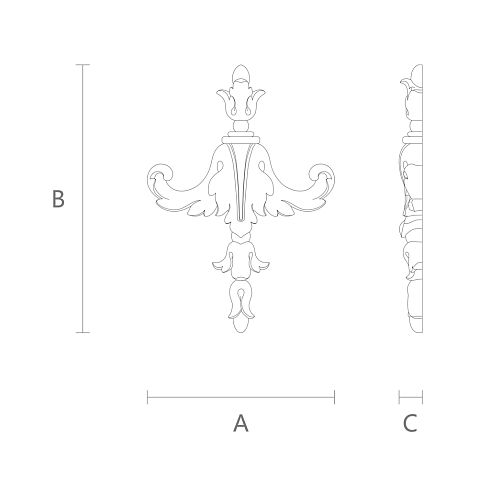
Dimensions and Options
Description
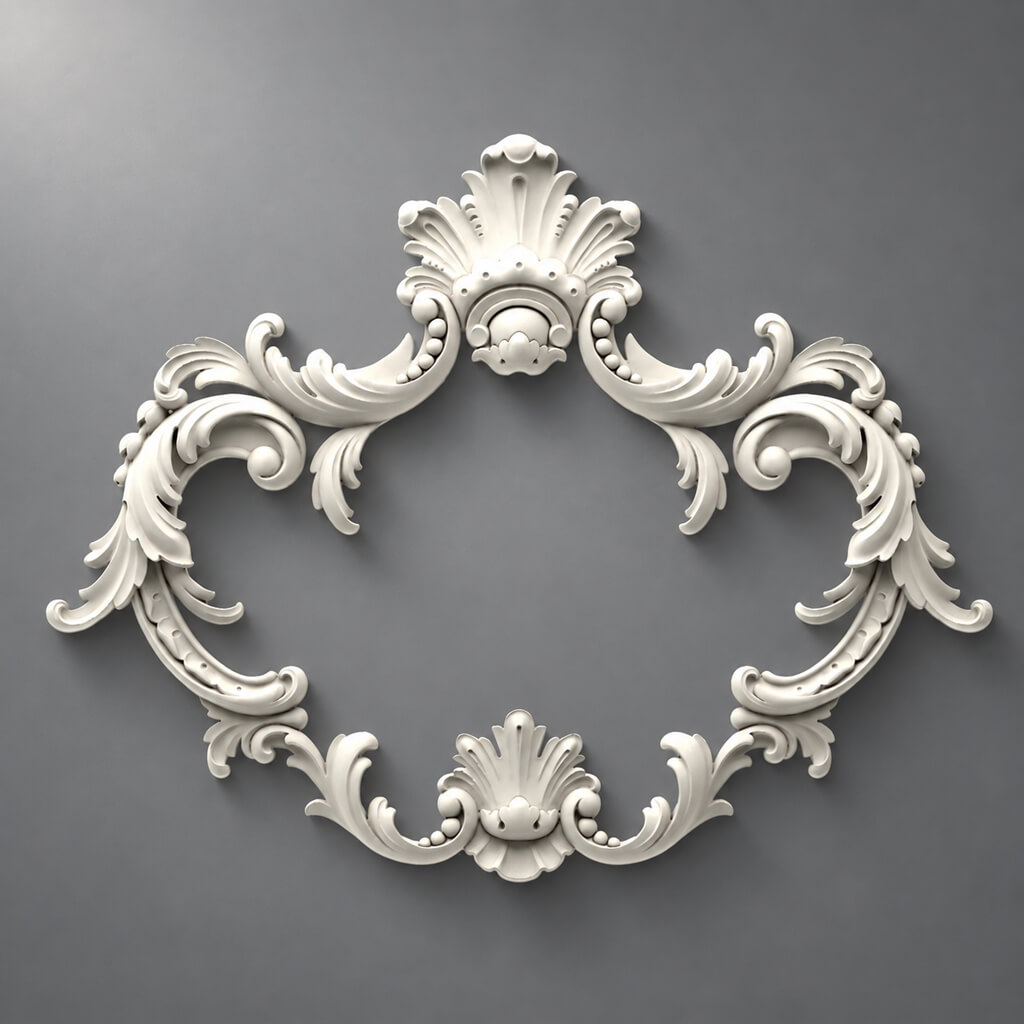
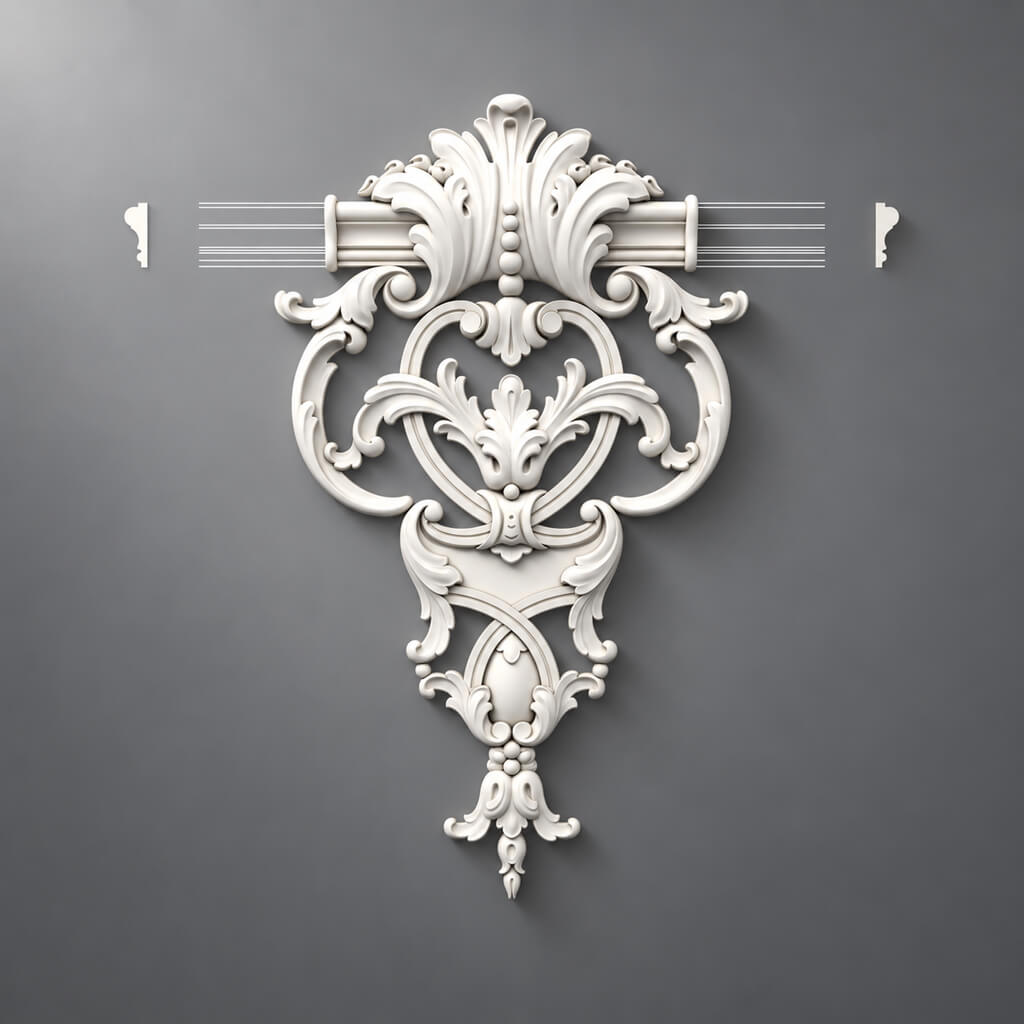
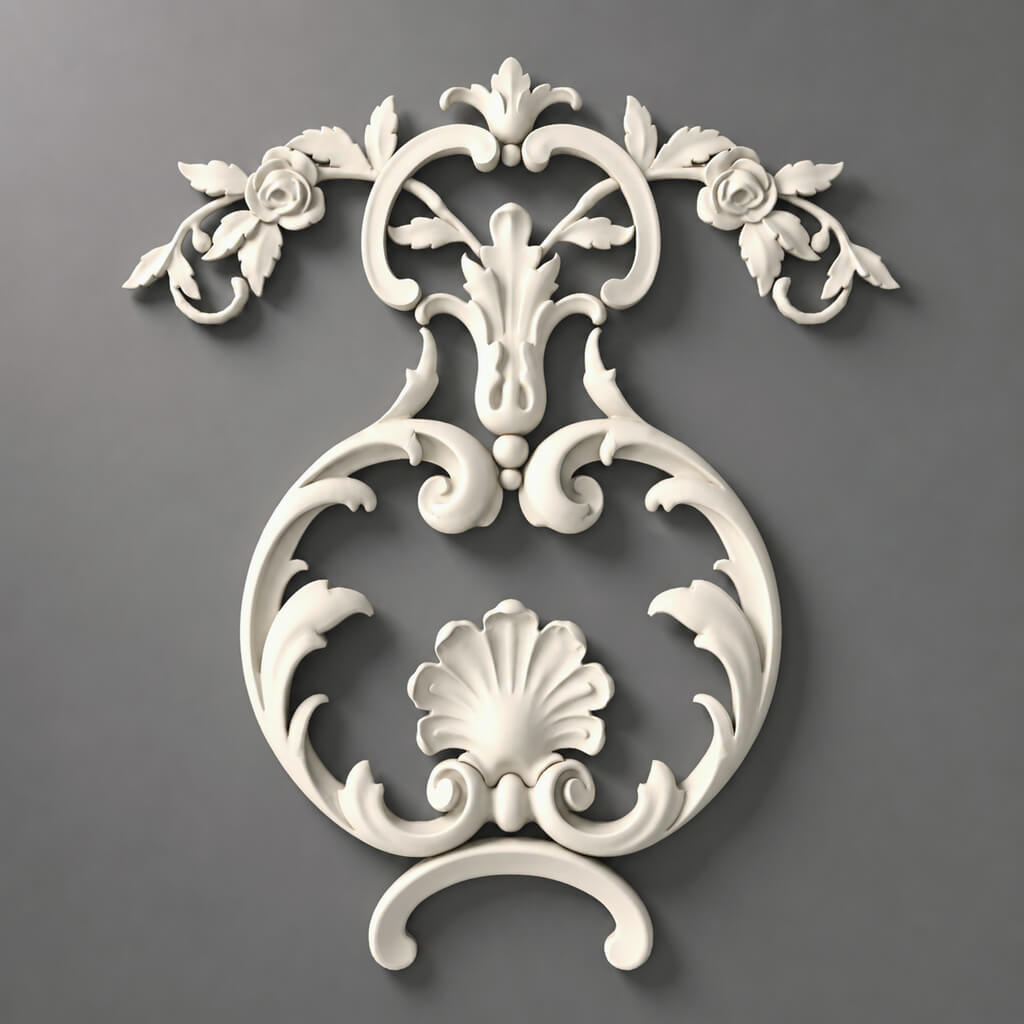
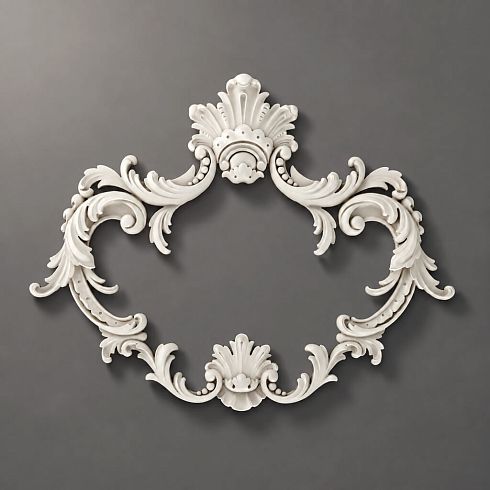
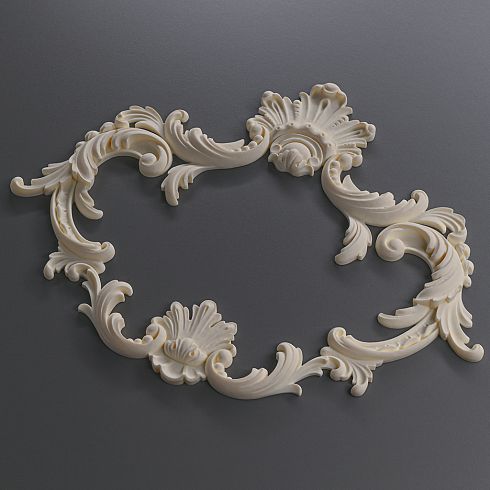
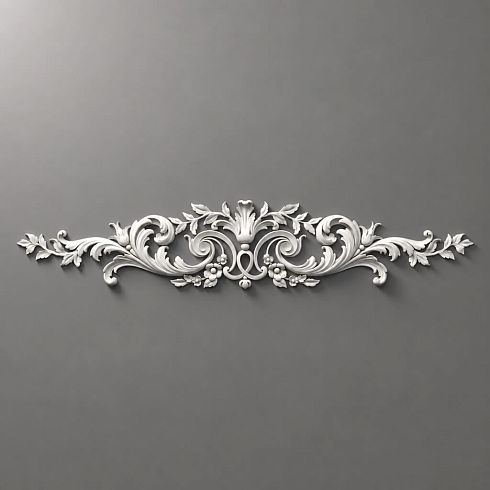
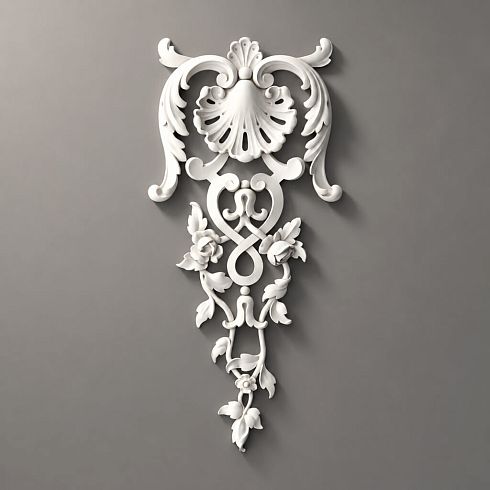
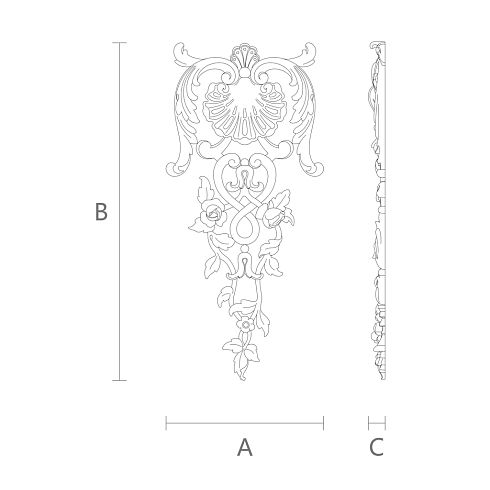
The vertical composition NPU-507 is built along a clear central axis. At the top, two roses and leaves form a wide botanical finial, while below, large curved branches and volutes frame a decorative shell. The expressive relief and the size of 392 × 336 mm allow the applique to be used as a standalone accent on a wall panel, furniture facade, or door leaf. This polyurethane wall decor is especially appropriate inside a moulding frame, above a console or mirror, where the symmetry of the design supports the architecture of the composition.
Have questions?
Customers also buy







Ekaterina Y.
October 5, 2026
An excellent team! A huge selection of products! I recommend that craftsmen, designers, decorators, and home stagers take a tour of the production facility to immerse themselves and be inspired.
Alexander U.
October 2, 2026
I have been working with Stavros since 2024, and the quality of the products is top-notch. Customers are happy!!!
Elena G.
September 29, 2026
Daria is a very competent specialist; she provided consultation and helped us select items. They were sent promptly.
Polyurethane stucco decor
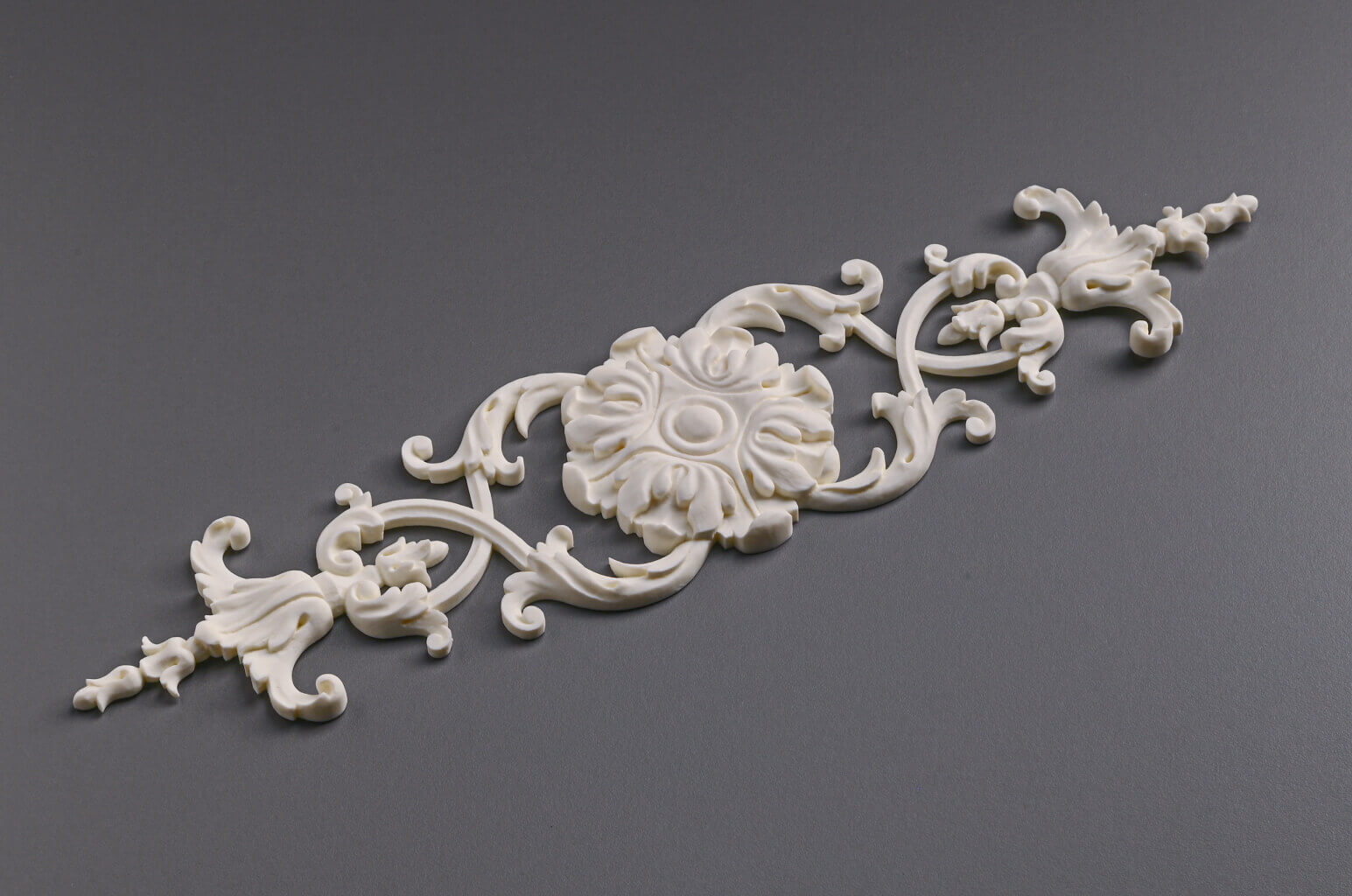
We have been on the market for over 20 years and are ready to offer you the best combination of aesthetics, quality, and practicality. Our polyurethane is not just a material, but a reliable foundation for flawless details, resistance to moisture and cracks, as well as convenient and quick installation. The company's success began in 2002, when two artists – Andrey Ragozin and Evgeny Tsapko – created a small creative workshop for making carved wooden products. The work of the craftsmen was quickly noticed, and within a year they were invited to participate in the reconstruction of the Konstantinovsky Palace in Strelna.
Every product in our range is the result of years of experience, thoughtful technology, and attention to detail. We constantly update our collections, follow and shape trends in interior design ourselves. From elegant neoclassicism to bold Art Deco, you will find the perfect accent for the interior of your dreams.
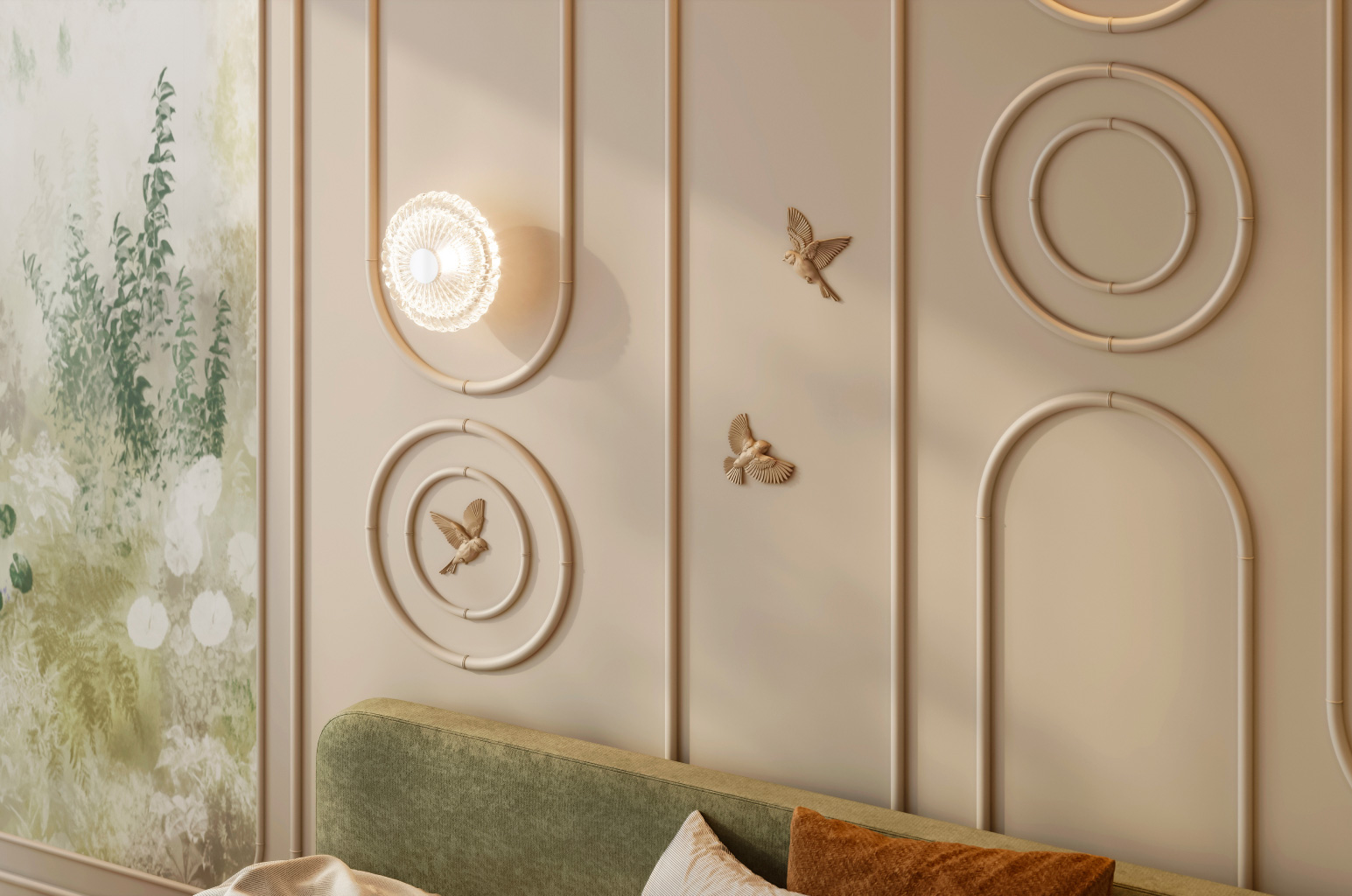
Choose durable polyurethane decor STAVROS — beauty proven by time and real projects, not just words.
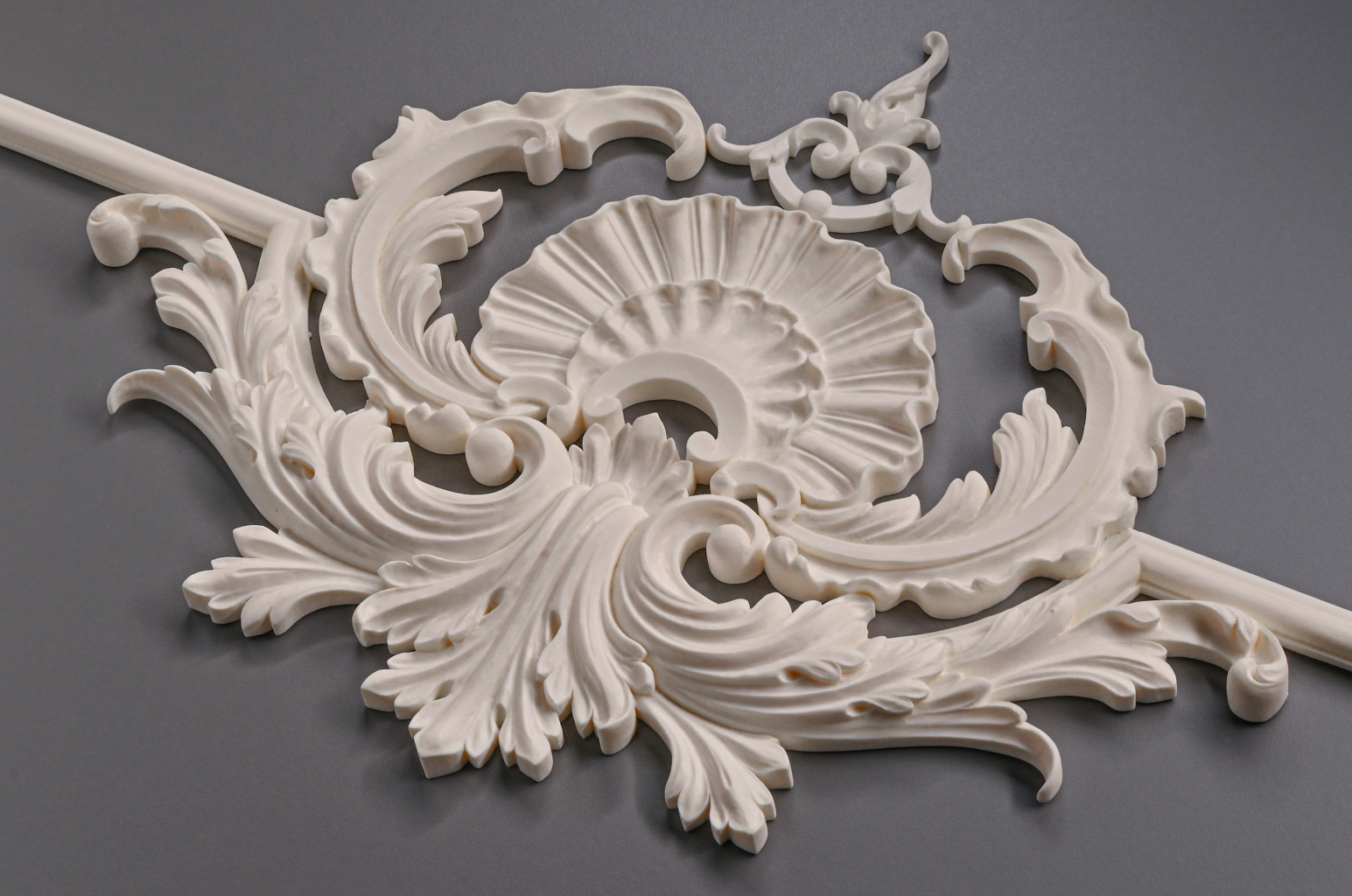
STAVROS Guarantees
Quality of products without complaints
We save your time, peace of mind, and budget
Large warehouse program
We solve your tasks with maximum speed
Adherence to production deadlines
Streamlined process reduces all risks
Delivery from 1 piece throughout Russia
Quality service regardless of order volume
Your positive business reputation
Reliable partner — the foundation of your business
More polyurethane molding products







Frequently asked questions
Our showrooms are located in Saint Petersburg and Moscow. Production is located in Saint Petersburg.
Moscow contacts: https://www.stavros.ru/contacts_all/?tab=msk
Contacts of Saint Petersburg: https://www.stavros.ru/contacts_all/?tab=spb
- Send request by email [email protected]
- Write to us at Telegram
- Write to us at WhatsApp
- Order by phone +7 (800) 555-46-75
- Visit our showroom in Saint Petersburg and Moscow
Yes, we ship orders throughout Russia and to CIS countries.
We cooperate with transportation companies such as СДЭК and DPD.
You can also arrange pickup of your order through any convenient transportation company for you.
Delivery cost depends on the size, weight of the item, and delivery address.
When placing an order, the delivery cost is calculated automatically and displayed as a separate line on our website.
Prices and availability of items on the website are always current. Data is updated daily.
Note: items in stock are stored on the warehouse in unpolished form and shipped within 3 working days.
If the item is not in stock, average production time: 5–10 working days.
This is the quality of polishing of the items.
Standard — machine polishing, at a more attractive price.
Prestige — detailed hand polishing, items do not require further work.
More details: https://www.stavros.ru/information/kachestvo/
This is the type of veneer of the items.
Under enamel: produced by gluing wooden laminates without color and texture matching. Contrast tonal and textural differences are noticeable. This blank should be chosen if the item is intended for opaque coating.
Under tinting: produced by gluing wooden laminates with color and texture matching. Tonal and textural differences may occur. This blank should be chosen if the item is intended for semi-transparent finish.
More details: https://www.stavros.ru/information/kachestvo/
Beech — dense, non-porous wood, most often used for items covered with enamel.
Oak — dense, porous wood with clearly visible natural grain. Due to its strength and decorative properties, it is often used in items with semi-transparent coating, highlighting the wood pattern.
Custom-made, if non-standard items are required, we can produce products from other types of wood, including blanks provided by the customer, manufactured according to our technical specifications.
All our furniture legs can withstand a vertical load of at least 100 kg.
Average production time for custom-made items: 5–10 working days.
Most items are stored on the warehouse in unpolished form. We need time to polish and pack orders.
Yes, we manufacture non-standard items according to individual projects, but we only accept orders with a minimum quantity.
We can manufacture items of the desired size, but we only work with bulk orders. For details, please consult the sales department manager.
Yes, some of our products can be used outdoors. For example, polyurethane items, as well as carved door casings made of pine.
Other items are produced to order using PUR glue, if minimum quantity is available. No warranty is provided for such products, as outdoor conditions are considered aggressive.
Yes, we paint items when ordering products for a total amount of 150,000 rubles or more.
- Dust removal. After sanding, the surface must be dusted.
- Priming. Apply primer in an even layer.
- Matting. After the primer has fully dried, the surface should be matted (lightly sanded for better adhesion).
- Finish coating. Apply finish coating: lacquer or enamel, in 2 layers, with interlayer drying.
More details: https://www.stavros.ru/information/sovety/
Apply adhesive to the decor. Place it on the surface and press briefly. Then, lift the decor from the surface and leave it open for 3–5 minutes. Press the decor firmly onto the surface and hold for 5–10 seconds.
More details: https://www.stavros.ru/information/sovety/
Ideally, you should prepare a design project before placing an order.
You can do this yourself by downloading drawings of our products from our website, or you can order a project from us.
If the number of decorative elements and fittings is small, our company's manager can assist you with selection.
Unfortunately, this service is not provided.
The packaging method depends on the type of items, but in each case, we ensure sufficient protection for safe transportation.
We most often use corrugated cardboard and stretch film. Fragile items are additionally secured on a rigid base to prevent damage during transport.
We ship all items starting from 1 piece.
Room measurements and item installation can be performed by our partners — carpentry companies represented in most regions of Russia.
Often searched in category Molded decor
4191
4186
3605
2849
347
244
Stucco decor NPU-507 — large polyurethane overlay with floral ornament
Stucco decor NPU-507 — expressive decorative overlay made of polyurethane, designed for decorating walls, furniture facades, doors, panels, portals, and other flat interior surfaces. The model reproduces a complex classical composition with roses, leaves, volutes, a shell, and smooth floral curls.
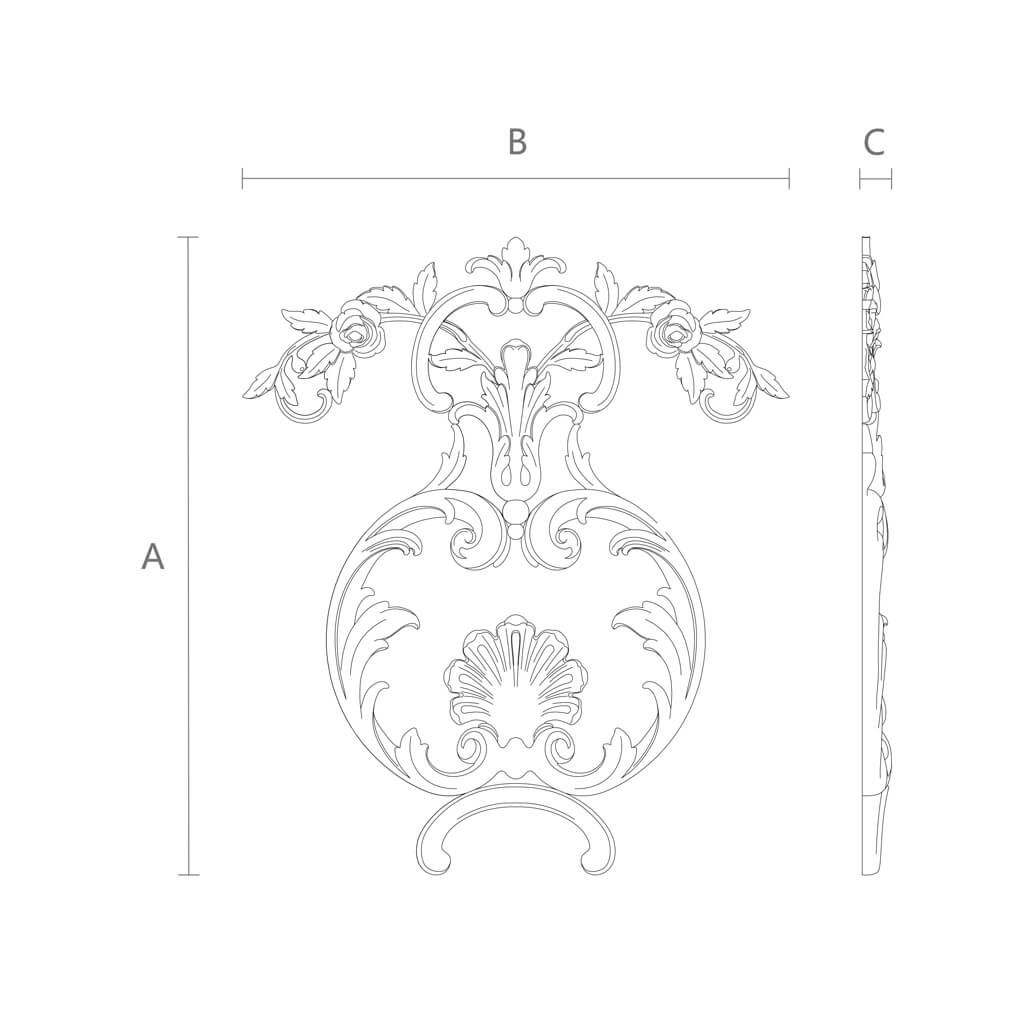
The product size is 392 × 336 × 18 mm, where 392 mm is the height, 336 mm is the width, and 18 mm is the maximum relief thickness. This is a large overlay element that is clearly visible in the interior and can become the compositional center of the decorated surface.
NPU-507 should not be perceived as a small decoration for randomly filling empty space. The ornament has its own vertical axis, a pronounced top finish, and a rounded lower part. It is recommended to include it in the project in advance, matching the overlay dimensions with the furniture facade, molding frame, door leaf, or wall panel.
In the STAVROS catalog, NPU series elements belong to polyurethane stucco decor. Such overlays are used for walls, ceilings, furniture, and interior accent zones, and polyurethane stucco can be painted in accordance with the overall project palette.
Main characteristics of NPU-507
- Name: stucco decor NPU-507.
- Material: polyurethane.
- Height A: 392 mm.
- Width B: 336 mm.
- Thickness C: 18 mm.
- Product type: decorative overlay.
- Composition orientation: vertical.
- Ornament character: floral, classical.
- Main motifs: roses, leaves, volutes, scrolls, and a shell.
- Application method: surface mounting on a prepared base.
Thanks to its size and intricate pattern, NPU-507 is suitable for standalone use. To decorate one panel or door, it is not necessary to add many other carved elements nearby: the overlay already represents a complete decorative composition.
How the stucco decor pattern is structured
The NPU-507 ornament is built around a central vertical axis. The right and left sides balance each other, making the overlay look cohesive and fit well on symmetrical surfaces.
At the top, there is a floral garland. Two roses are positioned on either side of the central floral finial. Leaves and small curved shoots extend from the flowers, forming a wide upper contour.
Below the garland, there are two large volutes. They curve toward each other and form a smooth arched frame. In the center, there is an elongated leaf motif that connects the upper part with the main rounded ornament.
The middle zone is complemented by paired curls and small round connecting elements. They create a visual transition between the upper floral fragment and the large lower composition.
The main lower part is constructed from two large curved branches. They form an almost circular field, inside which there is a decorative shell. The shell is one of the most recognizable classical motifs and helps emphasize the ceremonial character of the model.
The lower semicircular finish holds the entire composition on the central axis. Thanks to it, NPU-507 does not look sharply cut off and is perceived as a single vertical ornament.
A relief that retains expressiveness after painting
The maximum thickness of the overlay is 18 mm. The relief is prominent enough for the pattern to be readable even with a monochrome finish.
The protruding parts of the roses, leaves, and shell receive more light. The recesses between the petals and inside the curls remain darker. As a result, the ornament retains volume even when NPU-507 is painted exactly to match the color of the wall or furniture facade.
Expressiveness also depends on the direction of lighting. With frontal diffused light, the overlay looks calmer. Side light more strongly emphasizes depth, leaf contours, and transitions between relief levels.
If the decor is placed in a niche or molding frame, it is recommended to check the placement of light fixtures in advance. Too harsh light from below can create unusual shadows, while even upper or side lighting usually better reveals the vertical composition.
Molded decor for walls
NPU-507 can be used as a standalone wall decor. Thanks to its size of 392 × 336 mm, the overlay can take a central place on a decorative panel, inside a molding frame, or above a small piece of furniture.
On a smooth wall, it is recommended to place the product not randomly, but in relation to the room's architecture. The center of the overlay can coincide with the axis of a console, mirror, bed, sofa, door, or wall panel.
NPU-507 looks especially expressive:
- above a console table;
- in the center of a tall wall panel;
- inside a rectangular molding frame;
- on the wall behind the sofa;
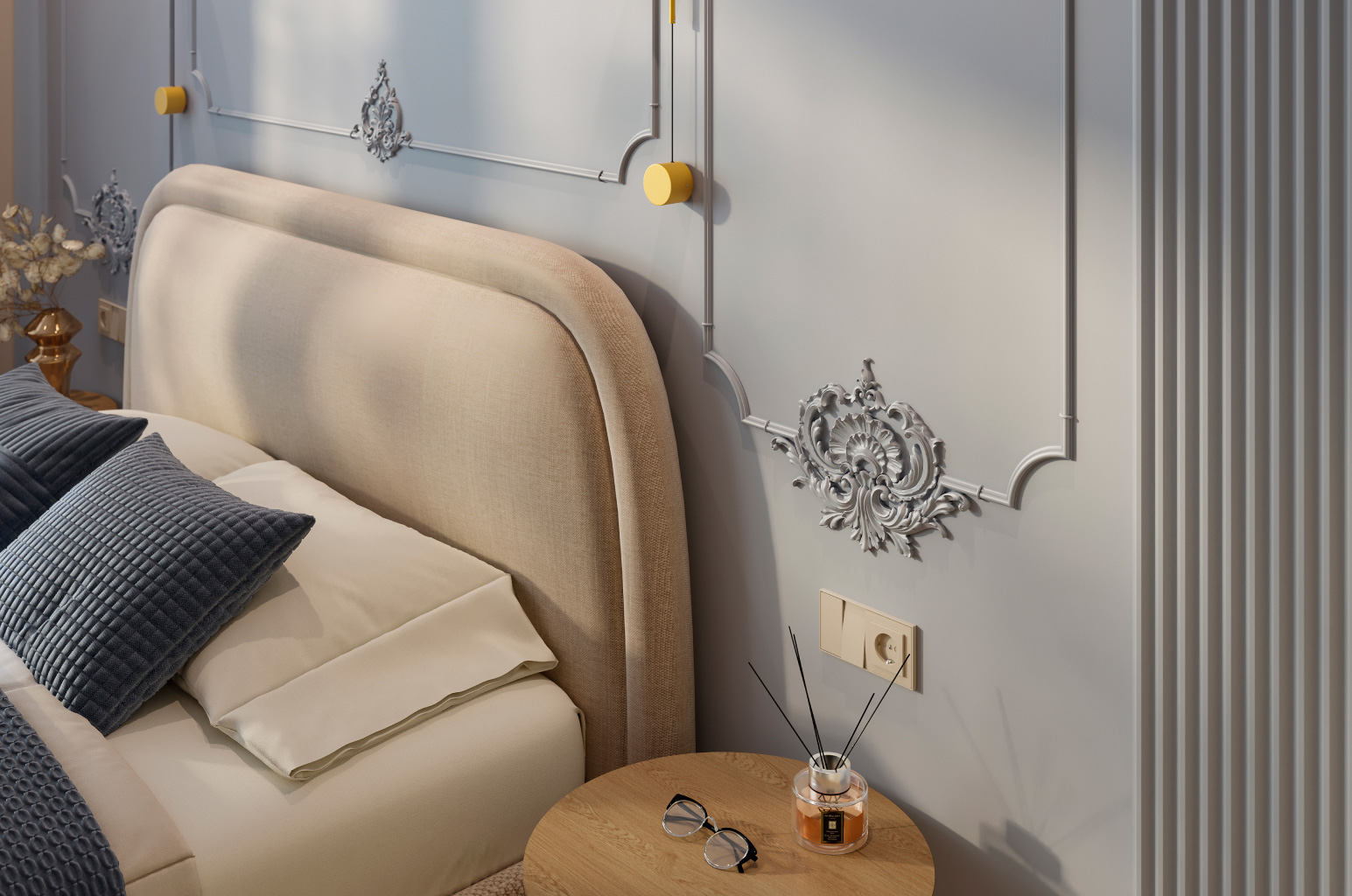
- above the headboard of the bed;
- in a decorative niche;
- between two wall sconces;
- on the wall between doors;
- in the design of the fireplace area;
- on an accent wall in the hallway.
If the overlay is painted in the color of the wall, it becomes part of the architectural relief. If you choose a contrasting shade, NPU-507 will be perceived as an independent decorative panel.
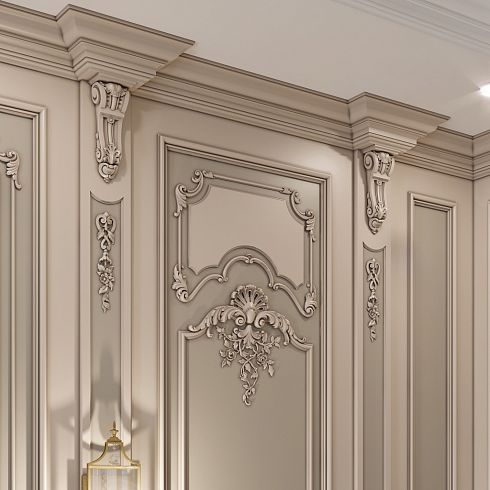
Inside the molding frame
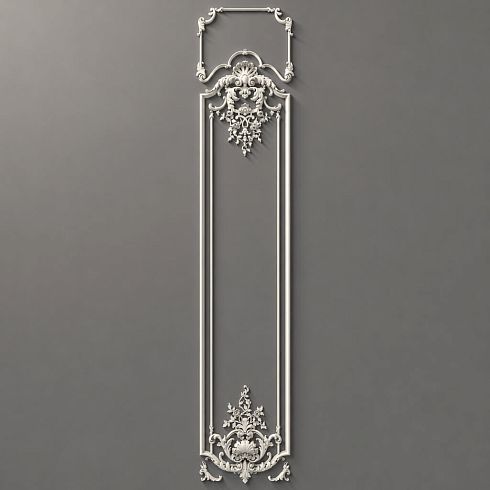
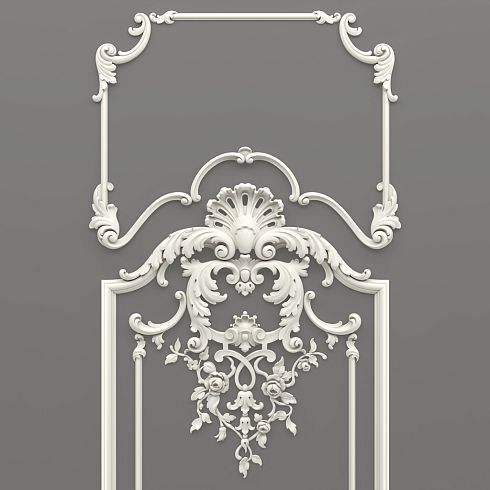
One of the most versatile ways to use it is to install the NPU-507 inside a frame made of moldings.
The molding organizes a free field on the wall, and the overlay creates a central accent. This technique suits classic, neoclassical, French style, and modern eclecticism.
Before installation, check the inner size of the frame. The width of the decor is 336 mm, but the frame should not be designed almost flush with the outermost roses and leaves. There must be a free field between the outer contour of the overlay and the molding.
It is undesirable for the side leaves to visually touch the vertical profiles. This makes the composition cramped and hinders viewing the details.
In a tall frame, the NPU-507 can be placed:
- strictly in the center;
- slightly above the geometric center;
- above a small additional element;
- in the upper part above a mirror or console.
The specific position depends on the height of the panel and neighboring objects. To check, it is recommended to make a paper template measuring 392 × 336 mm and attach it to the wall with painter's tape.
Wall decoration above a console
The vertical composition NPU-507 is well suited for the area above a console table.
The console forms the lower horizontal line, while the stucco decor directs the gaze upward. This combination allows you to decorate a narrow wall section, hallway, entryway, living room, or the space between windows.
The overlay can be used independently or combined with a mirror. Several schemes are possible:
- NPU-507 is placed above the mirror as a decorative top piece.
- The overlay is installed under a small mirror.
- The mirror is placed in the center of a large molding frame, and NPU-507 occupies the upper part.
- Two identical elements are placed symmetrically on the sides of the mirror.
- The overlay is installed without a mirror and works as a standalone panel.
When placing above a console, it is necessary to consider the height of decorative items: lamps, vases, candlesticks, and paintings. The ornament should not be partially covered by tall accessories.
Wall decor behind the sofa
On the wall behind the sofa, NPU-507 can be used as the central element of a molding composition.
One overlay fits a narrow central panel. For a wide wall, several elements can be used, but a clear rhythm must be maintained between them.
Possible layout:
- one overlay centered behind the sofa;
- three identical frames, with NPU-507 in the central one;
- two overlays above a pair of side tables;
- central NPU-507 with simpler elements on the sides;
- repeating NPU-507 in several panels of equal width.
It is not recommended to uncontrollably fill the entire wall with equally complex molding. NPU-507 contains many details, so it is better to use calm moldings and plain empty fields nearby.
Stucco decor for the bedroom
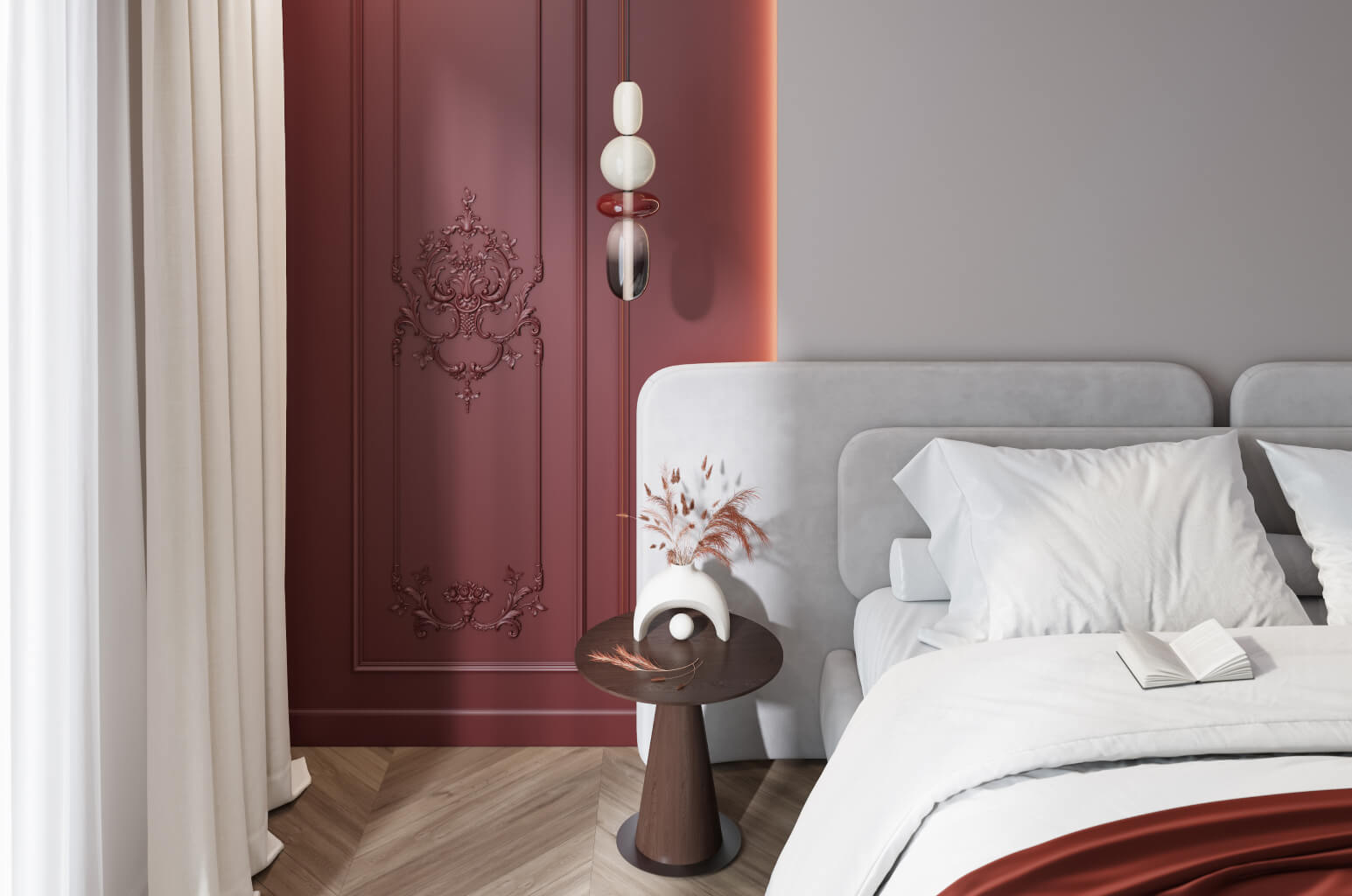
In the bedroom, NPU-507 can be placed above the headboard or incorporated into the design of wall panels.
The central axis of the overlay should align with the middle of the bed. In this case, the actual height of the mattress, pillows, and soft headboard must be taken into account.
If the decor is placed too low, its lower part will be hidden. If the item is raised excessively high, it may lose visual connection with the bed.
For a calm neoclassical interior, the overlay can be painted in the color of the wall. Milky, beige, gray-beige, powder, and muted colored shades are suitable.
In a more decorative interior, roses, the shell, or individual edges of the volutes can be highlighted with patina or a metallic effect.
When using paired elements, two NPU-507 units can be placed above the bedside tables. This scheme supports the symmetry of the bedroom and leaves the central part of the wall free for a soft headboard or a painting.
Overlay for furniture facade
NPU-507 can be used as a decorative overlay on furniture. However, before ordering, it is necessary to check the actual dimensions of the facade.
The height of the product is 392 mm, the width is 336 mm. For a small door, this is a large element. It is best suited for:
- tall cabinet;
- wide sideboard;
- display cabinet;
- chest of drawers with a solid central panel;
- decorative cabinet;
- console;
- dressing table;
- on a furniture wall panel;
- tall headboard;
- large nightstand.
The overlay cannot be moved across lines between doors or drawers without checking. The entire element must be attached to one fixed or movable part.
On a paneled front, measure the inner field. The outermost rosettes and leaves should not accidentally extend onto the frame profile, unless specified in the project.
On a smooth door, you can create an additional molding frame and place the NPU-507 inside it. This method helps connect the intricate ornament with the furniture's geometry.
Where to place the furniture handle
The handle should not overlap the central part of the overlay.
The most important areas of the pattern:
- central top finial;
- elongated plant motif;
- paired volutes;
- lower shell;
- symmetrical side leaves.
If you install the handle over one of these elements, the composition will lose its integrity. Additionally, the protruding relief may interfere with a comfortable grip on the hardware.
On a double-door cabinet, different solutions are possible:
- one overlay on each door, with handles positioned closer to the central joint;
- one NPU-507 is installed on the solid central panel;
- overlays are placed above the handles;
- the decor occupies the lower part, and the hardware — the upper part;
- handles are installed on the sides of the outer contour of the overlay.
The exact position is determined by the facade drawing. Before installation, it is advisable to draw the NPU-507 contour on paper and check the opening of the furniture.
Decorative overlay for doors
NPU-507 is suitable for decorating interior doors and decorative door panels.
On a tall solid door leaf, the product can be installed in the upper or central part. Upper placement helps create the effect of a carved top, while central placement turns the overlay into the main ornament of the door.
When designing, check:
- the width of the panel;
- position of panels;
- distance to trims;
- height of the door handle;
- location of the lock;
- the direction of opening;
- gap to the wall;
- possible contact of the relief with furniture.
It is not allowed to attach one solid overlay to two movable leaves simultaneously. If a double door needs to be decorated, use two separate elements or place the NPU-507 on the fixed upper panel of the portal.
With a solid color finish of the door and decor, the overlay looks like part of the door leaf itself. Contrasting finish makes it an independent artistic accent.
Door portal trim
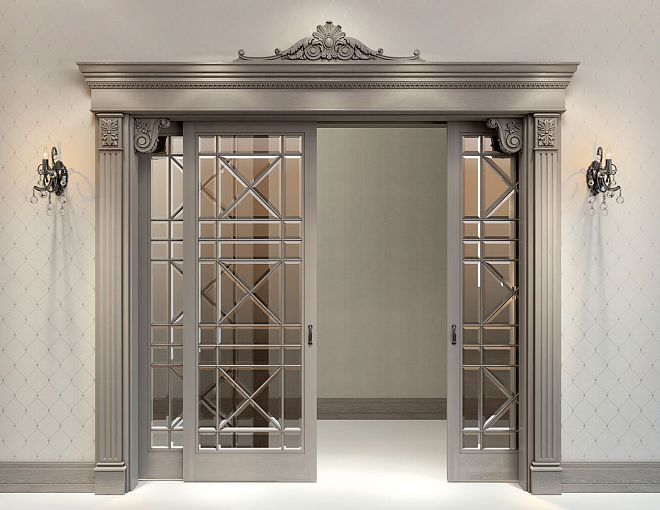
In the NPU-507 portal, you can use:
- above the opening;
- on the side decorative panels;
- in the center of the frieze;
- between pilasters;
- above a mirror or door frame;
- as part of a composition of moldings and cornices.
Vertical ornamentation is especially well-suited for side panels. For placement above a door, it is necessary to check how the shape of the product relates to the horizontal frieze.
If NPU-507 is installed above a door, it can maintain a vertical orientation and serve as a central finial. Flipping the model without prior visualization is not recommended: the placement of the rosettes and the lower shell defines a clear top and bottom.
In a wide portal, a single element may appear too compact. Then it is supplemented with moldings or simpler side overlays, without overloading the central part.
Use on the ceiling
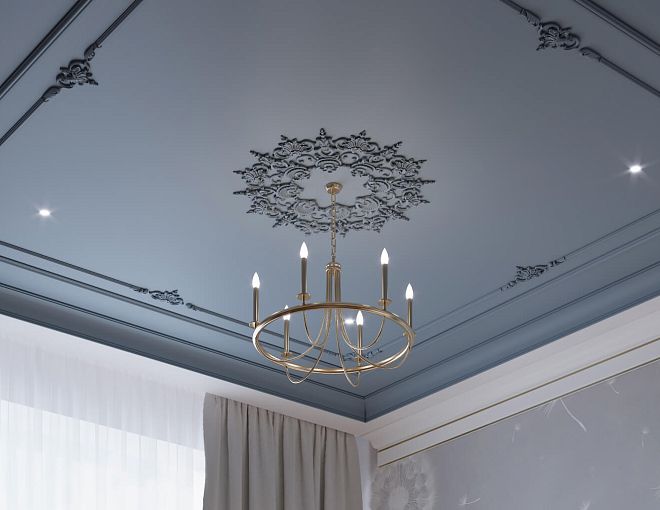
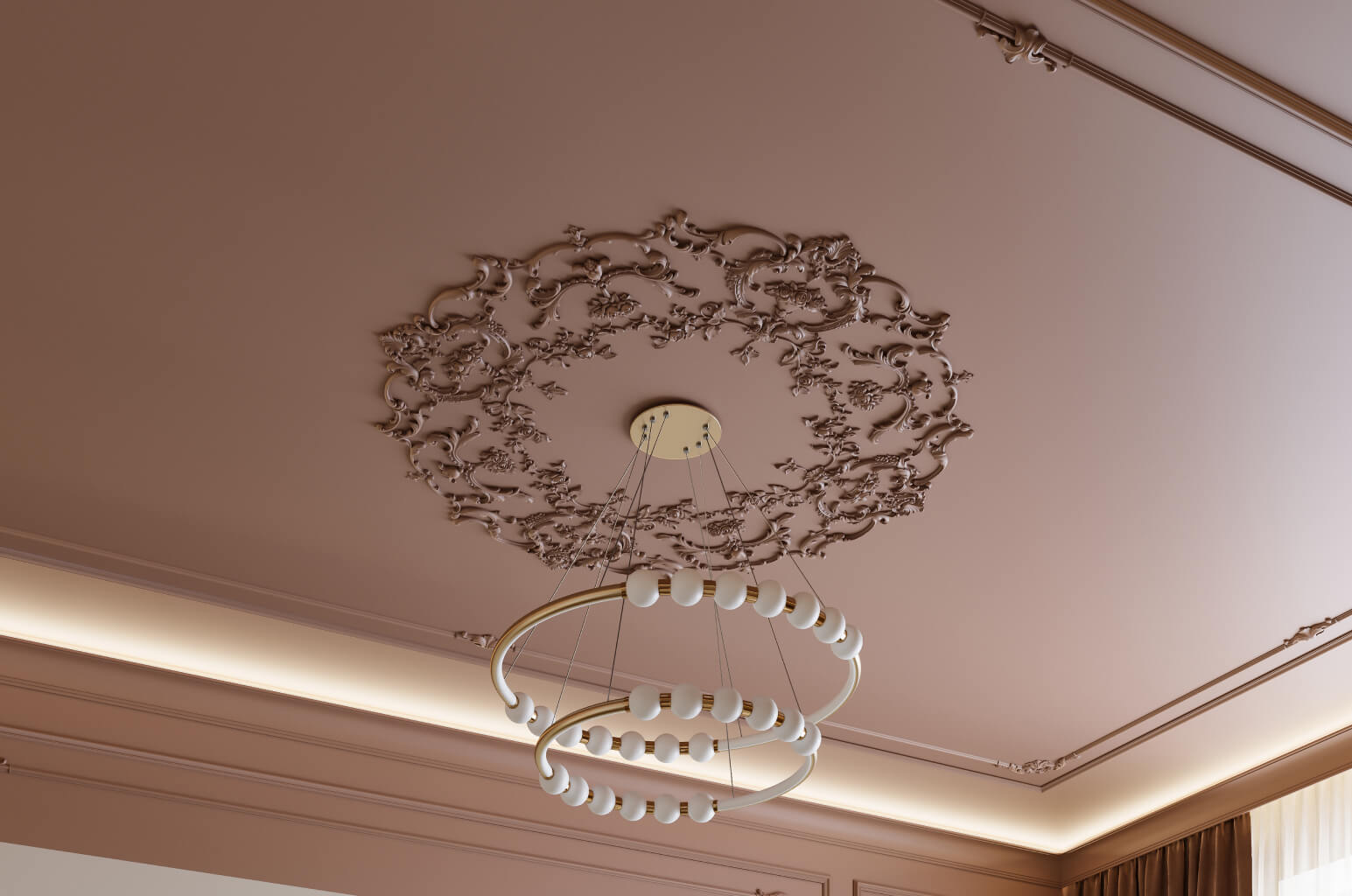
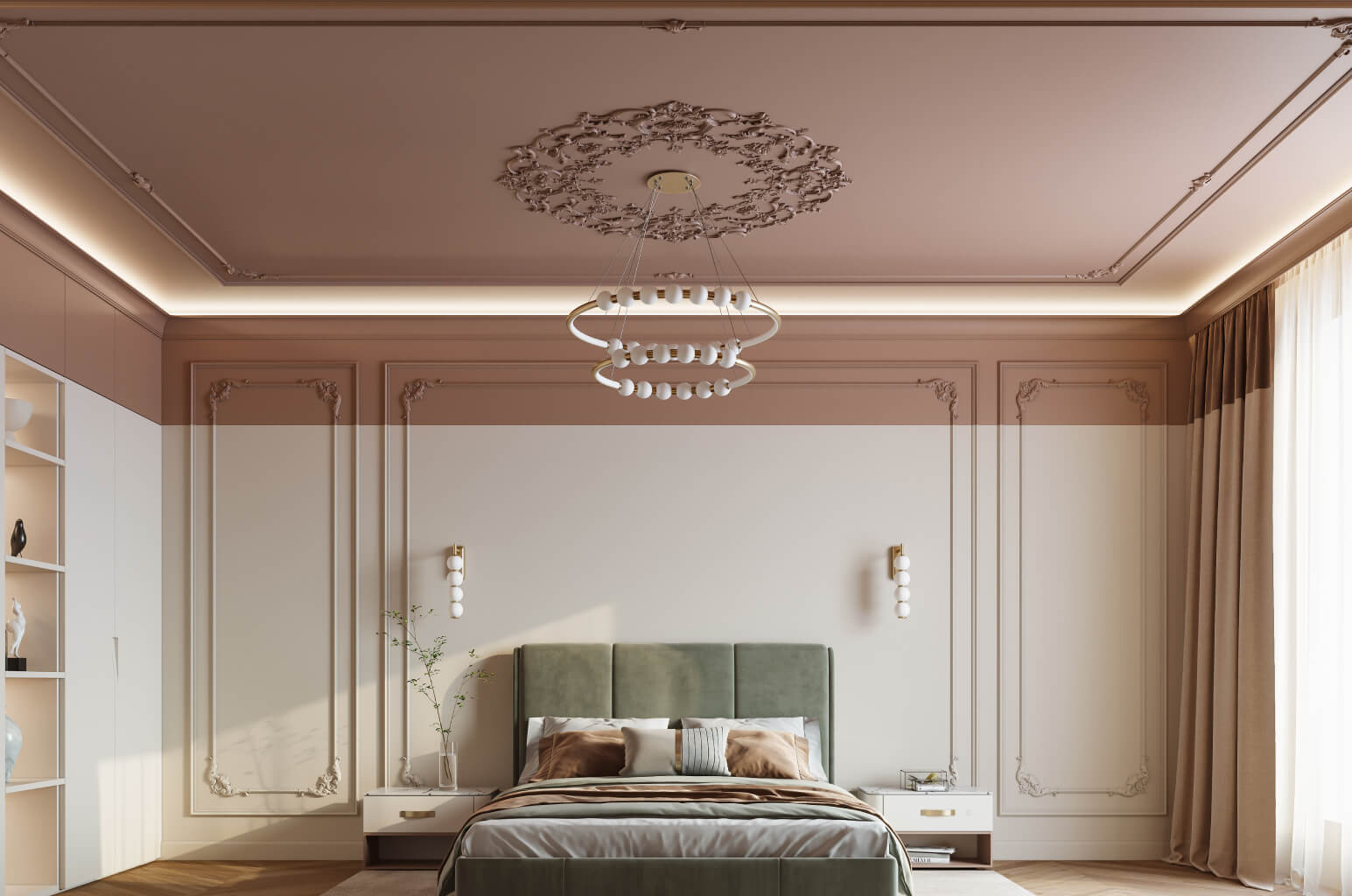
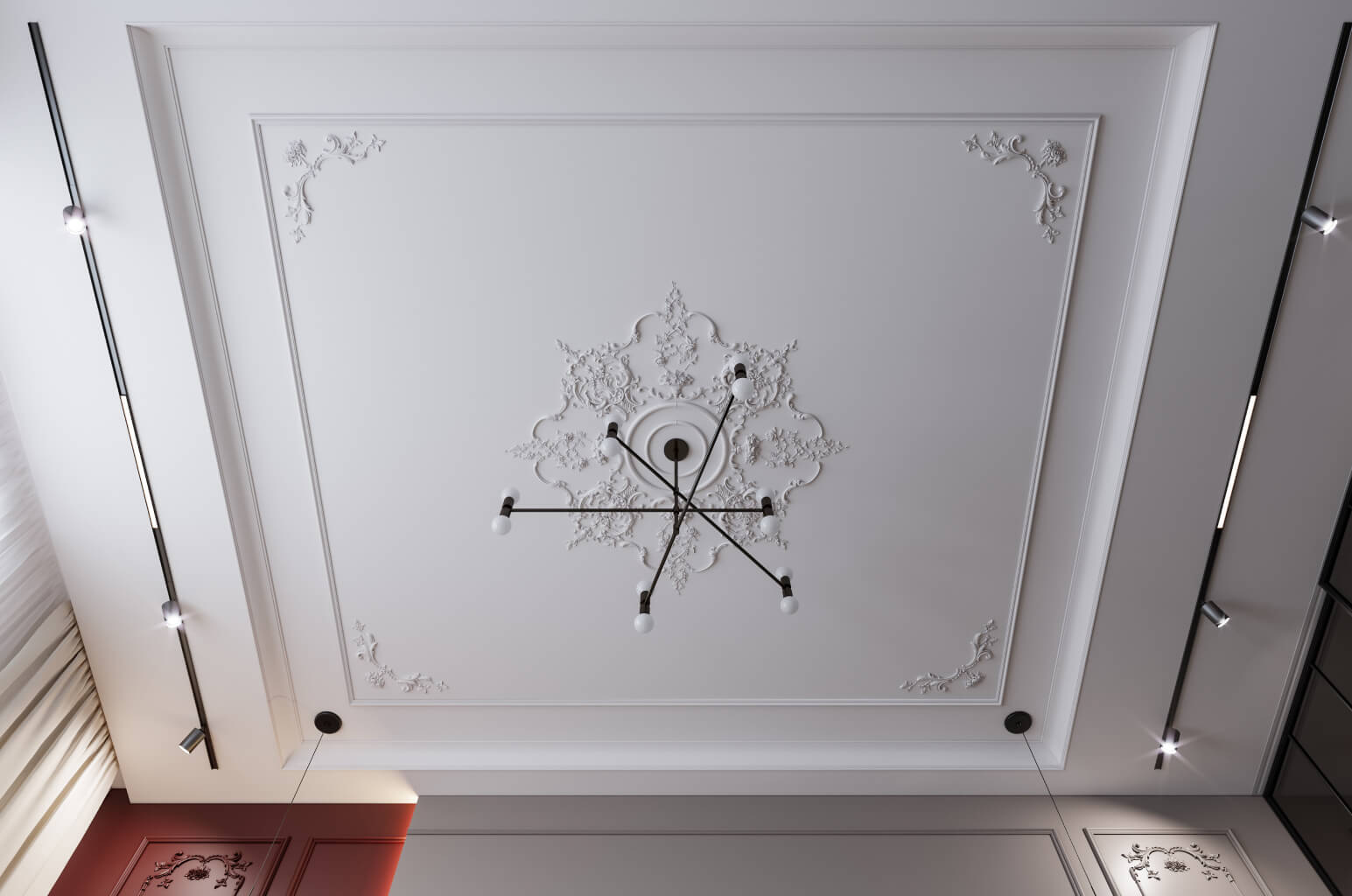
NPU-507 can also be used in ceiling decorative compositions. For this, the product is included in a radial layout, placed inside a coffered panel, or used as a repeating element around a central medallion.
Before installation on the ceiling, it is necessary to prepare a precise scheme. Due to the pronounced orientation, each NPU-507 must be rotated relative to the common central point.
The following solutions are possible:
- four elements around the center of the ceiling;
- NPU-507 in the corners of a square coffered ceiling;
- paired overlays on the sides of an elongated ceiling panel;
- composition around the base of the chandelier;
- repetition of the product in several ceiling cells;
- decoration of the central part of a bay window or dome area.
For ceiling mounting, reliable fixation is especially important. The fastening method is chosen considering the base, the position of the product, and recommendations for the applied mounting compound.
Polyurethane instead of natural wood
NPU-507 reproduces the pattern of the wooden model N-507, but is made of polyurethane. This changes the nature of further work with the product.
There is no natural wood grain pattern on the surface that needs to be matched with furniture or adjacent details. Therefore, the overlay is especially convenient for projects with solid-color painting.
The polyurethane version allows focusing on the shape of the ornament. After painting, the main decorative qualities remain the roses, leaves, volutes, and the shell.
This solution is suitable when:
- the natural wood texture is not required;
- the decor is planned to be painted in the wall color;
- the same ornament needs to be repeated on several panels;
- a uniform surface with moldings and other stucco is important;
- a classic pattern without a wood tint is required;
- the project includes decorative patina or gilding.
On STAVROS pages, polyurethane stucco is considered as a material for classical and neoclassical interiors, wall panels, and decorative compositions for painting.
Preparation for Painting
Before finishing, the product must be inspected and cleaned of dirt and dust. The specific preparation system depends on the chosen paint, primer, and operating conditions.
Special attention is required for:
- recesses between rose petals;
- inner edges of the volutes;
- leaf contours;
- central shell;
- side spirals;
- transitions between relief levels;
- end sections of the overlay.
A thick layer of primer or paint can make fine details less expressive. Therefore, finishing materials are applied evenly, avoiding accumulation in recesses.
Before treating the entire product, it is advisable to perform a test on a small inconspicuous area or a separate sample. This helps check adhesion, color, and gloss level.
Painting in wall color
Monochrome design is one of the most versatile options for NPU-507.
The overlay, moldings, and wall are painted in one color, making the composition look cohesive. The relief is revealed through shadows rather than color contrast.
Suitable for this solution:
- white;
- milky;
- light beige;
- gray-beige;
- light gray;
- powder;
- muted blue;
- olive;
- deep green;
- blue;
- graphite;
- other design shades.
On a light background, the pattern is perceived more easily. Dark solid coloring makes the relief more graphic, especially under directional lighting.
It is important that the decor and the base have the same degree of gloss. If the wall is matte and the overlay is noticeably glossy, it will be perceived as a separately glued element.
Contrast painting
NPU-507 can be highlighted in a different color.
For example:
- white overlay on a gray wall;
- golden decor on a dark blue background;
- milky ornament on a green panel;
- bronze decor on a graphite wall;
- dark overlay on a light furniture facade;
- Colored ornament inside a white molding frame.
The contrast enhances the outer contour and allows small details to be seen from a greater distance. This option is appropriate in interiors where stucco decor should become an independent accent.
It is not necessary to use maximally contrasting colors. A difference of one or two tones creates a calmer effect.
Patina
Patina helps to emphasize recesses and add extra depth to the ornament.
On a light base, you can use:
- gray patina;
- beige;
- brown;
- golden;
- bronze.
The compound remains inside the petals, between leaves, and in the recesses of volutes. This makes the pattern more readable.
On a dark background, light or metallic patina is possible. It can be applied only to protruding edges, creating a soft worn effect.
The intensity should match the scale of the room. Too much darkening of each line can make the composition visually heavy.
Gilding and metallic effects
The NPU-507 shape is suitable for partial or full decorative gilding.
A fully gilded overlay becomes a bright accent for classic, baroque, or palace interiors.
For a more restrained result, individual details are highlighted:
- roses;
- central finial;
- edges of large volutes;
- shell;
- protruding leaves;
- round connecting elements.
The metallic effect can be combined with a painted base. For example, most of the overlay remains white or colored, while only individual protrusions are highlighted in gold.
Instead of gold, bronze, silver, copper, or a muted metallic shade are possible.
How to check the scale before purchasing
An image on a white or gray background does not always allow you to correctly visualize the size of the product in an interior.
NPU-507 has a height of 392 mm and a width of 336 mm. To see the real scale, it is recommended to make a paper template.
The template is applied to the wall, door, or furniture and checked:
- side clearances;
- distance to the molding;
- position relative to the handles;
- height above the furniture;
- alignment with the center of the panel;
- visibility from different points in the room;
- distance to adjacent decor;
- proportion to the scale of the entire surface.
The template should be viewed not only up close. From a distance of two to three meters, it becomes clearer whether the pattern is expressive enough and whether it looks overly large.
Mounting Markup
Before fixing, it is necessary to determine the central vertical axis of the surface.
On it, mark:
- top point of the overlay;
- bottom point;
- geometric center;
- position relative to the frame;
- distances to adjacent elements.
Due to the complex contour, one should not rely only on the extreme rosettes. A more reliable reference is the central finial, the elongated middle motif, and the shell at the bottom.
First, a dry fit is performed. The overlay is temporarily held on the surface and the composition is checked. Final installation begins only after the position is confirmed.
If multiple NPU-507 units are used, a common layout is prepared for all elements. Even a slight difference in height will be noticeable on a symmetrical wall.
Selecting the base
NPU-507 is designed for installation on a prepared surface.
The base must be:
- even;
- strong;
- clean;
- dry;
- compatible with the selected mounting compound;
- devoid of peeling coatings.
On furniture facades, the opening of doors and sliding elements is additionally checked. On walls, the location of hidden wiring is taken into account. On ceilings, the safety of fastening above people is assessed.
If the surface has a noticeable curve, a flat overlay may not fit evenly. Before ordering, the geometry of the base must be checked.
Painting before or after installation
Both approaches are possible.
Pre-painting is convenient when a contrasting color, patina, gilding, or complex decorative finish is used. The product can be rotated and processed at a convenient angle.
After installation, it may be necessary to locally hide the fastening points and treat the junction with the base.
Painting after installation is suitable for a monochrome wall or furniture facade. The overlay and base receive a single color and look like a solid surface.
The combined method involves pre-treatment of hard-to-reach areas, installation, masking of joints, and application of a final coat.
The order of work should be determined before installation begins, especially if materials of different types are used.
Combining with other elements
NPU-507 can be combined with:
- smooth moldings;
- ornamental moldings;
- ceiling cornices;
- pilasters;
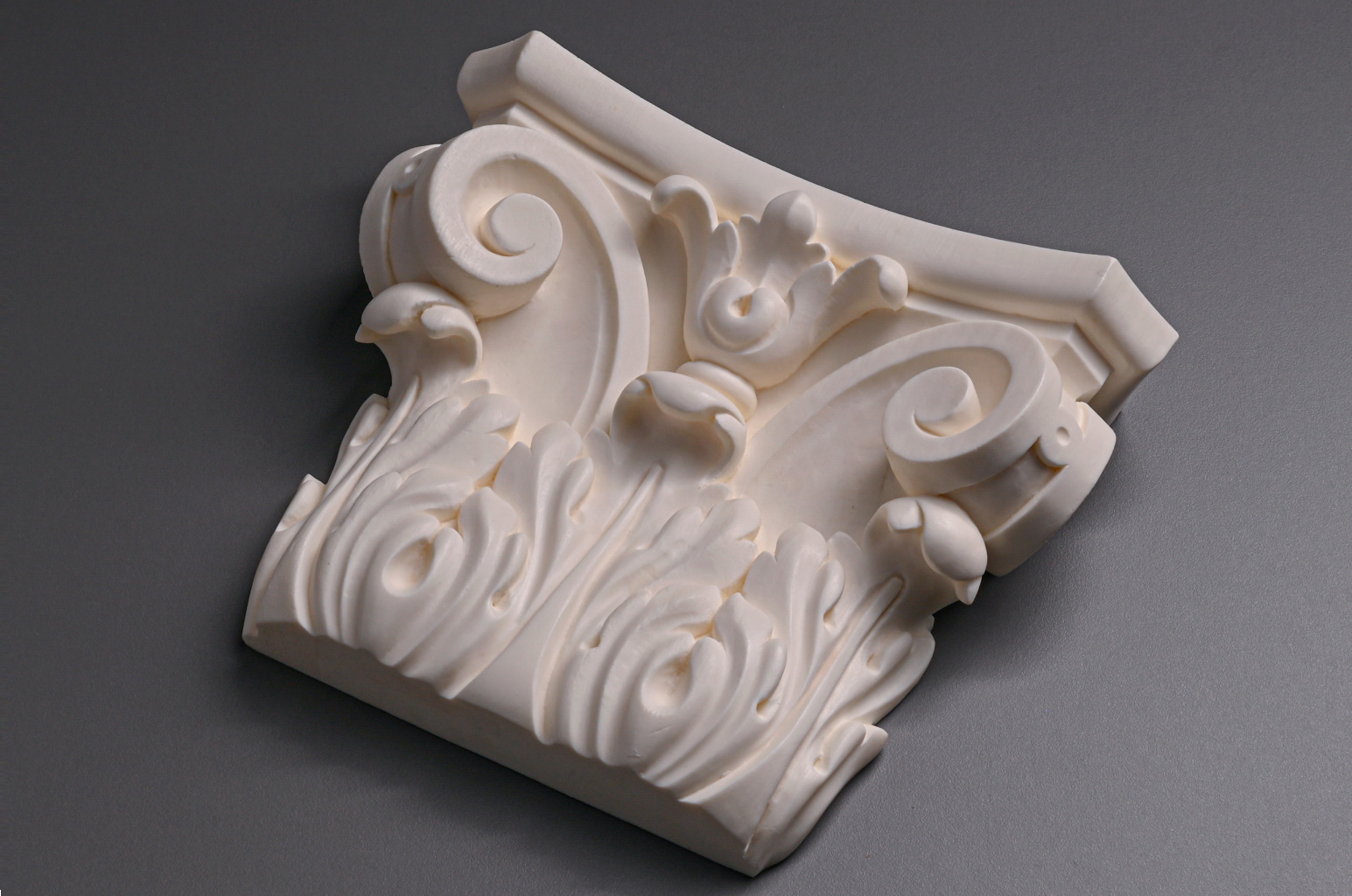
- capitals;
- bases;
- small rosettes;
- corner overlays;
- decorative panels;
- with mirror frames;
- door portals.
The more complex the pattern of the central overlay, the calmer the neighboring profiles can be. A simple molding frame well highlights NPU-507 without entering into a visual dispute with it.
If other plant elements are used nearby, it is desirable to repeat individual motifs: roses, acanthus leaves, shells, or smooth volutes.
It is not necessary to select all details with absolutely identical patterns. More important is to coordinate the scale, density of the ornament, and the character of the lines.
For which styles is NPU-507 suitable
Classic Interior
Roses, volutes, and shells correspond to traditional classical decor. The overlay can be painted in the color of the wall, supplemented with patina, or used inside a strict molding frame.
Neoclassicism
For neoclassicism, monochrome finishing is suitable. The complex ornament is preserved but looks calmer thanks to the single color of the wall and stucco.
Baroque
In Baroque interiors, contrast, gilding, and combination with large cornices, pilasters, and rich decorative surfaces are acceptable.
Rococo
Flowers, flexible lines, and curls support the light character of Rococo. Milky, pastel shades and soft gold are suitable.
French style
NPU-507 can be used above a console, mirror, or inside a tall wall panel, combined with thin moldings and light finishes.
Modern eclecticism
The classic overlay can be placed on a minimalist solid-color wall. The contrast of the intricate ornament and simple modern furniture creates an expressive designer effect.
Common Mistakes
Incorrect size assessment
The height of almost 40 cm makes NPU-507 a noticeable element. On a narrow furniture facade, the overlay may look too large. Template verification is mandatory.
Frame too tight
The outermost roses and leaves require free space. If the molding is placed almost flush, the composition loses its lightness.
Overlap by handle
The furniture or door handle should not cover the shell, volutes, and central axis.
Installation without marking
A symmetrical pattern immediately reveals even a slight deviation from vertical.
Too much adjacent decor
NPU-507 already has a rich composition. Many additional large overlays can overload the surface.
Thick layer of paint
Excessive finishing smooths out petals, leaves, and fine grooves.
Unprepared base
A weak or peeling coating does not ensure reliable installation.
Separation between moving parts
One solid overlay cannot be attached to two doors or drawers at once.
Incorrect orientation
NPU-507 has a distinct top and bottom. Before installation, it is necessary to check against the image and drawing.
Who is NPU-507 stucco decor suitable for
The product can be used:
- interior designers;
- architects;
- furniture production;
- decorators;
- door manufacturers;
- wall panel specialists;
- installation organizations;
- apartment owners;
- country house owners;
- designers of restaurants, hotels, and salons.
NPU-507 is especially useful in projects where a ready-made large ornament is needed without assembling a composition from many small parts yourself.
When to choose NPU-507
The model is suitable when it is necessary to:
- create a central accent on the wall;
- decorate a tall furniture door;
- decorate a door leaf;
- complement a wall panel;
- create decor above the console;
- design the headboard of the bed;
- add a floral ornament to the portal;
- create a classic composition inside the moldings;
- repeat the same decor in several rooms;
- achieve an expressive relief for monochromatic painting;
- use patina or gilding;
- replace small scattered overlays with one complete element.
The product may not be suitable for very narrow facades, small drawers, highly curved bases, and minimalist interiors where ornamentation is completely excluded.
Advantages of NPU-507 stucco decor
NPU-507 combines several important characteristics:
- large size;
- finished symmetrical pattern;
- expressive vertical composition;
- complex floral ornament;
- noticeable relief;
- polyurethane execution;
- possibility of painting;
- application on walls and furniture;
- use on doors and panels;
- combination with moldings;
- possibility of patination;
- possibility of decorative gilding;
- use as a separate accent;
- use in modular compositions.
Frequently asked questions
What is the size of NPU-507?
The product dimensions are 392 mm in height, 336 mm in width, and 18 mm in thickness.
What material is the overlay made of?
NPU-507 is made of polyurethane.
Is the decor suitable for a wall?
Yes. The overlay can be used independently, inside a molding frame, on a wall panel, or as part of a more complex composition.
Can NPU-507 be installed on furniture?
Yes, if the facade has sufficient size and a flat surface. Before installation, it is necessary to check the position of the handles and the free opening of the furniture.
Is the overlay suitable for a door?
Yes. The decor can be placed on a solid door leaf or a decorative portal panel.
Can the NPU-507 be used above a bed?
Yes. The overlay is suitable for decorating the wall above the headboard or the central part of a tall panel.
Can the product be painted?
Polyurethane stucco decor is used in projects intended for painting. The specific primer and paint system must be selected based on the material and substrate.
Can the overlay be painted to match the wall color?
Yes. When the wall and decor are the same color, the pattern is revealed through relief and shadows.
Is NPU-507 suitable for patination?
The intricate pattern allows recesses to be highlighted with patina. It is recommended to perform a test before treatment.
Can gilding be done?
Yes, full or partial decorative highlighting of individual elements is possible.
Do I need to make a template before ordering?
Recommended. A template measuring 392 × 336 mm helps check scale and indents.
Can the overlay be trimmed?
Changing the outer contour yourself may disrupt the symmetry and integrity of the ornament. The size should be considered in advance.
Where to place the handle on a furniture facade?
The handle is placed outside the main design elements so that it does not overlap the central axis and does not interfere with use.
Can one overlay be installed on two doors?
No. The solid decor must be attached to one base part.
Is NPU-507 suitable for a ceiling?
The product can be used in composite ceiling compositions provided proper marking and reliable installation.
What moldings should the decor be combined with?
An intricate ornament pairs well with calmer smooth or moderately profiled moldings.
Buy molded decor NPU-507 for walls, furniture, and doors
Molded decor NPU-507 is designed for projects that require a large and well-readable floral ornament. The size of 392 × 336 × 18 mm allows the overlay to be used as a standalone accent on a wall, furniture facade, door, decorative panel, or portal.
Roses, leaves, volutes, and a central shell form a complete symmetrical composition. The buyer does not need to separately select several small details and manually assemble the overall pattern from them.
The polyurethane version is convenient for painting projects. NPU-507 can be finished in the color of the wall or furniture, highlighted with a contrasting shade, emphasized with patina, or use metallic decorative effects.
Before ordering, it is necessary to check the dimensions of the base, prepare a full-size template, and determine the position relative to moldings, hardware, and adjacent decor. Special attention is required when installing on furniture doors and interior doors: the overlay should not interfere with opening or cover handles.
NPU-507 is suitable for classic, neoclassical, baroque, rococo, and eclectic interiors. In light monochrome finishing, it looks like architectural stucco, and with contrasting painting, it becomes a standalone decorative panel.
This is a solution for those who need not a small auxiliary element, but an expressive polyurethane overlay capable of forming the center of the entire composition.
Your request has been sent!
Our manager will contact you within 5 minutes