Article Contents:
- A book table starts with mechanics, not with four beautiful legs
- Why search results show MN-029 for a query about a folding table
- What is not included in the meaning of the product item
- Scheme one: MN-029 stands on a fixed central body
- Scheme two: MN-029 moves together with the rotating frame
- Scheme three: fixed underframe and only the tabletop folds
- Folding design for everyday use
- Book table for rare family gatherings
- Folding table for a small kitchen
- MN-029 with a height of 650 mm
- MN-029 with a height of 740 mm
- MN-029 with a height of 850 mm
- Collision with the apron
- Collision of two frames
- Collision with the lower wing plane
- Reduction of legroom
- Impact of the heel plate on the floor
- Conflict with the baseboard and wall
- Conflict with the handle or decorative trim
- How to make a volumetric mockup without a turned part
- What to record after the mockup
- Calculation examples
- Is a reserve needed
- Number of thrust bearings and number of legs
- Beech for enamel
- Oak with visible texture
- Can beech and oak be mixed
- Material of the movable frame
- Why a test coat is done on a separate fragment
- What the central frame must ensure
- Why the apron is more important than it seems
- Central frame as part of the design
- What dimensions need to be recorded
- Appearance of the edge in the folded state
- Round glide FUR-022
- Felt glide FUR-028
- How many glides to order
- Why mounting materials are chosen after the assembly
- In the entryway
- In the living room
- In the kitchen
- In the study
- In the bedroom
- In a restaurant or a small salon
- First, describe two states of the table
- Then, define the central fixed part
- After that, divide the tabletop
- Choose the support scheme
- Calculate the height
- Check the kinematics
- Collect the materials map
- Compile the list
- Make a control node
- Only then place the full order
- Need a compact table for a small apartment
- Need a console that sometimes becomes a table
- All legs must be the same
- When folded, the movable supports should not be visible
- The tabletop is heavy
- The table is painted in one color
- The oak tabletop remains natural
- Tall furniture is needed
- Mistake 1. Order four legs before the drawing
- Mistake 2. Consider MN-029 a folding mechanism
- Mistake 3. Choose 740 mm as the finished table height
- Mistake 4. Not accounting for size F
- Mistake 5. Checking only the front view
- Mistake 6. Not making a rotation template
- Mistake 7. Making the central cabinet too narrow
- Error 8. Place a high drawer rail in the path of the leg
- Error 9. Leave a wide wing without support
- Error 10. Do not fix the opened frame
- Error 11. Mix MN-029 heights
- Error 12. Mix beech and oak randomly
- Error 13. Order floor glides only for four legs
- Error 14. Do not account for the height addition from hardware
- Error 15. Choose fasteners out of habit
- Error 16. Paint everything before the test assembly
- Error 17. Assemble the mechanism directly on the finished tabletop
- Error 18. Not leaving room for knees
- Error 19. Not checking the floor
- Error 20. Thinking a pretty leg guarantees stability
- Error 21. Not sorting oak by grain pattern
- Error 22. Ordering finishing materials after assembly
- Error 23. Ignoring the folded state
- Error 24. Not checking the kit delivery
- Error 25. Copying someone else's table without dimensions
- Select the exact size
- Determine the material
- Set the quantity
- Add glides
- Choose the frame and tabletop
- Specify the mechanism
- Check logistics
- Does MN-029 fold?
- Can MN-029 be used for a book table?
- How many legs should I order?
- Why can't I buy four pieces at once?
- What height is best for a regular table?
- What does the size 740 × 80 × 167 mm mean?
- Can I make a table exactly 740 mm high?
- Is MN-029 650 mm suitable for a dining table?
- What is MN-029 850 mm for?
- What to choose — beech or oak?
- Is the leg already painted?
- Can oak be coated with a clear finish?
- Is the frame included in the MN-029 set?
- Is the folding hardware included?
- Which glides are suitable?
- How many glides are needed?
- Can the MN-029 be placed on a swivel frame?
- Why make a 1:1 template?
- Can the leg height be reduced by cutting?
- Will a ready-made stationary frame fit?
- Can one MN-029 be used under each wing?
- What to do if two frames collide inside?
- Do I need to buy legs in one batch?
- When to perform final finishing?
- Will MN-029 fit for a console without folding?
- Where to see other furniture legs?
- Is a professional project needed?
- What to specify to the STAVROS manager?
- Can I order one leg as a sample?
- How to know that the project is ready for ordering?
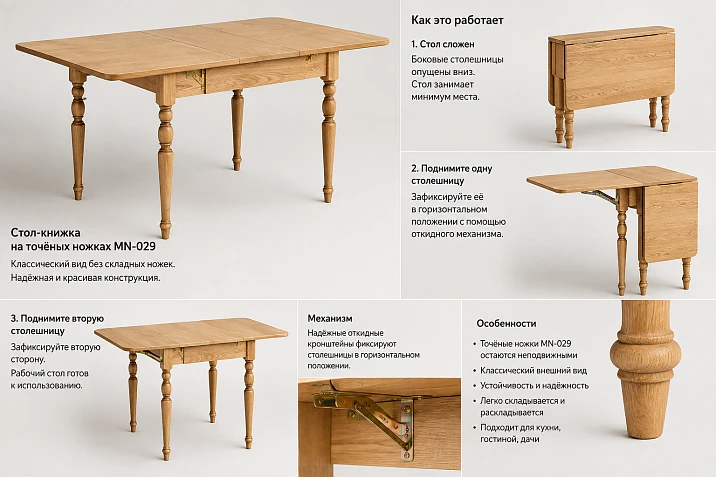
Legs for a book table are often searched for as if the supports themselves must fold, turn, or hide under the tabletop. In the photo, the turned MN-029 looks convincing: a tall wooden form, expressive silhouette, three size options, beech and oak. You want to choose four identical pieces, screw them to the tabletop — and get a beautiful folding table. But a book table has one fundamental secret: it is not necessarily the leg that folds; it is the entire pre-designed system that folds.
MN-029 can be used as a decorative wooden support in a book table project, a console with drop-leaf wings, or a compact folding table. The model itself is not claimed to be a folding leg. It has no confirmed hinge, pivot, latch, sliding rail, or rotating mounting plate. Therefore, the buyer orders not a "ready-made folding mechanism" but a turned support, which the designer includes in the stationary part of the base or attaches to a separate movable frame.
This difference decides everything. It determines the number of legs, the height of the finished table, the position of the aprons, the trajectory of the rotating support, the width of the folded body, the knee space, and even whether the side parts of the tabletop can be fully lowered. A beautiful profile does not forgive approximate calculations: bulky turned sections can hit the body, a neighboring leg, a hinge, or the edge of the tabletop.
The direct answer for the buyer is this: MN-029 is suitable for a book table as a static furniture support or as a leg mounted on a separately designed rotating frame. It does not fold by itself. The quantity and size are chosen only after the overall scheme is approved. If the project has not yet been developed, it is wiser to first determine the structure of the frame and tabletop, and then buy the turned furniture leg MN-029 in the required height, wood species, and quantity.
A book table starts with mechanics, not with four beautiful legs
An ordinary stationary table can be imagined as a tabletop resting on a fixed base. A book table changes geometry. In the folded position, it should take up little space, and in the open position, it should gain sufficient area and stable support at the edges. Between these states, the parts move, pass near each other, and lock into working points.
That is why the request "wooden legs for a book table" cannot be reduced to choosing height and material. Several independent components are involved in the project.
| Part of the structure | What it is responsible for | Why it cannot be attributed to MN-029 |
|---|---|---|
| MN-029 | Transfers load to the floor and forms the external appearance of the base | This is a separate turned wooden support |
| Central frame | Connects the fixed part of the table and maintains geometry | The frame is designed separately |
| Folding tabletop wing | Increases the working area | Moves on its own hinges or another mechanism |
| Rotating or sliding support | Supports the raised wing | Requires trajectory calculation and fixation |
| Tsargas and crossbars | Increase spatial rigidity | Their dimensions depend on the entire scheme |
| Fixator | Holds the movable support in the working position | Such an element is not declared in card MN-029 |
| Thrust bearing | Protects the bottom end and floor covering | Ordered as a separate item |
| Fastening | Connects the leg, frame, and tabletop | It is selected for a specific node |
A beautiful leg is only responsible for its own part of the work. It can become the main visual accent, but it will not replace hinges, side rails, mounting plates, and stability calculations. The sooner the buyer accepts this logic, the lower the risk of ordering four expensive supports that physically do not fit in the folded body.




Why search results show MN-029 for a query about a folding table
The search engine sees close signs: a tall furniture leg, application for a table and console, solid wood, several sizes. But search relevance does not mean the presence of a built-in mechanism. The card helps find a suitable support, but the table structure still has to be assembled as a separate project.
This is a normal situation for a furniture designer. One card describes a leg, another a tabletop, a third a floor protector, a fourth finishing materials. The finished product is born only after these items are combined with a drawing.
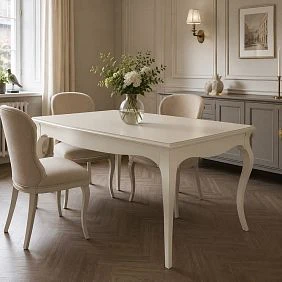
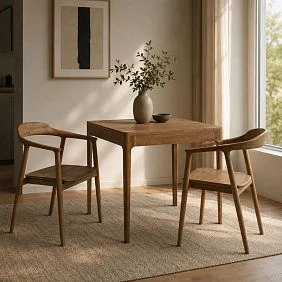
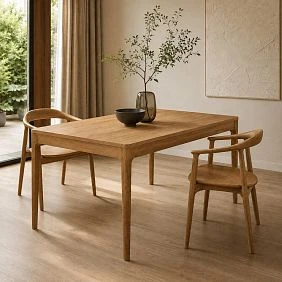
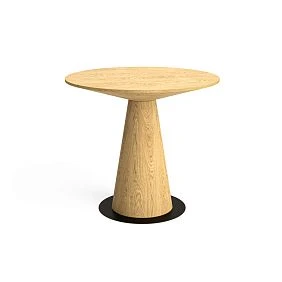
Our factory also produces:

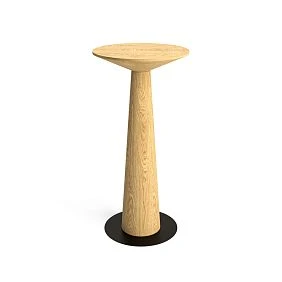
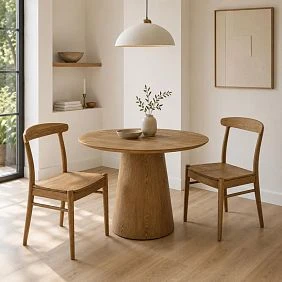
What exactly the buyer gets when ordering MN-029
MN-029 is a turned furniture leg made of solid wood. Its silhouette is built not on a simple straight post, but on changing diameters, belts, and rounded transitions. This shape creates an expressive vertical and makes the base a noticeable part of the furniture. On a console, the leg reads almost like an architectural column; on a folding table, it can turn a utilitarian folding item into full-fledged interior furniture.
The line confirmed by the card includes three sizes:
| Size A × B × F, mm | How height can be perceived in a project | What to be sure to check |
| 650 × 70 × 146 | Low console, work surface of special height, non-standard folding item | The final height together with the frame and tabletop |
| 740 × 80 × 167 | Support height close to a familiar table | Thickness of the tabletop, apron, and mounting assembly |
| 850 × 88 × 192 | High console, bar or special furniture | Ergonomics, stability, and compliance with the purpose |
Letters A, B, and F should be read according to the current drawing. You cannot independently declare B as the diameter of any specific part, and F as the size of the mounting platform, if the diagram is not open and the designations are not verified. For the buyer, it is safer to use the full dimension record and compare it with the drawing, rather than build the structure by guesswork.
Beech and oak are available. The card specifies the sanding quality "Prestige" and preparation for enamel. This information is important not only for appearance. It determines how the leg will fit into the overall finishing system: whether it will be covered with an opaque color, whether it will retain visible texture, and whether it will match the aprons and tabletop.
Get Consultation
What is not included in the meaning of the product item
MN-029 cannot be automatically considered a table set. Together with the leg, the following should not be expected by default:
-
folding mechanism;
-
hinges for the tabletop;
-
swivel frame;
-
pull-out support;
-
locks;
-
aprons;
-
tabletop;
-
mounting plates;
-
self-tapping screws and bolts;
-
ready finish coating;
-
set of glides for the entire table.
Each line of the order is checked separately. The card indicates associated glides FUR-022 and FUR-028, but the quantity of these parts must match the actual number of legs, not the usual formula of "four pieces per table."
Three working schemes for a book table with MN-029
A folding table has no single correct design. In one project, turned legs remain stationary. In another, they move together with the frame. In a third, only the tabletop wings unfold, while the base maintains a constant geometry. The choice depends on dimensions, load, storage space, and the furniture's style.
Scheme one: MN-029 stands on a fixed central body
The central part of the table remains narrow and stable. MN-029, aprons, and the main strip of the tabletop are attached to it. The side wings rise, supported by separate rotating or sliding elements.
This is the most understandable role for a turned support. MN-029 works as a regular leg: it does not move, does not pass through narrow gaps, and does not bear load from the hinge. The decorative profile can be positioned so that it is clearly visible in both folded and unfolded states.
The complexity shifts to the wing supports. They can be simpler in shape but must lock securely. If it is important to the customer that all visible legs look the same, the movable frames can also be designed with MN-029, but that is a different scheme and a different number of parts.
Advantages of stationary installation:
-
easier to maintain the geometry of the central body;
-
less risk of the turned profile catching when folding;
-
easier to match the aprons;
-
the leg is constantly visible and works as a decorative accent;
-
the load is transferred through the stationary base.
The limitation is obvious: one fixed base does not always support wide raised wings. So hidden or rotating supports are still needed.
Scheme two: MN-029 moves together with the rotating frame
In this variant, it is not the wooden leg that folds, but the entire frame structure. MN-029 is rigidly connected to the apron or vertical frame element. When the tabletop wing is lowered, the frame rotates inward. When the table is opened, the frame extends under the edge and becomes a support.
Visually, such a table is especially convincing: under the opened tabletop there are identical turned legs, not decorative supports next to simple technical props. But the project becomes more complex.
Need to check:
-
the radius of movement of the farthest point of the profile;
-
the position of the leg in the folded state;
-
gap between two movable frames;
-
collision with central crossbars;
-
space for hinges and latches;
-
no skew when turning;
-
ease of manual opening;
-
frame rigidity in working position;
-
position of the foot plate relative to the floor;
-
load distribution under the raised wing.
The turned shape requires a real template. A rectangular post can pass through a narrow corridor, but the convex belt MN-029 may catch an adjacent part. The cross-section should be checked along the entire contour, not just by the maximum dimension at one point.
Scheme three: fixed underframe and only the tabletop folding
Sometimes the tabletop folds within an existing support contour. The wings are relatively small, so separate pull-out frames are not used. MN-029 remain at the four corners of the frame.
This option is simpler in appearance, but it is not acceptable for every width. The farther the edge of the raised wing goes from the support, the greater the moment tending to overturn or deform the structure. Without an engineering calculation, a specific overhang cannot be declared safe.
This scheme is more suitable for small additional surfaces rather than a traditional drop-leaf table with large side halves. If the buyer needs a full dining area, separate wing support usually becomes a mandatory part of the project.
Which scheme suits your table
You can start the choice not with the mechanism, but with five questions.
| Question | If the answer is "yes" | What this leads to |
| Should the table be very narrow when folded? | The movable supports will have to hide inside | An accurate calculation of the frames and MN-029 profile is needed |
| Should all visible legs be identical? | Technical supports are undesirable | They are considering MN-029 on swivel frames |
| Will the table be unfolded daily? | The mechanism experiences regular load | Reliable latches and a convenient trajectory are needed |
| Is the tabletop heavy or wide? | A single central base is not enough | Support is designed under each wing |
| Is simplicity more important than full symmetry? | Decorative and technical supports can be separated | MN-029 is left stationary |
Don't try to make one leg solve all the tasks. Sometimes it's more elegant to leave MN-029 on the central body and hide a simple support mechanism. Sometimes, on the contrary, the interior requires identical turned legs in the open position. Both ideas are viable if the design is calculated.
Folding design for everyday use
A table that is opened twice a year and a table that changes position every day require different approaches to the mechanics. In the first case, the user can calmly open the frames and check each lock. In the second, speed, predictability, and the absence of complex actions are important.
For the everyday scenario, you need to decide in advance which part a person grabs with their hand. The turned leg should not become a lever: constant lateral force can loosen the joint. It's better to provide a convenient apron, handle, or section of the frame designed for gripping.
Also, check whether you have to lift a heavy wing with one hand while holding the support with the other. A beautiful table should not turn every opening into a small strength workout.
Book table for rare family gatherings
If the furniture serves as a console most of the time and is fully opened only on holidays, you can make the central body especially expressive. In this case, MN-029 is constantly in view and sets the character of the furniture even without opening.
Even with rare use, you cannot skimp on locking. A support that remains stationary for several months should easily transition to the working position and not get stuck due to finish, misalignment, or dirt.
Folding table for a small kitchen
Here, it's not just the folded width that matters. You need to check the passage, the radius of the cabinet door, the position of chairs, proximity to the radiator, and the ability to fully lower the wings. A tall turned profile looks elegant but takes up real volume.
In a small kitchen, the scheme with MN-029 on a fixed body is often more practical: decorative legs remain outside, while more compact technical supports are hidden inside. But the final choice depends on the drawing.
Height 650, 740, or 850 mm: why the leg size doesn't equal the table height
The card offers three heights, but finished furniture always consists of several vertical layers. The leg may rest against the apron, fit into the mounting unit, reach directly to the tabletop, or attach to the underframe. The thickness of the tabletop is added on top. Below is the foot pad, if its design increases the height.
Basic calculation logic:
Hfinished = Hleg + Hunit above leg + Ttabletop + Δfoot pad − Zrecess
Where:
-
Hleg — confirmed height of the selected MN-029;
-
Hunit above leg — height of the mounting platform, underframe, or other part;
-
Ttabletop — thickness of the top panel;
-
Δfoot pad — addition from the foot pad, if any;
-
Recesses are the part of the leg that enters the joint, if the project provides for it.
You cannot take 740 mm and write in the estimate "table 740 mm high." If there is a tabletop 40 mm thick on top, and the fastening does not recess the leg, the result will already be higher. The exact formula depends on the drawing.
MN-029, 650 mm high
This option may be suitable for a low console, a special work table, furniture for sitting at a non-standard height, or a project where a tall frame is located above the leg. It should not automatically be called dining height.
The advantage is a more compact scale and a stable visual base. The limitation is the need to check ergonomics. The user must understand what chair and what posture the furniture is being created for.
In a folding structure, a 650-millimeter leg may prove convenient if a tall box or decorative apron is located above it. But this does not mean that any missing height can be "made up" with a random strip. The upper joint must be part of the project.
MN-029, 740 mm high
This is the most obvious candidate for a table, but here too the final height depends on the upper joint. If the tabletop is attached directly above the leg, the structure may turn out taller than usual. If the leg fits into an apron or subframe, the result will be different.
Before ordering, it is useful to make a vertical section at a 1:1 scale at least on a sheet: floor, foot cap, leg, fastening, apron, tabletop. Such a drawing reveals an error faster than a long discussion of numbers.
In the folding table project, additionally mark the lower plane of the lowered wing. It should not press against the decorative top of the leg or the apron connected to it.
MN-029 with a height of 850 mm
A tall support is suitable for console, bar, or specialty furniture. In a fold-out table, it creates an expressive slender silhouette but increases requirements for stability and rigidity. The higher the center of lateral load application, the more noticeable possible swaying.
850 mm should not be chosen just because a tall leg looks more impressive in a photo. An appropriate tabletop, seat height, or usage scenario is needed.
For a tall console with one drop leaf, this option may be suitable. For a regular dining table, only after checking ergonomics.
Turned profile in motion: where unexpected collisions occur
The main feature of MN-029 is not just the height, but the voluminous shape. The leg has widenings, narrowings, and rounded sections. For a stationary console, this is a decorative advantage. In a folding structure, every protrusion becomes part of the kinematic contour.
Collision with the apron
The rotating frame may pass close to the central frame. If only the narrow part of the leg is measured, the wide band will hit the apron before the frame reaches the folded position.
Collision of two frames
A classic fold-out table may have two movable supports. Inside the narrow body, they must fit side by side or one behind the other. Symmetrical turned legs can intersect in one zone.
Collision with the lower surface of the wing
When lowered, the tabletop passes close to the support. A convex top of the leg or a high apron may prevent the wing from assuming a vertical position.
Reduction of legroom
In the open table, decorative supports may be closer to the user than they appear in the front sketch. Check knees, feet, chair placement, and the walkway around the furniture.
Impact of the floor glide on the floor
The movable frame must move without jamming. If the floor glide protrudes, it may catch on uneven flooring. However, one cannot simply abandon floor protection: the solution lies in the frame geometry and the chosen hardware.
Conflict with the baseboard and wall
The folded table is often placed flush against the wall. A turned leg may protrude beyond the body and prevent the furniture from approaching the baseboard. If the width of the folded table is calculated without accounting for the profile, the actual dimension will be larger.
Conflict with a handle or decorative trim
A drawer, door, or handle is sometimes placed on the central part. The rotating frame may pass behind them. Any protruding hardware must be indicated on the movement plan.
Template 1:1: the cheapest way to save an expensive project
Before purchasing the kit, cut out the MN-029 contour according to the current drawing. Thick cardboard, thin plywood, or sheet material that holds its shape will work. You need not a pretty mock-up, but an honest footprint.
Check two positions:
-
the table is fully folded;
-
the table is fully unfolded.
Between them, move the template along the entire trajectory of the rotating frame. Mark the places where it approaches the aprons, tabletop, and other supports. Leave the technological gaps assigned by the designer.
The mock-up is especially important for the 850 × 88 × 192 mm leg. The large profile takes up more space. But the 650 mm option cannot be considered automatically safe either: the body geometry can be very narrow.
How to make a volumetric mock-up without a turned part
A flat contour is sometimes not enough. You can cut several cross-sectional templates and connect them with a batten, obtaining a rough spatial model. It will show whether a convex section passes through an apron or a neighboring leg.
To check the appearance, it is enough to paint the mock-up in the intended color and place it next to the tabletop. This makes it clearer whether the profile is too heavy for a small body.
What to record after the mock-up
After the fitting, don't limit yourself to saying "it seems to fit." Write down:
-
minimum clearance;
-
frame opening angle;
-
latch position;
-
distance to the countertop;
-
support point;
-
space for the hand;
-
width of the folded body;
-
actual number of legs.
These figures carry over to the working drawing and specification.
How many MN-029 to order: the number depends on the support scheme
The usual formula "a table means four legs" doesn't work here. A book-table can have four fixed legs and two movable ones. It can stand on two side frames. It can use MN-029 only on the central body. Sometimes the project requires eight identical supports, and sometimes two.
Basic formula:
QMN = Qстац + Qлев + Qправ + Qпроч + R
Where:
-
Qстац — legs of the fixed part;
-
Qлев — MN-029 on the left movable support;
-
Qправ — MN-029 on the right movable support;
-
Qпроч — other points specified by the drawing;
-
R — reserve, if needed for the batch and finishing.
Calculation examples
| Diagram | Fixed MN-029 | Movable MN-029 | Total before reserve | Comment |
| Central body on 4 legs, technical supports for wings | 4 | 0 | 4 | All MN-029 remain stationary |
| Central body on 4 legs and two frames with one MN-029 each | 4 | 2 | 6 | In the unfolded state, six supports are visible |
| Two stationary and two rotating frames with one leg each | 2 | 2 | 4 | Requires a particularly rigid central frame |
| Four stationary and two frames with two legs each | 4 | 4 | 8 | Symmetrical, but takes up a lot of space inside |
| Console with one folding wing | As per project | 1 or 2 | According to the drawing | Not equal to a classic two-wing table |
| Table with a fixed underframe and small wings | 4 | 0 | 4 | Acceptability depends on overhang and load |
The table is not a ready-made engineering solution. It shows why you cannot click "4 pcs." before approving the scheme.
Is a reserve needed
For a single home table, a spare full leg is not always necessary. But for a batch of furniture, complex tinting, or a project that will be repeated, a reserve may be justified. This is especially important if all supports must match in shade and grain.
The decision is made not by percentage, but by risk:
-
can you quickly get exactly the same part later;
-
will the finish be repeated;
-
is a difference in texture allowed;
-
is there a risk of damaging the leg during assembly;
-
Is a control sample needed for painting?
Number of glides and number of legs
Glides are counted based on actual support points. If two movable frames are equipped with MN-029, their bottom ends also require protection. You cannot order six legs and automatically keep four glides in the estimate.
If some supports are technical and have a different shape, separate hardware should be selected for them. A general line item "glides — 6 pcs." without splitting by model can lead to errors.
Beech or oak: the material must follow the overall composition
Both wood species are available for MN-029, but choosing them only by price or name is wrong. A drop-leaf table does not consist of just one leg. Nearby are aprons, frames, the tabletop, decorative inserts, and sometimes a handle for opening. All parts must speak the same visual language.
Beech for enamel
Beech is well suited when the turned shape should be readable through the silhouette, and the natural grain will be covered by an opaque finish. Light or colored enamel unifies the legs with the aprons and the body.
The advantage of beech in such a project is the ability to focus on the rhythm of turned transitions. But even under enamel, it is better to order all parts in the same wood species and with similar preparation. Different bases may behave differently at joints and ends.
For this scenario, it is useful to order turned wooden legs without a finished coating and to agree on a test stain before assembling the entire batch.
Oak with visible texture
Oak is chosen when the wood should remain noticeable. Its grain adds depth to the table and makes each leg individual. On a large unfolded structure, oak supports become a strong visual base.
But the movable and fixed legs need to be laid out before finishing. If one side has a calm texture and the other an active one, the table may look random. For paired frames, parts are sorted by grain and fiber direction.
Can beech and oak be mixed
Technically, wood can be combined, but in one MN-029 set this is rarely justified. Under enamel, the difference may be less noticeable, but the behavior of surfaces and end grains remains different. Under a transparent finish, the mixing is immediately visible.
If the designer needs contrast, it is better to build it with large planes: for example, an oak tabletop and painted beech legs. Randomly replacing one leg with another species breaks the rhythm.
Material of the movable frame
The frame on which MN-029 moves must not only match in color. It has to maintain geometry under rotation and load. The material and cross-section are determined by the designer.
If the frame is painted together with the beech legs, the visual result is calm. If it remains oak, you need to decide how the joint will look in the folded state.
Preparation for enamel: what it gives and what it does not promise
The phrase "under enamel" does not mean that the leg is already painted. It is a characteristic of preparation for further finishing. The color, gloss, primer system, number of layers, and final result are determined separately.
The buyer needs to decide:
-
whether the entire structure will be monochromatic;
-
whether the tabletop will remain wooden;
-
whether the movable frames are painted together with the legs;
-
how the ends of the aprons are closed;
-
whether visible fasteners are allowed;
-
whether patina or another decorative effect is needed;
-
how to protect areas where parts move nearby.
Special attention — to hinge zones. A thick layer of finish should not interfere with movement and fixation. At the same time, exposed wood in the working assembly is also undesirable. The sequence of painting and assembly is determined by the craftsman after a test sample.
Why a test coat is done on a separate piece
Color on screen and color on a turned part are perceived differently. On convex areas light appears, in recesses — shadow. The same shade may look lighter on a roller and darker between belts.
A test coat helps to check:
-
shade;
-
gloss level;
-
the appearance of sanding marks;
-
transitions on end faces;
-
compatibility with aprons;
-
the look next to the tabletop;
-
the behavior of the coating in a movable joint.
First the sample is approved, then the whole set is painted. Otherwise, six legs identical in shape may get visually different surfaces due to uneven preparation.
Table frame: a beautiful leg needs a rigid system
MN-029 perceives vertical load, but the stability of the table depends on the connection between the supports. If four legs are simply screwed to a large tabletop without aprons and an underframe, the structure may become loose. For a folding table, the risk is higher: when opened, the user applies lateral force, and the wings increase the leverage.
In the catalog you can buy a table frame and study ready-made principles for constructing bases. But a ready-made stationary frame should not be automatically turned into a folding one. It helps to understand the role of aprons, underframe, and fastening zones, but the pivot mechanism is still designed separately.
What the central frame should provide
-
constant geometry;
-
connection of fixed legs;
-
support for the central part of the tabletop;
-
place for attaching wing hinges;
-
space for folded frames;
-
no skew when opening;
-
convenient access to the mechanism;
-
sufficient legroom.
Why the apron is more important than it seems
The apron doesn't just cover the space under the tabletop. It connects the legs and resists wobbling. But an apron that is too high reduces knee space and can interfere with the swivel frame. One that is too low doesn't provide the needed rigidity. Its size cannot be chosen based on appearance alone.
The central frame as part of the design
When folded, it is the narrow base that remains visible. If it looks like a technical box, turned legs won't save the composition. A good design continues their rhythm in the aprons, front, side panels, and tabletop.
At the same time, the decor should not block access to the mechanism. A removable panel, hidden mounting area, or a well-thought-out inner side make maintenance possible without damaging the finish.
Tabletop: the folding surface must align with the base
The wings of a drop-leaf table determine the load on the movable supports. The wider and heavier they are, the more serious the requirements for the frame, hinges, and locking. The material, thickness, and grain direction affect the weight and behavior of the part.
At STAVROS you can choose a wooden tabletop For a furniture project, but a standard solid tabletop cannot be declared a ready-made kit for a book table without verification. The folding surface requires division into a central part and wings, edge processing, and a separate mounting scheme.
What dimensions need to be recorded
-
the length of the table when unfolded;
-
the width of the unfolded surface;
-
the width of the central fixed part;
-
the width of each wing;
-
The thickness of the tabletop;
-
the position of the folding lines;
-
the overhang of the wing beyond the support;
-
the distance to MN-029;
-
dimensions in the folded state;
-
height from floor to lower surface.
Without this data, it is impossible to honestly choose either the number of legs or the mechanism.
Appearance of the edge in the folded state
The lowered wings become vertical planes. Their edge and underside are more visible than on a regular table. The finish needs to be designed for two positions.
If the tabletop is wooden, the pattern on the central part and wings should be coordinated before cutting. If it is painted, the hinge lines and joints should look neat and not create random gaps.
Hardware and floor glides: small details change the operation of the entire table
Card MN-029 offers a round floor glide FUR-022 and a felt one FUR-028 as necessary hardware. They solve different practical tasks, so they should not be perceived as two names for the same part.
Round floor glide FUR-022
Buy floor glide FUR-022 for MN-029 can be used to protect the lower end of the support and contact with the floor. Before ordering, you need to check the fit, the method of attachment, and how the part affects the height.
For the movable frame, additionally check whether the glider catches on the covering during turning.
Felt glider FUR-028
Order felt gliders FUR-028 It is reasonable when gentle contact with the floor and soft movement become the priority. But felt does not eliminate the need to check stability, surface cleanliness, and compatibility with the bottom end of the leg.
How many gliders to order
The quantity equals the total number of legs that actually touch the floor, plus an agreed reserve. If the table has six MN-029, four gliders are insufficient. If the movable technical supports have a different shape, different hardware may be needed for them.
To search for mounting plates, fasteners, and related elements, you can Buy hardware for furniture legs, but each item must be linked to the drawing, not added to the cart by a similar name.
What to buy together: the folding table project as a set
One MN-029 does not turn into furniture. The buyer assembles a system where each line of the estimate is responsible for a separate function.
| What to include in the project | Why it's needed | What to check | Inner page |
| MN-029 | Decorative load-bearing support | Size, wood species, quantity | Order wooden legs MN-029 for the table |
| Central frame | Connect fixed supports | Rigidity and space for frames | buy a table frame |
| Tabletop | Create a work surface | Division into center and wings | choose a wooden tabletop |
| Rotating or sliding support | Support folding parts | Trajectory and fixation | Designed separately |
| Hinges and fasteners | Ensure movement | Load and geometry | buy furniture hardware |
| Floor protectors | Protect legs and floor | Diameter, mounting, height | Cards FUR-022 and FUR-028 |
| Finishing materials | Prepare and coat wood | Compatibility with beech or oak | buy materials for finishing wooden legs |
| Design project | Connect mechanics and appearance | All table positions | Order a design project for a folding table |
The table does not replace the specification. It shows the route: first the function, then the part, after that the quantity and a reference to the required section.
Why mounting materials are chosen after the assembly
One composition may work well with wood, but not suit a metal plate, painted surface, or another substrate. You cannot choose an adhesive based only on the word "furniture."
For each joint, two values are recorded
The interior character of MN-029: folding furniture does not have to look temporary
The folding table is often associated with a compromise: a rectangular slab, simple supports, minimal decor. MN-029 changes this perception. Turned verticals give the furniture a permanent, "real" character. Even when folded, the narrow console can look like a finished piece.
In the hallway
The folded table works as a console. A lamp, key holder, or decorative composition can be placed on it. When an additional surface is needed, the wing is opened. The height is chosen according to the scenario: 740 mm is closer to a table, 850 mm — to a tall console.
In the living room
The table can stand against a wall and be opened for a family dinner. Here, the view in both states is especially important. The central body should not look like a random box, and the movable frames should not protrude outward.
In the kitchen
Daily opening requires convenient mechanics and a finish designed for cleaning. The turned profile is beautiful, but it has more horizontal transitions than a straight leg. Maintenance needs to be considered in advance.
In a study
One wing can turn the console into a work desk. The support should not fall into the leg and cable area. A design with a single rotating frame often differs from a classic two-wing table.
In the bedroom
Folded furniture can work as a vanity console, and unfolded — as a surface for work or crafts. Oak texture creates a more natural look, painted beech — a lighter one.
In a restaurant or a small salon
Folding furniture saves space, but commercial use raises requirements for stability and the mechanism. You cannot transfer a home design without calculating load and opening cycles.
Project route: from idea to specification
A good book table does not start with a basket. It starts with two drawings: the furniture in folded state and the same furniture after unfolding. Between the drawings lies all the mechanics, due to which an ordinary turned leg either becomes a successful choice or turns into an obstacle.
First, describe the two states of the table
Draw top and side views. Indicate length, width, and height in folded and unfolded positions. Separately mark the position of each MN-029. If the leg changes place with the frame, show the starting and ending points.
Do not limit yourself to a pretty perspective. A working sketch should answer questions: where the wing lowers, where the hinges are, what holds the tabletop, and how much space remains between the frames.
Then determine the central fixed part
Its width determines how much space remains for rotating elements. A too-narrow body looks compact, but two bulky MN-029s may physically not fit inside. A too-wide body loses the point of a book table.
The central part must be rigid enough not to change geometry when opened. It does not just store the frames; it ties the table into a single system.
After that, divide the tabletop
Fix the width of the center and each wing. The wider the wing, the farther its edge moves from the support. This affects load, frame position, and seating comfort.
Fold lines should be where hinges do not conflict with aprons and leg attachments. The underside of a lowered wing also becomes a visible part of the furniture.
Choose a support scheme
Write down specifically: four MN-029s stand still; two additional MN-029s move on frames; or all decorative legs are only on moving elements. The phrase "legs will be somewhere inside" is not suitable for an order.
Calculate the height
Use the full vertical assembly, not a single number from the card. At this stage, choose 650, 740, or 850 mm.
Check the kinematics
Kinematics is the movement of parts. For the buyer, a practical question is enough: does the leg move from the folded position to the working position without hitting anything? A 1:1 template gives the answer faster than complex words.
Assemble the materials map
Beech or oak, enamel or visible texture, apron material, tabletop color, type of foot. All decisions are recorded before payment.
Create a list
The list must have separate lines:
-
MN-029 fixed;
-
MN-029 on the left frame;
-
MN-029 on the right frame;
-
FUR-022 or FUR-028;
-
central frame;
-
tabletop parts;
-
hinges;
-
locks;
-
mounting hardware;
-
finishing materials;
-
reserve.
Make a control node
Before processing the entire set, assemble one side. Check not only the movement, but also the appearance: does the frame seem too heavy, does the apron cover the turned profile, is the leg too close to the seated person.
Only then place the full order
This order may seem slower than buying "by eye," but it saves time on rework. A mistake in a cardboard template costs a few minutes. A mistake in a painted oak frame costs much more.
Practical scenarios for choosing legs for a book table
Need a compact table for a small apartment
Make the central part narrow, but first check the space for the frames. MN-029 with a height of 740 mm may suit the look, but its turned profile requires space. If the internal volume is limited, leave the decorative legs stationary and support the wings with a more compact unit.
Need a console that sometimes becomes a table
You can leave MN-029 on the stationary part and unfold one wing on a separate support. Such an item is closer to a transformer console than to a symmetrical book table. To compare models, you can buy legs for a console after checking the height and silhouette.
All legs must be identical
Design swivel frames with MN-029. Increase the internal space in advance and check for collisions. The quantity may increase to six or eight parts.
In the folded state, the movable supports must not be visible
The frames will have to be moved inside the housing. A turned profile will require more clearance than a straight post. Sometimes, for a clean side view, the width of the central part has to be increased.
The tabletop is heavy
Do not limit yourself to individual legs. A frame that distributes the load and confirmed support for the wings is needed. A beautiful profile does not compensate for a weak base.
The table is painted in one color
Beech MN-029 under enamel can be combined with painted aprons and the housing. A test paint-out is mandatory. Movable and fixed parts must look the same under different lighting.
The tabletop is oak and remains natural
Oak legs will support the material, but their grain needs to be sorted. An alternative scenario is painted legs and a contrasting oak top. This separation looks intentional and does not require random matching of all shades.
Tall furniture is needed
MN-029 850 mm is suitable only after checking the purpose. It could be a console or a bar surface, but not a regular dining table. The tall folding structure is especially sensitive to lateral force.
Mistakes that cause the table to not fold or lose stability
Mistake 1. Ordering four legs before the drawing
The number of supports is determined by the scheme. As a result, six or eight MN-029s may be needed, and the four already purchased parts will turn out to be only part of the set.
Mistake 2. Considering MN-029 a folding mechanism
The built-in hinge and lock are not specified. The leg can only move together with a separately created frame.
Mistake 3. Choosing 740 mm as the ready table height
The tabletop and mounting assembly are added on top. The final mark may differ noticeably.
Error 4. Not accounting for size F
The full geometry is given by three parameters. Ignoring one value can lead to a conflict with the frame.
Error 5. Checking only the front view
The table folds in plan. Top and side views are needed, as well as the movement trajectory.
Error 6. Not making a rotation template
The leg passes through space, not instantly moving from one position to another. The convex part can hit the apron.
Error 7. Making the central body too narrow
Two bulky frames will not fit inside. The table will remain half-open or require rework.
Error 8. Placing a high apron in the leg's path
The frame will hit and not close. The apron height is related to both rigidity and movement.
Error 9. Leaving a wide wing without support
A large overhang creates load on hinges and the central body. A separate support is needed.
Error 10. Not fixing the opened frame
The pivot support must not spontaneously move out of the working position under a lateral push.
Error 11. Mixing MN-029 heights
650, 740, and 850 mm cannot be used at the same level without a specially calculated structure.
Error 12. Mixing beech and oak randomly
After finishing, the difference will become noticeable. It will be especially evident under a transparent coating.
Error 13. Ordering floor glides for only four legs
If there are six supports, six protective elements are also required, unless the project specifies another option.
Error 14. Not accounting for the height added by hardware
The foot and mounting plate can change the final level and cause rocking near another support.
Error 15. Choosing fasteners out of habit
The joint depends on the direction of loads, material of parts, and serviceability. A random screw does not become correct just because it matches in length.
Error 16. Painting everything before a trial assembly
Coating thickness and covered holes can hinder movement. Geometry is checked first.
Error 17. Assembling the mechanism directly on the finished countertop
This error will damage an expensive surface. A test piece is safer.
Error 18. Not leaving room for knees
A movable support may end up right in front of a seated person. The exploded top view should include chairs.
Error 19. Not checking the gender
Uneven surfaces, carpet, and soft flooring affect the support and movement of frames. The foot is chosen considering the actual surface.
Error 20. Considering a beautiful leg a guarantee of stability
Stability is created by the system: frame, distances, locks, fasteners, and the tabletop.
Error 21. Not sorting oak by grain pattern
Paired sides will look different. The layout is done before finishing.
Error 22. Ordering finishing materials after assembly
You need to know in advance which surfaces, edges, and moving zones are treated.
Error 23. Ignoring the folded state
The table can be beautiful when open and messy against the wall. The design is evaluated in two positions.
Error 24. Failure to check the delivery of the set
Legs, frame, and tabletop have different dimensions. Separate logistics complicates receiving and batch control.
Error 25. Copying someone else's table without dimensions
A visually similar structure may have different thicknesses, hinges, and load distribution. A photo does not replace a drawing.
Who MN-029 is suitable for as a book table
MN-029 is worth considering when an expressive turned silhouette is needed, and folding furniture should look like a full-fledged interior item. The model suits a project where the designer is ready to develop a separate mechanism, there is space for a voluminous profile, and the number of legs is determined by the drawing.
MN-029 is especially appropriate in the following situations:
-
the folded table works as a console;
-
the legs remain noticeable in both states;
-
a choice of three heights is required;
-
the type of wood is important;
-
the finish is done with one system;
-
a test assembly is planned;
-
the design should be classic, neoclassical, or eclectic;
-
technical elements can be hidden inside the body.
In which cases is it better to choose a different support
Another model is more reasonable if a ready-made folding unit is needed, the central body is too narrow for a turned profile, or the project requires minimalist straight geometry. It is not worth insisting on MN-029 when heights of 650, 740, and 850 mm do not fit the calculation, or moving parts must pass through a very small gap.
An honest refusal of an unsuitable leg is better than trying to rework it on site. In the general catalog, you can order solid wood furniture legs and compare other shapes, sizes, and purposes.
How to place order MN-029 at STAVROS
Select the exact size
Not "approximately table height", but the full line A × B × F. Check the drawing and the final furniture height.
Determine the material
Beech is for painted or calm compositions, oak is for visible texture. This is a design recommendation, not a prohibition on other finishing options.
Record the quantity
Separate stationary and movable supports. Add a reserve only when reasonably necessary.
Add foot pads
Match the quantity of FUR-022 or FUR-028 to the number of support points. Do not mix items without a reason.
Select the frame and tabletop
Do not count them as part of position MN-029. Each category is opened and calculated separately.
Clarify the mechanism
If there is no working drawing, you can Order a design project for a folding table and link the appearance to the actual kinematics.
Check the logistics
Before paying, it is worth calculate the delivery of furniture legs together with the frame and tabletop. Separate deliveries may complicate batch acceptance and shade control.
Acceptance of MN-029 before finishing
Upon receiving the order, do not immediately send the legs to the painting workshop. First, verify:
-
item MN-029;
-
selected height;
-
full dimensions;
-
material;
-
quantity;
-
sanding quality;
-
absence of noticeable damage;
-
matching of paired parts by overall tone;
-
straightness;
-
condition of the top and bottom ends;
-
set of thrust bearings;
-
compliance with the design specification.
Next, lay out the supports in place: front left, front right, movable left, and so on. For oak, this helps preserve the symmetry of the grain. Marking is applied so that it does not damage the face surface.
Test assembly before painting
Dry assembly shows what is not visible in the dimension table. Install legs or templates, assemble one frame, check opening and closing. Do not load an incomplete assembly as a finished table.
Check:
-
height alignment;
-
no rocking;
-
frame movement;
-
gaps;
-
position of thrust bearings;
-
leg room;
-
tabletop line;
-
symmetry;
-
view in folded state;
-
access to fasteners for maintenance.
Only after correcting the geometry do they proceed to final finishing.
Care for turned legs of a folding table
The turned profile has horizontal ridges where dust accumulates faster. For regular care, use a soft cloth and products compatible with the finish. Do not transfer recommendations for untreated wood to enamel or varnish.
The movable frames are inspected separately. If play appears, the problem may not be in MN-029, but in the hinge, latch, or apron connection. The leg should not be used as a lever for opening: grip the intended part of the frame or tabletop.
Clean the floor glides from sand. Felt with a hard particle can scratch the floor more than a clean rigid support.
FAQ: questions about MN-029 and the book table
Does MN-029 fold?
No. The card does not state a built-in folding mechanism. The leg can only move together with a separately designed frame.
Can MN-029 be used for a book table?
Yes, as a decorative support in a calculated design. You need to determine its position in the folded and unfolded state.
How many legs should I order?
According to the drawing. Schemes with four, six, eight, and other numbers of supports are possible.
Why can't I buy four pieces at once?
Because the side wings may require additional movable supports. Four legs are only suitable for one of the possible schemes.
What height is better for a regular table?
One leg height does not determine the final result. You need to add the tabletop and mounting assembly, then check ergonomics.
What does the size 740 × 80 × 167 mm mean?
This is the full A × B × F line for one modification. The letter decoding should be looked up in the current drawing.
Can I make a table exactly 740 mm high?
Only if the entire vertical assembly is designed for that mark. A 740 mm leg by itself does not guarantee a finished height of 740 mm.
Is MN-029 650 mm suitable for a dining table?
Not automatically. The final height and ergonomics must be checked with specific chairs, tabletop, and frame.
What is MN-029 850 mm used for?
For a high console, bar, or special furniture, if the project confirms such a height.
What to choose — beech or oak?
Beech is convenient for painted compositions, oak — when pronounced texture is important. The decision is coordinated with the tabletop and aprons.
Is the leg already painted?
There is no reason to consider it a finished painted part. The card specifies preparation for enamel.
Can oak be coated with a transparent finish?
The possibility and coating system must be coordinated with the finisher and current recommendations for the selected material.
Is the frame included in the MN-029 set?
No. The frame is selected or designed separately.
Is folding hardware included?
Not specified. Hinges, latches, and the pivot mechanism are calculated separately.
Which floor glides are suitable?
The card offers FUR-022 and FUR-028. Fit and height impact are checked before ordering.
How many thrust pads are needed?
One for each corresponding leg, plus a spare if necessary.
Can MN-029 be installed on a swivel frame?
Yes, if the frame is rated for its dimensions, load, and trajectory.
Why make a 1:1 template?
To check collisions of the turned profile with the frame, tabletop, and adjacent frame before purchasing the batch.
Can the leg height be reduced by cutting?
Do not plan modifications without checking the drawing and shape. Cutting may disrupt proportions and the seating area.
Will a ready-made stationary frame fit?
It can serve as a starting point, but it does not become foldable without separate mechanism design.
Can one MN-029 be used under each wing?
The possibility depends on the width, mass, and rigidity of the frame. There is no universal answer without calculation.
What to do if two frames collide inside?
Increase the central body, change the trajectory, the number of supports, or choose a more compact leg.
Do I need to buy legs in one batch?
For identical finish and appearance, this is reasonable, especially when using oak.
When to perform the final finish?
After the test assembly and checking all moving parts.
Will MN-029 fit for a console without folding?
Yes. This is a natural scenario for a tall turned support. In the category, it can be compared with other models for console furniture.
Where can I see other furniture legs?
In the general section, you can compare the height, shape, material, and purpose of different solid wood supports.
Is a professional project needed?
It is especially useful for heavy tabletops, daily opening, movable frames with turned legs, and serial production.
What should I specify to the STAVROS manager?
Article number, size, material, quantity, purpose, installation diagram, selected floor glides, and finishing requirements.
Can I order one leg as a sample?
Terms and availability are checked in the product card. For a complex project, a sample helps assess the real scale and movement.
How do I know the project is ready to order?
You should have four fixed decisions: the table layout, the chosen height, the calculated quantity of MN-029, and a list of individual components.
Final decision: buy the support after the folding unit has been designed
MN-029 can make a folding table expressive. The turned silhouette transforms folding furniture from a temporary compromise into a piece that fits in a living room, hallway, study, or dining room. Three sizes offer freedom: 650 mm — for low and special projects, 740 mm — for dining room logic after calculating the total height, 850 mm — for tall consoles and special scenarios. Beech suits a painted composition, oak — for a project with a pronounced wood texture.
But the main advantage of MN-029 is revealed only in the right role. It is not a hinge, not a swivel plate, and not a ready-made mechanism. It is a wooden support. It can remain on a fixed body or move together with a separate frame. The structure folds, not the leg itself.
Before ordering, lock in six things: table dimensions in two states, frame layout, final height, number of supports, material, and hardware set. Then check the leg contour on a mockup, assemble a test joint, and only then place the entire batch.
At STAVROS, you can select MN-029, other wooden supports, a frame, tabletop, floor glides, and finishing materials as part of one cohesive project. This path does not promise a miraculous assembly from a single card. It offers something more valuable — the ability to create a folding table where the beauty of turned wood does not conflict with the mechanics but works together with it.