Article Contents:
- Why you need to measure the front panel, not the total width of the console
- 253 and 361 mm: the difference is more than 108 mm in length
- First check the height of the apron
- When the 253 × 35 × 8 mm version looks more convincing
- Low front panel
- Richly decorated legs
- There is a large decorative handle
- The console itself is narrow
- Need a light, not dominant accent
- Wide free apron
- The height of the bar allows placing 50 mm without crowding
- The legs themselves are large
- There is no handle or other active elements on the facade
- The table is viewed from some distance
- Why a rectangular template is enough for the first test
- Incorrect scale
- Random position
- Different finish
- The ornament is not supported by anything
- The front bar is too low
- The free field is too short
- The handle occupies the center
- The table is already decoratively saturated
- The furniture style is too minimalist
- Need not a central detail, but a long continuous ornament
- Painting in furniture color
- Contrast painting
- Step 1. Measure the total width of the console
- Step 2. Measure the free space between the legs
- Step 3. Measure the height of the front panel
- Step 4. Find the drawer
- Step 5. Mark the position of the handle
- Step 6. Make two templates
- Step 7. First place both by geometric center
- Step 8. Take photos
- Step 9. Check the thickness
- Step 10. Compare four solutions
- Step 11. Only now choose the product
- Mistake 1. Counting from the total width of the tabletop
- Mistake 2. Comparing 253 and 361 mm only by length
- Mistake 3. Not considering the handle
- Mistake 4. Buying two small parts instead of one large one without calculation
- Mistake 5. Choosing a large size only for an expensive or massive table
- Mistake 6. Trying to fix a small overlay with contrasting paint
- Mistake 7. Gluing decor before checking drawer opening
- Which NPU-074 size is better for a console 900 mm wide?
- Can NPU-074 be used on a drawer front?
- What to choose if the free field is about 400 mm?
- Do I need to leave equal margins on the right and left?
- Can two NPU-074 253 mm be installed?
- What to do if 253 mm looks too small, and 361 mm too big?
- Does the thickness of 8 and 10 mm matter?
- Can the NPU-074 be left in a different color than the table itself?
- Which version is more cost-effective?
- Is it mandatory for the pad to be positioned strictly in the middle?
- How to try on the NPU-074 if the product hasn't been purchased yet?
- What matters more — the width of the pad or its height?
- When is it better to choose a wooden pad instead of the NPU-074?
- Can the NPU-074 be glued onto an already painted console?
- When is the NPU-074 not needed at all?
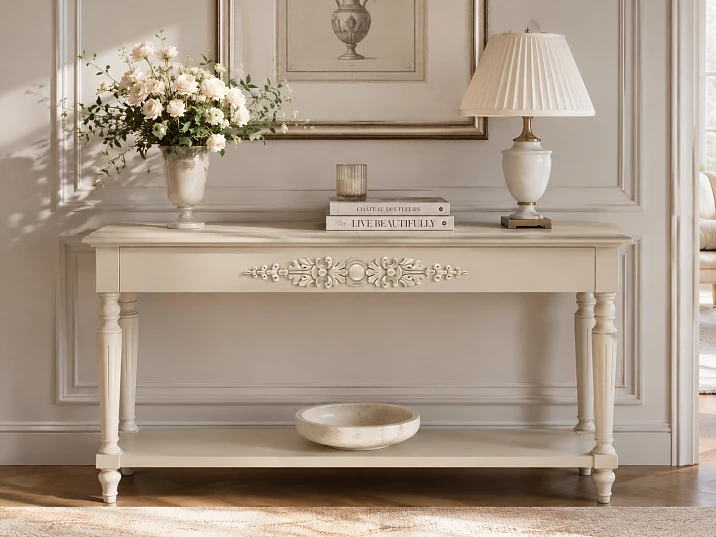
A console table can be well assembled, have a suitable tabletop and beautiful legs, but still look unfinished. The reason is often right under the tabletop: a long smooth front rail remains visually empty and does not connect the left and right parts of the furniture.
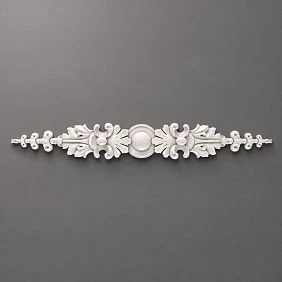
Usually there is no need to completely redo the underframe for this problem. If the structure itself is satisfactory, you can change only the front part and add one carved polyurethane overlay NPU-074 in the center.
NPU-074 comes in two sizes:
| NPU-074 option | Size | Material | Price |
|---|---|---|---|
| Compact | 253 × 35 × 8 mm | Polyurethane | 920 ₽ |
| Large | 361 × 50 × 10 mm | Polyurethane | 1 290 ₽ |
The choice between them cannot be reduced to the rule "a wide table gets a large overlay." The 361 mm version is not only longer. It is 15 mm taller and has a more pronounced thickness dimension: 10 mm instead of 8 mm. Therefore, the two NPU-074s fill both the horizontal space between the legs and the height of the front rail differently.
For the correct choice before ordering, four measurements are needed:
-
free width of the front rail between the legs or other constraints;
-
actual height of this bar;
-
position and size of the drawer, if present;
-
clear space around the handle, lock, or other facade element.
After that, it's enough to make two paper templates — 253 × 35 mm and 361 × 50 mm — and try them directly on the furniture.
This makes it clear not only which NPU-074 physically fits, but also which one actually looks like part of the table rather than a random overlay glued on top of finished furniture.
Why you should measure the front panel, not the overall width of the console
The most common mistake starts with the characteristics of the table itself.
The buyer knows: the console is 900 mm wide. They see the NPU-074 is 361 mm long and conclude it will take up about 40% of the width, so it should look fine.
But the overall width of the tabletop almost never equals the useful width for decor.
The console may have:
-
wide legs;
-
protruding capitals;
-
shaped connections under the tabletop;
-
internal decorative protrusions;
-
drawer;
-
handle;
-
technological gaps;
-
existing moldings or edges.
Therefore, you need to calculate the free decorative field, that is, the section of the front panel where the overlay can actually be placed without conflicting with neighboring elements.
Suppose:
-
total console width — 900 mm;
-
after the legs and structural offsets, 620 mm of flat central surface remains.
It is 620 mm, not 900 mm, that should be used in the NPU-074 comparison.
For the 253 mm option:
620 − 253 = 367 mm
With precise centering:
367 / 2 = 183.5 mm
That is, approximately 183.5 mm remains on each edge.
For the 361 mm variant:
620 − 361 = 259 mm
After centering:
259 / 2 = 129.5 mm
Approximately 129.5 mm remains on each edge.
Both overlays physically fit. But the visual result is different.
The 253-millimeter version leaves noticeably more calm surface.
The 361-millimeter one fills the middle more strongly and becomes a more significant part of the front panel.
So, the task of the article is not just to determine whether it "fits or doesn't fit." We need to understand what proportion of the free zone the carved decor should occupy.




253 and 361 mm: the difference is more than 108 mm in length
Between the two NPU-074 variants horizontally, the difference is:
361 − 253 = 108 mm.
The large overlay is approximately 42.7% longer than the compact one relative to the 253 mm size.
But if we consider only this figure, the choice will still be incomplete.
The vertical size also differs:
50 − 35 = 15 mm.
The 361 mm version is approximately 42.9% taller.
By the third dimension:
10 − 8 = 2 mm.
That is, the increase occurs in all three dimensions at once.
| Parameter | NPU-074 253 mm | NPU-074 361 mm | Difference |
|---|---|---|---|
| Length | 253 мм | 361 мм | +108 mm |
| Height | 35 мм | 50 мм | +15 mm |
| Thickness | 8 мм | 10 мм | +2 mm |
| Price | 920 ₽ | 1 290 ₽ | +370 ₽ |
Therefore, the 361 mm version cannot be perceived as the same part, just slightly stretched horizontally.
On the low front panel, it is the additional 15 mm of height that can be decisive.
On the wide high apron, on the contrary, the 253 × 35 mm version may look too delicate.
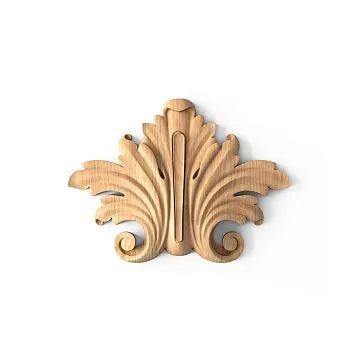
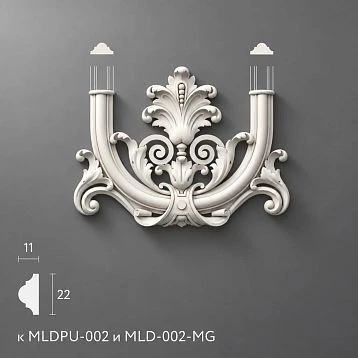
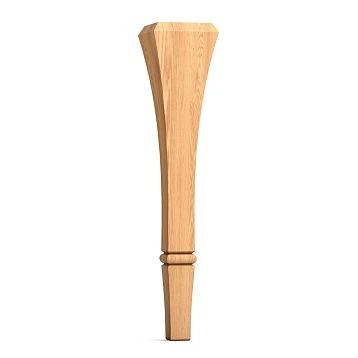
Our factory also produces:

First, check the height of the drawer front.
For horizontal decor, the buyer usually first looks at the length. But in real furniture, the height often becomes the limiting factor.
Suppose the free face area has a height of 70 mm.
For NPU-074 with a height of 35 mm and central placement, the remaining space will be:
(70 − 35) / 2 = 17.5 mm
at the top and bottom.
For NPU-074 with a height of 50 mm:
(70 − 50) / 2 = 10 mm
The second version also fits, but visually it will fill most of the height.
Now let's imagine a front panel with a height of 100 mm.
We get:
| Height of the free area | Top/bottom field with NPU-074 35 mm | Top/bottom field with NPU-074 50 mm |
|---|---|---|
| 60 мм | 12.5 mm | 5 мм |
| 70 мм | 17.5 mm | 10 мм |
| 80 мм | 22.5 mm | 15 мм |
| 90 мм | 27.5 mm | 20 мм |
| 100 мм | 32.5 mm | 25 мм |
| 120 мм | 42.5 mm | 35 мм |
The table does not set a universal minimum margin. It shows something else: the same console width does not yet determine the correct NPU-074 option.
If the front rail is low, 361 × 50 mm can look very tight.
If it is high, 253 × 35 mm can visually get lost.
Therefore, choosing a size only by the distance between legs is not enough.
Get Consultation
When the 253 × 35 × 8 mm version looks more convincing
The compact NPU-074 is suitable not only for small tables.
It should be considered when the furniture itself requires calmer decor.
Low front rail
With a limited height, the 35-millimeter decor leaves more free surface and comes closer to the top or bottom edge less.
Richly decorated legs
If the legs already have noticeable carving, fluting, capitals, or complex shapes, the front rail does not necessarily need to compete with them.
A compact overlay can merely mark the center.
There is a large decorative handle
On a facade with a noticeable handle, a second large element can overload a small area.
The console itself is narrow
On a small piece of furniture, too large a central decor can visually reduce the free margins between the overlay and the legs.
A light, not dominant, accent is needed
253 mm leaves more "air" around the ornament. This is especially useful if the decorative task is not to fill the entire rail, but to eliminate the feeling of an empty middle.
When it is wiser to choose NPU-074 361 × 50 × 10 mm
The larger version is needed not because it is more expensive or more noticeable.
It is justified when the surface itself allows for a larger scale.
Wide free apron
If there is 600–700 mm or more left between the legs, the 253-mm overlay may occupy a relatively small central part.
361 mm brings the composition together more strongly.
The height of the strip allows 50 mm to be placed without crowding
This works especially well on massive furniture, where a small flat overlay can get lost.
The legs themselves are large
The more massive the side supports, the more visual weight falls on the edges of the table. A larger central decor helps tie them together.
There is no handle or other active elements on the facade.
If the front panel is completely clean, the NPU-074 can become its main focal point.
The table is viewed from some distance.
A fine ornament appears calmer when viewed from a distance. A larger version retains a noticeable silhouette better if the console is placed, for example, in a hallway or along a free wall and is visible from the door.
Selection table based on free width between legs.
Arithmetic alone cannot solve the design question, but the table helps quickly understand the difference in filling.
The calculation below assumes that the NPU-074 is installed exactly in the center of the free field.
| Free field | Fields with NPU-074 253 mm | Fields with NPU-074 361 mm | What to Check |
|---|---|---|---|
| 400 мм | 73.5 mm each | 19.5 mm each | 361 mm may look too tight |
| 450 мм | 98.5 mm each | 44.5 mm each | Both fit, but the character is very different |
| 500 мм | 123.5 mm each | 69.5 mm each | Good range for comparing templates |
| 550 мм | 148.5 mm each | 94.5 mm each | 253 mm becomes a more local accent |
| 600 мм | at 173.5 mm | at 119.5 mm | The large version gets more air |
| 620 мм | at 183.5 mm | at 129.5 mm | Both variants are physically free |
| 650 мм | at 198.5 mm | at 144.5 mm | 253 mm may seem small on a massive console |
| 700 мм | by 223.5 mm | by 169.5 mm | For large furniture, it is worth carefully checking 361 mm |
| 800 мм | by 273.5 mm | by 219.5 mm | One small decor item already becomes very local |
This table should not be turned into an instruction like "at 600 mm, you must buy 361 mm."
For example, a free field of 650 mm on a thin console and the same 650 mm on a heavy classic table are perceived completely differently.
But the table helps to see the main thing: as the surface increases, the character of the two options begins to diverge more and more.
The best way to choose a size is to make two 1:1 templates
No product card photo shows the real scale on your furniture.
So before buying, it's useful to spend a few minutes on a simple fitting.
Cut out from paper or thin cardboard:
-
a rectangle 253 × 35 mm;
-
a rectangle 361 × 50 mm.
Attach the first one to the center of the free space with masking tape.
Step back a few steps.
Take a photo of the table.
Then replace it with the second one.
It will immediately become visible:
-
which size matches the mass of the legs;
-
isn't it too empty around 253 mm;
-
isn't it getting too tight around 361 mm;
-
doesn't the large version conflict with the drawer;
-
how the proportion of the entire console changes.
Why a rectangular template is sufficient for the first test
The real NPU-074 has a shaped carved silhouette, so it will visually be lighter than a solid rectangle.
But the first test is needed to assess the maximum occupied footprint.
If a 361 × 50 mm rectangle is already almost pressed against adjacent parts, the real overlay won't cancel the overall density problem.
If there is still a large margin around the template, you can move on to a more precise assessment of the pattern.
Do not center the overlay relative to the tabletop automatically
Suppose:
-
tabletop — 1000 mm;
-
legs shifted inward;
-
clear apron between them — 650 mm.
If you place NPU-074 in the center of the entire tabletop, it will indeed coincide with the middle of the apron only with a perfectly symmetrical design.
But a real console table may have:
-
asymmetric legs;
-
side drawer;
-
decorative cabinet;
-
additional stand;
-
visually unequal margins.
Therefore, the first reference point should be the center of the surface to which the overlay belongs.
If the decor is located on the apron between two legs, first find the center of that exact field.
Then compare it with:
-
the center of the tabletop;
-
the center of the entire console;
-
the axis of the wall;
-
the mirror or painting above the table.
In good symmetrical furniture, these axes usually coincide.
If they do not coincide, a paper template will help you understand which placement looks more meaningful.
What to do if the console has a drawer
The drawer fundamentally changes the task.
The front panel may turn out to be not a fixed apron, but a facade.
Then the NPU-074 will move together with the drawer.
This in itself is not a problem, but before purchasing you should check:
-
facade height;
-
handle position;
-
facade edge;
-
the gaps around it;
-
the method of opening;
-
whether it is necessary to press directly on the central part.
Pay special attention to the handle.
If it is located strictly in the center of the facade, exactly where the ornament should be, a conflict between the two elements arises.
In this case, you cannot simply stick the NPU-074 on top of the existing solution.
You need to choose one of the options:
-
use a smaller NPU-074 and keep the handle;
-
change the height of the overlay;
-
choose an overlay with a different pattern;
-
move or replace the handle if the design allows it;
-
abandon NPU-074 on this facade.
The handle and overlay should be perceived as one composition
If a handle remains on the drawer, measure distances not only from the edges of the overlay to the legs.
Check the mutual position:
overlay → handle → edges of the facade.
A bad option is when the handle almost touches the ornament but is not part of it.
Such a small random gap often looks worse than either a confident distance or a pre-designed integration.
A paper template is especially useful here.
Draw the handle position on it or place the template directly around the existing hardware.
If the drawer opens by pushing
Furniture without handles may use push-to-open mechanism.
In this case, before installing NPU-074, you need to determine where a person actually presses with their hand.
If the working area coincides with the relief panel, using the drawer may become less convenient.
Do not make a decision just because the decor physically fits.
Open the drawer several times in your usual way and see where your hand naturally goes.
If this is the central part of the facade, a large 361 × 50 × 10 mm piece can take up a significant portion of the work area.
The compact version sometimes leaves more free surface.
A thickness of 8 or 10 mm also affects the result.
The difference of just 2 mm seems small.
But for furniture decor, the third dimension affects two things:
-
the amount of shadow around the relief;
-
how clearly the overlay protrudes relative to the smooth surface.
On a thin, elegant console, the 10 mm version may be perceived as more prominent, especially with side lighting.
On massive furniture, this, on the contrary, can help the decor not get lost.
If there is a drawer under the tabletop, additionally check that the protruding relief is not in the area where the user grips with their hand.
How to avoid the feeling that the detail was simply glued on top
This is one of the main risks of any ready-made furniture decor.
Even a beautiful overlay looks alien if there is no compositional connection between it and the furniture itself.
Usually the problem arises for one of four reasons.
Incorrect scale
A too small detail looks like a random icon in the center of a large field.
A too large one seems like an attempt to fill the entire surface at any cost.
Random position
If the distances to the legs differ without a clear reason, the overlay is perceived as a later addition.
Different finish
For example, the furniture has a calm matte finish, while the overlay is left in a different state or stands out too sharply.
The ornament is not supported by anything
On a minimalist console with perfectly straight metal legs, a classic carved overlay may appear stylistically isolated.
Therefore, before purchasing, evaluate not only the free millimeters but the entire piece of furniture.
One NPU-074 or two small overlays
On a wide apron, the idea may arise to use two NPU-074 253 mm instead of one 361 mm.
This is not always mathematically possible and compositionally solves a completely different task.
One central NPU-074:
-
creates one axis;
-
connects two legs through the middle;
-
leaves calm side margins.
Two identical ones:
-
create rhythm;
-
require a separate center distance;
-
form an empty center between themselves;
-
need a wider surface.
Let's imagine a free field of 800 mm.
Two plates of 253 mm each occupy:
253 × 2 = 506 mm
remains:
800 − 506 = 294 mm
But these 294 mm now need to be distributed across at least three sections:
-
from the left;
-
between the overlays;
-
from the right.
This is already a full-fledged compositional task.
Therefore, you should not buy two small pieces just because one seems not large enough.
First, compare one version of 361 mm.
If it also seems small, perhaps a different decor format is needed, not an increase in the number of NPU-074.
When you should not choose NPU-074 at all
A good product article should help not only to buy, but also to refuse an unsuitable solution in time.
The front strip is too low
If even the 35 mm high version looks squeezed between the top and bottom edges, it is better to choose another element.
Free field is too short
NPU-074 should not almost touch the legs.
The handle occupies the center
If the decorative element cannot be naturally connected to the hardware, consider a different overlay.
The table is already decoratively saturated
A complex tabletop, shaped legs, carved side panels, and active hardware may not need another ornament.
The furniture style is too minimalist
The overlay should enhance the item's character, not change its language with a random decorative fragment.
What is needed is not a central piece, but a long continuous ornament
NPU-074 is a separate overlay. If the task is to decorate the entire length of the apron, consider a different type of decor.
Polyurethane or wooden overlay
NPU-074 is made of polyurethane.
But a buyer who changes the appearance of furniture is not obliged to limit themselves to one material in advance.
If a carved furniture accent is specifically required, it makes sense to first understand what result is needed.
Polyurethane NPU-074 is convenient as a ready-made decorative element of a certain size and can be used in a paintable composition.
If the furniture concept requires natural wooden carved decor, you can separately look at wooden decorative overlays for furniture.
This does not mean that wood is automatically better for a wooden console, and polyurethane only for a painted one.
The choice depends on the specific finish, construction, and task.
The main thing is not to mix materials randomly just because two elements have a similar ornament.
Paint NPU-074 together with the table or separately
If the console is still in the process of manufacturing or restoration, it is more convenient to consider the overlay as part of a single finishing system.
This makes it easier to achieve an effect where the carved element looks built into the furniture.
If the table is already ready, the task is different: you need to either match the existing finish as precisely as possible, or deliberately make the overlay contrasting.
Painting in furniture color
This is the calmest option.
The ornament is read primarily through light, shadow, and its own form.
This way, NPU-074 looks less like a separate attached piece.
Contrast painting
Makes the overlay much more noticeable.
On the small 253 mm version, contrast can compensate for part of the visual lightness.
On the large 361 mm version, the same technique can make the central ornament dominant.
Therefore, it is better to make the decision about contrast after the size is approved.
Do not use color as an attempt to fix an incorrect proportion.
If 253 mm is objectively too small, brighter coloring does not turn this overlay into a 361-millimeter one.
Lighting changes the perception of relief
The console is often installed:
-
under the mirror;
-
next to a wall lamp;
-
in the hallway;
-
near a table lamp;
-
by the window.
Side light enhances shadows from the relief.
Therefore, the 361 × 50 × 10 mm version may seem more voluminous in the evening than in diffused daylight.
Before final painting, it is useful to look at the template or the overlay itself under the room's normal lighting.
This is especially true for contrasting coatings.
Installation on already painted furniture
The NPU-074 card provides for decorative installation, but the practical task always depends on the specific furniture surface.
Before gluing, you need to understand:
-
what the front panel is made of;
-
what it is painted with;
-
how firmly the existing coating holds;
-
whether the surface is even;
-
whether it is removable;
-
is there a movable facade nearby.
One should not assume that the mere fact of a polyurethane overlay automatically determines a suitable composition for any furniture coating.
The mounting material must be compatible with both NPU-074 and the substrate.
If the surface is already finished, it is reasonable to first test the system on an inconspicuous area or sample.
If the furniture is not yet painted
This scenario offers more freedom.
Allowed:
-
choose the size;
-
perform a dry fit;
-
mark the position;
-
prepare the base;
-
install the overlay according to the chosen technology;
-
then perform the overall finishing.
Due to the same color, the line between furniture and decor visually becomes calmer.
But even in this case, you cannot skip the full-size template.
The overall coloring unifies details by color, but does not fix incorrect scale.
How much does the choice between two versions cost
At the time of preparing the material:
-
NPU-074 253 × 35 × 8 mm — 920 ₽;
-
NPU-074 361 × 50 × 10 mm — 1,290 ₽.
The difference:
1 290 − 920 = 370 ₽.
At the level of a single product, the difference is relatively small compared to redoing the entire under-table.
But choosing the larger version just because it costs 370 ₽ more and seems “better value by size” is wrong.
The buyer does not pay for the maximum number of millimeters.
He chooses the size that fits the specific free field.
If 253 mm looks more proportional, the extra 108 mm of the large version is not an advantage.
Conversely, if the small overlay gets lost on a wide drawer front, saving 370 ₽ does not solve the decorative task.
Where to buy NPU-074
After measuring and comparing the two templates, you can buy the carved overlay NPU-074.
Both size options discussed are available in the product card, so before ordering it is important to double-check which variant is selected: 253 × 35 × 8 mm or 361 × 50 × 10 mm.
If NPU-074 does not fit in pattern or scale, you can look at other Polyurethane appliqués.
For a wider selection of interior items, you can You can buy ready-made stucco matching the Baroque style. Calculate the quantity: linear meters of cornices and moldings, number of rosettes, pilasters, consoles, corner elements. Add a ten to fifteen percent allowance for trimming..
It also makes sense to look for another molded decoration made of polyurethane, if one central overlay is not enough for a specific piece of furniture.
What size to put in the basket: a practical algorithm
To avoid choosing between 253 and 361 mm based only on a photo, go through the sequence completely.
Step 1. Measure the total width of the console
It will be needed to understand the overall scale, but not for the final calculation.
Step 2. Measure the free space between the legs
Exclude:
-
the legs themselves;
-
protruding decorative elements;
-
technical zones;
-
edges of the facade that cannot be overlapped.
Step 3. Measure the height of the front panel
Compare it with 35 and 50 mm.
Step 4. Find the box
If it exists, determine its actual boundaries.
Step 5. Mark the handle position
Measure not only its center, but also the full occupied dimension.
Step 6. Make two templates
253 × 35 mm and 361 × 50 mm.
Step 7. First place both at the geometric center
Do not shift them immediately for a nice result.
This makes it easier to compare the sizes themselves.
Step 8. Take photos
Look not only at the overlay, but at the entire console as a whole.
Step 9. Check the thickness
Especially if there is a drawer or a hand work area nearby.
Step 10. Compare four solutions
-
without decor;
-
NPU-074 253 mm;
-
NPU-074 361 mm;
-
a different format of furniture overlay.
Step 11. Only now choose the product
If the larger version clearly looks better and doesn't conflict with the facade, choose 361 mm.
If it fills the drawer front too tightly, and 253 mm creates a neat center, the smaller version will be a more precise purchase.
Mistakes when choosing NPU-074 for a console table
Mistake 1. Calculating from the total width of the tabletop
Why it happens: this is the most accessible furniture size.
Consequence: the overlay is chosen for a space that doesn't actually exist on the drawer front itself.
How to check: measure the clear field between the actual stops.
How to avoid: only calculate based on the decorative surface.
Mistake 2. Comparing 253 and 361 mm only by length
Why it happens: these numbers differ the most in the product card.
Consequence: the buyer does not take into account the height of 35 versus 50 mm and the thickness of 8 versus 10 mm.
How to check: make two full-size templates.
How to avoid: compare all three dimensions.
Mistake 3. Not taking the handle into account
Why it happens: the overlay and hardware are selected separately.
Consequence: two conflicting centers appear on the facade.
How to check: draw the handle directly on the template or try it around an existing one.
How to avoid: design the entire facade as one composition.
Mistake 4. Buying two small parts instead of one large one without calculation
Why it happens: it seems easier to fill a long rail this way.
Consequence: a new central gap appears and a completely different rhythm.
How to check: lay out two templates simultaneously.
How to avoid: first compare one NPU-074 361 mm.
Error 5. Choosing a large size only for an expensive or massive table
Why it occurs: the size of the decor is attempted to be linked to the price of the furniture.
Consequence: NPU-074 may not match the actual height and width of the apron.
How to check: use only actual dimensions and visual fitting.
Error 6. Trying to fix a small overlay with contrasting paint
Why it occurs: the desire is to make 253 mm more noticeable.
Consequence: the element becomes brighter, but its proportion relative to the furniture does not change.
How to check: first evaluate monochrome patterns.
How to avoid: choose size before color.
Error 7. Glue decor before checking drawer opening
Why it occurs: statically everything looks correct.
Consequence: the relief ends up in the hand's working area or conflicts with the handle.
How to check: open the drawer several times with a volumetric mockup.
How to avoid: test furniture in normal use.
Quick selection table for NPU-074
| Condition | Rather look at 253 mm | Rather look at 361 mm |
|---|---|---|
| Low front rail | Yes | Check especially carefully |
| High massive apron | May be too small | Yes |
| Free field about 400–450 mm | Yes | May be cramped |
| Free field 600–700 mm | Calm small center | Expressive central accent |
| Very active legs | Yes | Only after the template |
| Simple massive legs | Possible | Often more logical |
| There is a large handle | Less risk of conflict | Requires precise fitting |
| No drawer and handle | Suitable for a light accent | More freedom for the large version |
| Needs delicate decor | Yes | No |
| Needs a prominent central ornament | May turn out to be small | Yes |
| Little space for protruding relief | 8 mm is more convenient | Check 10 mm |
| Very wide apron | May get lost | Preferable to compare first |
FAQ
Which NPU-074 size is better for a console 900 mm wide?
You cannot choose the size based on the overall table width alone. Measure the distance between the legs and the height of the front rail. For example, if the free zone is 620 mm, both versions fit: for 253 mm, 183.5 mm will remain on each side; for 361 mm, 129.5 mm on each side. After that, it is better to choose the size using a full-size template.
Can NPU-074 be used on a drawer front?
This option can be considered if the overlay fits completely on the front and does not interfere with the handle or usual opening. Furniture with a push-to-open mechanism needs especially careful checking.
What to choose if the free space is about 400 mm?
NPU-074 361 mm will formally leave only small side margins, so the large version must be tried on. In this range, the 253 mm variant often provides significantly more free surface.
Should the margins on the left and right be kept the same?
For a symmetrical console, this is a good starting option. But if the furniture is structurally asymmetrical, the final position should be assessed based on the entire composition, not just the mathematical center.
Can two NPU-074 253 mm be installed?
Yes, if a paired composition is indeed planned on the wide apron. But two overlays are not a replacement for one 361 mm version. A new task arises: choosing the distance between them and the side margins.
What to do if 253 mm looks too small and 361 mm too large?
It is not necessary to choose one of them. This is a sign that NPU-074 may not match the specific furniture in scale. It is better to look at other Polyurethane appliqués.
Does the thickness of 8 and 10 mm matter?
Yes, especially on thin furniture and near a pull-out front. A deeper relief protrudes more above the plane and gives a more noticeable shadow. This should be assessed together with the height and length.
Can NPU-074 be left in a different color than the table itself?
It's possible, but the contrast sharply increases the visual prominence of the overlay. So first approve the size and position, and only then decide on the color.
Which version is more cost-effective?
253 × 35 × 8 mm costs 920 ₽, while 361 × 50 × 10 mm costs 1,290 ₽. The difference is 370 ₽. But "more cost-effective" here doesn't mean "more for a small extra charge": the correct version is the one that matches the specific front rail.
Must the overlay be positioned exactly in the middle?
No, if the furniture itself is asymmetrical. But for a regular symmetrical console, the center of the free space between the legs is the most logical starting point.
How can I try on the NPU-074 if the product hasn't been purchased yet?
Make two full-size paper templates: 253 × 35 and 361 × 50 mm. Secure them with painter's tape and photograph the entire console. This test allows you to assess the scale much more accurately than an image on a screen.
What matters more — the width of the overlay or its height?
Both parameters must be considered simultaneously. The width determines the side margins between the overlay and the legs, while the height determines how tightly the ornament fills the apron. The 361 mm version is both longer and taller, so you can't check only one dimension.
When is it better to choose a wooden overlay instead of the NPU-074?
If the construction and finishing of the furniture require a wooden carved element specifically, it makes sense to compare wooden decorative overlays for furniture. The material should be chosen as part of the overall furniture finishing, not just based on the similarity of the ornament.
Can NPU-074 be glued onto an already painted console?
The possibility of installation depends on the specific coating and the condition of the base. Before final installation, you need to ensure that the chosen mounting compound is compatible with both the polyurethane overlay and the existing furniture surface.
When is NPU-074 not needed at all?
If the front rail is already proportional, the furniture has sufficiently expressive legs and hardware, and paper templates make the facade heavier, it is better to leave the smooth apron without additional decoration.
Result: 253 or 361 mm — choose based on the apron, not the tabletop width
The main difference between the two NPU-074s is not that one is "small" and the other is "large."
These are two different scales of the same decorative solution.
NPU-074 253 × 35 × 8 mm for 920 ₽ leaves more free surface, is suitable for a more delicate accent, and fits more easily into a low front rail.
NPU-074 361 × 50 × 10 mm for 1,290 ₽ fills the center more strongly, reads better on a wide or massive apron, and simultaneously becomes more noticeable in height and relief.
If the free field of the console is 620 mm, the choice is especially clear:
- with the 253-mm overlay, 183.5 mm remains on each side;
- with the 361-mm one — 129.5 mm on each side.
But these numbers are not enough without checking the height, drawer, and handle.
Therefore, the correct sequence before purchasing is simple:
measure the free field → measure the apron height → check the drawer and handle → make two 1:1 templates → compare the entire table from a distance → choose the size.
After such a fitting, you can buy the carved overlay NPU-074 no longer by photo or by the principle of "I'll take a bigger one," but according to the actual dimensions of the specific console.