Article Contents:
- What is included in loft furniture components
- Furniture legs and supports
- Handles for fronts and drawers
- Mounting hardware and fasteners
- Materials for installation and finishing
- Loft is not the rule of “everything black”
- Oak
- Oak
- Solid wood vs imitation
- Geometric shape
- Wood in loft furniture: three working strategies
- Strategy 1. Wood as a warm accent
- Strategy 2. Wood as the primary material
- Strategy 3. Contrast between real wood and imitation
- Legs and supports for different types of loft furniture
- For tables and work desks
- For dressers and cabinets
- For console furniture
- For sofas and armchairs
- For heavy case furniture
- Loft support proportions: why "thinner" is not always more modern
- Long geometric handles
- Bracket handles
- Button Handles
- Vertical arrangement
- Uncoated handles: a powerful tool for a furniture collection
- When a ready-made finish is more convenient
- Studs and threaded connections
- The mounting plate must account for the furniture body
- Glides and floor protection
- Tinting to a single visual language
- Oil and natural texture
- Painting to match the facade color
- Components without coating or ready-made: what should a manufacturer choose
- Without coating
- With a ready-made coating
- Custom finishing
- Wood and natural finish: when oil is more appropriate than paint
- Wood and paint: when color matters more than texture
- Material board: how to check wood, metal, and facade before ordering
- What conflicts most often
- Dark metal + natural oak
- Black facade + light wood
- Light metal + dark wood
- Wood and metal: how to repeat geometry, not just color
- MDF + wooden handles: when the combination looks convincing
- Wood-look chipboard + real wooden legs
- What to store in a specification
- Why a sample is needed before the series
- How to standardize a kit for a furniture series
- What to lock in the BOM
- Approved sample for the series
- What should be included in a serial kit card
- How to calculate the number of components for a furniture batch
- The reserve should not be the same for all items
- Mistake: choosing only by photo
- Error: legs too thin for a heavy cabinet
- Error: incorrect support height
- Error: not accounting for cabinet weight
- Error: mixing several wood tones
- Error: buying legs without suitable fasteners
- Error: mixing different geometric languages
- Error: large batch without a sample
- Error: do not lock in SKU and finish
- When a loft component is not needed
- Decision tree: how to choose components for a specific model
- Where to buy components for loft furniture
- Buying furniture components does not mean buying everything from one supplier
- How to compare the price of furniture components
- Batch price and test item price
- What to send for a commercial quote
- Furniture components wholesale: how to prepare
- How not to overpay for loft components
- What counts as confirmation of compatibility
- When it's cheaper to order less instead of taking a "wholesale" batch
- How to compare two commercial offers
- Practical scenario: long TV stand
- Practical scenario: loft desk
- Practical scenario: chest of drawers with wooden handles and legs
- Practical scenario: a set of a nightstand, a dresser, and a wardrobe
- When a single SKU should not be unified
- Why all four legs need to be seen together
- Packaging: why test it on a pilot batch
- How to prepare a claim for components
- When changing a supplier or SKU is risky
- How to check the first repeat batch
- What to do if the required SKU disappears before a series launch
- How to handle old stock
- How to assess a loft kit's readiness for reorder
- Minimum B2B package for ordering components
- Which components are suitable for loft-style furniture?
- Can wooden legs be used in loft furniture?
- Which handles to choose for loft furniture?
- How to choose a mount for wooden furniture legs?
- Can components for furniture be ordered wholesale?
- Which is better for a series — coated or uncoated components?
- How to match wood with black metal?
- Can wooden handles be used on wood-effect chipboard?
- Do I need to buy floor glides separately?
- How can I tell if a leg is too thin?
- When can't a handle be replaced with a similar one?
- How to place a repeat order?

In loft furniture, it's not enough to choose a "brutal" leg and a black handle. The support must provide the required height and work with the cabinet, the handle must match the size of the front and the mounting holes, the fasteners must be compatible with the leg, and the wood and finish must come together as one system. That's why it's better to select loft furniture components not from individual photos, but as a set for a specific piece.
If you need to buy furniture components, first lock in the furniture model, the dimensions of the cabinet and fronts, the method of installing the supports, the material of the visible parts, and the overall character of the finish. After that, choose the legs, handles, threaded rods, mounting plates, floor glides, and finishing materials. This order reduces the risk of buying beautiful but incompatible parts.
For STAVROS, this intent is especially practical: the catalog has separate sections for wooden furniture legs and supports, wooden furniture handles, hardware for legs and handles и materials for installation and finishing.
The main logic of the article: furniture model → part function → size → material → fastening → finish → sample → quantity → order. It is equally useful for a private project and for a furniture series.
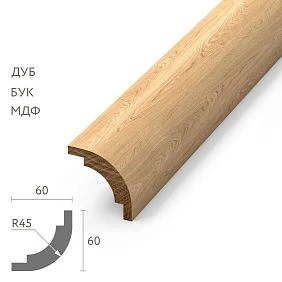
What is included in the components for loft furniture
Components for loft furniture are conveniently divided into four groups. They solve different tasks and should not replace each other.




Legs and furniture supports
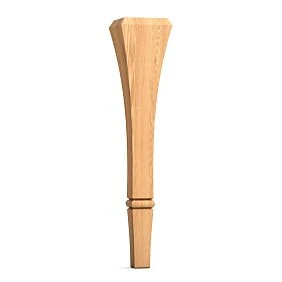
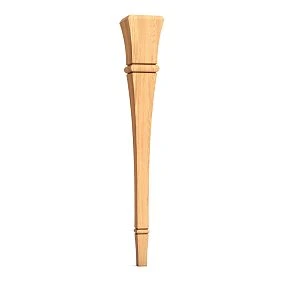
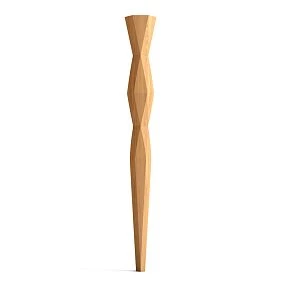
They determine the position of the cabinet relative to the floor, affect the final height, and noticeably change the character of the furniture. A short massive support gives one visual effect, a tall geometric leg gives another. For a series, height, cross-section, mounting area, and the associated fasteners are critical.
Our factory also produces:
Handles for fronts and drawers
Handles as furniture components are not just a decorative accent. A handle defines the grip, projection, center-to-center distance, and drilling pattern. After the fronts are manufactured, replacing a handle may require new holes or a new front.
Get Consultation
Mounting hardware and fasteners
Studs, plates, and foot pads connect the wooden support to the cabinet. If a leg is chosen without a mounting unit, the actual compatibility remains unknown.
Materials for installation and finishing
In loft furniture, wood is often left visually active: tinted, oiled, or painted to match the front. Therefore, the finishing material is part of the system, not a final random step.
Wider STAVROS furniture hardware catalog combines the main related categories and helps move from a general query to a specific group.
Loft is not the rule of "everything black"
Strong loft furniture is built on clear construction, visible logic of materials and geometry. Black color may be present, but it does not turn any handle or leg into a loft component.
Working combinations are usually built around several features:
- clear geometry;
- natural wood or realistic wood surface;
- contrast with metal;
- minimal random ornament;
- visually readable construction;
- controlled finish.
If the front already has an active wood texture, the handle can be more subdued. If the carcass is smooth and dark, a wooden handle or support becomes a warm material accent. Balance matters, not a set of clichés.
Which wooden components are suitable for loft-style furniture
Wooden components for furniture work well in loft interiors because they provide a natural texture and allow industrial geometry to be connected with a warmer material. But the species, shape, and finish must match the furniture.
Oak
Oak is rational when the texture needs to remain noticeable. Under a clear or tinted finish, it works as a standalone visual material. It looks especially expressive next to dark metal, graphite fronts, and calm gray surfaces.
Beech
Beech provides a calmer and more uniform base. It is convenient to use where the shape of the part is more important than a pronounced wood grain, or where custom tinting/painting is planned.
Solid wood vs. imitation
If the carcass is made of chipboard or MDF, a natural handle or leg can become a material accent. It is not necessary to make the entire item out of solid wood in order to use real wood meaningfully.
Geometric shape
For loft interiors, simple conical, cylindrical, square, and other clear shapes are especially appropriate. A turned part can also work if the profile is restrained and does not push the product into a classical style.
Wood furniture components are best checked physically next to the front and metal. The same verbal description of “oak” does not guarantee the same shade across different parts after finishing.
Wood in loft furniture: three working strategies
Strategy 1. Wood as a warm accent
The carcass stays graphite, black, or gray, the metal is dark, and wood appears only in handles and legs. This scenario works well when you need to soften the industrial feel without shifting toward rustic.
The advantage is a small number of wooden SKUs. They are easier to coordinate by finish. The downside is that any shade difference between the handle and the leg is immediately noticeable.
Strategy 2. Wood as the main material
If the countertop, fronts, or carcass have pronounced wood grain, handles and supports are better not made too active. Their job is to continue the material, not create another accent.
Here it is especially important to choose the shape. A geometric leg and a minimalist bracket are usually safer than a complex classic turned part if the rest of the furniture is modern.
Strategy 3. Contrast of real wood and imitation
Wood-effect chipboard can be combined with natural handles and legs if the difference is made intentional. For example, a light oak-effect carcass and a noticeably darker solid wood in the supports. Trying to achieve “almost the same” shade without a physical sample more often creates visual noise.
Legs and supports: height, shape, proportions, and purpose
Furniture components such as legs cannot be selected from a photograph alone. For a real product, overall height, cross-section, position relative to the carcass, number of supports, and mounting method all matter.
Before choosing, ask five questions:
- What should the final height of the furniture be?
- How many supports does the design actually require?
- What size mounting area is available underneath?
- Will the leg be fully or partially visible?
- Is a ready-made finish needed, or will the part be finished separately?
There is no universal “correct load” that can be defined by a single style or material. Structural sufficiency of a support is confirmed for the specific piece of furniture: carcass weight, geometry, number of supports, mounting assembly, and operating conditions.
Legs and supports for different types of loft furniture
For tables and work desks
A tall table support must work together with the tabletop and the base. If the tabletop is thick, an overly massive leg can make the structure look visually heavy; if the tabletop is thin, a wooden support that is too thin may look accidental. The designer checks not only the style but also the height of the finished table, the mounting plane, the distance between supports, and stability.
For a series, it is important to lock in one size and not change it between batches. Even a small change in support height changes the dimensions of the finished product and can affect packaging, labeling, and the model description.
For Dressers and Nightstands
Here the support has a stronger effect on how the body is perceived. A low, wide leg makes the furniture look visually heavier, while a tall one lightens the volume and increases the clearance from the floor.
When choosing, check:
- overall body height;
- desired clearance;
- width and depth of the cabinet;
- number of supports;
- size of the bottom panel;
- location of the drawers;
- access to the fasteners.
If the leg is installed via a mounting plate, its overall dimensions must also fit on the bottom without conflicting with the runners or dividers.
For wall-mounted furniture
A console table often has a shallow depth, so it is especially sensitive to the proportions of the supports. A leg that is too wide visually eats away at the lightness of the structure; one that is too thin may look out of proportion to a long tabletop. For loft style, a simple geometric profile works well, supporting the lines of the carcass without excessive decoration.
For sofas and armchairs
For upholstered furniture, the support is tied to the seat height and the frame. Replacing a leg with a taller one changes the user's seating position. Therefore, "raising the sofa by 30 mm" is not just a decorative task.
Need to check:
- the new seat height;
- the position of the lower frame;
- the leg's offset from the edge;
- installation area;
- tool access;
- the visual relationship with the soft volume.
For heavy case goods
When it comes to a long sideboard, a massive display cabinet, or a wardrobe on supports, aesthetics alone are not enough. The structural design must determine the number of support points and the need for additional central supports. Four legs that suit a compact nightstand do not automatically become suitable for a long cabinet body.
The style can be maintained through a family of identical profiles: the outer and central supports can be visually related but structurally different.
Loft support proportions: why "thinner" is not always more modern
Loft is often associated with a light industrial frame, so there is a temptation to make wooden legs as thin as possible. But visual lightness must match the scale of the cabinet body.
It is useful to compare:
- the width of the facade;
- the height of the body;
- countertop thickness;
- the leg overhang from the edge;
- the support cross-section;
- the number of supports.
For example, a compact bedside table can look neat on thin tapered legs. The same profile under a wide sideboard may seem too weak visually, even if the support is structurally acceptable.
The rule is simple: the support should look like part of the construction, not a random leg screwed on after the cabinet body was designed.
Loft furniture handles: shape, size and finish
Loft does not require a mandatory metal handle. Wooden hardware can work stronger if the body already contains metal or dark fronts. In this case, wood becomes a contrast in material, not in color.
В catalog of wooden handles STAVROS you can select geometric bar handles, knobs and other shapes for modern fronts.
Long geometric handles
Suitable for tall cabinets, wide fronts and kitchen modules. In loft furniture, they work well as a vertical or horizontal line. But the length must be coordinated with the front: a handle that is too short on a tall cabinet gets lost, while one that is too long on a small door becomes dominant.
Bar handles
Practical for drawers and doors. For serial furniture, the center-to-center distance is critical: it must be fixed before drilling the front. After a batch of fronts has been manufactured, switching to another bar handle with a different center-to-center distance is already difficult.
Knob handles
Good for compact cabinets, small drawers and furniture where a local accent is needed. For loft, geometric, laconic shapes without complex ornamentation work better.
Vertical placement
On tall fronts, a vertical handle maintains the proportion of the door. On a wide drawer, the same model can be mounted horizontally. If a series uses one handle in two orientations, it is best to show this in the technical drawing.
Uncoated handles: a powerful tool for a furniture series
uncoated wooden handles are especially interesting for furniture manufacturing. They make it possible to match handles with other wooden elements of the series at your own finishing facility.
This is useful if:
- the factory tints the legs and handles in the same color;
- you need to match the shade of the front;
- one geometry is used in several color versions;
- you have your own painting line;
- finish is part of the proprietary technology.
But this approach also has a downside: the factory itself is responsible for the consistency of tinting, surface preparation, and matching between batches.
When a ready-made finish is more convenient
If the batch is small, you don't have your own finishing area, or you need to move to assembly faster, a ready-made handle may be more rational. In that case, the finish is part of the procurement configuration rather than being created in-house.
| Option | When to use | What to control |
|---|---|---|
| Unfinished | Unified tinting across the entire series, own painting area | Own finish process |
| With ready coating | Small batches, fast installation | Compliance with approved sample |
| Custom finish | Premium or designer series | Color repeatability between batches |
Leg fastening: studs, plates, and glides
One of the most expensive mistakes in specification is buying legs without understanding how they will be installed. The shape and material may be perfect, but the mounting interface won't match the body.
В in the catalog of hardware for furniture legs and handles there are individual fastening elements, including studs, mounting plates, and glides. For real furniture, they should be considered as a single assembly.
Workflow:
support → stud → mounting plate → body → glide.
Not every SKU requires all elements at once. The specific composition depends on the design, but it must be determined before ordering a batch.
Studs and threaded connections
A stud seems like a simple part, but it is what connects the wooden support to the body or mounting plate. If the diameter, length, or thread do not match, the leg does not become part of the structure, even if it looks like a perfect fit.
Before the series, it is necessary to fix:
- thread diameter;
- stud length;
- seating depth in the leg;
- the depth or type of the mating part;
- the point at which the connection is considered assembled;
- whether repeated disassembly is possible if the furniture is supplied unassembled.
Do not transfer a threaded rod from one leg model to another just because the diameter looks similar. Compatibility is verified against the specific mounting assembly.
The mounting plate must account for the furniture body
The plate transfers the load from the leg to the body. Therefore, its size and position depend not only on the support but also on the furniture base.
Check:
- whether the plate fits on the bottom panel;
- whether the fastener falls into the edge;
- whether it conflicts with a drawer or runner;
- whether the tool is accessible;
- whether the required leg offset from the edge is maintained;
- whether the plate protrudes into the visible area.
For serial furniture, installation coordinates are best specified on the drawing. The wording "at the corners" gives the assembler too much freedom.
Glides and floor protection
A glide is a small part that is easy to forget in the BOM. But if it is provided for by the design, the absence of four glides makes the set incomplete.
A glide can:
- protect the wood at the lowest point;
- reduce direct contact with the floor covering;
- make movement easier;
- in certain designs, compensate for a small contact point.
But a single glide cannot be universally assigned to all models. It is selected based on the shape of the leg, the floor, and the design of the finished furniture.
Finishing of wooden components
Finishing is especially important when wooden handles and supports remain visible. STAVROS provides a dedicated section of materials for furniture installation and finishing. It presents complementary solutions for fastening and finishing.
In an article about loft configuration, it is important not to turn this section into a general overview of adhesives and coatings. For furniture, three questions need to be answered:
- Who applies the finish — the supplier or the furniture factory?
- Should the handle and the leg match in tone?
- Which surfaces remain natural, and which are covered with color?
Tinting to a single visual language
If an oak handle and an oak leg should look like one system, it is better to check them side by side. The wood species is the same, but the actual grain and shade may differ. The finish should bring the parts closer together, not create random shades.
Oil and natural texture
For a loft, the natural wood grain is often an advantage. If oil or another transparent finish is used, it should emphasize the texture but not conflict with the color of the metal and panel elements.
Painting to match the facade color
Sometimes a wooden handle or leg is painted to match the color of the MDF facade. In this case, the wood works through form and tactility rather than color. This is an acceptable scenario, but it requires its own approved sample, because the same color code on different substrates can be perceived differently.
Components without a finish or ready-made: what should a manufacturer choose
For the loft series, this is not just a matter of convenience. The finishing method determines who is responsible for the final color and consistency between batches.
Without a finish
Suitable if the factory wants to control the entire visual language independently. Unpainted handles and legs can be tinted together with other wooden elements of the series.
Advantages:
- a unified finish for handles, legs, and decor;
- several color versions can be produced on the same geometry;
- easier to adapt to your own palette;
- wood can be coordinated with the facade on a material board.
Risks:
- the factory itself is responsible for consistency;
- additional time must be taken into account;
- stable surface preparation is required;
- for a new batch, the shade must be checked against the reference.
With a ready finish
Reasonable if the furniture must be assembled without its own painting stage. Then the finish is purchased together with the component and checked during incoming inspection.
Advantages:
- fewer operations inside the factory;
- faster path from warehouse to assembly;
- easier to calculate the cost of the finished unit.
But you cannot leave only the color name in the specification. You need an exact SKU/finish and a physical reference sample if the shade is critical.
Custom finish
Suitable for premium and small batches, where the finish creates distinct value. But this scenario is harder to scale. If each batch requires manual "shade matching," the process must be documented especially carefully.
Wood and natural finish: when oil is more appropriate than paint
If the goal is to show the species, opaque paint hides one of the main arguments of natural wood. Oil, a clear or tinted coating can preserve the grain pattern.
But this choice must be systematic. If the handle is oiled and the leg is painted opaque, they will be perceived as different materials even if they are the same species. This may be intentional, but it should not happen by accident.
Wood and paint: when color matters more than texture
For a collection with several facade colors, you can use one geometry of wooden handle and paint it in the collection color. Then the handle works through form and tactility.
Production advantage: one base SKU can serve several variants. But at the level of finished furniture, each finish must be recorded separately, otherwise the warehouse will mix different color versions.
Material board: how to check wood, metal, and facade before ordering
For loft furniture, a physical board is especially useful: materials of different natures end up side by side, and a screen or render shows them inaccurately.
You can assemble on the board:
- an MDF or chipboard facade sample;
- a wooden handle;
- a leg or its fragment/finish sample;
- a metal element;
- the countertop color;
- an oil or stain sample.
They are checked under neutral and project lighting. The main question is not “does everything look beautiful separately,” but whether the set looks like a single piece of furniture.
What most often conflicts
- three close but different shades of oak;
- black metal with varying degrees of gloss;
- warm wood and a cold gray facade without a unifying accent;
- an overly active laminate texture next to solid wood;
- a matte handle and a glossy facade, if the contrast is not intentional;
- different radii of geometric elements.
How to combine wood with metal, MDF, and laminate
The combination of wood and metal is one of the strongest loft scenarios, but it works best when one material does not try to imitate the other.
Dark metal + natural oak
The contrast is built on material and temperature. Dark metal provides a graphic structure, oak provides a warm texture. In this case, wooden handles and legs can link several pieces in the collection.
Black facade + light wood
A light handle or leg becomes an accent. It is especially important not to add several more competing wood tones. If the countertop, handles, and legs all differ in tone, the interior loses cohesion.
Light metal + dark wood
This scenario is less stereotypical for a loft and can look more modern than the usual pairing of “black metal + red oak.” The main thing is to repeat one material or one geometric motif in at least several points of the piece or collection.
Wood and metal: how to repeat geometry, not just color
A unified style can be built through geometry. If the metal base consists of straight square lines, a wooden handle with a clear rectangular profile supports the structure better than a complex rounded shape.
It is useful to compare:
- corner radii;
- line thickness;
- the relationship of verticals and horizontals;
- matte or gloss;
- the scale of the details.
This way, you can create a loft interior without literally repeating one color in all elements.
MDF + wooden handles: when the combination looks convincing
Painted MDF provides a smooth flat surface, while a natural handle offers a tactile contrast. In loft furniture, this is especially appropriate if the facade is understated and the handle has a simple shape.
Working scenarios:
- graphite MDF + natural oak;
- black MDF + light beech;
- beige MDF + dark wood tint;
- a handle painted to match the facade with a visible wooden leg.
If the handle is unfinished, it can be brought to the same overall finish as the leg. This is convenient for serial production, but requires a stable in-house finishing technology.
Wood-look melamine-faced chipboard + real wooden legs
This combination is possible, but here it is especially easy to end up with "almost identical" wood tones that look worse than a contrast. If the chipboard imitates oak and the leg is real oak in a different shade, the viewer compares them directly.
There are two safe approaches:
- bring the shade of the natural component as close as possible to the panel decor through the finish;
- on the contrary, make the difference intentional — for example, darker legs on a light-colored cabinet.
The intermediate option of “almost matched” most often looks accidental.
How to assemble and standardize a kit for a furniture series
For furniture production, the key task is not just to buy individual components, but to establish a repeatable configuration.
- Determine the furniture model.
- Fix the cabinet dimensions.
- Determine the required final height.
- Choose a leg or support.
- Check the installation area and fasteners.
- Choose the handle and mounting dimensions.
- Determine the wood species.
- Assemble a physical sample.
- Approve finish.
- Lock in the supplier SKU and internal Part ID.
- Assemble a prototype.
- Only after that, consider it a production batch.
This is how loft furniture components become part of the BOM, rather than a set of visual references.
What to store in the specification
| Component | What to fix |
|---|---|
| Leg | SKU, height, cross-section, material, finish, mount |
| Handle | SKU, size, center-to-center, material, finish |
| Screw | SKU, thread, length |
| Plate | SKU, dimensions, holes |
| Thrust bearing | SKU, size, installation method |
| Finish | Code, physical sample, application process |
Why a sample is needed before the series
A photograph does not show the real size and tactile feel. A leg on a white background may look thin, but on a compact cabinet it may turn out to be too bulky. A handle may seem suitable in style, but have an inconvenient projection.
For a series, it is better to check the real part on a prototype than to fix hundreds of fronts after delivery.
How to standardize a set for a furniture series
Series loft furniture benefits from a common language of components. For example, a wardrobe, chest of drawers, cabinet, and table can use the same wood species and the same geometric logic of handles, but different sizes.
Practical model:
| Model | Handle | Leg/support | Finish | Fasteners |
|---|---|---|---|---|
| Cabinet | H-S | LEG-S | OAK-NATURAL | MOUNT-A |
| Commode | H-M | LEG-M | OAK-NATURAL | MOUNT-A |
| Cabinet | H-L | — / by construction | OAK-NATURAL | — |
| Table | — | LEG-L | OAK-NATURAL | MOUNT-B |
This way the series looks related, but does not force one handle or one support height to work on all models.
What to lock in the BOM
For each item:
PART ID
SUPPLIER SKU
SIZE
MATERIAL
FINISH
MOUNT
QTY
USED IN MODELS
If one component is used in several models, it is more convenient to purchase it as a shared batch. But the size and finish must match physically, not just by family name.
Approved sample for the series
After selection, you can save one handle, one leg, and the material board as reference standards. The next batch is compared against them, not against a render or the designer's memory.
What should be in the series kit card
For one furniture model, it is useful to store not only individual master cards, but also the assembled kit.
LOFT-TUMBA-A
HANDLE: H01 / OAK / NATURAL / 2 pcs
LEG: L01 / OAK / NATURAL / 4 pcs
PLATE: P01 / 4 pcs
STUD: S01 / 4 pcs
FOOT: F01 / 4 pcs
FINISH SAMPLE: FS-01
BOM REV: 03
This way the next release does not require reassembling the system from several sources.
How to calculate the quantity of components for a furniture batch
Piece items are calculated simply:
quantity per item × number of items = gross requirement.
For example, the batch is 150 cabinets. One cabinet requires:
- 2 handles;
- 4 legs;
- 4 mounting plates;
- 4 studs;
- 4 glides.
| Position | Per 1 item | Plan | Gross |
|---|---|---|---|
| Handles | 2 | 150 | 300 |
| Legs | 4 | 150 | 600 |
| Plates | 4 | 150 | 600 |
| Studs | 4 | 150 | 600 |
| Floor protectors | 4 | 150 | 600 |
But the actual order:
gross − free verified stock + justified reserve.
If there are 80 legs in stock, but 20 are reserved for service, the free balance is 60. With a production reserve of 20 units, the order will be:
600 − 60 + 20 = 560 legs.
The reserve should not be the same for all items
An expensive leg with a short lead time and a cheap mounting plate with high consumption are different risks. The reserve depends on:
- replenishment lead time;
- cost;
- damage history;
- minimum order quantity;
- number of models using the SKU;
- service commitments;
- availability of a proven alternative.
Mistakes, limitations, and decision tree
Mistake: choosing based only on a photo
Why it happens: visually, the leg seems suitable. Consequence: the real scale or fit does not match. How to prevent: dimensions, drawing, and physical sample.
Mistake: legs that are too thin under a heavy cabinet
Why it happens: a thin profile is perceived as "more loft-like." Consequence: visual imbalance or structural risk. How to prevent: check the cross-section and the entire furniture structure.
Mistake: incorrect support height
Why it happens: the cabinet was designed separately. Consequence: the finished furniture ends up taller or shorter than the target dimensions. How to prevent: calculate the final height with the leg.
Mistake: not accounting for the cabinet weight
Why it happens: the component is chosen as decorative. Consequence: the support is used in a structure for which its suitability has not been confirmed. How to prevent: engineering verification of the specific product.
Mistake: mixing several wood shades
Why it happens: the specification simply says "oak". Consequence: handles, legs, and the body look like a random set. How to prevent it: material board and finish code.
Mistake: buying legs without suitable fasteners
Why it happens: installation is left for later. Consequence: the batch sits in the warehouse and cannot go into assembly. How to prevent it: kit the leg together with the stud/plate/glide according to the project.
Mistake: mixing different geometric languages
A thin cylindrical leg, a massive ornate handle, and a complex classical molding can each be high quality on their own, but together they do not create loft furniture. It is better to repeat one principle of geometry.
Mistake: a large batch without a sample
Why it happens: you want to get a better price. Consequence: a scale or finish mistake is repeated across hundreds of items. How to prevent it: first a sample and prototype.
Mistake: not fixing the SKU and finish
Why it happens: the supplier is an acquaintance, the manager "remembers". Consequence: a repeat order several months later arrives different. How to prevent it: BOM and master-card.
When a loft component is not needed
A commercial article should not push toward an unnecessary purchase. Sometimes the best option is to leave the existing structure without an additional wooden handle, new leg, or decorative element.
Components should not be changed if:
- the current assembly is already functional and the new part does not provide a noticeable improvement;
- a hidden support is more rational than a visible one;
- the front is designed for push-to-open and a separate handle breaks the concept;
- the metal structure is already the main visual accent;
- natural wood creates a third mismatched shade;
- the new leg changes the furniture height and worsens ergonomics;
- the production volume is too small for a separate non-standard SKU;
- It is not possible to confirm mounting compatibility.
Loft does not require the maximum number of visible details. It benefits from a clear construction.
Decision tree: how to choose components for a specific model
- Are there visible supports? If not, do not add legs just for style.
- Do you need a handle? If push-to-open is used, a separate handle may be unnecessary.
- Is the front simple? If so, a wooden handle can become the main accent.
- Does the body look visually heavy? Check a taller or visually lighter support, but only after a structural check.
- Is there already wood in the countertop? Decide: repeat the tone or create contrast.
- Is there your own finish? Consider RAW components.
- Is the series large? A sample, prototype, and SKU locking are mandatory.
So the choice becomes a sequence of technical decisions, not a selection of decor based on pictures.
How to choose a supplier and buy components for loft-style furniture
If it's a one-off cabinet, it's enough to select compatible products. For a series, you need a furniture component supplier that allows you to repeat the same configuration.
Before ordering, it's useful to check:
| Criterion | What to Check |
|---|---|
| Catalog | Whether the required category and specific SKU are available |
| Dimensions | Whether there is enough data for a drawing |
| Material | Whether the wood species/finish is specified |
| Finish | Whether a specific option can be reserved |
| Fastening | Whether there are associated mounting elements |
| Sample | Whether the physical part can be inspected |
| Repeat supply | Can the same SKU be reproduced |
| Communication | Can a batch quote be obtained |
Price is an important criterion, but not the only one. If a cheap leg requires an additional plate, a modification to the cabinet, or manual fitting, the final assembly may end up costing more.
Where to buy loft furniture components
If the task is phrased as buying furniture components, it is more convenient to navigate by category rather than by searching for individual images.
В STAVROS furniture components store you can move on to handles, hardware for legs/handles, and materials for installation and finishing. Wooden supports are placed in a separate category of solid wood products.
Commercial route:
- Open the desired category.
- Choose the shape.
- Check the dimensions.
- Check the material.
- Determine the finish.
- Check the mounting.
- Order a test item or sample if the solution is new.
- Assemble a prototype.
- Calculate the quantity.
- Place the main order.
For general access, you can use STAVROS main page, and then go to the specialized section.
Buying furniture components doesn't mean buying everything from a single supplier
A specific model may have hinges, slides, or a metal frame from another manufacturer. That's normal. What matters is that all items come together in a single BOM and are technically compatible.
STAVROS is best used where the range actually exists: wooden handles, legs and supports, mounting hardware, finishing materials, and other related decorative elements.
How to compare the price of furniture components
The query "furniture components price" is only useful after the configuration is fixed. The price of a handle without size and finish says little. The price of a leg without the mounting assembly says little too.
Compare the full set:
handle + fasteners + drilling + finish
Or:
leg + threaded rod + plate + glide + cabinet preparation + finish.
If two legs cost the same, but one requires a different mounting plate and additional cabinet reinforcement, the total costs differ.
Batch price vs. test item price
You should not automatically carry over the price of a single test part to a large production run. Serial pricing may depend on quantity, finish, and delivery terms. It is best to confirm the current price before ordering a specific configuration.
What to send for a commercial quote
MODEL:
HANDLE SKU / SIZE / MATERIAL / FINISH / QTY
LEG SKU / HEIGHT / MATERIAL / FINISH / QTY
STUD SKU / QTY
PLATE SKU / QTY
FOOT SKU / QTY
NEED DATE:
DELIVERY:
This is how the request "order furniture components" becomes a clear specification.
Furniture components wholesale: how to prepare
For wholesale production, you can add a quarterly forecast. This does not replace a real order, but it helps discuss delivery regularity.
How not to overpay for loft components
The most common mistake is optimizing the price of an individual part without calculating the cost of the finished assembly.
For example, leg A is cheaper than leg B, but A requires a new plate, additional drilling, and its own painting. Leg B is more expensive as a product, but it is already compatible with the current cabinet.
The comparison should include:
| Article | Option A | Option B |
|---|---|---|
| Leg | SKU price | SKU price |
| Fastening | Separately | Compatible current |
| Body preparation | New operation | No changes |
| Finish | Own area | ready-made |
| Prototype | Needed | Already verified |
The final cost may turn out to be the opposite of the initial impression.
Compatibility is confirmed when the part is installed on a real body or an exact prototype, the hardware fits without manual modification, the final furniture dimensions match the project, and the handle or leg does not conflict with neighboring elements. Photos and dimensions from the product card are a necessary first step, but not the final check for a series.
What counts as confirmation of compatibility
A rational sequence: test unit → small pilot → main batch. After repeatability is confirmed, you can increase the volume and discuss regular supply.
For a new model, a large order can be riskier than a small first batch. If the shape, finish, or fastening have not yet been tested on a prototype, the per-unit savings will not compensate for the cost of hundreds of unsuitable components.
When it's cheaper to order less rather than take a "wholesale" batch
This is how the query "furniture components price" gains practical meaning: the cost of a complete compatible solution is compared, not the random price of a single part.
- exact SKU and size;
- the material;
- finish;
- whether fasteners are included;
- minimum quantity;
- the deadline;
- packaging;
- the delivery cost;
- the ability to repeat the same configuration later.
It's useful to include in the comparison table:
If two suppliers offer similar components, compare the same configuration. The price of an unfinished oak handle and the price of a beech handle with a ready finish are not direct equivalents. The same applies to legs with different mounting.
How to compare two commercial offers
What to check before ordering a batch
A short checklist covers most of the mistakes:
| Check | Status |
|---|---|
| Furniture model is finalized | OK / HOLD |
| Cabinet dimensions are final | OK / HOLD |
| Leg height is included in the overall size | OK / HOLD |
| The leg has a specific SKU | OK / HOLD |
| Mounting assembly is defined | OK / HOLD |
| The handle has a size and fit | OK / HOLD |
| Material confirmed | OK / HOLD |
| Finish is approved | OK / HOLD |
| Sample is checked | OK / HOLD |
| Quantity is calculated | OK / HOLD |
| Free stock verified | OK / HOLD |
| Reserve justified | OK / HOLD |
| Reorder possible by SKU | OK / HOLD |
If a critical line is on HOLD, it is better not to release a large batch.
Practical loft furniture scenarios
Suppose there is a chest of drawers made of dark MDF with two drawers. You need to achieve a modern loft character without metal supports.
Sequence:
- Determine the finished height of the chest of drawers.
- From it, derive the allowable leg height.
- Choose four wooden supports with simple geometry.
- Check the mounting plate and the bottom of the cabinet.
- Choose two wooden handle-brackets.
- Assemble a sample: dark MDF + wood.
- Choose a natural or contrasting finish.
- Assemble a prototype.
If the result is expressive enough, no additional decorative ornament is needed. In this model, the loft style is created by proportions, natural material, and clean geometry.
Practical scenario: a long TV stand
A long stand has its own separate problem — sagging and support distribution. A designer may like four legs at the corners, but the structure may require an additional central support.
In this case:
- the outer supports define the visible composition;
- the central support can be less noticeable;
- the height of all supports must match;
- the mounting assembly must account for internal partitions;
- handles are selected based on the width of individual fronts, not the overall length of the cabinet.
That is, “a single cabinet model” already requires several interrelated decisions.
Practical scenario: loft-style desk
For a desk, the supports become the main element. If they are wooden and the tabletop combines wood and dark metal, handles may be absent altogether.
Check:
- the final height of the desk;
- countertop thickness;
- the geometry of the underframe;
- legroom;
- the setback of the supports;
- stability;
- the wood finish relative to the tabletop.
Here, you don't need to add handles just because the article is about components. Function determines the composition of the order.
Practical scenario: a chest of drawers with wooden handles and legs
A chest of drawers is a good example where all component groups come together in a single piece. There is a carcass, several fronts, repeating handles, four legs, and mounting hardware.
If the chest of drawers has four drawers:
- the handles must repeat in height and axis;
- the legs must provide the same overall height;
- it is best to compare the finish of the handles and legs on a single physical board;
- the fastening assembly must not conflict with the bottom drawer;
- if there are glides, they are part of the complete set.
If the designer also wants to add applied decor, it is worth checking whether the front becomes overloaded. For loft, it is often better to keep the geometry clean and use wood as a material rather than as an ornament.
Practical scenario: a series of a cabinet, a chest of drawers, and a wardrobe
The goal of serial production is to maintain recognizability without creating three independent sets of components.
You can use:
- one series of wooden handles in three sizes;
- one wood finish;
- one family geometry of legs for the nightstand and the dresser;
- one type of mounting plate, if the design allows;
- one material — for example, oak or beech — throughout all visible hardware.
This way, 'loft' reads as a system, not as a random set of black and wooden parts.
When a single SKU does not need to be unified
A tall wardrobe may require a long vertical handle that would be too large for a nightstand. That is normal. It is the design family that needs to be unified, not a single physical size at any cost.
Incoming inspection, packaging, and claims
If an order consists of hundreds of identical parts, a new batch should not go straight to the assembly line. First, identity and compatibility are checked.
| Component | Check |
|---|---|
| Handle | SKU, size, center-to-center, material, finish |
| Leg | Height, cross-section, fastening area, finish |
| Screw | Thread, length |
| Plate | Overall dimensions, holes, compatibility |
| Thrust bearing | Size, completeness |
If a new batch differs in color or size, it is better to isolate it until a decision is made. Mixing it with the old remaining stock complicates claims and service.
Why four legs need to be seen together
A slight difference in shade or profile may be unnoticeable on a single part, but obvious on a finished dresser. Therefore, it is useful to selectively compare a set of four supports as a single visual unit.
Packaging: why check it on a pilot batch
A wooden component can be damaged after production. A painted handle gets scratches, a shaped leg gets a chip, and a long part gets marks from mutual friction.
The test batch is checked for:
- number of parts in the box;
- presence of dividers;
- finish protection;
- SKU and material labeling;
- ease of recounting;
- no free movement inside the packaging.
This is especially important if furniture components are shipped wholesale to another region and go through several logistics operations.
How to prepare a claim for components
The phrase "the legs arrived bad" does not help the supplier much. Data is needed.
For a claim, please keep:
- SKU;
- order or batch number;
- quantity;
- description of the defect;
- photo;
- measurements, if the issue is dimensional;
- comparison with the approved sample;
- the furniture model in which the part is used.
This helps distinguish a one-off transport damage from a systemic batch issue.
Reorder and SKU replacement management
For serial loft furniture, it is not enough to keep a link to the product in the browser. A component card is needed.
| Field | What to store |
|---|---|
| Part ID | Internal factory code |
| Supplier SKU | SKU STAVROS or another supplier |
| Category | Handle / leg / fastener |
| Size | Height, center-to-center, overall dimensions |
| Material | Oak / beech / other finish |
| Finish | RAW / finish code |
| Mount | Related stud/plate/glide |
| Used in models | List of models |
| Status | APPROVED / ARCHIVE / SERVICE |
A repeat order six months later should start from this card, not from a photo of the previous batch.
When changing supplier or SKU is risky
A new part may look similar but have a different fit, height, finish, or material. Therefore, changing supplier should go through a prototype if the component affects the construction or appearance.
Especially important to change with caution:
- the handle after drilling the fronts;
- the leg that affects the final height;
- the mounting plate;
- a part with an individual finish;
- a component used in several models at once.
How to check the first repeat batch
Even if the first series was successful, the first repeat delivery is a good check of process maturity. If the buyer can order by SKU, the warehouse can accept by specification, and assembly can receive the same parts without clarification, the system is truly standardized.
If the repeat release again begins with searching for "which leg was it", the documentation is insufficient.
What to do if the required SKU disappears before the series launch
For a one-off project, you can quickly choose a different handle or leg. In a series, such a replacement must go through as a product change if it affects fit, height, finish, or appearance.
Sequence:
- Check the available stock of the approved SKU.
- Confirm the restock lead time.
- Check whether there is a pre-approved alternative.
- If there is no alternative, choose a candidate.
- Compare dimensions and installation.
- Assemble a prototype.
- Approve finish.
- Update the BOM only after verification.
It is especially risky to change the handle after the fronts have been drilled and the leg after the furniture dimensions have been approved. Even a small difference can turn a commercial replacement into an engineering rework.
How to handle old stock
If the new version completely replaces the old one, the remaining stock cannot be mixed without a decision. It can be used up to a certain batch, kept for service, or removed from active production. For versions sold in parallel, it is better to create separate product SKUs.
How to assess a loft kit's readiness for reorder
A kit can be considered mature if the following questions have clear answers without referring to old correspondence:
- which handle SKU is used;
- its size and finish;
- which leg is on the model;
- what the support height is;
- which stud and mounting plate are compatible;
- whether a base plate is needed;
- which material board is approved;
- how many units are needed per product;
- what stock is available;
- which batch was received last.
If the answer sounds like “let's look at the previous cabinet,” the system is not yet ready for stable mass production.
Minimum B2B package for ordering components
| Document / data | What it contains |
|---|---|
| BOM | SKU, quantity, size, material, finish |
| Facade drawing | Handle drilling |
| Lower body assembly | Coordinates of supports and plates |
| Approved sample | Visual reference |
| Forecast | Expected batches |
| RFQ | Exact commercial query |
This is how loft furniture components move from a design choice into a procurement system. This is especially important if a manufacturer wants to regularly order the same wooden parts and not re-approve them with every production run.
FAQ: components for loft furniture
Which components are suitable for loft-style furniture?
First of all, those compatible with the specific construction. For the visible part, wooden legs and supports with simple geometry, wooden handles, and neat mounting hardware work well. The style is created by a combination of shape, material, and finish, not by a single black color.
Can wooden legs be used in loft furniture?
Yes. Natural wood pairs well with metal, MDF, and chipboard. You need to check the height, cross-section, mounting area, number of supports, and structural suitability for the specific furniture.
Which handles should you choose for loft furniture?
Geometric brackets, long linear handles, or minimalist knobs. The size is chosen based on the front and grip. If a series consists of several items, it is convenient to use one design series of handles in different sizes.
How do you choose the mounting for wooden furniture legs?
It depends on the specific model of the support and the body construction. Threaded studs, mounting plates, and base glides are possible. It is better to choose the leg and the fastener as a single assembly rather than independently.
Can furniture components be ordered wholesale?
Yes, but to calculate the batch we need a specific list of SKUs, sizes, materials, and quantities. For a series, it is better to first check a sample or a test item.
What is better for a series — coated or uncoated components?
If the factory has its own stable finishing, uncoated parts give more control over a consistent color across the series. A ready-made coating is more convenient when you need to reduce in-house operations and go straight to assembly.
How do you match wood to black metal?
It is better to check a real sample. Natural oak has a pronounced grain, while beech is more subdued. What matters more is not the “right species for loft,” but consistency with the facade, countertop, and metal finish.
Can wooden handles be used on wood-look melamine-faced chipboard?
Yes. The most common mistake is trying to achieve an almost identical shade and failing to match it. Either match the finish precisely or make the contrast intentional.
Do base glides need to be purchased separately?
Only if they are provided by the selected assembly. If the glide is a separate item, add it to the BOM and verify completeness before packing.
How can you tell that a leg is too thin?
A single visual criterion is not enough. You need to compare the cross-section with the scale of the cabinet and perform a structural check. If the support looks disproportionate or its structural suitability is not confirmed, it is better to choose a different size or profile.
When can a handle not be replaced with a similar one?
After drilling the front — without checking the center-to-center distance. Also, replacement requires approval if the projection, size, finish, or ergonomics change.
How do you place a repeat order?
Use an exact record: supplier SKU, size, material, finish, quantity, and the details of the last accepted batch. The wording “the same legs” is not sufficient.
Final route: from loft furniture idea to order
- Determine the type of furniture and its dimensions.
- Choose the role of the visible components.
- Determine the final height of the furniture.
- Select legs or supports.
- Check the mounting assembly.
- Choose handles and mounting dimensions.
- Determine oak, beech, or another finish.
- Decide: RAW or finished finish.
- Assemble the material board.
- Obtain a sample or test part.
- Assemble a prototype.
- Lock the SKU in the BOM.
- Calculate gross requirement.
- Subtract available stock.
- Add a justified reserve.
- Generate RFQ.
- Check the new batch before assembly.
- Save master-card for repeat order.
This is how loft furniture components stop being a set of stylistic details. The leg, handle, stud, mounting plate, glide, and finish work as one system. It is this compatibility that determines whether the furniture will not only look the right style but also assemble consistently in the first and subsequent batches.
Once the model, dimensions, and quantity are finalized, you can use the STAVROS catalog to buy furniture components in the required categories and request a commercial quote for a specific project.