






























































Article Contents:
- C-005-1-1, C-005-1-2 and C-005-2: confirmed dimensions and main purpose
- Why identical material does not make the sets interchangeable
- What is included in each set and what role the parts play
- How to read dimensions A, B and C without error
- How to determine the useful field of the facade
- When to buy C-005-1-1
- Elongated ornament for a tall or long panel
- Composition with a central axis and mirrored parts
- When it's better not to choose C-005-1-1
- Large facade and maximally pronounced relief
- Classic furniture, Baroque, Empire, and Eclecticism
- Structural depth limitations of 31 mm
- Compact composition for one door, chest of drawers, or nightstand
- Eight elements as a ready-made layout
- When C-005-2 turns out to be too small
- Advantages of a ready-made composition
- When individual elements give more freedom
- Beech for opaque enamel
- MDF base
- Solid wood base or veneered surface
- Painted facade
- Choosing Only by Photo
- Confusing parameters A and B with automatic orientation
- Ignore depth 31 mm
- Consider C-005-1-1 and C-005-1-2 almost identical
- Stretch C-005-2 onto a large panel
- Confuse right and left parts
- Overlap the movable gap
- Do not account for handles and panels
- Mix beech and oak without a project
- Order parts in different periods without a list
- Start installation without dry layout
- Use one universal glue
- C-005-1-1 fits
- C-005-1-1 does not fit
- C-005-1-2 fits
- C-005-1-2 does not fit
- C-005-2 fits
- C-005-2 does not fit
- When decor is added to an existing cabinet
- When the furniture is still being designed
- Which kit is the most compact?
- Which kit is the deepest?
- Can C-005-1-1 and C-005-1-2 be considered the same length?
- What to choose for one tall narrow panel?
- What to choose for a large classic wardrobe?
- What to choose for a chest of drawers?
- Can the kit be split between two doors?
- Do I need to use all the elements?
- What is better: beech or oak?
- Can I paint the overlays before installation?
- How to choose "Standard" or "Prestige"?
- Can I glue decor on painted MDF?
- What glue is needed?
- Do I need a full-size template?
- How to check the depth before purchase?
- Can I repeat C-005-2 on two facades?
- Is C-005-1-2 suitable for an interior door?
- What to check upon receipt?
- Can I mix parts from different batches?
- Where to see other overlay options?

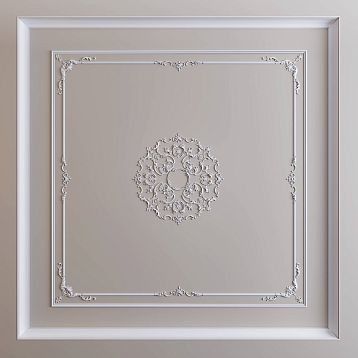
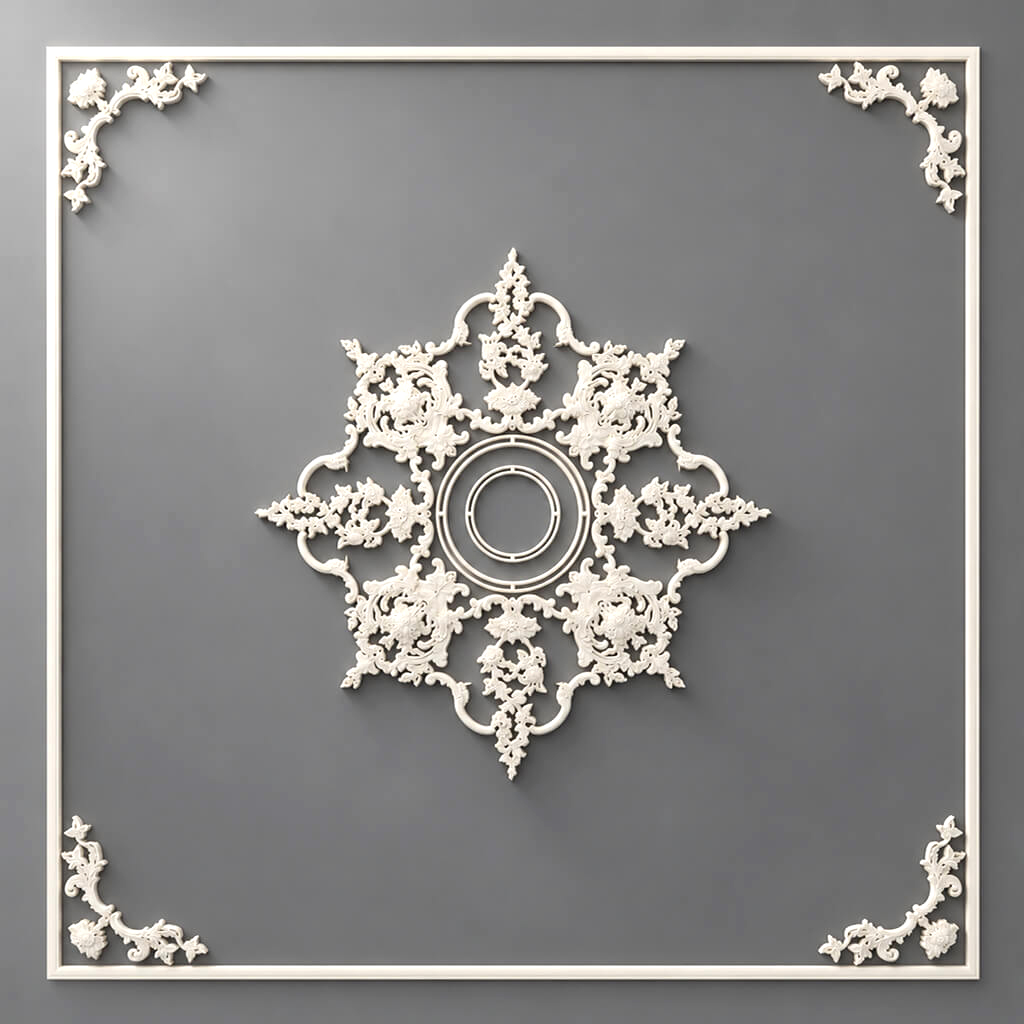
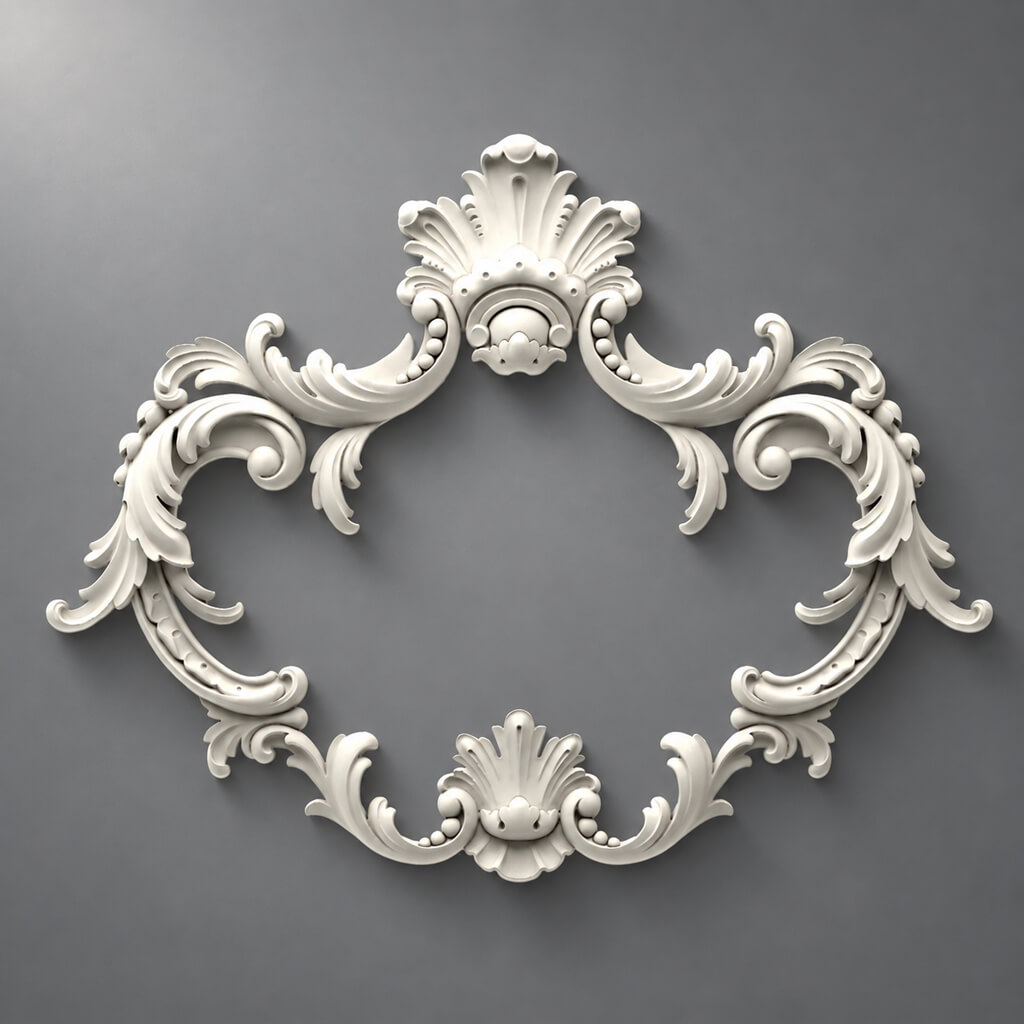
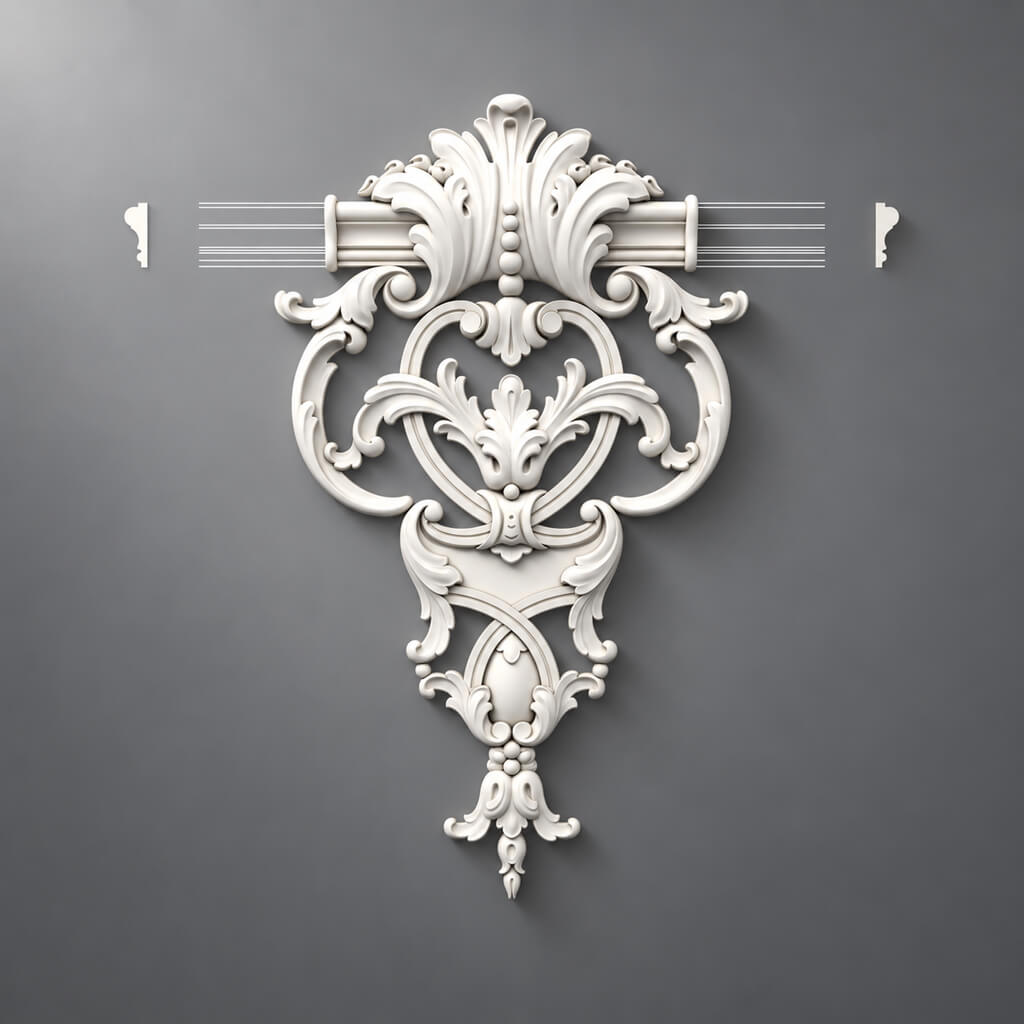
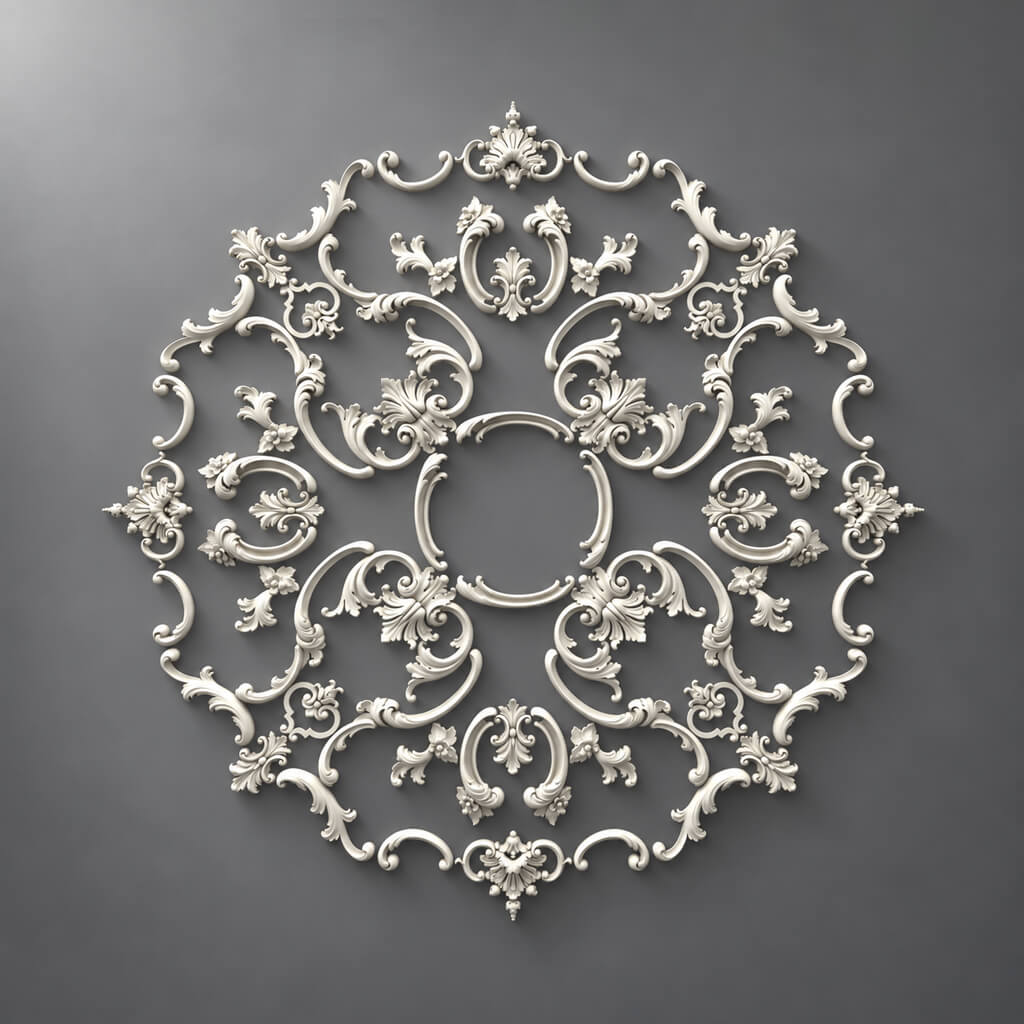
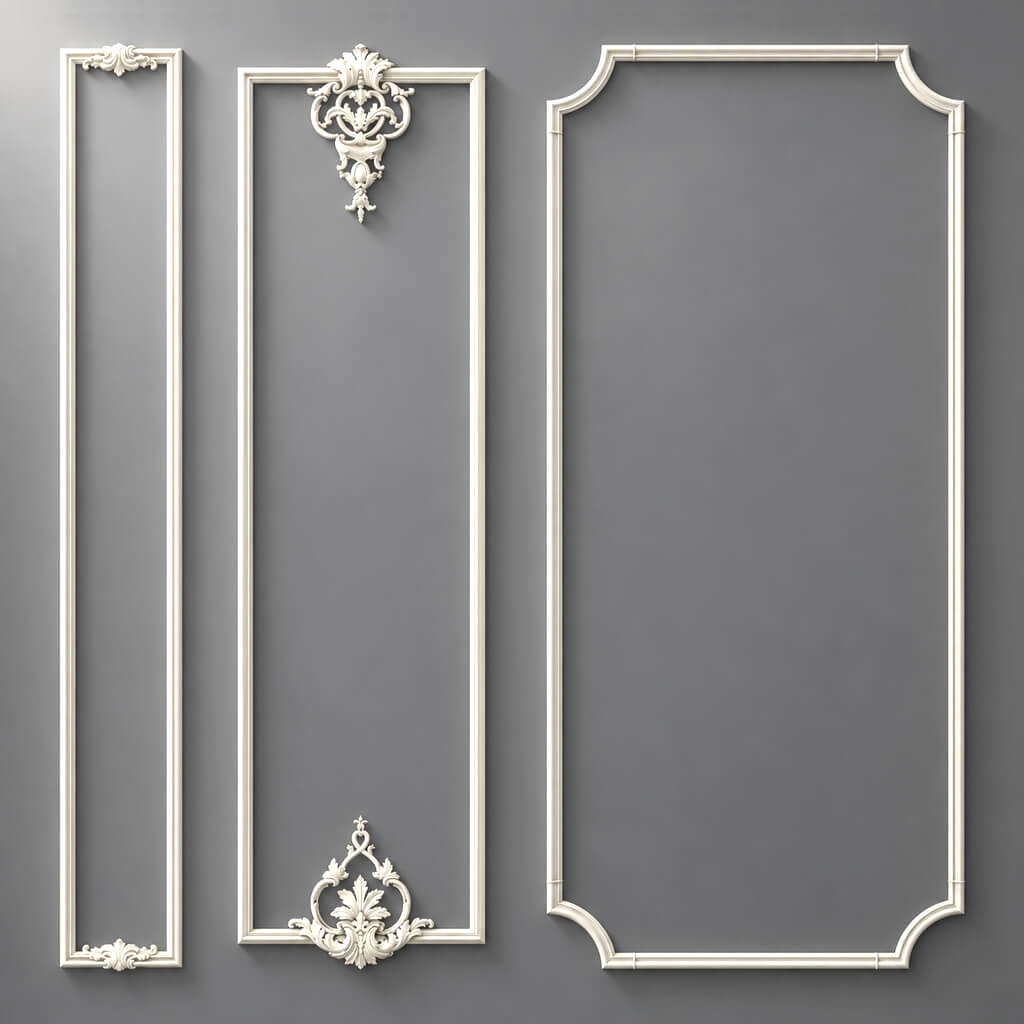
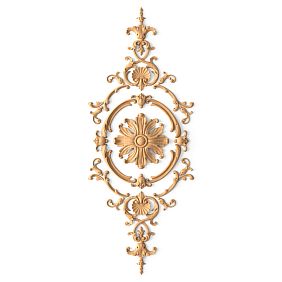
It is wiser to buy a set of carved furniture decor after determining the free field of the facade, the scale of the ornament, and the permissible depth of the relief. The C-005 series offers three ready-made compositions with different dimensional logic. C-005-1-1 has a pattern of 180 × 1920 × 15 mm and forms an elongated, relatively light design. C-005-1-2, with dimensions of 450 × 1860 × 31 mm, looks significantly more massive and creates the deepest chiaroscuro. C-005-2, measuring 260 × 700 × 16 mm, is designed for a more compact field and is convenient where a composition about 1.9 meters long cannot be placed.
All three sets belong to wooden overlay decor and are available in beech or oak. Beech is prepared for enamel, oak for tinting. However, the same material does not make the products interchangeable. The choice between them is determined not only by the total length according to the dimensional scheme, but also by the depth of the relief, the number of parts, the nature of the central and side elements, the presence of moldings, and the distance from which the furniture will be perceived in the interior.
It is important for the buyer not to transfer the dimensions of one set to another and not to choose based on a large photo of the card. First, you should open set C-005-1-1, set C-005-1-2 и set C-005-2, compare the DWG, and then make a full-size or scaled layout on a specific facade. Only such a fitting shows whether free fields will remain, whether the carving will collide with a handle, panel, hinge, or adjacent door.
This article helps to choose a ready-made composition for a wardrobe, chest of drawers, sideboard, cabinet, wall panel, or interior door; explains the roles of parts within the sets; shows how not to confuse parameters A, B, and C; and translates the idea into a clear order. As a result, the buyer receives not a random set of beautiful overlays, but a coordinated decor that matches the scale of the furniture and can be finished in a uniform way.
Short answer. C-005-1-1 is chosen for elongated and relatively shallow compositions: the dimensional scheme 180 × 1920 × 15 mm helps emphasize the long axis of the furniture without excessive bulk. C-005-1-2 is needed for large facades where a depth of 31 mm is acceptable and the most expressive relief is required. C-005-2, measuring 260 × 700 × 16 mm, is suitable for compact doors, chests of drawers, nightstands, or repeating facades.
The final decision is made based on the DWG and layout on the actual plane. Parameters A, B, and C should be read as the dimensional scheme of a specific product, not automatically considered as width, height, and thickness in any orientation.
Select C-005-1-1 180 × 1920 × 15 mmSelect C-005-1-2 450 × 1860 × 31 mmSelect C-005-2 260 × 700 × 16 mm


C-005-1-1, C-005-1-2 and C-005-2: confirmed dimensions and main purpose
| Criterion | C-005-1-1 | C-005-1-2 | C-005-2 |
|---|---|---|---|
| Dimensional scheme A × B × C | 180 × 1920 × 15 mm | 450 × 1860 × 31 mm | 260 × 700 × 16 mm |
| Material | Beech or oak | Beech or oak | Beech or oak |
| Sanding | "Standard" or "Prestige" | "Standard" or "Prestige" | "Standard" or "Prestige" |
| Preparation of beech | For enamel | For enamel | For enamel |
| Oak preparation | For tinting | For tinting | For tinting |
| Depth by parameter C | 15 мм | 31 мм | 16 мм |
| Character | Elongated, relatively light | Large, deep, multi-component | Relatively compact |
| Molding part | There is a matched profile | MLD-004 and MLD-001 | MLD-001 |
| Composition | Central, paired, and additional elements | Central, side, mirror elements and two moldings | Eight matched overlays |
| Typical scenario | High or long panel | Large facade, portal, big panel | One door, chest of drawers, cabinet, repeating facades |
| Main risk | Stretch on too short a field | Overload furniture and ignore 31 mm relief | Lose scale on a large empty panel |
The table shows the main fork but does not replace the drawing. The most important difference between the two elongated options is not 60 mm in parameter B, but the depth of the relief: C-005-1-2 is 16 mm deeper than C-005-1-1. Therefore, two compositions of similar length give completely different chiaroscuro. On a calm facade, C-005-1-1 may look thin and collected, while C-005-1-2 will turn the same object into a noticeable architectural element.
C-005-2 is separated from the other two primarily by the length of the dimensional scheme of 700 mm. It is not a simplified or incomplete version of a large set. This is an independent composition of eight parts, designed for a different field and a different density of ornament. This option is easier to repeat on paired doors, use on a chest of drawers, or fit between the handle, panel, and edges of the facade.




Why the same material does not make sets interchangeable
The buyer often starts with the wood species: beech under enamel or oak with visible texture is needed. This is the right question, but it comes after geometry. The composition must first fit on the facade and support its proportions. If a large set overlaps the handles, extends onto the panel, or visually presses on a small cabinet, the choice of oak will not fix the scale error. Conversely, a compact set on a huge furniture wall may look like a random spot even with flawless finishing.
C-005-1-1, C-005-1-2, and C-005-2 differ not only in their overall outline. The number of visual centers, the distance between paired details, the role of moldings, and the depth of shadows also change. The finished composition is designed as a system: the central element sets the axis, the right and left details maintain symmetry, the moldings connect sections, and the free space around the pattern prevents the facade from turning into a continuous ornament. Therefore, removing or accidentally rearranging details requires a new layout, not a mechanical reduction of the set.
When the task is broader than choosing three models, it is useful to first study how to choose decorative overlays for furniture. The general material helps to understand the role of overlays, and this article solves a narrower purchasing task: which specific C-005 set corresponds to the size and character of a particular facade.
Our factory also produces:


What is included in each set and what role the details play
| Composition element | C-005-1-1 | C-005-1-2 | C-005-2 | Practical role |
|---|---|---|---|---|
| Central motif | N-344 | N-415 and N-414 | N-415 and N-414 | Sets the main axis and the point relative to which symmetry is built |
| Paired elements | N-438R/L and N-014R/L | N-438R/L, N-014R/L, N-402R/L | Paired side parts | Create a mirror continuation; right and left parts cannot be swapped without checking the pattern |
| Additional part | N-311 | Several central and side parts | Included in a set of eight overlays | Fills transitions and supports a consistent ornament |
| Molding part | Consistent profile | MLD-004 and MLD-001 | MLD-001 | Connects motifs, sets the line, and helps assemble a cohesive composition |
| Depth | 15 мм | 31 мм | 16 мм | Determines the clarity of chiaroscuro and the necessary clearance to handles, adjacent planes, and opening elements |
The names of individual items are useful not for the buyer to disassemble the finished set into random parts, but for understanding the logic. The central overlay does not replace the side one, the mirrored right part is not equal to the left one, and the molding performs a different function than the carved tip. During dry layout, it is better to label each position with painter's tape or a paper tag. This reduces the risk of confusing the orientation after priming, tinting, or moving parts from the workshop to the installation site.
If a part of the kit seems unnecessary, first check whether the central axis and the completion of the ornament will be disrupted. In some projects, the composition is indeed adapted, but that is already a new design layout. For this, it is reasonable to use a service that allows ordering a layout of decor for a furniture facade, rather than removing elements by eye after receiving the order.
Get Consultation
How to read dimensions A, B, and C without error
The product cards show a dimensional diagram A × B × C. The main mistake is to automatically call A width, B height, and C thickness without opening the drawing. In a real project, the composition may be oriented differently, and the points from which the dimensions are measured are determined by the DWG. Therefore, in the text, it is more correct to talk about parameters A, B, and C and separately describe the actual placement on the facade after fitting.
Parameter C is especially important because it is related to the protrusion of the relief. For C-005-1-1 it is 15 mm, for C-005-2 — 16 mm, for C-005-1-2 — 31 mm. The difference of one millimeter between the first and third kit rarely becomes the main visual factor. The difference of 15–16 mm between them and C-005-1-2 is more noticeable: the shadow is deeper, the edge of the ornament is more active, and the requirements for the placement of handles, adjacent doors, and protruding parts become stricter.
Parameter B helps to estimate the length of the composition: 1920 mm for C-005-1-1, 1860 mm for C-005-1-2, and 700 mm for C-005-2. But you cannot choose only by B. The two long kits differ in parameter A, depth, composition, and pattern character. The compact C-005-2 may work better on a large cabinet if it is repeated on several identical doors, while one elongated kit can unite the central panel. The decision depends on the entire furniture architecture.
How to determine the useful field of the facade
The useful field is not the full size of the door or panel. From it, you need to subtract areas that cannot be covered with decor: gaps between doors, panels, profile edges, handles, lock elements, ventilation grilles, hinges, and areas where the facade enters the body. In addition, air is left around the carved pattern so that the ornament reads as a composition, not as a detail accidentally squeezed between the edges.
For a preliminary assessment, measure the clean plane and apply it to the diagram. Then mark the central axis, the extreme opening points, the position of handles, and the line of adjacent facades. After that, place the outer contour of the selected kit on paper. If the contour fits only tightly to the edges, the model is likely too large. If there is a huge empty space around and the pattern is lost from a normal distance, consider a larger option or repeating several compositions.
| Situation | What to measure | Preferred candidate | What to check before ordering |
|---|---|---|---|
| One tall narrow panel | Clear axis length, free field width, handle position | C-005-1-1 | Whether the outermost elements fit and there is air around the pattern |
| Large classic facade | Overall plane, depth to adjacent parts, visibility from a distance | C-005-1-2 | Whether a 31 mm relief is allowed and does it interfere with opening |
| Chest of drawers or cabinet | Field of one door or group of drawers, handles and joints | C-005-2 | Whether the composition extends into movable gaps |
| Pair of doors | Size of each door and central gap | Two C-005-2 or design adaptation of another set | Each moving part must remain independent |
| Large furniture wall | Width of the entire group and repetition of modules | C-005-1-1, C-005-1-2 or C-005-2 series | How the composition works not on one door, but on the entire wall |
When to buy C-005-1-1
Elongated ornament for a tall or long panel
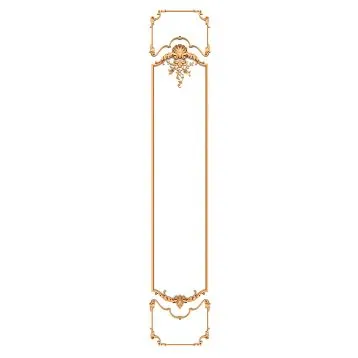
C-005-1-1 is chosen when a design with pronounced length and moderate relief is needed. The dimensional scheme of 180 × 1920 × 15 mm suggests that the composition occupies a long axis but remains relatively narrow and shallow. This character is convenient for the central panel of a tall cabinet, a decorative insert in a sideboard, a vertical section of a wall unit, or a long plane where massive relief would look heavy.
The depth of 15 mm creates shadow but does not turn the facade into an almost sculptural surface. This helps maintain visual lightness and leaves the main role to the proportions of the furniture. The set is especially appropriate when there are already cornices, pilasters, legs, or noticeable handles nearby, and the new carving should tie them together rather than compete with all elements at once.
Composition with a central axis and mirrored details
The set includes a central overlay, right and left elements, an additional part, and a molding profile. This structure requires a precise axis. If the facade is asymmetrical, the handle is offset, or one side is overlapped by an adjacent section, first make a paper layout and check that the ornament does not appear accidentally shifted. On a symmetrical panel, the set unfolds most naturally: the eye reads the center, then moves along the paired elements and the molding line.
When it is better not to choose C-005-1-1
It is not suitable when the usable field is noticeably shorter than parameter B and the composition has to be compressed, trimmed, or assembled with disproportionately small intervals. On a very large wide panel, the narrow pattern may get lost if there is no architectural frame or other elements around. Finally, if the project requires maximum chiaroscuro and deep classical relief, C-005-1-2 will be more convincing.
Before ordering, you can buy the carved decor set C-005-1-1 after checking the DWG and layout. In the cart, you should save the selected wood species, sanding level, and information about the future finish so that all parts are prepared as a single system.
When to buy C-005-1-2
Large facade and maximally expressed relief
C-005-1-2 is the deepest and most visually rich option in comparison. Parameter C is 31 mm, so the ornament creates an active shadow and is well readable on a large plane. Such a set is appropriate on a large cabinet, sideboard, wall panel, portal, or interior door when the furniture should become the architectural center of the room. On a small facade, the same relief can overload the item and reduce the sense of free space.
The dimensional diagram 450 × 1860 × 31 mm shows that the composition is not only deep but also wider than C-005-1-1 in parameter A. It uses two moldings, central elements, and several pairs of mirror parts. The more components, the more important it is to preserve their roles. Randomly reducing distances or removing one side motif can disrupt the logic of the pattern more severely than in a more compact composition.
Classic furniture, Baroque, Empire, and Eclecticism
Complex floral decor works especially naturally in interiors where furniture is supported by cornices, pilasters, carved legs, frame facades, and rich finishes. However, the set does not require an entire historical room. In modern eclecticism, it can be used as one large accent on a calm, monochrome cabinet. The key condition is sufficient scale of the item and the absence of visual competition from many small details.
Structural limitations of 31 mm depth
Before ordering, not only the appearance is checked, but also the movement of the facades. The carving should not collide with the adjacent door, side panel, cornice, or handle. If the panel is pull-out, the trajectory and grip are considered. If the set is installed on a door, the slope, casing, and distance to the wall when fully opened are evaluated. Universal compatibility cannot be guaranteed: it depends on the specific furniture and arrangement of elements.
After technical verification, you can purchase the large decor set C-005-1-2. For a complex composition, preliminary layout and coordination of the finish of all parts in one batch are especially useful.
When to buy C-005-2
Compact composition for a single door, dresser, or nightstand
C-005-2 has a dimension scheme of 260 × 700 × 16 mm and consists of eight coordinated carved overlays. It is chosen when a long set of about 1.9 meters does not fit or does not match the scale of the item. The composition is convenient for a single cabinet door, the central field of a dresser, the front of a nightstand, a small sideboard, or an interior panel with limited free space.
The depth of 16 mm is close to C-005-1-1, so the relief remains noticeable but does not reach the massiveness of C-005-1-2. This makes C-005-2 flexible for medium-sized furniture. It can work as a single motif or be repeated on two symmetrical fronts. Repetition is especially useful when furniture is built from identical modules: each door gets its own complete composition and maintains independent opening.
Eight elements as a ready-made layout
The advantage of the set is the consistency of the parts. The buyer does not need to re-select central and side motifs by scale. However, the eight elements still need to be laid out on a specific surface. Uniform intervals must be maintained between them, the right and left orientation must not be changed, and the central axis must coincide with the architecture of the facade.
When C-005-2 is too small
On a large empty panel, a single compact motif may look lost. In this case, three solutions are possible: choose a more elongated set, repeat C-005-2 in the facade system, or supplement the layout with frame elements if provided by the design. Do not simply increase the distances between the eight parts until they fill the entire wall: excessive intervals will destroy the integrity of the pattern.
After fitting, you can buy the compact decorative set C-005-2 and use it as a finished composition for one or more repeating facades.
C-005-1-1 or C-005-1-2: why similar length is deceptive
Parameter B of the two sets differs by only 60 mm: 1920 mm and 1860 mm. This may create the impression that the products are almost identical and differ only in pattern. In practice, parameter A changes from 180 to 450 mm, and the depth — from 15 to 31 mm. C-005-1-2 occupies a wider field and protrudes almost twice as much. Therefore, it requires a larger facade, greater distance to adjacent parts, and a calmer environment.
C-005-1-1 is perceived as an elongated line with carved accents. It helps emphasize the vertical or the length of the panel. C-005-1-2 is perceived as an independent relief motif. It doesn't just guide the eye, but forms a central architectural scene on the facade. The choice depends on the role of the furniture: a background item with delicate decor or a main object that should hold attention.
For an honest comparison, not only the outer contour is printed, but also the conditional shadow from the depth. On paper, both sets may seem equally flat. In reality, 31 mm creates a noticeable side edge. It is useful to cut a strip of cardboard of the corresponding depth and temporarily attach it to the facade next to the handle and the adjacent door. Such a simple mockup shows design risks better than a frontal picture.
C-005-1-1 or C-005-2: long axis or compact motif
These sets are close in depth — 15 and 16 mm, but fundamentally differ in length. C-005-1-1 builds a long composition and requires a pronounced axis. C-005-2 fits approximately 700 mm in parameter B and is suitable for a limited field. Therefore, choosing between them is easier not by style, but by the architecture of the item. A tall central panel leans towards C-005-1-1; a separate door, chest of drawers, or repeating sections — towards C-005-2.
If the cabinet consists of two identical doors, one long set through the central gap can create an installation problem. A single piece should not rigidly connect movable facades. Two C-005-2 sets allow maintaining the independence of the doors and achieving symmetry. Another option is to adapt the long set so that each part is located on only one door, but such a scheme needs to be designed in advance.
C-005-1-2 or C-005-2: large architecture or repeatable module
C-005-1-2 is needed when one composition should dominate a large plane. C-005-2 is more convenient as a module that repeats on several doors. In a wardrobe with four identical facades, four compact sets can create a calm rhythm. One large C-005-1-2 works better on a central cabinet, portal, or wide panel where the ornament is not fragmented by door gaps.
Depth also affects operation. A compact set of 16 mm is easier to place next to a handle and in a walkway area. A relief of 31 mm requires more attention to contact with clothing, opening adjacent facades, and cleaning. This does not make C-005-1-2 less practical, but moves it into the category of design decor that cannot be placed without checking the surroundings.
Ready-made set or individual overlays
Advantages of a ready-made composition
A ready-made set saves the most difficult part: searching for elements of the same ornamental language and scale. It already includes central, right, left, and connecting parts. It is easier for the buyer to maintain symmetry, repeat the layout on another facade, and order all elements in the same wood species. This is especially important for oak under tinting, where differences in texture and shade are more noticeable than under opaque enamel.
The set also simplifies commercial ordering. Instead of a list of many individual SKUs, the project gets a clear base: C-005-1-1, C-005-1-2, or C-005-2. Then materials, finish, and installation diagram are added. Completeness errors are reduced, and reordering is easier to restore using the saved SKU.
When individual elements provide more freedom
A non-standard facade may require a different pattern density, asymmetry, or a local accent. Then individual overlays allow you to assemble your own scheme. But freedom increases responsibility: you need to check the compatibility of scales, orientation of paired parts, uniform depth, and transitions to moldings. A random set of beautiful elements rarely automatically turns into a cohesive ornament.
To view alternatives, you can Buy decorative furniture overlays in the category where single, paired, and set solutions are presented. For a complex task, it is better to first determine the central axis and maximum contour, and only then select individual SKUs.
Can one set be divided between two facades
Technically, individual overlays can be placed on different doors, but the composition cannot be mechanically split in half. You need to consider the central gap, the direction of right and left parts, the location of the molding, and independent door opening. No single solid part should overlap the movable joint, otherwise the facades will be connected or the decor will be damaged upon first opening.
For two identical doors, it is often safer to use two compact sets C-005-2 or repeat the matching part of the pattern on each leaf. If C-005-1-1 or C-005-1-2 is chosen, the layout is constructed so that each overlay belongs to one plane. The central gap becomes part of the composition, not an obstacle that is attempted to be hidden with a carved detail.
Before ordering, it is useful to cut out two paper leaves to scale, draw a gap line, and check each position. After that, the mockup is opened like real doors. If elements visually collide or one side loses its finish, the scheme is adjusted before purchase.
Full-size layout: how to check the composition before installation
| Stage | What to do | Why this is needed | Typical mistake |
|---|---|---|---|
| 1. Get the drawing | Check A, B, C and part contours against DWG | Do not transfer dimensions and orientation from another card | Assume A is width, B is height without verification |
| 2. Apply the facade | Mark edges, panels, handles, hinges, joints, and opening zones | Get the actual usable field | Use the full door width |
| 3. Draw axes | Mark the center of the facade and the center of the composition | Maintain symmetry | Align to the nearest edge, which itself may be asymmetrical |
| 4. Lay out contours | Transfer each part to paper or masking film | See the intervals and orientation of paired elements | Check only the overall rectangle of the set |
| 5. Check depth | Make cardboard spacers 15, 16 or 31 mm | Evaluate collisions and side shadow | Look only at the flat frontal image |
| 6. Evaluate from a distance | View the facade from 2–4 meters and take a frontal photo | Understand the real scale in the room | Make a decision close to the furniture |
| 7. Check movement | Open doors and drawers with the mockup | Eliminate conflict with adjacent parts | Check only the closed facade |
Full-size layout is especially important for C-005-1-2. The large depth and width of the composition may look convincing on the drawing but conflict with the handle or adjacent door. For C-005-1-1, the layout shows whether the elongated ornament appears too narrow on a wide panel. For C-005-2, it helps select intervals between eight pieces and decide whether to repeat the set on the paired facade.
Temporary fixation of paper outlines is safer than fitting wooden parts without protection. If real overlays have already been received, they are laid out on a soft, clean surface; do not press the threads with hard clamps and do not use tape directly on prepared wood without checking. The purpose of dry fitting is to preserve the parts and check the project, not to start installation prematurely.
How to account for furniture handles, hinges, and panels
The handle is not a secondary point. It must remain comfortable to grip and not collide with protruding relief. On a facade with C-005-1-2, the distance to the handle is especially important due to the 31 mm depth. The user's hand passes not along the plane but next to the carving. If the gap is small, the decor will interfere with daily opening and get dirty faster.
Hinges are on the reverse side but affect permissible fastening and drilling zones. The panel may have a height difference that prevents the overlay from lying flat across the entire plane. A frame facade requires checking whether the base of each part is in the same plane. Unevenness cannot be compensated with an excessive layer of glue without a technical solution: this worsens the fit and may lead to noticeable gaps.
On dresser drawers, inter-facade gaps are considered. The composition should not turn several drawers into one rigid system. If the pattern runs through a group, each overlay and each section of molding is attached only to its own facade, and the lines visually continue through the technological gap.
Beech or oak: how to choose the material for the set
Beech for opaque enamel
Beech is chosen when the decor is planned to be painted with opaque enamel and unified with the facade in one color. Preparation for enamel helps build a solid surface where the relief is readable
Why you should not mix beech and oak in one set without a project
Different species perceive transparent finishes differently and have different textures. Mixing can be a deliberate design technique, but should not occur due to a missing detail or random purchase. If the entire facade is painted with opaque enamel, differences can be visually reduced, but the preparation and behavior of the materials still require verification. For a predictable result, the set is ordered in one species.
"Standard" or "Prestige": what to consider as sanding
Cards confirm two levels of sanding — "Standard" and "Prestige". The choice is related to the requirements for the future finish and the level of preparation planned to be done in the workshop. It cannot be automatically assumed that any option can be painted immediately without inspection. After receipt, check the surface, edges, carving recesses, and joining areas.
For thin solid-color enamel, the preparation requirements are especially high because the smooth color reveals scratches and transitions. Oak tinting, on the contrary, emphasizes the texture, but can also reveal unevenly treated areas. Before ordering, it is useful to study the section on how STAVROS describes the quality of wood decor processing, and coordinate the expected result with the finisher.
Do not aggressively sand the carving after receipt. Strong impact can round off thin lines and change the pattern. Adjustments are made delicately, with the appropriate tool, and only where truly needed. If a discrepancy is found, it is documented before installation and finishing.
What to buy together with the C-005 set
| What to add | What for | When it is especially important | Where to go |
|---|---|---|---|
| Materials for installation and finishing | Prepare the base, secure the parts, treat the joints, and perform the finish | For any set; the composition is selected based on the base and finish | Buy materials for installing wooden overlays |
| Additional overlays | Adapt a non-standard facade or assemble an adjacent composition | When a ready-made kit does not cover the entire furniture group | View decorative overlays for furniture |
| Related carved decor | Coordinate cornices, rosettes, pilasters, and other elements | For a large classical furniture system | View all carved wood decor |
| Layout project | Check scale, axes, intervals, and placement on multiple facades | For C-005-1-2, complex cabinets and non-standard panels | ordering a layout of decor for a furniture facade |
| Instructions and tips | Prepare for fitting, finishing and installation | Before starting independent work | Study tips on preparation and installation |
| Coordinated handles and legs | Match overlays with other furniture parts | When not just one facade is updated, but the entire piece | How to combine overlays, handles and furniture legs |
The exact composition of glue, primer and finish cannot be chosen solely by the name of the wooden decor. It depends on the base material: solid wood, MDF, veneer, painted or laminated surfaces require different preparation. Additionally, the weight and area of specific parts, operating conditions and finishing technology are taken into account. There is no universal solution for any furniture.
When ordering, it is useful to compile a complete list: the article number of the main set, material, sanding, quantity, additional items, finish code, and purpose of each position. Such a document helps not to lose details between purchase, workshop, and installation, and facilitates reordering for a second room or adjacent section.
Installation on MDF, solid wood, and painted facade
MDF base
MDF must be flat, clean, and sufficiently strong in the installation area. If the facade is already painted, check the adhesion of the existing coating and compatibility of the mounting compound. Do not glue wooden decor over weak paint that peels off together with the overlay. If necessary, the area is prepared according to the technology agreed upon with the material manufacturer and the craftsman.
Base made of solid wood or veneered surface
On solid wood, consider the direction of the fibers, flatness, and future finish. Veneer must not be damaged by rough mechanical preparation. If the decor remains in its natural wood color, accuracy is especially important: traces of glue and markings may appear after tinting. All tests are carried out on a sample or a hidden area.
Painted facade
A finished painted surface requires a precise decision: finish the decor separately or after installation. Separate painting simplifies access to the carving, but the joint remains visible and the shade must be matched. Painting after installation unifies the facade and overlays but requires careful preparation of boundaries and even application in recesses. The decision is made before purchasing materials.
Large elements cannot be held by one random method without verification. The fastening method depends on the geometry and base. In some projects, additional mechanical fixation is possible, but it cannot be universally recommended: damage to the facade, fastener exit on the front side, and splitting of the carved part must be avoided.
Layout and fixation order without dry instructions
It is convenient to divide the work into three states: project, dry fit, and final fixation. At the project stage, scale and placement are decided. During the dry fit, actual parts, orientation, intervals, and furniture movement are checked. Only after this is the installation sequence chosen. This approach protects against the most expensive mistake — gluing a correctly manufactured set in the wrong place.
The central element is usually used as a starting point, but the sequence depends on the composition and base. Sometimes it is more convenient to first fix the molding lines, sometimes the central overlay, and position the side parts using a template. It is important not to move from one edge without general marking: the accumulated error in intervals will become noticeable on the opposite side.
Temporary fixation should hold the part but not damage the relief and coating. Hard pressing against protruding areas can leave a dent or break a thin element. Pads are made soft and distribute pressure over safe zones. Residues of the mounting compound are removed before irreversible drying using a method compatible with the selected system.
How not to confuse a ready-made kit with a set of random overlays
The main sign of a ready-made kit is a coordinated compositional scheme. The parts have roles, orientation, and connection with moldings. A random set may include beautiful elements but lack overall scale or completion. If the central motif is significantly deeper than the side ones, if the right and left parts belong to different ornaments, or if the molding does not match in character, the facade will look assembled from leftovers.
In the product card, check the full article number. C-005-1-1, C-005-1-2, and C-005-2 are similar in name but differ in size scheme and composition. You cannot order a missing item based only on "C-005". Before payment, verify the suffix, material, sanding, and quantity. Upon receipt, compare the marking with the specification.
Do not confuse the kit with a ready-made furniture facade. The included parts are overlay decor that needs to be fitted, finished, and installed on a prepared base. The door itself, handle, hinges, and mounting materials are not automatically included unless directly confirmed by the product card.
Practical selection for different furniture items
| Item or task | More often suitable | Why | What can change the choice |
|---|---|---|---|
| Tall cabinet with a narrow central panel | C-005-1-1 | Elongated pattern and moderate depth support the vertical | Wide field and requirement for large relief may lead to C-005-1-2 |
| Large sideboard or portal | C-005-1-2 | Large subject and depth of 31 mm are readable from a distance | If the furniture is already saturated with decor, C-005-1-1 may be calmer |
| Chest of drawers or cabinet | C-005-2 | Size pattern 260 × 700 × 16 mm fits more easily into a compact field | A wide single facade can allow an elongated composition |
| Two identical doors | Two C-005-2 | Each door receives an independent completed motif | Project layout of long set parts without gap overlap is possible |
| Wall panel | C-005-1-1 or C-005-1-2 | There is space for a long pattern | Viewing distance and permissible depth determine the choice |
| Interior door | Per DWG: C-005-2 or extended set | Need to consider panels, handle, and opening direction | 31 mm relief may conflict with wall or casing |
| Modular wall unit | System C-005-2 or one central large set | You can choose a repeating rhythm or a single main accent | Number of doors and joint placement |
How to combine carved decor with handles, legs, and moldings
Overlays should work together with the rest of the furniture. If the handle is long and contrasting, a large C-005-1-2 can create competition. In this case, either include the handle in the composition axis, or choose a calmer C-005-1-1. On a dresser, a compact C-005-2 can be supported by the shape of the legs, but it is not necessary to repeat every line of the carving. A general character is sufficient: a smooth plant motif, similar finish, and consistent scale.
Moldings within a set cannot be replaced with a random profile just because it looks similar in a photo. The section, depth, and line must match the intended composition. Additional frames around the set are also designed in advance. A frame that is too wide can visually compress the ornament, while one that is too thin can get lost next to a deep relief.
For the overall system, it is useful to study How to combine overlays, handles and furniture legs. Such a check is especially important when completely updating a cabinet or sideboard, where a single beautiful overlay should become part of the piece, rather than looking like a later addition.
Mistakes when choosing C-005-1-1, C-005-1-2, and C-005-2
Choosing only by photo
A close-up hides the real scale. On a small facade, C-005-1-2 may be excessive, while C-005-2 on a large panel may be unnoticeable.
Confusing parameters A and B with automatic orientation
Dimensions must be read from DWG. The scheme cannot be transferred to the project without understanding the measurement points and actual location.
Ignore the depth of 31 mm
C-005-1-2 requires checking handles, adjacent sashes, passage, and opening. The front image does not show the side risk.
Consider C-005-1-1 and C-005-1-2 almost identical
A close parameter B does not cancel the difference in width, depth, composition, and visual mass.
Stretch C-005-2 to a larger panel
Excessive intervals destroy the integrity of eight elements. It is better to repeat the set or choose a longer model.
Confuse right and left parts
Mirror elements have a direction. An error disrupts the pattern and becomes noticeable after fixing.
Overlap the movable gap
A one-piece overlay or molding should not rigidly connect two doors or several drawers.
Do not consider handles and panels.
The relief may interfere with the grip, and an uneven base may prevent the part from lying flat.
Mixing beech and oak without a project.
Under a transparent finish, the differences are obvious. Even under enamel, material preparation must be coordinated.
Ordering parts at different times without a specification sheet.
You may get different material, sanding, or finish shade. Completeness and coating code should be maintained.
Start installation without dry layout
After fixing, adjusting the position may damage the facade and the carving itself.
Using one universal adhesive.
The base material and coating condition differ. The composition is selected for a specific system.
Which set suits whom, and who should choose a different option
C-005-1-1 is suitable
For owners of tall or long furniture panels who need an elongated plant ornament with moderate depth. It is appropriate when the composition should support the vertical, maintain lightness, and connect central and paired details with a molding line.
C-005-1-1 is not suitable
For a short facade where the 1920 mm dimensional scheme does not fit without compression, and for a project where maximum deep relief is needed. On a very wide empty panel, it may also require an additional architectural frame or a different scheme.
C-005-1-2 is suitable
For large furniture, a portal, or a wall panel with sufficient free space and an allowable depth of 31 mm. It is chosen when the decor should be the main visual object and be readable from a distance.
C-005-1-2 is not suitable
For a small door, a cramped passage area, and a facade where the handle, adjacent doors, or paneling leave no room for deep relief. It is also excessive if the furniture is already overloaded with carving and complex hardware.
C-005-2 is suitable
For a chest of drawers, a nightstand, one door, a small sideboard, and repeating facades. The compact layout is convenient for symmetrical repetition and for furniture where a long set of about 1.9 meters is not possible.
C-005-2 is not suitable
As the only small motif on a huge panel without other elements. If the free field is significantly larger, you need to either repeat the module, choose an elongated set, or order a custom layout.
How to buy a set of carved decor on STAVROS
First, determine not the article number, but the task: an elongated light composition, a large deep subject, or a compact module. Then open the cards of three sets and compare the dimensions, material, sanding, and composition. After that, transfer the outlines to the facade, check the handles, joints, and opening. Only the model that passes the fitting is added to the order.
For an elongated solution, go to the card and can buy the carved decor set C-005-1-1. For a large relief facade, choose a large set C-005-1-2. For a door, chest of drawers, or repeating module, a compact set C-005-2 is suitableIf no pattern matches the facade, it's better to open catalog of decorative overlays for furniture and assemble a different solution rather than trying to force an unsuitable set.
The order specifies the wood species, sanding option, number of sets, and future finish. Next, add Mounting and finishing materials, selected for a specific base. For complex furniture, it's useful to order a layout design. The terms for receiving and calculating the order are checked in the section payment and delivery of decorative sets.
Buying a ready-made set is more convenient than random selection because the compositional roles of the parts are already coordinated. However, the readiness of the set does not eliminate the need for design on a specific facade. STAVROS provides an accurate product base, and the buyer or designer links it to furniture dimensions, finish, and installation technology.
Checklist before placing an order
- Full article numbers C-005-1-1, C-005-1-2, and C-005-2 have been verified, not just the general C-005 series.
- DWG files have been opened and the values of parameters A, B, and C for the selected product have been checked.
- The usable area has been measured, not the full facade dimension.
- Handles, hinges, panels, joints, and opening trajectory have been marked.
- The layout of all part contours has been made, not just the outer rectangle.
- The depth of 15, 31, or 16 mm has been checked next to adjacent elements.
- It has been determined whether beech under enamel or oak under tinting is needed.
- All parts are planned to be ordered in one wood species and in the agreed finish.
- It has been decided whether one set or a repeat on multiple facades is used.
- Materials have been selected for the specific base, not a universal composition at random.
- Saved list of articles, quantity, and future coating code.
- Current availability, configuration, and order receipt conditions have been clarified.
How light and viewing distance change the choice of kit
The same relief is perceived differently in a workshop, showroom, and living room. Frontal diffused light makes the surface calmer, while a side beam emphasizes every edge. Therefore, the 31 mm depth of C-005-1-2 is especially noticeable near a window, sconce, or directional lighting. C-005-1-1 and C-005-2 give a softer chiaroscuro, but also become expressive under low side lighting. Before ordering, it is worth evaluating not only the daytime view but also the evening scenario of the room.
Viewing distance affects the required scale. A chest of drawers is viewed from one to two meters, so compact details are well readable. A tall cabinet or panel in a spacious living room may be perceived from four to five meters: a small motif gets lost there, while a large composition becomes justified. In a narrow corridor, deep decor is close to the person and feels more massive than on the same furniture in a large hall. It is useful to photograph the mockup from the points where the item will be seen daily.
Dark tinting enhances shadow contrast, light enamel makes the pattern dependent on lighting. This is not a rigid rule of color, but a reason to test material and light together. It is better to place a test swatch vertically next to the facade, rather than evaluating it on a table under a different lamp.
Updating existing furniture and designing new furniture are different routes
When decor is added to an existing cabinet
Existing furniture already has set dimensions, holes, handles, hinges, and coating. Here, the choice begins with limitations. It is necessary to check whether the surface can withstand preparation, whether the facades can be removed, where the internal fastenings run, and whether access to the handles will remain. Compact C-005-2 is often easier to adapt, but this is not a universal answer: a tall central panel can accept C-005-1-1, and a large sideboard can accept C-005-1-2. The decision depends on the actual usable area.
During restoration, it is especially important to test the compatibility of the new coating with the old one. If the overlays are painted separately, the shade is matched to the existing furniture. If the facade is completely repainted, the decor can be included in the new finishing system, but first, the condition of the base and the possibility of quality preparation are assessed.
When furniture is still being designed
It is easier to plan the composition in advance for new furniture. The size of the facade, handle, panel, and gaps can be subordinated to the chosen set, rather than trying to fit decor into the remaining space. For C-005-1-2, the designer can provide a sufficient plane and offsets for a depth of 31 mm. For C-005-1-1, build a central long axis. For C-005-2, repeat the same module on a series of doors.
The design approach also allows for preparing technological templates, marking each part, and agreeing on the finish before the facades are produced. As a result, installation becomes part of furniture production, rather than a separate operation after its assembly.
C-005 sets in a commercial interior
In a hotel, restaurant, salon, or showroom, furniture is considered not only as a storage item but also as part of the brand environment. C-005-1-2 can decorate a large counter, cabinet, or panel in an area where a noticeable classic motif is needed. C-005-1-1 helps emphasize a tall section and maintain a lighter perception. C-005-2 is convenient for repeated doors when the ornament should create a recognizable rhythm throughout the room.
Commercial use requires considering the frequency of touches, cleaning, and passageways. Deep relief is not placed where it is constantly bumped by bags, carts, or clothing. On doors with daily intensive use, a comfortable grip and access to hardware are left. The finish must match the room conditions, but specific compositions and care routines are chosen within the project, not by the general name of the set.
For a network of rooms, repeatability is important. Article numbers, diagrams, material, sanding, coating code, and photos of the approved sample are preserved. Then an additional section or new object can be designed in the same logic without re-selecting from scratch.
Acceptance of the set before finishing and installation
The received parts are first checked against the order in a dry, clean room. Full article numbers, quantity, beech or oak, sanding option, and the presence of provided moldings are verified. Right and left parts are laid out mirror-wise and compared with the drawing. Such inspection is carried out before primer, tinting, and glue: after surface modification, it is more difficult to determine the origin of a defect or missing item.
The carving is inspected under side lighting. It reveals chips, crushed edges, and areas that require clarification. Natural differences in wood grain are not equal to a defect, but the set must match the agreed material and be suitable for the chosen finish. All issues are recorded with photos showing a general view and close-up, keeping the packaging and labeling until the inspection is complete.
After acceptance, a control layout is performed with actual parts on a protected surface. It confirms completeness and helps assign a place for each overlay in advance. On the reverse side or on a separate tag, safe numbering can be used that will not damage the visible surface or show through under the coating.
Storage and transfer of parts between the workshop and installation site
Wooden decor should not be left in a pile, pressed with heavy objects, or carried by protruding carving elements. Parts are stored on a flat, dry base with soft separators. Paired overlays are kept together with markings, but not fastened in a way that leaves marks. Moldings are protected from bending and accidental impact.
If finishing is done in the workshop and installation is at the site, a specification and layout are transferred with the kit. It indicates the facade number, part position, orientation, and sequence. This eliminates the situation where an installer receives a beautiful set without understanding where the right side is and which element should complete the composition.
Packaging after painting is selected so that surfaces do not touch or stick to each other. The readiness time of the coating for packaging is determined by the system used, so one cannot rely solely on touch dryness. Before transportation, it is checked that the relief is not under load and each part is secured against movement.
FAQ: answers to questions about C-005 kits
Which kit is the most compact?
C-005-2: its dimensional scheme is 260 × 700 × 16 mm. It is suitable for a relatively small door, chest of drawers, cabinet, or repeating facades.
Which kit is the deepest?
C-005-1-2 with parameter C 31 mm. C-005-1-1 has 15 mm, C-005-2 has 16 mm.
Can C-005-1-1 and C-005-1-2 be considered the same length?
No. Their parameter B is close, but parameter A, depth, composition, and visual scale differ. C-005-1-2 is significantly more massive.
What to choose for one tall narrow panel?
C-005-1-1 is more often suitable, but the decision needs to be checked against the DWG and the usable area of the specific facade.
What to choose for a large classic cabinet?
If there is enough free space and a depth of 31 mm is acceptable, C-005-1-2 will be the most expressive.
What to choose for a chest of drawers?
Usually C-005-2, because its length of about 700 mm is easier to fit into the dresser field. But the exact choice depends on the size and placement of the handles.
Can the kit be split between two doors?
Individual parts can be distributed across different doors only according to the project scheme. It is not allowed to cover the moving gap with a solid overlay or molding.
Is it necessary to use all elements?
The finished set is designed as a coordinated composition. Removing a part is possible only after a new layout, otherwise the symmetry and completion of the ornament may be disrupted.
Which is better: beech or oak?
Beech is logical under opaque enamel, oak — under tinting and texture preservation. It is better to order all elements of one set in the same wood species.
Can overlays be painted before installation?
Yes, if the project technology allows it. The shade must be agreed upon, joint areas protected, and the relief not flooded. An alternative is finishing after installation.
How to choose 'Standard' or 'Prestige'?
Based on preparation requirements and future coating. After receipt, the surface is still inspected; precise expectations are better agreed upon before ordering.
Can decor be glued onto painted MDF?
The possibility depends on the coating strength, preparation, and compatibility of the mounting compound. Weak paint cannot be considered a reliable base.
What glue is needed?
There is no single glue for all substrates. The choice depends on the facade material, surface condition, area, and part geometry.
Is a full-size template needed?
Yes, especially for C-005-1-2 and long C-005-1-1. It shows scale, intervals, conflicts with handles and joints.
How to check the depth before purchase?
Make a cardboard spacer 15, 16 or 31 mm thick and apply it to the installation area next to the handle and adjacent leaf.
Can C-005-2 be repeated on two facades?
Yes. Two identical kits help create symmetry and maintain independent opening of each leaf.
Is C-005-1-2 suitable for an interior door?
Such a scenario is possible, but you need to check the panels, handle, casing, distance to the wall, and opening considering the 31 mm relief.
What to check upon receipt?
Part numbers, quantity, material, orientation of right and left parts, thread condition, moldings, and compliance with the specification.
Can parts from different batches be mixed?
Technically possible after checking, but the shade, texture, and preparation may differ. For a consistent result, it is better to order the kit at the same time.
Where can I see other overlay options?
In the category you can Buy decorative furniture overlays and compare single, paired, and complete solutions.
Result: which C-005 set to choose
C-005-1-1, C-005-1-2, and C-005-2 solve three different tasks. The first creates an elongated composition with a moderate depth of 15 mm. The second forms a large multi-component relief with a depth of 31 mm and requires a large free field. The third assembles eight parts into a compact layout about 700 mm long and is convenient for a separate door, chest of drawers, cabinet, or repeating facades.
The right choice starts with the usable area, not the attractiveness of the photo. You need to check the DWG, mark handles and joints, check the depth, make a mockup, and evaluate the furniture from a normal distance. After that, choose birch under enamel or oak under tinting, fix the sanding, and gather materials for installation.
STAVROS allows you to move from an idea to a specific product system: choose elongated C-005-1-1, large C-005-1-2 or compact C-005-2, and also view all carved wood decorConscious fitting before purchase helps preserve the proportions of the facade, avoid conflicts when opening, and achieve a composition that looks like part of the furniture, not a randomly glued decoration.