Article Contents:
- Why you should buy the C-054 set
- Confirmed specifications of the C-054 set
- What is included in the carved decor set C-054
- Large side elements
- Medium paired elements
- Small overlays
- Central element
- Left and right parts
- When a large symmetrical facade is needed
- When the project needs to be repeated
- When a unified finish is important
- When a full route from center to edges is needed
- When individual overlays are better
- Central Accents
- Paired Elements
- Side and corner zones
- Repeating details
- Pauses between elements
- C-054 for flexible composition
- C-047 for compact composition
- C-009-1-2 for large ornamental field
- Commode
- Sideboard or display cabinet
- Interior door
- Wall panel
- Cabinet and wardrobe
- Fireplace area
- Decorative console
- Make a paper mockup
- Mark the central axis
- Check free fields
- Consider the thickness of 15 mm
- Check the opening
- Take a photo of the layout
- One set
- Two sets
- Set for each leaf
- Spare parts
- Calculation for a hotel or restaurant
- Beech for enamel
- Oak for tinting
- Can oak be painted with enamel
- Can beech be tinted
- Combination with existing furniture
- Opaque enamel
- Clear tint
- Clear varnish or oil
- Contrasting Finishing
- Patina and relief highlighting
- When it's better to paint in advance
- When it's better to paint together with furniture
- Why a test is needed
- Marking
- Foundation Preparation
- Adhesive Selection
- Fixation
- Mechanical fixation
- Installation on the door
- Mounting on wall panel
- Construction Adhesive
- Primer
- Enamel, tinting or oil
- Brushes and consumables
- Additional overlays
- More compact set
- Large architectural composition
- Set and single overlay
- C-054 and C-047
- C-054 and C-009-1-2
- Carved decor and molding
- Carved decor and furniture handle
- Wood and polyurethane decor
- Set and ready-made furniture
- Need to update an old dresser
- Need to order a new sideboard
- Need to decorate a double door
- Need to design the wall behind the console
- Need to create a classic panel
- Need to design hotel furniture
- Need to use part of the set
- Need to create an asymmetrical composition
- Buying a set without measurements
- Focusing only on the overall size
- Not accounting for handles and hardware
- Gluing without a dry layout
- Mixing up the left and right overlay
- Reducing intervals too much
- Painting without a test sample
- Choosing glue out of habit
- Glue on weak coating
- Wait for the finished painted composition
- Use all parts at any cost
- Do not consider the thickness of the relief
- Owner of a large chest of drawers or sideboard
- Custom furniture manufacturer
- Designer of classic interior
- Restorer and craftsman
- Commercial interior
- The surface is too small
- A minimalist interior is needed
- A large wall composition is needed
- There is no way to prepare the base
- The decor must be frequently removed
- Dust removal
- Wet cleaning
- Impact protection
- Local repair
- Fastening control
- Classic
- Neoclassicism
- Provence
- Eclecticism
- Modern Interior
- Boutique and hotel
- Print or trace the outlines
- Secure the paper with masking tape
- Check the composition with open furniture
- View under different lighting
- Ask another person to evaluate
- Start with the largest pairs
- Medium elements form the transition
- Small pairs support the ornament
- The central detail should not be lost
- Make three options
- Check distances numerically
- Approve the position of the handles
- Check the side view
- Save the template
- How many overlays are included in C-054?
- What is the overall size of the set?
- What wood is C-054 made from?
- Can I use fewer than all 14 elements?
- Will C-054 fit a dresser?
- Can the set be installed on an interior door?
- Is C-054 suitable for a wall panel?
- How is C-054 different from C-047?
- How is C-054 different from C-009-1-2?
- Should I paint the overlays before or after installation?
- What glue is needed?
- Do I need to use nails or staples?
- Can C-054 be glued to painted MDF?
- Is the kit suitable for white enamel?
- Can oak be tinted?
- How many kits are needed for two doors?
- Can C-054 be used on old furniture?
- What to buy together with the kit?
- How to care for the carving?
- Where to buy the C-054 kit?
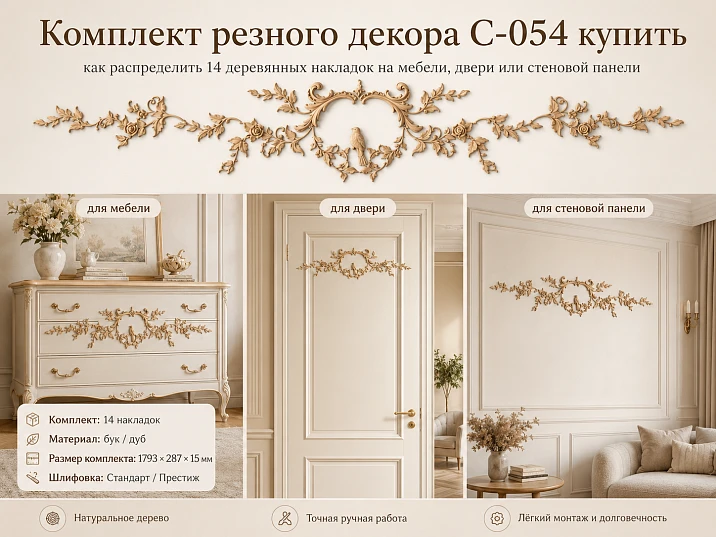
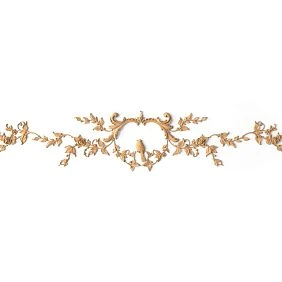
Why you should buy the C-054 set
C-054 is a ready-made set of 14 coordinated carved overlays made of solid oak or beech. It suits a buyer who needs not just one decorative spot, but a full symmetrical layout for a chest of drawers, sideboard, door, wall panel, or other large facade. The main advantage of the set is that all elements are already unified by a common plasticity and scale, so the composition does not have to be assembled from random parts.
Short answer: C-054 should be chosen for a large surface where a single accent is not needed, but a coordinated system of 14 overlays is. Before ordering, measure the facade, make a paper mockup, determine the central axis, and decide whether the decor will be painted with the furniture or finished separately.
Buy a set of carved decor C-054Buy a set of carved decor It is easier than selecting fourteen separate overlays only when the buyer understands the future layout. C-054 cannot be judged from a single photo: large elements, small paired details, and the central accent work differently on a chest of drawers, a door, and a wall panel. Therefore, the choice begins not with color, but with the dimensions of the surface, the axis of symmetry, and the amount of free space around the ornament.
In the finished layout, the set occupies approximately 1793 × 287 × 15 mm. This does not mean that all parts must be installed in one continuous strip. The dimension helps to understand the maximum scale of the composition and compare it with the furniture or wall. On a chest of drawers, you can use the central part and side pairs; on a tall door, stretch the elements vertically; on a wall panel, form a wide horizontal composition.
The main mistake when working with carved decor is trying to 'arrange beautifully' without marking. Fourteen parts quickly create visual noise if the distances between them are not repeated and the center is shifted relative to the facade. C-054 reveals itself when each element gets a clear role: center, pair, edge, corner, or repeat.




Confirmed characteristics of the C-054 set
| Parameter | C-054 | What this means for the project |
|---|---|---|
| Product type | Set of carved decor | Ready-made system, not a single overlay |
| Quantity | 14 wooden overlays | You can assemble a central, paired, and side composition |
| Overall layout size | 1793 × 287 × 15 mm | Suitable for evaluating a large facade, door, or panel |
| Material | Beech or oak | The choice depends on the future finish and adjacent wooden elements |
| Preparation | For enamel or tinting — depending on the configuration | The finish must be determined before ordering |
| Sanding quality | Standard or Prestige — by available option | The choice is related to the requirements for the finish coating |
| Purpose | Furniture, doors, walls, panels, and other prepared surfaces | The installation method depends on the base and finish |
| Order | The card allows you to add a product to the cart or make a one-click purchase | The current price and delivery time should be checked before ordering |
The card offers beech and oak, as well as options for preparation under enamel and tinting. Before purchasing, it is useful to view the C-054 set made of oak or beech and compare the active configuration. The cost depends on the material and the quality of sanding, so it is better not to fix it in the article.
Our factory also produces:

What is included in the C-054 carved decor set
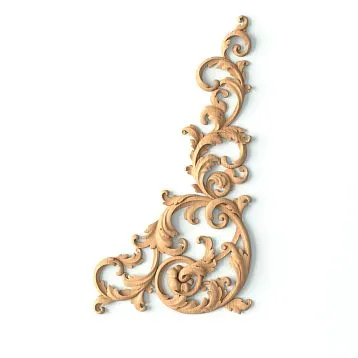
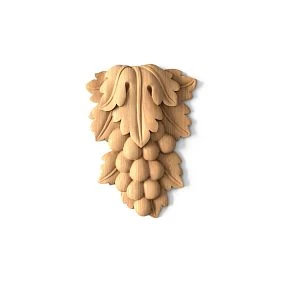
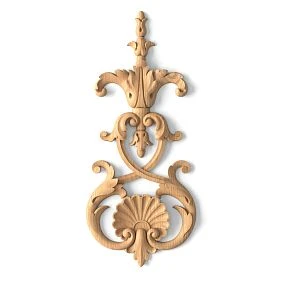
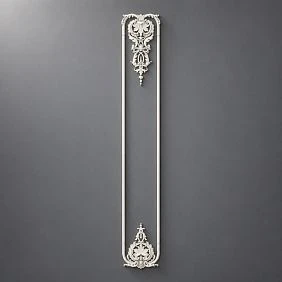
C-054 consists of fourteen overlays of different sizes. The set includes paired left and right elements, larger parts, medium connecting overlays, and a small central accent. This structure allows you to work not only with a single ready-made strip but also to assemble different compositions for a specific surface.
Get Consultation
Large side elements
The most noticeable paired overlays form the outer boundaries of the composition. They are convenient to use along the edges of a long chest of drawers, the top of a sideboard, on a wide wall panel, or around the central area of a door. A large relief should have free space around it, otherwise the pattern will rest against the edge, handle, panel, or molding.
Medium paired elements
They connect the large side parts with the center. On a wide facade, the middle pair helps make the transition gradual: the composition does not break off but narrows toward the central axis. On a door, these elements can be used above and below the central part if the height of the panel allows.
Small overlays
Small elements are useful in corner and repeating areas. They help support the pattern on adjacent facades, frame handles, or fill a short section where a large part does not fit. But a small size does not mean the overlay can be placed without marking: an incorrect rotation immediately disrupts symmetry.
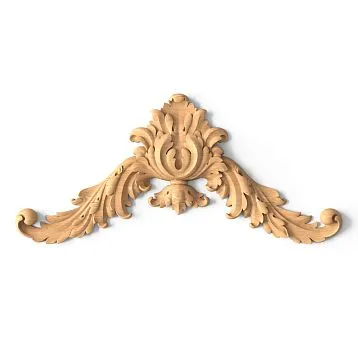
Central element
The smallest part can work as the assembly point of the entire composition. On a chest of drawers, it is placed along the axis of the body or central drawer. On a wall panel, it is placed in the center of the frame. On a door, it is placed along the axis of the panel, but taking into account the handle, panel, and eye level.
Left and right parts
Pairing is especially important for plant patterns. The left and right elements turn leaves and curls toward or away from the center. If the sides are mixed up, the composition will diverge randomly. Before installation, all overlays are laid out on the floor or a large table and the direction is marked with painter's tape.
When it's more profitable to buy a set rather than individual overlays
A ready set is more profitable not only in terms of search time. Its main advantage is a consistent form language. Individual overlays may have different thread depths, leaf scales, ornament directions, and thicknesses. Even beautiful details individually do not always come together into a cohesive composition.
When a large symmetrical facade is needed
For a long dresser, double-door sideboard, or wide wall panel, a set is more convenient. It already has paired elements and central logic. The buyer only needs to adjust the distances to their size.
When the project needs to be repeated
If the same decor is needed on two doors, a pair of cabinets, or several panels, a ready-made model simplifies repetition. Two sets are ordered and one layout scheme is used. When selecting individual elements, the risk of differences is higher.
When a uniform finish is important
Overlays from one set can be prepared and painted simultaneously. This helps achieve the same shade and gloss level. When purchasing parts at different times, the material and sanding may differ.
When a full route from center to edges is needed
C-054 provides not only a central accent but also elements for side zones. This is useful when an empty facade needs to be fully decorated. If only one small rosette or a pair of corners is required, the set may be excessive.
When individual overlays are better
Individual parts are more reasonable for a small bedside table, a narrow drawer, local repairs, or an asymmetrical project. In this case, you can buy decorative wooden overlays by size, shape, and ornament, without using all fourteen elements.
How to distribute 14 elements without visual noise
Distribution starts from the central axis. First, mark the middle on the surface by width and height. Then lay out the central piece, followed by the nearest pair, the middle pair, and the large outer elements. This order helps to see where the composition becomes too long or dense.
Central accents
The center does not always coincide with the geometric center of the entire piece of furniture. On a chest of drawers, it may coincide with the central drawer; on a sideboard, with the line between the doors; on a door, with the center of the upper panel. First, determine what the eye perceives as the main axis.
Paired elements
Paired overlays are placed at the same distance from the center. Measure not by the outer contour of the carving, but by selected reference points on the back side or drawing. Otherwise, an asymmetrical shape will cause an error.
Side and corner zones
Large elements can complete the composition but should not touch the edge. Leave a calm field. If the facade has a frame or panel, the overlays should be inside one architectural field, not crossing it randomly.
Repeating details
On furniture with multiple drawers, some elements can be repeated vertically. For example, small pairs on the top drawers, large ones on the doors. It is important that the repetition follows a single grid and does not turn each facade into a separate story.
Pauses between elements
Free space is part of the ornament. The deeper and larger the carving, the more air it needs. If fourteen pieces do not fit without crowding, it is better to use part of the set and save the rest for a neighboring item or another panel.
Three basic layout schemes
| Scheme | How to distribute | What it's suitable for | Main risk |
|---|---|---|---|
| Horizontal | Center, two middle pairs, large elements at the edges | Chest of drawers, long sideboard, wall panel | Line too dense without free space |
| Vertical | Central axis, pairs above and below, large elements in upper and lower zones | Interior door, tall panel, cabinet door | Conflict with handle, panel, or lock |
| Divided | Part of overlays on central facade, the rest on side doors or adjacent panels | Sideboard, display cabinet, furniture set | Different distances and loss of common axis |
| Corner | Paired elements in four corners, small details in the center | Wall frame, door panel, facade | Incorrect rotation of left and right parts |
C-054, C-047 or C-009-1-2: which to choose
Three sets solve different tasks. C-054 includes 14 overlays and is suitable for a rich but flexible composition. C-047 consists of seven elements and is more convenient for a more compact facade. C-009-1-2 is designed for a significantly larger architectural layout and includes not only overlays but also long profiles.
C-054 for flexible composition
Choose it when the surface is large enough and the decor needs to be distributed across the center, sides, and repeating areas. It is suitable for a chest of drawers, sideboard, door, and wall panel.
C-047 for compact composition
Seven elements are easier to place on a medium facade. If the fourteen parts of C-054 seem excessive, it is worth looking at the C-047 set and comparing the sizes with your furniture.
C-009-1-2 for a large ornamental field
This set has an overall size of 1900 × 2700 × 30 mm and is designed for a much larger composition. It should be considered for high walls, large panels, or architectural decoration. For an alternative ornament, you can compare C-054 with C-009-1-2.
What surfaces is C-054 suitable for
Chest of drawers
On a long dresser, C-054 can be used as a horizontal composition. The central element is placed along the axis of the body or middle drawer, the middle pairs on the sides, and the large parts closer to the edges. If the drawers are separated by noticeable gaps, it is better not to stretch the ornament across multiple facades without checking: when opened, the pattern will break apart.
For a dresser with three large drawers, it is more convenient to distribute the set across tiers. The central part can be on the top drawer, paired elements on the middle drawer, and large side overlays on the bottom drawer. This approach ties the entire piece together but requires identical vertical axes.
If the dresser has doors on the sides and drawers in the center, C-054 can be divided into three groups. The central parts work on the drawers, and the large pairs on the doors. The composition becomes architectural rather than just decorative. Before installation, check that the carving is not too close to handles and edges.
Sideboard or display cabinet
A sideboard is usually taller than a dresser and has more zones: lower doors, pull-out drawers, an upper display cabinet, and a cornice. C-054 can be used only on the lower part or distributed between the lower and upper facades. It is important not to mirror the entire set on each tier, otherwise the furniture will become overloaded.
For a sideboard, a scheme works well where large elements are placed on the lower doors, middle pairs on the drawers, and small overlays support the ornament on the upper part. If the display cabinet has glass, the decor should not obstruct the view or reduce the light opening.
On a sideboard, the connection between the carving and handles, hinges, and cornice is especially noticeable. The shape of the overlays should either repeat the botanical character of other details or remain the only expressive motif. Mismatched handles and a carved set create a feeling of random assembly.
Interior door
On door C-054, you can stretch vertically. The central axis is drawn from the top edge of the panel to the bottom, and the elements are distributed inside the panels or free field. If the door already has a frame profile, the overlays should be inside it and not cross the molding.
The most important area is the handle and lock. The relief should not interfere with grip, catch on clothing, or cross technical openings. On a double door, you can use half of the set on each leaf, maintaining mirror symmetry.
For a tall door, large overlays are better suited than for a standard narrow one. But the overall size of 1793 mm does not mean the composition needs to be stretched to the full height of the panel. The top and bottom parts should have calm fields so that the carving is perceived as a finished composition.
Wall panel
On wall panel C-054, you can assemble a wide horizontal composition, corner layout, or central cartouche. The surface must be flat, prepared, and suitable for adhesive mounting. If the panel consists of separate modules, the joints cannot be covered without understanding their movement.
In a living room, the set can decorate a panel behind a console or dresser. In a study, the central part of the wall between bookcases. In a hotel or boutique, an accent panel in the waiting area. The scale of the room affects the distance between elements: on a large wall, the overlays can be spaced wider; on a narrow one, use part of the set.
Cabinet and wardrobe
On tall cabinet doors C-054, distribute vertically or divide across the leaves. For a four-door cabinet, you can use large elements on the central doors and small pairs on the outer ones. It is important to maintain the same height and not conflict with handles.
If the cabinet has mirror inserts, it is better to place the decor on wooden or MDF frames, rather than gluing it onto the mirror without confirmed technology. The surface, adhesive, and finish must be compatible.
Fireplace Area
The kit can be used to decorate a wooden or prepared decorative panel around the fireplace. Wood cannot be placed in an area where temperature and fire safety requirements are not met. C-054 here works only as a decorative element on a safe base.
Decorative console
On a narrow console, the entire kit may be too large. It is better to use the central part and two pairs, and move the remaining overlays to the wall panel above the furniture. This creates a cohesive ensemble without overloading the facade.
How to check dimensions before purchasing
The size 1793 × 287 × 15 mm shows the overall dimensions of the finished layout, but does not replace measuring each part and surface. The buyer needs to understand where the ornament ends, how much free space remains, and how the relief interacts with handles, frames, and edges.
Make a paper mockup
Draw a rectangle of 1793 × 287 mm to scale or assemble a full-size strip from paper. Apply it to the facade and see if the composition looks too long. Then divide the mockup into individual elements and try other distances.
Mark the central axis
The axis does not always run through the center of the wall. For furniture, it must account for doors, drawers, and handles. On a door, consider panels and the lock. On a wall panel, consider adjacent furniture and light fixtures.
Check the free margins
There should be enough space from the edge of the largest overlay to the edge of the facade so that the carving does not look cut off. The exact distance depends on the scale of the furniture, but visually the margin should be repeated on the left and right.
Consider the thickness of 15 mm
The maximum thickness of the set affects the protrusion above the surface. On a door, the decor may catch on the trim or adjacent leaf. On a drawer, it may interfere with the handle. On a wall panel, it may create a noticeable shadow. The relief should be evaluated from the side, not just from the front.
Check the opening
Open all doors and drawers with the paper mockup. Ensure that parts do not fall into the grip zone and do not collide with adjacent facades. This is especially important for corner furniture and narrow passages.
Take a photo of the mockup
A photo from a normal distance helps to notice distortions that are not visible up close. Look at the furniture from the room entrance and from the main point of use. The composition should be readable as a whole, not just when examining details.
How many sets to order
One set
Suitable for one large facade, door, or wall panel. Some elements can be used on furniture, some on an adjacent surface, preserving the overall pattern.
Two sets
Needed for paired items, two doors, symmetrical panels, or identical toggles. Ordering together helps ensure matching material and preparation for finishing.
Kit for each leaf
This option is only suitable for very large furniture. On a regular cabinet, two full C-054s can overload the facade. First, create a mockup and compare with the more compact C-047.
Spare elements
The card shows the composition of the finished kit. If the project is commercial or repeated in multiple rooms, it's better to clarify the issue of spare overlays before ordering. Don't assume that any individual part will be available in the same finish later.
Calculation for a hotel or restaurant
For a series of doors and panels, a working sample is needed. First, order one test kit, check the layout, finish, and installation, then order the main batch. This reduces the risk of repeating an error on dozens of surfaces.
Oak or beech: which material to choose
Both species are suitable for carved decor but produce different visual results. Beech has a calmer, more uniform texture and is often convenient under opaque enamel. Oak features pronounced pores and works well under transparent or semi-transparent tinting.
Beech for enamel
If the overlays should become an extension of a painted facade, beech helps achieve an even base. After priming and enameling, the relief becomes the focus, not the wood grain. This option suits white, gray, blue, green, and other opaque furniture.
Oak for tinting
Oak is chosen when the carving should retain a natural character. Tinting highlights the fibers, and the recesses of the ornament become darker. On large C-054 elements, the wood grain is more noticeable than on small parts.
Can oak be painted with enamel
Technically, the choice of configuration depends on the card and preparation. But if the texture is completely covered, the decorative advantage of oak is used less. The buyer should compare the budget, desired finish, and available options.
Can beech be tinted?
Beech is tinted differently than oak and has a calmer pattern. For an even result, a test coating on the same wood species and with the same surface preparation is needed. You should not choose a shade based only on a photo.
Combination with existing furniture
If the chest of drawers is already made of oak, oak overlays can be connected to the body with a clear finish. If the furniture is painted, beech under enamel often looks more natural. When restoring an old item, the base material may differ — in this case, color unifies the details.
Enamel, tinting, or clear coating
Opaque enamel
Enamel completely changes the color and makes the set part of the facade. White carving looks architectural, dark — graphic, colored — decorative. For complex ornamentation, it is important to apply the coating in thin layers to avoid filling small recesses.
Clear tint
It preserves the pattern of oak or beech and changes the shade. On the relief, the color is distributed unevenly: recesses appear darker, peaks lighter. This adds volume but requires careful application.
Clear varnish or oil
This finish preserves the natural color and protects the surface. The choice of a specific composition depends on the wood species, furniture purpose, and compatibility with the base. Before mass finishing, a test should be done on one element or a separate sample.
Contrast finish
Overlays can be painted in a color different from the facade. Contrast emphasizes each element and makes the composition more dynamic. On fourteen parts, this technique can easily overload the furniture, so it's better to check the layout and color sample.
Patina and relief highlighting
Patination emphasizes recesses and edges but requires experience. If the compound is applied unevenly, paired elements will differ. For a set, it is especially important to process all parts in one batch and in the same sequence.
Paint before or after installation
| Method | Advantages | Limitations | When to choose |
|---|---|---|---|
| Paint before installation | Easier to process edges and recesses without staining the facade | Adhesive may adhere poorly to the finished coating without proper preparation | Contrast finish or separate tinting |
| Paint after installation | Overlays and facade receive a single color | Harder to paint narrow areas, higher risk of drips | Monochrome furniture under enamel |
| Combined method | Primer and part of the preparation are done in advance, finishing after installation | Compatibility of glue, primer, and enamel is required | Complex projects with precise finishing |
When it's better to paint in advance
If the overlays differ from the facade in color, it is more convenient to finish them completely before installation. All parts are laid out in order and processed with one system. The back side and gluing areas are prepared according to the recommendations of the selected glue.
When it's better to paint together with the furniture
For a white dresser, painted door, or wall panel, a single enamel helps connect the carving to the base. The overlays are installed after marking and preparation, then primed and painted together with the surface.
Why a test is needed
Even a confirmed breed can absorb tint differently on individual parts. One test piece shows the color, gloss, and behavior of the relief. Without a test, the error will repeat on all fourteen overlays.
How to secure carved overlays
The method of attachment depends on the base material, element size, and surface condition. The STAVROS website has separate recommendations for adhesive installation. For unpainted solid wood decor and unpainted wooden surfaces, one set of compounds is used; for painted surfaces, another.
Marking
First, the overlays are laid out on the surface without glue. The contours are marked with a pencil or masking tape. For fourteen elements, a common template made of paper or transparent film is useful.
Preparation of the Base
The surface must be clean, dry, and level. Dust, grease, and peeling coating reduce adhesion. Old furniture should be checked especially carefully: decorative paint may hold worse than it seems.
Adhesive selection
The size of the overlay and the surface condition influence the choice. Large elements require a compound designed for the corresponding area and material. Before ordering, you can select materials for installation and finishing of wooden decor, and check final compatibility with the manufacturer's instructions for the compound.
Fixation
After applying the glue, the part is placed according to the markings and pressed down. For large elements, temporary support may be required. Do not hold the overlay with your hands longer than the technology allows if it continues to slide: you need to reconsider the glue or the base.
Mechanical fixation
In some cases, additional fixation with pins is used, but the method must be consistent with the material and thickness of the element. A thin part can easily split, and the mark from the fastener must be properly filled.
Installation on a door
The door leaf experiences movement and vibration. The adhesive must be suitable for both the overlay and the door covering. The decor should not be placed in the area of the rebate, hinges, lock, or constant hand contact.
Installation on a wall panel
The panel must be securely fastened. If it expands, is removable, or consists of movable modules, overlays cannot be glued across the joint without a design solution.
Before starting work, it is useful to study tips for installing and painting carved decor and check the sequence of preparation, gluing, priming, and finishing coating.
What to buy together with C-054
Overlay set — the central purchase, but mounting and finishing materials are needed for the finished result. Additional decor is sometimes also required if C-054 only covers part of a large set or wall composition.
Construction adhesive
Glue is chosen based on the base material and surface condition. Different formulations may be needed for unpainted wood, primed furniture, and finished coating. You cannot buy the first universal glue without testing.
Primer
Primer evens out absorption and helps achieve a smooth enamel. For carved relief, it is important to apply it thinly to avoid filling the recesses. The primer system must be compatible with the paint.
Enamel, tinting, or oil
The finish is chosen together with the wood species. One logic applies for beech under a covering color, another for oak with visible texture. A sample is made before full finishing.
Brushes and consumables
For deep relief, tools are needed that reach into the recesses and do not leave a thick layer. Masking tape helps mark the composition, protect the facade, and label pairs.
Additional overlays
If C-054 is used on one facade, adjacent items can be supported with small single elements. It is important to choose parts with a similar plant motif and thickness. For this, you can buy decorative wooden overlays separately.
More compact set
For a small pedestal or narrow door, C-047 may be more rational. It contains seven elements and allows for a concise composition without needing to split C-054.
Large architectural composition
For a tall wall, portal, or panel about two meters wide and almost three meters high, consider C-009-1-2. It is significantly larger and is not a direct replacement for C-054 for furniture.
| What to add to the purchase | Why | For which scenario | What to Check |
|---|---|---|---|
| Construction adhesive | Secure the overlays on the base | Furniture, door, wall panel | Material and condition of both surfaces |
| Primer and enamel | Combine decor with painted facade | Chest of drawers, sideboard, door for covering finish | System compatibility and layer thickness |
| Tinting or transparent finish | Preserve the oak or beech grain pattern | Furniture with visible wood | Test swatch and color uniformity |
| Masking tape and template | Maintain symmetry of 14 elements | Any complex layout | Central axis and equal intervals |
| Additional overlays | Match the pattern on adjacent items | Suite, wall system, two doors | Style, thickness, and scale of carving |
| Set C-047 | Create a more compact surface | Cabinet, narrow front, small door | Sufficiency of seven elements |
Set and single overlay
A single overlay solves a local task: center of a drawer, corner of a front, top of a door. C-054 is designed for a system. Buying it for one part is irrational if the other elements are not used.
C-054 and C-047
C-047 contains seven overlays and has a more compact overall scale. It suits surfaces where fourteen C-054 parts would be too dense. Before choosing, compare not only the price but also the actual area of the front.
C-054 and C-009-1-2
C-009-1-2 is significantly larger and includes long moldings and tips. It is intended for an architectural composition, not a regular dresser. The error occurs when a buyer sees the same number of elements and considers the sets interchangeable.
Carved decor and molding
The overlay creates a separate relief motif. The molding forms a long line, frame, or contour. C-054 can be combined with moldings but does not replace them on long straight sections.
Carved decor and furniture handle
The overlay is not intended for gripping. It cannot be installed instead of a handle, nor can the protruding element be used as an opening point. Handles are placed separately, and the distance to the relief must be checked.
Wood and polyurethane decor
The materials differ in weight, texture, preparation, and installation. C-054 is made of solid oak or beech. It should not be selected based on instructions for another material without verification.
Set and finished furniture
C-054 is a set of decorative parts, not a finished dresser, door, or panel. The base, hardware, installation, and finish are not automatically part of the product. The surface must be prepared before ordering.
Practical selection for specific situations
Need to update an old dresser
First, check the condition of the facades. Old varnish or paint may peel, and veneer may have bubbles. The set cannot be glued over a weak layer. After repairing the base, make a horizontal layout and decide whether the overlays will be painted together with the furniture.
Need to order a new custom buffet
Pass the dimensions of C-054 to the furniture designer before manufacturing the facades. They will be able to position the handles, panels, and hinges so that the decor does not conflict with functional elements. This is easier than adapting a ready-made body.
Need to decorate a double door
Divide the set into two mirror groups. Check that the line between the doors remains free and that large overlays do not fall under the rebate. The central element can be used above the door or on a separate panel.
Need to decorate the wall behind the console
Place the central composition along the axis of the furniture, not the entire wall. If the console is offset due to a door or window, the decor should support it. On a large wall, the overlays can be spread wider while maintaining pairs.
Need to create a classic panel
C-054 can be placed inside a frame made of molding. First, design the frame, then check if the carving fits with sufficient margins. The overlays should not touch the molding or create accidental intersections.
Need to design hotel furniture
First, make one test facade. Check cleaning, finish durability, contact with handles, and repeatability of markings. Only after approval, order sets for the entire series.
You need to use part of the set
This is acceptable. For example, large items can be placed on a dresser, medium ones on a mirror or panel, and small ones on nightstands. The main thing is to maintain a single color and not lose pairs.
You need to create an asymmetrical composition
C-054 is built on paired elements, but part of the set can be used asymmetrically. Such a project requires a more precise layout: the ornament should look intentional, not like an incomplete set.
Mistakes when buying and laying out C-054
Buying a set without measurements
Fourteen overlays look more compact in the photo than in an actual layout. The total length of 1793 mm is not suitable for every dresser or door. Without a layout, large elements may hit the edges, and the composition may lose its free field.
Relying only on the overall size
The dimensions 1793 × 287 × 15 mm show the finished layout, but each overlay has its own shape. On a surface with drawers and panels, the parts may be arranged differently. You need to study the composition and sizes of the elements.
Not considering handles and hardware
The carving can interfere with the grip, cover holes, or fall near the loop. First, mark the functional parts, then the decor. Moving the handle after painting will leave holes and disrupt the composition.
Glue without dry layout
Even a small error in the center repeats on both sides. All fourteen overlays are first placed without glue, photographed, checked with a level, and only then fixed.
Confuse the left and right overlay
Paired elements have a direction. If one part is turned incorrectly, the leaves and curls will face different directions. Before installation, pairs are laid out and labeled.
Reduce intervals too much
Trying to fit a full set on a small facade makes the relief heavy. It's better to use part of the set or choose C-047. An empty field allows you to see the shape of each detail.
Paint without a test sample
Enamel can fill thin recesses, and tinting can cause stains. A test shows how many layers are needed and how the wood behaves. Fixing an error on a finished set is more difficult.
Choose glue out of habit
A composition that holds on unpainted wood may perform poorly on glossy enamel. The surface and size of the overlay determine the technique. There is no universal solution for all substrates.
Gluing onto a weak coating
If the old paint is peeling, the overlay will stick to it rather than to the solid base. Over time, the decor will come off along with the coating layer. The surface needs to be checked and prepared.
Expecting a ready-made painted composition
The card suggests the material and preparation options, but the final finish depends on the chosen configuration and project. You cannot assume that the kit will automatically match the furniture color.
Using all parts at any cost
The kit provides possibilities, not a mandatory scheme. If some overlays do not fit, they can be moved to an adjacent item. An overloaded composition is worse than an incomplete but well-balanced one.
Not accounting for the relief thickness
A protrusion of up to 15 mm may interfere with door opening, touch the wall, or catch on clothing. Checking is especially important in narrow hallways and on cabinets with hinged doors.
Who should take a closer look at C-054
For the owner of a large chest or sideboard
The set allows you to design a wide facade without having to search for matching parts yourself. It is suitable for furniture where there is enough space for the center, side elements, and free fields.
For a custom furniture manufacturer
C-054 can be incorporated into the project before the facades are made. The designer takes into account the relief, handles, and layout, while the finisher receives an approved set from a single wood species.
For a classical interior designer
Fourteen parts provide flexibility: some can be used on furniture, others on doors or wall panels. This helps tie different items together with a common ornament.
For a restorer and craftsman
The set is suitable for updating furniture if the base is restored and designed for installation. The carving helps change the character of a simple body but does not hide structural defects.
For a commercial interior
A hotel, restaurant, salon, or boutique can use C-054 on panels, posts, and doors. The series requires a test sample and repeatable markings.
When it's better to choose another option
The surface is too small
For a narrow pedestal or a single drawer, fourteen overlays are excessive. A separate element or C-047 will suffice.
A minimalist interior is needed
The carved plant ornament is active. If the furniture is based on smooth facades and strict geometry, C-054 may conflict with the overall concept.
A large wall composition is needed
For a high wall or portal, C-054 may be too compact. In this case, compare larger sets, including C-009-1-2.
There is no way to prepare the base
You cannot glue carvings onto a damaged, damp, or unstable surface. First, repair the base or choose a different finishing method.
The decor must be frequently removable
Adhesive mounting is designed for permanent placement. For a temporary exhibition composition or replaceable panels, a different structural approach is needed.
How to care for carved decor
Dust removal
Relief collects dust in recesses. Use a soft brush, dry cloth, or gentle low-power attachment. A stiff brush can damage edges and finish.
Wet Cleaning
A slightly damp cloth is only suitable for finishes that allow such cleaning. Do not leave water in recesses. After cleaning, wipe the surface dry.
Impact protection
Large edge elements are especially vulnerable on doors and furniture in walkways. Layout should be planned so that carving is not hit by bags, chairs, or cleaning equipment.
Local Repair
For restoration, it is important to know the wood species, primer, paint, and finish. Save order data and a small color sample. Random touch-ups can stand out more than the defect itself.
Mounting control
If an appliqué edge starts to lift, do not press it with random glue over the old layer. Determine the cause: weak base, incompatible compound, impact, or moisture. Repair after cleaning the area.
How to buy set C-054 on STAVROS
Before ordering, open the product page and select beech or oak, sanding quality, and available pre-finish preparation. Check the overall size 1793 × 287 × 15 mm and composition of fourteen pieces. If the set is being matched to existing furniture, send the manager a photo of the facade and dimensions of the free area.
Prepare a brief specification: surface, dimensions, number of sets, material, finishing method, and base type. For two identical doors or serial furniture, indicate that a repeatable layout is required.
Do not rely on the price of a single configuration seen earlier. The actual cost depends on the material and processing and is verified in the active option of the card. Installation compounds and finishing materials are calculated separately.
Once the layout is confirmed, you can order the C-054 set in the required wood species and preparation, and then coordinate materials for installation and finishing.
What to check before placing an order
- overall surface size and free field;
- layout of all fourteen overlays;
- central axis of the furniture, door, or panel;
- position of handles, hinges, locks, and moldings;
- relief thickness and door opening;
- beech or oak;
- preparation for enamel or tinting;
- the quality of sanding;
- one set or several;
- need for a test sample;
- composition of the adhesive system;
- compatibility of primer and finish;
- marking and temporary fixing method;
- post-installation care conditions;
- current price and delivery time in the card.
How C-054 works in different interior styles
Classic
In a classic interior, the set can be used in a full composition. Symmetry, paired elements, and pronounced carving support paneled facades, cornices, and traditional handles. It is better to keep calm fields and not mix C-054 with several unrelated ornaments.
Neoclassicism
For neoclassicism, some elements can be removed, and the remaining ones painted together with the facade. The carving becomes a soft relief rather than a contrasting decoration. White, gray, or muted colored enamel helps tie the set to modern furniture forms.
Provence
Light enamel, soft patina, and a floral motif suit a sideboard, display cabinet, or chest of drawers. But excessive aging on fourteen details can create a variegated surface. Patina is applied uniformly and tested on a sample.
Eclecticism
In an eclectic interior, C-054 can be placed on a simple modern body, turning it into an accent piece. To prevent the furniture from looking random, repeat the material or color of the carving in one or two adjacent details.
Modern interior
A full set is not always suitable. A more restrained layout of a central element and two pairs can work on a smooth facade. Monochromatic enamel reduces historical expressiveness and leaves only the relief.
Boutique and hotel
In a commercial space, the decor must be not only beautiful but also resistant to cleaning and contact. Large details are placed away from the passage, and the finish is chosen considering the operating mode. Repeatable compositions are first tested on one item.
How to make a test layout without risk
Print or trace the outlines
If drawings are available, transfer the dimensions onto paper. For complex shapes, rectangles based on maximum dimensions are sufficient to estimate the occupied space. A more precise silhouette helps check intervals.
Secure the paper with masking tape
The tape should not damage the coating. Place all fourteen templates, step back a few meters, and take a photo. Compare the horizontal, vertical, and split layout.
Check the composition with the furniture open
Open drawers and doors. Paper elements will show where the pattern breaks, falls on a joint, or interferes with grip. It's better to adjust the layout at this stage.
View under different lighting
Morning, evening, and artificial light emphasize the relief differently. Thickness up to 15 mm creates a shadow. It will be stronger on dark enamel and softer on light.
Ask another person to evaluate
The project author gets used to their own layout and stops noticing misalignment. A fresh perspective helps see that the center doesn't align with the furniture or one side seems heavier.
How to save project data
After approving the layout, save the photo, margin sizes, and position of each part. Label the article numbers of left and right elements. For serial furniture, create a template with control points.
Record the wood species, sanding quality, primer, finish, and glue. This data will be useful for repairs, reordering, or manufacturing a second piece of furniture. It is better to record the color not only by name but also with a sample.
For a commercial project, prepare a separate installation diagram. Workers should not interpret the composition from a photo. A drawing with a central axis and margin sizes reduces the risk of error.
How to distribute elements of different sizes
C-054 includes overlays from a small central element measuring 35 × 53 × 9 mm to large paired parts 285 × 152 × 15 mm. Between them are elements 80 × 60 × 8 mm, 100 × 70 × 12 mm, 135 × 85 × 8 mm, 190 × 75 × 7 mm, 195 × 112 × 13 mm, and 250 × 135 × 14 mm. This range helps build a gradual transition from the center to the edges but requires the correct sequence.
Start with the largest pairs
Overlays measuring 285 × 152 × 15 mm and 250 × 135 × 14 mm set the limit of the composition. Place them on the facade first and check if there is free space left to the edge. If the large parts do not fit, the full C-054 is too large for this surface or requires division between several zones.
Medium elements form the transition
Pairs 195 × 112 × 13 mm and 190 × 75 × 7 mm connect the outer overlays with the center. They can be located on the same horizontal line or transition to the adjacent tier of the facade. It is important not to mix parts of different thicknesses so that one does not unexpectedly protrude more next to a flatter one.
Small pairs support the ornament
Elements 135 × 85 × 8 mm, 100 × 70 × 12 mm, and 80 × 60 × 8 mm are suitable for short sections, corners, and repeats. On a dresser, they can be placed closer to the central drawer; on a door, above and below the main pair; on a wall panel, inside separate frames.
The central piece should not get lost
A small element 35 × 53 × 9 mm only works with sufficient distance from adjacent overlays. If large pieces are brought too close, the center disappears into the overall relief. Leave a calm field around it or use it as a separate accent on a handle, key area, or small drawer, if it does not interfere with function.
How to approve the layout before installation
Make three options
Don't stop at the first scheme. Prepare horizontal, vertical, and split layouts. Photograph each from the same point and compare the scale. Often a variant that looks beautiful up close appears heavy on the entire piece of furniture.
Check distances numerically
After visual selection, measure the intervals between paired elements and the margins from the edges. Write them down. The phrase "approximately the same" is not suitable for fourteen pieces: an error of a few millimeters repeats and becomes noticeable.
Approve the position of the handles
Handles are installed or marked before final fixation of the decor. The user should be able to freely open the furniture without touching the threads. On a door, additionally check the key, lock, and hand movement.
Check the side view
The thickness of the elements varies from 7 to 15 mm. Look at the composition from an angle. Deeper overlays should be perceived as intentional accents, not random protrusions. Light is also better evaluated before installation.
Save the template
After approval, transfer the position of the parts to paper, film, or a rigid template. It will be useful for the second door, paired cabinet, or repairs. On the template, mark the article numbers and the direction of left and right elements.
Before final ordering, it is useful to attach not only the overall layout of 1793 × 287 mm to the furniture, but also templates of the largest overlays 285 × 152 mm. They most often determine whether the set fits the surface. If the large pairs fit with normal gaps, the remaining elements can usually be distributed flexibly. If they overlap a panel, handle, or edge, it is better to choose a more compact set or use C-054 on several connected surfaces.
Such dimensional control is especially important for doors and furniture with multiple leaves: large overlays should work as part of the overall composition, not cover functional areas. The earlier the layout, direction of pairs, and distances are checked, the lower the risk of rework after painting and installation.
Frequently asked questions
How many overlays are included in C-054?
The set consists of 14 wooden carved overlays of different sizes, including paired left and right elements and a small central accent.
What is the overall size of the set?
The card indicates the finished layout size of 1793 × 287 × 15 mm. The actual placement can be adapted by changing the intervals and using some of the elements.
What wood is C-054 made of?
Beech and oak are available. Beech is often chosen for enamel, oak for finishes with visible texture, but the exact configuration should be checked in the product card.
Can I use fewer than all 14 elements?
Yes. The set can be divided between furniture and an adjacent panel, or only part of the details can be used on a compact facade. Paired elements are best kept together.
Is C-054 suitable for a dresser?
Yes, if the facade width allows placing the composition with free margins. For a small dresser, the full set may be too large.
Can the set be installed on an interior door?
Yes, after checking the panels, handle, lock, rebate, and relief thickness. On a double door, the elements can be conveniently split mirror-wise.
Is C-054 suitable for a wall panel?
Yes, on a flat and stable base. The set can be arranged horizontally, vertically, or inside a molding frame.
How is C-054 different from C-047?
C-054 contains 14 elements and is designed for a richer composition. C-047 consists of seven overlays and is more convenient for a compact surface.
How is C-054 different from C-009-1-2?
C-009-1-2 is significantly larger and includes long profiles. Its overall size of 1900 × 2700 × 30 mm is oriented towards architectural compositions.
Should the overlays be painted before or after installation?
Contrasting decor is more convenient to finish in advance. For monochrome furniture, overlays are often installed and painted together with the facade. The choice depends on the glue and coating system.
What glue is needed?
The glue is chosen based on the size of the overlay, the base material, and the condition of the surfaces. Unpainted wood and finished enamel require different preparation.
Is it necessary to use nails or pins?
Additional mechanical fixation is possible in individual projects, but must account for the thickness of the part and the base. Without experience, the thread can be split.
Can C-054 be glued to painted MDF?
Only if the glue is compatible with the finished coating and the enamel itself is strong enough. A weak layer must be removed or prepared.
Is the set suitable for white enamel?
Yes, white enamel highlights the relief and unifies the overlays with the facade. The layer should be thin to preserve carving details.
Can oak be tinted?
Yes, oak shows texture well under transparent tinting. Before finishing the entire set, test on a similar material.
How many sets are needed for two doors?
For an identical full composition, one set per door is usually needed. One set can be divided between two doors if the chosen layout is confirmed by a mockup.
Can C-054 be used on old furniture?
Yes, after repair and surface preparation. Peeling varnish, weak veneer, and damaged paint are not suitable for direct installation.
What to buy together with the kit?
You will need marking materials, suitable adhesive, primer, and the chosen finish. Additional overlays are only needed for adjacent surfaces or to expand the composition.
How to care for the carving?
Dust is removed with a soft brush or cloth. Wet cleaning should be done carefully and only if compatible with the finish coating.
Where to buy the C-054 kit?
The kit is presented in the STAVROS catalog. In the product card, you can select the material, sanding quality, and available preparation for finishing.
Result: C-054 is purchased for a coordinated composition of 14 parts
C-054 is not for random decoration of a single drawer, but for a well-thought-out system. Fourteen carved overlays allow you to design a large chest of drawers, sideboard, door, or wall panel, distributing elements by center, pairs, sides, and repeating areas.
Before purchasing, you need to check the overall size 1793 × 287 × 15 mm, create a layout, choose beech or oak, and determine the finish. Paired elements must maintain direction, and large parts must have free space. Installation depends on the base and coating, so adhesive and primer are selected together with the project.
STAVROS offers a ready-made kit that eliminates the need to search for fourteen unrelated overlays. After marking, material selection, and surface inspection, you can move from idea to order and get a composition where the shape, scale, and ornament are coordinated in advance.