Article Contents:
- How classic bedroom furniture differs from modern
- What furniture items are needed for a classic bedroom
- Bed: the main item and starting point
- Nightstands: symmetry and functionality
- Chest of drawers: storage and visual wall support
- Wardrobe: how not to disrupt the classic look
- Vanity table and console: a feminine touch in the interior
- Bench: completing the space by the bed
- Light or dark classic furniture: how to choose the color scheme
- Light classic furniture for the bedroom
- Dark classic furniture
- Natural wood tones
- The main rule: do not mix tones
- Classic furniture for a small bedroom: how not to overload the space
- How to choose furniture handles, legs, and carved decor for a classic bedroom
- Furniture handles
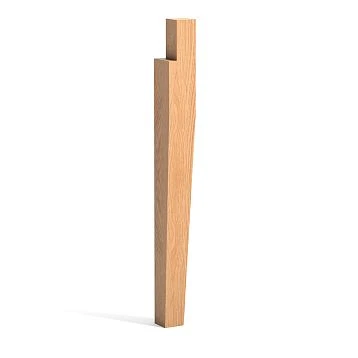
- Legs for furniture
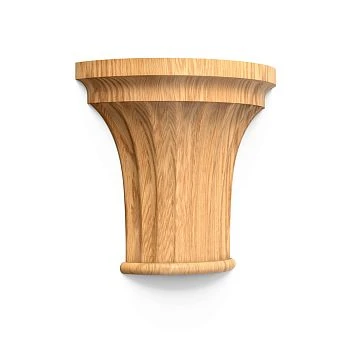
- Carved Inlays
- How to combine classic furniture with walls, baseboards, and moldings
- Skirting
- Moldings on the wall behind the bed
- Ceiling Cornice
- Mirror frames
- Doors and door casings
- Classic bedroom in different styles: nuances
- Classic
- Neoclassicism
- Baroque
- Russian style
- Modern classicism
- How to combine classic-style furniture with textiles and lighting
- Mistakes when choosing classic furniture for the bedroom
- What to buy for a classic bedroom: a complete list
- How to buy classic bedroom furniture without mistakes: an algorithm
- About the Company STAVROS
- FAQ: Answers to Popular Questions
The bedroom is the only place in the house where there is no room for compromise. Here a person rests, recovers, begins and ends the day. That is why choosing bedroom furniture is not just a matter of taste. It is a question of what this space should be: heavy or light, warm or neutral, solemn or calm.
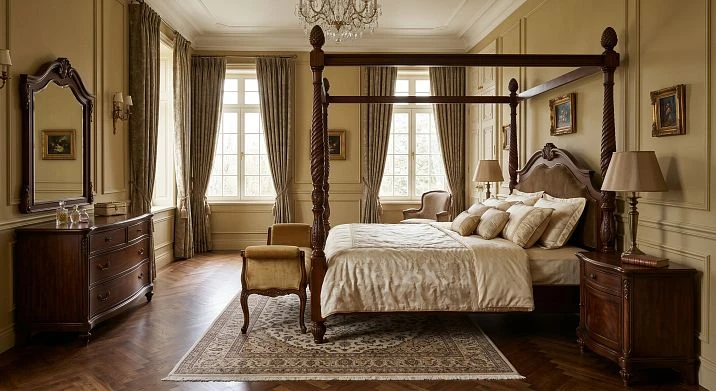
Classic bedroom furniture answers this question in its own language — the language of symmetry, natural wood, noble forms, and thoughtful decor. A bed with a headboard, bedside tables on turned legs, a chest of drawers with elegant wooden handles, soft light through textiles — this is not just a set of items. It is an environment you want to stay in.
But a classic bedroom is built not only around the bed. The mistake most people make is to buy a beautiful bed and then put whatever comes to hand next to it. The result is an interior that does not work as a system. A unified set is important: by wood color, leg shape, handle character, carved details, baseboard, moldings, and the overall rhythm of the space. That is what we will talk about.
How classic bedroom furniture differs from modern
This question seems rhetorical — 'everyone understands the difference.' In practice, many confuse 'classic' with 'outdated' or 'heavy.' This is incorrect. Classic furniture is architectural furniture. It is built according to the laws of the order system: proportion, symmetry, hierarchy of details.
What distinguishes classic bedroom furniture from modern:
-
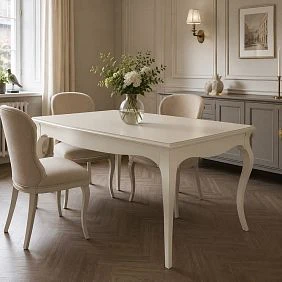
The shape of legs and supports. Turned, carved, or twisted legs are not a decorative whim but an architectural detail. Solid wood furniture legs determine the character of the item. A nightstand on a thin straight leg is modern. A nightstand on a curved conical leg is classic.
-
Furniture handles. Wooden furniture handles On the chest of drawers, bedside tables, and wardrobe — one of the main "speaking" elements. The shape, size, and material of the handle are instantly read as belonging to a style.
-
Decorative overlays on facades. Carved appliqués for furniture — silken garlands, cartouches, floral motifs — add plastic depth to flat facades. This distinguishes classic furniture from minimalist.
-
Symmetry as a principle. A classic bedroom is built on an axis of symmetry: the bed in the center of the wall, bedside tables on both sides, a chest of drawers opposite or to the side with a symmetrical mirror. This is not rigidity — it is order that calms.
-
Natural materials. Classic furniture made of solid wood — oak, cherry, walnut — materials with history and character. They darken and acquire patina over time, which only adds nobility.
-
Connection with the interior. Classic furniture in the bedroom should engage in a dialogue with the walls, baseboards, doors, moldings, and textiles. It is not a separate object in the space, but part of the room's architectural program.




What furniture items are needed for a classic bedroom
A good question — and the answer depends on the room size, budget, and personal lifestyle. But there is a basic set without which a classic bedroom cannot exist.
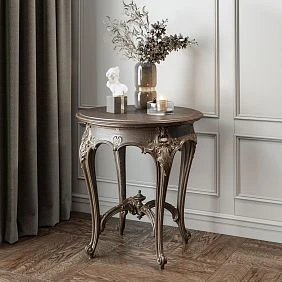
Our factory also produces:
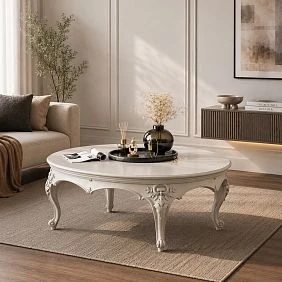
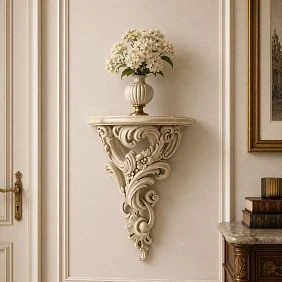
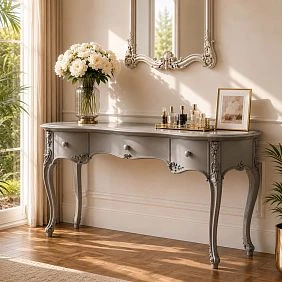
Bed: the main item and starting point
A bed is not just a place to sleep. In a classic interior, it is the architectural center of the bedroom. Everything else is built around it.
What is important when choosing a classic bed:
Headboard. In a classic bedroom, the headboard is a statement. A soft headboard in expensive fabric with a wooden frame. A wooden headboard with carved details. A tall headboard with a molding frame. The height of the headboard should match the ceiling height: the higher the ceiling, the more expressive the headboard can be.
Bed legs. Legs for solid wood furniture — tapered, turned, carved — set the tone for the entire bed. Legs 15–20 cm high create a feeling of lightness and air. A massive base without visible legs is a different character.
Wood color and species. This is a decision that needs to be made immediately — and coordinated with the floor, doors, and other furniture. Light oak, dark walnut, cherry with a reddish tint — each option creates its own image.
Size. A bed of 160×200 or 180×200 is the standard for a classic double bedroom. It is important that there is space around the bed for passage and nightstands — at least 60–80 cm on each side.
Get Consultation
Nightstands: symmetry and functionality
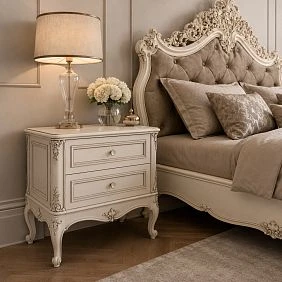
Nightstands are items that are often perceived as optional. This is a mistake. In a classic bedroom, nightstands visually "hold" the bed on both sides, creating symmetry and completeness.
What is important when choosing nightstands:
-
The height of the bedside table should be comparable to the height of the mattress: the surface of the table at the level of the mattress or slightly higher is convenient and visually correct.
-
The legs of the bedside tables should be in the same style as the legs of the bed. Furniture legs are chosen within a single family of forms.
-
The handles of the bedside tables should match the handles of the dresser and other items. A unified style wooden furniture handles is a sign of a well-thought-out interior.
-
The wood color of the bedside tables and the bed must be coordinated.
Dresser: storage and visual support for the wall
A dresser in a classic bedroom is not just drawers for clothes. It is an item that creates a visual horizontal line on the wall, and its surface becomes a place for a mirror, lamps, flowers, and decor.
Rules for choosing a classic dresser:
-
The dresser should be coordinated with the bed and bedside tables in color and leg style.
-
Handles are from the same family as toggle and cabinet handles. Wooden handles With carved motifs or teardrop shapes — classic formats.
-
Carved overlays on the dresser facades — cartouches, garlands, floral rosettes — enhance the classic character without overloading.
-
The height of the dresser is usually 85–100 cm: a convenient work surface.
-
The width of the dresser should match the scale of the wall. A too narrow dresser on a wide wall looks lost.
Wardrobe: how not to break the classic look
The wardrobe is the largest item in the bedroom. And the most complex in terms of classic design. A modern sliding wardrobe with mirrored doors next to a classic bed destroys the look.
For a classic bedroom, the wardrobe should:
-
have facades with profiled moldings or frame inserts;
-
be consistent in color with the rest of the furniture;
-
have legs or a base that lifts it off the floor — this creates a sense of lightness;
-
have handles in a unified style with the cabinets and chest of drawers.
Alternative: a built-in wardrobe with facades in a classic style — molding frames and wooden handles. Such a wardrobe visually disappears into the interior and does not compete with other furniture.
Vanity table and console: a feminine touch in the interior
A vanity table is one of the most characteristic pieces of a classic bedroom. It creates a special zone: a place for the morning ritual that also serves as a decorative accent.
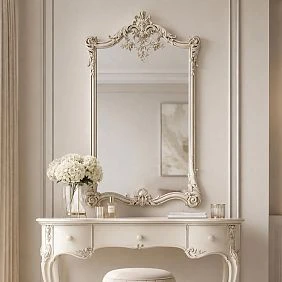
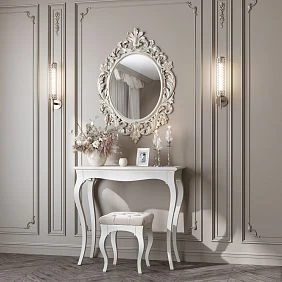
Classic vanity table: on elegant legs, with a mirror in a wooden solid wood frame, with drawers on wooden handlesIt is placed by a window or a wall with good lighting.
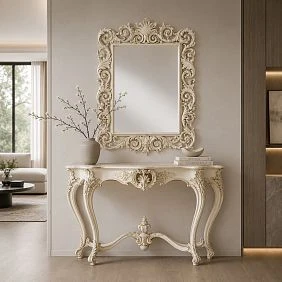
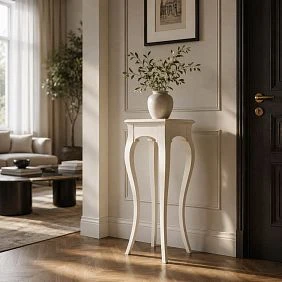
If there is not enough space for a dressing table, it is replaced by a console: a narrower piece that works well by a mirror or in a niche. Classic Furniture includes options for both full-size dressing tables and compact consoles for small bedrooms.
Bench: completing the space by the bed
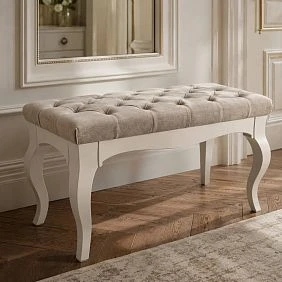
A bench by the bed is a detail that transforms a bedroom from "normal" to "thoughtful." It completes the space at the foot of the bed, creates an additional soft spot, and adds a horizontal line in the lower part of the room.
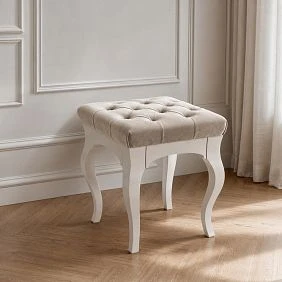
Classic bench: on turned legs, with a soft seat in fabric coordinated with the headboard and textiles. Solid wood legs for the bench — tapered or curved — are essential in a classic interior.
Light or dark classic furniture: how to choose the color scheme
This decision is made once — and is then difficult to correct. Therefore, it should be taken seriously.
Light classic bedroom furniture
White, milky, cream, light oak — a palette that works almost everywhere. Light furniture does not weigh down the space, looks good in apartments with standard ceilings, and does not require additional lighting.
Light classic bedroom furniture is an ideal choice for neoclassicism: when you want classic forms without solemnity and heaviness. A white bed with silver handles, a milky chest of drawers, light bedside tables with wooden legs — this is the image of "light classics."
Important: white furniture works well with Wooden moldings in white or near-white finishes. They support the theme without weighing it down.
Dark classic furniture
Dark walnut, wenge, oak with chocolate tinting — this is solemnity and dignity. Dark bedroom furniture in a classic style requires two conditions: sufficient space (from 18–20 sq. m) and good lighting. In a small dark bedroom, dark furniture creates a feeling of confinement.
Dark wood pairs well with lighter walls — milky, cream, warm gray — and with solid wood baseboard the same or slightly lighter tint.
Natural wood tones
Golden oak, warm ash, light cherry — this is "in between." Neither light nor dark, they create an organic, warm look. They pair well with textiles in beige, terracotta, and dusty pink shades. This is the most versatile palette for classic bedroom furniture.
The main rule: do not mix tones
Dark bed + light chest of drawers + medium-tone bedside tables = chaos. All items in one bedroom should be in a coordinated color scheme. A slight difference is acceptable — for example, lighter bedside tables with a dark bed — but it should be intentional, not accidental.
Classic furniture for a small bedroom: how not to overload the space
A small bedroom is not a death sentence for a classic style. It's a challenge with constraints. And there are more solutions for it than it seems.
Bed. For a small bedroom, choose a bed 140×200 or 160×200, not 180×200. The headboard should be medium height, without excessive bulk. The legs should be thin, elegant, so the bed doesn't 'sit' on the floor with all its weight.
Nightstands. Compact nightstands on elegant solid wood legs — 50–60 cm high, 40–45 cm wide. Nothing extra on the surface — only a lamp and minimal decor.
Chest of drawers instead of a wardrobe. In a small bedroom, a full-size wardrobe can eat up all the space. Consider this option: a built-in wardrobe or a dressing room niche + a classic-style chest of drawers as the only freestanding piece.
Dressing table → console. A full-size dressing table takes up a lot of space. A narrow console 80–90 cm with a mirror above it — a classic look with a minimal 'footprint' in the room.
Light shades. White or milky classic furniture for a small bedroom is a must. Light facades visually expand the space.
Wall behind the bed. In a small bedroom, you don't need to make a heavy decorative wall with stucco and moldings. One neat frame of molding behind the headboard is enough — Moldings from solid wood with a thin profile, painted in the color of the wall. This creates an architectural accent without overload.
How to choose furniture handles, legs, and carved decor for a classic bedroom
This is where most people make a quiet but visible mistake: they buy a beautiful classic bed and dresser — and then put modern metal handles on the dresser. The result: the furniture "speaks" in two languages at once.
Decorative details are the language furniture speaks. They must be consistent.
Furniture handles
Wooden furniture handles — one of the most expressive elements of a classic bedroom. Their shape is read instantly and immediately creates a stylistic atmosphere.
Main formats for classic style:
-
Teardrop handles. A rounded shape with a taper — a classic and versatile option for a dresser, nightstands, and wardrobe.
-
Carved handles. With floral or geometric decor — for a richer classic style.
-
Arc-shaped brackets. A semi-arched shape with two attachment points — a noble classic motif.
-
Knobs. Compact round or square knob handles for drawers of nightstands and small sections.
Crucially: all handles in the bedroom must be from the same family. You cannot mix wooden teardrop handles on nightstands with metal arcs on the dresser.
Furniture legs
Solid wood furniture legs — this is the basis of the plastic identity of the object. The style is instantly determined by them.
For a classic bedroom:
-
Tapered legs — straight, narrowing towards the bottom. A universal classic option, working from neoclassicism to baroque.
-
Curved "saber" legs — curved in an S-shape. More decorative, suitable for baroque and rococo styles.
-
Turned legs with a neck — a characteristic shape with a narrowing in the middle. Especially good for ottomans and dressing tables.
-
Square fluted legs — a strict classic option for a cabinet style and a bedroom with a restrained character.
The height of the legs determines the "lightness" of the furniture. A nightstand on 12–15 cm legs is airy, almost floating. A nightstand on 5–6 cm legs is more substantial.
Carved Appliqués
Carved wooden overlays for furniture — this is a point decorative accent that transforms an ordinary facade into a "classic" one. A central overlay on a cabinet door, a cartouche on a dresser facade, a decorative garland on a headboard — these are details that create a sense of handcraft and individuality.
Important rule: one decorative motif on all items. Floral overlays on a dresser and geometric ones on nightstands — dissonance. One chosen ornament — a unified decorative language.
How to combine classic furniture with walls, baseboards, and moldings
Furniture in the bedroom does not live separately from the walls. It exists in space — and this space is defined by baseboards, moldings, cornices, doors, and architraves.
Baseboard
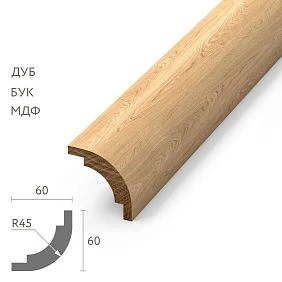
solid wood baseboard — the lower architectural line of a classic bedroom. It must be coordinated with the furniture in color and "weight." A thin baseboard of 5–6 cm next to a massive classic bed — a mismatch. A baseboard 10–15 cm high with an expressive profile — the correct scale.
Baseboard color: matching the door and architraves — a standard architectural principle. Or matching the furniture — a bolder but expressive solution.
Moldings on the wall behind the bed
The wall behind the headboard is the main decorative surface of the bedroom. Here, a molding frame or decorative panel creates an "architectural headboard" — even if the bed's headboard itself is modest.
Wooden moldings on the wall matching the furniture or matching the wall — this is a subtle classic technique. Frame behind the bed: the width of the frame corresponds to the width of the bed, the height is proportional to the height of the headboard.
Ceiling cornice
Solid Wood Items — cornices, moldings, baseboards — create three horizontal lines of a classic bedroom: the upper (cornice under the ceiling), the middle (molding belt on the walls), and the lower (baseboard). This is an architectural system that holds the space.
Frames for mirrors
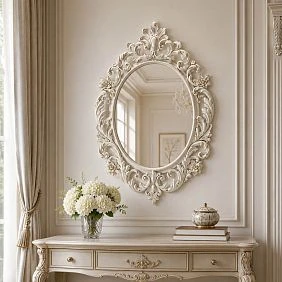
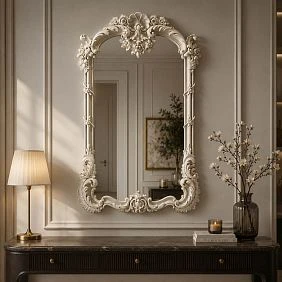
A mirror in a classic bedroom is a must-have element. It expands the space, adds light, and serves as a decorative accent. Solid wood mirror frames in a style and color coordinated with the furniture is the right choice. A mirror above the dresser, a mirror at the vanity table, a mirror in the alcove — each option is appropriate.
Doors and door casings
The color and style of the doors should match the furniture. If the furniture is light oak, then the doors should be in the same range or white. Dark furniture with white doors is acceptable but requires a well-thought-out wall color solution.
Classic bedroom in different styles: nuances
Under "classic" several stylistic directions with different characters are hidden.
Classic
Expressive forms, symmetry, rich decor. A bed with a high headboard, carved framing, and wooden legs. A dresser with overlay panels and decorative handles. Mirror Frames with stucco or carved ornament. High baseboard, cornice with brackets. Textiles — dense, with texture.
Neoclassicism
Classic forms without heaviness. Thin legs, restrained decor, white or milky palette, moderate ornament. Wooden handles simple forms. Molding on the walls is thin, without ornamentation. The cornice is laconic. This is the most popular version of a classic bedroom in modern apartments.
Baroque
More curved shapes, twisted legs, rich carved decor. A bed with a canopy or a lush fabric headboard. Decorative carved appliqués on all surfaces. Important: in apartment conditions, Baroque easily turns into overload — strict editing is needed.
Russian Style
Natural wood with pronounced texture, carved motifs in traditional ornamentation, connection with natural imagery. Solid Wood Items — wooden architraves, handles, baseboards — create the integrity of this style.
Modern classic
This is a compromise that is currently most in demand: classic forms + modern execution. Neat legs, clean facades without ornamentation, restrained handles. Decor is minimal. Classic Furniture for modern classics — it's a balance between respect for tradition and current taste.
How to combine classic-style furniture with textiles and lighting
Textiles and lighting are two elements that give completeness to the most well-thought-out interior.
Textiles. In a classic bedroom, textiles should be dense and rich in texture: silk, velvet, cotton with jacquard, linen — but noble, not denim. Bed linen color: milky, gray, powder, warm beige. Window textiles: thick curtains with lining, reaching the floor, with classic folds. Pillows with decorative trim.
Lighting. The main fixture is a chandelier in a classic style: with metal or crystal decor, on wooden or metal elements. Sconces above the bedside tables — symmetrically, one on each side. A table lamp or floor lamp near the dressing table.
A classic bedroom does not tolerate harsh directional light. Soft, diffused, warm light is needed here — like in a good theater.
Mistakes when choosing classic bedroom furniture
We are approaching the most honest section.
-
Buying a bed separately from the nightstands and dresser. Then the nightstands don't match in height, the color doesn't match, the handles are different. Buy a set.
-
Mixing different wood shades. A dark bed and light nightstands — ruining the look. One tone, a slight difference is acceptable — but intentional.
-
Choosing too massive furniture for a small room. The scale of the furniture and the scale of the room must match. A wardrobe 2.4 m high in a 12 sq. m bedroom creates a warehouse feel.
-
Using random modern handles. A mistake that kills the entire classic look. Furniture Handles — this is not a technical detail, but a stylistic element.
-
Do not ignore the color of doors and floor. Furniture exists in a space with doors, floor, and baseboards. If they are not coordinated, the interior will not be cohesive.
-
Overloading a small bedroom with carved decor. applique — is good. Overlays on every surface of every item — chaos.
-
Not planning the wall behind the headboard. An empty wall behind a beautiful bed is a missed opportunity. A molding frame, a mirror in the frame, a small panel — the wall should work.
-
Choosing furniture only by photo without dimensions. Photos in a showroom feature high ceilings, proper lighting, and a large area. Your bedroom is different.
-
Not checking how furniture matches the baseboard. Wooden baseboard — is part of the system. If it is not coordinated with the furniture in color and profile, the floor line disrupts the look.
What to buy for a classic bedroom: a complete list
To create a cohesive classic bedroom interior, you will need:
-
Classic Furniture — bed, nightstands, dresser, console or vanity table, bench.
-
Solid wood furniture legs — for the bed, nightstands, bench, console.
-
Wooden furniture handles — for the dresser, nightstands, wardrobe.
-
Carved decorative inserts for furniture — on the fronts of the dresser, wardrobe, console.
-
Solid wood frames — for mirrors above the dresser and at the vanity table.
-
solid wood baseboard — the lower architectural line of the bedroom.
-
Wooden moldings and cornices — for wall panels, cornice under the ceiling.
-
Furniture and interior items — additional decorative items to complete the look.
-
Solid Wood Items — full catalog of wooden elements for a classic bedroom.
How to buy classic bedroom furniture without mistakes: an algorithm
1. Measure the bedroom: width, length, ceiling height. Mark windows, doors, outlets, wardrobe niche.
2. Determine the main item — the bed. Choose size, headboard shape, height.
3. Select nightstands according to mattress height. Check compatibility of legs and handles.
4. Decide if you need a separate dresser, wardrobe, console, or vanity table.
5. Choose a color scheme: light, natural, or dark. Coordinate with the floor and doors.
6. Select handles and legs from the same family. Use Wooden furniture handles и legs from solid wood a unified style.
7. Add carved appliqués on key facades — dresser, headboard, wardrobe doors.
8. Choose Skirting и Moldings in a style consistent with the furniture.
9. Think about the wall behind the bed: a molding frame, mirror frame, a decorative accent.
10. Go to the catalog classic furniture STAVROS и of solid wood — and assemble a set for your bedroom.
About the company STAVROS
Classic bedroom furniture is a system. And STAVROS creates exactly systems: furniture, handles, legs, overlays, baseboards, moldings, cornices, and frames made of natural wood — everything coordinated, everything in a single style, everything produced by one enterprise.
STAVROS has been operating since 2002. Own production in St. Petersburg: a carpentry workshop, a milling workshop, a quality control department, a finished goods warehouse. The catalog includes Classic Furniture, Solid wood furniture legs, Wooden handles, carved appliqués, wooden frames, Wooden baseboard, Wooden moldings and the entire range of solid wood for residential and commercial interiors. Shipment from 1 piece. Contact us to confirm shipping to your destination.
FAQ: Answers to popular questions
What furniture is needed for a classic bedroom?
Bed, bedside tables, chest of drawers, wardrobe or built-in closet, dressing table or console, bench, mirror in a frame. Decorative details — handles, legs, overlays — are part of the system, not an additional option.
Can classic furniture be used in a small bedroom?
Yes. You need to choose light shades, compact items, thin legs, and moderate decor. A small bedroom with well-thought-out classic furniture looks significantly better than the same room with faceless modern furniture.
What is better — light or dark classic furniture?
Light — for apartments and small bedrooms: it doesn't overwhelm, is lighter, and more versatile. Dark — for spacious bedrooms with good lighting: it is more solemn and looks more expensive. Natural wood shades are the most versatile option.
What to pair classic bedroom furniture with?
With wooden baseboards, wall moldings, ceiling cornices, mirror frames, carved furniture overlays, and coordinated handles. All elements should speak the same language.
Do I need to buy a full bedroom set?
Not necessarily. A set guarantees consistency, but it is often excessive in volume. Sometimes it is better to choose a bed, nightstands, a dresser — and complement everything with thoughtful details: handles, legs, overlays, and decor.
How to choose handles for classic furniture?
Choose one style of handles and use it on all bedroom items. Wooden drop-shaped, carved, or bracket handles in a unified decorative motif. Do not mix different formats.