Article Contents:
- What is included in classic living room furniture: complete set of the hall
- Cabinet Furniture
- Soft furniture
- Decor and hardware
- How the living room differs from the bedroom and study: the logic of space
- Display cabinet for a classic living room: how to choose the main piece
- Height and scale of the display cabinet
- Facades and glass
- Lower part of the display cabinet
- Legs of the display cabinet
- Coordinating the display cabinet with the rest of the living room furniture
- Chest of drawers and console: how to create expressive wall accents
- Chest of drawers in a classic living room
- Console: a narrow piece with great decorative value
- How to combine a chest of drawers and a console into a single system
- Coffee table and TV zone: how not to ruin the classic with a TV
- Coffee table: proportions and shape
- TV cabinet in a classic style
- How wall moldings 'tame' the TV
- How to combine case and upholstered furniture in a classic living room
- Legs of sofas and armchairs
- Upholstery color relative to case furniture
- Shape of upholstered furniture and style of case furniture
- Furniture color for a classic living room: three systems and their logic
- Dark classics: walnut, dark oak, cherry
- Light classics: white enamel, ivory, patina
- Natural wood: light oak, ash, maple
- What absolutely does not combine
- Decor and hardware: architectural details that create class
- Carved decor on facades
- Wooden handles and metal hardware
- Wooden legs: unified profile
- Mirror and Picture Frames
- Moldings on living room walls
- Mistakes When Choosing Classic Furniture for the Living Room
- How to arrange classic furniture in the living room: principles of composition
- Principle of Symmetry
- The zone principle
- The "wall" principle
- Where to buy classic living room furniture: choosing a supplier
- FAQ: Answers to Popular Questions
- About the manufacturer
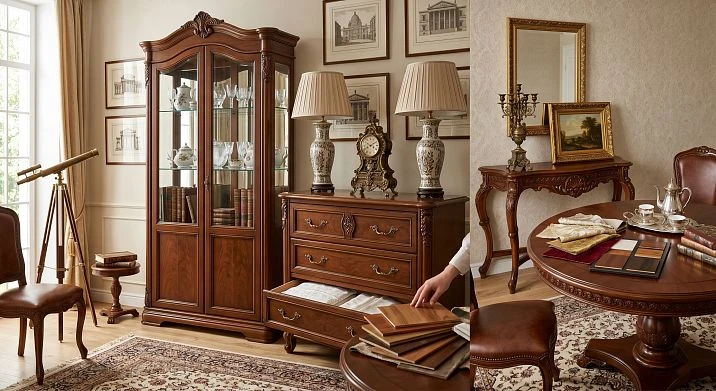
buy classic living room furniture means creating not a set of objects, but a cohesive scene: a display cabinet, chest of drawers, console, coffee table, TV area, soft seating group, mirror, decor — all of this should work as a single architectural ensemble. Each item must be "aware" of its neighbor: in color, proportions, material, and decor style.
This article is a detailed guide to creating a classic living room. We'll break down the furniture composition, the logic behind choosing each item, the rules for coordinating case goods and upholstered furniture, color, decor, and hardware. And most importantly — typical mistakes that turn an expensive purchase into a disappointing result.
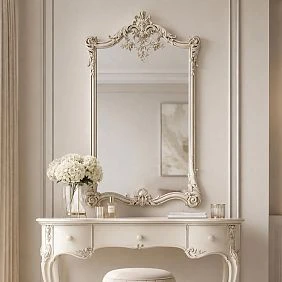
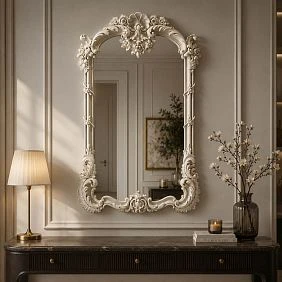
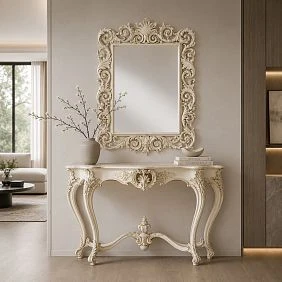
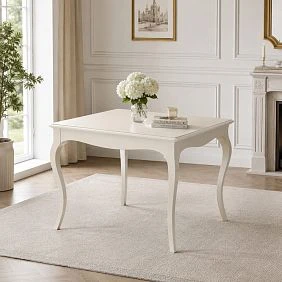
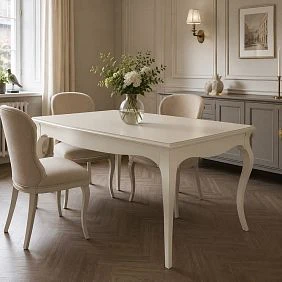
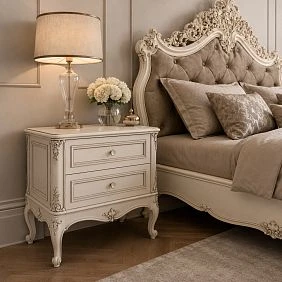
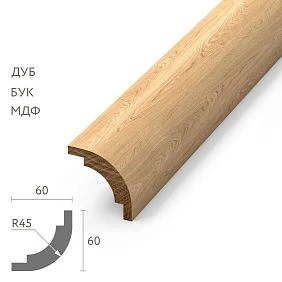
What is included in classic living room furniture: the complete hall composition
Before making a choice, let's define what a complete Classic Furniture for the Living Room.




Cabinet Furniture
-
Showcase — for dishes, crystal, decorative items, books. The central element of a "wall unit" or a standalone accent.
-
Chest of drawers — storage and a horizontal surface for decor, lamps, mirrors.
-
Console — a narrow, long table against the wall. It frames the entrance to the living room, the area behind the sofa, or a wall space.
-
TV cabinet or TV cabinet with a hutch — storage area and base for the television.
-
Coffee table — in front of the sofa. Functional and forms the central zone.
-
Shelving unit or bookcase — if the living room serves as a library.
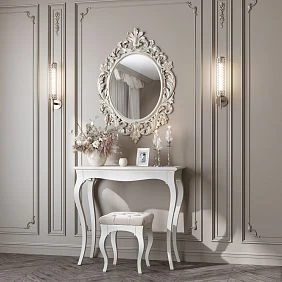
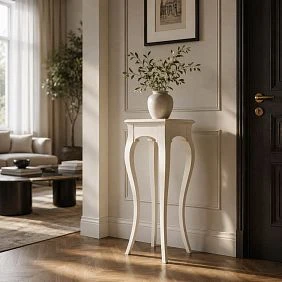
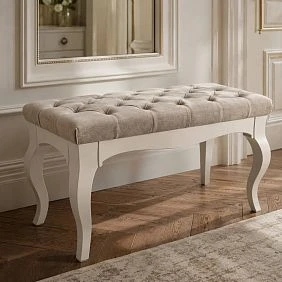
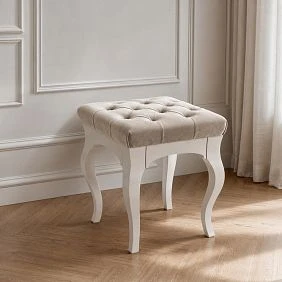
Our factory also produces:
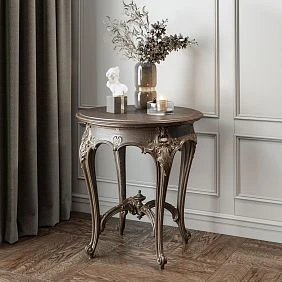
Soft furniture
-
Sofa — the foundation of the seating area. Should be coordinated in legs and style with the case furniture.
-
Armchairs — one or two armchairs complement the sofa and form a relaxation area.
-
Ottoman or bench — additional seating, an accent decorative element.
Get Consultation
Decor and hardware
-
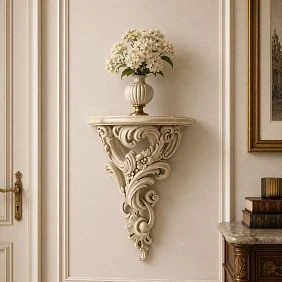
Carved wooden decoration — overlay elements on the facades of the showcase, chest of drawers, console.
-
wooden furniture handles — for boxes and doors.
-
wooden furniture legs — turned supports for a chest of drawers, console, coffee table.
-
wooden frames — for mirrors, paintings, panels above a console or chest of drawers.
-
Furniture Decoration from Wood — overlay elements on facades.
This is not an ideal “dream” — it’s a real set that makes the living room complete.
How a living room differs from a bedroom and study: the logic of space
Why can’t you just take any classic furniture and arrange it in the living room? Because each room has its own logic.
In the bedroom, furniture serves relaxation: the main thing is the bed, quiet, coziness. In the study — focused work: the main thing is the desk, shelving, concentration. In the living room, furniture works for presentation and communication: visual integrity, symmetry, and representativeness are important here. The living room should be liked — by both the owner and guests.
Hence the special requirements for classic-style living room furniture:
-
Symmetry: the display cabinet and chest of drawers — symmetrical relative to the central axis. Armchairs — symmetrical relative to the sofa.
-
Composition: each wall should read as a complete “portrait”. Chaotic arrangement of items is not a living room.
-
Representativeness: display case glass, mirror in frame, decorative elements on the console — all of this "works for the audience."
-
Balance of storage and decor: in the living room they store, but this storage must be beautiful.
That is why Living room furniture in classic style — this is a special system, not just "the same classic, only for the hall."
Display case for a classic living room: how to choose the main item
A display case is the soul of a classic living room. It stores crystal, porcelain, silver, books, collectibles. But most importantly: it creates a vertical accent on the wall and is one of the most decoratively rich items in the hall.
Height and scale of the display case
The height of a classic display case is from 180 to 220 cm. The display case should be "representative": a low display case in a tall room looks unimpressive. Rule: the display case fills 70 to 85% of the wall height.
The width of the display case is 80–140 cm for a standalone item. If the display case is paired (two display cases symmetrically on both sides of a central element) — 60–80 cm each.
Depth — 35–45 cm. This is enough for storing dishes, books, or decorative items.
Facades and glass
In a classic display case, the upper part features glazed facades. The glass can be:
-
Transparent — for maximum visibility of the contents.
-
Faceted (with beveled edges around the perimeter) — creates an "antique" glass effect.
-
Ribbed or frosted — if the contents of the display case are not intended for viewing.
The glass facade frame — with a molding profile or with applied wooden decor. This is what distinguishes a classic display case from a simple "glass cabinet": the profiled glass mullion creates a pattern, making the facade expressive.
Lower part of the display case
The lower part of the display case is solid (closed doors or drawers). This is storage hidden from view. Important: the facades of the lower part should be coordinated with the upper part in terms of decor style, handles, and profiles.
wooden furniture handles on the display case facades — of a single type on all doors and drawers. Metal hardware (bronze, gold) — for display cases with enamel or in a neutral tone.
Cabinet legs
A classic display cabinet "stands" on turned or tapered wooden furniture legs. The height of the legs is 60–100 mm. This creates a "lightness" in the lower part and visually "lifts" the piece above the floor. A display cabinet without legs, standing directly on the floor, is a "Soviet sideboard," not classic furniture.
Coordinating the display cabinet with the rest of the living room furniture
The display cabinet sets the tone for the entire room. The wood color, facade decoration style, type of handles, and leg profile—all of this should be repeated (or matched) on the chest of drawers, console table, and coffee table.
Chest of drawers and console table: how to create expressive wall accents
If the display cabinet is the main vertical piece in the living room, then the chest of drawers and console table are horizontal accents that "hold" the walls.
Chest of drawers in a classic living room
A chest of drawers in the living room serves two purposes: storage and a decorative horizontal line. The surface of the chest of drawers is a "stage" for decor: lamps, a vase, photo frames in wooden framessmall sculptures, decorative plates.
The height of a living room chest of drawers is 80–95 cm. This is a comfortable height for use and the correct proportion for a mirror or painting above it.
The width of the chest of drawers is 100–140 cm. A wide chest of drawers in the living room is more substantial than in the bedroom: here it carries a greater decorative function.
Drawer fronts with profiled moldings, with applied decor, with carved rosettes or medallions. Smooth drawers without decoration in a classic living room are neoclassicism in a minimal interpretation, which is only acceptable with a very strict and restrained style of the entire hall.
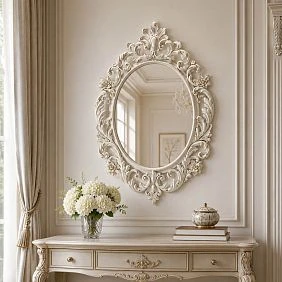
Mirror above the chest of drawers. wooden frame for the mirror must be coordinated with the chest of drawers: the same wood species, the same finish, a similar profile character. A mirror in a wooden frame above the chest of drawers is a "pair," a classic solution that has worked in European living rooms for three centuries.
Console: a narrow item with great decorative significance
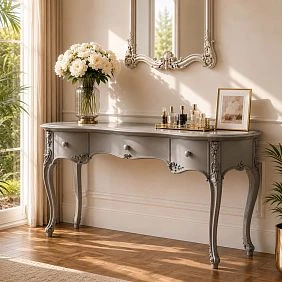
A console is a narrow long table (depth 30–40 cm) on legs or with a wall support. In a classic living room, it occupies:
-
The wall space at the entrance to the living room — welcomes guests.
-
The area behind the sofa — if the sofa is not against the wall.
-
The free wall opposite the window — for a mirror or a painting.
A console functionally carries little: a lamp, a vase, decorative items. But visually — a lot. A properly chosen console with a mirror in a wooden frame above it is a ready-made "picture" on the wall.
Console height — 75–90 cm. It is convenient for placing table lamps and decor.
Console length — 100–160 cm. The console should be proportionate to the wall and the items placed on it.
Console legs — turned, tapered, carved — matching the style of the rest of the furniture. wooden furniture legs for a classic living room console — of the same profile as the legs of the chest of drawers and coffee table.
How to link a chest of drawers and a console into a single system
The chest of drawers and console in the same room should be from the same series or carefully coordinated:
-
The same wood species and the same finish.
-
The same handles: Wooden handles or metal fittings of the same type.
-
The same facade decor style: both with moldings, both with carved inlays or both smooth.
-
The same legs in profile and height.
When the chest of drawers and console "speak the same language" — the living room acquires that very integrity that distinguishes a professionally furnished hall from a random set of items.
Coffee table and TV area: how not to ruin the classic style with a TV
This is a sensitive topic. The TV is an integral part of a modern living room. But in a classic interior, it creates a problem: the rectangular black screen fits poorly into the system of wooden profiles and carved decor.
Coffee table: proportions and shape
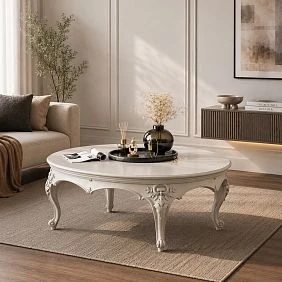
A coffee table in a classic living room is not a glass square on metal. It is a wooden piece with turned legs, a profiled tabletop, or a small lower shelf for storage.
The table height is 40–50 cm. This is a working height for a seated person: convenient to pick up a cup, put down a book.
The tabletop shape is rectangular, oval, or round. Oval and round in a classic style are softer, French. Rectangle is stricter, more versatile.
Size is proportional to the sofa. The table length is 60–70% of the sofa length. The distance from the sofa to the table is 40–50 cm: convenient to stand up without hitting the table.
The table legs are the same wooden furniture legs, as those of the console and chest. Turned, tapered — depending on the style.
TV cabinet in a classic style
A TV cabinet is an item with special requirements in a classic living room. It must support the TV without revealing its structural function.
Solutions:
-
A TV cabinet in the style of a chest of drawers — with drawers, profiled facades, and wooden handles. The TV sits on top — between two symmetrical items (display cabinets or shelving units on the sides).
-
A TV area with a niche — the TV in a shelving unit niche, framed by wooden pilasters and a cornice. This is the most elegant solution for a classic living room.
-
A TV on the wall — the screen is mounted above a classic console or TV cabinet. The area around it is decorated with decorative moldings on the wall, which "embeds" the TV into the architectural context.
How moldings on the wall "tame" the TV
A technique often used by designers in classic interiors: the TV is hung in a "frame" of moldings applied directly to the wall. A rectangular frame made of wooden profile or stucco molding surrounds the screen, making it visually part of the wall's architecture — rather than a black spot on a white plane.
How to combine case goods and upholstered furniture in a classic living room
The sofa and armchairs are the heart of the living room. But they must be "in conversation" with the case goods, not existing in a parallel world.
Legs of the sofa and armchairs
The first and most important element of coordination: the legs of the sofa and armchairs must be of the same wood species and finish as the legs of the case goods — chest of drawers, display cabinet, console. This is the "single floor" rule: the legs of all living room furniture are from the same "family."
Dark turned legs on case goods + light tapered legs on the sofa — this is a disconnect that is immediately noticeable. Dark legs on all furniture in the room — unity.
The color of the upholstery relative to the case furniture
The upholstery of the sofa and armchairs should not 'shout over' the wooden furniture. In a classic interior:
-
Dark wooden furniture (walnut, wenge) + sofa in warm neutral tones: cream, beige, warm gray, mustard.
-
White or light furniture + sofa in muted tones: smoky blue, lavender, gray-green, dusty rose.
-
Natural varnished wood + sofa in neutral or natural tones: sand, olive, terracotta.
Bright upholstery colors (red, ultramarine, emerald) are possible in a classic living room — but only as an accent, not as the base. And only with delicate furniture that does not 'argue' with the upholstery.
The shape of the upholstered furniture and the style of the case furniture
A classic sofa — with curved armrests, a soft back, with straight or slightly curved lines. A corner sofa in a classic living room is a complex solution: corner structures fit poorly into symmetrical classic compositions.
The shape of the armchairs should echo the sofa: the same armrest lines, the same back height. 'Heterogeneous' sofas and armchairs are a sign of an ill-conceived soft seating area.
Furniture color for a classic living room: three systems and their logic
Color is one of the key factors when creating furniture for a living room in a classic style.
Dark classics: walnut, dark oak, cherry
Dark wood creates depth, nobility, and 'weight'. A living room with dark walnut furniture is representative, 'masculine', and solemn. It evokes the image of a country library or an English club.
What is needed for balance:
-
Light walls — cream, beige, warm milk.
-
Light or neutral floor — light parquet, beige tiles.
-
Gold or bronze hardware — Wooden handles in a dark tone or bronze metal.
-
Warm textiles — curtains, upholstery, carpet in golden, cream, warm tones.
Light classics: white enamel, ivory, patina
White classic furniture is the most popular option for city apartments. Lightness, airiness, a "French" feel — while maintaining classic forms and carved decor elements.
Notes:
-
White enamel with carved applied elements and gold hardware — maximum "Frenchness".
-
Patina (slightly aged white enamel) — antique character, depth.
-
Ivory (slightly warmer than white) — a softer and cozier option.
For white furniture — colorful accents in textiles and upholstery. Calm muted tones: smoky blue, warm gray, powder.
Natural wood: light oak, ash, maple
Natural texture under lacquer is neoclassicism. Classic forms while preserving the living wood surface. This option works well in modern interiors where you want classics but without the "heaviness" of dark wood or the "elegance" of white enamel.
For natural wood — neutral walls, neutral floor, without bright contrasts.
What absolutely does not combine
Several combinations to avoid:
-
Dark walnut furniture + chrome or nickel metal handles — cold metal on warm wood.
-
White furniture + dark parquet without a light rug — too harsh a contrast.
-
Three different wood shades in one room: a display case from one batch, a chest of drawers from another, a console from a third.
Decor and hardware: architectural details that create class
This is where the difference lies between a "set of furniture" and a true classic living room. Details are what you pay for and what gets noticed.
Carved decor on facades
Carved wooden decoration on the facades of the display case, chest of drawers, and console — applied elements: medallions, cartouches, acanthus leaves, rosettes, ornamental strips. They turn an ordinary facade into a classic piece of furniture.
Scale matters: the central medallion on the display case facade should match its width. On a narrow door — a small element. On a wide chest of drawers facade — a larger one.
Mistake: one large carved detail on a small facade. Result — overload, "screaming" decor instead of a delicate accent.
Wooden handles and metal fittings
wooden furniture handles — the best choice for classic wooden furniture: they create material unity, tactilely consistent with the wood of the facades.
Metal fittings — bronze or gold — for furniture under enamel or with a dark finish. All handles in the living room are of the same article. This is fundamental: handles of different styles on different items are a sign of an ill-considered purchase.
Wooden legs: uniform profile
wooden furniture legs on all case and upholstered furniture in the living room — of the same profile. Not identical — but from the same "family": a display cabinet and a chest of drawers on turned baluster legs, a console and a coffee table on conical legs — possible if both forms belong to the same classical vocabulary.
Frames for mirrors and pictures
wooden frames for mirrors above the chest of drawers and console — consistent with the furniture in wood species, finish, and profile character. A mirror in a wooden frame above the console is a "pair" to the console, a decorative duet. A frameless mirror in a classic living room is a contradiction to the style.
Moldings on living room walls
Wooden moldings on the living room walls — horizontal dividing lines, "framed" sections on the walls — this is an architectural technique that transforms an ordinary room into a "classical hall." Walls with moldings, consistent with the wooden furniture, are what make the living room "truly" classic, not an imitation.
Mistakes when choosing classic furniture for the living room
This is the most practical section. Every mistake costs money and time — it's better to know about them in advance.
Buying items separately without an overall composition. A display cabinet from one store, a chest of drawers from another, a console from a sale — and as a result, three different styles in one living room. A classic living room requires a systematic approach: first — a plan, then — a purchase.
Mixing different wood shades. A display cabinet in dark wenge, a chest of drawers in light walnut, a console in natural beech — this is not "variety," it's chaos. All wooden items — from the same batch or carefully coordinated.
Choosing too massive furniture for a small hall. A tall display cabinet 220 cm + a wide chest of drawers 140 cm + a console + a soft seating group in a 20 sq. m hall — the space is "cluttered". For small living rooms — more compact items, neoclassical in light proportions.
Not considering the TV zone. The TV "appears" after buying furniture, and there is no place to put it. Or the TV stand does not match the style of the display cabinet. The TV zone should be planned at the design stage.
Forgetting about storage. A beautiful console and mirror are good. But where to put remotes, albums, dishes? In a classic living room, storage should be built into the system: a display cabinet, closed drawers of the chest, the lower part of the display cabinet.
Buying a display cabinet without connection to the chest and console. A baroque-style display cabinet with stucco decor + a minimalist neoclassical chest — a stylistic gap that cannot be "smoothed out" with decor.
Not linking handles, legs, and decor into a unified system. Different types of handles on different items, different leg profiles — these are "parts from different sets". The result is a feeling of randomness.
Overloading the living room with carving. Carved decor on every facade, every drawer, every leg — this is excess. Carving should be an accent, not a background. Rule: a carved element on the central facade, delicate overlays on the side ones — that's enough.
How to arrange classic furniture in the living room: principles of composition
Arrangement in a classic living room is not a matter of taste. It is an architectural task with correct and incorrect solutions.
Principle of symmetry
A classic living room is built on symmetry. The central axis — most often a window or fireplace — is the point of symmetry. Relative to it: the sofa — in the center, the coffee table — in front of the sofa in the center, two armchairs — symmetrically on both sides. The display cabinet and chest — symmetrically on the side walls.
Breaking symmetry in a classic living room is like a false note in an orchestra. It is immediately heard.
Zone principle
The living room is divided into zones:
-
Relaxation zone — sofa, armchairs, coffee table.
-
Storage and decor zone — display cabinet, chest of drawers, console.
-
TV zone — cabinet or niche with a TV.
Zones should not mix: the display cabinet is not in the relaxation zone, the sofa does not block the chest of drawers.
Wall principle
Each wall of the living room reads as a separate "picture". The main wall (opposite the entrance) is the most representative: display cabinet + chest of drawers + mirror or display cabinet + TV zone. Side walls are more restrained: console with mirror, shelving, panel.
Where to buy classic living room furniture: choosing a supplier
Classic Furniture for the Living Room requires a single source: a supplier with a full range where the display cabinet, chest of drawers, and console are from the same series — with the same wood, decor, and hardware.
In the Stavros catalog — Classic Furniture from solid wood, Carved wooden decoration for facades, wooden furniture appliqués, wooden furniture handles, Furniture legs of different shapes and heights, wooden frames for mirrors and paintings. A complete system of classic wooden decor for the living room — from a single source, with a guarantee of stylistic unity.
FAQ: Answers to popular questions
How to choose classic furniture for a living room?
Define the color concept, create a layout plan, choose a display cabinet as the main piece — and select the rest of the furniture from the same series: chest of drawers, console, coffee table. The hardware is uniform across all items.
What is included in the furniture set for a classic hall?
Display cabinet, chest of drawers, console, coffee table, TV cabinet or sideboard, sofa and armchairs, decor: handles, legs, frames for mirrors, carved overlay elements.
Is a display cabinet needed in a classic living room?
A display cabinet is one of the main pieces in a classic living room. It creates a vertical accent, provides storage for dishes and decor, and forms the 'center' of the wall.
How to choose a chest of drawers and console for the living room?
From the same series as the display cabinet. The same handles, legs, facade decor. The chest of drawers is wider (100–140 cm), the console is narrow (30–40 cm depth). Both with mirrors in wooden frames.
How to combine a sofa with classic case furniture?
The sofa legs are of the same wood type and finish as the cabinet furniture legs. The upholstery color is coordinated with the wood tone. The sofa shape is classic, without sharp corners.
What color of furniture to choose for a classic living room?
Three directions: dark wood (walnut, wenge) — for a formal hall; white enamel or patina — for French classic; natural lacquered wood — for modern neoclassicism.
Is classic furniture suitable for a small hall?
Yes, if you choose neoclassicism in compact proportions. Do not place tall display cabinets, limit yourself to two or three pieces of cabinet furniture. Use mirrors to expand the space.
Which handles and legs are suitable for classic furniture?
Wooden handles matching the furniture or metal fittings (bronze, gold) — of a single type on all items. Legs — turned or tapered from the same wood species.
How not to overload the living room with carved decor?
Carving is an accent, not a background. A carved element on central facades, delicate overlays on side ones. Other surfaces are clean, with molding profiles, without carving.
Where to buy classic furniture for the living room?
In the STAVROS catalog: Classic Furniture from solid wood with a full range of decor and fittings with Contact us to confirm shipping to your destination.
About the manufacturer
STAVROS is a Russian manufacturer of classic furniture and solid wood interior products. The range includes — Living room furniture in classic style, Carved Decor, Wooden Inlays, Handles, Legs и wooden frames for mirrors. If you want to create a classic living room with unified wooden decor made of solid wood — STAVROS offers a full range with Contact us to confirm shipping to your destination.