Article Contents:
- HI WOOD A70: what product is actually being purchased
- Why the size 50×50×2000 mm still remains in the specification
- Why the problem is not limited to adhesive
- Why a revision is needed in the data sheet
- Why the adhesive must be suitable for two surfaces at once
- Why a list of solvents does not replace checking the specific composition
- The danger of the usual cleaner from the warehouse
- Why the ban must be physically visible to the crew
- Paint A70 before or after installation: two working schemes
- Scheme A — main painting before installation
- Scheme B — installation and then a single painting
- Why the choice cannot be changed midway through the project
- What to record in the reference apartment
- Who should approve the reference system
- How to check the reference area after curing
- Why the reference area protects against more than just chemical reactions
- Conditional example
- Why adhesive consumption cannot be calculated by the number of planks
- How to obtain the working consumption rate of the installation compound
- Why paint also cannot be calculated by the number of cornices
- Commercial stock and consumables stock are different line items
- How to mark A70 by floors and phases
- Why marking helps control the technology
- Should A70 be divided by colors
- What to do if A70 is painted together with the ceiling
- What to do if the walls are already painted
- Why the substrate should be part of the passport
- What to do if the crew asks to replace the adhesive with a cheaper one
- What to do if the required adhesive is out of stock
- Fresh excess of installation compound
- Stain after drying
- Paint contamination
- Why acetone, white spirit, and gasoline must not be stored near the installation station without supervision
- Why "didn't see the damage right away" does not mean compatibility
- How to approve the joint material
- Why the joint should be assessed after the final painting
- How to assess joint quality on a serial project
- Why the same A70 can look different with different painting crews
- How to standardize the work of painting crews
- What to do if the painter suggests a different paint
- How to work with multiple colors on a single project
- Why color reserve should be counted separately from commercial stock
- Why edges and end faces matter before painting
- How to store A70 before installation
- Why long-length materials must be protected from "temporary" storage
- How to label delivery batches
- Why A70 reserve must not be mixed with the current batch
- How to calculate A70 commercial reserve
- Installation reserve
- Operational reserve
- Reserve for project changes
- Why full two-meter planks are more valuable than random offcuts
- How to store usable leftovers
- How to tell a usable leftover from trash
- What to do if one area in the apartment has changed
- How to place an A70 reorder
- Why you need to specify the full SKU and size when reordering
- 2. Using a “universal” adhesive without testing
- 3. Using a solvent for cleaning without testing
- 4. Assuming that only the adhesive is hazardous
- 5. Allow each crew to use their own adhesive
- 6. Change adhesive only because of price
- 7. Change paint without a control area
- 8. Calculate adhesive consumption by the number of planks
- 9. Do not secure the base
- 10. Start 40 apartments at once
- 11. Confuse A70 with A70V1/A70V2 when reordering
- 12. Label only “cornice 50×50”
- 13. Mix commercial and consumable stock
- 14. Do not record a technology change
- 15. Is an identical product code a guarantee of an identical result?
- What size is the A70?
- What material is the A70 made of?
- Is this a ceiling cornice or a curtain system?
- Can the A70 be painted?
- Can any mounting adhesive be used?
- What is dangerous for polystyrene?
- Can the A70 be degreased with a solvent?
- Should a test area be done?
- Should it be painted before installation?
- Can different crews use different adhesives?
- How to calculate the amount of A70?
- How to calculate the amount of adhesive?
- How to calculate paint?
- What to keep in reserve?
- How to place an additional order?
- Where to buy A70 in bulk?
- Decision tree when replacing any material
- What to do if the defect appeared only after 20 apartments
- Possible conclusion 1
- Possible conclusion 2
- Possible conclusion 3
- Possible conclusion 4
- Why you can't immediately repaint the defective area
- How to divide responsibility between procurement, installation, and painters
- Procurement
- Installation
- Painting contractor
- Technical control
- How to formalize a technology change officially
- How to count serial launch after the control apartment
- Why the first apartment must be fully completed
- How to check uniformity after the first five apartments
- How to track actual consumption of consumables
- Why a sharp increase in adhesive consumption requires checking
- How to manage A70 deliveries in batches
- Phase 1
- Queue 2
- Queue 3
- How to check the reserve between batches
- How to prepare the operation kit after handover
- Why service personnel especially need a solvent ban
- How to submit the final request to the supplier
- How to check readiness before payment
- Why savings on consumables should be calculated across the entire cycle
- How to keep a change log for A70
- How to conduct a spot audit of a crew
- What to do if a worker used an unknown compound on only one section
- Why you shouldn't mix up "compatibility" and "installation quality"
- How to use general commercial anchors naturally in an article
- How to tell that an article has solved a practical problem
- Product
- Installation
- Finishing
- Control
- How to verify that the supply batch matches the production schedule
- How to close the project after the last apartment
- How to conduct the final test before signing the supplier's order
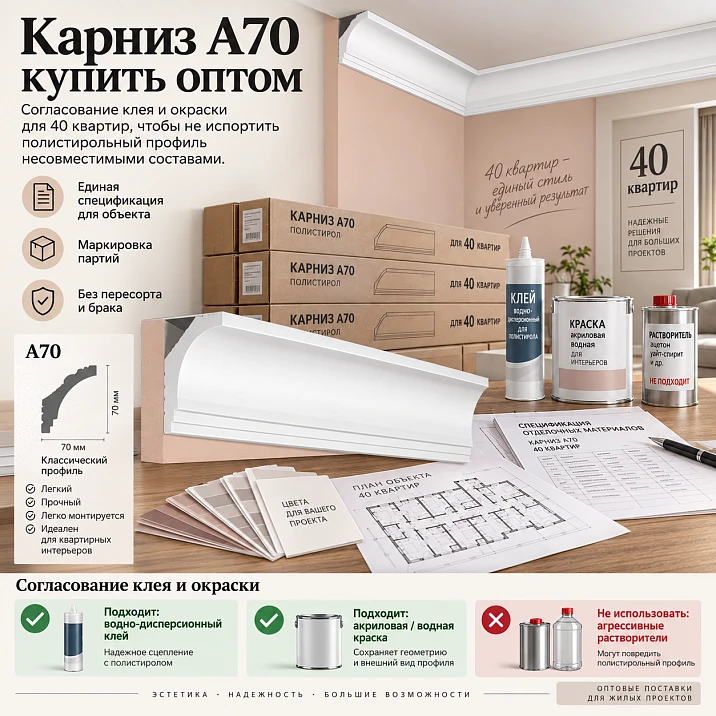
When the same ceiling cornice is repeated in 40 apartments, the main threat to the wholesale batch arises not only from the number of strips. A70 may be purchased exactly according to the schedule, delivered without damage, and distributed across floors, but the result will still differ if installation crews use different adhesives, painters change the painting system, and someone removes an accidental stain with solvent "as usual."
For HI WOOD A70 this is fundamental: the profile is made of polystyrene. Polystyrene works well as a lightweight decorative material and is suitable for subsequent painting, but it requires control of the chemical compatibility of the adhesive, cleaner, joint materials, and finish coating. Aggressive organic solvents can damage the polystyrene base. Therefore, on a large project, the procurement decision cannot end with the line:
A70 — 480 pcs.
A second document is needed — an approved installation and painting system passport:
A70 → wall base → ceiling base → compatible installation compound → joint treatment → primer/preparation if necessary → compatible paint → safe cleaning → control area → serial installation.
It is only after this that it makes sense to buy the A70 cornice wholesale for 40 apartments.
The main principle of the article:
the same article must be installed according to one approved technological system; the habit of an individual crew is not a reason to change the adhesive, cleaner, or paint on their floor.
If the system changes, the change undergoes a separate review. Otherwise, the project ends up with dozens of apartments where a visually identical A70 is actually installed as three different products.

HI WOOD A70: what product is actually purchased
This article examines one specific ceiling cornice:
| Parameter | A70 |
|---|---|
| Article number | A70 |
| Brand | HI WOOD |
| Material | Polystyrene |
| Cross-section | 50×50 mm |
| commercial length | 2000 мм |
| Type | Decorative ceiling cornice |
| Surface | for subsequent finishing/painting |
Product card: cornice HI WOOD A70 50×50×2000 mm.
In this article, A70 has already been approved by the designer and the project. We are not comparing it with A53, A70V1, A70V2, A100, and other profiles. We are not deciding which height is better. We are not turning the material into an overview of cornices.
The task begins after selection:
A70 approved → need to purchase a large batch and guarantee identical installation and painting technology in all 40 apartments.




Why the size 50×50×2000 mm still remains in the specification
Although the central topic is material compatibility, the procurement line must be complete.
Bad:
cornice A70 — 300 pcs.
Stronger:
HI WOOD A70 / polystyrene / 50×50×2000 mm / ___ pcs. / project ___ / phase ___.
This way, when reordering, the model is not confused with neighboring SKUs of a similar name.
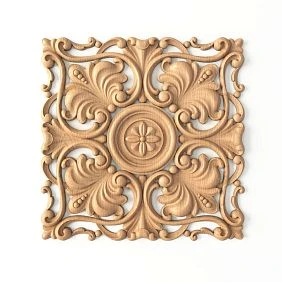
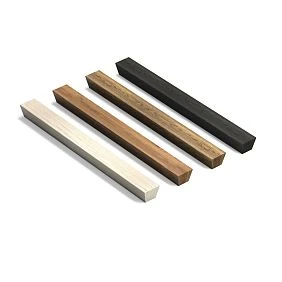
Our factory also produces:




Why the technology must be approved before mass procurement
A typical procurement sequence often looks like this:
-
calculated the cornice;
-
placed the order;
-
delivered;
-
installers choose their usual adhesive;
-
painters use their own paint;
-
when contamination occurs, they take the first cleaner from the warehouse.
For wood or MDF, the crew may have established habits. They cannot be automatically transferred to polystyrene.
Polystyrene is sensitive to a number of organic solvents. Consequently, an incompatible compound can:
-
soften the surface;
-
leave a dent;
-
destroy the edge;
-
change the texture;
-
worsen the appearance of the coating;
-
cause damage after installation.
Across 40 apartments, one wrong decision is multiplied across the entire project.
Get Consultation
Why the problem is not limited to the adhesive
You need to check more than just one product.
The following may come into contact with A70:
-
mounting compound;
-
jointing material;
-
filler compound;
-
primer;
-
paint;
-
degreaser;
-
tool cleaner;
-
cured adhesive remover;
-
compound for local touch-up.
If seven products are compatible, but the eighth contains a solvent capable of damaging polystyrene, the entire system remains risky.
Unit A70 passport: the main document of a serial object
Before launching the first apartment, it is useful to create a one-page working passport.
Example structure:
| Inspection | Approved parameter |
|---|---|
| Cornice | HI WOOD A70 |
| Size | 50×50×2000 mm |
| Material | Polystyrene |
| Wall base | ___ |
| Ceiling base | ___ |
| Mounting compound | ___ |
| Polystyrene compatibility | confirmed / not |
| Joint material | ___ |
| Primer if necessary | ___ |
| Paint | ___ |
| Coating compatibility | confirmed / not |
| Permitted cleaning | ___ |
| Prohibited cleaners | per the approved instructions |
| Control area | completed / no |
| Control area | accepted / no |
| System revision | R1 / R2 / ... |
| Mass installation permitted | Yes / no |
Such a passport links supply, installation, and painting works.
It does not replace the technical instructions of manufacturers of specific compounds. It records which products and procedures are permitted at this site.
Why an audit is needed in the passport
Let's imagine:
R1
-
glue K-01;
-
paint F-01.
Two weeks later, the glue was replaced.
It appears:
R2.
Now it is known:
-
in which apartments R1;
-
from which apartment R2 began;
-
whether the new composition passed the control section;
-
what to use during repair.
Without an audit, a change turns into a verbal agreement.
Why the word "universal adhesive" proves nothing
The marketing word "universal" is not a technical confirmation of compatibility with A70.
Before including the product in the system, you need to check the documentation for the specific formulation:
-
whether it is approved for use on polystyrene;
-
whether the formulation contains solvents that are hazardous to polystyrene;
-
whether the formulation is compatible with the actual wall substrate;
-
whether it is compatible with the ceiling substrate;
-
whether it is suitable for vertical and ceiling areas;
-
what the working time for adjustment is;
-
what surface preparation is required;
-
can the seam be painted;
-
what to use to remove fresh excess;
-
what must not be used for cleaning after polymerization.
If the instructions do not provide a sufficient answer, the technology should not be invented on your own.
Why the adhesive must be suitable for both surfaces at once
A70 comes into contact not only with its own material.
The adhesive must work as part of a system:
polystyrene + the specific wall/ceiling.
The substrate can be:
-
plaster;
-
filler;
-
painted surface;
-
drywall;
-
another reason provided for in the project.
Compatibility with polystyrene alone does not yet guarantee reliable adhesion to the wall.
Organic solvents as a red flag
You cannot write:
all chemicals are dangerous for polystyrene.
This is incorrect.
The problem lies in specific incompatible substances and formulations. For polystyrene, aggressive organic solvents require particular attention. STAVROS materials specifically mention acetone, white spirit, gasoline, toluene, and other similar solvents as potentially damaging to polystyrene.
Practical rule for the site:
if an adhesive, paint, primer, cleaner, or stain remover contains a solvent, compatibility with polystyrene must be confirmed in the technical documentation of the specific product before it is used on A70.
Why a list of solvents does not replace checking a specific formulation
It is impossible to create a permanent list:
these ten substances are prohibited, everything else is permitted.
Commercial materials have a complex composition.
Therefore, the correct logic is:
-
identify the product;
-
review the technical information;
-
confirm compatibility;
-
create a test area;
-
only then include the product in the A70 data sheet.
The danger of a familiar cleaner from the warehouse
The most typical household mistake occurs after installation.
Remains on the cornice:
-
traces of adhesive;
-
paint;
-
dirt;
-
pencil;
-
random stain.
An installer or painter grabs their usual cleaner.
If it is suitable for metal, glass, or wood, that says nothing about polystyrene.
Therefore, the data sheet must have a separate item:
what A70 is permitted to be cleaned with on site.
And one more:
what it is prohibited to clean with.
Why the prohibition must be physically visible to the crew
Instructions in a shared folder do not always work.
For 40 apartments it is even more so:
-
specify the approved cleaner in the process sheet;
-
label the working containers;
-
do not store unsuitable solvents near the work station;
-
conduct a short briefing;
-
include compatibility in the acceptance checklist.
This is an organizational measure, not a "tidiness tip."
The material for joints is also part of the system
Even a correctly glued A70 can get a poor result at the joints.
It is necessary to determine in advance:
-
what is used to treat the joint;
-
whether the material is compatible with polystyrene;
-
whether it can be sanded using the accepted technology;
-
how it behaves after painting;
-
whether it differs in absorption/texture;
-
whether it allows local repair touch-up.
You cannot choose a filler or joint compound just because the painters already have it.
Painting A70: system first, then 40 apartments
A polystyrene cornice is usually considered an element for subsequent finishing. But "paint with white paint" is not a technological specification.
It is necessary to record:
-
exact color code;
-
gloss level;
-
coating type;
-
compatibility with polystyrene and the joint material;
-
need for primer;
-
painting location;
-
number of working stages according to the instructions of the selected system;
-
local repair scheme;
-
method for cleaning the tool and profile.
If the apartments must look identical, these parameters cannot be left to each painter's discretion.
Painting A70 before or after installation: two working schemes
For a large project, there is no point in arguing about the “only correct” order without context. Different technological schemes can be used if each is approved in advance and delivers a stable result on the control area.
Scheme A — main painting before installation
Sequence:
-
surface preparation A70;
-
base painting;
-
holding;
-
cutting;
-
installation;
-
seam treatment;
-
local refinement;
-
final touch-up painting of joints.
Advantages:
-
part of the painting work is done centrally;
-
lower risk of staining the walls;
-
you can control the painting quality before installation.
Disadvantages:
-
during cutting and fitting, the painted surface may be damaged;
-
the joints still require local treatment;
-
the shade of the local touch-up must match the main surface.
Scheme B — installation and then a single painting
Sequence:
-
installation of A70;
-
seam treatment;
-
preparation of joints;
-
protection of adjacent surfaces;
-
uniform painting of the cornice;
-
local acceptance.
Advantages:
-
joints and cornice are painted with the same system;
-
easier to achieve a uniform color and gloss;
-
less local touch-up.
Disadvantages:
-
the volume of painting work at the site increases;
-
protection of walls and ceiling is required;
-
the result depends more on the discipline of the crews.
Why the choice cannot be changed midway through the project
If the first 20 apartments are done according to scheme A, and the rest according to scheme B, the visual result may differ in:
-
surface structure;
-
coating thickness;
-
type of joints;
-
nature of local repairs.
Therefore, the decision is recorded in the system passport.
The first apartment as a technological benchmark
Before starting 40 apartments, a control unit must be selected.
This could be:
-
one apartment;
-
one typical fragment;
-
one full room perimeter.
It is important that the control area includes:
-
real substrates;
-
real joints;
-
real corners;
-
the actual installation composition;
-
the actual paint;
-
the actual cleaning.
A laboratory piece on the table is useful for preliminary testing, but it does not replace an assembly under real site conditions.
What to record during the inspection of the apartment
In the report or work sheet:
-
passport review;
-
A70 50×50×2000;
-
wall base;
-
ceiling base;
-
glue;
-
joint material;
-
paint;
-
cleaner;
-
sequence of operations;
-
actual consumption;
-
comments;
-
acceptance date.
Once approved, this document becomes the reference standard.
Who should accept the inspection system
The decision should not be left to the installer alone.
The following may be involved in the project:
-
site foreman;
-
technical supervision;
-
designer;
-
representative of the painting contractor;
-
procurement;
-
quality assurance officer.
It is not necessary to assemble a huge commission. But it must be clear:
who has the authority to approve mass installation.
Otherwise, one contractor considers the assembly accepted, while another does not.
How to check the control area after the holding time
You cannot evaluate the system only five minutes after gluing.
You need to wait for the time specified in the instructions for the materials used, and then check:
-
adhesion;
-
absence of softening;
-
absence of deformation;
-
condition of edges;
-
seam quality;
-
paint compatibility;
-
absence of stains;
-
possibility of local touch-up;
-
visual uniformity.
If one parameter raises doubts, a mass launch is premature.
Why a control area protects against more than just chemical reactions
It also reveals other problems:
-
the adhesive sets too quickly;
-
the profile is difficult to adjust;
-
the substrate is dusty;
-
the joint is visible after painting;
-
the actual color differs;
-
the crew does not understand the sequence of operations.
In other words, the test checks the entire system, not just the material.
How to calculate the quantity of A70 after technical approval
Only after the installation system is approved does it make sense to finalize the wholesale quantity.
Calculation:
apartment plans → finish lines → details → 2000 mm strips → reserve.
There is no need to repeat the huge article about cutting.
But two rules are mandatory.
First:
linear meters are not equal to the number of strips.
Second:
the cornice reserve is not equal to the glue and paint reserve.
Conditional example
For one apartment, the net requirement:
22.8 m.
For 40 apartments:
912 m.
Mathematical minimum:
912 / 2 = 456 planks.
But the actual purchase may be higher due to:
-
joints;
-
the saw cut;
-
non-applicable remnants;
-
non-standard apartments;
-
reserve fund.
Therefore, the final quantity is confirmed by a separate map.
Why adhesive consumption cannot be calculated by the number of planks
Bad formula:
one cartridge per ten A70.
Without technical confirmation, it is fabricated.
Actual consumption depends on:
-
contact area;
-
the method of application;
-
evenness of the substrate;
-
layer thickness;
-
manufacturer's recommendations;
-
losses;
-
actual control consumption.
Therefore, the amount of cornice and the amount of adhesive have different calculation bases.
How to obtain a working consumption rate for the installation compound
A reliable sequence:
-
take the manufacturer's technical consumption;
-
carry out a control section;
-
record actual consumption;
-
compare with the reference;
-
determine the working norm for the object;
-
add a justified technological reserve.
For example:
the control apartment used X planks and Y packs of glue.
This data can be used for the budget of the remaining apartments, but it cannot be declared a universal norm for other objects.
Why paint also cannot be calculated by the number of cornices
Paint is calculated using its own system:
-
area;
-
coverage;
-
number of layers;
-
application method;
-
absorption/preparation;
-
manufacturer data.
Formula:
10 strips = 1 liter
is not permissible without confirmation.
For the article, it is important to show the breakdown:
-
A70 — pieces;
-
glue — based on actual consumption;
-
paint — based on area and system;
-
joint material — according to its own norm.
Product reserve and consumables reserve are different line items
For A70, the reserve can be:
-
full planks;
-
finished short parts;
-
operational reserve.
For glue:
-
additional packaging based on actual consumption and risk.
For paint:
-
reserve for local repairs and consistent batch color.
There is no need to reduce everything to:
+10% for everything.
How to label A70 by floors and phases
If installation is carried out in stages, the internal code may look like this:
A70 / K1 / E03
A70 / K1 / E04
A70 / RESERVE
Where:
-
K1 — body;
-
E03 — floor;
-
RESERVE — reserve.
The product itself does not change.
The logistics purpose changes.
Why labeling helps control the process
The following can be linked to the label:
-
passport review;
-
color;
-
contractor;
-
queue.
For example:
A70 / E03 / R1 / W01.
This immediately shows which technological version was used.
Should A70 be divided by color
If the item has a single finish, no additional code is needed.
If there are two options:
A70-W01
A70-W02
These are internal project codes, not new manufacturer SKUs.
They help:
-
do not mix batches;
-
do not send the wrong paint;
-
monitor local repairs.
What to do if A70 is painted together with the ceiling
In this scenario, the sequence must be approved:
-
installation;
-
seam treatment;
-
surface finishing;
-
protection of adjacent areas;
-
compatible paint;
-
acceptance.
Pay special attention to the boundary between:
-
the ceiling;
-
the cornice;
-
the wall.
If the paint is the same, this simplifies color control, but does not eliminate the need to check chemical compatibility with polystyrene.
What to do if the walls are already painted
This is a separate risk.
Any ready-made paint cannot be considered a good substrate for adhesion.
Need to check:
-
durability of the coating;
-
adhesion to the substrate;
-
adhesive compatibility with this paint;
-
cleanliness;
-
need for local preparation.
If the old paint is peeling, even an ideal adhesive will bond to the weak layer and come off with it.
Why the substrate should be part of the specification
Phrase:
glue A70 to the wall
is too general.
You need to:
A70 / substrate S1 / adhesive K1.
If some apartments have a different substrate:
S2 / K2
or it is necessary to confirm that K1 is also suitable there.
This is how the technology is governed by the actual surfaces.
How to organize the work of several installation crews
Let's imagine:
-
Team A — floors 2–4;
-
Team B — 5–7;
-
Team C — 8–10.
Everyone receives:
-
one passport revision;
-
identical materials;
-
identical installation procedure;
-
identical checklist.
Must not be allowed:
Team B always does things its own way.
If it suggests a different adhesive, that is a new technological variant that needs to be tested.
What to do if the crew asks to replace the adhesive with a cheaper one
Price is not a sufficient reason.
The new material must pass:
-
a compatibility test with polystyrene;
-
a substrate test;
-
a control area;
-
approval.
After that, you can compare the cost.
Otherwise, saving a few packs can lead to redoing dozens of apartments.
What to do if the required adhesive is out of stock
Options:
-
wait for delivery;
-
choose a confirmed equivalent;
-
change the schedule;
-
perform a new alternative check.
Prohibited:
use a similar construction adhesive without verification.
For a large-scale project, a consumable shortage is a logistics problem, not permission to violate the technology.
A70 cleaning: a separate operation, not an improvised decision on site
The process sheet must specify in advance how to act in three situations:
Fresh excess installation compound
It is removed using a method approved by the manufacturer of the specific adhesive and that does not damage the polystyrene.
Stain after drying
Do not automatically jump to a "strong solvent".
First check:
-
whether it can be removed mechanically without damage;
-
which cleaner is approved;
-
what the adhesive documentation says;
-
what material A70 allows.
Paint contamination
You must not treat the problem with a product that dissolves the profile itself.
Prevention is more important here:
-
surface protection;
-
neat painting work;
-
timely removal of fresh contamination in a safe manner.
Why acetone, white spirit, and gasoline must not be stored next to an assembly station without supervision
If the following are present at the site:
-
glue;
-
primer;
-
paint;
-
white spirit;
-
acetone;
-
degreaser,
a worker may use a familiar product not because it is approved, but because it is within reach.
For polystyrene, this is a real risk.
Therefore, on a large-scale project, a simple organizational measure is useful:
Only materials approved by the A70 passport are located at the assembly station.
Other chemical compounds are either not used nearby or are clearly labeled "do not use on A70".
Why "didn't see damage immediately" does not mean compatibility
Chemical exposure may manifest:
-
immediately;
-
after drying;
-
after painting;
-
as a change in gloss;
-
as surface softening;
-
as loss of texture.
Therefore, you cannot test compatibility with a quick swipe and immediately release 40 apartments.
You need the curing time required by the technology and a full-scale control section.
How to coordinate the joint material
Joints between two-meter planks are an inevitable part of a large project.
It is necessary to determine in advance:
-
what composition is used;
-
how it is applied;
-
whether sanding is allowed;
-
what it is cleaned with;
-
how it behaves under paint;
-
how it is repaired locally.
If the joint is made with one material and the local finishing is done with another, both compounds must be checked for compatibility.
Why the joint should be assessed after the final painting
Before painting, the joint may look perfect.
After the finish, the following become apparent:
-
difference in absorption;
-
microrelief;
-
sanding marks;
-
putty boundary;
-
change in gloss.
Therefore, the control area is considered complete only after the stage that corresponds to a finished apartment.
How to assess the quality of a joint on a serial project
There is no need to turn acceptance into something subjective:
I think it's fine.
It is useful to record:
-
visibility from a normal viewing angle;
-
absence of sagging;
-
no protrusion;
-
geometry match;
-
evenness of paint coverage;
-
absence of chemical damage.
If there are design requirements for seam visibility, they become part of the project.
Why the same A70 can look different with different painting crews
Even with the same color, the following differ:
-
layer thickness;
-
tool;
-
paint stretch;
-
preparation;
-
seam treatment;
-
time between coats.
Therefore, consistency is ensured not only by identical goods, but also by identical technology.
This is especially important if the apartments are sold or rented as a single standard line.
How to standardize the work of painting crews
You need to provide:
-
paint code;
-
manufacturer's instructions;
-
preparation;
-
reference sample;
-
photo of the approved assembly;
-
revision;
-
local repair rules.
If the contractor changes, the new contractor receives the same package.
What to do if the painter suggests a different paint
Algorithm:
-
obtain the exact name;
-
check the technical documentation;
-
confirm compatibility with polystyrene;
-
check compatibility with the joint and substrate;
-
perform inspection;
-
replace the system only after acceptance.
Phrase:
we always paint with this
is not a technical justification.
How to work with multiple colors on a single object
Let's imagine:
-
apartments of type A — W01;
-
apartments of type B — W02.
A70 itself is a single one.
But after painting, these are two finishing groups.
Marking:
A70 / TYPE-A / W01
A70 / TYPE-B / W02
Before painting, whole planks can be kept in a common pool if that is convenient.
After assigning a color group, the material becomes linked to it.
Why the color reserve must be calculated separately from the stock reserve
A whole unfinished A70 plank is universal.
Painted W01 no longer always fits W02.
Therefore, the reserve may include:
-
universal unpainted A70;
-
pre-painted parts;
-
a paint reserve from the same approved system.
Each type of reserve serves its own purpose.
How to accept A70 on site
Acceptance before installation must confirm:
-
A70 item code;
-
50×50×2000 mm;
-
polystyrene;
-
quantity;
-
integrity;
-
straightness;
-
condition of edges;
-
absence of dents;
-
surface cleanliness;
-
packaging integrity;
-
distribution by delivery queue.
You should not accept only:
24 boxes.
The number of packages does not replace the number of profiles themselves.
Why the edge and end face matter before painting
Damage to the end face can complicate the joint.
A dent on the front part will show after painting.
Therefore, the defect is best detected before cutting and installation.
The material receives the status:
-
valid;
-
conditionally suitable;
-
for a sample;
-
defects;
-
for approval.
How to store A70 before installation
Without inventing a specific temperature, a safe logic can be formulated:
-
dry prepared area;
-
protection from impacts;
-
no heavy loads on top of the profiles;
-
preservation of factory identification;
-
storage by batches;
-
protection against accidental contact with aggressive chemicals.
If the manufacturer of a specific product provides additional conditions, they take priority.
Why long-length profiles need protection from "temporary" storage
On a construction site, a lightweight profile is easily perceived as something that can be put down:
-
under a ladder;
-
near buckets;
-
under tools;
-
next to solvents.
This causes more damage than during transportation.
Therefore, the storage location must be designated in advance.
How to label delivery batches
Example:
A70 / building 1 / floor 3 / batch 1
A70 / building 1 / floor 4 / batch 2
A70 / reserve
This does not create new SKUs.
This manages the object.
Why A70 reserve cannot be mixed with the current batch
If the reserve is in a shared pile, it will quickly be used for a local shortage and forgotten to be replenished.
Stronger:
-
separate labeling;
-
separate line;
-
separate responsible person.
Then after the first batch, it is clear how much stock actually remains.
How to calculate the A70 stock reserve
Don't automatically:
+10 %.
The reserve depends on:
-
number of apartments;
-
number of joints;
-
geometry complexity;
-
risk of damage;
-
reorder speed;
-
phasing;
-
operating requirements.
It is useful to separate:
Installation reserve
Before handover.
Operational reserve
After handover.
Reserve for project changes
If some apartments have not yet been approved.
Why whole two-meter strips are more valuable than random offcuts
A whole A70 can be used:
-
for a long line;
-
for several short ones;
-
for a new version of the unit.
A 430 mm piece is limited.
Therefore, functional reserve cannot be assessed by meters alone.
How to store usable leftovers
Each leftover receives:
-
actual length;
-
condition;
-
code;
-
color status;
-
purpose.
Example:
| Code | Length | Status | Possible purpose |
|---|---|---|---|
| O-001 | 920 мм | unpainted | Spacious |
| O-002 | 610 мм | W01 | TYPE-A |
| O-003 | 380 мм | Damaged | Sample |
| О-004 | 2000 мм | whole | Reserve |
Entry:
17 m remaining
does not provide such benefit.
How to distinguish usable leftover from waste
A usable leftover must:
-
have sufficient length;
-
not be damaged;
-
match the finishing group;
-
have a clear status;
-
be available for re-cutting.
If it is already painted W02, it is not considered a universal reserve.
What to do if one section in the apartment has changed
Do not recalculate all 40.
First determine:
-
which profile is needed;
-
whether there is a free remainder;
-
whether there is a whole spare plank;
-
whether the material from the next batch can be used without risk;
-
whether an additional order is needed.
A change to one room should remain local if it does not alter the standard system.
How to place an additional order for A70
Bad:
another 50 meters of cornice.
Stronger:
HI WOOD A70 / polystyrene / 50×50×2000 mm / 26 pcs. / object ___ / phase ___ / reserve ___.
This makes it impossible to accidentally get A70V1 or an adjacent profile.
Why you need to specify the full article number and size when reordering
A70, A70V1, A70V2 are different products.
The name “cornice 70” or “cornice 50×50 approximately” with
2. Using a “universal” adhesive without checking
Cause: the crew’s habit.
Consequence: risk of incompatibility with polystyrene or the substrate.
Prevention: technical documentation and a control area.
3. Use solvent for cleaning without testing
Cause: the product works well on other materials.
Consequence: damage to the A70 surface.
Prevention: approved cleaning system.
4. Assume that only the adhesive is hazardous
Cause: primary contact is associated with installation.
Consequence: the profile is damaged by primer, paint, or cleaner.
Prevention: check the entire chain.
5. Allow each crew to use their own adhesive
Cause: contractors work with their usual technology.
Consequence: one product yields different results.
Prevention: a single revision of the passport.
6. Changing adhesive only because of price
Cause: cost savings.
Consequence: unverified compatibility.
Prevention: technical confirmation first, then price comparison.
7. Changing paint without a test area
Cause: the batch ran out or the painter changed.
Consequence: difference in color, gloss, or material reaction.
Prevention: a new check.
8. Calculate adhesive consumption by the number of planks
Reason: convenient for purchasing.
Consequence: a fabricated norm.
Prevention: manufacturer's data + control consumption.
9. Do not record the substrate
Reason: all walls are considered identical.
Consequence: the adhesive is not suitable for every surface.
Prevention: substrate S1/S2 in the data sheet.
10. Start 40 apartments at once
Reason: the schedule needs to be accelerated.
Consequence: one mistake scales to the entire object.
Prevention: control apartment.
11. Confusing A70 with A70V1/A70V2 when reordering
Cause: similar name.
Consequence: a different profile.
Prevention: full string 50×50×2000.
12. Label only “cornice 50×50”
Cause: seems sufficient.
Consequence: loss of brand and SKU.
Prevention: HI WOOD A70.
13. Mixing commercial and consumable stock
Cause: one shared percentage.
Consequence: it is unclear what is actually sufficient.
Prevention: separate groups.
14. Do not record technology changes
Cause: the change seems minor.
Consequence: the defect cannot be investigated.
Prevention: R1/R2.
15. Treat the same SKU as a guarantee of the same result
Cause: it is the same product.
Consequence: installation and finishing quality are ignored.
Prevention: technology serial production.
Practical questions before payment
What size is A70?
50×50×2000 mm.
What material is A70 made of?
Made of polystyrene.
Is this a ceiling cornice or a curtain system?
A70 is a decorative ceiling cornice.
Can A70 be painted?
Yes, the profile is intended for subsequent finishing. The specific coating system must be checked for compatibility with polystyrene.
Can any mounting adhesive be used?
No. The specific product must be approved for polystyrene and the actual substrate.
What is dangerous for polystyrene?
Aggressive organic solvents require special attention. Formulations containing acetone, white spirit, gasoline, toluene, and similar solvents must not be used without confirmed compatibility.
Can A70 be degreased with a solvent?
Do not use an arbitrary solvent. Cleaning must be part of an approved system.
Is a test area necessary?
For a project with 40 apartments, it is reasonable and practically necessary.
Should painting be done before installation?
Not necessarily. Different schemes are possible; one must be approved and repeated throughout the project.
Can different crews use different adhesives?
Only if each system is separately tested and officially approved. Otherwise, it is an uncontrolled change.
How to calculate the quantity of A70?
Based on plans, finished parts, and two-meter strips, taking into account cutting and reserve.
How to calculate the amount of adhesive?
According to the technical norm of the selected product and the actual consumption of the control apartment.
How to calculate paint?
According to the coating manufacturer's system, area, and number of coats.
What should be kept in reserve?
Whole A70 units, ready-made parts if necessary, and a separate stock of approved consumables.
How to place an additional order?
HI WOOD A70 / polystyrene / 50×50×2000 mm / quantity / object / phase.
Where to buy A70 wholesale?
After the system is approved, you can order A70 in the calculated quantity.
Practical compatibility matrix A70
Before mass installation, it is convenient to consolidate the system into a single table.
| Inspection | Question | Status |
|---|---|---|
| Profile | A70 50×50×2000 mm confirmed | Yes/No |
| Material | Polystyrene accounted for in the technology | Yes/No |
| Wall base | Surface type known | Yes/No |
| Ceiling base | Surface type known | Yes/No |
| Glue | Approved for polystyrene | Yes/No |
| Glue | Compatible with the base | Yes/No |
| Joint | Material approved | Yes/No |
| Joint | Compatibility confirmed | Yes/No |
| Primer | Required / not required determined | Yes/No |
| Paint | Compatible with polystyrene | Yes/No |
| Cleaning | Permitted method determined | Yes/No |
| Solvents | Prohibited products known | Yes/No |
| Control area | Completed | Yes/No |
| Control area | Accepted | Yes/No |
| revision | Assigned | Yes/No |
| Mass installation | Allowed | Yes/No |
If several critical lines remain "no", it is too early to launch 40 apartments.
Decision tree when replacing any material
Has the adhesive changed?
Yes → check compatibility with polystyrene → check the substrate → control area → new revision.
Has the paint changed?
Yes → check compatibility → check the joint material → control painting → new revision.
Has the cleaner changed?
Yes → check suitability on polystyrene → test → update the instructions.
Has the substrate changed?
Yes → recheck the installation system.
Has nothing changed?
We continue the current revision.
This way, the object does not depend on the memory of a specific foreman.
What to do if the defect appeared only after 20 apartments
First, do not automatically blame A70 itself.
It is necessary to restore the facts:
-
which revision;
-
what glue;
-
which paint;
-
which cleaner;
-
which crew;
-
which base;
-
date of work;
-
when the defect appeared.
Then compare with apartments without the defect.
Possible conclusion 1
Defect only in crew B.
We check the crew's technology.
Possible conclusion 2
The defect began after the change K1 → K2.
Checking the new revision.
Possible conclusion 3
The problem is only on substrate S2.
Checking adhesion to this substrate.
Possible conclusion 4
The problem occurs after local cleaning.
Checking C2.
Traceability sharply narrows the scope of inspection.
Why you cannot immediately repaint the defective area
Repainting may hide the symptom.
But if the polystyrene is chemically damaged, the problem lies in the surface material.
If the adhesive loses its bond, paint won't fix the joint either.
First:
cause → solution → repair.
Not the other way around.
How to divide responsibility between procurement, installation, and painters
Procurement
Responsible for:
-
the correct A70;
-
quantity;
-
delivery;
-
approved consumables.
Installation
Responsible for:
-
preparation;
-
use of the approved adhesive;
-
geometry;
-
joints;
-
absence of prohibited chemicals.
Painting contractor
Responsible for:
-
approved paint system;
-
preparation;
-
uniform color/gloss;
-
proper cleaning.
Technical control
Checks:
-
compliance with the data sheet;
-
revision;
-
control result.
So the argument:
this is a bad cornice
can be replaced by item analysis.
How to formalize a technology change officially
Minimum format:
Change No.___
Was: K1 / F1 / C1
Became: K2 / F1 / C1
Reason: ___
K2 compatibility with polystyrene confirmed: yes/no
Control area: ___
Date of adoption: ___
Effective from apartment: ___
Responsible: ___
This is a simple discipline that is especially useful on a large site.
How to count serial launch after the control apartment
For example:
-
40 apartments in total;
-
control — 1;
-
first phase — 5;
-
after verification — the remaining 34.
Thus, an error not noticed in one area has a chance to manifest before scaling to the entire site.
This exact scheme is not mandatory.
Principle:
control → small series → mass series.
Why the first apartment must be fully completed
It is not enough to simply glue A70.
You need to see:
-
finished joint;
-
finished paint;
-
junction to the ceiling;
-
adjacency to the wall;
-
quality under daylight and artificial light;
-
result after curing.
Only a full cycle confirms the technology.
How to check uniformity after the first five apartments
Compare:
-
color;
-
shine;
-
joints;
-
geometry;
-
damage;
-
installation speed;
-
actual adhesive consumption;
-
actual joint material consumption.
If the figures diverge, determine the cause before the next batch.
How to track actual consumption of consumables
Example:
| Apartment | A70 strips | Adhesive | Joint material | Paint | Crew |
|---|---|---|---|---|---|
| K-01 | 24 | actual | actual | actual | А |
| K-02 | 24 | actual | actual | actual | А |
| K-03 | 25 | actual | actual | actual | Б |
The table shows where the anomaly occurs.
You don't have to count every gram.
You need to see the stability of the system.
Why a sharp increase in adhesive consumption requires investigation
Causes:
-
uneven base;
-
a different application method;
-
losses;
-
a different crew;
-
a new adhesive;
-
incorrect preparation.
Simply increasing the adhesive order means hiding the signal.
First the cause, then the new budget.
How to manage A70 deliveries in batches
For example:
Phase 1
Control unit + 5 apartments.
Phase 2
12 apartments.
Phase 3
Remaining.
Each queue is reduced from a single master specification.
No need to recalculate the stock each time.
How to check the reserve between queues
Was:
installation reserve of 20 planks.
After queue 1, 3 used.
17 remaining.
Before queue 2:
-
restore to 20;
-
or accept 17 as a sufficient level.
The decision is documented.
This way, the reserve stops being a mystical percentage.
How to prepare the operational kit after handover
Pass:
-
several whole A70;
-
usable leftovers;
-
paint code;
-
joint material;
-
the current revision;
-
cleaning instructions;
-
photo of the reference unit;
-
contact/product card details.
During repairs, you won't have to guess the technology again.
Why service personnel especially need a solvent ban
A year later, the cleaner or technician doesn't know the installation history.
It sees the stain and can use a strong cleaner.
Therefore, the repair passport must contain a simple warning:
do not use aggressive solvents without confirmed compatibility with polystyrene.
This protects the already finished object.
How to place the final request to the supplier
Please calculate the wholesale supply of the HI WOOD A70 polystyrene ceiling cornice measuring 50×50×2000 mm for a project of 40 apartments. Required quantity — ___ pcs., installation reserve — ___ pcs., operational reserve — ___ pcs., delivery — ___ phases. Please confirm the current price, availability or lead time, packaging scheme, and delivery terms. We also ask you to provide the manufacturer's current recommendations on compatible installation and painting materials for the polystyrene profile.
Such a request separates:
-
the product;
-
technology;
-
logistics.
How to check readiness before payment
You need to answer “yes”:
-
Is A70 definitively approved?
-
Is 50×50×2000 confirmed?
-
Is polystyrene accounted for in the technology?
-
Are the bases determined?
-
Is the adhesive selected?
-
Is compatibility confirmed?
-
Is the joint material selected?
-
Is the paint selected?
-
Is cleaning determined?
-
Is the control area completed?
-
Has the first apartment been accepted?
-
Has the number of planks been calculated?
-
Has the reserve been allocated?
-
Have the delivery queues been coordinated?
-
Have the crews received a single revision?
If several answers are "no", the large batch is not yet ready for launch.
How to estimate the cost of a technological error before launching 40 apartments
The buyer often sees the risk only as the cost of a damaged A70 plank.
On a mass project, the consequences are broader.
If an incompatible composition is used in five apartments, additional costs are possible for:
-
dismantling;
-
new profile;
-
repeat delivery;
-
a new adhesive;
-
base restoration;
-
re-treatment of joints;
-
painting;
-
crew downtime;
-
re-inspection.
That is why the cost of a control apartment is incomparably lower than the cost of mass rework.
This is exactly how a technological test should be evaluated: not as a delay in the start, but as insurance for the series.
Why savings on consumables should be calculated across the entire cycle
Suppose an alternative adhesive is cheaper.
It is necessary to compare not only:
the price of a K1 cartridge versus K2.
But:
cost of K2 + time for a new check + risk of rework + impact on the schedule.
If K2 is compatible and produces the same result after testing, replacement may be reasonable.
If the check has not been performed, the economic advantage is not proven.
How to keep a change log for A70
Simple table:
| Date | Change | Was | Became | Reason | Check | From which apartment |
|---|---|---|---|---|---|---|
| ___ | Glue | K1 | K2 | ___ | accepted | K-18 |
| ___ | Paint | F1 | F2 | ___ | accepted | K-27 |
| ___ | Cleaning | C1 | C2 | ___ | accepted | K-31 |
This way, the object retains its technological history.
This is useful both for warranty purposes and for defect analysis.
How to conduct a spot audit of the crew
It is not necessary to check every minute of work.
It is enough to periodically verify:
-
the correct A70 is used;
-
the adhesive matches the revision;
-
the container is labeled;
-
prohibited solvents are not used;
-
joints are made with the approved compound;
-
cleaning is carried out using an approved method;
-
the paint matches the code.
Spot checks support the system without excessive bureaucracy.
What to do if an employee used an unknown compound on only one area
Do not automatically extend the problem to the entire apartment.
You need to:
-
determine the exact composition;
-
determine the contact area;
-
isolate the area;
-
assess the condition after the holding period;
-
decide on the repair;
-
check whether the same compound was used anywhere else.
This way, a local error remains local if the facts confirm it.
Why 'compatibility' and 'installation quality' must not be conflated
Even a fully compatible adhesive does not guarantee a good result if:
-
the base is weak;
-
the surface is dusty;
-
the profile is not pressed down properly;
-
the geometry is incorrect;
-
the joint is made carelessly.
Compatibility is a necessary condition, but not the only one.
That is why the control apartment evaluates both the material and the workmanship.
How to use general commercial anchors naturally in an article
A large project often begins with a search Wholesale building material suppliers or delivery of finishing materials.
But after selecting a product, the general purchase should narrow down to a specific line A70.
The same applies to queries wholesale purchase of building materials, buy finishing materials wholesale и wholesale trade in building materials.
All these directions lead to the supplier.
The technical solution remains specific:
HI WOOD A70 / polystyrene / 50×50×2000 mm / approved technology passport.
How to tell that the article solved a practical problem
After reading, the buyer should be able to:
-
order the correct A70;
-
request a compatible adhesive;
-
distinguish stock reserve from consumable;
-
request a control area;
-
prohibit unverified solvent;
-
record the paint;
-
manage crew shift changes;
-
process an additional order;
-
preserve the technology for repair.
The foreman must be able to:
-
check the revision;
-
compare the actual materials with the data sheet;
-
stop the unconfirmed substitution;
-
accept the control apartment.
Operations should receive:
-
repair stock;
-
the coating code;
-
a safe cleaning method;
-
the current technology version.
Only then does the wholesale article truly help the project rather than repeat the product card.
Final acceptance of the technology system before mass launch
Before starting installation on several floors at once, it is useful to conduct a separate final acceptance not of the product, but of the entire A70 system.
Four independent results are checked.
Product
-
A70 corresponds to the item code;
-
size 50×50×2000 mm;
-
quantity confirmed;
-
reserve allocated separately;
-
reorder can be placed without ambiguity.
Installation
-
base determined;
-
adhesive approved;
-
application method is clear;
-
adjustment time taken into account;
-
the joint is made with the approved material.
Finishing
-
paint code selected;
-
compatibility confirmed;
-
the sequence of works is clear;
-
local touch-up has been verified;
-
post-painting cleanup has been defined.
Check
-
the control apartment has been accepted;
-
comments have been closed;
-
passport revision has been assigned;
-
all crews have received the current version;
-
mass launch has been authorized by the responsible person.
If the product is accepted but the technology is not accepted, the site is not yet ready for serial installation.
How to verify that the delivery batch matches the production schedule
A wholesale order may be technically correct but logistically inconvenient.
For example, the entire A70 arrived at the site at once, but installation is stretched over three months.
This creates risks:
-
excess storage;
-
damage;
-
loss of marking;
-
movement around the site;
-
accidental use of reserve.
Therefore, the delivery schedule must take into account:
-
installation pace;
-
warehouse space;
-
order of floor handover;
-
size of the reserve fund.
If wholesale supplies of building materials they proceed in several queues; each queue must reference a single master specification rather than create a new independent calculation.
How to close the project after the last apartment
After completing 40 apartments, a final material and technological balance is performed:
purchased → installed → damaged/written off → remaining → transferred to reserve.
At the same time, the following are recorded:
-
the last active revision;
-
the adhesive used;
-
paint;
-
joint material;
-
permissible cleaning;
-
the number of intact A70 in reserve;
-
usable leftovers;
-
storage location.
Thus, the object is handed over for operation not only with a beautiful cornice, but also with clear instructions on how to maintain and repair it without repeating construction experiments.
How to conduct the final test before signing the order to the supplier
It is useful to take the final specification and check it "from the end".
For each order line, it should be clear:
-
which item is being purchased;
-
where the batch is going;
-
which revision of the technology is in effect;
-
what reserve remains outside the main installation;
-
who is responsible for the compatibility of the adhesive and paint;
-
where the control sample is stored.
If the request contains only the quantity of A70, and the unit passport has not yet been approved, procurement remains incomplete.
If the passport is approved but the delivery is not linked to queues and reserve, logistics remains unmanageable.
A finished system must simultaneously answer three questions:
what are we buying;
with what and how do we install;
how do we verify the same result in all 40 apartments.
Only after this can a wholesale order be considered not merely large in volume, but truly prepared for serial application.
Final logic of the A70 wholesale order
For a project with 40 apartments, the order should be as follows:
HI WOOD A70
→ 50×50×2000 MM
→ POLYSTYRENE
→ ACTUAL SUBSTRATES
→ COMPATIBLE ADHESIVE
→ JOINT MATERIAL
→ COMPATIBLE PAINT SYSTEM
→ SAFE CLEANING
→ ASSEMBLY PASSPORT
→ CONTROL AREA
→ CONTROL APARTMENT
→ A70 CALCULATION IN WHOLE PLANKS
→ SEPARATE CONSUMABLES CALCULATION
→ MARKING BY BATCHES
→ SMALL SERIES
→ ACTUAL CONTROL
→ MASS INSTALLATION
→ INSTALLATION RESERVE
→ operational reserve
→ REPAIR PASSPORT
The main question of wholesale purchasing here is not:
how many two-meter A70 to buy?
But:
which unified installation and painting system will be used across all 40 apartments, which compounds are actually compatible with polystyrene, how to verify this compatibility before mass launch, and how to prevent individual crews from quietly changing the technology?
Once this issue is resolved, A70 ceases to be just a large number of identical planks. It becomes part of a managed system where the product, adhesive, joint, paint, cleaning, and control work together. This is what protects a wholesale batch from the most expensive mistake: buying the right profile but ruining it with the wrong accompanying materials already on site.
Final approval for mass installation must be in writing and must refer to a specific revision of the A70 passport. If at least one critical component changes later — adhesive, joint material, paint, cleaner, or substrate type — the previous approval cannot be automatically transferred to the new combination. First, the updated assembly is tested, then a new revision is recorded, and only after that does serial installation continue. It is precisely this discipline that protects a large wholesale batch from hidden technological discrepancies between floors and contractors.
After such a check, the batch is considered technologically prepared for serial use throughout the entire project.