Article Contents:
- The mistake starts with the word "pilaster" in the estimate
- A pilaster and a half-column look similar only from afar
- A pilaster works with a flat surface
- A half-column works with volume
- Why the difference is especially noticeable in the capital
- The landing didn't match, but another dimension did
- The frontal width matched, but the depth didn't
- The capital expansion was not taken into account
- Frontal width
- Depth of protrusion from the wall
- Cross-section shape
- Width of the wall junction
- Body height
- Top mark
- Adjacent constraints
- Why trimming should not be the first solution
- The transition platform also changes the composition
- Step 1. Determine the type of vertical
- Step 2. Get the body drawing
- Step 3. Get drawing KL-037.01
- Step 4. Overlay the seating zones
- Step 5. Check the overhang
- Step 6. Check the top
- Step 7. Create a layout
- Step 8. Only then select the row
- How to write the article number without ambiguity
- Door portal
- Built-in library
- Fireplace portal
- Furniture portal
- Decorative niche
- Beech for even coloring
- Oak for tinting and clear finish
- Why breeds cannot be mixed randomly
- "Standard" for a project with further preparation
- "Prestige" for more detailed manual sanding
- Installation height also affects the decision
- Mockup from the front
- Mockup from the side
- Mockup from above
- Finish before installation
- Finish after installation
- Combined order
- Mistake 5. Chose the largest size "for solidity"
- Mistake 6. Didn't check the cornice
- Mistake 7. Ordered the capital separately from the body
- Mistake 8. Mixed beech and oak
- Mistake 9. Took "Prestige" for a ready-made coating
- Mistake 10. Expected to redo the back part
- Mistake 11. Didn't do a paired layout
- Mistake 12. Bought the glue in advance
- Mistake 13. Left the inspection to the installers
- Mistake 14. Only considered the width of the passage
- Error 15. The capital was chosen by style, not by fit
- Error 16. The dimension line was not fully rewritten
- Error 17. The drawing was changed after ordering
- Error 18. The location of the finishing layer was not checked
- Error 19. Paired parts were ordered at different times
- Error 20. The warehouse model was accepted as a replacement without approval
- Designer
- Designer or technologist
- Estimator
- Purchaser
- Production
- Installer
- Customer
- Rough and final dimensions
- Room angle
- First, name the vertical correctly
- Then get two drawings
- Match all four parameters
- Check the volume in the room
- Match the top
- Select material
- Determine the sanding
- Calculate the quantity
- Add related materials
- Check the invoice
- Clarify manufacturing and delivery
- Is KL-037.01 intended for a pilaster or a half-column?
- Can KL-037.01 be installed on a flat pilaster?
- How does a half-column differ from a pilaster?
- What sizes are available for KL-037.01?
- What do A, B, C, and F mean?
- Why can't A be called width and C depth without checking?
- Which option should be chosen for a half-column 100 mm wide?
- Is it necessary to know the depth of the half-column?
- Is a front photo of the capital sufficient?
- Is it necessary to make a full-size mockup?
- Can the largest option be chosen for a tall room?
- Which capital looks better on a narrow half-column?
- What materials is KL-037.01 made from?
- What to choose for opaque enamel?
- What to choose for tinting or oil?
- Can you mix an oak capital and a beech half-column?
- What does the 'Standard' sanding quality mean?
- How does "Prestige" differ from "Standard"?
- KL-037 and KL-037.01 — are they the same product?
- Can KL-037.01 be replaced with KL-037?
- Is KL-037.01 suitable for a Gothic portal?
- Can it be used in a classic interior?
- Is KL-037.01 suitable for a door portal?
- Can the capital be installed on a cabinet?
- Is the model suitable for a library?
- Can KL-037.01 be used in a niche?
- Will the capital fit a fireplace portal?
- Can the capital be trimmed from the back to fit a flat pilaster?
- Can an adapter be made between the pilaster and KL-037.01?
- How to check if the capital obstructs the passage?
- Do I need to take the ceiling cornice into account?
- What to do if the wall is uneven?
- Which wall size should be considered — rough or finished?
- How many capitals are needed for the portal?
- Can I order just one capital as a sample?
- Why is it better to order the pair at the same time?
- Is the KL-037.01 capital in stock?
- Where can I see capitals in stock in Moscow?
- Where can I see options in Saint Petersburg?
- Can I order KL-037.01 without a half-column drawing?
- How do I check the seating part?
- How should I write the size in the request?
- How can I find out the price of KL-037.01?
- What glue is needed for KL-037.01?
- Can the capital be attached only with glue?
- What should I order together with the capital?
- Where can I see other carved models?
- Where can I find a Gothic set?
- Can I order a compatibility check?
- How to arrange delivery of a custom capital?
- What to check upon receipt?
- Can I start painting immediately after receiving it?
- How to understand that the capital is chosen correctly?
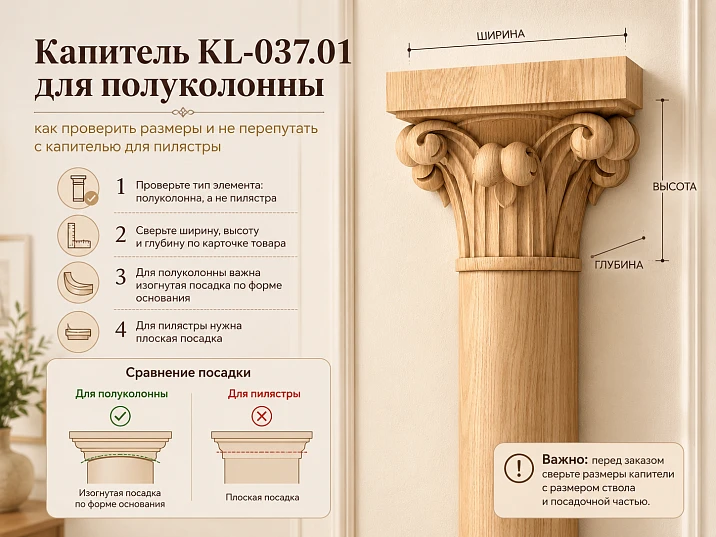
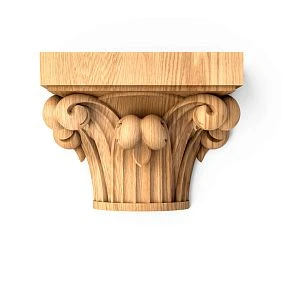
The estimate says: "pilaster 100 mm wide." In the catalog, there is a wooden capital with the number 100 in the table, the carving matches the style, the material can be selected, and the appearance is satisfactory. It seems that a solution has been found. But model KL-037.01 has a fundamental purpose: it is a capital for a half-column, not a universal finish for any vertical decorative element. The coincidence of one number does not yet prove that the product will fit correctly on a flat pilaster, adjoin the wall, and align with the body of the vertical element.
This is where an expensive mistake occurs. The buyer manages to choose the material, quantity, and quality of sanding, but checks the fit shape only after receiving it. The capital turns out to be more voluminous than expected, its back part does not match the plane, the side protrusion looks random, and the top does not connect with the cornice. You have to change the project, select another vertical element, or redo finished parts.
Before buy capital KL-037.01 for half-column, you need to check not only one width. The card presents four dimensional options with parameters A, B, C, and F, beech and oak are available, and the sanding quality can be chosen between "Standard" and "Prestige." The product is indicated as made to order. This means the decision should be made based on the drawing before placing the item, not after the capital is already included in the set.
The mistake begins with the word "pilaster" in the estimate
In a real project, names are often shortened. The designer writes "pilaster," the craftsman says "column by the wall," the purchaser looks for "capital 100 mm," and the client sees only a beautiful carved detail. While the project exists at the sketch level, these words seem to denote the same thing. But when purchasing, the difference becomes constructive.
A flat pilaster is located on the surface of a wall or furniture facade as a rectangular vertical strip. A half-column protrudes forward with a volumetric part. They differ in body shape, depth, line of attachment to the base, and the nature of the upper termination. The capital must continue the geometry of the element on which it is installed.
Therefore, the entry "capital 100 mm" is dangerous for three reasons at once:
-
it is unclear which vertical element it refers to;
-
it is not specified which specific dimension letter equals 100 mm;
-
the rear shape and seating zone are not confirmed.
A competent specification begins with the purpose: "capital for half-column KL-037.01." Only then are the specific dimension line, material, sanding, and quantity added.




Pilaster and half-column are similar only from afar
Architectural decor often follows one logic: base at the bottom, vertical body in the middle, capital at the top. Because of this common scheme, the buyer thinks the upper parts are interchangeable. But the same compositional role does not mean the same shape.
Our factory also produces:
The pilaster works with a plane
A pilaster reads as a vertical projection or an applied rectangular element. Its front part can be smooth, fluted, carved, or paneled, but the basic geometry remains flat. The top termination should usually fit confidently against the wall or facade and continue the rectangular body.
Get Consultation
A semi-column works with volume
A semi-column is perceived as part of a round column connected to the wall. Its front surface protrudes, and the side lines recede toward the base plane. The capital for such a form must account for the volume of the body, not just its visible width from the front.
Why the difference is especially noticeable at the capital
The body of a pilaster can be relatively calm, but the capital always expands the top. Ornament, transitions, and projections are concentrated on it. If the seating is chosen incorrectly, it is the upper part that first reveals the error: a gap, a step, excessive projection, or a mismatch with the cornice appears.
| Criterion | Flat pilaster | Semi-column | What to check at the capital |
|---|---|---|---|
| Body shape | Predominantly rectangular and flat | Voluminous, protruding from the wall | Does the back side repeat the geometry of the body |
| Adjoining the wall | Along the wide plane | Along the side or rear zones of the structure | Are there any gaps or accidental protrusions |
| Frontal perception | Vertical stripe | Column fragment | Does the frontal scale correspond |
| Depth | Usually associated with the thickness of the overlay element | Associated with the radius or volume of the half-column | Does the capital interfere with passage and adjacent parts |
| Top finish | Consistent with the flat body | Consistent with the volumetric form | Do the fit, width, and overhang match |
| Selection by a single digit | Insufficient | Insufficient | A full drawing is needed |
If the project has not yet decided between these two types, first open the section where you can buy wooden pilasters and half-columns, compare shapes and choose the correct body. The capital is selected after this decision.
What does the phrase "capital for a half-column" mean
The card name is not a decorative description or a style recommendation. It indicates the structural purpose. KL-037.01 was designed as the upper part for a volumetric wall-attached element.
This leads to practical conclusions:
-
compatibility cannot be assessed only by a front photo;
-
you need to see the top, bottom, or rear view;
-
the seating shape must be determined;
-
the dimensions of the half-column body are compared with all parameters of the capital;
-
the side and frontal projections are checked separately;
-
The connection to the cornice or top panel is decided in the drawing;
-
The word "half-column" must remain in the specification and the invoice.
The buyer sometimes reasons like this: "If the capital is wider than the pilaster and covers it from above, then everything is fine." But the capital is not just a decorative visor. Its lower part should logically continue the vertical. When the shape does not match, even high-quality carving looks attached to a random base.
Four sizes of KL-037.01: the table must be read in full
The KL-037.01 card contains four dimension rows.
| Option | A, mm | B, mm | C, mm | F, mm |
| 1 | 80 | 100 | 50 | 26 |
| 2 | 100 | 125 | 63 | 33 |
| 3 | 120 | 150 | 75 | 39 |
| 4 | 144 | 180 | 90 | 47 |
The most common mistake is to take one number from a row and compare it with the width of the pilaster. For example, the project specifies a vertical of 100 mm. In the table, 100 mm appears in two places at once: B for the first option and A for the second. Without a drawing, it is impossible to honestly decide which one refers to the required part.
The letters A, B, C, and F only make sense together with the product's graphic diagram. You cannot habitually assign A as width, B as height, C as depth, and F as seating if the card or drawing does not explicitly show this. The order of letters for different products may describe different sections.
Before purchasing, you need to download the KL-037.01 drawing or request it from the manager and mark each dimension line on it. After that, the numbers turn from an abstract table into the real boundaries of the product.
Why the 100 mm match proves nothing
Consider a typical situation. A flat pilaster has a frontal width of 100 mm. The buyer sees the KL-037.01 option with A = 100 mm and selects it. Three problems are possible.
The fit did not match, but another dimension did
The number 100 may refer to a part that does not come into contact with the body. Then the capital will be wider or narrower than expected at the installation point.
The frontal width matched, but the depth did not
The pilaster is flat, but the capital is designed for a volumetric half-column. From the front, the composition may look almost acceptable, but from the side, there will be extra protrusion or a gap.
The expansion of the capital was not taken into account
The capital is usually larger than the body of the vertical element. This is a normal architectural technique, but the size of the expansion must be coordinated. Too small a protrusion looks cramped, too large looks heavy and random.
One number helps find the right row, but does not complete the selection. A full check requires overlaying the capital drawing onto the half-column section and onto the full composition layout.
What to measure on the vertical element before opening the card
Do not start with choosing the capital. First, gather data about the body it completes.
Frontal width
The visible front part is measured. For a half-column, one width is not enough, but it is needed for scale.
Projection depth from the wall
This dimension shows how far the vertical element extends into the room. The capital should not unexpectedly increase the projection to a level that obstructs passage, doors, or furniture.
Cross-section shape
Semicircle, segment, complex profile, rectangle — the shape determines the fit. A photo of the facade does not replace a top view.
Width of the wall attachment
For a wall-attached half-column, you need to know how the body connects to the plane. The back part of the capital must work with this line.
Body height
It does not directly determine the capital size, but it affects proportions. A small capital on a tall massive vertical will get lost, while a large one on a short post will overload the composition.
Top mark
You need to know what is above the capital: cornice, lintel, shelf, portal, ceiling line, or free wall. Without this, it is impossible to check the upper connection.
Adjacent constraints
Record the distance to the corner, door leaf, cabinet, window, outlet, molding, and passage. The carved capital is wider than the body, so side clearance is critical.
The drawing is more important than a beautiful frontal photo
The photograph shows the character of the carving and the overall look. The drawing answers whether the product can be installed in a specific location.
On drawing KL-037.01, you need to check:
-
where the wall plane runs;
-
which part of the product faces forward;
-
where the lower seating zone is located;
-
which lines correspond to A, B, C, and F;
-
how much wider the capital is than the body;
-
how far it protrudes forward;
-
what its total height is;
-
is there an internal recess or a complex back shape;
-
how the top surface connects with other elements;
-
whether the right and left capitals can be installed symmetrically.
It is convenient to print the drawing at a scale of 1:1 or make a cardboard template. Such a mock-up does not convey the carving, but it shows the volume. Hold it up to the installation site and look at it from the side. It is the side view that often destroys the false sense of compatibility.
In the drawings section, you can check dimensions A, B, C, and F before the selected option goes into production.
Back geometry: the part not visible in the interior decides everything
The buyer evaluates the front carving because it shapes the style. The master first looks at the back side. That's where the seating is.
If a capital is designed for a half-column, its back geometry may account for the volumetric profile of the body. On a flat pilaster, such a shape can create:
-
voids;
-
support points instead of full contact;
-
different overhang on the right and left;
-
a noticeable step;
-
difficulty in mounting;
-
the need to fabricate a transition piece.
One cannot assert in advance what exact back shape is made for KL-037.01 without looking at the drawing for a specific size. But the very designation "for half-column" obliges this shape to be checked.
Why trimming should not be the first solution
Sometimes after detecting an incompatibility, they suggest "filing down the back." This can disrupt the geometry, weaken the part, or affect the thread. The possibility of modification is assessed by the manufacturer or an experienced craftsman based on the drawing. You cannot buy a product expecting an unknown rework.
The transition platform also changes the composition
Theoretically, a transition can be designed between a flat pilaster and a three-dimensional capital. But then it becomes a separate part that affects height, depth, and style. It needs to be included in the drawing and estimate before ordering.
How to choose one of four options without guessing
The working algorithm does not look like "pilaster 100 mm — we take A = 100 mm," but rather like a sequential comparison.
Step 1. Determine the type of vertical element
If it is a flat pilaster, KL-037.01 is not selected automatically. First, open the capital catalog for comparison and look for a model with a suitable fit.
If it is a half-column, proceed to its cross-section.
Step 2. Obtain the body drawing
Do not limit yourself to the name and overall width. You need the front view, top view, and depth.
Step 3. Obtain drawing KL-037.01
Each dimension line is considered separately.
Step 4. Overlay seating zones
Compare not only the overall size, but also the shape.
Step 5. Check the overhang
Assess the lateral expansion and depth relative to the wall.
Step 6. Check the top
The capital must connect with the cornice, portal, or top panel without any accidental gap.
Step 7. Make a mockup
A full-size template quickly shows whether the composition has become too heavy.
Step 8. Only then select the row
Fix A, B, C, and F completely, without reducing to a single digit.
Selection table by scenario
| Situation | Can KL-037.01 be selected immediately | Next action |
| The project specifies a half-column with a confirmed cross-section | Can proceed to comparing drawings | Check all four parameters |
| The estimate only says "pilaster" | No | Clarify the type of vertical element |
| The vertical is completely flat | Should not be selected automatically | Open category of other capitals |
| One width matched | No | Check seating shape and depth |
| Only frontal visualization available | No | Get top view and section |
| Capital is installed in pairs | Selecting one size is not enough | Check mirroring and identical marks |
| A cornice passes above the capital | Additional check required | Approve the top connection |
| The passage is narrow | A mockup is needed | Check the maximum overhang into the room |
| The project is executed under enamel | Geometry is still checked first | Then select beech and primer |
| A transparent finish is planned | Material compatibility of the entire set is needed | Match the oak of the capital, body, and base |
When KL-037.01 really fits
The KL-037.01 capital can be confidently included in the project when all conditions are met:
-
the vertical element is indeed a semi-column;
-
a drawing of its cross-section has been obtained;
-
the seating area of the capital matches the body;
-
the selected row A, B, C, and F has been fully checked;
-
the side protrusion looks proportional;
-
the depth does not obstruct passage or opening;
-
the top is coordinated with the cornice or another detail;
-
the capital's material matches the concept of the set;
-
grinding is selected for further finishing;
-
quantity is calculated for all vertical elements;
-
order is placed with full article number KL-037.01.
For such a project you can buy a half-column made of oak or beech after matching dimensions, and then connect it with the selected capital, base, and top profile.
When you need to open the catalog of other capitals
KL-037.01 is not a bad choice. It becomes incorrect only when its purpose does not match the project.
Another model should be sought if:
-
the vertical is completely flat;
-
finishing is required specifically for the pilaster;
-
the mounting part does not match;
-
depth is too great;
-
side offset overlaps the adjacent element;
-
the Gothic carving style is not suitable;
-
the top cannot be connected to the cornice;
-
a different scale is needed;
-
the project requires a ready-made element of a different shape;
-
the rework of the rear part is not confirmed.
In the category you can view all dimensions of wooden capitals and compare models by purpose, not just by numbers. For a flat vertical element, it is first useful buy a flat pilaster for furniture after choosing the appropriate form, and only then look for a compatible top part.
KL-037.01 and KL-037: the dot in the article number changes the product
The catalog contains a separate card for KL-037. This is not an abbreviated spelling of KL-037.01 and not the same item without extra characters.
An error in the specification looks innocent:
-
KL-037.01 was required;
-
KL-037 was written down;
-
the buyer opened a different card;
-
the dimensions and purpose no longer matched.
Therefore, the article number must be copied in full. Before ordering, it is useful to compare KL-037.01 and KL-037 according to the drawings. The comparison should concern the actual geometry, not just the ornament in the photograph.
How to write an article number without ambiguity
Correct:
Capital on a half-column KL-037.01.
Not enough:
Capital KL-037.
Danger:
Gothic capital 120 mm.
The last formulation contains neither the exact model nor the full dimension line.
Gothic carving: the style should continue, not emerge as a single detail
KL-037.01 belongs to the expressive decorative group. The Gothic character is read through the vertical rhythm, carved transitions, and architectural density of the form. Such a capital rarely looks convincing completely on its own.
It can become part of:
-
door portal;
-
library design;
-
fireplace composition;
-
niches;
-
furniture portal;
-
symmetrical wall with half-columns;
-
decorative framing of a cabinet.
But style should not replace structural verification. Even if the capital perfectly matches the ornament, incorrect seating will ruin the impression.
For a cohesive composition, you can buy wooden decor in the Gothic style and match the capital with rosettes, overlays, and brackets from the same collection. Collection affiliation helps align the decorative language, but the size compatibility of each piece is checked separately.
Where a gothic capital looks appropriate
Door portal
A pair of half-columns can frame an opening, and capitals can support the upper part. Here, the passage, door swing, position of the casing, and height of the lintel are critical.
Built-in library
Vertical elements divide sections, and capitals create an architectural finish. The depth of the detail should not interfere with doors, lighting, or shelves.
Fireplace portal
The capital is located close to the top shelf and other profiles. Precise joining is required, and materials and application conditions must match the project.
Furniture Portal
A tall cabinet or wardrobe system gets an expressive frame. The scale of KL-037.01 is checked on the full facade, not on a separate photograph.
Decorative niche
Half-columns can frame a recess. Here, the side abutment to the wall and the symmetry of the pair are especially noticeable.
To find stylistically consistent options, you can buy a gothic wooden capital, comparing not only the ornament but also the purpose of each model.
Beech or oak: the material ties the entire portal together
Card KL-037.01 offers beech and oak. The choice of wood species should not be limited to the words "lighter" or "more expensive." The capital is included in the set, so its wood must match the half-column, base, cornice, and adjacent decor.
Beech for uniform staining
Beech is often chosen for projects under opaque enamel. Its surface allows attention to focus on the relief rather than on pronounced texture. But the result depends on preparation, primer, and painting technology.
You can order KL-037.01 in beech after beech is confirmed for all visible parts of the composition.
Oak for tinting and transparent finish
Oak is chosen when the texture should remain noticeable. On the carved capital, fibers and shadows work together. That is why the shade cannot be assessed on screen — a sample is required.
Before ordering, you can find out the price of oak KL-037.01, but the cost should be compared within the full set, not separately from the half-column body and base.
Why wood species cannot be mixed randomly
Even under dense enamel, different materials may require different preparation. Under a transparent coating, the mismatch is immediately visible. If the capital is oak, the half-column is beech, and the base is made of a third material, the composition requires a deliberate finishing solution.
In the specification, the material is repeated in each line. The general phrase "the entire portal is made of oak" is useful but does not replace checking individual items.
"Standard" or "Prestige": the choice depends on viewing distance and finish
The sanding quality of KL-037.01 is available in "Standard" and "Prestige" options. These are not two colors and not two ready-made finishes.
"Standard" for projects with further preparation
This option can be considered when the workshop plans its own surface preparation before coating. The amount of subsequent work should be assessed in advance.
"Prestige" for more detailed hand sanding
A carved capital has many transitions. Upon close inspection, the condition of recesses and edges is especially noticeable. The "Prestige" option is appropriate when more thorough hand sanding is important.
But sanding quality does not eliminate the need for a test coat and does not turn the product into a ready-painted item.
Installation height also influences the decision
The capital above a high portal is viewed from a distance and from below. Small surface details are perceived differently than on a furniture piece at eye level. However, one cannot automatically assume that preparation is unimportant for high installation: side lighting can emphasize carving and irregularities.
Four size options and visual scale
The size is chosen based on fit, but after technical verification, proportions need to be assessed.
| A × B × C × F, mm | Visual perception | Where to check especially carefully |
| 80 × 100 × 50 × 26 | The most compact of the four options | Small portals, narrow verticals, proximity of adjacent details |
| 100 × 125 × 63 × 33 | Medium compact scale | Furniture and interior compositions of medium width |
| 120 × 150 × 75 × 39 | More prominent architectural completion | High portals, paired half-columns, junction with cornice |
| 144 × 180 × 90 × 47 | The largest variant in the table | Wide verticals, passage, side projection, composition load |
The formulations in the right column describe only the principle of visual inspection. They do not assign a specific model to a specific room without a drawing.
Increasing all parameters changes not only the width. The capital becomes deeper and more expressive. Therefore, you cannot choose a large variant "for solidity" if the body of the half-column and the surrounding space are not designed for such volume.
Full-size mockup: the most honest way to see the projection
For the mockup, you need cardboard, a ruler, and a drawing. It is not necessary to reproduce the carving. It is enough to build the main boundaries.
Front mockup
Shows the width, height, and ratio to the body.
Side mockup
Shows the projection into the room. This is where it becomes clear whether the capital interferes with the door, cabinet, or passage.
Top layout
Helps to see the connection with the wall plane and the shape of the junction.
Apply the template at the design height. Do not evaluate the large capital while holding the cardboard at chest level if it will be under the ceiling in the interior. Perspective changes perception.
For a complex composition, you can order a half-column project with KL-037.01 and provide the specialist with the actual dimensions of the room.
Paired installation: two capitals must be one solution
A portal is rarely built on a single half-column. A pair increases precision requirements.
Check:
-
Are the vertical elements identical;
-
Do the top elevations match;
-
Is the projection from the wall the same;
-
Is there no difference in the junction;
-
Is the ornament oriented the same way;
-
Is one size selected;
-
whether the material matches;
-
Is the surface prepared identically;
-
Do the adjacent constraints not differ;
-
does the order include two pieces of one item.
The phrase "order two capitals" is still insufficient. Need to order a pair of capitals for the portal with a full dimension line and confirmed compatibility.
Portal at the door: checking movement, not just a static image
In the visualization, the door is closed, the capital looks impressive. In reality, the leaf opens, the handle approaches the wall, a person passes nearby.
Before ordering, check:
-
the trajectory of the door leaf;
-
handle position;
-
the protrusion of the casing;
-
the minimum passage width;
-
the distance to the capital;
-
access to the switch;
-
possibility of installing the cornice;
-
position of the ceiling plinth.
A large capital may not touch the door, but visually narrow the passage. The mockup helps to assess this before production.
Built-in wardrobe: depth matters more than frontal beauty
In the furniture portal KL-037.01 can complete vertical half-columns on the sides of the wardrobe. But nearby there are facades, handles, cornice, and side walls.
Pay special attention to checking:
-
opening of the outer doors;
-
the gap to the wall;
-
hinge position;
-
access to the upper cabinets;
-
depth of the decorative crown;
-
light from the backlight;
-
symmetry relative to the body.
If the vertical on the cabinet is a flat applied pilaster, you cannot automatically transfer the capital for a half-column onto it. In such a case, it is better to order pilasters for a door portal or furniture framing and select the top according to a compatible shape.
Fireplace portal: a decorative idea requires a technical project
A carved capital is organically perceived in a fireplace composition, but here one cannot limit oneself to aesthetics. The structure, base material, and conditions near the heat source are determined by the project.
The article cannot assign KL-037.01 to a specific fireplace without technical data. The buyer needs to check:
-
type of structure;
-
distances to heated zones;
-
base material;
-
finishing requirements;
-
mounting method;
-
compatibility with the top shelf;
-
possibility of maintenance.
The capital is chosen only after the decorative and technical parts are agreed upon.
Niche and library: carving needs air
In a niche, the capital may end up too close to a side wall or shelf. A deep shadow will hide the ornament, and a protrusion will create a feeling of crampedness.
For the library, check whether the detail blocks:
-
facades;
-
glass doors;
-
lighting;
-
top shelf;
-
access to books;
-
ventilation gaps.
An appropriate scale is not the maximum size that physically fits. Visual space should remain between the capital and adjacent details.
What to buy together with KL-037.01
The capital does not form a portal by itself. It is purchased as part of a set.
| Element | Why it's needed | What to check |
| Half-column | Main vertical body | Section, depth, and placement of the capital |
| Base | Completes the vertical from below | Material, scale, and shape of the body |
| Upper cornice or lintel | Connects the capitals into a composition | Height, projection, and line of junction |
| Second capital | Needed for a symmetrical portal | Full match of size and finish |
| Sockets and covers | Support Gothic style | Scale and free space |
| Installation materials | Used according to the selected technology | Base, wood species, and finish |
| Materials for painting | Form the finish | Compatibility and test coat |
| Drawing | Confirms dimensions | All A, B, C and F |
| Design project | Connects parts | Full dimensions of the room and facades |
In the catalog you can select a body for the KL-037.01 capitaland then check the base and top elements. Formal belonging to the same product group does not replace comparison of drawings.
Mounting adhesive cannot be selected before the base.
The materials section presents mounting adhesive, but the installation method depends on the base, size, weight, construction, and finish. It cannot be stated that adhesive fixation alone is sufficient for any KL-037.01 option.
Before purchasing materials, determine:
-
what the capital is attached to;
-
what the base is made of;
-
whether surfaces are painted;
-
whether there is hidden mechanical fixation;
-
whether temporary pressing is needed;
-
how the capital connects to the half-column;
-
Does the selected finish allow contact with glue?
After agreeing on the technology, you can Buy mounting glue for the capital and other consumables.
Finishing before or after installation
There is no universal order. The decision depends on the project.
Finishing before installation
Convenient for access to the thread and rear areas. But after installation, touch-up of joints and correction of mounting marks may be needed.
Finishing after installation
Helps achieve a uniform color of the composition. But working in corners and under the cornice is more difficult.
Combined order
Part of the preparation and base layers are done in advance, finishing after assembly. This option requires a technological map.
For beech, it is possible order finishing materials after a trial coating. For oak, the acceptable composition is also chosen based on the desired effect and compatibility.
How to write KL-037.01 in the specification
A good line should exclude three substitutions: a different article number, a different size, and a different purpose.
Example of a detailed entry:
Capital KL-037.01 for a half-column, size A × B × C × F — 120 × 150 × 75 × 39 mm, beech, sanding quality "Prestige", for further painting, 2 pcs.; compatibility with the half-column body confirmed by drawing.
What is recorded here:
-
exact article number;
-
the purpose;
-
the entire size line;
-
material;
-
polishing;
-
quantity;
-
future finishing;
-
the fact of compatibility verification.
Incorrect entry:
Capital KL-037, 120 mm, 2 pcs.
It leads to another card, does not show other sizes, and says nothing about the half-column.
What to check in the invoice before payment
Match the invoice with the specification line by line.
-
KL-037.01, not KL-037;
-
selected rows A, B, C, and F;
-
beech or oak;
-
"Standard" or "Prestige";
-
quantity;
-
made-to-order status;
-
associated materials;
-
delivery;
-
receiving city;
-
absence of accidental replacement with a similar model.
The current price can be seen in the card of the selected option. The article query "KL-037.01 price" should not be separated from size, material, and finish: the cost of a specific item is determined by the selected modification.
Made-to-order changes the sequence of actions
In the current card, KL-037.01 options are listed as made-to-order. This means the check cannot be postponed to the receiving stage.
Before launching the order, the following must be approved:
-
type of vertical element;
-
drawing of the half-column;
-
capital dimension line;
-
material;
-
polishing;
-
quantity;
-
finish;
-
position in the project;
-
connection with the top;
-
Delivery.
The phrase "we'll see on site" is dangerous precisely for a custom-made product. On site, you can clarify the installation joint, but you cannot turn a flat pilaster into a compatible half-column without a new design solution.
Availability in Moscow and Saint Petersburg: do not confuse with the status of a specific model
The website has filters for capitals available in different cities. But the availability of a category does not mean that any size of KL-037.01 is in stock. The card of this model indicates production to order.
For a buyer who values a quick turnaround, it is useful to:
-
compare available models by purpose;
-
do not substitute KL-037.01 with a random capital just for speed;
-
clarify the current production times for the selected modification.
Warehouse item
Error 5. Chose the largest size "for solidity"
The capital overloaded the vertical and visually narrowed the passage.
How to fix: make a full-size mockup and evaluate the detail at the design height.
Error 6. Didn't check the cornice
The top part didn't connect with the lintel, and a random step appeared between the elements.
How to fix: build a common section of the portal, not a separate drawing of the capital.
Error 7. Ordered the capital separately from the body
Later it turned out that the half-column section is different.
How to fix: check the set using one scheme and one version of the project.
Error 8. Mixed beech and oak
Parts of the portal started to differ after finishing.
How to fix: specify the wood species in each line of the order.
Error 9. "Prestige" was mistaken for a ready-made coating
Finishing materials were not ordered, but the client expected a finished color.
How to fix: separate the quality of sanding and finishing.
Mistake 10. Planned to redo the back side
After receiving, the rework turned out to be more complex than expected and affected the mounting geometry.
How to fix: approve any changes before production.
Mistake 11. Did not make a paired layout
The right and left capitals ended up at different heights or got unequal projection.
How to fix: check both sides on the same drawing.
Mistake 12. Bought the adhesive in advance
The composition did not suit the substrate or the chosen finish.
How to fix: first approve the installation technology.
Error 13. The check was left to the installers
The installers received an already manufactured incompatible set and were forced to find a solution on site.
How to fix: assign a person responsible for compatibility before ordering.
Error 14. Only the width of the passage was considered
The door trajectory, handle position, and side overhang of the capital were not checked.
How to fix: test the movement on a mock-up.
Error 15. The capital was chosen by style, not by fit
The ornament matched, the geometry did not.
How to fix: the structure is checked before aesthetics.
Error 16. The dimension string was not fully rewritten
In the specification, only "120 mm" remains, although the option 120 × 150 × 75 × 39 mm was selected.
How to fix: transfer all four parameters without abbreviations.
Error 17. The drawing was changed after the order
The half-column became deeper or narrower, but the capital remained the same.
How to fix: record the drawing version number in the specification.
Error 18. The location of the finishing layer was not checked
After wall cladding or painting, the actual contact plane shifted.
How to fix: specify final dimensions, not just structural ones.
Error 19. Paired parts were ordered at different times
The selection of wood and control of identical preparation became more complicated.
How to fix: submit the set as one request when possible.
Error 20. The warehouse model was accepted as a replacement without approval.
A similar capital was available faster, but differed in purpose or shape.
How to fix: re-check any replacement against the drawings.
Who should confirm compatibility
Different specialists are involved in the project, and each has their own area of control. The error appears when everyone is sure that someone else will check.
Designer
Defines the composition, scale, material, and style. In the drawing, it must clearly indicate whether it is a pilaster or a half-column, not use a generic word for any vertical.
Designer or technologist
Checks the cross-section, fit, connection, and installation feasibility. This is where A, B, C, and F are compared with the body.
Estimator
Enters the full article number, size line, material, finish, and quantity. The entry "capitel 120 mm" should be returned for clarification.
Purchaser
Matches the invoice with the specification and does not replace the model without approval. He checks that KL-037.01 has not turned into KL-037.
Production
Assesses the feasibility of assembly, preparation, and finishing. If a transition part is needed, it must appear in the project in advance.
Installer
Confirms access, base, and actual position, but should not be the first to determine the purpose of the product on site.
Customer
Approves the appearance and budget, but the decision must be shown to him on a clear mockup. The customer cannot be required to read letter sizes without a diagram.
A good process does not shift all responsibility onto one person. Checks are recorded in the drawing, list, and specification.
Project version: an inconspicuous line that saves the order
The capital may be selected correctly, but according to an outdated drawing. For example, after approval, the designer increased the width of the portal, changed the depth of the half-column, or raised the cornice. The old dimension line remained in the estimate.
It is useful to specify in the documents:
-
drawing number;
-
version date;
-
author of the change;
-
status "approved";
-
link to the sheet with the section;
-
date of capital verification.
With any change to the vertical body, KL-037.01 compatibility is checked anew. It cannot be assumed that a minor adjustment to the half-column does not affect the fit.
Project control card
Before payment, fill out a short table.
| Question | Project response |
| Vertical element | Half-column / pilaster |
| Capital article | KL-037.01 |
| Size | A × B × C × F |
| Drawing received | Yes / no |
| Drawing version | Number and date |
| Seating matches | Confirmed / not confirmed |
| Material | Beech / Oak |
| Sanding | "Standard" / "Prestige" |
| Finishing | Specify system |
| Quantity | ___ pcs. |
| Pair installation | Yes / no |
| Upper connection | Approved / no |
| Installation technology | Approved / no |
| Delivery | City and method |
| Responsible for verification | Name / position |
If the "landing matches" line has no confirmation, it's too early to order.
On-site check before production starts
Even an accurate drawing may not reflect the actual wall. Before ordering, it's useful to compare the project with the room.
Check:
-
wall verticality;
-
actual angle;
-
thickness of future finishing;
-
position of the baseboard;
-
ceiling height;
-
distance to the casing;
-
location of switches and sockets;
-
furniture protrusion;
-
possibility to bring in and install large elements.
The capital should not be used as a way to hide all construction deviations. If the wall is uneven, first determine the installation plane and the structure of the base layer.
Rough and finish dimensions
The rough wall may become thicker after panels, plaster, or cladding. The half-column and capital must be tied to the finish plane. Otherwise, the calculated projection will change after finishing is completed.
Room corner
If the portal is near an internal corner, the side projection of the capital is checked against the actual distance. A large option may physically fit on the drawing but hit the adjacent wall after finishing installation.
How to check the composition without expensive visualization
A photorealistic render is useful but not mandatory for initial assessment. You can make a full-scale marking with painter's tape.
-
Mark the width of the half-column.
-
Construct the outer boundaries of the capital.
-
Mark the top elevation.
-
Show the cornice or lintel.
-
Mark the door edge and the handle trajectory.
-
Stand at the main viewing points.
-
Compare the compact and large versions.
The tape shows the frontal composition. For depth, add a cardboard profile. Such a mockup is especially useful when the client chooses between 120 × 150 × 75 × 39 mm and 144 × 180 × 90 × 47 mm: numbers are hard to imagine, but the real outline is visible immediately.
How to buy KL-037.01 without redesigning the project
First, name the vertical correctly
A half-column and a pilaster are not interchangeable. The documents must contain the exact name.
Then get two drawings
The first is of the body, the second is of the capital. Without them, the comparison remains a visual guess.
Match all four parameters
Do not shorten the line to a single size. Check where A, B, C, and F pass.
Check the volume in the room
Use the layout from the front, side, and top.
Align the top
The cornice and lintel should continue the capital without an accidental gap.
Choose the material
Beech or oak for the entire visible set.
Determine the sanding
"Standard" or "Prestige" considering further preparation.
Calculate the quantity
By the number of half-columns, including additional elements in niches and cabinets.
Add accompanying materials
Only after technology approval.
Check the invoice
Article number, dimensions, material, finishing, quantity, and order status.
Clarify manufacturing and delivery
KL-037.01 is listed as a custom item, so timelines and conditions need to be verified before payment.
After all stages, you can purchase KL-037.01 with delivery in the configuration that specifically applies to your project.
Frequently asked questions about the KL-037.01 capital
Is KL-037.01 intended for a pilaster or a half-column?
The card directly names KL-037.01 as a capital for a half-column. This is the basic purpose of the product. For a flat pilaster, the model cannot be selected automatically, even if one digit in the table matches the width of the vertical element. First, you need to check the rear geometry, the mounting area, and the full set of dimensions according to the drawing.
Can KL-037.01 be installed on a flat pilaster?
Only after separate project confirmation. A transition piece or design modification may be required, but the possibility of such adaptation cannot be considered guaranteed. If the vertical element is truly flat, it is safer to open the category where you can order a capital for a column or pilaster, and select a model with a compatible shape.
How does a half-column differ from a pilaster?
A half-column protrudes from the wall with a volumetric part and visually resembles half of a round column. A pilaster works as a flat rectangular vertical element. They differ in cross-section, depth, and the line of attachment to the wall. Therefore, the top finishes cannot be considered interchangeable solely based on the same width.
What sizes are available for KL-037.01?
The card confirms four size lines: 80 × 100 × 50 × 26 mm; 100 × 125 × 63 × 33 mm; 120 × 150 × 75 × 39 mm; 144 × 180 × 90 × 47 mm. The values refer to parameters A, B, C, and F. The line should be selected only after matching the letters with the lines on the drawing.
What do A, B, C, and F mean?
Their exact meaning is determined by the graphic scheme KL-037.01. You cannot assign size names to letters out of habit or by order in the table. Before ordering, open the drawing, find the dimension arrows, and note which part of the product corresponds to each letter.
Why can't you call A the width and C the depth without checking?
Letter designations are not a universal standard for all cards. For different products, they may refer to different areas. Incorrect interpretation creates a false match and leads to choosing an unsuitable option.
Which option should be chosen for a half-column with a width of 100 mm?
One frontal width is not enough. The cross-section shape, depth, width of the wall attachment, and seating area are needed. The number 100 mm appears in table KL-037.01 in different positions, so it does not indicate a single correct option.
Do I need to know the depth of the half-column?
Yes. The capital expands not only at the front. Its volume must align with the protrusion of the vertical body and not interfere with passage, doors, furniture, or adjacent elements. The depth is checked in the top view or cross-section.
Is a front photo of the capital enough?
No. The frontal view shows the ornament and scale but hides the seating. A drawing, top view, bottom view, or rear view is needed. For a particularly complex project, it is useful to request additional photos of the rear part.
Do you need to make a full-size mockup?
For a small open space, a mockup is desirable, but for a narrow passage, doorway, or large option, it is practically necessary. A cardboard model shows the projection and proportions better than numbers on a screen.
Can you choose the largest option for a tall room?
Room height is not the only criterion. A large capital must match the body of the half-column and leave enough space to walls, door, and cornice. The size 144 × 180 × 90 × 47 mm cannot be assigned just because the ceiling is high.
Which capital looks better on a narrow half-column?
The one whose fit and proportions are confirmed by the drawing. The compactness of the first option does not mean it suits every narrow vertical. First, check the cross-section, then the visual scale.
What materials is KL-037.01 made from?
Beech and oak are confirmed. The material is chosen together with the half-column, base, and adjacent decor so that the entire portal has a consistent surface and the same finishing logic.
What to choose for opaque enamel?
Beech is often considered for uniform painting, where the main accent is created by the carved relief. But this does not cancel the checks of preparation, priming, and test painting. The specific coating system is determined by the workshop's technology.
What to choose for tinting or oil?
Oak is suitable for a project where visible wood texture should be preserved. A test on a real sample is done before the entire batch, because carving recesses may perceive color differently than a flat surface.
Can an oak capital and a beech half-column be mixed?
Technical combination is possible only as a deliberate design decision. Under transparent finish, the difference will be noticeable. Under enamel, materials may also require different preparation. Random mixing of wood species complicates finishing and quality control.
What does the 'Standard' sanding quality mean?
This is one of the surface preparation options. It does not mean finished painting and does not describe color. The scope of further work needs to be clarified for a specific project and chosen finishing system.
How does "Prestige" differ from "Standard"?
"Prestige" involves more detailed hand sanding. For a carved capital, this is important in recesses and at ornament transitions. However, even this option requires verification before applying the final coating.
Are KL-037 and KL-037.01 the same product?
No. These are separate entries. The dot and digits in the article number matter. In the specification, KL-037.01 must be written in full and the purpose "for half-column" added.
Can KL-037.01 be replaced with KL-037?
Only after comparing drawings, dimensions, and purpose. Similar ornament or a common collection name does not confirm compatibility. Any replacement must be returned to the designer and engineer for approval.
Is KL-037.01 suitable for a Gothic portal?
Stylistically, the model belongs to the Gothic direction and can be part of such a composition. However, the portal must be built on compatible half-columns. For a complete selection, you can order a capital from the "Gothic" collection and compare it with other elements of the collection.
Can it be used in a classic interior?
The possibility depends on the overall composition. Gothic carving is expressive and requires support in adjacent elements. If the rest of the interior is calm and minimalist, the capital may look alien. The style is assessed on the full facade or wall.
Is KL-037.01 suitable for a door portal?
Yes, when the portal actually includes half-columns of a suitable cross-section. Additionally, the width of the passage, the trajectory of the door leaf, the handle, the casing, the ceiling plinth, and the upper lintel are checked.
Can the capital be installed on a cabinet?
It can be used in a furniture portal with voluminous half-columns. If the side verticals of the cabinet are flat overlays, a different capital or a confirmed transition node will be required.
Is the model suitable for a library?
It can complete half-columns of the built-in library. Need to check that the protrusion does not interfere with facades, shelves, lighting, and opening of glass doors. The carving also requires sufficient visual space.
Can KL-037.01 be used in a niche?
Yes, if the fit and dimensions match. In a narrow niche, side clearances and lighting are especially important: a too-large capital may overlap the wall and lose the readability of the ornament.
Will the capital suit a fireplace portal?
Only after technical design. Need to consider the material of the structure, location relative to heating zones, installation method, and finishing requirements. Decorative compatibility does not replace technical constraints.
Can the capital be trimmed from the back for a flat pilaster?
The possibility of such modification must be confirmed by the manufacturer or a craftsman based on a drawing. Trimming may change the fit, weaken the part, or affect the ornament. Buying the product with the expectation of unknown rework is risky.
Can an adapter be made between the pilaster and KL-037.01?
Theoretically, a separate transition piece can be designed, but it will change the height, depth, and appearance of the assembly. Such an element needs to be drawn, material selected, and included in the estimate. This is no longer a standard installation of a capital on a flat pilaster.
How to check if the capital interferes with the passage?
Build a maximum contour on the wall and add a cardboard side profile. Then walk through the opening, open the door, and check the handle. Evaluate at the actual installation height.
Do I need to consider the ceiling cornice?
Yes. The top of the capital may connect with the cornice or be located next to it. You need to check the height, projection, and transition line so that the parts do not collide or form an accidental gap.
What to do if the wall is uneven?
First, determine the finished mounting plane and the method of preparing the base. The capital should not compensate for a construction deviation with an accidental gap. If necessary, design a sub-base.
Which wall size to consider — rough or finished?
For placing decorative elements, use the finished size after plastering, panels, painting, or other finishing. The thickness of the future layer may change the depth and the junction line.
How many capitals are needed for a portal?
The quantity equals the number of half-columns that this model completes. For a symmetrical portal, a pair is usually counted, but in a complex library or niche, there may be more verticals.
Can I order just one capital as a sample?
Order terms should be clarified in the product card or with the manager. To check the scale, a full-size template and drawing are often sufficient. If a real sample is needed, determine in advance how it will be used after approval.
Why is it better to order a pair at the same time?
This makes it easier to control one size line, material, polishing quality, and visual consistency with natural wood. Separate ordering increases the risk of documentation errors.
Is the capital KL-037.01 in stock?
In the current product card, the options are listed as made to order. The current status and lead time should be clarified before payment. The availability of other capitals in stock does not guarantee the availability of the specific KL-037.01 modification.
Where can I see capitals in stock in Moscow?
The website has a separate filter for stock items. You can open the section that shows wooden capitals from the warehouse in Moscow, but each alternative needs to be checked for purpose and drawing.
Where can I see options in Saint Petersburg?
For Saint Petersburg, the section is available buy capital in stock in Saint Petersburg. It helps to see warehouse positions, but does not cancel compatibility checks.
Can I order KL-037.01 without a half-column drawing?
It is possible to place the item, but the risk remains with the project. Without a section of the vertical body, it is impossible to prove correct seating. For a custom product, such a risk is especially undesirable.
How to check the seating part?
Compare the top view or section of the capital with the section of the half-column. Mark the wall plane, front, attachment points, and maximum overhang. A frontal photo is not enough.
How to correctly write the size in the request?
Copy the entire line: for example, A × B × C × F — 120 × 150 × 75 × 39 mm. Next to it, specify the material, polishing, quantity, and purpose "for half-column".
How to find out the price of KL-037.01?
The current price is checked in the card of the specific modification. The price is linked to the selected size, material, and polishing quality, so a request without this data remains incomplete.
What glue is needed for KL-037.01?
The composition is selected based on the base material, wood, finish, and the chosen fastening system. A universal recommendation cannot be given without a project. First, a technologist confirms the installation method, then materials are purchased.
Can a capital be attached only with glue?
This depends on the size, weight, base, and installation scheme. The material card does not confirm that glue is sufficient in every case. The possibility of mechanical fixation or combined installation must be determined by a specialist.
What should be ordered together with the capital?
Usually, a half-column, base, upper cornice or lintel, a second capital for a pair, decorative elements, and materials for installation and finishing are checked. The composition of the set depends on the project.
Where can I see other carved models?
You can buy a capital with carved ornament after comparing sizes, style, and purpose.
Where can I choose a Gothic set?
In the collection, you can select a capital, rosettes, and overlays from one collection. Matching style helps create a cohesive composition, but the dimensions of all parts are still checked separately.
Can I order a compatibility check?
For a complex portal, you can check the compatibility of the capital and the vertical element as part of the design process. This will require room dimensions, a drawing of the body, and composition requirements.
How is delivery of a custom capital organized?
First, the size, material, sanding, and quantity are fixed. Then you can calculate delivery of wooden capitals and agree on the city of receipt, packaging, and acceptance procedure.
What to check upon receipt?
Article number, full size range, material, finish, quantity, thread integrity, and back geometry. Before painting, a dry fitting on a half-column or template must be performed.
Can painting be started immediately after receipt?
No, first acceptance and fit check are carried out. After coating is applied, it is harder to record the original condition and correct an order error.
How do you know that the capital is chosen correctly?
The correct option matches the half-column in fit, has an agreed projection, does not interfere with neighboring objects, connects with the upper element, matches the material, and is fixed by the full line in the specification.
The capital is chosen by shape, not by a familiar number
KL-037.01 attracts with expressive carving and a clear size table. It is this clarity that can be deceptive. Four lines create the feeling that it is enough to find the matching width. But the capital is intended for a half-column, and therefore it must be compared with the volumetric body according to the drawing.
Before ordering, answer five questions:
-
Is the vertical truly a half-column?
-
What do A, B, C, and F mean on the diagram?
-
Does the mounting shape match?
-
Does the projection interfere with the passage, door, or cornice?
-
Are the material, sanding, and dimensions of the entire set the same?
If at least one answer is missing, it is too early to turn a beautiful card into a product item. First, you need to restore the logic of the assembly: body, capital, base, top finish, finishing, and installation. After such a check, Buy wooden capitals you can proceed not based on the impression from the photo, but on the exact purpose.
The STAVROS company allows you to go through this path consistently: view the card KL-037.01, compare wooden capitals, choose half-columns or flat pilasters, assemble Gothic decor, get drawings, order design, select materials for installation, and arrange delivery. This approach preserves the main value of the carved capital — it looks not like a separate beautiful thing, but like a natural completion of a properly designed vertical.