Article Contents:
- Wooden baguette K-017 under the shelf: which part of the portal is purchased
- "Croutons" 15×10 or 30×20 mm: choosing the scale under the top shelf
- Only at the front or extending to the sides: determining the outline before calculating meters
- Two side panels change the order: calculating K-017 by parts
- Finished length and material for manufacturing the part
- Why 1900 mm of remainder is not necessarily a reserve for the front strip
- Can I start with a short plank and then include it in the main set?
- What to do if the front strip is longer than two meters?
- Can I leave the return on only one side?
- Can returns be made from several short pieces?
- Is a photo of the portal enough to order two planks?
- Do I need to keep all remaining offcuts?
- Can a body made of another material and a wooden baguette be painted the same way?
- Will this scheme work if the electric fireplace is not turned on yet?
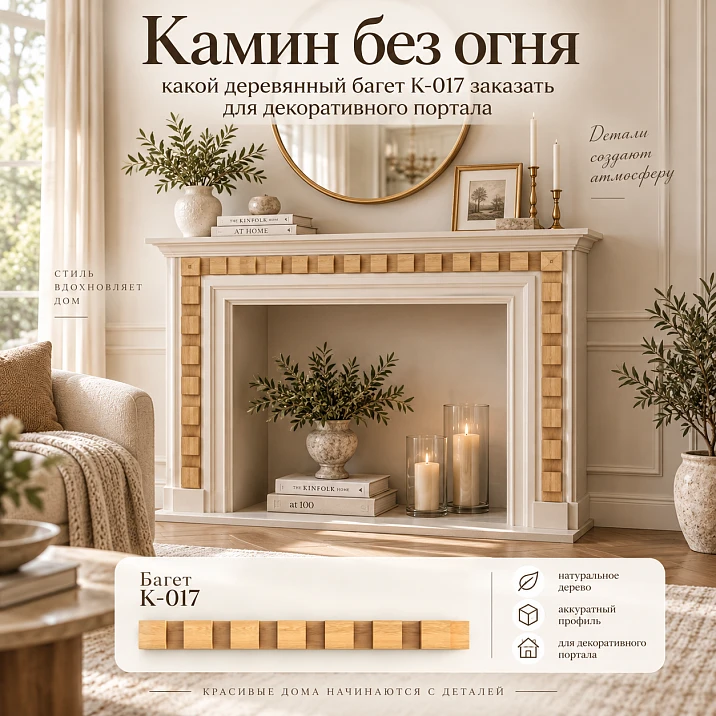
The wooden baguette K-017 for a decorative portal is chosen based on two decisions: how noticeable the strip under the top shelf should be and whether it will continue onto the side panels. After that, individual parts are calculated, not just the total length. For a conditional set consisting of a front strip of 1400 mm and two side sections of 350 mm each, one two-meter blank is clearly insufficient. Two is the initial lower order limit, which still needs to be checked against the cutting layout.
Let's imagine a home project: a portal with a top shelf, an empty niche, and calm side posts will appear against the wall. They want to finish it with a narrow geometric relief, without adding complex carving to every surface. This is an example for selection and calculation, not a description of a completed object.
Here, only a decorative portal without a firebox, heater, candles, or open flame is considered. The baguette is responsible for the decoration. The frame, stability of the entire structure, the shelf, and its fastenings remain separate tasks for the workshop. You cannot first order decor for a non-heated composition and then consider it prepared for heating equipment.
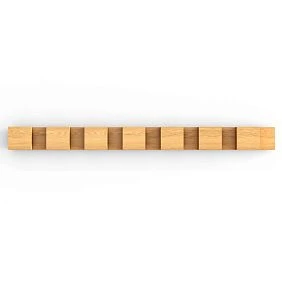
Wooden baguette K-017 under the shelf: which part of the portal is purchased
The upper part of the portal has several independent elements. The shelf forms a horizontal surface. The frame defines the shape and serves as the base for the intended connections. The decorative strip covers the selected area from the outside and creates a rhythm of pattern.
On the working layout, it is convenient to label them separately:
Top: shelf with its own fastening.
Under the shelf: K-017 strip on an agreed base.
Below: portal frame with niche and side posts.
Such a record does not allow the baguette to be discreetly integrated into the load-bearing scheme. It is not assigned as a shelf support, reinforcement for external corners, or a mounting point for a heavy mirror. Decorative proximity of parts does not mean that one should support the other.
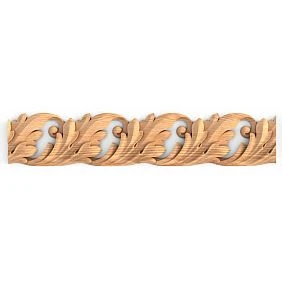
In the card, you can buy wooden baguette K-017 made of beech or oak. The manufacturer calls the pattern "checkers" or "crackers." Two cross-sections and two levels of sanding are available — "Standard" and "Prestige."
Below are prices per blank specifically as "Prestige," verified on September 6, 2026.
| Size A × C × L, mm | Beech | Oak |
|---|---|---|
| 15 × 10 × 300 | 200 ₽ | 270 ₽ |
| 15 × 10 × 2000 | 1 280 ₽ | 1 780 ₽ |
| 30 × 20 × 2000 | 2 310 ₽ | 3 750 ₽ |
Length 300 mm is only available for the narrow cross-section 15×10 mm. The variant 30×20×300 mm is not in the verified table. Therefore, the entry "large baguette, one long and two short strips" is not yet a correct order: first, existing product variants must be specified.




"Crackers" 15×10 or 30×20 mm: choosing the scale under the top shelf
Compare the two cross-sections on the same portal image. Otherwise, the larger profile on an enlarged fragment seems more convincing only because it takes up more screen space. Keep the cabinet and shelf dimensions, the position of the decorative strip, and the viewing point; change only the K-017 cross-section.
For a preliminary selection, make full-size strips indicating the dimensions of each variant in the chosen orientation. Paper helps visualize the width of the band but does not reproduce the protrusion and shadows of the relief. These are checked against a sample or a suitable three-dimensional mock-up. The dimensional mock-up should not depict a fictional "cracker" pitch as an exact product pattern.
On the layout, mark the bottom line of the shelf, the top and bottom of the baguette, and the nearest cabinet boundary. It will immediately become clear whether a calm field remains between the parts or the entire area is filled with profile. On the side view, check how recessed the baguette is relative to the shelf edge and whether it remains visible from a typical viewing height.
For example, for a conditional sketch, a field height of 100 mm is allocated, and the top offset is set to 12 mm. If the strip width in this orientation is 15 mm, then 100 − 12 − 15 = 73 mm remains at the bottom. For a 30 mm strip — 58 mm. This is a comparison of filling one field, not recommended offsets for any portal.
Look at options from the entrance, from the sofa, and from the side in the aisle. A narrow profile may be sufficient for close viewing, but can almost disappear under an overhanging shelf from a distant point. A large one can become a standalone accent; in a small composition, it sometimes takes away too much attention. The decision depends on the desired result, not on the rule "for a fireplace, it always needs to be more massive."
Before Buy wooden picture frame molding, determine whether the visitor should notice the pattern immediately or perceive it only up close. This is a clear task for comparing samples.
A short blank of narrow K-017 allows you to examine the narrow version specifically and test the finish on the chosen wood. It does not replace a sample of a large cross-section. An enlarged photo also does not confirm how a real 30×20 mm strip will look on your corners.
Our factory also produces:
Only on the front or with continuation onto the sides: we determine the contour before calculating meters
A front strip and a strip with side returns are different sets. A return here refers to the section of molding that, after the front corner, continues onto the side surface of the portal. This is not a material allowance or an arbitrary offcut left after installation.
If the relief is needed only on the front, decide where both of its edges end. They can reach the agreed boundary of the body or finish earlier—but in both cases, you need to see the end from a side angle. An ending that is unnoticeable in a frontal sketch may end up right in front of a person entering the room.
When continuing onto the sides, two outer corners and two rear endings are added. Now not only the front view is assessed, but also the entire wrapping line under the shelf.
| Option | What is included in the parts list | What to check separately |
|---|---|---|
| Only the front strip | One detail along the accepted contour | Left and right ends, side view |
| Front strip and two returns | Front, left, and right parts | Outer corners, side lengths, rear ends |
On the top plan, draw the path of the baguette from one rear end through the front part to the other. The side view will show on which surface the return runs and where it stops. If dimensions are taken from the body, mark its boundaries; if from the outer contour of the baguette, label that contour specifically. Mixing two systems in one list is not allowed.
The total depth of the portal is not automatically equal to the length of the return. The shelf may protrude, the body may have a step, and the decorative strip may end before the wall. First, the position of the part is approved, then the distance between its selected end points is measured.
For angled joints, distinguish between the long and short cut points. The wording "side 350 mm" without this clarification allows two different interpretations. In the calculation below, all finished lengths are given according to the agreed long points; transferring them to another measurement scheme without recalculation is not allowed.
Even before cutting, look at which part of the pattern fits each corner. One turn may feature an entire protrusion, while another may have an awkwardly trimmed fragment. Perfect alignment of a repeating ornament cannot be promised for any body size. If acceptable matching requires shifting the pattern, this possibility is taken into account during cutting.
The general choice of profile and application reveals the material about baguette molding for the portal. For the specific K-017, the following result is needed: labeled front, left, and right parts, installation direction, and measurement points.
When it is difficult to coordinate the shelf, belt, and corners on your own, you can order a design project for decorative framing. The selection of decor and specification help complete the purchase, but do not replace the design of the load-bearing part of the portal.
Get Consultation
Two side panels change the order: we calculate K-017 by parts
Let's take a training set for a 30×20 mm section. All dimensions are conditional: they are needed to show the purchasing logic and are not measurements of your portal.
| Detail | Length according to agreed long points | Quantity |
|---|---|---|
| Front strip | 1400 мм | 1 |
| Left return | 350 мм | 1 |
| Right return | 350 мм | 1 |
The net total is 1400 + 350 + 350 = 2100 mm. One 2000 mm blank is 100 mm shorter than this total even before any technological losses. Therefore, the arithmetic lower bound is two whole strips. Dividing the footage with rounding up here helps exclude a knowingly insufficient order, but does not complete the calculation.
Preliminarily, the front part can be assigned to the first strip, and both returns to the second. The check should answer more specific questions: from which section each part is cut, where the pattern is located, which ends are trimmed, how much material the cuts will take, and what remnants are preserved.
Finish length and material for manufacturing the part
The conditional 1400 mm is the length of the finished front strip between the specified points. This is not permission to measure exactly 1400 mm from a random factory end and start assembly. First, the contractor checks the original strip and selects the position of the part within it.
The waste includes end trimming, kerf losses, and pattern matching. For corner cuts, losses along the workpiece are accounted for in the specific layout, rather than substituting an arbitrary blade width as a universal allowance. If the length has already been measured at the long points of finished joints, the geometry of those same corners cannot be added to it a second time under a different name.
The allowance for error must also have a purpose. A short piece is useful for testing a cut or finish. To replace a damaged front strip, a section is needed from which the entire front piece with necessary allowances can be produced. The same offcut does not always serve both purposes.
A verification record for each original plank can be formulated as follows:
Finished pieces + trimming + losses from cuts + additional consumption for pattern placement ≤ usable length of the blank.
Each loss is accounted for once. The values are determined by the craftsman based on their equipment and chosen joints; a universal percentage here says nothing about the possibility of obtaining the required long piece.
Why 1900 mm of remainder is not necessarily a reserve for the front strip
Two planks provide 4000 mm of source material. After subtracting finished parts, the result is 4000 − 2100 = 1900 mm. But these millimeters are distributed among individual pieces, not remaining as one continuous plank.
| Preliminary distribution | Remainder of the first plank | Offcut of the second plank |
|---|---|---|
| 1400 mm from the first; 350 + 350 mm from the second | 600 мм | 1300 мм |
| 1400 + 350 mm from the first; 350 mm from the second | 250 мм | 1650 мм |
The table shows only pure arithmetic before trimming, cuts, and pattern fitting. In the first distribution, no remainder reaches 1400 mm. They cannot be considered a reserve for a solid front strip. In the second, a longer section is potentially preserved, but this is not yet a finished cutting map: both pieces on the first plank and the suitability of the second's remainder must be checked.
The choice between distributions also depends on the pattern at the corners. In one project, preserving a long reserve is more important; in another, the craftsman will choose sections that match better. The decision is made based on actual planks, without promising minimal waste, flawless ornament, and allowance for any error in advance.
Do not automatically turn remnants into an additional strip inside the niche. This will change the original composition and add finishing work. First, keep material for intended trials and repairs, then separately decide whether it needs another application scenario.
Purchasing the short K-017 15×10×300 mm does not eliminate the drawback of the large profile. The cross-sections are different; a continuous belt of 30×20 mm cannot be achieved from such a combination. Moreover, the 300 mm length is less than the conditional return of 350 mm even before trimming.
The ability to buy wooden molding by the meter means choosing linear footage, not a promise to receive any ready-made cut pieces. STAVROS indicates that cutting to size is not provided. Whole executions are ordered from the seller, and a separate cutting task is given to the workshop.
Unpainted wooden molding: a unified finish with the portal or a separate accent
Once the contour is defined, decide how the band will look. In a single color with the body, attention is directed to the shape and shadows. A contrasting finish highlights the line and makes its ends more noticeable. Therefore, the sample is evaluated together with the corner and background, not just as a pleasant shade on a separate piece of wood.
In the order, the wood, quality of gluing, sanding, and finish are recorded separately. On the page explaining quality of wood and sanding, "Standard" and "Prestige" refer to surface treatment. "Prestige" includes additional detailed hand sanding. The designations "under enamel" and "under tinting" describe the selection of wood lamellas, not already applied paint.
The entry "beech, Prestige" does not specify a white color. The entry "oak, for tinting" does not establish a specific shade and gloss. Confirm the available combination of parameters for the selected version, and provide the finisher with an independent description of the final result.
If the body is already painted, compare the K-017 sample with it indoors. If the portal is still being manufactured, approve the baguette and body samples simultaneously. Matching color names does not replace comparison: the buyer evaluates two real surfaces side by side, not two entries in the estimate.
The sample must show protrusions, recesses, and a section of the end. Then you can decide whether the "crackers" read neatly enough after finishing and whether the appearance of the ending is satisfactory. A small flat color swatch does not answer these questions.
Distinguish between a color standard and an installation test. One sample is used to approve the appearance; another, if necessary, checks the agreed connection with the body material. Do not use the only signed standard for test cutting: it will still be needed when accepting the entire strip.
Before irreversible fastening, perform a dry fit. Check the front line, both corners, and rear endings without attempting to hide discrepancies with a thick layer of coating. The direction and part codes must be preserved after transfer from the carpentry section to the finishing section.
The sequence of work is coordinated with the contractor: what preparation is done before assembly, where access for connections remains, and how cut areas are treated. tips for finishing wooden decor Conditions for installation on unpainted and finished surfaces are distinguished. Therefore, a universal adhesive "for any portal" cannot be chosen based solely on the baguette name.
The coating composition and its application mode are determined by the selected material system. Color, varnish, and sanding do not provide grounds to consider the decorative strip heat-resistant or suitable near a future firebox.
The price of K-017 is not the price of a finished false fireplace
Let's continue with the same example: two blanks 30×20×2000 mm, quality "Prestige". The calculation does not include other products, discounts, or work not present in the confirmed order.
| Purchase composition | Beech | Oak |
|---|---|---|
| Two slats K-017 | 4 620 ₽ | 7 500 ₽ |
| Packaging frame, one per order in the example | 390 ₽ | 390 ₽ |
| Linear molding with specified packaging | 5 010 ₽ | 7 890 ₽ |
The price of the packaging frame is indicated in the product card. In the example, it is added once; the actual packaging composition is confirmed in the invoice. The difference between the options is 2880 ₽. With identical packaging, it is fully explained by the difference in the price of the slats themselves.
These amounts are not the cost of the finished portal. They do not include the frame, shelf, its structural fastening, cutting, additional reserve, coating samples, finishing, installation, and delivery. The decor selection service, if ordered, is also accounted for separately.
It is convenient to divide the full budget into the purchase of material and bringing it to the final result:
Portal = frame and shelf with fasteners + baguette per cutting + packaging + preparation and finishing + installation + delivery.
Check which operations the workshop has already included in its proposal. If cutting is within the agreed manufacturing cost, a repeated line for the same cutting is not needed. If the expense for a sample is included in the quantity of slats, its material is also not counted twice.
Factory painting of a small set cannot be assumed: the published STAVROS condition is ordering products from 150,000 ₽. For the purchase in question, the finish and price should be agreed separately with the contractor. Adding unnecessary items just to reach the threshold is not required.
A cheaper blank does not automatically make the entire project more profitable. Compare quotes with the same cross-section, contour, coating, and scope of work. Without a comparable estimate for the finished portal, there is no basis to promise a specific percentage of savings.
When to buy K-017 for a portal, and when to change the decision
The order is ready to be placed when the non-heating purpose is fixed, the body has its own structure, the cross-section is chosen on the mockup, and the contour is converted into a parts list. The finish, the number of initial planks, and the cutting contractor must also be clear. The absence of any of these decisions means it is too early to buy the entire set.
K-017 is suitable for a task that specifically requires a geometric decorative belt. If the buyer expects to receive an assembled faux fireplace, two planks do not meet their request. Compare the full workshop order with the finished product, rather than comparing only the cost of linear molding.
It is better to abandon the chosen layout if the pattern looks random next to the shelf or the endings cannot be agreed upon. First, check a different scale and position of the strip. If no option works, the composition can be changed without this relief. The presence of a free surface does not in itself obligate covering it with decor.
A separate reason to stop the order is the intention to later add a heater or firebox. Such a change requires a new technical selection of the entire structure. Moving the baguette a few centimeters or changing the paint does not confirm the project's suitability for a different purpose.
Sometimes the portal is already installed, but the base under the shelf is uneven or partially inaccessible. Then the craftsman first determines the possibility of preparing the mounting location. Do not expect that a decorative plank will simultaneously fix the body geometry and cover any defect without additional work.
Ordering wooden baguette K-017: what to convey to the seller and workshop
The seller and the contractor need different documents. The product request determines which whole items should arrive. The workshop assignment explains which parts to make from them and how to achieve the agreed portal appearance. One document does not replace the other.
Sample application for the execution selected in the calculation:
K-017 / 30×20×2000 mm / beech / sanding "Prestige" / glue joint quality — confirm / quantity per approved cutting plan: ___ pcs.
Purpose — decorative portal without firebox or heating. Specify packaging and delivery separately. Confirm current price and order completion time.
For the oak option, change the material and price while keeping other agreed parameters. Do not just write "two cracker planks": such wording loses the cross-section, length, and surface treatment.
Provide the workshop with the overall layout and top view, mark visible ends, and attach a list. Replace educational dimensions from the article with actual ones. Even with external symmetry, measure the left and right sides separately: the position of the body relative to the wall may differ.
| What to provide | How to record without ambiguity |
|---|---|
| Pieces | Front, left, right; assign a code to each |
| Dimensions | Actual lengths indicating long or short points |
| Joints | Drawing of each corner and end, direction of parts |
| Finishing | Signed sample, color, gloss, visible surfaces |
| Installation | Material and condition of the base, agreed mounting method |
| Remains | Which to keep for samples and which for repair |
Before confirming the order, take a look payment and delivery terms for the baguetteDelivering the material directly to the workshop may be more convenient than home delivery, but the address, recipient, and acceptance procedure must be agreed upon in advance. The installation date is set taking into account delivery, cutting, and finishing, not just the production time of the slats.
Upon receipt, the execution and quantity are checked before trimming. After a dry fitting, the contour and angles are accepted; after finishing, the color, relief pattern, and visible ends are checked. This procedure allows discrepancies to be identified at a stage where they can still be discussed substantively, without being masked by the next operation.
When both lists are agreed upon, you can order baguette K-017 for a decorative portal. An invoice for whole slats is not an order for ready-made cut pieces. Before payment, re-check the selected execution, current price, and delivery contents.
Questions before buying a baguette for a fake fireplace
Can I start with a short slat and then include it in the main set?
Yes, if the 15×10 mm profile is chosen and after samples there remains a section suitable in length, pattern, and condition. Then it is accounted for in the list of actually usable pieces. If the sample was used for a destructive test or different finishing, it should not be automatically deducted from the future purchase.
What to do if the front strip is longer than two meters?
A two-meter blank will not yield a longer one-piece part. You need to decide in advance whether a composite section is acceptable and where the joint will be. The mere presence of an additional slat does not resolve the appearance issue. If a joint on the front side is unacceptable, the strip project or product choice is revised before ordering.
Is it possible to leave the return on only one side?
This is a possible design option, for example, with different visibility of the side panels. But first, evaluate the portal from all available directions and agree on the finish of the other side. One hidden side panel does not automatically mean it can be excluded: after rearranging furniture, it may become exposed. The number of parts is determined by the accepted composition.
Can the returns be made from several short pieces?
Only as a pre-agreed composite part. Additional joints will appear that need to be integrated into the pattern and finished. For the large cross-section in question, short pieces are still obtained by cutting existing blanks. Assembly from scraps does not guarantee either lower labor costs or less noticeable connections.
Is a photo of the portal sufficient to order two planks?
A photo is useful for choosing the appearance, but insufficient for calculating parts. Dimensions, the position of the strip, and information about connections are needed. A shot with a ruler helps explain a specific area but does not replace an agreed list. Two planks from a training example cannot be automatically transferred to another portal.
Do I need to store all remaining offcuts?
It is more useful to keep those assigned a clear task: a test color, joint check, or repair of a specific part. Label the cross-section, wood type, and purpose, and for finished samples, also the coating. The total length of random offcuts helps little when a single continuous section of the required size is needed.
Can a body made of another material and a wooden baguette be painted identically?
Such a task can be set for a finisher, but the result is confirmed by samples on both substrates. The same label on the can does not determine the appearance of different surfaces. Agree not only on color but also on gloss, preparation, and visibility of texture; the cost of these works must be included in the full estimate.
Will this scheme work if the electric fireplace is not turned on yet?
No, the planned equipment already changes the original specification. The promise not to turn it on now does not confirm the admissibility of future operation. The portal for the fireplace is designed considering the specific device and its requirements. The current calculation applies exclusively to a decorative composition without a firebox, heating, or open flame.