











































































Article Contents:
- Why a renovation can be "normal" but the interior still looks tired
- What is the "architectural layer" and why it matters
- What can be updated with stucco without demolition: a complete list of zones
- An empty wall is the most common point of application
- The wall behind the sofa is the main zone of the living room
- Bed headboard in the bedroom
- Ceiling under the chandelier
- Hallway and entry area
- Mirror — a quick accent in one evening
- Furniture front
- Niche, portal, doorway
- Polyurethane moldings: the fastest way to transform a wall
- How moldings work on an old wall
- What to buy for updating a wall with moldings
- How to choose the width of molding for a specific room
- Buy polyurethane moldings: what else is important to consider
- Decorative stucco: how to add an accent without remodeling the room
- Where to use decorative stucco when updating without renovation
- Choosing an ornament for decorative stucco
- Stucco decor: a small detail that changes the mood of a room
- Stucco decor for quick refresh: how it works
- Stucco decor for furniture update
- Pairing as a principle for working with stucco decor
- Ceiling stucco: how to refresh the top of a room without complex ceilings
- Ceiling rosette: the fastest way to refresh a ceiling
- Ceiling cornice: connecting wall and ceiling
- Ceiling decor without a chandelier: rosette as an independent accent
- Ready-made purchase scenarios: what exactly to take in each case
- Scenario 1. "The living room has become boring"
- Scenario 2. "Bedroom without character"
- Scenario 3. "The ceiling looks empty"
- Scenario 4. "I want to keep the furniture but make it more expensive"
- What to check before buying: a practical checklist
- 1. Surface condition
- 2. Do you need to pre-paint the wall
- 3. Calculating the number of moldings
- 4. Allowance for trimming
- 5. Do you need glue in the same order
- 6. Will the stucco be painted the same color as the wall
- 7. Do you need a matching element
- 8. How does ceiling molding connect to walls
- Table: what we update, what we buy, what we get
- Why polyurethane is the best choice for renovation without repairs
- FAQ: answers to the most frequently asked questions
- Can you update an interior with molding without major renovation?
- What to buy for a quick wall update?
- Can you glue moldings onto an already painted wall?
- How to update a ceiling without complex repairs?
- What to buy together with molding?
- How long does it take to update one wall?
- Can you glue polyurethane decor onto wallpaper?
- How to choose the size of a ceiling rose?
- STAVROS: all decor for renovation without repairs in one catalog

There is one question that many apartment and house owners ask themselves: why does the room look like something is missing — even though the renovation was done recently? The walls are smooth, the paint is fresh, the furniture is fine, but the space feels flat, boring, faceless. Not outdated — just unfinished. Incomplete. Like a draft missing the final edit.
It is in this situation Moldings that it becomes not a luxury item, but a precise tool. Polyurethane moldings, decorative stucco, stucco decor, ceiling stucco — all of this is added on top of the finished finish without demolition, without dust, without months of renovation. It is the architectural layer that the room has been missing from the very beginning.
This article is about how to update an interior with stucco without major renovation: which areas to tackle first, what to buy, how to calculate, and why the result looks more expensive than the cost.




Why a renovation can be 'normal' but the interior still looks tired
When people say 'we need a renovation,' they most often don't mean that the walls are cracked or the ceiling is leaking. They mean that looking at the room is not interesting. That there is not a single point where the eye would go with pleasure. That the space looks 'standard' — and this word in this context sounds almost like an insult.
Why does this happen? Because most modern renovations are smooth walls, smooth ceilings, smooth floors. Everything is clean, everything is correct. But there is no architecture. No relief. No lines that make a wall a wall in the full sense of the word, and a ceiling the completion of the space.
This is exactly what is missing. And this is exactly what Buy moldings provides within a reasonable budget and in a reasonable time — without demolishing walls, without new leveling, without removing construction waste.




What is an "architectural layer" and why is it important
Professional designers know: the difference between "expensive" and "budget" interiors is almost always in the details. In the presence or absence of moldings, baseboards with the right profile, ceiling cornices, decorative accents on the walls. This is the architectural layer — the level of work with space that turns a "box" into a living space with character.
Buy molding made of polyurethane — means adding this layer without a major renovation. Polyurethane is glued to a prepared surface, painted in the color of the wall or ceiling, and within a day the room looks as if it always had a design project.
Our factory also produces:




What can be updated with stucco without demolition: a complete list of areas
This is the first practical question a person asks when deciding to try. Where exactly? What to glue it on? What will happen?
Answer: on almost any surface that is already prepared — painted, wallpapered, leveled.
Get Consultation
An empty wall is the most common point of application
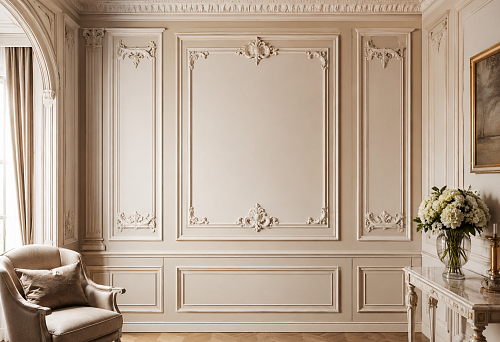
An empty wall is a wall without accents, without structure, without a zone. It just exists. Moldings made of polyurethane turn it into a system of frames: horizontal and vertical lines divide the surface into proportional sections. After painting in the color of the wall, it is no longer an "empty wall", it is an architectural surface.
Processing one wall of a standard apartment takes one to two days. Glue, trimming, installation, puttying joints, painting. Without dust, without noise, without a team of builders.
The wall behind the sofa is the main zone of the living room
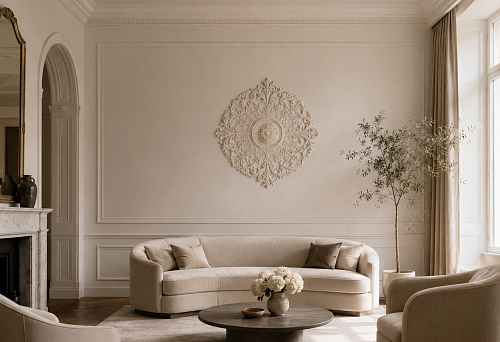
The wall behind the sofa is the focal point of the living room. Everyone who enters the room looks at it. And it is most often left empty or decorated with a single painting.
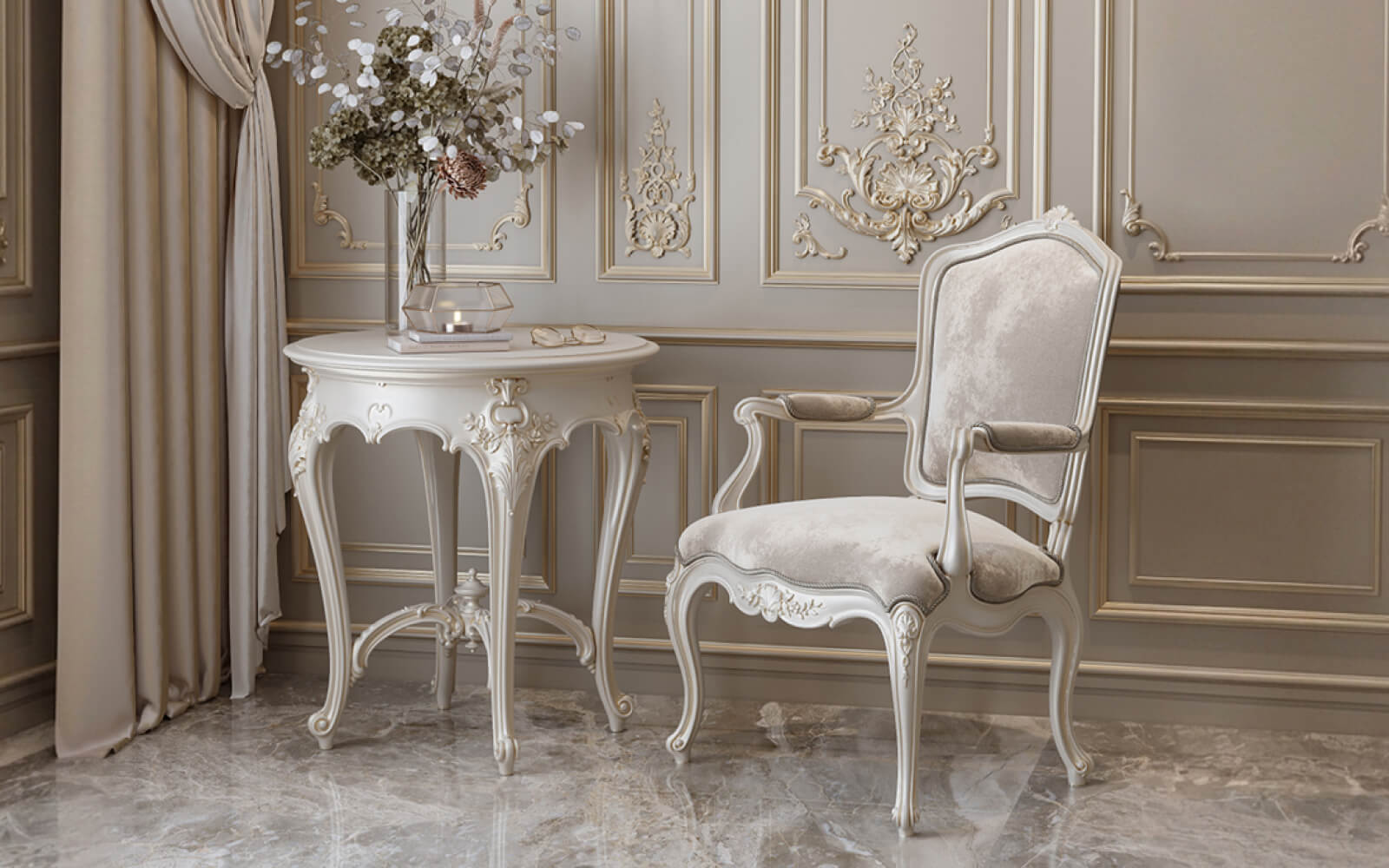
Molding frames on this wall plus Relief Decoration in the center — this is a full-fledged architectural wall without major renovation. Within a weekend, the room looks as if a designer worked on it.
Wall behind bed finished with planks
The wall behind the headboard is the second most important accent after the main wall of the living room. A molding frame behind the bed, paired decorative overlays on the sides — and the bedroom acquires a character that cannot be bought in a single trip to a furniture store, but can be created with a few decorative elements.
Decorative stucco for the headboard should be small and delicate: the bedroom is a space of peace, and the decor here speaks quietly but expressively.
Ceiling under the chandelier
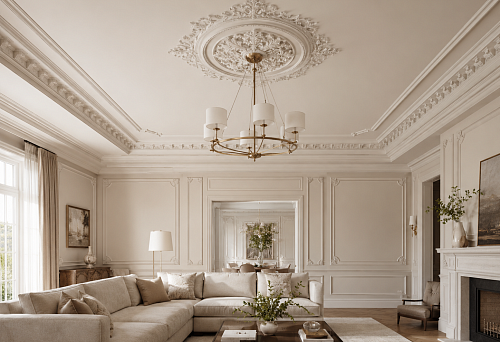
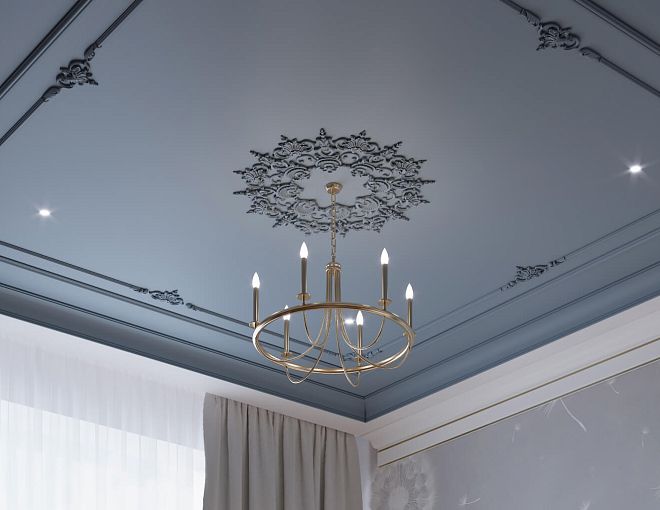
A ceiling rosette under the chandelier is one of the fastest and most noticeable ways to refresh a room. It is glued to a clean ceiling in a few minutes, painted to match — and immediately gives the center of the room a finished look.
Ceiling molding in the form of a cornice around the perimeter — this is the next level. The cornice visually "lowers" the ceiling to the desired level, creates a horizontal frame, and connects the walls with the ceiling into a single system.
Hallway and entrance area
The hallway is the first thing a guest sees. In most apartments, it is decorated on the principle of "clean and nothing." Moldings on the walls, Decorative stucco above the mirror, a ceiling cornice — and the hallway transforms from a "transit zone" into a full-fledged part of the interior.
A mirror — a quick accent in one evening
A mirror with a molding frame and a decorative element above it is a separate architectural object, not just a "mirror on the wall." This effect is achieved in one evening with a minimal set of elements.
Furniture front
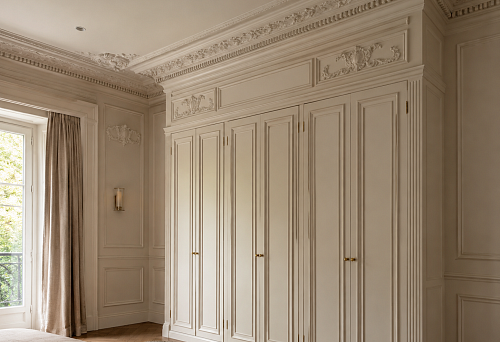
An old kitchen set, a chest of drawers, a cabinet — they don't need to be replaced if they can be updated. Buy decorative molding for furniture facades — means adding thin moldings along the perimeter of the door, small decorative overlays in the center, and painting everything in a single color. The result is furniture that looks custom-made.
A niche, a portal, a doorway
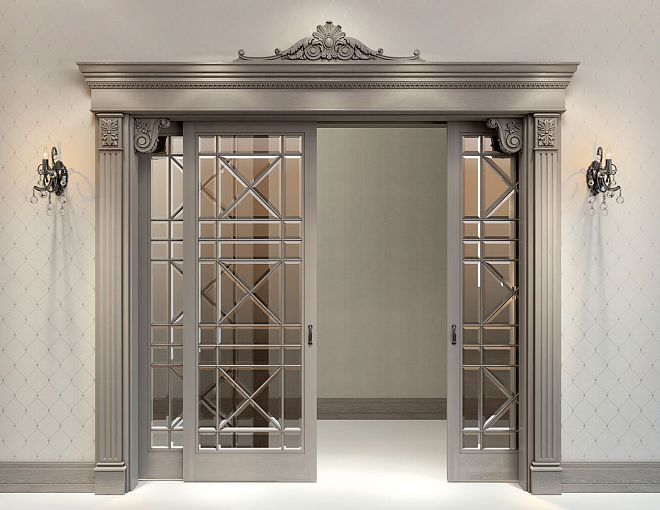
A niche without framing is just a hole in the wall. A niche with a molding frame and with molded decoration above it is an accent zone. A doorway with a molding portal is an architectural detail. A fireplace or a fireplace imitation with decorative brackets and a cornice is the central object of the room.
Polyurethane moldings: the fastest way to change a wall
If you choose one tool for updating an interior without renovation, it is Moldings made of polyurethaneThey work fast, charge reasonably, and deliver results that are immediately visible.
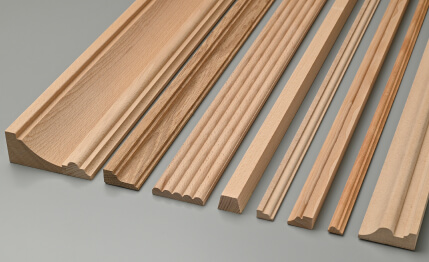
Molding is a profile strip with a relief or smooth cross-section. It is glued to a wall or ceiling, creating a line, frame, or vertical — and instantly changes the character of the surface.
How moldings work on an old wall
Painted walls, surfaces under wallpaper, drywall, plaster — all of these can have moldings installed with proper preparation. The main condition: the surface must be strong, clean, and dry. Peeling paint or loose plaster requires preliminary preparation.
A special adhesive for polyurethane products is applied to the prepared base. The molding is pressed and held until it sets. Joints are filled with putty. After drying — painting to match the wall. The entire process for one wall takes one working day.
What to buy for updating a wall with moldings
Minimum set for one wall:
-
Moldings made of polyurethane of the required profile and width — with a 15–20% margin
-
Decorative corner blocks — 4 for each frame
-
Adhesive for polyurethane products
-
Finishing putty for joints
-
Paint matching the wall color
This is enough to turn a blank wall into an architectural surface in one weekend.
How to choose the width of molding for a specific room
Choosing the profile width is a key decision. A molding that is too thin gets lost on a high ceiling. One that is too wide looks heavy in a small room.
Guideline:
-
Ceiling height up to 2.7 m — molding width 20–35 mm
-
Ceiling height from 2.7 to 3.2 m — molding 35–60 mm
-
Ceiling height from 3.2 m and above — molding 60 mm and larger
For wall frames in a standard apartment, a 30–50 mm profile is a universal choice. It reads well from a distance and does not overwhelm the surface.
Buy polyurethane moldings: what else is important to consider
buy polyurethane moldings you need an accurate calculation of the linear footage. Moldings are sold in sticks of a certain length, and every time you make a miter cut, some material goes to waste. The rule: a reserve of at least 15%, and for complex frame layouts — 20%.
It is also important to ensure that the catalog includes corner blocks for the selected profile — this greatly simplifies installation and gives a cleaner result than cutting at 45 degrees.
Decorative stucco: how to add an accent without remodeling the room
Moldings provide structure. Decorative stucco it creates an accent. These are not the same thing: a molding is a line, decorative stucco is a point. A point where the gaze stops and finds something interesting.
Decorative overlays, high reliefs, medallions, ornamental friezes, corner elements with relief — all of these are glued on top of the finished finish and create exactly those details that the interior was missing.
Where to use decorative stucco when updating without renovation
Above the mirror. The mirror already attracts the eye — a decorative element above it enhances this point and makes it architectural. One overlay above the mirror — and the entire entry wall looks different.
In the center of the molding frame. A frame without a central accent is an empty rectangle. A frame with with molded decoration in the center is already a "painting." It is the central element that turns a wall frame into a meaningful zone.
Above the console. A console in the hallway or living room is almost always a horizontal shelf with objects. A decorative element above it creates a vertical line and "finishes" the composition.
By the sconce. A wall light with a decorative overlay next to or above it is a full-fledged architectural object, not just a lighting fixture.
On the furniture facade. Cabinet doors, kitchen unit doors, or dresser doors with thin moldings around the perimeter and a central decorative element look like custom-made furniture. This is one of the most economical and effective uses of polyurethane decor.
In the hallway. Even a small decorative overlay in the right place in the hallway makes the first impression of the apartment significantly richer.
Above the headboard. Paired stucco decor above the bed is symmetry that signals: everything here is thought out.
Choosing an ornament for decorative stucco molding
Ornament is a stylistic decision that cannot be made by chance. Floral relief suits classic and neoclassical interiors. Geometric relief suits modern, restrained spaces. Abstract relief suits eclecticism and custom projects. Zoomorphic relief (birds, mascaron, acanthus leaves) suits interiors with a pronounced historical character.
buy decorative moldings needs to be in a style that matches the rest of the interior. A single baroque high relief in a minimalist room is not an accent, it's a mistake.
Stucco decor: a small detail that changes the mood of a room
There is a special class of elements that work precisely—not as a system, but as one expressive gesture. These are Relief Decorationmedallions, ornamental overlays, high reliefs, cartouches, rocailles, and plant branches. One such element in the right place changes the mood of the entire wall.
Stucco decor for quick updates: how it works
Imagine: a living room wall painted dusty gray. In the middle — a TV. Above it — nothing. The room looks like an office. Now add a symmetrical pair of polyurethane decorative overlays above the TV, and a small medallion between them. Paint everything the color of the wall. The same gray wall now looks like a well-thought-out accent zone. No renovation. Just three decorative elements and two hours of work.
This is not a fantasy — this is how it works Buy Molded Decoration right on point. This is exactly the approach designers use when they need to "finish" an interior quickly and without rework.
Stucco decor for furniture updates
Furniture is a separate story. An old cabinet or dresser doesn't need to be thrown away if it can be updated with decor. Thin polyurethane moldings around the door perimeter, a small decorative overlay in the center, a unified paint job — and the furniture takes on a completely different character. This works on kitchen cabinets, bedroom furniture, and bookcases in the study.
Buy Moldings for furniture, you need to consider the size of the facades: decorative elements should be proportional to the door area. A small high relief on a large door gets lost. A large overlay on a small facade looks heavy.
Pairing as a principle of working with stucco decor
Most decorative overlays work in pairs. Two identical elements on either side of a mirror, console, headboard — this is symmetry that reads as "intention." One element without a pair looks random — as if the second one got lost.
Before ordering, it is important to ensure that the required element is available in a mirrored version or is symmetrical in itself.
Ceiling molding: how to refresh the top of a room without complex ceilings
The ceiling is the most overlooked area during cosmetic updates. Walls are touched, furniture is rearranged, but the ceiling is left "as is." Yet it is the ceiling that completes the space from above and ties the walls into a unified interior.
Buy ceiling molding — this does not mean creating a multi-level ceiling with lighting. It could be a single rosette under a chandelier, a cornice around the perimeter, or a simple ceiling molding — and that alone is enough to stop the ceiling from being a "fifth white spot."
Ceiling rosette: the fastest way to refresh a ceiling
A ceiling rosette is a single decorative element mounted on the ceiling in the center of the room, anchoring the entire space. Without a rosette, the ceiling is just a white plane. With a rosette, it has a center, an accent, and a sense of completion.
A rosette under a chandelier with a diameter proportional to the room: in a standard room of 15–20 sq. m — a rosette with a diameter of 30–40 cm. In a spacious living room — 50–60 cm or more. This is the simplest decorative element with the most noticeable result.
Ceiling cornice: the connection between wall and ceiling
A cornice around the ceiling perimeter is what professional designers call a "top finish." It does several things at once: visually "lowers" the ceiling to the desired level (important for very tall rooms), creates a horizontal frame around the perimeter, and connects vertical walls with the horizontal ceiling.
Buy ceiling stucco molding The cornice should be ordered based on the room's perimeter plus a 15% reserve. Corner blocks for internal and external corners are a mandatory order item.
Ceiling decor without a chandelier: rosette as a standalone accent
A rosette doesn't have to be a "stand" for a chandelier. It can sit on the ceiling as an independent decorative object — without any light fixture at all. This is especially relevant in rooms with hidden or spot lighting, where a central chandelier is not planned.
In this case, the rosette works as an architectural medallion on the ceiling: it anchors the center and creates a sense of thoughtfulness. Ceiling molding as a standalone decor — this is a solution that is increasingly used in modern interiors.
Ready-made purchase scenarios: what exactly to buy in each case
Theory is good. But a concrete list is better. Let's break down four real renovation scenarios without major repairs.
Scenario 1. "The living room has become boring"
This is the most common situation: the living room functions normally but doesn't inspire. The furniture is in place, the TV works, the sofa is comfortable — but you don't want to enter the room. There's no character.
What to update: the wall behind the sofa — the main zone of the living room. It should become an accent.
What to buy:
-
Moldings made of polyurethane — for two or three frames on the wall behind the sofa
-
Decorative corner blocks — 4 for each frame
-
decorative molding — corner accents inside frames
-
Relief Decoration — central element in the main frame
-
Ceiling cornice — to finish the wall at the top
-
Glue, putty, paint matching the wall
Result: the wall behind the sofa became an architectural dominant. The room gained a focal point. Buy molding for this scenario means transforming the living room in one weekend.
Scenario 2. “Bedroom without character”
A bedroom with white walls, a standard bed, and typical light fixtures is zero emotion. A place to sleep, but not to live.
What to update: the wall behind the headboard is the architectural dominant of the bedroom.
What to buy:
-
Moldings made of polyurethane — for the frame behind the headboard (or two frames on both sides)
-
decorative molding — corner elements of the frame
-
Paired Relief Decoration — on both sides of the center of the headboard
-
Ceiling rosette — above the bed or above the entire room
-
Glue, paint matching the wall color
Result: the wall behind the bed became an accent wall, the bedroom gained symmetry and character. Buy decorative molding for a bedroom — this is not a luxury, but an architectural solution that changes the mood of the entire room.
Scenario 3. “The ceiling looks empty”
Here you don’t need to touch the walls at all. Only the ceiling.
What to buy:
-
ceiling molding in the form of a cornice around the perimeter
-
Ceiling rosette — proportional to the size of the room
-
Corner blocks for the cornice
-
Glue, paint in the color of the ceiling
Result: the ceiling from a "white slab" turns into a finished horizontal plane with an accent center. Buy ceiling molding for this scenario — the fastest room update with the most noticeable result.
Scenario 4. "I want to keep the furniture but make it look more expensive"
The furniture is still decent, it's a shame to replace it, but it looks like mass market. I want character without replacing the set.
What to buy:
-
Thin Moldings made of polyurethane — for frames on door fronts
-
decorative molding — central overlays on each door
-
Paint in the color of the furniture or in a new accent color
Result: the same furniture, but with molding frames and central overlays, looks like an Italian custom-made set. buy decorative moldings for this scenario means spending a small budget and getting furniture that guests won't recognize.
What to check before buying: a practical checklist
Any purchase of decor without prior inspection is a risk. To avoid going back for missing elements, go through this list before ordering.
1. Surface condition
Can you glue it to the current surface? If the paint is peeling, the plaster is loose, or the wallpaper is not firmly fixed, prepare the base first. Polyurethane molding adheres well, but only to a solid surface.
If the surface is painted or covered with dense vinyl wallpaper, in most cases you can glue directly after degreasing.
2. Do you need to pre-paint the wall
If you plan to paint the wall a new color, do it before installing the moldings. After installation, painting the wall with a roller through the moldings is much more difficult.
3. Calculating the number of moldings
Calculate the perimeter of each frame: (width + height) × 2. Add up all frames. Add 15–20% for reserve. Convert to the number of standard-length strips.
4. Allowance for trimming
Moldings are cut at 45 degrees at the joints. Each cut is a loss of material. A reserve is mandatory, especially during the first DIY installation.
5. Is glue needed in the same order
Glue for polyurethane products is not ordinary construction adhesive. It must be compatible with polyurethane and provide reliable adhesion without damaging the surface. It's best to order glue together with the main elements.
6. Will the molding be painted the wall color
Painting to match the wall is a standard technique that makes the decor appear 'architectural' rather than 'applied'. This requires water-based paint compatible with polyurethane.
7. Is a paired element needed
Before ordering decorative molding, check: is a mirror pair needed? If the pattern is asymmetrical, ensure the mirror version is available in the catalog.
8. How does ceiling molding connect with walls
If you are updating both walls and ceiling, ensure the cornice and wall moldings are from the same line or stylistically similar series. Mismatched profiles at the wall-ceiling junction disrupt the sense of unity.
Table: what we update, what we buy, what we get
| Update zone | What to buy | Result |
|---|---|---|
| Wall behind the sofa | Moldings + Relief Decoration + glue + paint | Architectural accent wall |
| Bed headboard | Moldings + steam room Decorative stucco | Symmetrical bedroom wall |
| Ceiling | Ceiling molding + socket + curtain rod | Completed top of the room |
| Mirror | Decorative stucco + molding framing | Architectural object |
| Furniture front | Thin moldings + overlays + paint | Custom furniture |
| Hallway | Moldings + stucco accent above mirror + cornice | Luxury entryway |
| Niche or portal | Molding framing + Relief Decoration | Architectural accent point |
Why polyurethane is the best choice for renovation-free updates
It's important to understand why polyurethane, not plaster, polystyrene foam, or wood.
Lightweight. Polyurethane is 5–7 times lighter than plaster. This means elements stay securely on glue without additional mechanical fasteners — even on the ceiling.
Moisture resistance. Polyurethane does not swell, deform, or crack when in contact with moisture. This is important for kitchens, bathrooms, and country houses.
Casting precision. STAVROS polyurethane products are manufactured using precision casting, which preserves the detail of the relief. Thin leaves, small ornaments, complex profile transitions — everything is conveyed accurately, without loss of detail.
Paint compatibility. Polyurethane readily accepts water-dispersion paints — the same ones used for painting walls and ceilings. This means that after painting, the decor looks like an architectural detail, not like glued-on plastic.
Easy installation. Self-installation without special tools or specialized skills is a reality for most polyurethane moldings and overlays.
FAQ: answers to the most frequently asked questions
Can you update an interior with stucco without major renovations?
Yes, that is exactly what polyurethane stucco is best suited for. Moldings made of polyurethane, Decorative stucco, Relief Decoration и Ceiling molding glue onto finished finishes, paint to match the wall, and deliver results without demolition, dust, or lengthy construction work.
What to buy for a quick wall update?
Minimum set: Moldings made of polyurethane for frames, decorative corner blocks, Decorative stucco for a central accent, glue, paint. For an accent point, add Relief Decoration.
Can you glue moldings onto an already painted wall?
Yes, provided the paint is firmly adhered and the surface is clean. The surface must be degreased, polyurethane adhesive applied, and the molding fixed until it sets. Loose, peeling paint must be removed beforehand.
How to update a ceiling without major repairs?
Enough Buy ceiling molding in the form of a cornice around the perimeter and a rosette under the chandelier. Installation takes one day. Result: the ceiling transforms from a "bare slab" into a finished surface with architectural character.
What to buy together with the molding?
Essential set: moldings, polyurethane adhesive, finishing putty for joints, paint matching the wall or ceiling color, decorative corner blocks. If necessary — paired decorative molding elements and Ceiling molding to finish the top.
How long does it take to update one wall?
Updating one wall of a standard room (2–3 frames, corner blocks, central accent) takes one working day: installation of moldings and decor, puttying joints, drying. The next day — painting. In two days, the room looks fundamentally different.
Can polyurethane decor be glued onto wallpaper?
Depends on the type of wallpaper. For dense vinyl wallpaper in good condition — yes, with the right choice of glue. For non-woven — with caution. For paper — not recommended. If in doubt, it's better to remove the wallpaper under the installation area or replace it with paint.
How to choose the size of a ceiling rosette?
The diameter of the rosette should be approximately 1/8–1/10 of the shorter side of the room. A room 3×4 m — rosette diameter 30–37 cm. A room 5×6 m — rosette 50–60 cm. If the rosette is without a chandelier, it is acceptable to take a slightly larger one for expressiveness.
STAVROS: all decor for renovation without repair in one catalog
All elements described in this article — Moldings made of polyurethane, Decorative stucco, Relief Decoration, Ceiling molding, ceiling rosettes, cornices, baseboards, brackets, furniture decor — are presented in the full catalog of STAVROS company.
STAVROS produces products from European high-density polyurethane with precision casting that preserves the detail of the relief. Each series of moldings and decorative elements is designed as a system: profiles, corner blocks, overlays, and cornices of the same line are compatible in height, style, and proportions — and this is exactly what is needed to create a cohesive interior without major renovation.
STAVROS works with designers, construction companies, and private clients across Russia. Delivery is carried out to Moscow, Saint Petersburg, and all regions of the country. to buy molding from the STAVROS catalog means getting a professional result without a construction crew, without months of waiting, and without the feeling of 'we have eternal renovation.' Sometimes an interior doesn't need a new renovation. It needs the right final layer.