



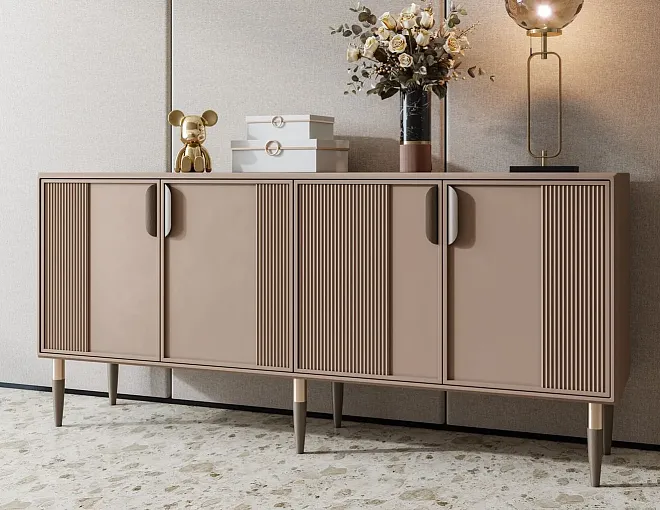
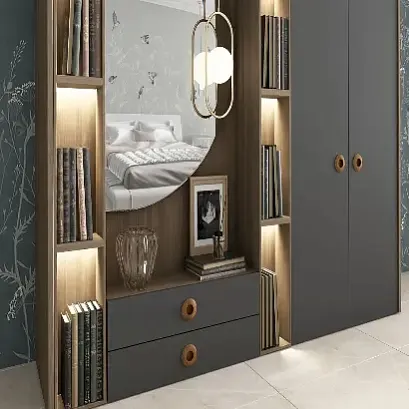
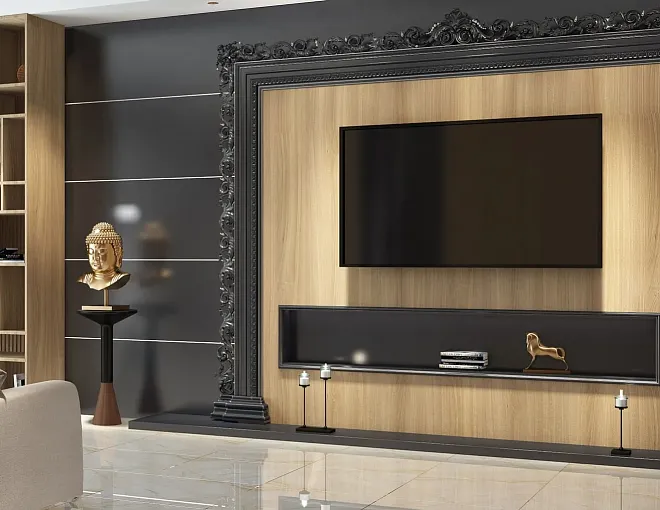


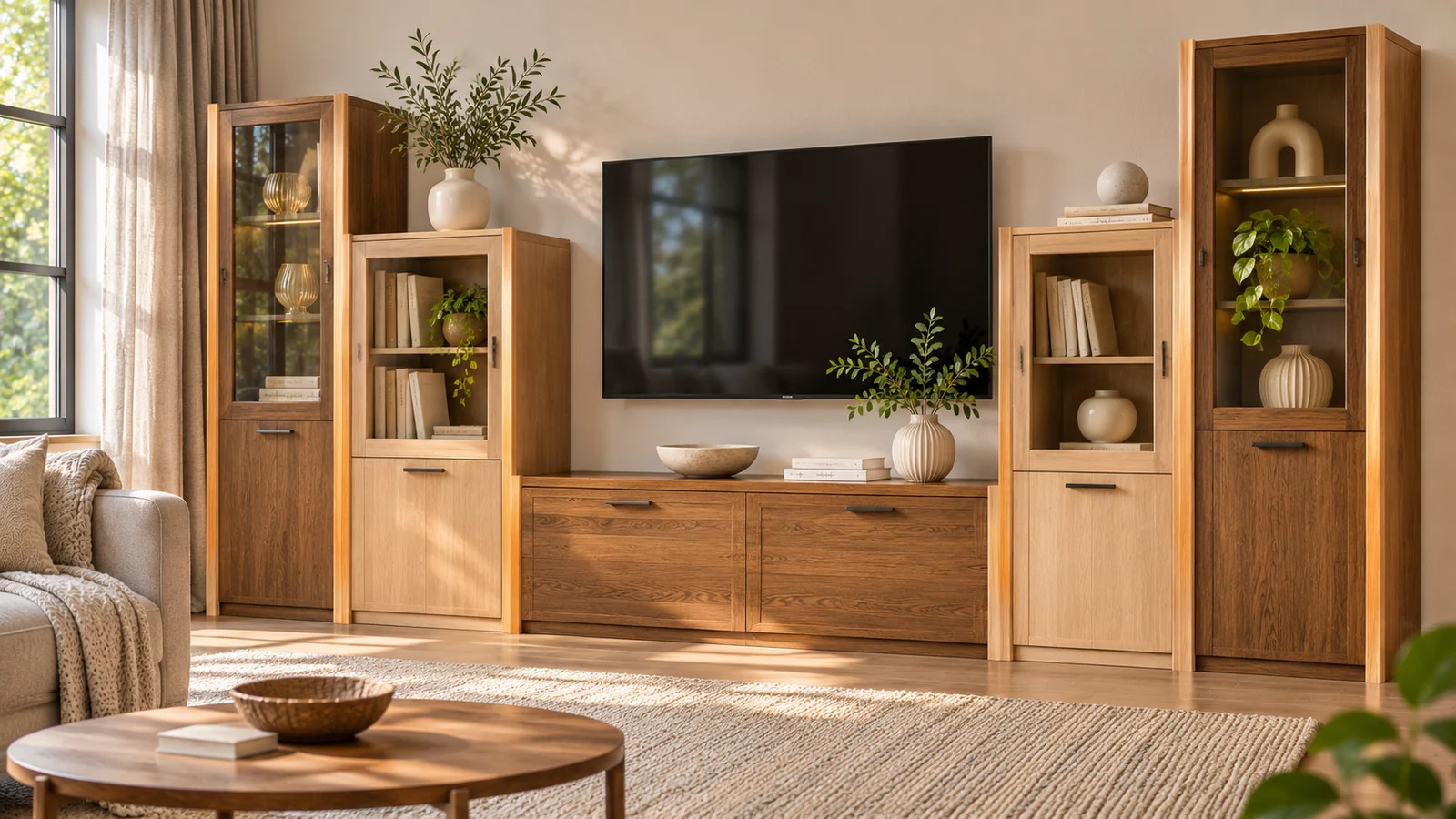
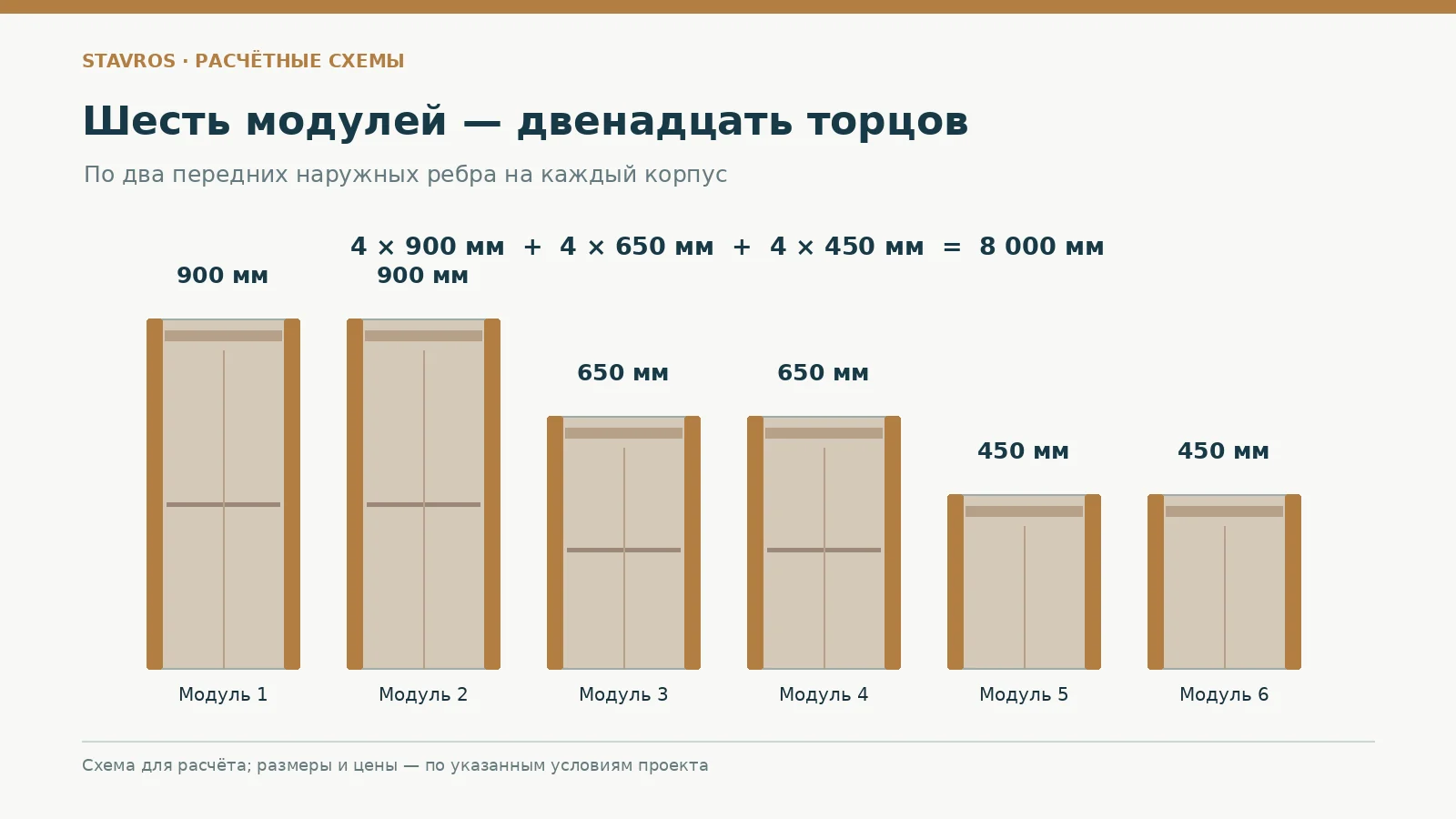
Six modules of the TV wall unit are assembled into a single composition: two tall elements with 900 mm end faces, two medium ones at 650 mm, and two low ones at 450 mm. Each module has two exposed front vertical edges that the customer wants to cover with a decorative wooden corner profile. This gives twelve separate pieces: four long, four medium, and four short. Their total length is exactly eight meters, but buying eight linear meters without a cutting plan is not enough. The price depends on the number of whole factory lengths, not just on the total meterage.
For this project, let's look at the UG-001 STAVROS external corner profile in beech and oak. It comes in cross-sections of 25×25 and 34×34 mm and factory lengths of 1000, 1500, and 2400 mm. Let's compare two real purchases: four 2400 mm lengths, or three such lengths together with one 1500 mm length. Based on the manufacturer's product page prices checked on November 22, 2026, the second option is cheaper for each of the four finishes. At the same time, both options must allow obtaining exactly twelve solid cover pieces with an allowance for the saw cut. Below, all figures are tied to specific parts, not to a conventional "medium-sized" wall unit.

Which twelve end faces on the TV wall unit need to be covered
Six cabinets do not mean six corner profiles
In the original task, each of the six cabinets has two visible front vertical edges. An external profile is needed where the front and side planes form a protruding edge. If only the left side of some modules is covered, the number of pieces decreases; if rear exposed corners are added, it increases. Therefore, before ordering, the furniture is numbered and the end faces are marked on the diagram. This simple technique prevents the craftsman from accidentally counting one length for the entire cabinet.
A TV wall unit may include closed cabinets, open book sections, and vertical tall units. Within our calculation, their internal contents do not affect the corner profile length: what matters is the position of the external edge from its top point to the bottom. If the top of the cabinet protrudes above the side panel, the cover piece may start directly under the overhang. If a plinth is provided at the bottom, its end must align with the plinth rather than mechanically reaching the floor.
Which measurements should be considered final
The figures 900, 650, and 450 mm are finished lengths of the decorative cover pieces after a verification measurement, and not the overall height of the furniture modules according to the manufacturer's invoice. A low section may have a suspended mounting and a gap under the carcass, a middle one may have an overlay top panel, and a tall one may have adjustable supports. To avoid getting an extra centimeter on all twelve edges, measurements are taken at the future installation site, after the furniture and cladding have been installed.
It is useful to photograph not only the general view of the wall unit, but also close-ups of the top and bottom of each group of end faces. The photos should show the adjacent doors, the opening gap, and the cladding material. Photographs do not replace dimensions, but they show details that do not make it into a short request: the protrusion of a handle, the rebate of a door, a crooked joint between two panels. This data will help agree on the thickness and appearance of the profile before ordering.
Where to buy a wooden corner piece in Omsk for specific furniture
Start with the catalog, finish with the specification
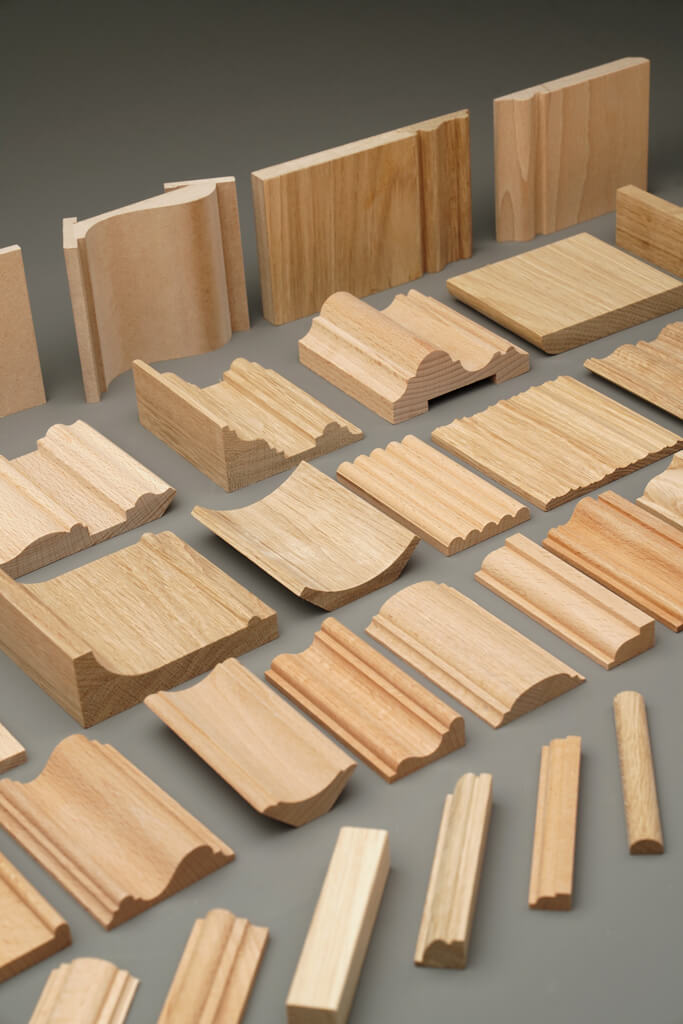
If required buy a wooden corner piece in Omsk, you should first open the STAVROS profile category, and then check the parameters of UG-001 in the product card. On the category page you can assess the purpose of the product, but the final order should not be based on the picture from the general list. Here you need one specific cross-section, one wood species, and four factory strips with precisely specified lengths. A product designation without a size is not a complete bill of materials.
The region of purchase does not change the nominal geometry of the factory profile: 25×25 mm remain 25×25 mm both in Omsk and in Saint Petersburg. However, for a remote buyer, the transportation of long products, packaging, the procedure for confirming availability, possible custom manufacturing, and the accuracy of the document with specifications are important. The official website presents delivery terms across Russia, but the specific timeframe and transport tariff for this set must be calculated when placing the request.
Do not confuse the outer profile with a mounting bracket
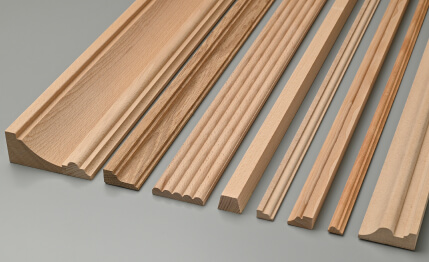
The name “wooden corner piece” is used for small connecting parts, for construction trim, and for furniture finishing. For this TV wall unit, what is needed is specifically an outer decorative profile that covers the two planes of the protruding vertical rib. A metal mounting bracket serves a different function; it can remain inside the furniture carcass, but it does not replace the wooden cladding. Similarly, an ordinary flat batten is not suitable: it covers only one plane and requires a different treatment of the joint.
When buying wood for a group of identical modules, it makes sense to immediately check the uniformity of batches and the type of subsequent finishing. The craftsman may be working with opaque enamel or with a transparent coating in which the natural texture is visible. These scenarios impose different requirements on shade matching and surface quality. You cannot assume that all UG-001 variants are completely identical in color: natural wood has permissible variations in grain.
What is known about the UG-001 corner piece from the official product page
Two cross-sections, three lengths and two wood species
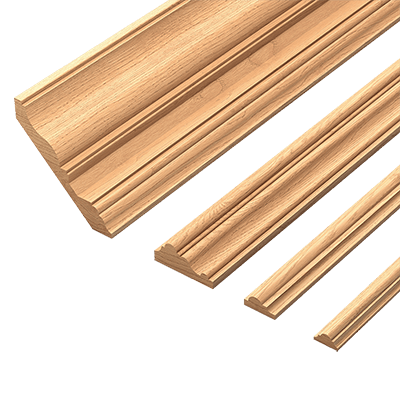
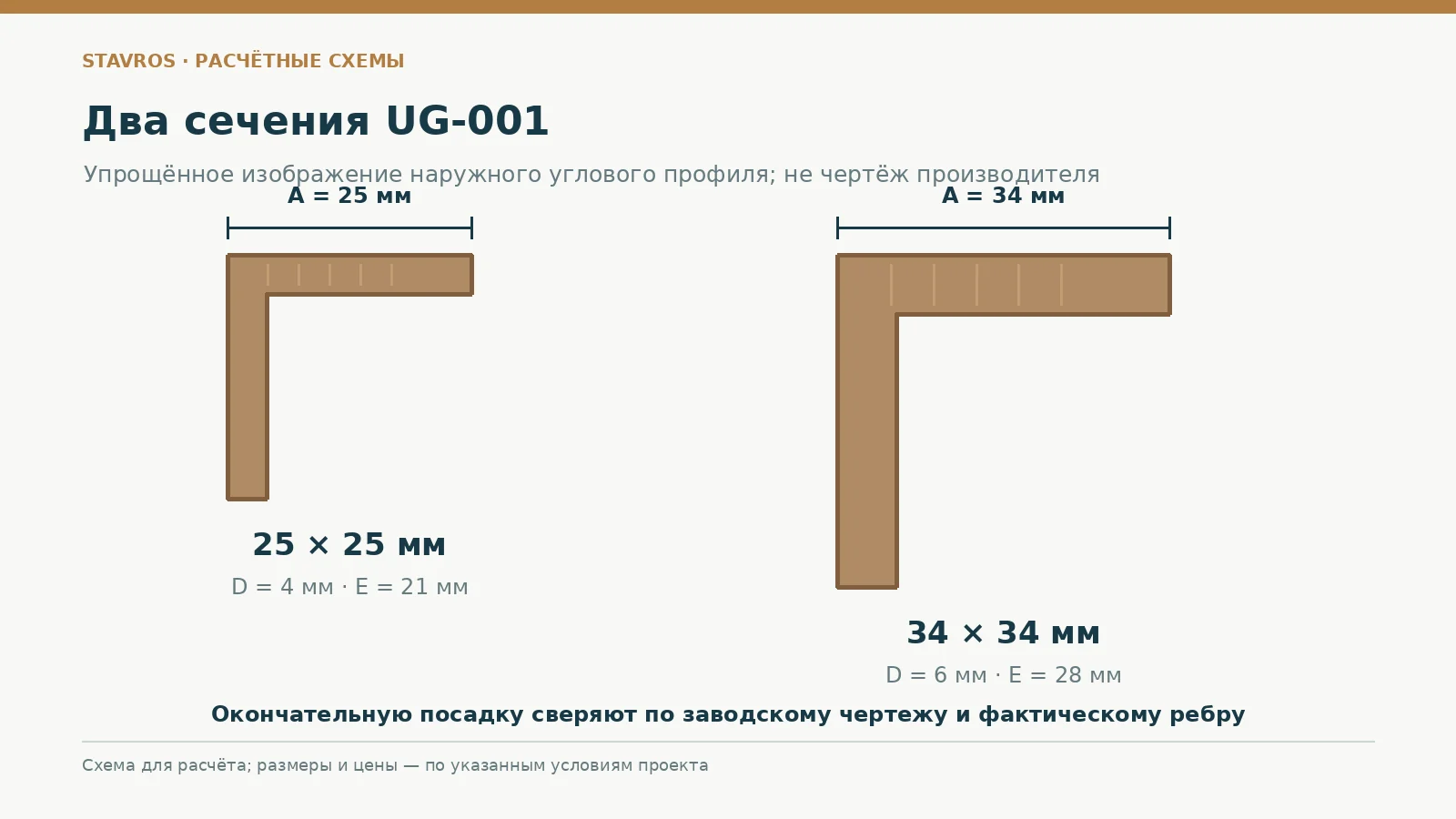
For those planning to buy the wooden corner profile UG-001, the official product page lists two outer profile sizes — 25×25 and 34×34 mm. For the first, the drawing table shows the parameters A×C×D×E = 25×25×4×21 mm; for the second, 34×34×6×28 mm. The manufacturer offers standard lengths of 1000, 1500 and 2400 mm, and the price table for these sizes shows options in beech and oak. This set is sufficient to calculate both procurement schemes without assumed non-standard sizes.
| Indicator | UG-001 25×25 mm | UG-001 34×34 mm |
|---|---|---|
| Outer sides A and C | 25 and 25 mm | 34 and 34 mm |
| D and E as shown in the drawing | 4 and 21 mm | 6 and 28 mm |
| Factory length L | 1000 / 1500 / 2400 mm | 1000 / 1500 / 2400 mm |
| Wood | Beech, oak | Beech, oak |
| Role on the TV wall | Understated end framing | A more prominent decorative edge |
This data applies to a specific product code. It cannot be automatically transferred to another external corner piece, nor can size E be used as the only permissible parameter for furniture panel thickness. For a correct fit, the actual shape of the internal corner, the adhesive joint, the carcass facing and the edge configuration all matter. If in doubt, compare the manufacturer's drawing with a full-size paper template or a physical sample.
Why the factory length matters, not a nominal linear metre
The buyer pays for whole strips of the chosen option. A 650 mm piece from a 2400 mm strip is not automatically sold at 650/2400 of the factory product price; material remains and a separate cutting plan is required. With twelve end faces, it is precisely the distribution of parts across strips that determines the number of items purchased. That is why the statement "you need eight metres of corner profile" does not allow an accurate price comparison between two baskets.
For a project with unequal heights, the ability to cut a long strip into several short parts at once is particularly valuable. At the same time, a 200 mm remainder after cutting is not a defect or evidence of a mistaken purchase: it is a working technological allowance. It is far more dangerous to design parts totalling exactly 2400 mm without allowing for the saw kerf, when the last piece will in fact come out shorter than required.
How to understand the corner profile section when choosing a finish
Width of the outer flanges and internal space
The external size of 25×25 mm shows how wide the visible framing will be on both sides when fitted perfectly. With a size of 34×34 mm, the profile line becomes more expressive. On a TV wall facade with narrow decorative gaps, a nine-millimetre difference on each side can change the composition's pattern. If a door frame or vertical milling runs nearby, a wide corner piece may visually compete with these elements.
The internal geometry is considered separately from the external. The surface applied to the actual edge must not press against protruding edgebanding or leave a wide visible gap. For carcass furniture with different lamination thicknesses, a test fit is carried out first. It must not be assumed solely that a standard panel is 16 or 18 mm thick: two faced surfaces form the geometry of the corner itself, and a suitable overlay is determined by its actual profile.
Test fitting at the top and bottom ends
What stands out most is not the middle of the vertical, but the two ends of the overlay. At the top, the corner piece may meet the top panel; at the bottom, it may meet the plinth or an adjacent cabinet. If the profile is too wide, the upper end looks like a separate massive part; if it is too narrow, it does not cover the cladding line. It is useful to cut templates of both cross-sections out of thick paper and look at them next to the facade in daylight and in the evening under artificial light.
The purpose of the template is to check proportions, not mechanical strength. It does not show how precisely the wood fits and cannot replace a physical sample in a complex configuration. However, it helps you choose between two standard sizes before buying expensive long strips, and it also shows whether the profile will cover the door's technical gap. In open sections, the trim may be more noticeable than on closed facades, because there is no door plane to balance the vertical edge.
25×25 mm corner piece: when you need a calm contour
For narrow parts and a light visual composition
A 25×25 mm cross-section is usually logical to consider on furniture where the outer edge needs to be neatly covered without turning it into the main decorative element. On low modules 450 mm high, a wide trim can take up a significant share of the visible side panel. In such a situation, a narrow profile better preserves the relationship between the facade plane and the vertical edge. At the same time, the appearance depends not only on the number of millimetres, but also on the wood shade, the degree of contrast and the overall arrangement of the cabinets.
For white matte carcasses, a beech corner piece under enamel can give a calm, uniform surface if the finish is coordinated with the furniture paint. For carcasses with a clear wood finish, the oak option can create a deliberate contour thanks to its pronounced texture. But you should not promise the same colour in advance after applying stain: a wood sample and a test coating give a more reliable result than a photo on a screen.
What to check before moving on to purchase
When choosing the narrow version, check whether the profile fully covers both sides of the edge, whether there is room left for the adhesive layer, and whether the corner piece conflicts with opening doors. If the furniture section is under the TV and has a hinged door, open it to the working angle with the template temporarily held in place. On a drawing everything may look clear, but in reality the end of the facade sometimes passes close to the decorative overlay.
Once the size and wood are agreed, you can buy a 25×25 mm oak corner piece or choose the same cross-section in beech. These are not two different shapes: the material and price change within the same item code. They should not be treated as interchangeable without discussing the coating, especially if the customer wants a clear finish on one of the six sections and an opaque one on another.
Corner profile 34×34 mm: when a striking vertical is needed
Wide edge on a tall section
A wider profile is noticeable on a TV wall even when viewed from the opposite side of the room. It can appropriately support a massive top shelf, the side panels of a cabinet, or deep facade frames. On tall 900 mm modules it gives the edges a finished look; on low 450 mm ones, check whether the framing seems disproportionately heavy. Using different profile sizes within a single set is only advisable as a deliberate design technique, but then the purchasing estimate changes and a single cutting plan is no longer possible.
The 34×34 mm cross-section in the catalog corresponds to a different profile thickness, so it cannot be evaluated by the price of the narrow option. In our comparison, the same cutting plan costs noticeably more, which means a mistake in the number of strips becomes more expensive. It is especially important to make sure the 1500 mm length is selected, not the 1000 mm one with a similar photo and cross-section size in the product card.
How to relate the corner profile's scale to adjacent decor
If the cabinets are in a modern style with minimal overlays, the wide trim should be compared with the handles, door frames, and the thickness of the top covers. For a more classic set with pronounced uprights, 34×34 mm may look logical. Try both options on the lowest section: that is where the visual impact of width is often stronger due to the low facade height.
If you intend buy beech corner profile 34×34 mm the availability of the 1500 mm length must be confirmed separately. During the check, the product card showed made-to-order production for this combination, while some other versions were marked as in stock in Saint Petersburg. This is not information about the warehouse in Omsk and not a promise of a specific arrival date. For remote delivery, it is better to confirm the status of the selected item before payment, since a mixed cart may depend on the slowest line.
Oak or beech: how to choose the material for a TV wall
The difference between the visible grain and the coating approach
Beech has a relatively even texture, which is convenient to consider for painting with opaque enamel. Oak is usually chosen when one wants to see an expressive wood grain and pores after a transparent or semi-transparent finish. These are guidelines for the artistic decision, not a promise that any beech corner piece will be uniform in color or that every oak profile will turn out equally contrasting. On natural wood, differences in grain are acceptable, and the quality of pre-selection should be discussed with the seller.
For a TV wall, what matters is not the name of the wood species itself, but the consistency of three surfaces: the corner piece, the side panel of the cabinet, and the front. For example, a light laminated board with an oak pattern can differ greatly from real oak after lacquering. If the customer wants a match, a control finish sample will be required, and sometimes a deliberate decision to make a contrasting dark vertical, so that the difference does not look like a mistake.
Why you should not change the wood species just to save money
Beech purchasing in each size group is cheaper than oak at the verified UG-001 prices, but this difference cannot be considered the only selection criterion. If oak furniture with a transparent finish is already in place, replacing the decorative corner pieces with beech may lead to additional costs for tinting and color matching. Conversely, for painted furniture, paying extra for the vivid natural texture of oak may not produce the expected visual result.
In the estimate, account separately for the cost of the wooden strips themselves and the cost of the final finish. The manufacturer prices given below refer to the selected products and do not mean that the profile will be painted in the color of your front. If an unusual enamel shade is chosen, check the surface preparation technology and the compatibility of the material with the coating system used. There is no universal painting recipe without information about the specific product and the workshop conditions.
Bill of materials for six modules and twelve vertical parts
Distributing the blanks by height
Before drawing up the cutting map, let us fix the final requirement. We have two cabinets of each height and two outer edges per cabinet. Therefore, each size occurs four times. This count is easy to verify regardless of the future purchasing scheme: two modules multiplied by two edges give four identical overlays. The entire project consists of parts of three lengths without transverse joints on the visible edges.
| Module group | Number of modules | Overlay height | Number of parts | Finished length of the group |
|---|---|---|---|---|
| Tall cabinets | 2 | 900 мм | 4 | 3600 мм |
| Medium cabinets | 2 | 650 мм | 4 | 2600 мм |
| Low cabinets | 2 | 450 мм | 4 | 1800 мм |
| Total | 6 | — | 12 | 8000 мм |
A photograph of the TV wall unit may show more decorative lines than are listed in the schedule: horizontal shelves, facade joints, frames and side decorative strips. They are not included in these eight metres. If the customer also wants the top edges framed, a new schedule with horizontal parts will be required. One should not quietly add them to the twelve verticals and then be surprised by a material shortage.
The one-species, one-section rule
Both cutting plans below assume that all twelve parts are made from a single UG-001 finish. For the "beech 25×25" option, only strips of this species and section are needed. For "oak 34×34" — only wide oak strips. This restriction is necessary, otherwise you get a formally correct linear metreage but a genuinely non-uniform composition. If it is decided to finish the upper cabinets in oak and the lower ones in beech, the cost and cutting are calculated as separate groups, even if the short offcuts are geometrically compatible with each other.
We recommend assigning the parts conventional numbers V1–V4, S1–S4 and L1–L4: "tall", "medium", "low". On the reverse side of each cut blank, the craftsman can leave a small removable label. This is especially useful if the work area is limited and the finishing will be done separately from installation. The names on the labels are internal project designations, not manufacturer's article numbers.
Control measurement before purchase and cutting
Three measurements on one edge
Before payment, it is enough to check the dimensions of each of the twelve edges once, but it is better to use several control points. A tape measure determines the length between specific upper and lower ends, a square checks the shape of the outer edge, and a straight batten checks for any noticeable bend. For a cabinet with an opening door, additionally check the movement path of the front. Sometimes it is precisely this that requires changing the position of the overlay, even though the length of the part remains the same.
The project assumes that the four tall parts really equal 900 mm, and not, for example, 899, 901, 900 and 903 mm. If the measurements differ, record each position separately in the final list. The nominal bill of materials serves as a training example and should not force the craftsman to adjust the actual furniture to a neat table. Incorrect measurement leads to gaps at the lid and plinth, which are far more noticeable than a small remainder of unused wood.
Overhangs, coating and end trimming
Particular attention is paid to the thickness of the future coating. A corner piece cut before the finishing work on the furniture itself is complete may need trimming after paint is applied or edge banding is installed. Therefore, it is better to agree on the sequence: first finish the cabinets, then take the final dimensions, and only after that cut the expensive profile. If such an order is impossible, the designer must provide a clear installation tolerance in advance, rather than the craftsman determining it by eye during the process.
For wood, preparation of its own ends for finishing is also important. An open cross-cut may absorb the composition differently from a longitudinal surface; additional sanding or priming may be needed there. If necessary, the length from the bill of materials is considered the finished length, and a minimal technological allowance is provided for cutting. In our calculation, the individual strips have enough free space for the saw kerf, but any significant addition to the lengths should be entered into the card and checked again.
Why eight meters of profile cannot simply be divided into four strips
The sum of lengths and actual layout are different tasks
Eight meters of finished overlays seem like a modest requirement. Four products 2400 mm long yield 9600 mm of source material; therefore, by meterage the reserve is 1600 mm. But such arithmetic by itself does not yet prove that all blanks can be placed without joints. Suppose the craftsman had long parts of 2300 mm and several short ones: they could not be arbitrarily combined on the principle of “the sum is less than the sum.” Each factory strip is a separate container of fixed length, within which whole parts must fit.
For this set of 900, 650 and 450 mm, there is a valid layout both on four long strips and on three long plus one one-and-a-half-metre strip. We will show both options piece by piece so that the buyer can hand the cutting plan to the craftsman and independently recalculate the figures. This approach makes it possible to distinguish real savings from an arithmetic illusion, where a supposedly cheap kit cannot be cut without a missing fragment.
What counts as a useful offcut
An offcut does not always turn into waste. A 450 mm piece left after cutting one of the long strips may be useful for a test paint, glue testing or a separate small item. However, for the current estimate its price has already been paid and cannot be automatically deducted from the order. If the offcut has no confirmed use, it is economically more honest to count it as material stock rather than conditional profit.
When comparing options, separate three quantities: the linear metres of finished decorative parts, the linear metres of purchased profiles, and the material remaining before saw kerfs are taken into account. The option with minimal waste is not always cheaper, but in this case the reduction in factory linear metres coincides with a lower price. On other articles, where the cost of a short strip is relatively high, the result may be different.
Option A: four factory strips of 2400 mm
Working cutting plan without tight fitting to size
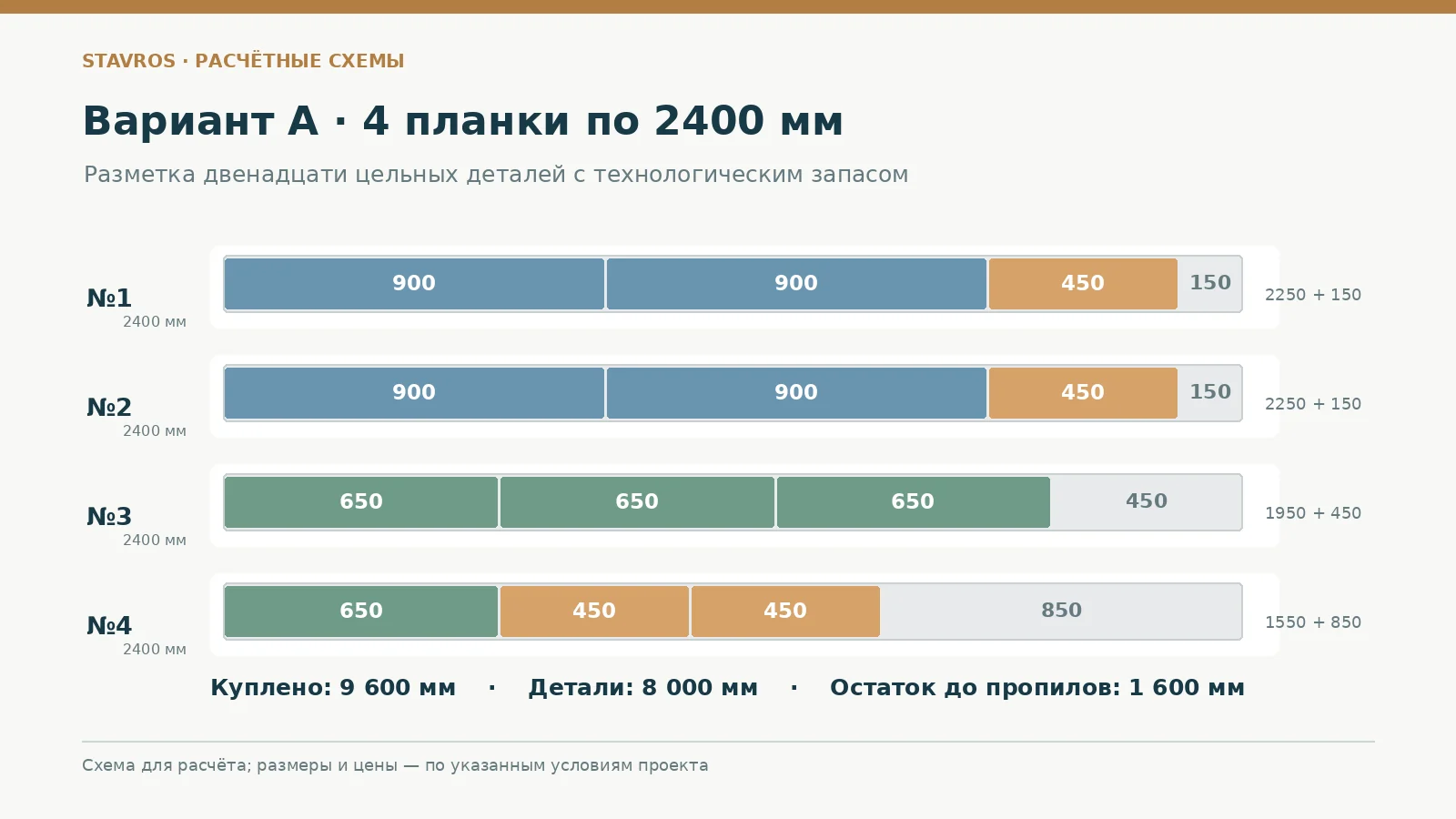
The first way to buy UG-001 is to take four identical long strips. Here it is convenient to distribute the tall parts across two blanks: cut each of the first two strips as 900 + 900 + 450 mm. On the third, place three medium parts of 650 mm each; on the fourth, the remaining medium part and two low parts. Thus the craftsman gets all twelve overlays and does not rely on a combination that fills the entire original size to the limit.
| Plank 2400 mm | Parts, mm | Sum of finished parts | Free before saw kerfs |
|---|---|---|---|
| №1 | 900 + 900 + 450 | 2250 мм | 150 мм |
| №2 | 900 + 900 + 450 | 2250 мм | 150 мм |
| №3 | 650 + 650 + 650 | 1950 мм | 450 мм |
| №4 | 650 + 450 + 450 | 1550 мм | 850 мм |
| Total | 12 pieces | 8000 мм | 1600 мм |
This option is easy to put together: the cart contains only one factory length for the selected species and cross-section. The craftsman is left with relatively large offcuts, including 850 mm from the fourth strip. Such a stock is useful for likely project changes: it can sometimes be used to make an additional short overlay. But the offcut can be used in another area only after checking its actual length and surface quality.
Checking the cutting allowance
For demonstration, let's take the kerf width 3 mm for each separated partThis is a calculated allowance, not a parameter of the tool declared by the manufacturer. Each strip holds three parts, so we allocate 9 mm per cut. The first and second strips retain a margin of 141 mm, the third 441 mm, and the fourth 841 mm. The total remainder under this conservative model will be 1564 mm. Even if the source strips need slight end trimming, the free space allows an additional allowance to be accommodated without changing the purchase.
In actual cutting, the blade width, the clamping scheme, and the need to correct a damaged factory end may differ. Therefore, the worker cannot be instructed to cut all parts solely according to the neat sums in the table. First, he checks the tool and the allowance for the clean end, then marks the strip. With these conditions in mind, the four long strips form a technically plausible set, not just a shopping list.
Option B: three 2400 mm strips and one 1500 mm strip
How to get all twelve overlays from 8.7 meters
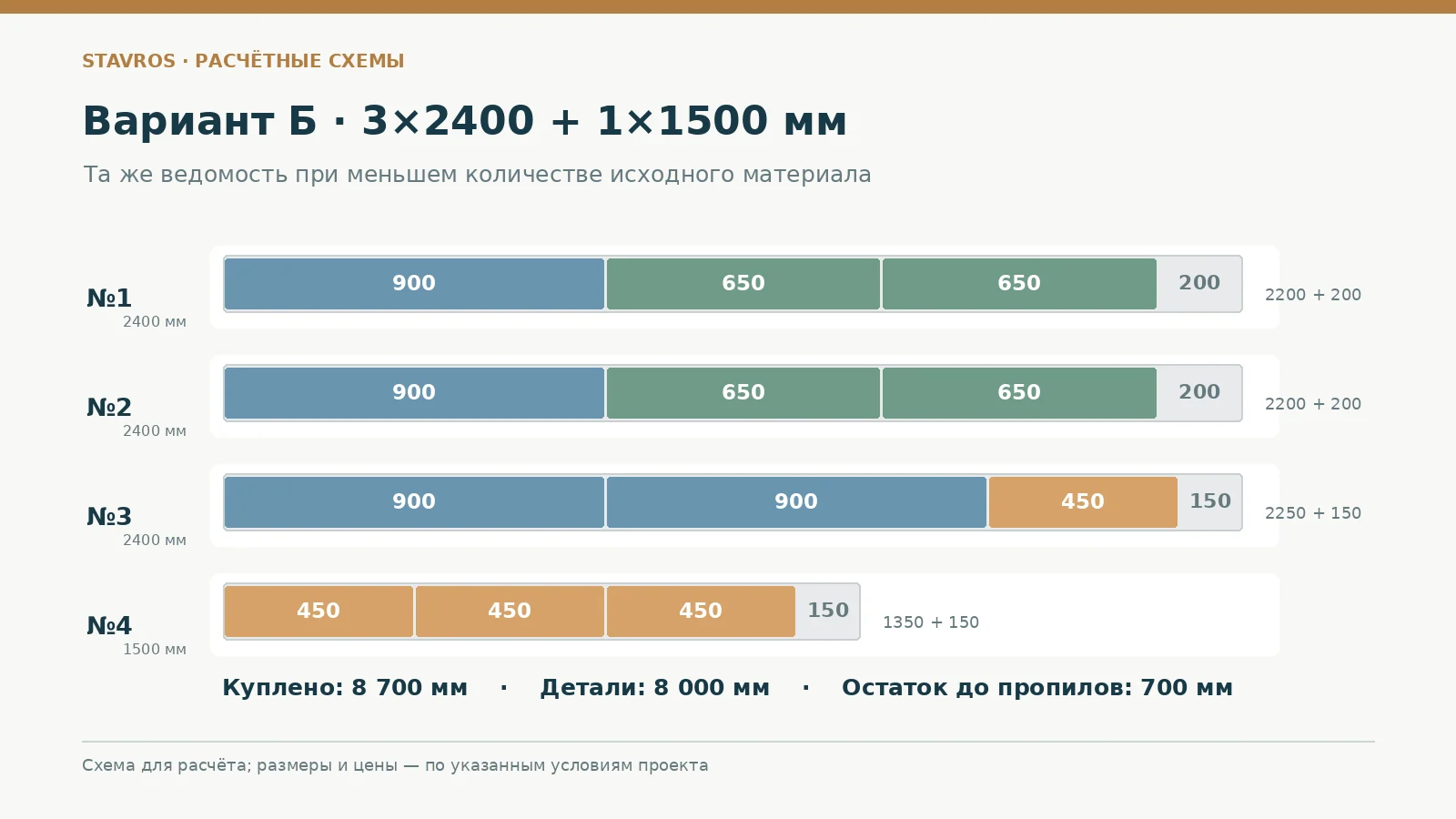
The second scheme uses long strips to place tall and medium parts together. The first and second blanks hold 900 + 650 + 650 mm, the third holds 900 + 900 + 450 mm, and the one-and-a-half-meter strip holds three 450 mm parts. This is exactly where the advantage of short overlays for low modules comes into play: they fill a 1500 mm strip without requiring a separate purchase of one-meter items.
| Factory-made product | Parts, mm | Finished consumption | Remaining allowance for saw cuts |
|---|---|---|---|
| 2400 mm, No. 1 | 900 + 650 + 650 | 2200 мм | 200 мм |
| 2400 mm, No. 2 | 900 + 650 + 650 | 2200 мм | 200 мм |
| 2400 mm, No. 3 | 900 + 900 + 450 | 2250 мм | 150 мм |
| 1500 mm, No. 4 | 450 + 450 + 450 | 1350 мм | 150 мм |
| Total | 12 pieces | 8000 мм | 700 мм |
Checking the quantity by sizes is mandatory: there are four tall 900 mm overlays here, four medium 650 mm ones, and four low 450 mm ones. The total purchased length is 3×2400 + 1500 = 8700 mm. This leaves 700 mm before the cuts, which is 900 mm less than in the first option. That is not the only advantage for the buyer; below we will compare the price of each factory-made item.
What remains after sawing
With the same conditional allowance of 3 mm per piece, the waste for twelve cuts is 36 mm. The remnants of the individual strips will be approximately 191, 191, 141 and 141 mm. In total, this gives 664 mm after the cuts, without additional crosscutting operations. The margin on each strip is sufficient for the cutting model under consideration: the tightest placement leaves 141 mm, not just a few millimetres.
This scheme requires carefully marking four different layouts. If 900 + 900 mm is accidentally cut from the first strip instead of the specified third one, the distribution of the other blanks will most likely need to be revised. Therefore, the craftsman should not simply cut according to the list of heights; he needs a map linking each group to the number of the original item. On the worksheet, it is convenient to mark the first cut point and the order in which the parts are obtained with a marker.
Process tolerances and the order of work at the workbench
Why three millimetres is only a design example
The kerf width depends on the blade or saw used. The adopted 3 mm serves as a verification condition showing that the layout is not based on an impossible requirement of zero cut thickness. It does not replace the tool's data sheet and does not automatically account for all allowances for sanding or end fitting. The worker must measure the actual kerf, check the condition of the blanks, and if the item is to be crosscut on both sides, add the required allowance before final marking.
A wooden corner profile has a geometry different from a flat board. When sawing it, it should be reliably supported and secured so as not to damage the thin flanges or disturb the perpendicularity of the end. The method of fastening to the machine is chosen by a qualified craftsman, taking into account the equipment and applicable safety rules. You must not hold a short offcut with your fingers close to the cutting edge in an attempt to use every millimetre of wood.
How to keep paired overlays in order
For two tall cabinets, the left and right sides can be determined in advance, and then each part can be labelled. With an open, uncovered top end, the craftsman can agree in advance which way to orient the grain and where to place the visually more expressive section. If the surface of the item will be covered with clear varnish, such distribution is of greater aesthetic importance than with opaque enamel.
After a trial cut of one part, the length should be checked not against the markings on the machine, but with a measuring tool. Next, it is sensible to do a dry fit to the furniture, especially at a complex junction of the top cover. It is important not to glue all twelve elements one by one based on a single erroneous setting: if the first corner reveals a gap at the base, the correction must be made before processing the rest of the set.
Is there a cheaper combination with one-meter strips
We are checking more than just the two advertised options
UG-001 has a length of 1000 mm, so it is fair to ask: can two long strips, several one-meter strips and one one-and-a-half-meter strip be bought cheaper than option B? Some such baskets look tempting in a standard calculator: the total linear meterage is almost equal to eight thousand millimeters. The problem appears when trying to fit four 900 mm pieces, four 650 mm pieces and four 450 mm pieces into separate factory products with a cutting allowance.
For example, a set of two 2400 mm strips, one 1500 mm and two 1000 mm gives 8300 mm of source material. For a beech section of 25×25, its price would indeed be 8290 ₽, that is, 20 ₽ less than option B. But such a set does not allow all twelve required parts to be distributed without missing space: the sizes do not fit into separate blanks, despite the similar total. One should not offer the buyer fictitious savings that cannot be realized at the workbench.
What is the point of the additional check
An exhaustive search of reasonable combinations of standard lengths 1000, 1500 and 2400 mm with a model allowance of 3 mm per part did not reveal a cheaper feasible basket than 3×2400 + 1×1500, across the four price sets considered. This is a result of this particular cutting plan, not proof of the universal optimality of the 2400 mm format. Change at least two module heights, and the preferred combination may become different.
If the craftsman is willing to join short overlays on visible verticals, other schemes are mathematically possible, but the original task requires solid parts without transverse joints. They cannot be presented as an equivalent alternative solely on the basis of low cost. Also not included in the comparison are discounted remnants, special negotiated prices, cutting at the seller's warehouse, and non-standard lengths whose existence in this assortment has not been confirmed.
Base prices for UG-001: what exactly is being paid for
Manufacturer's price table as of November 22, 2026
Before buy a wooden outside corner, it is worth checking the UG-001 product page: it lists a separate price for each combination of wood species, cross-section and length. So that the estimate is reproducible, all three factory sizes are listed below, although the two main baskets use 1500 and 2400 mm. The amounts refer to a single strip; they cannot be considered the price of installation work, painting or a set of twelve ready-made overlays.
| UG-001 version | 1000 mm, ₽ | 1500 mm, ₽ | 2400 mm, ₽ |
|---|---|---|---|
| 25×25 mm, beech | 1 120 | 1 530 | 2 260 |
| 25×25 mm, oak | 1 600 | 2 210 | 3 290 |
| 34×34 mm, beech | 2 630 | 3 700 | 5 060 |
| 34×34 mm, oak | 3 960 | 5 550 | 7 610 |
These prices were visible on the official product page when checked on 22 November 2026. The range, stock and cost may change. If the purchase is made later, you must reopen the selected variant rather than transferring the figure from the article directly into the payment. The availability indicated for Saint Petersburg does not mean that a warehouse for the same item exists in Omsk; remote collection and shipping are arranged according to the store's rules.
The cost must not be taken as the "minimum price from"
The category of wooden corners may display a minimum price relating to the shortest and cheapest variant. It does not describe a real set of four strips, most of which are 2400 mm long. If you multiply the conditional price "from 1120 ₽" by four, the result will not correspond to any of the options we selected. Therefore, when preparing an order, you need exact lines with cross-section, species and length, not a total of linear metres or the price of the entry-level variant.
Additionally, check the finish and quality of processing if the product page has the relevant parameters. The amount in the table describes the product variant shown on the website, but does not cover custom furniture painting. If a specific shade is required, additional work must be discussed separately and must not be added to the catalogue price until an agreed quote is obtained.
Cost of two sets of four factory strips
We count every cart without rounding
Option A assumes 4×2400 mm, so the cost equals four prices of the long plank in the corresponding row. Option B assumes 3×2400 + 1×1500 mm: three prices of the long item plus one price of the one-and-a-half-meter item. This formula does not depend on how the craftsman later distributes the 450 and 650 mm segments, as long as the layout is technically feasible. It depends only on the number of factory units purchased.
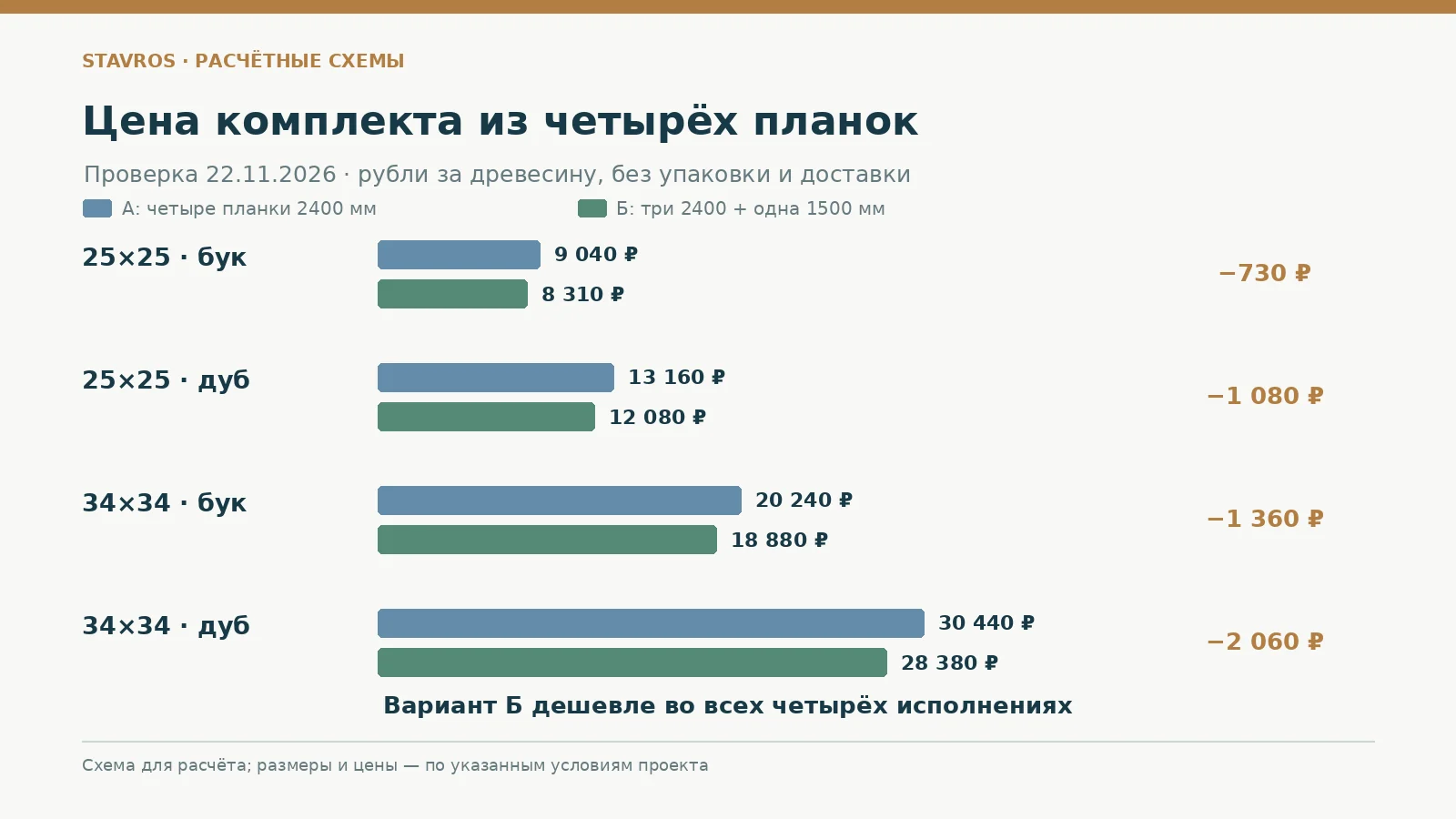
| Execution | Option A, 4×2400 | Option B, 3×2400 + 1500 | Savings B |
|---|---|---|---|
| 25×25 mm, beech | 9 040 ₽ | 8 310 ₽ | 730 ₽ |
| 25×25 mm, oak | 13 160 ₽ | 12 080 ₽ | 1 080 ₽ |
| 34×34 mm, beech | 20 240 ₽ | 18 880 ₽ | 1 360 ₽ |
| 34×34 mm, oak | 30 440 ₽ | 28 380 ₽ | 2 060 ₽ |
Let's check the two extreme rows. For the narrow beech profile, 3×2260 + 1530 = 8310 ₽, whereas four long planks cost 4×2260 = 9040 ₽. For the wide oak profile, 3×7610 + 5550 = 28,380 ₽, compared with 4×7610 = 30,440 ₽. The other two rows are calculated in exactly the same way. There is no invented discount in these amounts — the difference follows from the already published prices for standard lengths.
Why the total does not equal the full price of a finished TV wall unit
The table above covers only the purchase of UG-001 wooden overlays. It does not include the cost of furniture cabinets, transportation, the packaging frame, tools, fasteners, primer, lacquer or enamel, the craftsman's work, or a possible allowance for size changes. It also does not include the cost of manufacturing a custom profile, because such an order is not required for this task. Therefore, 8310 ₽ cannot be called the full cost of finishing six modules turnkey.
For a person who wants buy wooden corners, it is useful to split the budget into a confirmed product part and variable expenses. The first has already been calculated; the second is clarified when choosing the delivery city, carrier, and type of finish surface. This makes it easier to compare offers where someone has included painting and someone else has quoted only the price of factory planks.
How to estimate savings when material reserve matters
900 mm difference between layouts
Option A contains 9600 mm of factory profile, option B — 8700 mm. The net consumption is the same — 8000 mm, and the nominal remainder before cuts is 1600 and 700 mm respectively. The difference is 900 mm of raw material, but it does not mean that the material of the first option is completely discarded. Its larger offcuts can be used to make test samples, a separate finishing piece, or kept for repairs if the shade and profile need to be preserved.
Option B is more practical where the cutting map has already been approved and no additional end pieces are expected. Its set is more compact in total length, but three blanks still have a length of 2400 mm and require suitable transportation. When buying a combined set, one cannot expect a small box just because one of the four strips is shorter than the others.
When a spare long strip is justified
If the site has not yet been assembled, the dimensions are doubtful, or changes are possible in the design project, the customer may deliberately purchase additional material. This is not a mistake if the decision is made consciously and listed as a separate line in the estimate. For example, one more 2400 mm strip will make it possible to replace a damaged part or create an additional rib. But its price is fully added to the chosen option and cancels out part of the calculated savings; the reserve cannot be declared free.
When all the cabinets are in place, the end pieces have been checked, and the installation is being carried out by an experienced craftsman, it is wiser to start with an accurate map without extra footage. Before the final purchase, it is still worth discussing the acceptability of repairing small chips, the finishing sequence, and the need for a test blank. The decision on the reserve depends on the project stage, the installer's qualifications, and the availability of repeat delivery, not only on the waste percentage.
What to do if the actual heights differ from the project
Replacing 450 mm with 480 mm does not change the entire bill of materials
After installing the sections, it sometimes turns out that the lower decorative rib has a length of not 450 but 480 mm due to a different thickness of the top cover. If this happened with at least one of the four low overlays, the total net footage will increase by 30 mm. In itself, such an increase does not ruin option B, but the craftsman must recalculate the specific strip to which the changed part is assigned. One cannot simply add 30 mm to the total order and leave the previous cutting map unchecked.
If all four short parts have become 30 mm longer, on a one-and-a-half-metre strip three such elements will take up 1440 mm before cuts, leaving only 60 mm. This is still possible with a nominal 3 mm cut, but the margin for trimming is noticeably reduced. If the new length becomes 500 mm, three identical parts will give exactly 1500 mm, and the scheme of placing them on a single strip is no longer viable because of the cuts. In that case, the parts should be redistributed and the prices compared again.
When a full recalculation is needed
The specification must be fully updated if the number of outer edges changes, horizontal elements are added, or at least one of the ends becomes too long for the planned original strip. Recalculation is also needed when switching from solid parts to jointed ones and back. If the order has already been placed, do not change dimensions in verbal correspondence: send a new table indicating the revision and ask to confirm which version is used in production and installation.
The examples in this article are intended for working with an actual TV wall, not for mechanical copying. Lengths measured on site take priority over the training model. With the original values of 900/650/450 mm retained, both calculated baskets are acceptable; at other heights, the choice of "three long plus one one-and-a-half-metre" ceases to be a ready-made answer.
Preparing edges and the base for the decorative profile
Checking where the profile should actually sit
An outer corner covers a protruding joint between two planes, but it cannot fix a twisted carcass, a deep dent or poorly glued facing. Before installation, you need to make sure that the two surfaces are positioned according to the design geometry and have no protruding varnish drips, peeling edge banding or fasteners. During a dry fit, the profile should sit level, without noticeable rocking or excessive force. If the overlay has to be pulled to the furniture by force, first look for the cause of the mismatch.
When combining wood with laminated board, it is important to choose an adhesive that the manufacturer approves for both materials and the intended operating conditions. Not all construction adhesives perform equally well on smooth films and porous wood. On carcasses with an already finished decorative surface, the risk of damaging the coating when removing excess adhesive should be checked in advance. The test is carried out on a hidden area or on material samples.
At which stage it is more convenient to carry out the finishing
Painting the corners before installation reduces the risk of accidentally staining the fronts and internal shelves, but requires careful fitting of the finished painted ends. Finishing after installation allows the profiles to be visually coordinated with the wall as a single composition, but complicates the protection of adjacent surfaces. Both approaches are applicable in different projects; the choice depends on the type of coating, the possibility of dismantling, the quality of the preparatory work and the requirements for the seams.
If the corner pieces are coated with clear lacquer, determine in advance the orientation of the visible side and the distribution of the grain between paired parts. With opaque enamel, the preparation of the end surfaces and adherence to the application regime of the compound become especially important. Do not allow mounting clamps or protective tape to leave marks on a coating that has not yet gained strength. Exact holding intervals should be taken from the instructions of the chosen material, not from the general advice in the article.
Installation of twelve overlays without noticeable joints
Dry fitting before fixing
Before gluing, the craftsman lays out the finished overlays in groups, places each against its edge and checks the upper and lower termination. On a tall section 900 mm long, the line must run vertically without protruding unevenly onto the front. On medium and low cabinets, it is important to compare the height of the overlays in pairs: even a slight visual discrepancy on two adjacent sections is noticeable in the overall composition. The check is carried out under normal room lighting and from the working viewing distance of the television.
The joint with the top cover does not necessarily have to be flush with the outer edge: this is determined by the furniture design. If the corner piece meets another wooden part, the shape of the end trimming and the mating line are agreed in advance. There is no need to make an arbitrary 45-degree cut without a drawing just because this technique is often used for frames. Here vertical overlays are installed, not a closed rectangular frame.
Fixing, holding time and initial use
The fastening method is chosen according to the cabinet material and appearance requirements: compatible adhesive solutions and concealed mechanical fasteners specified by the design are possible. If adhesive is used, its amount and placement must not cause squeeze-out onto the front surface. During temporary fixing, the straightness of the profile along the entire height should be maintained, rather than pressing only the middle. Excessive pressure can displace the overlay and change the width of the visible shelves on adjacent faces.
The furniture should not immediately be subjected to impact loads or actively moved until the technological holding time of the fastening is complete. The time is determined by the specific compound and room conditions. The decorative corner piece protects protruding edges from normal household contact within the capabilities of the material, but it does not become a load-bearing element that holds together a poorly assembled cabinet. The strength of the side panel must be ensured by its own frame and correct joints.
How to finish the upper and lower terminations in different modules
Tall sections and the area near the television
On tall sections, the outer edge is visible on both sides of the screen area. If a TV on a swivel bracket is placed nearby, make sure the screen does not catch the corners of the furniture when it moves. The trims themselves must not cover technical openings, appliance ventilation gaps, or cable entries. Even decorative finishing cannot justify violating the requirements for TV placement and safe cable routing.
At the top edge of two tall cabinets, it is important to achieve the same visual finish. If one has an overhanging top and the other ends with an exposed end, their finishing should preferably be decided before cutting. Within this project, the 900 mm length assumes an already agreed finish. If the designer changes the junction line, not only the aesthetic sketch but also the trim schedule should be updated.
Low cabinets and door working clearances
Low sections 450 mm high are more often located in areas of frequent contact: nearby there may be a passage, a remote control, books, baskets, and opening fronts. Here the end corner piece must not interfere with drawer extension or door opening. Check the clearance after installing a test template rather than calculating it from the thickness of the original side panel. If the front opens toward the adjacent cabinet, take its end trajectory into account.
Cleaning is a separate issue. At the lower ends, exposed unfinished wood should not be left if water regularly gets on the floor during wet cleaning. For cabinet furniture, it is important to follow the manufacturer's recommendations for the room's humidity conditions rather than assuming any wooden profile is moisture-resistant. A decorative trim should be part of the overall furniture solution, not a weak point that will be damaged in daily use.
Finishing the beech and oak corner piece after cutting
A transparent result requires a sample
With an open wood texture, you need to decide whether the corner piece will become part of the overall wooden background or a separate contrasting accent. An oak profile can differ significantly in grain from a laminated board with a printed oak decor, even if the shade names match. A control test coat on an offcut allows you to evaluate the color after drying and how the composition reveals the end surface. Compare under the lighting in which the TV wall will be used permanently.
If the goal is a smooth, uniform color, the beech version can conveniently be included in the finishing process, but the primer, enamel, and application method must be compatible with the specific wood. Do not simply transfer an MDF recipe to solid wood without testing. Areas with different absorbency may show on open edges, and sanding across the grain leaves scratches that are visible after coating.
Care and repair of minor damage
After installation, dirt is usually removed with a soft cloth and products approved for the chosen finish. Avoid abrasive sponges and do not over-wet unprotected joints. If an impact has damaged only the decorative layer, whether local restoration is possible depends on the depth of the defect and the type of finish. On clear lacquer, touch-up paint may remain visible, so for serious damage it is better to consult the craftsman who applied the original coating.
It is useful to store short offcuts from cutting with a label noting the wood species and cross-section, if future repairs are planned. However, storing them does not make them a full substitute for a whole 900 mm part: the volume and length of the reserve must match the intended task. Before Buy wooden trim to expand the composition, match the new parts with those already installed by profile and decorative design.
Ordering and delivery of wooden corner pieces to Omsk
Send the manager four specific lines
For the "beech 25×25 mm" option, the selected cart contains three UG-001 strips 2400 mm long and one 1500 mm long. For oak or a wide cross-section, the composition by lengths does not change, but the materials, dimensions and prices do. It is useful to send the seller everything in one message: item code, cross-section, wood species, selected lengths, quantity, delivery city and contact details. Such a list helps avoid the situation where the buyer writes "I need four corner pieces" and the supplier does not know which ones exactly.
The official section "delivery of wooden moulding across Russia" lists the shipping options by transport companies and courier delivery. Availability information on the website is tied to specific warehouse locations, so it cannot be claimed that the order is already waiting for the buyer in Omsk. The conditions for transporting long items, the timeframe, the final cost and the availability of the pickup point must be confirmed for the actual delivery address.
Packaging of long strips and inspection upon receipt
A 2400 mm profile requires attention to straightness and protection from damage during transport. The STAVROS product page states the cost of a rigid packaging frame of 390 ₽, added to the order; the currency of this condition and its application to a specific cart should be checked when calculating delivery. The frame itself is not included in the tables above. You cannot add a conditional cost of Omsk transportation to the prices without knowing the carrier, route and packaging dimensions.
Upon receipt, the number of packages, the integrity of the packaging and any visible damage to the products are checked in the manner prescribed by the carrier and the seller. Before starting painting and cutting, the slats should be laid out, their lengths and material compared with the specification, and any discrepancies recorded. This sequence is more important than promises that "everything will definitely arrive": long wooden profiles require careful handling, and claims are easier to resolve before the original condition of the goods has been altered.
Exact order specification for six modules
What to include in the request regardless of the finish
The product section of the request must list four items of the same finish: "UG-001, 25×25 mm, beech, 2400 mm — 3 pcs.; UG-001, 25×25 mm, beech, 1500 mm — 1 pc.". If oak or the 34×34 mm size is selected, the corresponding parameters should be replaced in all lines. You cannot combine cross-sections into a single entry "assorted angles" and expect the store to reconstruct the cutting plan from a verbal description. The product name, wood species, cross-section and length determine the price.
In a separate attachment, leave a list of the twelve finished parts: four at 900 mm, four at 650 mm and four at 450 mm. This sheet is intended for the craftsman who will carry out the cutting, not necessarily for the factory warehouse. Before sending the request, check whether cutting services are offered and on what terms; if there is no confirmation, proceed on the basis of purchasing whole factory slats. Do not promise ready-cut sets on behalf of STAVROS based solely on our calculated scheme.
How to link the main purchase with other decor
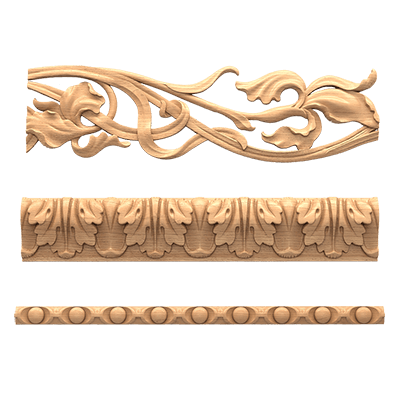
If a ceiling or wall wooden frame is additionally planned for the TV wall unit, it is treated as a separate task. In the section solid oak and beech mouldings various profiles are presented, but the presence of a similar pattern does not mean that the shape and dimensions match. A moulding may be required for a horizontal line, and a corner profile for an outer edge. Do not substitute one item for another for the sake of simplifying the order.
Before paying, it is worth checking once more whether it would be more advantageous to receive all the items in a single agreed delivery. But combining orders should remain a matter of commercial calculation: the carrier's tariffs and packaging conditions depend on the actual cargo. If the new basket contains long skirting boards or battens, its parameters may differ significantly from those of four angles; transport figures from a previous purchase cannot be carried over to it.
Mistakes when buying corner profiles for a TV wall
Mistakes in dimensions and cutting
Most often people make mistakes when they count modules instead of outer edges; use the nominal body height instead of the visible length of the overlay; mix up cross-section variants; assume that a sum of segments equal to the length of a factory strip allows sawing without waste. A separate risk is cutting several strips by eye without tying specific parts to the original products. In that case, even a sufficient total length can be spent in such a way that no whole fragment remains for the last overlay.
Another typical mistake is transferring a price from an old calculation into today's cart without rechecking. UG-001 prices were valid on the date of the specified check and may change. To buy a 1500 mm wooden corner profile, you need to select the exact wood species and cross-section on the page, because one SKU includes several commercial variants.
Mistakes in purpose and finishing result
A decorative corner profile is sometimes mistakenly considered a way to reinforce poorly assembled furniture. This is incorrect: the profile is responsible for finishing the outer edge and, to a certain extent, for protecting the finish from everyday contact, but it does not replace fastening the body. Other problems appear when a wide cross-section blocks the opening of a facade or when the true color of solid wood turns out different from the pattern of a laminated panel.
A consistent check helps avoid these risks: first the finished furniture and actual edges, then profile selection, a dry fit, a bill of materials and cutting, approval of the final coating, and only after that installation. The buyer keeps control over costs when every factory strip purchased already has a purpose in the plan, and all additional work is indicated separately from the product price.
Frequently asked questions from Omsk customers
Can one UG-001 be used for all six modules?
Yes, if the selected cross-section fits each cabinet and a consistent exterior appearance is agreed upon. The TV wall unit in question uses one article number, one wood species and one cross-section, but the finished overlays come in three different lengths. This approach simplifies the visual composition and allows factory strips to be cut together. When switching between species or cross-sections, the schedule is divided into independent groups.
Are three 2400 mm strips and one 1500 mm strip enough for twelve ends?
For four pieces of 900 mm, four of 650 mm and four of 450 mm — yes, with the cutting map provided. On each factory strip, at least 150 mm remains before the cuts after the pieces are placed. The example with a calculated allowance of 3 mm per piece also works. Before the actual sawing, the craftsman must check the width of their own tool, the end trimming and the final edge dimensions.
Which is cheaper: four long strips or a mixed purchase?
At the verified manufacturer prices as of 22 November 2026, the option with three 2400 mm strips and one 1500 mm strip is cheaper for beech and oak in both cross-sections. The saving ranges from 730 to 2060 ₽ depending on the finish. This comparison covers only the cost of factory products; transport and installation are not included.
Can offcuts be used instead of buying an additional strip?
Yes, if the offcut physically has a suitable length, shape and surface quality and matches the required species and cross-section. After cutting option B, four relatively short offcuts remain, so they are more convenient for finish samples than for new long verticals. To add another 900 mm rib, a new material assessment will be required rather than automatic use of the offcuts.
Which cross-section looks better on a low 450 mm cabinet?
It depends on the proportions of the cabinet and the adjacent fronts. A 25×25 mm cross-section creates a more restrained line, while 34×34 mm creates a noticeable edge. Both are actually available in the UG-001 range, but the choice should be checked on a full-size template. It is especially important to make sure that the profile does not interfere with opening the doors and does not cover the technical gaps.
Which should I choose for enamel painting — oak or beech?
For opaque painting, beech is often considered because of its calmer texture; oak is chosen, among other reasons, to showcase the wood grain. However, the final decision depends on the quality of the surface, the primer, the shade and the finishing technology. It is better to request a sample and carry out a test coating, especially if an exact match with already painted furniture is required.
Can the corner piece be attached with adhesive only?
This depends on the surface of the cabinet, the weight and shape of the profile, the chosen adhesive composition and the operating conditions. The instructions for a compatible material must be followed, and a test joint should be checked. A decorative profile should not be used as a load-bearing fastener: the structural strength of the TV wall unit is ensured by its own joints.
Does STAVROS have a warehouse with UG-001 in Omsk?
The verified public product page shows availability information for Saint Petersburg and made-to-order options, but does not confirm a separate UG-001 warehouse in Omsk. The manufacturer describes Contact us to confirm shipping to your destination. Actual availability, the method of collection, the cost and the dispatch times to Omsk should be confirmed with the seller for the selected version and delivery address.
Will the purchase be a ready-made set of twelve cut corner pieces?
No, the calculation assumes the purchase of whole factory strips of standard length and subsequent cutting. The possibility of factory cutting must be agreed separately. The tables in the article are a technical specification for ordering and for the craftsman's work, not confirmation that the manufacturer provides a cutting service included in the price.
What should I do if, after a few months, I need another identical corner piece?
Keep the article number UG-001, the selected cross-section, the wood species, the length and the details of the finish. Before repurchasing, the current price and availability must be checked again. Even if the article number matches, a new strip of natural wood may differ in grain and shade from the previously installed parts. If an inconspicuous replacement is required, it is better to first compare a sample and agree the finish with the craftsman, and only then order an additional strip.


Buy STAVROS wooden corner pieces with delivery to Omsk: final configuration
Selection result with no hidden assumptions
The original TV wall requires twelve solid outer pieces: four at 900 mm, four at 650 mm and four at 450 mm. They are laid out on three factory strips UG-001, 2400 mm long, and one 1500 mm long, with a finished consumption of 8000 mm and a remainder of 700 mm before cuts. The estimate based on prices verified on 22 November 2026 is 8310 ₽ for beech 25×25 mm, 12 080 ₽ for oak 25×25 mm, 18 880 ₽ for beech 34×34 mm or 28 380 ₽ for oak 34×34 mm.
Before buy wooden corner piece, four practical steps remain: recheck the edges of the already installed furniture, choose the cross-section based on the actual angle, agree on the wood species and finish, and confirm the cost of the selected factory strips and delivery to Omsk. This way the buyer gets not just a set of long pieces, but a verifiable order with a clear cutting plan, budget and installation sequence.


