










































































Article Contents:
- The main difference: what lies behind each option
- Ready-made window frames: a known result
- Custom window frames: a personal project
- What to choose: comparison by key criteria
- When ready-made carved window frames are the right choice
- Standard window openings
- A wooden house without historical requirements
- Bathhouse, gazebo, summer cottage
- When speed matters
- When you need to design multiple buildings in a unified style
- When the budget is limited
- When custom architraves are truly needed
- Non-standard sizes: when the numbers don't match
- Historical restoration
- Unique ornament according to the project
- Non-trivial facade system
- How to choose a ready-made architrave: step-by-step logic
- Step 1. Measuring all openings
- Step 2. Selecting the plank width
- Step 3. Choosing the ornament to match the house style
- Step 4. Selecting color and finish
- Step 5. Forming the complete set
- How to assemble a set around a window: from the first measurement to the last nail
- Side trims
- Top horizontal element
- Bottom plank
- Corner rosettes
- Connecting elements
- Brackets
- Advantages of ready-made carved trims: why it is profitable
- Common mistakes when choosing and purchasing trims
- Mistake 1. Buying without calculating the quantity
- Mistake 2. Ignoring the distance to the wall edge
- Mistake 3. Buying only side trims without horizontal elements
- Mistake 4. Mixing ornaments from different styles
- Mistake 5. Not planning the painting before installation
- Mistake 6. Not considering the thickness of the trim during installation
- Mistake 7. Not treating the back side
- Specifics of selection for different objects
- Country house: main and side facades
- Bathhouse: modestly and with quality
- Gazebo: close-up perception scale
- Porch and entrance area
- Dacha: lightness and speed
- Carved window frames for painting: nuances that determine the result
- Additional elements: how to expand the standard set
- Frequently asked questions and answers
- STAVROS — ready-made decor for wooden facades
Sooner or later, everyone involved in decorating a wooden house faces this question. The catalog is open, the patterns are appealing, the sizes seem to fit. But somewhere in the back of your mind, there's a doubt: what if I should order a custom one? What if nothing ready-made fits my windows?
This doubt is understandable. But in most cases, it is unnecessary. Buy ready-made carved window frames — this is not a compromise or a simplification. It is a reasonable, fast, and fully professional solution that covers the task for 85–90% of wooden houses, bathhouses, gazebos, and country facades without any loss in quality.
But there are also cases where ordering custom production is truly justified. Let's break this down honestly, without marketing tricks — when to choose ready-made, when to go for custom manufacturing, and how to avoid mistakes in both cases.


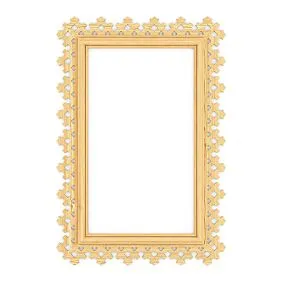
The main difference: what lies behind each option
Before diving into details, it's important to understand how ready-made architraves fundamentally differ from custom-made ones. This isn't just a matter of 'fast or slow.' These are two different approaches to the task.




Ready-made architraves: a known result
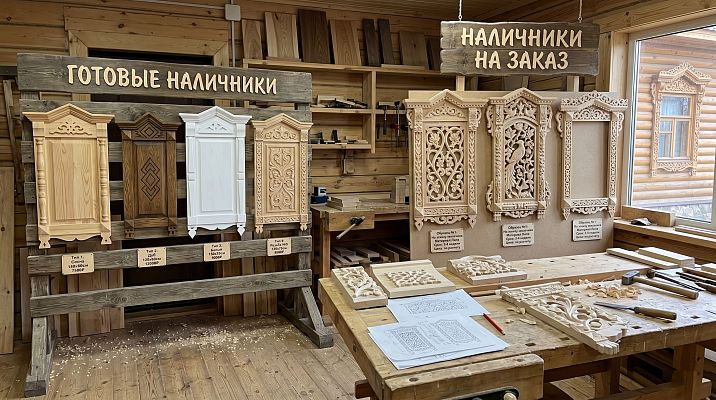
A ready-made architrave is a product that has already been manufactured, with specific dimensions, ornament, shape, and relief. You see it in the catalog, know all the parameters, can order it right now, and receive it soon. No sketches, no approvals, no waiting.
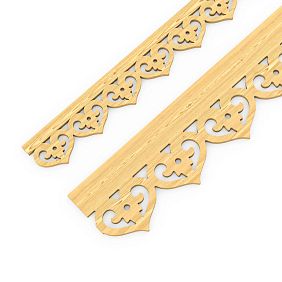
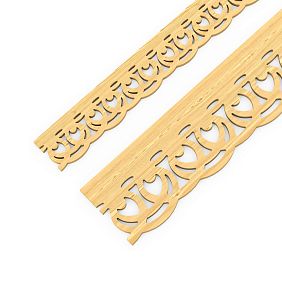
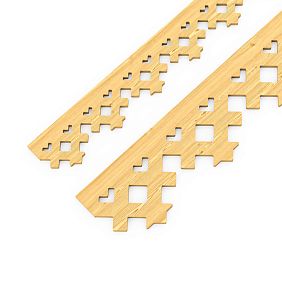
Ready-made carved architraves from the STAVROS catalog are products 2000 mm long, 18 mm thick, with widths from 114 to 250 mm, featuring ornaments from several collections. They are all made from glued pine panels with defects removed, sanded, and supplied without a finish coating — ready for processing for your project.
This is the main advantage: predictability. You know exactly what you'll get. You can evaluate the ornament in advance, see how it looks in examples in the section ideas for using carved decor, and make an informed decision.
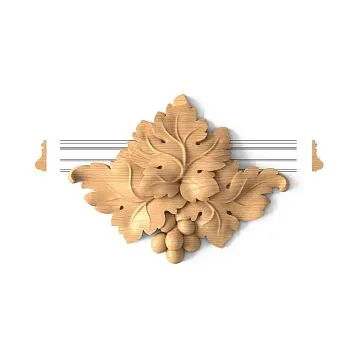
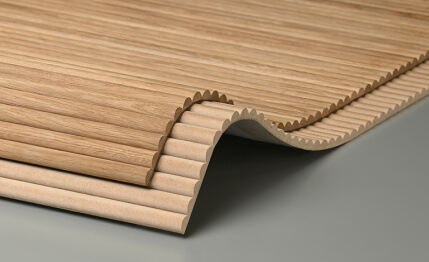
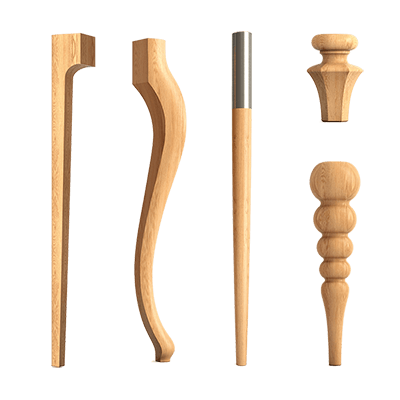
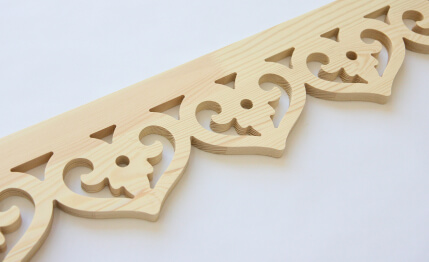
Our factory also produces:




Custom architraves: a personal project
A custom architrave is a product made specifically to your parameters. There is no ready-made sample here: everything starts with measurements, a sketch, approval of the ornament, material, thickness, and width. Then comes production and inspection. This path is longer, requires a clear technical specification, and patience.
But in a number of situations, this very path is justified — and we will discuss them separately.
Get Consultation
What to choose: comparison by key criteria
To make an informed choice, it is helpful to go through the main parameters and honestly answer the question: what is more important for your project?
| Criterion | Ready-made architraves | Custom architraves |
|---|---|---|
| Speed of delivery | High (from a few days) | Low (from a few weeks) |
| Predictability of result | High: you see the product | Depends on the quality of the technical specification |
| Cost | Below | Higher |
| Flexibility of sizes | Limited by standards | Any size |
| Ornament | From the catalog | Any |
| Convenience of selecting a set | High | Requires design |
| Suitable for standard windows | Yes | Yes |
| Suitable for non-standard tasks | Partially | Yes |
For most wooden houses, bathhouses, gazebos, and dachas — the first column covers all tasks. The second is needed in specific cases, which we will discuss below.
When ready-made carved architraves are the right choice
This is the most common and practically universal scenario. Here are the situations in which ready-made house carving works perfectly.
Standard window openings
Window openings 600×900, 900×1200, 1000×1400, 1200×1500 mm — these are all standard formats for which a standard trim 2000 mm long fits without alterations or with minimal length trimming. Trimming is not a problem or a drawback. It is a common construction practice: the plank is cut to the required length on site, preserving the pattern from the neutral end.
If your window height does not exceed 2000 mm — the standard length covers the opening completely. If slightly larger — two elements with a joint or a special insert. In 90% of private houses, the window opening height ranges from 1000–1800 mm, which fully fits the standard.
A wooden house without historical requirements
If the task is to create a beautiful, expressive facade of a wooden house with ornamental decor, but without recreating a specific historical sample, ready-made trims solve the problem completely. The catalog includes both classic ornaments, folk motifs, and modern geometric patterns. Choose according to the house architecture — and the result will be flawless.
You can view ornament options and compare them in the section of carved decor for the facade — there the full range of products is presented with filtering by style, ornament, and size.
Bathhouse, gazebo, dacha
For small buildings — bathhouses, garden gazebos, dacha houses, summer kitchens — ready-made trim is simply ideal. There is no need for custom production here: sizes are standard, the task is aesthetic, and speed is more important than uniqueness.
Wooden trim for bathhouses from the catalog is installed quickly, painted in the desired color, and lasts for seasons without losing shape — provided proper finishing treatment. The same applies to gazebos and dachas: a ready-made solution here is not just "sufficient," but optimal.
When speed matters
The construction season doesn't wait. If a house is being built or renovated in spring, and trim is needed by June, a custom order may simply not arrive in time. Ready-made products are a different story: ordered, received, treated, installed.
This is especially relevant for dacha construction, where everything is done seasonally, and no one wants to postpone work to the next year.
When you need to decorate several buildings in a unified style
House, bathhouse, gazebo, fence with gates, guest house — a typical set of objects on a large plot. Decorating them all in a single decorative key is a task perfectly solved by ready-made trim from one collection. Order everything at once from the catalog: one collection, one pattern, one width. All objects look like a single ensemble.
You can try to assemble such an ensemble element by element or see examples in the section decor application ideaswhere there are examples for different types of buildings.
When the budget is limited
Let's be direct: ready-made products are cheaper than custom ones. This is an objective difference that you shouldn't be embarrassed to consider. The cost difference can be significant — especially when designing a large facade with many windows. The saved funds can be directed towards high-quality finishing, additional brackets, or other decorative elements.
When custom trims are really needed
Honest answer: less often than it seems. But there are still situations where custom production is unavoidable.
Non-standard sizes: when the numbers don't match
If the opening height is 2300–2500 mm — a standard trim 2000 mm long won't cover it with one plank. Here you either need two elements with a joint (this is solvable with connecting inserts) or a custom length.
If the opening width is such that the horizontal top element should be 1800–2000 mm or more — this is also non-standard and requires separate production.
Important: in most cases, a non-standard size can be solved with a smart arrangement of ready-made elements. Two trims with a connecting insert, a properly selected horizontal element — and the non-standard becomes standard. This is worth checking in the catalog and, if necessary, consulting with specialists.
Historical restoration
If the house is an object with historical elements that need to be recreated or preserved in their original form—an exact pattern, a specific folk ornament characteristic of the region or era—a custom order is unavoidable. No catalog can reproduce the specific Volga carving from a particular 1897 window casing.
This is a specific and rare task. It is handled by restoration architects and specialized workshops. This is not a mass product—it is custom work.
Unique custom-designed ornament
If a designer has created a custom ornament specifically for a particular house—a family crest, a ancestral pattern, a unique geometric pattern—then ready-made analogs will not exist by definition. A custom order is needed here.
This is a scenario for project-based, often expensive construction. If you are in it, you already understand that a custom order is inevitable.
Non-trivial facade system
There are projects where the facade decor is a complex multi-level system, where all elements are designed by the architect as a single whole: specific connection angles, particular relief depth, atypical profiles. For such projects, ready-made products may not fit not because of the ornament, but due to the profile and construction.
How to choose a ready-made window casing: step-by-step logic
So, you have decided to work with ready-made products. Great. Now, how to choose correctly so you don't have to redo things.
Step 1. Measure all openings
The first and mandatory step. The opening height is the length of the vertical casing. The opening width is the length of the top horizontal element. The distance from the edge of the opening to the corner of the wall or the nearest obstacle is the maximum allowable plank width.
Create a table with all windows: window 1, window 2, etc. — height, width, free field on the left, free field on the right. This will take 20 minutes but will save days of potential errors.
Step 2. Choosing the plank width
Based on the free field and the scale of the facade, the width of the casing is determined. Narrow (114 mm) — for small windows, bathhouses, gazebos. Medium (140–164 mm) — for most country houses. Wide (185–250 mm) — for large windows, the main facade, entrance areas.
More details on how width affects the perception of the facade are described in the article about carved elements for a wooden house — the logic for choosing the size with specific examples is described there.
Step 3. Choosing the ornament to match the house style
The architecture of the house dictates the ornament. A log or timber house in a traditional style — folk or classic ornament. A frame or modern wooden house — geometric pattern or light openwork carving. A dacha and garden buildings — concise, readable patterns without overload.
Look at the ornaments in the catalog and imagine them not on the screen, but on a specific wall of your house. Mentally check how the pattern will look from a distance of 10 meters — it is from this distance that the facade is perceived by passersby.
Step 4. Choosing color and finish
Ready-made STAVROS architraves are supplied without coating — this allows you to choose any color of finish. But the color needs to be thought out in advance: it affects the perception of the ornament. White or light on a dark wall — contrasting, readable, expressive. Monochrome (architrave in the color of the wall) — embossed, subtle, architectural. Dark architrave on a light wall — restrained, graphic.
Important: a number of ornaments with deep relief work significantly more expressively when painted than when impregnated. And some light openwork patterns look better when preserving the natural texture of the wood.
Step 5. Forming a complete set
Architraves are the base, but not the entire set. You need to select for them:
-
corner rosettes — to cover joints in the corners of the window frame;
-
brackets — to enhance decor in the cornice area, under canopies, near the porch;
-
connecting elements — to adjust length and cover inter-window gaps;
-
decorative overlays — for additional accents on the wall or in the cornice area.
All these elements are available in the STAVROS catalog. Wooden decorative inlays expand the kit's capabilities, allowing you to add details precisely where needed.
How to assemble a kit around a window: from the first measurement to the last nail
This is a practical section — as specific as possible. We'll break down what a complete kit for one window consists of.
Side casings
Two vertical casings — one on each side of the window opening. Length equals the opening height with a small allowance for trimming. Standard length of 2000 mm fits most openings. Installed with a 3–5 mm gap from the frame — so the casing does not directly touch the window frame and does not accumulate moisture in the joint.
Top horizontal element
Covers the opening from above. Length equals the opening width plus the width of two side casings with a slight overlap. The top element can be of the same profile as the side ones, or more decorative — with a shaped finish. It is the top part that creates an accent when looking at the facade.
Bottom strip
Not a mandatory element — used where the lower part of the window is not covered by a sill and the opening is exposed from below. The bottom strip completes the window frame and protects the lower end of the side casings from direct water ingress.
Corner rosettes
Cover the joints in four corner areas (where side casings meet horizontal ones). Without rosettes, the corners look unfinished and are technically vulnerable — the open end absorbs moisture. Rosettes are selected to match the ornament and width of the casing.
Connecting elements
Used in several situations: adjusting the length of side planks for non-standard openings without trimming the pattern, filling the space between adjacent windows, and rhythmic repetition of the ornament on long horizontal sections. They make the set universal and adaptable.
Brackets
Installed above the top horizontal casing — on the sides of the window frame. They add volume, enhance decorativeness, and create the feel of an architectural portal. For the main facade and entrance area, they are almost a mandatory element.
For the cornice area, porch, and canopies, brackets are selected separately — they can be larger and more massive than those used for windows. Options should be viewed together with casings, comparing scale and ornament. The full range of possibilities is in the section carved decor elements.
Advantages of ready-made carved casings: why it is profitable
Let's be honest and specific — without unnecessary words.
Fast. A finished product is a product that already exists. Choose, pay, receive. No approvals, no sketches, no technical specifications. If the house is being built seasonally, this is fundamental.
Predictable. You see the exact ornament, exact dimensions, exact quality. No surprises upon receipt. If you look at a photo of a casing in the catalog and you like it — that's exactly what you will get.
Cheaper. Serial production is always more economical than single production. The cost difference can be significant — especially when purchasing a large set for the entire house. The saved budget can be invested in high-quality painting, brackets, or wooden baguette for facade decoration.
Easier to assemble. All catalog elements are compatible within one collection — this is fundamentally important. A casing, rosette, bracket from the same series are guaranteed to match each other in ornament, thickness, and width. No custom fitting.
Easier to install. Finished products with clear parameters are easier to install: the thickness, plane, and corner cuts are known. Installation can be done independently, without hiring specialists.
Universal. Ready-made trims are suitable for facades, bathhouses, gazebos, verandas, porches, and country houses. One product type solves the task across multiple sites.
Common mistakes when choosing and buying trims
Mistakes happen to everyone — even those who have done this before. Here are typical scenarios to be aware of in advance.
Mistake 1. Buying without calculating the quantity
"I'll grab a couple to see" — and in the end, one window is done, the rest are not. And when you come back for the next batch, the needed item is out of stock. Calculate the full set for all windows at once, add 5–10% as a reserve.
Mistake 2. Ignoring the distance to the wall edge
A trim 185 mm wide won't fit in 120 mm of free space between the window and the corner. Measure in advance. It's 10 minutes of work that can save you rework.
Mistake 3. Buying only side trims without horizontal elements
Two side trims without a top horizontal one is not a finished window. Be sure to include the top element and rosettes in your calculation.
Mistake 4. Mixing ornaments from different styles
Folk ornament on the side casings and geometric on the top, plus an unidentified pattern on the rosettes — this is visual chaos. Stick to one collection throughout the entire set.
Mistake 5. Not planning the painting before installation
Installing the casings and then figuring out how to paint them means doing the work twice. Painting (at least primer + two coats of paint) is done before installation: then you will work on all sides, including the back and ends. After installation, this is much more difficult to do.
Mistake 6. Not considering the thickness of the casing during installation
A thickness of 18 mm is not the plane of the wall. When the casing sits on the slope, it protrudes by 18 mm. This must be taken into account when fitting rosettes, connecting elements, and horizontal planks: they all must lie in the same plane.
Mistake 7. Not treating the back side
The side that adjoins the wall is the most vulnerable. Condensation and moisture from the wall can get there. If the back side is not treated with a protective compound, the casing will start to deform from the inside. Treat all surfaces.
Selection specifics for different objects
Different objects have different priorities. Let's briefly go through the main scenarios.
Country house: main and side facades
The main facade is a showcase. Here it makes sense to take a medium or wide platband (140–185 mm) with an expressive ornament. The side facades are functional: here you can take the same ornament, but narrower (114–140 mm). The hierarchy of decor creates an interesting facade without overload.
Bathhouse: modest and high-quality
For a bathhouse, narrow or medium platbands (114–140 mm) with a laconic ornament are ideal. The main priority is the quality of the material and finish, because the bathhouse operates in conditions of high humidity. Wooden platbands for a bathhouse made of glued pine panel — the right choice precisely for this reason.
Gazebo: close scale of perception
The gazebo is viewed up close. Here the ornament should be readable from a distance of 2–3 meters. This means: detailed pattern is appropriate, fine openwork is also suitable, deep relief works beautifully. Width — moderate: 114–164 mm depending on the size of the openings.
Porch and entrance area
The entrance area is a place for maximum decor. Wide platbands (164–185 mm), rich brackets, rosettes with expressive ornament. It is here that ready-made products from a good catalog give a full result without any restrictions.
Country house: lightness and speed
For a dacha, ease of installation and lightness of ornament are important. Narrow (114 mm) or medium (140 mm) platbands with a geometric pattern, paint in one tone with the shutters — and the dacha acquires a charm that requires neither expensive design nor custom production.
In addition to platbands, the following are well suited for the dacha facade and veranda interior wooden decorative elements from the STAVROS assortment: countertops, overlays, furniture elements — they allow you to continue the wooden style indoors.
Carved platbands for painting: nuances that determine the result
A separate topic worth considering specifically in the context of finished products. Since finished platbands are supplied without coating, proper finishing is not an option, but a mandatory stage.
What is important to know:
Painting is done before installation. This allows all surfaces to be treated evenly. After installation on the wall, the back side and ends become hard to reach.
Priming is a mandatory first layer. The primer penetrates the wood pores, fixes the fibers, and ensures better adhesion of the finish paint. Without primer, the paint will quickly peel off in areas with humidity fluctuations.
Two coats of finish paint — minimum. For facade use, facade acrylic or alkyd paint with UV protection is recommended. The first coat is thin, providing color. The second is the finishing coat, leveling the surface.
The ends are treated separately. They absorb moisture particularly actively. A good practice is to apply an additional layer of primer or oil impregnation to the ends.
The ornament under paint looks different than on bare wood. The deep relief is enhanced by the contrast of light and shadow. A small flat pattern may "drown" in the paint layer. Choose the ornament considering the future finish.
Information about the material and its properties — on the page Materials and product quality: it explains why a re-glued pine panel is more stable than a regular board and how this affects the durability of facade decor.
Additional elements: how to expand the standard set
Even if ready-made trim covers the main task, you can go further and enrich the facade with additional wooden details.
wooden baguette for facade decoration — a profile strip with a neutral ornament or none at all. Used to create architectural bands, dividing lines between facade zones, and decorating gable overhangs. It pairs well with trim of any ornament — works as a background architectural element.
Wooden decorative inlays — point accent elements. They cover "empty" areas between main parts, add rhythm to long horizontal strips, decorate posts and ends of cornice boards. Small and versatile — easy to add to any set.
For those decorating a porch or staircase area, the section is useful wooden decorative elements: balusters, handrails, posts — they create a unified wooden system from the facade to the entrance.
Frequently asked questions and answers
What is better: ready-made carved trim or custom-made?
For most wooden houses, bathhouses, gazebos, and country buildings — ready-made ones. They are faster, cheaper, and more predictable in results. Custom ordering is needed for non-standard sizes, historical restoration, or unique designer projects.
Can ready-made trim be used for a wooden house?
Yes, completely. Ready-made carved trim is professional facade decor for wooden houses. It works most organically for wooden facades: the material matches, the style matches, and installation is simple.
Do I need to select additional elements to go with the trim?
For a finished result — yes. The minimum set: side trim, top horizontal element, corner rosettes. The extended set adds brackets, connecting inserts, a bottom strip, and decorative overlays.
Are ready-made trim suitable for painting?
Yes. All STAVROS ready-made trim are supplied without a finish coating — specifically so the customer can choose any color and any type of finish. The trim accept facade paint, impregnation, and varnish perfectly.
Can the entire facade be decorated with ready-made house carving?
Yes, and this is the most common scenario. Trim, brackets, rosettes, connecting elements, balusters, overlays — all of this is available in ready-made form in the catalog. By selecting elements from one collection, you can decorate the entire facade.
How do I know if ready-made trim will fit my windows?
Measure the height and width of each opening, the free space from the edge of the opening to the corner of the wall. A standard casing 2000 mm long covers openings up to 2000 mm high with trimming to the required size. Choose the plank width based on the free space and the scale of the facade.
How many elements are needed for one window?
Basic set: 2 vertical casings + 1 upper horizontal + 2–4 rosettes. The extended set adds a bottom plank, brackets (2 pcs.) and connecting inserts as needed.
STAVROS — ready-made decor for a wooden facade
Carved casings, brackets, rosettes, connecting elements, decorative overlays and wooden baguettes in finished form — all this is produced and supplied by STAVROS. Products are made from glued pine panels, processed on CNC machines, hand-sanded and supplied without a finish coating — ready for finishing for any project.
The STAVROS catalog features several collections with different ornaments — from laconic geometric to rich folk carving. Casing widths range from 114 to 250 mm. All elements are compatible within collections and allow you to assemble a complete set for windows, doors, porches, bathhouses and gazebos. Catalog filters help you quickly find the right size, ornament and product type. Delivery — throughout Russia. Start your selection in the section house carving — and decorate the facade of your home as it deserves.