Article Contents:
- A ready-made overlay and a milled facade are two different ways to achieve relief
- When a ready-made overlay is especially advantageous for a small workshop
- When milling the facade yourself can be justified
- Make-or-buy: what to actually compare, not just the price of the part
- Break-even point: when a batch starts to justify milling it yourself
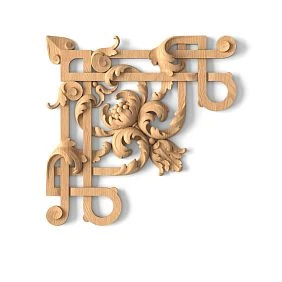
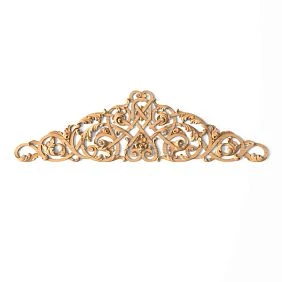
- Central overlay
- Corner overlay
- Vertical overlay
- Straight overlay
- Test Card
- Golden Sample
- Golden Sample
- First Article Inspection
- Conditional calculation of internal hours: six fronts
- Three order scales: the decision changes with the volume
- Final make-or-buy algorithm
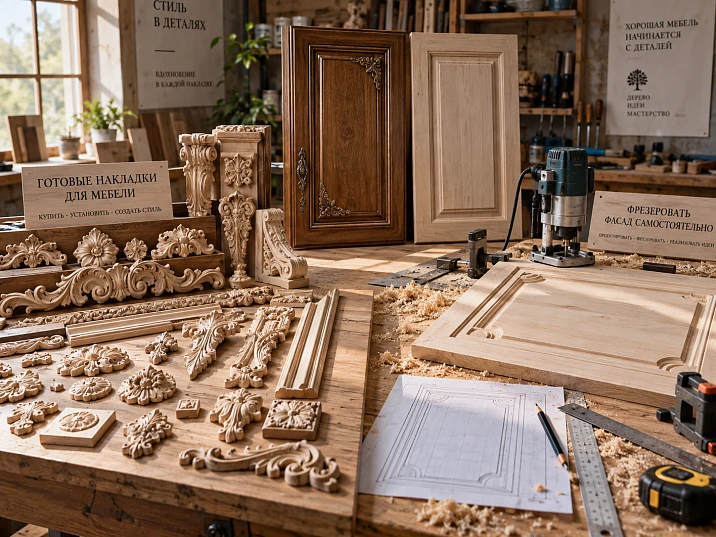
A single carved front for a chest of drawers can be made in two fundamentally different ways. The first is to turn the front itself into a relief part: build a 3D model, prepare CAM, set up the CNC, perform roughing and finishing passes, and then manually finish the relief by sanding. The second is to leave the front as an independent plane and add a ready-made wooden overlay with the complex geometry already executed.
Externally, both solutions can lead to a similar result. In production, they are two different systems.
For a small workshop, the main question is not "what looks better," but:
where is it more reasonable to spend your own time and machine resources — on creating the relief from scratch or on integrating a ready-made serial SKU into your own furniture?
The working chain for the second option:
facade → required relief → ready-made SKU → A/B/C → trial overlay → marking → own or ready-made finish → BOM → installation → repeat order.
A ready-made overlay has another property that a relief milled directly into the facade does not have: it exists as a separate replaceable commodity part. It can be calculated, ordered, stored in the BOM, repeated in the next project, and — if the SKU remains on sale — replaced separately from the facade.
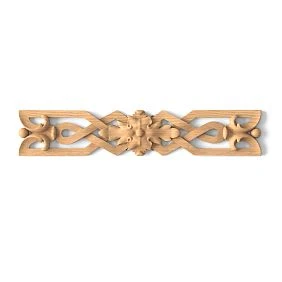
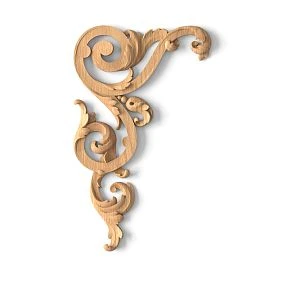

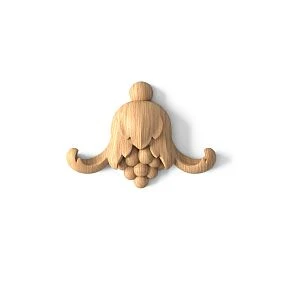
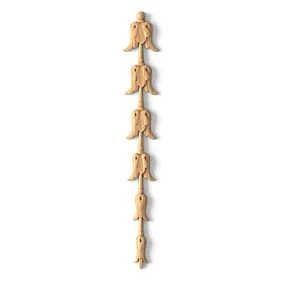

Ready-made overlay and milled facade — two different ways to achieve relief
If the ornament is milled directly into the facade, the decorative geometry becomes part of the furniture part itself.
The production chain looks approximately like this:
sketch → 3D/CAD → CAM → tool → setup → trial machining → roughing pass → finishing pass → hand finishing → sanding → finish.
A ready-made overlay follows a different logic:
select SKU → check size → test fit → prepare the facade → apply the finish → install.
The difference isn't just in the number of operations.
The relief in the facade cannot be separated from the facade.
If the relief is damaged, the furniture part itself is damaged.
If the geometry is unsatisfactory after processing, the facade is redone.
If a client asks a year later to repeat the same ornament, the workshop must retain:
- 3D model;
- CAM;
- tools;
- modes;
- sanding technique;
- attachment to a specific facade.
The finished overlay exists as a separate line item.
For example:
DEC-01 → Manufacturer → SKU → A × B × C → Material → Qty.
The facade and decor remain separate objects.
This makes it easier to:
- design;
- trial assembly;
- quantity calculation;
- replacement;
- reorder;
- small batch.
What exactly the workshop is buying.
Not "a piece of wood with a pattern."
She buys an already completed complex production operation:
- carved geometry;
- repeatability;
- serial size;
- product identity.
The in-house workshop keeps for itself:
- the facade itself;
- the layout;
- the drilling;
- the frame;
- finish;
- Installation.
This is the essence of make-or-buy.




When a ready-made overlay is especially advantageous for a small workshop
The smaller the batch and the more complex the relief, the more strongly the preparatory operations of in-house production affect each part.
Particularly illustrative scenarios:
- one cabinet;
- one chest of drawers;
- one kitchen;
- several identical fronts;
- a restoration project;
- a small batch of furniture;
- a prototype of a new model.
One cabinet.
For example, the craftsman needs:
- two central overlays;
- four corner ones;
- one set for the upper part.
For the sake of a few parts, a separate modeling and CNC cycle can turn out to be disproportionately large relative to the entire order.
One chest of drawers.
Here the scale is even more noticeable.
There are few fronts, but the ornament can be complex.
A ready-made overlay allows you to check the composition before the wood goes into machine processing.
A one-of-a-kind kitchen.
If the carved decor is repeated on part of the fronts, the workshop gets a serial geometry without having to turn each door into a separate 3D-milled piece.
Restoration.
One lost decorative detail needs to be restored.
If a serial element matches in scale and character, separately modeling a historically non-unique detail may be excessive.
But for an exact museum copy of the original, a serial overlay no longer replaces custom.
Small batch.
For example:
8 identical fronts.
Preparing your own program is divided into only eight parts.
The ready-made overlay already exists as a repeatable SKU.
This is exactly where a catalog becomes an alternative to launching your own relief production.
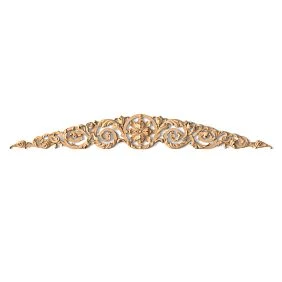
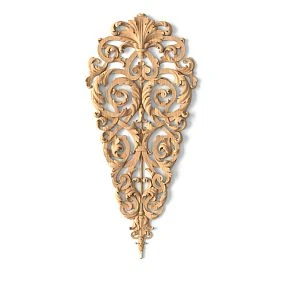
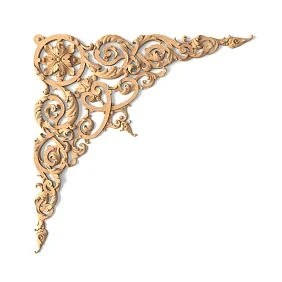
Our factory also produces:



When in-house facade milling can be justified
A ready-made SKU does not need to be declared the winner in advance.
There are situations where integrated relief is stronger.
Unique signature geometry.
If the ornament is part of the furniture's recognizability, buying a mass-produced overlay means giving up your own shape.
Then the investment in:
- 3D;
- CAM;
- the tooling;
- the program;
- trial runs
may be justified.
The relief must be part of the plane.
Some compositions are designed so that a separate overlay will look exactly like an applied part, while the project requires a solid finished surface.
Then integrated milling makes more sense.
Large repeatable series.
If a workshop produces a single facade in tens or hundreds and the program is already proven, the setup cost is spread over a large run.
The economics change.
Tooling and CAM already exist.
If the workshop has already produced the same relief, make-or-buy needs to be recalculated.
Zero modeling and zero program preparation change the initial conditions.
A non-standard scale is needed.
A serial overlay cannot simply be stretched.
If all ready-made models are too large or too small, custom may be the only correct solution.
Get Consultation
Make-or-buy: what to actually compare, not just the price of the part
Comparing the price of a wooden blank with the price of a ready-made overlay is almost pointless.
You need to compare the entire production cycle.
| Parameter | Facade milling | Ready-made overlay |
|---|---|---|
| 3D relief model | Need | not created by the workshop |
| CAM | Needed | not needed for relief |
| CNC setup | Need | No |
| machine time | Present | no for making the relief |
| test pass | often needed | replaced by SKU fitting |
| risk of relief defects | at the workshop | serial geometry already manufactured |
| sanding of complex relief | at the workshop | volume of own operations is lower |
| Repeatability | controlled by the workshop | determined by the serial SKU |
| separate decor replacement | relief = part of the facade | overlay replacement possible |
| small series | preparation is noticeable | Strong scenario |
| unique shape | Strong scenario | limited to the catalog |
A formula without made-up prices.
You can calculate it like this:
Make Cost = 3D + CAM + Setup + Machine Time + Tool Wear + Hand Work + Sanding + Risk + Rework.
Buy Cost = Overlay Price + Delivery + Incoming QC + Fitting + Finish + Installation.
Real internal workshop data is used for each project.
Break-even point: when a series starts to justify its own milling
For internal workshop calculations, it is convenient to divide costs into fixed and variable.
For in-house production:
C_make(Q) = F_make + Q × V_make
Where:
F_make— 3D, CAM, setup, test run, tooling preparation;V_make— material for one part, machine time, tooling, manual finishing and sanding of one part;Q— number of elements.
For a ready-made overlay:
C_buy(Q) = F_buy + Q × V_buy
Where:
F_buy— order preparation, delivery, or other fixed costs;V_buy— cost of one overlay plus in-house fitting and finishing.
If in-house production has a higher fixed start but a lower variable cost per unit, the theoretical break-even point can be estimated:
Q* = (F_make − F_buy) / (V_buy − V_make).
The formula is useful only when the denominator is positive: a ready-made overlay is indeed more expensive by one unit, while an in-house technology after launch becomes cheaper for each subsequent part.
If V_make not lower than V_buy, the increase in volume may not be enough for in-house milling to become cheaper at all.
Why internal hours should be counted as money.
A craftsman might say:
I'll build the model myself, so it's free.
For a business, this is not zero.
If modeling takes four hours, those four hours cannot simultaneously be spent on:
- designing another order;
- assembly;
- commercial work;
- preparation of new furniture.
The same applies to the machine.
Machine time is a limited resource.
If the CNC is loaded with case parts, the decorative relief competes with the main production program.
Therefore, to V_make it is useful to add not only direct costs, but also the cost of a production hour of equipment.
Defects should be counted as a probability, not forgotten.
A complex relief may require:
- a second pass;
- tool changes;
- corrections for under-milling;
- a new workpiece after an error.
There is no need to invent a universal defect rate.
A workshop can use its own statistics from past runs.
A ready-made overlay also has its own hidden costs.
The purchased option does not equal the card price.
Need to consider:
- delivery;
- incoming inspection;
- fitting;
- possible adjustment;
- finish;
- installation;
- a spare part, if it is really needed.
This way, the comparison remains fair for both routes.
Decision Matrix.
| Condition | More often stronger with a ready SKU | More often stronger with proprietary CNC |
|---|---|---|
| 1–10 parts | Yes | only with a ready program |
| unique branded ornament | Limited | Yes |
| no 3D/CAM | Yes | requires setup |
| program is already proven | depends | becomes more interesting |
| requires separate replaceable decor | Yes | No |
| relief should be part of the facade | Not always | Yes |
| CNC is overloaded with core work | Yes | weaker |
| large repeatable series | Calculate | Calculate |
The table does not choose for the workshop. It shows which parameters actually change the decision.
Machine time also has a cost.
Even if the CNC is your own and "you don't need to pay a contractor," the machine is not free.
While it is making decorative relief, it is not making:
- cabinet parts;
- facades;
- countertops;
- templates;
- other paid work.
This is the alternative cost of production capacity.
A small batch is especially sensitive to setup.
Program preparation can take the same time for 2 parts and for 50 parts.
Therefore, with two overlays, its share is large.
With fifty, it is much smaller.
A finished overlay is a separate furniture component, not a "final decoration"
Once the craftsman has chosen a serial overlay, it must enter the project as disciplined as a handle, leg, or molding.
Minimum entry:
Project Code → Manufacturer → SKU → A × B × C → Material → Qty.
Why a Project Code is needed.
For example:
DEC-01.
It is convenient to put a short code on the drawing.
In the BOM, the code is linked to the actual SKU.
Why one SKU is not enough.
One geometry can have different:
- materials;
- versions;
- orientations;
- dimensions.
Therefore, the entry must be unambiguous enough for reordering.
The catalog as a production tool.
At the time of checking, the official STAVROS category showed 544 items. The filters separately include:
- A — width;
- B — height;
- C — thickness;
- shape;
- ornament;
- availability.
For a furniture maker, this matters more than general style search: first you can limit the physical geometry, and only then choose the pattern.
Main section — ready-made furniture overlays.
A/B/C: ready-made decor is selected by actual dimensions before cutting the facade
A photograph shows the pattern well.
It poorly shows how much space the part will occupy on the actual facade.
Therefore, before approving the SKU, you need to obtain the actual A/B/C.
In the current STAVROS catalog, the filters directly separate:
- A — width;
- B — height;
- C — thickness.
This allows the choice to be based on geometry.
Free field of the facade.
Conditional example.
Facade:
W = 480 mm.
After the molding frame, an inner field remains:
W_free = 320 mm.
Overlay:
A = 220 mm.
Free space:
(320 − 220) / 2 = 50 mm
on each side.
If you choose an overlay:
A = 290 mm,
will remain:
15 мм.
Formally, the part fits.
Compositionally, it may already almost "cut into" the frame.
Height works the same way.
The overlay may fit by width but overlap:
- with the handle;
- a panel;
- the top frame;
- other decor.
Therefore, the entire A×B rectangle is checked.
Thickness C affects the relief and joints.
The overlay depth changes:
- shadow;
- protrusion;
- proximity to the handle;
- the ability to open the adjacent door;
- overall visual weight.
C cannot be considered a secondary parameter.
SKU cannot be scaled to the project.
If the actual overlay is 220 mm wide, but the designer reduced it to 180 mm in 3D, the project no longer contains the real product.
A different SKU or a custom one is needed.
Central, corner, vertical, and straight overlays solve different production tasks
The STAVROS category allows filtering overlays by shape. For a workshop this is convenient, because the function becomes the first level of the shortlist.
Central overlay
central overlays used for:
- in the center of the cabinet door;
- on the chest of drawers front;
- on the kitchen cabinet door;
- at the headboard;
- in the decorative panel.
Checked:
- X axis;
- Y axis;
- free field;
- handle;
- molding frame.
Corner overlay
Works together with the frame or corner of the front.
Here, what matters is:
- corner geometry;
- size;
- orientation;
- outer size of the composition;
- pairing.
Vertical overlay
Vertical decorative overlays convenient on:
- tall cabinets;
- pencil cabinets;
- side pilasters;
- long panels;
- narrow doors.
On an elongated facade, this shape can work more naturally than a large central cartouche.
Straight overlay
Straight decorative overlays You can use:
- horizontally;
- vertically;
- as part of a composite composition;
- in a long decorative band.
Curved shape.
The presence of the "curved" filter does not mean that any wooden overlay can be bent on site.
A curved element must be initially designed for the corresponding geometry.
If the facade is radiused, the following are checked:
- actual form;
- bend direction;
- compatibility with the radius;
- mounting plane.
There can be no universal claim that it "fits any radius."
L/R and paired overlays: a mirrored image does not make parts interchangeable
Asymmetric elements may have left and right variants.
For production, these are different items.
If, hypothetically, there is:
N-XXX-L
and:
N-XXX-R,
you cannot write in the BOM:
DEC-02 × 4.
Correct:
DEC-02-L × 2
DEC-02-R × 2.
Why Mirror in 3D is not enough.
The visualizer can mirror a single model.
The supplier still ships physical SKUs.
A quantity error halts assembly.
Three left and one right overlay do not form a symmetrical set.
Therefore, the sides are counted separately until the order itself.
The stock is also separate.
If a reserve is needed:
Spare L
and:
Spare R.
An extra left part does not cover a shortage of the right one.
The overlay, handle, and moulding frame are designed simultaneously
The most common mistake in facade composition does not arise from the overlay itself. The conflict appears between several already selected elements.
For example:
- central overlay;
- furniture handle;
- molding frame;
- panel.
Each object individually can be correct.
Together they may not fit.
First, the outer contour.
Conventionally:
W_facade = 500 mm.
The molding frame forms:
W_inner = 340 mm.
This is the actual area for the overlay and handle.
Then the overlay.
Let:
A_overlay = 220 mm.
Free space:
(340 − 220) / 2 = 60 mm.
Then the handle.
If the handle is positioned below the overlay, check:
- actual dimensions;
- overhang;
- hand zone;
- distance to the relief.
Frontally, the elements may not intersect.
But when opening, the hand will pass near the relief.
The frame is built according to the actual profile.
Not along a conventional line.
If the molding width changes, the inner field changes as well.
This may require:
- replacing the overlay;
- moving the handle;
- change the front
- change the frame itself.
Correct order.
outer front size → actual frame profile → inner field → overlay → handle → movement check.
Not the other way around.
Beech, oak, and custom finish: ready-made geometry does not replace the workshop's finishing
A ready-made wooden overlay is especially convenient because the workshop can buy a complex shape while keeping its own finishing system.
For opaque enamel.
The main factors become:
- geometry;
- surface quality;
- preparation;
- compatibility with the painting technology.
The wood texture fades into the background.
For a transparent coating.
More important:
- wood species;
- pattern;
- shade;
- grain direction;
- combination with the front.
You can't make a universal rule like "beech for enamel, oak for lacquer."
The specific choice depends on:
- the actual product;
- the workshop's technology;
- the desired visual result.
The material must be verified against the card of the selected SKU.
Overlay for enamel.
A strong B2B scenario:
finished geometry → primer → painting together with the facade → installation / assembly.
As a result, the decorative element is perceived as part of the overall furniture surface.
When to finish separately.
Sometimes it is technologically more convenient to fully finish the overlay before installation.
For example, if:
- complex relief;
- access from all sides is required;
- installation after finishing will not damage the coating.
There is no universal rule.
The decision depends on:
- mounting method;
- coating systems;
- facade structures;
- required quality.
Finish Code.
For repeatable furniture, it is useful to store:
DEC-01 / SKU / Material / F-03.
Where:
F-03
— the workshop's internal finish code.
This way, reordering the geometry is not mixed up with repeating the finishing process.
Trial overlay: one part is cheaper than a series of wrong fronts
For a new SKU, it is especially useful to buy one trial overlay before launching a series.
It tests several hypotheses at once.
Actual size.
Catalog data is transferred to the real front.
Scale.
On screen, the overlay may appear small.
On a 350 mm wide door, the same part may take up half the field.
Depth.
The relief is perceived more strongly in reality than in the frontal visualization.
Surface.
It's understandable:
- how much preparation is required;
- how the sanding behaves;
- how the primer goes on;
- how convenient it is to paint deep areas.
Installation.
A test piece shows:
- the actual mounting plane;
- fit;
- the need for local adjustment.
Test Card
| Check | Result |
|---|---|
| SKU confirmed | yes/no |
| A/B/C | approved/reject |
| Visual Scale | approved/reject |
| Mounting | approved/rework |
| Finish Test | approved/reject |
| Facade Compatibility | approved/reject |
| Series | ready/hold |
When you can skip the test piece.
If the SKU has already been used by the workshop and:
- size is known;
- finish is known;
- installation method is finalized;
- facade is standard.
Then the overlay is already a MASTER component.
Moving a trial SKU into series: first master facade, then repeat
If the furniture contains several identical facades, after checking one overlay you do not need to immediately install the decor on all parts.
First, one master facade is assembled.
The following are approved on it:
- overlay;
- molding;
- handle;
- coordinates;
- finish;
- installation method.
Only after the status:
APPROVED
the solution is repeated.
Why this matters.
A single overlay can be correct.
But its position on the facade is incorrect.
It is master facade that checks the entire assembly, not the product separately.
Production Release.
Can be written:
FACADE-A / DEC-01 / MLD-01 / HND-01 / REV03 / RELEASED.
What gets frozen.
- SKU overlay;
- coordinates;
- orientation;
- the material;
- finish;
- adjacent elements;
- drawing revision.
What happens when it changes.
If the overlay is shifted by 20 mm, the SKU stays the same.
But the drawing revision changes.
If the SKU changes, the entire assembly is rechecked.
BOM: the overlay must be counted as a separate line, not as a “decor as a set”
The Bill of Materials is needed precisely so that serial decor remains a separate product item.
Example:
| Code | SKU | Element | Material | Qty per facade | Facades | Calculated Qty |
|---|---|---|---|---|---|---|
| DEC-01 | … | central overlay | beech | 1 | 6 | 6 |
| DEC-02-L | … | corner L | beech | 2 | 6 | 12 |
| DEC-02-R | … | corner R | beech | 2 | 6 | 12 |
Why “decor — 1 set” is bad.
it is impossible:
- recalculate;
- replace one item;
- place a reorder;
- view L/R;
- compare the cost;
- check the delivery.
Qty per facade.
If one central overlay is on each front:
1 × 6 = 6.
Paired elements.
If there are two left and two right:
2 × 6 = 12 L
2 × 6 = 12 R.
Spare Qty.
The reserve is calculated separately.
For example:
Calculated = 6
Spare = 1
Order Qty = 7.
Why an automatic 10% buffer isn't needed.
For six overlays:
6 × 1.1 = 6.6.
This is not a purchasing figure.
A real decision needs to be made:
- 6;
- 7;
-
Depending on:
- risk of damage;
- the reorder lead time;
- the criticality of the series;
- the cost of the part.
Ready-made overlay and furniture repairability
A separate overlay element offers an important advantage over integrated milling.
If the relief is cut into the facade and damaged, it is often necessary to restore or replace the entire facade.
If a separate overlay is damaged, theoretically only it can be replaced.
Key condition:
the same SKU must be available or a compatible replacement must be confirmed.
This is not an absolute advantage.
If the product is discontinued, the problem returns.
Therefore, it is useful for the workshop to keep:
- Manufacturer;
- SKU;
- A/B/C;
- Material;
- URL;
- photo;
- project.
Repair after several years.
If the overlay is painted together with the facade, a single physical replacement may not be enough.
It is necessary to replicate:
- finish;
- tone;
- patina;
- visual match.
But replacing a single element is still potentially easier than reproducing the entire relief facade.
Service Spare.
For critical custom furniture, you can order:
1 spare.
And store it together with the project documentation.
This is especially useful for:
- rare SKU;
- long-term project;
- remote site.
How to store finished overlays in the workshop library
After a successful project, there is no need to search again for "the same curl."
Create a simple card.
| Field | Value |
|---|---|
| Code | DEC-01 |
| Manufacturer | STAVROS |
| SKU | real |
| Form | central / vertical / corner |
| A/B/C | actual |
| Material | beech / oak |
| Finish | F-03 |
| Used In | PROJECT |
| Photo | result |
| URL | clean |
| Status | MASTER |
Why photos are useful.
It shows:
- the real scale;
- the finishing result;
- composition.
But a photo does not replace the SKU.
Used In.
The past project field is especially valuable.
You can open the finished furniture and see:
- how the overlay worked;
- what the front was;
- which finish;
- what the neighboring elements were.
MASTER and PROJECT.
PROJECT
— selected for the current order.
MASTER
— verified and suitable for reuse.
Not every beautiful overlay should become a MASTER.
Reorder: repeatability is based on SKU, not on external similarity
Three months later, the client requests a second wardrobe.
Weak process:
find a similar overlay in the catalog.
Strong:
DEC-01 → SKU → Material → A/B/C → Finish → URL.
Reorder Card.
| Field | Value |
|---|---|
| Code | DEC-01 |
| SKU | real |
| Material | beech |
| A/B/C | actual |
| Finish | F-03 |
| Facade | F-01 |
| Qty per facade | 1 |
| Status | MASTER |
Before reordering.
Check:
- the SKU still exists;
- the same material is available;
- dimensions have not changed;
- the required quantity can be ordered;
- the finish process has been preserved.
Golden Sample
For a repeatable series, you can keep one sample chip or one finished sample with the finish.
A new batch is compared against it.
What to do if the original sample chip is no longer available
This is not a purchasing trifle.
A replacement may change the front.
A new SKU is compared by:
- A;
- B;
- C;
- shape;
- ornament;
- material;
- orientation.
Three outcomes.
1. Fully compatible.
The new part fits into the existing field and does not change the composition.
2. Geometrically compatible, visually different.
The facade needs to be rechecked.
3. Does not fit by size.
Need to change:
- facade;
- the frame;
- the handle;
- the decor itself.
New revision.
DEC-01 REV01 = old SKU
DEC-01 REV02 = new SKU.
You cannot change only the BOM.
The drawing must be updated as well.
Otherwise, the workshop produces the old geometry while procurement purchases the new item.
Ready-made overlay and rosette: they can be combined, but the composition must have a hierarchy
Wooden sockets can complement overlays.
For example:
- a vertical overlay forms direction;
- the rosette creates a center;
- the molding assembles the frame.
But you shouldn't turn the facade into a catalog of all types of decor.
One element should be the main one.
If the central overlay is already large, an additional rosette may be unnecessary.
Several elements must have real geometry.
Checked:
- dimensions;
- the axes;
- fields;
- depth;
- quantity.
Composite Assembly.
Can create:
DEC-SET-01.
Inside:
DEC-01;RST-01;MLD-01.
But the BOM still stores each SKU separately.
Practical scenario: six cabinet fronts — ready-made overlay versus custom CNC
Conditional project.
Cabinet:
- 6 identical fronts;
- central relief;
- frame;
- handle.
The workshop is considering two routes.
Option A — custom 3D milling.
You need to:
- build the relief;
- prepare CAM;
- make a test;
- process 6 fronts;
- perform sanding;
- control repeatability.
Plus: the relief is fully integrated into the facade.
Minus: the entire cycle rests with the workshop.
Option B — ready-made overlay.
You need to:
- select SKU;
- check A/B/C;
- buy 1 trial;
- assemble master facade;
- approve;
- order 6 + reserve if needed;
- execute finish;
- install.
Conditional geometry.
Facade:
W = 520 mm.
After the frame:
W_free = 350 mm.
Overlay:
A = 230 mm.
Free field:
(350 − 230) / 2 = 60 mm.
The handle is located below the overlay and does not conflict with it.
What economics solves.
If the workshop:
- has no ready-made model;
- has no CAM;
- the series has only 6 fronts,
a ready-made overlay eliminates several preparatory operations.
If the same front is repeated across 300 products, custom milling may become more worthwhile.
The solution is not universal.
The main criterion:
how preparatory costs are distributed across the actual production run and how important unique geometry is.
This is exactly how make-or-buy turns from a matter of taste into a production decision.
From the make-or-buy decision to production and ordering
Once the workshop has chosen a ready-made overlay instead of custom milling, what begins is not a "simple purchase of decor" but a short production cycle. Its purpose is to preserve the link between the real SKU, the front, and the future repeat.
Marking must be based on the actual part.
Even if the catalog offers A/B/C, it is useful to check a specific sample before the production run.
Especially if it is an overlay:
- large;
- asymmetrical;
- has a complex mounting plane;
- refers to L/R;
- is used next to the handle;
- is part of a composite frame.
The layout must specify:
- where the X axis is;
- where the Y axis is;
- from which edge the base is built;
- what the orientation is;
- where the mounting plane is;
- what is considered the center of the element.
For a symmetrical central overlay, the geometric center is often obvious.
For an asymmetrical one, it is not.
Pivot in 3D and the mounting base are different things.
If the visualizer uses a 3D model, its pivot can be placed anywhere.
The production drawing should not automatically inherit this point.
The base is defined by the actual geometry:
- center;
- mounting edge;
- axes of symmetry;
- to the control overall dimension.
This way, replacing the model does not accidentally shift the overlay.
Installation cannot be described with a universal adhesive or fastener.
Different products, substrates, and finishes require different solutions.
Therefore, the article should not claim:
all wooden overlays are attached in one way.
Before production, it is necessary to check:
- facade material;
- pad material;
- surface preparation;
- the specified finish;
- a specific recommendation for the product and the installation system used.
Dry Fit before finishing.
A dry fit is useful for a new SKU.
On a facade without a final coating, the following are checked:
- position;
- edges;
- fit;
- adjacent elements;
- handle;
- frame.
If an error is found now, it is usually easier to fix than after enamel or tinting.
An overlay painted together with the facade.
One of the strong scenarios for furniture to be finished with enamel.
The facade and decor receive a unified color.
But the technological sequence must be chosen in advance.
The options may differ:
- first attach and paint together;
- paint separately and install afterwards.
Which path is better depends on:
- geometry;
- coating systems;
- access to the relief;
- risk of damaging the finish;
- requirements for the joint.
There is no need to turn a private production technique into a universal rule.
Overlay for a clear finish.
Here the match of the material becomes more noticeable.
It is necessary to assess:
- tone;
- wood grain;
- grain direction;
- adjacent facade;
- the remaining overlays of the set.
For a series, it is better to lay out the parts by fronts before the final finishing.
Incoming QC: incoming inspection of the finished series.
A purchased SKU reduces the volume of in-house production, but does not remove the need for control.
For a batch of overlays, check:
- SKU;
- quantity;
- L/R;
- the material;
- A/B/C;
- damage;
- surface;
- pairing.
For a small series, all parts can be checked.
Why the same SKU should be inspected as a set.
Natural wood has visual variability.
On six different pieces of furniture, this may be insignificant.
On a single facade block next to each other, it is more noticeable.
Therefore, before a clear finish, the parts are best distributed deliberately.
Golden Sample
After a successful first item, the workshop can keep:
GS-DEC-01.
This:
- one physical overlay;
- or a fully finished sample with finish;
- or a detailed documented master facade.
Golden Sample helps with:
- new batch;
- reorder;
- replacement;
- finish control.
First Article Inspection
The first facade of a small series is checked as a reference.
Checklist:
- correct SKU;
- correct orientation;
- A/B/C match the project;
- the overlay sits on the approved axis;
- the handle does not conflict;
- the molding does not conflict;
- finish approved;
- installation is clear.
Only after this do the remaining fronts get release.
Production package.
Minimum:
- Carved wooden decoration;
- Wooden sockets;
- Wooden moldings for furniture;
- Mounting and finishing materials.
- 4 h — 3D;
- 2 h — CAM;
- 1 h — setup and test;
- 1.5 h — machine time per front;
- 0.5 h — manual finishing of the relief per front.
- 1.5 h — SKU selection and verification;
- 0.5 h — trial fitting;
- 0.4 h — marking, adjustment, and preparation of one overlay for its own process.
- obtain data for the specific element;
- create a template for the required facade radius;
- check the fit;
- only then approve the SKU.
- the central part;
- two side parts;
- four corner parts;
- molding.
DEC-C × 1;DEC-L × 2;DEC-R × 2;CORNER-L × 2;CORNER-R × 2;MLD-01 × cut plan.- size;
- axis;
- adjacent elements;
- free fields;
- overall visual weight.
DEC-SET-01DEC-SET-02.- machine time for 12 facades;
- manual sanding;
- the price of 12 ready-made overlays;
- own finish;
- the risk of rework;
- equipment load.
- the machine is the bottleneck;
- manual finishing of the relief is too labor-intensive;
- the overlay is needed as a replaceable component;
- the workshop wants to keep one base front for several decorative variants.
- 4 wide fronts;
- 6 narrow;
- 2 tall.
- Should the relief be an inseparable part of the facade, or is a separate applied element acceptable?
- How many truly identical repeats will be produced?
- Does the workshop have free production capacity for this operation?
- Will separate replaceability of the decorative element be needed in the future?
- Will the same design be retained in subsequent orders, or will each project be new?
Where to buy ready-made furniture overlays.
Main category:
ready-made furniture overlays.
For narrower shapes:
For related components:
Queries like "buy furniture overlays", "buy decorative furniture overlays", "buy wooden furniture overlays", "carved wooden overlays for furniture", "buy decorative overlays for furniture fronts", "buy ready-made furniture overlays" are united here by one task: to choose a real serial element that is economically and geometrically suitable for a specific furniture production.
Conditional calculation of internal hours: six fronts
Below is not a standard or a "market average", but a model that a workshop can replace with its own values.
Suppose the own relief requires:
For six fronts:
F_make = 4 + 2 + 1 = 7 h.
Variable part:
V_make = 1.5 + 0.5 = 2 h per facade.
Total:
7 + 6 × 2 = 19 h of internal time.
Conditional route with a ready-made overlay:
Total internal time:
2 + 6 × 0.4 = 4.4 h.
The price of the overlays themselves, delivery, and finishing must be added to this. For the in-house option — material, tooling, depreciation, electricity, and the risk of rework.
The purpose of the calculation is not to prove that one option is cheaper. It shows which line items a workshop usually forgets to compare.
If the CNC is idle, the conclusion may change.
Production load is a separate factor.
If the machine is free, the in-house operation has one opportunity cost.
If the CNC order queue is fully booked, 12 hours of decorative processing could delay more important work.
That is why make-or-buy is sometimes decided not by cost but by the production bottleneck.
If the facade is expensive, an integrated relief increases the cost of an error.
When milling a relief, the error occurs on the furniture part itself.
With a ready-made overlay, the facade can be manufactured separately, and the decorative element can be checked before installation.
This does not eliminate all risks, but distributes them between two components.
If the overlay is expensive, the finished SKU also requires verification before ordering a batch.
One cannot assume that purchased geometry is automatically safe.
One incorrect model ordered in a quantity of 30 pcs. creates its own type of expensive mistake.
Therefore, a trial sample remains an important part of the buy scenario.
Radius facade and curved overlay: verification with a template.
If the surface is not flat, A/B/C alone is not enough.
Control of the actual shape will be required.
Working method:
If the geometry does not match, you cannot "stretch" the array to the required radius without a confirmed technology.
A composite composition made of several overlays.
Sometimes a single facade is assembled from:
Here, make-or-buy should be calculated not for each overlay separately, but for the entire decorative assembly.
For example, in-house CNC milling may prove more cost-effective if the entire complex ensemble is produced in a single pass across the facade.
And conversely, a set of ready-made SKUs may be more cost-effective if the workshop avoids several different 3D models and manual finishing.
Compositional BOM.
For such a facade, you can store:
ASSEMBLY DEC-A.
Inside:
Assembly helps replicate the facade, but does not replace individual SKUs.
Replacing one item should not automatically change the entire set.
If the central overlay is missing, only its replacement is checked first.
But then the entire composition is reassessed:
A local replacement can change the balance of the entire facade.
A separate overlay simplifies the variability of the furniture collection.
A single base front can be used with different decorative packages.
For example:
FACADE BASE-A
Or:
This allows the workshop to create model variants without completely changing the front technology.
But each set must have its own BOM and APPROVED composition.
When this is commercially useful.
For custom furniture, the base carcass can remain stable while the decorative program changes to suit the client.
In this scenario, ready-made overlays work as a configurable product layer.
This is no longer just CNC savings.
It is a way to separate the core furniture platform from the decorative variant.
Three order scales: the solution changes with the volume
One chest of drawers.
Two decorative overlays are needed.
If you don't have your own ready-made file, running a separate 3D → CAM → CNC cycle for just two parts usually requires especially careful calculation of prep hours. A ready-made SKU here offers maximum organizational simplicity: choose, check, order two parts, and integrate them into the facade.
Twelve facades.
The prep costs of your own CNC are already spread over a larger run. The decision becomes less obvious. You need to compare:
It is precisely at this scale that the break-even formula is useful, not intuition.
One hundred identical fronts.
If the geometry continues to repeat, in-house 3D milling can gain a strong advantage: the model, CAM, and setup are already spread across a large production run.
But even here, a ready-made SKU can win if:
Quantity alone does not determine the winner. It changes the weight of fixed costs.
A project made of different fronts.
Another borderline scenario is a kitchen or wardrobe where there are formally many doors, but the actual relief differs.
For example:
If each type requires a separate 3D relief model, "12 fronts" no longer means one repeatable series.
Ready-made overlays may be more convenient because the same serial part is transferred between several base fronts without new CAM.
Conclusion for calculation.
Before choosing a technology, count not the total number of doors, but the number of identical production repeats.
This is a more accurate indicator for make-or-buy.
Final make-or-buy algorithm
1. Determine whether a unique relief is needed.
If yes — evaluate CNC/custom.
If no — check the catalog of ready-made SKUs.
2. Filter by shape and A/B/C.
Not from a photo.
3. Gather 3–5 candidates.
4. Compare the full Make Cost and Buy Cost.
Not just the material.
5. If the SKU is new — order one sample front.
6. Build the facade around the actual geometry.
7. Check the handle and the molding frame at the same time.
8. Choose the finishing technology.
9. Assemble the master facade.
10. Lock the APPROVED SKU and revision.
11. Calculate Qty per facade × Number of facades.
12. Decide Spare Qty separately.
13. Issue the BOM.
14. Conduct a First Article Inspection.
15. Only after that, start mass production.
16. Save the Reorder Card and Golden Sample.
17. For replacement, return the new SKU to the facade verification stage.
Control question before the final technology selection.
Before deciding between make or buy, it is useful to answer five more questions:
If the relief is unique, there are many repeats, the CNC is free, and replaceability is not needed, then an in-house technology becomes stronger.
If the batch is small, the ornament is serial, the machine is loaded, and the craftsman wants to keep the same base facade for different decorative programs, a ready-made applied element gains the advantage.
This check is useful even before choosing a specific ornament: it prevents wasting time selecting a beautiful SKU in a project where an integrated relief is structurally required, and vice versa, it does not force launching a complex CNC process where a serial applied element already solves the task.
Final formula:
NEED RELIEF → OWN CNC OR READY SKU? → CHECK A/B/C → TEST ONE OVERLAY → BUILD FACADE AROUND REAL DIMENSIONS → FINISH → BOM → ORDER → REORDER.
For a small workshop, a ready-made wooden applied element is not just a way to “decorate the facade.” It is an opportunity to buy an already completed complex operation as a repeatable component and to focus its own CNC, time, and manual work on those parts of the furniture that truly need to be unique. But the advantage arises only when the serial SKU fits in geometry, material, and production logic. If the workshop has to almost completely rework the ready-made part, make-or-buy must be recalculated.