






























































Article Contents:
- Carved table base STL-007: what the buyer gets by default
- Wooden table frame disassembled: who such an order suits
- Assembled table support: when assembly and gluing are better ordered at once
- Carved table base made of beech or oak: material is chosen together with finish
- Solid wood support for enamel or tinting: what is the difference when ordering
- Wooden table base "Standard" or "Prestige": how much preparation remains for the finisher
- Table frame STL-007 and tabletop: what to check before payment
- Why first approve the tabletop, and then choose the readiness level of STL-007
- How to prepare a workspace if STL-007 arrives disassembled
- Mistakes when choosing the STL-007 configuration
- Three practical scenarios for ordering STL-007
- How to accept STL-007 before assembly or finishing
- At what point to attach the tabletop
- Assembly before painting or painting before assembly
- When choosing the assembled option saves not time, but risk
- When the disassembled option gives more control
- How to formalize the decision in one document
- 1. SKU and current size
- 2. Material
- 3. Sanding quality
- 4. Re-gluing quality
- 5. Degree of readiness
- 6. Assembly contractor
- 7. Tabletop
- 8. Tabletop attachment
- 9. Final height
- 10. Finish
- 11. Delivery
- 12. Drift
- 13. Acceptance
- 14. Order comment
- When can you click "checkout"
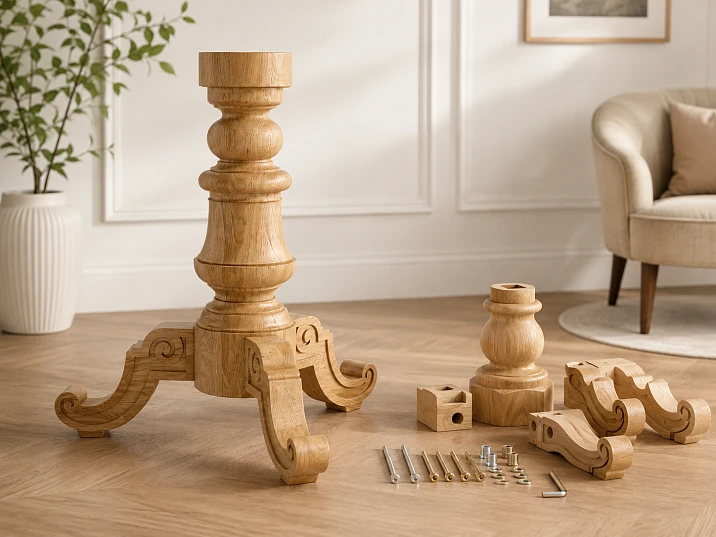
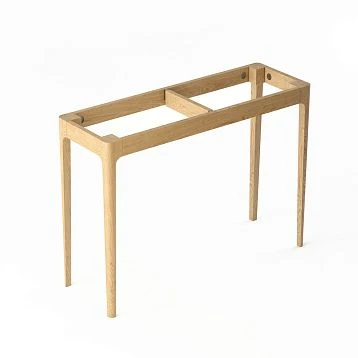
A buyer sees a carved underframe, chooses beech or oak, quality of sanding and finish option, adds the item to the cart — and easily misses the most important line in the product card. STL-007 is shipped disassembled by default. Furniture hardware is included. If a pre-assembled and glued version is needed, this must be specified in advance to the manager in the order comment.
Therefore buy carved underframe STL-007 It matters not only in the right material and color preparation, but also in the right degree of readiness. For a carpentry workshop, disassembled delivery may be more convenient: elements are easier to accept, finish, and assemble in their own technological chain. For a private buyer without a furniture craftsman, the same kit can become an unexpected task — hardware is there, but a ready base for the tabletop is not yet.
The current table on the STL-007 card shows the size 685 × 757 × 174 mm in A × B × D notation. These are the data to use when ordering. Below on the same page, an old SEO text remains, where the size 900 × 760 × 332 mm appears. It contradicts the current table and drawing. For a new article, specification, and correspondence with the manager, the correct starting point is 685 × 757 × 174 mm.
There is another boundary that cannot be blurred. STL-007 is an underframe, not a finished table. The card does not state that a tabletop is included in the product. Before payment, the buyer needs to separately decide which tabletop will be installed, how it is attached, what its actual size and weight are, what overhang relative to the underframe is required, and how the entire system will fit into the room after assembly. Compatibility of STL-007 with any round, oval, rectangular, wooden, stone, or glass tabletop cannot be automatically promised.
The short algorithm for selecting the configuration looks like this:
-
record the current article number and size STL-007;
-
choose beech or oak;
-
select "Standard" or "Prestige";
-
decide whether it will be opaque enamel or semi-transparent tinting;
-
determine who is responsible for assembly and gluing;
-
if you don't have your own craftsman, request an assembled and glued version in advance;
-
separately agree on the tabletop and its mounting;
-
clarify the packaging specifically for the chosen degree of readiness;
-
check the delivery into the building;
-
record all parameters in the order comment before payment.
This sequence is more important than the usual question "which base is prettier." A mistake in color is unpleasant; a mistake in configuration stops the entire table project.
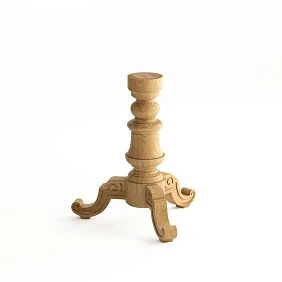
Carved table base STL-007: what the buyer gets by default
The current STL-007 card provides several levels of information that are useful to separate: dimensions, material, preparation quality, and delivery format.
| Parameter | Current STL-007 data |
|---|---|
| Article number | STL‑007 |
| Product type | carved table base |
| Size A × B × D | 685 × 757 × 174 mm |
| Material | Beech or oak |
| Sanding quality | "Standard" or "Prestige" |
| Regluing quality | For enamel or tinting |
| Default delivery | Exploded view |
| Hardware | Included |
| Assembled version | must be specified separately to the manager |
| Assembled version per card | assembled and glued |
| Delivery | Across Russia |
| Tabletop included | Not confirmed by the card |
The main commercial fact is in the product description: disassembled delivery is the default scenario. That is, the buyer's silence does not mean "please assemble." On the contrary, if no other instruction is given, the order should be perceived as a set of parts and the provided furniture fittings.
Fittings are included — what this means in practice
Having fittings is useful: the buyer does not need to guess the type of fastening kit on their own just from photos. The card also shows the fastening options FUR 001 and FUR 012.
But the phrase "fittings are included" does not mean:
-
that the product is already assembled;
-
that the joints are already glued;
-
that the tabletop is installed;
-
that the table is ready for use immediately after unpacking;
-
that the box necessarily contains wood glue, clamping devices, tools, and a mounting template;
-
that self-assembly does not require skill.
Fittings are part of the connection system. Assembly and gluing are separate operations.
Why "disassembled" should not be perceived as "just need to tighten a couple of screws"
For a carved frame, spatial geometry is important. Even if the fitting kit determines the main connection points, during assembly you need to achieve the correct relative position of parts before final fixation.
Without an official step-by-step instruction, you cannot invent the technology specifically for STL-007: which joint is glued first, in what order the parts are tightened, which glue is used, what clamps are needed, how long to hold the connection. This should be determined by the manufacturer or a professional assembler.
Therefore, it is useful for a private buyer to ask the manager a direct question:
"What exactly will need to be done on site with STL-007 in a standard disassembled delivery, and is an assembly diagram provided?"
The answer will immediately show whether your tools and experience are sufficient.
The current size is more important than the old advertising text
The old product description still contains the figure 900 × 760 × 332 mm. It conflicts with the current table, which clearly states 685 × 757 × 174 mm.
In the order, it is better to write:
STL-007, A × B × D = 685 × 757 × 174 mm.
Do not just write "the 900 mm underframe on the page," otherwise you transfer the internal error of the old text into commercial correspondence.
Why you cannot copy the number of legs from the old text
The old SEO block contains a description of the design that should not be mechanically transferred to a new publication if it conflicts with current images and the drawing. For the article, only facts confirmed by the current product section are sufficient: STL-007 is a carved underframe, there is an up-to-date drawing, a standard delivery format, and material/preparation options.
The quantity and geometry of individual elements should be described only according to the current drawing, not the promotional paragraph.


Wooden table frame in disassembled form: who such an order suits
Disassembled delivery in itself is not a drawback. For some buyers, this is the most convenient configuration.
Furniture workshop
If STL-007 arrives at a professional carpentry workshop, it already has:
-
a flat assembly surface;
-
measuring tool;
-
clamps and clamps;
-
experience in checking diagonals and angles;
-
adhesive systems;
-
finishing skills;
-
the ability to assemble the frame before finishing or in the required technological sequence.
For such a workshop, a disassembled under-table may be more convenient than an assembled one. The craftsman himself incorporates STL‑007 into the technological process of the future table.
For example, first performs a test dry assembly, then checks the future tabletop, disassembles the unit, applies finish to hard-to-reach areas, and only then makes the final assembly. This is just an example of professional logic; the specific sequence should match the STL‑007 design and the chosen finish.
Production that completes the table with its own tabletop
If a company produces tables in series, it is often more profitable to receive the base disassembled and combine:
-
STL‑007;
-
own tabletop;
-
own fastening technology;
-
painting;
-
packaging of the finished table.
In this case, factory assembly of the underframe may even interfere with individual operations.
Designer project with their own carpenter
The designer may have a contractor who is responsible for the entire table as a single item. Then STL-007 is supplied as a component. The responsibility for assembly lies not with the end customer, but with a specific craftsman.
This is a normal scheme if the following are defined in advance:
-
who accepts the parts;
-
who checks the completeness;
-
who assembles;
-
who glues;
-
who finishes;
-
who attaches the tabletop;
-
who is responsible for the final geometry.
Private customer with carpentry experience
Self-assembly is acceptable not because the customer "likes working with their hands," but because they truly understand furniture joints and take responsibility for the result.
Before choosing the disassembled configuration, he must answer "yes" to at least the following questions:
-
is there a place where the product can be assembled without warping;
-
is there a tool;
-
is the connection diagram clear;
-
Is a suitable adhesive composition known?
-
Is there anything to control the geometry?
-
Can carved parts be safely fixed?
-
Is there time for a trial assembly?
-
Will the final finish interfere with gluing?
-
Who will fix the error if the joint goes out of geometry.
If half the answers are "I don't know," saving on factory assembly is risky.
When disassembled delivery is especially convenient for carrying in
A disassembled underframe is potentially easier to move through narrow doorways and stair turns because the load is divided into elements. But the article should not invent specific box dimensions: card STL-007 does not publish them.
Before ordering, ask the manager:
-
number of shipping units;
-
actual package dimensions;
-
mass;
-
is it safe to unpack the set before bringing it inside;
-
how carved elements are protected.
Only after this data can you compare the logistics of the disassembled and assembled options.
Who the disassembled configuration is not suitable for
It is not suitable for a buyer who:
-
does not have a furniture craftsman;
-
is not ready to glue components themselves;
-
expects to receive an almost finished table;
-
does not have space for assembly;
-
has already completed expensive finishing of the premises and does not want to perform carpentry operations on site;
-
does not understand the sequence of painting and gluing;
-
must install the table on the day of delivery.
In this case, it is better to solve the problem before ordering rather than looking for an assembler after unpacking.
Our factory also produces:





Assembled table support: when it is better to order assembly and gluing immediately
Card STL-007 directly provides an alternative scenario: the buyer can receive the product assembled and glued if the manager enters this information in the comment.
This is a key formulation. Assembly is not automatically selected with a separate checkbox in the regular card — it needs to be discussed and recorded.
No own carpenter
This is the most obvious case. If there is no person at home who can professionally assemble the carved frame, there is no point in moving the production operation to the apartment just because the base delivery is disassembled.
The assembled option allows you to get the underframe with already formed spatial geometry. After that, other tasks remain — finishing, the tabletop, its fastening and installation — but the risk of self-gluing is eliminated.
Controlled geometry is important before finishing.
A finisher works more conveniently when they understand the final shape of the product.
The assembled frame allows:
-
to assess how light falls on the carving;
-
to choose the direction of tinting;
-
to treat visible joints as part of one form;
-
to try on the tabletop;
-
to check the overall scale of the future table.
But there is a downside: when assembled, some internal areas may become less accessible for sanding and painting. Therefore, the sequence of 'assembly first or partial finishing first' should be agreed with the finisher before ordering.
Tight deadlines on site
If the interior is delivered on schedule, separate carpentry assembly on site can become a critical stage.
For example:
-
The underframe arrives on Friday;
-
The table must be in place on site by Monday;
-
The carpenter is not scheduled;
-
The finisher has already completed the work;
-
The tabletop is ready.
In such a situation, a box with disassembled parts creates unforeseen work. It is better to agree on the assembled version in advance.
The buyer does not want to be responsible for gluing the joints
Gluing is not a decorative trifle. A mistake can lock in incorrect geometry.
If the buyer does not want to decide on their own:
-
what glue;
-
how much to apply;
-
what to use for tightening;
-
how to control the corners;
-
how long to hold;
-
how to remove excess,
it is better to move this operation to where the product is manufactured and its design is known.
STL‑007 should be immediately handed over to the finisher
If the finisher receives the frame already in its final geometry, he can plan the entire finish as a single object. This is convenient when complex patina, multi-layer enamel, or translucent tinting is used.
But before that, it is important to agree with him whether access to individual parts is needed before gluing. There is no universal rule of "always paint only after assembly".
What you must write to the manager
Do not rely on a phone call without documenting it.
Minimum wording:
"STL-007 is required in assembled and glued form. Please confirm that this condition is included in the order."
If the underframe is also needed for a specific finish, add the material, sanding, and quality of re-gluing.
Get Consultation
Carved underframe made of beech or oak: the material is chosen together with the finish
The choice of wood species for STL-007 cannot be separated from the final coating. Beech and oak are available in the same card, but the visual result after enamel and after translucent tinting will be different.
When beech is logical
STAVROS characterizes beech as dense, hard, non-porous wood. It is often used for products that will be coated with enamel.
For STL-007, beech is especially rational if:
-
the under-table will become white, black, gray, cream, or colored;
-
the natural texture of the wood is not planned to be emphasized;
-
the interior is built around an opaque paint system;
-
the finisher wants to obtain a uniform opaque surface;
-
other wooden elements of the project are also ordered in beech.
This does not mean that beech cannot be tinted. It is about a typical selection scenario, not a prohibition.
When oak is logical
Oak is dense, porous wood with a pronounced natural texture. If the designer wants the wood grain to remain part of the composition, oak becomes a more natural candidate.
Especially if:
-
the tabletop also has a visible wood texture;
-
the interior contains oak panels;
-
semi-transparent tinting is used;
-
the underframe should be perceived as a solid wood piece, not just a painted form;
-
patina or stain should work together with the natural grain.
But even here, perfect color matching by photo cannot be promised. Natural wood varies in tone. For an accurate project, a control sample is needed.
Why material and finish should be chosen before assembly
Disassembled and assembled options provide different access to the surface.
If STL-007 arrives disassembled, the finisher can:
-
pre-treat individual areas;
-
reach internal sections;
-
perform more convenient priming;
-
control the painting of complex relief.
If the frame is already glued, the product is perceived as a single spatial form, but part of the internal areas becomes harder to process.
Therefore, the question to the manager should not only be "beech or oak?", but also:
"What assembly and finishing order is best for the chosen coating system?"
This is especially important if the customer chooses "Prestige" and for tinting: the finisher may want to minimize additional interventions after gluing.
When it is better not to mix wood species
The card allows choosing either beech or oak for STL-007. If the tabletop is made of a different wood species, it is not necessarily a mistake, but the combination must be deliberate.
For example:
-
oak underframe + stone tabletop — the support material works independently;
-
beech underframe under enamel + wooden tabletop — the contrast can be a design choice;
-
oak underframe under tinting + oak tabletop — it is important to coordinate the shade;
-
Beech underframe for tinting + oak tabletop — a noticeable texture difference is possible.
Don't try to "even out" different wood species with one stain without testing.
If you want to compare other options, the section where you can to buy a base for a table, it's more useful to use before approving the tabletop, not after it.
Solid wood base under enamel or under tinting: what's the difference when ordering
On the STL‑007 card, the gluing quality is selected separately: under enamel or under tinting.
This is not a marketing color name. The difference lies in the joinery blank itself.
Under enamel
STAVROS explains: the blank for enamel is glued without matching lamellas by color and texture. Contrasting tonal and textural differences are acceptable because the product is designed for opaque finishing.
This blank is chosen when:
-
will be enamel;
-
will be dense opaque paint;
-
the array texture should not be readable;
-
for the designer, the plasticity of the carving is more important than the wood grain pattern.
If the buyer plans white STL-007 with patina on the relief, "under enamel" may be a logical option.
For tinting
Here, slats are matched by color and texture. Semi-transparent finish preserves the natural wood look, so the initial blank should be more consistent.
STAVROS separately warns: even in a "for tinting" batch, tonal differences are possible, because wood remains a natural material.
This is important for expectations. "For tinting" does not mean:
-
absolutely identical pattern;
-
absence of any color transitions;
-
perfect match with the photo;
-
guaranteed match with the existing countertop.
For a responsible project, a sample is needed.
Error: first choose for enamel, then decide to leave the wood natural
This is one of the most expensive mistakes after delivery.
The buyer orders STL‑007 "for enamel" because the option is available, but later decides: "oak is beautiful, let's keep a clear varnish."
As a result, the contrast of lamellas, which was acceptable for opaque painting, becomes part of the visible result.
It's too late to fix this. The correct order is:
finish → quality of re-gluing → order.
Not the other way around.
How to write it into the specification
Don't just write:
"oak, beautiful natural."
Write:
"STL-007, oak, quality of re-gluing for toning."
Or:
"STL-007, beech, for enamel."
This turns a visual wish into a technically clear parameter.
Wooden underframe "Standard" or "Prestige": how much prep work will remain for the finisher
Sanding quality is another parameter that affects the amount of work after receipt.
"Standard"
According to STAVROS, "Standard" includes milling and machine sanding. Minor roughness, fuzz, and processing marks are allowed within the tolerances set by the manufacturer.
In practice, this means: the surface is prepared, but the finisher should be ready for additional touch-up.
For a simple smooth element, this is not difficult. For the carved STL-007, the following is more important:
-
recesses;
-
curved sections;
-
internal transitions;
-
carved details;
-
hard-to-reach areas.
If the product will be under a complex glossy enamel, minor preparation defects may show up more strongly.
"Prestige"
"Prestige" includes detailed manual sanding. The manufacturer describes the surface as fully ready for the application of paint and varnish materials, with the permissible residual lint being significantly less.
This is especially convenient if:
-
the project is expensive;
-
the finish is translucent;
-
the underframe will be well lit;
-
the deadline for the finish is short;
-
the finisher does not want to spend a lot of time on complex carving;
-
the assembled version will be harder to refine in certain places.
What is more profitable for the workshop
A professional workshop may deliberately choose the "Standard" because:
-
it has its own abrasives;
-
there is a technologist;
-
Finishing is integrated into the production cycle;
-
The entire product is still primed and sanded.
That is, "Standard" is not "poor quality." It is a different degree of readiness.
What is simpler for a private customer
If the buyer does not handle final preparation themselves, "Prestige" removes some of the uncertainty.
But "Prestige" is also not equal to a finished painted product. It is surface preparation, not final finishing.
The connection between sanding and assembly
Disassembled "Standard" may be more convenient to finish piece by piece.
Assembled "Standard" is potentially harder to process at joints and internal corners.
Assembled "Prestige" makes sense if you want to get the most finished form before finishing.
But the specific choice must be confirmed by the finisher. Sometimes he still does his control matting regardless of the initial quality.
Detailed differences between levels can be checked on the page the quality of sanding of wooden products.
Frame for table STL-007 and tabletop: what to check before payment
The most dangerous mistake after choosing assembly is assuming that the underframe automatically fits any tabletop you like.
The STL-007 card sells specifically the underframe. It does not set a universal maximum weight, allowable diameter, or shape for any third-party tabletop.
Therefore, before ordering, data on both components is needed.
1. Actual size of the tabletop
Need to know:
-
length;
-
width;
-
thickness;
-
shape;
-
radius or diameter, if it is round/oval;
-
overhang relative to the support.
The underframe dimensions A × B × D = 685 × 757 × 174 mm cannot be directly compared with a single tabletop number without understanding the drawing.
For example, if a customer says "tabletop 1200 mm," that is not enough. You need to clarify: round 1200, rectangular 1200 × 700, oval 1200 × 800?
2. Tabletop weight
The STL‑007 card does not provide a universal allowable weight.
Special caution should be taken with:
-
natural stone;
-
quartz agglomerate;
-
thick glass;
-
massive slab tabletop;
-
multi-layer heavy panel.
Load information from other models cannot be transferred to STL‑007.
For example, STL-015 is directly described in its card as a construction for heavy stone countertops. This does not mean that the same conclusion automatically applies to STL-007.
The right question to ask the manager:
"Is STL-007 suitable for my countertop measuring ___ × ___ × ___ mm, weighing ___ kg, material ___?"
3. Mounting points
The countertop should not just be placed on top.
Need to know:
-
where the mounting points are located;
-
whether the countertop can be drilled;
-
what fasteners are needed;
-
whether an intermediate plate is needed;
-
how seasonal movement of the wood is compensated if the countertop is also wooden;
-
Are there any restrictions on the overhang?
You cannot invent a scheme without a drawing.
4. Tabletop shape
On a carved underframe, the relationship between the shape of the support and the top plane is especially noticeable.
A round tabletop may look different from a rectangular one, even if both are physically attached.
Need to check:
-
visual overhang;
-
seating of people;
-
position of knees;
-
stability;
-
access to the carved relief.
The article should not prescribe an "ideal overhang of 150 mm" or "diameter of 1200 mm" without confirmation.
5. Final height of the finished table
The size STL‑007 in the card is indicated by the designations A × B × D, and the height should be read according to the actual drawing. You cannot mechanically treat each number as "width/height/depth" without a diagram.
For the finished table, the final height depends on:
-
the height of the support according to the drawing;
-
tabletop thickness;
-
the method of attachment;
-
a possible intermediate part.
If the tabletop is 20 mm and 60 mm thick, the finished height differs by 40 mm — this is noticeable for seating.
6. Assembly before or after fitting the tabletop
If the tabletop is already made, the craftsman may want to first perform a dry assembly of STL‑007 and check it at full scale.
If the underframe is ordered pre-glued, this step has already been completed at the manufacturer's side, but compatibility with the tabletop still needs to be checked by dimensions and attachment.
7. Delivery of the finished assembly
Even if the STL-007 fits through the doorway separately, the assembled table with the attached tabletop may not fit back through the door.
Therefore, it is better to plan the installation of the tabletop on the underframe in the room where the table will be placed, if the finished item is too large for the route.
This is especially important for stone: the tabletop may have its own transportation and installation rules.
Why you should first approve the tabletop, and then choose the degree of readiness of the STL-007
The tabletop affects the technological sequence.
If the tabletop is already ready
Allowed:
-
provide the manager with exact dimensions;
-
check compatibility;
-
decide on attachment points;
-
understand whether access to internal nodes is needed;
-
choose assembled or disassembled STL‑007 deliberately.
If the tabletop has not been chosen yet
An assembled underframe can be ordered, but part of the project remains open.
Risk: after delivery it may turn out that the desired tabletop:
-
is too heavy;
-
has an inconvenient shape;
-
requires a different mounting scheme;
-
provides too much overhang;
-
changes the final height.
Therefore, it is better to at least specify the range and material of the countertop before paying for STL-007.
If the countertop is made by another workshop
Connect the two contractors before production.
The STAVROS manager is given the countertop parameters.
The countertop manufacturer is provided with:
-
STL-007 article number;
-
current size;
-
a drawing;
-
mounting diagram.
This way, the two components meet on paper first, rather than for the first time on installation day.
Disassembled underframe or glued frame: how delivery will change
Disassembled and assembled configurations differ not only in the amount of work after receipt. They may behave differently in logistics.
The STL-007 card confirms Contact us to confirm shipping to your destination. but does not publish the exact packaging dimensions for the two readiness variants. Therefore, it cannot be stated in advance:
-
how many boxes there will be;
-
how many times the assembled variant is more voluminous;
-
how much the transportation will cost;
-
whether a specific elevator will fit;
-
whether the order can be unpacked on the stair landing;
-
whether a rigid box will be required.
All these parameters need to be confirmed with the manager after choosing the configuration.
Why the disassembled variant is potentially more convenient to transport
Individual elements can be packed more compactly than a finished spatial frame.
For the buyer, this may mean:
-
easier to pass through a doorway;
-
easier to turn the cargo in a corridor;
-
less risk of the assembled geometry hitting a stair flight;
-
easier to bring into the room before final assembly.
But "potentially" does not mean "guaranteed." Carved parts require protection, and the packaging can be significantly larger than an individual element.
Therefore, before ordering, request the shipping dimensions rather than trying to derive them from the size 685 × 757 × 174 mm.
Why the assembled version requires a separate check for bringing it in
The assembled and glued STL-007 can no longer be turned back into a compact set without destroying the joints.
If this option is selected, measure:
-
the entrance door;
-
vestibule;
-
elevator;
-
the stair landing;
-
the turn into the corridor;
-
room door;
-
the turning area before final installation.
Consider the packaging. Even if the frame itself fits through the clear dimension, the protective box or rigid base can add centimeters.
How to check the turn without a finished product
You can make a simple dimensional mock-up from lightweight slats or cardboard according to the transport dimensions provided by the manager.
Do not use only the product size STL-007 as the box size.
The mock-up is carried along the route:
entrance → elevator/stairs → apartment → room.
If it doesn't unfold, the problem must be resolved before shipping.
Why a pre-assembled underframe isn't necessarily more expensive in the final project
Even if assembly and special packaging increase the order cost, the project's final result may be more favorable if the buyer would otherwise have to:
-
separately find a carpenter;
-
pay for a site visit;
-
set up a workshop on site;
-
buy glue;
-
rent clamps;
-
fix assembly errors;
-
call the finisher again.
The article should not calculate these amounts without data. It is more useful to compare the total cost of readiness, not just the price of one item in the cart.
Decision-making formula:
Total for disassembled option = product + delivery + assembly + gluing + possible finishing + workspace organization.
Total for assembled option = product + agreed assembly/gluing + delivery of larger cargo + carrying in.
The buyer substitutes real commercial offers.
Why delivery conditions need to be clarified after changing the configuration
The general STAVROS page states that delivery cost depends on size, weight, and address. Consequently, changing the spatial dimensions potentially alters the calculation.
Therefore, first:
choose disassembled/assembled → get packaging dimensions → calculate delivery.
And not the other way around.
Current service conditions are checked on the page Payment and delivery of STAVROS products.
Where to buy the wooden table base STL‑007 and what to write in the order comment
The commercial selection of STL‑007 should end not with an “add to cart” button, but with a short technical specification.
Especially if an assembled product is required.
Minimum comment for the assembled option
Please confirm the order STL‑007 with dimensions 685 × 757 × 174 mm, material — oak, sanding quality — “Prestige”, gluing quality — for tinting. Delivery is required in assembled and glued form. Please confirm the configuration, packaging, and compatibility with the prepared tabletop.
This is a good template because it captures all the parameters that might otherwise remain at the level of verbal conversation.
If the disassembled option is selected
The comment can be formulated as follows:
STL-007 685 × 757 × 174 mm, beech, "Standard", for enamel coating. Need standard disassembled delivery. Please confirm the full set of furniture fittings, number of transport packages, and availability of assembly diagram.
Such wording immediately reveals that the buyer understands the degree of readiness and prepares the craftsman.
If the tabletop already exists
Add:
Tabletop: material ___, size ___ × ___ × ___ mm, weight ___ kg. Please confirm the possibility of use with STL-007 and the recommended mounting scheme.
This is much more useful than the question "will a 120 cm tabletop fit?".
If the exact weight of the tabletop is unknown
Do not guess.
Request from its manufacturer:
-
material;
-
density;
-
the actual weight of the finished part.
Only after that send the data to the manager.
If finishing is needed
The card allows you to choose preparation for enamel or tinting, but painting is a separate matter.
If STAVROS is to perform an additional finishing service, this must be agreed upon as a separate order parameter. It should not be assumed that selecting "for enamel" means delivery of an already painted product.
"For enamel" describes the quality of the carpentry blank, not the color of the finished product.
Why the article number and size should be written together
The page contains a contradiction between the old SEO description and the current table.
Therefore, the safe commercial formula is:
STL-007 / 685 × 757 × 174 mm.
This way, the manager understands that you are referring to the current product section.
If you want order wooden table base STL-007 in a non-standard degree of readiness, it is the order comment that should record the assembly and gluing.
How to prepare a workspace if STL‑007 arrives disassembled
This part is especially useful for a private buyer who still decided to assemble the sub
Mistakes when choosing STL-007 configuration
Mistake: thinking that hardware means ready assembly.
The reason is that the buyer sees the word "kit" and expects an almost finished item.
The consequence is that a disassembled underframe arrives at the site, and the craftsman is not scheduled.
Prevention — separately record the degree of readiness.
Error: use the old size 900 × 760 × 332 mm.
Reason — the old text is on the same page.
Consequence — incorrect layout, countertop, and delivery are calculated based on contradictory data.
Prevention — use the current table 685 × 757 × 174 mm.
Error: order the assembled version without measuring the route.
Reason — the compact product image creates the impression of a small item.
Consequence — the finished frame does not fit through the turn.
Prevention — request the packaging dimensions.
Error: order the disassembled version without a carpenter.
The reason is the desire to reduce delivery costs or "assemble later."
The consequence is that the project stops.
Prevention — assign a contractor before payment.
Mistake: choose "under enamel" and then switch to a transparent finish.
The reason is that the term is perceived as a recommendation, not a characteristic of re-lamination.
The consequence is that the texture of the lamellas may not match expectations.
Prevention — approve the finish first.
Mistake: choose "Standard" without allowing for finishing work.
The reason is that only the price is compared.
The consequence is that the finisher gets additional scope of work.
Prevention — get a finisher's estimate before ordering.
Mistake: considering STL‑007 a finished table.
Reason — the photo may show a tabletop.
Consequence — the customer did not order the top.
Prevention — keep a separate line for "tabletop".
Mistake: buying a tabletop by appearance without checking its weight.
Reason — it seems that any wooden base will support any top.
Consequence — compatibility is not confirmed.
Prevention — provide the manager with the tabletop's dimensions, material, and weight.
Mistake: starting gluing before a dry assembly.
Reason — want to finish faster.
Consequence — geometric error is fixed with glue.
Prevention — first a test assembly.
Error: not recording the assembled version in writing.
Reason — the condition was discussed over the phone.
Consequence — different understanding of the order.
Prevention — a comment or specification with the phrase "assembled and glued".
Three practical scenarios for ordering STL‑007
Scenario 1. Private customer, finished apartment, no craftsman
The interior is already completed. The countertop is chosen from another manufacturer. The buyer does not plan to do carpentry work at home.
Optimal logic:
-
STL-007 — assembled and glued;
-
sanding — “Prestige”, if the finisher wants minimal touch-up;
-
re-gluing — according to the future finish;
-
countertop — pre-checked for size and weight;
-
transport dimensions of the assembled underframe — received from the manager;
-
delivery — verified before payment.
Disassembled delivery in this scenario offers no clear advantage: it shifts the assembly operation to the site, where there is neither a worker nor a workshop for it.
Scenario 2. The carpentry workshop makes the entire table to order
The workshop itself manufactures the countertop, paints the wood, and is responsible for the final geometry.
Here it is more reasonable to start with the disassembled STL-007.
Advantages:
-
parts are easier to include in your own production cycle;
-
a dry assembly with a real countertop can be performed;
-
it is easier to pre-treat internal areas;
-
the craftsman controls the gluing himself;
-
the finished table can be assembled already at the production site.
But even a professional workshop needs to receive the completeness and connection diagram before starting work.
Scenario 3. Designer object, complex finishing, and stone countertop
The project has a designer, finisher, mason, and carpenter.
The main question here is not "disassembled or assembled," but the sequence in which contractors work.
Before ordering, you need to decide:
-
who confirms the acceptability of the stone countertop;
-
who sets the fastening scheme;
-
who approves the finish;
-
does the finisher need work on individual parts;
-
who is responsible for the final gluing;
-
where does the connection to the countertop occur;
-
does the finished table fit through the room.
In one project, the assembled STL-007 will be correct, in another, the disassembled one. The expensive countertop itself is not automatically an argument for one option.
How to accept STL-007 before assembly or finishing
Acceptance is important for both degrees of readiness.
Disassembled set
Before any gluing, check:
-
article number;
-
actual size according to documentation;
-
material;
-
selected sanding;
-
gluing quality;
-
number of parts;
-
set of furniture fittings;
-
absence of transport damage;
-
integrity of carved relief;
-
absence of obvious mismatched parts.
If anything raises doubts, do not start sanding, painting, or gluing. After buyer intervention, it is harder to establish the original condition of the item.
Assembled and glued set
Check:
-
whether the product meets the condition of "assembled and glued";
-
are there any damages to the joints;
-
has the surface been damaged during transportation;
-
is there any noticeable misalignment;
-
does the material and quality match;
-
is the transport packaging preserved until the acceptance is completed.
Do not try to "tighten" or re-glue the connection yourself before resolving the issue with the seller if a problem is found upon receipt.
At what point to attach the countertop
The safest answer is after confirming compatibility and the final geometry of STL-007.
If the underframe is disassembled:
-
dry assembly;
-
geometry check;
-
countertop fitting;
-
approval of mounting points;
-
disassembly, if needed for finishing;
-
final assembly/gluing;
-
holding joints according to the master's technique;
-
final check;
-
countertop mounting.
If STL-007 arrives assembled and glued, the initial stages are shortened, but the countertop still should not be mounted "by eye."
For a wooden countertop, it is especially important to consider seasonal changes in material dimensions. For stone and glass, follow the countertop manufacturer's requirements. One universal mounting scheme cannot be used for all materials.
Assembly before painting or painting before assembly
There is no single rule for all projects.
Assembly first, then finishing is convenient if:
-
you need to see the product as a whole;
-
it is important to treat the joints as a single surface;
-
opaque enamel is used;
-
the finisher knows how to work with spatial carved form.
Partial finishing before assembly can be useful if:
-
after gluing, internal areas become hard to reach;
-
a translucent system is used;
-
it is important to process individual parts evenly;
-
the craftsman protects adhesive surfaces from coating in advance.
Critical rule: paint material must not accidentally get on surfaces where adhesive bonding is technically required, if this reduces adhesion. The specific procedure is determined by the craftsman according to the instructions for the adhesive and finishing system.
When choosing the assembled option saves not time, but risk
Sometimes the buyer thinks: "An assembled underframe is only needed by those in a hurry."
This is too narrow.
The assembled option reduces risk when:
-
the geometry is complex;
-
the cost of finishing is high;
-
the tabletop is expensive;
-
The gluing error will require rework by several contractors;
-
The object is located far from the workshop;
-
There is no possibility to call the carpenter again.
That is, the buyer pays not only for assembly hours, but for transferring responsibility for one of the critical stages to more controlled conditions.
When the disassembled version gives more control
The reverse situation is also real.
A professional workshop with the disassembled STL-007 has the opportunity to:
-
conduct its own incoming inspection;
-
mark the elements;
-
check the assemblies;
-
integrate them into the overall finishing map;
-
align with the countertop before final gluing;
-
package the finished table according to your own standards.
For such a buyer, factory assembly may be a limitation rather than an advantage.
How to document the solution in a single file
Before payment, it is convenient to create one specification line:
STL-007 / 685 × 757 × 174 mm / oak / Prestige / for tinting / assembled and glued / tabletop: oak 1200 × 800 × 40 mm, weight ___ kg / packaging dimensions confirmed / delivery to premises confirmed.
Or for a workshop:
STL-007 / 685 × 757 × 174 mm / beech / Standard / for enamel / disassembled / complete hardware / assembly and gluing performed by the workshop / tabletop ___ .
One such line is more valuable than a long correspondence because it captures all parameters of the solution.
When instead of STL-007 it is worth ordering a different table base
An expert commercial article should not convince you to buy STL-007 in any situation. Sometimes another product better matches the task.
If you need a model that is normally supplied assembled and glued
A good contrast is table base STL-015.
Its current product card directly states:
-
the product is supplied assembled;
-
the parts are joined with a tongue-and-groove connection;
-
additionally glued;
-
delivery is in a rigid box.
That is, for a buyer who fundamentally does not want to make a decision between "disassembled or pre-assembled," STL-015 represents a different type of product readiness.
But STL-015 cannot be called a direct replacement for STL-007 just because of assembly.
It has:
-
a different design;
-
a different size;
-
different styling;
-
a different purpose;
-
a different cost;
-
its own recommended countertop.
The comparison should be used only to understand the delivery format, not as a statement that the models are interchangeable.
If a simpler form is needed
In the general section, you can Buy wooden base without complex carved plastic STL-007.
This is reasonable if:
-
the interior is more modern;
-
the tabletop itself is the main accent;
-
the carving conflicts with other furniture;
-
want to simplify the finish;
-
a different size is needed.
If the project starts with a frame, not a specific under-table
Section furniture frames and under-table structures wider than the filter specifically "under-table".
It is useful when the buyer needs:
-
console;
-
furniture frame;
-
the basis of another geometry;
-
a variant for a specific tabletop.
Do not force STL‑007 to fit a task for which the catalog has a more suitable base.
If a heavy stone tabletop is needed
Here, choosing by visual similarity is especially dangerous.
The STL‑015 card separately states work with heavy stone tabletops. The STL‑007 card has no such universal claim.
Therefore, for stone, STAVROS is first submitted:
-
size;
-
thickness;
-
mass;
-
material;
-
mounting diagram.
And confirmation is received for the specific model.
If there is no confirmation for STL‑007, a different structure should be considered.
If the underframe is too small or too large
The current size of STL-007 is 685 × 757 × 174 mm according to drawing designations.
If the required tabletop requires a fundamentally different support area, you cannot simply "increase STL-007 by one and a half times" as a standard retail service.
On the STAVROS website, the possibility of changing the dimensions of individual products is associated with batch orders and separate approval.
For a single table, it is more rational to choose an existing model of a suitable size.
If the very principle of the carved underframe is not suitable
Sometimes the designer initially included STL-007, but after the appearance of other elements, the interior becomes overloaded.
Then you need to compare:
-
the ornament of the underframe;
-
the carving on the doors;
-
wall panels;
-
chair legs;
-
the decor of the console;
-
frames;
-
cornices.
If there are too many carved motifs, a simple frame can be stronger.
How to combine STL‑007 with other decor
If the carving, on the contrary, needs support, you can use wooden decor set C‑007‑1 as a separate source of coordinated decorative elements for another interior object.
But this is not a "mandatory addition" to STL‑007.
The link is appropriate only in a scenario where the designer consciously continues the ornamental language:
-
on the panel;
-
on the facade;
-
doors;
-
of a large decorative composition.
Do not add C-007-1 just for cross-linking.
Checklist before purchasing a carved table base
Before paying for STL-007, it is useful to go through the list from top to bottom. If at least one technical question remains unanswered, the order is not yet fully prepared.
1. Item number and current size
STL‑007.
685 × 757 × 174 mm.
Do not use the old 900 × 760 × 332 mm.
2. Material
Selected:
-
beech;
or -
Oak.
The reason for the choice is clear: enamel, tinting, combination with the tabletop, other decor.
3. Grinding quality
Selected:
-
"Standard";
or -
"Prestige".
The finisher understands how much finishing work remains.
4. Re-gluing quality
Selected:
-
under enamel;
or -
Under tinting.
The finish is already approved.
5. Degree of readiness
There are two options:
disassembled STL-007 + furniture fittings;
or
STL-007 assembled and glued upon separate request.
The wording has been added to the order in writing.
6. Assembly contractor
For the disassembled variant, the following are known:
-
master's name;
-
assembly location;
-
tool;
-
work order;
-
requirements for the adhesive;
-
assembly date.
If there is no master, we return to step 5.
7. Tabletop
Known:
-
material;
-
shape;
-
length;
-
width/diameter;
-
thickness;
-
mass;
-
supplier.
Compatibility with STL-007 is confirmed.
8. Tabletop mounting
There is a clear scheme.
Not "we'll attach it somehow," but a confirmed node.
9. Final height
The tabletop thickness is taken into account.
Seating for a person and chairs are verified by the project.
10. Finishing
Clear:
-
who paints;
-
where they paint;
-
before assembly or after;
-
Is there a control sample?
-
What type of primer?
-
What enamel/tinting/varnish?
For general technology, can be compared tips for finishing and installing wooden decor.
11. Delivery
Requested from the manager:
-
number of packages;
-
transport clearance;
-
mass;
-
type of packaging;
-
cost for the address.
12. Carrying in
Checked:
-
entrance;
-
elevator;
-
staircase;
-
corridors;
-
room door.
This is especially important for the assembled STL-007.
13. Acceptance
Before finishing, the following are checked:
-
article number;
-
size;
-
material;
-
quality;
-
completeness;
-
hardware;
-
absence of transport damage.
14. Order comment
The final entry may look like this:
STL-007, 685 × 757 × 174 mm. Oak. "Prestige". For tinting. Assembled and glued product required. Tabletop: ___, size ___, thickness ___, weight ___ kg. Please confirm compatibility, configuration, packaging, and transport dimensions.
When you can click "checkout"
When all four key systems are aligned:
product → assembly level → tabletop → logistics.
After that, the query "buy table underframe" turns from a general search into a specific order without hidden work after delivery.
Frequently asked questions about STL-007 configuration
Does STL-007 include furniture fittings?
Yes. The card directly states that fittings are included with disassembled delivery.
Is STL-007 delivered assembled by default?
No. By default, the product is manufactured in disassembled form.
Can I order it assembled?
Yes. The card provides for an assembled and glued option if the manager adds the appropriate condition to the order comment.
Do we need to write separately about gluing?
Better yes. The wording "assembled and glued" fully repeats the meaning of the card and eliminates ambiguity.
What is the correct size for STL-007?
The current table shows 685 × 757 × 174 mm.
The old value of 900 × 760 × 332 mm in the lower SEO description contradicts the table and should not be used.
Is the tabletop included?
The STL-007 card sells the underframe and does not confirm an included tabletop. The top needs to be planned separately.
Can a stone tabletop be installed?
Without separate confirmation, you cannot promise it. Provide the manager with the exact size, thickness, material, and weight.
What to choose: "Standard" or "Prestige"?
"Standard" leaves more work for final finishing. "Prestige" includes detailed hand sanding and is better prepared for applying paint and varnish materials.
What to choose for enamel?
The quality of re-veneering "under enamel" is intended for opaque finishes.
What to choose for transparent tinting?
"For tinting": slats are matched by color and texture for a semi-transparent coating.
Beech or oak?
Beech is often rational under opaque enamel. Oak is especially interesting when the natural texture is preserved. But the choice depends on the project, not on a universal rating.
Is the assembled option easier to deliver?
Not necessarily. It saves you from assembly, but may have a larger transport dimension. It needs to be requested before payment.
Is the disassembled option always cheaper?
The article cannot guarantee this. Compare the total including delivery and the carpenter's work.
Can STL-007 be assembled independently?
Only if the design is clear, and you have the tools, space, and experience in furniture assembly. Without instructions and skill, it's better to entrust the work to a specialist or order assembly in advance.
Do the joints need to be glued?
The card says that the alternative ready-made option is supplied assembled and glued. For self-assembly, the specific adhesive technology needs to be clarified, not invented.
Is there a maximum allowable weight for the STL-007 tabletop?
The open card does not specify a universal figure. It cannot be invented or transferred from STL-015.
How does STL-015 differ in terms of configuration?
The current card describes STL-015 as a product that is supplied assembled, connected with a tongue-and-groove joint, additionally glued, and packed in a rigid box.
Can STL-015 be chosen simply for the ready-made assembly?
Only if the model itself is suitable. It's a different design and a different size, so they need to be compared comprehensively.
What is the most important thing to write to the manager?
SKU, current size, material, sanding, re-gluing, and the phrase "required assembled and glued," if that exact option is needed.
Bottom line: the configuration of STL-007 is determined before payment, not after unpacking.
STL-007 is a good example of a product where the main risk lies not in choosing the color or even the price. It lies in expectations about the box.
By default, the buyer receives a disassembled carved table base with included furniture fittings. If a ready-made spatial frame is needed, this must be communicated to the manager in advance and the condition "assembled and glued" must be recorded.
The current size of the product is 685 × 757 × 174 mm. The old 900 × 760 × 332 mm from the lower promotional text cannot be used.
Then the choice is built in layers:
beech or oak → "Standard" or "Prestige" → under enamel or under tinting → disassembled or assembled → specific tabletop → confirmed mounting → packaging → delivery to the room.
If the buyer has a workshop, the disassembled STL-007 may be the most flexible option. If there is no assembler, the room is already ready, and the table is needed by a specific date, the assembled and glued format is better to agree on before payment.
The tabletop remains a separate part of the project. STL-007 cannot be considered a universal support for any size and weight without technical verification. Provide the manager with the exact parameters of the future top and get confirmation.
So buy solid wood table underframe you can treat it not as a beautiful blank with an uncertain fate, but as a pre-designed element of a specific table — in the degree of readiness that is actually needed on site.