










































































Article Contents:
- Why the dishwasher facade is more noticeable than it seems
- NPU-018: a small detail with two completely different scales
- Confirmed parameters of NPU-018
- 50 × 114 × 18 mm — when a neat motif is needed
- 67 × 152 × 25 mm — when the facade needs a real center
- Overlay exactly matching the front color
- Overlay of a close shade
- Contrasting NPU-018
- 1. Treating the panel as a regular door
- 2. Choosing NPU-018 based only on a nice photo
- 3. Not considering the thickness of 18 or 25 mm
- 4. Centering the overlay flush against the handle
- 5. Painting before fitting
- 6. Use unconfirmed glue
- 7. Install only the dishwasher on a completely smooth kitchen
- 8. Ignore the plinth and adjacent facades
- 9. Convince yourself that a small detail "definitely won't change anything"
- Check 1. PMM Documentation
- Check 2. Actual Facade
- Check 3. Handle
- Check 4. Templates
- Check 5. Relief
- Check 6. Opening
- Check 7. Color
- Is it possible to install NPU-018 on the facade of a built-in dishwasher at all?
- Does NPU-018 attach to the metal door of the dishwasher?
- What sizes of NPU-018 are available?
- How much does NPU-018 cost?
- What size is best for a standard dishwasher door?
- Do I need to consider the weight of the overlay?
- Can I just glue the overlay on without checking the mechanism?
- Will NPU-018 interfere with opening the dishwasher?
- Can the overlay catch on the plinth?
- Where should I place NPU-018 relative to the handle?
- Can I install two NPU-018 units?
- Do I need to install NPU-018 on adjacent facades?
- Can NPU-018 be painted to match the kitchen color?
- Is it better to paint before or after gluing?
- What should I use to glue NPU-018?
- Can the overlay be glued onto already painted MDF?
- Do I need to sand the finished facade for NPU-018?
- Will NPU-018 suit a classic kitchen?
- And a neoclassical kitchen?
- Will it suit a minimalist kitchen?
- What to do if 50 × 114 mm is too small, but 67 × 152 mm is too large?
- Can NPU-018 be complemented with a molding?
- Is it worth buying the overlay before checking the dishwasher instructions?
- Option 1. NPU-018 50 × 114 × 18 mm fits
- Option 2. Need NPU-018 67 × 152 × 25 mm
- Option 3. No size fits
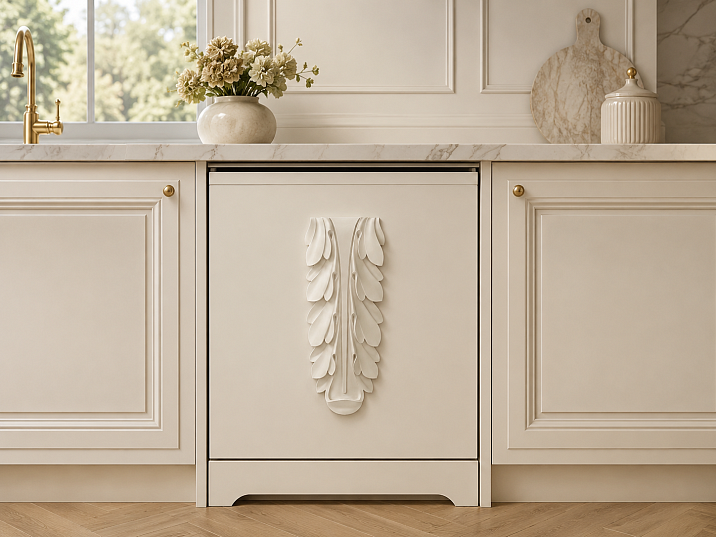
A built-in dishwasher has one feature that you notice not in the showroom, but already in the finished kitchen. The appliance is hidden, the row of facades is assembled, the color matches, the handles are selected — and yet one door looks foreign. The neighboring cabinets have panels, moldings, or carved decor, while the furniture panel of the dishwasher remains a flat rectangle. Functionally, everything is correct. Visually, it is too plain.
You want to fix this without ordering a new facade, using just one small detail. This is where interest in decorative furniture overlays and specifically the NPU-018 model arises. It is a carved decorative overlay made of polyurethane, available in two sizes: 50 × 114 × 18 mm and 67 × 152 × 25 mm. The cost of the smaller version is 1,070 ₽, and the larger one is 1,690 ₽.
At first glance, the task seems almost obvious: choose a size, place the overlay in the center of the door, paint it to match the kitchen — and the smooth facade will no longer stand out from the rest. But a built-in dishwasher has a fundamental difference from a regular cabinet. Its furniture panel is connected to the appliance door and its mechanism. It moves with it, follows a certain trajectory when opening, and interacts with the plinth, handle, and neighboring facades. Therefore, the decorative element here cannot be chosen by eye alone.
Can NPU-018 be added? In most design scenarios, such an idea can be considered, but the decision is made only after checking the specific dishwasher and furniture facade. You need to ensure that the appliance manufacturer allows the parameters of the installed external panel, that adding decor does not violate requirements for its mass and geometry, that the relief does not collide with neighboring elements, and that the chosen location remains convenient for daily opening.
Only after this does it make sense buy carved overlay NPU-018 and turn the too-simple dishwasher facade into part of the overall kitchen furniture composition.

Why the dishwasher facade is more noticeable than it seems
The dishwasher is hidden behind a furniture panel precisely so that the appliance disappears from the interior. In a well-designed kitchen with a closed door, it is impossible to tell at first glance where a regular cabinet is and where the household appliance is located.
But the masking principle only works as long as the exterior facades look cohesive.
Let's imagine a classic kitchen. To the right and left of the dishwasher are cabinets with widths close to the width of its panel. Regular doors have frames, routing, or decorative overlays. In the center, one smooth vertical plane appears.
The color is the same. The height is the same. The handle is the same.
But the eye still notices the difference.
Why?
Because the relief creates its own rhythm. Repeating panels or overlays form a sequence. One completely smooth facade breaks it. It seems to say: "this is not a cabinet."
It is in such a project that a small polyurethane overlay on a kitchen facade can work much more strongly than its physical size. It does not cover the entire door or imitate a complex panel. Its task is more precise: to add to the empty field a motif that is already present on neighboring facades.
This is a good reason to look not only at a specific article but also at the general principles by which stucco molding for kitchen facades. When furniture is already installed, it is especially important not to add ornament randomly, but to understand which part of the existing pattern needs to be repeated.
In the case of a dishwasher, the task is not to "decorate the dishwasher." The appliance should not be visible at all. The task is to make the furniture panel so logical that it stops revealing the location of the appliance.




NPU-018: a small detail with two completely different scales
The product name needs to be determined precisely: NPU-018 is a carved decorative overlay made of polyurethane.
This is not a molding. A molding forms a line or a frame.
This is not a baguette. A baguette works as a linear framing element.
This is not a rosette, although individual carved elements are sometimes habitually called by that word.
NPU-018 is a standalone shaped overlay intended for a local decorative accent. This format is especially interesting for furniture: there is no need to assemble four sides of a frame, calculate corners, or cover the entire facade with an ornament.
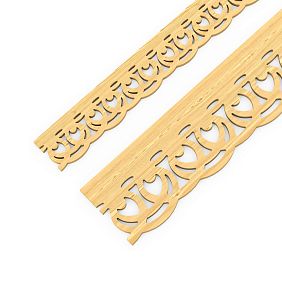
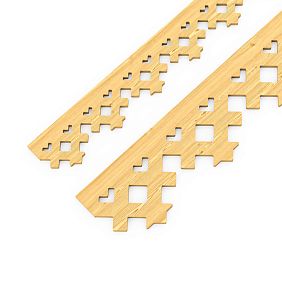
Our factory also produces:





Confirmed parameters of NPU-018
| Parameter | Small size | Enlarged size |
|---|---|---|
| Article number | NPU-018 | NPU-018 |
| Product type | Carved decorative overlay | Carved decorative overlay |
| Material | Polyurethane | Polyurethane |
| Size | 50 × 114 × 18 mm | 67 × 152 × 25 mm |
| Relief thickness | 18 мм | 25 мм |
| Price | 1 070 ₽ | 1 690 ₽ |
| Main article scenario | Dishwasher furniture front decor | Dishwasher furniture front decor |
| Installation in the project under consideration | Only after checking the specific front and appliance | Only after checking the specific front and appliance |
The two versions differ not only in length.
The 50 × 114 × 18 mm size is perceived as a compact accent. It leaves a lot of free front around it, coexists more easily with the handle, and suits where the kitchen's decorative scheme is quite restrained.
The 67 × 152 × 25 mm size is noticeably larger and deeper. It interacts more strongly with light, occupies more area, and can support more pronounced decor on adjacent doors.
Choosing between them only by price is a mistake.
The smaller overlay is not a 'budget version of the big one.' It is a different scale.
The larger one is not 'improved.' It is an option for a different front proportion.
Therefore, before order decorative overlay NPU-018, you need to compare both sizes directly on your door.
Get Consultation
The main feature of the dishwasher: it is not an ordinary cabinet door
This is where the line between a simple decorative idea and a well-designed project lies.
An ordinary facade of a wall or floor cabinet is attached to furniture hinges. We can evaluate its material, thickness, handle position, and decide whether the overlay fits.
The furniture panel of a built-in dishwasher works differently.
It is the external part of a system that includes:
-
the appliance door;
-
the furniture panel mounting;
-
the opening mechanism;
-
springs or another compensation system;
-
handle or another gripping method;
-
base;
-
adjacent kitchen elements.
When the user pulls the handle, not just a furniture door opens. The outer panel moves together with the machine door.
Therefore, any change to its outer configuration should be evaluated not only decoratively.
Even if the overlay seems small, before installation you need to check the documentation of the specific dishwasher model and the requirements of the furniture system. Special attention — to the permissible parameters of the facade panel and the rules for its installation.
You cannot reason like this:
“The overlay holds on the adjacent cabinet — so it will be the same on the dishwasher.”
No. The adjacent cabinet and the dishwasher have different mechanics.
That is why the decoration of the dishwasher facade starts not with glue or even with color selection. It starts with checking whether the specific construction allows an additional decorative element.
What exactly needs to be checked in the dishwasher documentation
Different models have different door mechanisms, allowable furniture panels, mounting methods, and interaction with the plinth. Therefore, a universal number suitable for all dishwashers cannot be invented.
Before ordering NPU-018, you need to find information about the external furniture facade in your model's documentation.
First of all, the following are of interest:
-
requirements for panel dimensions;
-
allowable weight restrictions, if specified;
-
allowable thickness;
-
attachment scheme;
-
position of fastening elements;
-
opening trajectory;
-
handle requirements;
-
rules for interaction with the base;
-
features of the sliding or other mounting system, if used.
If the documentation does not provide a clear answer, it is better to clarify the question with the equipment manufacturer or the cabinetmaker who installed the kitchen.
Why is this necessary?
Because NPU-018 will be glued not to a decorative wall panel, which remains stationary after installation. It will be placed on a movable facade that is used every day.
The dishwasher is opened with force. The door lowers. Then it rises. The part regularly follows the same trajectory.
Any decorative modification must preserve the normal operation of this system.
Where NPU-018 is glued: on the furniture facade, not on the appliance door
This point seems obvious, but it's better to state it directly.
In the scenario under consideration, NPU-018 is intended for the decorative outer surface of the furniture panel that covers the built-in dishwasher.
Do not transfer the overlay to the metal technical door of the appliance itself.
A built-in appliance is designed to be hidden behind the kitchen cabinet facade. It is the facade that should visually connect with the neighboring furniture doors.
This is also important for the styling.
The carved overlay should look like part of the kitchen, not an accessory of a household appliance.
If the facade is not yet installed, it is reasonable to plan its decor at the same time as the other doors.
If the kitchen is already assembled and the dishwasher has been in use for a long time, the task is different: assess the existing panel and add minimal decor without changing its functional scheme.
The first real test of NPU-018 is not glue, but paper
There is a wonderfully simple way to understand whether the overlay fits, even before purchasing.
You will need two paper or cardboard templates:
-
50 × 114 mm;
-
67 × 152 mm.
Cut out rectangles of these sizes. On them, you can roughly draw the silhouette of the ornament or simply round the contour so that the template is not perceived as a rigid rectangular block.
Attach both options one by one with masking tape to the dishwasher front.
First, close the machine and step back to the opposite wall.
Do not study the overlay up close. Look at the entire bottom row of kitchen fronts.
What happens?
If the small template almost disappears, the size 50 × 114 mm may not be noticeable enough.
If the large one starts to dominate and makes the facade heavier than the neighbors, then the 67 × 152 mm version is excessive.
Then look at the door from a normal working distance — standing in front of the countertop.
After that, be sure to open the dishwasher with the template in place.
This is no longer a design fitting, but a kinematics check.
Why the position of the overlay needs to be checked with the door open
A closed facade can look great.
The problem will show up in motion.
When the dishwasher door opens, its top and bottom parts change position relative to:
-
the countertop;
-
handles;
-
adjacent facades;
-
plinth;
-
floor;
-
protruding parts of furniture.
Relief NPU-018 is 18 or 25 mm.
This is not a flat sticker.
The enlarged version protrudes from the surface by 25 mm — two and a half centimeters. Such relief should already be considered as physical volume.
When opening, check:
-
whether anything is approaching the overlay;
-
whether it is convenient to stand in front of the open door;
-
whether the ornament ends up in the zone of accidental foot impact;
-
whether the adjacent opening door hits it;
-
whether it interferes with grabbing the handle;
-
doesn't it conflict with the plinth or other furniture parts.
If the paper template passes freely, that's not yet final confirmation. You need to separately account for the depth of 18 or 25 mm.
To check, you can temporarily add a piece of light cardboard of the appropriate thickness to the template and open the door again.
The handle and NPU-018 must first share the facade
On the PMM furniture panel, the handle is functionally more important than the overlay.
Therefore, the decorative element always yields to the convenience of grip.
In a classic kitchen, the handle can be positioned:
-
horizontally at the top;
-
closer to the center;
-
vertically on the side;
-
in another position provided by the facade design.
On a regular cabinet, the beautiful placement of the central overlay is sometimes built strictly according to the geometric center.
On a dishwasher, this principle is not always suitable.
If the central point falls too close to the handle, a dense group is formed: the handle and the ornament seem to compete for the same spot.
A person will touch the grip zone with their fingers every day. You cannot place a protruding carved element so that it interferes with the hand.
Therefore, it is better to start the layout not with the question "where is the center of the facade?", but with the question:
what area of the facade remains free after the functional zone of the handle?
Here, within this area, you can already search for the position of NPU-018.
Small NPU-018 or large: which is better for the PMM facade
Two sizes allow adapting one ornament to different furniture systems.
50 × 114 × 18 mm — when a neat motif is needed
The compact version is especially interesting when the kitchen is not overloaded with decor.
It takes up less area, leaves more flat surface around it, and competes less with the handle.
This option is worth trying first if:
-
neighboring overlays are small;
-
facades are narrow in perception;
-
the handle itself is noticeable;
-
the kitchen belongs to neoclassicism;
-
the relief is needed only for connection with neighboring doors;
-
there are already other decorative lines on the facade.
A thickness of 18 mm still creates volume, so a small length does not mean the part will disappear.
67 × 152 × 25 mm — when the facade needs a real center
The large size is more noticeable and deeper.
It can be appropriate on a large flat panel surrounded by expressively styled neighboring facades.
If the small version looks like a random dot, 67 × 152 mm can better hold the center.
But here the opening is checked more carefully. The 25 mm depth increases the protrusion, and the area of the element becomes larger.
The size should be evaluated together with the handle and neighboring furniture, not only with the door itself.
Comparison of two sizes of NPU-018 on a kitchen facade
| Criterion | 50 × 114 × 18 mm | 67 × 152 × 25 mm |
|---|---|---|
| Character of the Decoration | Delicate | More pronounced |
| Area occupied on the facade | Smaller | Larger |
| Relief | 18 мм | 25 мм |
| Proximity to a prominent handle | Simpler | Requires more free space |
| For calm neoclassicism | Often more convenient | Needs a fitting |
| For a large empty facade | May turn out to be too small | May be better to keep the scale |
| Check door movement | Required | Especially important |
| Price | 1 070 ₽ | 1 690 ₽ |
The table does not say that the first size is "safe" and the second is "dangerous." Both require checking the specific technique.
The difference is elsewhere: the large NPU-018 changes the external geometry of the furniture panel more significantly.
Therefore, the more relief there is, the less sense it makes to choose it based on a photo.
How to choose the size relative to adjacent facades
The dishwasher has an amazing feature: you need to choose the decor not based on the dishwasher itself, but based on the furniture around it.
Suppose there is a cabinet on the right with a decorative overlay about 140 mm high. On the left, there is the same one.
If you install a miniature part 50 × 114 mm on the dishwasher, it may disrupt the rhythm.
But this does not mean that the 67 × 152 mm version is automatically needed.
First, compare the actual shape of the adjacent decor.
One overlay can be visually light despite its large length, while another can be massive despite its small size.
Relief, the width of individual leaves, pattern density, and free space affect perception more than a simple number.
The most accurate principle:
The dishwasher should look as if its facade was designed together with the rest of the kitchen, not decorated after installing the appliance.
Sometimes for this, NPU-018 is worth repeating on adjacent smooth doors as well.
Sometimes — on the contrary, use it only on the dishwasher panel, if adjacent facades already have another similar motif.
Repeat NPU-018 on adjacent doors or leave just one?
This is where real design begins, not just buying a decorative piece.
First scenario: all adjacent facades are smooth, but the owner wants to add decor only to the dishwasher.
A strange idea.
If the problem was that the dishwasher differs from the other doors, adding a single carved overlay will make it even more noticeable.
Scenario two: regular kitchen doors already have relief, and only the dishwasher remains smooth.
Here, one NPU-018 can fix the mismatch.
Scenario three: the entire kitchen is smooth, but you want to refresh it completely.
Then NPU-018 makes sense to consider as a sample of the overall scheme. You can order the required number of identical elements for selected facades.
In this case, it is useful to first Buy decorative furniture overlays after counting all the doors, rather than styling the dishwasher separately.
The main thing is to decide what task the repetition performs.
The decor should unify, not label household appliances.
Decorative overlays for kitchen furniture: symmetry matters more than quantity
In a classic kitchen, there is a temptation to decorate every facade.
This is not necessary.
A kitchen can have dozens of doors and drawers. If you put the same relief on all surfaces, the furniture will become visually heavy.
Overlays are better distributed hierarchically.
For example:
-
central large facades receive decor;
-
narrow drawers remain smooth;
-
upper doors have one type of design;
-
lower ones are more restrained;
-
the PMM facade repeats the nearby facades of its row.
Then the dishwasher disappears into the system.
Extensive material on how they work decorative overlays for kitchen furniture, useful precisely for understanding repeatability. But in our project, the main criterion remains functional: the decorative scheme must not disrupt the operation of built-in appliances.
Can NPU-018 be used to imitate a panel
A single overlay does not create a panel.
It works as a central ornament.
If adjacent doors have full frame routing, a single NPU-018 can support their decorative look, but it will not reproduce the geometry literally.
To make a smooth facade more reminiscent of a classic door, a composition is possible:
molding frame + central overlay.
But for a dishwasher, this is already a significantly more serious surface modification.
Additional linear trim appears, more glue, more relief, different weight, and several protruding lines.
Therefore, for already installed built-in appliances, it is wiser to start with minimal intervention — a single overlay.
If this is truly insufficient and the appliance manufacturer allows the selected external panel, then you can consider buying polyurethane moldings for the kitchen and design the frame as a separate task.
Not the other way around.
Start with minimal decor.
Then add complexity, if it is truly needed.
Why NPU-018 is more interesting than a random universal sticker
There is a simple path: buy flat furniture decor, a self-adhesive appliqué, or a ready-made ornament without pronounced relief.
It is easier to install and barely changes the geometry.
But the visual effect is different.
NPU-018 has a real depth — 18 or 25 mm. It is the depth that creates shadows, makes the ornament readable when painted in the facade color, and connects the detail with classical furniture carving.
A flat image remains a drawing on the surface.
A carved overlay is perceived as a separate form.
The choice depends on the task.
If you only need to add a pattern, a flat option may be sufficient.
If you need a smooth furniture facade to receive a real relief detail, it is more interesting to consider exactly Buy NPU-018 made of polyurethane.
But relief is both an advantage and a parameter that needs to be checked against the opening trajectory.
Polyurethane on a kitchen facade: what is the practical meaning of the material
In this article, polyurethane is interesting not as an abstract "modern material."
It is needed for a specific task — to add a small carved detail to an existing furniture surface.
A polyurethane overlay allows you to achieve a complex relief without manufacturing a new furniture panel with carving or milling.
This is especially useful when the kitchen has already been purchased.
The user does not want to:
-
dismantle the facade;
-
order a new one;
-
reproduce the color;
-
wait for new furniture production;
-
change adjacent doors;
-
redo the entire composition.
He wants to change one visually empty surface.
Ready-made stucco molding for furniture allows you to start from a small element.
You can view in the catalog molding for furniture of different sizes, rather than making a carved motif yourself.
But this approach has a limit: ready-made decor does not fix an incorrect dishwasher front. If the furniture panel itself does not meet the appliance's requirements, the technical issue is resolved first.
Color is almost half the result
NPU-018 may have the right size and good position, but look foreign only because of the color.
There are three main strategies for the kitchen front.
Overlay exactly matching the front's color
For our task, this is the most natural scenario.
Why?
Because the goal is not to show the decorative detail separately, but to make the dishwasher panel look like the other doors.
When the color matches, the pattern is read through light and shadow.
This technique works especially well on:
-
white;
-
milky;
-
light gray;
-
gray-beige;
-
calm colored kitchens.
The facade remains a single color spot, but ceases to be flat.
Overlay of a close shade
The tone is slightly different.
This approach can emphasize the relief without creating a harsh contrast.
But the selection becomes more complex. What seems like a pleasant halftone on a sample may look like a mismatch error under kitchen lighting.
Contrasting NPU-018
Dark ornament on a light facade or vice versa.
This is no longer masking the dishwasher, but a deliberate accent.
If neighboring facades do not have such contrasting details, the dishwasher will stand out again.
Therefore, for the stated topic — "how to make its facade look like the others" — tone-on-tone is usually the most understandable.
Paint before or after installation
Once the kitchen is assembled, it is more convenient to work with the relief detail before final fixation.
The overlay can be positioned horizontally, carefully paint the recesses, and check the shade.
After installation, there is less risk of accidentally touching the finished facade with a brush.
But there is a nuance.
If finishing of the joint edge is required, some work may be done after gluing.
Therefore, the sequence depends on the chosen finishing technology.
The main rule is not to start final painting until a dry fit has been done.
Imagine: NPU-018 is perfectly painted to match the kitchen color, and then it turns out that the handle passes too close when opening, or the larger version visually overloads the door.
You will have to replace the part.
First, geometry.
Then finishing.
How to check the color without buying NPU-018
If you doubt whether a contrasting overlay is needed at all, make a color template.
Cut out a paper silhouette measuring 50 × 114 or 67 × 152 mm.
Paint it approximately:
-
in the color of the facade;
-
in the color of the handles;
-
in the intended accent shade.
Attach them one by one.
Look at it in the morning, in the evening, and with the kitchen light on.
Very often, a contrast that looked beautiful in the visualization turns out to be too harsh in a real kitchen.
This is especially noticeable on the dishwasher, because its facade is in the bottom row and regularly ends up right in front of a person.
The central overlay does not always have to be placed at the mathematical center
The geometric center is easy to calculate.
If the facade width is W, the overlay width is A, the offset from the side edge with precise centering will be:
X = (W − A) / 2.
Vertically, the principle is the same.
But the PMM has a handle.
If the handle occupies the upper part, the geometric center of the entire panel may create too dense a proximity.
Therefore, there is a second center — the visual center of the free field.
It is determined between:
-
the lower edge of the handle;
-
the lower part of the facade;
-
the side edges.
Thus, NPU-018 is not necessarily strictly in the middle of the entire door, but looks natural in the free zone.
At the same time, the overlay cannot be shifted randomly.
If it deviates by 15–20 mm without a compositional reason, the eye will notice the inaccuracy.
Horizontally, symmetry is usually better to preserve.
Vertically, more freedom in positioning is acceptable.
Base: this is often where the problem is discovered too late
For a built-in dishwasher, the facade lowers when opening.
Depending on the furniture system, the lower part may pass close to the base.
This happens every day.
NPU-018 is usually assumed to be higher, so direct contact with the base may not occur. But the entire trajectory needs to be checked.
Especially if the designer wants to place a decorative element low.
That's why a template on a closed facade is insufficient.
Open the door fully.
See where the NPU-018 has moved.
If it ended up too close to your feet, a plinth, or a protruding element, it's better to lift it.
The decorative layout should match the moving door, not just a nice photo when closed.
Adjacent doors and drawers also need to be opened.
A kitchen is rarely used one facade at a time.
While the dishwasher is open, someone might pull out the adjacent drawer.
When the dishwasher is closed, a hinged cabinet next to it may open.
The large NPU-018 protrudes by 25 mm. Therefore, checking adjacency is mandatory.
Especially if:
-
facades are positioned at an angle;
-
The dishwasher is located next to the corner section;
-
The adjacent handle protrudes significantly;
-
there is a pull-out system nearby;
-
the kitchen has an unusual geometry.
Check the actual movements.
Do not reason only from the frontal drawing.
Why one large NPU-018 can be worse than two small ones — and vice versa
Suppose the facade is tall and wide.
The large central overlay looks a bit heavy.
The idea arises to take two small ones: one higher, the other lower.
This is possible as a decorative technique, but the composition changes completely.
One NPU-018 creates a center.
Two form a vertical axis.
If adjacent facades have one central motif, a pair on the MDF will make it stand out again.
And the reverse situation.
If adjacent doors are decorated with two symmetrical elements, one large NPU-018 can disrupt the rhythm.
Therefore, the quantity is determined not by the area of the empty door, but by the decorative system of the entire kitchen.
The rectangular shape of NPU-018 and its advantages for furniture facades
A separate category buy rectangular polyurethane overlays useful precisely for comparing proportions.
On a vertical furniture panel, a rectangular elongated shape reads naturally.
It supports the very geometry of the door.
A round rosette would create an independent central point.
A corner overlay would require either four elements or a molding scheme.
And NPU-018 can work alone.
This is what makes it interesting for a ready-made PMM: minimal parts, minimal intervention, one clear center.
When it's better not to install an overlay at all
A good commercial article should help not only to buy a product.
It should explain when a purchase is not needed.
NPU-018 should not be installed on the dishwasher front if:
-
the instructions for the specific appliance or furniture system do not allow the intended panel modification;
-
the door already operates at the limit of adjustment and additional intervention is undesirable;
-
the relief interferes with the handle;
-
the overlay collides with adjacent furniture;
-
the facade bends or the coating does not adhere well;
-
the surface is not suitable for the chosen adhesive mounting technology;
-
the entire kitchen is minimalist and smooth, and a single carved detail will specifically mark the dishwasher;
-
the NPU-018 ornament does not match the style of adjacent facades.
Sometimes the best solution is to leave the door smooth.
Sometimes — replace it with a facade made in the same system as the rest.
Sometimes — choose a different decorative element.
The catalog allows Buy decorative furniture overlays of different proportions, so you don't need to force one specific article to work where it clearly doesn't fit.
NPU-018 and a regular cabinet door: comparison of conditions
| Question | Regular furniture door | Facade of a built-in dishwasher |
|---|---|---|
| Is the facade related to the appliance | No | Yes |
| Do you need to consider the manufacturer's requirements for the appliance | No | Yes |
| Do you need to check the door compensation mechanism | Usually not | Yes |
| Is the trajectory relative to the plinth important? | Less often | Especially important |
| Handle | Furniture function | Simultaneously controls the appliance door |
| Can you choose the decor only visually? | Undesirable | Not allowed |
| Checking the opening after the template | Useful. | Required |
| Choosing the size based on adjacent facades | Important | Doubly important |
That is why you cannot transfer the experience of designing a regular cabinet to a dishwasher without additional verification.
What about the weight of the overlay?
The NPU-018 card confirms the dimensions and material, but if the exact weight of a specific part is not specified in the data used, it cannot be invented.
You cannot write:
"the overlay weighs very little, so it will not affect the mechanism in any way."
We did not confirm this.
The polyurethane decorative element is indeed perceived as a small part, but for a technical solution, what matters is not the subjective assessment of "light," but the compliance of the entire panel with the requirements of a specific dishwasher.
Therefore, the algorithm is more correct as follows:
-
find out the equipment limitations;
-
determine the parameters of the existing furniture facade;
-
clarify the weight of the selected NPU-018 if it is critical for the calculation;
-
compare the final configuration with the permissible one;
-
only then perform the installation.
If the machine manufacturer does not allow going beyond a certain configuration, the design appeal of the overlay changes nothing.
Facade surface: where glue holds, and where separate verification is required
Kitchen facades come in different types.
This could be:
-
painted MDF;
-
solid wood;
-
veneer;
-
laminated surface;
-
film finish;
-
another furniture system.
The same mounting compound does not necessarily work equally well with all substrates.
Therefore, the task is formulated as follows:
The adhesive must be compatible with polyurethane NPU-018 and the specific outer coating of the furniture facade.
If the facade is painted, the quality of the paint itself matters.
Imagine that the adhesive has bonded perfectly to the paint layer, but the paint holds poorly to the MDF.
Then the overlay will come off along with the paint.
Therefore, the strength of the top coating is also tested.
The material details the principles of selecting the composition. molded decoration adhesive, but for PMM there is an additional requirement: the facade is constantly moving, so the installation must be designed for the operation of a movable furniture panel.
Why double-sided tape is a poor way to "try on forever"
For a paper template, painter's tape is excellent.
For final fixation of the carved overlay, random household double-sided tape cannot be chosen without confirming its suitability.
The reasons are simple.
The kitchen facade regularly:
-
moves;
-
heats up and cools down with the room;
-
is subjected to wet cleaning;
-
receives random touches.
Protruding decor can be accidentally caught by a hand or clothing.
Therefore, permanent installation must be done with a material designed for a specific pair of surfaces.
Moisture and steam near the dishwasher
A built-in dishwasher has a special mode of use.
After the cycle ends, when opening the door, warm moist air may escape from the working chamber.
Practical scenario No. 1: white classic kitchen, smooth dishwasher
Adjacent facades have decorative frames.
The dishwasher is covered with a white smooth panel.
The handle is horizontal at the top.
What to do?
Start with template NPU-018 50 × 114 mm.
Position it along the horizontal axis of the facade, below the handle.
Close the door and look at the entire row.
If a small ornament already removes the feeling of emptiness, a large version is not needed.
The advantage of this solution is restraint. The dishwasher gets relief, but does not become the main facade of the kitchen.
Scenario #2: wide expressive doors and large decor nearby
Adjacent facades have noticeable ornamental elements.
The small template on the PMM gets lost.
Then 67 × 152 × 25 mm is tried on.
But along with the size increase, all the mechanics are checked:
- distance to the handle;
- trajectory;
- neighboring drawer;
- position when the door is open.
If everything is free and the large overlay matches the scale of the neighbors, it can look more convincing.
Scenario #3: modern smooth kitchen without decor
Here the problem may be posed incorrectly.
The dishwasher front is smooth not because it was "forgotten to be decorated," but because the entire kitchen is built on smooth surfaces.
Adding one NPU-018 will create a new visual language on only one front.
Instead of masking, the appliance will become more noticeable.
In such a kitchen, it is better to forgo the overlay or first develop a general scheme for updating several fronts.
Scenario #4: kitchen is already being repainted
This is a very convenient moment for NPU-018 integration.
You can pre-arrange the decor on all selected facades, check for repetition, and then paint the composition uniformly.
If the dishwasher is to receive the same motif as adjacent doors, the overlay is tried on before final finishing.
This is especially useful here Buy Polyurethane Molded Decoration immediately according to the overall project list, rather than gradually buying different elements.
Scenario #5: The dishwasher stands at the very corner of the kitchen
The most important check is the adjacent door.
On a straight section, a large relief may not bother anyone.
In a corner module, trajectories intersect much more complexly.
Open:
- Dishwasher;
- adjacent door;
- nearest drawer.
Not necessarily at the same time.
You just need to make sure that each operation remains free, taking into account the thickness of NPU-018.
Scenario No. 6: the handle is located close to the center
Instead of trying to squeeze the overlay between the handle and the edge, it is worth considering a smaller NPU-018 or a completely different article.
The decor should not live in the residual space.
When the handle and the overlay almost touch each other, the composition looks random, and using the door becomes less convenient.
What to buy together with NPU-018
A purchase for one facade can be very short.
There is no need to assemble a decorative set just to increase the cart volume.
| What to consider | Why | When needed | Link |
| NPU-018 | Main decor of the PMM facade | If technical and visual checks are passed | buy carved overlay NPU-018 |
| Other overlays | Compare size and pattern | If both NPU-018 sizes do not fit | Buy decorative furniture overlays |
| Rectangular overlays | Compare similar geometry | If you like the elongated shape but need a different scale | buy rectangular polyurethane overlays |
| Moldings | Create a frame composition | Only if one overlay is insufficient and the technique allows decor | buying polyurethane moldings for the kitchen |
| General stucco decor | Select elements for other facades | When comprehensively renovating the kitchen | You can buy ready-made stucco matching the Baroque style. Calculate the quantity: linear meters of cornices and moldings, number of rosettes, pilasters, consoles, corner elements. Add a ten to fifteen percent allowance for trimming. |
| Installation information | Check the adhesive technology | Before final fixation | molded decoration adhesive |
There is only one main product here.
Everything else appears only when truly necessary.
Nine mistakes that are especially dangerous on the dishwasher front panel
1. Treating the panel as a regular door
This is the main mistake.
A dishwasher is an appliance with its own mechanism.
Documentation first, decor later.
2. Choosing NPU-018 only based on a pretty photo
50 × 114 and 67 × 152 mm look completely different on a real door.
A template is needed.
3. Not considering the thickness of 18 or 25 mm
The relief changes the external geometry.
The opening direction needs to be checked.
4. Centering the overlay flush with the handle
Hand comfort is more important than geometric symmetry.
5. Painting before fitting
You can perfectly finish a size that doesn't fit.
6. Use unverified glue
The base of a kitchen front can vary.
7. Style only the dishwasher on a fully smooth kitchen
This can make the appliance even more noticeable.
8. Ignore the plinth and adjacent fronts
The problem only appears when moving.
9. Reassuring yourself that a small detail "definitely won't change anything"
There is no room for assumptions with appliances. Manufacturer requirements must be checked.
How not to confuse NPU-018 with similar products
NPU-018 is an overlay.
If you need a line around the perimeter, you need a molding.
If you need an element in each corner of the frame, you need corner decor.
If you want a large central medallion, you may need to look at a different overlay shape.
If the task is a single compact vertical ornament on a smooth facade, NPU-018 fits it much more precisely.
This is the value of proper classification.
The buyer is not looking for "some kind of stucco molding."
He is looking for a specific shape for a specific empty field.
NPU-018 or a new furniture panel
Sometimes it's easier to install an overlay.
Sometimes it's more correct to replace the facade.
A new panel is more reasonable if:
- the existing facade is damaged;
- its color differs noticeably;
- neighboring doors have deep milling that a single overlay cannot imitate;
- an exact replication of the furniture model is required;
- the current panel was initially incorrectly matched to the dishwasher.
NPU-018 wins when the existing facade is technically correct, neat, and matches in color, and the problem is purely decorative.
That is, we do not repair a faulty structure.
We refine a successful but too simple external surface.
Small or large size: the final logic of choice
Start small.
Not because it is cheaper.
But because adding visual weight is easier than removing it.
Try 50 × 114 mm.
If the facade still seems empty, move to 67 × 152 mm.
If the enlarged version looks heavy, then NPU-018 may simply not have the needed intermediate scale.
Then there is no need to choose the 'least bad' of the two options.
Open the catalog and compare other decorative inlays for furniture.
The right size matters more than loyalty to the liked item.
Who NPU-018 is really suitable for
This overlay is especially interesting to a kitchen owner who has:
- the built-in dishwasher is already covered with a quality furniture facade;
- the adjacent doors have classic or neoclassical decor;
- the smooth panel of the machine visually stands out;
- the appliance allows the selected configuration of the external panel;
- there is enough free space on the facade;
- the handle does not conflict with the relief;
- the door trajectory is clear;
- you want to avoid making a new facade.
Here, NPU-018 solves a specific problem and does not require a large decorative project.
It's better for someone to look at another option
NPU-018 may not suit the owner of a fully minimalist kitchen.
It is not needed if the dishwasher already does not visually differ from the adjacent smooth facades.
A different size or article number should be chosen if both versions of NPU-018 disrupt the scale.
The idea should be abandoned altogether if the installation contradicts the equipment requirements.
And finally, a new panel is more reasonable when the problem is not the absence of ornament, but the geometry, color, or condition of the facade itself.
Commercial route: from idea to order without unnecessary purchases
You don't need to gather a long list of items before ordering.
Do seven checks.
Check 1. PMM Documentation
Confirm the validity of the furniture panel configuration.
Check 2. Actual Facade
Measure the width and height of the installed door exactly.
Check 3. Handle
Determine the free field.
Check 4. Templates
50 × 114 and 67 × 152 mm.
Check 5. Relief
Model 18 and 25 mm.
Check 6. Opening
Follow the full trajectory.
Check 7. Color
Decide how the overlay will be connected to adjacent facades.
If all items give a clear result, you can proceed to the card and order decorative overlay NPU-018 of the required size.
FAQ: questions before purchasing NPU-018 for the dishwasher facade
Can NPU-018 be installed on the facade of a built-in dishwasher at all?
Such installation can only be considered after checking the specific appliance. The furniture panel of the dishwasher is connected to the door mechanism, so you need to ensure that the selected facade configuration meets the requirements of the machine manufacturer and the furniture system.
Is NPU-018 attached to the metal door of the dishwasher?
No, in the project under consideration, the decorative overlay is installed on the external furniture facade that hides the built-in appliance. The technical door of the machine should not be used as a regular decorative furniture surface.
What sizes are available for NPU-018?
Two: 50 × 114 × 18 mm and 67 × 152 × 25 mm. The sizes differ not only in length and width, but also in the depth of the relief.
How much does NPU-018 cost?
The 50 × 114 × 18 mm model costs 1,070 ₽, and the 67 × 152 × 25 mm option costs 1,690 ₽.
Which size is better for a standard dishwasher door?
There is no universal answer. Even furniture panels of the same size look different due to handles, neighboring facades, and the overall kitchen style. First, try paper templates of both sizes.
Do I need to consider the weight of the overlay?
Yes, because the furniture panel is connected to the dishwasher door mechanism. The exact allowable configuration should be checked against the documentation of the specific appliance. If the weight of the NPU-018 itself is needed for calculations, it should be confirmed before installation, not estimated "by eye."
Can I simply glue the overlay on and not check the mechanism?
No. First, check the manufacturer's requirements for the dishwasher, the position of the facade, the handle, the opening, the plinth, and adjacent doors. Glue mounting is a subsequent step.
Will the NPU-018 interfere with opening the dishwasher?
This depends on its position and the specific kitchen. The small version protrudes by 18 mm, the large one by 25 mm. Therefore, a dry fit should be done and the door fully opened.
Can the overlay touch the plinth?
In most compositions, the overlay is positioned above the lower edge, but contact cannot be universally excluded. The specific trajectory of the furniture panel depends on the dishwasher system and kitchen, so it is checked before installation.
Where should the NPU-018 be placed relative to the handle?
So that a free and comfortable grip is maintained. There is no need to force the overlay to be at the geometric center if it ends up too close to the handle there. Horizontal symmetry is better preserved, while the vertical position is chosen based on the free space.
Can two NPU-018s be installed?
Yes, if such a layout matches the adjacent facades and does not violate technical requirements. But two overlays are already a different composition. Do not increase the quantity just because one small detail seems insufficiently noticeable.
Is it necessary to install NPU-018 on adjacent facades?
Only if it helps the overall kitchen system. If neighboring doors are already decorated, it is enough to repeat their character on the dishwasher. If the entire kitchen is smooth, a single overlay on the machine, on the contrary, can highlight it.
Can NPU-018 be painted to match the kitchen color?
Polyurethane decor allows for finishing, but the specific primer and paint system must be selected considering the chosen material and the existing kitchen finish. For masking the dishwasher, a color matching the facade usually looks most natural.
Is it better to paint before gluing or after?
It is convenient to do the main work with the relief before installation, but the final scheme depends on the treatment of the joint area. In any case, first do a dry fit and only then proceed to the final finishing.
What should be used to glue NPU-018?
A compound compatible with both polyurethane and the specific furniture facade coating is needed. You cannot choose an adhesive just by the word "universal." Detailed selection principles can be found in the material. molded decoration adhesive.
Can the overlay be glued onto already painted MDF?
The possibility of installation depends on the condition and type of coating. The paint layer itself must adhere firmly to the base, and the mounting compound must be compatible with it. If the coating is peeling or unknown, the base issue is resolved first.
Is it necessary to sand the finished facade for NPU-018?
There is no need to damage the existing coating unnecessarily. Surface preparation is determined by the selected adhesive system and facade material. If special treatment is required, it is chosen only after checking the specific materials.
Will NPU-018 suit a classic kitchen?
Yes, this scenario is most understandable if neighboring facades already have carved or framed decor. The overlay helps remove the empty field on the PMM panel and tie it to the rest of the furniture.
And for a neoclassical kitchen?
It may fit especially well in a calm tone-on-tone color. For neoclassicism, dosage is often more important: one small carved detail works more convincingly than an overly saturated composition.
Will it suit a minimalist kitchen?
Not necessarily. If all facades are smooth and the absence of ornament is part of the design, adding NPU-018 only to the PMM makes no sense. It may, on the contrary, emphasize the location of the appliance.
What to do if 50 × 114 mm is too small, and 67 × 152 mm is too large?
Do not choose a compromise by force. Better to look at the category and Buy decorative furniture overlays of a different scale.
Can the NPU-018 be complemented with a molding?
Yes, such a composition is possible decoratively, but on the PMM facade it is already a significantly more serious modification. First, the admissibility of the entire structure is checked, and then it can be considered. buying polyurethane moldings for the kitchen.
Is it worth buying the overlay before checking the PMM instructions?
No. First technical compatibility, then purchase. This avoids the situation where the part fits perfectly in design, but cannot be safely used on a specific furniture panel.
Final fitting: five minutes that decide the fate of the decor
Before ordering, close the dishwasher.
Attach the selected template.
Step back.
Compare it with the neighboring facades.
Then approach, grab the handle, and open the door all the way.
Close it.
Open the nearest drawer.
Look at the side door.
If the model is large, mentally add a 25 mm protrusion. Even better — model it with cardboard.
Now ask yourself five questions.
First: has the dishwasher become less different from the other facades?
If yes — the design task is solved.
Second: is the ornament really needed, or is the door now overloaded?
Third: is the handle convenient to use?
Fourth: is there any place where the relief conflicts during movement?
Fifth: does the specific appliance allow such a configuration?
Only when all five answers are positive does the decorative idea become a finished project.
The dishwasher facade should disappear, not become the main door of the kitchen.
This is the main criterion for a good result.
The NPU-018 cannot be evaluated separately.
Even a beautifully designed overlay fails its purpose if, after installation, everyone immediately notices:
"Oh, here you have a dishwasher."
We want the opposite.
The dishwasher should blend into the row of furniture.
The carved detail is not needed for its own sake. It should echo the decorative language of neighboring facades.
If the regular doors have one small ornament — we repeat its scale.
If they are designed modestly, we do not choose an excessively large overlay.
If the kitchen is smooth, we may not add anything at all.
This is how mature interior selection works: the product is chosen for the task, not the task invented for the product.
Buy NPU-018 or choose another decorative overlay
After all checks, the solution usually falls into one of three options.
Option 1. NPU-018 50 × 114 × 18 mm fits
The template looks proportional, the relief does not interfere, and technical constraints are met.
You can buy carved overlay NPU-018 for 1,070 ₽ and prepare the finish to match the facade color.
Option 2. NPU-018 67 × 152 × 25 mm is needed
The small decor gets lost, and the larger version better matches the adjacent facades.
Price — 1,690 ₽.
Before purchasing, double-check that the depth is exactly 25 mm when fully opened.
Option 3. No size fits.
This is not a reason to give up the idea of a decorative facade altogether.
You can buy rectangular polyurethane overlays of a different scale or go to the general section of overlays.
The incorrect size of a specific item should not dictate the interior.
Why the ready-made NPU-018 is more convenient than trying to make a carved element yourself
If the task is limited to one decorative detail, making a complex ornament yourself almost always increases the number of decisions.
You need to:
- develop a design;
- transfer it;
- achieve the same depth;
- process the edges;
- achieve symmetry;
- prepare the surface;
- repeat the motif if several elements are needed.
The finished NPU-018 already has a specific shape and two clear dimensions.
The buyer can focus on what really matters:
- whether it fits in scale;
- whether it is allowed by the PMM design;
- where to place it;
- how to paint it;
- how to secure.
This is precisely where the practical value of the finished polyurethane molding decoration: a complex decorative form is not created anew for a single facade.
Before ordering, photograph the kitchen directly
There is another simple professional trick.
Take a photo of the kitchen strictly from the front.
Not at an angle.
This makes it easier to see:
- repetition of facades;
- height of handles;
- position of centers;
- symmetry;
- the emptiness specifically on the PMM.
Then overlay the NPU-018 silhouette onto the image.
Even a simple rectangle of the right size is already useful.
If possible, make two variants — small and large.
After that, compare not just a single facade, but the entire kitchen.
Sometimes the decision changes instantly.
The large NPU-018, which looked great up close, turns out to be too heavy in the overall photo.
And the small one, which seemed modest, perfectly matches the rhythm of the neighboring doors.
The cost of an overlay and the cost of redoing a facade are different scales of solution.
NPU-018 is considered a point change.
The small size costs 1,070 ₽, the large one costs 1,690 ₽.
But you need to compare not only the cost of the two options with each other.
An alternative may mean:
- a new furniture facade;
- color selection;
- repeating the milling;
- dismantling the old panel;
- installing a new one;
- reconfiguring the system.
This is a completely different scope of the project.
If the existing facade is technically correct and of good quality, and the problem comes down to the lack of slight relief, the overlay is interesting precisely because of the scale of intervention.
But savings cannot be an argument against technical requirements.
If a specific PMM does not allow the chosen modification, a more expensive new facade may be the only sensible solution.
Decorative polyurethane elements: when to expand the composition
Let's imagine that NPU-018 is installed virtually, but the facade is still too different.
The reason may be that adjacent doors have a full frame architecture.
Then one central piece is objectively not enough.
Instead of chaotically adding a couple more overlays, it's better to consider a system:
- molding;
- central element;
- repetition on adjacent facades.
For such a task, you will need decorative polyurethane elements.
But you should move to them only after checking the technical limitations of the PMM.
The more decor appears on the moving panel, the more careful the inspection of the entire structure should be.
Final decision: whether NPU-018 can be added to the facade of a built-in PMM
Yes, NPU-018 can be considered as a decorative element for the furniture facade of a built-in dishwasher, but only after checking the requirements of the specific appliance and furniture system.
This key condition cannot be replaced by general reasoning that the polyurethane pad is small or is installed on furniture.
The PMM facade is connected to a working mechanism.
Before purchasing, you need to check:
- is the selected configuration of the external panel acceptable for the specific model;
- what size of NPU-018 fits the scale;
- does the 18 or 25 mm relief conflict with movement;
- whether the handle remains comfortable;
- do the adjacent facades open freely;
- are there any issues with the plinth;
- is the mounting compound compatible with the panel coating;
- does the decorative scheme match the rest of the kitchen.
If all checks are passed, NPU-018 becomes a very precise tool.
There is no need to change the entire kitchen.
There is no need to order a new facade just for a single ornament.
The small size 50 × 114 × 18 mm for 1,070 ₽ is suitable for a more subtle accent. The enlarged version 67 × 152 × 25 mm for 1,690 ₽ is designed for a more noticeable relief and requires especially careful checking of the available space.
After a dry fitting, you can Buy NPU-018 made of polyurethane exactly in the size that connects the dishwasher facade with the neighboring doors, rather than just looking better in the product photo.
If neither size fits, on STAVROS it is wiser to move to the category where you can Buy decorative furniture overlays, and find another scale without compromising on geometry.
This is exactly how a decorative element works correctly: STAVROS helps not to mask an error with a random ornament, but to select a ready-made relief element for the existing furniture, preserve the functionality of built-in appliances, and make the dishwasher facade part of a unified kitchen.