Article Contents:
- KL-006 wooden capital: six sizes that cannot be considered one model 'in different scales'
- Why this matters for the finished portal
- What can be determined from the table without a drawing
- What cannot be determined without the official drawing
- Why this is stronger than the usual selection by a single width
- Example with B=180
- Why this is not bureaucracy
- What to do if B matches, but one of the other parameters does not
- First, determine whether the two pilasters are actually identical
- Working table
- Why you need to measure both sides
- What to do if the pilasters differ slightly
- Why compact size does not mean "for a narrow door"
- Where it is especially important to compare the small variant visually
- What to check at the top
- Price of one
- Pair price
- Why it's useful to compare the second size with the first physical template
- Price of one
- Pair
- Practical selection scheme
- Why a paired template is more important than a single one
- Price of one KL-006 B=210 mm
- Pair for a door portal
- What changes besides the price
- Why a larger capital may be more correct on a tall portal
- When B=210 mm is already overloaded
- Why with B=240 mm you need to look at the portal not only from the front
- Where this is critical
- Pilaster near a cabinet
- Door next to a corner
- Narrow pier
- Two pilasters standing close together
- Why you can't evaluate only 'fits/doesn't fit'
- The difference between the smallest and largest pair
- The main problem with maximum size is architectural
- When a large KL-006 can be strong
- When the 'largest' looks cheap, not solid
- Why B=140 and B=290 cannot be compared as a 'small/large photograph'
- What this means visually
- Front template
- Side
- Why you cannot automatically draw B×A
- Convenient system
- What to photograph
- Pair control
- Why you can't order "KL-006 — 2 pcs." without a size
- Ready-made line
- What the table shows
- If the pilasters are oak and will remain under a transparent finish
- If the pilasters are beech
- If the entire portal is under a covering enamel
- Why random beech on an oak pilaster is dangerous with transparent finishing
- Why you shouldn't buy oak "just in case"
- Example B=180, beech
- Oak B=290
- When "Standard" is rational
- When 'Prestige' is stronger
- Why 'Prestige' doesn't mean 'the coating is already ready'
- For enamel
- For tinting
- Why you can't place an order 'and decide later'
- What joint selection provides
- Why you can't buy a capital now and "pick a pilaster later"
- Finished pilasters are checked
- Why an article number is useful
- If the pilaster is custom
- 1. Exact pilaster article number
- 2. Actual top geometry
- 3. Material
- 4. Finish already applied
- 5. Free space to the top element
- 6. Two sides of the portal
- First, determine the source of the difference
- Then decide whether the base can be leveled
- If not
- Why two different KL-006 — an extreme scenario
- Why the order is exactly this way
- What to check at the joint
- When the capital and the baguette are better separated by a smooth field
- What to check on the front elevation sketch
- When B=240/290 is especially sensitive
- What the portal carries
- Why this is important
- Bad approach
- Correct
- Prepare the photo strictly frontally
- Scale each variant according to the drawing
- Place two identical capitals
- Compare not only the details
- Why a single fitting is misleading
- Practical conclusion
- What this means
- Make a side template
- Check
- Why 'does not touch' is not enough
- Risks
- Possible conclusion
- In an open hall
- In the niche
- Therefore, the same SKU cannot be recommended based on the width of the doorway without the context of the room.
- Solution option
- What not to do
- Particularly dangerous phrase
- What changes when switching models
- Why you cannot transfer B=180 from KL-006 to another article
- One portal
- Three identical portals
- Five
- Why serial production increases the importance of a reference sample
- Why the node first, then the paint
- What to do
- Therefore
- Risk
- What is important
- Why it is risky
- Therefore
- When the individual scenario is logical
- Watch
- Why
- What to do before tinting
- Can they be swapped
- Better
- Why
- Alternative
- Why this is not a project failure
- Mistake 1. Choosing by B
- Mistake 2. Calling B the pilaster width without a drawing
- Mistake 3. Checking only the left pilaster
- Mistake 4. Ordering two different KL-006 to compensate for a crooked portal
- Mistake 5. Buying the maximum B290 "for solidity"
- Mistake 6. Choosing B140 only to save money
- Mistake 7. Not checking the baguette
- Mistake 8. Not making a side mockup B240/290
- Mistake 9. Mixing beech and oak
- Error 10. Mixing "Standard" and "Prestige"
- Error 11. Starting painting before a dry fitting
- Error 12. Using random glue
- Error 13. Filing the thread without approval
- Error 14. Ordering one capital, and the second one later
- Error 15. Considering 5–10 days as a guaranteed delivery date
- Error 16. Checking the order by the total amount
- Error 17. Not saving the full A×B×C×D×F
- Error 18. Transferring the sizing logic of KL-006 to another article
- Possible outcomes
- What to check
- If space is limited
- What to do
- Options
- Why a 'nearly right' size may be more correct
- Risk
- What not to do right away
- Better
- Check
- Possible conclusion
- If the pilasters are narrow
- What can be changed
- Solution
- What to Check
- If oak is not repeated anywhere else
- Not necessarily prohibited
- Stronger
- Why
- Step 1
- Step 2
- Step 3
- Step 4
- Step 5
- Step 6
- Why dry fitting is especially important
- Main
- Labeling
- Save in the object passport
- Why «KL-006 B180» is worse than the full size
- If KL-006 is already approved
- If the model did not fit
- If the entire artistic language of the portal changes
- Why you don't need to return to the general catalog after every minor doubt
- Step 1. Is there a drawing of the pilaster and KL-006?
- Step 2. Do A/B/C/D/F match at the node?
- Step 3. On both pilasters?
- Step 4. Does the capital fit next to the baguette and casing?
- Step 5. Is the scale visually suitable?
- Step 6. Does the material match the concept?
- Step 7. Are sanding and finish approved?
- Base 1 — own pilaster
- Base 2 — central axis of the doorway
- Base 3 — upper horizontal of the portal
- Why you cannot rely on the floor for orientation
- What to do
- Control under three lighting modes
- Sequence
- Why two first, not one
- Working formula
- Practical meaning
- Example B180 vs B210, beech "Standard"
- Another example: B240 vs B290, oak "Prestige"
- 1. Full size
- 2. Wood species
- 3. Sanding
- 4. Preparation
- 5. Thread integrity
- 6. Dry fitting
- Why you can't paint first and then check the fit
- Possible actions
- What should not be required automatically
- For a serial item
- If the size has not been confirmed yet
- Zero installation includes
- When it makes sense to order one control KL-006 first
- When it's better to order two at once
- Why ordering two at once doesn't cancel the fitting
- Inspection after dry fitting
- What sizes does KL-006 have?
- How to choose the size of KL-006 for a pilaster?
- Can you rely only on B?
- If the pilaster is 180 mm, is B=180 suitable?
- Which A/B/C/D/F values need to be checked?
- How to order two identical capitals?
- What is the maximum size of KL-006?
- What is the minimum?
- Is there a KL-006 made of oak?
- Can I order KL-006 in beech?
- What is better under enamel?
- What should I choose for clear tinting?
- How is "Standard" different from "Prestige"?
- Is it mandatory to take the "Prestige"?
- Can KL-006 be used in a door portal?
- Is KL-006 a load-bearing part of the portal?
- What to do if no size fits?
- Can KL-006 be sawed down?
- How to combine a capital with a wooden pilaster?
- Do I need to buy pilasters and KL-006 at the same time?
- How to choose a wooden baguette to match KL-006?
- Where can I see other carved capitals?
- How much does a pair B=180 cost?
- How much does the maximum pair B=290 cost?
- What is the production time?
- Can I order just one capital?
- What to check before payment?
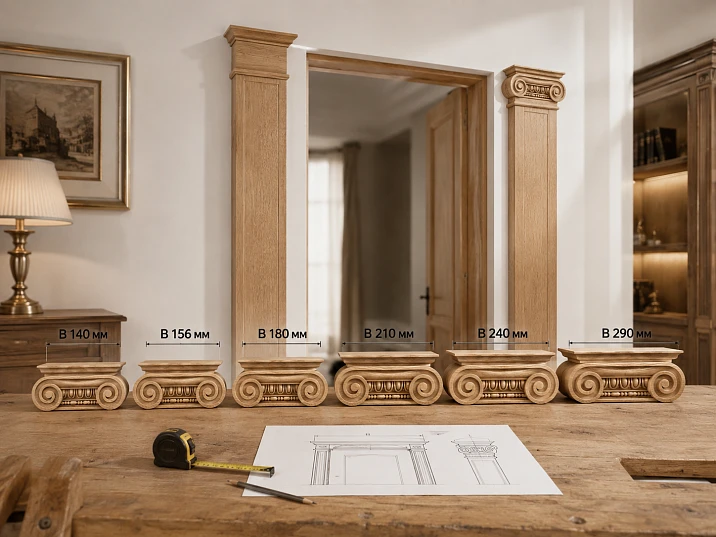
The most dangerous number in the KL-006 card is neither the largest nor the smallest. It is B=180 mm, if the buyer sees it next to their pilaster width of 180 mm and immediately decides: "it matches — I'll take it."
A match of one number doesn't prove anything yet.
KL-006 has six standard versions, and in each row A, B, C, D, and F change simultaneously:
| Option | A | B | C | D | F |
|---|---|---|---|---|---|
| 1 | 57 | 140 | 27 | 66 | 23 |
| 2 | 64 | 156 | 30 | 73 | 26 |
| 3 | 74 | 180 | 35 | 85 | 30 |
| 4 | 86 | 210 | 40 | 99 | 35 |
| 5 | 98 | 240 | 46 | 113 | 40 |
| 6 | 119 | 290 | 56 | 136 | 48 |
Therefore, for an already assembled door portal, the correct order is not like this:
pilaster width → similar number B → cart.
But like this:
real portal → two pilasters → branded drawing KL-006 → check A/B/C/D/F → free zone up to cornice and casing → visual scale of the pair → material → sanding → order of two identical capitals.
This is especially important in a paired portal. An error in one size is repeated on both sides at once. If the capital is too wide, too deep, or incorrectly mates with the top of the pilaster, the problem becomes symmetrical and therefore even more visually noticeable.
At the time of verification, the KL-006 card confirms:
-
six sizes;
-
beech and oak;
-
sanding "Standard" and "Prestige";
-
preparation options for enamel and for tinting depending on the configuration;
-
custom manufacturing on average 5–10 days;
-
minimum shipment from one piece.
For a door portal in this article, the base batch is 2 identical KL-006 of the same size, same wood species, and same degree of sanding.
After checking the drawing, you can buy capital KL-006 not as a "beautiful capital about 180 mm", but as a specific set A×B×C×D×F.
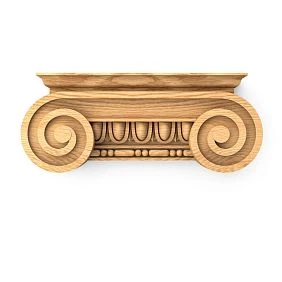
Wooden capital KL-006: six sizes that cannot be considered one model "in different scales"
KL-006 indeed forms a size series. But for purchase, it is not enough to say that 290 mm is a "large version" and 140 mm is a "small one".
In each version, the entire set of geometry changes.




Why this is important for the finished portal
Two pilasters already exist.
So, the project already has:
-
actual width of the verticals;
-
depth;
-
upper seating area;
-
distance to the door casing;
-
clear space to the upper cornice;
-
symmetry of the two sides.
The capital is not designed in a void. It must fit into the existing architectural assembly.
Our factory also produces:
What can be determined from the table without a drawing
Only that the dimensions differ and increase from one row to the next.
Get Consultation
What cannot be determined without the official drawing
It is not allowed to arbitrarily rename:
-
A — "height";
-
B — "pilaster width";
-
C — "depth";
-
D — "seating";
-
F — "offset".
Even if some guess seems obvious from the photo.
In the worksheet, it is better to keep the A/B/C/D/F designations until their geometric meaning is read from the official size chart.
Why this is stronger than the usual selection by a single width
Because one pilaster can match KL-006 in one parameter and not match in another.
For example, B=180 may beautifully align with one portal line, but C, D, or F may be incompatible with the actual top node.
Then the variant 74×180×35×85×30 cannot be considered confirmed.
Why a wooden capital for a pilaster cannot be ordered only by size B
Size B is convenient as a quick reference because it forms a clear sequence:
140 → 156 → 180 → 210 → 240 → 290 mm.
But in the finished portal, B is only one of five checks.
Example with B=180
The card provides a string:
74×180×35×85×30 mm.
Incorrect logic:
"Pilaster 180 mm — so KL-006 B=180 fits."
Correct:
-
open the KL-006 drawing;
-
find what exactly B measures;
-
determine the corresponding base on your pilaster;
-
check A;
-
check C;
-
check D;
-
check F;
-
check the free space around the product;
-
only after this consider the variant compatible.
Why this is not bureaucracy
Pilaster is a volumetric detail.
Its top can:
-
have a ledge;
-
expand;
-
narrow;
-
transition into a frieze;
-
approach the frame;
-
have a separate landing area.
One external number does not describe the entire node.
What to do if B matched, but one of the other parameters did not
Do not buy an "almost suitable" capital with the intention of sawing it off on site.
First, check:
-
whether the dimensional base is read correctly;
-
whether the pilaster is measured correctly;
-
is there another standard size;
-
is a different capital model needed;
-
is a separate transition element needed per the project.
How to take measurements from the two already manufactured pilasters
The advantage of a ready-made portal is that dimensions don't need to be guessed from the project.
You can measure the actual object.
First determine whether the two pilasters are actually identical
Don't assume.
Check the left and right separately.
Working table
| Parameter | Left pilaster | Right pilaster |
|---|---|---|
| Mating base A | ___ | ___ |
| Base B | ___ | ___ |
| Base C | ___ | ___ |
| Base D | ___ | ___ |
| Base F | ___ | ___ |
| Free space at top | ___ | ___ |
| To the trim | ___ | ___ |
| To the adjacent decor | ___ | ___ |
Names like "base A" etc. are filled in after reading the company drawing.
Why you need to measure both sides
Construction and carpentry geometry may have slight differences.
If one side is narrower, closer to the wall, or higher, the same KL-006 pair must still be checked in both positions.
What to do if there is a slight difference in pilasters
First, understand where the error is:
-
in the pilaster itself;
-
in the installation;
-
in the adjacent trim;
-
in the measurement.
Do not pick two different capitals just to compensate for a few millimeters without a design solution.
For a symmetrical portal, two identical KL-006 are stronger, and a geometric base defect is better corrected as a base defect.
KL-006 57×140×27×66×23 mm: the most compact option in the series
First line:
57×140×27×66×23 mm.
Price at the time of checking for one capital:
-
beech, "Standard" — 2,360 RUB;
-
beech, "Prestige" — 3,210 RUB;
-
oak, "Standard" — 2,600 RUB;
-
oak, "Prestige" — 3,330 RUB.
For the pair:
| Execution | 2 pcs. |
|---|---|
| Beech, Standard | 4 720 ₽ |
| Beech, Prestige | 6 420 ₽ |
| Oak, Standard | 5 200 ₽ |
| Oak, Prestige | 6 660 ₽ |
Why compact size doesn't mean "for a narrow door"
There is no such universal correspondence.
It can be a candidate for a lighter composition, but is first checked against A/B/C/D/F.
Where the small variant is especially important to compare visually
On the portal with:
-
a high opening;
-
a massive top cornice;
-
wide pilasters;
-
a large baguette.
A technically compatible capital may look too weak.
What to check at the top
Even a small variant should have a free architectural zone.
If the top of the portal is already saturated with baguette and cornice, the compact KL-006 is sometimes stronger than the next size up.
KL-006 64×156×30×73×26 mm: why the extra 16 mm in B is already noticeable in a pair
Second row:
64×156×30×73×26 mm.
Difference in B relative to the first variant:
156 − 140 = 16 mm.
On one piece, 16 mm may seem like a trifle.
But the portal has two capitals.
Visually, both the top left and top right change immediately.
Price of one
-
beech, Standard — 2,560 ₽;
-
beech, Prestige — 3,670 ₽;
-
oak, Standard — 3,080 ₽;
-
oak, Prestige — 3,960 ₽.
Price per pair
-
5 120 ₽;
-
7 340 ₽;
-
6 160 ₽;
-
7 920 ₽.
Why it's useful to compare the second size with the first physical template
On screen, the difference is small.
On two pilasters, the total visual weight increases.
Make two sets of frontal silhouettes:
-
2× B140;
-
2× B156.
And compare the entire portal, not just one capital separately.
KL-006 74×180×35×85×30 mm: first the pilaster drawing, then the basket
The third line is especially tempting because B=180 mm is a common "round" number for furniture and interior geometry.
But this is exactly where it is especially important not to confuse a numerical coincidence with technical compatibility.
Full line:
74×180×35×85×30 mm.
Price of one
-
beech, Standard — 3,490 RUB;
-
beech, Prestige — 4,710 RUB;
-
oak, Standard — 4,110 RUB;
-
oak, Prestige — 5,050 RUB.
Pair
-
6 980 ₽;
-
9 420 ₽;
-
8 220 ₽;
-
10 100 ₽.
Practical selection scheme
-
measure both pilasters;
-
open the official drawing KL-006;
-
compare A/B/C/D/F;
-
check the upper free zone;
-
check the architrave;
-
check the cornice above the portal;
-
make a paired template;
-
only then add two identical items to the order.
Why a paired template is more important than a single one
The two capitals share a common horizontal rhythm.
What looks "slightly larger" on one pilaster may become a proper classic frame on a portal — or, conversely, an excessively heavy top.
KL-006 86×210×40×99×35 mm: how a larger capital changes the top of a door portal
Fourth standard size:
86×210×40×99×35 mm.
Here B increases relative to the previous row by:
210 − 180 = 30 mm.
On two capitals, the portal gains an additional 60 mm of total frontal mass along this dimensional coordinate — if it is indeed the one that corresponds to the visible transverse dimension per the company drawing. The article does not substitute a guess for the drawing, so this figure is used only as an indicator of series growth.
Price of one KL-006 B=210 mm
At the time of checking:
-
beech, "Standard" — 3,700 ₽;
-
beech, "Prestige" — 5,110 ₽;
-
oak, "Standard" — 4,520 RUB;
-
oak, "Prestige" — 5,550 RUB.
Pair for door portal
-
beech, "Standard" — 7,400 RUB;
-
beech, "Prestige" — 10,220 RUB;
-
oak, "Standard" — 9,040 RUB;
-
oak, "Prestige" — 11,100 RUB.
What changes besides the price
The capital begins to more strongly shape the top of the portal.
It should already be evaluated together with:
-
height of the door opening;
-
width of the top horizontal;
-
the casing;
-
baguette;
-
the cornice;
-
distance to the ceiling.
Why a larger capital may be more appropriate on a tall portal
If the vertical pilasters are tall and massive, a too-small top looks like a random decorative "cap."
Version B=210 mm may better hold the scale.
But this is only a visual hypothesis after technical compatibility.
When B=210 mm is already overloaded
If the portal:
-
narrow;
-
low;
-
stands in a small corridor;
-
has a large carved baguette above the door;
-
is located next to the cabinet;
-
has a small free field above the pilasters.
Then the next larger part may physically fit, but compositionally worsen the portal.
Capital made of wood KL-006 98×240×46×113×40 mm: the side projection becomes a separate check
Fifth line:
98×240×46×113×40 mm.
Price of one:
-
beech, "Standard" — 4,380 ₽;
-
beech, "Prestige" — 6,250 RUB;
-
oak, "Standard" — 5,760 ₽;
-
oak, "Prestige" — 7,050 ₽.
Pair:
-
8 760 ₽;
-
12 500 ₽;
-
11 520 ₽;
-
14 100 ₽.
Why for B=240 mm you need to look at the portal not only from the front
The large capital protrudes more into the space.
But which specific one of A/B/C/D/F is responsible for the specific side dimension is determined by the proprietary drawing.
After reading it, you need to make a side template based on the actual maximum depth.
Where this is critical
Pilaster next to the cabinet
The capital may visually or physically overlap the plane of adjacent furniture.
Door near the corner
The top decor can approach the perpendicular wall.
Narrow wall section
The wide top starts to look cramped.
Two pilasters stand close together
The capitals can almost touch above the opening.
Why you can't evaluate only by "fits/doesn't fit"
If only a few millimeters remain to the adjacent part, there may be no technical conflict.
But the architectural junction will look randomly compressed.
Need to leave conscious space.
The project specifies the exact size of this space separately; there is no universal "20 mm gap" here.
KL-006 119×290×56×136×48 mm: why you shouldn't buy the maximum size "for show"
The largest KL-006:
119×290×56×136×48 mm.
Price of one:
-
beech, "Standard" — 6,170 ₽;
-
beech, "Prestige" — 8,200 ₽;
-
oak, "Standard" — 8,230 ₽;
-
oak, "Prestige" — 9,670 ₽.
Price of a pair:
-
12 340 ₽;
-
16 400 ₽;
-
16 460 ₽;
-
19 340 ₽.
The difference between the smallest and largest pair
For the beech "Standard":
12 340 − 4 720 = 7 620 ₽.
For the oak "Prestige":
19 340 − 6 660 = 12 680 ₽.
But even this difference is not the main limitation.
The main problem with the maximum size is architectural
B=290 mm must:
-
match the official drawing of the unit;
-
fit between adjacent elements;
-
not collide with the cornice;
-
not turn the pilaster into a visually weak "leg" under too large a top.
When a large KL-006 can be strong
-
high portal;
-
wide pilasters;
-
large hall;
-
high ceiling;
-
massive upper cornice;
-
large classical furniture on the sides.
When the "largest" looks cheap, not solid
When the scale is chosen without relation to the pilaster.
Excessive size of a decorative detail often makes the composition not richer, but more random.
All six KL-006 on one portal: comparing not sizes, but relationships
If you make six frontal mockups on one photo, it becomes clear that the choice should not be made in isolation.
It is useful to evaluate:
-
ratio of the capital to the width of the pilaster;
-
ratio to the height of the pilaster;
-
ratio to the upper cornice;
-
distance between two capitals;
-
free field above the door.
Why B=140 and B=290 cannot be compared as a "small/large photograph"
All geometry changes.
For example:
A:
57 → 119 mm.
C:
27 → 56 mm.
D:
66 → 136 mm.
F:
23 → 48 mm.
The largest version is roughly twice the size of the first in several parameters.
What this means visually
Two 290 mm capitals give a completely different portal top than two 140 mm ones.
This is no longer "slightly more decor," but a different architectural mass.
How to make six KL-006 templates without buying six capitals
For choosing the size, you can use paper, cardboard, or foam board.
But the template is built only after reading the drawing.
Front template
The actual dimensions corresponding to the frontal projection are taken.
Side
Depth/offset according to the brand scheme.
Why B×A cannot be drawn automatically
Because the article does not know how exactly these dimension lines are positioned on the drawing.
Convenient system
Create separate templates:
-
KL140;
-
KL156;
-
KL180;
-
KL210;
-
KL240;
-
KL290.
And place two of each size on the portal.
What to photograph
-
the entire portal;
-
the right capital in detail;
-
side node;
-
portal together with adjacent furniture.
Two identical capitals KL-006: how to place a paired order without confusion
For one symmetrical portal you need:
2 × the same size.
But sameness should include more than just the article number.
Pair control
-
KL-006;
-
identical A×B×C×D×F;
-
one wood species;
-
one sanding;
-
one finish;
-
one finish logic;
-
quantity 2.
Why you can't order "KL-006 — 2 pcs." without a size
Inside one card there are six options.
A line with one item number does not explain which two parts are needed.
Ready-made line
KL-006 / 74×180×35×85×30 mm / oak / Prestige / preparation ___ / 2 pcs. / door portal / node drawing verified.
After technical verification, you can wooden capital KL-006 order it specifically as a paired item, not as two separately selected decorative parts.
Price of the KL-006 pair in all six sizes
For purchasing convenience, we will combine the cost of two capitals.
| A×B×C×D×F | Beech Standard | Beech Prestige | Oak Standard | Oak Prestige |
|---|---|---|---|---|
| 57×140×27×66×23 | 4 720 ₽ | 6 420 ₽ | 5 200 ₽ | 6 660 ₽ |
| 64×156×30×73×26 | 5 120 ₽ | 7 340 ₽ | 6 160 ₽ | 7 920 ₽ |
| 74×180×35×85×30 | 6 980 ₽ | 9 420 ₽ | 8 220 ₽ | 10 100 ₽ |
| 86×210×40×99×35 | 7 400 ₽ | 10 220 ₽ | 9 040 ₽ | 11 100 ₽ |
| 98×240×46×113×40 | 8 760 ₽ | 12 500 ₽ | 11 520 ₽ | 14 100 ₽ |
| 119×290×56×136×48 | 12 340 ₽ | 16 400 ₽ | 16 460 ₽ | 19 340 ₽ |
Prices are indicated at the time of verification and must be re-checked before payment.
What the table shows
The price does not increase in a strictly uniform step.
Therefore, you cannot choose the size based on the "price ladder."
Compatibility first.
Then the scale.
Then the material and sanding.
Oak or beech capital: what to choose if two pilasters are already made
The material needs to be matched to the existing verticals.
If the pilasters are oak and will remain under a transparent finish
Oak KL-006 is more logical as a starting option.
Why:
-
one breed is preserved;
-
the wood structure is related;
-
the tinting is easier to coordinate.
But even two oak products can differ in natural pattern.
If the pilasters are beech
The same principle works in favor of beech.
If the entire portal will be under a covering enamel
The breed becomes less visible.
Then you need to compare:
-
price;
-
preparation;
-
workshop technology.
Why random beech on an oak pilaster is dangerous with a transparent finish
The texture difference will be exactly at the top point of the portal.
The eye easily notices the change of material.
Why you shouldn't buy oak 'just in case'
If everything is covered with enamel and the workshop works with beech, the extra cost for oak may not provide visible value.
Standard or Prestige: what the buyer pays for when ordering KL-006
STAVROS distinguishes two degrees of sanding:
-
'Standard' — machine;
-
'Prestige' — more detailed manual.
For a pair of carved capitals, this has a real production value.
Example B=180, beech
Standard:
6,980 ₽ per pair.
Prestige:
9 420 ₽.
The difference:
2 440 ₽.
Oak B=290
Standard:
16 460 ₽.
Prestige:
19 340 ₽.
The difference:
2 880 ₽.
When "Standard" is rational
If a furniture/carpentry workshop:
-
still performs its own finishing;
-
has experience in manual sanding of carved decor;
-
plans to use covering enamel.
When "Prestige" is stronger
if:
-
transparent finish is important;
-
Finishing deadlines are strict;
-
The workshop doesn't want to spend time on deep relief;
-
The appearance must be as ready as possible for subsequent coatings.
Why "Prestige" doesn't mean "the coating is already ready"
Sanding is only one stage.
Further steps may be required:
-
dust removal;
-
primer;
-
matting;
-
finish.
Under enamel or under tinting: choice before ordering, not after delivery
Card KL-006 contains preparation options.
This needs to be fixed simultaneously with the wood species and sanding.
Under Enamel
It makes sense if the portal is painted opaque.
Under Tinting
It makes sense if the wood texture should remain visible.
Why you can't place an order "we'll decide later"
Preparation affects how the workshop will work with the product.
It's better to agree on the finish before paying for the two capitals.
Why it's better to buy a pilaster and a capital as one architectural set
If the portal is not yet fully manufactured, the capital cannot be considered an independent decoration.
It completes the top of the pilaster.
Therefore, the combination:
pilaster → capital → baguette/cornice
must be designed as a single system.
If the verticals are still being selected, you can Buy wooden pilasters only after checking the interface with KL-006.
What does joint selection give
-
the same scale;
-
clear top node;
-
matched wood;
-
a unified finish.
Why you can't buy the capital now and "match the pilaster later"
The six sizes of KL-006 do not guarantee that any catalog column/pilaster will interface without a transition.
Wooden pilasters and columns: what to check in a finished portal
If the verticals are already in place, the category wooden pilasters and columns is needed more as reference context, not for a mandatory new purchase.
For finished pilasters, check
-
article number;
-
the actual width;
-
depth;
-
the top platform;
-
material;
-
finish;
-
height;
-
distance to the cornice;
-
Symmetry.
Why the article number is useful
If the pilaster is standard STAVROS, the manager can additionally verify the combination against the documentation.
If the pilaster is custom
The official drawing KL-006 still remains the basis for measurements.
What to check if wooden pilasters are already purchased and cannot be replaced
A finished portal moves the project from the stage of 'choosing a beautiful series' to the stage of compatibility with reality.
It's no longer possible:
-
to enlarge the pilaster for the capital;
-
to shift it without consequences;
-
to change the material without reworking the entire portal.
Therefore, the checklist becomes stricter.
1. Exact pilaster article number
If it is known, keep it in the specification.
2. Actual top geometry
Not just the nominal width from the old invoice.
Measure the actual part.
3. Material
Beech, oak, MDF, or another base.
KL-006 is made from beech/oak, so the clear finish is especially sensitive to mismatch.
4. Already applied finish
If the pilasters are painted, the new capital must match the existing color and gloss.
5. Free space up to the top element
The capital should not be "wedged" between the pilaster and the molding.
6. Two sides of the portal
The left and right sides are checked separately.
Two pilasters are identical by design, but not in reality: how to proceed
Suppose one vertical differs by a few millimeters.
Bad reaction:
take two capitals of different sizes.
This will destroy the portal's symmetry even more.
First, determine the source of the difference
-
installation;
-
finish thickness;
-
the pilaster itself;
-
wall curvature;
-
measurement error.
Then decide whether the base can be leveled
If yes — one pair of KL-006 is kept.
If not
Need a project for a non-standard transition or another model.
Why two different KL-006 — extreme scenario
Sizes 140/156/180/210/240/290 differ noticeably.
On one portal, such a difference will look like a configuration error.
How to connect the KL-006 capital with a wooden baguette above the door portal
The capital rarely exists completely alone.
Above the door there may be:
-
carved baguette;
-
cornice;
-
frieze;
-
horizontal panel.
If the top element is still being selected, you can Buy wooden picture frame molding after the size of the KL-006 pair has already been confirmed.
Why this order
Capitals are attached to pilasters.
The baguette is attached to the common horizontal line.
If you first select a wide baguette and then try to "squeeze" it between it and the KL-006 pilaster, the size selection becomes artificial.
What to check in the joint
-
height of the upper zone;
-
depth of the baguette;
-
visual line;
-
distance between carved motifs;
-
same material/finish, if intended.
When a capital and a baguette are better separated by a smooth field
If both are very active.
A small calm field can make the carving more readable.
The exact size of such a field is chosen according to the layout.
Two KL-006 and the top cornice: how not to get four competing horizontals
The portal may include:
-
top of the pilaster;
-
capital;
-
a baguette;
-
common cornice.
If each layer is strongly expressed, the top becomes heavy.
What to check on the front elevation sketch
Not just the KL-006 itself.
You need to see the entire stack:
pilaster → capital → frieze → baguette/cornice.
When B=240/290 is especially sensitive
A large capital already creates a strong horizontal line by itself.
Adding a massive baguette may overload it.
Why KL-006 should not be considered a load-bearing element of the door portal without a separate calculation
The card describes the capital as an architectural element, but in this article the portal is already assembled.
The task is decorative finishing of two pilasters.
Therefore, KL-006 does not automatically receive:
-
load from the wall;
-
load from the lintel;
-
the function of portal attachment;
-
calculated load-bearing capacity.
What the portal carries
What was provided by its design:
-
frame;
-
wall;
-
joinery unit;
-
other fastenings.
Why this is important
The word "capital" is historically associated with a column, but a decorative product in a modern interior should not be arbitrarily included in the load-bearing scheme.
If the capital is to cover the installation gap above the pilaster
This is a separate function that needs to be checked against the drawing.
Bad approach
"There's a 20 mm gap — a large capital will hide it."
The capital is not chosen as a masking overlay without checking the fit.
Correct
First determine:
-
why there is a gap;
-
should it be;
-
what is covered by the project;
-
does KL-006 match the node.
How to compare the scale of six sizes in one photo on the portal
After technical selection, it is useful to do a visual edit.
Prepare the photo strictly frontally
Minimize perspective.
Scale each variant according to the drawing
Not by the size of the picture from the website.
Place two identical capitals
Always in pairs.
Compare not only details
Rate:
-
opening width;
-
height;
-
pilasters;
-
the casing;
-
a baguette;
-
free field.
Why a single fitting is misleading
A pair doubles the visual presence.
Relative growth B: why adjacent sizes feel different
Let's count the steps:
140 → 156 = +16 mm;
156 → 180 = +24 mm;
180 → 210 = +30 mm;
210 → 240 = +30 mm;
240 → 290 = +50 mm.
The scale is uneven.
Practical conclusion
Transition 140→156 — fine adjustment.
240→290 — a much stronger change.
You can't say "let's take the next size" as if the step is always the same.
The growth of other parameters confirms that the entire volume changes.
A:
57 → 64 → 74 → 86 → 98 → 119.
C:
27 → 30 → 35 → 40 → 46 → 56.
D:
66 → 73 → 85 → 99 → 113 → 136.
F:
23 → 26 → 30 → 35 → 40 → 48.
What does this mean
The series scales consistently, but each transition affects the entire profile.
This is another argument against choosing only by B.
Capital KL-006 near the door casing: how to check for side conflict
On the finished portal, the casing may run close to the pilaster.
The large KL-006 can extend beyond the intended boundary.
Make a side template
Based on the actual geometry of the drawing.
Check
-
whether the casing overlaps;
-
whether it extends onto the adjacent wall;
-
whether it conflicts with the door hinge/closer in the upper zone;
-
whether a visually clear joint remains.
Why "not touching" is not enough
Two decorative elements may not physically touch, but look like they accidentally almost collided.
Portal next to the cabinet: when B=210/240/290, check especially carefully
The cabinet creates a second major vertical line.
Risks
-
the capital overlaps the cabinet facade;
-
the cabinet door opens nearby;
-
two carved systems conflict;
-
a narrow gap remains between them.
Possible output
The smaller KL-006 is better not because it is cheaper, but because the joint is freer.
Portal in a niche: the capital size is chosen based on the visible volume of the niche
If the portal is squeezed by side walls, large capitals visually appear larger.
In an open hallway
The same B=240 can look calm.
In a niche
Hard.
Therefore, the same SKU cannot be recommended based on door opening width without room context.
Door portal with a low ceiling: why top clearance matters more than "solidity"
If there is little space above the pilaster, a large capital plus a baguette can get close to the ceiling.
Result:
-
the top appears cramped;
-
the carving is hard to read;
-
shadows become heavy.
Solution option
Check a more compact size.
What not to do
Reduce the height of the KL-006 itself by filing without approval.
When it's better not to order KL-006
Purchase is premature if:
-
size chosen based on a photo;
-
only the catalog is open, but not the drawing;
-
only the "pilaster width" is known;
-
A/B/C/D/F not checked;
-
the top of the portal is still changing;
-
baguette/cornice not defined;
-
the two pilasters actually differ;
-
the material has not been chosen;
-
finish not selected;
-
a different architectural scale is needed.
A particularly dangerous phrase
“Let’s take B=180 — if anything, the carpenter will adjust it.”
Standard carved decor is better chosen to be compatible in advance.
When another capital will be better than KL-006
If none of the six options fits geometrically or visually.
Then you need to look at other models.
In the category you can buy wooden capitals after comparing other mounting geometries.
What changes when switching models
Everything needs to be checked again:
-
size letters;
-
a drawing;
-
material;
-
price;
-
style.
Why you cannot transfer B=180 from KL-006 to another article
Another model may have a different size chart.
Buy wooden capitals for a project with several portals: count in pairs
If the object has not one portal but several identical ones, Buy wooden capitals you need to count by the number of pairs.
One portal
2 pcs.
Three identical portals
6 pcs.
Five
10 pcs.
Why serial production increases the importance of a reference sample
One size error will repeat across all openings at once.
It's better to first assemble one reference portal.
Buy carved capitals for a hotel or restaurant: a standard node passport is needed
For a serial project buy carved capitals better after fixing one standard node.
In the passport:
-
KL-006;
-
full A×B×C×D×F;
-
material;
-
polishing;
-
finish;
-
coordinates;
-
a baguette;
-
photo.
This way the installer doesn't choose the size for each opening anew.
Buy carved wooden decor for a portal: when KL-006 should be the main element, and when — secondary
If the door portal is built not only from pilasters and
Installation KL-006: what needs to be decided before finishing
The product card should not replace the installation project.
Before painting the capitals, you need to understand:
-
material of the upper zone of the pilaster;
-
fixation method;
-
access from the reverse side;
-
need for mechanical fastening;
-
adhesive compatibility;
-
dismountability.
Why the assembly first, then the paint
If after finishing you have to:
-
to drill;
-
mill;
-
choose landing,
the surface can be damaged.
Can KL-006 be installed only with glue
This depends on:
-
masses of a specific size;
-
base material;
-
contact area;
-
the selected composition;
-
operating conditions.
The article does not prescribe a single universal adhesive.
What to do
Check:
-
manufacturer's recommendations;
-
technical data sheet of the adhesive;
-
actual material of the pilaster.
If the pilaster is already painted with enamel
Adhesion to finished paint may differ from adhesion to raw wood.
Therefore
Do not apply adhesive without a compatibility test.
Risk
The adhesive holds to the capital but tears a layer of enamel off the pilaster.
Then the problem is in the coating system, not in the adhesive itself.
If the pilaster is already coated with oil
Mounting chemicals require separate testing.
Some adhesives perform poorly on oily/waxy surfaces.
There is no need to universally promise reliability.
If the portal must be disassembled
For example, a furniture portal or a temporary commercial structure.
Then permanent adhesive fixation may be undesirable.
What is important
Design the mounting with future dismantling in mind.
Can KL-006 be trimmed after delivery
The FAQ card states that standard cutting/trimming to size service is not provided.
Self-trimming of the carved capital is a separate operation.
Why it is risky
Allowed:
-
disrupt the symmetry;
-
alter the joint;
-
damage the sanding;
-
expose fresh wood.
Therefore
It is better to choose a standard size before ordering.
When an individual size makes sense
The manufacturer reports the possibility of non-standard products for individual projects in batch orders.
For one door portal, a standard grid of six sizes is usually the first route.
When an individual scenario is logical
if:
-
the project is serial;
-
dozens of identical portals;
-
no standard size fits;
-
changing the pilaster is impossible.
How to check 'Standard' and 'Prestige' on one real part
If the budget is large or the project is serial, it is useful to get samples/consultation.
View
Not only a smooth outer surface.
Especially:
-
recesses;
-
Thread transitions;
-
edges;
-
hard-to-reach areas.
Why
It is there that manual finishing provides the greatest value.
Clear finish: why two oak capitals need to be seen side by side
Natural oak is variable.
Two parts may differ:
-
shade;
-
by grain;
-
by the direction of the grain.
What to do before tinting
Place them side by side and determine the left/right position.
Can they be swapped
Yes, if the geometry is symmetrical and both capitals are identical by SKU.
Distribution by pattern can improve balance.
Enamel: why a pair should be painted in one cycle
If two identical KL-006 are painted:
-
with different batches of paint;
-
with different gloss;
-
with a different number of layers,
the difference will be noticeable on a symmetrical portal.
Better
One finishing cycle.
The upper baguette is already painted: how to match the existing color
The new KL-006 is compared with a physical sample.
Not only with:
-
RAL;
-
NCS;
-
a photograph.
Why
The old coating could:
-
fade;
-
turn yellow;
-
change its shine.
What to do if the capital fits the drawing but not the style
Do not buy.
Technical compatibility is a necessary but not sufficient condition.
Alternative
Look at another capital in the category.
Why this is not a project failure
On the contrary, this is correct filtering.
Errors in selecting and ordering KL-006
Error 1. Selecting by B
Reason: B forms a convenient range of 140–290.
Consequence: the remaining parameters do not match.
Prevention: check A/B/C/D/F.
Error 2. Calling B the width of the pilaster without a drawing
The geometric meaning must be confirmed.
Error 3. Checking only the left pilaster
The right side may differ in fact.
Mistake 4. Order two different KL-006 to compensate for a crooked portal
The paired composition will fall apart.
Mistake 5. Buy the maximum B290 "for solidity"
The size may overload the top.
Mistake 6. Choose B140 only to save money
It may get lost on a large portal.
Mistake 7. Not checking the baguette
The capital collides with the upper horizontal.
Mistake 8. Not making a side mockup B240/290
Removal into space is detected after delivery.
Error 9. Mixing beech and oak
Under a transparent finish, the material differs.
Error 10. Mixing "Standard" and "Prestige"
Surfaces require different finishing.
Error 11. Starting painting before a dry fitting
A geometric error is detected late.
Error 12. Using random glue
The pilaster coating may not hold the joint.
Error 13. Filing threads without approval
The shape and preparation change.
Error 14. Order one capital, and the second one later
The pair of wood and the term may differ.
Error 15. Consider 5–10 days as a guaranteed delivery date
This is the average production time, not the entire logistics cycle.
Error 16. Check the order by the total amount
The size can be confused.
Error 17. Not saving the full A×B×C×D×F
In a year, only the memory "it was about 180" will remain.
Error 18. Transfer the dimensional logic of KL-006 to another article
Another capital has a different scheme.
When KL-006 can already be purchased
The order is ready if:
-
two pilasters are finally installed;
-
their actual geometry is measured;
-
the official KL-006 drawing is opened;
-
A/B/C/D/F are checked;
-
one size is selected;
-
a paired visual mockup is made;
-
the top baguette/cornice is checked;
-
breed selected;
-
sanding is selected;
-
preparation is selected;
-
installation method determined;
-
price and timeline checked.
Boundary scenario: B=180 fits per drawing, but too little space remains above the pilaster
Technical compatibility with the pilaster does not guarantee compatibility with the entire portal.
Let's imagine that 74×180×35×85×30 mm fully fits the joint, but the cornice starts almost immediately above the top of the pilaster.
Possible outcomes
-
the capital physically fits, but the carving is "pinched";
-
the upper molding overlaps part of the ornamentation;
-
an accidental gap remains between elements;
-
the two capitals visually conflict with the central horizontal line.
What to check
Not only the size KL-006.
Need a cut of the entire upper zone.
If space is limited
Possible options:
-
more compact KL-006;
-
different baguette;
-
change of the upper frieze;
-
another model of the capital.
Boundary scenario: B=156 looks small, B=180 is already too large
This is a real situation because the size grid is discrete.
There is no standard KL-006 between 156 and 180.
What to do
Do not look for the mathematical midpoint of 168 mm and do not assume it can be ordered as a regular SKU.
Options
-
check another article;
-
change the adjacent decor;
-
keep 156 and reinforce the top with a baguette;
-
discuss non-standard batch production if the project volume is suitable.
Why an "almost right" size may be more correct
Sometimes a visual problem is solved not by enlarging the capital, but by changing the surroundings.
Edge case: one pilaster next to a wall, the second one free-standing
The portal is symmetrical in terms of furniture, but the room is not.
Risk
A large right/left KL-006 next to a wall feels more cramped.
What not to do right away
Ordering different sizes.
Better
Compare the entire portal:
-
with the same pair;
-
with a more compact pair.
More often, a single pair preserves architectural logic better than trying to compensate for a wall with different capitals.
Edge case: a tall cabinet is nearby
Especially sensitive are B=240 and 290.
Check
-
opening of the facade;
-
handles;
-
distance to the side of the cabinet;
-
shadow;
-
visual collision of two verticals.
Possible output
B=210 may look stronger than B=240 precisely because of the surroundings.
Edge case: the portal is very wide
On a large opening, B=140/156 may seem small.
But you cannot switch to B=290 without checking the pilaster.
If the pilasters are narrow
The largest capital will not become correct just because of the opening width.
What can be changed
-
wider pilasters, if the project is not yet completed;
-
a different article;
-
the upper composition.
Boundary scenario: the portal is very tall, but the pilasters are thin
The height of the room pulls the size upward, while the geometry of the verticals pulls it downward.
This is a conflict of proportions.
Solution
Do not choose KL-006 based on only one of the factors.
A frontal mockup is needed.
Boundary scenario: pilasters are painted, capitals are intended to be left in natural oak.
This is already a deliberate material contrast.
What to check
-
doesn't the oak look like an accidentally "unpainted" detail;
-
is natural wood repeated anywhere else;
-
is it supported by the molding/door.
If the oak is not repeated anywhere else
The contrast may be too stark.
Edge case: two oak capitals, but the central molding is beech under a tinted finish
Under a clear finish, the difference in wood species will be noticeable.
It's not necessary to prohibit it
But it should be done deliberately.
Stronger
Either one wood species, or a clear contrast.
Edge case: the portal will be repainted in a year
If the finish is temporary, the material and preparation still need to be chosen correctly.
Why
Repainting will not fix an incorrect size or fit.
Edge case: the capital is needed only as a visual "cap" on a furniture pilaster.
KL-006 can be used not only in a construction door portal.
But the principle remains:
-
a drawing;
-
junction;
-
a pair;
-
Scale.
How to check two KL-006 after delivery to the finish
Do not start with painting.
Step 1
Check the marking.
Step 2
Verify the full A×B×C×D×F.
Step 3
Check the wood species.
Step 4
Compare the two parts side by side.
Step 5
Do a dry fit on both pilasters.
Step 6
Photograph the entire portal.
Why dry fitting is especially important
Even a correctly chosen size can reveal an unexpected visual issue only on the actual site.
How to store the pair before installation
Natural wooden items are best kept in conditions that match the recommendations of the manufacturer and the finishing workshop.
Key points
Do not separate paired capitals across different sites/boxes without labeling.
Marking
Portal-01 L/R, KL-006, 74×180×35×85×30.
If the parts are geometrically identical, L/R here only indicates the position on the portal, not different SKUs.
If one capital is damaged after installation
Need an exact repeat.
Save in the object passport
-
KL-006;
-
size;
-
material;
-
sanding;
-
finish;
-
photo.
Why is “KL-006 B180” worse than the full size
Over the years, the card may contain similar designations, but the full set is more reliable.
Where to buy KL-006, capitals, and carved decor in one order
The route depends on the selection stage.
If KL-006 is already approved
Go to the exact card.
If the model did not fit
Look at the capitals category.
If the entire artistic language of the portal changes
Open the general catalog of carved decor and compare other architectural elements.
Why you don't need to return to the general catalog after every minor doubt
The later the project stage, the narrower the choice should be.
Checklist before paying for pair KL-006
| Parameter | Project | Invoice |
|---|---|---|
| Article number | KL-006 | ___ |
| A | ___ | ___ |
| B | ___ | ___ |
| C | ___ | ___ |
| D | ___ | ___ |
| F | ___ | ___ |
| Material | ___ | ___ |
| Sanding | ___ | ___ |
| Preparation | ___ | ___ |
| Quantity | 2 | ___ |
| Lead time | ___ | ___ |
If one line doesn't match, the invoice is not confirmed.
Which KL-006 size to choose: decision tree
Step 1. Do you have a pilaster drawing and KL-006?
No → get them first.
Yes → continue.
Step 2. Do A/B/C/D/F match by node?
No → exclude the option.
Yes → continue.
Step 3. On both pilasters?
No → fix the base/look for another node.
Yes → continue.
Step 4. Does the capital fit next to the baguette and casing?
No → next size/model.
Yes → continue.
Step 5. Is the scale visually suitable?
No → compare another technically compatible option.
Yes → continue.
Step 6. Does the material match the concept?
No → choose beech/oak.
Yes → continue.
Step 7. Sanding and finishing approved?
Yes → order is ready.
How to mark two KL-006 on a finished portal so that identical capitals do not look different
Even a correctly selected pair can look asymmetrical if the left and right parts are installed on different bases.
On a finished portal, you cannot mark one capital "from the wall" and the second "from the edge of the trim." A pair needs one coordinate system.
Base 1 — own pilaster
If two pilasters are identical, it is logical to transfer the position of the capital relative to their own axes and top platforms.
Base 2 — central axis of the doorway
Useful as a visual check.
After dry installation, the distances from the inner edges of the two capitals to the central axis should form the expected symmetry of the project.
Base 3 — upper horizontal of the portal
If the capitals adjoin a common frieze or baguette, the upper line should be checked with a single level/drawing base.
Why you cannot rely on the floor
The floor may have a slope, while the pilasters are already installed relative to their own joinery system.
For a decorative pair, the connection to the portal is stronger than to the building floor of the room.
Optical symmetry and geometric symmetry: why they sometimes diverge
Two KL-006 units may stand perfectly aligned by the ruler, but one appears larger or taller.
Causes:
-
side lighting;
-
different pattern of natural wood;
-
adjacent cabinet;
-
one side of the portal is closer to the wall;
-
different shadows from the baguette.
What to do
First check the geometry.
If the dimensions are the same and the axes align, do not shift one capital "by eye" immediately.
Control under three lighting modes
-
daytime;
-
main artificial lighting;
-
side lighting, if available.
If the feeling of asymmetry changes with the light, the problem is not necessarily in the installation.
Dry fit of the pair before glue or final fastening
For a finished portal, this is a mandatory practical step.
Sequence
-
attach the left KL-006;
-
secure temporarily in a safe manner;
-
apply the right one;
-
step back 2–4 meters;
-
check the front;
-
view from the side;
-
check the molding;
-
Take a photo.
Why first two, not one
One capital only answers the question 'does it fit?'
A pair answers:
-
scale;
-
symmetry;
-
the overall weight of the top;
-
the distance between two carved elements.
How to check the free field between two capitals
If the doorway is relatively narrow, large B240/B290 may visually converge.
You need to measure not only the parts themselves, but also the remaining central clearance.
Working formula
If the clean internal dimension between the bases of two pilasters and the actual frontal projection of the capitals from the drawing are known, the central free field is calculated based on the actual geometry.
The article deliberately does not automatically substitute B into this formula, because B cannot be declared as the required frontal width without a drawing.
Practical meaning
When the central field becomes too narrow, the portal at the top turns into an almost solid carved horizontal line.
This may be intentional.
But if the project intended two light capitals at the edges, the size should be reduced.
How to check the cost of a pair relative to the overall portal budget
The price of two KL-006 can be a small part:
-
pilaster;
-
baguette;
-
doors;
-
finish;
-
installation.
Therefore, savings on an adjacent size should rarely determine the geometry.
Example B180 vs B210, oak "Standard"
B180:
6 980 ₽.
B210:
7 400 ₽.
The difference:
420 ₽ for the entire portal.
If B210 is visually and technically better, saving 420 ₽ on B180 almost certainly does not justify the wrong scale.
Another example: B240 vs B290, oak "Prestige"
14,100 ₽ vs 19,340 ₽.
The difference:
5 240 ₽.
Here, the budget may already be a separate factor, but only after both sizes are recognized as technically acceptable.
Acceptance of two KL-006: what to check before handing over to the finisher
The pair must be accepted as a set.
1. Full size
Not just B.
2. Wood species
Both beech or both oak.
3. Sanding
Same.
4. Preparation
Matches the order.
5. Thread integrity
Without damage to protruding elements.
6. Dry fit
Before coating.
Why can't you paint first and then check the fit
After individual finishing, correcting the order and geometry becomes significantly more difficult.
If one of the two parts looks noticeably different in wood
For natural oak or beech, some variation is normal.
But the pair is placed symmetrically, so a sharp contrast is better assessed before staining.
Possible actions
-
swap left and right;
-
select a stain;
-
Discuss pairing with the supplier/workshop.
What should not be required automatically
Photographically identical texture of natural wood.
Delivery of a pair: why the packaging cannot be opened one piece at a time and the marking cannot be thrown away
Before full verification, keep:
-
labels;
-
packaging;
-
documents.
If a size or material error is found, it is easier to match the item with the invoice.
For a serial item
Pack boxes/places by portals:
Portal-01, 2×KL-006.
This way, two identical capitals do not end up in different rooms.
Timeline 5–10 days: how to plan portal finishing
Average production time is only part of the schedule.
After it, the following remain:
-
delivery;
-
acceptance;
-
finish;
-
drying;
-
Installation.
If the portal must be ready by a specific date, it's better to place the order with a buffer, rather than treating the tenth day as a guaranteed installation date.
If the size hasn't been confirmed yet
Don't rush the purchase at the cost of a mistake.
A week spent on a new order after an incorrect size is usually worse than one extra day spent on properly checking the drawing.
What changes if the portal needs to be finished without the option for a reorder
In an expensive finished interior, sometimes what matters more is not the minimum price, but the absence of a second production cycle.
If you make a mistake with the KL-006 size, a reorder restarts the 5–10 day timeline plus delivery and finishing. Therefore, before paying for the pair, it's useful to do a 'zero installation' on paper and on site.
Zero installation includes
-
checking A/B/C/D/F against the drawing;
-
two full-size templates;
-
dry fitting to both pilasters;
-
checking the molding;
-
material confirmation;
-
finish confirmation;
-
invoice check.
When it makes sense to order one KL-006 control piece first
Not always.
For a symmetrical portal, one piece does not show the paired scale and can complicate matching the wood for the second.
But a test purchase can be rational if:
-
the portal is unique and expensive;
-
the actual appearance of a specific size is unknown;
-
the workshop is working with KL-006 for the first time;
-
the deadlines allow for a second order.
When it's better to order two at once
if:
-
the drawing is fully confirmed;
-
templates are made;
-
material and finish are approved;
-
the pairing of natural wood is important;
-
repeat delivery is undesirable.
Why "two at once" does not cancel acceptance
Even a paired order is checked before painting.
Capitals are first applied to the portal and only then sent to the finishing cycle.
Thus, commercial choice becomes manageable: the buyer does not overpay for an extra size and does not save on the check that protects the already finished door portal.
Control after dry fitting
After two KL-006 units are applied to the portal, photograph the assembly strictly from the front and save the frame along with the specification. The photo should show both pilasters, the top baguette, and the selected pair of capitals. This is useful for both the installer and the customer: during final installation, you can quickly check whether one of the parts has shifted and whether the project has changed between fitting and installation.
FAQ
What dimensions does KL-006 have?
Six:
-
57×140×27×66×23;
-
64×156×30×73×26;
-
74×180×35×85×30;
-
86×210×40×99×35;
-
98×240×46×113×40;
-
119×290×56×136×48 mm.
How to choose the size of KL-006 for a pilaster?
According to the official drawing A/B/C/D/F and the actual geometry of the mating pilaster, and then by the visual scale of the portal.
Can you rely only on B?
No. B is only one of five parameters.
If the pilaster is 180 mm, does B=180 fit?
Not necessarily. You need to confirm that B on the drawing refers to the same geometric base, and check A/C/D/F.
What values of A/B/C/D/F need to be checked?
All five. Their geometric meaning is read from the official KL-006 diagram.
How to order two identical capitals?
In one line: full size, material, polishing, preparation, quantity 2.
What is the maximum size of KL-006?
119×290×56×136×48 mm.
What is the minimum?
57×140×27×66×23 mm.
Is there a KL-006 made of oak?
Yes.
Can I order KL-006 in beech?
Yes.
What is better under enamel?
It depends on the existing pilasters and technology. Beech is often rational for opaque finishes if there is no requirement for an oak base.
What to choose for transparent tinting?
It is usually more logical to keep the same wood species as the pilasters. If they are oak, consider oak.
How does 'Standard' differ from 'Prestige'?
"Standard" is machine sanding, "Prestige" is more detailed hand sanding.
Is it mandatory to choose "Prestige"?
No. If the workshop performs quality finishing itself, "Standard" may be more rational.
Can KL-006 be used in a door portal?
Yes, as a decorative finish for the pilaster if the joint compatibility is confirmed.
Is KL-006 a load-bearing part of the portal?
The article does not use it as a calculated load-bearing element. The structural scheme of the portal is designed separately.
What to do if no size fits?
Choose a different capital model or design a custom joint.
Can KL-006 be sawed down?
Standard sawing-to-size service is not offered. Self-modification requires approval.
How to combine the capital with a wooden pilaster?
First by geometry, then by scale, material, and finish.
Do I need to buy pilasters and KL-006 at the same time?
If the portal is not yet made, it is more convenient. If pilasters already exist, the capital is matched to the actual situation.
How to select a wooden baguette to match KL-006?
After choosing the capital size, check the overall top composition, depth, and free space.
Where can I see other carved capitals?
In the category of wooden capitals STAVROS.
How much does a pair B=180 cost?
At the time of check — from 6,980 ₽ for beech "Standard" to 10,100 ₽ for oak "Prestige".
How much does the maximum pair B=290 cost?
From 12,340 to 19,340 ₽ in four reviewed configurations.
What is the production lead time?
Average lead time on the card is 5–10 days.
Can I order one capital?
Minimum order is one piece, but two are needed for a symmetrical portal.
What should I check before payment?
Full size A/B/C/D/F, quantity 2, material, sanding, preparation, price, and lead time.
Final ordering algorithm for two KL-006
-
Fix the door portal as a finished object.
-
Measure the left pilaster.
-
Measure the right one.
-
Open drawing KL-006.
-
Determine the geometric meaning of A.
-
Determine B.
-
C.
-
D.
-
F.
-
Transfer the same bases to the pilasters.
-
Check B140.
-
B156.
-
B180.
-
B210.
-
B240.
-
B290.
-
Exclude incompatible ones.
-
For the remaining ones, make two templates each.
-
Check the frontal scale.
-
Check the side.
-
Check the casing.
-
Check the top cornice.
-
Check the cabinet/wall nearby.
-
Select one size.
-
Choose birch or oak.
-
Select "Standard" or "Prestige".
-
Select finish preparation.
-
Decide on installation method.
-
Create specification for 2 pcs.
-
Check the price.
-
Check the deadline.
-
Check the invoice for all parameters.
-
Accept two capitals before finishing.
-
Perform a dry fit.
-
Perform a single finish.
-
Mount the pair.
-
Keep the full passport A×B×C×D×F.
Conclusion
For a finished door portal with two pilasters KL-006, you need to choose not by a single digit B, but by the full drawing A/B/C/D/F.
The card offers six versions:
57×140×27×66×23;
64×156×30×73×26;
74×180×35×85×30;
86×210×40×99×35;
98×240×46×113×40;
119×290×56×136×48 mm.
B=180 mm does not automatically mean "capital for a 180 mm pilaster." First, you need to understand what the dimension line B actually shows, and check the other four parameters against the real top assembly of both pilasters.
For one symmetrical portal, two identical KL-006 of the same size, same wood species, and same degree of sanding are ordered.
After technical compatibility, the visual scale is chosen. B140/156 give a more compact top; B210/240/290 more strongly shape the architectural horizontal and require more free space next to the baguette, casing, cabinet, and ceiling.
The material is chosen based on existing pilasters and finish. With a transparent finish, it is especially important not to accidentally mix beech and oak. Under enamel, the choice can be more economical. "Standard" and "Prestige" differ in the degree of sanding, so you need to compare not only the price of the capital, but also the future work of the workshop.
At the time of inspection, the KL-006 pair costs from 4,720 ₽ for the minimum beech size in "Standard" to 19,340 ₽ for the maximum oak option in "Prestige". The price may change; it needs to be rechecked before payment.
Correct sequence:
ready-made pilasters → official drawing → A/B/C/D/F → check both sides → paired template → baguette/cornice → material → sanding → finish → 2 identical capitals → order.
This way, the buyer chooses KL-006 as part of a specific door portal, not as a beautiful carved detail with an approximately matching B number.