Article Contents:
- NPU-293L and NPU-293R: is it mandatory to buy two overlays
- Why an asymmetrical slat wall does not require symmetrical door decor
- 170 × 78 × 11 mm: how to try on NPU-293L in full size
- Do not confuse the 170 × 78 mm dimension with the visual weight of the ornament
- Where to place a single NPU-293L if the slat wall is on the right
- In the upper part of the panel as a single accent
- Inside an existing molding frame
- Closer to the calm side of the panel
- According to the diagonal or directional logic of the pattern
- In the color of the door leaf
- In contrast
- Matching the slats
- Option A — only NPU-293L
- Option B — NPU-293L + NPU-293R
- Option C — without overlays
- Mistake: installing one NPU-293L without an architectural reason
- Mistake: evaluating a door without a slat wall in the frame
- Mistake: forgetting about the casing and the end of the slat panels
- Can you buy the NPU-293L now and add the NPU-293R later?
- Do you need to install the NPU-293L specifically on the left side of the door just because of the letter L?
- Can the NPU-293L be rotated 180 degrees?
- What to do if one NPU-293L looks too small?
- Can the NPU-293L be glued directly onto the door leaf with film?
- Do you need to take the door off its hinges for installation?
- What is more important — the same color as the NPU-293L and the door, or the same color as the slats?
- Can one NPU-293L be used without a molding frame?
- What to do if the NPU-293R on the slat side does not fit mechanically, but visually the pair is liked more?
- Is it worth buying both overlays "just in case" if the pair costs 2,500 ₽?
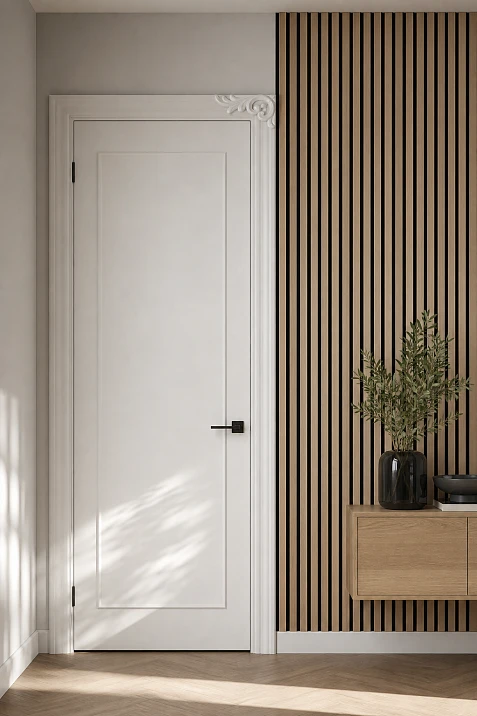
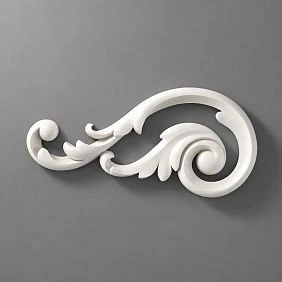
The door stands almost at the border of the slatted wall. On the right, there is already an active vertical texture: slats, shadows between them, the rhythm of the ends, and the transition from the panel to the wall. On the door itself, you want to add a carved polyurethane accent, and the catalog has two mirror-oriented positions — NPU-293L and NPU-293R. Hence a natural buyer's question arises: if the wall architecture is already asymmetrical, is it mandatory to buy both overlays, or can one NPU-293L look like a complete solution?
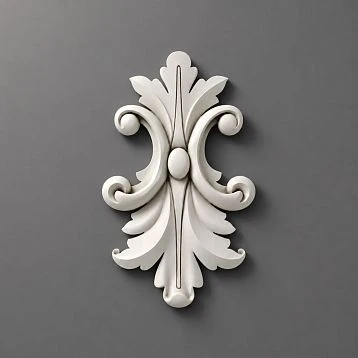
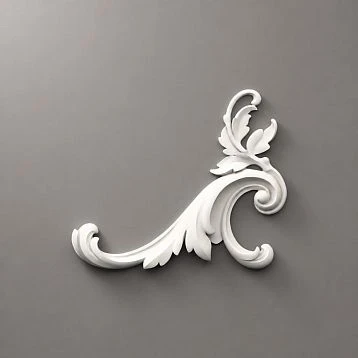
For this scenario, the NPU-293L measuring 170 × 78 × 11 mm made of polyurethane is considered. At the time of checking the current STAVROS product card, the selected option costs 1,250 ₽ per piece. The paired NPU-293R has the same dimensions of 170 × 78 × 11 mm and also costs 1,250 ₽. Therefore, the decision is reflected in the cart literally: one piece — 1,250 ₽, two — 2,500 ₽.
The direct answer is this: the letter L in the article number itself does not oblige you to buy R. For a specific door, you can deliberately use only one NPU-293L if the asymmetry is supported by the architecture itself — the slatted wall already "weighs down" the right side, and a single overlay on the calm part of the panel creates a balancing accent. But this cannot be decided by the product name. Before ordering, you need to make two full-size templates — NPU-293L and the mirrored NPU-293R — and compare three door states: only L, L + R, and no molding at all.
| Parameter | NPU-293L | NPU-293R | What is important in the article |
|---|---|---|---|
| Type | Carved decorative overlay | paired carved decorative overlay | this is decor, not a structural part of the door |
| Size | 170 × 78 × 11 mm | 170 × 78 × 11 mm | check in full size |
| Material | Polyurethane | Polyurethane | consider the base and installation method |
| Price at time of check | 1,250 ₽/pc. | 1,250 ₽/pc. | one piece — 1,250 ₽, a pair — 2,500 ₽ |
| Basic question | is one accent enough | is a mirror side needed | the composition of the door and adjacent wall decides |
| Pair requirement | is not confirmed by the very fact of L/R | is not confirmed by the very fact of L/R | pairing is a composition option, not a universal obligation |
If after an on-site check the single option really works, buy a carved decorative overlay NPU-293L made of polyurethane it is logical to do so after fixing the specific spot on the panel. If a door with one piece looks as if it has lost the second half of the ornament, the experiment should be repeated with NPU-293R, rather than trying to convince yourself that "asymmetry is fashionable now."
NPU-293L and NPU-293R: is it mandatory to buy two overlays
The most dangerous logical error here is very simple: seeing L and R in the article numbers and automatically taking them for a set that cannot be separated. In practice, decorative elements have two different things — product pairing and the obligation of a paired composition. The first means that mirror-oriented parts exist. The second depends on the specific object.
On a symmetrical door panel standing in a symmetrical wall, a paired solution is often perceived naturally: the two sides balance each other, and the door axis becomes the center of the composition. But our situation is different. To the right of the door, a slatted wall begins. It already adds a dense vertical rhythm and visual weight. To the left, there may be a calm painted surface, another partition, or open space. That is, the surrounding architecture is asymmetrical in advance.
In such an environment, two equally active overlays on the panel may not "fix" the asymmetry but create another layer that conflicts with the slats. One piece, on the contrary, can become a local counterbalance: not mirroring the right side, but compensating for it.
However, a single NPU-293L should look intentionally single. If the ornament is clearly directed toward a non-existent continuation, if there is an obvious empty space next to it for a mirror piece, or if the rest of the door is built on strict symmetry, the absence of R will be perceived as an incomplete set.
Therefore, the question "can one be used?" is better translated into practical terms: which option looks complete when looking at the door together with the right slat wall? Looking only at the white door with the template separately is not enough.
If you first need to understand the general principles of designing a door next to slats, it is useful to look at the material "Slat panels and door decor: how to design transitions, openings, and surfaces without a stylistic break". The entire transition is discussed there. Here the task is much narrower: to choose between one NPU-293L and a pair of L/R on a specific door leaf.




Why an asymmetrical slat wall does not require symmetrical door decor
Symmetry works convincingly when there is something to support it: identical pilasters, paired panels, the central axis of the opening, identical sconces, or identical wall sections on both sides. If the door is actually located at the edge of the slat composition, the surroundings already set a different rhythm.
The slats on the right create a dense textural mass. Even if their color is close to the color of the door leaf, vertical shadows make the surface visually more active than a smooth wall. The deeper the relief and the more contrasting the gaps, the stronger this side is. Therefore, mechanically adding NPU-293R "for balance" can only be done after checking — sometimes the right overlay turns out to be exactly the element that overloads an already saturated boundary.
It is useful to imagine the composition not as "the door should be symmetrical," but as three adjacent fields:
-
a calm field on the left;
-
the door leaf;
-
Active slat zone on the right.
Then the decor gains a function. One NPU-293L can work not as half of a pair, but as a connecting accent between the first and second panels. The L/R pair turns the canvas itself into a separate symmetrical composition. The option without overlays leaves the transition to the slats as the main object.
None of the three options is correct in advance. They need to be compared in the same photo from the same distance. A black-and-white shot is especially useful: it removes part of the color information and shows where contrasts and visual weight are actually concentrated.
If after adding the second overlay the door becomes the main decorative object of the room, ask whether that was the goal. If the slat wall was intended as an accent, a symmetrical pair on the door may draw attention away. If, on the contrary, the door should be a classic dominant, a single detail may seem too random.
Our factory also produces:
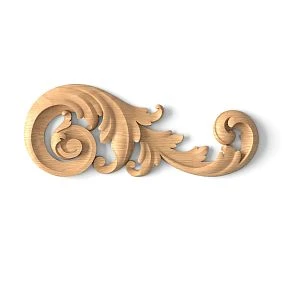
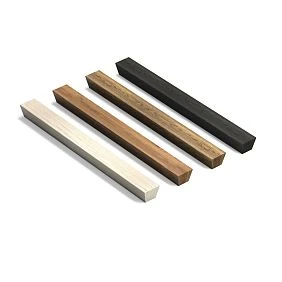
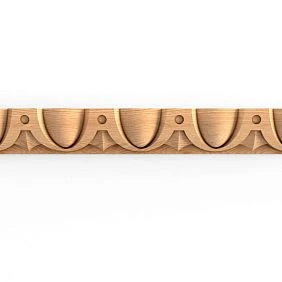
170 × 78 × 11 mm: how to try on NPU-293L in full size
For the selected product, dimensions are specified as A × B × C: 170 × 78 × 11 mm. In the current STAVROS catalog, parameter A is listed as width, B as height, C as thickness. This allows for a meaningful full-scale check, but still, you should not replace the product outline with a rectangle at the final stage: the asymmetric ornament distributes visual mass unevenly within the overall dimensions.
Start with a simple paper template of 170 × 78 mm. It answers the question of scale. Then print or trace the product silhouette if you have access to a drawing — such a template is already needed to assess the direction of the pattern.
Apply it not in one spot, but in several logical zones of the canvas. In each position, look at four parameters:
-
distance to the edge of the canvas;
-
connection with the handle, panel, or molding frame, if present;
-
distance to the right edge, near which the slat wall begins;
-
readability of the ornament from a typical viewing point.
Don't immediately look for the "ideal 100 mm from the edge" or any other universal offset. Doors can have different proportions, and the overlay itself can be placed in the upper third, in the corner area, inside a molding field, or as a separate accent. The correct offset is one where the decor doesn't look cramped and doesn't fall into operational zones.
The next step is the mirrored R template. Even if you currently want to buy only L, place both paper pieces at the same time. This is the best way to understand whether the single option looks intentional or truly feels like it's missing its pair.
After such a check, you can order NPU-293L 170 × 78 × 11 mm no longer "for trial," but for a specific composition.
Get Consultation
Don't confuse the 170 × 78 mm dimension with the visual weight of the ornament
Two elements of the same size can look different. A rectangular plate 170 × 78 mm creates one mass, while an openwork asymmetrical overlay with gaps and thin branches creates another. Therefore, the percentage of the door width is useful only as an auxiliary value.
If you want to formalize the scale, you can use a simple ratio:
share by width = 170 / width of the visible door field × 100%.
But you can't decide by one percent. The visible field is not always the entire width of the canvas. Handle, moldings, panels, glass, milling, and even a contrasting edge reduce the actual space for decor. On a door with an existing frame, NPU-293L should be compared not with the entire leaf, but with the inner field of that frame.
The situation is similar in height. The 78 mm dimension is small, but an asymmetrical detail can be noticeable due to the directional pattern and depth of relief. If it stands alone on a huge empty plane, what matters is not the absolute height, but the presence of a clear reference: to the top panel, handle axis, horizontal furniture line, or adjacent molding.
Check the scale from two distances. Up close, you will see the beauty of the carving. From the point where the door is usually perceived in the room, it becomes clear whether the detail works at all. If from a normal distance only a small white spot remains and the connection with the composition disappears, the product may be too small specifically for that place.
That is why the article should not be reduced to the formula "170 mm suits a door of such width." In a real interior, the decision is based on the free field, not on the leaf's passport.
Where to place one NPU-293L if the slatted wall is on the right
The correct place is not determined by the letter L. The letter in the article number helps distinguish mirror variants, but the specific mounting position should follow the ornament and architecture of the door. Therefore, first look at the drawing and front view, then at the door itself.
There are several logical zones on the door next to the slats.
In the upper part of the leaf as a single accent
This option is suitable if the lower part is occupied by a handle, panel, or simply should remain calm. The overlay works as a small ornamental sign and does not compete with the frequent vertical of the slats along the entire height.
Inside an existing molding frame
If the door already has a decorative frame, the NPU-293L must live within its geometry. Here it is especially easy to notice whether R is needed: the frame creates its own symmetry. One asymmetrical detail inside a strictly symmetrical rectangle requires a stronger compositional foundation.
Closer to the calm side of the panel
When the slats on the right are very active, a single accent can be shifted toward the freer field. But "shifting" does not mean pressing the decor against the left edge. Enough empty surface must remain around it so that the ornament does not look randomly glued on.
According to the diagonal or directional logic of the pattern
For asymmetrical overlays, not only the center matters, but also the direction of the motif. If the contour seems to "unfold" toward the center of the panel, it can support a single composition. If it clearly calls for a mirror continuation, R becomes more logical.
In all cases, apply the template with the door closed, then open the door and look at it at an angle. What looks perfect from the front may turn out to be too close to the trim or visually blend with the slats when opened.
What changes if you add NPU-293R on the slat side
The second overlay changes not only the number of details and the price. It changes the very principle of the composition. One NPU-293L says: "there is a local asymmetrical accent here." The L/R pair says: "the door is designed as an independent symmetrical object."
This is especially important near a slatted wall. If the NPU-293R is positioned closer to the right side of the panel, it ends up in the same visual field as the vertical slats. Three outcomes are possible.
The first is assembly. The ornament completes the door, and the slats remain the background. This works if there is a calm boundary between the right overlay and the slatted zone—a trim, a smooth wall section, or a sufficient pause.
The second is overload. The thread, the edge of the canvas, the trim, and the vertical slats end up too close together. The eye fails to separate the levels. The pair is formally symmetrical, but the whole scene as a whole becomes heavier on the right.
The third is unnecessary competition. The second overlay strengthens the door so much that the slatted wall ceases to be the main accent. This can be good if the door portal is meant to dominate. If not, the cost of the second detail pays not for improvement, but for a change in the interior's hierarchy.
It is in this section that it is appropriate to buy a paired carved overlay NPU-293R only after comparing two paper mockups. Buying R "just in case" only makes sense if you are ready to use it elsewhere; in the basic scenario, it is better to decide in advance whether it is needed compositionally.
When one NPU-293L looks like a deliberate decision, and when it looks like a lost half of a pair
A single asymmetrical detail must have an explanation that is visible without words. A person entering the room does not know that a mirrored version exists to the right of the product. They simply read the shape.
One NPU-293L looks deliberate if several conditions are met:
-
the neighboring architecture itself is asymmetrical;
-
the overlay is tied to a real object or field, rather than hanging at a random point;
-
there is enough free space around it;
-
the direction of the ornament does not obviously indicate a missing continuation;
-
the right slat zone already creates a visual counterbalance;
-
there are no other elements on the door that require strict pairing.
The effect of a "lost half" appears otherwise. For example, two identical panels clearly expect identical decor, but the overlay is only on one. Or the NPU-293L is placed at one upper corner, while the opposite corner remains empty without an architectural reason. Or the ornament starts at the center and clearly breaks off where the viewer expects a mirror motif.
A useful test is to show a photo to a person who does not know your intent and ask one question: "Is something missing here, or does the composition look complete?" Do not explain about economy, L/R, or slats. If several independent people immediately ask where the second overlay is, that is a strong signal to check the pair.
Another test is to temporarily remove the template altogether. Sometimes it turns out that the choice between one and two pieces is false: a door without molding better supports a modern slat wall. Such an option should remain until the very end.
11 mm relief: check not only the beauty, but also the free movement of the door
The thickness of the NPU-293L in the selected size is 11 mm. On the wall, this value mainly contributes to volume and shadow. On a moving door leaf, an additional task appears: the overlay must not create a mechanical conflict.
First, determine the direction of opening. If the door opens toward a wall, furniture, or a protruding trim, apply a temporary spacer of a thickness approximately equal to the actual protrusion of the future decor to the chosen spot and slowly go through the entire opening angle. Not only the moment of the fully open door matters. The minimum gap sometimes occurs in an intermediate position.
Pay special attention to the decor at the edge of the door leaf. The leaf itself may have sufficient clearance, but the protruding 11 mm changes the trajectory of the nearest point. You cannot assume that if the door currently does not touch the wall anywhere, nothing will change after installation.
A separate risk is adjacent slats if the door opens toward them. The slat protrudes from the wall plane, the NPU-293L protrudes from the door leaf plane, and the two reliefs can meet. This requires a physical check, not a visual assessment based on the closed door.
If the decor is located closer to the center of the leaf, the mechanical risk is usually lower, but still check the handle, limiter, door closer, and any surface-mounted parts.
Do not use the NPU-293L as a stop, handle, or element that must regularly absorb impact. It is a decorative overlay. If the door physically rests on the decor when opening, first change the limiter or the installation location.
Handle, lock, hinges, and the constant contact zone
A door is not a static panel. It is touched every day, pushed with the shoulder, held with the palm, opened by the handle, and sometimes brushed by a bag. Therefore, a beautiful point in a photo can turn out to be a poor operational point.
Around the handle there is a constant grip zone. The exact width of this zone depends on user habits and the shape of the hardware, so setting a universal number is pointless. Do a simple test: open the door several times with your usual motion and note where your fingers, palm, and forearm pass. The NPU-293L should not have protruding ornament parts in that area.
Hinges have a different problem. An overlay placed too close to the hinge side can end up in a small clearance zone when opening, especially if there is a protruding trim or wall finish. Again, this is checked not with a ruler on the closed leaf, but with a full cycle of movement.
If the door has a magnetic lock, door closer, concealed hinges, or electromechanics, the decor must not block access to serviceable elements and screws.
There is also a purely household factor—cleaning. A part near the handle collects dirt faster because the door is constantly touched nearby. When painted in a light color, this becomes noticeable sooner.
Therefore, a good place for a single NPU-293L is not just an empty field, but a calm field away from constant contact.
Should the NPU-293L be aligned to the handle axis, the door center, or the edge of the slat wall?
A decorative composition can have several competing axes. If you try to subordinate the overlay to all of them at once, the layout will become random.
The door panel axis is useful when the door itself is the main object. But a single asymmetric overlay does not have to lie on the center.
The handle axis only makes sense if the decor is truly built around the hardware. You cannot automatically transfer the handle height to the overlay.
The edge of the slat wall is important as a neighboring vertical. If the decor is too close to it, the NPU-293L may be perceived as part of the transition, even if you wanted to decorate the door.
A molding frame or panel, if already present, is usually more important than the external wall: a decorative element inside the frame should follow the local geometry.
Before final layout, write down which axis is primary in your project. For example: "The NPU-293L should work within the upper field of the door, and the slat wall only influences the choice of one detail instead of a pair." Then you don't need to pull the overlay to the very joint with the slats.
Another scenario: "the overlay should visually balance the dense right rhythm." Then the position relative to the slats becomes primary.
A good composition usually has one primary reference and one or two secondary checks. If the overlay simultaneously tries to be centered on the panel, centered on the panel insert, at the same height as the handle, and at a fixed distance from the slats, that is a sign that the task is formulated too complexly.
Is a molding frame needed around a single NPU-293L?
A frame can solve one problem and create another. It is useful when a single asymmetrical piece looks lost on a large smooth surface: a rectangular field gives it boundaries, and the ornament is perceived as part of a finished composition.
But a frame sharply increases decorative density. There is already a slat wall nearby. If you add moldings to the door, NPU-293L, and possibly NPU-293R, you get three different rhythm levels: vertical slats, a geometric frame, and carved ornament.
For a minimal scenario, first check NPU-293L without an additional frame. If it works on its own, there is no need to complicate the composition.
A frame becomes logical when:
-
other doors in the room already have similar molding fields;
-
the door leaf is too large and empty for one small element;
-
the interior style is deliberately built on a classic paneled system;
-
you need to separate the ornament from the active slat wall with a geometric boundary.
If the slats are modern, the leaf is smooth, the handle is minimalist, and NPU-293L is needed only as a small accent, a frame may look like an attempt to turn one idea into a whole portal.
General material about decorative polyurethane overlays for furniture and doors useful if you are designing not just a single piece, but a "frame + ornament" system. Our article deliberately keeps the basic choice simpler.
Paint NPU-293L to match the door leaf color or emphasize the relief
Color determines how strongly a single overlay asserts itself. This is especially important next to a slat wall, where there is already plenty of texture without molding.
In the color of the door leaf
This option makes the relief, not the silhouette of the piece, the main focus. NPU-293L reads through light and shadow and argues less with the slats. For a modern interior, this is often the safest first mockup.
But "matching the color" does not mean simply leaving the factory white if the door is white. Different white shades, degrees of matteness, and coating temperature can differ noticeably. It is better to rely on the actual finish of the panel.
In contrast
A contrasting NPU-293L turns into a small graphic sign. Then the absence of NPU-293R becomes more noticeable: the viewer reads the asymmetry faster. If that is exactly what is intended, the solution can be expressive. If not, the contrast amplifies the feeling of "one half."
In tone with the slats
This option connects the door to the wall by color rather than form. It can be interesting, but requires a sample. The same wood tone on matte polyurethane and on a slatted surface is perceived differently due to texture.
Before final painting, make a color mockup at least in a photo editor or paint a small test sample. Especially if contrast is planned. For a single composition, color affects the need for R no less than position.
Light and shadow can make one overlay more noticeable than a pair
A relief depth of 11 mm creates its own shadow. On a door located next to a slat wall, lighting is often already directional: ceiling spots, side light from the hallway, backlighting of the slats themselves. Therefore, evaluating only in daylight diffused light is not enough.
If light comes from the side of the slat wall, the right part of the panel may be brighter or darker than the left. A single NPU-293L in a calm zone receives an additional light-and-shadow pattern and looks more noticeable than in the front catalog photo.
A pair L/R under side lighting can also lose mirror symmetry. Geometrically, the details are symmetrical, but one ends up lit, the other in shadow. If you buy R only for perfect balance, that balance may disappear in the evening.
Do a template check in a real evening scenario. To simulate the relief, place a thin spacer under the paper outline and observe the direction of the shadow. There is no need to try to accurately reproduce the 11-millimeter carving—the task is to understand which side the contrast appears on.
If one NPU-293L is already well readable under normal lighting, adding R will not necessarily improve the result. Sometimes a second detail simply doubles the number of shadows and makes the door visually heavier.
The slat panels on the right already create a vertical rhythm—how not to arrange a "picket fence"
NPU-293L is small compared to the door, but the ornament still adds direction. If vertical slats, a casing, the edge of the panel, and possibly a vertical handle line run nearby, the composition quickly accumulates too many parallel boundaries.
Look not only at the overlay itself, but at the number of active lines in one area. If the right edge of the door is already saturated with details, NPU-293R right there may be redundant. This is one of the strongest arguments for a single L—but only if L is placed where there is a calm field.
Sometimes the problem is solved not by abandoning R, but by changing the position of the pair. For example, both trims can be placed higher, where the slats visually compete less with the handle and furniture. But if the article's topic is minimal purchase of one part, you should first check that part itself.
If you haven't bought the panels yet and are selecting the entire wall system, buy wall slat panels it's better to do so after understanding the width of the slat zone and the position of the doorway. When the wall is already installed, NPU-293L must adapt to the existing rhythm, not the other way around.
What matters more: symmetry of the door leaf or balance of the entire wall
This is the central design choice of the article.
Locally, the door is a rectangle. It has a geometric center, and the L/R pair seems natural. But the interior is not perceived as separate rectangles. A person sees the door together with the surrounding wall, furniture, light, and passage.
If a large slat zone starts to the right of the leaf, the visual center of the entire scene shifts. Then a strictly symmetrical door may look like a separate insert, not connected to the wall. One NPU-293L allows the door to be more softly integrated into an asymmetrical composition.
The opposite situation is also possible: the slat wall occupies a small strip, and the door is framed with a wide casing and stands almost in the center of the entire plane. Here, local symmetry may be more important, and the pair will be more convincing.
It's useful to evaluate two frame boundaries:
-
a photo of just the door;
-
photograph of the door together with the entire slat wall.
If in the first frame one L seems strange, and in the second it looks logical, the solution really depends on the architecture. If a single detail looks unfinished even in the overall frame, the slats do not justify the asymmetry.
Such a double test protects against a typical mistake — designing decor based on a close-up of the product, forgetting the room's scale.
Three full-size mockups to compare before ordering
Instead of lengthy reasoning, you can spend one evening with paper and painter's tape.
Option A — only NPU-293L
Make a contour 170 × 78 mm, preferably with a real silhouette. Secure it in the chosen area. Look at the door closed, open, from the hallway, and from the room.
Option B — NPU-293L + NPU-293R
Add a mirrored template. Do not change the position of L, otherwise the comparison will be unfair. Assess whether the door has truly become more cohesive or just more decorative.
Option C — without overlays
Remove both templates. This is a mandatory control option. Sometimes after two decorated layouts, an empty door suddenly looks better because the slat wall already does all the work.
Photograph each option from the same point and under the same lighting. Then compare by five criteria:
| Criterion | Only L | L + R | Without overlays |
| Connection with the slat wall | Check | Check | Base level |
| Door completeness | Check | usually higher, but not automatically better | Depends on the style |
| Visual density | Minimal | Maximum | Minimal |
| Cost of decoration | 1 250 ₽ | 2 500 ₽ | 0 ₽ |
| Risk of overload | Below | higher near active slats | absent on the molding side |
Do not assign scores in advance. Fill in the table after the actual fitting. This approach turns subjective "liking" into a comparison of three specific solutions.
How to check door opening with an 11 mm thickness template
Flat paper shows scale but not mechanics. For a mechanical check, a safe three-dimensional mock-up is needed. A piece of lightweight foam board or several layers of cardboard assembled to approximately the protrusion of the future part will work. It should be attached temporarily so as not to damage the coating.
Open the door slowly to the maximum working angle. Check:
-
a wall;
-
protruding rails;
-
the casing;
-
baseboard;
-
the handle on the adjacent door;
-
furniture;
-
wall switches and frames;
-
the door stop.
If the gap seems minimal, do not measure "by eye." Measure the actual remaining space and leave a margin for installation inaccuracies and slight movements of the door leaf. A universal safe margin cannot be specified without knowing the construction.
When marking close to the right edge, consider that the rails themselves may protrude from the wall plane. With the door closed, everything looks clear, but during rotation the trajectories converge.
If the three-dimensional template catches on anything even once, the location is unsuitable without changing the stop or the position of the decor. Do not assume that the real polyurethane overlay is "slightly thinner at the edge" and will pass.
Door base: where decorative trim can be glued at all
Polyurethane decor requires a stable base and a compatible mounting adhesive. But door panels come in different types: enamel, lacquer, film, veneer, laminated surface, glass inserts, soft coverings. One method cannot be recommended universally without testing.
Task before purchase:
-
determine the material and finish specifically at the installation site;
-
check the door manufacturer's recommendations for applying decor;
-
select an adhesive suitable for polyurethane and the actual surface;
-
ensure that future removal is acceptable.
Be especially cautious with films and coatings that may peel off along with the adhesive. The trim may hold perfectly, but the weak link could be the decorative layer of the panel itself.
If the door is expensive or under warranty, coordinate the installation with the manufacturer. The fact that polyurethane is lightweight does not automatically make any base suitable.
For selecting adhesives and related compounds, you can look at Mounting and finishing materialsbut the specific composition is chosen after determining the door covering.
Glue before painting or first assemble the color scheme
The sequence depends on whether you will paint the overlay separately or together with the door leaf.
If the NPU-293L must match the door color exactly, it is more careful to first make a test paint and ensure a match. After installation, you can refine the seam and finish, but painting the entire finished door for the sake of one part is not always reasonable.
If the overlay is contrasting, separate painting before installation is more convenient: it is easier to paint the relief and not stain the door leaf. After gluing, local touch-up in the joint area may be required.
If the door is already in use, do not start with glue. First complete the entire mock-up stage: position L, option with R, color, lighting, and opening. Otherwise, you might perfectly glue the first part and then realize that the pair would look better or that the overlay should have been a few centimeters elsewhere.
This is a good example of why a commercial article should sometimes help postpone a purchase rather than push toward it immediately.
If the door is hidden or almost without a casing, the requirements for a single NPU-293L change
A hidden door next to a slatted wall is not just another door leaf option. It usually has a less pronounced door frame, and the boundary between the wall and the door can be reduced to a thin shadow seam. In such architecture, any carved overlay becomes more noticeable because it appears on a surface that was originally designed to be almost a continuation of the wall.
Here, a single NPU-293L can work in two opposite ways. The first is successful: it deliberately reveals the hidden door and makes asymmetry part of the design. The second is unsuccessful: a small classic ornament destroys the idea of an "invisible" door leaf, and the slatted wall nearby ceases to read as a single plane.
Therefore, for a hidden door, ask yourself an additional question: do we want to preserve the effect of a hidden opening, or are we consciously turning the door into a decorative object? If the first answer matters more, the absence of both trims is often more logical. If the second, the NPU-293L can be used, but its position must be especially precise, because the casing does not create the usual frame within which a small error is less noticeable.
Separately check the shadow gap. The trim must not extend onto the movable joint, overlap the technical clearance, or obstruct access to the hidden hinges. In this case, the 170 × 78 mm dimension is assessed relative to the clean field of the door leaf, and 11 mm relative to the actual opening trajectory.
If on the right the slats transition to the hidden door or approach it almost without a pause, a single carved detail may look foreign even with perfect installation. Then it is more useful to keep the slat rhythm as the main decor.
Check not only this door, but also the other doors in the room
A single NPU-293L can look perfect next to a specific slatted wall and still disrupt the interior if the adjacent doors are styled according to a different system. This is especially noticeable in a corridor, hall, or large living room where two or three openings are visible at the same time.
Compare four signs: whether there are trims on other panels, whether they are symmetrical, whether the molding frames are the same, and whether the decor color repeats. If all other doors are built on strict paired compositions, a single L on the new door requires a very strong explanation through the architecture of the slatted wall. Otherwise, it looks not like a designer asymmetry, but like an exception to the system.
The reverse situation is also important. If the other panels are smooth and minimalist, a pair of L/R on only one door can create too strong a stylistic leap. A single NPU-293L in the color of the panel sometimes introduces the classic relief more softly and does not turn the opening into a separate ceremonial portal.
A useful test is to photograph not one door, but the entire fragment of the corridor or room. Insert a paper L template on the desired panel and see whether it repeats any existing logic: color, accent height, ornament direction, frame rhythm. If there is no connection, try a pair, a different type of trim, or a complete refusal.
This is a separate purchase criterion: a locally beautiful door should not break the system of the other doors. Therefore, the decision "one for 1,250 ₽ or a pair for 2,500 ₽" is made not only within one rectangle of the panel, but also on the scale of the room.
Four mistakes that make an asymmetrical door look random
Even a correctly chosen NPU-293L can yield a weak result if you err not in the product but in the layout logic. Below are four different mistakes: one is related to buying a pair, another to the absence
Mistake: placing a single NPU-293L without an architectural reason
Asymmetry does not mean arbitrariness. If the overlay is glued to one corner simply because "it looked nice from this side," the viewer may consider the composition unfinished.
Reason: lack of anchoring. Consequence: the effect of a lost half.
Verification method: temporarily draw axes on the door with painter's tape — the boundaries of the panels, the center of the leaf, the handle line, the edge of the slat wall. See which one the NPU-293L relates to. If none, try another place.
Sometimes after this it turns out that a single decor works better not at the edge, but in the upper field or inside the frame. Sometimes a pair is needed. Sometimes overlays are not needed at all.
Mistake: evaluating the door without the slat wall in the frame
This theme exists precisely because of the neighboring slats. If you cover them with a sheet of paper or look at the door in close-up, the reason for asymmetry disappears.
Make the final choice from a point where both the leaf and a significant part of the slat wall are visible. In a narrow corridor, this may be the entry point. In a living room — the sofa or the passage. In a study — the workspace.
If the door is seen separately from most real viewpoints, the influence of the slats is weaker, and a symmetrical pair becomes a more likely option. If it is almost always perceived as part of one accent wall, the overall balance is more important than local symmetry.
Error: forget about the platband and the end of the slat panels
Between the door leaf and the slats there is often a platband, an extension, a shadow gap, or a finished panel end. This element already separates the two textures.
If the platband is wide and contrasting, the NPU-293R can comfortably exist on the right side of the door: it will have a visual pause before the slats. If the transition is almost frameless, additional carving near the edge competes more strongly with the vertical rhythm.
Do not measure the distance only from the door edge to the first slat. The entire chain matters: overlay → free door field → edge → platband/seam → slat panel.
It is this chain that determines whether the right side of the composition feels 'cramped.'
When a single NPU-293L is truly better than a pair
A single piece is a strong solution if at least several independent conditions are met, not just the desire to save money.
It is better than a pair when:
-
the right slat wall is already noticeably more active than the left part of the composition;
-
a second overlay would be too close to the slats or the platband;
-
NPU-293L has a clear reference to the free field;
-
when adding R, the door starts to draw attention away from the wall;
-
the lighting makes one detail expressive enough;
-
the door leaf is modern and minimalist, and only one classic accent is needed;
-
the 11-millimeter relief of the second detail creates an undesirable risk when opening;
-
the mockup without R looks complete from the real viewpoint.
Here, a single purchase is not a compromise, but a precise solution.
If you want to compare other shapes rather than force a specific model to work at any cost, you can buy asymmetric polyurethane overlays after viewing several options by scale and pattern direction.
When NPU-293R is still better to buy additionally
A paired detail becomes logical when the door itself should look like a separate, fully finished object.
Signs:
-
The panel has a symmetrical molding frame;
-
Two identical panels require identical decor;
-
One NPU-293L visually "pulls" the composition to the side;
-
The slatted wall is separated by a wide, calm trim and barely interferes with the right detail;
-
The interior style implies a paired classic ornament;
-
A symmetrical scheme is already used on other doors;
-
When comparing mockups, most viewpoints clearly win with two overlays;
-
Mechanical gaps allow safe placement of R.
Then saving on the second detail worsens the composition. In that case, it is wiser to plan NPU-293L + NPU-293R for 2,500 ₽ right away than to leave the door deliberately unfinished.
What matters is different: the output appears after the layout, not before it.
When you should buy neither NPU-293L nor NPU-293R
The most useful commercial advice sometimes ends with an empty cart.
Skip both overlays if:
-
the slat wall already fully creates the accent and the door is better left as a background;
-
there is no calm spot on the panel outside the handle and the constant contact zone;
-
the 11-millimeter relief conflicts with the opening;
-
the door covering cannot be safely glued or the warranty prohibits interference;
-
one pattern looks random, while a pair overloads;
-
the ornament does not match the existing hardware and finishes;
-
From a normal distance, the element is barely readable;
-
The only reason to buy it is "it's a pity to leave the door empty."
An empty smooth surface is also part of the composition. Next to a rhythmic slat wall, it often creates the necessary pause.
If the problem is not the quantity, but that the specific shape of NPU-293L doesn't fit, look at Polyurethane decorative appliques wider options. Perhaps the door needs a different scale, a central element, or a calmer ornament.
What to put in the cart: one NPU-293L for 1,250 ₽ or a pair for 2,500 ₽
It's convenient to reduce the solution to a small matrix.
| Fitting result | What to buy | Why |
| Only L looks finished, the right side is already active due to the slats | 1 × NPU-293L | the second detail adds no value |
| Only L looks like half, the pair assembles the door | NPU-293L + NPU-293R | symmetry is needed by the panel itself |
| The pair overloads, one gets lost | nothing from this pair | the problem is in the shape/scale, not in the quantity |
| The decor catches the wall or slats when opening | nothing before changing the location | functionality first |
| One L is good, but a more pronounced connection with the wall is needed | 1 × NPU-293L + color/position work | no need to automatically add R |
| The door should repeat the symmetrical design of other doors | pair | interior consistency is more important than local savings |
If the test result requires one element, buy one. If a pair is needed — buy NPU-293R together with L it's easier before marking: both parts can be tried as a single composition.
For a project where slat finishing is still being chosen, buy slat panels for walls for interior finishing it's logical after aligning the width of the panel zone, the doorway, and future decor. In an already finished interior, this sequence is reversed: first the existing architecture, then the molding.
Practical algorithm before ordering — from a blank door to a decision in one evening
Don't start with the basket. Start with the photo and paper.
-
Photograph the door together with the right slat wall. Don't crop the slats.
-
Capture the functional zones: handle, hinges, opening trajectory, casing, protruding slats.
-
Make a template NPU-293L 170 × 78 mm. Better to use the actual contour.
-
Find 2–3 logical spots. Don't multiply options by dozens.
-
Make a mirrored template NPU-293R.
-
Compare A/B/C: only L, L + R, empty door.
-
Check the 11 mm volume with a temporary spacer at full opening.
-
Look at it during the day and in the evening.
-
Check the color: matching the door and a contrasting option.
-
Determine the main axis of the composition: the door, the panel, a calm field, or balance with the slats.
-
Check the base and adhesive compatibility.
-
Only after this, decide on the basket.
If option A wins, one NPU-293L is enough. If B — a pair is needed. If C — refusing the purchase is a full-fledged result of the check, not a failure.
How to keep asymmetry neat if you chose only NPU-293L
After deciding to buy one piece, a second task appears: not to turn deliberate asymmetry into inaccurate marking.
Use a laser or at least a level for the door's base lines. Asymmetric ornament does not mean crooked installation. Its dimensions must be positioned precisely relative to the chosen axis.
Make a paper template with the center of the dimensions marked. Transfer not the entire outline at once, but several control points onto the panel. After temporary fixation, step back and check again.
Do not rely only on the slat lines on the right. If the slats themselves have slight installation deviations, copying their angle onto the door decor will only spread the error.
After installation, the single NPU-293L should look as if no one ever planned a second piece. This is achieved with precise positioning, sufficient free space, and a clear connection to the interior.
How not to turn internal linking into advertising
A buying article is useful when links appear at the point of the next decision.
The specific NPU-293L card is needed after trying on the size. NPU-293R — in the section about the pair. The category of asymmetric overlays — when the shape didn't fit. The general catalog — when a different type of molding is required.
If a wider selection of materials and decor types is needed, you can You can buy ready-made stucco matching the Baroque style. Calculate the quantity: linear meters of cornices and moldings, number of rosettes, pilasters, consoles, corner elements. Add a ten to fifteen percent allowance for trimming. after defining the task. There's no need to send a person there in every section.
This logic is more useful than a set of repetitive CTAs: the article first helps make a decision, and then gives a specific path to purchase.
Conclusion: is NPU-293R needed alongside one NPU-293L near the right slatted wall
Not necessarily. For a door that adjoins the right side of an active slatted wall, one NPU-293L may be compositionally more precise than a pair. But the right to single use doesn't come from the letter L or from the general idea that "asymmetry is beautiful." It comes after checking the specific door.
The criteria are simple:
-
NPU-293L 170 × 78 × 11 mm reads at full scale;
-
it has a clear anchor on the canvas;
-
the right slat zone really creates a visual counterbalance;
-
without R the door does not look unfinished;
-
the 11-millimeter relief does not interfere with opening;
-
the base allows installation;
-
the version without overlays looks weaker;
-
the version with a pair does not provide a noticeable advantage.
If all these points align, one NPU-293L for 1,250 ₽ is enough. If the mirrored NPU-293R template clearly completes the door, there is no point in saving on the second part — the pair costs 2,500 ₽. If both decorated options are worse than the blank canvas, the best purchase for this door is none.
It is precisely this kind of choice that makes the article useful: it does not prove that the product must be bought at any cost, but helps to understand when one asymmetrical overlay is a complete solution, when a pair is needed, and when the slat wall itself already sets a strong enough composition.
FAQ
Can I buy NPU-293L now and add NPU-293R later?
Technically, this is possible if the product remains available, but compositionally it is better to check both templates before the first installation. After gluing L, you will already be evaluating R relative to a fixed point and will lose the freedom to rearrange the entire pair. If the probability of a paired decision is high, mark both places in advance even when purchasing one part.
Do I need to install NPU-293L specifically on the left side of the door just because of the letter L?
No. For an article, you cannot determine the installation side only from the letter in the article number. Refer to the current drawing, the direction of the ornament, and the specific composition. L/R help distinguish mirror variants, but the location is determined by the project.
Can NPU-293L be rotated 180 degrees?
The physical possibility of rotation does not mean compositional correctness. An asymmetric ornament changes direction. Before such a decision, print the outline in the desired rotation and compare it with the original position; also check the current product drawing.
What to do if one NPU-293L looks too small?
Do not automatically add NPU-293R. First, check a different position, a molding field, or a product of another scale. A pair solves the symmetry issue, but not necessarily the issue of insufficient scale.
Can NPU-293L be glued directly onto the door leaf with film?
Without knowing the specific film and the door manufacturer's recommendations, it is impossible to confidently promise reliable installation. The adhesive may hold to the film better than the film itself holds to the base. First, clarify compatibility and the permissibility of such intervention.
Do I need to remove the door from its hinges for installation?
This depends on the installation location, the type of adhesive, and the ease of fixation. If the marking and pressing are done reliably on the installed door, removal is not always mandatory. However, installation should not force you to hold the part "by eye" on a moving panel.
What matters more — the same color as the NPU-293L and the door, or the same color as the slats?
It depends on the role of the decor. In the door color, the overlay usually works through the relief and remains calmer. In the tone of the slats, it more strongly connects the panel to the wall. The decision is best made on samples or a visual mockup, especially if the slats have a wood texture.
Can one NPU-293L be used without a molding frame?
Yes, if it has sufficient free space and a clear compositional anchor. The frame is not a mandatory condition for a single decor piece. It is needed when you need to form a separate field or support a classic system on other doors.
What to do if the NPU-293R does not fit mechanically on the slat side, but visually the pair is preferred more?
Door functionality is a priority. You can look for another placement for both overlays, reduce decorative saturation, or choose a different element. You cannot mount the R in a spot where the 11-millimeter relief will hit the wall, slats, or trim.
Is it worth buying both overlays "just in case" if the pair costs 2,500 ₽?
If you already see a possible use for the second piece elsewhere, that is a practical choice. But for this door, such an approach does not replace a trial fit. Extra items should not dictate the composition after purchase.