Article Contents:
- Four compositions that the buyer equally calls a "pair"
- Sameness is no worse than mirroring — it solves a different task
- Why the article number matters more than the impression from the photo
- Why 134 × 96 mm needs to be checked in two orientations
- The free field matters more than the overall door size
- The 18 mm depth changes the side view
- Draw the outer dimension
- Mark the direction of the pattern
- Label the top and front side
- Make the required number of copies
- Place the templates on the actual facades
- Photograph the options
- Approve the scheme
- Only now determine the quantity
- One cabinet door
- A large dresser drawer
- Central section of the sideboard
- Free field of wall panel
- Control piece before batch
- Two doors as a single panel
- Fish one after another
- Diagonal across two facades
- Repeat on two drawers
- Same shape in different colors
- Three-door wardrobe
- Dresser with multiple drawers
- A flock on the wall panel
- Serial children's furniture
- Long furniture front
- Why you can't promise mirroring without a drawing
- Can the overlay be flipped to the reverse side
- Can an individually mirrored N-487 be ordered
- Scheme 1. Two fish move in one direction
- Scheme 2. Fish are positioned one above the other
- Scheme 3. Both parts are directed away from the center
- Scheme 4. One fish on a two-door cabinet
- One N-487 on the top drawer
- One plate in the center
- N-487 on each drawer
- Alternation
- Free diagonal
- "Shoal" of three fish
- Group of five elements
- One fish inside a frame
- N-487 in furniture color
- Contrast fish
- Multiple colors in one group
- Why it's better to order all overlays at once
- Oak fish on painted facade
- Oak on oak furniture
- Oak under opaque enamel
- When one configuration is especially important
- Why the control part belongs to the set, not to extra stock
- Do not mix N-487 and NPU-487 accidentally
- Approve the regulation
- Check the furniture operation
- Perform a dry fitting
- Prepare the finish
- Select mounting material
- Fix the orientation
- Error 3. The paper template was flipped to the reverse side
- Error 4. The quantity was counted by the doors
- Error 5. For a three-door wardrobe, two fish were ordered without a diagram
- Error 6. For the dresser, a plate was bought for each drawer
- Error 7. Only the 134 × 96 mm rectangle was used
- Error 8. Did not account for the 18 mm thickness
- Error 9. Measured the entire facade, not the free field
- Error 10. Center measured from different sides
- Error 11. Direction left to the installer
- Error 12. Standard and Prestige mixed in one group
- Error 13. Beech under enamel mistaken for ready-made paint
- Error 14. Color chosen by screen
- Error 15. Oak ordered without a tinting sample
- Error 16. All parts ordered at different times
- Error 17. Control sample not provided
- Error 18. N-487 and NPU-487 mixed by the same size
- Error 19. Glue chosen only by the word "universal"
- Error 20. Installation done before checking opening
- Error 21. Fish plates placed too close to the central gap
- Error 22. Overlays spaced too far apart
- Error 23. Height determined separately on each leaf
- Error 24. Orientation checked only frontally
- Error 25. Two parts ordered on the wall without room scale
- Error 26. For strict symmetry, L/R abandoned for a single article
- Error 27. Residual overlay called a reserve without purpose
- Error 28. The package was opened without marking
- Error 29. The invoice was checked only by amount
- Error 30. After installation, the wrong direction was discovered
- Is N-487 sold individually or as a set?
- Will a mirror pair work from two identical N-487s?
- Can one fish be rotated 180 degrees?
- How to understand if one fish looks upside down?
- How many N-487 are needed for two cabinet doors?
- Do I need to put a fish on each door?
- How many N-487 are needed for a dresser with three drawers?
- Is a fish needed on each drawer?
- What is the exact size of N-487?
- What does the size 134 × 96 × 18 mm mean?
- How to make a full-size template?
- Why is one rectangle not enough?
- Do I need to make a three-dimensional mockup?
- Will N-487 fit a frame facade?
- Can the fish be installed on top of the molding?
- Is N-487 suitable for a smooth door?
- Can N-487 be placed next to a handle?
- What materials is N-487 made from?
- What to choose for enamel?
- Does the beech come pre-painted?
- When to choose oak?
- Can the oak be painted opaque?
- What does Standard mean?
- What does Prestige mean?
- Can Standard and Prestige be mixed?
- Do I need to buy all the fish in one batch?
- Can I order one N-487 first?
- What should I do with the control part after checking?
- Where can I check the price of N-487?
- Is there a left version of N-487?
- Is there a right version of N-487R?
- Where can I find genuine left and right overlays?
- How does directional repeat differ from a mirror pair?
- Can I make the fish face each other?
- Can I make the fish face in different directions?
- Will N-487 be suitable for children's furniture?
- Will the fish be suitable for a marine interior?
- Can N-487 be used on a wall?
- How many fish are needed for a wall panel?
- Why is an odd number often chosen for a "school"?
- Can N-487 be combined with other fish?
- How is N-487 different from NPU-487?
- Can wood and polyurethane be used in the same group?
- What glue is needed for N-487?
- Should the overlay be painted before or after installation?
- Can N-487 be painted in the facade color?
- Can the fish be made contrasting?
- What to do if the fish turn out to be identical after delivery?
- What to do if the fish are already glued in the wrong direction?
- How to avoid incorrect installation on site?
- Can I write "N-487 kit" in the order?
- How to place an order for four identical fish?
- Is a spare needed?
- How to check the delivered batch?
- What is considered the main criterion for choosing the quantity?

In the cart there are two identical N-487 items. On the screen everything seems obvious: one carved fish will go to the left cabinet door, the second to the right, and together they will form a symmetrical pair. But after unpacking, an unpleasant detail may emerge: the customer ordered not left and right overlays, but two copies of the same article. They can repeat the same direction, create a rhythmic composition, or be placed at different heights, but the quantity "2 pcs." itself does not turn them into a mirrored set.
Therefore, the question "how many N-487 to order" does not start with a number. First, you need to understand what composition is required: one wooden fish as a standalone accent, two identical overlays for a directional repeat, several elements for a free "school", or a true mirrored system where the left and right sides are designated by different articles. Only after such a check does the quantity in the cart become meaningful.
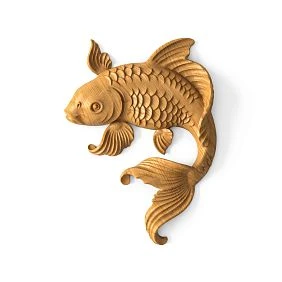
N-487 is a carved wooden overlay in the shape of a fish, measuring 134 × 96 × 18 mm. It is produced in beech and oak, and is offered with Standard or Prestige sanding quality. For the beech version, an enamel finish option is provided. The card lists a single standalone article N-487 without L and R markings. This does not mean that a beautiful composition cannot be created from two pieces. It means something else: mirroring cannot be assumed in advance—it must be verified against the actual geometry, the current drawing, and a full-size template.
A buyer who plans buy carved overlay N-487 in the shape of a fish, it is useful to first cut out a paper rectangle 134 × 96 mm, mark the head, tail, and top of the design on it, and then lay out as many copies as are planned to be ordered. Such a check takes a few minutes but immediately shows whether the fish will move in the same direction, face the central axis, diverge from it, be placed at different heights, or turn into a random repeat.
The main commercial mistake here is simple: two pieces is a quantity, not confirmed pairing. The specification should record not only "N-487 — 2 pcs.", but also where each overlay is located, how the design is oriented, which material is chosen, what sanding quality is required, and what finish is planned. For serial facades, a control piece or an approved full-size template is added to this line.
Four compositions that the customer equally calls a "pair"
The word "pair" sounds unambiguous, but in decorative layout it can describe several fundamentally different solutions. Until they are separated, it is impossible to correctly choose the quantity and place the order.
| Option | What is on the facades | What happens to the design | Can it be considered a mirror system |
|---|---|---|---|
| Two identical parts | Two instances of N-487 | One geometry repeats twice | No, mirroring is not confirmed |
| Directed repetition | Two N-487s are positioned identically | Both fish "swim" in the same direction | No, this is a rhythmic composition |
| Rotation of one part | One instance is mirrored relative to the second | The direction of the head changes, and with it the position of the top and bottom | Checked against the template, but not automatically equal to a reflection |
| True L/R system | Left and right parts have independent item numbers | One shape is built as a reflection of the other | Yes, if confirmed by cards and the drawing |
The difference is especially noticeable on a two-door cabinet. If both fish are positioned identically, the composition gets movement from left to right or right to left. This can be a successful technique: the facades are perceived as a single panel with a directional motif running across it. But if the designer wanted both fish to face the central gap between the doors, purchasing two identical N-487 units is not enough for certainty.
A 180-degree rotation is also not equal to a mirror reflection. In a reflection, the top remains the top, the bottom remains the bottom, but the right side of the pattern becomes the left. In a rotation, the wooden part is turned as a whole: the head may end up on the other side, while the position of the back, belly, tail, and fins changes simultaneously. On an abstract ornament, such a rotation is sometimes almost unnoticeable. On a recognizable fish shape, it can create the impression that one figure is positioned upside down.
If the project requires strict axial symmetry, it is wiser to immediately examine products where the left and right sides exist as independent positions. For example, you can separately look at left carved overlay N-349L и right overlay N-349R. On a larger scale, the same principle is implemented in the models N-350L и N-350R. Their marking directly separates left and right geometry.
The N-487 does not have such a designation, so its strength is not a ready-made mirror system, but the freedom of independent layout.




Sameness is not worse than mirroring — it solves a different problem
You should not perceive two identical fish as a mistaken purchase in all cases. Directional repetition often looks livelier than strict reflection. The fish can:
-
move horizontally across two doors;
-
go one after another;
-
be placed at different heights;
-
create diagonal movement;
-
repeat on dresser drawers;
-
form a free group on the wall panel;
-
connect several facades into one visual story.
The error only occurs when the buyer expected mirror symmetry but did not check it. If the directional repetition is chosen deliberately, two identical N-487s match the task.
Our factory also produces:

Why the article number matters more than the impression from the photo
In the photo, the product may be shown in one position. The user mentally assumes that the second piece can be "simply flipped." But the product card reports a more reliable fact: there is one article number N-487. The absence of L/R markings does not prove that a beautiful paired arrangement is impossible. It forbids considering the mirrored geometry as guaranteed.
The correct wording is: N-487 is not marked by the manufacturer as left or right, so the direction of each overlay is checked against the drawing and full-size template before purchasing the batch.
Get Consultation
N-487 close-up: size, material, and surface preparation
| Characteristic | Confirmed value | What this changes for the buyer |
|---|---|---|
| Article number | N-487 | All ordered units belong to the same model without L/R |
| Shape | Carved fish | The drawing has a direction and recognizable top and bottom |
| Size | 134 × 96 × 18 mm | Need to check the free space, the frame, and the adjacent hardware |
| Material | Beech or oak | The wood species is linked to the future finish |
| Sanding | Standard or Prestige | Variants must not be accidentally mixed within one visible group |
| Beech finish | For enamel | Color and finish coating are coordinated separately |
| Oak execution | For the selected finishing system | Texture and shade are checked against a sample |
| Product type | Self-adhesive overlay | The quantity is determined by the layout, not by the set contents |
| L/R marking | Not specified | A mirror pair cannot be assumed |
| Application | Furniture fronts, doors, wall panels, free compositions | The base and installation are checked against the project |
The 134 × 96 mm size seems compact when the overlay is considered separately. On a narrow drawer, 134 mm can take up a significant part of the front. On a tall door, the same fish will look like a small accent. The 18 mm thickness creates a noticeable relief and side shadow, so a flat paper outline is not enough for a final assessment: after the initial layout, it is useful to make a simple three-dimensional mock-up.
The card allows order N-487 in beech or oak, but the choice of wood species cannot be separated from the color and surface of the furniture. Beech under enamel is suitable for opaque painting, when the fish should match the front or, conversely, get a contrasting color. Oak is chosen when it is necessary to preserve the wood grain under tinting, oil, varnish, or another agreed system.
Why 134 × 96 mm needs to be checked in two orientations
The size consists of two frontal values. The template needs to show not only a rectangle, but also the actual direction of the fish. In horizontal orientation, the overlay takes up 134 mm in width and 96 mm in height. If the part is rotated, these values swap relative to the facade: the composition height becomes 134 mm, and the width becomes 96 mm.
The very fact that the rectangle fits does not mean a successful layout. The fish may end up too close to the frame, handle, panel, or door edge. A relief of 18 mm can interfere with handle grip if the decor is located nearby.
Free space is more important than the overall door size
To check N-487, not the entire facade is measured, but the free decorative zone. The following are excluded from it:
-
frame or panel;
-
furniture handle and space for fingers;
-
keyhole;
-
decorative moldings;
-
edges;
-
gaps between doors;
-
hinge and fastening zones;
-
existing overlays;
-
areas that overlap with the adjacent door;
-
places of likely impact when opening.
Only the remaining area is compared with the 134 × 96 mm template.
The 18 mm depth changes the side view
The overlay does not just draw a fish on the surface, but protrudes above it. On a smooth painted facade, the relief will be especially clear. Next to a deep 18 mm frame, it may look moderate, but on a thin flat door, it will be pronounced. Therefore, after the paper template, a cardboard or foam board mock-up 18 mm thick is made, and the facade is examined at an angle.
Template N-487 in full size: check before purchase
The template is needed not only by the designer. It is a working tool for the buyer, the kit assembler, the cabinetmaker, and the installer. It answers four questions at once: whether the overlay fits, how the fish is oriented, how many parts are required, and whether the relief interferes with the furniture's operation.
Draw the outer dimension
On thick paper or transparent film, construct a 134 × 96 mm rectangle. Label the size. If the mock-up is printed, check the scale with a ruler: office software may automatically reduce the page to the print area.
Mark the direction of the pattern
Draw a conditional head, tail, and back line. There is no need to repeat all the carving. It is important to see where the fish is directed and where the top of the drawing is.
Sign the top and front side
Such an inscription prevents incorrect rotation. If the template is transparent, distinguish its front and back sides: flipping the paper mimics a mirror reflection, which cannot be achieved by ordinary rotation of a wooden part.
Make the required number of copies
Planning two overlays — prepare two templates. For a chest of drawers with five drawers, make five. Do not move one layout in turn: simultaneous placement shows the rhythm of the entire group.
Place the templates on the actual facades
Secure them with a temporary method that does not damage the surface. Open and close the doors, pull out the drawers, grab the handles. Check whether the decor falls into the touch zone.
Photograph the options
Shoot the composition strictly from the front and at an angle. Take separate shots for the same direction, rotation toward the center, and free layout. In photos, it is easier to compare the rhythm than when constantly moving paper blanks.
Approve the scheme
On the selected photo, label the part numbers: N-487-1, N-487-2, and so on. For each, indicate the direction of the head, the height of the center, and the distance to the edge of the facade.
Only now determine the quantity
If one template turns out to be extra, there is no need to buy a part "just in case." If the composition requires a third fish, this is visible before placing the order, not after installation.
In the documentation section, you can check the availability of the current drawing N-487 and compare it with your own layout. The paper rectangle accounts for the overall dimensions, while the drawing helps to more accurately understand the geometry of the motif.
One N-487: when a single accent is stronger than a pair
One carved fish looks meaningful if the surface itself has a center. The overlay does not have to seek a second piece for the sake of formal symmetry.
One cabinet door
On a single door, N-487 can be placed in the center of the panel, shifted diagonally, or linked to the position of the handle. There is no risk of false pairing here: the direction is chosen relative to the door itself.
Large dresser drawer
One fish on the top or central drawer can become a hallmark of the entire furniture collection. The other facades remain calm. This technique is especially useful when installing N-487 on every drawer creates too dense a pattern.
Central section of the sideboard
If there are identical blank doors on the sides and a separate drawer or panel in the center, a single overlay emphasizes the hierarchy. Buying two for formal symmetry is not required.
Free field of the wall panel
A single fish can work as a small relief accent inside a molding frame. Before installation, check the scale: on a large wall, 134 mm may look too small without other elements.
Control piece before the batch
The most practical option is to buy one N-487 for a real trial. The wooden overlay shows the direction of the carving, the 18 mm relief, the quality of sanding, and the behavior of the chosen finish. After checking, you can order the remaining pieces in one approved configuration.
One control piece is especially useful if the project requires strict mirror symmetry and the current drawing has not yet been studied. The buyer does not risk the entire batch and gets the opportunity to decide whether N-487 is suitable for specific furniture.
Two identical N-487: when directional repetition looks convincing
Two fish do not have to face each other. They can support a sense of movement, and that will become the main advantage of the composition.
Two doors as a single panel
The fish are positioned at the same height and "swim" in the same direction. The central gap between the doors does not become an axis of reflection; it merely divides the overall scene. This technique works well when the handles also do not form a pronounced central ornament.
Fish one after another
The first is higher and in front, the second is lower and behind. The composition suggests movement rather than a heraldic pair. The distance between elements is determined on the common template.
Diagonal across two facades
One plate is placed at the bottom of the left door, the other at the top of the right door. The group connects the doors and guides the eye diagonally. Here, identical orientation is natural.
Repeat on two drawers
On a dresser, the fish can be placed on the top and bottom drawers, leaving the middle one free. Another option is to place the decor on the two outer facades. The key is to see the entire piece, not each detail separately.
Same shape in different colors
Two N-487 can be painted differently, but this scenario requires a well-thought-out palette. If one fish is light and the other dark, the equality of shape is preserved, while color creates hierarchy. For paired doors, identical finishes are usually chosen to avoid accidental differences.
When two fish are not enough
Sometimes a customer puts two pieces in the cart just because the furniture has two doors. But the composition may require more elements.
Three-door wardrobe
If N-487 should appear on each door, three overlays are needed. If the decor is placed only on the outer doors, two are enough. The central door can remain empty or receive a different accent. The layout decides, not the number of doors by itself.
Chest of drawers with multiple drawers
Different options are possible:
-
one fish on the central drawer;
-
one on each drawer;
-
two fish on the top and bottom fronts;
-
three elements in a free group;
-
alternating fish and empty drawers.
Therefore, for a chest of drawers with four drawers, one, two, three, or four N-487 may be needed. There is no universal norm.
A school on the wall panel
Three, five, or seven elements create a free composition. An odd number helps avoid the feeling of rigid pairing, but it is not a mandatory rule. More important are the scale of the wall, the distances, and the direction of each fish.
Serial children's furniture
If the motif is repeated on each locker or cabinet, the quantity equals the number of approved locations plus a control position, when provided by production. All items are ordered with the same material and sanding quality.
Long furniture facade
On a wide panel, two fish may get lost. Three or five create rhythm, but you need to ensure that the relief does not turn into a continuous ornament.
Quantity schedule: the number is born from the layout
| Surface | Possible quantity | When it works |
|---|---|---|
| One door | 1 | Independent central or offset accent |
| Two doors | 2 | Directed repetition or proven scheme |
| Two doors with strict mirror symmetry | Not detected automatically | First check N-487; if necessary, select L/R |
| Three panels | 1, 2, or 3 | Central accent, edge details, or repetition on each |
| Chest of drawers with three drawers | 1, 2, or 3 | According to the approved rhythm |
| Chest of drawers with five drawers | 1, 3 or 5 | Accent, alternation or full repetition |
| Four-door wardrobe | 2 or 4 | Only outer facades or each door |
| Wall panel | 1, 3, 5 and more | By full-size sketch |
| Serial furniture | Control part and batch | By list of all facades |
| Interior door | 1 or group | Considering handle, panel and frame |
The table does not assign a fixed number. It shows a range of solutions. The final figure appears after each instance is assigned a specific place.
Strict mirror composition: when N-487 is better not to buy as a pair
Honest commercial consultation sometimes leads not to an increase in quantity, but to a refusal of the product for a specific task.
N-487 should not be ordered in two copies as a ready-made mirror pair if:
-
each fish must look exactly toward the central axis;
-
the top and bottom of the pattern must match;
-
rotation of one part creates the feeling of an inverted figure;
-
the designer requires separate left and right positions;
-
the installer must not choose the orientation independently;
-
the furniture series must be reproduced without manual interpretation;
-
The customer expects a complete set, not a free layout.
In such cases, models with L/R markings are studied. Compact N-349L/R and larger N-350L/R solve a different problem: their left and right geometry is built into separate SKUs. This simplifies specification and reduces the risk that two identical parts arrive at the site instead of mirrored ones.
Why mirroring cannot be promised without a drawing
Even if a photo seems clear, perspective distortion, lighting, and angle can hide asymmetry. A reliable check is based on an up-to-date drawing or a physical part. If the geometry confirms the required layout, the solution is fixed. If not, another product is chosen.
Can the overlay be flipped to the reverse side
The back surface is not a second front side. The carved pattern, finish, and fit are designed for the installed orientation. Flipping the part face-down to the base does not create a working mirrored fish.
Can an individually mirrored N-487 be ordered
The standard product card does not confirm such an option. The possibility of custom manufacturing, minimum quantity, cost, and lead time must be separately agreed with the manufacturer. A presumed mirrored modification cannot be entered into a regular order as an existing item.
N-487 on a two-door cabinet: four working layouts
A cabinet with two doors is the main source of error. It is here that the buyer most often perceives the number "2" as proof of mirroring.
Scheme 1. Two fish move in the same direction
Both overlays are at the same height and oriented identically. The composition reads as a continuous narrative. The central gap does not become an axis of reflection.
Advantages:
-
clear direction;
-
simple repetition;
-
identical orientation of installation;
-
possibility to connect the panels with a single line.
Risk — accidental asymmetry in offsets. If the fish are identical, differences in position are especially noticeable.
Scheme 2. Fish are positioned one above the other
The left overlay is higher, the right one is lower. Identical geometry turns into movement. This layout allows moving away from the expectation of a mirrored pair.
Check that the lower fish does not conflict with the handle and that the upper one is not too close to the frame.
Scheme 3. Both parts are directed from the center
The buyer may try to turn one N-487. The result is first checked with templates with a signed top. If one fish visually flips, the scheme is not suitable.
Scheme 4. One fish on a two-door cabinet
The overlay is placed on one door, on the central strip, or in a common compositional zone. The asymmetry becomes intentional. This solution requires support from other details: handles, color, or the placement of moldings.
Before choosing, you can look at examples of cabinets with decorative facades and assess how densely the decor interacts with frames, panels, and hardware.
Fish on a dresser: count drawers or compositional points
The number of drawers does not have to match the number of overlays.
One N-487 on the top drawer
The top of the dresser gets an accent, the lower fronts remain calm. The fish can support items on the countertop or the shape of the handles.
One overlay in the center
On a dresser with an odd number of drawers, the central front becomes the focus. This is the most economical and clear option.
Per N-487 on each drawer
The rhythm becomes strong. Before purchasing the entire batch, you need to check whether the repetition overloads the furniture. On small fronts, an 18 mm relief may look dense.
Alternation
The fish are placed through one drawer. Empty surfaces give the ornament space.
Free diagonal
Three overlays are placed on different fronts diagonally. Such a group looks like movement and does not require mirror symmetry.
In the section dressers and cabinets with decorative fronts You can evaluate different principles for placing carved decor. Your own layout still needs to be built based on the actual dimensions of the furniture.
N-487 on the door: the handle is more important than the geometric center
On the door panel, you want to place the fish exactly in the center of the panel. But the door is used by hand, so first check the handle, lock, and opening direction.
If N-487 is near the handle, the 18 mm relief may fall into the space for fingers. If the overlay is placed low, it is easier to bump into. If too high, it loses connection with the rest of the decor.
For an interior door, three approaches are possible:
-
one fish as a central sign;
-
two identical pieces in directed motion;
-
a group of three elements within a large field.
A strict mirror pair is appropriate on a symmetrical double-leaf portal, but then you need to use confirmed left and right positions or separately check the geometry of N-487.
Examples of complex decor can be viewed in the section carved interior doors. The ready-made solution should not be copied without measuring your own door leaf.
Fish on the wall panel: freedom does not cancel marking
On wall N-487, it depends less on handles and opening, but more on the scale of the room. One fish measuring 134 mm on a large panel can get lost. Five pieces placed too close together will turn into a dense spot.
A full-size layout should take into account:
-
the width and height of the panel;
-
molding frames;
-
furniture in front of the wall;
-
sockets and switches;
-
lighting direction;
-
eye level;
-
viewing distance;
-
adjacent doors;
-
the overall style of the room.
For a wall composition, it is convenient to use transparent templates. They allow you to see the frame lines under the layout. After choosing the position, mark the center of each N-487 and the direction of the head.
In the section of boiserie and wall panels you can see how individual carved elements interact with large architectural fields.
A "school" of three fish
Three elements allow creating movement without a formal pair. One fish can be leading, two — supporting. All three do not necessarily need to be placed on one line.
Group of five elements
Five N-487 require a large surface. It is useful to distinguish distances: if the gaps are completely identical, the composition becomes ornamental; if they differ — more lively.
One fish inside a frame
The calmest option. The relief works as a small panel. The frame size is selected according to the template, without pressing the overlay against the moldings.
Beech under enamel: how to make directional decor part of the facade
Beech is chosen when the natural wood grain should not become the main accent. Opaque enamel can connect the fish with the facade or highlight it with a separate color.
N-487 in furniture color
If the overlay and facade are painted the same, the shape is read through light and shadow. The direction of the fish becomes noticeable due to the relief, not color contrast.
This option requires approval of:
-
the exact shade;
-
gloss level;
-
preparation of the carved relief;
-
the painting order;
-
the boundary between the overlay and the base;
-
the condition of the recesses after finishing.
The phrase "beech under enamel" does not mean that the desired color is already applied. The specific finish is arranged separately.
Contrasting fish
N-487 may be darker or lighter than the facade. Then every orientation error becomes more noticeable because the silhouette is read immediately.
Multiple colors in one group
If the "school" consists of three fish, they can be colored in related shades. But before ordering a batch, it is better to approve all colors on physical samples, otherwise the composition will become random.
Why it is better to order all overlays at the same time
The visible group must match in material, preparation quality, and approved finish. A late additional order may require re-matching the color. Absolute matching of different batches cannot be assumed without verification.
Oak and texture preservation: the wood grain becomes part of the fish
Oak is chosen when the natural texture must remain visible. On a carved relief, the fibers interact with shadows: protrusions receive more light, recesses appear deeper.
For oak N-487, check:
-
the tint shade;
-
texture direction;
-
combination with the facade;
-
the behavior of the coating in recesses;
-
the uniformity of the group;
-
the appearance of the edges;
-
gloss level;
-
the result after full drying.
Two identical oak fish may differ in wood grain pattern. This is a natural property of the material, but for paired fronts, the acceptable difference should be assessed in advance.
Oak fish on a painted front
The contrast of the material makes N-487 a standalone accent. It is especially important to leave free space around it, otherwise the texture will compete with the frame and handle.
Oak on oak furniture
An exact shade match cannot be assumed based on the word "oak." The base and the overlay may react differently to the tinting compound. A joint sample is needed.
Oak under opaque enamel
This option is only possible as a deliberate decision. If the texture is completely covered, one must understand why oak was chosen instead of beech. The reason may be a connection with other details of the project, but it is fixed before ordering.
Standard or Prestige: do not mix the two qualities randomly
For N-487, Standard and Prestige are available. The article should not attribute unconfirmed characteristics to these options. It is enough for the buyer to understand the basic rule: the quality of preparation is chosen deliberately and consistently for the entire visible group.
If on two doors one fish is Standard and the other is Prestige, different amounts of manual preparation may be required after finishing. This increases the risk of surface differences.
Before placing an order, you need to specify one option:
-
N-487, beech, Standard;
-
N-487, beech, Prestige;
-
N-487, oak, Standard;
-
N-487, oak, Prestige.
The exact surface condition and the necessary cycle of further preparation are checked in the card and agreed with the finisher.
When one configuration is especially important
-
on paired doors;
-
in a series of identical drawers;
-
in a wall group;
-
with contrast staining;
-
under a transparent finish;
-
when ordering for furniture production.
Do not leave the sanding quality as "default". If the field is absent in the invoice, the specification allows for different interpretations.
What to order together with N-487
| Position | What it's for | What to Check |
|---|---|---|
| N-487 | main decorative element | Material, quality, and quantity |
| Control N-487 | Checking direction and scale | Actual geometry and relief |
| Full-size templates | Layout confirmation | Number, orientation, and height |
| Mounting compound | Fixing the overlay | Base, material, and finish |
| Enamel materials | Beech finish | System compatibility |
| Materials for tinting | Oak finish | Color and texture sample |
| Protective materials | Work without facade contamination | Compatibility with coating |
| Drawing | Direction and size check | Version relevance |
| Paired L/R elements | Alternative for strict symmetry | Individual items and scale |
| Delivery | Getting the entire group | Packaging and completeness |
In the catalog you can buy materials for installation and decorative finishing. A specific adhesive or finishing compound cannot be chosen only by the general category name. You need to consider the overlay material, the base, the already applied coating, and the selected finishing system.
Why the control part belongs to the kit, not to extra stock
Control N-487 solves several tasks:
-
shows the actual direction;
-
checks the size on the facade;
-
allows making a color sample;
-
helps determine the installation method;
-
serves as a sample for the batch;
-
reduces the risk of mistakenly ordering several parts.
After approval, it can be used in the finished composition if the condition and finish match the project.
N-487 made of wood or NPU-487 made of polyurethane
The same motif also has a separate polyurethane version NPU-487 measuring 134 × 96 × 18 mm. This is a standalone product, not a different finish of the wooden N-487.
It is useful for a buyer considering an alternative material to look at the NPU-487 stucco decor in the shape of a fish. The comparison should not be reduced to price. Check:
-
base material;
-
future finishing;
-
mounting method;
-
weight and relief;
-
surface designation;
-
project requirements;
-
compatibility with other parts.
The main topic of this article remains the wooden N-487. The polyurethane version is needed as a separate commercial path if the project requires a different material.
N-487 and NPU-487 must not be mixed accidentally
The same dimensions do not mean full visual and technological identity. In one group, wood and polyurethane may accept coatings differently and look different under side light. If material mixing is intended, it is checked on samples.
Installation begins with marking, not with glue
The article does not prescribe a universal method of fastening. It depends on the base, facade material, finish, and recommendations of the chosen mounting compound. But the preparation sequence can be described without risk.
Approve the position
On the facade, mark the center of the overlay, the top of the pattern, and the direction of the head. For each N-487, create a separate record.
Check the furniture operation
Doors open, drawers pull out, handles are used. The overlay should not obstruct movement or fall into the area of constant contact.
Perform a dry fit
The actual part is applied before painting and installation. Look from the front and from the side.
Prepare the finish
Decide whether N-487 is painted separately or together with the facade. There is no universal answer: the order depends on the coating system and the method of fixation.
Choose mounting material
The composition must be suitable for the wooden overlay, the specific base, and the finish. Its consumption and technology are determined according to the instructions and the actual contact area.
Fix the orientation
On the back of the packaging or temporary marking, write the facade number and direction. For a series, this protects against accidental rotation by the installer.
Correct specification of N-487
Incorrect
Error 3. The paper template was flipped to the reverse side
On paper, a mirror shape appeared that the wooden part does not have.
How to fix: distinguish between rotation and reflection.
Error 4. The quantity was counted by the doors
Two doors automatically turned into two overlays.
How to fix: first determine the compositional points.
Error 5. For a three-door wardrobe, two fish were ordered without a diagram
The central door was accidentally left empty.
How to fix: lay out three templates and compare the options.
Error 6. For the dresser, an overlay was bought for each drawer
The relief overloaded the facades.
How to fix: check one, two, and alternating patterns.
Error 7. Used only a 134 × 96 mm rectangle
The direction of the fish itself is not marked.
How to fix: draw the head, tail, and top.
Error 8. Did not account for the 18 mm thickness
The overlay interferes with using the handle.
How to fix: make a 3D mockup.
Error 9. Measured the entire facade, not the free field
The fish crossed the frame.
How to fix: exclude moldings, handles, and edges.
Error 10. The center was measured from different sides
On paired doors, the overlays were at different heights.
How to fix: use a common baseline.
Error 11. The direction was left to the installer
The contractor chose the orientation on site.
How to fix: number each part and location.
Error 12. Standard and Prestige were mixed in one group
Surface preparation required different actions.
How to fix: specify one quality in the specification.
Error 13. Beech under enamel was mistaken for finished paintwork
After delivery, the overlays turned out to be without the selected color.
How to fix: arrange the finish separately.
Error 14. The color was chosen by screen
The fish did not match the facade.
How to fix: make a physical color sample.
Error 15. Oak was ordered without a tinting sample
The texture and shade did not connect with the furniture.
How to fix: check the finish on the actual material.
Error 16. All parts were ordered at different times
A repeated selection of finishing was required.
How to fix: design the visible group as one batch.
Error 17. The control sample was not provided for.
The error appeared across the entire order.
How to fix: first order a sample or approve a template.
Error 18. N-487 and NPU-487 were mixed by the same size.
The materials looked different.
How to fix: treat them as separate products.
Error 19. The adhesive was chosen only by the word "universal".
Compatibility with the coating was not checked.
How to fix: take into account the tree, the base, and the finish.
Error 20. Installation was done before checking the opening.
The decor fell into the touch zone.
How to fix: open all doors and drawers with templates.
Error 21. The fish were placed too close to the central gap.
The composition became cramped.
How to fix: compare several distances.
Error 22. The overlays were spread too far apart.
The connection between them disappeared.
How to fix: evaluate the cabinet as a whole from a normal distance.
Error 23. The height was determined separately on each door.
A step appeared.
How to fix: draw a common horizontal line.
Error 24. Orientation was checked only from the front.
From the side, one fish looked upside down.
How to fix: take photos from multiple angles.
Error 25. Two parts were ordered for the wall without considering the room's scale.
The composition got lost.
How to fix: create a full-size layout of the entire panel.
Error 26. For strict symmetry, L/R was abandoned in favor of a single article.
The result did not match the project.
How to fix: use confirmed paired models.
Error 27. The residual overlay was called a spare without purpose
The extra part did not fit any place.
How to fix: bind the reserve to a specific group and finish.
Error 28. The packaging was opened without marking
Identical parts got mixed up across facades.
How to fix: label numbers before finishing.
Error 29. The invoice was checked only by the total amount
The material or quality turned out to be different.
How to fix: verify every characteristic.
Error 30. After installation, the wrong direction was found.
The rework affected the finished surface.
How to fix: approve the actual details before final fixation.
Who N-487 is suitable for
The overlay is suitable if:
- a recognizable fish motif is needed;
- the size 134 × 96 × 18 mm fits into the free field;
- the composition allows a single accent;
- a directed repeat is required;
- a free group is planned;
- the buyer is ready to check the orientation with a template;
- beech or oak matches the finish;
- Standard or Prestige is chosen deliberately;
- installation is coordinated with the base;
- strict mirror symmetry is not assumed automatically.
When to choose a different decor
N-487 is better replaced with another model if:
- a guaranteed L/R pair is required;
- the pattern must face strictly toward the center;
- the free field is smaller than the overlay's dimensions;
- The 18 mm relief interferes with the hardware;
- The fish motif does not match the style;
- A ready-made set without manual layout is needed;
- The base is not suitable for the selected installation;
- Polyurethane is required, not wood;
- The size is too small for the wall;
- The client is not ready to approve the direction.
In the catalog you can Buy decorative furniture overlays and compare symmetrical, asymmetrical, single, and paired models. For a wider selection, a section is available where you can to buy carved wooden decor — overlays, rosettes, capitals, brackets, baguette, and other elements.
Ready order route N-487
- Determine the surface: cabinet, dresser, door, or panel.
- Measure the free field.
- Make a template 134 × 96 mm.
- Mark the head, tail, and top.
- Create copies according to the estimated quantity.
- Check the same direction.
- Check the rotated variant.
- Compare with real L/R overlays.
- Take into account the 18 mm relief.
- Open doors and drawers.
- Choose beech or oak.
- Select Standard or Prestige.
- Confirm the finish.
- Order one control piece if in doubt.
- Number all locations.
- Create a specification.
- Add installation and finishing materials.
- Check the invoice.
- Coordinate packaging and delivery.
- Before installation, repeat the dry layout with actual pieces.
For a complex furniture or wall composition, you can order a project layout of decor and see in advance how many overlays will be needed, where the central axis runs, and what direction each fish will get.
After the quantity is approved, shipping conditions can be checked on the page where delivery of STAVROS decorative overlays. In the order, you need to specify the article number, material, full size, sanding quality, and quantity.
Frequently asked questions about N-487 and the number of overlays
Is N-487 sold individually or as a set?
N-487 is listed as a standalone article number. The quantity is selected by the buyer according to the layout. One product item should not be considered a ready-made pair.
Will a mirror pair be possible from two identical N-487?
Automatically — no. Two identical parts are two instances of the same geometry. The possibility of the required placement is checked against the drawing and template.
Can one fish be rotated 180 degrees?
You can physically change the orientation, but rotation is not the same as mirror reflection. The position of the top and bottom of the image changes simultaneously.
How can you tell if one fish looks upside down?
Mark the top on the template and compare the two pieces from the front. If the back line, belly line, and other parts look unnatural, the pattern is not suitable.
How many N-487 are needed for two wardrobe doors?
One, two, or another number — depending on the composition. For an identical repeat, two are usually considered. For a central accent, one may be enough. For strict mirror symmetry, check L/R first.
Do I need to place a fish on each door?
No. The decor can be on only one door, on two outer doors, or on each one. The decision is determined by the overall composition of the wardrobe.
How many N-487 are needed for a dresser with three drawers?
One, two, or three overlays are possible. One element creates an accent, two create rhythm, three create repetition on each facade.
Is a fish needed on every box?
Not necessarily. Before ordering, lay out paper templates and compare a full repeat with an alternation.
What is the exact size of N-487?
134 × 96 × 18 mm.
What does the size 134 × 96 × 18 mm mean?
The first two values describe the frontal dimension, the third is the depth of the relief.
How to make a full-size template?
Draw a rectangle 134 × 96 mm, mark the direction of the head, the tail, and the top of the design. Check the scale with a ruler.
Why is one rectangle not enough?
It shows the size but not the direction of the motif. Without the head and the top, it is impossible to assess the rotation.
Do I need to make a 3D mockup?
It is advisable if there is a handle, frame, or other protruding decor nearby. The thickness of the mockup should imitate 18 mm.
Is N-487 suitable for a framed facade?
Only if there is enough free space inside the frame and the relief does not cross the profile.
Can the fish be installed on top of the molding?
Such a solution cannot be considered standard. The overlay must have a suitable base; the intersection of profiles is checked by the project.
Is N-487 suitable for a smooth door?
Yes, if the size, placement, and installation are confirmed. On a smooth facade, the relief will be especially noticeable.
Can N-487 be placed next to a handle?
Only after checking the space for fingers and the depth of 18 mm.
What materials is N-487 made from?
made of beech and oak.
What to choose for enamel?
Beech version for enamel — a clear option for opaque painting.
Does beech come already painted?
The phrase "for enamel" does not mean applied color. The coating is agreed upon separately.
When to choose oak?
When you need to preserve or emphasize the wood texture.
Can oak be painted opaquely?
This option requires separate justification and approval of the finish. If the texture is covered, the reason for choosing oak needs to be understood.
What does Standard mean?
This is one of the available sanding quality options. The exact surface condition should be checked in the card and agreed with the finisher.
What does Prestige mean?
This is the second available option for the quality of sanding. It also should not be confused with a ready-made finish coating.
Can Standard and Prestige be mixed?
In one visible group, doing this without a reason is not recommended. Different options may require different preparation.
Do I need to buy all the fish in one batch?
For a visible composition, this is preferable: it is easier to preserve the material, quality, and a uniform finishing sample.
Can I first order one N-487?
Yes, this path is convenient for checking the actual size, direction, and finish.
What to do with the control piece after checking?
If it matches the approved configuration, it can be included in the finished composition.
Where can I check the price of N-487?
In the product card before placing an order. The price depends on the selected configuration and should not be carried over from another model.
Is there a left version of N-487?
A separate article N-487L is not confirmed in the provided data.
Is there a right version of N-487R?
A separate item N-487R is also not confirmed.
Where can I find genuine left and right overlays?
In the carved overlays category, you can explore products with L and R designations, for example N-349L/R or N-350L/R.
How does a directional repeat differ from a mirror pair?
In a directional repeat, identical shapes are oriented the same way. In a mirror pair, one geometry reflects the other.
Can the fish be made to face each other?
Only if the actual geometry and permissible rotation yield a natural result. This is verified by the template and the drawing.
Can the fish be made to face different directions?
The same check is mandatory. The result cannot be assumed from a single card image.
Is N-487 suitable for children's furniture?
The motif can be used in a suitable project, but the size, finish, base, and mounting must be checked separately.
Is the fish suitable for a marine interior?
The shape supports the marine theme, but the composition must match the scale of the furniture and the room.
Can N-487 be used on a wall?
Yes, as part of a decorative composition with a suitable base and coordinated mounting.
How many fish are needed for a wall panel?
One, three, five, or another number based on the full-size layout. There is no universal standard.
Why is an odd number often chosen for a "flock"?
An odd-numbered group is easier to perceive as a free composition, but this is a design technique, not a mandatory rule.
Can N-487 be combined with other fish?
Only after checking scale, material, relief, and overall style. Random mixing of models may look inconsistent.
How is N-487 different from NPU-487?
N-487 is made of wood, NPU-487 is a separate polyurethane version. With the same dimensions, these are different products and materials.
Can wood and polyurethane be used in the same group?
This solution requires samples and a unified finishing system. An identical result cannot be assumed.
What glue is needed for N-487?
The specific composition is selected based on the wooden overlay, base, and finish coating. A universal recommendation without this data will be unreliable.
Should the overlay be painted before installation or after?
The order depends on the finishing system and the method of fixation. It is coordinated with the craftsman before work begins.
Can N-487 be painted in the color of the facade?
Yes. Then the relief will be read through light and shadow. The color and gloss are checked against a sample.
Can the fish pattern be made contrasting?
Yes, if the color scheme is approved. Contrast enhances the visibility of the direction and placement errors.
What to do if the fish patterns turned out to be identical after delivery?
First, return to the approved layout. If a directional repeat was required, the order may be correct. If a mirrored pair was expected, the specification needs to be checked and another solution agreed upon before installation.
What to do if the fish patterns have already been glued in the wrong direction?
Do not attempt to remove them without assessing the base and mounting compound. Contact the contractor to avoid damaging the facade and carving.
How to avoid incorrect installation on site?
Number the overlays and facades, attach a layout photo, and label the top of each piece.
Can I write "set N-487" in the order?
Only if the word "set" is used as an internal designation for the selected quantity and does not create L/R expectations. It is safer to list each piece and its location.
How to place an order for four identical fish?
Specify N-487, full size, material, quality, finish, quantity of 4 pcs., and layout scheme H-01–H-04.
Is a reserve needed?
The reserve should have a clear purpose. For one project, a control piece is more useful than an abstract percentage.
How to check the delivered batch?
Verify the article number, quantity, size, material, sanding quality, thread condition, and compliance with facade markings.
What should be considered the main criterion for choosing the quantity?
The number of approved composition spots, not the number of doors or drawers.
First direction, then quantity
N-487 is not a ready-made left and right pair, but an independent carved overlay in the shape of a fish measuring 134 × 96 × 18 mm. One piece can become the central accent. Two identical fish create a directional repeat. Three, five, or more elements allow you to assemble a free composition. But strict mirror symmetry cannot be derived from quantity: it is confirmed by geometry, L/R marking, or actual layout.
Before ordering, make a template, mark the top and the direction of the head, lay out copies on all facades, open doors and drawers, check the 18 mm depth. Then choose beech or oak, Standard or Prestige, approve the finish, and enter each overlay into the list.
STAVROS company allows you to go through this path without a random purchase: open the N-487 card, compare wooden decorative overlays, choose real left and right elements, view the polyurethane version of the motif, select mounting materials, and arrange delivery. When the direction of each fish is determined before payment, the quantity ceases to be a guess: the cart contains exactly as many N-487s as required for a specific cabinet, dresser, door, or wall panel.