Article Contents:
- When long wooden handles are needed: application scenarios
- Tall wardrobes and dressing rooms
- Kitchen tall cabinets and columns
- Built-in hallway furniture
- Chests of drawers with tall drawer fronts
- Designer facades and built-in systems
- How a long handle differs from a knob and a pull: what's the difference
- Knob handle
- Bracket handle
- Long handle
- Long handles for a wardrobe: how to choose correctly
- Visual balance: handle and facade
- Vertical vs horizontal placement
- Wooden handle and cabinet material
- Long handles for kitchen: a special case
- Kitchen tall cabinet: vertical accent
- Kitchen cabinets and wall-mounted units
- Hygiene requirements for kitchen handles
- Island and work surface area
- How to choose the length of a wooden handle: calculation and logic
- Parameter 1: facade height
- Parameter 2: facade width
- Parameter 3: weight and frequency of use
- Parameter 4: center distance
- How to choose the shape and grip of a long handle
- Handle profile: cross-section and rounding
- Projection depth
- Tactile feel: wood vs metal
- Material and coating of a long wooden handle
- Oak
- Oak
- Spruce
- Uncoated handles: possibilities
- Handles with ready-made coating
- How to combine long wooden handles with furniture and interior
- Handle and facade: color and material
- Handle and countertop
- Handle and moldings, furniture decor
- Handle and floor
- Handles in the dressing room: system and rhythm
- Mistakes when choosing long wooden handles
- Installation of long wooden handles: what to pay attention to
- Marking Hole Positions
- Depth and diameter of holes
- Tightening of fasteners
- Pre-installation processing
- Where to buy long wooden handles for furniture
- FAQ: Answers to Popular Questions
- About the manufacturer
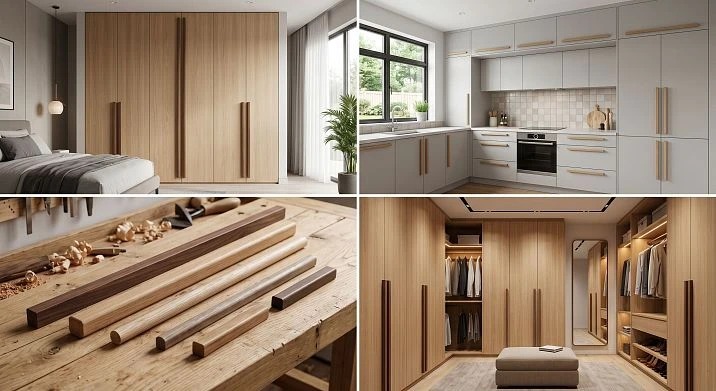
There are interior details you don't notice — and it's these that make a space either complete or random. Furniture handles fall into this category. A small knob on a tiny drawer is one story. A long vertical handle on a two-meter wardrobe or kitchen tall cabinet is a completely different one. This is no longer hardware in the everyday sense; it's a vertical accent that reads from across the room.
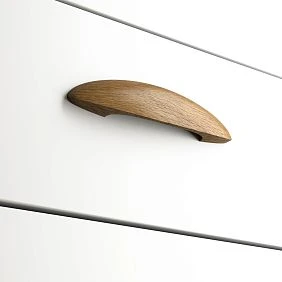
Wooden long handles — a separate type of furniture hardware chosen deliberately. Not because 'some kind of handle is needed,' but because it's understood: on a tall facade, a long solid wood handle works as a gripping element, a decorative vertical, and a material signal — here, wood is chosen, not metal.
This article is a detailed breakdown of the topic from start to finish. Who needs long wooden handles, in which situations they are indispensable, how to choose length, shape, material, and finish, how to match them with furniture and interior — and how to avoid mistakes when buying.
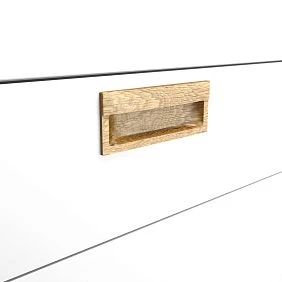
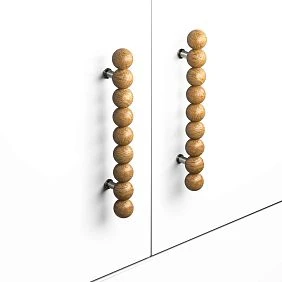

When long wooden handles are needed: application scenarios
Before discussing selection, it's important to understand: a long handle is not just a 'big handle.' It's a handle that fulfills a different visual and ergonomic purpose.




Tall wardrobes and dressing rooms
A hinged wardrobe 2000–2400 mm high is a large facade. A standard knob handle with a diameter of 30 mm on such a surface will look like a randomly glued pea. It creates neither visual balance nor convenience for opening a heavy door.
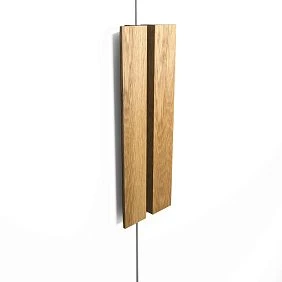
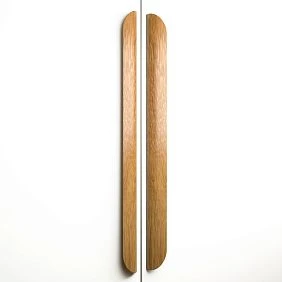
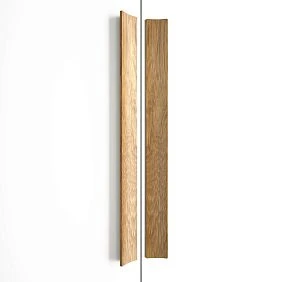
A long wooden handle for a wardrobe, 300–500 mm high, is a different matter. It creates a vertical axis, emphasizes the height of the facade, and is convenient for gripping when opening the door from any height — from hip to chest.
For a walk-in closet with multiple sections, long handles create rhythm: vertical accents repeat from section to section and unify the closet into a cohesive ensemble.
Our factory also produces:
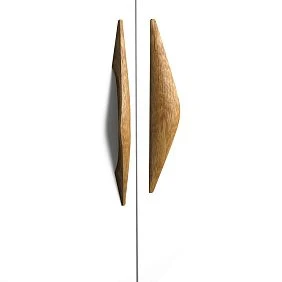
Kitchen tall cabinets and columns
A kitchen tall cabinet 2000–2200 mm high is one of the most challenging facades for choosing a handle. If small handles are used on lower and upper cabinets, they get lost on the tall cabinet. A long handle on the tall cabinet highlights it as a large vertical volume, emphasizes height, and creates a proper hierarchy in the kitchen set.
In a kitchen with wooden facades or wooden elements—countertop, slats, open shelves—a long wooden handle fits organically into the material context.
Get Consultation
Built-in furniture in the hallway
The hallway is the first thing a guest sees. A built-in wardrobe spanning the entire wall with long wooden handles immediately makes a style statement. Vertical handles on the hinged doors of the hallway wardrobe create a strict and modern look.
Chests of drawers with tall drawer fronts
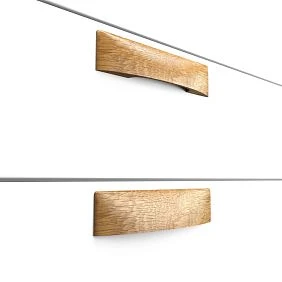
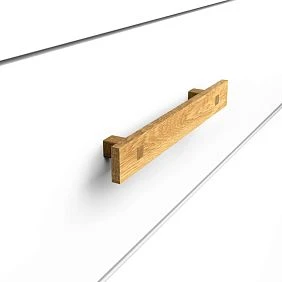
On a wide chest of drawers with fronts 200–300 mm high, a horizontal long handle along the entire width of the drawer is a strong and concise technique. It "stretches" the front horizontally, creating a minimalist look characteristic of Scandinavian style and modern Japanese interiors.
Designer facades and built-in systems
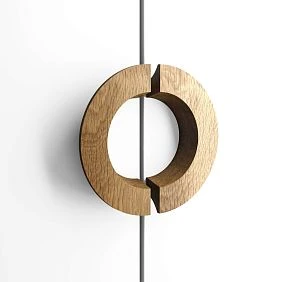
When furniture is created for a custom project—in a bedroom, study, library, or children's room—a long solid wood handle becomes a key design element. It is chosen not "from a catalog" but as a separate design item: by length, profile shape, wood species, and finish.
How a long handle differs from a knob and a pull: what's the difference
Understanding the classification of furniture handles means immediately realizing why a long wooden handle is a separate choice.
Knob Handle
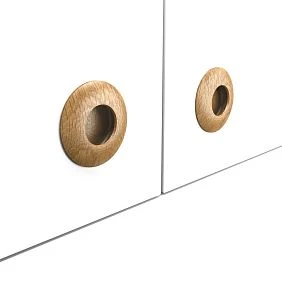
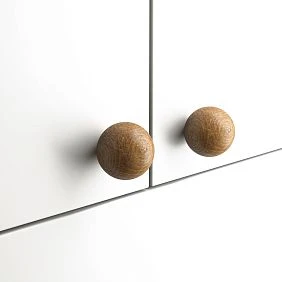
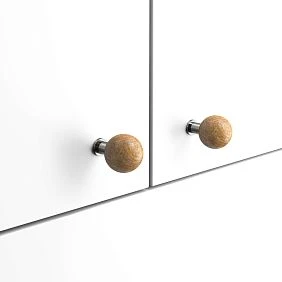
A knob is a compact point element. It is attached with one screw. Diameter: 25–50 mm. Application: small drawers, nightstand drawers, small furniture. On a large facade, a knob gets lost and visually devalues the door.
Bracket handle
A pull is an arched handle attached with two screws. Length: from 32 to 320 mm (these are "standard" pulls). A pull is a universal type, used everywhere. But even the longest standard pull (320 mm) on a facade 2000 mm high occupies only 16% of the height and visually fails to handle the scale.
Moreover, Bracket Handle It has a horizontal or vertical grip through an arch. A long handle is a straight grip along the bar. These are different tactile and ergonomic solutions.
Long handle
A long handle is a straight bar attached with two or more screws and has a length from 300 to 600 mm or more. It works as a vertical or horizontal accent on the facade, convenient for opening large doors with the whole palm, not two fingers.
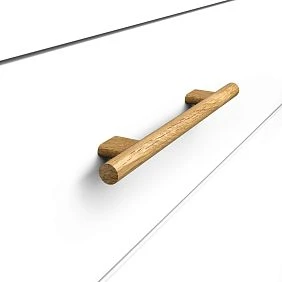
Long wooden handle LAGOM is an example of such a handle: a laconic straight bar made of solid wood without coating, with smoothly rounded edges and a surface prepared for finishing. It is equally suitable on a bedroom wardrobe, kitchen tall cabinet, and walk-in closet.
Long handles for a wardrobe: how to choose correctly
A wardrobe is the main "consumer" of long handles. Three aspects are important here: visual balance with the facade, grip comfort, and style.
Visual balance: handle and facade
The handle length should be proportional to the facade. A working ratio: handle length is 20–30% of the facade height.
For a facade 2000 mm high — handle 400–600 mm.
For a facade 1400 mm high — handle 300–420 mm.
For a facade 900 mm high — handle 200–270 mm.
A handle that is less than 15% of the facade height visually gets lost. A handle longer than 40% of the height overloads the facade.
Vertical vs horizontal placement
A long handle on a cabinet is installed vertically or horizontally — depending on the design solution.
Vertical placement is classic for swing doors. The handle runs along the door, grip is vertical, hand moves forward-backward when opening. A vertical handle emphasizes the height of the cabinet.
Horizontal placement is for lower cabinets, drawers, chests. The handle runs across the facade. A horizontal handle emphasizes width and creates a calm, balanced look.
On tall cabinets, a horizontal long handle is a less common but interesting technique: the handle is placed at the center level of the door, a wide horizontal strip of wood cuts the facade in half.
Wooden handle and cabinet material
wooden furniture handles work with any facade material:
-
Wooden facades — complete material unity: a handle made of the same wood or from a different species, contrasting in color.
-
Painted MDF facades — a handle without coating for final painting in the color of the facade (handleless effect) or in a contrasting tone.
-
Veneered facades — a handle made of the same veneer species or from wood with a similar texture.
-
White furniture — a dark wooden handle (wenge, walnut) as a bright contrasting accent.
Long handles for the kitchen: a special case
The kitchen is the most intensive place for furniture handle use. Here, the handle is touched not once a day, but dozens of times. The requirements are stricter.
Kitchen tall cabinet: a vertical accent
A pencil case in the kitchen is usually the tallest element of the set. It closes the row or stands as a separate block. A long wooden handle for a kitchen pencil case is a necessity, not an option: a small handle on a two-meter door creates the feeling that the facade is "unfinished."
The length of the handle for a kitchen pencil case with a height of 2000–2200 mm is 400–600 mm. Placement is vertical, at the edge, at a comfortable grip height (approximately 1000–1200 mm from the floor to the lower mounting hole).
Kitchen cabinets and wall-mounted
Long handles are used less often on wall-mounted cabinets of a kitchen set — the facades there are small. But if the wall cabinets are 900–1000 mm high, a handle of 200–300 mm will be appropriate here and create visual unity with the pencil case.
On lower floor cabinets — horizontal long handles along the drawer facade. This is "handles without handles" in the sense that the entire front panel of the drawer seems to follow the handle — a modern minimalist technique.
Hygienic requirements for kitchen handles
In the kitchen, handles regularly get dirty. A wooden handle without coating is beautiful but requires regular maintenance: oil, wax, sometimes sanding. Handles with Finish — with varnish or enamel — more practical for the kitchen: the surface is easy to wipe, does not absorb grease and moisture.
If a handle without coating is essential, treat it with oil-wax before installation in the kitchen. The oil closes the pores, creates a protective layer, and facilitates maintenance.
Island and work surface area
A kitchen island with drawers is another scenario for long handles. A long horizontal handle along the front of the island drawer is an elegant technique, especially in Scandinavian, Japanese, or loft interiors.
On the island, a horizontal handle is also convenient: you approach the drawer from any side, and the grip is natural regardless of body position.
How to choose the length of a wooden handle: calculation and logic
This is a practical section. We will break down a specific method.
Parameter 1: facade height
The main reference is the height of the facade on which the handle is installed. Table of recommended lengths:
| Front height | Recommended handle length |
|---|---|
| up to 500 mm | 100–160 mm |
| 500–800 mm | 160–250 mm |
| 800–1200 mm | 250–350 mm |
| 1200–1600 mm | 350–450 mm |
| 1600–2000 mm | 400–550 mm |
| 2000–2400 mm | 500–650 mm |
These are recommendations, not standards. The final choice depends on the design solution.
Parameter 2: facade width
Door width also affects the choice. A narrow facade (wider than 300 mm) + an overly long horizontal handle = the handle "extends beyond the edges" or takes up almost the entire width. For narrow facades — vertical handles of medium length.
Parameter 3: weight and frequency of use
A heavy cabinet door requires a secure grip. Here, the handle length directly affects convenience: the longer the handle, the larger the palm contact area, the less effort required to open.
If the cabinet door weighs 8–15 kg (built-in cabinets with mirrors, massive wooden doors) — the handle should be at least 300 mm. This ensures a full palm grip engaging several fingers, not just the tips of two.
Parameter 4: center-to-center distance
Center-to-center distance is the distance between the centers of two mounting holes. This is a critically important parameter when ordering: if the distance in the pre-drilled holes in the facade does not match the handle's center-to-center distance, installation is impossible without re-drilling.
Standard center-to-center distances: 96, 128, 160, 192, 224, 256, 320 mm. For long handles — 160–320 mm and more.
When purchasing a handle, check the center-to-center distance and ensure it matches your holes or that you are prepared to drill holes for the specific model.
How to choose the shape and grip of a long handle
A long handle is not just a bar. The shape of its profile determines the comfort of everyday use.
Handle profile: cross-section and rounding
A good handle is one that feels pleasant to hold. This means:
-
No sharp edges on the grip area.
-
Rounded or chamfered edges (a 2–5 mm chamfer is the minimum for comfort).
-
A smooth transition from the side surface to the top.
The profile can be:
-
Rectangular with chamfers — the most common. Minimalist, modern. Looks good under oil or varnish.
-
Rounded — softer, more tactilely pleasant. The hand grips without pressure from edges.
-
Trapezoidal — widens toward the base. Visually more "confident," suitable for large facades.
-
Shaped profile — with decorative flutes or grooves. Classic, good for furniture in historical or neoclassical style.
Projection depth
Projection depth — the distance from the facade surface to the inner side of the handle (to the gap where fingers fit). For a comfortable grip — at least 25–30 mm. Too small a projection (15–18 mm) — fingers do not fit under the handle, opening requires fingertip effort.
Standard projection for long wooden handles — 25–40 mm. This ensures a free full-palm grip.
Tactile sensation: wood vs metal
A wooden handle is warmer than a metal one: its thermal conductivity is lower, the surface does not "chill" the hand. This is especially noticeable in rooms with temperature fluctuations — in the hallway in winter or at the dacha.
Additionally, the surface of wood treated with oil or wax — slightly matte, a bit rough — provides good grip. There is no risk of wet hands slipping.
Material and coating of a long wooden handle
wooden furniture handles are made from different wood species. Choosing the species is a choice of appearance, tactile quality, and durability.
Beech
Beech is the most common material for wooden furniture handles. Dense, fine-textured, uniform wood. It accepts any coating well: varnish, stain, enamel, oil. Ideal for painting: a smooth surface without pores or knots.
A beech handle is a universal choice. Without coating — light beige, warm tone. Under tinting — from light oak to dark walnut.
Oak
Oak is a rich, expressive material. The texture is coarse, with expressive fibers. High hardness — the handle won't scratch under intensive use.
A long oak handle with oil finish gives an "expensive" look in the right sense: natural wood texture with a deep tone. It looks good on wooden cabinets, veneered facades, eco or neoclassical style furniture.
Spruce
Pine is a soft and affordable material. A pine handle is for painting or enamel coating. Softness means the surface may get dents with active use in the kitchen. For a study, dressing room, or bedroom — an acceptable choice.
Handles without coating: possibilities
handles without coating — these are blanks for self-finishing. This is not "unfinished" handles in a bad sense. This is a professional semi-finished product that allows you to achieve an exact match in color and coating for a specific project.
What can be done with a handle without coating:
-
Paint to match the facade color ("invisible handle" effect).
-
Paint in a contrasting color (bright accent on a neutral facade).
-
Apply stain to imitate expensive wood species.
-
Treat with oil-wax for a natural look.
-
Tint to wenge, walnut, oak, birch.
For custom projects, handles without coating are the right choice. No serial manufacturer will match your specific facade color as accurately as you can by finishing the handle on-site.
Handles with ready coating
Handles with Finish — ready to install, with factory lacquer or enamel. Convenient if you don't have the desire or ability to finish them yourself. High-quality factory coating is more uniform than DIY application and holds up well with proper installation and care.
How to combine long wooden handles with furniture and interior
A handle does not exist in a vacuum. It is perceived in the context of furniture, flooring, walls, decor.
Handle and facade: color and material
The first rule of coordination is to determine whether you are creating unity or contrast. Both approaches work, but each requires consistency.
Unity: a handle made from the same wood as the facade, or painted in the facade's color. This is a "seamless" solution where the handle does not stand out but "dissolves" into the surface. Good for modern minimalist interiors where there are no extra accents.
Contrast: a dark handle on a light facade (or vice versa). The handle becomes an accent. This is an expressive design technique: for example, a dark oak handle on white matte kitchen facades creates a strong and modern look.
Handle and countertop
In the kitchen, a wooden handle often echoes a wooden countertop. They don't have to be from the same wood species, but should be from the same "tonal group": warm tones with warm, cool with cool.
A light beech handle + a light oak countertop creates a unified warm space. A dark walnut handle + a dark wenge countertop creates a rich, "masculine" interior.
Handle and moldings, furniture decor
If there are furniture moldings — milled decorative frames on the facades — the handle should "converse" with their style. Classic moldings + a shaped profiled handle. Modern minimalist overlays + a rectangular handle with chamfers.
Furniture Decoration from Wood — overlays, rosettes, corner elements — creates a unified decorative language. The handle should be part of this language, not a foreign element.
Handle and floor
Wooden floor and wooden handles — a classic combination. The same principle of tonality applies here: handles made from the same wood species as the floor create unity. Contrasting ones create an accent.
On a light oak floor + dark walnut handles: wood everywhere, but with a tonal variation. On a dark cherry floor + white painted handles: material contrast, a modern technique.
Handles in the walk-in closet: system and rhythm
A walk-in closet is a space where handles are visible in large numbers simultaneously. Five, ten, twelve identical long handles on closet sections create a rhythm. It should be even: the same installation height, the same direction, the same distance from the door edge.
For a walk-in closet — order handles from one batch: from the same batch, same manufacturer, same finish. Different batches may differ in tone even with the same wood species.
Mistakes when choosing long wooden handles
A list of real mistakes people make when choosing.
Choosing a handle only from a photo. The real color and tactile feel of wood cannot be conveyed on a screen. If possible, take a sample or order several options with a return condition.
Putting a handle that is too small on a tall cabinet. A 128 mm handle on a 2000 mm cabinet is a visual mistake that immediately catches the eye. Maintain proportion.
Not checking the grip comfort. A beautiful handle with sharp edges or too small a projection (15 mm) is uncomfortable for daily use. Choose a handle with a projection of at least 25–30 mm.
Choose the handle color separately from the facade. The color should be checked in context: place the handle sample on the door. A tone that seemed neutral may turn out too warm or cold next to a specific facade.
Do not ignore the opening direction. On a hinged door, the handle is installed at the edge opposite the hinges. This affects the location of the mounting holes — check before purchasing.
Buy handles from different batches. Even the same model from different batches may differ in wood tone. For a wardrobe or kitchen with several identical handles — take the entire set at once from one batch.
Forget about fasteners and center-to-center distance. Clarify the center-to-center distance before purchasing. Standard 128 mm and non-standard 160 or 200 mm — different holes in the facade.
Do not buy a spare for replacement. A wooden handle may crack with careless handling or after several years of intensive use. Having one or two handles from the same batch in stock is practical. Finding the same batch after two years can be impossible.
Installing long wooden handles: what to pay attention to
Installing a long handle is not a difficult task. But a few nuances are important.
Drill hole marking
Mark the centers of the mounting holes strictly horizontally (for a vertical handle — vertically). A deviation of even 2–3 mm is noticeable when viewed from the side — the handle will be "crooked".
Use a template: a strip of paper or cardboard with marked centers. Apply the template to the facade, mark the centers, drill.
Depth and diameter of holes
The hole diameter is typically 5 mm for a standard M4 or M5 screw. The drilling depth is through the entire facade. The handle is attached with screws from the inside of the facade: the screw head is recessed into the facade material, and the tip is screwed into the threaded element of the handle.
Tightening the fastener
The wooden handle is not metal. Excessive tightening of the screw splits the handle body in the area of the threaded hole. Tighten until the handle makes firm contact with the facade — without overdoing it. If the handle is loose, use Loctite to secure the threads rather than overtightening the fastener.
Treatment before installation
If the handle is uncoated, treat it before installation: all surfaces, including the ends and the area around the mounting holes. After installation, it is harder to reach all surfaces.
Where to buy long wooden handles for furniture
long wooden handles in the STAVROS catalog — this is a professional range for furniture projects of any scale. Nearby — handles without coating for custom finishing, Handles with Finish for quick installation, decor for furniture и furniture moldings solid wood.
Full range wooden furniture handles available with Contact us to confirm shipping to your destination. If you are outfitting a walk-in closet, kitchen, built-in cabinets, or designing custom furniture — Wooden products for interior STAVROS allows you to assemble a unified material ensemble.
FAQ: Answers to popular questions
How to choose a long wooden handle for a cabinet?
Determine the height of the facade and take a handle with a length of 20–30% of this height. Check the overhang (at least 25 mm), center distance, and wood species. Match the color with the facade and other wooden interior elements.
How is a long handle different from a pull handle?
A pull handle is arched, shorter, grip through the arch. A long handle is a straight bar, full palm grip, vertical or horizontal decorative accent on the facade.
Are long wooden handles suitable for the kitchen?
Yes. For the kitchen, it is better to choose handles with a coating (varnish or enamel) or treat uncoated handles with oil-wax before installation to protect against dirt.
What length should the handle be for a tall facade?
For a facade of 2000–2200 mm — a handle of 400–600 mm. Universal ratio: handle length = 20–30% of the facade height.
Can wooden handles be painted?
Yes. Uncoated handles are intended exactly for this. Primer + enamel (2–3 coats). For an exact match to the facade color — test on a separate sample before application.
Which handles to choose for a walk-in closet?
Long vertical handles of the same length and from the same batch. For a walk-in closet, rhythm is important: all handles are identical, installed at the same height and distance from the edge.
Are long handles suitable for a chest of drawers?
Yes, horizontal long handles on wide chest of drawers are a popular design technique in Scandinavian and minimalist styles.
How to combine wooden handles with facades?
Unity: a handle made of the same wood species or in the same color as the facade. Contrast: a dark handle on a light facade or vice versa. Both approaches work — consistency throughout all furniture is important.
What to check before buying a long handle?
Length, center-to-center distance, projection, coating, and wood species. Check compatibility with the holes in your facade or be prepared to drill new ones.
Where to buy long wooden handles?
In the STAVROS catalog: LAGOM solid wood handle and a full range wooden furniture handles with delivery across all of Russia.
About the manufacturer
STAVROS is a Russian manufacturer of solid wood products for furniture and interiors. The range includes — long wooden handles, handles without coating, Handles with Finish, furniture moldings, decor for furniture and all Wooden products for interior. If you are outfitting a walk-in closet, kitchen, or wardrobe and want an expressive wooden handle — STAVROS offers a professional range with Contact us to confirm shipping to your destination.