Article Contents:
- Confirmed specifications of MLD-059 and MLD-060
- MLD-059 or MLD-060: direct comparison
- Why the two products cannot be considered interchangeable
- How MLD-059 forms a frame and graphic line
- MLD-059 on a wardrobe, dresser, and nightstand
- MLD-059 for door, mirror, and wall panel
- How to calculate MLD-059 for one frame
- Cutting map for a series of facades
- MLD-059 from MDF, beech or oak
- When additional quarter sampling is required
- How the round axis MLD-060 works
- When to choose MLD-060 with a length of 1000 mm
- When to choose MLD-060 with a length of 2400 mm
- Which KN figures fit MLD-060
- How to calculate a modular stand
- MLD-060 in a furniture leg
- MLD-060 in a stand and decorative rod
- MLD-060 in an interior partition
- Can MLD-059 and MLD-060 be combined
- Mounting MLD-059 on a surface
- Assembling MLD-060 with figures
- Enamel, tinting and protection of mounting holes
- What to buy together with MLD-059 and MLD-060
- Practical selection for different tasks
- Mistakes when choosing and ordering
- 1. Treat MLD-060 as a regular overlay molding
- 2. Use MLD-059 as an axis for KN
- 3. Order MLD-059 by total length
- 4. Mix internal and external frame dimensions
- 5. Do not account for handles and gaps
- 6. Buy KN figures only from a photo
- 7. Paint MLD-060 before fitting without masking
- 8. Consider the bearing axis without calculation
- 9. Leave the axis joint in a random place
- 10. Mix materials without common finishing
- 11. Order a large batch without a sample
- 12. Confuse the decorative axis with a handrail or shaft
- How is MLD-059 different from MLD-060?
- Can I make a furniture frame from MLD-060?
- Can I use MLD-059 as an axle for KN?
- Which material of MLD-059 to choose for enamel?
- Which option to choose for tinting?
- How to calculate the quantity of MLD-059?
- Do I need a margin for frame corners?
- When to choose MLD-060 with a length of 1000 mm?
- When is a length of 2400 mm needed?
- Which shapes are exactly suitable for MLD-060?
- Can MLD-060 be painted before assembly?
- Is MLD-060 a ready-made support leg?
- Can MLD-060 be used in a partition?
- Can MLD-059 and MLD-060 be combined?
- What to check before ordering MLD-059?
- What to check before ordering MLD-060?
- Can MLD-059 be ordered with a quarter cut?
- Will the sample set help choose a profile?
- Do I need to order elements in one batch?
- Where can I see both products?
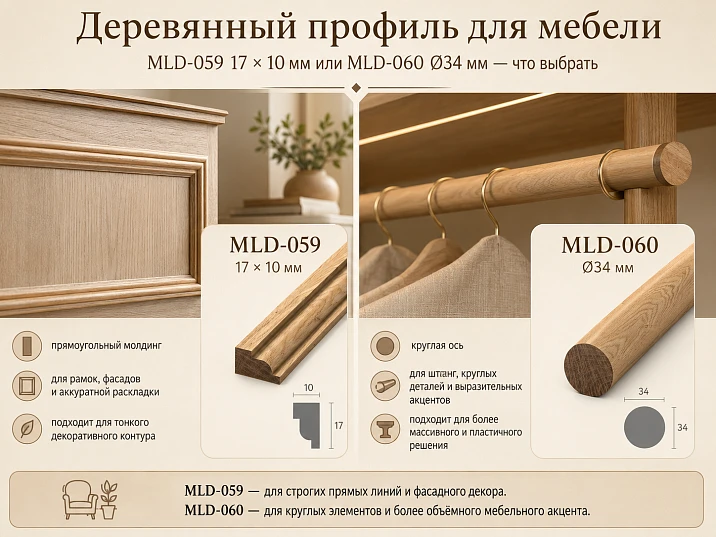
It is easier to buy a wooden profile for furniture when the function of the part is determined first. MLD-059 and MLD-060 are in the same product group, but perform fundamentally different tasks. The thin rectangular MLD-059 with a cross-section of 17 × 10 mm is installed on a flat surface and forms a frame, contour, or dividing line. The round MLD-060 with a diameter of 34 mm becomes the central axis of a volumetric stand, furniture leg, partition, or decorative rod.
The main mistake is to perceive these products as two similar moldings of different cross-sections. Buy rectangular molding MLD-059 needed for overlay decoration of a facade, door, or wall panel. Buy round wooden axis MLD-060 is worth it when compatible geometric elements will be mounted on it and a volumetric composition will be assembled. Replacing one article with another changes the very design principle.
MLD-059 is made from MDF, beech, and oak. For MDF, a length of 2600 mm is confirmed; for beech and oak, 2400 mm. MLD-060 is produced from beech and oak with a diameter of 34 mm in lengths of 1000 and 2400 mm. Both products have a "Prestige" sanding finish, but the material is linked to the finish: MDF and beech are chosen for enamel, oak for tinting when the wood grain needs to be preserved.
The buyer needs to answer one question: is it necessary to decorate an existing surface or create a new three-dimensional furniture part? For a frame on a cabinet door, a graphic line on a dresser, or a panel edging, MLD-059 is suitable. For a modular post with KN parts, a decorative leg, or a partition section, MLD-060 is needed. Then it remains to calculate the length, choose the material, and check compatibility.
Short answer. MLD-059 is chosen for flat applied decor: a frame on a facade, a contour on a door, a dividing line on a wall panel, or repeating fields on a cabinet and dresser. Its rectangular cross-section is 17 × 10 mm.
MLD-060 is chosen for a three-dimensional structure: a furniture leg, post, partition, baluster, or decorative rod with geometric KN elements. This is a round wooden axis Ø34 mm with a length of 1000 or 2400 mm.
MLD-059 is applied to the surface. MLD-060 passes through compatible parts. They do not replace each other but can be used in the same furniture project.
Select MLD-059 17 × 10 mm Select MLD-060 Ø34 mm buy wooden moldings
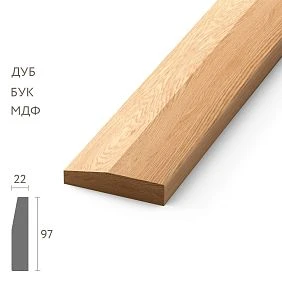
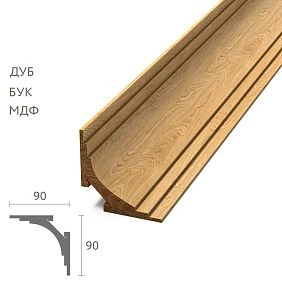
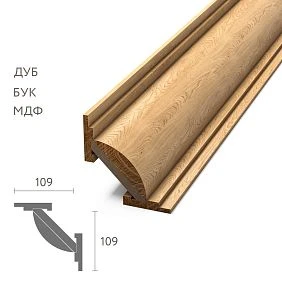
Confirmed specifications of MLD-059 and MLD-060
| Parameter | MLD-059 | MLD-060 | Practical Meaning |
|---|---|---|---|
| Type | Rectangular applied profile | Round wooden axis | First, the design principle is chosen |
| Cross-section | 17 × 10 mm | Ø34 mm | Flat frame and axial assembly are not interchangeable |
| MDF | 17 × 10 × 2600 mm | No | MLD-059 from MDF — for enamel |
| Beech | 17 × 10 × 2400 mm | Ø34 × 1000 or 2400 mm | Beech prepared for enamel |
| Oak | 17 × 10 × 2400 mm | Ø34 × 1000 or 2400 mm | Oak prepared for tinting |
| Sanding | «Prestige» | «Prestige» | Finish is planned separately |
| Application | Facade, door, panel, frame | Rack, leg, partition, bar | Purpose is more important than the word "molding" |
| Feature | Quarter sampling per specification for batches of 100+ pcs. | Compatibility with KN shapes and Ø34 mm | Special conditions are agreed upon before ordering |




MLD-059 or MLD-060: direct comparison
| Criterion | MLD-059 | MLD-060 | Conclusion |
|---|---|---|---|
| Geometry | Rectangular strip | Cylindrical axis | Operate on different principles |
| Location | On the surface | In the center of the modular assembly | MLD-060 is not a trim frame |
| Furniture front | Suitable | Not intended | For a cabinet and dresser, MLD-059 is usually needed |
| Modular leg | Does not serve as an axis | Suitable as a KN base | Load check required |
| Wall frame | Suitable | Does not replace flat profile | Frame is calculated by perimeter |
| Partition | Not a main element | Can be an axis | Mounting project required |
| Lengths | 2400 or 2600 mm | 1000 or 2400 mm | Length is chosen according to cutting map |
| Materials | MDF, beech, oak | Beech, oak | Only MLD-059 available from MDF |
| Main risk | Error in frame cutting | Error in compatibility and load | A drawing is needed before ordering |
Our factory also produces:
Why two products cannot be considered interchangeable
MLD-059 works as an overlay line: its front surface remains visible, and the base of the profile adjoins the facade, door, or panel. MLD-060 works as a central axis passing through volumetric elements. This difference must be recorded already in the sketch, because after cutting and finishing, replacing one principle with the other without reworking the furniture is no longer possible. The buyer should see not just a separate beautiful strip, but its position relative to the facade, frame, adjacent parts, and mounting points.
If the profile is shown on top of a plane in the drawing, choose MLD-059. If a single central line passes through a set of shapes, choose MLD-060. A practical choice begins with a full-size fragment or a clear drawing. On it, mark the edge of the furniture, handles, gaps, attachment points, profile length, and future finish. Such a layout shows the scale more accurately than a photo and helps determine in advance how many strips, axes, or geometric modules will be needed.
For MLD-059, check the rectangular section 17 × 10 mm and the length of the strip. For MLD-060, check the circle Ø34 mm, length 1000 or 2400 mm, and the holes of compatible parts. Checking before ordering saves not only material. It protects against a situation where the profile matches by name but does not work in a specific construction. For flat decor, indents, angles, and a cutting map are important. For the axial system, the diameter, fit, overall height, joint positions, and stability calculation are important.
You cannot buy MLD-060 for a regular frame just because it is also called a molding, and you cannot use MLD-059 as an axis for KN elements. It is better to correct the mistake on paper rather than after installation. As a result, MLD-059 forms a surface pattern, while MLD-060 creates a new volumetric part. When the decision is confirmed, you can proceed to selecting the material, length, and kit on STAVROS, without mixing different purposes and without attributing unconfirmed properties to the part.
Get Consultation
How MLD-059 forms a frame and a graphic line
The 17 × 10 mm section makes MLD-059 noticeable enough for a relief frame but preserves the free field of the facade. The profile is suitable for one outer frame, several repeating fields, and straight dividing lines. This difference must be recorded already in the sketch, because after cutting and finishing, replacing one principle with the other without reworking the furniture is no longer possible. The buyer should see not just a separate beautiful strip, but its position relative to the facade, frame, adjacent parts, and mounting points.
On a small facade, one calm frame is often left. On a tall door, the field can be divided into two parts if the handle, hinges, and furniture proportions allow an additional line. A practical choice begins with a full-size fragment or a clear drawing. On it, mark the edge of the furniture, handles, gaps, attachment points, profile length, and future finish. Such a layout shows the scale more accurately than a photo and helps determine in advance how many strips, axes, or geometric modules will be needed.
Check equal indents from the edges, frame diagonals, distance to the handle and adjacent facades, as well as the direction of the texture when choosing oak. Checking before ordering saves not only material. It protects against a situation where the profile matches by name but does not work in a specific construction. For flat decor, indents, angles, and a cutting map are important. For the axial system, the diameter, fit, overall height, joint positions, and stability calculation are important.
You should not turn a thin profile into a too frequent grid: a large number of lines reduces internal margins and visually fragments the furniture. It is better to correct the mistake on paper rather than after installation. A competent layout helps to update a smooth cabinet, dresser, or nightstand without deep milling of the entire surface. Once the decision is confirmed, you can proceed to selecting the material, length, and kit on STAVROS, without mixing different purposes and attributing unconfirmed properties to the details.
For a wide selection, it is useful to open the catalog of furniture profiles and compare MLD-059 with other sections without changing the confirmed URL of the card.
MLD-059 on a cabinet, dresser, and nightstand
On a cabinet, a rectangular profile more often repeats the shape of the door and creates a uniform system of frames. On a dresser, it unites the drawers, and on a nightstand, it helps make small facades more expressive without large carved decor. This difference needs to be fixed already in the sketch, because after cutting and finishing, replacing one principle with another without reworking the furniture is no longer possible. The buyer should see not a separate beautiful strip, but its position relative to the facade, frame, adjacent parts, and mounting points.
For a tall cabinet, choose a uniform external offset and decide whether one elongated frame or two fields are needed. For a dresser, coordinate the position of frames on drawers of different heights. A practical choice begins with a full-size fragment or a clear drawing. On it, mark the edge of the furniture, handles, gaps, attachment points, profile length, and future finish. Such a layout shows the scale more accurately than a photo and helps to determine in advance how many strips, axes, or geometric modules will be required.
You need to check that the profile does not intersect handles, locks, gaps, and opening areas. On paired doors, evaluate the pattern in both closed and open states. Checking before ordering saves not only material. It protects against a situation where the profile fits by name but does not work in a specific construction. For flat decor, offsets, angles, and a cutting map are important. For an axial system, the diameter, fit, overall height, joint positions, and stability calculation are important.
An error occurs when each door is marked separately without a common template: small discrepancies turn into a noticeable step between adjacent frames. It is better to correct the mistake on paper rather than after installation. Repeatable marking makes the furniture set integral and allows using one profile on a cabinet, dresser, and bedside table. Once the decision is confirmed, you can proceed to selecting the material, length, and kit on STAVROS, without mixing different purposes and attributing unconfirmed properties to the details.
MLD-059 for door, mirror, and wall panel
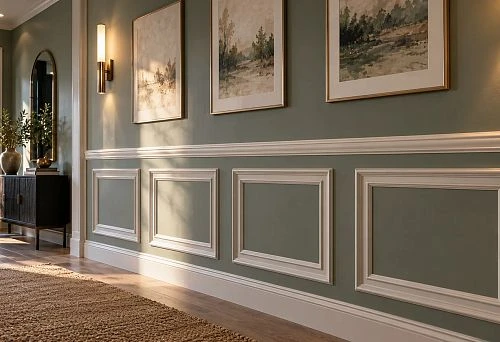
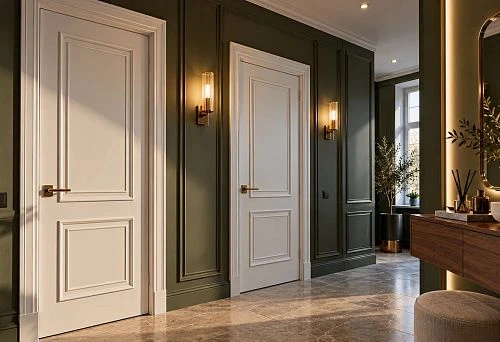
On the MLD-059 door, it creates an overlay frame pattern, on the wall panel — straight fields, and around the mirror — a decorative contour. In all cases, the profile remains a finishing element and does not replace the support system. This difference must be recorded at the sketch stage, because after cutting and finishing, it will not be possible to replace one principle with another without reworking the furniture. The buyer should see not a separate beautiful strip, but its position relative to the facade, frame, adjacent parts, and mounting points.
For the door, the profile is selected considering the architraves, handle, and lock area. On the panel, the wall geometry is checked. In a mirror composition, the fastening of the panel itself is designed separately. A practical choice begins with a full-size fragment or a clear drawing. It marks the edge of the furniture, handles, gaps, attachment points, profile length, and future finishing. Such a layout shows the scale more accurately than a photo and helps to determine in advance how many strips, axes, or geometric modules will be needed.
Before ordering, the finished surface is measured, all technical elements are noted, and strips of paper 17 mm wide are applied to assess the scale from a normal distance. Checking before ordering saves not only material. It protects against a situation where the profile fits by name but does not work in a specific construction. For flat decor, offsets, angles, and the cutting map are important. For an axial system — diameter, fit, total height, joint positions, and stability calculation.
The molding cannot be used to correct an uneven base or be considered as a mirror fastener. These tasks are solved separately. It is better to correct an error on paper rather than after installation. Proper separation of functions allows for neat decor without expectations that are not in the MLD-059 specifications. When the decision is confirmed, you can proceed to selecting the material, length, and kit on STAVROS, without mixing different purposes and without attributing unconfirmed properties to the part.
How to calculate MLD-059 for one frame
The calculation is based on the lengths of four straight sections, not on the facade area. For a frame, two verticals and two horizontals are needed, the length of which depends on the chosen measurement line and the method of joining corners. This difference must be recorded at the sketch stage, because after cutting and finishing, it will not be possible to replace one principle with another without reworking the furniture. The buyer should see not a separate beautiful strip, but its position relative to the facade, frame, adjacent parts, and mounting points.
Before cutting, it is fixed whether measurements are taken along the inner, outer, or axial contour. All parts of one frame are calculated using one system. A practical choice begins with a full-size fragment or a clear drawing. It marks the edge of the furniture, handles, gaps, attachment points, profile length, and future finishing. Such a layout shows the scale more accurately than a photo and helps to determine in advance how many strips, axes, or geometric modules will be needed.
After summing up, a technological allowance is added, then the segments are distributed among strips 2400 or 2600 mm long. It is the cutting map that determines the final quantity. Checking before ordering saves not only material. It protects against a situation where the profile fits by name but does not work in a specific construction. For flat decor, offsets, angles, and the cutting map are important. For an axial system — diameter, fit, total height, joint positions, and stability calculation.
Simply dividing the total length by the commercial length can lead to an error: the remnants may be long in total but too short for a specific vertical. It is better to correct an error on paper rather than after installation. Laying out on paper helps to use remnants for short horizontals and avoid a visible joint in the middle of the facade. When the decision is confirmed, you can proceed to selecting the material, length, and kit on STAVROS, without mixing different purposes and without attributing unconfirmed properties to the part.
Cutting map for a series of facades
When frames are repeated on multiple doors and drawers, all dimensions are combined into a single list. Long parts are distributed first, then short sections are placed in the remaining spaces. This distinction must be recorded on the sketch, because after cutting and finishing, it will not be possible to replace one principle with another without reworking the furniture. The buyer should see not an individual beautiful strip, but its position relative to the facade, frame, adjacent parts, and mounting points.
For a series, it is convenient to label each segment: item, facade number, side, and sequence. This is especially important for oak, where the texture of adjacent parts must look consistent. A practical choice begins with a full-size fragment or a clear drawing. It marks the edge of the furniture, handles, gaps, attachment points, profile length, and future finish. Such a layout shows scale more accurately than a photo and helps determine in advance how many strips, axes, or geometric modules will be needed.
Check the saw kerf width, final trimming, allowance for corners, and the possibility of obtaining solid visible lines. The nominal length of the strip is not equal to the usable length after all operations. Checking before ordering saves not only material. It protects against a situation where the profile fits the name but does not work in a specific construction. For flat decor, offsets, angles, and a cutting map are important. For an axial system, the diameter, fit, total height, joint positions, and stability calculation are important.
You cannot save money at the expense of random joints on the front side if they are not intended by the design. One extra profile is often more rational than correcting the entire series. It is better to correct a mistake on paper than after installation. An accurate cutting map allows you to order MLD-059 deliberately and use material without chaotic leftovers. When the decision is confirmed, you can proceed to selecting the material, length, and kit on STAVROS, without mixing different purposes and without attributing unconfirmed properties to the part.
MLD-059 made of MDF, beech, or oak
MLD-059 made of MDF has a length of 2600 mm and is prepared for enamel. The beech and oak versions have a length of 2400 mm; beech is chosen for enamel, oak for tinting. This distinction must be recorded on the sketch, because after cutting and finishing, it will not be possible to replace one principle with another without reworking the furniture. The buyer should see not an individual beautiful strip, but its position relative to the facade, frame, adjacent parts, and mounting points.
MDF is convenient in painted furniture and can reduce the number of joints on long parts. Beech is chosen when a wooden profile under an opaque coating is required. Oak is needed for visible texture. A practical choice begins with a full-size fragment or a clear drawing. It marks the edge of the furniture, handles, gaps, attachment points, profile length, and future finish. Such a layout shows scale more accurately than a photo and helps determine in advance how many strips, axes, or geometric modules will be needed.
Check not only the color of the future finish, but also the furniture base, part lengths, requirements for solid wood, and the technology for preparing edges. Checking before ordering saves not only material. It protects against a situation where the profile fits the name but does not work in a specific construction. For flat decor, offsets, angles, and a cutting map are important. For an axial system, the diameter, fit, total height, joint positions, and stability calculation are important.
You should not automatically choose oak under opaque enamel as the "best" material: if the texture is covered, the decision must have a clear constructive or design reason. It is better to correct a mistake on paper than after installation. One material in the kit simplifies finishing and reduces differences in tone, absorption, and surface behavior. When the decision is confirmed, you can proceed to selecting the material, length, and kit on STAVROS, without mixing different purposes and without attributing unconfirmed properties to the part.
When an additional rabbet selection is required
For MLD-059, the possibility of an additional quarter sampling according to the technical specification is confirmed when ordering a batch of 100 pieces or more. This is a separate condition, not a standard characteristic of each strip. This difference must be recorded already on the sketch, because after cutting and finishing, replacing one principle with another without reworking the furniture is no longer possible. The buyer should see not a separate beautiful strip, but its position relative to the facade, frame, adjacent parts, and mounting units.
Such processing is considered for a serial project where the profile must receive a special fit or interface. First, a drawing with dimensions and a sample of the assembly are prepared. A practical choice begins with a full-size fragment or a clear drawing. It marks the edge of the furniture, handles, gaps, attachment points, profile length, and future finishing. Such a mockup shows the scale more accurately than a photograph and helps to determine in advance how many strips, axes, or geometric modules will be required.
Before ordering, the geometry of the sampling, tolerances, material, quantity, and the effect of processing on the visible part of the profile are clarified. Checking before ordering saves not only material. It protects against a situation where the profile fits by name but does not work in a specific construction. For flat decor, offsets, angles, and a cutting map are important. For an axial system, the diameter, fit, overall height, joint positions, and stability calculation are important.
You cannot expect individual sampling in a single order or transfer the conditions of one batch to another without agreement. It is better to correct an error on paper than after installation. The technical specification turns a non-standard idea into a verifiable order and protects against different understandings of the form. When the solution is confirmed, you can proceed to selecting the material, length, and kit on STAVROS, without mixing different purposes and without attributing unconfirmed properties to the part.
How the round axis MLD-060 is arranged
MLD-060 is a wooden axis Ø34 mm made of beech or oak. It is produced in lengths of 1000 and 2400 mm and serves as the central base for modular posts, legs, partitions, and decorative rods. This difference must be recorded already on the sketch, because after cutting and finishing, replacing one principle with another without reworking the furniture is no longer possible. The buyer should see not a separate beautiful strip, but its position relative to the facade, frame, adjacent parts, and mounting units.
Compatible figures are sequentially placed onto the axis, their order, distances, and overall height are set. Smooth sections of MLD-060 may remain visible between modules. A practical choice begins with a full-size fragment or a clear drawing. It marks the edge of the furniture, handles, gaps, attachment points, profile length, and future finishing. Such a mockup shows the scale more accurately than a photograph and helps to determine in advance how many strips, axes, or geometric modules will be required.
The hole of each figure, the depth of fit, the orientation of faces, the position of the top and bottom fastening, and the exact length of free sections are checked. Checking before ordering saves not only material. It protects against a situation where the profile fits by name but does not work in a specific construction. For flat decor, offsets, angles, and a cutting map are important. For an axial system, the diameter, fit, overall height, joint positions, and stability calculation are important.
You cannot consider any wooden figure compatible based only on appearance, and you cannot assign a load-bearing axis without calculating the specific construction. It is better to correct an error on paper than after installation. MLD-060 provides freedom for custom assembly but requires a more detailed project than a ready-made furniture leg. When the solution is confirmed, you can proceed to selecting the material, length, and kit on STAVROS, without mixing different purposes and without attributing unconfirmed properties to the part.
When to choose MLD-060 with a length of 1000 mm
A meter-long axis is suitable for a compact furniture leg, a low stand, a decorative fragment, or a prototype when the calculated length fits entirely within 1000 mm. This difference must be recorded in the sketch, because after cutting and finishing, replacing one principle with another without reworking the furniture is no longer possible. The buyer should see not a separate beautiful strip, but its position relative to the facade, frame, adjacent parts, and mounting units.
It is chosen after summing up modules, open areas, and fit into fastenings. A short commercial length is convenient if the remainder after cutting is minimal. A practical choice begins with a full-size fragment or a clear drawing. It marks the edge of the furniture, handles, gaps, attachment points, profile length, and future finishing. Such a layout shows scale more accurately than a photo and helps determine in advance how many strips, axes, or geometric modules will be needed.
It is necessary to account for final trimming and hidden areas inside the upper or lower unit. The visible height is not always equal to the axis length. Verification before ordering saves not only material. It protects against a situation where the profile fits by name but does not work in a specific structure. For flat decor, offsets, angles, and a cutting map are important. For an axial system, the diameter, fit, total height, joint positions, and stability calculation are important.
It is a mistake to choose a meter-long blank "by eye" and then discover that after installation, a few centimeters are missing. It is better to correct a mistake on paper than after installation. A verified drawing allows ordering the required number of short axes without excess material. When the decision is confirmed, you can proceed to selecting the material, length, and kit on STAVROS, without mixing different purposes and without attributing unconfirmed properties to the part.
When to choose MLD-060 with a length of 2400 mm
A length of 2400 mm is suitable for a high stand, partition, long decorative rod, or cutting several short axes from one blank. This difference must be recorded in the sketch, because after cutting and finishing, replacing one principle with another without reworking the furniture is no longer possible. The buyer should see not a separate beautiful strip, but its position relative to the facade, frame, adjacent parts, and mounting units.
It reduces the number of connections in height and provides freedom of cutting, but requires careful transportation, storage, and straightness checking. A practical choice begins with a full-size fragment or a clear drawing. It marks the edge of the furniture, handles, gaps, attachment points, profile length, and future finishing. Such a layout shows scale more accurately than a photo and helps determine in advance how many strips, axes, or geometric modules will be needed.
Before ordering, mounting gaps, upper and lower fastening, saw kerf width, and possible joint location are calculated. Verification before ordering saves not only material. It protects against a situation where the profile fits by name but does not work in a specific structure. For flat decor, offsets, angles, and a cutting map are important. For an axial system, the diameter, fit, total height, joint positions, and stability calculation are important.
You cannot equate the room height to the axis length: structural units can reduce or increase the required blank. It is better to correct a mistake on paper than after installation. A long profile is rational only when the cutting map and installation scheme are confirmed. When the decision is confirmed, you can proceed to selecting the material, length, and kit on STAVROS, without mixing different purposes and without attributing unconfirmed properties to the part.
Which KN shapes are suitable for MLD-060
Category «Constructor» STAVROS contains geometric elements for modular compositions. For KN-005, a through hole of 34 mm and application on MLD-060 are confirmed. This difference must be recorded already in the sketch, because after cutting and finishing, replacing one principle with another without reworking the furniture will no longer be possible. The buyer should see not a separate decorative strip, but its position relative to the facade, frame, adjacent parts, and mounting units.
Geometric figure KN-005 creates a rounded module. The faceted figure KN-006 can be considered as a different visual option, but the actual dimensions and fit must be verified in the card. A practical choice begins with a full-size fragment or a clear drawing. It marks the edge of the furniture, handles, gaps, attachment points, profile length, and future finish. Such a layout shows the scale more accurately than a photo and helps to determine in advance how many strips, axes, or geometric modules will be needed.
For each article, the hole diameter, overall height, orientation, and quantity are checked. Matching category names does not replace technical compatibility. Checking before ordering saves not only material. It protects against a situation where the profile fits by name but does not work in a specific construction. For flat decor, indents, angles, and cutting map are important. For an axial system, the diameter, fit, overall height, joint position, and stability calculation are important.
A mistake is to assemble a set based only on beautiful images and discover differences only after finishing the axis. It is better to correct a mistake on paper than after installation. To compare shapes, it is useful to read which figures to install on MLD-060, and finalize the list in the specification. When the decision is confirmed, you can proceed to selecting the material, length, and kit for STAVROS, without mixing different purposes and without attributing unconfirmed properties to a part.
How to calculate a modular stand
The calculation starts with the finished height of the post. Then determine the length of the upper and lower fastening, the height of each figure, the depth of fit, and the length of open sections of the axis. This difference must be recorded in the sketch, because after cutting and finishing, replacing one principle with another without reworking the furniture is no longer possible. The buyer should see not a separate beautiful strip, but its position relative to the facade, frame, adjacent parts, and mounting units.
If elements are placed closely, their working heights are summed. If there are gaps between them, these distances are added to the total length of MLD-060. A practical choice begins with a full-size fragment or a clear drawing. It marks the edge of the furniture, handles, gaps, attachment points, profile length, and future finishing. Such a layout shows the scale more accurately than a photo and helps determine in advance how many strips, axes, or geometric modules will be needed.
For several identical posts, a sequence table is compiled and all kits are assembled dry. Finished sets are placed side by side and control marks are compared. Checking before ordering saves not only material. It protects against a situation where the profile matches the name but does not work in a specific construction. For flat decor, offsets, angles, and a cutting map are important. For an axial system, the diameter, fit, total height, joint positions, and stability calculation are important.
You cannot calculate from a photo: internal sampling, protrusions, and fit can change the working height of a part. It is better to correct an error on paper rather than after installation. Dry assembly before gluing and painting allows correcting the sequence without losing elements. When the solution is confirmed, you can proceed to selecting the material, length, and kit on STAVROS, without mixing different purposes and without attributing unconfirmed properties to the part.
MLD-060 in a furniture leg
In an author's leg, MLD-060 sets the center line, and KN figures form the silhouette. The decorative pattern must be coordinated with the height of the body and other supports. This difference must be recorded in the sketch, because after cutting and finishing, replacing one principle with another without reworking the furniture is no longer possible. The buyer should see not a separate beautiful strip, but its position relative to the facade, frame, adjacent parts, and mounting units.
First, determine the final height of the furniture, the floor
Check the number of legs, body stability, length of free sections, and design load. The product card does not provide a universal value in kilograms. Checking before ordering saves not only material. It protects against a situation where the profile matches the name but does not work in a specific construction. For flat decor, offsets, angles, and a cutting map are important. For an axial system, the diameter, fit, total height, joint positions, and stability calculation are important.
A mistake is to perceive a beautiful modular assembly as a ready-made load-bearing support without design. It is better to correct an error on paper rather than after installation. With a confirmed design, MLD-060 allows obtaining repeatable legs that are not available among standard ready-made models. When the solution is confirmed, you can proceed to selecting the material, length, and kit on STAVROS, without mixing different purposes and without attributing unconfirmed properties to the part.
MLD-060 in a post and decorative rod
In the MLD-060 post, smooth sections can be combined with geometric modules, and in the decorative rod, a long repeating line can be formed. This difference must be captured in the sketch, because after cutting and finishing, it will not be possible to replace one principle with another without reworking the furniture. The buyer should see not just a beautiful individual strip, but its position relative to the facade, frame, adjacent parts, and mounting points.
For a console, display case, or shelving unit, the top and bottom fastening, the length of the free section, and lateral stability are important. A practical choice begins with a full-size fragment or a clear drawing. It marks the edge of the furniture, handles, gaps, attachment points, profile length, and future finishing. Such a layout shows scale more accurately than a photo and helps determine in advance how many strips, axes, or geometric modules will be needed.
Check whether the decorative axis is used as a handrail, wardrobe rail, or element under dynamic load. Such functions require separate calculation. Checking before ordering saves not only material. It protects against a situation where the profile fits the name but does not work in a specific structure. For flat decor, offsets, angles, and a cutting map are important. For an axial system, the diameter, fit, overall height, joint positions, and stability calculation are important.
One cannot draw a conclusion about the permissible load based only on a diameter of 34 mm or the type of wood. It is better to correct an error on paper than after installation. A clear purpose protects the project from mixing a decorative profile with a structural part. When the decision is confirmed, you can proceed to selecting the material, length, and kit on STAVROS, without mixing different purposes and without attributing unconfirmed properties to the part.
MLD-060 in an interior partition
Several MLD-060 axes can form a repeating partition with geometric shapes. The rhythm is created by the same order of modules and equal spacing between the posts. This difference must be captured in the sketch, because after cutting and finishing, it will not be possible to replace one principle with another without reworking the furniture. The buyer should see not just a beautiful individual strip, but its position relative to the facade, frame, adjacent parts, and mounting points.
Before purchasing, determine the dimensions of the opening, the number of axes, the top and bottom base, the possibility of disassembly, and safe distances. A practical choice begins with a full-size fragment or a clear drawing. It marks the edge of the furniture, handles, gaps, attachment points, profile length, and future finishing. Such a layout shows scale more accurately than a photo and helps determine in advance how many strips, axes, or geometric modules will be needed.
Check the stability of the entire section, not just one post. For a tall structure, joints and fastenings are designed separately. Checking before ordering saves not only material. It protects against a situation where the profile fits the name but does not work in a specific structure. For flat decor, offsets, angles, and a cutting map are important. For an axial system, the diameter, fit, overall height, joint positions, and stability calculation are important.
A mistake is to secure long axes only decoratively or leave the connection in a random place between the shapes. It is better to correct an error on paper than after installation. With a technically confirmed scheme, the modular system allows assembling a partition in a single wood type and finish. When the decision is confirmed, you can proceed to selecting the material, length, and kit on STAVROS, without mixing different purposes and without attributing unconfirmed properties to the part.
Can MLD-059 and MLD-060 be combined
Both profiles can be used in one piece of furniture: MLD-059 decorates the facades, while MLD-060 works in legs, posts, or open sections. This difference must be recorded at the sketch stage, because after cutting and finishing, it will not be possible to replace one principle with another without reworking the furniture. The buyer should see not just a separate beautiful strip, but its position relative to the facade, frame, adjacent parts, and mounting points.
To make the parts appear unified, choose a consistent wood species, shade, and decorative density. Beech elements can be combined with a common enamel, oak elements with a common tinting system. A practical choice starts with a full-size fragment or a clear drawing. It marks the edge of the furniture, handles, gaps, attachment points, profile length, and future finish. Such a mockup shows scale more accurately than a photo and helps determine in advance how many strips, axes, or geometric modules will be needed.
Check whether the thin line of MLD-059 gets lost next to large shapes and whether the composition becomes too saturated. Checking before ordering saves not only material. It protects against a situation where the profile fits the name but does not work in a specific construction. For flat decor, offsets, angles, and the cutting map are important. For an axial system, the diameter, fit, overall height, joint positions, and stability calculation are important.
A mistake is to compensate for the difference in scale with a large number of frames and modules simultaneously. It is better to correct a mistake on paper rather than after installation. A full-size mockup helps find a balance between flat graphics and three-dimensional geometry. When the solution is confirmed, you can proceed to selecting the material, length, and kit on STAVROS, without mixing different purposes and without attributing unconfirmed properties to the part.
Mounting MLD-059 on the surface
The facade base must be clean, durable, and compatible with the chosen adhesive. Laminated, painted, veneered, and untreated surfaces require different preparation methods. This difference must be recorded at the sketch stage, because after cutting and finishing, it will not be possible to replace one principle with another without reworking the furniture. The buyer should see not just a separate beautiful strip, but its position relative to the facade, frame, adjacent parts, and mounting points.
Marking is done from control axes. For a frame, check the diagonals, and for a series of facades, use a template or stop. A practical choice starts with a full-size fragment or a clear drawing. It marks the edge of the furniture, handles, gaps, attachment points, profile length, and future finish. Such a mockup shows scale more accurately than a photo and helps determine in advance how many strips, axes, or geometric modules will be needed.
Before fixing, lay out all the pieces dry, evaluate the angles, texture, handles, and gaps. Choose the clamping method so that the profile does not shift. Checking before ordering saves not only material. It protects against a situation where the profile fits the name but does not work in a specific construction. For flat decor, offsets, angles, and the cutting map are important. For an axial system, the diameter, fit, overall height, joint positions, and stability calculation are important.
You cannot assign one adhesive and the same preparation for all bases without checking the system recommendations. It is better to correct a mistake on paper rather than after installation. Accurate marking and dry fitting give a more predictable result than trying to align parts after bonding. When the solution is confirmed, you can proceed to selecting the material, length, and kit on STAVROS, without mixing different purposes and without attributing unconfirmed properties to the part.
Assembly of MLD-060 with shapes
The axis and modules are first assembled without glue. The order, orientation, overall length, and uniformity of several posts are checked. This difference must be recorded in the sketch, because after cutting and finishing, it will be impossible to replace one principle with another without reworking the furniture. The buyer should see not a separate beautiful strip, but its position relative to the facade, frame, adjacent parts, and mounting units.
For KN-005, fixation with wood glue is confirmed; the element can be temporarily held with masking tape, and some schemes allow micro-pins. A practical choice starts with a full-size fragment or a clear drawing. It marks the edge of the furniture, handles, gaps, attachment points, profile length, and future finishing. Such a mockup shows scale more accurately than a photo and helps determine in advance how many strips, axes, or geometric modules will be needed.
It is necessary to control the amount of glue and not fill the mounting hole so that the figure no longer sits at the calculated depth. Checking before ordering saves not only material. It protects against a situation where the profile fits by name but does not work in a specific structure. For flat decor, offsets, angles, and a cutting map are important. For an axial system, the diameter, fit, overall height, joint positions, and stability calculation are important.
A mistake is to fully fix the first post without comparing it with the other sets. It is better to correct a mistake on paper rather than after installation. Parallel dry assembly allows you to obtain a repeatable pattern and correct discrepancies before finishing. When the decision is confirmed, you can proceed to selecting the material, length, and kit on STAVROS, without mixing different purposes and without attributing unconfirmed properties to the part.
Enamel, tinting, and protection of mounting holes
MDF and beech are prepared for enamel, oak for tinting. An opaque coating unifies the profile with the furniture, while tinting preserves the texture of the oak. This difference must be recorded in the sketch, because after cutting and finishing, it will be impossible to replace one principle with another without reworking the furniture. The buyer should see not a separate beautiful strip, but its position relative to the facade, frame, adjacent parts, and mounting units.
On MLD-059, the coating is evaluated on the flat and side faces. On MLD-060, on the cylindrical surface and near the figures. A practical choice starts with a full-size fragment or a clear drawing. It marks the edge of the furniture, handles, gaps, attachment points, profile length, and future finishing. Such a mockup shows scale more accurately than a photo and helps determine in advance how many strips, axes, or geometric modules will be needed.
Before painting the axial system, a trial fit is performed and the holes are protected from an excessive layer. Otherwise, the fit after finishing may change. Checking before ordering saves not only material. It protects against a situation where the profile fits by name but does not work in a specific structure. For flat decor, offsets, angles, and a cutting map are important. For an axial system, the diameter, fit, overall height, joint positions, and stability calculation are important.
You cannot consider the same color name a guarantee of the same result on MDF, beech, and oak. It is better to correct a mistake on paper rather than after installation. A test paint on real materials helps to agree on the shade and technology before processing the entire set. When the decision is confirmed, you can proceed to selecting the material, length, and kit on STAVROS, without mixing different purposes and without attributing unconfirmed properties to the part.
What to buy together with MLD-059 and MLD-060
Purchasing a single profile rarely covers the entire project. For MLD-059, you will need an accurate cutting map, materials for joint preparation, and a finishing system. For MLD-060, compatible geometric elements, a mounting diagram, and a total height calculation are required. Below are only confirmed STAVROS pages that help assemble the kit without random links.
If the task is not yet defined, you can open Catalog of wooden moldings and compare sections. For axial composition, go to the "Constructor" category. For a realistic assessment of the shape, it is useful OMLD-005 sample set, but the availability of MLD-059 and MLD-060 in the current kit configuration needs to be confirmed before ordering.
| What to add | Main profile | Why | What to Check | Transition |
|---|---|---|---|---|
| Wooden molding catalog | MLD-059 and alternatives | Compare sections, materials and lengths | Purpose of each profile | buy wooden moldings |
| Category "Constructor" | MLD-060 | Select axial modules | Hole diameters and dimensions | select STAVROS constructor elements |
| KN-005 | MLD-060 | Assemble a rounded module | Hole 34 mm, quantity, order | Buy geometric shape KN-005 |
| KN-006 | MLD-060 | Add a faceted shape | Current compatibility by card | buy faceted figure KN-006 |
| OMLD-005 | Both profiles | Evaluate shape and material in real scale | Current set configuration | purchase the OMLD-005 sample set |
| Guide to wooden moldings | MLD-059 | Compare types and applications | Specifications by cards | View types of wooden moldings |
| Guide to furniture moldings | MLD-059 | Calculate frames on facades | Indents and cutting map | how to choose a molding for a furniture facade |
| Article about KN shapes | MLD-060 | Compare geometric modules | Hole, height and order | Select geometric elements with a 34 mm hole |
Practical selection for different tasks
| Task | What to choose | Why | Main check |
|---|---|---|---|
| Thin frame on the cabinet | MLD-059 from MDF, beech or oak | The profile lies on the plane and forms a contour | Indents, handles, corners, cutting map |
| Repeating frames on the dresser | MLD-059 | Section 17 × 10 mm does not overload small facades | Template for all boxes |
| Oak furniture with visible texture | MLD-059 made of oak | Prepared for tinting | Test color and pattern selection |
| Painted furniture with long parts | MLD-059 made of MDF 2600 mm | Long length can reduce the number of joints | Compatibility of enamel technology |
| Custom furniture leg | MLD-060 + compatible KN | The axis connects the modules | Load, mounting, height |
| Low modular rack | MLD-060 1000 mm | Suitable when assembly length is confirmed | Seating and mounting areas |
| High rack or partition | MLD-060 2400 mm | Fewer connections in height | Stability and position of joints |
| Facades and volumetric supports in one project | MLD-059 + MLD-060 | Profiles perform different roles | Common material, shade and scale |
Errors when selecting and ordering
1. Consider MLD-060 as a regular overlay molding
The round axis is not intended for a flat frame. Its task is to pass through compatible elements. Attempting to glue it onto the facade changes the geometry and does not correspond to its purpose. Before purchasing, you should return to the drawing, check the product card, and verify what specific operation the profile should perform. Such control is cheaper than reworking finished furniture.
2. Use MLD-059 as an axis for KN
The rectangular cross-section 17 × 10 mm does not correspond to the round hole of 34 mm. Even if the profile is visually appealing, it does not replace MLD-060. Before purchasing, you should return to the drawing, check the product card, and verify what specific operation the profile should perform. Such control is cheaper than reworking finished furniture.
3. Order MLD-059 by total length
The sum of lengths does not show how specific verticals and horizontals are distributed across the planks. Without a cutting map, you can get a lot of useless leftovers. Before purchasing, you should return to the drawing, check the product card, and verify what specific operation the profile should perform. Such control is cheaper than reworking finished furniture.
4. Mixing internal and external frame dimensions
If some parts are measured along the outer edge and others along the inner edge, the corners will not align. All dimensions are fixed along a single chosen line. Before purchasing, you should return to the drawing, check the product card, and verify which specific operation the profile should perform. Such control is cheaper than reworking finished furniture.
5. Not accounting for handles and gaps
The frame may intersect with the hardware or be too close to the joint of the doors. The layout is checked on the facade at full scale. Before purchasing, you should return to the drawing, check the product card, and verify which specific operation the profile should perform. Such control is cheaper than reworking finished furniture.
6. Buying KN shapes only from a photo
The appearance does not confirm the mounting hole. Compatibility with Ø34 mm is checked in the card of each item. Before purchasing, you should return to the drawing, check the product card, and verify which specific operation the profile should perform. Such control is cheaper than reworking finished furniture.
7. Painting MLD-060 before fitting without masking
A thick layer of coating inside the holes can change the fit. First, perform a dry assembly and choose the protection technology. Before purchasing, you should return to the drawing, check the product card, and verify which specific operation the profile should perform. Such control is cheaper than reworking finished furniture.
8. Assuming the axis of the support without calculation
The diameter and type of wood do not provide a universal load. For a leg, post, or partition, check the fastenings, length, number of axes, and the frame. Before purchasing, you should return to the drawing, check the product card, and verify which specific operation the profile should perform. Such control is cheaper than reworking finished furniture.
9. Leave the joint axis in a random place
The joint may become visible or fall into a loaded area. Its position is designed in advance. Before purchasing, you should return to the drawing, check the product card, and verify what specific operation the profile should perform. Such control is cheaper than reworking finished furniture.
10. Mix materials without a common finish
MDF, beech, and oak perceive coatings differently. Even the same color does not guarantee an identical surface. Before purchasing, you should return to the drawing, check the product card, and verify what specific operation the profile should perform. Such control is cheaper than reworking finished furniture.
11. Order a large batch without a sample
A cross-section of 17 × 10 mm and a diameter of 34 mm are perceived differently on screen than on furniture. A physical sample helps verify the scale. Before purchasing, you should return to the drawing, check the product card, and verify what specific operation the profile should perform. Such control is cheaper than reworking finished furniture.
12. Confuse a decorative axis with a handrail or shaft
MLD-060 does not become a mechanical or construction part due to its round shape. A different purpose requires separate design. Before purchasing, you should return to the drawing, check the product card, and verify what specific operation the profile should perform. Such control is cheaper than reworking finished furniture.
How not to confuse a profile with similar products
MLD-059 is not an edge, baseboard, or structural strip. It creates a decorative line on a flat surface. If you need to cover an end, protect a corner, or fix a construction joint, a different type of product is required.
MLD-060 is not a dowel, peg, handrail, wardrobe rod, or mechanical shaft. The word "axis" describes a position within a modular composition, not rotation or a universal load-bearing function.
A reliable way to distinguish products is to look at the cross-section and drawing. A 17 × 10 mm rectangle is placed on top of the base. A circle Ø34 mm passes through the shapes. If the diagram does not show this logic, the choice is not yet confirmed.
When in doubt, it is useful to compare profiles at actual scale and discuss the non-standard joint before ordering a large batch.
Who MLD-059 is for
MLD-059 is suitable for furniture manufacturers, designers, and furniture owners who need a thin frame, a repeating line, or a calm facade division. It is especially useful for painted cabinets, dressers, doors, and wall panels.
The profile is convenient where deep milling is not required or possible, but a flat surface looks too simple. The applied strip allows you to manage proportions without changing the entire facade structure.
MLD-059 is not suitable for a voluminous post, load-bearing beam, covering a construction corner, or edge protection. It may also be too thin for a large classical composition where a more massive profile is needed.
Even on a small facade, the 17 × 10 mm cross-section is checked with a paper template. If the internal field becomes cramped, reduce the number of lines or choose a different profile.
Who is MLD-060 suitable for
MLD-060 is suitable for those who design a modular stand and know in advance which elements will be installed on the axis. This is a solution for custom furniture, partitions, decorative rods, and repeating volumetric compositions.
The axis is useful when a standard ready-made leg does not provide the desired pattern. The order of shapes can be changed, but each version requires a new length calculation and fastening check.
MLD-060 is not suitable for a buyer who needs a fully finished support without assembly and design. In such a situation, it is more rational to choose a ready-made furniture leg with confirmed parameters.
The profile also cannot be assigned as a handrail, mechanical shaft, or structural column without a separate calculation. Decorative potential does not negate safety requirements.
How to use samples before a large order
Set OMLD-005 contains 84 samples of moldings, cornices, and baseboards made of oak, beech, and MDF, each 100 mm long. It helps evaluate the actual cross-section, finish, and character of materials. The availability of MLD-059 and MLD-060 in the current configuration should be clarified.
MLD-059 is applied to the facade at the intended distance from the edge and viewed from a normal distance. Side lighting shows the relief height and the shadow the profile creates on the surface.
For MLD-060, a short sample does not replace a full stand, but helps evaluate the diameter, fit, and trial finish. It is useful to assemble a fragment with one or two shapes.
The approved sample is retained until the project is completed. It becomes a reference standard for color, gloss, finish, and quality of the finished batch.
How to buy MLD-059 or MLD-060 on STAVROS
For the frame on the facade, open the card and select MLD-059 with dimensions 17 × 10 mm. Check the material, length, and preparation for finishing. Then create a cutting map and determine the number of slats.
For a volumetric post, go to the card and select MLD-060 with a diameter of 34 mm. Verify the length of 1000 or 2400 mm, material, and future finishing. After that, select shapes in the constructor category.
When the profile type is not yet determined, you can view MDF, beech and oak moldings and read how to choose a profile for furniture. For calculating frames, material on how to choose a molding for a furniture facade.
Before placing an order, prepare a sketch with dimensions, a list of parts, the number of frames or posts, the selected material and finishing method. For a large batch, quarter sampling or a loaded structure, it is better to coordinate the parameters with a STAVROS manager.
FAQ: questions about MLD-059 and MLD-060
How is MLD-059 different from MLD-060?
MLD-059 is a rectangular profile 17 × 10 mm for overlay decoration of surfaces. MLD-060 is a round axis Ø34 mm for modular posts, legs, partitions and other volumetric compositions.
Can I make a furniture frame from MLD-060?
As a regular overlay molding, MLD-060 is not intended for a frame. Its round geometry is designed for axial assembly. For a facade, choose MLD-059 or another flat profile.
Can MLD-059 be used as an axis for KN?
No. The rectangular section 17 × 10 mm does not match the Ø34 mm hole system. For compatible shapes, MLD-060 is needed.
Which material of MLD-059 should be chosen for enamel?
MDF and beech are confirmed for enamel. MDF is produced in lengths of 2600 mm, beech — 2400 mm. The choice depends on the furniture design and finishing technology.
Which option should be chosen for tinting?
Oak is chosen for tinting. It is available for MLD-059 in lengths of 2400 mm and for MLD-060 in lengths of 1000 or 2400 mm.
How to calculate the quantity of MLD-059?
Add the lengths of all straight sections, add a technological allowance, and distribute the parts across the planks. The result is determined by the cutting map, not just the total footage.
Is an allowance needed for the corners of the frame?
Yes. The exact allowance depends on the number of corners, the connection method, and the complexity of the cutting. Dimensions are fixed along one selected line and checked with a dry layout.
When to choose MLD-060 with a length of 1000 mm?
A meter-long axis is suitable for a compact leg, stand, or experimental fragment if the entire assembly with fasteners fits within this length.
When is a length of 2400 mm needed?
For a tall stand, partition, long rod, or cutting several short axes. You need to account for the kerf, trimming, and mounting areas.
Which figures are definitely compatible with MLD-060?
For KN-005, a through hole of 34 mm is confirmed. Compatibility of other elements is checked in the current product cards before ordering.
Can MLD-060 be painted before assembly?
Only with a well-thought-out process. First, perform a dry fit and protect the mounting holes from excess coating.
Is MLD-060 a ready-made load-bearing leg?
Not automatically. For loaded furniture, check the material, free length, fastening, number of supports, and body construction.
Can MLD-060 be used in a partition?
The card provides for this scenario, but the height, post spacing, fasteners, and stability of the entire section are calculated separately.
Can MLD-059 and MLD-060 be combined?
Yes. For example, MLD-059 finishes facades, while MLD-060 is used in legs or posts. The material, finish, and scale are coordinated in one scheme.
What to check before ordering MLD-059?
Cross-section 17 × 10 mm, material, length 2400 or 2600 mm, number of frames, cutting map, finish, and mounting compatibility with the base.
What to check before ordering MLD-060?
Diameter 34 mm, length 1000 or 2400 mm, wood species, list of shapes, hole sizes, assembly height, fasteners, and load calculation.
Can MLD-059 be ordered with a rebate?
The card confirms an additional rebate according to the technical specification for batches of 100 pieces or more. Current terms are agreed upon before ordering.
Will the sample set help choose a profile?
Yes, OMLD-005 helps evaluate actual cross-sections and materials. But the presence of MLD-059 and MLD-060 specifically in the current composition needs to be clarified.
Is it necessary to order elements in one batch?
For consistent finish and repeatability, it is better to order the profile and compatible parts from the same wood species and close batch, then make a test paint-out.
Where can I see both products?
MLD-059 and MLD-060 are available in STAVROS cards. For a broad comparison, open Catalog of wooden moldings, and for the axial system — the "Constructor" category.
Result: flat frame or volumetric axial structure
The choice between MLD-059 and MLD-060 starts not with the material or length. First, the operating principle is determined. If you need to decorate a surface, create a frame, contour, or repeating line, choose MLD-059 with a cross-section of 17 × 10 mm. If you need to assemble a post, leg, partition, or decorative rod from modules, choose MLD-060 Ø34 mm.
MLD-059 is calculated based on the lengths of straight sections and the cutting map. MLD-060 is calculated based on the total height of the axial assembly, dimensions of shapes, and mounting nodes. For the first, angles and offsets are critical; for the second, mounting holes, joints, and stability. These differences cannot be replaced by the general word "molding."
At STAVROS you can Buy rectangular molding MLD-059, Buy round wooden axis MLD-060 and select related items based on confirmed cards. Before ordering, it is worth checking the dimensions, material, finish, and full set. This approach allows you to get not a random set of wooden parts, but a clear system for a specific piece of furniture or interior.