Article Contents:
- What are geometric shapes for furniture
- Not a toy and not a children's set
- Not a universal blank for creativity
- Functional module inside a modular system
- KN-005: soft rounded geometry
- KN-006: faceted modern accent
- KN-011: strict cubic block
- Why one model cannot be automatically replaced by another
- Classic and transitional furniture
- Art Deco
- Modern geometric furniture
- Designer furniture and eclecticism
- Compact furniture leg
- Medium height stand
- Floor-to-ceiling partition
- Baluster or decorative support
- One large accent or repetition of small modules
- Measure the actual axis
- Check the passage along the entire length
- Do not paint the mounting channel
- Wooden and metal axes require different approaches
- Dry layout is mandatory
- Beech for opaque enamel
- Oak for tinting
- Why adjacent elements are better ordered from the same wood species
- Texture orientation
- One shape as a central accent
- Repetition of identical details
- Alternation of rounded and faceted shapes
- Cube as base or center
- Rotation of faceted elements
- Sum up the actual heights
- Don't forget about installation gaps
- Calculate for each post
- Create a specification
- A small soft insert is needed in the furniture leg
- A modern faceted post is needed
- A large center is needed for a high partition
- The design should not look heavy
- Need a set for an author's table
- Need to replicate a ready-made composition
- Need a different scale for the rounded shape
- Living Room
- Kitchen and dining room
- Entry Hall
- Bedroom and dressing room
- Office and Library
- Commercial interior
- Furniture shape and children's toy
- KN and craft blank
- KN-005 and wooden ball
- KN-006 and cube
- KN-011 and finished furniture leg
- Separate figure and partition set
- Choosing only by photo
- Hole check only
- Purchase of figures without axis
- Channel painting
- Gluing without layout
- Different rotation of KN-006
- Mixing beech and oak under a transparent coating
- Using a cube in too small furniture
- Waiting for a finished support leg
- No exact quantity calculation
- Installation of an external structure without agreed finishing
- Purchase of a product for a children's project
- Before installation
- Fixation on a wooden axis
- Fixing on a metal pipe
- Finishing sequence
- Maintenance
- Where to buy wooden geometric shapes for furniture?
- How is KN-005 different from KN-006?
- Which shape to choose for modern furniture?
- When is it better to use KN-011?
- What is the mounting diameter of the elements?
- Can the figure be installed on a metal pipe?
- Does MLD-060 fit all three models?
- What is better for enamel — beech or oak?
- Can round and faceted elements be combined?
- How to calculate the number of figures per stand?
- Can KN-011 be used as a leg base?
- How do furniture modules differ from wooden blanks?
- Are the products suitable for children?
- How to fix the figure on the central axis?
- Do I need to paint the parts before assembly?
- Can I replace KN-005 with KN-011 without changing the drawing?
- How to orient KN-006?
- What to buy together with geometric shapes?
- Can the figures be used outdoors?
- Do I need to order a sample?
- Paper and cardboard templates
- Test stand
- Evaluation from different distances
- Light check
- Divide the racks by type
- Add an orientation diagram
- Record the finish
- Check the set before launch
- What needs to be controlled during self-manufacturing
- What a ready-made system provides
- When modification is still required
- Commercial output
- Console and narrow table
- Dining or coffee table
- Cabinet and chest of drawers
- Open shelving unit
- Decorative partition
- Restoration of old furniture
- Decor should not hide a weak joint
- Repeating posts must be identical
- Check the base
- When to consult a structural engineer
- One color for the axis and shapes
- Contrasting modules
- Matte and glossy surfaces
- Patina
- Finishing the entire batch
Customer who plans to buy wooden geometric shapes for furniture, solves not an abstract decorative task. They need a specific module for a prefabricated leg, interior post, baluster, decorative rod, or vertical partition. The shape must fit in size, sit on the central axis without accidental play, match adjacent parts, and not overload the structure with its scale.
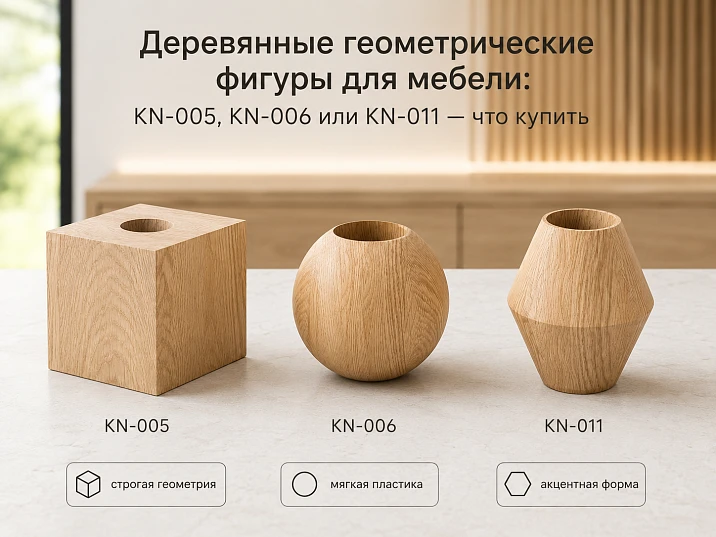
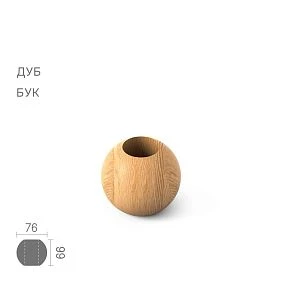
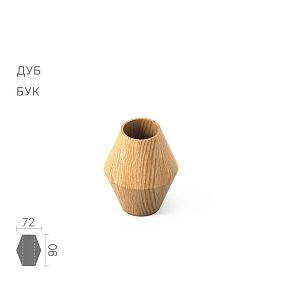
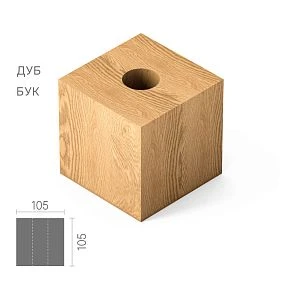
In the STAVROS "Constructor" system, there are three expressive options with the same mounting hole of 34 mm, but completely different character. KN-005, size 66 × 76 × 76 mm, creates a soft rounded transition. KN-006, size 90 × 72 × 72 mm, works as a faceted modern module. KN-011, size 105 × 105 × 105 mm, is a perfect cube and becomes a large architectural block. The matching hole diameter does not make these products interchangeable: height, width, silhouette, direction of faces, and role in the overall composition differ.
Such parts should not be confused with children's blocks, sorters, or craft blanks. These are three-dimensional furniture and interior modules made of solid beech or oak with a through mounting channel. They are installed on a compatible wooden axis MLD-060 or on a metal pipe with a diameter of 34 mm, and the fixing method and finish are selected considering the base material and the purpose of the structure.
The article will help compare three shapes, check compatibility with the axis, calculate the total height of the modules, choose beech for opaque enamel or oak for tinting, and then proceed to the specific product card. You can start your selection in the category where wooden geometric shapes for furniture posts, supports, and interior compositions are collected. for furniture posts, supports, and interior compositions.
What are geometric shapes for furniture?
Geometric figure KN is a ready-made volumetric module with specified dimensions and a through mounting hole. A central axis passes through the part, uniting several elements into one vertical or horizontal structure. Depending on the project, the figure becomes a transition between rack sections, a central accent, a repeating rhythm, or a large connecting block.
The buyer receives not a random wooden block that still needs to be marked and drilled, but a part with a coordinated fit. This is especially important when assembling several identical posts. If each shape is made manually, a small difference in hole diameter, height, or channel position will accumulate throughout the structure. Ready-made modules simplify repeatability and help calculate the composition in advance.




Not a toy or a children's set
In search, the phrase "wooden geometric shapes" often refers to educational toys, sorters, and blocks. KN products have a different purpose. They are designed as parts of furniture and interior systems, installed on a rod, and after assembly can be glued, painted, or tinted. They cannot be positioned as goods for children's games.
The difference is already visible in the dimensions and design. KN-011 is a cube with a side of 105 mm and a hole of 34 mm. An axis passes through it, so the internal channel is not a random technological cavity, but the main compatibility parameter. A children's toy lacks such a mounting scenario.
Our factory also produces:
Not a universal blank for creativity
The figures can be finished with enamel, stain, oil, varnish, or patina, but they are not dimensionless blanks for painting. The size, shape, and hole are already determined. Before purchasing, you need to understand where the part will be placed, which section of the axis it will occupy, and which elements will be located nearby.
If the task is limited to a decorative craft without a furniture structure, a special module with a 34 mm fit may be redundant. Its advantages are revealed precisely in a stand, support, partition, baluster, or custom interior object.
Get Consultation
Functional module within a prefabricated system
Round, faceted, and cubic shapes affect the appearance, but the installation logic remains common. The central axle holds the geometry, and the figures form the volume around it. This allows changing the order of parts, distances between them, and the number of repetitions without manufacturing each stand as a single complex turned part.
The modular approach is convenient for designers and workshops. First, a layout with precise heights is created, then the axis is calculated, shapes are selected, and a trial arrangement is performed. The buyer sees the future result before gluing and can replace one element without rebuilding the entire project from scratch.
Confirmed specifications of KN-005, KN-006, and KN-011
| Model | Size A × B × C × D | Shape | Material and preparation | Main role |
|---|---|---|---|---|
| compact wooden shape KN-005 | 66 × 76 × 76 × 34 mm | Round, flattened | Beech for enamel or oak for tinting | Small insert, delicate transition, repeating module |
| Faceted wooden figure KN-006 | 90 × 72 × 72 × 34 mm | Faceted, square cross-section | Beech for enamel or oak for tinting | Modern geometric transition, medium accent |
| Wooden cube KN-011 with 34 mm hole | 105 × 105 × 105 × 34 mm | Correct cube | Beech for enamel or oak for tinting | Large central or architectural block |
In the card notations, D is the diameter of the through hole. For all three models, it is 34 mm. This creates a common mounting system, but does not eliminate the need to check the actual axle. Wood profile, metal pipe, paint coating, and manufacturing tolerances affect the actual assembly, so a dry fit is performed before gluing.
The size difference clearly shows the scale. KN-005 has a height of 66 mm and a cross-section of 76 × 76 mm. KN-006 is taller — 90 mm, but slightly narrower along the other two axes: 72 × 72 mm. KN-011 is significantly larger and uniform in all directions — 105 mm. The cube is not just 39 mm longer than the rounded shape: it creates a much larger plane and a heavier silhouette.
Three shapes — three different results
KN-005: soft rounded geometry
compact wooden shape KN-005 suitable for structures that need noticeable volume without a sharp change in direction. The rounded silhouette softly connects the straight axis with adjacent discs, bushings, or turned parts. On a small furniture leg, it does not capture all the attention, but on a tall stand, it can be repeated several times.
The size 66 × 76 × 76 mm makes KN-005 the most compact of the compared models. This is useful when the shape needs to work next to a thin tabletop, a small cabinet body, or a narrow furniture front. A large cube in such a situation would look heavier than the entire structure.
The rounded shape reveals itself well both under opaque enamel and under translucent finish. In the first case, light gently passes over the surface and emphasizes the volume; in the second, the wood grain enhances the feeling of natural material.
KN-006: faceted modern accent
Faceted wooden figure KN-006 creates a different character. Its surfaces break light into separate planes, and the square cross-section connects the part with rectangular facades, slats, panels, and modern furniture bodies.
At a height of 90 mm, the shape remains relatively compact in width — 72 × 72 mm. It is more elongated than KN-005 and therefore suitable for vertical transitions. On a stand, KN-006 can separate a straight section from a cube, repeat at equal intervals, or form a series of faceted inserts.
For Art Deco, orientation is especially important. If several KN-006 units are on the same axis, their faces must be turned identically or form a pre-designed rotation. Random variation is more noticeable than with a rounded figure.
KN-011: strict cubic block
Wooden cube KN-011 with 34 mm hole It has a side of 105 mm and is perceived as an independent architectural volume. It is suitable for a central point of a stand, a large support, the base of a decorative node, or a place where the transition between sections needs to be emphasized.
The cube requires free space. On a small leg, it may look like a randomly placed block, but on a high partition or massive console, it becomes a convincing center. Its straight edges pair well with modern furniture, large panels, and strict metal details.
KN-011 cannot be automatically considered a finished leg. The through hole indicates that the product is designed to work within an assembly unit. The load, attachment to the body, base, and axis fixation are designed separately.
Why one model cannot be automatically replaced by another
All three products have a 34 mm hole, so they physically belong to the same mounting system. But replacing KN-005 with KN-011 will increase the total height by 39 mm and significantly change the external dimension. In a stand of four repeats, the height difference will already be 156 mm. This may disrupt the ceiling clearance, fastener position, and distance between decorative zones.
KN-006 requires rotation control around the axis, while KN-005 barely shows any slight rotation. The cube has four distinct side planes; if one face is not parallel to the facade or wall, the error is immediately noticeable. Therefore, interchangeability is assessed not only by the hole but also by the entire layout.
Comparison of KN-005, KN-006, and KN-011
| Parameter | KN-005 | KN-006 | KN-011 |
|---|---|---|---|
| Size | 66 × 76 × 76 mm | 90 × 72 × 72 mm | 105 × 105 × 105 mm |
| Hole | 34 мм | 34 мм | 34 мм |
| Shape | Rounded | Faceted | Cubic |
| Scale | Compact | Medium | Large |
| Character | Soft transition | Modern cut | Strict architectural block |
| Convenient scenario | Series of small repetitions | Geometric stand or transition | One main center or large node |
| What to control | Repeat frequency | Face orientation | Free space and scale |
Quick selection looks like this: KN-005 is taken for delicate insertion and repeating rhythm, KN-006 for modern faceted shape, KN-011 for a large strict center. But the final order is still checked against the drawing, because one module does not work in isolation, but together with the axis, adjacent parts and the base.
How to choose a shape to match the furniture style
Classic and transitional furniture
Classic furniture typically features smooth transitions, turned legs, and rounded details. KN-005 supports this character better than a faceted module. It can separate a straight section from a disc, soften the transition to a support, or be repeated on a decorative baluster.
However, classic does not mean a mandatory rejection of the cube. KN-011 can work as a massive base block or center of the composition if other elements also have a large scale. The main thing is not to place a strict cube next to small flowing carvings without an intermediate transition.
Art Deco style is renowned for its love of ornamentation, symmetry, and refined details. The molded decoration NPU-422 can become an excellent complement to geometric motifs and contrasting color combinations characteristic of this style. Try highlighting it with metallic paint or patina — and you’ll get an eye-catching detail that’s hard to look away from.
Art Deco is built on clear geometry, stepped transitions, and the play of facets. KN-006 is especially appropriate here. Its planes are emphasized by contrasting enamel, dark tinting, or side lighting. In one stand, you can repeat several identical shapes or separate a faceted module with thin straight sections of the axis.
KN-011 is also suitable for Art Deco, but makes the structure heavier. It is better to use it as a single center, base or top block, and KN-006 as a repeating link.
Modern geometric furniture
For minimalist furniture without excessive carving, KN-006 and KN-011 are suitable. The faceted shape adds volume but maintains a relatively narrow dimension. The cube forms a strong point and connects the post to the rectangular body.
The rounded KN-005 in a modern project works as a softening contrast. For example, a strict table with a rectangular top gets several rounded inserts on the legs. This technique should be repeated on all supports, otherwise one detail will look random.
Custom furniture and eclecticism
In a designer project, it is acceptable to combine all three shapes, but the order must be justified. A convenient scheme: a large cube sets the center, faceted elements form the transition, rounded ones complete or soften the composition. Another option is to repeat only one shape at different intervals.
Eclecticism does not mean an arbitrary set. Before ordering, assemble a full-scale mockup and evaluate the entire post, not each figure separately.
How to choose a figure based on the scale of the structure
Compact furniture leg
On a small cabinet, console, or light table, a large cube can visually outweigh the body. KN-005 looks calmer and takes up less height. It is suitable as a single insert between straight sections or as a pair of symmetrical modules.
KN-006 is chosen if the furniture has square legs and strict facades. It maintains geometry but is narrower than KN-011. Before purchasing, check that the outer dimension of 72 mm does not extend beyond the leg or apron line.
Medium height stand
For a decorative stand near table height or a bar structure, you can use one central KN-011, several KN-006, or a repeat of KN-005. One large element creates the center, a series of small ones creates a more frequent rhythm.
The quantity is chosen after calculating the axis. Sum up the height of all figures, the length of open sections, and the thickness of additional parts. You cannot first order an arbitrary number of modules and then try to fit them into a finished size.
Partition from floor to ceiling
A high stand is perceived from a distance, so too small decor can get lost. KN-005 is better repeated in a series, KN-006 used in several equal nodes, and KN-011 placed as one or two large centers. The exact room height and installation gaps must be taken into account.
A tall partition is a structure, not just decor. The method of attachment to the floor and ceiling, stability, and permissible load must be calculated separately. Figures shape the appearance but do not replace engineering verification.
Baluster or decorative support
For a baluster, a readable sequence is important: base, transition, center, finish. KN-005 is convenient as a soft transition, KN-006 as a faceted middle, KN-011 as a large node. If a cube is used at the bottom, check whether it should rest on a separate base rather than on the edge of the hole.
One large accent or repetition of small modules
One KN-011 creates a calm, large geometry. Three KN-005 with a similar total height give a more complex rhythm and more joints. The choice depends on the style and complexity of assembly. The more parts, the more fixation points and the more carefully the intervals must be maintained.
Mounting hole 34 mm: key compatibility parameter
The hole diameter unites KN-005, KN-006, and KN-011 into one system. Each figure is designed for a 34 mm axle. The cards indicate compatibility with the MLD-060 wooden profile and a polished stainless steel pipe of the same diameter.
Measure the actual axis
The nominal size must be confirmed by measurement. Wood reacts to humidity, the metal pipe has its own tolerances, and the paint coating adds thickness. A caliper shows the actual diameter better than a regular ruler.
Check the fit along the entire length
The shape must fit onto the axis without impact or strong misalignment. At the same time, excessive play complicates precise positioning. Before assembly, run one part along the working section of the axis and check for thickenings or contaminants.
Do not paint the mounting channel
Cards recommend masking the hole before painting. A layer of enamel or varnish reduces the free diameter and may make installation impossible. This is especially critical with multiple figures: even a small buildup inside each part will complicate assembly.
Wooden and metal axes require different approaches
On a wooden axis, wood glue is used; the cards specify PVA class D3; elements can be temporarily held with masking tape, and micro-pins can be used if necessary. For a polished stainless steel tube, an assembly compound compatible with wood and metal is required. Suitable Mounting and finishing materials are selected based on the base and instructions of the specific compound.
Dry layout is mandatory
Before gluing, all figures are placed on the axis in the required order. The overall height, rotation of faces, intervals, and joint positions are checked. After applying the composition, the time for adjustment is limited, so improvisation during installation leads to misalignment.
Round wooden axis MLD-060
Provided for the wooden composition round wooden axis MLD-060 with a diameter of 34 mm is provided. It passes through through holes and connects individual figures into one stand. The profile must be even, dry, and suitable in length.
The axle does not simply fill a hole. It defines the overall geometry and perceives structural loads together with the mount. If the post must bear furniture loads, the calculation cannot be based solely on the decorative properties of the shapes. The axle length, material, support nodes, and force direction are taken into account.
The appearance of the axis is also important. Open sections between modules can be painted the same color as the figures or left with visible texture. For transparent finishing, it is advisable to match the wood species so that the axis and modules do not differ in random grain.
Beech or oak: choosing the material for finishing
Beech for opaque enamel
Beech has a dense, relatively calm structure and is convenient for painting with opaque compounds. If the stand should be white, black, green, or match the furniture facade, the enamel option allows focusing on the shape.
Preparation "for enamel" means that the lamellas may differ in shade and grain, since the finish completely covers the wood. This is not a defect for an opaque coating, but such an option should not be chosen for light stain if the buyer wants a uniform visible texture.
Oak for tinting
Oak has pronounced pores and noticeable grain. It is suitable for oil, stain, and clear varnish when the natural texture should remain part of the project. The KN-011 cube made of oak particularly well showcases large planes, while the KN-006 edges create different shades under side lighting.
Even oak parts from the same batch may differ. Before finishing, they are laid out on posts to distribute darker and lighter areas. A test coating is done on a separate sample or an inconspicuous area.
Why it is better to order adjacent elements from the same wood species
Beech and oak absorb stain differently and have different porosity. Under the same stain, they do not become identical. For a transparent structure, it is better to choose the axle, shapes, and additional elements from the same species.
Under dense enamel, the difference is less noticeable, but the materials still require their own preparation. The fewer combinations in one set, the easier it is to achieve a stable result.
Texture orientation
On a cube, large planes show the direction of the lamellas. On a faceted shape, the pattern runs across several surfaces. When assembling parts of one stand, it is useful to choose in advance which sides will face the room and which will face the wall.
How to assemble a composition from several shapes
One shape as a central accent
For calm furniture, one module on each support is enough. KN-005 creates a slight thickening, KN-006 creates a faceted center, KN-011 creates a large block. All legs or stands must have the same position of the shape relative to the floor and the body.
Repetition of identical parts
The KN-005 or KN-006 series creates rhythm. The distances between elements are made equal or follow a clear scheme. Random intervals are perceived as an assembly error. For several identical stands, a template or marks on the axis are used.
Alternation of rounded and faceted shapes
KN-005 softens KN-006, and the faceted part adds structure to the rounded composition. They can be alternated if the external dimensions and heights are pre-drawn on the blueprint. Due to the difference of 66 and 90 mm, the rhythm will not be uniform without additional axis sections.
Cube as a base or center
KN-011 can be placed closer to the bottom, but it cannot be assumed that it automatically performs the function of a load-bearing support. The base, thrust bearing, and load transfer method are designed separately. As a decorative center, the cube is especially convincing in the middle of a tall stand.
Rotation of faceted elements
KN-006 can be oriented with faces parallel to the facade or at an angle. In a series, all parts are usually rotated the same way. Rotation of each subsequent element is allowed as a special pattern, but it is fixed with a template before gluing.
How to calculate the number of figures and the length of the axis
The calculation begins with the total height of the finished structure. The thickness of the top and bottom fasteners, base, installation gaps, and other components are subtracted from it. The remaining space is distributed between the figures and open sections of the axis.
Sum up the actual heights
For one KN-005, consider 66 mm, for KN-006 — 90 mm, for KN-011 — 105 mm. Two KN-005 take up 132 mm, three — 198 mm. If one cube is added, the total height of the figures becomes 303 mm. All open gaps are added to this.
Don't forget about installation gaps
The stand from floor to ceiling should not be calculated tight without considering the installation method. The exact allowance depends on the fastening system and site conditions. It is determined by the technician after measurement.
Calculate for each stand
If the partition consists of ten verticals, multiply the composition of one post by ten. Then add a reasonable reserve for the project if uniform finishing and long production are required. Do not round the quantity without a layout.
Create a specification
In the order table, specify the article number, size, material, preparation, quantity per stand, and total quantity. The axis length, additional parts, and mounting materials are recorded separately. Such a specification prevents mixing up KN-005 and KN-006, which may look similar in a small photo.
Practical choice for different tasks
A small soft insert is needed in the furniture leg
Choose KN-005. Make a paper template 66 × 76 mm and attach it to the leg drawing. Check that the 76 mm width does not extend beyond the contour of the apron or body. If the support is very thin, even a compact figure may be large.
A modern faceted post is needed
See KN-006. It suits straight facades, square slats, and art deco. Determine the rotation of the facets in advance and repeat it on all posts. Under side lighting, a slight difference in orientation will become noticeable.
A large center is needed for a high partition
KN-011 creates a readable block at a distance. One cube can be placed in the middle of each post, leaving the other sections calmer. Several cubes in a row will require a large height and may weigh down the partition.
The structure should not look heavy
Use KN-005 or a limited number of KN-006. Leave open sections of the axis between modules. A large cube and too frequent repetitions reduce the feeling of lightness.
A kit for the designer's table is needed
First, calculate the support system, then the decor. For four legs, the composition must be repeated exactly. One KN-011 on each support creates a large motif, KN-005 creates a softer one. Do not use figures as the only design element without an axis and fastening.
Need to repeat the finished composition
Ready-made partition kit KON-006 shows a practical example of one vertical decorative post made of MLD-060 axis and a set of figures. The kit is supplied disassembled, and the composition can be discussed and changed for the project. This is a useful reference, but one post does not equal a full partition: the number of verticals is calculated separately.
Need a different scale of the rounded figure
If KN-005 is too small and the cube is too strict, you can look at compact figure KN-013 for furniture posts и large figure KN-014 for prefabricated supports. These models do not replace the main comparison, but help expand the range after choosing the overall style.
Application in furniture and interior
Living room
Geometric posts can decorate a console, TV cabinet, decorative partition, or open shelving. KN-005 adds softness next to a sofa group, KN-006 supports straight panels, KN-011 connects the post with large furniture.
Kitchen and dining room
Modules are suitable for custom island supports, bar counter or console table, but the load is calculated separately. The finish must withstand room conditions. Under enamel, parts can be matched with facades, under a transparent coating — with the tabletop and chairs.
Hallway
In the hallway, a post can separate the entry area from the living room. The structure should not narrow the passage or catch clothing. For a small space, KN-005 looks lighter; a large cube requires free floor area.
Bedroom and dressing room
Decorative stands are suitable for zoning a dressing room, decorating a console, and open shelves. A rounded shape is calmer, a faceted one supports modern furniture. All surfaces must be well sanded, as a person passes nearby.
Study and library
Oak modules for tinting are matched with bookcases and a table. KN-011 creates an architectural character, KN-006 — a lighter geometry. The frequency of figures is chosen so that the partition does not obstruct the view.
Commercial interior
In a salon, hotel, restaurant, or showroom, a modular stand helps repeat one motif in several zones. For a serial project, an accurate specification, finish sample, and kit marking are needed. Mounting units must account for intensive use.
What to buy together with geometric shapes
One shape rarely solves the task completely. For a prefabricated stand, a rod is required, sometimes additional modules and fixing materials. It is better to purchase parts after a drawing to avoid getting a set of different wood species, holes, and scales.
| What to add | Why | Scenario | What to Check |
|---|---|---|---|
| round wooden axis MLD-060 with a diameter of 34 mm is provided | Combines figures into one stand | Legs, balusters, partitions | Actual diameter, length, wood species and finish |
| Wooden elements for stands and furniture supports | Allow assembling transitions and repeating nodes | Author compositions and series stands | Holes, total height, material, and style |
| Ready-made partition kit KON-006 | Shows a consistent example of one vertical stand | Zoning and decorative columns | Composition, height, number of stands and on-site installation |
| Compact figure KN-013 for furniture posts | Expands the selection of rounded transitions | When KN-005 is not expressive enough | Dimensions and two mounting channels per card |
| Large figure KN-014 for assembled supports | Provides a large transition without a proper cubic shape | Tall posts and massive furniture units | Dimensions, channel orientation, and free space |
| Mounting and finishing materials | Needed for fixing, priming, and finishing | Wooden or metal axis | Compatibility of the composition with both bases |
It is useful to consider the entire group as part of a category products made from solid wood and MDF, but the specific set is assembled within the "Constructor" section. This helps avoid mixing furniture modules with regular linear products and decorative blanks for other purposes.
How not to confuse figures with similar products
Furniture figure and children's toy
KN have a technical hole, precise mounting dimensions, and a purpose for furniture and interiors. They are not children's blocks, sorters, or play sets. In the finished article and application card, this difference must be stated directly.
KN and blank for creativity
A universal blank is purchased for free painting or decoupage. The KN module is chosen for compatibility with the axle, height, and role in the structure. The possibility of painting here complements the furniture function, rather than replacing it.
KN-005 and a wooden ball
KN-005 has a flattened rounded shape and a through channel. It is not a perfect sphere. In a stand, the figure creates a soft expansion but occupies less height than a spherical element of comparable diameter.
KN-006 and a cube
KN-006 has a square cross-section and faces, but its dimensions 90 × 72 × 72 mm do not form a perfect cube. It is elongated along the axis. KN-011 is the same in three directions and is perceived as significantly more massive.
KN-011 and finished furniture leg
A cube with a hole is part of an assembly unit. It has no automatically defined attachment to the body, thrust bearing, or calculated support scheme. The leg requires an axis, upper and lower nodes, and a load check.
Individual figure and partition set
One KN does not turn into a finished partition. Even KON-006 represents a single selected vertical post, not an entire wall. The number of verticals, pitch, attachment, and overall dimensions are calculated per room.
Mistakes when purchasing and assembling
Choosing only by photo
In a large image, KN-005 and KN-011 may appear close in scale. The actual dimensions differ significantly. Make a full-size template and apply it to the drawing.
Checking only the hole
Matching D 34 mm does not guarantee interchangeability. The height, outer width, shading, and face rotation will change.
Purchasing figures without an axis
If the MLD-060 profile or metal pipe is not ordered and measured, installation is postponed. First, the entire system is determined, then the number of modules.
Channel painting
Enamel inside the hole reduces the passage. The mounting channel is masked until finishing and cleaned before dry assembly.
Gluing without layout
After applying glue, it is difficult to correct the order. All parts are pre-fitted onto the axis, the position is marked, and the finished diagram is photographed.
Different rotation of KN-006
The edges on adjacent posts are oriented differently. For orientation, a mark on the hidden side and a common template are used.
Mixing beech and oak under a transparent coating
The species retain different textures. If a uniform pattern is needed, all elements and the axis are selected from the same wood.
Using a cube in furniture that is too small
KN-011 suppresses a light cabinet or thin console. Check not only the height, but also the outer side of 105 mm.
Expecting a finished load-bearing leg
A decorative figure does not replace calculation. Before loading, design the axis, attachment to the body, and base.
No exact calculation of quantity
The buyer orders several parts "with a margin", but then cannot create identical stands. The specification is compiled for each vertical.
Installation of an external structure without approved finishing
A regular interior option cannot be automatically transferred outdoors. For the external environment, suitable materials, glue, and a protective system are needed, coordinated before ordering.
Purchase of a product for a children's project
Furniture modules should not be used as toys. For children's furniture, they can be part of a professionally assembled structure, but not a separate play item.
Who geometric modules are suitable for
- furniture manufacturers and carpentry workshops;
- designers of custom furniture;
- restorers creating new prefabricated supports;
- to decorative manufacturers
When it's better to choose another solution
- need children's blocks or educational toys;
- requires a flat blank for painting;
- the actual axle has a different diameter and the modification is not accounted for;
- the buyer needs a fully finished furniture leg with mounting;
- the load is not calculated, and the figure is being used as a standalone support;
- there is no space in the project for the external dimensions of the selected model;
- outdoor use is planned without special protection;
- it is impossible to perform a trial layout and check compatibility.
Preparation, installation, and finishing
Before installation
They check article numbers, sizes, wood species, and quantity. Each part is fitted onto the axis. Faceted and cubic modules are oriented with the front side facing out. The position on the axis is marked with a pencil or painter's tape.
Fixing on a wooden axis
The cards indicate PVA D3 wood glue. The compound is applied without excess to prevent it from seeping onto the front surface. During polymerization, the figures are held in place with painter's tape; micro-pins are used only where specified by the master and do not damage the visible side.
Fixing onto a metal pipe
An assembly adhesive that works with wood and polished stainless steel is required. Surfaces are prepared according to the compound's instructions. It cannot be assumed that wood glue will automatically hold metal.
Sequence of finishing
Cards recommend performing painting or tinting after full assembly and installation, since the coating inside the channel complicates fitting. In a real project, the sequence is coordinated with the master, but the hole is in any case protected from drips.
To keep the decor attractive, it is enough to periodically wipe it with a soft dry or slightly damp cloth. For heavy soiling, use a mild soap solution. Avoid aggressive chemical agents and stiff brushes, which may damage the finish.
Recommendations depend on the finish. General rules are collected on the page care for solid wood products. The surface should not be cleaned with abrasives or left wet. Local repair of the coating is performed with a compatible compound.
What to Check Before Ordering
- exact article: KN-005, KN-006 or KN-011;
- size A × B × C and hole D 34 mm;
- actual diameter of the wooden or metal axle;
- axle length and total height of all modules;
- external dimension relative to furniture and passages;
- number of figures per stand and total quantity;
- order and intervals between modules;
- orientation of KN-006 faces and KN-011 planes;
- beech for enamel or oak for tinting;
- single material of adjacent parts and axle;
- method of fixation on wood or metal;
- mounting gaps and the possibility of dismantling;
- drawing of the card and current product options;
- operating conditions and future maintenance;
- calculation of load-bearing units if the structure bears a load.
How to buy wooden geometric shapes at STAVROS
First, open the "Constructor" category and determine the shape. For a soft small insert, go to the KN-005 card. For a modern faceted module, go to KN-006. For a large cubic block, go to KN-011.
In the card, select the material and preparation option, check the full size A × B × C × D and open the drawing. Do not limit yourself to the name "figure with a 34 mm hole": the external dimensions determine the actual scale.
Then calculate the axis and the remaining elements. If you need a ready starting point, study KON-006 as an example of one vertical post. For a custom composition, compile a list for each axis and send the project dimensions to the STAVROS manager.
Current prices, availability, lead times, and available options should be checked directly before placing an order. For a complex post, it is useful to attach a drawing with the total height, order of shapes, intervals, and axis material. This route reduces the risk of ordering parts that are compatible by hole but unsuitable in scale.
FAQ: questions about wooden geometric shapes
Where to buy wooden geometric shapes for furniture?
In the "Constructor" section of STAVROS, modules KN-005, KN-006, KN-011 and others are presented. Before ordering, choose the shape, size, material and check the 34 mm hole.
How is KN-005 different from KN-006?
KN-005 has a rounded shape and dimensions 66 × 76 × 76 mm. KN-006 is faceted, elongated along the axis and has dimensions 90 × 72 × 72 mm. Both are equipped with a 34 mm hole.
Which shape to choose for modern furniture?
For strict geometry, KN-006 or KN-011 is more suitable. The first looks lighter and more faceted, the cube creates a large architectural block.
When is it better to use KN-011?
When a noticeable center, large transition or strict cubic motif is needed. On small furniture, first check the template 105 × 105 mm.
What is the mounting diameter of the elements?
KN-005, KN-006 and KN-011 have a through hole of 34 mm. The actual axis is still measured before installation.
Can the figure be installed on a metal pipe?
The cards allow a polished stainless steel pipe with a diameter of 34 mm. For fixation, a compatible mounting adhesive is used, not a regular compound intended only for wood.
Is MLD-060 suitable for all three models?
Yes, the cards indicate a wooden axis MLD-060 with a diameter of 34 mm for KN-005, KN-006, and KN-011. A dry fit is performed before gluing.
What is better for enamel — beech or oak?
For opaque enamel, beech with appropriate preparation is usually chosen. Oak is suitable when the texture needs to be preserved under tinting or a transparent coating.
Can round and faceted elements be combined?
Yes, if the order is indicated on the drawing, the heights are calculated, and the orientation of the facets is repeated. Random alternation looks disjointed.
How to calculate the number of figures per stand?
Subtract the bases and mounting gaps from the total height, then sum the heights of the figures and the open sections of the axis. Multiply the composition of one post by the number of verticals.
Can KN-011 be used as a leg base?
As a decorative block — yes, but it is not a ready-made independent support. An axle, furniture attachment, lower assembly, and load calculation are required.
How do furniture modules differ from wooden blanks?
They have specified mounting dimensions and a 34 mm hole, working within a system with an axle and adjacent parts. The ability to paint is part of the finishing, not the sole purpose.
Are the products suitable for children?
No, they cannot be positioned as toys. These are furniture and interior parts for professionally assembled structures.
How to secure the figure on the central axle?
On a wooden axis, PVA D3 is recommended for cards, temporary fixation with painter's tape, and micro-pins if necessary. For metal, a suitable mounting adhesive is used.
Should the parts be painted before assembly?
The cards recommend finishing after full assembly and installation, so that the paint layer does not reduce the hole. The mounting channel is masked.
Can KN-005 be replaced with KN-011 without changing the drawing?
No. The hole matches, but the height will increase from 66 to 105 mm, and the outer dimension from 76 to 105 mm. The entire rack needs to be recalculated.
How to orient KN-006?
Edges are usually set parallel to the facade or wall and repeated in the same position on all elements. A template is used for special rotation.
What to buy together with geometric shapes?
The MLD-060 axis, compatible construction elements, and materials for installation and finishing. The composition depends on the stand drawing.
Can the shapes be used outdoors?
A regular interior version cannot be moved outside without an agreed-upon protective system, adhesive, and structure. Conditions must be discussed before ordering.
Is it necessary to order a sample?
For a large series or complex finish, a sample is useful. It helps check fit, scale, texture, and color before purchasing the full set.
Conclusion: choose not just the shape, but the role of the part in the structure
KN-005, KN-006 and KN-011 are united by a 34 mm hole, but solve different tasks. The round KN-005 is suitable for a soft compact transition. The faceted KN-006 adds modern geometry and requires precise orientation. The cube KN-011 becomes a large architectural center and needs free space.
Before purchasing, calculate the axis height, number of modules, intervals, and outer dimension. Check the actual diameter of MLD-060 or metal pipe, choose one wood species for adjacent parts, and do not allow paint inside the mounting channel.
In the STAVROS catalog, you can compare the cards of three models, go to a ready-made set, or assemble your own stand from compatible elements. A ready-made system with precise dimensions is more reliable than random wooden blanks: the buyer knows in advance the fit, scale, and commercial composition of the order.
How to check the composition in full size
A scale drawing helps calculate the height, but does not always convey the real impression. For a large cube, the difference is especially noticeable: a 105 × 105 mm square on the screen seems compact, but on a thin furniture leg it occupies almost the entire visible area.
Paper and cardboard templates
Make silhouettes of three shapes. For KN-005, mark a height of 66 mm and a width of 76 mm; for KN-006, 90 and 72 mm; for KN-011, a 105 mm square. Attach the templates to a rod with a diameter close to the future axis. Such a layout does not show the full volume but helps compare the frequency and outer size.
Test stand
For a serial project, it is useful to assemble one real sample without final glue. It is placed next to furniture, panels, and lighting. Check how easily the edges are read, whether the rounded inserts are too frequent, and whether the cube looks heavy.
Evaluation from different distances
A furniture leg is examined up close, a partition from across the room. Small KN-005 are easily readable nearby but may blend together from a distance. KN-011 retains its silhouette at a distance, but appears larger in a cramped space.
Lighting check
Side lighting emphasizes KN-006 and the planes of the cube. Front diffused light makes the faceted shape calmer. The layout is examined in the morning and evening, especially if the stand is near a window or backlight.
How to prepare a specification for the workshop
A complex stand should be described not by a photo, but by a table. For each element, specify the article number, height, outer dimension, hole, material, preparation, and quantity. Separately record the axle length and mounting units.
Divide the stands by type
One partition may have central and side verticals with different compositions. Assign them designations: S1, S2, and S3. For S1, specify, for example, two KN-005 and one KN-011, for S2 — three KN-006. This eliminates confusion during assembly.
Add an orientation diagram
For KN-006, draw a top view and the direction of the front face. For KN-011, mark the side selected by texture. The mark on the hidden plane helps the installer replicate the project.
Record the finish
The specification records beech under enamel or oak under tinting, the name of the finishing system, and a sample. If the posts are painted after assembly, masking of the mounting channel and attachment points is indicated.
Check the kit before starting
Count the received parts, sort them by posts, and test fit on the axis. Only then begin the final finishing. This sequence reduces the risk of discovering a shortage of one item after painting the entire batch.
Ready-made modules or custom figure fabrication
A joinery workshop can turn or carve geometric parts independently, but this approach is not justified in every project. For a one-off experimental piece, manual work provides freedom of form. For a series of identical legs, posts, or partitions, repeatability is more important: holes must align with the axis, heights must not accumulate errors, and external surfaces must form a consistent silhouette.
What needs to be controlled during in-house fabrication
The craftsman selects a dry blank, marks the center, drills a long channel, shapes the external geometry, and repeats the operation for each piece. In a faceted part, identical planes must be maintained; in a cube, right angles; in a rounded module, a smooth symmetrical profile. Even a shift of the channel by a few millimeters leads to varying wall thicknesses and noticeable wobble on the axis.
What the finished system provides
KN-005, KN-006, and KN-011 have confirmed dimensions and a uniform diameter of 34 mm. The buyer focuses on selecting the shape, material, and assembly order, rather than on manufacturing each blank. For a project of twenty identical posts, this reduces the number of unpredictable operations and simplifies the specification.
When modification is still required
A finished module does not eliminate fitting, sanding to the chosen quality grade, finishing, and development of mounting assemblies. If the axis is non-standard, the load is unusual, or the figure must connect with a custom metal part, the master checks compatibility and, if necessary, creates an adapter assembly. Boring a hole independently without calculation is not recommended: reducing wall thickness may affect strength.
Commercial conclusion
Finished figures are rational where precise repeats and clear fit are important. Individual manufacturing makes sense for truly non-standard geometry or a batch order for a separate project. Before choosing, compare not only the price of one part but also the time for marking, drilling, defects, rework, and assembly.
Choosing modules for different types of furniture
Console and narrow table
A console has a small depth, so the supports are visible from the side and front. KN-005 helps create a soft thickening without excessively widening the leg. KN-006 is suitable for a strict body with straight facades. The KN-011 cube is used only after checking that the 105 mm side does not extend beyond the edge of the tabletop and does not interfere with passage.
Dining or coffee table
On four supports, the figures must be at the same height. One large module near the top makes the leg more massive, several small ones make it more complex. The decorative composition should not interfere with the placement of the apron, mounting plate, and the legs of a seated person. First, design the structure, then distribute KN along the free section of the axis.
Cabinet and chest of drawers
Low furniture is sensitive to scale. In a cabinet with a height of several tens of centimeters, a cube can take up most of the support. KN-005 usually looks more appropriate. If the facades are geometric, KN-006 connects the legs with handles and body lines. For each model, check the distance to the floor and the possibility of cleaning.
Open shelf
The vertical posts of the shelf are repeated, so the shapes create a noticeable overall pattern. KN-006 is conveniently oriented with its faces parallel to the shelves. KN-011 can mark the level of one large shelf or divide the structure into sections. The module cannot be placed where it interferes with the installation of fasteners.
Decorative partition
In a partition, the view from both sides is important. The texture of the oak and the rotation of the faces are checked from both rooms. Too frequent cubes block light, while a series of KN-005 leaves the structure more airy. The distance between the posts and the attachment to the base are determined by a separate project.
Restoration of old furniture
A ready-made KN can replace a lost decorative section only after measuring the old axis and comparing the scale. Matching the diameter does not guarantee historical accuracy. Sometimes a new faceted shape creates a deliberately modern contrast, but such an approach is coordinated with all the furniture, not used as a random patch.
How to maintain stability and not overload the structure
A wooden figure adds not only volume but also mass. The larger the module and the more of them on a high stand, the more carefully the center of gravity, support nodes, and fastening are evaluated. KN-011 is visually and physically more massive than KN-005, so replacing several rounded parts with cubes requires checking the entire structure.
Decor should not hide a weak node
A cube or faceted shape can cover the joint of the axis, but the external volume does not automatically strengthen it. If two parts of the axis are joined inside a large module, the depth of gluing, glue, and load direction must be calculated. In the KON-006 card, large shapes are described as possible joining nodes, but a specific post still requires a project.
Repeated stands must be identical
Different module heights change the center of gravity and external rhythm. For serial furniture, parts are distributed into kits before finishing. Each box receives a marking S1, S2, or an item number. This reduces the risk of accidentally placing KN-011 instead of KN-006 in one of the four legs.
Check the base
The lower end of the axis, thrust bearing, or metal support bears contact with the floor. The figure itself with a hole should not stand on the edge of the channel without a provided base. For sensitive floor coverings, suitable protection is selected, and verticality is checked before final fixation.
When a designer consultation is needed
It is necessary for high partitions, loaded tables, supports with large overhang, commercial furniture, and joining multiple axes. The article helps to choose a decorative shape but does not replace strength calculation. Before ordering a large batch, it is useful to provide the manager and craftsman with a general drawing, not just a list of figures.
Finishing as part of geometry
Color and gloss level change the perception of dimensions. Light matte enamel softens KN-011 and makes it less heavy. Dark tinting enhances the edges of KN-006. Transparent oil emphasizes the roundness of KN-005 due to the continuous grain pattern.
One color for the axis and figures
This method unifies the parts and makes the post calm. It is suitable for furniture matching the color of walls or facades. Joints become less noticeable, but the quality of marking is still important: shadows reveal any misalignment.
Contrasting modules
A cube of a different shade becomes the center. Contrast should be used sparingly — once or twice on a stand. If every figure has its own color, the structure starts to resemble a toy set, which contradicts its furniture purpose and can ruin a serious interior image.
Matte and glossy surface
Matte enamel hides minor light imperfections and looks restrained. Gloss emphasizes edges and requires more thorough preparation. Reflections are especially noticeable on a cube, so surfaces are inspected under side lighting before the final coat.
Patina
Patination can highlight transitions and recesses, but on simple geometric shapes it is used sparingly. Too active patina turns the modern KN-006 into an artificially aged part. First, make a sample and compare it with the furniture.
Finishing the entire batch
It is advisable to process the axis and figures of one stand simultaneously. If some parts are purchased later, the shade may differ. For a large order, keep a signed sample, the composition recipe, and one spare figure of the main article.
Control sample before a large order
For one stand, the buyer can immediately order a complete set, but for a series of furniture or a partition, it is reasonable to first check one figure and a short section of the axis. The sample shows what is not visible in the drawing: actual fit density, edge depth, wood grain, and real perception of size next to furniture.
KN-005 is useful to evaluate on a small leg, KN-006 — to rotate in several ways and view under side light, KN-011 — to apply to a facade or stand in full size. If the project is executed under enamel, the primer and color are checked on the sample. For oak, a test tinting is done and compared with the MLD-060 axis.
After checking, the selected article, material, preparation, and finish are fixed. Only then is the full quantity calculated. Such control is especially important for commercial interiors and several identical items: an error in one sample is corrected quickly, while a mismatch in dozens of finished posts requires serious rework.