Article Contents:
- KZ-006 or KZ-008: which cornice to choose
- What is a decorative ceiling cornice
- The cornice completes the wall from above
- The cornice changes the perception of height
- The cornice helps coordinate the finish
- The cornice is not intended for curtains
- For a standard ceiling
- For a small room
- For Modern Interiors
- When the cornice should not be the main element
- For Office
- For Kitchen
- for the bedroom
- For hallway and corridor
- When KZ-006 will be too weak
- For high ceilings
- For a spacious living room
- For a study or library
- For Country Houses
- For a classic composition
- When a pronounced shadow is needed
- For Commercial Space
- When KZ-008 will be too large
- Why 55 mm feel lighter
- Why 90 mm become part of the architecture
- How to match the cornice with the door height
- How to account for the baseboard
- How to check the profile against the layout
- How to account for color
- How to account for the wall pattern
- MDF under enamel
- Beech for enamel
- Oak for tinting
- Can you mix materials
- What to choose for painting in the wall color
- What to choose for visible texture
- Measure each wall separately
- Identify areas without profile
- Consider the length of the material
- Distribute the joints
- Add a margin
- Calculate the spare plank
- Check delivery of long planks
- The base must be level
- Internal corners
- External corners
- Longitudinal joints
- Glue and mechanical fixation
- Installation before or after painting
- Ceiling and wall protection
- Temperature and humidity
- Why KZ-008 is harder to trim
- Living Room
- Bedroom
- Office
- Kitchen
- Hallway and corridor
- Children's room
- Country house
- Hotel, restaurant, or salon
- Ceiling cornice and curtain rod
- Cornice and molding
- Cornice and baseboard
- Need to neatly cover the joint between wall and ceiling
- Need to make a high ceiling more proportionate
- Need to design a small bedroom
- Need to assemble a classic living room
- Need to design a library or study
- Need to choose a cornice for an already installed baseboard
- Need to paint the profile to match the ceiling color
- Need to preserve natural oak
- Need to reduce the number of joints
- Need to design a room with a complex shape
- Need to update the interior without a full renovation
- Need to design a commercial space
- Choosing only by photo
- Ignoring the difference between MDF and solid wood
- Buying KZ-008 for a small room
- Buying KZ-006 for a large tall wall
- Mixing materials without a common finish
- Calculating only by perimeter
- Missing a spare plank
- Installation on an uneven wall
- Random placement of the joint
- Expecting a ready-made color
- Attempting to use the profile as a curtain rod
- Inconsistency with the baseboard
- Painting before checking corners
- Lock in the model and material
- Attach the floor plan
- Decide on the finish in advance
- Check the drift route
- Save the remainder and batch data
- Side light emphasizes the relief
- Top lighting enhances the horizontal line
- Dark color increases visual weight
- Light color does not negate size
- How to remove dust without damage
- How to fix local damage
- Why store a spare strip
- What to record after completing the work
- Which cornice is best for a standard ceiling?
- Which cornice to choose for a high ceiling?
- How do the sizes of KZ-006 in MDF and solid wood differ?
- How do the sizes of KZ-008 in MDF and solid wood differ?
- Why is 90 × 44 mm often specified in the name KZ-008?
- Can KZ-006 be used in a classic interior?
- Is KZ-008 suitable for a modern interior?
- What to choose for white enamel?
- What should I choose for natural staining?
- Can an MDF cornice be combined with a wooden baseboard?
- How to calculate the number of planks?
- Do I need to buy an additional strip?
- Can KZ-006 or KZ-008 be used for curtains?
- What is more difficult to install?
- Do I need to paint the cornice before installation?
- How to choose a cornice to match the baseboard?
- How to check if KZ-008 will be too large?
- Which profile is better for a narrow hallway?
- Where can I see other sizes?
- What to check right before payment?
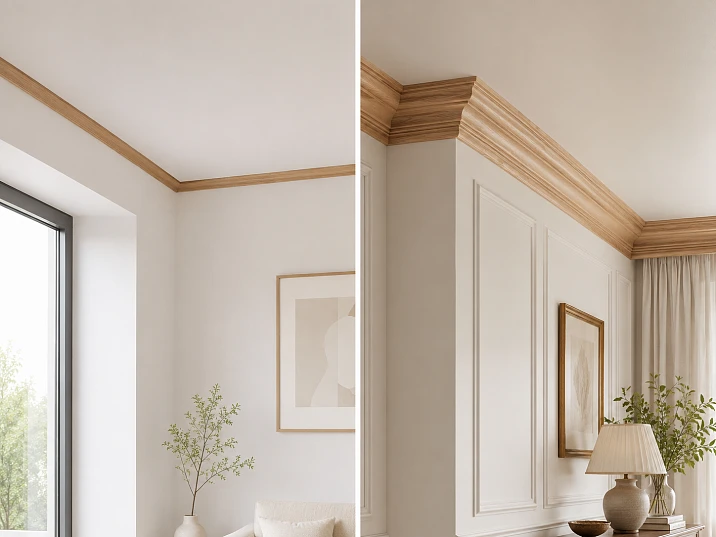
Comparison of two architectural profiles made of MDF, beech, and oak for ceilings of different scales
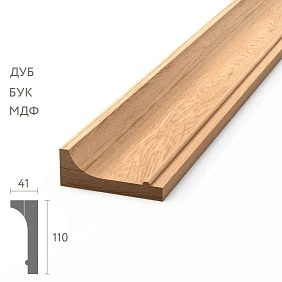
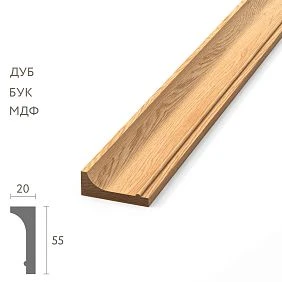
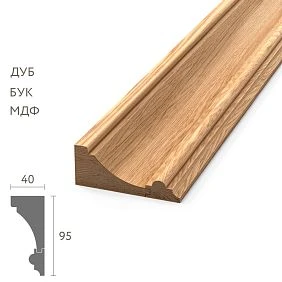
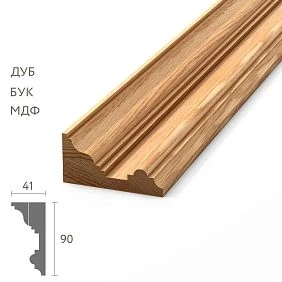
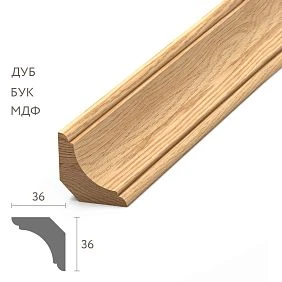
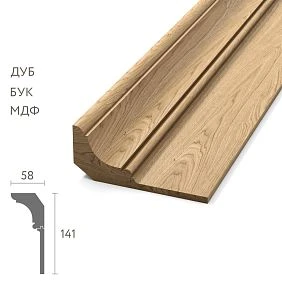
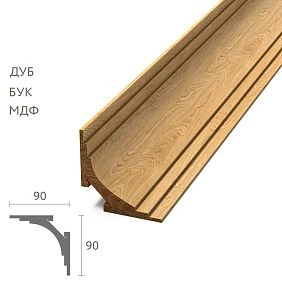
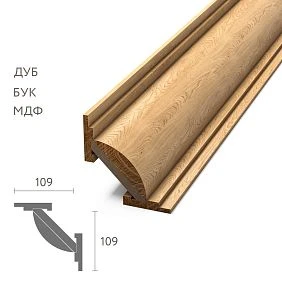
KZ-006 or KZ-008: which cornice to choose
Short answer: For a room with a standard ceiling, a calm modern interior, and a delicate top line, choose KZ-006. For the beech or oak version, the cross-section is 55 × 20 mm with a length of 2400 mm; for MDF, it is 55 × 22 mm with a length of 2600 mm. If the room is spacious, the ceiling is high, and a noticeable architectural profile is needed, KZ-008 is better suited: for MDF, the size is 90 × 44 × 2600 mm; for solid wood, it is 90 × 41 × 2400 mm.
Buy KZ-006 Buy KZ-008 View all wooden curtain rods
KZ-006 — compact top line. Suitable for apartments, bedrooms, studies, kitchens, hallways, and interiors where the curtain rod should not dominate.
KZ-008 — large architectural profile. Best showcased in a spacious living room, library, hall, or country house.
55 or 90 mm in height. The difference changes not only the size of the detail but also how much the top of the wall affects the room's proportions.
MDF and beech — for enamel. These options are chosen when the cornice should match the wall, ceiling, doors, or baseboard in opaque color.
Oak — for tinting. Suitable for interiors with visible wood texture, oak doors, furniture, and baseboards.
This is not a curtain rod. KZ-006 and KZ-008 are decorative ceiling profiles for finishing the wall-ceiling joint.
A wooden ceiling cornice is bought not only to cover the wall-ceiling junction line. The profile sets the upper boundary of the room, connects doors, baseboards, wall moldings, and furniture into one system, and noticeably changes the perception of height. Therefore, the difference between 55 and 90 mm is not a formality in the size table, but a choice of the entire interior's scale.
KZ-006 and KZ-008 solve the same architectural task but do it differently. KZ-006 forms a neat, assembled line and does not require a large room. It is especially suitable where walls and ceiling are painted in similar tones, and the upper part of the room should look finished but not heavy. KZ-008 is more noticeable: the 90 mm high profile creates a pronounced horizontal line, supports a high baseboard, large architraves, and classic furniture.
It is important for the buyer to consider not only the profile height but also the material. For KZ-006, MDF has dimensions of 55 × 22 × 2600 mm, while beech and oak are 55 × 20 × 2400 mm. For KZ-008, MDF is produced in size 90 × 44 × 2600 mm, and solid wood is 90 × 41 × 2400 mm. This means the plank length, profile depth, and number of joints depend on the chosen base.
For a small room and delicate wall finishing, you can buy a wooden cornice KZ-006For a spacious room and a noticeable top line — buy wooden cornice KZ-008If no section matches the room's proportions, it's better to open catalog of wooden ceiling cornices and compare other profiles.




What is a decorative ceiling cornice
A decorative ceiling cornice is an architectural molding profile that runs along the top edge of a wall. It covers the transition to the ceiling, creates shadow, sets the room's scale, and helps connect the top and bottom of the wall. Unlike a regular strip, it is chosen not only by length but also by height, projection, shape, material, and future finish.
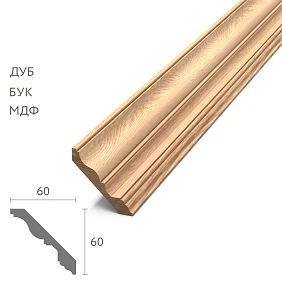
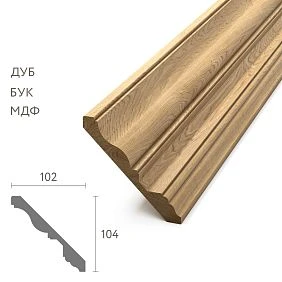
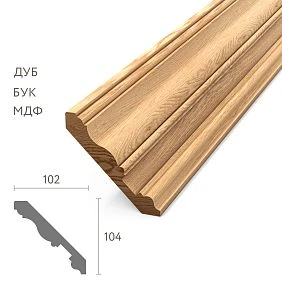
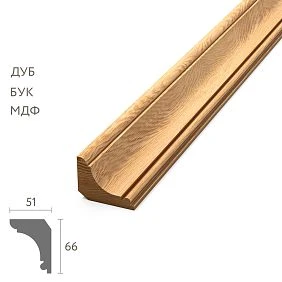
Our factory also produces:
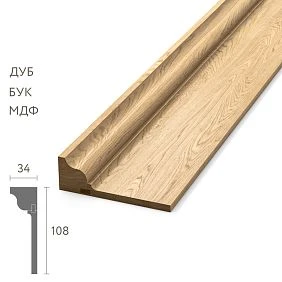
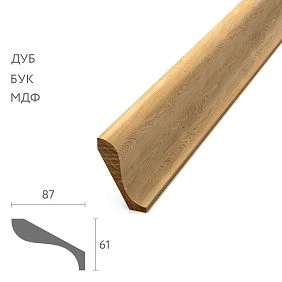
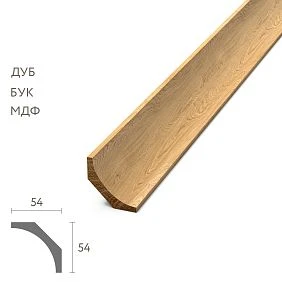
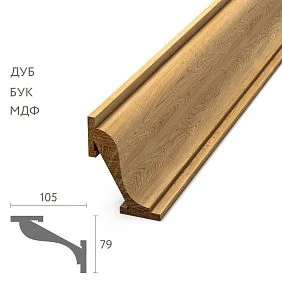
The cornice finishes the wall at the top
Without a top line, a painted wall can look cut off, especially if the interior has a high baseboard, trim, and moldings. The cornice brings these elements together into a unified system. KZ-006 does this subtly, KZ-008 — noticeably and architecturally.
Get Consultation
The cornice changes the perception of height
A small profile leaves more visual air and suits a standard-sized room. A large cornice creates a strong horizontal line and can make a high ceiling more proportionate to the furniture. In a low room, a too-wide profile can visually lower the upper boundary.
The cornice helps coordinate the finish
MDF or beech under enamel can be painted to match the ceiling, wall, baseboard, or door color. Tinted oak preserves the texture and extends natural wood around the entire perimeter. This choice is useful when the interior is built not on random details but on a single material system.
The cornice is not intended for curtains
KZ-006 and KZ-008 are not rods, tracks, or hidden niches for textiles. They do not carry curtains and do not replace a ceiling system for drapes. Their purpose is to decoratively finish the wall and create an architectural line under the ceiling.
Confirmed specifications of KZ-006 and KZ-008
| Parameter | KZ-006 | KZ-008 | What this means for the buyer |
|---|---|---|---|
| Product type | Compact decorative ceiling cornice | Large architectural ceiling cornice | The choice depends on the room's scale and the role of the top line. |
| MDF | 55 × 22 × 2600 mm | 90 × 44 × 2600 mm | Long strip for opaque enamel, fewer joints in a standard room. |
| Beech | 55 × 20 × 2400 mm | 90 × 41 × 2400 mm | Natural wood for opaque finish. |
| Oak | 55 × 20 × 2400 mm | 90 × 41 × 2400 mm | Textured option for tinting or semi-transparent finish. |
| Sanding quality | «Prestige» | «Prestige» | Profiles are prepared for further finishing with minimal manual touch-up. |
| Main effect | Delicate wall finish | Pronounced architectural horizontal line | KZ-006 is less noticeable, KZ-008 has a stronger impact on the interior. |
In current KZ-008 cards, the array has a depth of 41 mm, not 44 mm. The size 90 × 44 mm refers to the MDF version. This is important for precise trimming, joining, and calculating the profile offset from the wall. For KZ-006, the difference between MDF and array is 2 mm in depth.
How KZ-006 differs from KZ-008 in the finished interior
| Criterion | KZ-006 | KZ-008 |
|---|---|---|
| Profile height | 55 мм | 90 мм |
| Line character | Calm, compact, restrained | Expressive, architectural, noticeable |
| Room scale | Small and medium room | Spacious room, high ceiling |
| Combination with baseboard | Low or medium baseboard | Medium or high baseboard, large architraves |
| Modern interior | Fits easier | Requires sufficient space and support from other details |
| Classic interior | Restrained classic, neoclassical | Pronounced classic, library, study, hall |
| Risk of overloading the room | Below | Higher in a small room or with a low ceiling |
| Role in the composition | Completes the wall without conflicting with furniture | Becomes an independent architectural belt |
KZ-006 is easier to integrate into an already finished room. It requires less visual support and does not force you to change the baseboard, trim, or molding if they are restrained enough. KZ-008 is better planned as part of a unified system: the top line, bottom baseboard, doorways, and wall decor should have a comparable scale.
The height difference is 35 mm. In the catalog, this seems like a small number, but around the entire perimeter of the room, it turns into a noticeable band. That is why KZ-008 has a stronger impact on proportions and color scheme, while KZ-006 works as a delicate finish.
When to buy KZ-006 55 × 20–22 mm
KZ-006 is suitable for a buyer who needs a neat ceiling profile without heavy decoration. It covers the wall-to-ceiling transition, creates a clean line, and helps tie the interior together, but does not become the first element noticed when entering the room.
For a standard ceiling
In a room of standard height, a large profile can take up too noticeable a part of the wall. KZ-006, with a height of 55 mm, keeps the top line light. It is suitable for an apartment, bedroom, study, kitchen, hallway, and a room where the ceiling does not require visual "grounding."
If needed wooden cornice for a standard ceiling, first mark a 55 mm strip around the perimeter of one wall. Even such a compact profile is perceived differently in a room with dark finishes or a contrasting ceiling.
For a small room
In a small bedroom, study, or hallway, KZ-006 helps finish the walls without visually reducing them. The 20–22 mm projection creates a neat shadow but does not form a massive shelf under the ceiling. The profile looks especially calm in the color of the ceiling or wall.
If the room is narrow, it is important to check not only the height but also the number of lines. A high baseboard, wide trim, several moldings, and a large cornice can overload a small area. KZ-006 allows you to keep the decorative system assembled.
For modern interior
A simple profile suits modern classics, Scandinavian interiors, calm minimalism, and spaces with smooth walls. It can be painted white, gray, graphite, or another opaque color if MDF or beech under enamel is chosen.
In a modern interior, the cornice does not necessarily have to contrast. When painted together with the ceiling, the line looks softer. When it matches the wall, the ceiling is perceived as more free. The contrasting oak KZ-006, on the contrary, creates a subtle natural frame.
When the cornice should not be the main element
If the room already has expressive furniture, wall panels, a large headboard, a fireplace portal, or active wallpaper, a large KZ-008 can create competition. KZ-006 completes the top but leaves the main role to other objects.
For a study
In a small study, KZ-006 supports the door trims and baseboard without reducing the height. The oak profile can be tied to the desk and bookshelves, while the painted version can be tied to the walls or built-in furniture.
For the kitchen
In the kitchen, a compact profile is appropriate if the cabinets do not reach the ceiling and do not require a large architectural finish. Steam, humidity, the range hood, and proximity to upper cabinets must be considered. The material and coating are chosen based on the actual room conditions, and installation is performed on a prepared base.
For the bedroom
The bedroom often requires a calm top line. KZ-006 does not compete with the headboard, curtains, sconces, and textiles. If the walls and ceiling are painted in similar shades, the profile creates a soft finish. In oak, it can support a wooden bed and nightstands.
For the hallway and entryway
In a narrow passage space, a large cornice can enhance the feeling of tightness. KZ-006 is more suitable, especially with light finishes. The length of 2400 or 2600 mm helps calculate joints along short walls, but corners and doorways still need to be included in the scheme.
When KZ-006 will be too subtle
On a high wall, in a large living room or library, a 55 mm profile can get lost, especially next to a large baseboard and wide trim. If the top of the wall looks insufficiently expressive, it is worth comparing KZ-008 or another profile from the category.
When to buy KZ-008 90 × 41–44 mm
KZ-008 is chosen when the cornice should not just cover the joint, but become part of the room's architecture. The 90 mm height creates a strong horizontal line, connects large elements, and helps make a high wall more proportionate to people and furniture.
For a high ceiling
In a room with high ceilings, a compact profile can look like a random thin strip. KZ-008 forms a noticeable upper belt. It is especially appropriate if the doors are tall, the trim is wide, and the furniture is large-scale.
For such a task, you can buy wooden cornice KZ-008 and check it with a full-size template on the wall before ordering the entire perimeter.
For a spacious living room
In a large living room, KZ-008 helps to tie together long walls and support the furniture group. The profile is especially convincing if the room has a high baseboard, doors with wide trim, a fireplace portal, wall panels, or a library.
The cornice should not exist separately. If the other architectural details are very thin, KZ-008 can look heavy. In this case, either reduce the profile or strengthen the lower and vertical system.
For a study or library
A large cornice pairs well with tall bookcases, wood panels, and massive furniture. The oak KZ-008, tinted to match, creates a cohesive wood line. Painted MDF or beech can continue the color of built-in cabinets and doors.
For a country house
Spacious rooms in a country house often have high ceilings, wide openings, and large windows. KZ-008 helps balance these elements. In a living room, hall, or dining room, it can become part of a unified trim system made from the same wood species.
For a classic composition
A classic interior requires a clear hierarchy: baseboard finishes the wall at the bottom, architraves frame openings, moldings divide the plane, and the cornice closes the top. KZ-008 is suitable if the other details are wide enough and do not appear too thin next to it.
When a pronounced shadow is needed
A depth of 41–44 mm creates a more noticeable shadow at the wall-ceiling joint than the 20–22 mm of KZ-006. This enhances the relief and makes the top of the wall appear more voluminous. The effect is stronger on dark oak and calmer on white enamel.
For commercial spaces
In a corporate office, restaurant, hotel, salon, or showroom, a large profile helps give the room architectural completeness. It is important that the scale matches the height and area. In a small room, KZ-008 may look unconvincing or excessively heavy.
When KZ-008 will be too large
If the ceiling is low, the room is small, the baseboard is thin, and the doors are standard, a 90 mm profile can visually lower the top. In such a case, KZ-006 will provide a more precise finish without overloading.
How the width of a ceiling cornice affects the interior
The width of a ceiling cornice affects several things at once: how noticeable the wall boundary is, how the room height is perceived, how convincing the baseboard looks, and whether the architraves get lost. A 55 mm profile and a 90 mm profile cannot be considered simply two sizes of the same part. They create a different architectural scale.
Why 55 mm feels lighter
KZ-006 occupies a smaller part of the wall and forms a thin top line. It does not require high doors, massive furniture, or a large viewing distance. Even in a small room, the profile remains noticeable but does not turn the ceiling into a separate heavy belt.
If the cornice is painted the same color as the ceiling, 55 mm reads even more calmly. If it matches the wall color, the line becomes slightly more expressive due to the shadow. The oak version creates a noticeable natural outline, but thanks to its compact height, it does not overwhelm the room.
Why 90 mm becomes part of the architecture
KZ-008 can no longer be perceived as a neutral transition. Around the entire perimeter, it creates a wide belt and a noticeable shadow. Such a profile must be supported by other elements: a high baseboard, wide architraves, large doors, wall panels, or furniture of a corresponding scale.
If KZ-008 is painted in a contrasting color, attention to the top edge increases. If it matches the wall or ceiling, the profile remains voluminous but looks calmer. In oak with a tinted finish, it becomes an independent wooden frame for the room.
How to match the cornice with the door height
The door is one of the main scale references. The narrow KZ-006 easily combines with a standard opening and a restrained architrave. KZ-008 looks better next to a tall door, wide architrave, or portal design. If the cornice is noticeably more massive than the entire door system, the top of the wall begins to dominate.
How to account for the baseboard
The top and bottom of the wall do not have to be the same height, but should feel related. KZ-006 is usually paired with a low or medium baseboard. KZ-008 more easily supports a high profile at the bottom. For a precise solution, it is worth matching a wooden baseboard to the cornice in the same wood species or finish.
How to check the profile using a mockup
Cut a strip of cardboard 55 or 90 mm high and make a small fold corresponding to a depth of 20–22 or 41–44 mm. Apply the template to the joint of the wall and ceiling. Such a mockup shows the real shadow and helps to understand whether a large profile lowers the room.
It is useful to place the template next to the door and baseboard. If KZ-008 seems heavy only on an empty wall but becomes harmonious next to a large door, then the problem was not the size but the lack of a system. If it remains excessive, choose KZ-006.
How to account for color
A dark profile appears larger than a light one. KZ-008 in oak with a rich stain will be more noticeable than white KZ-008 under enamel. Therefore, it is advisable to paint the mockup at least approximately in the future color. The same size looks different on a light and dark wall.
How to account for wall pattern
On a wall with active wallpaper, panels, or frequent molding, a large cornice adds another strong line. KZ-006 helps complete the composition without excessive ornamentation. KZ-008 is appropriate if the other elements are specifically assembled into a classical architectural system.
The material on how to choose the height of a ceiling cornice. After checking the principles, you need to return to the specific comparison of KZ-006 and KZ-008.
MDF, beech or oak: which material to choose
Both models are available in three materials, but the choice affects length, depth, finish, and appearance. MDF and beech are intended for opaque enamel, oak for tinting. You cannot choose a material only by price or name: you need to understand what finish should be achieved around the entire perimeter.
MDF under enamel
For KZ-006, MDF has dimensions of 55 × 22 × 2600 mm, for KZ-008 — 90 × 44 × 2600 mm. The length of 2600 mm helps reduce the number of joints compared to the 2400 mm array. MDF provides a smooth base for opaque painting and is suitable for interiors where visible wood texture is not required.
MDF is chosen for white, gray, black, or colored enamel. It is especially convenient if the cornice should match the wall, ceiling, built-in furniture, or painted baseboard. The ends and cut areas need to be properly prepared so that the finish looks uniform.
For a compact room, you can buy an MDF cornice for enamelFor a large architectural line — choose MDF KZ-008 90 × 44 mm.
Beech for enamel
Beech is a natural wood with a calmer grain, often chosen for opaque finishes. KZ-006 in beech has dimensions of 55 × 20 × 2400 mm, KZ-008 — 90 × 41 × 2400 mm. This material is suitable for projects where solid wood is important, but the texture should not dominate.
Beech profiles can be painted to match the color of doors, furniture, or wall moldings. The surface requires proper primer and an even finish. If other beech parts are nearby, it is better to finish them in the same batch.
For a calm top line, you can choose a beech cornice for painting. For a larger classical composition — beech KZ-008.
Oak for tinting
Oak is chosen when a pronounced texture needs to be preserved. The profile becomes a noticeable part of the interior and ties in with oak doors, furniture, panels, and baseboards. KZ-006 in oak has dimensions of 55 × 20 × 2400 mm, KZ-008 — 90 × 41 × 2400 mm.
Light tinting makes oak calmer and suits modern classics. Dark tinting enhances architecturality and relief. On KZ-008, dark oak creates a particularly strong horizontal line, so it requires a spacious room. KZ-006 in the same material looks lighter.
For a small room, you can choose an oak ceiling cornice KZ-006. For a large study or living room — Oak ceiling cornice KZ-008.
Can materials be mixed
Technically, the upper cornice can be made of MDF and the baseboard of oak, but this decision must be deliberate. Under opaque enamel, different bases can be visually unified. Under a transparent finish, the differences will be noticeable. If the interior is based on natural wood, it is better to stick to one species.
What to choose for painting in the wall color
MDF or beech under enamel. MDF provides a length of 2600 mm and a smooth base, beech provides natural wood with a length of 2400 mm. The choice depends on the project, budget, required base, and the composition of other details. The color and gloss level are approved before installation.
What to choose for visible texture
Oak for tinting. It preserves the natural grain and makes the cornice part of the wooden architecture. To match the shade with doors or furniture, a test coating on the actual material is required.
To select the finish, you can open the section and buy materials for finishing the wooden cornice, but the specific system must be coordinated with the chosen base.
How to calculate the amount of cornice
The calculation starts from the finished perimeter, not the room area. You need to measure each wall along the installation line, exclude areas without a cornice, account for ledges, niches, columns, internal and external corners. Then the lengths are distributed across planks of 2400 or 2600 mm, considering joints and trimming.
Measure each wall separately
Don't limit yourself to the formula "length plus width times two" if the room has niches, bay windows, or ledges. Record each section and the direction of corners. This way, the installer can distribute the planks and avoid placing a short leftover in the most visible area.
Identify areas without a profile
The cornice may be interrupted by a built-in wardrobe up to the ceiling, a decorative panel, a fireplace portal, or another architectural element. These zones need to be decided before ordering. A random break in the profile looks unfinished.
Consider the material length
MDF KZ-006 and KZ-008 have a length of 2600 mm. Beech and oak — 2400 mm. For the same room, the number of planks may differ. You cannot calculate the total footage and divide it by an average length without selecting the material.
Distribute the joints
Joints are best placed in less noticeable areas, and several short fragments should not be gathered on the central wall. Corner cuts require additional length. The larger the profile, the more noticeable the mismatch of pattern and geometry at the connection.
Add a margin
A reserve is needed for corners, end cuts, possible defects during cutting, and repairs. The universal percentage depends on the room geometry and the installer's experience. For a simple rectangular room, it is smaller; for bay windows and a large number of corners, it is larger. The exact amount is determined after laying out the planks.
Order a spare plank
For complex finishing, it's useful to have an extra profile from the same batch. It will come in handy if you make a cutting error or for future repairs. This is especially important for oak intended for tinting, where a later purchase may differ in pattern.
Check delivery of long planks
Profiles of 2400 and 2600 mm require space for carrying in, storage, and finishing. Measure the elevator, stair turns, doors, and corridors. Do not cut the cornice before reaching the site just for transport if it will create unnecessary joints.
Installing a ceiling cornice: what to decide before finishing
Molding seems simple only until the first corner. On a real site, you need to join long planks, precisely cut internal and external corners, prepare the wall, choose the right mounting compound, decide the painting order, and avoid damaging the already finished ceiling. The larger the profile, the more noticeable any mistake.
The base must be level
The cornice follows the line of the wall and ceiling. If the junction is wavy, a long profile will not automatically hide the defect. It may emphasize gaps or require an excessive amount of compound. Before installation, check the flatness, angles, and cleanliness of the base.
Internal corners
Even in a rectangular room, the angle is rarely exactly 90 degrees. Cutting using a standard template may result in a gap. The craftsman measures the actual angle and makes a test joint. For KZ-008, the wide front part increases the visibility of any mismatch.
External corners
On protrusions, the profile is especially vulnerable. The joint must be precise, and the ends must be protected with finishing. If the external corner is in a walkway, consider the risk of accidental impact. KZ-006 protrudes less, KZ-008 requires more attention.
Longitudinal joints
The planks are joined on a straight section so that the line remains continuous. On painted MDF, the seam can be prepared for a common enamel. On oak under tinting, the joint and pattern difference are more noticeable, so the layout is done in advance and adjacent planks are selected.
Glue and mechanical fixation
The installation method depends on the material of the profile, wall, weight, and geometry. The mounting compound helps ensure contact, and additional fixation holds the part until strength is gained and secures a long profile. One scheme cannot be assigned for MDF, beech, and oak without checking the base.
Installation before or after painting
Part of the finishing is convenient to do before installation, especially on oak under tinting. But joints and corners may require touch-up after installation. With enamel, it is often more convenient to assemble the entire perimeter, prepare the connections, and then apply the finish in a single layer. The sequence is determined by the master based on the coating system.
Protection of ceiling and walls
If the finish surfaces are already ready, installation requires careful marking and protection. Glue, putty, and enamel should not get on the ceiling or wallpaper. It is easier to plan the cornice before the final painting of the wall than to repair damage afterward.
Temperature and humidity
Wood and MDF must be in conditions suitable for interior finishing. Before installation, the products are kept in the room according to the manufacturer's recommendations and the chosen system. Long profiles should not be installed immediately after cold delivery or in a damp room.
Why KZ-008 is more difficult to cut
The height of 90 mm and depth of 41–44 mm increase the joint area and make errors more noticeable. The profile must be securely held during cutting, and the tool must be guided without chipping. KZ-006 is more compact and easier for a small room, but also requires precise geometry.
How KZ-006 and KZ-008 work in different rooms
Living room
In a small living room, KZ-006 finishes the walls and leaves the main role to furniture, a lamp, or a fireplace area. In a spacious room, KZ-008 helps connect long walls, tall doors, and large baseboards. The choice depends not on the room's name, but on its actual scale.
Bedroom
KZ-006 suits a calm interior where the main focus is on the headboard, textiles, and lighting. KZ-008 is appropriate in a large bedroom with a high wall, large bed, and architectural decor. If the ceiling is standard, a wide profile can make the room feel lower.
Cabinet
A small study benefits from the compact KZ-006. A library with tall cabinets and wooden panels may require KZ-008. An oak profile connects the top of the wall with furniture, while a painted one continues the color of built-in cabinets.
Kitchen
If upper cabinets don't reach the ceiling, KZ-006 creates a neat line and doesn't conflict with the fronts. KZ-008 suits a spacious kitchen-living room with tall cabinets, columns, and large doorways. Humidity conditions and finish must be considered separately.
Entryway and Corridor
In a narrow hallway, KZ-006 is often chosen. It doesn't create a heavy belt and pairs more easily with standard doors. KZ-008 is possible in a spacious hall with a high ceiling, wide portals, and noticeable baseboards.
Children's room
The compact KZ-006 is easier to fit into a calm children's room, especially if the walls are painted in a light color. The large KZ-008 is only appropriate in a spacious room and within an overall architectural concept. The cornice should not visually overwhelm small furniture.
Country house
In rooms of standard scale, KZ-006 remains rational. In a living room with a double-height ceiling, tall openings, or a large staircase area, KZ-008 helps unify the space. The material can be coordinated with doors, stairs, and furniture.
Hotel, restaurant, or salon
KZ-008 works well in a representative interior with high ceilings and long walls. KZ-006 suits small rooms, offices, hallways, and areas where a neat trim without architectural heaviness is needed. For commercial spaces, maintainability and material stock are especially important.
What to buy with a ceiling cornice
One cornice rarely creates a complete system. The top of the wall should match the baseboard, door trims, moldings, and finishing. If these elements are chosen separately and without a common scale, even a high-quality profile looks random.
For KZ-006, a more restrained lower belt is usually suitable. For KZ-008, you can choose a baseboard in the same finish as the ceiling cornice and check if it is expressive enough. Materials for painting, tinting, and installation should be selected in the section materials for painting MDF and beech.
| What to add to the purchase | Why this is needed | For which scenario | What to Check |
|---|---|---|---|
| Compact ceiling cornice 55 × 20 mm | Creates a delicate top line without overload | Apartment, bedroom, study, kitchen, hallway | Material, length 2400 or 2600 mm, depth 20 or 22 mm |
| Wide ceiling cornice 90 × 44 mm | Forms a noticeable architectural horizontal line | High living room, library, hall, country house | MDF 90 × 44, solid wood 90 × 41 mm, door and baseboard scale |
| Wooden baseboard for cornice | Connects the upper and lower boundaries of the wall | Any interior with a unified trim system | Height, material, color, thickness and scale of architraves |
| Materials for finishing wooden cornice | Allow painting MDF and beech or tinting oak | Self-finishing or workshop work | Compatibility of primer, enamel, oil or tint with the base |
| Installation compound and fasteners | Provide contact with the wall and hold the long profile | Both models, especially the large KZ-008 | Wall material, weight, geometry, installation conditions |
| Additional strip | Provides allowance for trimming, corners and future repairs | Complex geometry, oak for tinting, commercial project | The same model, material, length and batch |
How not to confuse a decorative cornice with similar products
Ceiling cornice and curtain rod
A curtain rod carries textiles and has a bar, profile, or track. KZ-006 and KZ-008 are fixed along the top edge of the wall and serve a decorative architectural function. They are not intended for hanging curtains.
Cornice and molding
Molding is typically used on the wall surface for frames, panels, and decorative lines. A ceiling cornice finishes the wall at the top and forms a transition to the ceiling. One profile cannot be automatically replaced by another just because of a similar pattern.
Cornice and baseboard
A baseboard covers the lower edge of the wall and the junction with the floor. A cornice works at the top. Their dimensions must be
You need to neatly close the joint between the wall and the ceiling
Start with KZ-006. The height of 55 mm and depth of 20–22 mm allow for a finish without a large decorative band. MDF under enamel is convenient if the profile will be painted together with the ceiling or wall. Beech is suitable for a solid wood project under an opaque finish, oak for a natural wood system.
You need to make a high ceiling more proportionate
Consider KZ-008. The 90 mm profile forms a noticeable horizontal line and visually connects the top of the wall with the furniture. But do not choose it just because of the room height: compare the size with doors, architraves, baseboards, and wall moldings.
You need to design a small bedroom
KZ-006 is often more suitable. It does not conflict with the headboard, curtains, and sconces. For a light, calm interior, you can choose MDF or beech under enamel. If the bedroom has natural oak furniture, a compact oak profile will create a subtle wooden frame.
You need to assemble a classic living room
KZ-008 is suitable if the room is spacious, doors and baseboards have sufficient scale, and wall panels do not look thin. If the living room is medium-sized and classic restrained, KZ-006 may be more harmonious. A full-size pattern resolves the debate better than an abstract rule.
Need to design a library or study
Built-in cabinets up to the ceiling, wide architraves, and wooden panels support KZ-008. If the study is small and furniture is compact, choose KZ-006. An oak profile is tied to furniture by tinting, a painted one to facades and walls.
Need to select a cornice for an already installed baseboard
Measure the height and projection of the baseboard, look at the width of door architraves. A low restrained bottom usually pairs better with KZ-006. A high baseboard and large openings can support KZ-008. There is no exact rule of "same height top and bottom" — overall scale matters.
Need to paint the profile in the ceiling color
MDF or beech under enamel are more suitable. KZ-006 almost dissolves and creates a soft shadow. KZ-008 retains volume even in the same color as the ceiling, so it remains architectural. Before ordering, choose the gloss level: matte and glossy finishes highlight the profile differently.
Need to preserve natural oak
Choose oak for tinting. For a small room — KZ-006, for a spacious one — KZ-008. Immediately select baseboards and other wooden elements, make a test stain, and order the required volume in one batch.
Need to reduce the number of joints
MDF 2600 mm long may be more advantageous than solid wood 2400 mm long in terms of layout. However, the material is chosen not just for the extra 200 mm. If natural oak is needed, it cannot be replaced with MDF merely to reduce the number of joints. It is better to optimize the cutting.
Need to decorate a room with a complex shape
With many corners, KZ-006 is easier in terms of scale and trimming. KZ-008 requires more precise connections and a larger margin. Create a diagram of all walls, mark internal and external corners, then distribute the planks by length.
Need to update the interior without a full renovation
The cornice can be added to an already painted room, but the surface will need to be checked and prepared. KZ-006 is easier to integrate into an existing system. KZ-008 may require replacing the baseboard or reinforcing other architectural lines to avoid looking out of place.
Need to decorate a commercial property
In small offices, corridors, and rooms, KZ-006 is practical. In a hall, restaurant, executive office, or large salon, KZ-008 creates more noticeable architecture. Order an extra plank for future repairs and save the finish code.
Mistakes when buying a ceiling cornice
Choosing only by photo
In a large image, KZ-006 and KZ-008 may look similar. In a room, the difference between 55 and 90 mm is obvious. Make full-size templates and apply them to the actual ceiling.
Ignoring the difference between MDF and solid wood
The buyer calculates all options as 2600 mm, although beech and oak have a length of 2400 mm. Or considers KZ-008 to be the same depth, although MDF has 44 mm, solid wood has 41 mm. This leads to errors in quantity and joints.
Buying KZ-008 for a small room
The profile is chosen for its expressiveness, but after installation the ceiling seems lower, and the doors and baseboard look too thin. If other elements don't support 90 mm, better go with KZ-006.
Buying KZ-006 for a large tall wall
A compact line gets lost, and the interior remains unfinished. Adding many small moldings doesn't always fix the scale. First compare KZ-008.
Mixing materials without a unified finish
Oak cornice, beech baseboard, and MDF casings look disjointed under a clear finish. Under enamel they can be unified, but primer and preparation must account for each substrate.
Calculating only by perimeter
The buyer divides the total footage by the plank length and doesn't account for corners, niches, joints, and unusable short leftovers. A layout for each wall is needed, not just the final meter count.
Lack of a spare plank
If a cut is wrong, you have to buy a profile from a different batch. On oak, the grain may differ; on painted options, the shade may change after re-mixing the enamel. A spare reduces this risk.
Installation on an uneven wall
A long cornice emphasizes waves and gaps. Trying to fill everything with glue creates an unstable line. The base needs to be leveled or an acceptable technology must be determined in advance.
Random placement of the joint
The joint falls in the center of the main wall or near a light fixture, where it is clearly visible. The layout of the planks is done before cutting, not during installation.
Waiting for the finished color
The phrases "for enamel" and "for tinting" describe material preparation, not necessarily the finished coating. The color and finish need to be checked in the product card and included in the estimate.
Attempting to use a profile as a curtain cornice
KZ-006 and KZ-008 are not designed for hanging textiles. A separate system is needed for curtains. The decorative profile can only conceal or accompany it according to a specially designed project.
Inconsistency with the baseboard
A large KZ-008 and a very thin baseboard create a heavy top. A compact KZ-006 next to a massive lower band may get lost. The top and bottom need to be compared on the same wall.
Painting before checking the corners
After the finished finish, it turns out that the corners require adjustment. The cut damages the enamel or tinting. It is better to do a trial assembly and only then complete the finishing according to the master's technology.
Who is KZ-006 suitable for
- for an apartment and a room with a standard ceiling;
- for a bedroom, small study, kitchen, hallway, or children's room;
- for a modern, Scandinavian, and restrained classic interior;
- when the cornice should complete the wall but not dominate;
- for combination with a low or medium baseboard;
- for MDF or beech under opaque enamel;
- for oak under a calm natural tint;
- for a room where a 90 mm profile looks too large.
Who is KZ-008 suitable for
- for a spacious living room, library, study, hall, or country house;
- for high ceilings and long walls;
- for classical, neoclassical, and architectural compositions;
- when a noticeable horizontal line is needed;
- for pairing with a high baseboard and wide architraves;
- for MDF or beech under enamel;
- for an oak interior with visible texture;
- for a project where a large profile is planned in advance.
When it's better to choose a different profile
- neither 55 nor 90 mm match the scale of the room;
- need a shaped, more classic or, conversely, a completely flat cornice;
- the profile should solve a furniture task, not a ceiling one;
- a curtain system is required;
- the wall material does not allow reliable installation without preparation;
- the selected depth interferes with built-in furniture or engineering elements;
- the length of the planks creates too many joints in a complex room;
- the buyer needs a finished finish that is not confirmed by the selected card.
How to prepare an order without unnecessary rework
A good order for a ceiling cornice starts not with the number of planks, but with a short specification. It specifies the model, material, length, finish, walls by sections, number of corners and the estimated allowance. Such a list helps to avoid mixing MDF and solid wood, depth errors, and accidental placement of joints.
Record the model and material
For KZ-006, record: MDF 55 × 22 × 2600 mm or beech or oak 55 × 20 × 2400 mm. For KZ-008: MDF 90 × 44 × 2600 mm or beech or oak 90 × 41 × 2400 mm. This eliminates the error of using dimensions from different options in the same estimate.
Attach the room plan
The plan must show all walls, niches, ledges, door portals, and areas without a cornice. Each segment is numbered. The length and intended plank are indicated next to it. Such a document helps the master distribute joints and leftovers.
Determine the finish in advance
For MDF and beech, record the enamel code and gloss level. For oak, the tinting or semi-transparent finish system. If the baseboard and trim already exist, attach a sample. The same color on a screen does not replace a physical swatch.
Check the delivery route
Planks 2400 and 2600 mm long must fit through the entrance, elevator, staircase, and doors. If delivery is impossible, the layout plan should be revised in advance. Unauthorized cutting before delivery increases the number of joints and can ruin the central walls.
Keep the leftover and batch data
After installation, it is useful to keep a suitable fragment for repairs. You can also preserve a finish sample on it. Record the model, material, and color. In a few years, this information will help select a replacement more accurately.
How light and color change the perception of the cornice
The same profile looks different in the morning, evening, and under artificial light. KZ-006 creates a short soft shadow, while KZ-008 creates a deeper and more noticeable one. Therefore, the final choice should be checked not only by size but also by how the top of the wall is lit.
Side lighting emphasizes the relief
If there is a window nearby, light passes along the profile and shows all joints, corners, and unevenness. On KZ-008 this effect is stronger due to greater depth. Precise trimming and surface preparation become especially important. KZ-006 is less visually demanding, but the long line must still remain straight.
Top lighting enhances the horizontal
Lights directed at the ceiling make the cornice more noticeable. White KZ-008 can look voluminous even without a contrasting color. If the interior should remain calm, KZ-006 is safer. If architectural depth is needed, the large profile reveals itself better.
Dark color increases visual weight
Oak with dark tinting or a cornice with graphite enamel appears larger than a light one. Therefore, KZ-008 in a dark color requires a particularly spacious room. KZ-006 allows using contrasting finishes without the feeling of a heavy ceiling belt.
Light color does not negate size
White enamel makes the profile calmer, but KZ-008 remains 90 mm high. You cannot expect that a light color will completely hide a large cross-section. The mockup must replicate not only the height but also the depth, otherwise the shadow will be underestimated.
Care, repair, and storage of spare profile
After installation, the cornice does not require complex daily maintenance, but dust gradually accumulates on the top horizontal and in corners. The surface is cleaned with a soft dry or slightly damp cloth compatible with the coating. Abrasives and excess water are not used, especially on oak with a transparent finish.
How to remove dust without damage
For painted profiles, a soft cloth or brush is suitable. Do not leave wet marks on oak. If the cornice is located high, use a stable ladder and do not lean on the profile with your hand.
How to fix local damage
A small chip or scratch is repaired using the same system that was used to finish the cornice. For enamel, preserve the color code and gloss level; for oak, a tinting sample. Before applying the compound to a visible area, test it on a leftover piece.
Why store a spare plank
In case of serious damage to a section, it is easier to replace the fragment with the same profile and material. A spare from the same batch is especially important for oak: the pattern and shade of a later purchase may differ. Store the plank horizontally, in a dry room, and protected from impacts.
What to record after completing the work
Save the article number, material, size, quantity, enamel code, or tinting recipe. This data will be useful for repairs, redevelopment, or adding a cornice to an adjacent room. Such a small archive eliminates the need for repeated selection after several years.
How to buy KZ-006 or KZ-008 on STAVROS
First, choose the scale. For a room of standard height and a calm interior, open the KZ-006 card. For a spacious room and a pronounced horizontal line, choose KZ-008. Then select the material, because the depth and length of the plank depend on it.
If the decision hasn't been made yet, you can buy a wooden cornice go through the general category and compare other profiles. The general principles of assignment are explained in the material about how to choose a wooden cornice for the interior.
A buyer leaning towards a large model would benefit from reading the material about KZ-008 separately — wooden cornice as an architectural horizontal. It helps to understand the role of the 90 mm profile, but the final choice should still be compared with KZ-006 on a full-size template.
Before ordering, check the current price, availability, selected material, size, sanding quality, and finishing conditions in the product card. If the room has complex corners, built-in furniture, or a non-standard ceiling, provide the manager with a plan and photos. This helps clarify the quantity, but the final layout and installation should be checked by a specialist on site.
FAQ: questions about KZ-006 and KZ-008
Which cornice is better for a standard ceiling?
Usually KZ-006. The 55 mm height creates a neat top line and is less likely to visually lower the ceiling.
Which cornice to choose for a high ceiling?
KZ-008, if the room is spacious and the profile is supported by doors, baseboards, and furniture. The fact of a high ceiling itself does not negate checking the overall scale.
How do the sizes of KZ-006 in MDF and solid wood differ?
MDF has dimensions 55 × 22 × 2600 mm, beech and oak — 55 × 20 × 2400 mm.
How do the sizes of KZ-008 in MDF and solid wood differ?
MDF — 90 × 44 × 2600 mm, beech and oak — 90 × 41 × 2400 mm.
Why is KZ-008 often listed as 90 × 44 mm in the name?
This is the size of the MDF version. For beech and oak variants, the actual depth is 41 mm. Before ordering, you need to check the specific configuration.
Can KZ-006 be used in a classic interior?
Yes. It suits restrained classic and neoclassical styles, especially in a standard-scale room. For a more formal composition, compare KZ-008.
Is KZ-008 suitable for a modern interior?
Yes, if the room is spacious and the large horizontal line is part of the design. In a small room, the profile may look heavy.
What to choose for white enamel?
MDF or beech under enamel. MDF is produced in lengths of 2600 mm, beech — 2400 mm. The choice depends on the desired base and other details.
What should I choose for natural tinting?
Oak. It retains a pronounced texture and pairs well with oak doors, furniture, and baseboards.
Can an MDF cornice be combined with a wooden baseboard?
Yes, especially under opaque enamel. But the dimensions, color, and gloss level need to be coordinated. Under a transparent finish, the materials will differ.
How to calculate the number of planks?
Measure each section along the installation line, account for corners and allowance, then distribute the lengths across planks of 2400 or 2600 mm. Simply dividing the total perimeter is not enough.
Is it necessary to buy an additional plank?
For complex geometry, oak tinting, and a commercial project, this is reasonable. The reserve helps with cutting errors and future repairs.
Can KZ-006 or KZ-008 be used for curtains?
No. These are decorative ceiling profiles, not load-bearing cornices for textiles.
Which is more difficult to install?
KZ-008. The 90 mm height and large depth make corners and joints more noticeable. KZ-006 is more compact, but also requires precise cutting.
Do I need to paint the cornice before installation?
It depends on the system. Some finishing can be done in advance, but joints and corners often require a final finish after assembly. The sequence is determined by the craftsman.
How to choose a cornice to match the baseboard?
Compare the height, projection, material, and color on the same wall. KZ-006 is easier to combine with a low baseboard, KZ-008 with a larger lower profile.
How to check if KZ-008 will be too large?
Make a template 90 mm high and 41–44 mm deep, hold it under the ceiling next to the door and baseboard. Evaluate the room from the usual entry point.
Which profile is better for a narrow hallway?
More often KZ-006. It creates a finish without a heavy top belt. KZ-008 is only suitable for a spacious hall.
Where can I see other sizes?
In the category you can view all STAVROS cornices and compare shape, material, and length.
What should you check right before payment?
SKU, material, cross-section, length, quantity, allowance, sanding quality, future finish, current price, and availability. For a complex project, additionally check angles and joint scheme.
Result: KZ-006 for a delicate line, KZ-008 for architectural scale
KZ-006 and KZ-008 cannot be chosen only by external pattern. Compact KZ-006 with a height of 55 mm is suitable for a standard-sized room, bedroom, study, kitchen, and corridor. It neatly finishes the wall and does not require a massive system of baseboards and architraves.
KZ-008 with a height of 90 mm creates a pronounced horizontal line and is better revealed in a spacious living room, library, hall, or country house. It must be coordinated with a high baseboard, large openings, and furniture. In a small room, such a profile can visually lower the ceiling.
Material affects exact dimensions. For KZ-006 MDF — 55 × 22 × 2600 mm, solid wood — 55 × 20 × 2400 mm. For KZ-008 MDF — 90 × 44 × 2600 mm, solid wood — 90 × 41 × 2400 mm. MDF and beech are chosen for enamel, oak for tinting.
Before ordering, make a full-size template, calculate each wall, determine joints, and coordinate the cornice with the baseboard. On the STAVROS website you can buy narrow wooden cornice KZ-006 or buy large wooden cornice KZ-008. A conscious choice of profile helps to achieve a cohesive architecture without random mismatches in size, material, and finish.